 by Tom Gurney
Tom Gurney BSc (Hons) is an art history expert with over 20 years experience
Published on June 19, 2020 / Updated on October 14, 2023
Email: tomgurney1@gmail.com / Phone: +44 7429 011000
The Love Letter (Le Billet Doux) by John William Godward: Introduction
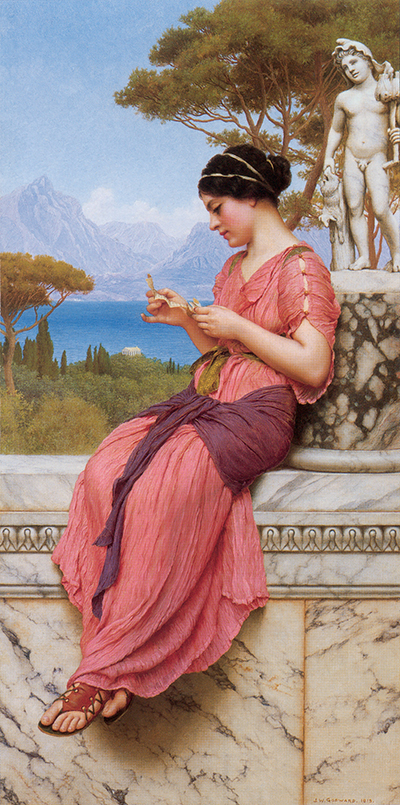
A woman in a rose-pink dress sits on a marble terrace, looking down at a small note held between her hands. Behind her, a marble figure stands among trees and the blue water runs towards a wall of distant mountains. John William Godward painted this tall oil on canvas in 1913 under the title Le Billet Doux, which can be translated as The Love Letter or The Love Note. The canvas measures 80 × 39.8 cm. Godward also painted a separate The Love Letter in 1907. That earlier work has a circular painted field and shows a woman with a stylus and a wax tablet. [1] [2] [3] [4]
At a Glance
- Date1913
- MediumOil on canvas
- Dimensions80 × 39.8 cm
This work across John William Godward’s career
The Engagement Ring
c. 1891 [6]The Betrothed
1892 [7]Far Away Thoughts
1892 [8]Contents
- A small note in a tall picture
- Godward in Rome
- The circular Love Letter of 1907
- A tablet, a stylus and an ink pen
- Other messages in Godward’s paintings
- Annotated details
A small note in a tall picture
The woman sits beside a statue’s pedestal at the right of the terrace. Her feet hang over the front of the marble, one sandal passing beneath the other. The hem gathers around her ankles and a plum-coloured wrap falls in a long fold from her lap. These downward lines make the little lift of her hands conspicuous. The hands meet just left of her body, where the dark trees and intense blue of the water give the paler fingers and the edges of the note a clear outline. One hand lifts a narrow end of the note while the other supports it closer to her chest. In a painting tall enough to show her whole body, the action occupies an area barely wider than her face. [1] [3]
The French title helps explain why Godward made the object so small. A billet is a short written message. A billet doux is a note between lovers. A tiny, partly opened slip suits the name. At the scale of the reproduction, we can see the note’s shape and the way the woman handles it, while the words remain private. Her lowered eyes give the impression of reading, though her fingers may still be opening or straightening the note. Her shoulders are settled and there is very little movement in her face. The painting gives time to an ordinary action that a more eventful scene might take for granted. [1] [2] [3]
The terrace is open to an extensive view. Below the level of the woman’s hands, the water forms a narrow blue band, wider at the left and cut off on the right by her body. The distant slopes are pale enough to merge into the air near the horizon. In the foreground the colours are denser, from the pink cloth and the green and yellow at her waist to the dark pattern on the statue’s pedestal. The marble in front of the terrace has broader veins. Its polished surface catches the shadow of her skirt and feet, placing her forward of the bench. The contrast between the near stone and the distant mountains makes the setting feel spacious while her gaze keeps bringing us back to the note. [1] [3]
The sculpture above her shoulder gives that quiet occupation a second point of attention. Its pale head inclines towards the left, in roughly the same direction as hers. It stands, while her weight sits heavily on the bench. The bowed heads connect two figures with different poses and materials, across a gap in which there is room for branches and dark hair. The proximity of the statue to a scene of courtship invites an association with classical love imagery. The reproduction gives a clearer account of the figure’s pose and its place in the design than of any particular antique model for it. [1] [3]
Godward in Rome
The painting dates to the period when Godward was working in Rome. In its catalogue for the signed and dated Cleonice (1913), Christie’s records a move to Rome in 1912 and a studio at the Villa Strohl-Fern. The catalogue draws attention to the pink dress and green sash in Cleonice and compares the costume with those in Absence Makes the Heart Grow Fonder (1912) and Le Billet Doux. In Cleonice, the head and shoulders occupy most of the painting. In Le Billet Doux, Godward can follow the costume down the full length of the body. The pale clips on the sleeve, folds across the lap and gathered fabric near the sandals register differently because we see how the clothes hang and how the figure sits. The resemblance between the clothes gives us a firmer basis for comparison than the identity of the sitter or the site of the terrace. [1] [10]
The Art Renewal Center records Le Billet Doux in the collection of Edward B. Frankel, M.D. Michael Allan Kodysz reproduces it in his study of Godward’s classical subjects, citing colour plate 81 on page 103 of Vern Grosvenor Swanson’s catalogue of the artist’s work. Kodysz compares Godward’s thoughtful recipient with pensive women in Renaissance religious imagery. In his reading, a message from an absent lover takes the place of news from an angel. The implied event is the arrival of a message, and Godward leaves the sender and any messenger outside the picture. The only visible consequence is the woman’s absorbed attention. [1] [3]
Annotated Details from The Love Letter (Le Billet Doux)
The numbered points identify visible features discussed in this article. Return from each detail to the numbered overview. John William Godward, The Love Letter (1913). Image source. Public domain.
.jpg)
Details from THE LOVE LETTER (LE BILLET DOUX)
Compare the cropped details with the source images above. Notice how their colours, shapes and positions contribute to the larger compositions.
The folded note
The light edge of the paper shows between the hands against blue water and dark trees.
 Detail 01 the-folded-note.jpg)
Two lowered heads
The carved figure and the woman angle their heads in the same direction at different heights.
 Detail 02 two-lowered-heads.jpg)
Feet below the carved band
The woman’s crossed sandals interrupt the lines of the marble below the bench.
 Detail 03 feet-below-the-carved-band.jpg)
John William Godward videos
See Godward’s paintings and studio practice alongside films on two Victorian contemporaries.
John William Godward - Part 1: The Last Painter of the Victorian Age
An overview of Godward’s career and the Victorian market for pictures set in antiquity.
Watch on YouTubeThe circular Love Letter of 1907
The other painting is an oil on canvas signed and dated 1907 at the lower centre, catalogued as lot 51 by Sotheby’s in 2009. The catalogue gives dimensions of 94.9 × 93.9 cm for the work within its circular painted field. The woman wears a blue-green garment with red bands and sits against panels of veined marble. We see her from the head down to her knees, where the curve cuts through her drapery. On the left her right hand holds a slender stylus, its lower tip close to her skirt. Her other hand hangs beside the seat and holds the edge of a rectangular tablet. Its plain reddish surface is partly cut off by the lower edge of the circle. The circle visible in the catalogue reproduction describes the painted field. The canvas perimeter beyond it is outside the available view. [4]
Her gaze runs past the stylus towards the left of the picture. The pale centre panel makes the line from her forehead to her chin especially clear, and her hair casts a shadow onto the marble behind her. Gold-coloured bands stand out against her dark hair, and pale fastenings trace the edges of the thin sleeves. The near arm and the long red end of the sash lead down towards the lower curve. They take the eye past the tablet, which occupies comparatively little of the painted surface. In the 1913 picture, the head, hands and note meet near the middle. In the 1907 picture, the profile, stylus and tablet sit far enough apart for the viewer to discover them in turn. [1] [4]
Sotheby’s describes the wax tablet as blank and reads the pose as the moment before she writes a romantic message. The stylus hangs over the cloth and her gaze falls elsewhere. She could be thinking of what to say, turning over something she has already read, or simply looking away for a moment. The objects support the idea of writing. The title supplies the possible subject, and the painted gesture stops before any words can be made out. [4]
The 2009 catalogue places the circular painting with London dealer Thomas McLean on 26 July 1907. It records its appearance as lot 39 at Sotheby’s Belgravia on 1 October 1979, bought by Owen Edgar Gallery, and as no. 4 in the gallery’s 1980 exhibition A Victorian Collection. The exhibition ran from 8 May to 27 June, with the picture illustrated on pages 10–11 of the catalogue. Sotheby’s then lists the Maas Gallery and the owner who acquired it there before the 2009 sale. It identifies the 1907 painting as no. 9 for that year in Swanson’s catalogue, with colour plate 64. Simon Parkes Art Conservation reported in 2009 that the canvas was unlined, the paint layer was stable and clean, and the background had four or five tiny areas of retouching. These are records for the circle with the tablet. The tall terrace painting is the work reproduced as Swanson’s colour plate 81. [3] [4]
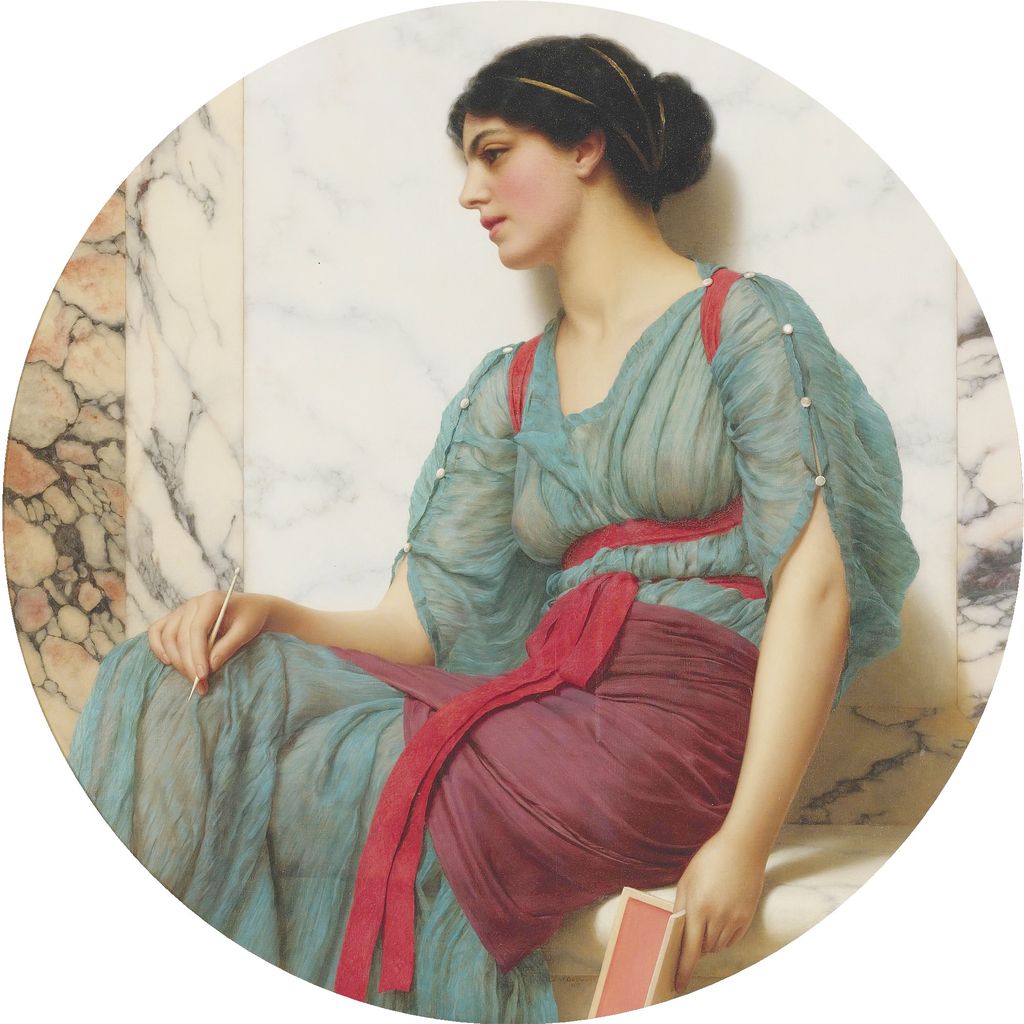
John William Godward, The Love Letter (1907). The 1907 circle has its own pose and painted field. Image source. Public domain.
A tablet, a stylus and an ink pen
Ancient writing equipment helps explain why a plain tablet could be ready for use. A bronze stylus in the Metropolitan Museum of Art, dated to the fourth to first century BCE and made in Cyprus, has a point at one end and a flat edge at the other. A writer could scratch letters into the wax with the point and level it again with the flattened end. The wooden panels recovered from the Roman excavations at Bloomberg London preserve shallow recesses for the wax. At Vindolanda, a tablet was found with an address scratched on the outer wood and a subsequent letter written on the wax inside. The archaeologists photographed the wax before it dissolved during conservation. The technology makes an unwritten tablet and an erased one equally imaginable in Godward’s painting. [11] [12] [13]
The Met’s Roman terracotta inkwell of the first or second century CE was found with a bronze implement. The online collection calls it a stylus, while the museum’s educational catalogue describes the same object as an ink pen. The catalogue distinguishes wax tablets incised with a pointed tool from surfaces written on in ink, including thin sheets of wood and papyrus. Godward reduces the scene to a woman and the two objects the 2009 Sotheby’s catalogue identifies as a stylus and wax tablet. [4] [13] [14]
An ancient painting gives a closer comparison for the posture. The small Pompeian portrait traditionally called Saffo at the Museo Archeologico Nazionale di Napoli shows a woman holding a set of four wax tablets and bringing a stylus to her lips. The museum reads the gesture as the hesitation that precedes writing. In the Pompeian portrait the stylus points to the face and the tablets are held high. In Godward’s circle both implements have dropped below the shoulders, leaving the profile to sustain the pause. The comparison helps explain how a painter can make the preparation for writing visible with a tool and a still figure. [4] [15]
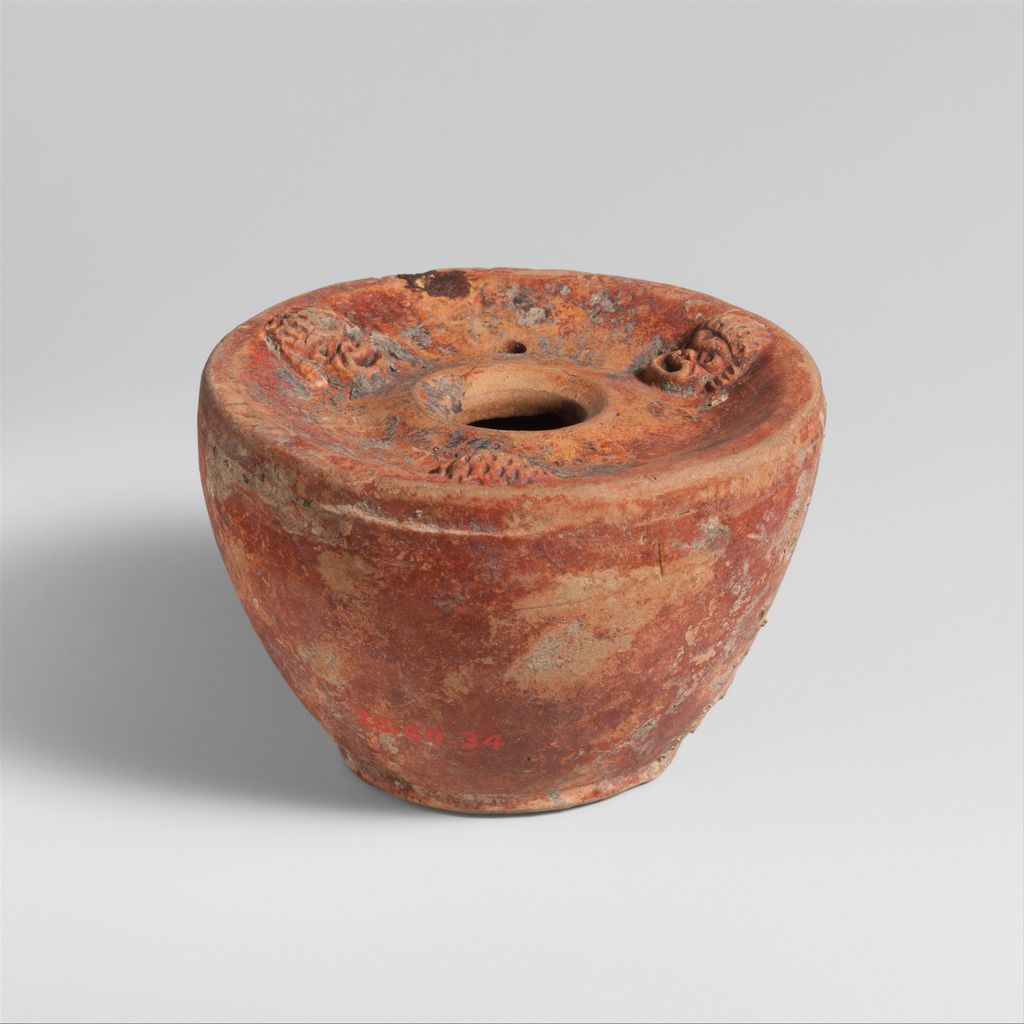
Terracotta inkwell and bronze stylus, first to second century CE, The Met. The surviving objects give scale and material to a different way of producing the words that Godward leaves unseen. The Metropolitan Museum of Art. Image source. CC0 / Public domain.
Other messages in Godward’s paintings
The signed 1899 The Letter (A Classical Maiden) shows a woman in red leaning across a stone surface. Two open leaves of a tablet lie in front of her with a slender implement across them. She turns her head to the right. The tablet is close to the viewer, just above the bottom edge. In the 1907 circle, Godward moves the two objects apart by putting one in each hand. The catalogue history of the 1899 picture is as distinctive as its composition. It was sold in 1969 as a work by Alma-Tadema and in 2011 as from Godward’s circle. Sotheby’s catalogued it under Godward’s name in 2016 with Swanson’s confirmation of the attribution and identified it provisionally with the entry for The Letter in his 1997 catalogue. [4] [16]
The earlier paintings also show how much the story changes when Godward puts a second person within reach. In the signed 1889 Waiting for an Answer, a man watches the woman beside him while her attention rests on a palm frond. Her answer hangs on the difference between their gazes. The signed 1888 version of The Engagement Ring has a scroll near a seated woman’s feet and a doorway beyond her. The auction catalogue reads the scroll as a declaration of intent, giving the viewer a possible event to imagine before the scene we see. In Le Billet Doux, everything the viewer learns about the exchange comes from a little note in the woman’s hands. The open view across the water makes the smallness of what she is looking at more striking. [1] [5] [17]
John William Godward artworks directory
Search documented oil paintings, drawings, watercolours and reproductive prints. The directory includes the Art Renewal Center’s catalogue and additional works in museum, exhibition and sale records.
| Name | Date | Medium |
|---|---|---|
| Absence Makes the Heart Grow Fonder | 1912 | Oil on canvas |
| Amaryllis | 1903 | Oil on canvas |
| An Amateur | 1915 | Oil on canvas |
| Ancient Pastimes | 1916 | Oil on canvas |
| The Answer | 1917 | Oil on canvas |
| An Arcadian Beauty | 1899 | Painting |
| At the Fountain | 1893 | Oil on canvas |
| At the Garden Door | 1901 | Oil on canvas |
| At the Garden Shrine, Pompeii | 1892 | Oil on canvas |
| At the Gate of the Temple | 1898 | Oil on canvas |
| At the Thermae | 1909 | Oil on canvas |
| Atalanta | 1892 | Oil on canvas |
| Athenais | 1908 | Oil on canvas |
| An Auburn Beauty | 1895 | Oil on canvas |
| Autumn | 1900 | Oil on canvas |
| Beauty in a Marble Room | 1894 | Oil on canvas |
| The Belvedere | 1913 | Oil on canvas |
| The Betrothed | 1892 | Oil on canvas |
| The Betrothed (print after Godward) | 1893 | Photoengraving, as reported |
| The Bouquet | 1899 | Oil on canvas |
| Briseis | 1896 | Painting |
| The Broken Vase | 1889 | Oil on canvas |
| By the Blue Ionian Sea | 1916 | Oil on canvas |
| By the Wayside | 1912 | Oil on canvas |
| Byrsina | 1915 | Painting |
| Campaspe | 1896 | Oil on canvas |
| Campaspe (print after Godward) | Print, process unconfirmed | |
| Chloris (A Summer Rose) | 1902 | Oil on canvas |
| Classical Beauty | Oil on canvas | |
| A Classical Beauty | Oil on canvas | |
| A Classical Beauty | Painting | |
| A Classical Beauty | Oil on canvas | |
| A Classical Beauty | 1909 | Oil on canvas |
| A Classical Beauty In Profile | Oil on canvas | |
| A Classical Lady | 1908 | Oil on canvas |
| Clymene | 1892 | Oil on canvas |
| A Congenial Task | 1915 | Oil on canvas |
| Contemplation | 1922 | Oil on canvas |
| A Cool Retreat | 1910 | Oil on canvas |
| Country House in the 18th Century | c. 1883 | Oil on canvas |
| Cytheris | 1922 | Painting |
| The Day Dream | 1920 | Oil on canvas |
| The Delphic Oracle | 1899 | Oil on canvas |
| A Dilettante | 1922 | Oil on canvas |
| Distant Thoughts | 1918 | Oil on canvas |
| Dolce Far Niente | 1897 | Oil on canvas |
| Dolce Far Niente | 1906 | Oil on canvas |
| Dolce far niente (A Pompeian Fishpond) | 1904 | Oil on canvas |
| Dolce far niente (coloured print after Godward) | Exhibited 1900 | Coloured print, exact process unconfirmed |
| Dolce far niente (grapes) | 1907 | Oil on canvas |
| Dora | 1887 | Oil on canvas |
| Drusilla | 1906 | Oil on canvas |
| An Edition de Luxe | 1920 | Oil on canvas |
| Eighty and Eighteen | 1898 | Oil on canvas |
| Endymion | 1893 | Oil on canvas |
| The Engagement Ring (horizontal composition) | 1888 | Oil on canvas |
| The Engagement Ring (upright composition) | c. 1891 | Oil on canvas |
| Erato at Her Lyre | Oil on canvas | |
| A Fair Reflection | 1915 | Oil on canvas |
| A Fair Reflection (Taber-Prang print) | By 1923 | Sepia artotype |
| Far Away Thoughts (circular sewing scene) | 1911 | Oil on canvas |
| Far Away Thoughts (left-facing profile) | 1892 | Oil on canvas |
| Far Away Thoughts (right-facing profile) | 1892 | Oil on canvas |
| Female Figure (probable Grecian Idyll study) | 1907 | Oil on board |
| Flabellifera | 1905 | Oil on canvas |
| Flabellifera (painted study) | c. 1905 | Oil study |
| Flabellifera (pencil study) | c. 1905 | Pencil on paper |
| The Flower Girl | Painting | |
| A Flower Seller | 1896 | Oil on canvas |
| The Flowers of Venus | 1890 | Oil on canvas |
| A Fond Farewell | 1918 | Watercolour |
| The Fragrant Rose | 1892 | Painting |
| The Fruit Vendor | 1917 | Oil on canvas |
| A Garland Seller | 1914 | Painting |
| Giotto Drawing from Nature | Painting | |
| Girl in Yellow Drapery | 1901 | Oil on canvas |
| Golden Hours | 1913 | Oil on canvas |
| A Grecian Girl | 1908 | Oil on canvas |
| Grecian Idyll | 1907 | Oil on canvas |
| A Grecian Lovely | 1909 | Oil on canvas |
| Grecian Reverie | 1889 | Oil on canvas |
| Grecian Reverie | 1889 | Oil on canvas |
| A Greek Beauty | 1905 | Oil on canvas |
| A Happy Awakening | 1903 | Oil on canvas |
| He Loves Me, He Loves Me Not | 1896 | Oil on canvas |
| A head and shoulders profile portrait of a young woman wearing a white tunic style blouse | c. 1889 | Painting |
| Head of a Girl (The Priestess) | 1896 | Oil on canvas |
| Heart on her Lips and Soul within her Eyes | 1904 | Painting |
| His Birthday Gift | 1889 | Oil on canvas |
| Ianthe | 1889 | Oil on canvas |
| An Idle Hour | 1890 | Oil on canvas |
| Idle Moments | 1895 | Oil on canvas |
| Idle Thoughts | 1898 | Oil on canvas |
| Idleness | 1900 | Oil on canvas |
| Il Dolce Far Niente (Pears print after Amaryllis) | 1906 | Chromolithograph |
| Il Dolce far niente (seated figure) | 1893 | Oil on canvas |
| In Expectation | c. 1892 | Oil on canvas |
| In Realms of Fancy | 1911 | Oil on canvas |
| In the Prime of the Summertime (Reverie) | 1914 | Oil on canvas |
| In the Tepidarium | 1913 | Oil on canvas |
| Innocent Amusements | 1891 | Oil on canvas |
| Ione | c. 1896-1898 | Oil on canvas |
| Ionian Dancing Girl | 1902 | Oil on canvas |
| Ismenia | 1908 | Oil on canvas |
| An Italian Beauty | 1897 | Oil on canvas |
| An Italian Girls' Head | 1902 | Oil on canvas |
| The Jewel Casket | 1900 | Oil on canvas |
| Julia | 1914 | Painting |
| Knuckle Bones | 1890 | Oil on canvas |
| La Pensierosa | 1913 | Oil on canvas |
| A Lady | 1895 | Oil on canvas |
| Landscape: Blossoming Red Almond [study] | c. 1912 | Oil on panel |
| Le Billet Doux (The Love Letter) | 1913 | Oil on canvas |
| Leaning Against a Column | 1901 | Painting |
| Leaning on the Balcony | 1892 | Oil on canvas |
| Leisure Hours | 1905 | Oil on canvas |
| Lesbia with her Sparrow | 1916 | Oil on canvas |
| The Letter | 1899 | Painting |
| Liegende | 1893 | Oil on canvas |
| A Lily Pond | 1917 | Oil on canvas |
| Looking Out to Sea | 1918 | Pencil and watercolour |
| The Love Letter (circular composition) | 1907 | Oil on canvas |
| Lucilia | 1917 | Oil on canvas |
| Lycinna | 1918 | Oil on canvas |
| Marcella | 1912 | Painting |
| Matrona Superba | Oil on canvas | |
| Megilla | 1921 | Oil on canvas |
| A Melody | 1904 | Oil on canvas |
| Memories | c. 1891 | Oil on canvas |
| Mirinna | Painting | |
| The Mirror | 1899 | Oil on canvas |
| Mischief | 1905 | Oil on canvas |
| Mischief and Repose | 1895 | Oil on canvas |
| A Mouse in the Work Basket | 1893 | Oil on canvas |
| Nerissa | 1906 | Oil on canvas |
| The New Perfume | 1914 | Oil on canvas |
| Noon Day Rest | 1910 | Oil on canvas |
| Nu Sur La Plage | 1922 | Oil on panel |
| Nude Study | Oil on canvas | |
| An Offering to Venus | 1912 | Oil on canvas |
| The Old, Old Story | Oil on canvas | |
| The Old, Old Story | 1903 | Oil on canvas |
| On the Balcony | 1911 | Oil on canvas |
| On The Terrace | 1918 | Oil on canvas |
| Ophelia | Oil on panel | |
| The Peacock Fan | 1912 | Oil on canvas |
| Phyleis | 1908 | Oil on canvas |
| The Playground | 1892 | Oil on canvas |
| Playtime | 1891 | Oil on canvas |
| A Pompeian Bath | 1890 | Oil on canvas |
| A Pompeian Lady | 1891 | Oil on canvas |
| A Pompeian Lady | 1895 | Oil on board |
| A Pompeian Lady | 1901 | Painting |
| A Pompeian Lady | 1904 | Painting |
| Portrait of Mary Frederica 'Nin' Godward | c. 1882-1883 | Oil on canvas |
| Portrait of Mary Perkinton Godward | c. 1880-1881 | Watercolor |
| The Posy | 1900 | Painting |
| A Priestess (bare-shouldered figure) | 1893 | Oil on canvas |
| A Priestess (clothed composition) | 1894 | Oil on canvas |
| A Priestess (W. Biscombe Gardner after Godward) | Exhibited 1897 | Print, process unconfirmed |
| A Priestess of Bacchus | 1890-1890 | Oil on canvas |
| Pyrallis | 1918 | Oil on canvas |
| The Quiet Pet | 1906 | Oil on canvas |
| A Red, Red Rose | 1920 | Oil on canvas |
| Reflections | 1893 | Oil on canvas |
| The Rendezvous | 1903 | Oil on canvas |
| Repose, the Flower Girl | c. 1887 | Oil on canvas |
| Reverie | 1888 | Oil on panel |
| Reverie | 1912 | Oil on canvas |
| Reverie (In the Days of Sappho) | 1904 | Oil on canvas |
| Reverie (Pears print after In the Prime of the Summertime) | 1916 | Chromolithograph |
| 'Rich Gifts Wax Poor When Lovers Prove Unkind' | 1916 | Oil on canvas |
| The Ring | 1898 | Oil on canvas |
| A Roman Matron | 1905 | Oil on canvas |
| Sabinella | 1912 | Oil on canvas |
| Sappho | 1910 | Oil on canvas |
| The Siesta | Oil on canvas | |
| A Siesta | 1895 | Oil on canvas |
| The Signal | 1899 | Oil on canvas |
| Sitting for Her Portrait | 1893 | Oil on canvas |
| Sketch for Amaryllis | 1903 | Oil on board |
| A Souvenir | 1920 | Oil on canvas |
| Stesicrate | 1914 | Oil on canvas |
| Study for 'Rêverie' | 1890 | Oil on canvas |
| Study for 'The Priestess' | 1895 | Oil on board |
| Study for An Egyptian Minstrel | 1906 | Painting |
| Study for The New Perfume | Drawing, medium unconfirmed | |
| Study for ‘The Old, Old Story’ | 1903 | Oil paint on wood |
| Study of a Girl's Head | 1899 | Painting |
| Study of Campaspe | Oil on canvas | |
| Study of Head and Drapery, Miss Ethel Warwick | 1898 | Painting |
| Summer Day | 1897 | Painting |
| Summer Flowers | 1903 | Oil on canvas |
| Sweet Dreams | 1901 | Oil on canvas |
| Sweet Dreams | 1904 | Painting |
| The Sweet Siesta of a Summer's Day | 1891 | Oil on canvas |
| The Tambourine Girl (profile at the marble wall) | 1906 | Oil on canvas |
| The Tambourine Girl (relief-backed version) | 1906 | Oil on canvas |
| Tender Thoughts | 1917 | Oil on canvas |
| Tender Thoughts (woman leaning over a parapet) | 1918 | Pencil and watercolour |
| The Tiff (oil) | By 1888 | Oil on canvas |
| The Tiff (print after Godward) | 1894 | Photogravure |
| The Tigerskin | 1889 | Oil on canvas |
| The Time of Roses | 1916 | Oil on canvas |
| Tranquillity | 1914 | Oil on canvas |
| A Tryst | 1912 | Oil on canvas |
| Tympanistria | 1909 | Oil on canvas |
| Under the Blossom that Hangs on the Bough | 1917 | Oil on canvas |
| Venus at the Bath | 1901 | Oil on canvas |
| Venus Binding Her Hair | 1897 | Oil on canvas |
| Violets, Sweet Violets | 1906 | Painting |
| Waiting for an Answer | 1889 | Oil on canvas |
| Waiting for the Procession | 1890 | Oil on canvas |
| Waiting for the Procession | 1890 | Painting |
| The Water Carrier (magazine reproduction of At the Fountain) | 1898 | Magazine reproduction |
| When the Heart is Young | 1902 | Oil on canvas |
| Who Can They Be | Painting | |
| Winding Wool | 1894 | Painting |
| 'With Violets Wreathed and Robe of Saffron Hue' | 1902 | Oil on canvas |
| The Yellow Shawl | 1893 | Painting |
| 'Yes or No?' | 1893 | Oil on canvas |
| Young Girl Picking Grapes | 1902 | Oil on canvas |
| Youth and Time | 1901 | Oil on canvas |
Frequently Asked Questions
The upright picture is the 1913 Le Billet Doux. Godward’s 1907 The Love Letter uses a circular painted field and is a separate canvas.
Discussion
Look again at the images and ideas explored in The Love Letter (Le Billet Doux) by John William Godward. These editorial prompts invite your observations.
Reader Insights
What do the reader’s hands tell you about the size and weight of the note?
How does the upright format change the scene compared with the 1907 circle?
Join the Conversation
Share a detail, comparison or question about The Love Letter (Le Billet Doux) by John William Godward below.
References
- Art Renewal Center. Le Billet Doux, artwork 11128 (English). Reproduction, date, medium, dimensions and historic collection credit. View source.
- Académie française. “Billet,” Dictionnaire de l’Académie française, ninth edition (French). The definition distinguishes the short written message and the note exchanged by lovers. View source.
- Michael Allan Kodysz. The Classical-Genre Paintings of John William Godward: From Archaeology to Archetypes, University of Manchester master’s dissertation, 2007, restored digital edition, pp. xv, 52 and 112, fig. 55 (English). Reproduces the 1913 canvas, credits Edward B. Frankel, M.D., and cites Vern Grosvenor Swanson, John William Godward: The Eclipse of Classicism (1997), p. 103, colour pl. 81. View source.
- Sotheby’s. The Love Letter, 19th Century European Art, lot 51, 2009 (English). Exact 1907 work, with plate, inscription, provenance, exhibition history, conservation note and reference to Swanson, pp. 85–86, 219 and 273, colour pl. 64. View source.
- Sotheby’s. Waiting for an Answer, lot 163, 2007 (English). Image and signature dated 1889. View source.
- The Engagement Ring. View source.
- The Betrothed. View source.
- Far Away Thoughts. View source.
- Mischief and Repose. View source.
- Christie’s. Cleonice, lot 4928740 (English). Signed and dated Roman-period painting, with a catalogue note on the 1913 Le Billet Doux, the 1912 Absence Makes the Heart Grow Fonder and Godward’s move to Rome. View source.
- The Metropolitan Museum of Art. Bronze stylus, accession 74.51.5495 (English). Cypriot example with a pointed writing end and flattened erasing end. View source.
- Roger S. O. Tomlin. “The tablets: their form and epigraphy,” Roman Inscriptions of Britain (English). Archaeological account of timber, wax, inscriptions and the Vindolanda letter tablet. View source.
- The Metropolitan Museum of Art. Roman Art: A Resource for Educators, pp. 171–172, nos. 36–39 (English). Ancient materials for writing in wax and ink and discussion of the bronze pen recovered with the Roman inkwell. View source.
- The Metropolitan Museum of Art. Terracotta inkwell and bronze stylus, accession 26.60.34 and Bronze stylus, accession 26.60.35 (English). Museum records of the inkwell and associated bronze implement. View source 1. View source 2.
- Museo Archeologico Nazionale di Napoli. Saffo, inventory 9084, on Google Arts & Culture (Italian). Pompeian painting, dated 55–79 CE, and museum interpretation of the stylus and wax tablets. View source.
- Sotheby’s. The Letter (A Classical Maiden), lot 24, 2016 (English). Exact image, signature, date, earlier sale attributions and Swanson reference. View source.
- Sotheby’s. The Engagement Ring, lot 36, 2023 (English). Illustration and discussion of the signed 1888 canvas and its scroll. View source.