 by Tom Gurney
Tom Gurney BSc (Hons) is an art history expert with over 20 years experience
Published on June 19, 2020 / Updated on October 14, 2023
Email: tomgurney1@gmail.com / Phone: +44 7429 011000
Sappho: Introduction
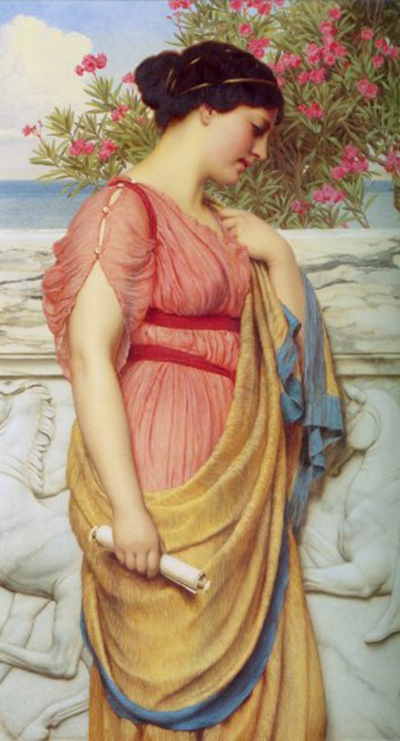
A woman lowers her head beside a marble parapet, a tightly rolled scroll hanging from one hand. Pink flowers crowd in behind her, and a strip of blue sea is visible above the stone. The Art Renewal Center catalogues John William Godward’s Sappho as a 1910 oil on canvas. The dimensions and present whereabouts of the painting are unconfirmed. The title evokes Sappho, the ancient Greek lyric poet of Lesbos. Godward gives her the setting and costume of an imagined antiquity, with a single object that suggests what this woman might be known for. [1] [2]
At a Glance
- Date1910 in the Art Renewal Center catalogue
- MediumOil on canvas
This work across John William Godward’s career
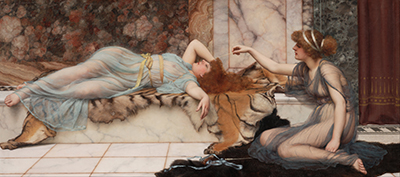
Far Away Thoughts
1892 [3]Noon Day Rest
1910 [4]Sappho (current article)
1910, catalogued date [1]A Fair Reflection
1915 [6]Contents
- The woman with the scroll
- A poet with a book roll in ancient art
- Two paintings beside Godward’s Sappho
- The words available to Godward’s readers
The woman with the scroll
In the upper half of the painting, the woman’s features make a clean edge against the leaves. Her dark hair is gathered into a knot, held by a slender gold-coloured band that catches the light in short stretches. Follow the profile down past the nose and mouth and the angle of her neck becomes apparent. Her eyes are lowered, and the hand nearest her face rises to gather the wrap at her collarbone. The other arm extends almost the length of the exposed tunic. It ends in a small, firm grip, with the pale roll projecting on either side of her fingers. [1]
Near the shoulder, small fastenings interrupt the edge of the rose tunic and leave the upper arm bare. Two red bands cross the waist, where the thin folds are drawn close to the body. Below, the yellow wrap hangs in much broader curves. Its blue lining appears first in broken folds near the raised hand, then in a continuous sweep across the bottom. Just above that sweep, the white edge of the scroll stands out against the yellow. [1]
The landscape is visible in intervals. At the left, a bright cloud stands over a level horizon. At the right, little openings between the leaves and the stone allow that stretch of blue to continue behind the shrub. The parapet’s upper edge cuts across the vertical picture at about shoulder height. Lower down, portions of horses in relief emerge from behind the drapery, their movement interrupted by the figure in front of them. Their bent legs are carried on the surface of the stone while the warm colour of the woman’s arm and the shading around her fingers give her a presence in front of it. [1]
Her lowered gaze is easy to associate with the scroll, which is held too far down for her to read and remains coiled. Godward gives the sense of inward attention through the tilt of the head and the two small, independent actions of her hands. In The Love Letter, the written object belongs to the exchange suggested by the title. Here the name of a poet makes the roll an attribute, a thing through which the viewer can recognise the subject. The image leaves the particular words and the woman’s thoughts to the imagination. [1]
A poet with a book roll in ancient art
An ancient Athenian vessel gives us another version of Sappho with a scroll. The red-figure hydria, a water jar now in the National Archaeological Museum in Athens, was made around 440–430 BC, well after the poet’s lifetime. Her name appears beside the seated reader. Three women stand around her, with a wreath held above her on one side and a lyre offered on the other. J. M. Edmonds studied enlarged photographs for his 1922 article on the vase. He noted that the painted reader’s fingers interrupt the lines on the roll, an observation that shows how carefully the vase painter made the writing part of an action. The vase had already been illustrated before Edmonds’s study. There is no documented link between it and Godward’s painting. [8] [9]
On the jar, the open roll belongs to an encounter among several people. The figures around Sappho make it possible to imagine the words being heard or the reading turning to music. Godward removes that company from view. The sculpted figures behind his Sappho belong to the parapet, and the only other signs of movement come from the branching leaves and the sweep of the cloth. Where the vase painter shows the roll held open, Godward gives its unbroken white surface almost the character of another piece of costume. [1] [8]
John William Godward videos
See Godward’s paintings and studio practice alongside films on two Victorian contemporaries.
John William Godward - Part 1: The Last Painter of the Victorian Age
An overview of Godward’s career and the Victorian market for pictures set in antiquity.
Watch on YouTubeTwo paintings beside Godward’s Sappho
In Lawrence Alma-Tadema’s Sappho and Alcaeus, an 1881 oil on panel in the Walters Art Museum, the two poets attend a performance on Lesbos. Alcaeus plays a kithara, a stringed instrument, and Sappho leans forward among the listeners. The museum traces the scene to a passage by the Greek poet Hermesianax preserved by Athenaeus. Alma-Tadema based the marble seats on those in the Theatre of Dionysos in Athens and adapted the inscriptions to the women in the scene. The rows of benches bring the listeners into the picture one behind another, and the gap between them and Alcaeus gives us room to imagine the sound carrying across. [10]
Godward’s own Reverie, also called In the Days of Sappho, is a separate oil on canvas in the J. Paul Getty Museum. The painter’s signature and 1904 date appear at lower left, and the unframed canvas measures 58.4 by 73.7 centimetres. A label on the back also records the title Reverie. Its seated woman occupies a broad marble bench that terminates in a carved head the Getty tentatively associates with Homer. There, the sculpture and the alternate title supply much of the literary suggestion. In the upright Sappho, the pale roll is small enough to fit within the silhouette of the wrap, and Godward lets both ends of it show. [1] [11]
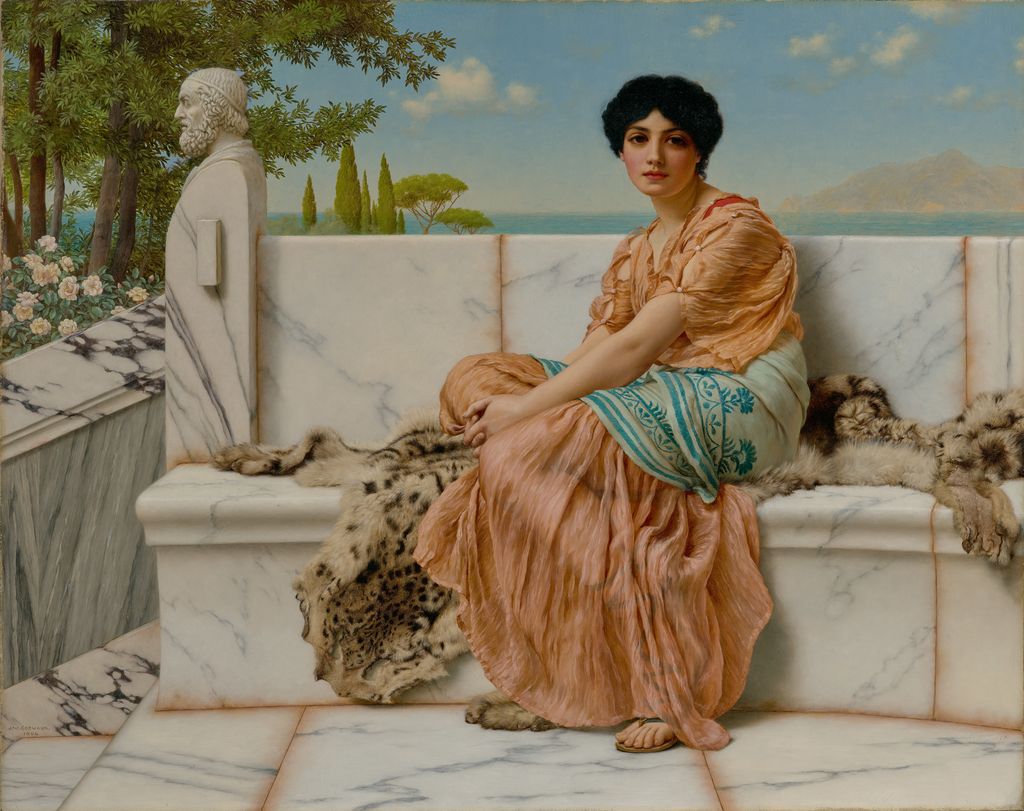
John William Godward, Reverie (1904). Godward’s separate 1904 Reverie shows a seated figure on a long marble bench. J. Paul Getty Museum. Image source. CC0 / Public domain.
The words available to Godward’s readers
The University of Bristol’s critical edition project explains that the ancient edition of Sappho’s poetry probably ran to nine books. Much of what survives comes from quotations in other authors and from papyrus fragments. Henry Thornton Wharton’s English edition, reissued in 1908, shows what a reader could find close to the time Godward painted Sappho. It prints the Greek text, Wharton’s prose translation and versions by other translators. In the poem now known as Fragment 1, the speaker asks Aphrodite for help in love. She remembers a visit from the goddess, who addresses her by name and promises a reversal. The one who flees will pursue, and the one who refuses gifts will offer them. Wharton’s prose keeps the beloved female. An earlier verse translation he reproduces, by Ambrose Philips, turns the beloved into a young man. The two versions show how much a reader’s impression of the ancient poet could depend on the English words chosen for her. [2] [12]
Wharton’s readers also saw a particular image of the poet before reaching the Greek. The book opens with an engraved medallion by J. Cother Webb. Wharton explains that Webb took Sappho’s head from Alma-Tadema’s painting, reducing the large gathering at the theatre to the figure’s profile and headdress. A reader met that image beside a book that prints her poems. A gallery visitor looking at Godward’s standing Sappho saw a whole figure with a book roll, whose words the paint leaves hidden. [1] [10] [12]
The ancient papyrus fragments held by the University of Cologne show what it takes for such words to reach us. The university dates the surviving pieces of the roll, inventory numbers 21351 and 21376, to the third century BC. Michael Gronewald and Robert W. Daniel first published the material in 2004. Part of its text overlaps with a papyrus from Oxyrhynchus that was published in 1922. As the classicist Anton Bierl explains, the Cologne fragments helped restore a poem about growing old. They also reopened the question of where it ends, because the two copies part ways after the story of Eos and Tithonus. Both publications came after Godward painted Sappho. His young woman holds a roll that looks smooth, intact and closed. On the surviving papyrus, the words are exposed, along with the torn edges and gaps that leave editors weighing where even a whole poem begins or ends. [1] [13] [14]
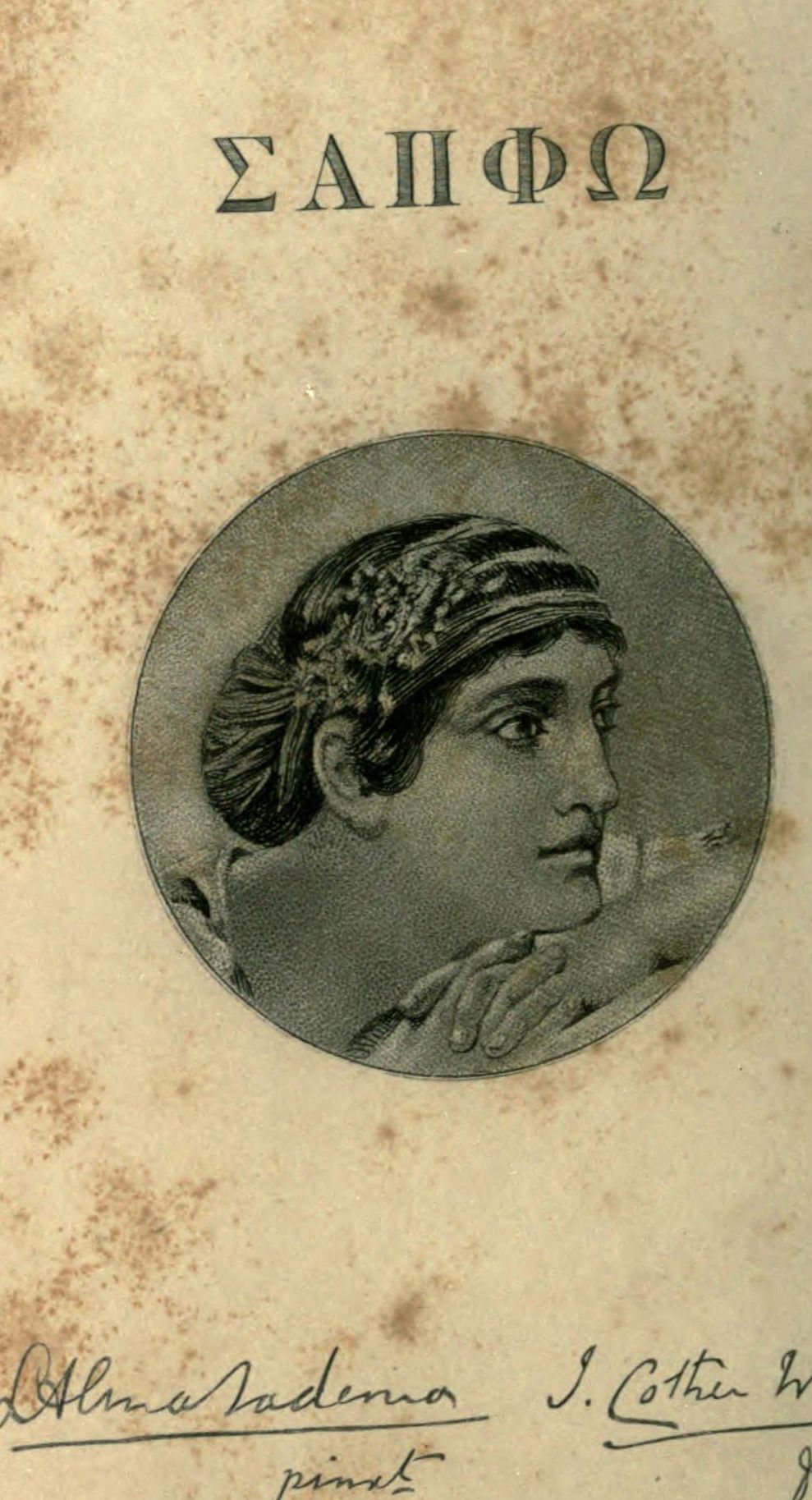
John Cother Webb after Lawrence Alma-Tadema, Sappho. The frontispiece in this 1907 New York edition isolates the face from Alma-Tadema’s painting. University of California Libraries copy. Image source. Public domain.
John William Godward artworks directory
Search documented oil paintings, drawings, watercolours and reproductive prints. The directory includes the Art Renewal Center’s catalogue and additional works in museum, exhibition and sale records.
| Name | Date | Medium |
|---|---|---|
| Absence Makes the Heart Grow Fonder | 1912 | Oil on canvas |
| Amaryllis | 1903 | Oil on canvas |
| An Amateur | 1915 | Oil on canvas |
| Ancient Pastimes | 1916 | Oil on canvas |
| The Answer | 1917 | Oil on canvas |
| An Arcadian Beauty | 1899 | Painting |
| At the Fountain | 1893 | Oil on canvas |
| At the Garden Door | 1901 | Oil on canvas |
| At the Garden Shrine, Pompeii | 1892 | Oil on canvas |
| At the Gate of the Temple | 1898 | Oil on canvas |
| At the Thermae | 1909 | Oil on canvas |
| Atalanta | 1892 | Oil on canvas |
| Athenais | 1908 | Oil on canvas |
| An Auburn Beauty | 1895 | Oil on canvas |
| Autumn | 1900 | Oil on canvas |
| Beauty in a Marble Room | 1894 | Oil on canvas |
| The Belvedere | 1913 | Oil on canvas |
| The Betrothed | 1892 | Oil on canvas |
| The Betrothed (print after Godward) | 1893 | Photoengraving, as reported |
| The Bouquet | 1899 | Oil on canvas |
| Briseis | 1896 | Painting |
| The Broken Vase | 1889 | Oil on canvas |
| By the Blue Ionian Sea | 1916 | Oil on canvas |
| By the Wayside | 1912 | Oil on canvas |
| Byrsina | 1915 | Painting |
| Campaspe | 1896 | Oil on canvas |
| Campaspe (print after Godward) | Print, process unconfirmed | |
| Chloris (A Summer Rose) | 1902 | Oil on canvas |
| Classical Beauty | Oil on canvas | |
| A Classical Beauty | Oil on canvas | |
| A Classical Beauty | Painting | |
| A Classical Beauty | Oil on canvas | |
| A Classical Beauty | 1909 | Oil on canvas |
| A Classical Beauty In Profile | Oil on canvas | |
| A Classical Lady | 1908 | Oil on canvas |
| Clymene | 1892 | Oil on canvas |
| A Congenial Task | 1915 | Oil on canvas |
| Contemplation | 1922 | Oil on canvas |
| A Cool Retreat | 1910 | Oil on canvas |
| Country House in the 18th Century | c. 1883 | Oil on canvas |
| Cytheris | 1922 | Painting |
| The Day Dream | 1920 | Oil on canvas |
| The Delphic Oracle | 1899 | Oil on canvas |
| A Dilettante | 1922 | Oil on canvas |
| Distant Thoughts | 1918 | Oil on canvas |
| Dolce Far Niente | 1897 | Oil on canvas |
| Dolce Far Niente | 1906 | Oil on canvas |
| Dolce far niente (A Pompeian Fishpond) | 1904 | Oil on canvas |
| Dolce far niente (coloured print after Godward) | Exhibited 1900 | Coloured print, exact process unconfirmed |
| Dolce far niente (grapes) | 1907 | Oil on canvas |
| Dora | 1887 | Oil on canvas |
| Drusilla | 1906 | Oil on canvas |
| An Edition de Luxe | 1920 | Oil on canvas |
| Eighty and Eighteen | 1898 | Oil on canvas |
| Endymion | 1893 | Oil on canvas |
| The Engagement Ring (horizontal composition) | 1888 | Oil on canvas |
| The Engagement Ring (upright composition) | c. 1891 | Oil on canvas |
| Erato at Her Lyre | Oil on canvas | |
| A Fair Reflection | 1915 | Oil on canvas |
| A Fair Reflection (Taber-Prang print) | By 1923 | Sepia artotype |
| Far Away Thoughts (circular sewing scene) | 1911 | Oil on canvas |
| Far Away Thoughts (left-facing profile) | 1892 | Oil on canvas |
| Far Away Thoughts (right-facing profile) | 1892 | Oil on canvas |
| Female Figure (probable Grecian Idyll study) | 1907 | Oil on board |
| Flabellifera | 1905 | Oil on canvas |
| Flabellifera (painted study) | c. 1905 | Oil study |
| Flabellifera (pencil study) | c. 1905 | Pencil on paper |
| The Flower Girl | Painting | |
| A Flower Seller | 1896 | Oil on canvas |
| The Flowers of Venus | 1890 | Oil on canvas |
| A Fond Farewell | 1918 | Watercolour |
| The Fragrant Rose | 1892 | Painting |
| The Fruit Vendor | 1917 | Oil on canvas |
| A Garland Seller | 1914 | Painting |
| Giotto Drawing from Nature | Painting | |
| Girl in Yellow Drapery | 1901 | Oil on canvas |
| Golden Hours | 1913 | Oil on canvas |
| A Grecian Girl | 1908 | Oil on canvas |
| Grecian Idyll | 1907 | Oil on canvas |
| A Grecian Lovely | 1909 | Oil on canvas |
| Grecian Reverie | 1889 | Oil on canvas |
| Grecian Reverie | 1889 | Oil on canvas |
| A Greek Beauty | 1905 | Oil on canvas |
| A Happy Awakening | 1903 | Oil on canvas |
| He Loves Me, He Loves Me Not | 1896 | Oil on canvas |
| A head and shoulders profile portrait of a young woman wearing a white tunic style blouse | c. 1889 | Painting |
| Head of a Girl (The Priestess) | 1896 | Oil on canvas |
| Heart on her Lips and Soul within her Eyes | 1904 | Painting |
| His Birthday Gift | 1889 | Oil on canvas |
| Ianthe | 1889 | Oil on canvas |
| An Idle Hour | 1890 | Oil on canvas |
| Idle Moments | 1895 | Oil on canvas |
| Idle Thoughts | 1898 | Oil on canvas |
| Idleness | 1900 | Oil on canvas |
| Il Dolce Far Niente (Pears print after Amaryllis) | 1906 | Chromolithograph |
| Il Dolce far niente (seated figure) | 1893 | Oil on canvas |
| In Expectation | c. 1892 | Oil on canvas |
| In Realms of Fancy | 1911 | Oil on canvas |
| In the Prime of the Summertime (Reverie) | 1914 | Oil on canvas |
| In the Tepidarium | 1913 | Oil on canvas |
| Innocent Amusements | 1891 | Oil on canvas |
| Ione | c. 1896-1898 | Oil on canvas |
| Ionian Dancing Girl | 1902 | Oil on canvas |
| Ismenia | 1908 | Oil on canvas |
| An Italian Beauty | 1897 | Oil on canvas |
| An Italian Girls' Head | 1902 | Oil on canvas |
| The Jewel Casket | 1900 | Oil on canvas |
| Julia | 1914 | Painting |
| Knuckle Bones | 1890 | Oil on canvas |
| La Pensierosa | 1913 | Oil on canvas |
| A Lady | 1895 | Oil on canvas |
| Landscape: Blossoming Red Almond [study] | c. 1912 | Oil on panel |
| Le Billet Doux (The Love Letter) | 1913 | Oil on canvas |
| Leaning Against a Column | 1901 | Painting |
| Leaning on the Balcony | 1892 | Oil on canvas |
| Leisure Hours | 1905 | Oil on canvas |
| Lesbia with her Sparrow | 1916 | Oil on canvas |
| The Letter | 1899 | Painting |
| Liegende | 1893 | Oil on canvas |
| A Lily Pond | 1917 | Oil on canvas |
| Looking Out to Sea | 1918 | Pencil and watercolour |
| The Love Letter (circular composition) | 1907 | Oil on canvas |
| Lucilia | 1917 | Oil on canvas |
| Lycinna | 1918 | Oil on canvas |
| Marcella | 1912 | Painting |
| Matrona Superba | Oil on canvas | |
| Megilla | 1921 | Oil on canvas |
| A Melody | 1904 | Oil on canvas |
| Memories | c. 1891 | Oil on canvas |
| Mirinna | Painting | |
| The Mirror | 1899 | Oil on canvas |
| Mischief | 1905 | Oil on canvas |
| Mischief and Repose | 1895 | Oil on canvas |
| A Mouse in the Work Basket | 1893 | Oil on canvas |
| Nerissa | 1906 | Oil on canvas |
| The New Perfume | 1914 | Oil on canvas |
| Noon Day Rest | 1910 | Oil on canvas |
| Nu Sur La Plage | 1922 | Oil on panel |
| Nude Study | Oil on canvas | |
| An Offering to Venus | 1912 | Oil on canvas |
| The Old, Old Story | Oil on canvas | |
| The Old, Old Story | 1903 | Oil on canvas |
| On the Balcony | 1911 | Oil on canvas |
| On The Terrace | 1918 | Oil on canvas |
| Ophelia | Oil on panel | |
| The Peacock Fan | 1912 | Oil on canvas |
| Phyleis | 1908 | Oil on canvas |
| The Playground | 1892 | Oil on canvas |
| Playtime | 1891 | Oil on canvas |
| A Pompeian Bath | 1890 | Oil on canvas |
| A Pompeian Lady | 1891 | Oil on canvas |
| A Pompeian Lady | 1895 | Oil on board |
| A Pompeian Lady | 1901 | Painting |
| A Pompeian Lady | 1904 | Painting |
| Portrait of Mary Frederica 'Nin' Godward | c. 1882-1883 | Oil on canvas |
| Portrait of Mary Perkinton Godward | c. 1880-1881 | Watercolor |
| The Posy | 1900 | Painting |
| A Priestess (bare-shouldered figure) | 1893 | Oil on canvas |
| A Priestess (clothed composition) | 1894 | Oil on canvas |
| A Priestess (W. Biscombe Gardner after Godward) | Exhibited 1897 | Print, process unconfirmed |
| A Priestess of Bacchus | 1890-1890 | Oil on canvas |
| Pyrallis | 1918 | Oil on canvas |
| The Quiet Pet | 1906 | Oil on canvas |
| A Red, Red Rose | 1920 | Oil on canvas |
| Reflections | 1893 | Oil on canvas |
| The Rendezvous | 1903 | Oil on canvas |
| Repose, the Flower Girl | c. 1887 | Oil on canvas |
| Reverie | 1888 | Oil on panel |
| Reverie | 1912 | Oil on canvas |
| Reverie (In the Days of Sappho) | 1904 | Oil on canvas |
| Reverie (Pears print after In the Prime of the Summertime) | 1916 | Chromolithograph |
| 'Rich Gifts Wax Poor When Lovers Prove Unkind' | 1916 | Oil on canvas |
| The Ring | 1898 | Oil on canvas |
| A Roman Matron | 1905 | Oil on canvas |
| Sabinella | 1912 | Oil on canvas |
| Sappho | 1910 | Oil on canvas |
| The Siesta | Oil on canvas | |
| A Siesta | 1895 | Oil on canvas |
| The Signal | 1899 | Oil on canvas |
| Sitting for Her Portrait | 1893 | Oil on canvas |
| Sketch for Amaryllis | 1903 | Oil on board |
| A Souvenir | 1920 | Oil on canvas |
| Stesicrate | 1914 | Oil on canvas |
| Study for 'Rêverie' | 1890 | Oil on canvas |
| Study for 'The Priestess' | 1895 | Oil on board |
| Study for An Egyptian Minstrel | 1906 | Painting |
| Study for The New Perfume | Drawing, medium unconfirmed | |
| Study for ‘The Old, Old Story’ | 1903 | Oil paint on wood |
| Study of a Girl's Head | 1899 | Painting |
| Study of Campaspe | Oil on canvas | |
| Study of Head and Drapery, Miss Ethel Warwick | 1898 | Painting |
| Summer Day | 1897 | Painting |
| Summer Flowers | 1903 | Oil on canvas |
| Sweet Dreams | 1901 | Oil on canvas |
| Sweet Dreams | 1904 | Painting |
| The Sweet Siesta of a Summer's Day | 1891 | Oil on canvas |
| The Tambourine Girl (profile at the marble wall) | 1906 | Oil on canvas |
| The Tambourine Girl (relief-backed version) | 1906 | Oil on canvas |
| Tender Thoughts | 1917 | Oil on canvas |
| Tender Thoughts (woman leaning over a parapet) | 1918 | Pencil and watercolour |
| The Tiff (oil) | By 1888 | Oil on canvas |
| The Tiff (print after Godward) | 1894 | Photogravure |
| The Tigerskin | 1889 | Oil on canvas |
| The Time of Roses | 1916 | Oil on canvas |
| Tranquillity | 1914 | Oil on canvas |
| A Tryst | 1912 | Oil on canvas |
| Tympanistria | 1909 | Oil on canvas |
| Under the Blossom that Hangs on the Bough | 1917 | Oil on canvas |
| Venus at the Bath | 1901 | Oil on canvas |
| Venus Binding Her Hair | 1897 | Oil on canvas |
| Violets, Sweet Violets | 1906 | Painting |
| Waiting for an Answer | 1889 | Oil on canvas |
| Waiting for the Procession | 1890 | Oil on canvas |
| Waiting for the Procession | 1890 | Painting |
| The Water Carrier (magazine reproduction of At the Fountain) | 1898 | Magazine reproduction |
| When the Heart is Young | 1902 | Oil on canvas |
| Who Can They Be | Painting | |
| Winding Wool | 1894 | Painting |
| 'With Violets Wreathed and Robe of Saffron Hue' | 1902 | Oil on canvas |
| The Yellow Shawl | 1893 | Painting |
| 'Yes or No?' | 1893 | Oil on canvas |
| Young Girl Picking Grapes | 1902 | Oil on canvas |
| Youth and Time | 1901 | Oil on canvas |
Discussion
Look again at the images and ideas explored in Sappho. These editorial prompts invite your observations.
Reader Insights
How does the held scroll direct your reading of the standing figure?
What did Godward give the seated figure in his Getty Reverie that changes her relationship to the viewer?
Join the Conversation
Share a detail, comparison or question about Sappho below.
References
- Art Renewal Center, John William Godward, Sappho, record 1144. Image and catalogue metadata. View source.
- University of Bristol, Sappho and Alcaeus: A New Critical Edition, Patrick Finglass’s project on the surviving poetry and its transmission. View source.
- Far Away Thoughts. View source.
- Noon Day Rest. View source.
- Le Billet Doux (The Love Letter). View source.
- A Fair Reflection. View source.
- Lycinna. View source.
- J. M. Edmonds, Sappho’s Book as depicted on an Attic Vase, The Classical Quarterly 16 (1922), pp. 1–14, extract and publication details. View source.
- Academy of Athens, Πίνακας 46: Ερυθρόμορφη υδρία (ΕΑΜ 1260), photographic plate and catalogue record for the Attic hydria, in Greek. View source.
- The Walters Art Museum, Lawrence Alma-Tadema, Sappho and Alcaeus, collection record 37.159. View source.
- J. Paul Getty Museum, John William Godward, Reverie, also known as In the Days of Sappho, collection record 79.PA.150. View source.
- Henry Thornton Wharton, Sappho: Memoir, Text, Selected Renderings, and a Literal Translation, fifth edition (John Lane, 1908), frontispiece, p. 30 and pp. 49–52. Wharton’s prose translation and Ambrose Philips’s 1711 verse version. View source.
- University of Cologne, Ein neuer Sappho-Papyrus, collection record and publication history for papyrus fragments inv. 21351 and 21376, in German. View source.
- Anton Bierl, Der neue Sappho-Papyrus aus Köln und Sapphos Erneuerung, Center for Hellenic Studies, discussion of the Cologne and Oxyrhynchus texts, in German. View source.