by Tom Gurney
Tom Gurney BSc (Hons) is an art history expert with over 20 years experience
Published on June 19, 2020 / Updated on October 14, 2023
Email: tomgurney1@gmail.com / Phone: +44 7429 011000
John William Godward Biography: Introduction
On the walls of the Royal Academy in 1887, John William Godward was represented by a painting called A Yellow Turban. In the back of the same exhibition catalogue, he was listed at 7 Wilton Road, Wimbledon. The address was his family home. Six years earlier he had been recorded as an insurance clerk. The two records catch him on either side of a change that is hard to follow in any detail. By the time visitors encountered his painting in Gallery IX at Burlington House, he was making a public career out of a skill he had developed largely out of sight. [1] [2]
Godward spent much of that career working between studios and dealers in London, then continued to sell through London from Rome. The paintings offer a steadier record of his activity than the surviving accounts of his private life. On their backs, dates and place names help establish where he worked. In the dealers’ files, letters about purchases and reproduction show how his versions of classical life reached a public audience. The pictures themselves connect those records across the years. A London courtship scene and a late garden painting can look like very different propositions, yet both depend on a painter who knew how to make one small action hold the viewer’s attention.
At a Glance
- Full nameJohn William Godward
- Birth9 August 1861, Battersea
- Death13 December 1922, London
- Principal working centresLondon and Rome
John William Godward in context
Pre-Raphaelite art
1848–1900 exhibition context [3]The Aesthetic Movement
1860–1900 [4]Frederic Leighton
1830–1896 [6]Lawrence Alma-Tadema
1836–1912 [7]John William Waterhouse
1849–1917 [7]John William Godward
1861–1922 [8]The Betrothed
1892 [10]The Quiet Pet
1906 [14]The New Perfume
1914–15 inscriptions [16]Tender Thoughts
1917 [17]A Souvenir
1920 [18]Contents
- From Battersea to Wimbledon
- Finding a place in the London exhibitions
- Fulham Road, dealers and models
- The first Italian visits and a new dealer
- The Villa Strohl-Fern and the Rome paintings
- Return to Fulham
- Death and the paintings’ later reception
From Battersea to Wimbledon
John William Godward was born in Battersea on 9 August 1861, the first of five children of John Godward and Sarah Eborall. Vern Swanson’s account places the birth at 2 Woodbine Cottages on Bridge Road West. The family moved to Fulham in 1864 and later to 3 Dorset Road in Merton, where it was established by 1876. In 1882 the Godwards moved again, this time to Wilton Road. Desmond Bazley, researching his own house for the Merton Historical Society, traced the old number 7 to the site of 43 Wilton Grove. The original gabled house was replaced after the Second World War. Wimbledon Council’s minutes record the decisions behind the street’s renaming in 1907. The modern address thus marks a house the family moved to when John William was already a young adult. [2] [19]
Clerical work in banking and insurance ran in the family. The 1881 census, as reported by Bazley, lists Godward as an insurance clerk at nineteen. Swanson also identifies a small gouache of his paternal grandmother, Mary Perkinton Godward, dated to about 1880–81. She had died in 1866, so he proposes that the young artist worked from an earlier likeness. The small family portrait and the census put paid office work and picture-making in the same period. They leave open how Godward divided his time, and how he acquired the skills he would use to paint figures, fabrics and architecture. [2] [19]
The most specific early training account comes through the Wontner family. Swanson records a family tradition relayed by Julian Wontner that Godward and William Clarke Wontner learned rendering and graining from William’s father, the architect and designer William Hoff Wontner. Bazley also considers architectural study with the elder Wontner probable. Graining, the imitation of patterned surfaces, would fit a young artist who later made the veins in painted marble integral to the design of a picture. The proposed instruction is based on family testimony, however, and Swanson’s suggestion that the younger Wontner subsequently guided Godward is harder to establish. The Musée Jacquemart-André’s exhibition puts William Clarke Wontner and Godward in a shared Victorian setting while showing how differently they approached it. Wontner’s Joueuse de Soz draws on an imagined East, while Godward’s Beauté classique clothes its ideal figure in classical terms. The finished paintings give the comparison a firmer footing than a claim about either artist’s schooling. [2] [19] [20]
Four stages of John William Godward’s career
The stages follow the strongest dated evidence. Visits, dealers and painting projects overlap across the boundaries.
Early London shows
The Royal Academy and Thomas McLean put early paintings before London viewers. Godward used a door, a ledge or the exchange of a glance to create a small drama. [1] [9] [10]
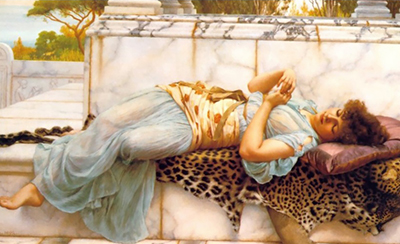
Large canvases and distinctive formats
In 1895 the Academy showed both a large upright priestess and the wide Mischief and Repose. The dancer at the New Gallery and Flabellifera at the Academy show how he adapted the single figure for public exhibition. [11] [12] [21]
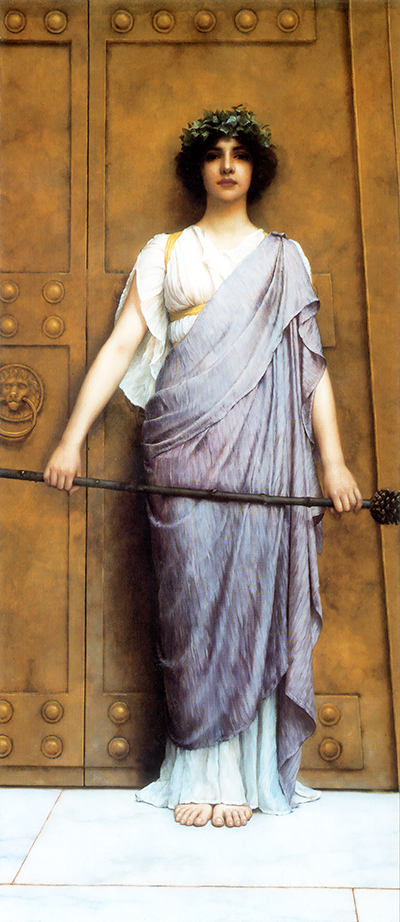
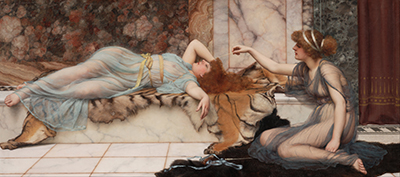
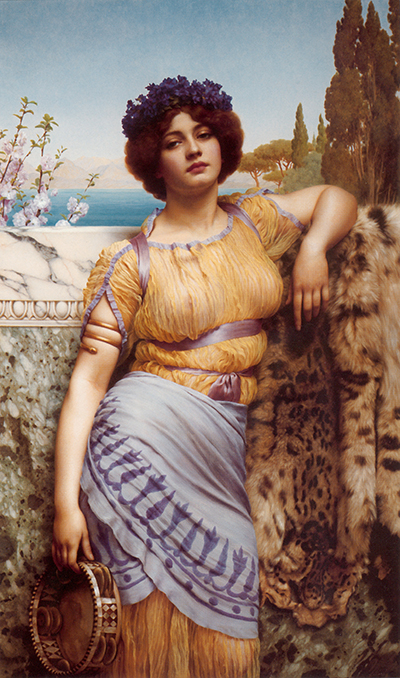
Finding a place in the London exhibitions
The 1887 Academy catalogue places A Yellow Turban at no. 721, on printed page 29. Algernon Graves’s exhibitor index then records Ianthe the following year as no. 941, still under the same Wimbledon address. The surviving exhibition entries establish that Godward showed at the Royal Academy. Where he received his formal training remains unresolved. The printed address was also a way to reach an exhibitor and could overlap with the first years of working in a separate studio. In Graves’s index the sequence goes from Wilton Road to 34 St Leonardos Terrace, Chelsea, and then to 410 Fulham Road. Swanson also records Poppaea at the Royal Society of British Artists’ winter exhibition of 1887–88. Godward later became a member of that society, which showed in Suffolk Street and had its own exhibitions. [1] [26] [27]
Swanson places Godward at the Bolton Studios in the late 1880s, among artists who included Henry Ryland and George Lawrence Bulleid. Michael Allan Kodysz’s study puts the three in neighbouring studios in 1888–89 and points to a patterned girdle in pictures by Ryland and Godward. The Bulleid account published by Christie’s likewise situates the two painters in a shared studio setting. A fabric pattern is a small but tangible connection. Young painters working near one another could encounter the same kinds of cloth, props and poses, and compare ways of depicting them. The girdle is visible evidence of common visual material. How the painters came to use it remains open. [27] [28] [29]
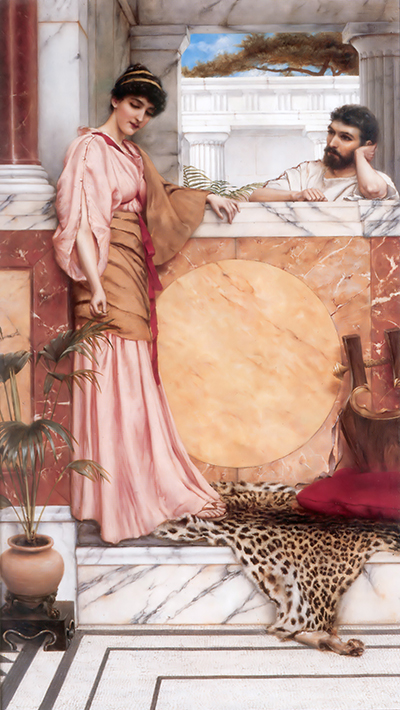
Godward was already developing scenes that could carry an incident through posture alone. The winter exhibition at Thomas McLean’s gallery in 1888–89 included The Tiff as no. 22. The picture places a woman in the foreground while her companion withdraws through an arch. A signed 1888 version of The Engagement Ring, distinct from the taller composition discussed on the painting’s page, builds its scene around a hand and a small object. In Waiting for an Answer, signed and dated 1889, a palm frond hangs between two figures whose glances keep the exchange unfinished. Swanson has proposed that the man might be Godward, based on a resemblance to photographs of his brothers. That remains a suggestion. The early courtship paintings are firmer evidence of the young artist’s interest in how one figure responds to another. [27] [30] [31] [9]
The paintings could travel between settings as readily as the artist did. The oil of The Tiff came to auction in 1894 under the title A Tiff. In November that year Henry Graves & Co. published a photo-engraving made by the Hanfstaengl firm, and a separate issue followed in New York in 1896. A partially colour-printed photogravure in the Metropolitan Museum of Art preserves evidence of the 1894 publication. The prints after Godward made photographs and printing processes part of the public life of his paintings. A scene conceived in a London studio could circulate well beyond the room in which McLean first showed it. [30] [32]
McLean also gave Godward room to show variations on a theme. Swanson records five pictures by him in the 1890–91 winter exhibition. Among them were The Flowers of Venus and its companion An Idle Hour, both painted in 1890. The pairing let visitors see what happened when he changed the pose or the setting within a related design. He would make a career out of returning to familiar arrangements and finding room in them for different gestures, shades of feeling or entirely different titles. [33]
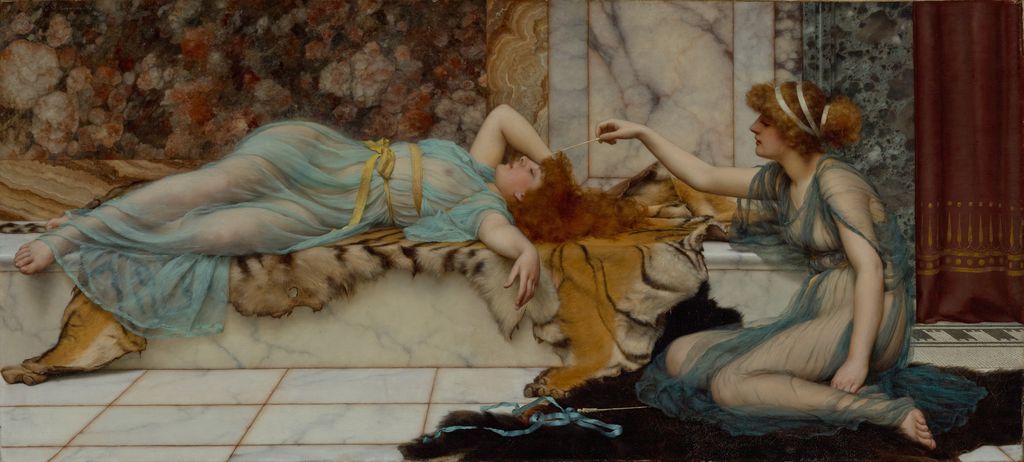
John William Godward, Mischief and Repose (1895). Early London exhibitions brought these carefully staged gestures before a public audience. J. Paul Getty Museum. Image source. CC0 / Public domain.
Fulham Road, dealers and models
In 1893 Godward had four entries at the Royal Academy, including Rest and At the Fountain. The 1895 catalogue lists him at 410 Fulham Road. That year visitors could see A Priestess, no. 304 in Gallery IV on printed page 17, and Mischief and Repose, no. 472 in Gallery VI on printed page 23. The Getty identifies that exhibit as the painting in its collection today. The priestess title recurs across his early work. Writing that year, Henry Blackburn described the exhibit’s transparent black gauze and polished brass doors. Those details point to the clothed composition. They leave the precise canvas open. [26] [34] [11] [35]
Two years of Academy records show how extensively he could vary his scale and subject. The two women of Mischief and Repose share a close, horizontal space, one watching the other rest. The following year’s Campaspe, no. 521, is a tall full-length nude backed by architectural forms. In 1898 he showed Circe as no. 442 and painted another tall work, At the Gate of the Temple. Christie’s records that McLean acquired the latter from him on 15 July 1898. The private transaction belongs alongside the public exhibitions. Godward made large canvases for a market that reached well beyond the Academy’s galleries. [26] [11] [36] [37]
Other London exhibitions gave the work a different audience. In 1900 the New Gallery exhibited as no. 225 the painting later sold as Preparing for the Bath. An old label gives the title The Toilet. A related sketch described by Sotheby’s suggests Godward considered a nude before adding the transparent covering visible in the finished picture. In 1902 the New Gallery displayed the signed Ionian Dancing Girl as no. 250 in its summer exhibition. Christie’s records both McLean’s possession of the picture by 18 April and his letter to Godward of that date. Later the same year, McLean’s own winter exhibition carried When the Heart is Young as no. 48. A dancing figure presented in a large public exhibition and an absorbed young woman shown at the dealer’s gallery give a sense of the range of poses and moods through which Godward was establishing a name. [38] [12] [39]
Those effects depended on the work of models. The record is better for some sittings than for others. In its later catalogue for Preparing for the Bath, Sotheby’s proposes Ethel Maud Warwick as the sitter. Warwick supported her studies in painting and acting by working as a model and went on the stage in 1900, the year of the picture. Her career gives some idea of the professional experience a sitter could bring to a session. For Godward, how long a pose could be held, how a length of fabric fell and how much light it admitted were matters to solve with the model in the room. The related drawings can sometimes show how he approached such decisions. [38] [40]
The last Royal Academy exhibit identified by Bazley and Swanson was Flabellifera, in 1905. The catalogue put it in Gallery IV as no. 252 and still gave 410 Fulham Road in the exhibitor index. A surviving pencil study connects that last appearance to work that took place in the studio, where Godward could consider the reclining figure and fan in line before fitting them into a painted setting. There is little evidence for why he ended his Academy submissions. The public trace of his career became more fragmented after 1905, even as the correspondence, the paintings and occasional exhibitions show him continuing to work. [2] [21] [41] [42]
John William Godward videos
See Godward’s paintings and studio practice alongside films on two Victorian contemporaries.
John William Godward - Part 1: The Last Painter of the Victorian Age
An overview of Godward’s career and the Victorian market for pictures set in antiquity.
Watch on YouTubeThe first Italian visits and a new dealer
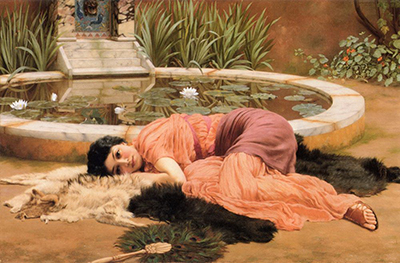
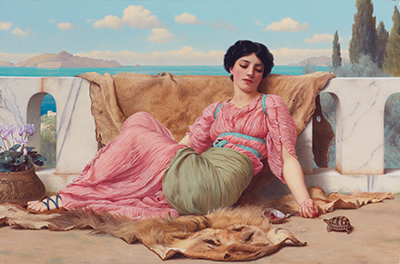
Antiquity was already part of Godward’s London practice before he travelled. The pool and marble of the 1904 Dolce far niente belong to a painter accustomed to composing an imaginary ancient setting from observed things. In his account of Outside the Gate of Pompeii, Swanson allows for a first visit to Italy in late 1904 or early 1905. His biography gives particular weight to evidence around 1905, including a drawing marked with the name of the Naples museum and an object number. Sotheby’s, discussing the signed 1906 Dolce far niente, gives 1905 as the likely first trip. The sketch might have been made before the object or from an image of it. The oil Outside the Gate of Pompeii, signed 1905, offers another kind of evidence. Its crowded view of the excavated site is unusual for a painter who so often put a lone figure at the centre of his pictures. [2] [42] [43] [44] [45]
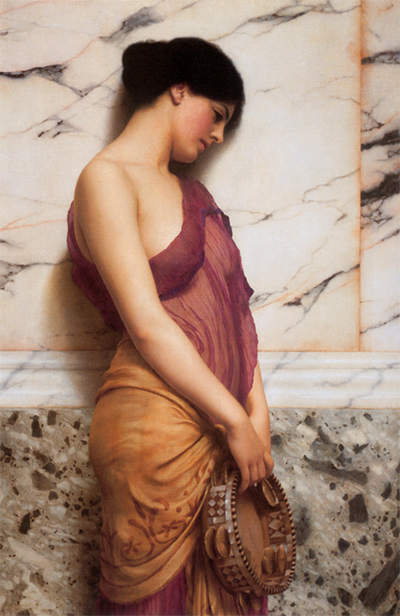
Godward still had an exhibition presence beyond Britain. Swanson and Christie’s record that a compact, signed version of The Tambourine Girl, with a carved relief behind the figure, was shown at a Paris Salon in 1906. At home the relationship with McLean continued, as a letter dated 19 March 1907 confirms for the signed Dolce far niente of that year, in which a bunch of dark grapes provides the figure with something to hold. In 1908 Eugène Cremetti took over McLean’s Haymarket gallery. In the correspondence Swanson publishes, the new dealer returned an earlier statement signed by McLean and sent Godward £25 for the copyright of Crytilla. That payment was for the right to reproduce the image. It shows why the financial record of a Godward composition might continue long after the buyer or dealer had taken the oil. [42] [46] [47]
The change of dealer mattered once Godward began to spend longer in Italy. Paintings could be made in one country and acquired for sale in another. A particularly clear example is Memories. Sotheby’s records a 1910 signature on the face and an inscription giving Rome and 1910 on the reverse. It also records acquisition by Cremetti in London on 8 September that year and cites a letter from the dealer with the same date. The back of the painting fixes a Rome connection before the date commonly given for permanent settlement. The correspondence fixes the London end of its journey. [24]
The evidence for 1912 has a similar shape. An Offering to Venus is dated 1912 on its face, and Christie’s repeats an earlier catalogue’s report of a Rome inscription on the back. Cremetti acquired it on 5 May 1912, the date of a letter listed with the painting. Bazley gives 1912 for the permanent departure from England. Swanson weighs late 1911 against the spring or early summer of 1912, considering the gaps in the Fulham records and the distribution of dated dealer letters. The Rome inscription published for Memories and the 1912 evidence fit a period of movement between cities. Taken together, they give a better account of that change than an exact departure date would. [2] [24] [15] [48]
The Villa Strohl-Fern and the Rome paintings
Godward worked at the Villa Strohl-Fern, a wooded estate adjoining the Villa Borghese. Its Alsatian proprietor, Alfred Strohl-Fern, had studios with skylights built along the tree-lined paths. Artists worked in small buildings dispersed across the grounds, some living as well as painting there. In his account of visiting Rome in the winter of 1912–13, the painter William Russell Flint remembered Godward’s fine studio and its open view. He also recalled Godward helping him find his feet in Rome, and seeing him work in silk drapery from a Roman model he refers to as Dolcissima. The recollection offers an unusually direct glimpse of Godward at work. It establishes a professional model’s presence, while stories about her identity and private life have circulated with less secure support. [48] [49] [50]
The address appears in records of different kinds. Giovanna Caterina de Feo’s study of the Villa lists him under the variant “G. Goduard” and cites the Roman Guida Monaci directory for every year from 1918 to 1923. The catalogue’s entry begins with an apparent misprint of “1818,” a century earlier than the first directory it cites. A will dated 30 January 1921, quoted by Swanson, gives the address as no. 2 Villa Strohl-Fern. Flint’s recollection places Godward at the estate years before those directory entries begin. At the other end of the sequence, the listings continue beyond his return to England and include an issue dated after his death. These records establish the address more securely than they establish an uninterrupted span of residence. [49] [50] [51]
Rome offered a new physical setting for a long-established way of working. Draped models and a few carefully positioned objects still occupy the foreground, often separated from the distance by a wall or terrace. In 1914 Godward could make that view quite expansive. Christie’s compares the mountain landscape of the signed In the Prime of the Summertime with the vista in Tranquillity from the same year. Swanson also records small studies from nature, including fruit and landscape. Those studies give a sense of the preparatory work that can disappear into the finish of the larger pictures. The villa grounds and their outlook offered a place to look closely at plants, light and distance. The finished landscapes could bring those observations into imagined settings. [48] [50] [52]
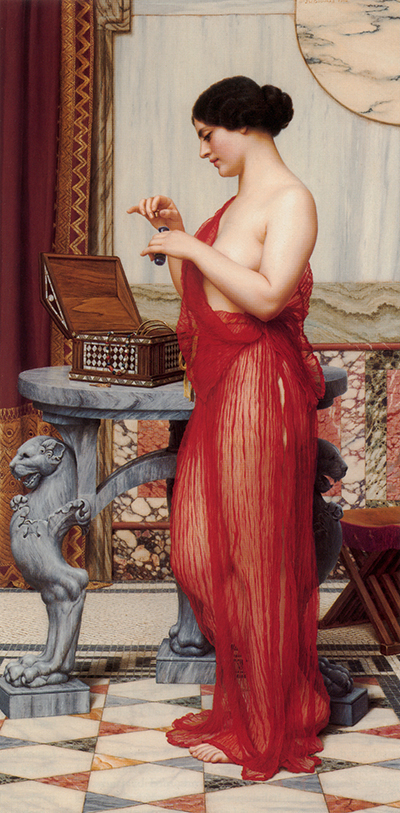
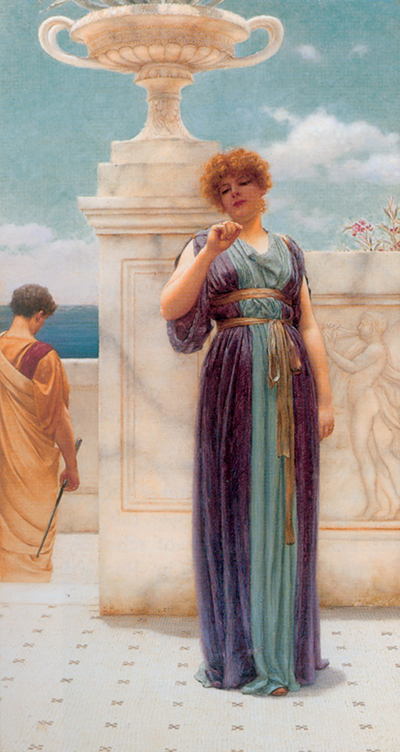
Several paintings allow the work of these years to be traced almost from the studio bench. The New Perfume is signed and dated 1914 on the front, while its reverse inscription gives Rome and 1915. Both dates belong to the same object. The reason for the difference is unrecorded. The oil Tender Thoughts carries a Rome inscription dated 1917. Christie’s links it to a sketchbook drawing, an oil study whose whereabouts were unknown at the time of cataloguing, and a simplified 1918 watercolour of the same composition. Another painting, the profile Lycinna, is dated and inscribed Rome 1918. Taken together, the inscriptions and studies make visible the persistence of his workshop practice through the war years. Some ideas crossed from one medium to another. Others, like the pose in Lycinna, could stand almost on their own. [16] [17] [53]
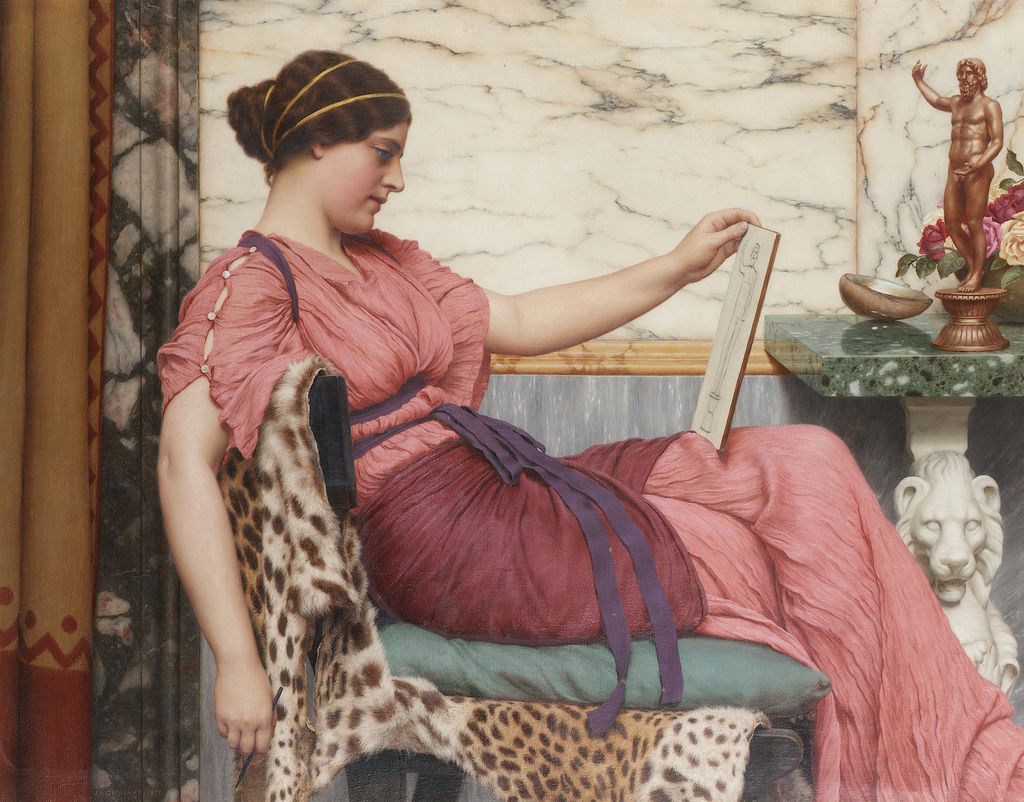
John William Godward, An Amateur (1915). Godward’s titles, dates and Rome inscriptions help place paintings in his career. Image source. Public domain.
Return to Fulham
Among the works from 1920 are The Day Dream and A Souvenir. The former, signed and dated, returns to the reclining figure and peacock-feather fan. In the latter, pictured by Swanson, accessories recede and the architecture has more room to direct the eye. The two works also suggest where the late market lay. Sotheby’s traces The Day Dream through a Toronto gallery and connects A Souvenir with an Indian patron and a 1977 sale. The surviving records give a view of individual purchases, with a reach that extended beyond the London market through which Godward had built his career. [51] [54]
By August 1921 he was giving his address as 410 Fulham Road again. Swanson quotes a second will, dated 20 August, using that address, and places the move in May or June. A memorial published soon after his death estimated that Godward had returned to England about eighteen months earlier, consistent with a return in the middle of 1921. Swanson reports that the electoral register listed William Clarke Wontner and his wife Jessie at the same Fulham Road address during the years Godward was based in Italy. That later connection between the two painters is easier to trace than their early instruction. The brother who testified at the inquest lived at the same address. Godward used the detached studio in the garden, where the separation between living and working space was small enough for the two buildings to be linked by a speaking tube. [51] [55] [56]
He still painted ambitiously. A Dilettante, signed and dated 1922 on both sides, shows a woman intent on modelling a small figure. Sotheby’s compares it to his 1915 An Amateur and identifies Marietta Avico as the sitter for the 1922 canvas. The little figure has a close counterpart in the Louvre’s veiled terracotta known as the Titeux Dancer, excavated at the Acropolis in the nineteenth century. The little sculpture gives the woman’s concentration a visible focus. [5] [57]
The inquest reporting identifies her as a professional model who knew Godward during this period. The connection is particularly apt in a picture about making art, in which the painter drew on a model’s labour to show another artist absorbed in her own. A December dealer letter described in the Fulham Gazette records a payment of £125 for a painting titled Contemplation. That contemporary account and the dated A Dilettante both attest to work in his last year. The chronology of every late picture remains incomplete. [55] [5]
Death and the paintings’ later reception
Godward died by suicide at his Fulham studio on 13 December 1922, aged sixty-one, and was buried in Brompton Cemetery. At the inquest on 16 December, his brother Charles Arthur and Marietta Avico both described insomnia and stomach complaints. Charles Arthur said he knew of no financial worries. The Fulham Gazette account, preserved in Swanson’s transcription, records their observations and the coroner’s verdict of suicide. The witnesses could report what they saw and what Godward had told them. The inquest gives limited evidence about his health and circumstances in his last months. [2] [55]
Family memories preserved much later give a different scale of detail. Ivy Godward, who knew him in Fulham, remembered a quiet man who spent much of the day working and was courteous in her company. Swanson also records family recollections that Godward’s mother removed him from photographs. That account comes through relatives. It sits beside evidence of continuing ties, including reports that he corresponded with his sister Mary Frederica in Rome and the provision he made for members of his family in his will. Papers and pictures survived in some family hands. The evidence leaves room for the affection his sister remembered as well as for the distance other relatives recalled. [50] [55] [58]
Early in 1923 The Connoisseur remembered a painter who had once been popular and whose work had slipped from public view. Its memorial describes the Fulham studio as elaborately decorated with antique forms and set in a garden with pergolas and fountains. The writer likened the sound from the neighbouring football ground to a crowd in an amphitheatre. The comparison was the writer’s own, but it catches something of the conditions under which the paintings were made. A painter at work on an imagined Rome was still within earshot of west London. [56]
The later history of the works is visible in individual collections and exhibitions. J. Paul Getty acquired Mischief and Repose through the 1938 sale chain, and the work passed from his estate to the Getty Museum in 1979. Imagining Rome placed Godward in the long history of British artists who engaged with Italy in the nineteenth century. The 2003 Royal Academy exhibition of the Andrew Lloyd Webber collection brought the 1904 Dolce far niente back to Burlington House nearly a century after Godward’s final Academy submission. In 2013 the Musée Jacquemart-André showed works including the 1912 Absence Makes the Heart Grow Fonder, with its Paris display followed by venues including Madrid. [2] [20] [28] [11] [59] [60]
At the Hessisches Landesmuseum Darmstadt, the recovery of the early Unexpected Arrival as a Godward illustrates another kind of reassessment. The museum bought the painting in 1965 as a Leighton, with a signature since removed. A related composition attributed to Godward, in which the male visitor is absent, was traced through the Düsseldorf art trade. The comparison helped give an individual history back to a painting once filed under a more famous name. [61]
These exhibitions returned his paintings to the company of the artists with whom he shared subjects, exhibition rooms and collectors. They also made it easier to see what distinguishes his work. Across the move from London to Rome and back again, he kept finding ways to give a small gesture the weight of a whole scene.
Further reading
John William Godward: The Eclipse of Classicism. Vern Grosvenor Swanson. Expanded edition, ACC Art Books, 2018.
The illustrated catalogue is a way to trace recurring titles, versions and studio evidence. Find the catalogue in the NYPL guide.
The Classical-Genre Paintings of John William Godward. Michael Allan Kodysz. University of Manchester dissertation, 2007, restored digital edition.
Compare painting, studio practices and the ancient objects recorded by the author. Read the dissertation.
John William Godward artworks directory
Search documented oil paintings, drawings, watercolours and reproductive prints. The directory includes the Art Renewal Center’s catalogue and additional works in museum, exhibition and sale records.
| Name | Date | Medium |
|---|---|---|
| Absence Makes the Heart Grow Fonder | 1912 | Oil on canvas |
| Amaryllis | 1903 | Oil on canvas |
| An Amateur | 1915 | Oil on canvas |
| Ancient Pastimes | 1916 | Oil on canvas |
| The Answer | 1917 | Oil on canvas |
| An Arcadian Beauty | 1899 | Painting |
| At the Fountain | 1893 | Oil on canvas |
| At the Garden Door | 1901 | Oil on canvas |
| At the Garden Shrine, Pompeii | 1892 | Oil on canvas |
| At the Gate of the Temple | 1898 | Oil on canvas |
| At the Thermae | 1909 | Oil on canvas |
| Atalanta | 1892 | Oil on canvas |
| Athenais | 1908 | Oil on canvas |
| An Auburn Beauty | 1895 | Oil on canvas |
| Autumn | 1900 | Oil on canvas |
| Beauty in a Marble Room | 1894 | Oil on canvas |
| The Belvedere | 1913 | Oil on canvas |
| The Betrothed | 1892 | Oil on canvas |
| The Betrothed (print after Godward) | 1893 | Photoengraving, as reported |
| The Bouquet | 1899 | Oil on canvas |
| Briseis | 1896 | Painting |
| The Broken Vase | 1889 | Oil on canvas |
| By the Blue Ionian Sea | 1916 | Oil on canvas |
| By the Wayside | 1912 | Oil on canvas |
| Byrsina | 1915 | Painting |
| Campaspe | 1896 | Oil on canvas |
| Campaspe (print after Godward) | Print, process unconfirmed | |
| Chloris (A Summer Rose) | 1902 | Oil on canvas |
| Classical Beauty | Oil on canvas | |
| A Classical Beauty | Oil on canvas | |
| A Classical Beauty | Painting | |
| A Classical Beauty | Oil on canvas | |
| A Classical Beauty | 1909 | Oil on canvas |
| A Classical Beauty In Profile | Oil on canvas | |
| A Classical Lady | 1908 | Oil on canvas |
| Clymene | 1892 | Oil on canvas |
| A Congenial Task | 1915 | Oil on canvas |
| Contemplation | 1922 | Oil on canvas |
| A Cool Retreat | 1910 | Oil on canvas |
| Country House in the 18th Century | c. 1883 | Oil on canvas |
| Cytheris | 1922 | Painting |
| The Day Dream | 1920 | Oil on canvas |
| The Delphic Oracle | 1899 | Oil on canvas |
| A Dilettante | 1922 | Oil on canvas |
| Distant Thoughts | 1918 | Oil on canvas |
| Dolce Far Niente | 1897 | Oil on canvas |
| Dolce Far Niente | 1906 | Oil on canvas |
| Dolce far niente (A Pompeian Fishpond) | 1904 | Oil on canvas |
| Dolce far niente (coloured print after Godward) | Exhibited 1900 | Coloured print, exact process unconfirmed |
| Dolce far niente (grapes) | 1907 | Oil on canvas |
| Dora | 1887 | Oil on canvas |
| Drusilla | 1906 | Oil on canvas |
| An Edition de Luxe | 1920 | Oil on canvas |
| Eighty and Eighteen | 1898 | Oil on canvas |
| Endymion | 1893 | Oil on canvas |
| The Engagement Ring (horizontal composition) | 1888 | Oil on canvas |
| The Engagement Ring (upright composition) | c. 1891 | Oil on canvas |
| Erato at Her Lyre | Oil on canvas | |
| A Fair Reflection | 1915 | Oil on canvas |
| A Fair Reflection (Taber-Prang print) | By 1923 | Sepia artotype |
| Far Away Thoughts (circular sewing scene) | 1911 | Oil on canvas |
| Far Away Thoughts (left-facing profile) | 1892 | Oil on canvas |
| Far Away Thoughts (right-facing profile) | 1892 | Oil on canvas |
| Female Figure (probable Grecian Idyll study) | 1907 | Oil on board |
| Flabellifera | 1905 | Oil on canvas |
| Flabellifera (painted study) | c. 1905 | Oil study |
| Flabellifera (pencil study) | c. 1905 | Pencil on paper |
| The Flower Girl | Painting | |
| A Flower Seller | 1896 | Oil on canvas |
| The Flowers of Venus | 1890 | Oil on canvas |
| A Fond Farewell | 1918 | Watercolour |
| The Fragrant Rose | 1892 | Painting |
| The Fruit Vendor | 1917 | Oil on canvas |
| A Garland Seller | 1914 | Painting |
| Giotto Drawing from Nature | Painting | |
| Girl in Yellow Drapery | 1901 | Oil on canvas |
| Golden Hours | 1913 | Oil on canvas |
| A Grecian Girl | 1908 | Oil on canvas |
| Grecian Idyll | 1907 | Oil on canvas |
| A Grecian Lovely | 1909 | Oil on canvas |
| Grecian Reverie | 1889 | Oil on canvas |
| Grecian Reverie | 1889 | Oil on canvas |
| A Greek Beauty | 1905 | Oil on canvas |
| A Happy Awakening | 1903 | Oil on canvas |
| He Loves Me, He Loves Me Not | 1896 | Oil on canvas |
| A head and shoulders profile portrait of a young woman wearing a white tunic style blouse | c. 1889 | Painting |
| Head of a Girl (The Priestess) | 1896 | Oil on canvas |
| Heart on her Lips and Soul within her Eyes | 1904 | Painting |
| His Birthday Gift | 1889 | Oil on canvas |
| Ianthe | 1889 | Oil on canvas |
| An Idle Hour | 1890 | Oil on canvas |
| Idle Moments | 1895 | Oil on canvas |
| Idle Thoughts | 1898 | Oil on canvas |
| Idleness | 1900 | Oil on canvas |
| Il Dolce Far Niente (Pears print after Amaryllis) | 1906 | Chromolithograph |
| Il Dolce far niente (seated figure) | 1893 | Oil on canvas |
| In Expectation | c. 1892 | Oil on canvas |
| In Realms of Fancy | 1911 | Oil on canvas |
| In the Prime of the Summertime (Reverie) | 1914 | Oil on canvas |
| In the Tepidarium | 1913 | Oil on canvas |
| Innocent Amusements | 1891 | Oil on canvas |
| Ione | c. 1896-1898 | Oil on canvas |
| Ionian Dancing Girl | 1902 | Oil on canvas |
| Ismenia | 1908 | Oil on canvas |
| An Italian Beauty | 1897 | Oil on canvas |
| An Italian Girls' Head | 1902 | Oil on canvas |
| The Jewel Casket | 1900 | Oil on canvas |
| Julia | 1914 | Painting |
| Knuckle Bones | 1890 | Oil on canvas |
| La Pensierosa | 1913 | Oil on canvas |
| A Lady | 1895 | Oil on canvas |
| Landscape: Blossoming Red Almond [study] | c. 1912 | Oil on panel |
| Le Billet Doux (The Love Letter) | 1913 | Oil on canvas |
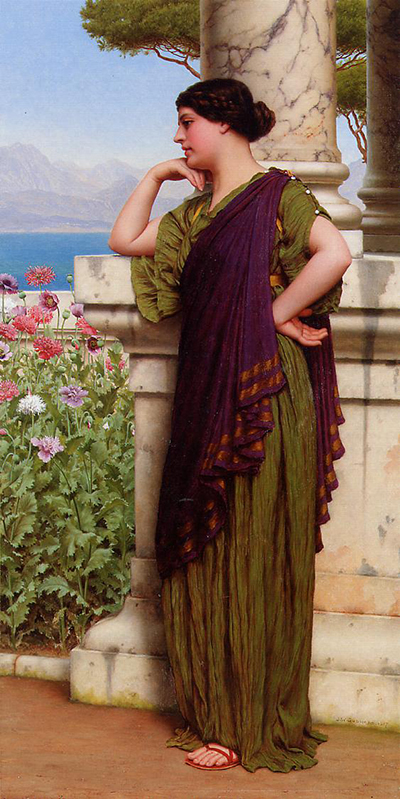
| Leaning Against a Column | 1901 | Painting |
| Leaning on the Balcony | 1892 | Oil on canvas |
| Leisure Hours | 1905 | Oil on canvas |
| Lesbia with her Sparrow | 1916 | Oil on canvas |
| The Letter | 1899 | Painting |
| Liegende | 1893 | Oil on canvas |
| A Lily Pond | 1917 | Oil on canvas |
| Looking Out to Sea | 1918 | Pencil and watercolour |
| The Love Letter (circular composition) | 1907 | Oil on canvas |
| Lucilia | 1917 | Oil on canvas |
| Lycinna | 1918 | Oil on canvas |
| Marcella | 1912 | Painting |
| Matrona Superba | Oil on canvas | |
| Megilla | 1921 | Oil on canvas |
| A Melody | 1904 | Oil on canvas |
| Memories | c. 1891 | Oil on canvas |
| Mirinna | Painting | |
| The Mirror | 1899 | Oil on canvas |
| Mischief | 1905 | Oil on canvas |
| Mischief and Repose | 1895 | Oil on canvas |
| A Mouse in the Work Basket | 1893 | Oil on canvas |
| Nerissa | 1906 | Oil on canvas |
| The New Perfume | 1914 | Oil on canvas |
| Noon Day Rest | 1910 | Oil on canvas |
| Nu Sur La Plage | 1922 | Oil on panel |
| Nude Study | Oil on canvas | |
| An Offering to Venus | 1912 | Oil on canvas |
| The Old, Old Story | Oil on canvas | |
| The Old, Old Story | 1903 | Oil on canvas |
| On the Balcony | 1911 | Oil on canvas |
| On The Terrace | 1918 | Oil on canvas |
| Ophelia | Oil on panel | |
| The Peacock Fan | 1912 | Oil on canvas |
| Phyleis | 1908 | Oil on canvas |
| The Playground | 1892 | Oil on canvas |
| Playtime | 1891 | Oil on canvas |
| A Pompeian Bath | 1890 | Oil on canvas |
| A Pompeian Lady | 1891 | Oil on canvas |
| A Pompeian Lady | 1895 | Oil on board |
| A Pompeian Lady | 1901 | Painting |
| A Pompeian Lady | 1904 | Painting |
| Portrait of Mary Frederica 'Nin' Godward | c. 1882-1883 | Oil on canvas |
| Portrait of Mary Perkinton Godward | c. 1880-1881 | Watercolor |
| The Posy | 1900 | Painting |
| A Priestess (bare-shouldered figure) | 1893 | Oil on canvas |
| A Priestess (clothed composition) | 1894 | Oil on canvas |
| A Priestess (W. Biscombe Gardner after Godward) | Exhibited 1897 | Print, process unconfirmed |
| A Priestess of Bacchus | 1890-1890 | Oil on canvas |
| Pyrallis | 1918 | Oil on canvas |
| The Quiet Pet | 1906 | Oil on canvas |
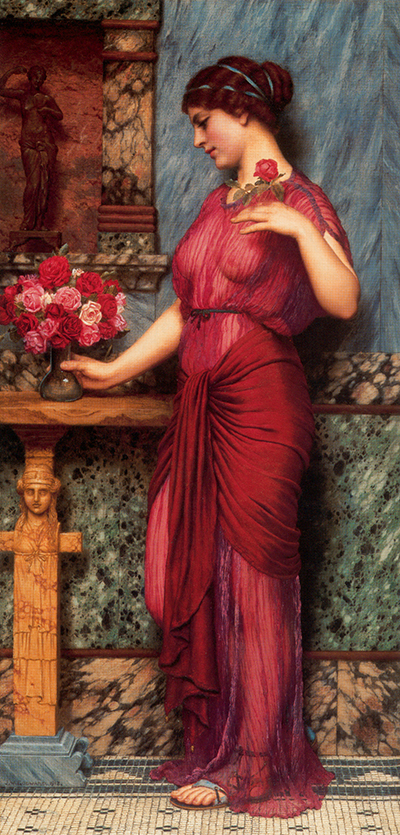
| A Red, Red Rose | 1920 | Oil on canvas |
| Reflections | 1893 | Oil on canvas |
| The Rendezvous | 1903 | Oil on canvas |
| Repose, the Flower Girl | c. 1887 | Oil on canvas |
| Reverie | 1888 | Oil on panel |
| Reverie | 1912 | Oil on canvas |
| Reverie (In the Days of Sappho) | 1904 | Oil on canvas |
| Reverie (Pears print after In the Prime of the Summertime) | 1916 | Chromolithograph |
| 'Rich Gifts Wax Poor When Lovers Prove Unkind' | 1916 | Oil on canvas |
| The Ring | 1898 | Oil on canvas |
| A Roman Matron | 1905 | Oil on canvas |
| Sabinella | 1912 | Oil on canvas |
| Sappho | 1910 | Oil on canvas |
| The Siesta | Oil on canvas | |
| A Siesta | 1895 | Oil on canvas |
| The Signal | 1899 | Oil on canvas |
| Sitting for Her Portrait | 1893 | Oil on canvas |
| Sketch for Amaryllis | 1903 | Oil on board |
| A Souvenir | 1920 | Oil on canvas |
| Stesicrate | 1914 | Oil on canvas |
| Study for 'Rêverie' | 1890 | Oil on canvas |
| Study for 'The Priestess' | 1895 | Oil on board |
| Study for An Egyptian Minstrel | 1906 | Painting |
| Study for The New Perfume | Drawing, medium unconfirmed | |
| Study for ‘The Old, Old Story’ | 1903 | Oil paint on wood |
| Study of a Girl's Head | 1899 | Painting |
| Study of Campaspe | Oil on canvas | |
| Study of Head and Drapery, Miss Ethel Warwick | 1898 | Painting |
| Summer Day | 1897 | Painting |
| Summer Flowers | 1903 | Oil on canvas |
| Sweet Dreams | 1901 | Oil on canvas |
| Sweet Dreams | 1904 | Painting |
| The Sweet Siesta of a Summer's Day | 1891 | Oil on canvas |
| The Tambourine Girl (profile at the marble wall) | 1906 | Oil on canvas |
| The Tambourine Girl (relief-backed version) | 1906 | Oil on canvas |
| Tender Thoughts | 1917 | Oil on canvas |
| Tender Thoughts (woman leaning over a parapet) | 1918 | Pencil and watercolour |
| The Tiff (oil) | By 1888 | Oil on canvas |
| The Tiff (print after Godward) | 1894 | Photogravure |
| The Tigerskin | 1889 | Oil on canvas |
| The Time of Roses | 1916 | Oil on canvas |
| Tranquillity | 1914 | Oil on canvas |
| A Tryst | 1912 | Oil on canvas |
| Tympanistria | 1909 | Oil on canvas |
| Under the Blossom that Hangs on the Bough | 1917 | Oil on canvas |
| Venus at the Bath | 1901 | Oil on canvas |
| Venus Binding Her Hair | 1897 | Oil on canvas |
| Violets, Sweet Violets | 1906 | Painting |
| Waiting for an Answer | 1889 | Oil on canvas |
| Waiting for the Procession | 1890 | Oil on canvas |
| Waiting for the Procession | 1890 | Painting |
| The Water Carrier (magazine reproduction of At the Fountain) | 1898 | Magazine reproduction |
| When the Heart is Young | 1902 | Oil on canvas |
| Who Can They Be | Painting | |
| Winding Wool | 1894 | Painting |
| 'With Violets Wreathed and Robe of Saffron Hue' | 1902 | Oil on canvas |
| The Yellow Shawl | 1893 | Painting |
| 'Yes or No?' | 1893 | Oil on canvas |
| Young Girl Picking Grapes | 1902 | Oil on canvas |
| Youth and Time | 1901 | Oil on canvas |
Discussion
Look again at the images and ideas explored in John William Godward Biography. These editorial prompts invite your observations.
Reader Insights
Which kind of evidence gives you the clearest picture of Godward’s working life?
Where do you see a change in his paintings during the Rome years?
Join the Conversation
Share a detail, comparison or question about John William Godward Biography below.
References
- Royal Academy of Arts. The Exhibition of the Royal Academy, 1887, Gallery IX, no. 721, printed p. 29, digital canvas c28, and exhibitor index, c69. Digitised annual catalogue, Paul Mellon Centre. View source.
- Desmond Bazley. “John William Godward (1861–1922).” Merton Historical Society Bulletin, no. 151, September 2004, pp. 8–9. Bulletin and sources. View source.
- Pre-Raphaelites, Victorian Art and Design, 1848–1900. View source.
- An introduction to the Aesthetic Movement. View source.
- Sotheby’s. John William Godward, A Dilettante, 1922, signature, inscriptions and catalogue essay. 2019 sale N10009, lot 425. View source.
- Frederic Leighton, Baron Leighton. View source.
- Lawrence Alma-Tadema, 1836–1912. View source.
- Desmond Bazley, John William Godward (1861–1922). View source.
- Sotheby’s. John William Godward, Waiting for an Answer, signed 1889, 2007. Sale N08355, lot 163. View source.
- The Betrothed. View source.
- J. Paul Getty Museum. John William Godward, Mischief and Repose, 1895, 79.PA.149, provenance and exhibition history. Collection record. View source.
- Christie’s. John William Godward, Ionian Dancing Girl, 1902, New Gallery no. 250 and McLean letter of 18 April 1902. Lot 920644. View source.
- Dolce far niente (A Pompeian Fishpond). View source.
- The Quiet Pet. View source.
- Christie’s. John William Godward, An Offering to Venus, inscriptions, earlier reverse record and Cremetti letter of 5 May 1912. Lot 6012063. View source.
- Christie’s. John William Godward, The New Perfume, front and reverse inscriptions. Lot 245788. View source.
- Christie’s. John William Godward, Tender Thoughts, Rome 1917, inscription, preparatory work and 1918 watercolour. Lot 1369821. View source.
- A Souvenir. View source.
- Vern Grosvenor Swanson. J. W. Godward: The Eclipse of Classicism. Art Renewal Center reproduction, web p. 1, early life and training. Archived chapter. View source.
- Musée Jacquemart-André. Désirs et volupté à l’époque victorienne, exhibition education dossier, 2013, pp. 7, 20–21 and checklist pp. 22–24. French. Original museum dossier. View source.
- Royal Academy of Arts. The Exhibition of the Royal Academy, 1905, Gallery IV, no. 252, digital canvas c15, and exhibitor index, c69. Digitised annual catalogue, Paul Mellon Centre. View source.
- The Tambourine Girl. View source.
- Rina Kajima, Repetition of Women Who Are Doing Nothing. View source.
- Sotheby’s. John William Godward, Memories, 1910, inscriptions, provenance and Cremetti letter of 8 September 1910. 2007 sale N08303, lot 177. View source.
- Giovanna Caterina de Feo, Artisti e personalità nella Villa Strohl Fern. View source.
- Algernon Graves. The Royal Academy of Arts: A Complete Dictionary of Contributors and Their Work from Its Foundation in 1769 to 1904, vol. III, p. 257, “Godward, John William.” London, 1905. Digitised volume. View source.
- Vern Grosvenor Swanson. J. W. Godward: The Eclipse of Classicism. Art Renewal Center reproduction, web p. 2, Bolton Studios and early works. Archived chapter. View source.
- Michael Allan Kodysz. The Classical-Genre Paintings of John William Godward: From Archaeology to Archetypes. University of Manchester master’s dissertation, 2007, introduction and ch. 1, restored digital edition. Dissertation. View source.
- Christie’s. George Lawrence Bulleid, At the well, catalogue essay on Bulleid and Bolton Studios. Lot 4189183. View source.
- Christie’s. John William Godward, The Tiff, exhibition, provenance and publication records. Lot 6438367. View source.
- Sotheby’s. John William Godward, The Engagement Ring, signed 1888 version, 2023. Auction catalogue and image. View source.
- The Metropolitan Museum of Art. The Tiff, photogravure after Godward, published by Henry Graves & Co., 1894. Collection record 668642. View source.
- Vern Grosvenor Swanson. J. W. Godward: The Eclipse of Classicism. Art Renewal Center reproduction, web p. 5, the 1890–91 McLean winter exhibition. Archived chapter. View source.
- Royal Academy of Arts. The Exhibition of the Royal Academy, 1895, Gallery IV, no. 304, printed p. 17, digital canvas c17, Gallery VI, no. 472, printed p. 23, c23, and exhibitor index, c69. Digitised annual catalogue, Paul Mellon Centre. View source.
- Henry Blackburn. Academy Notes, 1895, Gallery IV, p. 12, description of no. 304. View source.
- Sotheby’s. John William Godward, Campaspe, 1896, 2006. Sale L06132, lot 127. View source.
- Christie’s. John William Godward, At the Gate of the Temple, 1898, acquisition from the artist. Lot 5403403. View source.
- Sotheby’s. John William Godward, Preparing for the Bath, New Gallery exhibition, label and study, 2014. Sale L14133, lot 34. View source.
- Sotheby’s. John William Godward, When the Heart is Young, McLean winter exhibition, 1902, no. 48. Sale N09143, lot 24. View source.
- Sotheby’s. John William Godward, Preparing for the Bath, catalogue essay on Ethel Warwick, 2017. Sale N09940, lot 15. View source.
- Art Renewal Center. John William Godward, Flabellifera (pencil study). Artwork record 11390. View source.
- Vern Grosvenor Swanson. J. W. Godward: The Eclipse of Classicism. Art Renewal Center reproduction, web p. 8, first Italian travel and the change from McLean to Cremetti. Archived chapter. View source.
- Vern Grosvenor Swanson. “Memories of an Ancient City: Artists Looking at Pompeii,” pp. 90–91 and fig. 14. Author’s text. View source.
- Sotheby’s. John William Godward, Dolce far Niente, signed 1906 version, with account of the early Italian travel. 2013 sale N09034, lot 9. View source.
- Sotheby’s. John William Godward, Outside the Gate of Pompeii, 1905, signature and catalogue entry. 2005 sale N08121, lot 7. View source.
- Christie’s. John William Godward, The Tambourine Girl, exhibition history. Lot 1399080. View source.
- Sotheby’s. John William Godward, Dolce far niente, signed 1907 grape composition, with McLean letter of 19 March 1907. 2023 day auction, lot 153. View source.
- Vern Grosvenor Swanson. J. W. Godward: The Eclipse of Classicism. Art Renewal Center reproduction, web p. 9, the move to Rome, William Russell Flint’s recollections and studies from life. Archived chapter. View source.
- Giovanna Caterina de Feo. “Artisti e personalità nella Villa Strohl Fern tra il 1882 e il 1956. Elenco provvisorio,” in Alfred Wilhelm Strohl-Fern (Ghaleb Editore, 2010), pp. 103–104 and 114, citing six annual issues of Guida Monaci. Italian. Villa Strohl-Fern research. View source.
- Vern Grosvenor Swanson. J. W. Godward: The Eclipse of Classicism. Art Renewal Center reproduction, web p. 10, Villa Strohl-Fern, with a quotation from William Russell Flint’s account and recollections from Ivy Godward. Archived chapter. View source.
- Vern Grosvenor Swanson. J. W. Godward: The Eclipse of Classicism. Art Renewal Center reproduction, web p. 11, late Roman years and the London return, including the 1921 will addresses and illustrated A Souvenir. Archived chapter. View source.
- Christie’s. John William Godward, In the Prime of the Summertime, signed 1914, with comparison to Tranquillity. Lot 6290751. View source.
- Sotheby’s. John William Godward, Lycinna, Rome 1918, signature and reverse inscription. 2009 sale L09688, lot 11. View source.
- Sotheby’s. John William Godward, The Day Dream, 1920, signature and provenance, with the A Souvenir sale reference. 2007 sale L07132, lot 16. View source.
- The Fulham Gazette. Death and inquest reports, December 1922, as transcribed in Vern Grosvenor Swanson, J. W. Godward: The Eclipse of Classicism, Art Renewal Center reproduction, web p. 12. The same page records the wills and Brompton burial. Archived chapter. View source.
- The Connoisseur. Memorial notice for John William Godward, “Obituaries,” vol. 65, 1923, p. 108. Original printed notice. View source.
- Musée du Louvre. Figurine, dite Danseuse Titeux, terracotta from the Acropolis. French. Collection record CA 462. View source.
- Vern Grosvenor Swanson. J. W. Godward: The Eclipse of Classicism. Art Renewal Center reproduction, web p. 13, family recollections. Archived chapter. View source.
- Michael Liversidge and Catharine Edwards, eds. Imagining Rome: British Artists and Rome in the Nineteenth Century. Exhibition catalogue, 1996. See Elizabeth Prettejohn’s “Recreating Rome in Victorian Painting: From History to Genre” and the entry for At the Thermae, exhibited as A Roman Woman. University of Bristol exhibition record. View source.
- Museo Nacional Thyssen-Bornemisza. Alma-Tadema y la pintura victoriana en la Colección Pérez Simón, 2014. Spanish. Madrid exhibition record. View source.
- Udo Felbinger, Hessen Provenienzforschung. “Leider kein Leighton! John William Godwards Gemälde ‘Unexpected arrival’,” 12 October 2023, Hessisches Landesmuseum Darmstadt. German. Provenance research. View source.