 by Tom Gurney
Tom Gurney BSc (Hons) is an art history expert with over 20 years experience
Published on June 19, 2020 / Updated on October 14, 2023
Email: tomgurney1@gmail.com / Phone: +44 7429 011000
The Quiet Pet by John William Godward: Introduction
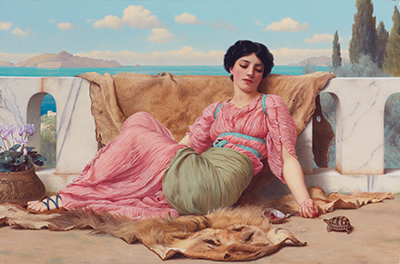
A woman resting on a marble terrace holds two cherries by their stems, just above the paving. A tortoise stretches its neck towards her hand. The fruit hangs in the narrow patch of bare stone between them, and the woman’s lowered head draws our attention to the same spot. John William Godward painted The Quiet Pet in 1906. The oil on canvas measures 50.8 × 76.2 cm (20 × 30 in.). He signed and dated it on the pale parapet at the left, near the edge of the canvas. Sotheby’s identifies the work as no. 1906.7 in Vern G. Swanson’s 1997 catalogue. [1]
At a Glance
- Date1906
- MediumOil on canvas
- Dimensions50.8 × 76.2 cm
This work across John William Godward’s career
Contents
- The space between the cherries and the tortoise
- Fur, drapery and marble
- A woman and her pets in Victorian painting
- The Evans letter, sales and exhibition
- The canvas in 2012
- Annotated details
The space between the cherries and the tortoise
The catalogue calls the fruit in the dish cherries, and a close view of the sale photograph shows the same round shape, glossy red skins and long pale stems on the two held between her fingers. Several more lie in the dish, to the picture’s left of her hand. The dish has a dark outer edge and a curved interior that catches pink and green reflections. Her fingers curl loosely towards her palm, and the two fruits hang almost level with her knuckles. Godward has brought the offer close to the paving, within the tortoise’s little field of action. The animal’s head points towards it, but its mouth is still separated from the fruit. [1]
The curve of the shell picks up the rounded shapes of the raised knee and the green fabric gathered across the woman’s hips. Godward paints dark bands around the plates of the shell and lets a shadow gather beneath it. The scaly legs are planted on the terrace, clear of the pelt. At the opposite end of the picture the woman’s sandalled foot is just as close to the floor, with blue straps cutting sharply across her bare toes. The sandal and the tortoise mark the two ends of the long sweep of cloth and hide. From the woman’s head, her forearm leads the eye down to the cherries and on to the animal. [1]
The lowered eyelids suggest where the woman’s attention has settled, though the angle of her face leaves her exact line of sight open. What is clear is the difference between the weight of the body and the precision of the hand. She leans back with one knee raised and her other arm partly hidden by the folds. Her reaching arm has come to rest low enough that she can offer the fruit with two fingers. Like the tortoise’s extended neck, the gesture takes very little effort. The painting holds both figures at the point where something could happen next. [1]
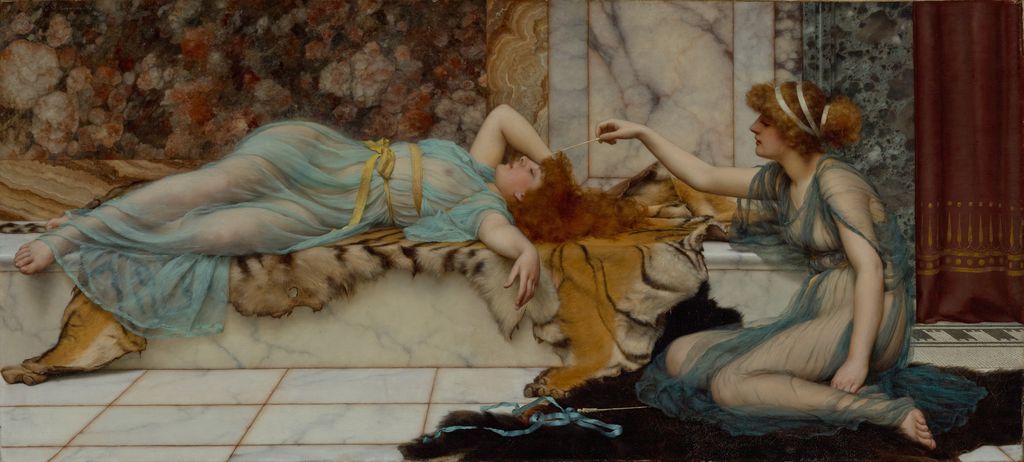
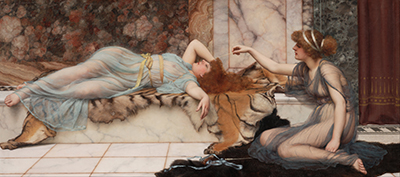
John William Godward, Mischief and Repose (1895). In the Getty painting, one small movement likewise carries the action across a marble terrace. J. Paul Getty Museum. Image source. CC0 / Public domain.
Fur, drapery and marble
The hide draped across the marble sets off the dark hair and changes colour as it comes into the foreground. The brown beneath the elbow gives way to tawny tufts along the floor. Along the front edge, the fur turns back on itself to expose part of its underside. A flattened animal face is still visible near the bottom centre. The spread hide softens the hard edge of the parapet and makes the shell’s rigid dome stand out. The living animal stays on the bare paving, outside the folds of fur. [1]
The thin pink fabric bunches at the raised knee and pools in long, narrow folds by the foot. Small pale fastenings mark the open sleeve along the shoulder and upper arm. The turquoise bands at the shoulder and waist carry a repeating angular pattern that reads clearly even where the cloth twists. They are among the sharpest edges on the figure. The bands also pick up the blue-green of the water, so that a costume detail close to us repeats a colour across the terrace wall. Sotheby’s compared the pink drapery with Godward’s signed 1913 Golden Hours (Expectancy) and associated the finely worked folds with Frederic Leighton. It also proposed Edward Poynter as a source for the plate of cherries, without identifying a specific painting. In the round Golden Hours, the woman looks out from beneath a fan, leaving the viewer to follow the folds past her into the landscape. In The Quiet Pet, the fall of the sleeve points more directly towards her hand. [1] [7]
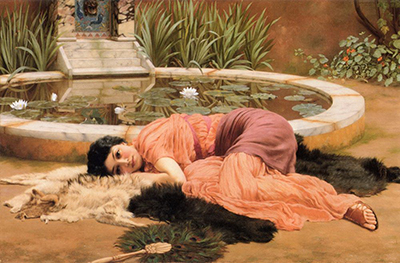
Here the parapet runs the full width of the picture. Its arched openings show lower ground and, through the one at the left, a small pale building above the water. The high view leaves only a narrow band of blue between the marble and the distant land. Tall, dark trees at the right break that long horizontal, and purple flowers at the left gather above a pot with a raised decorative band. The pot and sandal have sharp contours, while the distant ridges almost dissolve into the sky. The walled garden of the 1904 Dolce far niente also brings a reclining figure close to the picture’s edge, but there our view stays mostly within the garden. In The Quiet Pet the sea is available almost wherever we look up, even while the woman’s attention appears to stay with something a few inches from her hand. [1] [8]
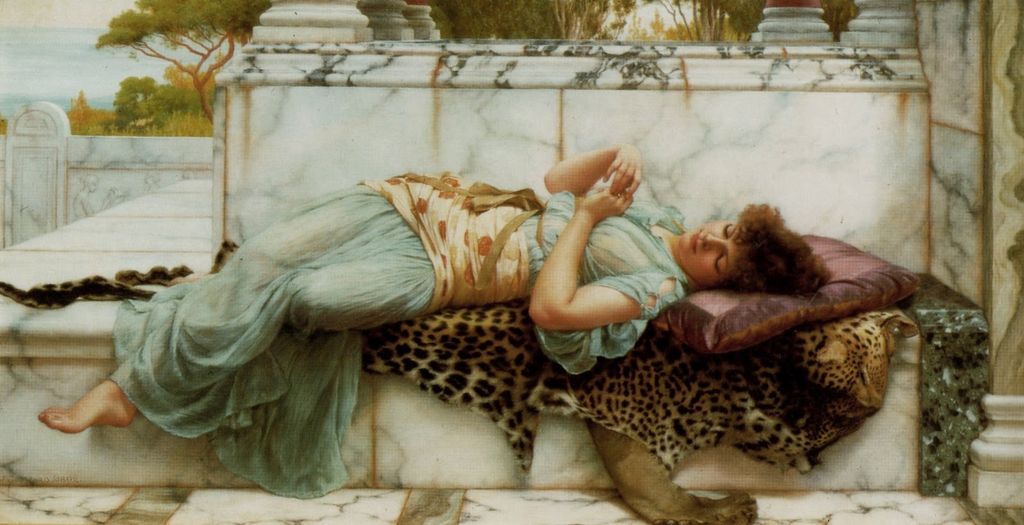
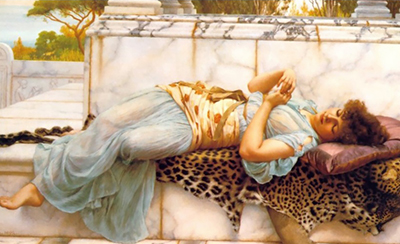
John William Godward, The Betrothed (1892). The spread of the drapery around the raised arms gives the reclining body a different balance on the stone. Image source. Public domain.
Annotated Details from The Quiet Pet
The numbered points identify visible features discussed in this article. Return from each detail to the numbered overview. John William Godward, The Quiet Pet (1906). Image source. Public domain.
.jpg)
Details from THE QUIET PET
Compare the cropped details with the source images above. Notice how their colours, shapes and positions contribute to the larger compositions.
The fingers and the tortoise
The woman lowers a hand almost to the ground. A tortoise beside it gives the gesture its direction.
 Detail 01 the-fingers-and-the-tortoise.jpg)
The skin beneath the drapery
Soft pink and green folds overlap the animal skin before it spreads in front of the bench.
 Detail 02 the-skin-beneath-the-drapery.jpg)
An opening beyond the seat
An opening in the white stone shows the depth of the terrace against the flat blue of the water.
 Detail 03 an-opening-beyond-the-seat.jpg)
John William Godward videos
See Godward’s paintings and studio practice alongside films on two Victorian contemporaries.
John William Godward - Part 1: The Last Painter of the Victorian Age
An overview of Godward’s career and the Victorian market for pictures set in antiquity.
Watch on YouTubeA woman and her pets in Victorian painting
The resemblance to Lawrence Alma-Tadema’s Quiet Pets extends beyond the titles. In Charles Oliver Murray’s etching and drypoint after Alma-Tadema, a woman sits upright on a chair draped in a striped pelt. Two tortoises are on the floor near her sandalled feet, where the Rijksmuseum identifies their food as lettuce. The arrangement is tall and close, with a patterned hanging behind her. Godward’s woman has slid lower and can bring the cherries close to a single tortoise. In both compositions marble and fur identify a setting of ease, and an animal at floor level gives the woman a reason to look down. [1] [9]
Sotheby’s proposed Alma-Tadema’s work as a likely influence. The Art Journal used Murray’s print as the frontispiece of its 1883 volume. It also discussed the painting while it was on display at London’s Grosvenor Gallery, drawing attention to the Roman woman, the two animals and the combination of marble and fur. That establishes the public life of the earlier composition well before 1906, while the route by which Godward might have encountered it remains open. [1] [10]
Marta Chiara Olimpia Nicosia considers The Quiet Pet alongside Godward’s Idleness of 1900 and his 1897 Dolce far niente. Her reading of Idleness allows for two different kinds of attention in one painting. The kitten is absorbed in the tip of a peacock feather while the woman, who barely has to move to keep it occupied, seems to be thinking about something else. In the 1897 painting the parrot is held up in the woman’s outstretched arms. That brings the bird much closer to her face than the tortoise is to the woman’s face in The Quiet Pet. Across all three pictures the encounters with pets are small enough to belong to an idle hour. Each animal gives a resting body a different reason to extend a hand. [11] [12] [13]
A different kind of interruption plays out in the Getty’s 1895 Mischief and Repose. A woman brings a dress pin towards her sleeping companion, who reclines in a diaphanous robe on a pelt. The movement is also concentrated in fingers and wrist, but there the small gesture threatens to end the rest that gives the picture its title. The suspended gesture in The Quiet Pet can go on for as long as the woman cares to wait. [1] [14]
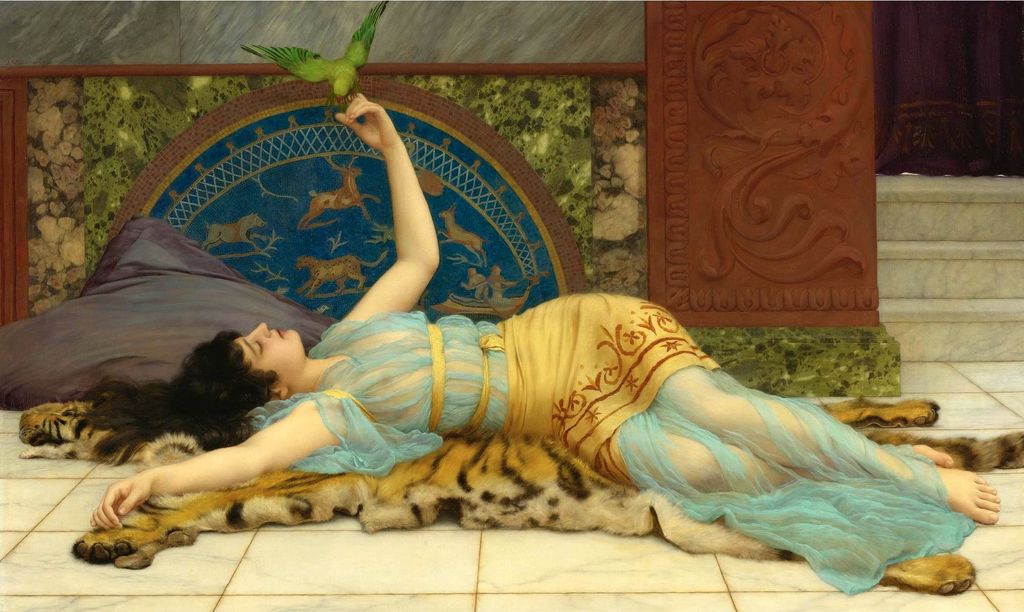
John William Godward, Dolce Far Niente (1897). A parrot supplies a different small action in the reclining figure’s scene. Image source. Public domain.
The Evans letter, sales and exhibition
The earliest dated document cited by Sotheby’s is a letter from Francis Michael Evans of Harrogate to Godward, dated 24 May 1906. The catalogue gives the date and correspondents, leaving the terms of the exchange open. It records Evans as owner by 1906 and lists Charles C. Wakefield next, before Evans acquired the work again at Christie’s in London on 18 June 1909, lot 136. The 1909 entry gives the painting a point of return to its earliest recorded owner. The terms of the first transfer between Evans and Wakefield and the exact wording of the Christie’s entry remain uncertain. [1]
Sotheby’s lists W. W. Sampson of London next, then W. L. Peacock, who acquired the painting in March 1911. In April it passed to the buyer named in the catalogue as Mr Mungall-Creiff. The next dated entry puts it with Leger Galleries, London, by 1973. A private US collection offered it at Sotheby’s in New York on 12 February 1997, lot 82. The later record names Anderson Galleries of Beverly Hills and a private buyer who acquired it from that gallery. These entries trace the painting’s journey across the Atlantic and through the trade without supplying dates for every handover. [1]
The Bruce Museum in Greenwich, Connecticut exhibited the painting in 1999 in Elegance and Opulence: Art of the Gilded Age. Sotheby’s gives page 7, figure 12 for the exhibition publication. A contemporary William Morris Society notice describes a show of roughly seventy works from a Greenwich private collection and points out how unusually broad its selection was, with British classicists including Leighton and Alma-Tadema shown alongside artists such as Bouguereau, Gérôme and Tissot. Godward’s terrace thus appeared in a public display that placed British pictures of antiquity alongside other nineteenth-century traditions. [1] [15]
The canvas in 2012
When The Quiet Pet appeared as lot 80 at Sotheby’s in 2012, Simon Parkes Art Conservation reported that the canvas had been lined using a synthetic, acid-free adhesive. Lining adds a secondary support behind the original canvas. Parkes described the surface as clean and varnished and identified one apparent area of retouching. It followed a diagonal about two inches long just to the right of the left-hand archway in the marble parapet. The same stretch of parapet has prominent diagonal veining. The report locates the retouching in that area, but an ordinary reproduction cannot tell us which marks Parkes saw as later paint. [1]
John William Godward artworks directory
Search documented oil paintings, drawings, watercolours and reproductive prints. The directory includes the Art Renewal Center’s catalogue and additional works in museum, exhibition and sale records.
| Name | Date | Medium |
|---|---|---|
| Absence Makes the Heart Grow Fonder | 1912 | Oil on canvas |
| Amaryllis | 1903 | Oil on canvas |
| An Amateur | 1915 | Oil on canvas |
| Ancient Pastimes | 1916 | Oil on canvas |
| The Answer | 1917 | Oil on canvas |
| An Arcadian Beauty | 1899 | Painting |
| At the Fountain | 1893 | Oil on canvas |
| At the Garden Door | 1901 | Oil on canvas |
| At the Garden Shrine, Pompeii | 1892 | Oil on canvas |
| At the Gate of the Temple | 1898 | Oil on canvas |
| At the Thermae | 1909 | Oil on canvas |
| Atalanta | 1892 | Oil on canvas |
| Athenais | 1908 | Oil on canvas |
| An Auburn Beauty | 1895 | Oil on canvas |
| Autumn | 1900 | Oil on canvas |
| Beauty in a Marble Room | 1894 | Oil on canvas |
| The Belvedere | 1913 | Oil on canvas |
| The Betrothed | 1892 | Oil on canvas |
| The Betrothed (print after Godward) | 1893 | Photoengraving, as reported |
| The Bouquet | 1899 | Oil on canvas |
| Briseis | 1896 | Painting |
| The Broken Vase | 1889 | Oil on canvas |
| By the Blue Ionian Sea | 1916 | Oil on canvas |
| By the Wayside | 1912 | Oil on canvas |
| Byrsina | 1915 | Painting |
| Campaspe | 1896 | Oil on canvas |
| Campaspe (print after Godward) | Print, process unconfirmed | |
| Chloris (A Summer Rose) | 1902 | Oil on canvas |
| Classical Beauty | Oil on canvas | |
| A Classical Beauty | Oil on canvas | |
| A Classical Beauty | Painting | |
| A Classical Beauty | Oil on canvas | |
| A Classical Beauty | 1909 | Oil on canvas |
| A Classical Beauty In Profile | Oil on canvas | |
| A Classical Lady | 1908 | Oil on canvas |
| Clymene | 1892 | Oil on canvas |
| A Congenial Task | 1915 | Oil on canvas |
| Contemplation | 1922 | Oil on canvas |
| A Cool Retreat | 1910 | Oil on canvas |
| Country House in the 18th Century | c. 1883 | Oil on canvas |
| Cytheris | 1922 | Painting |
| The Day Dream | 1920 | Oil on canvas |
| The Delphic Oracle | 1899 | Oil on canvas |
| A Dilettante | 1922 | Oil on canvas |
| Distant Thoughts | 1918 | Oil on canvas |
| Dolce Far Niente | 1897 | Oil on canvas |
| Dolce Far Niente | 1906 | Oil on canvas |
| Dolce far niente (A Pompeian Fishpond) | 1904 | Oil on canvas |
| Dolce far niente (coloured print after Godward) | Exhibited 1900 | Coloured print, exact process unconfirmed |
| Dolce far niente (grapes) | 1907 | Oil on canvas |
| Dora | 1887 | Oil on canvas |
| Drusilla | 1906 | Oil on canvas |
| An Edition de Luxe | 1920 | Oil on canvas |
| Eighty and Eighteen | 1898 | Oil on canvas |
| Endymion | 1893 | Oil on canvas |
| The Engagement Ring (horizontal composition) | 1888 | Oil on canvas |
| The Engagement Ring (upright composition) | c. 1891 | Oil on canvas |
| Erato at Her Lyre | Oil on canvas | |
| A Fair Reflection | 1915 | Oil on canvas |
| A Fair Reflection (Taber-Prang print) | By 1923 | Sepia artotype |
| Far Away Thoughts (circular sewing scene) | 1911 | Oil on canvas |
| Far Away Thoughts (left-facing profile) | 1892 | Oil on canvas |
| Far Away Thoughts (right-facing profile) | 1892 | Oil on canvas |
| Female Figure (probable Grecian Idyll study) | 1907 | Oil on board |
| Flabellifera | 1905 | Oil on canvas |
| Flabellifera (painted study) | c. 1905 | Oil study |
| Flabellifera (pencil study) | c. 1905 | Pencil on paper |
| The Flower Girl | Painting | |
| A Flower Seller | 1896 | Oil on canvas |
| The Flowers of Venus | 1890 | Oil on canvas |
| A Fond Farewell | 1918 | Watercolour |
| The Fragrant Rose | 1892 | Painting |
| The Fruit Vendor | 1917 | Oil on canvas |
| A Garland Seller | 1914 | Painting |
| Giotto Drawing from Nature | Painting | |
| Girl in Yellow Drapery | 1901 | Oil on canvas |
| Golden Hours | 1913 | Oil on canvas |
| A Grecian Girl | 1908 | Oil on canvas |
| Grecian Idyll | 1907 | Oil on canvas |
| A Grecian Lovely | 1909 | Oil on canvas |
| Grecian Reverie | 1889 | Oil on canvas |
| Grecian Reverie | 1889 | Oil on canvas |
| A Greek Beauty | 1905 | Oil on canvas |
| A Happy Awakening | 1903 | Oil on canvas |
| He Loves Me, He Loves Me Not | 1896 | Oil on canvas |
| A head and shoulders profile portrait of a young woman wearing a white tunic style blouse | c. 1889 | Painting |
| Head of a Girl (The Priestess) | 1896 | Oil on canvas |
| Heart on her Lips and Soul within her Eyes | 1904 | Painting |
| His Birthday Gift | 1889 | Oil on canvas |
| Ianthe | 1889 | Oil on canvas |
| An Idle Hour | 1890 | Oil on canvas |
| Idle Moments | 1895 | Oil on canvas |
| Idle Thoughts | 1898 | Oil on canvas |
| Idleness | 1900 | Oil on canvas |
| Il Dolce Far Niente (Pears print after Amaryllis) | 1906 | Chromolithograph |
| Il Dolce far niente (seated figure) | 1893 | Oil on canvas |
| In Expectation | c. 1892 | Oil on canvas |
| In Realms of Fancy | 1911 | Oil on canvas |
| In the Prime of the Summertime (Reverie) | 1914 | Oil on canvas |
| In the Tepidarium | 1913 | Oil on canvas |
| Innocent Amusements | 1891 | Oil on canvas |
| Ione | c. 1896-1898 | Oil on canvas |
| Ionian Dancing Girl | 1902 | Oil on canvas |
| Ismenia | 1908 | Oil on canvas |
| An Italian Beauty | 1897 | Oil on canvas |
| An Italian Girls' Head | 1902 | Oil on canvas |
| The Jewel Casket | 1900 | Oil on canvas |
| Julia | 1914 | Painting |
| Knuckle Bones | 1890 | Oil on canvas |
| La Pensierosa | 1913 | Oil on canvas |
| A Lady | 1895 | Oil on canvas |
| Landscape: Blossoming Red Almond [study] | c. 1912 | Oil on panel |
| Le Billet Doux (The Love Letter) | 1913 | Oil on canvas |
| Leaning Against a Column | 1901 | Painting |
| Leaning on the Balcony | 1892 | Oil on canvas |
| Leisure Hours | 1905 | Oil on canvas |
| Lesbia with her Sparrow | 1916 | Oil on canvas |
| The Letter | 1899 | Painting |
| Liegende | 1893 | Oil on canvas |
| A Lily Pond | 1917 | Oil on canvas |
| Looking Out to Sea | 1918 | Pencil and watercolour |
| The Love Letter (circular composition) | 1907 | Oil on canvas |
| Lucilia | 1917 | Oil on canvas |
| Lycinna | 1918 | Oil on canvas |
| Marcella | 1912 | Painting |
| Matrona Superba | Oil on canvas | |
| Megilla | 1921 | Oil on canvas |
| A Melody | 1904 | Oil on canvas |
| Memories | c. 1891 | Oil on canvas |
| Mirinna | Painting | |
| The Mirror | 1899 | Oil on canvas |
| Mischief | 1905 | Oil on canvas |
| Mischief and Repose | 1895 | Oil on canvas |
| A Mouse in the Work Basket | 1893 | Oil on canvas |
| Nerissa | 1906 | Oil on canvas |
| The New Perfume | 1914 | Oil on canvas |
| Noon Day Rest | 1910 | Oil on canvas |
| Nu Sur La Plage | 1922 | Oil on panel |
| Nude Study | Oil on canvas | |
| An Offering to Venus | 1912 | Oil on canvas |
| The Old, Old Story | Oil on canvas | |
| The Old, Old Story | 1903 | Oil on canvas |
| On the Balcony | 1911 | Oil on canvas |
| On The Terrace | 1918 | Oil on canvas |
| Ophelia | Oil on panel | |
| The Peacock Fan | 1912 | Oil on canvas |
| Phyleis | 1908 | Oil on canvas |
| The Playground | 1892 | Oil on canvas |
| Playtime | 1891 | Oil on canvas |
| A Pompeian Bath | 1890 | Oil on canvas |
| A Pompeian Lady | 1891 | Oil on canvas |
| A Pompeian Lady | 1895 | Oil on board |
| A Pompeian Lady | 1901 | Painting |
| A Pompeian Lady | 1904 | Painting |
| Portrait of Mary Frederica 'Nin' Godward | c. 1882-1883 | Oil on canvas |
| Portrait of Mary Perkinton Godward | c. 1880-1881 | Watercolor |
| The Posy | 1900 | Painting |
| A Priestess (bare-shouldered figure) | 1893 | Oil on canvas |
| A Priestess (clothed composition) | 1894 | Oil on canvas |
| A Priestess (W. Biscombe Gardner after Godward) | Exhibited 1897 | Print, process unconfirmed |
| A Priestess of Bacchus | 1890-1890 | Oil on canvas |
| Pyrallis | 1918 | Oil on canvas |
| The Quiet Pet | 1906 | Oil on canvas |
| A Red, Red Rose | 1920 | Oil on canvas |
| Reflections | 1893 | Oil on canvas |
| The Rendezvous | 1903 | Oil on canvas |
| Repose, the Flower Girl | c. 1887 | Oil on canvas |
| Reverie | 1888 | Oil on panel |
| Reverie | 1912 | Oil on canvas |
| Reverie (In the Days of Sappho) | 1904 | Oil on canvas |
| Reverie (Pears print after In the Prime of the Summertime) | 1916 | Chromolithograph |
| 'Rich Gifts Wax Poor When Lovers Prove Unkind' | 1916 | Oil on canvas |
| The Ring | 1898 | Oil on canvas |
| A Roman Matron | 1905 | Oil on canvas |
| Sabinella | 1912 | Oil on canvas |
| Sappho | 1910 | Oil on canvas |
| The Siesta | Oil on canvas | |
| A Siesta | 1895 | Oil on canvas |
| The Signal | 1899 | Oil on canvas |
| Sitting for Her Portrait | 1893 | Oil on canvas |
| Sketch for Amaryllis | 1903 | Oil on board |
| A Souvenir | 1920 | Oil on canvas |
| Stesicrate | 1914 | Oil on canvas |
| Study for 'Rêverie' | 1890 | Oil on canvas |
| Study for 'The Priestess' | 1895 | Oil on board |
| Study for An Egyptian Minstrel | 1906 | Painting |
| Study for The New Perfume | Drawing, medium unconfirmed | |
| Study for ‘The Old, Old Story’ | 1903 | Oil paint on wood |
| Study of a Girl's Head | 1899 | Painting |
| Study of Campaspe | Oil on canvas | |
| Study of Head and Drapery, Miss Ethel Warwick | 1898 | Painting |
| Summer Day | 1897 | Painting |
| Summer Flowers | 1903 | Oil on canvas |
| Sweet Dreams | 1901 | Oil on canvas |
| Sweet Dreams | 1904 | Painting |
| The Sweet Siesta of a Summer's Day | 1891 | Oil on canvas |
| The Tambourine Girl (profile at the marble wall) | 1906 | Oil on canvas |
| The Tambourine Girl (relief-backed version) | 1906 | Oil on canvas |
| Tender Thoughts | 1917 | Oil on canvas |
| Tender Thoughts (woman leaning over a parapet) | 1918 | Pencil and watercolour |
| The Tiff (oil) | By 1888 | Oil on canvas |
| The Tiff (print after Godward) | 1894 | Photogravure |
| The Tigerskin | 1889 | Oil on canvas |
| The Time of Roses | 1916 | Oil on canvas |
| Tranquillity | 1914 | Oil on canvas |
| A Tryst | 1912 | Oil on canvas |
| Tympanistria | 1909 | Oil on canvas |
| Under the Blossom that Hangs on the Bough | 1917 | Oil on canvas |
| Venus at the Bath | 1901 | Oil on canvas |
| Venus Binding Her Hair | 1897 | Oil on canvas |
| Violets, Sweet Violets | 1906 | Painting |
| Waiting for an Answer | 1889 | Oil on canvas |
| Waiting for the Procession | 1890 | Oil on canvas |
| Waiting for the Procession | 1890 | Painting |
| The Water Carrier (magazine reproduction of At the Fountain) | 1898 | Magazine reproduction |
| When the Heart is Young | 1902 | Oil on canvas |
| Who Can They Be | Painting | |
| Winding Wool | 1894 | Painting |
| 'With Violets Wreathed and Robe of Saffron Hue' | 1902 | Oil on canvas |
| The Yellow Shawl | 1893 | Painting |
| 'Yes or No?' | 1893 | Oil on canvas |
| Young Girl Picking Grapes | 1902 | Oil on canvas |
| Youth and Time | 1901 | Oil on canvas |
Discussion
Look again at the images and ideas explored in The Quiet Pet by John William Godward. These editorial prompts invite your observations.
Reader Insights
What makes you notice the small tortoise?
How do the cherries bring the woman and the animal into the same action?
Join the Conversation
Share a detail, comparison or question about The Quiet Pet by John William Godward below.
References
- Sotheby’s and Simon Parkes Art Conservation. The Quiet Pet, 2012 sale N08847, lot 80. Signed oil, original sale photograph, provenance, exhibition and literature records, catalogue note and 2012 condition report. Catalogued in Vern G. Swanson’s John William Godward: The Eclipse of Classicism (1997), no. 1906.7, p. 217, illustrated p. 83, as cited by Sotheby’s. View source.
- The Betrothed. View source.
- Girl in Yellow Drapery. View source.
- When the Heart is Young. View source.
- Dolce far niente (A Pompeian Fishpond). View source.
- Noon Day Rest. View source.
- Sotheby’s. Golden Hours (Expectancy), 2010 sale N08673, lot 53. Signed 1913 oil on canvas, catalogue note and photograph. View source.
- Art Renewal Center. Dolce far niente, record 1103. Reproduction of the 1904 pond and fountain composition. View source.
- Rijksmuseum. Quiet Pets, Charles Oliver Murray after Lawrence Alma-Tadema, RP-P-1904-1453. Etching and drypoint on paper, dated about 1887 in the Dutch catalogue. View source.
- The Art Journal. 1883 volume, Murray’s Quiet Pets frontispiece, plate list and discussion of Alma-Tadema’s painting in the Grosvenor Gallery. View source.
- Marta Chiara Olimpia Nicosia. L’art de la rêverie: Female Daydreams in Nineteenth Century Painting, IMT Institute for Advanced Studies, Lucca, 2015, pp. 162–163 and figs. 105–107. Doctoral thesis in English. View source.
- Sotheby’s. Idleness, 2007 sale L07131, lot 25. Signed 1900 oil on canvas with kitten and feather. View source.
- Sotheby’s. Dolce Far Niente, 2010 sale N08630, lot 64. Signed 1897 oil on canvas with parrot. View source.
- J. Paul Getty Museum. Mischief and Repose, 1895, object 79.PA.149. Collection record and photograph. View source.
- William Morris Society in the United States. “‘Elegance and Opulence’ in Connecticut”, Newsletter, January 2000. Contemporary notice of the 1999 Bruce Museum exhibition. View source.