 by Tom Gurney
Tom Gurney BSc (Hons) is an art history expert with over 20 years experience
Published on June 19, 2020 / Updated on October 14, 2023
Email: tomgurney1@gmail.com / Phone: +44 7429 011000
Lycinna: Introduction
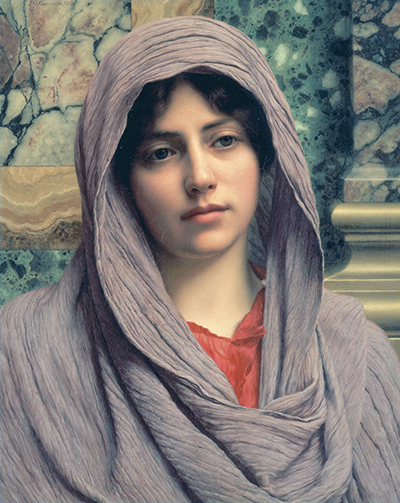
A woman looks out from a hood of grey-violet cloth in John William Godward’s Lycinna. Both eyes are visible, though the face is turned slightly, and the cloth hangs lower on one side of the opening than on the other. Above her forehead, dark hair emerges from beneath the hood. Below her chin, a patch of red shows through the layered folds. A wall of coloured stone fills the narrow space around her. The oil on canvas is signed and dated 1918 at the upper left. Sotheby’s records Godward’s name on the back as well, together with the title and the inscription “ROME. 1918”. The catalogue photograph’s record on Wikimedia Commons gives the dimensions as 51 × 40 cm. [1] [2]
At a Glance
- Date1918
- MediumOil on canvas
- Dimensions51 × 40 cm
This work across John William Godward’s career
Far Away Thoughts
1892 [3]A Fair Reflection
1915 [6]Tender Thoughts
1917 [7]Contents
- The face inside the hood
- Who was Lycinna?
- Two veiled women inscribed Rome, 1918
- Godward’s classical figures and the sale record
- Annotated details
The face inside the hood
The face is close to frontal, with enough of a turn for the two sides to catch the light differently. A shadow under the cloth deepens at the temple on the viewer’s left. The forehead, cheek and side of the neck on the right catch more light. The eyes sit just below the dark fringe, their pupils directed almost straight out of the painting. The mouth is closed, and the lighting makes the volume of the lower lip clearer than the corner of the mouth in shadow. The small differences between the two sides keep the pose from settling into symmetry, even with the head near the middle of the canvas. [2]
The hood supplies several outlines for the same head. Its outer edge makes a broad arc against the stone. Within it, the cloth bends into a shallower arch above the hair, then drops in almost vertical folds beside the cheeks. A few fine shadows beneath those folds are close in colour to the hair itself. At the lower edge of the opening the cloth overlaps itself and pulls sideways across the chest. Your eye can follow the ridges from the arch down around the face and back across the shoulders. The cloth holds the head in a clear outline even where the dark tones of hair and shadow meet. [2]
The fabric runs from dusty lilac on its highest ridges to a dark plum-grey in the folds. Fine parallel lines spread over the shoulder at the left, then gather more tightly where the fabric bends below the chin. The red neckline, with tiny ridges of its own, gives the violet an unexpectedly warm neighbour. Its brightest area sits beneath the softly lit neck. Godward describes that small fold of material with a sharper interruption of colour than he uses for most of the transitions within the skin. [2]
Behind this gathering and sagging cloth, straight seams divide the wall. Near the upper left, dark branching veins run across stone patterned in cream, pink and grey-green. Below them, a narrow ochre band has a thin pale streak that swells and recedes as it travels across the panel. The darker green patches farther down and to the right have a broken, granular appearance. At the right edge of the painting, a projecting moulding catches light along its rounded lip. It briefly carries the eye sideways out of the soft folds and gives the shallow setting a little depth. Godward paints lines in every part of the picture, but the folds pull under their own weight while the veins stop at the joins in the stone. [2]
Who was Lycinna?
Sotheby’s connected the name to the Roman poet Propertius, whose Elegies include a poem about an earlier lover called Lycinna. In Book 3, Elegy 15, the speaker brings her up while trying to reassure Cynthia, the woman he now loves. He remembers setting aside the garment of Roman boyhood and beginning his education in love. Lycinna was his confidante in those first encounters, he says, and gifts had played no part in winning her. Nearly three years have passed, and he now claims to remember scarcely ten words between them. By putting these professions of forgetfulness so close to the vivid memory of his initiation, Propertius leaves room for readers to hear how hard the speaker is working to make the past sound safely over. [1] [8] [9]
The speaker then turns to a story from Greek myth. Dirce mistreats Antiope over her relationship with Lycus, and Antiope’s sons eventually avenge their mother by tying Dirce to a bull. This story takes up most of the poem. It lends force to the plea that Cynthia leave Lycinna alone, even as the speaker returns to promising Cynthia his fidelity. P. J. F. Gantillon’s nineteenth-century edition treats Lycinna as Cynthia’s servant, an interpretation the auction catalogue also gives. In his study of jealousy in Latin love poetry, Fabio Nolfo likewise reads her as enslaved and discusses the role of myth in shaping the elegy’s love triangle. The verse itself depicts Antiope doing the forced labour. Lycinna’s position in Cynthia’s household is an inference from the parallels readers see between myth and the speaker’s account. [1] [8] [9] [10] [11]
The shared name makes the elegy an attractive source for the title, though Godward’s reason for choosing it remains unrecorded. The poem gives Lycinna no speech and very little space in a dispute recounted by someone else. In the painting she is the only figure, and her gaze holds the space where another participant might have been. There is no episode from the story to identify by an object, a gesture or the presence of Cynthia. The name on the back is good evidence for Godward’s title. The identity of the woman who posed and the connection he intended between her image and the poem remain open. [1] [2] [8] [9]
Annotated Details from Lycinna
The numbered points identify visible features discussed in this article. Return from each detail to the numbered overview. John William Godward, Lycinna (1918). Image source. Public domain.
.jpg)
Details from LYCINNA
Compare the cropped details with the source images above. Notice how their colours, shapes and positions contribute to the larger compositions.
The gaze inside the hood
The face is lit unevenly beneath the hood, and the eyes look sideways from within the dark opening.
 Detail 01 the-gaze-inside-the-hood.jpg)
The folds around the red cloth
The grey bands turn at different angles around a triangle of red fabric at her throat.
 Detail 02 the-folds-around-the-red-cloth.jpg)
Marble and woven cloth
Small veins in the green stone set off the regular lines of the cloth and the arc of the hood.
 Detail 03 marble-and-woven-cloth.jpg)
John William Godward videos
See Godward’s paintings and studio practice alongside films on two Victorian contemporaries.
John William Godward - Part 1: The Last Painter of the Victorian Age
An overview of Godward’s career and the Victorian market for pictures set in antiquity.
Watch on YouTubeTwo veiled women inscribed Rome, 1918
Godward painted another close view of a veiled woman in 1918. Pyrallis is an oil on canvas measuring 50 × 40 cm, almost the size of Lycinna. Sotheby’s records a signature and date on its front and the title, signature and Rome date on the back. The catalogue explicitly compares the two paintings. It also points to another name from ancient literature. A woman called Pyrallis appears in Suetonius’s Life of Caligula, where she is mentioned among the emperor’s lovers. The auction essay reads that name as a way of evoking antiquity, with the sitter’s identity a separate question. [12] [13]
In both pictures the cloth turns over the crown of the head and its ends gather in a broad sweep below the throat. In Pyrallis, the cloth is rose pink, with a lit edge so bright it seems to glow on the left of the picture. The woman lowers her lids and turns towards that light. Beyond her, a strip of blue water and distant hills are visible between the edge of the canvas and the hood. Leaves overhang that opening. In Lycinna the wall continues behind the figure, right up to the top of the painting. The light picks out the ridges of the cloth, and the warm red is confined to the small opening at her neck. The close cut is much the same in the two pictures, but the view outside Pyrallis gives the eye somewhere else to travel. In Lycinna the eyes and mouth keep drawing it back. The repeated arrangement makes the altered direction of the gaze especially easy to see. [2] [12]
The head in the Art Renewal Center’s 1892 Far Away Thoughts also fills much of its canvas. That face is in left profile. One eye is visible, and the forehead, nose and lips stand out in a single contour. Auburn hair follows a longer arc over the crown and opens into a bun. The neckline runs diagonally across the chest towards a clasp at the shoulder. In Lycinna the cloth encloses the contours of the head, and colour and shadow define features seen mostly from the front. The earlier picture shows how much Godward could already do with the angle of a face and the limited surroundings allowed by a close crop. [2] [3]
The signed 1914 Julia offers a different use of the same kind of individual title. The woman there lifts both arms to arrange her hair, and her lowered face is one part of an action that continues through the mirror and dressing table. Godward revisited that arrangement in A Fair Reflection. In Lycinna, the hands are outside the frame. The figure has just the face, the direction of the eyes and the layers of cloth with which to make her presence felt. [1] [2] [14]
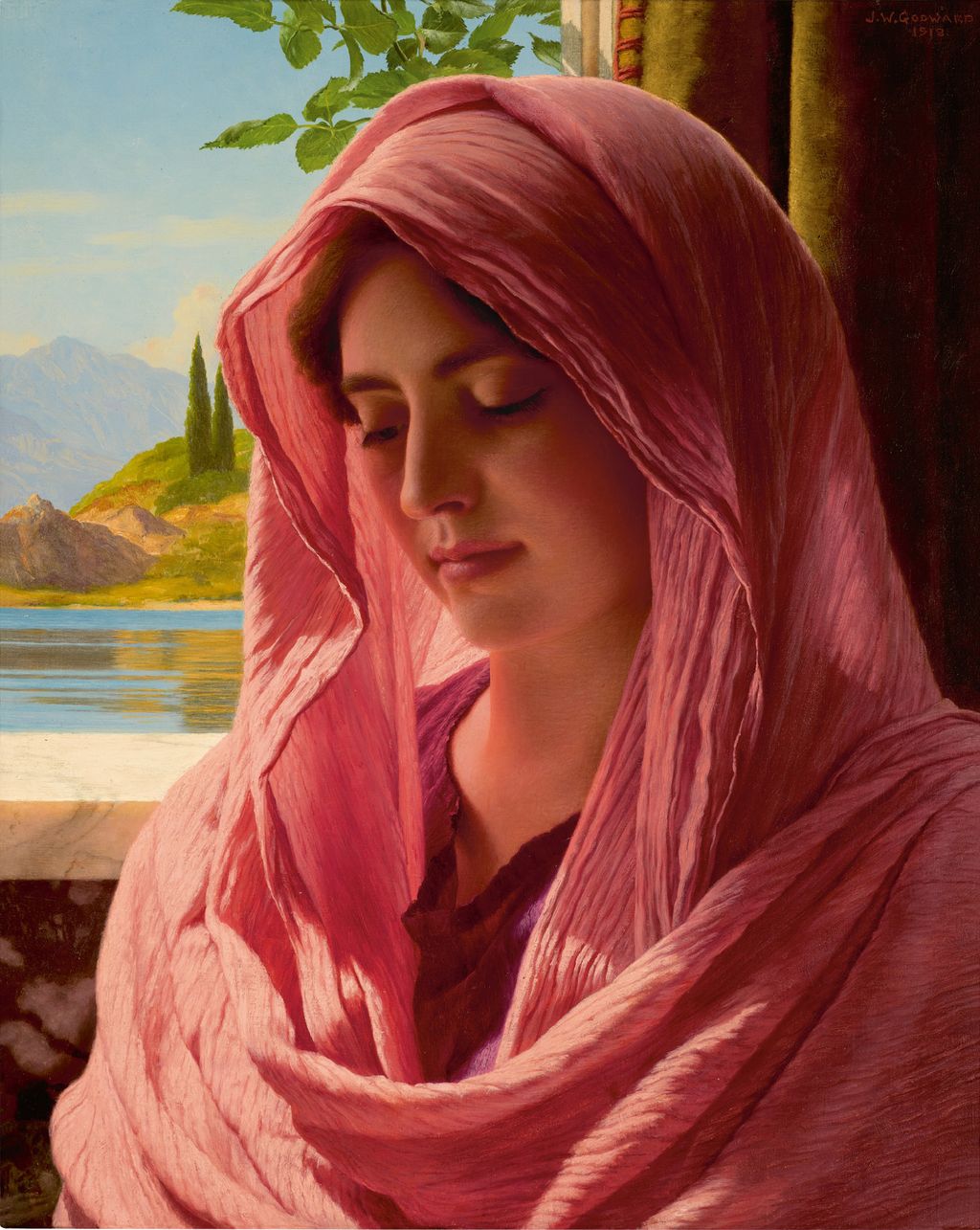
John William Godward, Pyrallis (1918). The deeper-coloured cloth frames a lowered gaze in this separate painting with the same year on the reverse. Image source. Public domain.
Godward’s classical figures and the sale record
Two assessments quoted in Sotheby’s catalogue describe what this concentration achieves in different ways. In Olympian Dreamers, Christopher Wood drew attention to Godward’s handling of classical robes and marble, and saw something of Frederic Leighton’s monumentality in his figures. Joseph A. Kestner, in Mythology and Misogyny, likewise recognised Leighton’s example, giving greater weight to what the drapery and figure contribute as decoration. Lycinna gives both accounts something to work with. The hood is a broad shape against rectangular stone panels, and its ridges make patterns in places where no gesture is visible. The figure can also feel imposing in a small picture. Her shoulders extend to both sides of the canvas, and there is little distance between the painted space she occupies and the person looking in. [1] [2]
The Rome inscription dates from Godward’s years at the Villa Strohl-Fern, where he worked in a studio on the estate. The artist’s biography traces his years there through letters, recollections and surviving records. In her study of the villa, Giovanna Caterina de Feo traces him in the Roman Guida Monaci directory, which lists him as “G. Goduard”. Her references include the 1918 directory, the year named on the painting. The directory documents the artist’s address. The inscription associates this particular canvas with Rome and gives the same year as the signature on the front. [1] [15]
Sotheby’s offered the painting in London on 17 December 2009, as lot 11. Its catalogue cites the 1997 edition of Vern Grosvenor Swanson’s John William Godward: The Eclipse of Classicism, p. 242, which lists the painting as no. 1918.7. The recorded ownership trail names Christie’s, 6 March 1970, lot 136, followed by Leger Galleries in London and a private collection. The dates of the gallery’s involvement and the painting’s present whereabouts remain unconfirmed. The condition report describes the original canvas as unlined in 2009, meaning it had no second canvas attached to reinforce it. It records very fine cracks in the paint near the face, with small filled areas detected under ultraviolet examination. The work was under glass in a moulded plaster frame with a wooden surround, and parts of the moulding were lifting. The report describes the painting and its frame as they were when examined for sale. [1] [16]
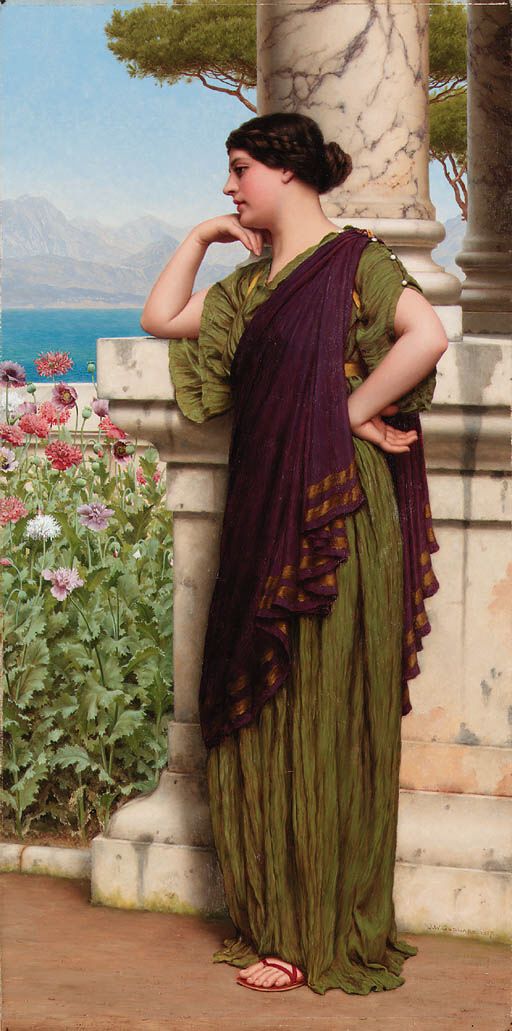
John William Godward, Tender Thoughts (1917), oil. The comparable oil keeps its name, place and year in a recorded inscription on the reverse. Image source. Public domain.
John William Godward artworks directory
Search documented oil paintings, drawings, watercolours and reproductive prints. The directory includes the Art Renewal Center’s catalogue and additional works in museum, exhibition and sale records.
| Name | Date | Medium |
|---|---|---|
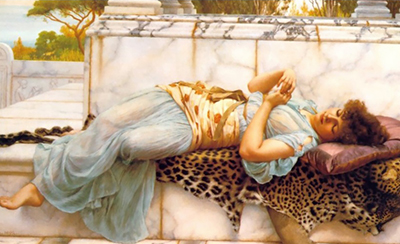
| Absence Makes the Heart Grow Fonder | 1912 | Oil on canvas |
| Amaryllis | 1903 | Oil on canvas |
| An Amateur | 1915 | Oil on canvas |
| Ancient Pastimes | 1916 | Oil on canvas |
| The Answer | 1917 | Oil on canvas |
| An Arcadian Beauty | 1899 | Painting |
| At the Fountain | 1893 | Oil on canvas |
| At the Garden Door | 1901 | Oil on canvas |
| At the Garden Shrine, Pompeii | 1892 | Oil on canvas |
| At the Gate of the Temple | 1898 | Oil on canvas |
| At the Thermae | 1909 | Oil on canvas |
| Atalanta | 1892 | Oil on canvas |
| Athenais | 1908 | Oil on canvas |
| An Auburn Beauty | 1895 | Oil on canvas |
| Autumn | 1900 | Oil on canvas |
| Beauty in a Marble Room | 1894 | Oil on canvas |
| The Belvedere | 1913 | Oil on canvas |
| The Betrothed | 1892 | Oil on canvas |
| The Betrothed (print after Godward) | 1893 | Photoengraving, as reported |
| The Bouquet | 1899 | Oil on canvas |
| Briseis | 1896 | Painting |
| The Broken Vase | 1889 | Oil on canvas |
| By the Blue Ionian Sea | 1916 | Oil on canvas |
| By the Wayside | 1912 | Oil on canvas |
| Byrsina | 1915 | Painting |
| Campaspe | 1896 | Oil on canvas |
| Campaspe (print after Godward) | Print, process unconfirmed | |
| Chloris (A Summer Rose) | 1902 | Oil on canvas |
| Classical Beauty | Oil on canvas | |
| A Classical Beauty | Oil on canvas | |
| A Classical Beauty | Painting | |
| A Classical Beauty | Oil on canvas | |
| A Classical Beauty | 1909 | Oil on canvas |
| A Classical Beauty In Profile | Oil on canvas | |
| A Classical Lady | 1908 | Oil on canvas |
| Clymene | 1892 | Oil on canvas |
| A Congenial Task | 1915 | Oil on canvas |
| Contemplation | 1922 | Oil on canvas |
| A Cool Retreat | 1910 | Oil on canvas |
| Country House in the 18th Century | c. 1883 | Oil on canvas |
| Cytheris | 1922 | Painting |
| The Day Dream | 1920 | Oil on canvas |
| The Delphic Oracle | 1899 | Oil on canvas |
| A Dilettante | 1922 | Oil on canvas |
| Distant Thoughts | 1918 | Oil on canvas |
| Dolce Far Niente | 1897 | Oil on canvas |
| Dolce Far Niente | 1906 | Oil on canvas |
| Dolce far niente (A Pompeian Fishpond) | 1904 | Oil on canvas |
| Dolce far niente (coloured print after Godward) | Exhibited 1900 | Coloured print, exact process unconfirmed |
| Dolce far niente (grapes) | 1907 | Oil on canvas |
| Dora | 1887 | Oil on canvas |
| Drusilla | 1906 | Oil on canvas |
| An Edition de Luxe | 1920 | Oil on canvas |
| Eighty and Eighteen | 1898 | Oil on canvas |
| Endymion | 1893 | Oil on canvas |
| The Engagement Ring (horizontal composition) | 1888 | Oil on canvas |
| The Engagement Ring (upright composition) | c. 1891 | Oil on canvas |
| Erato at Her Lyre | Oil on canvas | |
| A Fair Reflection | 1915 | Oil on canvas |
| A Fair Reflection (Taber-Prang print) | By 1923 | Sepia artotype |
| Far Away Thoughts (circular sewing scene) | 1911 | Oil on canvas |
| Far Away Thoughts (left-facing profile) | 1892 | Oil on canvas |
| Far Away Thoughts (right-facing profile) | 1892 | Oil on canvas |
| Female Figure (probable Grecian Idyll study) | 1907 | Oil on board |
| Flabellifera | 1905 | Oil on canvas |
| Flabellifera (painted study) | c. 1905 | Oil study |
| Flabellifera (pencil study) | c. 1905 | Pencil on paper |
| The Flower Girl | Painting | |
| A Flower Seller | 1896 | Oil on canvas |
| The Flowers of Venus | 1890 | Oil on canvas |
| A Fond Farewell | 1918 | Watercolour |
| The Fragrant Rose | 1892 | Painting |
| The Fruit Vendor | 1917 | Oil on canvas |
| A Garland Seller | 1914 | Painting |
| Giotto Drawing from Nature | Painting | |
| Girl in Yellow Drapery | 1901 | Oil on canvas |
| Golden Hours | 1913 | Oil on canvas |
| A Grecian Girl | 1908 | Oil on canvas |
| Grecian Idyll | 1907 | Oil on canvas |
| A Grecian Lovely | 1909 | Oil on canvas |
| Grecian Reverie | 1889 | Oil on canvas |
| Grecian Reverie | 1889 | Oil on canvas |
| A Greek Beauty | 1905 | Oil on canvas |
| A Happy Awakening | 1903 | Oil on canvas |
| He Loves Me, He Loves Me Not | 1896 | Oil on canvas |
| A head and shoulders profile portrait of a young woman wearing a white tunic style blouse | c. 1889 | Painting |
| Head of a Girl (The Priestess) | 1896 | Oil on canvas |
| Heart on her Lips and Soul within her Eyes | 1904 | Painting |
| His Birthday Gift | 1889 | Oil on canvas |
| Ianthe | 1889 | Oil on canvas |
| An Idle Hour | 1890 | Oil on canvas |
| Idle Moments | 1895 | Oil on canvas |
| Idle Thoughts | 1898 | Oil on canvas |
| Idleness | 1900 | Oil on canvas |
| Il Dolce Far Niente (Pears print after Amaryllis) | 1906 | Chromolithograph |
| Il Dolce far niente (seated figure) | 1893 | Oil on canvas |
| In Expectation | c. 1892 | Oil on canvas |
| In Realms of Fancy | 1911 | Oil on canvas |
| In the Prime of the Summertime (Reverie) | 1914 | Oil on canvas |
| In the Tepidarium | 1913 | Oil on canvas |
| Innocent Amusements | 1891 | Oil on canvas |
| Ione | c. 1896-1898 | Oil on canvas |
| Ionian Dancing Girl | 1902 | Oil on canvas |
| Ismenia | 1908 | Oil on canvas |
| An Italian Beauty | 1897 | Oil on canvas |
| An Italian Girls' Head | 1902 | Oil on canvas |
| The Jewel Casket | 1900 | Oil on canvas |
| Julia | 1914 | Painting |
| Knuckle Bones | 1890 | Oil on canvas |
| La Pensierosa | 1913 | Oil on canvas |
| A Lady | 1895 | Oil on canvas |
| Landscape: Blossoming Red Almond [study] | c. 1912 | Oil on panel |
| Le Billet Doux (The Love Letter) | 1913 | Oil on canvas |
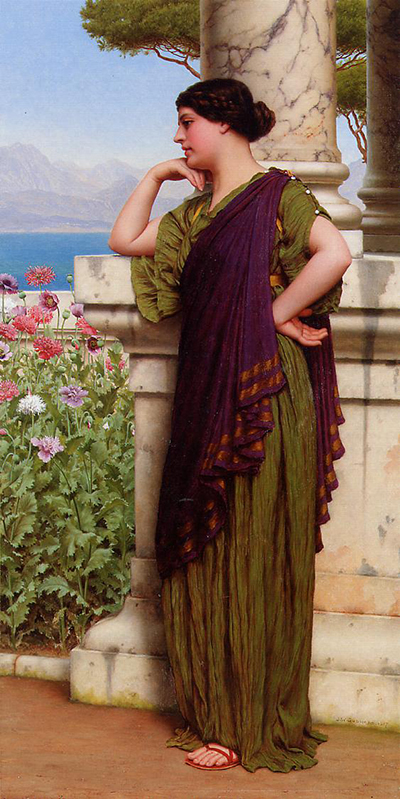
| Leaning Against a Column | 1901 | Painting |
| Leaning on the Balcony | 1892 | Oil on canvas |
| Leisure Hours | 1905 | Oil on canvas |
| Lesbia with her Sparrow | 1916 | Oil on canvas |
| The Letter | 1899 | Painting |
| Liegende | 1893 | Oil on canvas |
| A Lily Pond | 1917 | Oil on canvas |
| Looking Out to Sea | 1918 | Pencil and watercolour |
| The Love Letter (circular composition) | 1907 | Oil on canvas |
| Lucilia | 1917 | Oil on canvas |
| Lycinna | 1918 | Oil on canvas |
| Marcella | 1912 | Painting |
| Matrona Superba | Oil on canvas | |
| Megilla | 1921 | Oil on canvas |
| A Melody | 1904 | Oil on canvas |
| Memories | c. 1891 | Oil on canvas |
| Mirinna | Painting | |
| The Mirror | 1899 | Oil on canvas |
| Mischief | 1905 | Oil on canvas |
| Mischief and Repose | 1895 | Oil on canvas |
| A Mouse in the Work Basket | 1893 | Oil on canvas |
| Nerissa | 1906 | Oil on canvas |
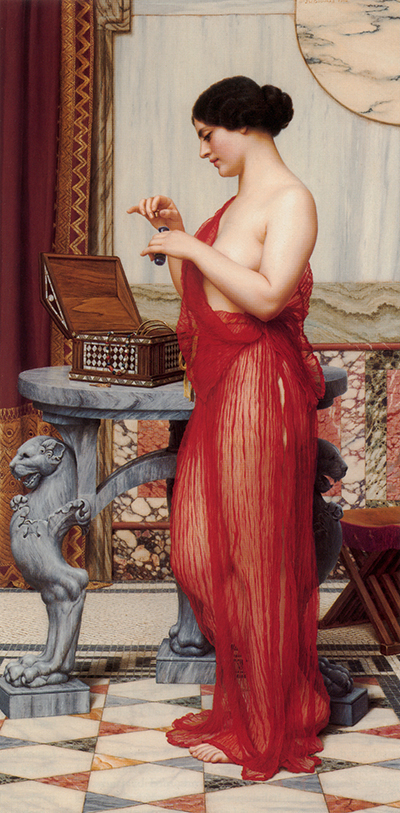
| The New Perfume | 1914 | Oil on canvas |
| Noon Day Rest | 1910 | Oil on canvas |
| Nu Sur La Plage | 1922 | Oil on panel |
| Nude Study | Oil on canvas | |
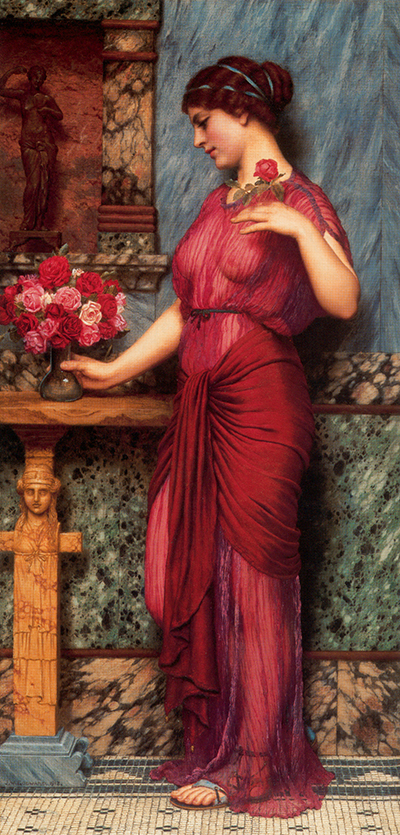
| An Offering to Venus | 1912 | Oil on canvas |
| The Old, Old Story | Oil on canvas | |
| The Old, Old Story | 1903 | Oil on canvas |
| On the Balcony | 1911 | Oil on canvas |
| On The Terrace | 1918 | Oil on canvas |
| Ophelia | Oil on panel | |
| The Peacock Fan | 1912 | Oil on canvas |
| Phyleis | 1908 | Oil on canvas |
| The Playground | 1892 | Oil on canvas |
| Playtime | 1891 | Oil on canvas |
| A Pompeian Bath | 1890 | Oil on canvas |
| A Pompeian Lady | 1891 | Oil on canvas |
| A Pompeian Lady | 1895 | Oil on board |
| A Pompeian Lady | 1901 | Painting |
| A Pompeian Lady | 1904 | Painting |
| Portrait of Mary Frederica 'Nin' Godward | c. 1882-1883 | Oil on canvas |
| Portrait of Mary Perkinton Godward | c. 1880-1881 | Watercolor |
| The Posy | 1900 | Painting |
| A Priestess (bare-shouldered figure) | 1893 | Oil on canvas |
| A Priestess (clothed composition) | 1894 | Oil on canvas |
| A Priestess (W. Biscombe Gardner after Godward) | Exhibited 1897 | Print, process unconfirmed |
| A Priestess of Bacchus | 1890-1890 | Oil on canvas |
| Pyrallis | 1918 | Oil on canvas |
| The Quiet Pet | 1906 | Oil on canvas |
| A Red, Red Rose | 1920 | Oil on canvas |
| Reflections | 1893 | Oil on canvas |
| The Rendezvous | 1903 | Oil on canvas |
| Repose, the Flower Girl | c. 1887 | Oil on canvas |
| Reverie | 1888 | Oil on panel |
| Reverie | 1912 | Oil on canvas |
| Reverie (In the Days of Sappho) | 1904 | Oil on canvas |
| Reverie (Pears print after In the Prime of the Summertime) | 1916 | Chromolithograph |
| 'Rich Gifts Wax Poor When Lovers Prove Unkind' | 1916 | Oil on canvas |
| The Ring | 1898 | Oil on canvas |
| A Roman Matron | 1905 | Oil on canvas |
| Sabinella | 1912 | Oil on canvas |
| Sappho | 1910 | Oil on canvas |
| The Siesta | Oil on canvas | |
| A Siesta | 1895 | Oil on canvas |
| The Signal | 1899 | Oil on canvas |
| Sitting for Her Portrait | 1893 | Oil on canvas |
| Sketch for Amaryllis | 1903 | Oil on board |
| A Souvenir | 1920 | Oil on canvas |
| Stesicrate | 1914 | Oil on canvas |
| Study for 'Rêverie' | 1890 | Oil on canvas |
| Study for 'The Priestess' | 1895 | Oil on board |
| Study for An Egyptian Minstrel | 1906 | Painting |
| Study for The New Perfume | Drawing, medium unconfirmed | |
| Study for ‘The Old, Old Story’ | 1903 | Oil paint on wood |
| Study of a Girl's Head | 1899 | Painting |
| Study of Campaspe | Oil on canvas | |
| Study of Head and Drapery, Miss Ethel Warwick | 1898 | Painting |
| Summer Day | 1897 | Painting |
| Summer Flowers | 1903 | Oil on canvas |
| Sweet Dreams | 1901 | Oil on canvas |
| Sweet Dreams | 1904 | Painting |
| The Sweet Siesta of a Summer's Day | 1891 | Oil on canvas |
| The Tambourine Girl (profile at the marble wall) | 1906 | Oil on canvas |
| The Tambourine Girl (relief-backed version) | 1906 | Oil on canvas |
| Tender Thoughts | 1917 | Oil on canvas |
| Tender Thoughts (woman leaning over a parapet) | 1918 | Pencil and watercolour |
| The Tiff (oil) | By 1888 | Oil on canvas |
| The Tiff (print after Godward) | 1894 | Photogravure |
| The Tigerskin | 1889 | Oil on canvas |
| The Time of Roses | 1916 | Oil on canvas |
| Tranquillity | 1914 | Oil on canvas |
| A Tryst | 1912 | Oil on canvas |
| Tympanistria | 1909 | Oil on canvas |
| Under the Blossom that Hangs on the Bough | 1917 | Oil on canvas |
| Venus at the Bath | 1901 | Oil on canvas |
| Venus Binding Her Hair | 1897 | Oil on canvas |
| Violets, Sweet Violets | 1906 | Painting |
| Waiting for an Answer | 1889 | Oil on canvas |
| Waiting for the Procession | 1890 | Oil on canvas |
| Waiting for the Procession | 1890 | Painting |
| The Water Carrier (magazine reproduction of At the Fountain) | 1898 | Magazine reproduction |
| When the Heart is Young | 1902 | Oil on canvas |
| Who Can They Be | Painting | |
| Winding Wool | 1894 | Painting |
| 'With Violets Wreathed and Robe of Saffron Hue' | 1902 | Oil on canvas |
| The Yellow Shawl | 1893 | Painting |
| 'Yes or No?' | 1893 | Oil on canvas |
| Young Girl Picking Grapes | 1902 | Oil on canvas |
| Youth and Time | 1901 | Oil on canvas |
Discussion
Look again at the images and ideas explored in Lycinna. These editorial prompts invite your observations.
Reader Insights
What does the hood make you notice about the eyes?
How much of the figure’s character comes from the paint, and how much from the title?
Join the Conversation
Share a detail, comparison or question about Lycinna below.
References
- Sotheby’s. John William Godward, Lycinna. London, 2009, lot 11. Inscriptions, provenance, condition, Swanson 1918.7, and excerpts from Christopher Wood, Olympian Dreamers (1983), p. 247, and Joseph A. Kestner, Mythology and Misogyny (1989), p. 338. English. View source.
- Sotheby’s, via Wikimedia Commons. Photograph of Lycinna. Reproduction and artwork dimensions. English. View source.
- Art Renewal Center. John William Godward, Far Away Thoughts. Record 10756, 1892, left-facing profile. English. View source.
- Sappho. View source.
- Le Billet Doux (The Love Letter). View source.
- A Fair Reflection. View source.
- Tender Thoughts. View source.
- Sextus Propertius. Elegies, book 3, poem 15. The Latin Library. Latin. View source.
- Sextus Propertius, translated by A. S. Kline. The Elegies, book 3, poem 15. Poetry in Translation. English translation. View source.
- Sextus Propertius, translated and annotated by P. J. F. Gantillon. The Elegies of Propertius, with Notes. George Bell & Sons, 1895, book 3, poem 15, introductory note. English. View source.
- Fabio Nolfo. “La gelosia delle donne nella poesia d’amore latina”, in Il teatro delle emozioni: la gelosia, Padova University Press, 2023, pp. 85–87. Italian. View source.
- Sotheby’s. John William Godward, Pyrallis. London, 11 July 2019, lot 33. Plate, dimensions, inscriptions and comparison with Lycinna. English. View source.
- Suetonius, translated by J. C. Rolfe. Life of Caligula, chapter 36. University of Chicago, LacusCurtius. English translation. View source.
- Sotheby’s. John William Godward, Julia. 2017, lot 8. Plate, dated signature and comparison to A Fair Reflection. English. View source.
- Giovanna Caterina de Feo. “Artisti e personalità nella Villa Strohl Fern tra il 1882 e il 1956. Elenco provvisorio”, in Alfred Wilhelm Strohl-Fern, Ghaleb Editore, 2010, pp. 103–104 and 114. References to Guida Monaci. Italian. View source.
- Sotheby’s. Victorian & Edwardian Art. London, 17 December 2009, sale L09688. English. View source.