 by Tom Gurney
Tom Gurney BSc (Hons) is an art history expert with over 20 years experience
Published on June 19, 2020 / Updated on October 14, 2023
Email: tomgurney1@gmail.com / Phone: +44 7429 011000
A Fair Reflection: Introduction
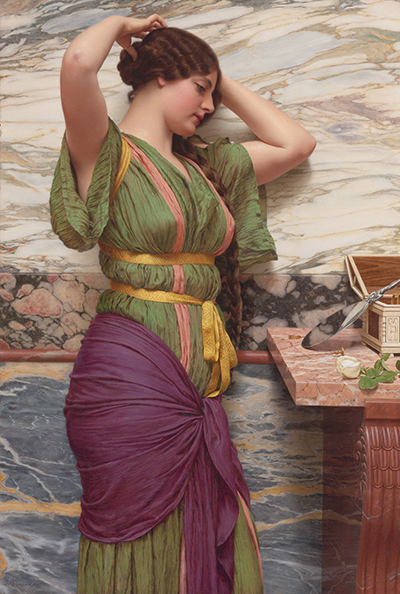
The woman in John William Godward’s A Fair Reflection has both arms raised to her hair. The fingers of one hand press into the dark coil at the back of her head. A thick braid falls over her shoulder and reaches almost to her waist. Her eyes are lowered towards the table beside her, where a hand mirror lies tilted against an open box. Look into it and you see a little of the room. Pale patches in the mirror pick up the pattern of the mottled stone behind it. The face the title leads us to expect stays in profile above. [1] [2]
Godward signed and dated the canvas 1915 at the lower left. The oil measures 116.8 × 80 cm (46 × 31½ in.) and appeared as lot 12 at Sotheby’s in New York on 4 May 2012. Its height gives the hairdressing gesture room to unfold at close to bodily scale, even though the canvas cuts the figure off well above her feet. The tall format also makes room below the table for an easily missed passage of reflected colour. [1] [2] [3]
At a Glance
- Date1915
- MediumOil on canvas
- Dimensions116.8 × 80 cm
This work across John William Godward’s career
Contents
- Hands, hair and the dressing table
- Marble in the mirror and under the table
- The same arrangement a year earlier
- Two paintings called A Fair Reflection
- What the 2012 sale records about the canvas
- Annotated details
Hands, hair and the dressing table
The hands are doing different jobs. The arm at the left of the picture reaches from behind, its fingers spread round the gathered hair. The other forearm runs beside the face and the hand disappears behind the head. The braid is still hanging while she attends to the hair already coiled at the back. You can see faint highlights across each turn of the braid and little wisps at the nape. The distance between that loose length and the coil suggests the time still needed to finish arranging it. [2]
One of the hairpins Sotheby’s identifies is especially clear. It lies in front of the mirror, with a ribbed golden head and a long shaft that nearly disappears into the tabletop’s veins. A smaller gilt piece lies beyond the mirror and gold-coloured shapes stand in the box. The Metropolitan Museum of Art has surviving Roman hairpins in materials as different as gold and bone. Godward describes the head of his painted pin with points of reflected light. Its exact material and any antique model for it remain uncertain. [1] [2] [9] [10]
The box has a reddish wood grain inside its lid and a small figure on a pale panel at the front. Its open lid rises diagonally from the table, and the handle of the mirror crosses in front of it. The stem and leaves of a pale rose extend over the front edge of the slab, breaking the hard line of the stone. Pin, rose and box occupy a narrow triangle of tabletop beneath the woman’s lowered gaze. [2]
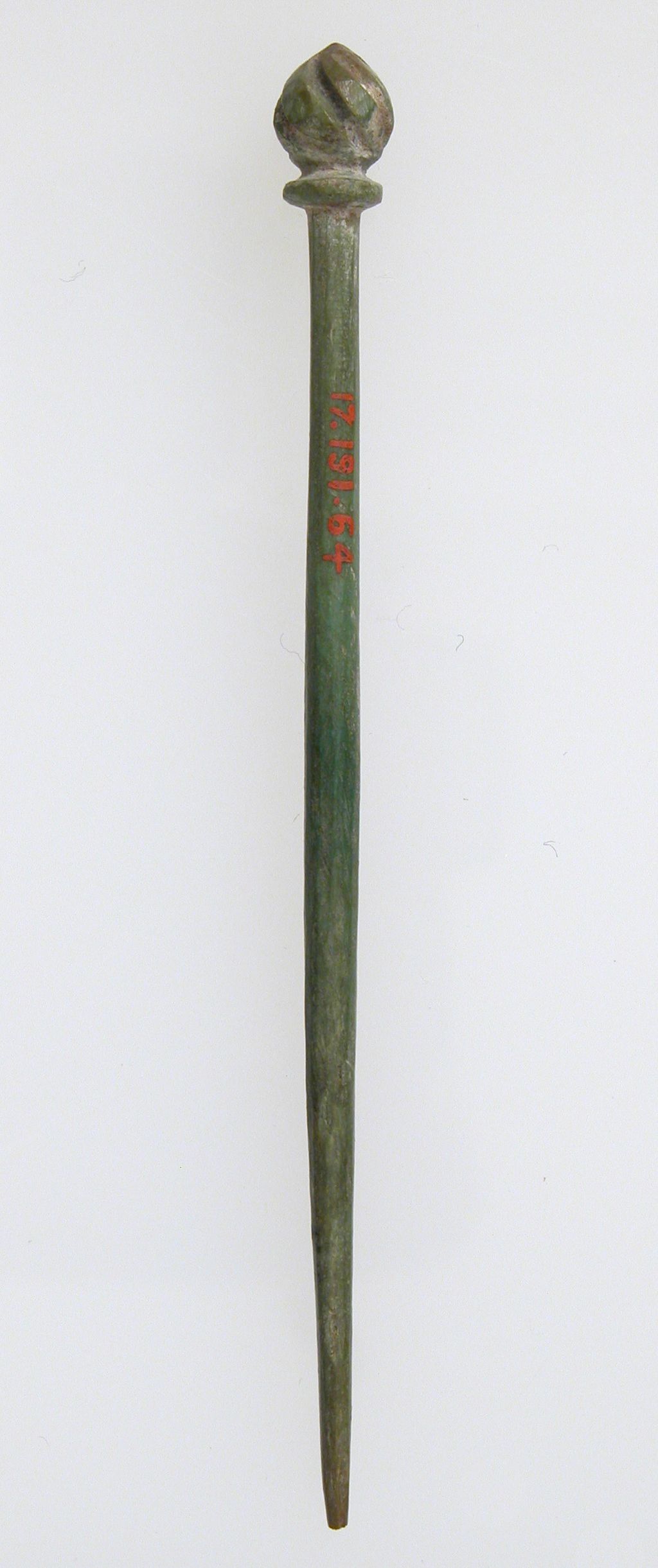
Hairpin, first to fourth century CE, The Met. A surviving pin gives scale and shape to an implement seen much more briefly in the painting. The Metropolitan Museum of Art. Image source. CC0 / Public domain.
Marble in the mirror and under the table
Godward divides the wall into bands. Behind the woman’s arms, wide veins of grey, blue and ochre streak across a pale ground. Below her elbows is a much darker strip with pink and cream patches, each with an irregular outline. Lower still, ribbons of yellow and grey cross the blue-grey stone. The dressing table brings two more stone colours into that arrangement. The pink slab projects far enough to expose its thick front edge, and its reddish support has a row of carved lobes on the side facing us. [2]
The mirror is so sharply foreshortened that its ellipse nearly closes to a line at the handle. Inside its rim, the alternation of dark and light recalls the middle band of wall, in smaller and less distinct patches. Sotheby’s calls this the marble reflected in the glass and identifies a second reflection in the table support. That second effect is easiest to see just below the slab, on the shadowed inner face of the support. Broken streaks of colour appear across the red surface like the veins in the lower wall on the left. The cool tones are much quieter there than in the stone itself. One reflection gives the eye a small patch to examine. The other runs along a vertical plane the eye might pass over altogether. [1] [2]
The woman may be looking towards the mirror. The painting gives us the view from in front of the table, at an angle to her, and her own view remains open. Sotheby’s calls the reflecting surface glass. A first-century Roman silver mirror at the Metropolitan Museum of Art had a slightly convex, highly polished face, an example of how ancient mirrors achieved the same effect with metal. The painting leaves the material of its disc uncertain. [1] [2] [11]
The drapery gives the eye a different set of lines to follow. Fine pleats in the green cloth run down from the shoulders until a yellow band pulls them in at the waist. Godward brings that yellow round the body in two strips, then lets the ends hang on the side nearest the table. The purple wrap holds a broader curve around her hip before gathering in a knot. Sotheby’s calls the green garment a stola and the wrap a palla. In ancient dress the terms describe distinct garments, a long dress and a mantle worn over it. Godward’s wrap sits low around the hips, where it sets the figure’s curve against the horizontal divisions of the wall. [1] [2] [12]
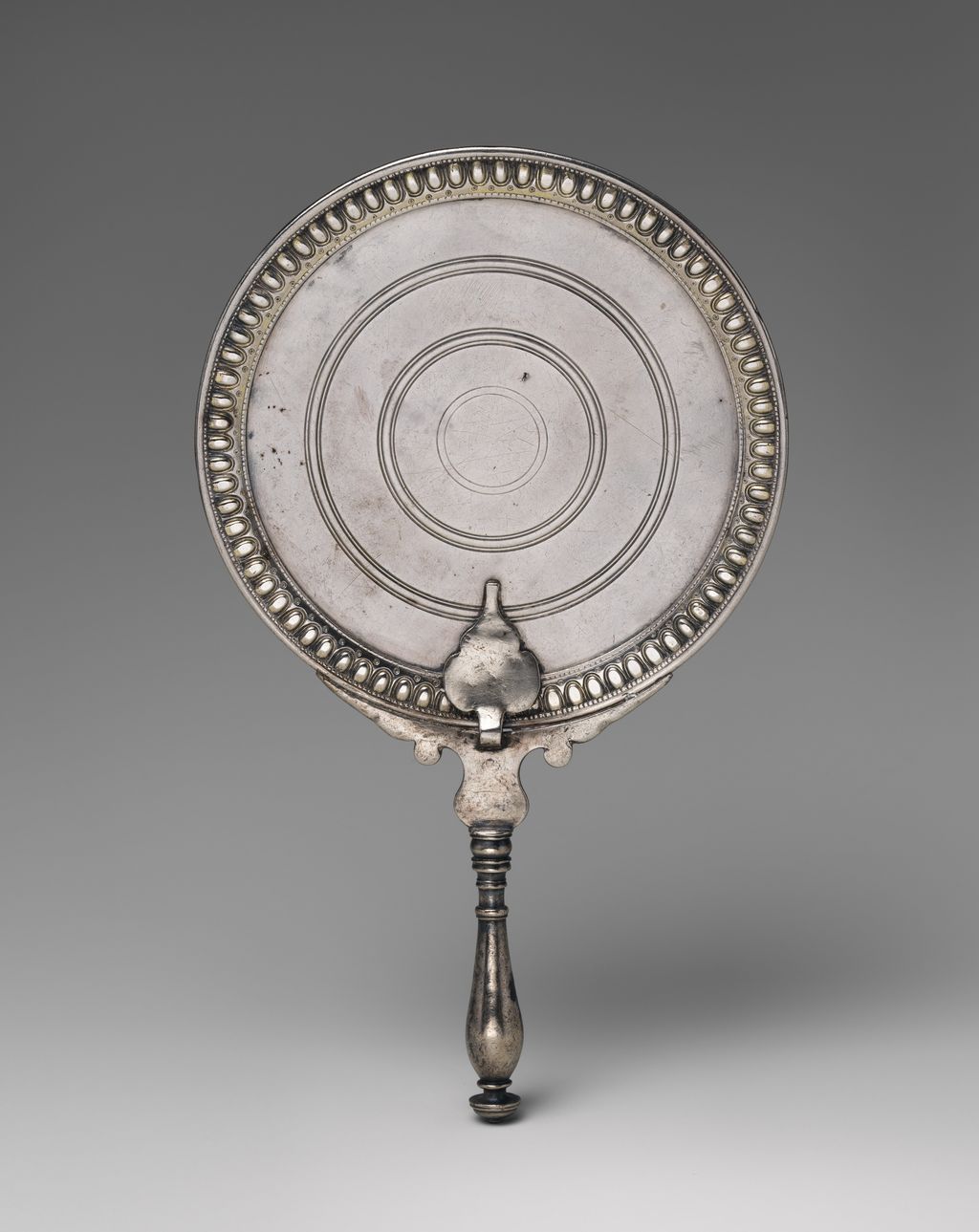
Silver mirror, first century CE, The Met. The back of an ancient hand mirror makes the relationship between the handle and the disc easy to see. The Metropolitan Museum of Art. Image source. CC0 / Public domain.
Annotated Details from A Fair Reflection
The numbered points identify visible features discussed in this article. Return from each detail to the numbered overview. John William Godward, A Fair Reflection (1915). Image source. Public domain.
.jpg)
Details from A FAIR REFLECTION
Compare the cropped details with the source images above. Notice how their colours, shapes and positions contribute to the larger compositions.
Hands arranging the hair
Both arms rise above the head, leaving the small mirror to one side of the figure.
 Detail 01 hands-arranging-the-hair.jpg)
The tilted mirror
The stone frame carries a small angled disc. Its dark reflection differs from the broader veins of the wall behind it.
 Detail 02 the-tilted-mirror.jpg)
Fabric turning at the waist
The tightly gathered purple fabric changes direction around the hip, across pale green and yellow cloth.
 Detail 03 fabric-turning-at-the-waist.jpg)
John William Godward videos
See Godward’s paintings and studio practice alongside films on two Victorian contemporaries.
John William Godward - Part 1: The Last Painter of the Victorian Age
An overview of Godward’s career and the Victorian market for pictures set in antiquity.
Watch on YouTubeThe same arrangement a year earlier
Sotheby’s treated A Fair Reflection as a variation on Julia when the earlier oil appeared at auction in 2017. Julia is signed and dated 1914 at the lower right and measures 80 × 60 cm. The woman inclines her head at much the same angle. She lifts both arms, lets a thick braid hang in front and wears a yellow double band above a gathered wrap. An open box and diagonal hand mirror sit to the right. Godward carried those features into a larger and proportionally taller canvas in 1915. [2] [3]
In Julia the area behind the raised arms is a field of deep reddish wall painting, its delicate ornaments visible around the woman’s sleeve. A green stone pilaster at the right has a projecting base that crowds the box and mirror from above. The table has a pale, strongly veined top and a support whose carved ornament stands out in the light. In the larger 1915 canvas the pale wall opens up around the arms, while the red has moved down to the furnishings on the right. The lowered head now sits against stone whose long veins continue around the figure. Even the colour of the wrap changes the balance. The dusty pink of Julia echoes the warm wall, while the saturated purple of the later canvas interrupts the cooler stretch of blue-grey stone. [2] [3]
The Julia catalogue identifies an ivory and wood box, a cylindrical Roman glass vessel for cosmetics, and a mirror with an Etruscan-style handle. It describes the pins in that picture as ivory. The slender shaft against the pale tabletop in Julia is easy to overlook. In the later work, a glint of gold separates the prominent pin from the pink slab, and the dark mottling inside the mirror helps the disc stand out from its surroundings. Godward retained the position of the mirror and made its reflecting face more conspicuous. [1] [2] [3]
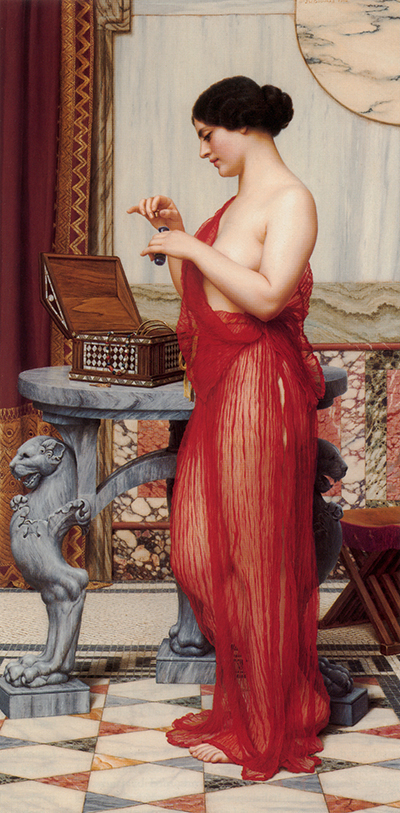
Godward’s The New Perfume offers another way to use a dressing table. The signature on its front is dated 1914 and the inscription on the reverse gives Rome, 1915. The hands converge around a little blue vessel, held close enough for the woman to examine it. The winged creature carved into the table support gives the furnishings a profile of their own. In A Fair Reflection, both hands have left the implements on the table. The height of the arms and the fall of the hanging braid draw us upwards, while the tabletop and its red support bring the eye down through two different reflections. [2] [13]
Two paintings called A Fair Reflection
The 2012 catalogue presented the 1915 painting as previously unrecorded and identified A Fair Reflection as a later title. It listed a private collection in the United States and descent within the family as the formal provenance. In a separate account, Sotheby’s proposed that the work had stayed in Italy, perhaps in Godward’s studio, until an American collector acquired it in the 1940s. The details of that purchase and the sitter’s name remain unconfirmed. [1]
The auction catalogue took the title from a composition dated 1899. Taber-Prang’s 1923 illustrated catalogue advertises A Fair Reflection by J. W. Godward on page 88 as item 3860, a sepia artotype, with a plate size of 13½ × 26 in. The small illustration shows a woman facing right, one hand extending a mirror, one arm raised over her head and a large round feature high in the room. The same features appear the other way round in Michael Allan Kodysz’s dissertation, where he deliberately reversed the image. He records the earlier oil at 76.2 × 38.1 cm. His figure 33 gives another painting from 1899, The Mirror, where the woman faces forward, the position of the arms changes and rectangular panels of stone fill the background. The prints show what an illustrated catalogue can establish about a work sold in reproduction. [1] [14] [15] [16]
Kodysz reversed the 1899 picture to compare its pose with Frederic Leighton’s The Bath of Psyche, exhibited in 1890. He draws attention to the difference between a picture named for a figure from myth and one focused on a familiar act in an ancient setting. In Leighton’s work, the bather looks towards the water where her own reflection appears. Both Godward paintings put a hand mirror in the room. The 1899 figure holds it in front of her. By 1915 it has moved to the table, where the stone it reflects directs attention to the place as well as the gesture. [1] [2] [15] [17]
Another of Godward’s hairdressing scenes has a title that can be traced to his hand. When Sotheby’s catalogued Preparing for the Bath in 2014, it recorded an old reverse label signed by Godward with the title The Toilet and his Fulham Road address. It also identified that canvas as no. 225 at the New Gallery in 1900. The familiar name of the 1915 oil comes to us through the 2012 catalogue. [1] [18]
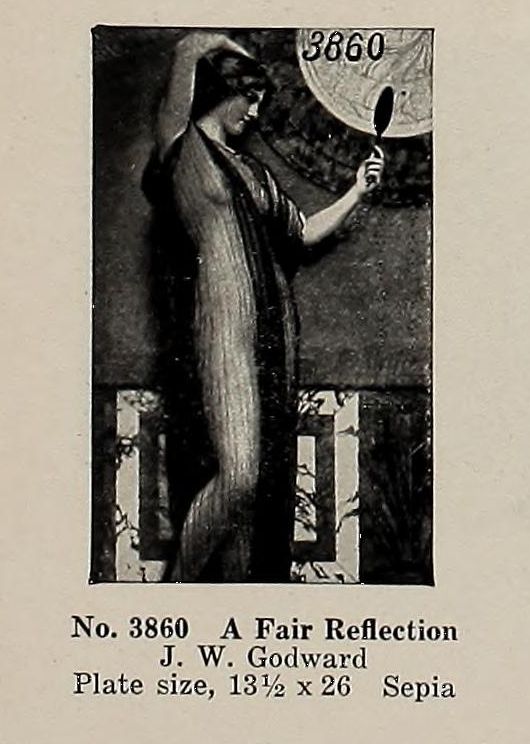
A Fair Reflection, Taber-Prang Art Company catalogue (1923), no. 3860. The period print catalogue reproduces the separate 1899 same-title painting. Taber-Prang Art Company, Illustrated Catalog of Pictures, 1923. Image source. Public domain.
What the 2012 sale records about the canvas
A report by Simon Parkes Art Conservation published with the lot describes a recently restored canvas. It had reinforcement around its edges while remaining unlined, meaning that the original canvas still had no second canvas attached across the back. The paint surface had been cleaned and varnished. An examination under ultraviolet light picked up isolated losses and associated retouches. The report locates small areas above the lip, on the neck and upper arm, at the elbow, and on the sash and pale marble. It describes these as minor and records the canvas as free of holes at the time. [1]
The frame used for the 2012 display was a loan, specially made for the picture in a tabernacle style. Sotheby’s describes a shallow base ornamented with egg-and-dart moulding, fluted pilasters with Ionic capitals, and a pediment and decorated frieze above. Small tooth-like blocks in the moulding, called dentils, added another architectural detail. The catalogue connects the design with a Renaissance frame type later taken up by artists such as Lawrence Alma-Tadema and Frederic Leighton. For viewers at the sale, those architectural details carried the painted room’s interest in carved surfaces out to the edge of the picture. [1]
John William Godward artworks directory
Search documented oil paintings, drawings, watercolours and reproductive prints. The directory includes the Art Renewal Center’s catalogue and additional works in museum, exhibition and sale records.
| Name | Date | Medium |
|---|---|---|
| Absence Makes the Heart Grow Fonder | 1912 | Oil on canvas |
| Amaryllis | 1903 | Oil on canvas |
| An Amateur | 1915 | Oil on canvas |
| Ancient Pastimes | 1916 | Oil on canvas |
| The Answer | 1917 | Oil on canvas |
| An Arcadian Beauty | 1899 | Painting |
| At the Fountain | 1893 | Oil on canvas |
| At the Garden Door | 1901 | Oil on canvas |
| At the Garden Shrine, Pompeii | 1892 | Oil on canvas |
| At the Gate of the Temple | 1898 | Oil on canvas |
| At the Thermae | 1909 | Oil on canvas |
| Atalanta | 1892 | Oil on canvas |
| Athenais | 1908 | Oil on canvas |
| An Auburn Beauty | 1895 | Oil on canvas |
| Autumn | 1900 | Oil on canvas |
| Beauty in a Marble Room | 1894 | Oil on canvas |
| The Belvedere | 1913 | Oil on canvas |
| The Betrothed | 1892 | Oil on canvas |
| The Betrothed (print after Godward) | 1893 | Photoengraving, as reported |
| The Bouquet | 1899 | Oil on canvas |
| Briseis | 1896 | Painting |
| The Broken Vase | 1889 | Oil on canvas |
| By the Blue Ionian Sea | 1916 | Oil on canvas |
| By the Wayside | 1912 | Oil on canvas |
| Byrsina | 1915 | Painting |
| Campaspe | 1896 | Oil on canvas |
| Campaspe (print after Godward) | Print, process unconfirmed | |
| Chloris (A Summer Rose) | 1902 | Oil on canvas |
| Classical Beauty | Oil on canvas | |
| A Classical Beauty | Oil on canvas | |
| A Classical Beauty | Painting | |
| A Classical Beauty | Oil on canvas | |
| A Classical Beauty | 1909 | Oil on canvas |
| A Classical Beauty In Profile | Oil on canvas | |
| A Classical Lady | 1908 | Oil on canvas |
| Clymene | 1892 | Oil on canvas |
| A Congenial Task | 1915 | Oil on canvas |
| Contemplation | 1922 | Oil on canvas |
| A Cool Retreat | 1910 | Oil on canvas |
| Country House in the 18th Century | c. 1883 | Oil on canvas |
| Cytheris | 1922 | Painting |
| The Day Dream | 1920 | Oil on canvas |
| The Delphic Oracle | 1899 | Oil on canvas |
| A Dilettante | 1922 | Oil on canvas |
| Distant Thoughts | 1918 | Oil on canvas |
| Dolce Far Niente | 1897 | Oil on canvas |
| Dolce Far Niente | 1906 | Oil on canvas |
| Dolce far niente (A Pompeian Fishpond) | 1904 | Oil on canvas |
| Dolce far niente (coloured print after Godward) | Exhibited 1900 | Coloured print, exact process unconfirmed |
| Dolce far niente (grapes) | 1907 | Oil on canvas |
| Dora | 1887 | Oil on canvas |
| Drusilla | 1906 | Oil on canvas |
| An Edition de Luxe | 1920 | Oil on canvas |
| Eighty and Eighteen | 1898 | Oil on canvas |
| Endymion | 1893 | Oil on canvas |
| The Engagement Ring (horizontal composition) | 1888 | Oil on canvas |
| The Engagement Ring (upright composition) | c. 1891 | Oil on canvas |
| Erato at Her Lyre | Oil on canvas | |
| A Fair Reflection | 1915 | Oil on canvas |
| A Fair Reflection (Taber-Prang print) | By 1923 | Sepia artotype |
| Far Away Thoughts (circular sewing scene) | 1911 | Oil on canvas |
| Far Away Thoughts (left-facing profile) | 1892 | Oil on canvas |
| Far Away Thoughts (right-facing profile) | 1892 | Oil on canvas |
| Female Figure (probable Grecian Idyll study) | 1907 | Oil on board |
| Flabellifera | 1905 | Oil on canvas |
| Flabellifera (painted study) | c. 1905 | Oil study |
| Flabellifera (pencil study) | c. 1905 | Pencil on paper |
| The Flower Girl | Painting | |
| A Flower Seller | 1896 | Oil on canvas |
| The Flowers of Venus | 1890 | Oil on canvas |
| A Fond Farewell | 1918 | Watercolour |
| The Fragrant Rose | 1892 | Painting |
| The Fruit Vendor | 1917 | Oil on canvas |
| A Garland Seller | 1914 | Painting |
| Giotto Drawing from Nature | Painting | |
| Girl in Yellow Drapery | 1901 | Oil on canvas |
| Golden Hours | 1913 | Oil on canvas |
| A Grecian Girl | 1908 | Oil on canvas |
| Grecian Idyll | 1907 | Oil on canvas |
| A Grecian Lovely | 1909 | Oil on canvas |
| Grecian Reverie | 1889 | Oil on canvas |
| Grecian Reverie | 1889 | Oil on canvas |
| A Greek Beauty | 1905 | Oil on canvas |
| A Happy Awakening | 1903 | Oil on canvas |
| He Loves Me, He Loves Me Not | 1896 | Oil on canvas |
| A head and shoulders profile portrait of a young woman wearing a white tunic style blouse | c. 1889 | Painting |
| Head of a Girl (The Priestess) | 1896 | Oil on canvas |
| Heart on her Lips and Soul within her Eyes | 1904 | Painting |
| His Birthday Gift | 1889 | Oil on canvas |
| Ianthe | 1889 | Oil on canvas |
| An Idle Hour | 1890 | Oil on canvas |
| Idle Moments | 1895 | Oil on canvas |
| Idle Thoughts | 1898 | Oil on canvas |
| Idleness | 1900 | Oil on canvas |
| Il Dolce Far Niente (Pears print after Amaryllis) | 1906 | Chromolithograph |
| Il Dolce far niente (seated figure) | 1893 | Oil on canvas |
| In Expectation | c. 1892 | Oil on canvas |
| In Realms of Fancy | 1911 | Oil on canvas |
| In the Prime of the Summertime (Reverie) | 1914 | Oil on canvas |
| In the Tepidarium | 1913 | Oil on canvas |
| Innocent Amusements | 1891 | Oil on canvas |
| Ione | c. 1896-1898 | Oil on canvas |
| Ionian Dancing Girl | 1902 | Oil on canvas |
| Ismenia | 1908 | Oil on canvas |
| An Italian Beauty | 1897 | Oil on canvas |
| An Italian Girls' Head | 1902 | Oil on canvas |
| The Jewel Casket | 1900 | Oil on canvas |
| Julia | 1914 | Painting |
| Knuckle Bones | 1890 | Oil on canvas |
| La Pensierosa | 1913 | Oil on canvas |
| A Lady | 1895 | Oil on canvas |
| Landscape: Blossoming Red Almond [study] | c. 1912 | Oil on panel |
| Le Billet Doux (The Love Letter) | 1913 | Oil on canvas |
| Leaning Against a Column | 1901 | Painting |
| Leaning on the Balcony | 1892 | Oil on canvas |
| Leisure Hours | 1905 | Oil on canvas |
| Lesbia with her Sparrow | 1916 | Oil on canvas |
| The Letter | 1899 | Painting |
| Liegende | 1893 | Oil on canvas |
| A Lily Pond | 1917 | Oil on canvas |
| Looking Out to Sea | 1918 | Pencil and watercolour |
| The Love Letter (circular composition) | 1907 | Oil on canvas |
| Lucilia | 1917 | Oil on canvas |
| Lycinna | 1918 | Oil on canvas |
| Marcella | 1912 | Painting |
| Matrona Superba | Oil on canvas | |
| Megilla | 1921 | Oil on canvas |
| A Melody | 1904 | Oil on canvas |
| Memories | c. 1891 | Oil on canvas |
| Mirinna | Painting | |
| The Mirror | 1899 | Oil on canvas |
| Mischief | 1905 | Oil on canvas |
| Mischief and Repose | 1895 | Oil on canvas |
| A Mouse in the Work Basket | 1893 | Oil on canvas |
| Nerissa | 1906 | Oil on canvas |
| The New Perfume | 1914 | Oil on canvas |
| Noon Day Rest | 1910 | Oil on canvas |
| Nu Sur La Plage | 1922 | Oil on panel |
| Nude Study | Oil on canvas | |
| An Offering to Venus | 1912 | Oil on canvas |
| The Old, Old Story | Oil on canvas | |
| The Old, Old Story | 1903 | Oil on canvas |
| On the Balcony | 1911 | Oil on canvas |
| On The Terrace | 1918 | Oil on canvas |
| Ophelia | Oil on panel | |
| The Peacock Fan | 1912 | Oil on canvas |
| Phyleis | 1908 | Oil on canvas |
| The Playground | 1892 | Oil on canvas |
| Playtime | 1891 | Oil on canvas |
| A Pompeian Bath | 1890 | Oil on canvas |
| A Pompeian Lady | 1891 | Oil on canvas |
| A Pompeian Lady | 1895 | Oil on board |
| A Pompeian Lady | 1901 | Painting |
| A Pompeian Lady | 1904 | Painting |
| Portrait of Mary Frederica 'Nin' Godward | c. 1882-1883 | Oil on canvas |
| Portrait of Mary Perkinton Godward | c. 1880-1881 | Watercolor |
| The Posy | 1900 | Painting |
| A Priestess (bare-shouldered figure) | 1893 | Oil on canvas |
| A Priestess (clothed composition) | 1894 | Oil on canvas |
| A Priestess (W. Biscombe Gardner after Godward) | Exhibited 1897 | Print, process unconfirmed |
| A Priestess of Bacchus | 1890-1890 | Oil on canvas |
| Pyrallis | 1918 | Oil on canvas |
| The Quiet Pet | 1906 | Oil on canvas |
| A Red, Red Rose | 1920 | Oil on canvas |
| Reflections | 1893 | Oil on canvas |
| The Rendezvous | 1903 | Oil on canvas |
| Repose, the Flower Girl | c. 1887 | Oil on canvas |
| Reverie | 1888 | Oil on panel |
| Reverie | 1912 | Oil on canvas |
| Reverie (In the Days of Sappho) | 1904 | Oil on canvas |
| Reverie (Pears print after In the Prime of the Summertime) | 1916 | Chromolithograph |
| 'Rich Gifts Wax Poor When Lovers Prove Unkind' | 1916 | Oil on canvas |
| The Ring | 1898 | Oil on canvas |
| A Roman Matron | 1905 | Oil on canvas |
| Sabinella | 1912 | Oil on canvas |
| Sappho | 1910 | Oil on canvas |
| The Siesta | Oil on canvas | |
| A Siesta | 1895 | Oil on canvas |
| The Signal | 1899 | Oil on canvas |
| Sitting for Her Portrait | 1893 | Oil on canvas |
| Sketch for Amaryllis | 1903 | Oil on board |
| A Souvenir | 1920 | Oil on canvas |
| Stesicrate | 1914 | Oil on canvas |
| Study for 'Rêverie' | 1890 | Oil on canvas |
| Study for 'The Priestess' | 1895 | Oil on board |
| Study for An Egyptian Minstrel | 1906 | Painting |
| Study for The New Perfume | Drawing, medium unconfirmed | |
| Study for ‘The Old, Old Story’ | 1903 | Oil paint on wood |
| Study of a Girl's Head | 1899 | Painting |
| Study of Campaspe | Oil on canvas | |
| Study of Head and Drapery, Miss Ethel Warwick | 1898 | Painting |
| Summer Day | 1897 | Painting |
| Summer Flowers | 1903 | Oil on canvas |
| Sweet Dreams | 1901 | Oil on canvas |
| Sweet Dreams | 1904 | Painting |
| The Sweet Siesta of a Summer's Day | 1891 | Oil on canvas |
| The Tambourine Girl (profile at the marble wall) | 1906 | Oil on canvas |
| The Tambourine Girl (relief-backed version) | 1906 | Oil on canvas |
| Tender Thoughts | 1917 | Oil on canvas |
| Tender Thoughts (woman leaning over a parapet) | 1918 | Pencil and watercolour |
| The Tiff (oil) | By 1888 | Oil on canvas |
| The Tiff (print after Godward) | 1894 | Photogravure |
| The Tigerskin | 1889 | Oil on canvas |
| The Time of Roses | 1916 | Oil on canvas |
| Tranquillity | 1914 | Oil on canvas |
| A Tryst | 1912 | Oil on canvas |
| Tympanistria | 1909 | Oil on canvas |
| Under the Blossom that Hangs on the Bough | 1917 | Oil on canvas |
| Venus at the Bath | 1901 | Oil on canvas |
| Venus Binding Her Hair | 1897 | Oil on canvas |
| Violets, Sweet Violets | 1906 | Painting |
| Waiting for an Answer | 1889 | Oil on canvas |
| Waiting for the Procession | 1890 | Oil on canvas |
| Waiting for the Procession | 1890 | Painting |
| The Water Carrier (magazine reproduction of At the Fountain) | 1898 | Magazine reproduction |
| When the Heart is Young | 1902 | Oil on canvas |
| Who Can They Be | Painting | |
| Winding Wool | 1894 | Painting |
| 'With Violets Wreathed and Robe of Saffron Hue' | 1902 | Oil on canvas |
| The Yellow Shawl | 1893 | Painting |
| 'Yes or No?' | 1893 | Oil on canvas |
| Young Girl Picking Grapes | 1902 | Oil on canvas |
| Youth and Time | 1901 | Oil on canvas |
Discussion
Look again at the images and ideas explored in A Fair Reflection. These editorial prompts invite your observations.
Reader Insights
When do you notice the small hand mirror?
How does the painter make the woman’s raised arms feel suspended?
Join the Conversation
Share a detail, comparison or question about A Fair Reflection below.
References
- Sotheby’s. John William Godward, A Fair Reflection. New York, 4 May 2012, lot 12. Description, provenance, condition report by Simon Parkes Art Conservation, and catalogue note. English. View source.
- Sotheby’s, via Wikimedia Commons. High-resolution photograph of A Fair Reflection (1915). English. View source.
- Sotheby’s. John William Godward, Julia. 2017, lot 8. Plate, object entry and catalogue note. English. View source.
- Far Away Thoughts. View source.
- Sappho. View source.
- Le Billet Doux (The Love Letter). View source.
- An Amateur. View source.
- Lycinna. View source.
- Metropolitan Museum of Art. Late Roman gold hairpin, third to fourth century, object 17.192.250. English. View source.
- Metropolitan Museum of Art. Roman bone hairpin, first to fourth century, object 17.191.64. English. View source.
- Metropolitan Museum of Art. Roman silver mirror, first century CE, object 07.286.127. English. View source.
- RD Milns Antiquities Museum, University of Queensland. “The Roman Matron”, in Useless Beauty: Luxury and Rome. English. View source.
- Christie’s. John William Godward, The New Perfume, lot 245788. Plate and inscriptions. English. View source.
- Taber-Prang Art Company. Illustrated Catalog of Pictures. Springfield, Massachusetts, 1923, p. 88, no. 3860. English. View source.
- Michael Allan Kodysz. The Classical-Genre Paintings of John William Godward: From Archaeology to Archetypes. University of Manchester master’s dissertation, 2007, restored digital edition, p. 17 and figs. 14 and 33. English. View source.
- Art Renewal Center. John William Godward, The Mirror, artwork 11596. English. View source.
- Tate. Frederic Leighton, The Bath of Psyche, collection picture reproduced by Tate, exhibited 1890. English. View source.
- Sotheby’s. John William Godward, Preparing for the Bath. 2014, lot 34. Description, exhibition history and catalogue note. English. View source.