 by Tom Gurney
Tom Gurney BSc (Hons) is an art history expert with over 20 years experience
Published on June 19, 2020 / Updated on October 14, 2023
Email: tomgurney1@gmail.com / Phone: +44 7429 011000
At the Gate of the Temple by John William Godward: Introduction
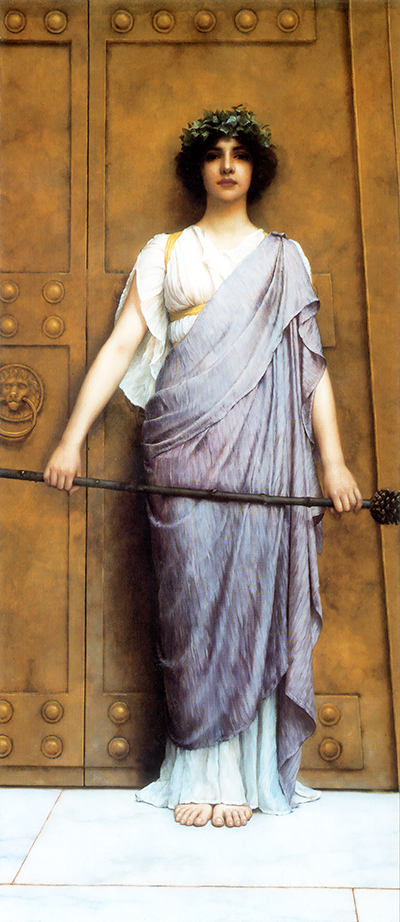
A woman stands barefoot in front of a closed door, looking straight at us. She holds a dark staff low across her body, with one hand near each side of the canvas. The staff crosses a seam in the door and makes a second barrier in front of it. John William Godward signed and dated At the Gate of the Temple in 1898. At 161.6 × 71.1 cm, the oil on canvas is more than twice as high as it is wide. That slender format is crucial to the encounter. We can see the woman from wreath to toes, yet there is scarcely room to look around her. [1]
At a Glance
- Date1898
- MediumOil on canvas
- Dimensions161.6 × 71.1 cm
This work across John William Godward’s career
Contents
- The figure and the closed door
- What the thyrsus tells us
- Earlier priestesses
- The recorded history of the 1898 canvas
- Annotated details
The figure and the closed door
The floor is a narrow strip of pale stone, set off sharply against the warm, mottled door. Its joints give a little depth to a picture otherwise pressed towards the surface. The door rises out of sight, leaving the height of the whole entrance to the imagination. Raised bosses catch the light along the rails. Beside the woman's arm, on the viewer's left, a sculpted head carries a hanging ring. The ring gives the eye a practical point of entry. It is hardware someone might reach for, and the straight line of the staff below it shows how thoroughly the figure occupies the space in front of the door. [1]
Godward keeps the principal verticals clear even where the door disappears behind the woman. A seam runs behind her on one side and a broad jamb closes the picture on the other. The cloth introduces a different set of directions. The blue-violet wrap starts high on the viewer's right and spreads diagonally across the white garment, gathering near the opposite hip before falling into long folds. The staff slopes gently the other way. The two diagonals animate a pose in which the head stays level, the feet are close together and the hands have a firm grip. Her unequal arm positions fit the drapery as well. The bare arm on the viewer's left leads out from the white sleeve to the shaft, while the other emerges from a heavier fall of fabric. [1]
The colour and lighting make the woman seem nearer than the door. The white beneath the violet brightens around the neckline and returns as a pale hem at floor level. Narrow hints of yellow near the shoulder and waist pick up the warmth of the metal behind her. Highlights on the knuckles, the ring and the bosses make each surface readable through a different kind of reflected light. The leafy crown has a broken edge against the door, while the long hems soften the line where the door meets the stone. Those small variations matter when most of the picture is built from repeated rails, panels and fittings. [1]
Door fittings with comparable forms survive from antiquity. A Hellenistic example in the Louvre, dated about 325–275 BCE and excavated at Pydna in northern Greece, consists of a circular bronze fitting with a lion head and ring. The museum records it as coming from the outside door of a tomb. It also holds an inner marble door leaf from the tomb with rows of carved bosses. The two records illustrate projecting bosses, inset panels and ring hardware in ancient door design. In Godward's painting they make the door legible from a few sharply chosen details even though its top and sides extend beyond the canvas. The specific architectural source of his entrance remains uncertain. [7] [8]
What the thyrsus tells us
Christie's identifies the staff as a thyrsus, a sign associated with Dionysus, or Bacchus in Roman tradition, and describes its finial as a pine cone. The dark, compact head is visible at the right edge and is balanced by the cluster of green leaves above the woman's forehead. Each is a relatively small detail. Together they give her a plausible identity as a bacchante, a female follower of the god, even though Godward shows her alone and gives her no overt ritual action. Her hands are separated widely on the shaft, as they might be on a bar held in front of an entrance. The gesture is enough to suggest that she controls the passage. The title supplies a temple and the attributes point towards Dionysus. The canvas leaves the specific sanctuary, any ceremony and the terms of admission to the imagination. [1]
The Marble Relief with a Dancing Maenad at the Metropolitan Museum of Art makes a useful comparison. The museum dates the Roman relief to the Augustan period, about 27 BCE–14 CE, and identifies it as a copy after a Greek relief attributed to Kallimachos. The woman wears an ivy wreath and carries a staff clothed in ivy leaves and berries. Her folds stream around her as she moves. Godward gives his figure the wreath and staff as similar signs of allegiance, but places the leaves on a still head and lowers the staff across the body. The same attributes can accompany a dance or help turn a motionless figure into the focus of a doorway. [9]
Even the cone-shaped tip has a history. Art historian Edward Olszewski argues that the ancient thyrsus took several forms and that the equation of its finial with a pine cone gained currency in the nineteenth century. Stylised clusters of ivy could take on a cone-like outline in ancient images. In Émile Lévy's Mort d'Orphée, exhibited at the Paris Salon in 1866, Olszewski identifies a pine cone on the thyrsus raised by one of the attacking women. Godward's dark finial fits an interpretation that a nineteenth-century artist or viewer could readily have recognised. The resemblance to a pine cone in this painting is a separate question from what an ancient follower carried. [10] [11]
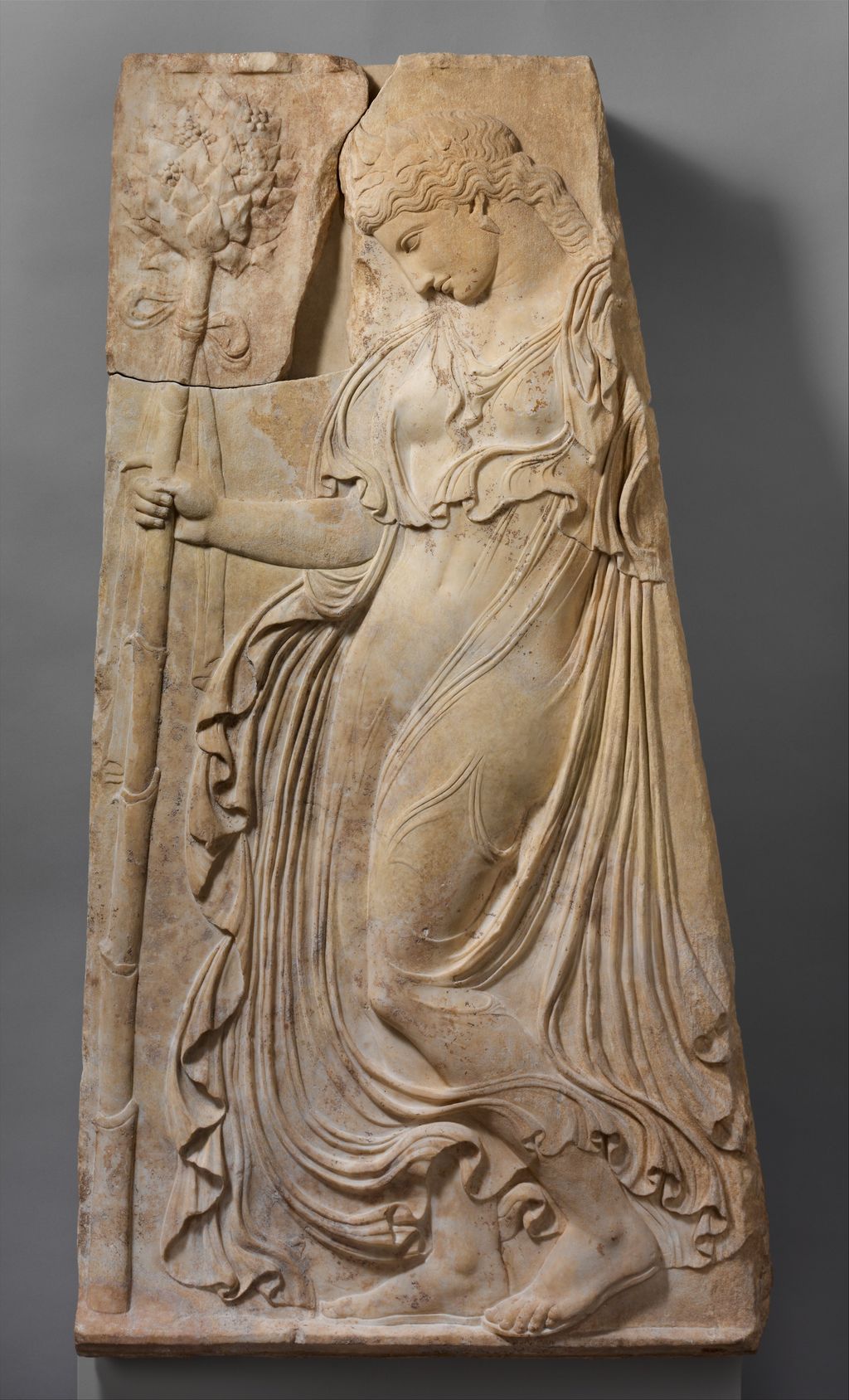
Relief with a dancing maenad, The Met. The ancient figure gives a point of comparison for a Dionysian attribute. The Metropolitan Museum of Art. Image source. CC0 / Public domain.
Annotated Details from At the Gate of the Temple
The numbered points identify visible features discussed in this article. Return from each detail to the numbered overview. John William Godward, At the Gate of the Temple (1898). Image source. Public domain.
.jpg)
Details from AT THE GATE OF THE TEMPLE
Compare the cropped details with the source images above. Notice how their colours, shapes and positions contribute to the larger compositions.
The staff across the doorway
The two hands hold the staff across the entrance, joining the two sides of the painting.
 Detail 01 the-staff-across-the-doorway.jpg)
A painted fold over the shoulder
Pale cloth and lavender folds cross at the shoulder in front of the broad vertical door panels.
 Detail 02 a-painted-fold-over-the-shoulder.jpg)
The sill and the feet
The feet rest on the paving close to the line where the doors end.
 Detail 03 the-sill-and-the-feet.jpg)
John William Godward videos
See Godward’s paintings and studio practice alongside films on two Victorian contemporaries.
John William Godward - Part 1: The Last Painter of the Victorian Age
An overview of Godward’s career and the Victorian market for pictures set in antiquity.
Watch on YouTubeEarlier priestesses
Vern Grosvenor Swanson singled out the resemblance to Godward's A Priestess of 1894. That oil, catalogued at 219.7 × 96.8 cm, is considerably larger than the 1898 canvas. It likewise shows a full-length woman against studded doors, looking out from the centre of the composition. Her black dress is gathered by a gold band and crossed by comparatively little lateral movement. One arm rises high to hold the upright staff, prolonging the verticals of the architecture. In the 1898 painting, the lighter fabric reaches across the body in a wide diagonal and both hands are engaged. Lowering the staff turns an emblem held beside a figure into an object interposed between the figure and the space in front of her. [1] [12] [13]
Godward's A Priestess of 1893 is a separate oil, 159.4 × 71.4 cm. It shows a near-nude figure who raises her staff. Its dimensions are very close to those of the 1898 painting. The clothed figure of 1894 supplies the clearer precedent for how the woman and the closed door are set against one another. The Royal Academy's 1895 exhibition catalogue lists Godward's A Priestess as no. 304 in Gallery IV. Henry Blackburn's contemporary Academy Notes describes the exhibitor's woman facing the spectator in transparent black gauze before polished brass doors. This description favours the clothed composition. It gives the exhibit neither measurements nor an illustration that would identify the canvas by itself. [14] [15] [16]
Humrich Fine Art catalogued a much smaller oil on panel dated 1895, showing the same black garment and raised staff as the large clothed canvas. The gallery describes it as an engraving model and credits W. Biscombe Gardner with making a print in 1896. Its account gives 1894 as the Academy exhibition year, while the contemporary listing and gallery notes are from 1895. In the panel, the trim and rows of bosses are still legible and the ground continues farther in front of her feet. The raised arm and upright staff keep the pose recognisable even at less than a sixth of the height of the large canvas. The dating discrepancy limits what the dealer's account can establish about the Academy exhibit. [15] [16] [17]
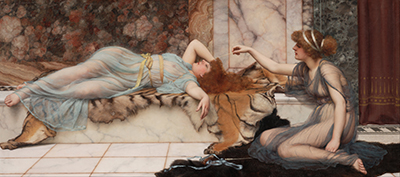
An earlier variant of the subject shows how much Godward could change while keeping the same attributes. His signed A Priestess of Bacchus of 1890 is a small horizontal oil, 29 × 45 cm. Here the wreath and thyrsus belong to a woman reclining on a curved marble bench, with other figures and the landscape visible behind her. Sotheby's records McLean handling the work in 1890 and documents its later sales under the titles Bacchante Resting and On the Terrace. Each of those titles directs attention to something different, whether the woman's mythological role, her pose or her surroundings. Michael Allan Kodysz draws the 1890 and 1898 pictures together through their outward gaze. He reads their quiet moments as part of a Victorian mode of storytelling in which a picture can anticipate an event or show its aftermath. The raised staff in the two earlier standing pictures and the staff held across the 1898 threshold leave a different set of actions to imagine. The earlier painting lets the eye travel beyond its central figure. At the closed door that outward gaze is harder to escape. [18] [19]
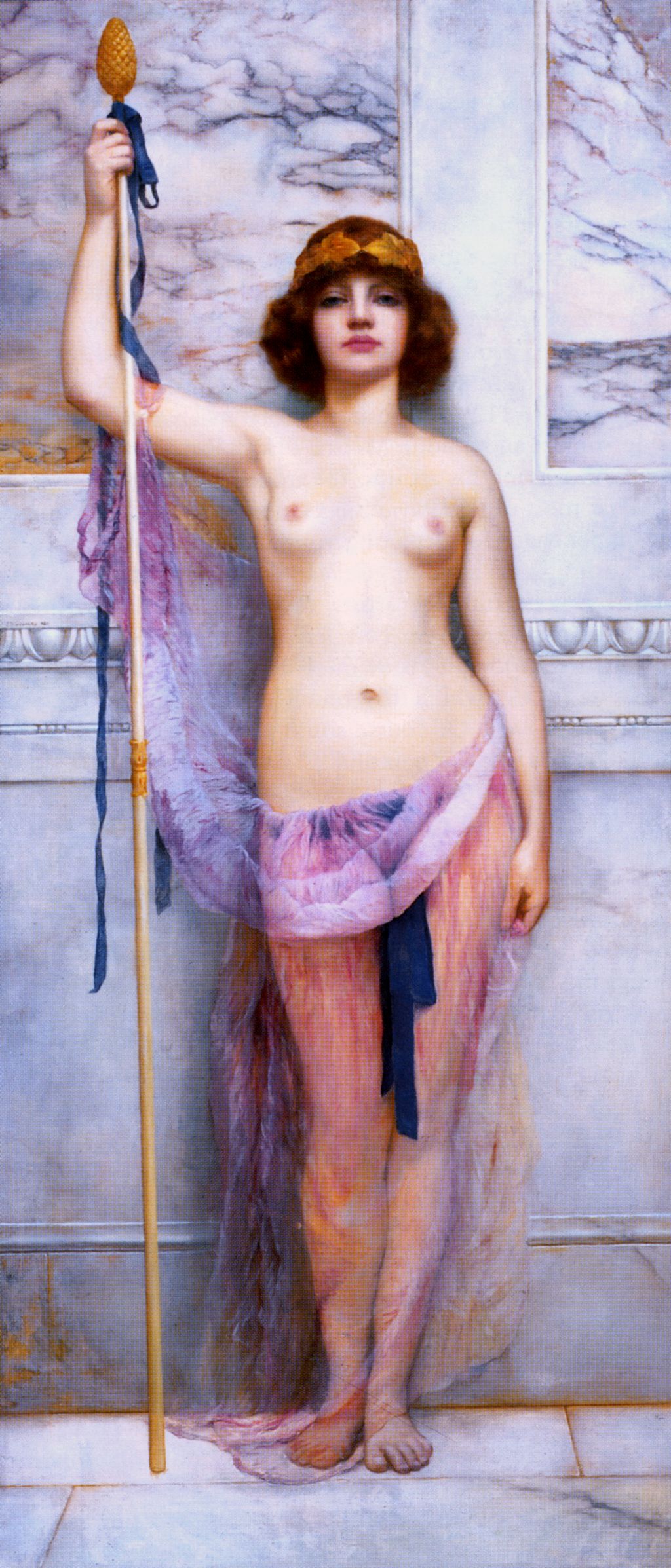
John William Godward, A Priestess (1893), near-nude composition. The earlier work brings the staff upright and makes the ribbons more conspicuous against the wall. Image source. Public domain.
The recorded history of the 1898 canvas
Christie's records the lower-left signature and date, “J.W.GODWARD. 98.” The earliest entry in the auction house's provenance places the picture with the London dealer Thomas McLean on 15 July 1898, within the year it was painted. McLean also handled Godward's Ionian Dancing Girl, for which the sale catalogue cites a dated 1902 letter. In At the Gate of the Temple, the published McLean date marks a point in the picture's circulation, and the later trail resumes at Christie's New York on 12 October 1993, lot 208. The 2011 catalogue also names the London dealer Richard Green and lists the canvas as property of a private collector at that sale. [1] [20]
The 2011 lot cites Swanson's John William Godward: The Eclipse of Classicism, p. 196, plate 36. It also quotes his proposal that Lily Pettigrew was the model for this canvas. Sotheby's separately associates Lily's sister Rose with the clothed A Priestess of 1894 in its catalogue for Far Away Thoughts. Both are attributed identifications of models for particular pictures. In the 1898 canvas, the set of the woman's mouth, the shadow around her eyes and the pressure of her fingers on the staff give the figure the immediacy of a close encounter even while her name remains uncertain. [1] [21]
John William Godward artworks directory
Search documented oil paintings, drawings, watercolours and reproductive prints. The directory includes the Art Renewal Center’s catalogue and additional works in museum, exhibition and sale records.
| Name | Date | Medium |
|---|---|---|
| Absence Makes the Heart Grow Fonder | 1912 | Oil on canvas |
| Amaryllis | 1903 | Oil on canvas |
| An Amateur | 1915 | Oil on canvas |
| Ancient Pastimes | 1916 | Oil on canvas |
| The Answer | 1917 | Oil on canvas |
| An Arcadian Beauty | 1899 | Painting |
| At the Fountain | 1893 | Oil on canvas |
| At the Garden Door | 1901 | Oil on canvas |
| At the Garden Shrine, Pompeii | 1892 | Oil on canvas |
| At the Gate of the Temple | 1898 | Oil on canvas |
| At the Thermae | 1909 | Oil on canvas |
| Atalanta | 1892 | Oil on canvas |
| Athenais | 1908 | Oil on canvas |
| An Auburn Beauty | 1895 | Oil on canvas |
| Autumn | 1900 | Oil on canvas |
| Beauty in a Marble Room | 1894 | Oil on canvas |
| The Belvedere | 1913 | Oil on canvas |
| The Betrothed | 1892 | Oil on canvas |
| The Betrothed (print after Godward) | 1893 | Photoengraving, as reported |
| The Bouquet | 1899 | Oil on canvas |
| Briseis | 1896 | Painting |
| The Broken Vase | 1889 | Oil on canvas |
| By the Blue Ionian Sea | 1916 | Oil on canvas |
| By the Wayside | 1912 | Oil on canvas |
| Byrsina | 1915 | Painting |
| Campaspe | 1896 | Oil on canvas |
| Campaspe (print after Godward) | Print, process unconfirmed | |
| Chloris (A Summer Rose) | 1902 | Oil on canvas |
| Classical Beauty | Oil on canvas | |
| A Classical Beauty | Oil on canvas | |
| A Classical Beauty | Painting | |
| A Classical Beauty | Oil on canvas | |
| A Classical Beauty | 1909 | Oil on canvas |
| A Classical Beauty In Profile | Oil on canvas | |
| A Classical Lady | 1908 | Oil on canvas |
| Clymene | 1892 | Oil on canvas |
| A Congenial Task | 1915 | Oil on canvas |
| Contemplation | 1922 | Oil on canvas |
| A Cool Retreat | 1910 | Oil on canvas |
| Country House in the 18th Century | c. 1883 | Oil on canvas |
| Cytheris | 1922 | Painting |
| The Day Dream | 1920 | Oil on canvas |
| The Delphic Oracle | 1899 | Oil on canvas |
| A Dilettante | 1922 | Oil on canvas |
| Distant Thoughts | 1918 | Oil on canvas |
| Dolce Far Niente | 1897 | Oil on canvas |
| Dolce Far Niente | 1906 | Oil on canvas |
| Dolce far niente (A Pompeian Fishpond) | 1904 | Oil on canvas |
| Dolce far niente (coloured print after Godward) | Exhibited 1900 | Coloured print, exact process unconfirmed |
| Dolce far niente (grapes) | 1907 | Oil on canvas |
| Dora | 1887 | Oil on canvas |
| Drusilla | 1906 | Oil on canvas |
| An Edition de Luxe | 1920 | Oil on canvas |
| Eighty and Eighteen | 1898 | Oil on canvas |
| Endymion | 1893 | Oil on canvas |
| The Engagement Ring (horizontal composition) | 1888 | Oil on canvas |
| The Engagement Ring (upright composition) | c. 1891 | Oil on canvas |
| Erato at Her Lyre | Oil on canvas | |
| A Fair Reflection | 1915 | Oil on canvas |
| A Fair Reflection (Taber-Prang print) | By 1923 | Sepia artotype |
| Far Away Thoughts (circular sewing scene) | 1911 | Oil on canvas |
| Far Away Thoughts (left-facing profile) | 1892 | Oil on canvas |
| Far Away Thoughts (right-facing profile) | 1892 | Oil on canvas |
| Female Figure (probable Grecian Idyll study) | 1907 | Oil on board |
| Flabellifera | 1905 | Oil on canvas |
| Flabellifera (painted study) | c. 1905 | Oil study |
| Flabellifera (pencil study) | c. 1905 | Pencil on paper |
| The Flower Girl | Painting | |
| A Flower Seller | 1896 | Oil on canvas |
| The Flowers of Venus | 1890 | Oil on canvas |
| A Fond Farewell | 1918 | Watercolour |
| The Fragrant Rose | 1892 | Painting |
| The Fruit Vendor | 1917 | Oil on canvas |
| A Garland Seller | 1914 | Painting |
| Giotto Drawing from Nature | Painting | |
| Girl in Yellow Drapery | 1901 | Oil on canvas |
| Golden Hours | 1913 | Oil on canvas |
| A Grecian Girl | 1908 | Oil on canvas |
| Grecian Idyll | 1907 | Oil on canvas |
| A Grecian Lovely | 1909 | Oil on canvas |
| Grecian Reverie | 1889 | Oil on canvas |
| Grecian Reverie | 1889 | Oil on canvas |
| A Greek Beauty | 1905 | Oil on canvas |
| A Happy Awakening | 1903 | Oil on canvas |
| He Loves Me, He Loves Me Not | 1896 | Oil on canvas |
| A head and shoulders profile portrait of a young woman wearing a white tunic style blouse | c. 1889 | Painting |
| Head of a Girl (The Priestess) | 1896 | Oil on canvas |
| Heart on her Lips and Soul within her Eyes | 1904 | Painting |
| His Birthday Gift | 1889 | Oil on canvas |
| Ianthe | 1889 | Oil on canvas |
| An Idle Hour | 1890 | Oil on canvas |
| Idle Moments | 1895 | Oil on canvas |
| Idle Thoughts | 1898 | Oil on canvas |
| Idleness | 1900 | Oil on canvas |
| Il Dolce Far Niente (Pears print after Amaryllis) | 1906 | Chromolithograph |
| Il Dolce far niente (seated figure) | 1893 | Oil on canvas |
| In Expectation | c. 1892 | Oil on canvas |
| In Realms of Fancy | 1911 | Oil on canvas |
| In the Prime of the Summertime (Reverie) | 1914 | Oil on canvas |
| In the Tepidarium | 1913 | Oil on canvas |
| Innocent Amusements | 1891 | Oil on canvas |
| Ione | c. 1896-1898 | Oil on canvas |
| Ionian Dancing Girl | 1902 | Oil on canvas |
| Ismenia | 1908 | Oil on canvas |
| An Italian Beauty | 1897 | Oil on canvas |
| An Italian Girls' Head | 1902 | Oil on canvas |
| The Jewel Casket | 1900 | Oil on canvas |
| Julia | 1914 | Painting |
| Knuckle Bones | 1890 | Oil on canvas |
| La Pensierosa | 1913 | Oil on canvas |
| A Lady | 1895 | Oil on canvas |
| Landscape: Blossoming Red Almond [study] | c. 1912 | Oil on panel |
| Le Billet Doux (The Love Letter) | 1913 | Oil on canvas |
| Leaning Against a Column | 1901 | Painting |
| Leaning on the Balcony | 1892 | Oil on canvas |
| Leisure Hours | 1905 | Oil on canvas |
| Lesbia with her Sparrow | 1916 | Oil on canvas |
| The Letter | 1899 | Painting |
| Liegende | 1893 | Oil on canvas |
| A Lily Pond | 1917 | Oil on canvas |
| Looking Out to Sea | 1918 | Pencil and watercolour |
| The Love Letter (circular composition) | 1907 | Oil on canvas |
| Lucilia | 1917 | Oil on canvas |
| Lycinna | 1918 | Oil on canvas |
| Marcella | 1912 | Painting |
| Matrona Superba | Oil on canvas | |
| Megilla | 1921 | Oil on canvas |
| A Melody | 1904 | Oil on canvas |
| Memories | c. 1891 | Oil on canvas |
| Mirinna | Painting | |
| The Mirror | 1899 | Oil on canvas |
| Mischief | 1905 | Oil on canvas |
| Mischief and Repose | 1895 | Oil on canvas |
| A Mouse in the Work Basket | 1893 | Oil on canvas |
| Nerissa | 1906 | Oil on canvas |
| The New Perfume | 1914 | Oil on canvas |
| Noon Day Rest | 1910 | Oil on canvas |
| Nu Sur La Plage | 1922 | Oil on panel |
| Nude Study | Oil on canvas | |
| An Offering to Venus | 1912 | Oil on canvas |
| The Old, Old Story | Oil on canvas | |
| The Old, Old Story | 1903 | Oil on canvas |
| On the Balcony | 1911 | Oil on canvas |
| On The Terrace | 1918 | Oil on canvas |
| Ophelia | Oil on panel | |
| The Peacock Fan | 1912 | Oil on canvas |
| Phyleis | 1908 | Oil on canvas |
| The Playground | 1892 | Oil on canvas |
| Playtime | 1891 | Oil on canvas |
| A Pompeian Bath | 1890 | Oil on canvas |
| A Pompeian Lady | 1891 | Oil on canvas |
| A Pompeian Lady | 1895 | Oil on board |
| A Pompeian Lady | 1901 | Painting |
| A Pompeian Lady | 1904 | Painting |
| Portrait of Mary Frederica 'Nin' Godward | c. 1882-1883 | Oil on canvas |
| Portrait of Mary Perkinton Godward | c. 1880-1881 | Watercolor |
| The Posy | 1900 | Painting |
| A Priestess (bare-shouldered figure) | 1893 | Oil on canvas |
| A Priestess (clothed composition) | 1894 | Oil on canvas |
| A Priestess (W. Biscombe Gardner after Godward) | Exhibited 1897 | Print, process unconfirmed |
| A Priestess of Bacchus | 1890-1890 | Oil on canvas |
| Pyrallis | 1918 | Oil on canvas |
| The Quiet Pet | 1906 | Oil on canvas |
| A Red, Red Rose | 1920 | Oil on canvas |
| Reflections | 1893 | Oil on canvas |
| The Rendezvous | 1903 | Oil on canvas |
| Repose, the Flower Girl | c. 1887 | Oil on canvas |
| Reverie | 1888 | Oil on panel |
| Reverie | 1912 | Oil on canvas |
| Reverie (In the Days of Sappho) | 1904 | Oil on canvas |
| Reverie (Pears print after In the Prime of the Summertime) | 1916 | Chromolithograph |
| 'Rich Gifts Wax Poor When Lovers Prove Unkind' | 1916 | Oil on canvas |
| The Ring | 1898 | Oil on canvas |
| A Roman Matron | 1905 | Oil on canvas |
| Sabinella | 1912 | Oil on canvas |
| Sappho | 1910 | Oil on canvas |
| The Siesta | Oil on canvas | |
| A Siesta | 1895 | Oil on canvas |
| The Signal | 1899 | Oil on canvas |
| Sitting for Her Portrait | 1893 | Oil on canvas |
| Sketch for Amaryllis | 1903 | Oil on board |
| A Souvenir | 1920 | Oil on canvas |
| Stesicrate | 1914 | Oil on canvas |
| Study for 'Rêverie' | 1890 | Oil on canvas |
| Study for 'The Priestess' | 1895 | Oil on board |
| Study for An Egyptian Minstrel | 1906 | Painting |
| Study for The New Perfume | Drawing, medium unconfirmed | |
| Study for ‘The Old, Old Story’ | 1903 | Oil paint on wood |
| Study of a Girl's Head | 1899 | Painting |
| Study of Campaspe | Oil on canvas | |
| Study of Head and Drapery, Miss Ethel Warwick | 1898 | Painting |
| Summer Day | 1897 | Painting |
| Summer Flowers | 1903 | Oil on canvas |
| Sweet Dreams | 1901 | Oil on canvas |
| Sweet Dreams | 1904 | Painting |
| The Sweet Siesta of a Summer's Day | 1891 | Oil on canvas |
| The Tambourine Girl (profile at the marble wall) | 1906 | Oil on canvas |
| The Tambourine Girl (relief-backed version) | 1906 | Oil on canvas |
| Tender Thoughts | 1917 | Oil on canvas |
| Tender Thoughts (woman leaning over a parapet) | 1918 | Pencil and watercolour |
| The Tiff (oil) | By 1888 | Oil on canvas |
| The Tiff (print after Godward) | 1894 | Photogravure |
| The Tigerskin | 1889 | Oil on canvas |
| The Time of Roses | 1916 | Oil on canvas |
| Tranquillity | 1914 | Oil on canvas |
| A Tryst | 1912 | Oil on canvas |
| Tympanistria | 1909 | Oil on canvas |
| Under the Blossom that Hangs on the Bough | 1917 | Oil on canvas |
| Venus at the Bath | 1901 | Oil on canvas |
| Venus Binding Her Hair | 1897 | Oil on canvas |
| Violets, Sweet Violets | 1906 | Painting |
| Waiting for an Answer | 1889 | Oil on canvas |
| Waiting for the Procession | 1890 | Oil on canvas |
| Waiting for the Procession | 1890 | Painting |
| The Water Carrier (magazine reproduction of At the Fountain) | 1898 | Magazine reproduction |
| When the Heart is Young | 1902 | Oil on canvas |
| Who Can They Be | Painting | |
| Winding Wool | 1894 | Painting |
| 'With Violets Wreathed and Robe of Saffron Hue' | 1902 | Oil on canvas |
| The Yellow Shawl | 1893 | Painting |
| 'Yes or No?' | 1893 | Oil on canvas |
| Young Girl Picking Grapes | 1902 | Oil on canvas |
| Youth and Time | 1901 | Oil on canvas |
Discussion
Look again at the images and ideas explored in At the Gate of the Temple by John William Godward. These editorial prompts invite your observations.
Reader Insights
How does the staff change the way you see the entrance?
What effect does the narrow canvas have on the encounter?
Join the Conversation
Share a detail, comparison or question about At the Gate of the Temple by John William Godward below.
References
- Christie's, At the Gate of the Temple, lot 72, illustrated New York auction record, 2011, including signature, dimensions, provenance and citation of Vern Grosvenor Swanson, John William Godward: The Eclipse of Classicism (1997), p. 196, pl. 36. English. View source.
- The Flowers of Venus. View source.
- A Priestess. View source.
- The Bouquet. View source.
- An Offering to Venus. View source.
- The Peacock Fan. View source.
- Musée du Louvre, Applique de porte, Br 4387, bronze lion-head door fitting from Pydna. French. View source.
- Musée du Louvre, Décor de tombe : porte, Ma 706, marble door leaf from the Korinos tomb at Pydna. French. View source.
- The Metropolitan Museum of Art, Marble Relief with a Dancing Maenad, 35.11.3, Augustan marble relief after a Greek work attributed to Kallimachos. English. View source.
- Edward Olszewski, “Dionysus's Enigmatic Thyrsus”, Proceedings of the American Philosophical Society 163, no. 2 (2019), pp. 153–173, especially pp. 153–156 and 159–168. English. View source.
- Musée d'Orsay, Émile Lévy, Mort d'Orphée, RF 103, illustrated collection record and exhibition history. French. View source.
- Vern Grosvenor Swanson, J. W. Godward: The Eclipse of Classicism, web p. 6, archived Art Renewal Center text on the 1894 painting. English. View source.
- Art Renewal Center, A Priestess, 1894, record 6633, catalogue data and reproduced plate. English. View source 1. View source 2.
- Vern Grosvenor Swanson, J. W. Godward: The Eclipse of Classicism, web p. 16, archived Art Renewal Center text and labelled plate of the 1893 A Priestess. English. View source.
- Royal Academy of Arts, The Exhibition of the Royal Academy, 1895, Gallery IV, p. 17, no. 304. English. View source.
- Henry Blackburn, Academy Notes, 1895, Gallery IV, p. 12, entry 304. English. View source.
- Humrich Fine Art, A Bacchante, a Priestess of Bacchus, Guarding the Gates to the Temple, illustrated catalogue entry for the oil on panel dated 1895. English. View source.
- Sotheby's, A Priestess of Bacchus, lot 19, illustrated London auction record, 2015, with the 1890 signature and historical sale titles. English. View source.
- Michael Allan Kodysz, The Classical-Genre Paintings of John William Godward: From Archaeology to Archetypes, University of Manchester master's dissertation, 2007, restored digital edition, 2026, pp. 46–49 and figs. 40 and 44. Figure 44 reproduces Swanson’s 1997 colour plate 36. English. View source.
- Christie's, Ionian Dancing Girl, signed canvas and Thomas McLean correspondence. English. View source.
- Sotheby’s, Far Away Thoughts, lot 36, sale L17132, 13 July 2017, printed p. 48, discussion of Rose Pettigrew and the 1894 A Priestess. English. View source.