 by Tom Gurney
Tom Gurney BSc (Hons) is an art history expert with over 20 years experience
Published on June 19, 2020 / Updated on October 14, 2023
Email: tomgurney1@gmail.com / Phone: +44 7429 011000
The Bouquet: Introduction
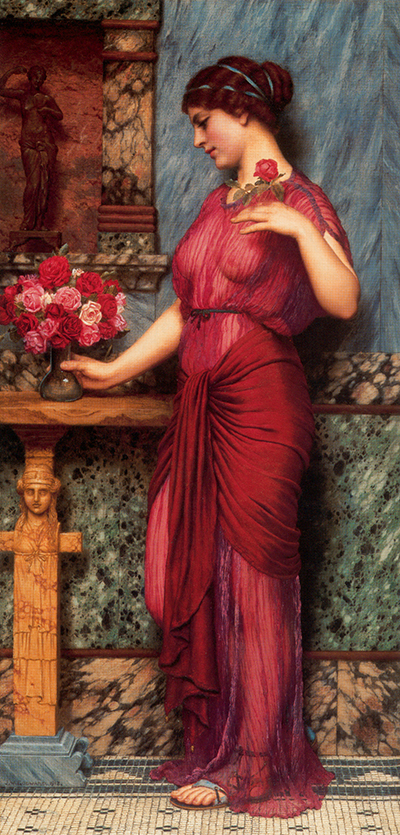
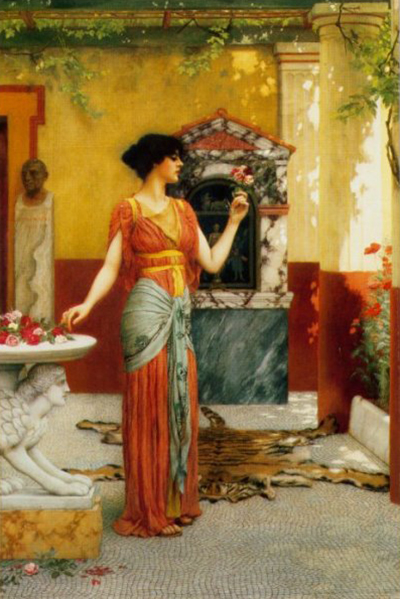
A woman lifts a few roses to eye level while her other hand still hovers over flowers on a marble table. A strip of sunlight falls along the courtyard wall, but her face is in the shade, framed by dark hair and the arch of a niche. John William Godward signed and dated The Bouquet in 1899. The tall oil painting gives as much attention to the courtyard that surrounds her as to the flowers she holds. [1] [2]
At a Glance
- Date1899
- MediumOil on canvas
- DimensionsAbout 76 × 50 cm
This work across John William Godward’s career
Contents
- Selecting the roses
- Stone, shade and a tiger skin
- A Pompeian portrait in the garden
- Reading the niche
- A change in the foliage
- The painting in the sale records
- Annotated details
Selecting the roses
The woman's arms set the pace of the picture. One extends diagonally down towards the cut flowers at the left edge, and the other bends to bring a few stems upright. Her head turns in the direction of the raised hand. In the gap between her face and the roses, the stems are thin enough to disappear against the patterned stone. Look down at the table and the flowers lie head to head in a shallow heap, pink and scarlet against the white rim. On the mosaic in the bottom corner, a few scattered petals and leaves pick up the same reds and greens. From the floor to the table to the woman's hand, the flowers appear at three heights and in three different states. The raised stems catch the woman’s eye, but the loose flowers and fallen petals show that the work of choosing is still in progress. [2]
The dress carries that upward movement through longer lines. Red-orange folds descend nearly to the floor, while a blue-green cloth passes across the hips and hangs from a gathering at the front. Two bright yellow bands cross the waist in the space between the arms. The cool cloth folds tightly where it is caught and opens into a broader fan towards the left hip. On the wall behind her, a sharp division between ochre and terracotta red cuts across the composition. The looser diagonal of the cloth and the changes of direction in her arms soften that rigid division. Her feet show just below the hem, where tiny mosaic tiles make the standing figure feel larger and the paved floor more extensive. [2]
Stone, shade and a tiger skin
Godward gives the courtyard a sense of open air without showing the sky. Vines run along a support near the top of the picture and hang down into the light. A planted strip at the right sends red flowers into view beside a column. The wall fills the background, even where vines reach above the woman's head. Broad expanses of yellow are broken by small, irregular leaf shadows, while the strongest patches of light fall across the right side. A vine casts shade on the walls and the floor, extending the garden beyond the narrow places where Godward shows plants growing. [2]
Godward changes how he paints every surface. The pale marble of the table reads as smooth along its rounded rim, then breaks into the carved forms of a sphinx beneath. At the back, dark branching veins in the pale stone frame the niche, and a deep green slab supports it below. Its slanting pale streaks are broad enough to read from across the courtyard. The floor mosaic has a much finer grain, with tiny units that bend in rows across the foreground. Against this mosaic lies the pelt Christie’s identifies as a tiger skin. Its edges curl and spread, and bands of orange, brown and black gather close together along the body. The stripes give the fur a direction, just as the streaks in the marble and the lines of the mosaic help us follow the shapes of those surfaces. [2]
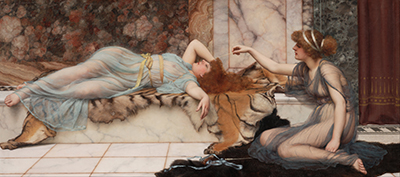
In Godward’s 1895 Mischief and Repose, the Getty identifies a tiger skin used as a cover on a marble ledge. There the reclining woman lies on the pelt, which follows the bench until it folds over the edge. In The Bouquet the skin is on the ground, behind the standing figure. Its irregular outline interrupts the otherwise orderly floor and helps separate the little space around the woman's feet from the wall and niche behind her. Four years apart, the two paintings show how the same kind of object could support a pose in one scene and help describe the depth of a courtyard in another. [2] [8]
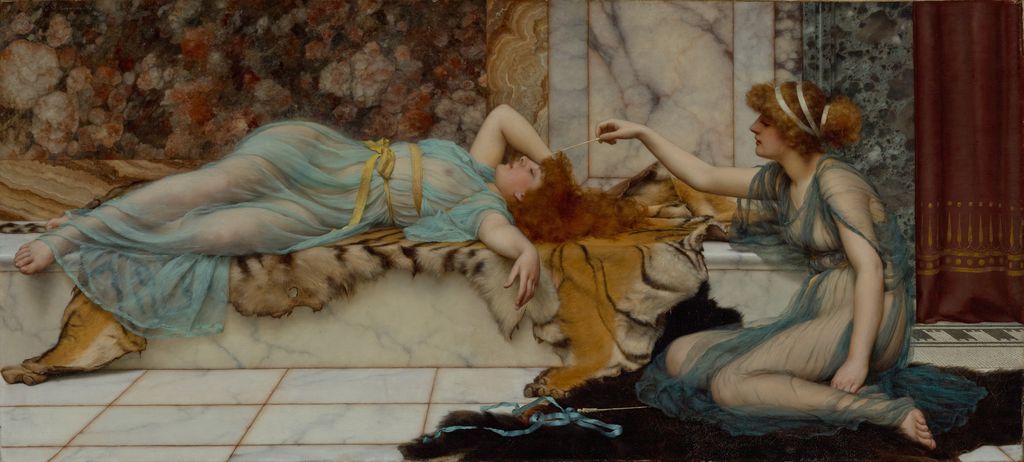
John William Godward, Mischief and Repose (1895). In the Getty oil the skin follows the bench and folds over its edge. J. Paul Getty Museum. Image source. CC0 / Public domain.
Annotated Details from The Bouquet
The numbered points identify visible features discussed in this article. Return from each detail to the numbered overview. John William Godward, The Bouquet (1899). Image source. Public domain.
.jpg)
Details from THE BOUQUET
Compare the cropped details with the source images above. Notice how their colours, shapes and positions contribute to the larger compositions.
The small portrait on a pillar
The dark head is mounted on a pale pillar. The painted arrangement recalls an ancient portrait herm.
 Detail 01 the-small-portrait-on-a-pillar.jpg)
The hand and the flowers
The lowered left hand reaches toward the flowers on the round table.
 Detail 02 the-hand-and-the-flowers.jpg)
The lifted hand before the niche
Her other hand lifts a flower in front of the dark niche, where the pale sculpted figure is easier to overlook.
 Detail 03 the-lifted-hand-before-the-niche.jpg)
A Pompeian portrait in the garden
Behind the flower table stands a dark head on a tall, pale shaft. A sculpture of this type is called a herm. The marks just below the head have unusual importance. Christie’s linked them to the inscription on a bronze portrait mounted on a marble pillar from the House of Lucius Caecilius Iucundus at Pompeii. The original is in the National Archaeological Museum in Naples. In the Roman house it stood by the entrance to the tablinum, a room opening off the atrium. On the original pillar, the words Genio L(uci) nostri / Felix l(ibertus) record a dedication by Felix, a freedman, to Lucius’s guardian spirit. The house yielded wax tablets that document Lucius Caecilius Iucundus’s business dealings, although the surviving head’s identification as a portrait of Lucius himself remains uncertain. [2] [9] [10] [11]
Godward brings that contrast between a dark head and a pale inscribed shaft into the courtyard, setting the sculpture against a red-framed opening. Much of the shaft is screened by the table. The eye can pick out the face before it distinguishes the lettering, especially in a small reproduction. August Mau’s illustrated account of Pompeii, published in English in 1899, reproduces a photograph that shows both the head and its inscription. How Godward encountered the object or its image remains open. [2] [11] [12]
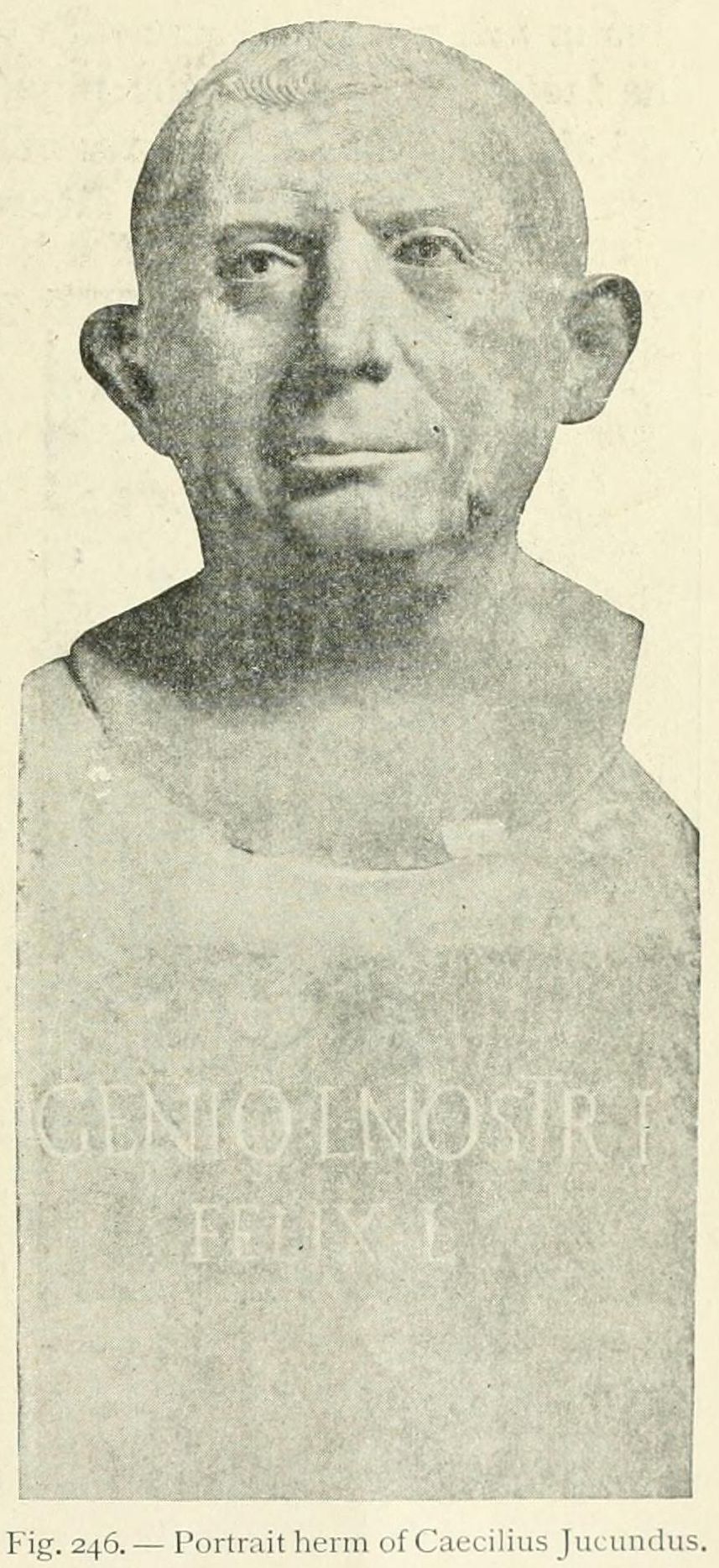
Portrait herm of Caecilius Jucundus in August Mau’s Pompeii, Its Life and Art (1899), fig. 246. The ancient bronze head and inscribed support supply the comparison Christie’s identifies beside the flower table. August Mau, Pompeii, Its Life and Art, 1899, fig. 246. Image source. Public domain.
John William Godward videos
See Godward’s paintings and studio practice alongside films on two Victorian contemporaries.
John William Godward - Part 1: The Last Painter of the Victorian Age
An overview of Godward’s career and the Victorian market for pictures set in antiquity.
Watch on YouTubeReading the niche
The central structure has a triangular top, an arched recess and a heavy base. It resembles a miniature building set against the wall. Its scale and placement make a Roman household shrine, or lararium, a plausible comparison. The same Pompeian house that yielded the portrait herm also contained a shrine in its atrium. Two marble reliefs from that shrine show the effects of an earthquake on public buildings at Pompeii. The documented portrait and the shrine are separate features of that house, which gives a concrete parallel for the coexistence of domestic portraiture and worship. [2] [10]
Another excavated example, near the Vicolo di Marco Lucrezio Frontone in Pompeii’s Regio V, helps explain how a garden setting could accommodate a shrine. There, painted household gods called Lares flank a small shrine set into a wall of painted plants and birds. Below it are snakes and a painted altar with offerings. Archaeologists also found a little stone altar with traces of burning in the garden, underlining the connection between the wall painting and activity in the room. The discoveries in Regio V came long after Godward painted The Bouquet. They give the darker niche and surrounding plants a historical comparison, while the identity of anything inside Godward’s recess and the purpose of the woman's flowers remain open. [2] [13]
The placement of the flowers matters in that reading. In the earlier The Flowers of Venus, a tall, narrow format brings the woman and the planting close together. In the 1912 An Offering to Venus, one hand raises a rose while the other tends a vase beneath a small figure. Christie’s records an earlier catalogue transcription of Godward’s title on the back of that canvas, where it appears with Rome and the date. In The Bouquet, the cut roses still lie loose on the sphinx table and the lifted stems are across the woman’s body from them. Their position establishes the act of selection. The title leaves the flowers’ eventual destination to the viewer. [2] [3] [6]
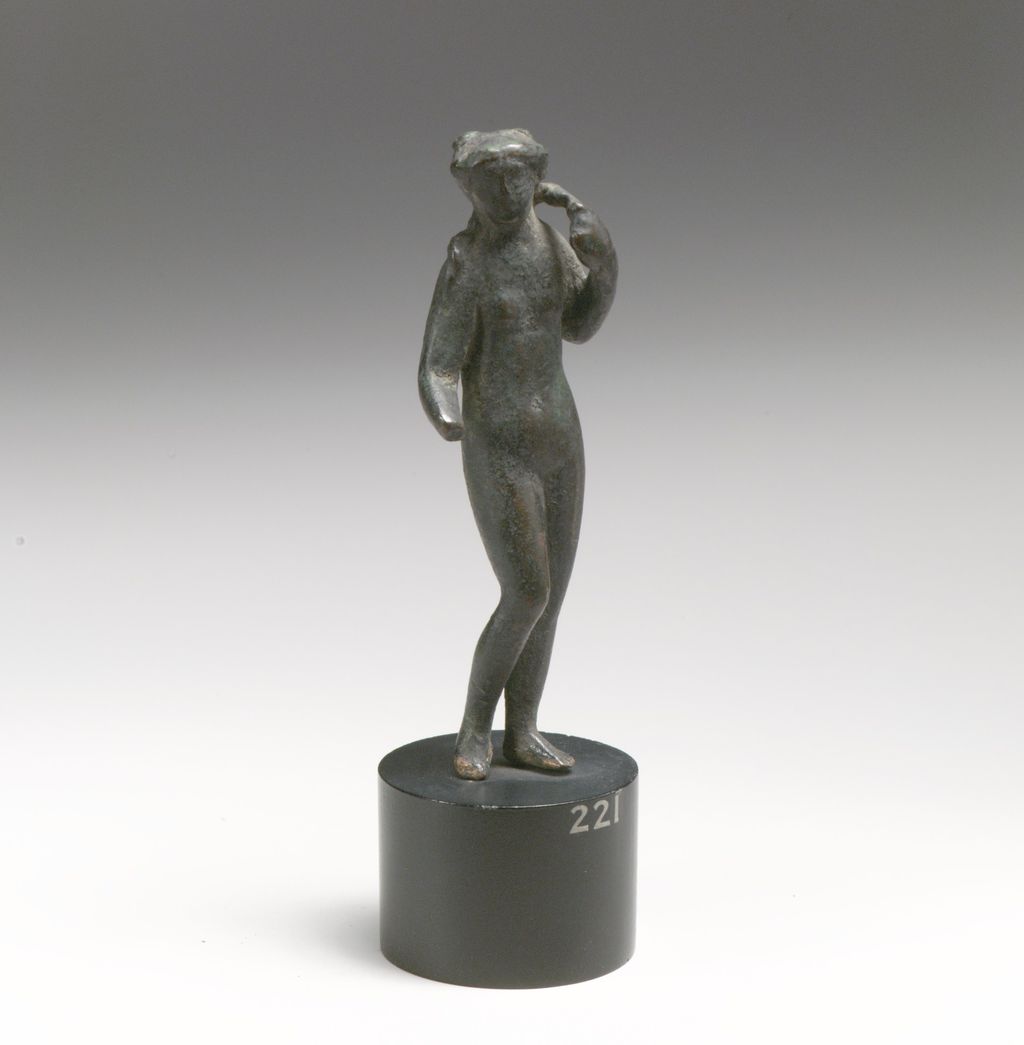
Bronze statuette of Venus, first to second century CE, The Met. This Roman bronze is a comparison for the small Venus figure beside Godward’s flower arranger. The Metropolitan Museum of Art. Image source. CC0 / Public domain.
A change in the foliage
A close look at the upper wall also raises a question about what is visible in the paint. In the report published for the November 2010 Sotheby’s sale, Simon Parkes Art Conservation described light retouching over pentimenti, or traces of an earlier design, in the foliage above the woman's head. That observation concerns a particular area of the upper wall. It leaves the full shape of the earlier foliage open. The leafy shadows in the finished composition still perform a clear visual task, carrying the eye past the woman’s dark hair to the brighter stone at the right. [1] [2]
The same report recorded a lined canvas, meaning that a supporting canvas had been attached to its reverse. It described the paint as stable at the time and noted two bands with slightly coarser canvas grain, one across the top of the hair and another around the knees. The conservator suggested that slight retouching in those areas might have been intended to make the bands less conspicuous. The report describes the painting as recently restored when it came to auction in 2010. [1]
The painting in the sale records
The earliest ownership event recorded in the two auction catalogues is Christie’s New York sale of 25 February 1983, where the picture appeared as lot 232. Sotheby’s names Kenneth Lux Gallery in New York between that sale and acquisition by the owner who eventually offered the painting as lot 57 in November 2010. Christie’s illustrated it again as lot 46 in July 2017, naming the 2010 auction as the point at which its consignor bought it. Both catalogues identify it as no. 1899.2 in Vern Grosvenor Swanson’s John William Godward: The Eclipse of Classicism and cite the reproduction on plate 130. Rehs Galleries also records the painting as sold and lists a private collection, with no name or current location specified. [1] [2] [14]
Sotheby’s gives the dimensions as 75.7 × 50.4 cm. The Christie’s catalogue lists 29¾ × 19⅞ inches, matching Rehs’s inch figures, but puts the height at 74.5 cm. The height in inches converts to about 75.6 cm. The reproduced composition, lower-left signature and date, and Christie’s reference to the 2010 lot all identify the same canvas. Its ownership before the 1983 sale remains open. [1] [2] [14]
John William Godward artworks directory
Search documented oil paintings, drawings, watercolours and reproductive prints. The directory includes the Art Renewal Center’s catalogue and additional works in museum, exhibition and sale records.
| Name | Date | Medium |
|---|---|---|
| Absence Makes the Heart Grow Fonder | 1912 | Oil on canvas |
| Amaryllis | 1903 | Oil on canvas |
| An Amateur | 1915 | Oil on canvas |
| Ancient Pastimes | 1916 | Oil on canvas |
| The Answer | 1917 | Oil on canvas |
| An Arcadian Beauty | 1899 | Painting |
| At the Fountain | 1893 | Oil on canvas |
| At the Garden Door | 1901 | Oil on canvas |
| At the Garden Shrine, Pompeii | 1892 | Oil on canvas |
| At the Gate of the Temple | 1898 | Oil on canvas |
| At the Thermae | 1909 | Oil on canvas |
| Atalanta | 1892 | Oil on canvas |
| Athenais | 1908 | Oil on canvas |
| An Auburn Beauty | 1895 | Oil on canvas |
| Autumn | 1900 | Oil on canvas |
| Beauty in a Marble Room | 1894 | Oil on canvas |
| The Belvedere | 1913 | Oil on canvas |
| The Betrothed | 1892 | Oil on canvas |
| The Betrothed (print after Godward) | 1893 | Photoengraving, as reported |
| The Bouquet | 1899 | Oil on canvas |
| Briseis | 1896 | Painting |
| The Broken Vase | 1889 | Oil on canvas |
| By the Blue Ionian Sea | 1916 | Oil on canvas |
| By the Wayside | 1912 | Oil on canvas |
| Byrsina | 1915 | Painting |
| Campaspe | 1896 | Oil on canvas |
| Campaspe (print after Godward) | Print, process unconfirmed | |
| Chloris (A Summer Rose) | 1902 | Oil on canvas |
| Classical Beauty | Oil on canvas | |
| A Classical Beauty | Oil on canvas | |
| A Classical Beauty | Painting | |
| A Classical Beauty | Oil on canvas | |
| A Classical Beauty | 1909 | Oil on canvas |
| A Classical Beauty In Profile | Oil on canvas | |
| A Classical Lady | 1908 | Oil on canvas |
| Clymene | 1892 | Oil on canvas |
| A Congenial Task | 1915 | Oil on canvas |
| Contemplation | 1922 | Oil on canvas |
| A Cool Retreat | 1910 | Oil on canvas |
| Country House in the 18th Century | c. 1883 | Oil on canvas |
| Cytheris | 1922 | Painting |
| The Day Dream | 1920 | Oil on canvas |
| The Delphic Oracle | 1899 | Oil on canvas |
| A Dilettante | 1922 | Oil on canvas |
| Distant Thoughts | 1918 | Oil on canvas |
| Dolce Far Niente | 1897 | Oil on canvas |
| Dolce Far Niente | 1906 | Oil on canvas |
| Dolce far niente (A Pompeian Fishpond) | 1904 | Oil on canvas |
| Dolce far niente (coloured print after Godward) | Exhibited 1900 | Coloured print, exact process unconfirmed |
| Dolce far niente (grapes) | 1907 | Oil on canvas |
| Dora | 1887 | Oil on canvas |
| Drusilla | 1906 | Oil on canvas |
| An Edition de Luxe | 1920 | Oil on canvas |
| Eighty and Eighteen | 1898 | Oil on canvas |
| Endymion | 1893 | Oil on canvas |
| The Engagement Ring (horizontal composition) | 1888 | Oil on canvas |
| The Engagement Ring (upright composition) | c. 1891 | Oil on canvas |
| Erato at Her Lyre | Oil on canvas | |
| A Fair Reflection | 1915 | Oil on canvas |
| A Fair Reflection (Taber-Prang print) | By 1923 | Sepia artotype |
| Far Away Thoughts (circular sewing scene) | 1911 | Oil on canvas |
| Far Away Thoughts (left-facing profile) | 1892 | Oil on canvas |
| Far Away Thoughts (right-facing profile) | 1892 | Oil on canvas |
| Female Figure (probable Grecian Idyll study) | 1907 | Oil on board |
| Flabellifera | 1905 | Oil on canvas |
| Flabellifera (painted study) | c. 1905 | Oil study |
| Flabellifera (pencil study) | c. 1905 | Pencil on paper |
| The Flower Girl | Painting | |
| A Flower Seller | 1896 | Oil on canvas |
| The Flowers of Venus | 1890 | Oil on canvas |
| A Fond Farewell | 1918 | Watercolour |
| The Fragrant Rose | 1892 | Painting |
| The Fruit Vendor | 1917 | Oil on canvas |
| A Garland Seller | 1914 | Painting |
| Giotto Drawing from Nature | Painting | |
| Girl in Yellow Drapery | 1901 | Oil on canvas |
| Golden Hours | 1913 | Oil on canvas |
| A Grecian Girl | 1908 | Oil on canvas |
| Grecian Idyll | 1907 | Oil on canvas |
| A Grecian Lovely | 1909 | Oil on canvas |
| Grecian Reverie | 1889 | Oil on canvas |
| Grecian Reverie | 1889 | Oil on canvas |
| A Greek Beauty | 1905 | Oil on canvas |
| A Happy Awakening | 1903 | Oil on canvas |
| He Loves Me, He Loves Me Not | 1896 | Oil on canvas |
| A head and shoulders profile portrait of a young woman wearing a white tunic style blouse | c. 1889 | Painting |
| Head of a Girl (The Priestess) | 1896 | Oil on canvas |
| Heart on her Lips and Soul within her Eyes | 1904 | Painting |
| His Birthday Gift | 1889 | Oil on canvas |
| Ianthe | 1889 | Oil on canvas |
| An Idle Hour | 1890 | Oil on canvas |
| Idle Moments | 1895 | Oil on canvas |
| Idle Thoughts | 1898 | Oil on canvas |
| Idleness | 1900 | Oil on canvas |
| Il Dolce Far Niente (Pears print after Amaryllis) | 1906 | Chromolithograph |
| Il Dolce far niente (seated figure) | 1893 | Oil on canvas |
| In Expectation | c. 1892 | Oil on canvas |
| In Realms of Fancy | 1911 | Oil on canvas |
| In the Prime of the Summertime (Reverie) | 1914 | Oil on canvas |
| In the Tepidarium | 1913 | Oil on canvas |
| Innocent Amusements | 1891 | Oil on canvas |
| Ione | c. 1896-1898 | Oil on canvas |
| Ionian Dancing Girl | 1902 | Oil on canvas |
| Ismenia | 1908 | Oil on canvas |
| An Italian Beauty | 1897 | Oil on canvas |
| An Italian Girls' Head | 1902 | Oil on canvas |
| The Jewel Casket | 1900 | Oil on canvas |
| Julia | 1914 | Painting |
| Knuckle Bones | 1890 | Oil on canvas |
| La Pensierosa | 1913 | Oil on canvas |
| A Lady | 1895 | Oil on canvas |
| Landscape: Blossoming Red Almond [study] | c. 1912 | Oil on panel |
| Le Billet Doux (The Love Letter) | 1913 | Oil on canvas |
| Leaning Against a Column | 1901 | Painting |
| Leaning on the Balcony | 1892 | Oil on canvas |
| Leisure Hours | 1905 | Oil on canvas |
| Lesbia with her Sparrow | 1916 | Oil on canvas |
| The Letter | 1899 | Painting |
| Liegende | 1893 | Oil on canvas |
| A Lily Pond | 1917 | Oil on canvas |
| Looking Out to Sea | 1918 | Pencil and watercolour |
| The Love Letter (circular composition) | 1907 | Oil on canvas |
| Lucilia | 1917 | Oil on canvas |
| Lycinna | 1918 | Oil on canvas |
| Marcella | 1912 | Painting |
| Matrona Superba | Oil on canvas | |
| Megilla | 1921 | Oil on canvas |
| A Melody | 1904 | Oil on canvas |
| Memories | c. 1891 | Oil on canvas |
| Mirinna | Painting | |
| The Mirror | 1899 | Oil on canvas |
| Mischief | 1905 | Oil on canvas |
| Mischief and Repose | 1895 | Oil on canvas |
| A Mouse in the Work Basket | 1893 | Oil on canvas |
| Nerissa | 1906 | Oil on canvas |
| The New Perfume | 1914 | Oil on canvas |
| Noon Day Rest | 1910 | Oil on canvas |
| Nu Sur La Plage | 1922 | Oil on panel |
| Nude Study | Oil on canvas | |
| An Offering to Venus | 1912 | Oil on canvas |
| The Old, Old Story | Oil on canvas | |
| The Old, Old Story | 1903 | Oil on canvas |
| On the Balcony | 1911 | Oil on canvas |
| On The Terrace | 1918 | Oil on canvas |
| Ophelia | Oil on panel | |
| The Peacock Fan | 1912 | Oil on canvas |
| Phyleis | 1908 | Oil on canvas |
| The Playground | 1892 | Oil on canvas |
| Playtime | 1891 | Oil on canvas |
| A Pompeian Bath | 1890 | Oil on canvas |
| A Pompeian Lady | 1891 | Oil on canvas |
| A Pompeian Lady | 1895 | Oil on board |
| A Pompeian Lady | 1901 | Painting |
| A Pompeian Lady | 1904 | Painting |
| Portrait of Mary Frederica 'Nin' Godward | c. 1882-1883 | Oil on canvas |
| Portrait of Mary Perkinton Godward | c. 1880-1881 | Watercolor |
| The Posy | 1900 | Painting |
| A Priestess (bare-shouldered figure) | 1893 | Oil on canvas |
| A Priestess (clothed composition) | 1894 | Oil on canvas |
| A Priestess (W. Biscombe Gardner after Godward) | Exhibited 1897 | Print, process unconfirmed |
| A Priestess of Bacchus | 1890-1890 | Oil on canvas |
| Pyrallis | 1918 | Oil on canvas |
| The Quiet Pet | 1906 | Oil on canvas |
| A Red, Red Rose | 1920 | Oil on canvas |
| Reflections | 1893 | Oil on canvas |
| The Rendezvous | 1903 | Oil on canvas |
| Repose, the Flower Girl | c. 1887 | Oil on canvas |
| Reverie | 1888 | Oil on panel |
| Reverie | 1912 | Oil on canvas |
| Reverie (In the Days of Sappho) | 1904 | Oil on canvas |
| Reverie (Pears print after In the Prime of the Summertime) | 1916 | Chromolithograph |
| 'Rich Gifts Wax Poor When Lovers Prove Unkind' | 1916 | Oil on canvas |
| The Ring | 1898 | Oil on canvas |
| A Roman Matron | 1905 | Oil on canvas |
| Sabinella | 1912 | Oil on canvas |
| Sappho | 1910 | Oil on canvas |
| The Siesta | Oil on canvas | |
| A Siesta | 1895 | Oil on canvas |
| The Signal | 1899 | Oil on canvas |
| Sitting for Her Portrait | 1893 | Oil on canvas |
| Sketch for Amaryllis | 1903 | Oil on board |
| A Souvenir | 1920 | Oil on canvas |
| Stesicrate | 1914 | Oil on canvas |
| Study for 'Rêverie' | 1890 | Oil on canvas |
| Study for 'The Priestess' | 1895 | Oil on board |
| Study for An Egyptian Minstrel | 1906 | Painting |
| Study for The New Perfume | Drawing, medium unconfirmed | |
| Study for ‘The Old, Old Story’ | 1903 | Oil paint on wood |
| Study of a Girl's Head | 1899 | Painting |
| Study of Campaspe | Oil on canvas | |
| Study of Head and Drapery, Miss Ethel Warwick | 1898 | Painting |
| Summer Day | 1897 | Painting |
| Summer Flowers | 1903 | Oil on canvas |
| Sweet Dreams | 1901 | Oil on canvas |
| Sweet Dreams | 1904 | Painting |
| The Sweet Siesta of a Summer's Day | 1891 | Oil on canvas |
| The Tambourine Girl (profile at the marble wall) | 1906 | Oil on canvas |
| The Tambourine Girl (relief-backed version) | 1906 | Oil on canvas |
| Tender Thoughts | 1917 | Oil on canvas |
| Tender Thoughts (woman leaning over a parapet) | 1918 | Pencil and watercolour |
| The Tiff (oil) | By 1888 | Oil on canvas |
| The Tiff (print after Godward) | 1894 | Photogravure |
| The Tigerskin | 1889 | Oil on canvas |
| The Time of Roses | 1916 | Oil on canvas |
| Tranquillity | 1914 | Oil on canvas |
| A Tryst | 1912 | Oil on canvas |
| Tympanistria | 1909 | Oil on canvas |
| Under the Blossom that Hangs on the Bough | 1917 | Oil on canvas |
| Venus at the Bath | 1901 | Oil on canvas |
| Venus Binding Her Hair | 1897 | Oil on canvas |
| Violets, Sweet Violets | 1906 | Painting |
| Waiting for an Answer | 1889 | Oil on canvas |
| Waiting for the Procession | 1890 | Oil on canvas |
| Waiting for the Procession | 1890 | Painting |
| The Water Carrier (magazine reproduction of At the Fountain) | 1898 | Magazine reproduction |
| When the Heart is Young | 1902 | Oil on canvas |
| Who Can They Be | Painting | |
| Winding Wool | 1894 | Painting |
| 'With Violets Wreathed and Robe of Saffron Hue' | 1902 | Oil on canvas |
| The Yellow Shawl | 1893 | Painting |
| 'Yes or No?' | 1893 | Oil on canvas |
| Young Girl Picking Grapes | 1902 | Oil on canvas |
| Youth and Time | 1901 | Oil on canvas |
Discussion
Look again at the images and ideas explored in The Bouquet. These editorial prompts invite your observations.
Reader Insights
How does your eye move from the scattered petals to the raised roses?
Which features make this room feel open to the air?
Join the Conversation
Share a detail, comparison or question about The Bouquet below.
References
- Sotheby’s. John William Godward, The Bouquet, 19th Century European Art, New York, 4 November 2010, sale N08673, lot 57. Signature, dimensions, provenance and condition report by Simon Parkes Art Conservation. English. View source.
- Christie’s. John William Godward, The Bouquet, Victorian, Pre-Raphaelite & British Impressionist Art, London, 11 July 2017, sale CKS14232, lot 46. Illustrated original catalogue, object record and lot essay. English. View source.
- Art Renewal Center. John William Godward, The Flowers of Venus, artwork 11593. English. View source.
- A Priestess. View source.
- At the Gate of the Temple. View source.
- Christie’s. John William Godward, An Offering to Venus, London, 13 July 2016, lot 126. Catalogue photograph, inscription and provenance. English. View source.
- The Peacock Fan. View source.
- J. Paul Getty Museum. John William Godward, Mischief and Repose, 1895, accession 79.PA.149. English. View source.
- The Swedish Pompeii Project. Casa di Caecilius Iucundus, south house, p. 3, Corpus Inscriptionum Latinarum X 860. Latin text, English translation and find context. View source.
- Parco Archeologico di Pompei. Guida agli scavi di Pompei, p. 51, Casa di Cecilio Giocondo. House, bronze portrait, wax tablets and reliefs from the household shrine. Italian. View source.
- National Trust Collections. Portrait of a Man, Perhaps Lucius Caecilius Iucundus, Ightham Mote, 825661. Jeremy Warren’s catalogue entry on a modern cast and its Pompeian original. English. View source.
- August Mau. Pompeii, Its Life and Art, translated by Francis W. Kelsey, New York, 1899, p. 439, fig. 246. Photograph of the herm in Naples. English. View source.
- Parco Archeologico di Pompei. Gli scavi della Regio V. Excavation account of the painted lararium near the Vicolo di Marco Lucrezio Frontone. Italian. View source.
- Rehs Galleries. John William Godward, The Bouquet, image 8849. Historical sales listing with signature, dimensions and private-collection provenance. English. View source.