 by Tom Gurney
Tom Gurney BSc (Hons) is an art history expert with over 20 years experience
Published on June 19, 2020 / Updated on October 14, 2023
Email: tomgurney1@gmail.com / Phone: +44 7429 011000
Ionian Dancing Girl by John William Godward: Introduction
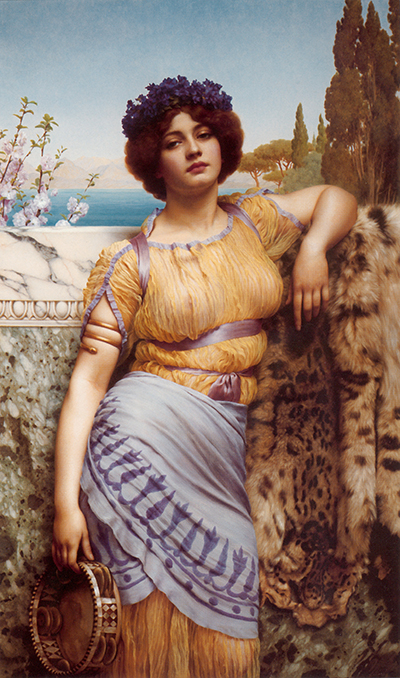
A young woman lets a tambourine hang from one hand and rests her other elbow on a leopard skin spread over a marble wall. She has turned her face towards us. The fabric follows the turn of her hips while the instrument hangs almost at the lower edge of the picture. John William Godward gives us the sense of a dance in a pose the woman could hold. He signed and dated the oil on canvas at the lower right in 1902. That summer it appeared as no. 250 at the New Gallery in London. [1] [2]
At a Glance
- Date1902
- MediumOil on canvas
- DimensionsAbout 137 × 83 cm
This work across John William Godward’s career
Grecian Idyll
1907 [4]The Peacock Fan
1912 [5]Tender Thoughts
1917 [7]Contents
- How the dancer holds her pose
- Fabric, marble and the tambourine
- Ionia and the instrument
- A second canvas from 1902
- The exhibition and the painting's later history
- Annotated details
How the dancer holds her pose
The weight goes through the elbow at our right. Her forearm drops beyond the top of the wall and her fingers are loosely separated against the skin. At our left, her other arm slopes out as it descends, carrying the eye past the coils of a gold-coloured armlet to the hand below her hip. The tambourine hangs slightly away from the body. Its circular face is turned at an angle, showing both the membrane and the depth of the decorated rim. The woman's head tips towards the lowered arm, yet her eyes are level enough to meet ours. Her direct gaze holds steady across a figure whose weight and outline are constantly shifting. [2]
Godward gives the figure room to lean by setting her against strong upright and horizontal lines. The tall trees at the right carry the eye all the way to the top of the canvas. The marble ledge runs behind the shoulders, with the band of blue water pressed into the gap between stone and sky. The doorway and its surround in At the Gate of the Temple rise with the figure to nearly fill her setting. Here most of the wall sits below the dancer's shoulders, so the open sky gives the violet wreath and the shape of her head a clear outline. Even the flowering branches contribute to that effect. At the left they are fine enough to pick out against the water and sky, while the mass of dark foliage on the right gives the raised arm a firmer outline. [2]
Fabric, marble and the tambourine
The yellow robe changes direction at each point where it is held. Fine creases descend from the lilac edging at the neck, narrow beneath the band under the bust, and bunch again where another length of ribbon is tied at the waist. The brightest folds are so slender they look like narrow threads of light across the body. The lilac wrap over the hips is denser. Its border crosses the figure diagonally in a line of repeated purple shapes, and where the cloth bends, the shapes contract or stretch. The violet flowers above the forehead carry the same colour into a different texture. Their small, crowded petals make a dark, irregular edge against the sky. [2]
The wall changes character above and below its carved band. The pale coping has dark, sharply defined veins. Below it, the deep green mottling makes a ground for the hanging arm and the yellow cloth. At the right, the pelt falls almost the length of the visible figure. Godward renders its spots differently wherever the fur bunches, changes direction or lies flat. On the section beneath the resting hand they sink into the darker fur. Along the outside edge, tufts break the outline of the skin. Vern Swanson singled out the pelt in his discussion of the painting. Its loose edge stands out especially clearly where the soft fibres give way to the smoother folds of the lilac wrap. [2]
The rim of the tambourine repays a closer look. Pale geometric shapes occupy a small area beside the slots, and a dotted edge follows the curve of the head. Michael Allan Kodysz describes the ornament as ivory inlay in his study of Godward's classical figure painting. He takes the care given to details like this as evidence of the persistence of archaeological interests in canvases chiefly concerned with the figure. The details belong to a broader pattern. The repeated circles of the tambourine and its fittings answer the repeated stone ovals along the top of the wall, though one pattern is caught on a slant and the other follows a straight line. [2] [8]
Annotated Details from Ionian Dancing Girl
The numbered points identify visible features discussed in this article. Return from each detail to the numbered overview. John William Godward, Ionian Dancing Girl (1902). Image source. Public domain.
.jpg)
Details from IONIAN DANCING GIRL
Compare the cropped details with the source images above. Notice how their colours, shapes and positions contribute to the larger compositions.
A drum held at a slant
The hanging drum turns away from the viewer and exposes the thickness and decoration of its rim.
 Detail 01 a-drum-held-at-a-slant.jpg)
Weight against the fur
The elbow rests on the fur as the forearm drops over the ledge.
 Detail 02 weight-against-the-fur.jpg)
A wreath above a direct gaze
The violet flowers repeat the garment’s colour beside a face turned toward the viewer.
 Detail 03 a-wreath-above-a-direct-gaze.jpg)
Ionia and the instrument
The title has a classical resonance. Ancient Ionia included Greek cities such as Miletus and Ephesus on the eastern shore of the Aegean. Bonhams identifies the water in Godward's painting as the Ionian Sea. The silhouette of distant land is lightly painted and gives little indication of a particular place. It is the marble, the costume and the instrument that most immediately suggest antiquity. [2] [9]
A late Hellenistic terracotta from Cyprus in the Metropolitan Museum of Art shows a woman playing a tympanon, an ancient hand drum. She holds it upright from underneath with her left hand and spreads the fingers of her right to strike it. Her two hands tell us something definite about the action. In Godward's painting the lowered instrument is suspended from one hand while the other rests away from it. The title tells us her role, and the drum gives it a physical presence. Her loose grip and resting elbow leave the timing open. We might see a pause between movements or a dancer still deciding whether to begin. [2] [10]
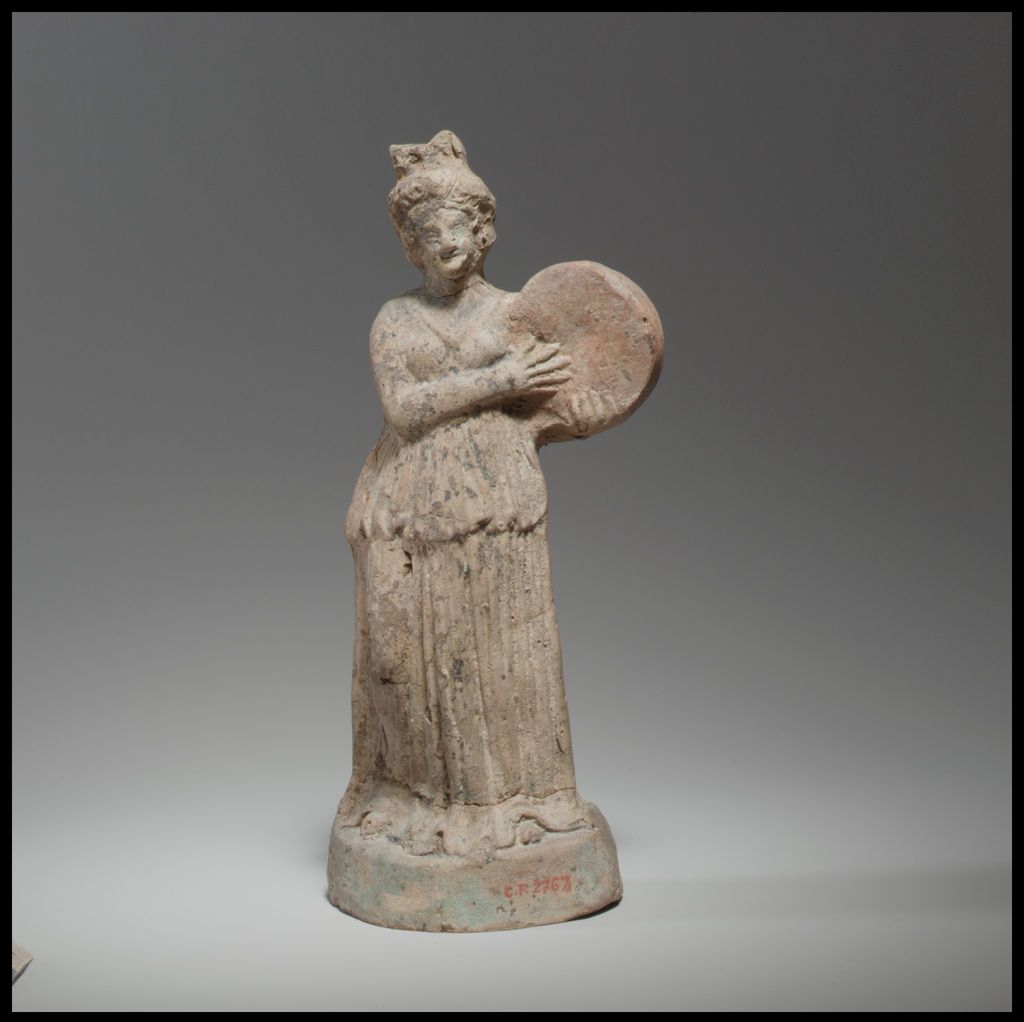
Terracotta figure of a woman playing a tympanon, The Met. The terracotta shows the distinct hand positions involved in supporting and striking a drum. The Metropolitan Museum of Art. Image source. CC0 / Public domain.
John William Godward videos
See Godward’s paintings and studio practice alongside films on two Victorian contemporaries.
John William Godward - Part 1: The Last Painter of the Victorian Age
An overview of Godward’s career and the Victorian market for pictures set in antiquity.
Watch on YouTubeA second canvas from 1902
Christie’s pairs the dancing girl with Godward's With Violets Wreathed and Robe of Saffron Hue, a signed oil of the same year and roughly half the height. It appeared as no. 92 at the 1902 Autumn Exhibition at Liverpool's Walker Art Gallery, where Christie’s records a sale at £210. The University of Glasgow's record of the Liverpool show puts the number of exhibits at 1,598. Christie’s also records the smaller picture under the title Reflections, which suits the water that takes up the bottom of the composition. [11] [12] [13]
The figure in the Liverpool picture wears a similar wreath, armlet and combination of yellow and purple. Her dress now spreads in a pool of gold across the tiled floor. One hand supports her beside her hip, and the other is raised behind her neck as she looks out past us. Godward retains the ledge and fur and places her far enough back to show the lily pond at her feet and a broader view of the coast. See how the edge of the pond curves along the lower part of the picture, where the hanging instrument directs the eye down in the London painting. The second canvas has room for a longer, shallower circuit through the water lilies, the folds by the woman's feet and the horizon beyond. Godward changes the pace by lowering the figure into the landscape and giving the water more space. [2] [11] [12]
The smaller, forward-facing version of The Tambourine Girl, signed in 1906, puts the instrument to another use. Christie’s also lists it as Greek Girl with Tambourine and Girl with a Tambourine, and both Christie’s and Sotheby’s record its appearance at the Paris Salon that year. Its upright canvas is less than half as tall as the 1902 oil. Behind the woman, a carved marble frieze contains figures making music and dancing. The relief moves the music and dancing into the background, where the small, busy figures are set against the stillness of the woman. In Ionian Dancing Girl the action is concentrated in the stance of the dancer herself. [2] [14] [15]
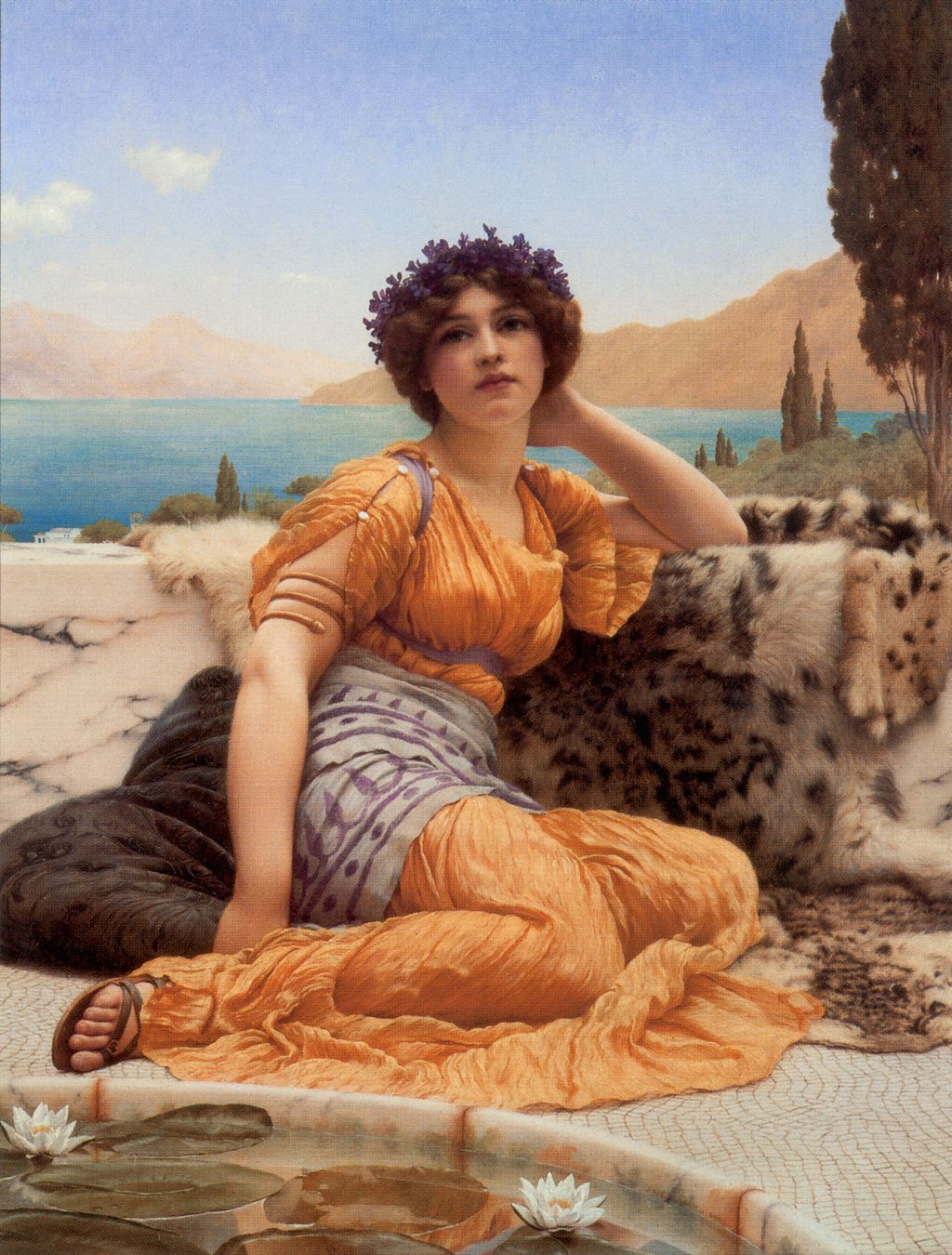
John William Godward, With Violets Wreathed and Robe of Saffron Hue (1902). The wreath, broad yellow folds and marble ledge are used to frame a seated figure beside a lily pond. Image source. Public domain.
The exhibition and the painting's later history
Christie’s records the canvas with the London dealer Thomas McLean by 18 April 1902, and lists a letter from McLean to Godward of that date. The next public record is the summer exhibition in Regent Street. In its review of 17 May, The Athenaeum singled out John Singer Sargent's group portrait of the Wertheimer children, the very next entry in the exhibition numbering, no. 251. The Art Journal called it the fifteenth summer exhibition and counted 309 exhibits that year, down from 469 the previous year, when pictures had also been hung on the balcony. Both periodicals discussed Sargent in the North Gallery. The contemporary reception of Godward's picture is harder to pin down. Christie’s and Bonhams report that it drew praise at the New Gallery, while the two published reviews concentrate on other exhibits. [1] [2] [16] [17]
Christie’s measured the canvas at 137.1 × 83.8 cm, and Bonhams recorded 137.2 × 83.2 cm in 2023. The earlier catalogue traces the work from McLean to Nathan Mitchell, then through Cooling Galleries in 1950 and Leger Galleries in 1972 to a private collection in Japan. Bonhams adds a private sale through Phillips in 1996, ownership by William O. Brisben, the Christie’s New York sale in February 1998, when Christie’s records a price of $680,000, and a subsequent private collection in Italy. The 1902 painting also appears in both editions of Swanson's catalogue raisonné, under item 1902.9 in the Bonhams record. Its prominent place on the cover of the first edition is consistent with Swanson's appraisal of the oil as a particularly full example of Godward's handling of the figure and her surroundings. [1] [2] [11]
Bonhams illustrated the picture both on its own and inside the gilt tabernacle frame in which it was offered. The frame's upright sides and triangular pediment give the figure an architectural setting outside the one Godward painted. Seen in that setting, the largest shapes are legible at a distance. The arc of the elbow, the long fall of the fur and the width of the lilac wrap keep their distinct outlines. As we get close, those large shapes resolve into quieter particulars, down to the pale decoration on a tambourine hanging just above the bottom of the canvas. [2]
John William Godward artworks directory
Search documented oil paintings, drawings, watercolours and reproductive prints. The directory includes the Art Renewal Center’s catalogue and additional works in museum, exhibition and sale records.
| Name | Date | Medium |
|---|---|---|
| Absence Makes the Heart Grow Fonder | 1912 | Oil on canvas |
| Amaryllis | 1903 | Oil on canvas |
| An Amateur | 1915 | Oil on canvas |
| Ancient Pastimes | 1916 | Oil on canvas |
| The Answer | 1917 | Oil on canvas |
| An Arcadian Beauty | 1899 | Painting |
| At the Fountain | 1893 | Oil on canvas |
| At the Garden Door | 1901 | Oil on canvas |
| At the Garden Shrine, Pompeii | 1892 | Oil on canvas |
| At the Gate of the Temple | 1898 | Oil on canvas |
| At the Thermae | 1909 | Oil on canvas |
| Atalanta | 1892 | Oil on canvas |
| Athenais | 1908 | Oil on canvas |
| An Auburn Beauty | 1895 | Oil on canvas |
| Autumn | 1900 | Oil on canvas |
| Beauty in a Marble Room | 1894 | Oil on canvas |
| The Belvedere | 1913 | Oil on canvas |
| The Betrothed | 1892 | Oil on canvas |
| The Betrothed (print after Godward) | 1893 | Photoengraving, as reported |
| The Bouquet | 1899 | Oil on canvas |
| Briseis | 1896 | Painting |
| The Broken Vase | 1889 | Oil on canvas |
| By the Blue Ionian Sea | 1916 | Oil on canvas |
| By the Wayside | 1912 | Oil on canvas |
| Byrsina | 1915 | Painting |
| Campaspe | 1896 | Oil on canvas |
| Campaspe (print after Godward) | Print, process unconfirmed | |
| Chloris (A Summer Rose) | 1902 | Oil on canvas |
| Classical Beauty | Oil on canvas | |
| A Classical Beauty | Oil on canvas | |
| A Classical Beauty | Painting | |
| A Classical Beauty | Oil on canvas | |
| A Classical Beauty | 1909 | Oil on canvas |
| A Classical Beauty In Profile | Oil on canvas | |
| A Classical Lady | 1908 | Oil on canvas |
| Clymene | 1892 | Oil on canvas |
| A Congenial Task | 1915 | Oil on canvas |
| Contemplation | 1922 | Oil on canvas |
| A Cool Retreat | 1910 | Oil on canvas |
| Country House in the 18th Century | c. 1883 | Oil on canvas |
| Cytheris | 1922 | Painting |
| The Day Dream | 1920 | Oil on canvas |
| The Delphic Oracle | 1899 | Oil on canvas |
| A Dilettante | 1922 | Oil on canvas |
| Distant Thoughts | 1918 | Oil on canvas |
| Dolce Far Niente | 1897 | Oil on canvas |
| Dolce Far Niente | 1906 | Oil on canvas |
| Dolce far niente (A Pompeian Fishpond) | 1904 | Oil on canvas |
| Dolce far niente (coloured print after Godward) | Exhibited 1900 | Coloured print, exact process unconfirmed |
| Dolce far niente (grapes) | 1907 | Oil on canvas |
| Dora | 1887 | Oil on canvas |
| Drusilla | 1906 | Oil on canvas |
| An Edition de Luxe | 1920 | Oil on canvas |
| Eighty and Eighteen | 1898 | Oil on canvas |
| Endymion | 1893 | Oil on canvas |
| The Engagement Ring (horizontal composition) | 1888 | Oil on canvas |
| The Engagement Ring (upright composition) | c. 1891 | Oil on canvas |
| Erato at Her Lyre | Oil on canvas | |
| A Fair Reflection | 1915 | Oil on canvas |
| A Fair Reflection (Taber-Prang print) | By 1923 | Sepia artotype |
| Far Away Thoughts (circular sewing scene) | 1911 | Oil on canvas |
| Far Away Thoughts (left-facing profile) | 1892 | Oil on canvas |
| Far Away Thoughts (right-facing profile) | 1892 | Oil on canvas |
| Female Figure (probable Grecian Idyll study) | 1907 | Oil on board |
| Flabellifera | 1905 | Oil on canvas |
| Flabellifera (painted study) | c. 1905 | Oil study |
| Flabellifera (pencil study) | c. 1905 | Pencil on paper |
| The Flower Girl | Painting | |
| A Flower Seller | 1896 | Oil on canvas |
| The Flowers of Venus | 1890 | Oil on canvas |
| A Fond Farewell | 1918 | Watercolour |
| The Fragrant Rose | 1892 | Painting |
| The Fruit Vendor | 1917 | Oil on canvas |
| A Garland Seller | 1914 | Painting |
| Giotto Drawing from Nature | Painting | |
| Girl in Yellow Drapery | 1901 | Oil on canvas |
| Golden Hours | 1913 | Oil on canvas |
| A Grecian Girl | 1908 | Oil on canvas |
| Grecian Idyll | 1907 | Oil on canvas |
| A Grecian Lovely | 1909 | Oil on canvas |
| Grecian Reverie | 1889 | Oil on canvas |
| Grecian Reverie | 1889 | Oil on canvas |
| A Greek Beauty | 1905 | Oil on canvas |
| A Happy Awakening | 1903 | Oil on canvas |
| He Loves Me, He Loves Me Not | 1896 | Oil on canvas |
| A head and shoulders profile portrait of a young woman wearing a white tunic style blouse | c. 1889 | Painting |
| Head of a Girl (The Priestess) | 1896 | Oil on canvas |
| Heart on her Lips and Soul within her Eyes | 1904 | Painting |
| His Birthday Gift | 1889 | Oil on canvas |
| Ianthe | 1889 | Oil on canvas |
| An Idle Hour | 1890 | Oil on canvas |
| Idle Moments | 1895 | Oil on canvas |
| Idle Thoughts | 1898 | Oil on canvas |
| Idleness | 1900 | Oil on canvas |
| Il Dolce Far Niente (Pears print after Amaryllis) | 1906 | Chromolithograph |
| Il Dolce far niente (seated figure) | 1893 | Oil on canvas |
| In Expectation | c. 1892 | Oil on canvas |
| In Realms of Fancy | 1911 | Oil on canvas |
| In the Prime of the Summertime (Reverie) | 1914 | Oil on canvas |
| In the Tepidarium | 1913 | Oil on canvas |
| Innocent Amusements | 1891 | Oil on canvas |
| Ione | c. 1896-1898 | Oil on canvas |
| Ionian Dancing Girl | 1902 | Oil on canvas |
| Ismenia | 1908 | Oil on canvas |
| An Italian Beauty | 1897 | Oil on canvas |
| An Italian Girls' Head | 1902 | Oil on canvas |
| The Jewel Casket | 1900 | Oil on canvas |
| Julia | 1914 | Painting |
| Knuckle Bones | 1890 | Oil on canvas |
| La Pensierosa | 1913 | Oil on canvas |
| A Lady | 1895 | Oil on canvas |
| Landscape: Blossoming Red Almond [study] | c. 1912 | Oil on panel |
| Le Billet Doux (The Love Letter) | 1913 | Oil on canvas |
| Leaning Against a Column | 1901 | Painting |
| Leaning on the Balcony | 1892 | Oil on canvas |
| Leisure Hours | 1905 | Oil on canvas |
| Lesbia with her Sparrow | 1916 | Oil on canvas |
| The Letter | 1899 | Painting |
| Liegende | 1893 | Oil on canvas |
| A Lily Pond | 1917 | Oil on canvas |
| Looking Out to Sea | 1918 | Pencil and watercolour |
| The Love Letter (circular composition) | 1907 | Oil on canvas |
| Lucilia | 1917 | Oil on canvas |
| Lycinna | 1918 | Oil on canvas |
| Marcella | 1912 | Painting |
| Matrona Superba | Oil on canvas | |
| Megilla | 1921 | Oil on canvas |
| A Melody | 1904 | Oil on canvas |
| Memories | c. 1891 | Oil on canvas |
| Mirinna | Painting | |
| The Mirror | 1899 | Oil on canvas |
| Mischief | 1905 | Oil on canvas |
| Mischief and Repose | 1895 | Oil on canvas |
| A Mouse in the Work Basket | 1893 | Oil on canvas |
| Nerissa | 1906 | Oil on canvas |
| The New Perfume | 1914 | Oil on canvas |
| Noon Day Rest | 1910 | Oil on canvas |
| Nu Sur La Plage | 1922 | Oil on panel |
| Nude Study | Oil on canvas | |
| An Offering to Venus | 1912 | Oil on canvas |
| The Old, Old Story | Oil on canvas | |
| The Old, Old Story | 1903 | Oil on canvas |
| On the Balcony | 1911 | Oil on canvas |
| On The Terrace | 1918 | Oil on canvas |
| Ophelia | Oil on panel | |
| The Peacock Fan | 1912 | Oil on canvas |
| Phyleis | 1908 | Oil on canvas |
| The Playground | 1892 | Oil on canvas |
| Playtime | 1891 | Oil on canvas |
| A Pompeian Bath | 1890 | Oil on canvas |
| A Pompeian Lady | 1891 | Oil on canvas |
| A Pompeian Lady | 1895 | Oil on board |
| A Pompeian Lady | 1901 | Painting |
| A Pompeian Lady | 1904 | Painting |
| Portrait of Mary Frederica 'Nin' Godward | c. 1882-1883 | Oil on canvas |
| Portrait of Mary Perkinton Godward | c. 1880-1881 | Watercolor |
| The Posy | 1900 | Painting |
| A Priestess (bare-shouldered figure) | 1893 | Oil on canvas |
| A Priestess (clothed composition) | 1894 | Oil on canvas |
| A Priestess (W. Biscombe Gardner after Godward) | Exhibited 1897 | Print, process unconfirmed |
| A Priestess of Bacchus | 1890-1890 | Oil on canvas |
| Pyrallis | 1918 | Oil on canvas |
| The Quiet Pet | 1906 | Oil on canvas |
| A Red, Red Rose | 1920 | Oil on canvas |
| Reflections | 1893 | Oil on canvas |
| The Rendezvous | 1903 | Oil on canvas |
| Repose, the Flower Girl | c. 1887 | Oil on canvas |
| Reverie | 1888 | Oil on panel |
| Reverie | 1912 | Oil on canvas |
| Reverie (In the Days of Sappho) | 1904 | Oil on canvas |
| Reverie (Pears print after In the Prime of the Summertime) | 1916 | Chromolithograph |
| 'Rich Gifts Wax Poor When Lovers Prove Unkind' | 1916 | Oil on canvas |
| The Ring | 1898 | Oil on canvas |
| A Roman Matron | 1905 | Oil on canvas |
| Sabinella | 1912 | Oil on canvas |
| Sappho | 1910 | Oil on canvas |
| The Siesta | Oil on canvas | |
| A Siesta | 1895 | Oil on canvas |
| The Signal | 1899 | Oil on canvas |
| Sitting for Her Portrait | 1893 | Oil on canvas |
| Sketch for Amaryllis | 1903 | Oil on board |
| A Souvenir | 1920 | Oil on canvas |
| Stesicrate | 1914 | Oil on canvas |
| Study for 'Rêverie' | 1890 | Oil on canvas |
| Study for 'The Priestess' | 1895 | Oil on board |
| Study for An Egyptian Minstrel | 1906 | Painting |
| Study for The New Perfume | Drawing, medium unconfirmed | |
| Study for ‘The Old, Old Story’ | 1903 | Oil paint on wood |
| Study of a Girl's Head | 1899 | Painting |
| Study of Campaspe | Oil on canvas | |
| Study of Head and Drapery, Miss Ethel Warwick | 1898 | Painting |
| Summer Day | 1897 | Painting |
| Summer Flowers | 1903 | Oil on canvas |
| Sweet Dreams | 1901 | Oil on canvas |
| Sweet Dreams | 1904 | Painting |
| The Sweet Siesta of a Summer's Day | 1891 | Oil on canvas |
| The Tambourine Girl (profile at the marble wall) | 1906 | Oil on canvas |
| The Tambourine Girl (relief-backed version) | 1906 | Oil on canvas |
| Tender Thoughts | 1917 | Oil on canvas |
| Tender Thoughts (woman leaning over a parapet) | 1918 | Pencil and watercolour |
| The Tiff (oil) | By 1888 | Oil on canvas |
| The Tiff (print after Godward) | 1894 | Photogravure |
| The Tigerskin | 1889 | Oil on canvas |
| The Time of Roses | 1916 | Oil on canvas |
| Tranquillity | 1914 | Oil on canvas |
| A Tryst | 1912 | Oil on canvas |
| Tympanistria | 1909 | Oil on canvas |
| Under the Blossom that Hangs on the Bough | 1917 | Oil on canvas |
| Venus at the Bath | 1901 | Oil on canvas |
| Venus Binding Her Hair | 1897 | Oil on canvas |
| Violets, Sweet Violets | 1906 | Painting |
| Waiting for an Answer | 1889 | Oil on canvas |
| Waiting for the Procession | 1890 | Oil on canvas |
| Waiting for the Procession | 1890 | Painting |
| The Water Carrier (magazine reproduction of At the Fountain) | 1898 | Magazine reproduction |
| When the Heart is Young | 1902 | Oil on canvas |
| Who Can They Be | Painting | |
| Winding Wool | 1894 | Painting |
| 'With Violets Wreathed and Robe of Saffron Hue' | 1902 | Oil on canvas |
| The Yellow Shawl | 1893 | Painting |
| 'Yes or No?' | 1893 | Oil on canvas |
| Young Girl Picking Grapes | 1902 | Oil on canvas |
| Youth and Time | 1901 | Oil on canvas |
Discussion
Look again at the images and ideas explored in Ionian Dancing Girl by John William Godward. These editorial prompts invite your observations.
Reader Insights
Where can you see the suggestion of dance in a held pose?
How does the lowered tambourine change the balance of the figure?
Join the Conversation
Share a detail, comparison or question about Ionian Dancing Girl by John William Godward below.
References
- Christie’s. Ionian Dancing Girl, New York, 12 February 1998, lot 44. Object, exhibition and provenance record, with the McLean letter dated 18 April 1902. English. Christie’s lot 44. View source.
- Bonhams. 19th Century and British Impressionist Art, London, 29 March 2023, lot 46, pp. 90–93. Object, exhibition and provenance record, colour plates and excerpts from Vern Grosvenor Swanson. English. Bonhams sale catalogue. View source.
- The Tambourine Girl. View source.
- Grecian Idyll. View source.
- The Peacock Fan. View source.
- A Tryst. View source.
- Tender Thoughts. View source.
- Michael Allan Kodysz. The Classical-Genre Paintings of John William Godward: From Archaeology to Archetypes, University of Manchester master's dissertation, 2007, restored digital edition. Chapter 3, pp. 41–43, and fig. 35, p. 94. English. Kodysz’s dissertation. View source.
- Elena Lagoudi, National Documentation Centre of Greece. Ιωνία (Ionia), 21 April 2023. Survey of Ionian Greek cities on the eastern Aegean coast. Greek. Notion project. View source.
- The Metropolitan Museum of Art. Terracotta statuette of woman playing a tympanon, Cypriot, second to first century BCE, object 74.51.1696. Collection record and image. English. Met collection record. View source.
- Christie’s. With Violets Wreathed and Robe of Saffron Hue. Object and exhibition record and comparison with Ionian Dancing Girl. English. Christie’s Liverpool exhibition entry. View source.
- Christie’s. With Violets Wreathed and Robe of Saffron Hue. Later illustrated sale record. English. Christie’s later illustrated record. View source.
- University of Glasgow. Autumn exhibition of pictures & sculpture: the thirty-second (Walker Art Gallery, Liverpool), 1902. Exhibition record from Mapping the Practice and Profession of Sculpture in Britain and Ireland 1851–1951. English. University of Glasgow exhibition record. View source.
- Christie’s. The Tambourine Girl, signed and dated 1906. Exhibition history and alternate titles. English. Christie’s lot record. View source.
- Sotheby’s. The Tambourine Girl, 2015, lot 53. Object record, illustration and discussion of the relief. English. Sotheby’s lot 53. View source.
- The Athenaeum. “The New Gallery”, 17 May 1902, no. 3890, pp. 631–632. Contemporary exhibition review. English. Original Athenaeum review. View source.
- The Art Journal. “The New Gallery Exhibition of 1902”, pp. 223–226. Contemporary exhibition review, illustrated. English. Original Art Journal review. View source.