 by Tom Gurney
Tom Gurney BSc (Hons) is an art history expert with over 20 years experience
Published on June 19, 2020 / Updated on October 14, 2023
Email: tomgurney1@gmail.com / Phone: +44 7429 011000
The Engagement Ring by John William Godward: Introduction
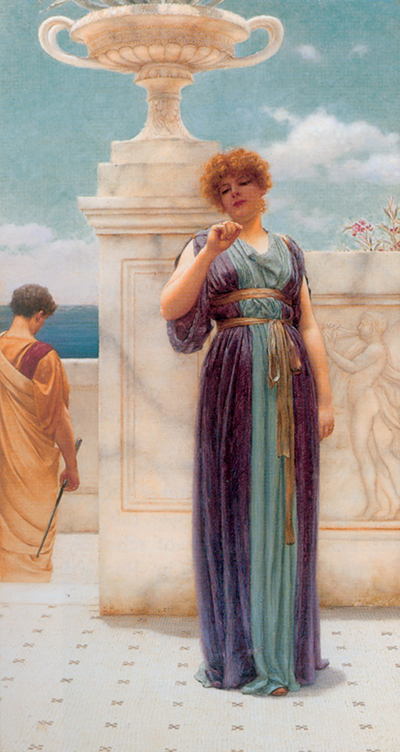
In John William Godward’s The Engagement Ring, a woman stands beside a stone pier topped by a handled urn. She tilts her head towards the hand she has raised almost to her chin. Beyond the pier to the left, a smaller figure appears on the steps above the sea. The two occupy different levels of the terrace, and the block of pale stone between them interrupts even the narrow view of the water. The title makes the raised hand the centre of a possible story. First, the picture makes it the most arresting gesture on a terrace full of straight lines. [1]
This is the upright oil on canvas dated to about 1891, recorded by the Art Renewal Center at 51 × 28 centimetres. Its standing figure, tall urn and glimpse of the sea match the photograph in Sotheby’s 2008 catalogue, where it appeared as lot 131. The auction entry identifies it as no. 1891.3 in Vern Grosvenor Swanson’s 1997 catalogue of Godward’s work, citing page 181 and colour plate 124. The dating is approximate. Godward’s signed 1888 oil of the same name has a different composition and exhibition history. [1] [2]
At a Glance
- Datec. 1891
- MediumOil on canvas
- Dimensions51 × 28 cm
This work across John William Godward’s career
Contents
- The hand and the figure on the steps
- Alma-Tadema and the same view of the sea
- Two pictures called The Engagement Ring
- Courtship kept in suspense
- What the sale catalogues establish
- Annotated details
The hand and the figure on the steps
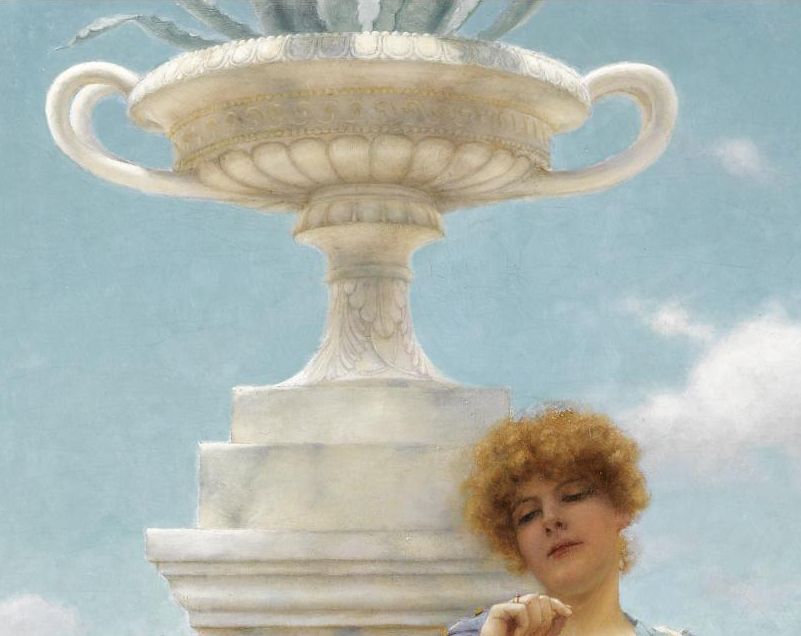
The tall format lets Godward stack the urn, the head and the hem almost from top to bottom. The urn’s handles curve out against the sky and its foot bears down on several layers of square moulding. Below, the woman’s blue and violet drapery drops in long folds, with a strip of brighter blue-green going down the front. The tight bands of her costume gather the material at the waist. At the top of that long column of cloth, one elbow bends and the wrist rises into the gap beneath her face. Her other arm descends beside her dress. That difference between the two arms gives the smallest action in the scene an unusually distinct outline. [1] [2]
The paving lets us judge how close she is. Its little dark marks are spaced out at the lower edge and crowd together towards the foot of the wall. Behind her, the marble mouldings run horizontally. A faint carved figure on the wall to her right echoes the presence of bodies without competing with the strong colour of her dress. The sky is as light as the foreground stone in places, but the band of deeper blue sea to the left gives the terrace an abrupt outer edge. The bright ochre of the other figure’s garment is easy to pick out against this strip of blue. A brief glance can therefore take in the figure on the steps, even though the painting lets us see far less of that person than of the woman beside the pier. [1] [2]
Sotheby’s reads the woman as admiring a gold betrothal ring given by the admirer now going down the steps. In the catalogue plate a narrow band catches the light on one bent finger. Her scrutiny makes the object important before we have time to make out what it is. The angle of the other figure’s head and the change of level make departure plausible, although the painting gives the viewer little purchase on the direction of a single step. No exchange takes place in the space we can see. We have one person absorbed in a small gesture and another partly screened by stone. A proposal, an acceptance and a parting can all be inferred from those circumstances. The stage of the encounter is a matter of interpretation. [1]
The catalogue also suggested that one of the Pettigrew sisters might have posed. Its note raises Rose, Harriet and Lilian as possibilities without identifying a particular sister. Even if a sitter were established, that would tell us who stood for the figure in the studio. The hand and the architecture would still be our evidence for what Godward made her do on the terrace. [1]
Alma-Tadema and the same view of the sea
Sotheby’s proposed a close precedent in Lawrence Alma-Tadema’s A Foregone Conclusion. Tate’s oil on wood dates to 1885 and measures 31.1 × 22.9 centimetres. The resemblance goes well beyond the shared subject of a ring. Both paintings place a large handled vessel on a dividing pier, with stairs on the left and sea visible beyond. In the Tate painting the vessel is cut off at the top, and the foreground women are gathered at its base, looking towards the man below. One bends forward from the right, in front of the woman standing next to the urn. The man below raises a hand towards his chest and looks down. The two women’s overlapping bodies and the tilt of their heads direct attention towards him. [1] [8]
Godward brings the whole urn into view and clears space around his standing woman. The sunlit dress and pale paving contribute to a more open foreground. He also turns the woman’s attention inward towards her own hand, so the step-side figure falls outside the focus of her gaze. Tate reads Alma-Tadema’s scene as a lover about to present an engagement ring, with the women’s eagerness making the result seem assured. If the Godward shows a woman after accepting, as the Sotheby’s note proposes, the two images could be read as different moments around a proposal. The change of emphasis is visible either way. Alma-Tadema’s figures lean towards a shared incident, while Godward’s woman has a moment to herself. [1] [8]
Tate records that the earlier picture belonged to Amy Hislop, who married Henry Tate in the year it was painted. The museum suggests that it may have been an engagement present and records her bequest in 1920. The possible gift gives the painting a nineteenth-century context for its subject. The imagined setting may belong to antiquity, but Victorian viewers could recognise the hesitation and anticipation of a proposal from the arrangement of the figures. [8]
Annotated Details from The Engagement Ring
The numbered points identify visible features discussed in this article. Return from each detail to the numbered overview. John William Godward, The Engagement Ring, upright composition. Image source. Public domain.
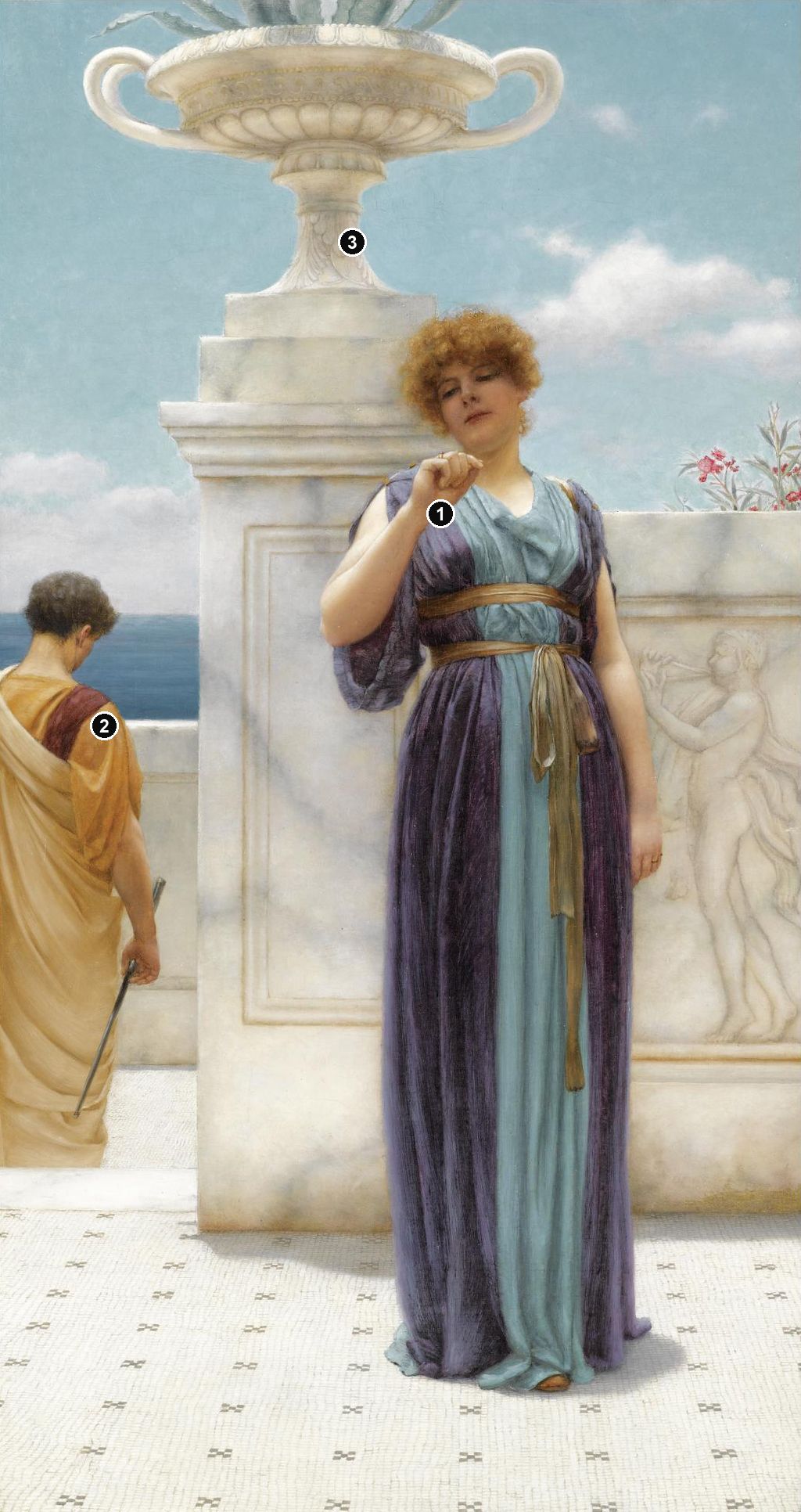
Details from THE ENGAGEMENT RING
Compare the cropped details with the source images above. Notice how their colours, shapes and positions contribute to the larger compositions.
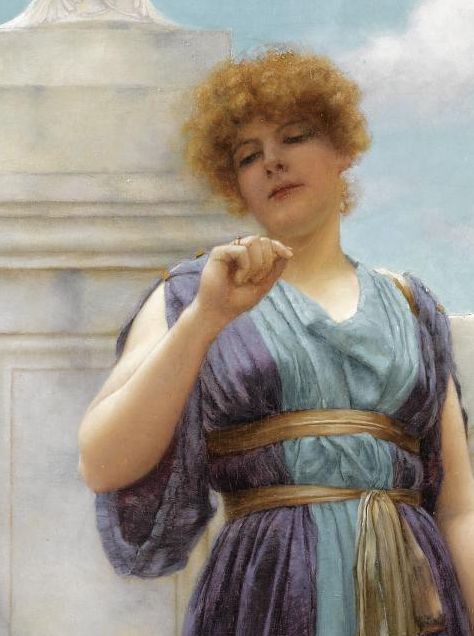
The small raised hand
The lifted hand appears just in front of the blue drapery, while the woman’s gaze turns inward.
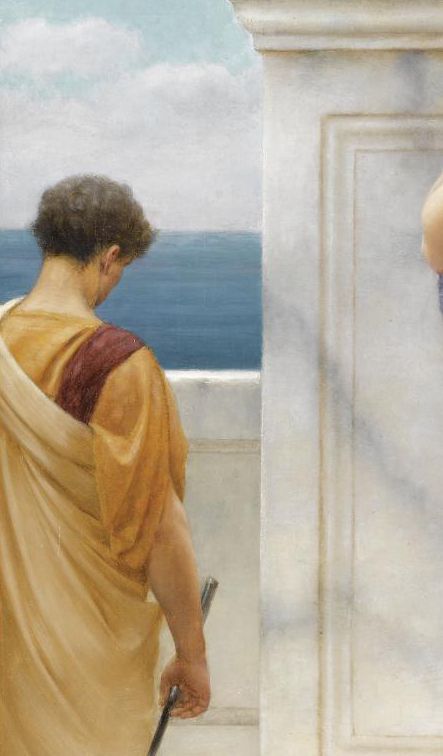
A second figure near the stairs
The pier partly screens the figure in yellow and puts it on a separate level of the terrace.
Urn and open sky
The wide urn offsets the narrow verticals of the pier and draws the eye upwards into the blue sky.
John William Godward videos
See Godward’s paintings and studio practice alongside films on two Victorian contemporaries.
John William Godward - Part 1: The Last Painter of the Victorian Age
An overview of Godward’s career and the Victorian market for pictures set in antiquity.
Watch on YouTubeTwo pictures called The Engagement Ring
The 1888 painting is wider than it is high, about 40.5 × 46 centimetres according to Sotheby’s. A woman sits low in a marble interior, with a patterned floor leading to an open door. There is a scroll near her feet. The auction catalogue interprets it as a declaration of intent and suggests the form beyond the door may be a statue. Both readings give the room a possible backstory. The seated woman’s downcast attention, the empty stretch of marble beside her and the glimpse through the opening are the elements that can be compared directly with the upright version. The scroll and the view through the doorway belong to the earlier canvas. [9] [10]
The 1888 date is part of the signature on a table leg. Sotheby’s identifies the canvas as Swanson’s no. 1888.3 and records it as no. 110, The Betrothal Ring, in Arthur Tooth & Son’s spring exhibition of 1889. Sotheby’s also traces its passage through E. M. Denny, whose 1906 Christie’s sale sent it to Thomas McLean, and through the Christie’s sale of 1912 and a Sotheby’s sale in 1982. That history belongs to the signed picture. The early exhibition title is also easy to confuse with The Betrothed, a separate 1892 Godward at Guildhall Art Gallery. Its long reclining figure gives the promise in the title a more leisurely rhythm. [9] [10] [11]
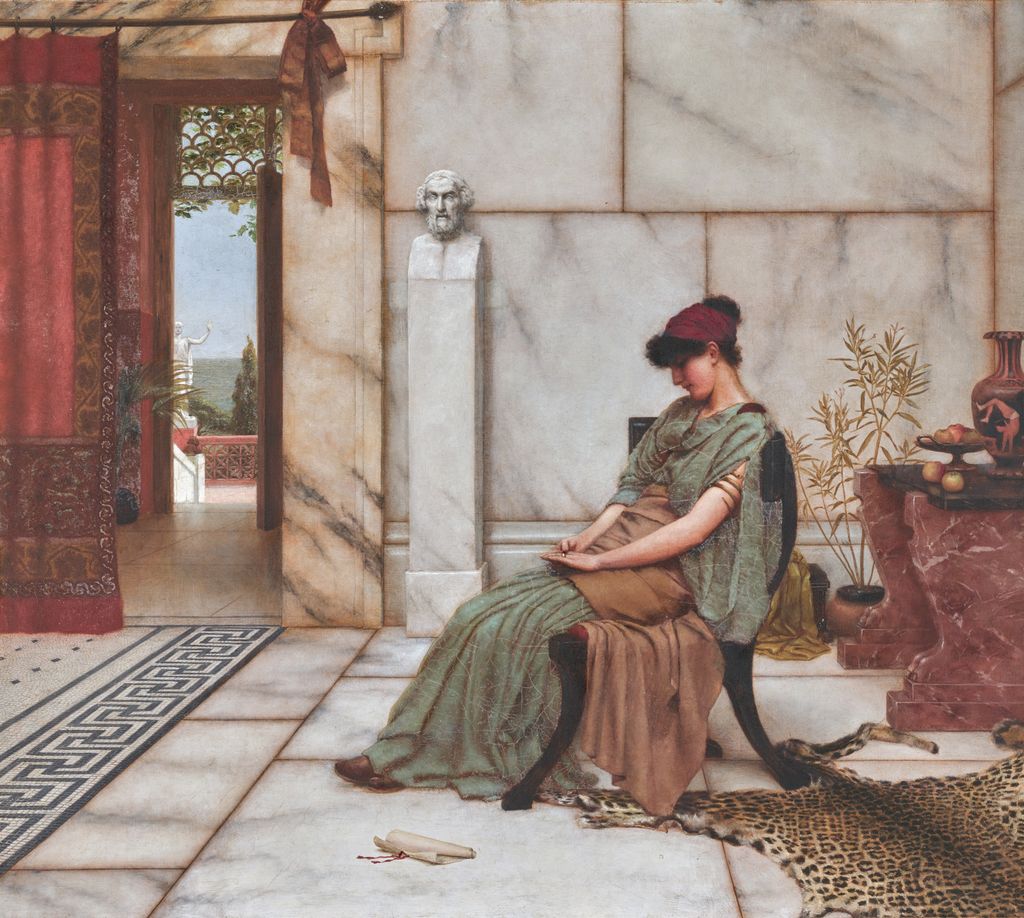
John William Godward, The Engagement Ring (1888), horizontal composition. The 1888 canvas opens a view through a doorway at the far end of the patterned marble floor. Image source. Public domain.
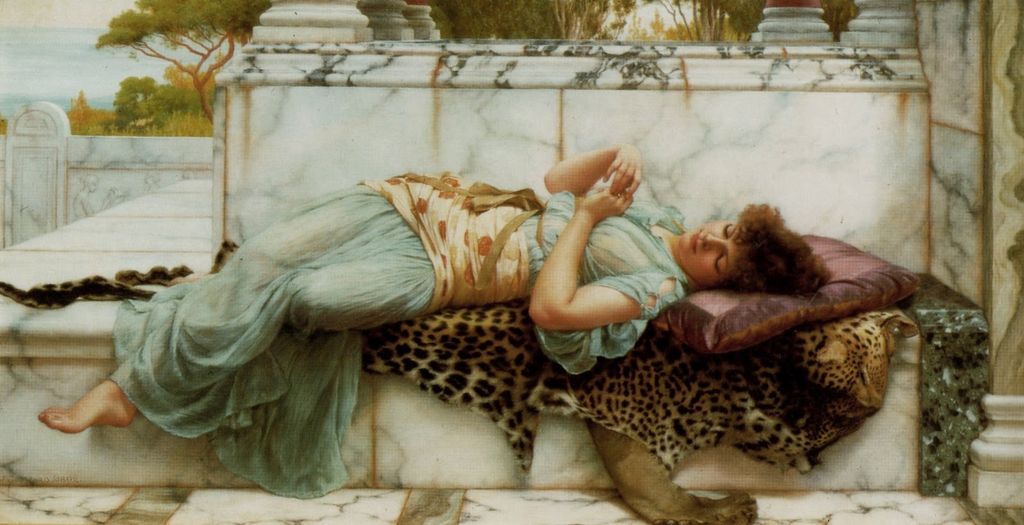
John William Godward, The Betrothed (1892). The long 1892 Guildhall canvas is a separate work, despite the earlier exhibition title The Betrothal Ring. Image source. Public domain.
Courtship kept in suspense
In Waiting for an Answer, signed and dated 1889, a man leans on a ledge and looks towards a woman standing close by. Her lowered gaze and her attention to a palm frond leave him waiting. They are close enough for the space between her fingers and his elbow to matter. The upright Engagement Ring also lets a hand occupy the viewer’s attention, but the other figure is already at a distance. The architectural division has grown from a ledge that allows an exchange into a pier that screens part of one. [1] [3]
Two canvases in the Hessisches Landesmuseum Darmstadt extend the comparison. In Unexpected Arrival (1891) a woman on a terrace above the sea has a man ascending the stairs on the right, with part of a ship still visible. Curator Udo Felbinger notes that Swanson illustrates another version without the man. The difference is revealing beside The Engagement Ring. A stair and a sea view establish the possibility that someone could come or go. In the Darmstadt version, the woman leans forward to meet the approaching man’s gaze. The pier between them marks a difference in levels, much as it does in the upright Engagement Ring, though here the two faces are turned towards each other. In Darmstadt’s Yes or No (1893), the woman extends her arm and the man bends over the marble to take her hand. Their touch is visible even in the small illustration the Berlin Photographic Company used to advertise the print as no. 2358. Godward could bring two figures into contact across a barrier or use the stone to let one figure have a moment apart. [1] [12] [13]
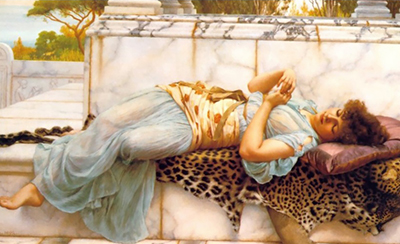
The terrace could also carry an expectation with a single figure. In Manchester Art Gallery’s Expectation (1900), the woman lies along the marble with a view beyond it. The picture is called Midday in Sotheby’s note on the 1888 canvas. Manchester’s exhibition label uses Expectation, a title also attached by Sotheby’s to a separate privately held work of 1887. The gallery’s title asks us to imagine what a reclining woman might be waiting for. In The Engagement Ring, a slight lift of the hand and a trace of movement on the stairs give that kind of speculation more to work with. [9] [14]
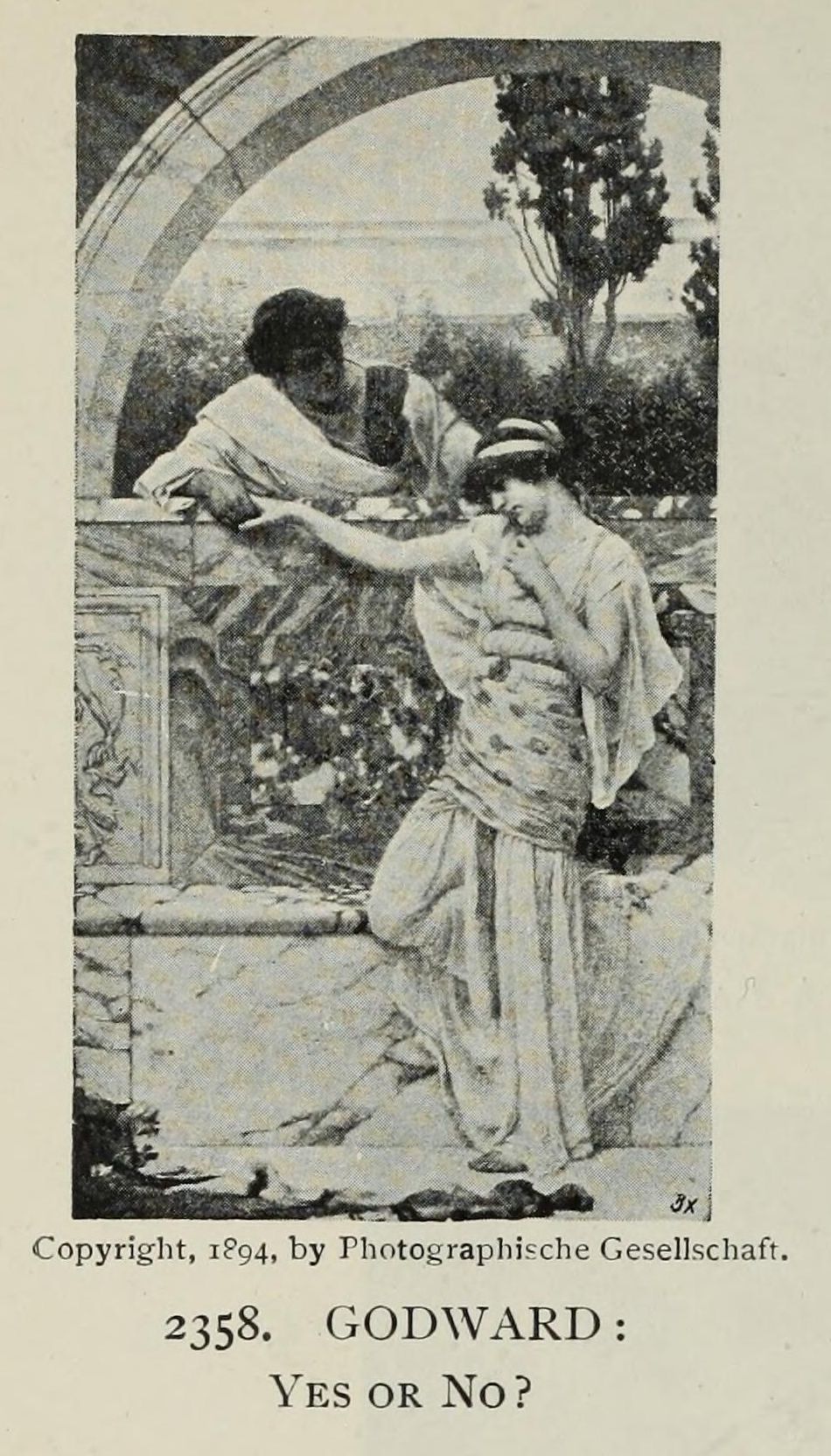
Yes or No?, Berlin Photographic Company catalogue (1906), no. 2358. In the Berlin Photographic Company’s illustration the two hands meet across the marble. Berlin Photographic Company, Catalogue of Select Publications, 1906. Image source. Public domain.
What the sale catalogues establish
The 2008 entry places the upright painting with Nathan Mitchell in London, then lists it as lot 50 at Parke-Bernet Galleries in New York on 11 May 1946, bought by Henry Jordan. The Fondazione Federico Zeri holds a copy of the catalogue for that date. Its library entry confirms the auction in New York. The lot number and buyer come from Sotheby’s later account, which also records its subsequent passage by descent in Texas and lists a private collection before the 2008 sale. Its condition report describes a lined canvas and scattered small areas of retouching, including in the sky and on the woman’s dress. The lining is a backing added to the original canvas. The report records what Sotheby’s observed for the sale. [1] [15]
The earliest sale in the published history remains unresolved. The 2008 catalogue gives Parke-Bernet in New York for 9–10 March 1900, while the National Gallery of Art dates the firm’s establishment to 1937. A surviving American Art Association catalogue covers a New York sale on those exact March dates. It lists a Godward as lot 61, but its title is The Ring and its entry describes a woman in a red robe with yellow bands, on a canvas 50 inches high by 35 inches wide. The Art Renewal Center gives those same dimensions for the separate 1898 The Ring. In its reproduction, the red-robed woman also holds the ring up before her face, but the gesture has a different setting. Her forearm rests across the balcony, and trees rise behind her. The March catalogue establishes an early record for that larger painting. The c. 1891 canvas with the urn, blue and violet dress and second figure on the steps still has a gap in its early history. [1] [16] [17] [18]
John William Godward artworks directory
Search documented oil paintings, drawings, watercolours and reproductive prints. The directory includes the Art Renewal Center’s catalogue and additional works in museum, exhibition and sale records.
| Name | Date | Medium |
|---|---|---|
| Absence Makes the Heart Grow Fonder | 1912 | Oil on canvas |
| Amaryllis | 1903 | Oil on canvas |
| An Amateur | 1915 | Oil on canvas |
| Ancient Pastimes | 1916 | Oil on canvas |
| The Answer | 1917 | Oil on canvas |
| An Arcadian Beauty | 1899 | Painting |
| At the Fountain | 1893 | Oil on canvas |
| At the Garden Door | 1901 | Oil on canvas |
| At the Garden Shrine, Pompeii | 1892 | Oil on canvas |
| At the Gate of the Temple | 1898 | Oil on canvas |
| At the Thermae | 1909 | Oil on canvas |
| Atalanta | 1892 | Oil on canvas |
| Athenais | 1908 | Oil on canvas |
| An Auburn Beauty | 1895 | Oil on canvas |
| Autumn | 1900 | Oil on canvas |
| Beauty in a Marble Room | 1894 | Oil on canvas |
| The Belvedere | 1913 | Oil on canvas |
| The Betrothed | 1892 | Oil on canvas |
| The Betrothed (print after Godward) | 1893 | Photoengraving, as reported |
| The Bouquet | 1899 | Oil on canvas |
| Briseis | 1896 | Painting |
| The Broken Vase | 1889 | Oil on canvas |
| By the Blue Ionian Sea | 1916 | Oil on canvas |
| By the Wayside | 1912 | Oil on canvas |
| Byrsina | 1915 | Painting |
| Campaspe | 1896 | Oil on canvas |
| Campaspe (print after Godward) | Print, process unconfirmed | |
| Chloris (A Summer Rose) | 1902 | Oil on canvas |
| Classical Beauty | Oil on canvas | |
| A Classical Beauty | Oil on canvas | |
| A Classical Beauty | Painting | |
| A Classical Beauty | Oil on canvas | |
| A Classical Beauty | 1909 | Oil on canvas |
| A Classical Beauty In Profile | Oil on canvas | |
| A Classical Lady | 1908 | Oil on canvas |
| Clymene | 1892 | Oil on canvas |
| A Congenial Task | 1915 | Oil on canvas |
| Contemplation | 1922 | Oil on canvas |
| A Cool Retreat | 1910 | Oil on canvas |
| Country House in the 18th Century | c. 1883 | Oil on canvas |
| Cytheris | 1922 | Painting |
| The Day Dream | 1920 | Oil on canvas |
| The Delphic Oracle | 1899 | Oil on canvas |
| A Dilettante | 1922 | Oil on canvas |
| Distant Thoughts | 1918 | Oil on canvas |
| Dolce Far Niente | 1897 | Oil on canvas |
| Dolce Far Niente | 1906 | Oil on canvas |
| Dolce far niente (A Pompeian Fishpond) | 1904 | Oil on canvas |
| Dolce far niente (coloured print after Godward) | Exhibited 1900 | Coloured print, exact process unconfirmed |
| Dolce far niente (grapes) | 1907 | Oil on canvas |
| Dora | 1887 | Oil on canvas |
| Drusilla | 1906 | Oil on canvas |
| An Edition de Luxe | 1920 | Oil on canvas |
| Eighty and Eighteen | 1898 | Oil on canvas |
| Endymion | 1893 | Oil on canvas |
| The Engagement Ring (horizontal composition) | 1888 | Oil on canvas |
| The Engagement Ring (upright composition) | c. 1891 | Oil on canvas |
| Erato at Her Lyre | Oil on canvas | |
| A Fair Reflection | 1915 | Oil on canvas |
| A Fair Reflection (Taber-Prang print) | By 1923 | Sepia artotype |
| Far Away Thoughts (circular sewing scene) | 1911 | Oil on canvas |
| Far Away Thoughts (left-facing profile) | 1892 | Oil on canvas |
| Far Away Thoughts (right-facing profile) | 1892 | Oil on canvas |
| Female Figure (probable Grecian Idyll study) | 1907 | Oil on board |
| Flabellifera | 1905 | Oil on canvas |
| Flabellifera (painted study) | c. 1905 | Oil study |
| Flabellifera (pencil study) | c. 1905 | Pencil on paper |
| The Flower Girl | Painting | |
| A Flower Seller | 1896 | Oil on canvas |
| The Flowers of Venus | 1890 | Oil on canvas |
| A Fond Farewell | 1918 | Watercolour |
| The Fragrant Rose | 1892 | Painting |
| The Fruit Vendor | 1917 | Oil on canvas |
| A Garland Seller | 1914 | Painting |
| Giotto Drawing from Nature | Painting | |
| Girl in Yellow Drapery | 1901 | Oil on canvas |
| Golden Hours | 1913 | Oil on canvas |
| A Grecian Girl | 1908 | Oil on canvas |
| Grecian Idyll | 1907 | Oil on canvas |
| A Grecian Lovely | 1909 | Oil on canvas |
| Grecian Reverie | 1889 | Oil on canvas |
| Grecian Reverie | 1889 | Oil on canvas |
| A Greek Beauty | 1905 | Oil on canvas |
| A Happy Awakening | 1903 | Oil on canvas |
| He Loves Me, He Loves Me Not | 1896 | Oil on canvas |
| A head and shoulders profile portrait of a young woman wearing a white tunic style blouse | c. 1889 | Painting |
| Head of a Girl (The Priestess) | 1896 | Oil on canvas |
| Heart on her Lips and Soul within her Eyes | 1904 | Painting |
| His Birthday Gift | 1889 | Oil on canvas |
| Ianthe | 1889 | Oil on canvas |
| An Idle Hour | 1890 | Oil on canvas |
| Idle Moments | 1895 | Oil on canvas |
| Idle Thoughts | 1898 | Oil on canvas |
| Idleness | 1900 | Oil on canvas |
| Il Dolce Far Niente (Pears print after Amaryllis) | 1906 | Chromolithograph |
| Il Dolce far niente (seated figure) | 1893 | Oil on canvas |
| In Expectation | c. 1892 | Oil on canvas |
| In Realms of Fancy | 1911 | Oil on canvas |
| In the Prime of the Summertime (Reverie) | 1914 | Oil on canvas |
| In the Tepidarium | 1913 | Oil on canvas |
| Innocent Amusements | 1891 | Oil on canvas |
| Ione | c. 1896-1898 | Oil on canvas |
| Ionian Dancing Girl | 1902 | Oil on canvas |
| Ismenia | 1908 | Oil on canvas |
| An Italian Beauty | 1897 | Oil on canvas |
| An Italian Girls' Head | 1902 | Oil on canvas |
| The Jewel Casket | 1900 | Oil on canvas |
| Julia | 1914 | Painting |
| Knuckle Bones | 1890 | Oil on canvas |
| La Pensierosa | 1913 | Oil on canvas |
| A Lady | 1895 | Oil on canvas |
| Landscape: Blossoming Red Almond [study] | c. 1912 | Oil on panel |
| Le Billet Doux (The Love Letter) | 1913 | Oil on canvas |
| Leaning Against a Column | 1901 | Painting |
| Leaning on the Balcony | 1892 | Oil on canvas |
| Leisure Hours | 1905 | Oil on canvas |
| Lesbia with her Sparrow | 1916 | Oil on canvas |
| The Letter | 1899 | Painting |
| Liegende | 1893 | Oil on canvas |
| A Lily Pond | 1917 | Oil on canvas |
| Looking Out to Sea | 1918 | Pencil and watercolour |
| The Love Letter (circular composition) | 1907 | Oil on canvas |
| Lucilia | 1917 | Oil on canvas |
| Lycinna | 1918 | Oil on canvas |
| Marcella | 1912 | Painting |
| Matrona Superba | Oil on canvas | |
| Megilla | 1921 | Oil on canvas |
| A Melody | 1904 | Oil on canvas |
| Memories | c. 1891 | Oil on canvas |
| Mirinna | Painting | |
| The Mirror | 1899 | Oil on canvas |
| Mischief | 1905 | Oil on canvas |
| Mischief and Repose | 1895 | Oil on canvas |
| A Mouse in the Work Basket | 1893 | Oil on canvas |
| Nerissa | 1906 | Oil on canvas |
| The New Perfume | 1914 | Oil on canvas |
| Noon Day Rest | 1910 | Oil on canvas |
| Nu Sur La Plage | 1922 | Oil on panel |
| Nude Study | Oil on canvas | |
| An Offering to Venus | 1912 | Oil on canvas |
| The Old, Old Story | Oil on canvas | |
| The Old, Old Story | 1903 | Oil on canvas |
| On the Balcony | 1911 | Oil on canvas |
| On The Terrace | 1918 | Oil on canvas |
| Ophelia | Oil on panel | |
| The Peacock Fan | 1912 | Oil on canvas |
| Phyleis | 1908 | Oil on canvas |
| The Playground | 1892 | Oil on canvas |
| Playtime | 1891 | Oil on canvas |
| A Pompeian Bath | 1890 | Oil on canvas |
| A Pompeian Lady | 1891 | Oil on canvas |
| A Pompeian Lady | 1895 | Oil on board |
| A Pompeian Lady | 1901 | Painting |
| A Pompeian Lady | 1904 | Painting |
| Portrait of Mary Frederica 'Nin' Godward | c. 1882-1883 | Oil on canvas |
| Portrait of Mary Perkinton Godward | c. 1880-1881 | Watercolor |
| The Posy | 1900 | Painting |
| A Priestess (bare-shouldered figure) | 1893 | Oil on canvas |
| A Priestess (clothed composition) | 1894 | Oil on canvas |
| A Priestess (W. Biscombe Gardner after Godward) | Exhibited 1897 | Print, process unconfirmed |
| A Priestess of Bacchus | 1890-1890 | Oil on canvas |
| Pyrallis | 1918 | Oil on canvas |
| The Quiet Pet | 1906 | Oil on canvas |
| A Red, Red Rose | 1920 | Oil on canvas |
| Reflections | 1893 | Oil on canvas |
| The Rendezvous | 1903 | Oil on canvas |
| Repose, the Flower Girl | c. 1887 | Oil on canvas |
| Reverie | 1888 | Oil on panel |
| Reverie | 1912 | Oil on canvas |
| Reverie (In the Days of Sappho) | 1904 | Oil on canvas |
| Reverie (Pears print after In the Prime of the Summertime) | 1916 | Chromolithograph |
| 'Rich Gifts Wax Poor When Lovers Prove Unkind' | 1916 | Oil on canvas |
| The Ring | 1898 | Oil on canvas |
| A Roman Matron | 1905 | Oil on canvas |
| Sabinella | 1912 | Oil on canvas |
| Sappho | 1910 | Oil on canvas |
| The Siesta | Oil on canvas | |
| A Siesta | 1895 | Oil on canvas |
| The Signal | 1899 | Oil on canvas |
| Sitting for Her Portrait | 1893 | Oil on canvas |
| Sketch for Amaryllis | 1903 | Oil on board |
| A Souvenir | 1920 | Oil on canvas |
| Stesicrate | 1914 | Oil on canvas |
| Study for 'Rêverie' | 1890 | Oil on canvas |
| Study for 'The Priestess' | 1895 | Oil on board |
| Study for An Egyptian Minstrel | 1906 | Painting |
| Study for The New Perfume | Drawing, medium unconfirmed | |
| Study for ‘The Old, Old Story’ | 1903 | Oil paint on wood |
| Study of a Girl's Head | 1899 | Painting |
| Study of Campaspe | Oil on canvas | |
| Study of Head and Drapery, Miss Ethel Warwick | 1898 | Painting |
| Summer Day | 1897 | Painting |
| Summer Flowers | 1903 | Oil on canvas |
| Sweet Dreams | 1901 | Oil on canvas |
| Sweet Dreams | 1904 | Painting |
| The Sweet Siesta of a Summer's Day | 1891 | Oil on canvas |
| The Tambourine Girl (profile at the marble wall) | 1906 | Oil on canvas |
| The Tambourine Girl (relief-backed version) | 1906 | Oil on canvas |
| Tender Thoughts | 1917 | Oil on canvas |
| Tender Thoughts (woman leaning over a parapet) | 1918 | Pencil and watercolour |
| The Tiff (oil) | By 1888 | Oil on canvas |
| The Tiff (print after Godward) | 1894 | Photogravure |
| The Tigerskin | 1889 | Oil on canvas |
| The Time of Roses | 1916 | Oil on canvas |
| Tranquillity | 1914 | Oil on canvas |
| A Tryst | 1912 | Oil on canvas |
| Tympanistria | 1909 | Oil on canvas |
| Under the Blossom that Hangs on the Bough | 1917 | Oil on canvas |
| Venus at the Bath | 1901 | Oil on canvas |
| Venus Binding Her Hair | 1897 | Oil on canvas |
| Violets, Sweet Violets | 1906 | Painting |
| Waiting for an Answer | 1889 | Oil on canvas |
| Waiting for the Procession | 1890 | Oil on canvas |
| Waiting for the Procession | 1890 | Painting |
| The Water Carrier (magazine reproduction of At the Fountain) | 1898 | Magazine reproduction |
| When the Heart is Young | 1902 | Oil on canvas |
| Who Can They Be | Painting | |
| Winding Wool | 1894 | Painting |
| 'With Violets Wreathed and Robe of Saffron Hue' | 1902 | Oil on canvas |
| The Yellow Shawl | 1893 | Painting |
| 'Yes or No?' | 1893 | Oil on canvas |
| Young Girl Picking Grapes | 1902 | Oil on canvas |
| Youth and Time | 1901 | Oil on canvas |
Discussion
Look again at the images and ideas explored in The Engagement Ring by John William Godward. These editorial prompts invite your observations.
Reader Insights
How does the stone pier govern the relationship between the two figures?
What can you tell about the raised hand before you know the title?
Join the Conversation
Share a detail, comparison or question about The Engagement Ring by John William Godward below.
References
- Sotheby’s. John William Godward, The Engagement Ring, Victorian & Edwardian Art, lot 131, 2008 (English). Exact upright plate, catalogue note, provenance, condition report and citation to Swanson’s 1997 catalogue, p. 181, no. 1891.3, colour pl. 124. View source.
- Art Renewal Center. The Engagement Ring, artwork 11592 (English). Upright reproduction, approximate date, medium and dimensions. View source.
- Sotheby’s. John William Godward, Waiting for an Answer, lot 163, 2007 (English). Signed 1889 oil, plate and catalogue note. View source.
- The Betrothed. View source.
- Far Away Thoughts. View source.
- Mischief and Repose. View source.
- Le Billet Doux (The Love Letter). View source.
- Tate Britain. A Foregone Conclusion, collection plate and gallery interpretation (English), on Google Arts & Culture. Tate’s image, material, measurements and bequest record for the 1885 painting, accession N03513. View source.
- Sotheby’s. John William Godward, The Engagement Ring, Victorian, Pre-Raphaelite & British Impressionist Art, lot 16, 2017 (English). Signed 1888 composition, 1889 exhibition title, Swanson no. 1888.3 and catalogue comparisons. View source.
- Sotheby’s. John William Godward, The Engagement Ring, Master Paintings and 19th Century European Art, lot 36, 2023 (English). The 1888 canvas, unframed measurements and sale history. View source.
- City of London Corporation, via Art UK. The Betrothed (English). Collection image and identification of the separate 1892 Guildhall Art Gallery canvas. View source.
- Udo Felbinger, Hessen Provenienzforschung. Leider kein Leighton! John William Godwards Gemälde „Unexpected arrival“, 2023 (German). Collection plates and provenance research for the two Darmstadt works. View source.
- Berlin Photographic Company. Catalogue of Select Publications, 1906 (English). Yes or No?, no. 2358, p. 74 and illustration facing p. 77. View source.
- Manchester Art Gallery. Friends, Family and Other Animals, exhibition labels (English). Gallery title and date for Expectation. View source.
- Fondazione Federico Zeri, Università di Bologna. Parke-Bernet Galleries, auction catalogue dated 11 May 1946 (Italian and English catalogue metadata for an English sale catalogue). Call number CA 13 1946 0511. View source.
- National Gallery of Art, Washington. Parke-Bernet Galleries, Inc. (English). Provenance authority record giving the 1937 establishment date. View source.
- American Art Association. Illustrated catalogue of master works from the Fischhof and Blakeslee collections, 9–10 March 1900 (English). Getty Research Institute copy, lot 61, The Ring. View source.
- Art Renewal Center. The Ring, artwork 11602 (English). Reproduction, dimensions and dating of the distinct 1898 red-robed composition. View source.