 by Tom Gurney
Tom Gurney BSc (Hons) is an art history expert with over 20 years experience
Published on June 19, 2020 / Updated on October 14, 2023
Email: tomgurney1@gmail.com / Phone: +44 7429 011000
Grecian Idyll by John William Godward: Introduction
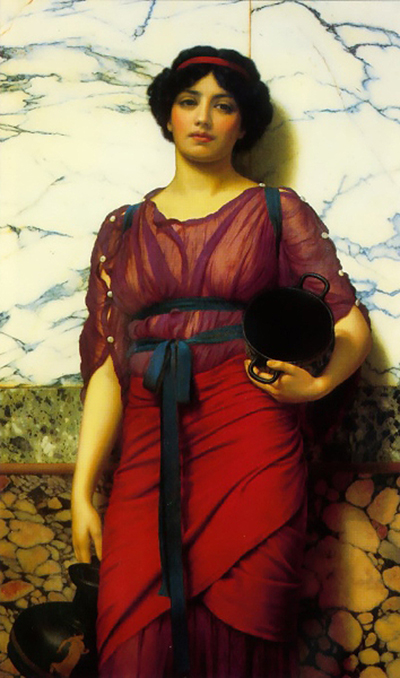
In John William Godward’s A Grecian Idyll, a woman pauses in front of a wall of veined marble. She meets our eyes while holding a dark vessel tipped far enough for us to see inside. Her other hand hangs almost to the bottom of the image, where it meets the neck of a second vessel. Painted in 1907, the oil on canvas is listed by Bridgeman Images at 152.4 × 76.2 cm, or five feet high and two and a half feet wide. The Art Renewal Center records the same composition as Grecian Idyll, without the opening article. [1] [2]
At a Glance
- Date1907
- MediumOil on canvas
- Dimensions152.4 × 76.2 cm, as catalogued
This work across John William Godward’s career
Contents
- A figure close to the wall
- The two vessels
- The small oil study
- Why call it an idyll?
- The original painting and the later reproduction
A figure close to the wall
Look at the dark patch to the right of the woman’s head. It starts just outside the outline of her hair and softens as it spreads over the marble. The shadow gives us a measure of the space behind her. The shadow places her a short distance in front of the stone. A fine vertical joint comes down almost to the centre of her head. At shoulder level the stone is streaked with irregular blue-grey lines, some fine as cracks and others spreading into broad patches. Beneath it run a mottled green band and a lower course patterned with rounded ochre and brown shapes. Their horizontal edges give a sense of order to the veining above. [2]
The fabric changes character as it descends. A violet-red upper garment falls in long folds from the shoulders, with warmer tones showing through the thinner stretches. At the viewer’s left, a row of pale fastenings marks the edge of the sleeve and catches the light in small points. The bright red wrap below the waist lies in broader folds that cross the body on a diagonal. A blue-green sash circles the waist and drops down the front, taking the eye in the opposite direction. A narrow band above the brow picks up the red of the skirt at the opposite end of the figure. [2]
The format makes those contrasts feel unusually close. The lower edge cuts across the skirt and one vessel, while the pale marble leaves open space above the hair. The figure’s lower body runs out of view before its weight is resolved in the position of her feet. Our first impression of a straight, upright pose gives way to details that resist it. One arm drops and the other bends, one shoulder sits a little higher, and the cloth runs obliquely across the hips. The wall’s joints and courses make each small departure easier to see. [2]
The two vessels
The raised vessel is easier to read as a shape than as an object in use. Its dark mouth faces us so directly that its rim is almost a circle, with a loop visible above the far side and another framed by the fingers below. The interior provides a broad area of shadow amid a busy passage of sleeve, bare forearm and red cloth. Down at the opposite corner, the narrower neck and rounded shoulder of another object show below the woman’s right hand. A warm figure-like mark appears on the side of that lower vessel, partly cut off by the edge of the painting. One vessel is almost presented to the viewer. The other sits low enough that the eye has to follow the arm to find it. [2]
The Cleveland Museum of Art’s black-gloss Attic Kantharos, made around 300–275 BCE, gives a historical comparison for the raised vessel. It has a deep bowl, two conspicuous loop handles and a dark surface, with an ivy band and a fluted lower body tapering towards the foot. The museum photograph shows its profile, including the base, while Godward’s angle makes the outline of the mouth more prominent than the shape beneath it. That difference limits how closely a viewer can identify the painted object. It also helps account for the painting’s effect. We notice the near-black circle and the fingers curled against it before we can ask what the vessel held or where the woman might be carrying it. [2] [8]
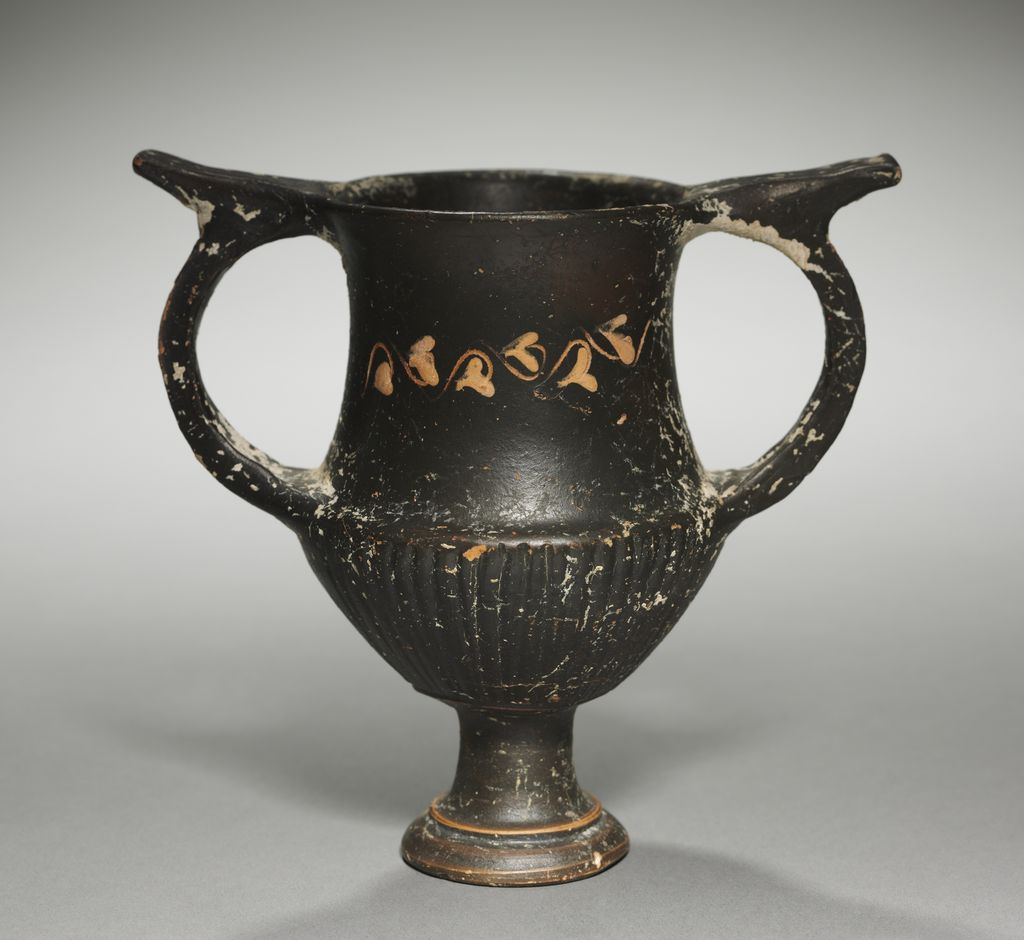
Attic red-figure kantharos, Cleveland Museum of Art. The Attic cup shows the loop handles and dark bowl that make the ancient comparison useful. The Cleveland Museum of Art. Image source. CC0 / Public domain.
John William Godward videos
See Godward’s paintings and studio practice alongside films on two Victorian contemporaries.
John William Godward - Part 1: The Last Painter of the Victorian Age
An overview of Godward’s career and the Victorian market for pictures set in antiquity.
Watch on YouTubeThe small oil study
Peter Nahum at The Leicester Galleries catalogued a separate work called Female Figure, dated 1907. The oil on board measures just 19 × 10.7 cm. The gallery considered it very likely to be a preparatory study for the larger Grecian Idyll. A reproduction published under the title Grecian Idyll (study) has proportions consistent with the board and shows a notably close design. In that image the bent arm, dark bowl, blue-green sash and hanging second vessel are already in place. The lower vessel is easier to make out, with a browner, rounder body. The upper wall is warm brown, with a curved form entering from the top left and a thin ornamental band crossing behind the elbows. In the finished picture, pale veined stone replaces that upper field. As a result the dark hair and its shadow stand out more clearly, and the contour of each shoulder is easier to follow. [2] [9] [10]
The finished canvas is eight times the reported height of the board. At that scale the fastening points, the sash knot and the shift from the veins above to the mottled stone below can each hold attention. The smaller design already arranges the face, two objects and sash so that the eye travels up and down the figure. The comparison suggests how much of the full canvas’s visual structure could be settled on a board small enough to hold in one hand. Sotheby’s catalogued another Godward study, Clymene, as a preparatory work for Godward’s Royal Academy picture of 1891. The standing woman there holds a peacock fan. Sotheby’s reports a carved procession and a mosaic floor in that finished composition. The conspicuous vessels and the unfigured marble of the 1907 canvas give it a different character. [1] [2] [9] [10] [11]
Why call it an idyll?
In Greek pastoral poetry an everyday object could hold the attention for a surprisingly long time. In the first Idyll of Theocritus, a goatherd promises Thyrsis a two-handled wooden cup in return for a song. The description lingers on what has been carved into the cup and the plants winding around it. The poem offers a parallel for the attention a humble vessel can command in a work bearing the word idyll. In Godward’s picture the vessel helps suspend the action. No liquid leaves it and nobody reaches out to receive it. The woman’s gaze leaves us with the sense that we have interrupted a moment whose purpose she has no obligation to explain. [2] [12]
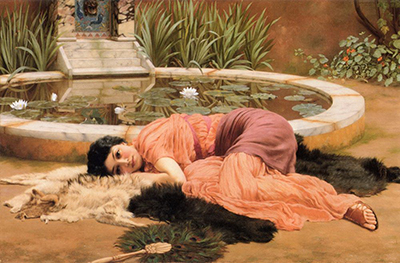
Godward found other ways to suggest such intervals. In Dolce far niente of 1904, a woman looks out from the edge of a fishpond. The pool gives the eye space to travel beyond her and then circle back. In Noon Day Rest, completed in 1910, a bare foot at the far left and the hand raised above the head at the right make the most of a wide canvas. The shoreline and terrace carry that movement further. In A Grecian Idyll, the woman and the near wall occupy almost the entire field. The repose comes from the held pose and the slow succession of details. [2] [13] [14]
In her study of Godward’s paintings of idleness, art historian Rina Kajima notes that a work from 1902 in the Dolce far niente group was also recorded as An Idyll. The date and title distinguish that work from the vessel-bearing canvas of 1907. Her discussion of how Godward varies the space and action around his figures also helps explain what the later painting achieves. We remain close to the woman and follow the colours of the cloth, the surfaces of the two vessels and the grain of the wall in the time it takes her to do almost nothing. [2] [15]
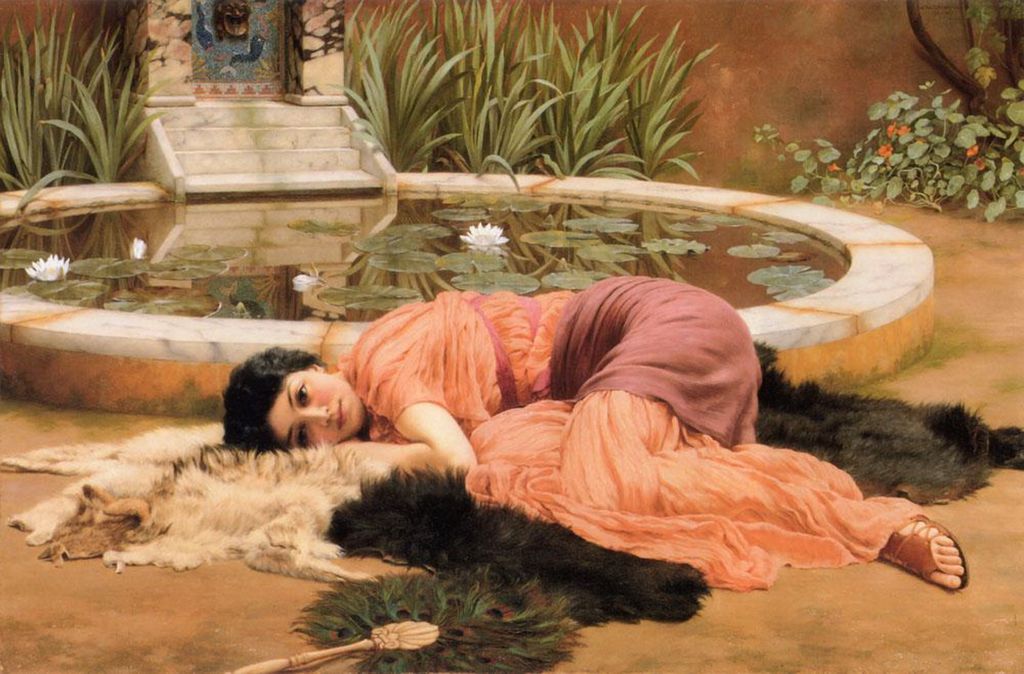
John William Godward, Dolce Far Niente (1904). A separate imagined setting makes the figure’s posture feel less exposed. Image source. Public domain.
The original painting and the later reproduction
Bridgeman describes the large painting as privately held and credits Christie’s Images for its photograph. The original commission, first exhibition and early owners of the canvas remain unconfirmed. There is a later appearance in a different medium. Bridgeman identifies A Grecian Idyll among the images it licensed for set design in Gurinder Chadha’s Viceroy’s House, the 2017 film set during the end of British rule in India. A picture made in 1907 thus had a second life helping to evoke an interior of the 1940s. [1] [2] [16] [17]
John William Godward artworks directory
Search documented oil paintings, drawings, watercolours and reproductive prints. The directory includes the Art Renewal Center’s catalogue and additional works in museum, exhibition and sale records.
| Name | Date | Medium |
|---|---|---|
| Absence Makes the Heart Grow Fonder | 1912 | Oil on canvas |
| Amaryllis | 1903 | Oil on canvas |
| An Amateur | 1915 | Oil on canvas |
| Ancient Pastimes | 1916 | Oil on canvas |
| The Answer | 1917 | Oil on canvas |
| An Arcadian Beauty | 1899 | Painting |
| At the Fountain | 1893 | Oil on canvas |
| At the Garden Door | 1901 | Oil on canvas |
| At the Garden Shrine, Pompeii | 1892 | Oil on canvas |
| At the Gate of the Temple | 1898 | Oil on canvas |
| At the Thermae | 1909 | Oil on canvas |
| Atalanta | 1892 | Oil on canvas |
| Athenais | 1908 | Oil on canvas |
| An Auburn Beauty | 1895 | Oil on canvas |
| Autumn | 1900 | Oil on canvas |
| Beauty in a Marble Room | 1894 | Oil on canvas |
| The Belvedere | 1913 | Oil on canvas |
| The Betrothed | 1892 | Oil on canvas |
| The Betrothed (print after Godward) | 1893 | Photoengraving, as reported |
| The Bouquet | 1899 | Oil on canvas |
| Briseis | 1896 | Painting |
| The Broken Vase | 1889 | Oil on canvas |
| By the Blue Ionian Sea | 1916 | Oil on canvas |
| By the Wayside | 1912 | Oil on canvas |
| Byrsina | 1915 | Painting |
| Campaspe | 1896 | Oil on canvas |
| Campaspe (print after Godward) | Print, process unconfirmed | |
| Chloris (A Summer Rose) | 1902 | Oil on canvas |
| Classical Beauty | Oil on canvas | |
| A Classical Beauty | Oil on canvas | |
| A Classical Beauty | Painting | |
| A Classical Beauty | Oil on canvas | |
| A Classical Beauty | 1909 | Oil on canvas |
| A Classical Beauty In Profile | Oil on canvas | |
| A Classical Lady | 1908 | Oil on canvas |
| Clymene | 1892 | Oil on canvas |
| A Congenial Task | 1915 | Oil on canvas |
| Contemplation | 1922 | Oil on canvas |
| A Cool Retreat | 1910 | Oil on canvas |
| Country House in the 18th Century | c. 1883 | Oil on canvas |
| Cytheris | 1922 | Painting |
| The Day Dream | 1920 | Oil on canvas |
| The Delphic Oracle | 1899 | Oil on canvas |
| A Dilettante | 1922 | Oil on canvas |
| Distant Thoughts | 1918 | Oil on canvas |
| Dolce Far Niente | 1897 | Oil on canvas |
| Dolce Far Niente | 1906 | Oil on canvas |
| Dolce far niente (A Pompeian Fishpond) | 1904 | Oil on canvas |
| Dolce far niente (coloured print after Godward) | Exhibited 1900 | Coloured print, exact process unconfirmed |
| Dolce far niente (grapes) | 1907 | Oil on canvas |
| Dora | 1887 | Oil on canvas |
| Drusilla | 1906 | Oil on canvas |
| An Edition de Luxe | 1920 | Oil on canvas |
| Eighty and Eighteen | 1898 | Oil on canvas |
| Endymion | 1893 | Oil on canvas |
| The Engagement Ring (horizontal composition) | 1888 | Oil on canvas |
| The Engagement Ring (upright composition) | c. 1891 | Oil on canvas |
| Erato at Her Lyre | Oil on canvas | |
| A Fair Reflection | 1915 | Oil on canvas |
| A Fair Reflection (Taber-Prang print) | By 1923 | Sepia artotype |
| Far Away Thoughts (circular sewing scene) | 1911 | Oil on canvas |
| Far Away Thoughts (left-facing profile) | 1892 | Oil on canvas |
| Far Away Thoughts (right-facing profile) | 1892 | Oil on canvas |
| Female Figure (probable Grecian Idyll study) | 1907 | Oil on board |
| Flabellifera | 1905 | Oil on canvas |
| Flabellifera (painted study) | c. 1905 | Oil study |
| Flabellifera (pencil study) | c. 1905 | Pencil on paper |
| The Flower Girl | Painting | |
| A Flower Seller | 1896 | Oil on canvas |
| The Flowers of Venus | 1890 | Oil on canvas |
| A Fond Farewell | 1918 | Watercolour |
| The Fragrant Rose | 1892 | Painting |
| The Fruit Vendor | 1917 | Oil on canvas |
| A Garland Seller | 1914 | Painting |
| Giotto Drawing from Nature | Painting | |
| Girl in Yellow Drapery | 1901 | Oil on canvas |
| Golden Hours | 1913 | Oil on canvas |
| A Grecian Girl | 1908 | Oil on canvas |
| Grecian Idyll | 1907 | Oil on canvas |
| A Grecian Lovely | 1909 | Oil on canvas |
| Grecian Reverie | 1889 | Oil on canvas |
| Grecian Reverie | 1889 | Oil on canvas |
| A Greek Beauty | 1905 | Oil on canvas |
| A Happy Awakening | 1903 | Oil on canvas |
| He Loves Me, He Loves Me Not | 1896 | Oil on canvas |
| A head and shoulders profile portrait of a young woman wearing a white tunic style blouse | c. 1889 | Painting |
| Head of a Girl (The Priestess) | 1896 | Oil on canvas |
| Heart on her Lips and Soul within her Eyes | 1904 | Painting |
| His Birthday Gift | 1889 | Oil on canvas |
| Ianthe | 1889 | Oil on canvas |
| An Idle Hour | 1890 | Oil on canvas |
| Idle Moments | 1895 | Oil on canvas |
| Idle Thoughts | 1898 | Oil on canvas |
| Idleness | 1900 | Oil on canvas |
| Il Dolce Far Niente (Pears print after Amaryllis) | 1906 | Chromolithograph |
| Il Dolce far niente (seated figure) | 1893 | Oil on canvas |
| In Expectation | c. 1892 | Oil on canvas |
| In Realms of Fancy | 1911 | Oil on canvas |
| In the Prime of the Summertime (Reverie) | 1914 | Oil on canvas |
| In the Tepidarium | 1913 | Oil on canvas |
| Innocent Amusements | 1891 | Oil on canvas |
| Ione | c. 1896-1898 | Oil on canvas |
| Ionian Dancing Girl | 1902 | Oil on canvas |
| Ismenia | 1908 | Oil on canvas |
| An Italian Beauty | 1897 | Oil on canvas |
| An Italian Girls' Head | 1902 | Oil on canvas |
| The Jewel Casket | 1900 | Oil on canvas |
| Julia | 1914 | Painting |
| Knuckle Bones | 1890 | Oil on canvas |
| La Pensierosa | 1913 | Oil on canvas |
| A Lady | 1895 | Oil on canvas |
| Landscape: Blossoming Red Almond [study] | c. 1912 | Oil on panel |
| Le Billet Doux (The Love Letter) | 1913 | Oil on canvas |
| Leaning Against a Column | 1901 | Painting |
| Leaning on the Balcony | 1892 | Oil on canvas |
| Leisure Hours | 1905 | Oil on canvas |
| Lesbia with her Sparrow | 1916 | Oil on canvas |
| The Letter | 1899 | Painting |
| Liegende | 1893 | Oil on canvas |
| A Lily Pond | 1917 | Oil on canvas |
| Looking Out to Sea | 1918 | Pencil and watercolour |
| The Love Letter (circular composition) | 1907 | Oil on canvas |
| Lucilia | 1917 | Oil on canvas |
| Lycinna | 1918 | Oil on canvas |
| Marcella | 1912 | Painting |
| Matrona Superba | Oil on canvas | |
| Megilla | 1921 | Oil on canvas |
| A Melody | 1904 | Oil on canvas |
| Memories | c. 1891 | Oil on canvas |
| Mirinna | Painting | |
| The Mirror | 1899 | Oil on canvas |
| Mischief | 1905 | Oil on canvas |
| Mischief and Repose | 1895 | Oil on canvas |
| A Mouse in the Work Basket | 1893 | Oil on canvas |
| Nerissa | 1906 | Oil on canvas |
| The New Perfume | 1914 | Oil on canvas |
| Noon Day Rest | 1910 | Oil on canvas |
| Nu Sur La Plage | 1922 | Oil on panel |
| Nude Study | Oil on canvas | |
| An Offering to Venus | 1912 | Oil on canvas |
| The Old, Old Story | Oil on canvas | |
| The Old, Old Story | 1903 | Oil on canvas |
| On the Balcony | 1911 | Oil on canvas |
| On The Terrace | 1918 | Oil on canvas |
| Ophelia | Oil on panel | |
| The Peacock Fan | 1912 | Oil on canvas |
| Phyleis | 1908 | Oil on canvas |
| The Playground | 1892 | Oil on canvas |
| Playtime | 1891 | Oil on canvas |
| A Pompeian Bath | 1890 | Oil on canvas |
| A Pompeian Lady | 1891 | Oil on canvas |
| A Pompeian Lady | 1895 | Oil on board |
| A Pompeian Lady | 1901 | Painting |
| A Pompeian Lady | 1904 | Painting |
| Portrait of Mary Frederica 'Nin' Godward | c. 1882-1883 | Oil on canvas |
| Portrait of Mary Perkinton Godward | c. 1880-1881 | Watercolor |
| The Posy | 1900 | Painting |
| A Priestess (bare-shouldered figure) | 1893 | Oil on canvas |
| A Priestess (clothed composition) | 1894 | Oil on canvas |
| A Priestess (W. Biscombe Gardner after Godward) | Exhibited 1897 | Print, process unconfirmed |
| A Priestess of Bacchus | 1890-1890 | Oil on canvas |
| Pyrallis | 1918 | Oil on canvas |
| The Quiet Pet | 1906 | Oil on canvas |
| A Red, Red Rose | 1920 | Oil on canvas |
| Reflections | 1893 | Oil on canvas |
| The Rendezvous | 1903 | Oil on canvas |
| Repose, the Flower Girl | c. 1887 | Oil on canvas |
| Reverie | 1888 | Oil on panel |
| Reverie | 1912 | Oil on canvas |
| Reverie (In the Days of Sappho) | 1904 | Oil on canvas |
| Reverie (Pears print after In the Prime of the Summertime) | 1916 | Chromolithograph |
| 'Rich Gifts Wax Poor When Lovers Prove Unkind' | 1916 | Oil on canvas |
| The Ring | 1898 | Oil on canvas |
| A Roman Matron | 1905 | Oil on canvas |
| Sabinella | 1912 | Oil on canvas |
| Sappho | 1910 | Oil on canvas |
| The Siesta | Oil on canvas | |
| A Siesta | 1895 | Oil on canvas |
| The Signal | 1899 | Oil on canvas |
| Sitting for Her Portrait | 1893 | Oil on canvas |
| Sketch for Amaryllis | 1903 | Oil on board |
| A Souvenir | 1920 | Oil on canvas |
| Stesicrate | 1914 | Oil on canvas |
| Study for 'Rêverie' | 1890 | Oil on canvas |
| Study for 'The Priestess' | 1895 | Oil on board |
| Study for An Egyptian Minstrel | 1906 | Painting |
| Study for The New Perfume | Drawing, medium unconfirmed | |
| Study for ‘The Old, Old Story’ | 1903 | Oil paint on wood |
| Study of a Girl's Head | 1899 | Painting |
| Study of Campaspe | Oil on canvas | |
| Study of Head and Drapery, Miss Ethel Warwick | 1898 | Painting |
| Summer Day | 1897 | Painting |
| Summer Flowers | 1903 | Oil on canvas |
| Sweet Dreams | 1901 | Oil on canvas |
| Sweet Dreams | 1904 | Painting |
| The Sweet Siesta of a Summer's Day | 1891 | Oil on canvas |
| The Tambourine Girl (profile at the marble wall) | 1906 | Oil on canvas |
| The Tambourine Girl (relief-backed version) | 1906 | Oil on canvas |
| Tender Thoughts | 1917 | Oil on canvas |
| Tender Thoughts (woman leaning over a parapet) | 1918 | Pencil and watercolour |
| The Tiff (oil) | By 1888 | Oil on canvas |
| The Tiff (print after Godward) | 1894 | Photogravure |
| The Tigerskin | 1889 | Oil on canvas |
| The Time of Roses | 1916 | Oil on canvas |
| Tranquillity | 1914 | Oil on canvas |
| A Tryst | 1912 | Oil on canvas |
| Tympanistria | 1909 | Oil on canvas |
| Under the Blossom that Hangs on the Bough | 1917 | Oil on canvas |
| Venus at the Bath | 1901 | Oil on canvas |
| Venus Binding Her Hair | 1897 | Oil on canvas |
| Violets, Sweet Violets | 1906 | Painting |
| Waiting for an Answer | 1889 | Oil on canvas |
| Waiting for the Procession | 1890 | Oil on canvas |
| Waiting for the Procession | 1890 | Painting |
| The Water Carrier (magazine reproduction of At the Fountain) | 1898 | Magazine reproduction |
| When the Heart is Young | 1902 | Oil on canvas |
| Who Can They Be | Painting | |
| Winding Wool | 1894 | Painting |
| 'With Violets Wreathed and Robe of Saffron Hue' | 1902 | Oil on canvas |
| The Yellow Shawl | 1893 | Painting |
| 'Yes or No?' | 1893 | Oil on canvas |
| Young Girl Picking Grapes | 1902 | Oil on canvas |
| Youth and Time | 1901 | Oil on canvas |
Discussion
Look again at the images and ideas explored in Grecian Idyll by John William Godward. These editorial prompts invite your observations.
Reader Insights
What do the woman’s hands tell you about the vessel?
How does the standing figure interact with the patterns in the marble?
Join the Conversation
Share a detail, comparison or question about Grecian Idyll by John William Godward below.
References
- Bridgeman Images. A Grecian Idyll, 1907, asset CH991264. Title, date, medium, dimensions, collection designation and photograph credit. View source.
- Art Renewal Center. Grecian Idyll, artwork 1116. Oil on canvas, 1907, and reproduction of the upright composition. View source.
- Ionian Dancing Girl. View source.
- The Tambourine Girl. View source.
- The Peacock Fan. View source.
- A Tryst. View source.
- Tender Thoughts. View source.
- Cleveland Museum of Art. Black-Gloss Kantharos (Drinking Cup), object 1916.760. Attic ceramic vessel, c. 300–275 BCE. View source.
- Peter Nahum at The Leicester Galleries. Female Figure, dealer record for the 1907 oil on board and its proposed preparatory relationship to the canvas. View source.
- WahooArt. Grecian Idyll (study), comparative illustration. The Leicester Galleries record supplies the medium and measurements of the board. View source.
- Sotheby’s. Clymene, lot 8, 19th Century European Art, 2013. View source.
- Lilah Grace Canevaro. “The Cup,” in Theocritus and Things, Edinburgh University Press, pp. 11–43. Greek text and English translation of Idyll 1.27–31, 55–56, with commentary. View source.
- Art Renewal Center. Dolce Far Niente, or Sweet Nothings, artwork 1103, the 1904 fishpond composition. View source.
- Bridgeman Images. Noon Day Rest, 1910, asset 353117. Reproduction, date and dimensions. View source.
- Rina Kajima. “反復される『何もしない』女性たち――ジョン・ウィリアム・ゴッドワード《愉しき無為》の分析” (“Repetition of Women Who Are Doing Nothing: Analysis of Dolce Far Niente by John William Godward”), 文化交流研究 20, pp. 1–24, especially note 11 on the 1902 An Idyll. Japanese with an English abstract. View source.
- Bridgeman Images. “Viceroy’s House uses Bridgeman for set design”, licensing notice identifying the 1907 canvas among the images supplied. View source.
- British Film Institute. “Gurinder Chadha on Viceroy’s House”, interview and film context, 2017. View source.