


 by Tom Gurney
Tom Gurney BSc (Hons) is an art history expert with over 20 years experience
Published on June 19, 2020 / Updated on October 14, 2023
Email: tomgurney1@gmail.com / Phone: +44 7429 011000
John William Godward’s Paintings: Introduction
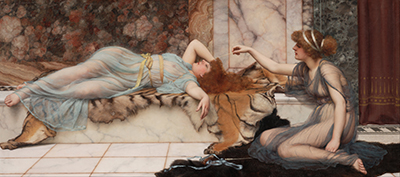
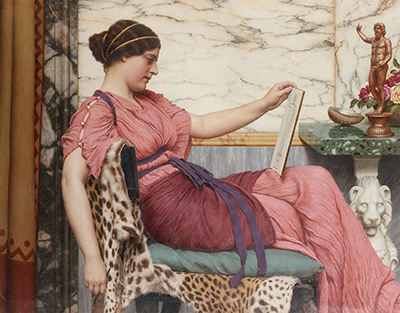
A dress pin, a marble bench and a length of blue cloth do much of the work in John William Godward’s Mischief and Repose. The bench gives the sleeping woman room to stretch out. The folds of her dress run down over the tiger skin beneath her, and her upright companion brings a tiny pin into the space above her. From across a room the painting looks like an expanse of pale stone broken by two figures. Closer up, the pin makes the distance between them feel charged. Godward’s pictures reward both views. Move back to see how he distributes the figures, then move in to see what a hand, a fold or the edge of a seat is doing. [1]
The same exercise works across a surprisingly wide range of paintings. Godward could give the whole height of a canvas to a woman standing in a doorway, use the width of a bench to stretch out a pause, or fit a sewing figure and her garden into a circle. From the late 1880s to the early 1920s he kept returning to certain poses, objects and titles. Comparing them is a way to see how much could change within a familiar scene.
At a Glance
- Principal mediumOil on canvas
- FormatsUpright, landscape and circular compositions
- SubjectsClassical settings, encounters, work and repose
Contents
- From courtship to the solitary figure
- Tall figures, long benches and circular frames
- Marble, fabric and the painter’s evidence
- Repetition and the pleasures of looking
- Gardens, terraces and the Roman-period oils
- Finding the picture you have in mind
- Annotated details
From courtship to the solitary figure
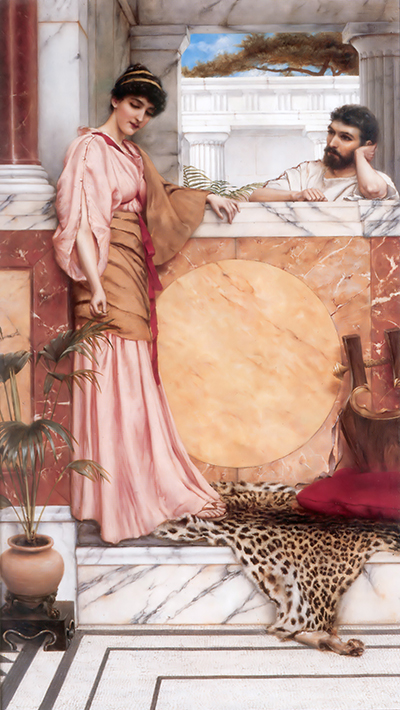
In Waiting for an Answer, signed in 1889, the two figures give the viewer something to follow before the title supplies the nature of the pause. A man directs his attention towards a woman whose gaze does not answer his. The space between them gives an ordinary hesitation room to play out. The Hessisches Landesmuseum Darmstadt’s Unexpected Arrival of 1891 changes the direction of the encounter. A woman is already on a terrace when a man comes up the steps, with part of a ship visible behind him. Udo Felbinger, writing for Hessen’s provenance research office, identifies a second composition in which the woman and setting remain and the approaching figure disappears. The museum’s painting itself was acquired as a Leighton in 1965. The misleading inscription has since been removed, and research on its ownership still has gaps. The two compositions show how readily a single arriving figure can turn a terrace into the setting for an incident. [2] [3]
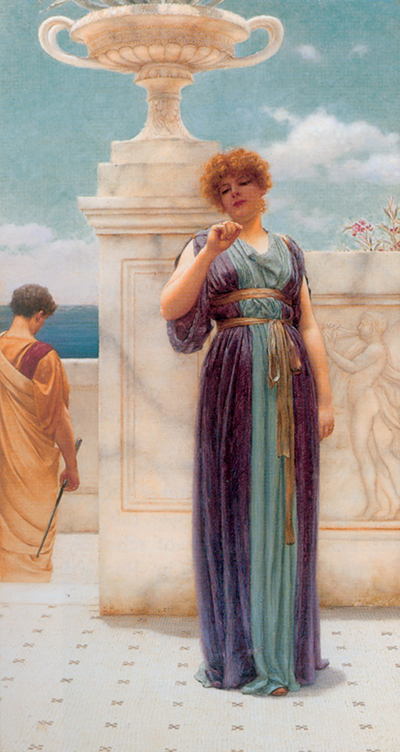
The two pictures called The Engagement Ring take a different route to a similar uncertainty. The signed 1888 oil is horizontal, with a woman seated near a doorway and a scroll nearby. The smaller, upright Engagement Ring catalogued to about 1891 puts its standing woman beside an urn-topped pier, with another figure and the sea beyond. Compare how much of each view the architecture screens and how readily the eye can move past the central figure. The doorway in the earlier composition draws attention towards the adjoining space. The upright canvas gives the woman and the pier much more of the frame and reduces the figure beyond to a secondary incident. With either picture the title suggests a proposal or a promise, while the scale and placement of the figures determine how much of the supposed story one can actually see. [4] [5]
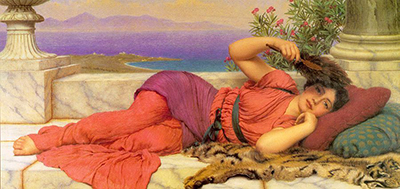
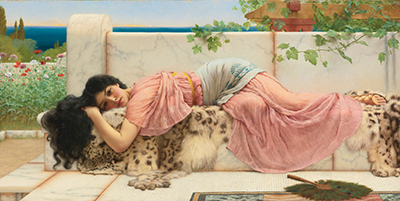
At the Getty, the 1895 Mischief and Repose makes the two women’s different levels of attention explicit. One watches and acts while the other rests. When Godward reused the title in 1909, he kept the blue dress, the raised elbow and the skin but left a single reclining figure out on a terrace. Her open eyes face the viewer. In the two canvases the same relaxed arrangement of limbs supports first a small comedy, then a direct exchange with the viewer. The 1909 oil is also considerably smaller, about 77 centimetres wide against the Getty canvas’s 133. Reproductions that fill the same space on a screen make those very different viewing experiences easy to miss. [1] [6]
Tall figures, long benches and circular frames
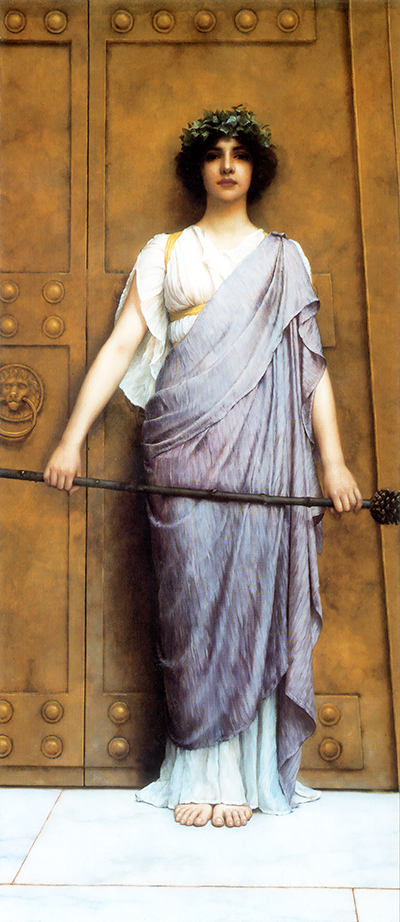
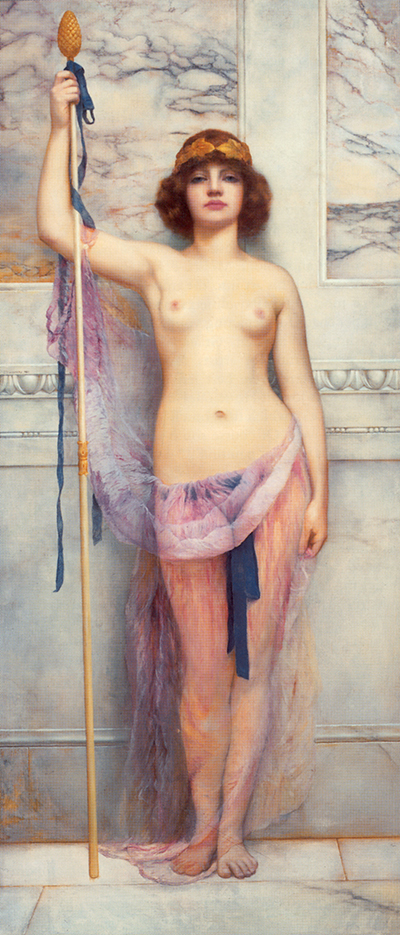
At just over 161 centimetres high and barely 71 centimetres wide, At the Gate of the Temple has nearly the height of a standing adult. The figure follows the upright lines of the doors, while the staff she holds across her body cuts across the entrance. Yet the fabric hangs in much softer lines than the solid door and floor. The woman faces out and meets the viewer at the threshold. In the roughly comparable upright format of A Priestess from 1893, the raised staff and turned body make a different set of diagonals and contours within the narrow frame. Even similar dimensions and classical titles offer considerable room for change. One painting centres on what it feels like to approach a guarded entrance, while the other gives the lifted arm and the gesture above the figure more space to work. [7] [8]
The original exhibition records help put the difference of scale in context. The Royal Academy’s 1895 catalogue lists A Priestess in one room and Mischief and Repose in another. Writing that year, Henry Blackburn described a woman in transparent black gauze before brass doors. His account points to the clothed composition, while the 1893 oil discussed here is the near-nude. A more securely identified Academy exhibit, the signed Campaspe of 1896, measures 230 centimetres high. Its scale makes the artist’s range easier to grasp. The intimate upright Engagement Ring and the monumental Campaspe may be reproduced at the same height on a page, yet the first is barely half a metre high and the second is taller than most viewers. Both ask the eye to climb. They ask very different things of the body in front of them. [9] [10] [11]
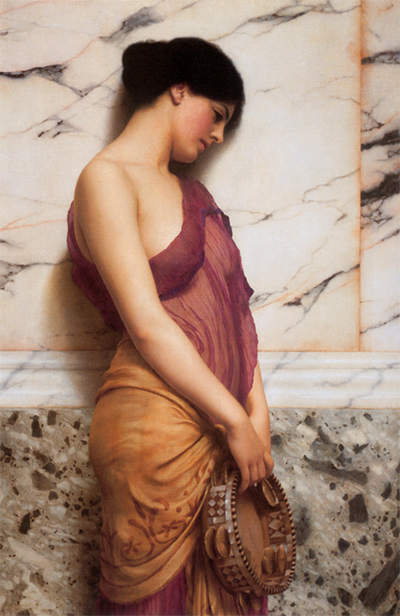
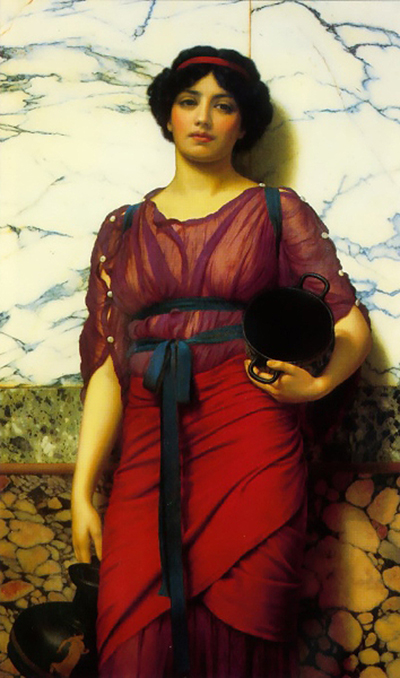
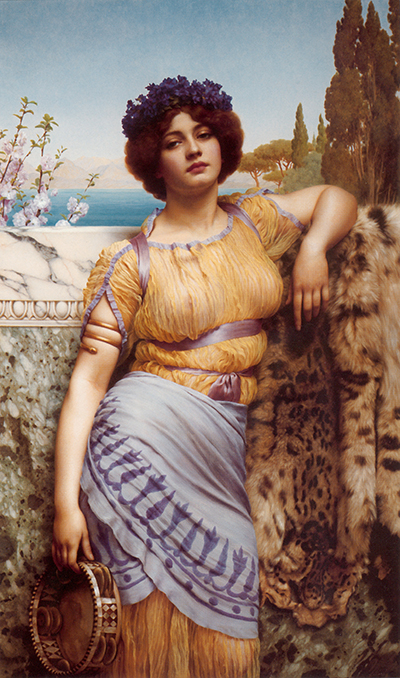
The upright format can also contain a turning body. Look at Ionian Dancing Girl, exhibited at the New Gallery in 1902, in relation to the temple picture. The dancer’s arms and instrument draw the eye away from the verticals behind her, and the fall of cloth gives the turn a visible rhythm. Architectural lines supply the steady measure against which we can register the move. The compact, signed 1906 version of The Tambourine Girl puts a decorated circular instrument in front of a carved relief. Changes in the position and outline of a hand or instrument matter more here than the broad resemblance of two paintings of women in antique dress. The small oil has circulated under several English titles. Christie’s records the Paris Salon that year in its exhibition history. [12] [13]
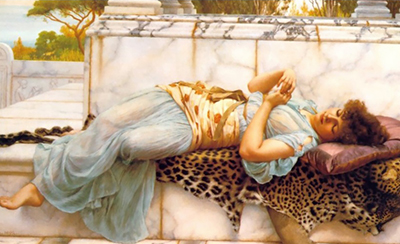
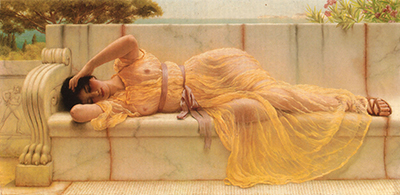
Turn to The Betrothed, in the Guildhall Art Gallery collection, and you can see how much a bench does for a reclining figure. It lets the body extend along its length, where a change in the direction of the head is enough to break the long line. A skin over the stone cushions the figure and overlaps the straight edge with an irregular border. Godward used a similar bench and a reversed direction of repose in Girl in Yellow Drapery of 1901. Its canvas is just over 30 centimetres high and twice as wide. The breadth of yellow cloth gives the figure a different weight in the picture. Compare the shapes between each body and the supporting bench, then trace the coloured folds across the edge. In When the Heart is Young of 1902, the hair becomes a particularly strong part of the horizontal design. It has a long, continuous fall where the garment gathers and breaks into folds. The stone supplies a firm edge for both. [14] [15] [16]
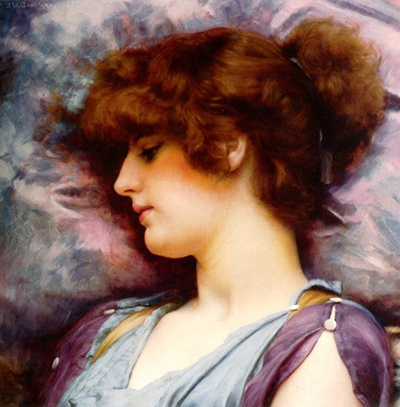
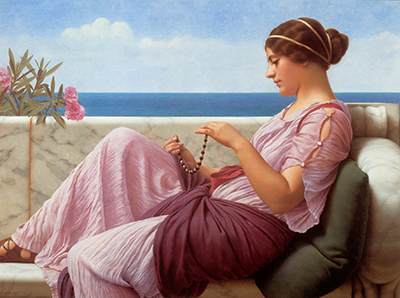
The early Far Away Thoughts, catalogued to 1892, brings an auburn-haired profile so close that an expression and the direction of a glance fill much of the subject. The signed Far away thoughts of 1911 is a different oil, a circular composition painted on a square canvas just over a metre across. It shows a dark-haired woman in profile sewing on a terrace, with a chair, a skin, oleander and a view of the sea. The curve gathers the seated woman and her surroundings into a single view. The low placement of the sewing gives the gaze somewhere to come to rest, where the 1892 picture leaves its destination to us. In the 1918 Lycinna, with Rome inscribed on the back, the close profile again makes hair, the edge of a cheek and the fabric around the figure’s shoulders count for a great deal. Set the three together and watch how radically the scale of a face within the frame changes the experience of looking at someone in thought. [17] [18] [19]
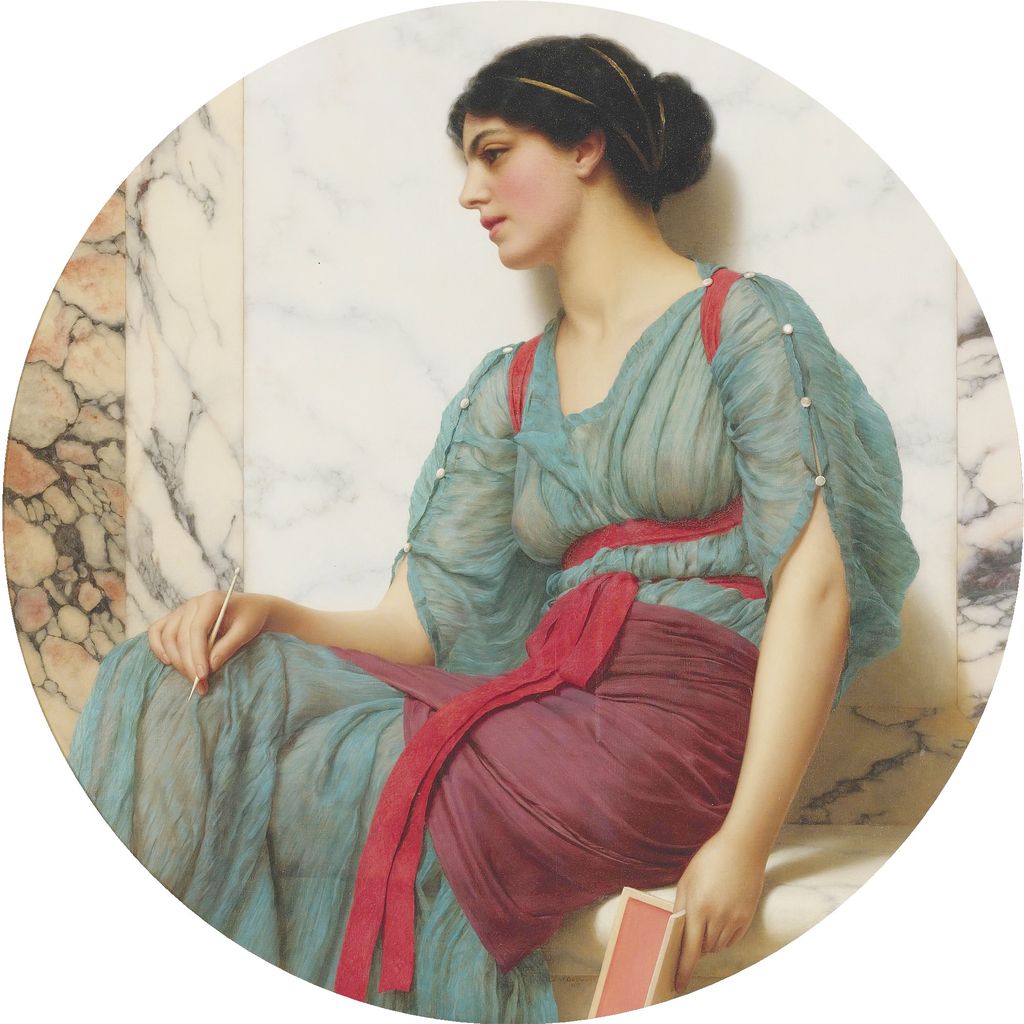
John William Godward, The Love Letter (1907). The format governs how the pose and the view beside it fit into the picture. Image source. Public domain.
John William Godward videos
See Godward’s paintings and studio practice alongside films on two Victorian contemporaries.
John William Godward - Part 1: The Last Painter of the Victorian Age
An overview of Godward’s career and the Victorian market for pictures set in antiquity.
Watch on YouTubeMarble, fabric and the painter’s evidence
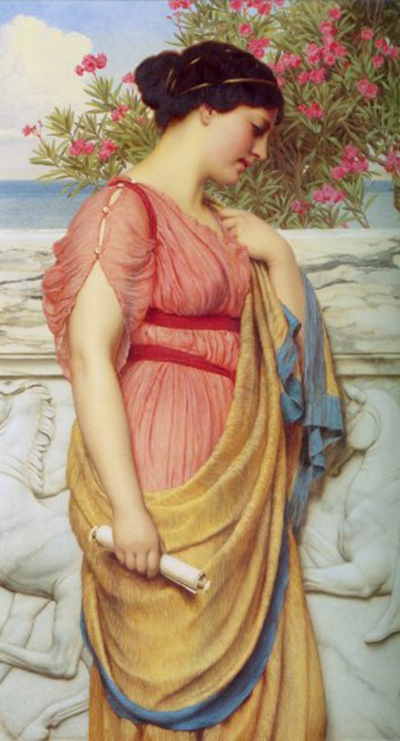
Godward’s finish makes hard surfaces distinct even when they are close in colour. A marble vein changes direction and runs beneath what looks like a polish. A fold ends at a seam or overlaps another layer. Fur breaks the outline of the object it covers and has a direction of its own. In the Getty’s Reverie (In the Days of Sappho), signed and dated 1904, the marble bench ends in a sculpted head that the Getty tentatively identifies as a type associated with Homer. The painted cloth at the woman’s hips carries a repeated palmette, a design resembling a spray of palm leaves. The museum distinguishes that recognisably ancient pattern from the costume Godward devised around it. The standing Sappho, catalogued by the Art Renewal Center to 1910, is a separate painting. The narrow scroll puts more emphasis on a particular object in the woman’s hands and directs attention down the upright composition. A title can invite a literary association even when the painting leaves us to imagine what the sitter is reading or thinking. [20] [21]
Michael Allan Kodysz’s study of Godward’s classical genre painting follows objects and designs between canvases. In Ionian Dancing Girl he examines the decoration of the tambourine closely, and he compares a patterned girdle in pictures by Godward and Henry Ryland, who worked in neighbouring studios. Those comparisons let us see a studio world as well as a classical one. A design could be useful to more than one painter or in more than one composition. Kodysz’s comparison with Lawrence Alma-Tadema also brings out a difference of emphasis. The archaeology in an elaborate scene of ancient life may help establish a particular practice or event. In many Godwards a few convincing objects lend authority to a scene whose main interest lies in a figure’s pose and the surfaces around her. [22]
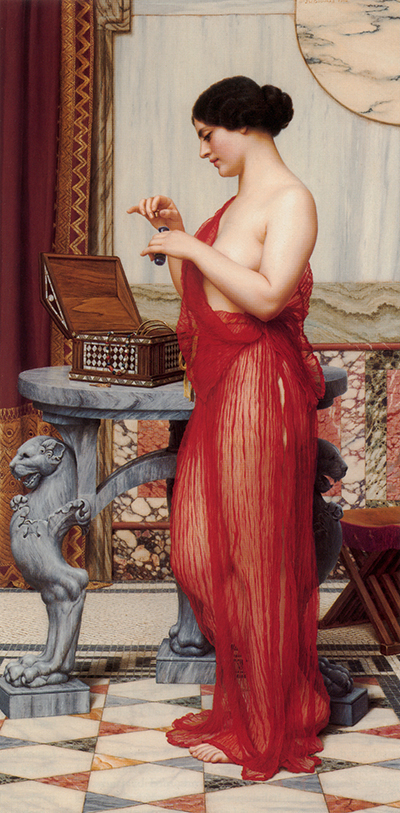
Try the griffin-shaped furniture support in The New Perfume. The carved profile and its sharp contours sit close to the small implements handled by the woman. The Metropolitan Museum of Art has a Roman marble table support of the first century BCE with a winged griffin emerging from a feline leg at each end. The museum’s object offers a comparison for the way animal forms can carry the weight of furniture and ornament it at the same time. The resemblance helps explain why the painted support looks at home in the imagined room. A direct link to this particular antiquity would need separate documentary evidence. The painting’s own inscriptions are more specific about the object itself. Christie’s records 1914 on the face and Rome, 1915 on the back. Both belong with the same canvas. [23] [24]
Vern Swanson’s study of Godward’s methods draws on surviving sketchbooks and describes how the painter worked through drawings, studies and poses with live models. There are also records of changes at the level of the painted surface. In a historical Sotheby’s condition report on The Bouquet, Simon Parkes Art Conservation noted retouching over changes in the foliage on the upper wall, as well as a lining, an added support attached to the back of the canvas. The same specialist reported that Girl in Yellow Drapery remained unlined at the time of its sale, with a small local reinforcement on the back. The report on A Tryst described a glue lining with unevenness on the back that did not show as a corresponding disturbance on the front. Each report has a date and an individual painting behind it. Their observations give a sounder basis for discussing a specific change than the different colours or sharpness of two online reproductions. [15] [25] [26] [27]
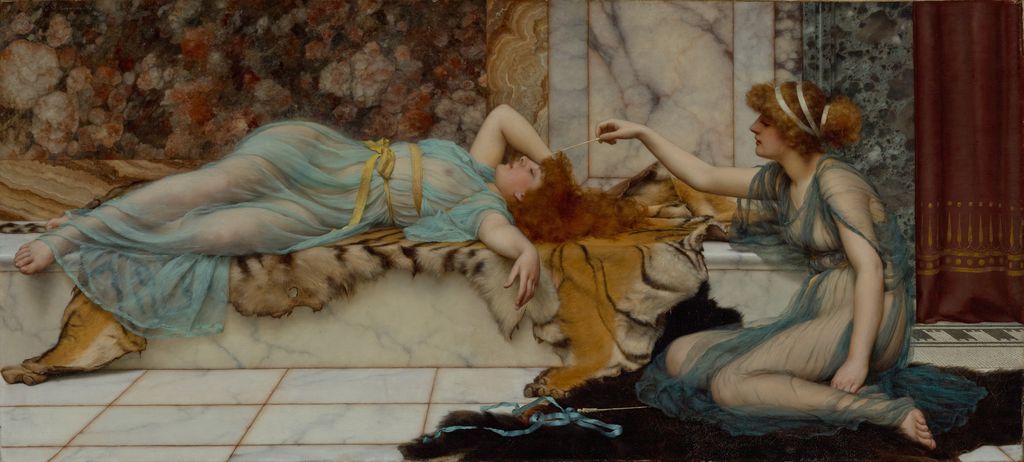
John William Godward, Mischief and Repose (1895). Painted tiger skin, drapery and mosaic meet along the marble ledge. J. Paul Getty Museum. Image source. CC0 / Public domain.
Annotated Details from John William Godward’s Paintings
The numbered points identify visible features discussed in this article. Return from each detail to the numbered overview. John William Godward, Reverie (1904). J. Paul Getty Museum. Image source. CC0 / Public domain.
.jpg)
Details from JOHN WILLIAM GODWARD’S PAINTINGS
Compare the cropped details with the source images above. Notice how their colours, shapes and positions contribute to the larger compositions.
The carved head at the bench end
The sculpted head looks out past the edge of the bench, at the far end of the sitter’s field of view.
 Detail 01 the-carved-head-at-the-bench-end.jpg)
The junction of two textiles
A blue patterned textile crosses the folds of the warm dress, separating the hand from the pale stone.
 Detail 02 the-junction-of-two-textiles.jpg)
Fur spilling over the bench
The skin makes an irregular line around the seat and down the marble in front of it.
 Detail 03 fur-spilling-over-the-bench.jpg)
Repetition and the pleasures of looking
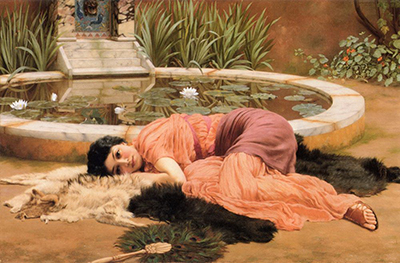
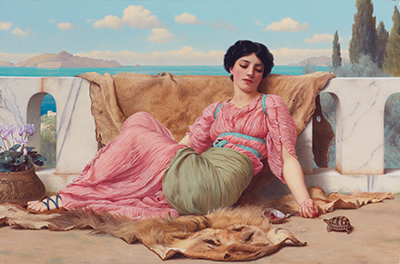
The Italian phrase dolce far niente means the sweetness of doing nothing. In Godward’s 1904 poolside Dolce far niente, the fountain and fishpond give the scene a point of gentle activity apart from the reclining woman. In the 1907 painting of the same name the small action belongs to the figure and the grapes she holds. A signed 1906 canvas and a documented 1897 composition are also distinct works. Across the group, compare the reach of an arm, the slope of the body and how much immediate space the woman shares with water, stone or fabric. What changes is the rhythm of the pause. The viewer’s eye can settle on the hand in one work and keep moving through the garden in another. [28] [29] [30]
In her Japanese-language study of the series, Rina Kajima compares Godward’s repeated subject with treatments by other artists, including John William Waterhouse and Alma-Tadema. She argues that Godward’s versions reduce narrative and, in places, give formally arranged surfaces more weight than the illusion of depth. A closely painted stone ledge can feel solid enough to touch even when its straight edge draws a band across the picture and flattens the composition. The long folds of a dress can describe the body in one area and turn into repeated stripes in another. Kajima’s broader study of inactive women in Victorian painting also asks what happens to the representation of women when action and moral instruction give way to colour and design. That question can sit beside the visual pleasure of the pictures. A woman may appear comfortably absorbed in rest, yet her posture, clothing and setting are carefully arranged for someone else to look at. [28] [31]
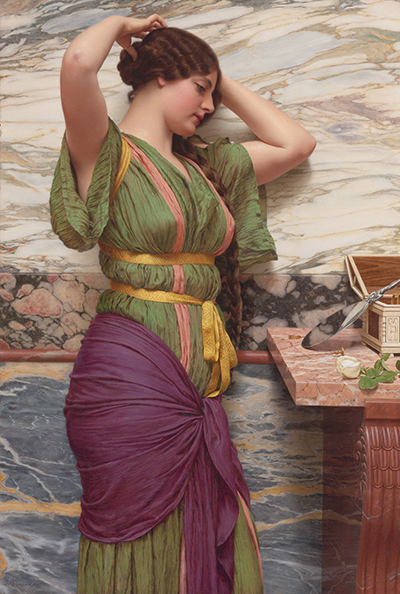
The Getty Villa’s exhibition The Last Days of Pompeii considered Mischief and Repose in a section devoted to decadence. The setting connects the reclining women and costly-looking surfaces to a later audience’s ideas about ancient luxury. The French-language dossier for the Musée Jacquemart-André’s 2013–14 Désirs et volupté à l’époque victorienne approached the colour and finish of Godward’s Beauté classique and L’Absence fait grandir l’amour alongside paintings by his Victorian contemporaries. Its original exhibition material is a reminder of how closely antique dress, the depiction of women and the appeal of rich surfaces were linked in that tradition. In particular, the tall 1912 L’Absence fait grandir l’amour is a useful neighbour for A Tryst. A solitary figure can carry the implication of someone absent without having to describe the encounter that has taken place or is about to happen. In A Tryst the raised hand and direction of the face are enough to keep the question open. [27] [32] [33]
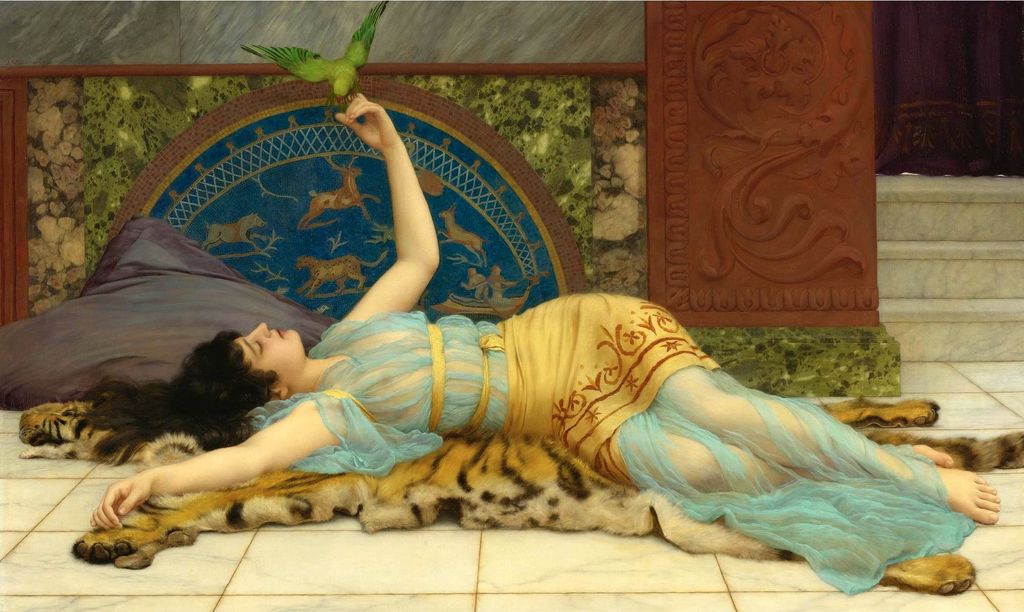
John William Godward, Dolce Far Niente (1897). In the 1897 version the reach towards the parrot draws attention up into the composition. Image source. Public domain.
Gardens, terraces and the Roman-period oils
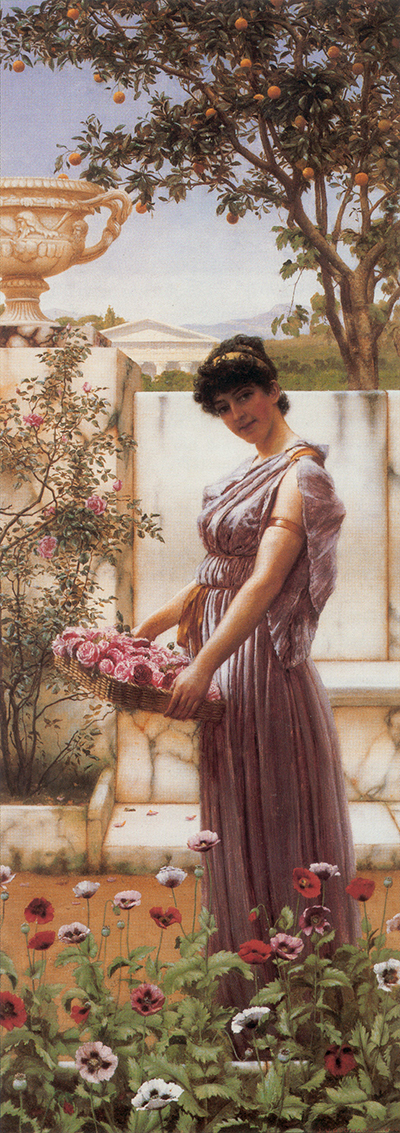
Godward used plants to set the size and pace of his spaces early on. The Flowers of Venus, exhibited with its companion An Idle Hour in McLean’s winter show of 1890–91, presses a standing figure and garden setting into a canvas less than 22 centimetres wide. The narrow view gives particular weight to the individual stems and to the places where the architecture lets a little space open up. In the later Bouquet the enclosing walls and taller foliage give the flowers a more sheltered setting. In Noon Day Rest, dated 1910 in the illustrated record, the oleander and the ledge anchor the picture close to the body, with the horizon well beyond them. In each case the arrangement of plants helps decide how far the gaze can travel. [26] [34] [35] [36]
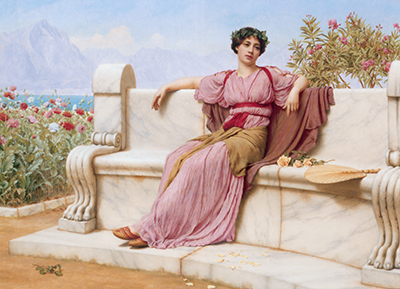
Two Roman-period oils from 1914 demonstrate how much the figure’s relation to a landscape can change while the vista itself is held steady. Christie’s links In the Prime of the Summertime to Tranquillity through the mountain view behind both. In the former, the raised peacock fan brings a cluster of dense shapes close to the head and answers the colour of ribbons and foliage. In Tranquillity, an extensive curved bench and intervening stretches of garden give the figure more room to be still. Small foreground marks, including slippers, seem to belong to the person’s immediate reach. The mountain shapes belong to a much slower passage across the picture. The painting was constructed from distinct distances, and its subject depends on the amount of room Godward gave each of them. [37] [38]
Follow the later oils for still other degrees of activity. In Tender Thoughts, signed and inscribed Rome in 1917, a surviving preparatory trail and a simpler related watercolour of 1918 let us consider which parts of the oil Godward felt could change. The interested gaze remains a useful point of comparison with the seated figure in Tranquillity. Look too at An Amateur, reproduced in the catalogue for Godward’s signed 1922 A Dilettante. Both pictures put a woman’s hands to work. The earlier figure bends to a drawing, while the later figure works on a statuette. Try looking first at the hands and asking where the body’s weight goes in order to make the action possible. The paintings become companions through their attention to the act of making, even as the props, format and arrangement of the body change. Sotheby’s compares the little figure in A Dilettante with the Louvre’s veiled terracotta dancer, known as the Danseuse Titeux. The Louvre’s French catalogue records a Greek figurine about 21 centimetres tall. It offers an unusually close comparison for the sweep of the drapery on the small figure being made in the picture. Ancient sculpture has become part of the woman’s work as well as part of Godward’s design. [39] [40] [41]
Finding the picture you have in mind
For public collection examples, the Getty’s records let you compare the long 1895 Mischief and Repose with the seated Reverie and the upright The Signal of 1899. Guildhall’s The Betrothed offers a good comparison for reclining figures, while the two Darmstadt paintings let you see what a second figure contributes to a scene of courtship. Collection ownership and gallery display can change independently, so the institution’s object record is the place to check before a visit. [1] [3] [14] [20] [42]
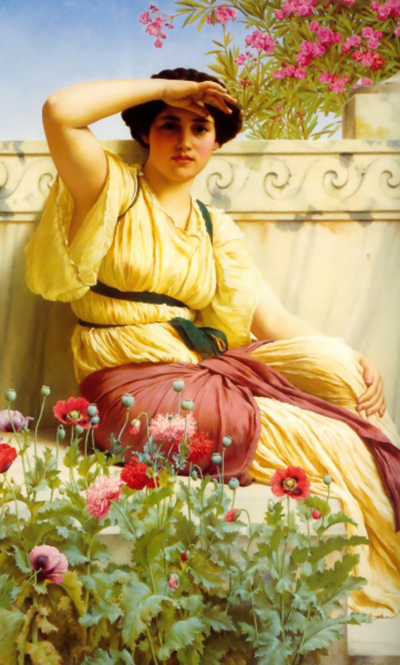
When looking for a specific Godward, take the title together with the date, proportions and one memorable feature. The upright Engagement Ring has its urn and prospect of the sea. The 1904 Dolce far niente has the fountain and fishpond. The large circular Far away thoughts of 1911 has its seated woman sewing. Other titles changed when pictures reached a new public. In the Prime of the Summertime circulated as Reverie in a 1916 print, a name easily confused with the Getty oil. The drawings and prints provide further ways to trace those changes. To compare the oils, begin with whichever detail caught your attention, then find what Godward did with a similar bench, turn of the head or view of the sea in another painting. [5] [18] [20] [28] [37]
Explore Godward’s paintings
Further reading
The Classical-Genre Paintings of John William Godward. Michael Allan Kodysz. University of Manchester dissertation, 2007, restored digital edition.
Compare painting, studio practices and the ancient objects recorded by the author. Read the dissertation.
Repetition of Women Who Are Doing Nothing. Rina Kajima, Journal of Cross-Cultural Studies 20, 2025. Japanese with an English abstract.
The illustrations make the recurring title Dolce far niente and the changes in pose easy to compare. Read the university publication.
John William Godward artworks directory
Search documented oil paintings, drawings, watercolours and reproductive prints. The directory includes the Art Renewal Center’s catalogue and additional works in museum, exhibition and sale records.
| Name | Date | Medium |
|---|---|---|
| Absence Makes the Heart Grow Fonder | 1912 | Oil on canvas |
| Amaryllis | 1903 | Oil on canvas |
| An Amateur | 1915 | Oil on canvas |
| Ancient Pastimes | 1916 | Oil on canvas |
| The Answer | 1917 | Oil on canvas |
| An Arcadian Beauty | 1899 | Painting |
| At the Fountain | 1893 | Oil on canvas |
| At the Garden Door | 1901 | Oil on canvas |
| At the Garden Shrine, Pompeii | 1892 | Oil on canvas |
| At the Gate of the Temple | 1898 | Oil on canvas |
| At the Thermae | 1909 | Oil on canvas |
| Atalanta | 1892 | Oil on canvas |
| Athenais | 1908 | Oil on canvas |
| An Auburn Beauty | 1895 | Oil on canvas |
| Autumn | 1900 | Oil on canvas |
| Beauty in a Marble Room | 1894 | Oil on canvas |
| The Belvedere | 1913 | Oil on canvas |
| The Betrothed | 1892 | Oil on canvas |
| The Betrothed (print after Godward) | 1893 | Photoengraving, as reported |
| The Bouquet | 1899 | Oil on canvas |
| Briseis | 1896 | Painting |
| The Broken Vase | 1889 | Oil on canvas |
| By the Blue Ionian Sea | 1916 | Oil on canvas |
| By the Wayside | 1912 | Oil on canvas |
| Byrsina | 1915 | Painting |
| Campaspe | 1896 | Oil on canvas |
| Campaspe (print after Godward) | Print, process unconfirmed | |
| Chloris (A Summer Rose) | 1902 | Oil on canvas |
| Classical Beauty | Oil on canvas | |
| A Classical Beauty | Oil on canvas | |
| A Classical Beauty | Painting | |
| A Classical Beauty | Oil on canvas | |
| A Classical Beauty | 1909 | Oil on canvas |
| A Classical Beauty In Profile | Oil on canvas | |
| A Classical Lady | 1908 | Oil on canvas |
| Clymene | 1892 | Oil on canvas |
| A Congenial Task | 1915 | Oil on canvas |
| Contemplation | 1922 | Oil on canvas |
| A Cool Retreat | 1910 | Oil on canvas |
| Country House in the 18th Century | c. 1883 | Oil on canvas |
| Cytheris | 1922 | Painting |
| The Day Dream | 1920 | Oil on canvas |
| The Delphic Oracle | 1899 | Oil on canvas |
| A Dilettante | 1922 | Oil on canvas |
| Distant Thoughts | 1918 | Oil on canvas |
| Dolce Far Niente | 1897 | Oil on canvas |
| Dolce Far Niente | 1906 | Oil on canvas |
| Dolce far niente (A Pompeian Fishpond) | 1904 | Oil on canvas |
| Dolce far niente (coloured print after Godward) | Exhibited 1900 | Coloured print, exact process unconfirmed |
| Dolce far niente (grapes) | 1907 | Oil on canvas |
| Dora | 1887 | Oil on canvas |
| Drusilla | 1906 | Oil on canvas |
| An Edition de Luxe | 1920 | Oil on canvas |
| Eighty and Eighteen | 1898 | Oil on canvas |
| Endymion | 1893 | Oil on canvas |
| The Engagement Ring (horizontal composition) | 1888 | Oil on canvas |
| The Engagement Ring (upright composition) | c. 1891 | Oil on canvas |
| Erato at Her Lyre | Oil on canvas | |
| A Fair Reflection | 1915 | Oil on canvas |
| A Fair Reflection (Taber-Prang print) | By 1923 | Sepia artotype |
| Far Away Thoughts (circular sewing scene) | 1911 | Oil on canvas |
| Far Away Thoughts (left-facing profile) | 1892 | Oil on canvas |
| Far Away Thoughts (right-facing profile) | 1892 | Oil on canvas |
| Female Figure (probable Grecian Idyll study) | 1907 | Oil on board |
| Flabellifera | 1905 | Oil on canvas |
| Flabellifera (painted study) | c. 1905 | Oil study |
| Flabellifera (pencil study) | c. 1905 | Pencil on paper |
| The Flower Girl | Painting | |
| A Flower Seller | 1896 | Oil on canvas |
| The Flowers of Venus | 1890 | Oil on canvas |
| A Fond Farewell | 1918 | Watercolour |
| The Fragrant Rose | 1892 | Painting |
| The Fruit Vendor | 1917 | Oil on canvas |
| A Garland Seller | 1914 | Painting |
| Giotto Drawing from Nature | Painting | |
| Girl in Yellow Drapery | 1901 | Oil on canvas |
| Golden Hours | 1913 | Oil on canvas |
| A Grecian Girl | 1908 | Oil on canvas |
| Grecian Idyll | 1907 | Oil on canvas |
| A Grecian Lovely | 1909 | Oil on canvas |
| Grecian Reverie | 1889 | Oil on canvas |
| Grecian Reverie | 1889 | Oil on canvas |
| A Greek Beauty | 1905 | Oil on canvas |
| A Happy Awakening | 1903 | Oil on canvas |
| He Loves Me, He Loves Me Not | 1896 | Oil on canvas |
| A head and shoulders profile portrait of a young woman wearing a white tunic style blouse | c. 1889 | Painting |
| Head of a Girl (The Priestess) | 1896 | Oil on canvas |
| Heart on her Lips and Soul within her Eyes | 1904 | Painting |
| His Birthday Gift | 1889 | Oil on canvas |
| Ianthe | 1889 | Oil on canvas |
| An Idle Hour | 1890 | Oil on canvas |
| Idle Moments | 1895 | Oil on canvas |
| Idle Thoughts | 1898 | Oil on canvas |
| Idleness | 1900 | Oil on canvas |
| Il Dolce Far Niente (Pears print after Amaryllis) | 1906 | Chromolithograph |
| Il Dolce far niente (seated figure) | 1893 | Oil on canvas |
| In Expectation | c. 1892 | Oil on canvas |
| In Realms of Fancy | 1911 | Oil on canvas |
| In the Prime of the Summertime (Reverie) | 1914 | Oil on canvas |
| In the Tepidarium | 1913 | Oil on canvas |
| Innocent Amusements | 1891 | Oil on canvas |
| Ione | c. 1896-1898 | Oil on canvas |
| Ionian Dancing Girl | 1902 | Oil on canvas |
| Ismenia | 1908 | Oil on canvas |
| An Italian Beauty | 1897 | Oil on canvas |
| An Italian Girls' Head | 1902 | Oil on canvas |
| The Jewel Casket | 1900 | Oil on canvas |
| Julia | 1914 | Painting |
| Knuckle Bones | 1890 | Oil on canvas |
| La Pensierosa | 1913 | Oil on canvas |
| A Lady | 1895 | Oil on canvas |
| Landscape: Blossoming Red Almond [study] | c. 1912 | Oil on panel |
| Le Billet Doux (The Love Letter) | 1913 | Oil on canvas |
| Leaning Against a Column | 1901 | Painting |
| Leaning on the Balcony | 1892 | Oil on canvas |
| Leisure Hours | 1905 | Oil on canvas |
| Lesbia with her Sparrow | 1916 | Oil on canvas |
| The Letter | 1899 | Painting |
| Liegende | 1893 | Oil on canvas |
| A Lily Pond | 1917 | Oil on canvas |
| Looking Out to Sea | 1918 | Pencil and watercolour |
| The Love Letter (circular composition) | 1907 | Oil on canvas |
| Lucilia | 1917 | Oil on canvas |
| Lycinna | 1918 | Oil on canvas |
| Marcella | 1912 | Painting |
| Matrona Superba | Oil on canvas | |
| Megilla | 1921 | Oil on canvas |
| A Melody | 1904 | Oil on canvas |
| Memories | c. 1891 | Oil on canvas |
| Mirinna | Painting | |
| The Mirror | 1899 | Oil on canvas |
| Mischief | 1905 | Oil on canvas |
| Mischief and Repose | 1895 | Oil on canvas |
| A Mouse in the Work Basket | 1893 | Oil on canvas |
| Nerissa | 1906 | Oil on canvas |
| The New Perfume | 1914 | Oil on canvas |
| Noon Day Rest | 1910 | Oil on canvas |
| Nu Sur La Plage | 1922 | Oil on panel |
| Nude Study | Oil on canvas | |
| An Offering to Venus | 1912 | Oil on canvas |
| The Old, Old Story | Oil on canvas | |
| The Old, Old Story | 1903 | Oil on canvas |
| On the Balcony | 1911 | Oil on canvas |
| On The Terrace | 1918 | Oil on canvas |
| Ophelia | Oil on panel | |
| The Peacock Fan | 1912 | Oil on canvas |
| Phyleis | 1908 | Oil on canvas |
| The Playground | 1892 | Oil on canvas |
| Playtime | 1891 | Oil on canvas |
| A Pompeian Bath | 1890 | Oil on canvas |
| A Pompeian Lady | 1891 | Oil on canvas |
| A Pompeian Lady | 1895 | Oil on board |
| A Pompeian Lady | 1901 | Painting |
| A Pompeian Lady | 1904 | Painting |
| Portrait of Mary Frederica 'Nin' Godward | c. 1882-1883 | Oil on canvas |
| Portrait of Mary Perkinton Godward | c. 1880-1881 | Watercolor |
| The Posy | 1900 | Painting |
| A Priestess (bare-shouldered figure) | 1893 | Oil on canvas |
| A Priestess (clothed composition) | 1894 | Oil on canvas |
| A Priestess (W. Biscombe Gardner after Godward) | Exhibited 1897 | Print, process unconfirmed |
| A Priestess of Bacchus | 1890-1890 | Oil on canvas |
| Pyrallis | 1918 | Oil on canvas |
| The Quiet Pet | 1906 | Oil on canvas |
| A Red, Red Rose | 1920 | Oil on canvas |
| Reflections | 1893 | Oil on canvas |
| The Rendezvous | 1903 | Oil on canvas |
| Repose, the Flower Girl | c. 1887 | Oil on canvas |
| Reverie | 1888 | Oil on panel |
| Reverie | 1912 | Oil on canvas |
| Reverie (In the Days of Sappho) | 1904 | Oil on canvas |
| Reverie (Pears print after In the Prime of the Summertime) | 1916 | Chromolithograph |
| 'Rich Gifts Wax Poor When Lovers Prove Unkind' | 1916 | Oil on canvas |
| The Ring | 1898 | Oil on canvas |
| A Roman Matron | 1905 | Oil on canvas |
| Sabinella | 1912 | Oil on canvas |
| Sappho | 1910 | Oil on canvas |
| The Siesta | Oil on canvas | |
| A Siesta | 1895 | Oil on canvas |
| The Signal | 1899 | Oil on canvas |
| Sitting for Her Portrait | 1893 | Oil on canvas |
| Sketch for Amaryllis | 1903 | Oil on board |
| A Souvenir | 1920 | Oil on canvas |
| Stesicrate | 1914 | Oil on canvas |
| Study for 'Rêverie' | 1890 | Oil on canvas |
| Study for 'The Priestess' | 1895 | Oil on board |
| Study for An Egyptian Minstrel | 1906 | Painting |
| Study for The New Perfume | Drawing, medium unconfirmed | |
| Study for ‘The Old, Old Story’ | 1903 | Oil paint on wood |
| Study of a Girl's Head | 1899 | Painting |
| Study of Campaspe | Oil on canvas | |
| Study of Head and Drapery, Miss Ethel Warwick | 1898 | Painting |
| Summer Day | 1897 | Painting |
| Summer Flowers | 1903 | Oil on canvas |
| Sweet Dreams | 1901 | Oil on canvas |
| Sweet Dreams | 1904 | Painting |
| The Sweet Siesta of a Summer's Day | 1891 | Oil on canvas |
| The Tambourine Girl (profile at the marble wall) | 1906 | Oil on canvas |
| The Tambourine Girl (relief-backed version) | 1906 | Oil on canvas |
| Tender Thoughts | 1917 | Oil on canvas |
| Tender Thoughts (woman leaning over a parapet) | 1918 | Pencil and watercolour |
| The Tiff (oil) | By 1888 | Oil on canvas |
| The Tiff (print after Godward) | 1894 | Photogravure |
| The Tigerskin | 1889 | Oil on canvas |
| The Time of Roses | 1916 | Oil on canvas |
| Tranquillity | 1914 | Oil on canvas |
| A Tryst | 1912 | Oil on canvas |
| Tympanistria | 1909 | Oil on canvas |
| Under the Blossom that Hangs on the Bough | 1917 | Oil on canvas |
| Venus at the Bath | 1901 | Oil on canvas |
| Venus Binding Her Hair | 1897 | Oil on canvas |
| Violets, Sweet Violets | 1906 | Painting |
| Waiting for an Answer | 1889 | Oil on canvas |
| Waiting for the Procession | 1890 | Oil on canvas |
| Waiting for the Procession | 1890 | Painting |
| The Water Carrier (magazine reproduction of At the Fountain) | 1898 | Magazine reproduction |
| When the Heart is Young | 1902 | Oil on canvas |
| Who Can They Be | Painting | |
| Winding Wool | 1894 | Painting |
| 'With Violets Wreathed and Robe of Saffron Hue' | 1902 | Oil on canvas |
| The Yellow Shawl | 1893 | Painting |
| 'Yes or No?' | 1893 | Oil on canvas |
| Young Girl Picking Grapes | 1902 | Oil on canvas |
| Youth and Time | 1901 | Oil on canvas |
Discussion
Look again at the images and ideas explored in John William Godward’s Paintings. These editorial prompts invite your observations.
Reader Insights
Which painting takes the best advantage of its shape?
Where do you see a recurring studio object used to different effect?
Join the Conversation
Share a detail, comparison or question about John William Godward’s Paintings below.
References
- J. Paul Getty Museum. Mischief and Repose, 1895, 79.PA.149. Object record and curatorial description. View source.
- Sotheby’s. Waiting for an Answer, sale N08355, lot 163. Signed date, plate and catalogue entry. View source.
- Udo Felbinger, Hessen Provenienzforschung. “Leider kein Leighton! John William Godwards Gemälde ‘Unexpected arrival’”, 12 October 2023. Collection research in German on Unexpected Arrival and Yes or No. View source.
- Sotheby’s. The Engagement Ring, 2023 sale. Signed 1888 canvas, with plate and catalogue entry. View source.
- Art Renewal Center. The Engagement Ring, artwork 11592. Upright oil catalogued to c. 1891. View source.
- Christie’s. Mischief and Repose, signed 1909 canvas. Plate, measurements and catalogue discussion of the 1895 oil. View source.
- Christie’s. At the Gate of the Temple, signed 1898 canvas. Plate, measurements and catalogue entry. View source.
- Vern Grosvenor Swanson. John William Godward: The Eclipse of Classicism, archived Art Renewal Center presentation, p. 16. Labelled plate of the 1893 A Priestess. View source.
- Royal Academy of Arts. The Exhibition of the Royal Academy, 1895. Gallery IV, no. 304, A Priestess, and Gallery VI, no. 472, Mischief and Repose. View source.
- Henry Blackburn. Academy Notes, 1895, Gallery IV, p. 12, description of no. 304. View source.
- Sotheby’s. Campaspe, sale L06132, lot 127. Signed 1896 canvas, dimensions and Royal Academy exhibition no. 521. View source.
- Christie’s. Ionian Dancing Girl, signed 1902 canvas. Plate and New Gallery exhibition record. View source.
- Christie’s. The Tambourine Girl, signed 1906 canvas. Plate, exhibition and alternate catalogue titles. View source.
- City of London Corporation, London Picture Archive. The Betrothed, 1892. Guildhall Art Gallery collection record. View source.
- Sotheby’s and Simon Parkes Art Conservation. Girl in Yellow Drapery, 2008 sale N08481, lot 105. Plate, dimensions, inscription and historical condition report. View source.
- Sotheby’s. When the Heart is Young, sale N09143, lot 24. Signed 1902 canvas and McLean winter exhibition record. View source.
- Art Renewal Center. Far Away Thoughts, artwork 10756. Profile oil catalogued to 1892. View source.
- Christie’s. Far away thoughts, signed 1911 oil. Dimensions, plate and description of the circular composition. View source.
- Sotheby’s. Lycinna, sale L09688, lot 11. Signed 1918 oil, Rome inscription and plate. View source.
- J. Paul Getty Museum. Reverie (In the Days of Sappho), 1904, 79.PA.150. Object record and curatorial description, including the alternate title. View source.
- Art Renewal Center. Sappho, artwork 1144. Standing figure with scroll, catalogued to 1910. View source.
- Michael Allan Kodysz. The Classical-Genre Paintings of John William Godward: From Archaeology to Archetypes. University of Manchester master’s dissertation, 2007, restored digital edition. Chapters 1 and 3 and fig. 35. View source.
- Christie’s. The New Perfume. Plate and transcription of the inscriptions on the front and reverse. View source.
- The Metropolitan Museum of Art. Marble trapezophoros (table support), Roman, first century BCE, 13.115.1. View source.
- Vern Grosvenor Swanson. John William Godward: The Eclipse of Classicism, archived Art Renewal Center presentation, p. 14. Study of Godward’s working methods and sketchbooks. View source.
- Sotheby’s and Simon Parkes Art Conservation. The Bouquet, 2010 sale N08673, lot 57. Plate, signed date and historical condition report. View source.
- Sotheby’s and Simon Parkes Art Conservation. A Tryst, 2012 sale N08894, lot 60. Plate, signed date and historical condition report. View source.
- Rina Kajima. “反復される『何もしない』女性たち――ジョン・ウィリアム・ゴッドワード《愉しき無為》の分析” (“Repetition of Women Who Are Doing Nothing: Analysis of Dolce Far Niente by John William Godward”). University of Tsukuba Society for Cross-Cultural Studies. Japanese with an English abstract and illustrated comparisons, particularly fig. 2 for the 1904 canvas. View source.
- Sotheby’s. Dolce far niente, sale N09034, lot 9. Signed 1906 painting and catalogue comparison with the other versions. View source.
- Sotheby’s. Dolce far niente, 2023 sale. Signed 1907 painting, plate and McLean correspondence. View source.
- Rina Kajima. “物語性から装飾性へ——ヴィクトリア朝絵画における非活動的な女性像の変遷” (“From Narrative to Decorative: Inactive Female Imagery in Victorian Paintings”). Vol. 27, 2026, pp. 113–135. Japanese with an English abstract, especially the section on the Dolce far niente motif and the conclusion. View source.
- J. Paul Getty Museum. “Decadence”, The Last Days of Pompeii. Getty Villa exhibition interpretation. View source.
- Musée Jacquemart-André. Désirs et volupté à l’époque victorienne, French exhibition dossier, 2013–14, pp. 20 and 23. Discussion, illustration and checklist of works from the Pérez Simón collection. View source.
- Vern Grosvenor Swanson. John William Godward: The Eclipse of Classicism, archived Art Renewal Center presentation, p. 5. McLean exhibition and companion picture. View source.
- Art Renewal Center. The Flowers of Venus, artwork 11593, 1890. Plate and dimensions. View source.
- Bridgeman Images. Noon Day Rest, illustrated record, asset 353117. See also Swanson’s discussion under Noonday Rest. View source 1. View source 2.
- Christie’s. In the Prime of the Summertime (Reverie), signed 1914 oil. Plate, relationship to Tranquillity and record of the 1916 Pears Annual reproduction. View source.
- Art Renewal Center. Tranquillity, artwork 11092, 1914. See also Swanson’s description of the bench and slippers. View source 1. View source 2.
- Christie’s. Tender Thoughts, signed 1917 oil. Inscriptions and catalogue discussion of studies and the 1918 watercolour. View source.
- Sotheby’s. A Dilettante, sale N10009, lot 425. Signed 1922 oil and fig. 1, An Amateur (1915). View source.
- Musée du Louvre. Figurine, dite Danseuse Titeux, CA 462. French collection record for the Greek terracotta. View source.
- J. Paul Getty Museum. The Signal, 1899, 79.PA.148. Object record. View source.