 by Tom Gurney
Tom Gurney BSc (Hons) is an art history expert with over 20 years experience
Published on June 19, 2020 / Updated on October 14, 2023
Email: tomgurney1@gmail.com / Phone: +44 7429 011000
Under the Blossom that Hangs on the Bough: Introduction
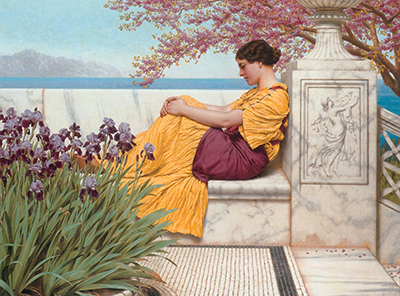
A flowering branch reaches almost to the head of the woman in John William Godward’s Under the Blossom that Hangs on the Bough. She sits sideways on a marble bench, with both hands resting on one raised knee. Beyond her, a level strip of blue water runs beneath a hazy headland. Godward painted the scene in oil on a canvas 61 cm high and 81.3 cm wide. The Art Renewal Center dates it to 1917 and lists it in a private collection. The title comes from a song near the end of Shakespeare’s The Tempest, when the spirit Ariel imagines where it will live once Prospero sets it free. [1] [2]
At a Glance
- Date1917
- MediumOil on canvas
- Dimensions61 × 81.3 cm
This work across John William Godward’s career
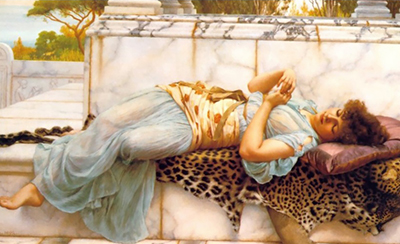
The Bouquet
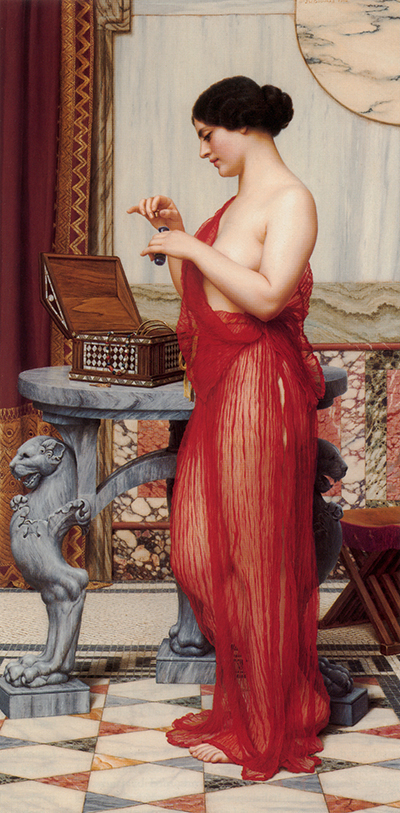
1899 [3]The New Perfume
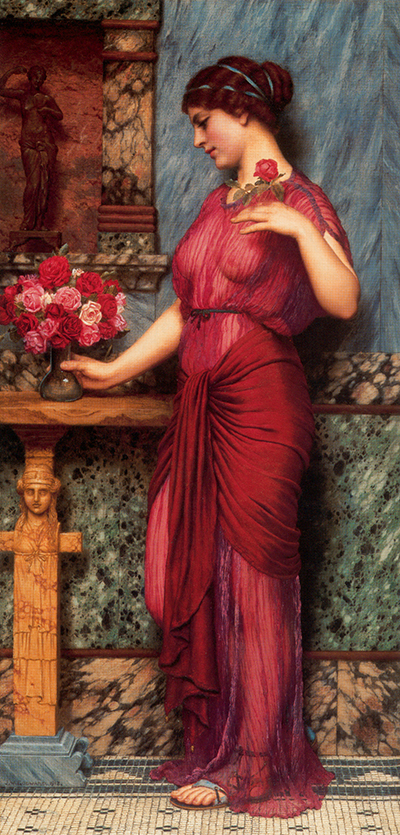
1914–15 inscriptions [5]An Amateur
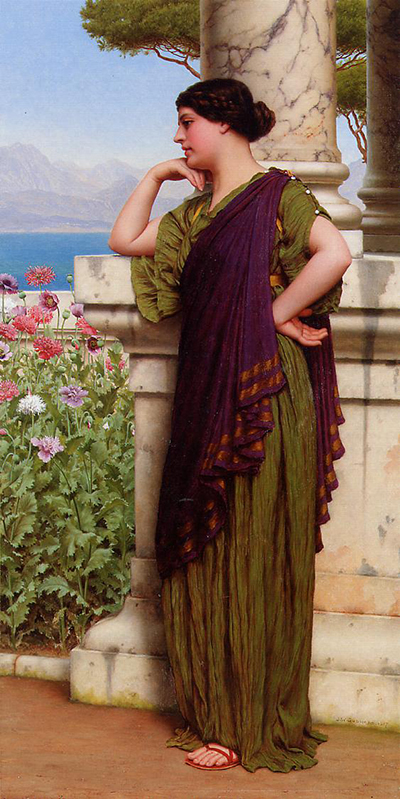
1915–16 inscriptions [6]A Souvenir
1920 [7]Contents
- A seat between the irises and the sea
- Where the title comes from
- Earlier paintings with the same title
- Two other gardens from 1917
- Annotated details
A seat between the irises and the sea
The woman occupies the right half of the canvas and turns to the left. The top of the bench and the long white parapet establish the horizontals of the terrace, while her leg carries the yellow cloth diagonally towards the flower bed. Her feet disappear behind the leaves. From her joined hands, the eye can follow the turn of the forearm to her shoulder and lowered face. Her profile stands out in a gap between the branch and the parapet, with her gaze directed towards the terrace. [1]
Godward sets two flowering plants at very different distances. At the lower left, the irises are close enough for their folded petals and stiff, blade-like leaves to interrupt the outline of the dress. The tree enters at the far right. Its thicker branches disappear behind the stonework and divide into finer ones as they reach across the sky. The blossom forms little clusters, with light coming through the spaces between them. A scatter of petals on the pavement at the foot of the marble pier shows just how far the bough extends over the terrace. [1]
The paving makes the foreground feel near enough to walk on. Dark strips and close-set rows of small pale blocks recede towards the seat. Beyond their edge, the larger slabs on the right have much fainter divisions. The bench itself is streaked with grey veins that wander across the stone. Godward gives the yellow dress finer lines, gathering some close together at the shoulder and letting others spread down the slope of the lifted leg. The plum-coloured cloth piled around the hip deepens where the body settles onto the seat. Along its lower edge, the shadow beneath the cloth is one of the clearest signs of the sitter’s weight. [1]
A shallow relief on the pier shows a figure in flowing drapery with arms raised. Thin lines reach from the figure’s face towards the hands. Bridgeman Images indexes the detail under aulos, the ancient wind instrument. Within the composition, the relief offers a possible second musical association after Ariel’s song. Its raised elbows, trailing cloth and lifted head also give the carved figure a sense of motion close to the still hands and downward glance of the woman beside it. The top of the vessel above the relief is cropped at the picture’s edge, leaving the panel as the most complete ornament on the pier. [1] [8]
Where the title comes from
Ariel sings in Act 5, scene 1. Prospero has called for his hat and rapier so that he can appear again as the Duke of Milan. Ariel helps him dress, singing of drinking where the bee drinks, lying inside a cowslip flower and flying on a bat’s back. The last line of the song reads “Under the blossom that hangs on the bow” in the Folger Shakespeare Library edition. The acting version published for Herbert Beerbohm Tree’s 1904 production spells the last word “bough”, as in the painting’s title. In Shakespeare’s scene, Prospero promises Ariel freedom again after the song and sends the spirit on another errand to the king’s ship. [2] [9]
The song could also be staged in a place of its own. Tree’s version introduces it earlier, in a woodland scene where the stage directions give Ariel a bower hung with honeysuckle and a chorus of unseen fairies. At the end of the production the song returns, with Ariel taking flight and the voice rising into the sound of a lark. On Godward’s terrace the overhanging branch suggests the shelter Ariel sings about. The title identifies the lyric, while the painting leaves the woman’s identity open. [1] [2] [9]
Henry Fuseli’s Ariel, painted around 1800–1810 and held by the Folger Shakespeare Library, gives the song a different shape. The pale spirit rises out of the dark with one arm curved overhead. A bat spreads its wings immediately below the extended leg, and two much smaller human figures appear near the bottom of the canvas. The steep vertical arrangement makes the raised figure seem to have left the ground far behind. Godward’s seated woman is anchored by the weight of her clothes and the firm line of the bench. The hint of a world beyond the terrace comes through the long view across the water. Fuseli makes the song’s flight visible. In Godward’s painting the bough itself draws the eye. [1] [2] [10]
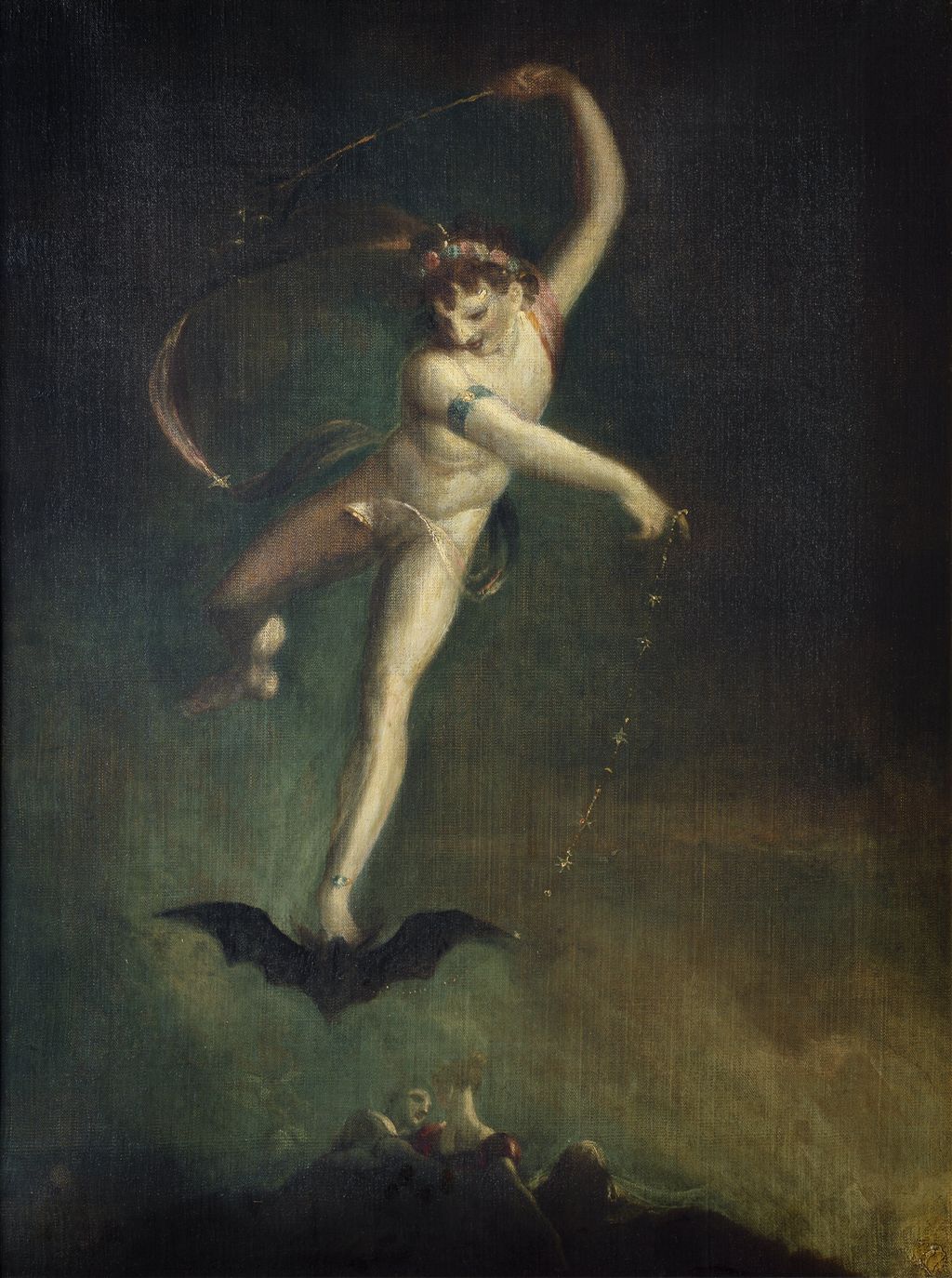
Henry Fuseli, Ariel (about 1800–10). Fuseli sets Ariel above a bat, taking up another image from the song that gives Godward’s painting its title. Image source. Public domain.
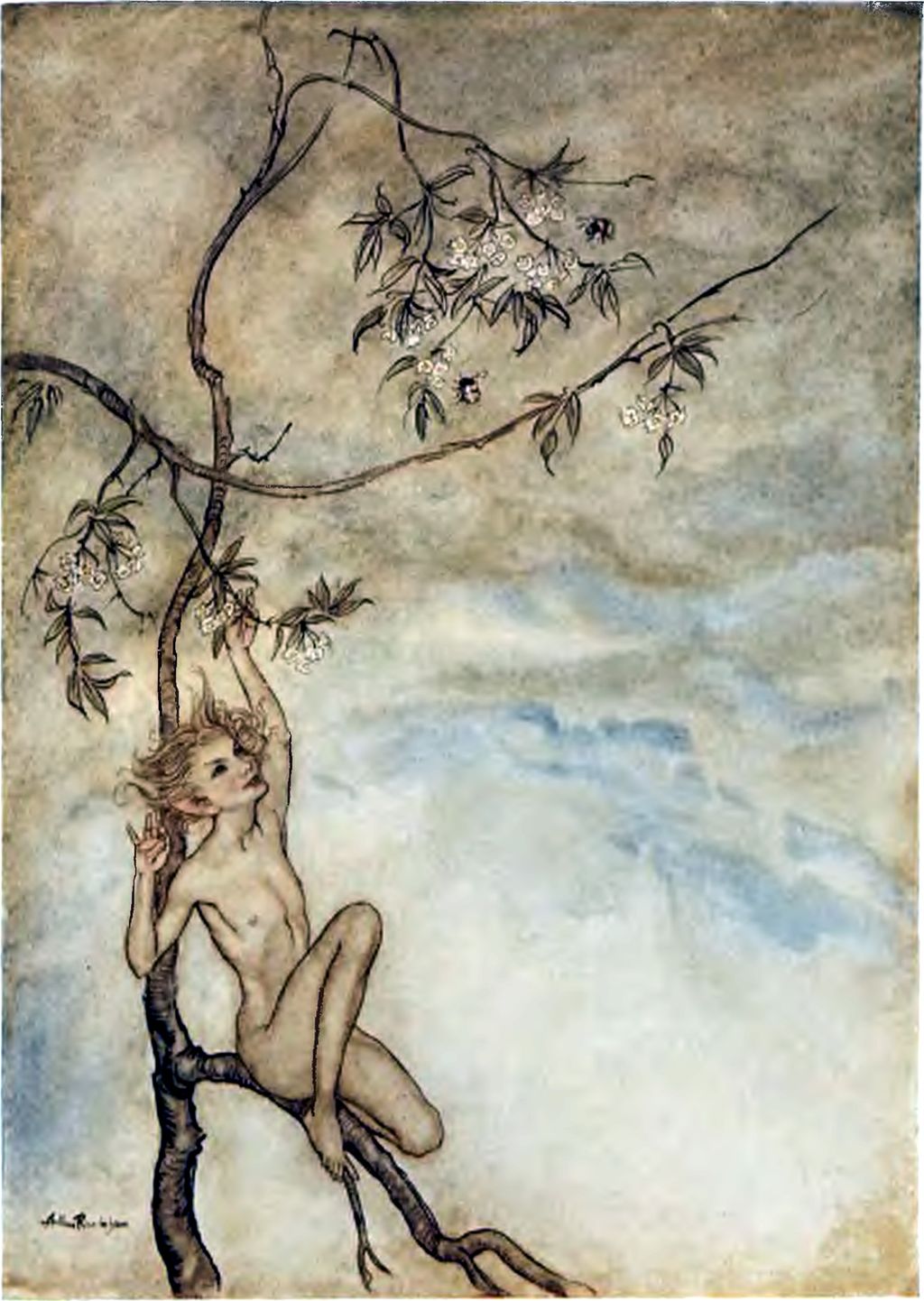
Arthur Rackham, plate 20 from The Tempest (1926). In Rackham’s 1926 edition, a later illustration to the same line puts Ariel in the branches. Arthur Rackham, The Tempest, 1926, plate 20. Image source. Public domain.
Annotated Details from Under the Blossom that Hangs on the Bough
The numbered points identify visible features discussed in this article. Return from each detail to the numbered overview. John William Godward, Under the Blossom that Hangs on the Bough (1917). Image source. Public domain.
.jpg)
Details from UNDER THE BLOSSOM THAT HANGS ON THE BOUGH
Compare the cropped details with the source images above. Notice how their colours, shapes and positions contribute to the larger compositions.
The branch above her head
The flowering branch breaks the blue sky and draws near the dark silhouette of the sitter’s head.
 Detail 01 the-branch-above-her-head.jpg)
The shallow relief
Raised arms and flowing drapery distinguish the carved figure from the woman’s still hands.
 Detail 02 the-shallow-relief.jpg)
The hands on the raised knee
The curve of the folded fingers answers the larger bend of the gold cloth below.
 Detail 03 the-hands-on-the-raised-knee.jpg)
John William Godward videos
See Godward’s paintings and studio practice alongside films on two Victorian contemporaries.
John William Godward - Part 1: The Last Painter of the Victorian Age
An overview of Godward’s career and the Victorian market for pictures set in antiquity.
Watch on YouTubeEarlier paintings with the same title
The line had already appeared as an exhibition title in Britain. The Royal Academy’s 1876 catalogue prints the line beneath no. 612, an entry by Alice Havers in Gallery VIII, with an explicit citation to Act 5, scene 1. The Academy’s later exhibitor index lists the line as the work’s title. Edwin Harris painted another oil under that title in 1884. Christie’s records its exhibition that autumn at the Royal Birmingham Society of Artists, as well as a contemporary notice in The Art Journal. The title was still in use in 1909, when the New English Art Club listed a work by Duncan Grant that took in the preceding line about living merrily as well. These records show that the phrase could stand on its own as a picture title across several generations. [11] [12] [13]
Harris’s surviving painting shows how differently the same words could be used. His figure stands in a meadow, wearing a broad hat and a high-necked white dress. One hand holds a slender trunk while she looks down at a sprig in the other. Harris places the blossom within reach and makes the gesture of examining it the centre of the scene. Godward leaves both hands on the knee. The branch passes behind the bowed head and connects the marble terrace with the landscape beyond it. The two paintings share a phrase and an absorbed figure, while giving the flowers different roles. A direct connection between the works remains unverified. [1] [12]
Two other gardens from 1917
Godward’s Tender Thoughts also places a woman near flowers, veined marble and distant blue water. Its format is a narrow upright, with a column beside the figure and a small opening towards the sea. The woman stands and supports her head with one hand, her face turned towards that opening. In Under the Blossom, the figure sits low within a much wider view. The shoreline and the clear strip of water can be followed well beyond her line of sight. Christie’s records “Rome. 1917” on the reverse of Tender Thoughts, a location and date attached to that individual canvas. [1] [14]
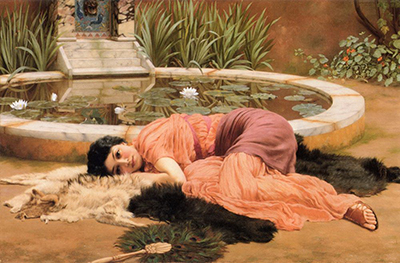
A Lily Pond is closer in format. The 1917 oil measures the same 61 × 81.3 cm, and Christie’s records a Rome inscription on its reverse. Its seated woman reaches towards a lily in a garden enclosed by decorated walls and columns. The carved and painted surfaces fill the distance that the blossom picture gives to sea and sky. The curving edge of the pool also turns the reaching arm into part of the picture’s geometry, where the straight bench and the joined hands in Under the Blossom give the figure a place to settle. The pool belongs to a set of motifs Godward had used earlier, including in the 1904 Dolce far niente. [1] [15]
The two Rome inscriptions help place Under the Blossom alongside Godward’s work of the period. The public record for the blossom painting itself gives the date and dimensions but supplies no corresponding transcription from the back of the canvas. Bridgeman’s image record also lists it in a private collection and credits the photograph to Roy Miles Fine Paintings. Its original owner, first exhibition and any commission remain unverified. [1] [8] [14] [15]
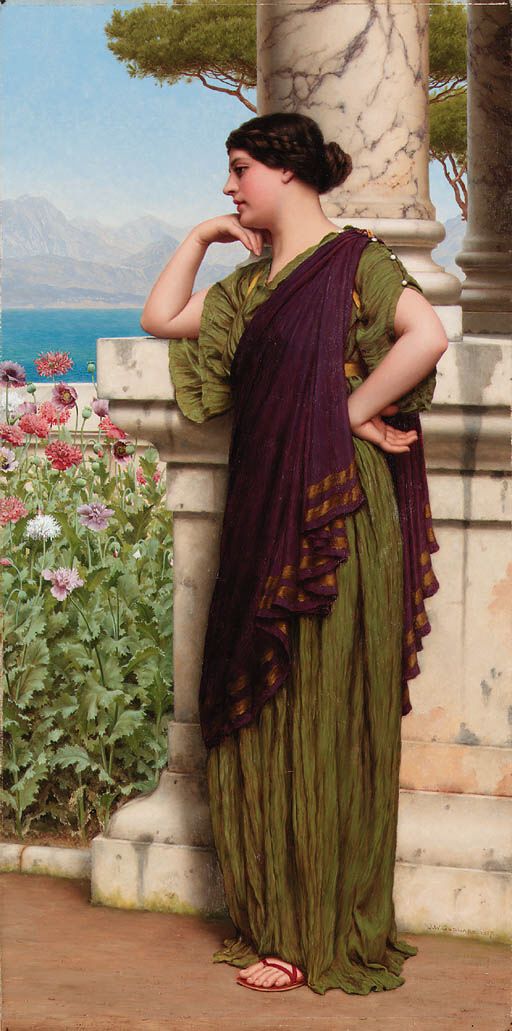
John William Godward, Tender Thoughts (1917), oil. Another 1917 canvas places a single figure among flowers, marble and a view past the foreground. Image source. Public domain.
John William Godward artworks directory
Search documented oil paintings, drawings, watercolours and reproductive prints. The directory includes the Art Renewal Center’s catalogue and additional works in museum, exhibition and sale records.
| Name | Date | Medium |
|---|---|---|
| Absence Makes the Heart Grow Fonder | 1912 | Oil on canvas |
| Amaryllis | 1903 | Oil on canvas |
| An Amateur | 1915 | Oil on canvas |
| Ancient Pastimes | 1916 | Oil on canvas |
| The Answer | 1917 | Oil on canvas |
| An Arcadian Beauty | 1899 | Painting |
| At the Fountain | 1893 | Oil on canvas |
| At the Garden Door | 1901 | Oil on canvas |
| At the Garden Shrine, Pompeii | 1892 | Oil on canvas |
| At the Gate of the Temple | 1898 | Oil on canvas |
| At the Thermae | 1909 | Oil on canvas |
| Atalanta | 1892 | Oil on canvas |
| Athenais | 1908 | Oil on canvas |
| An Auburn Beauty | 1895 | Oil on canvas |
| Autumn | 1900 | Oil on canvas |
| Beauty in a Marble Room | 1894 | Oil on canvas |
| The Belvedere | 1913 | Oil on canvas |
| The Betrothed | 1892 | Oil on canvas |
| The Betrothed (print after Godward) | 1893 | Photoengraving, as reported |
| The Bouquet | 1899 | Oil on canvas |
| Briseis | 1896 | Painting |
| The Broken Vase | 1889 | Oil on canvas |
| By the Blue Ionian Sea | 1916 | Oil on canvas |
| By the Wayside | 1912 | Oil on canvas |
| Byrsina | 1915 | Painting |
| Campaspe | 1896 | Oil on canvas |
| Campaspe (print after Godward) | Print, process unconfirmed | |
| Chloris (A Summer Rose) | 1902 | Oil on canvas |
| Classical Beauty | Oil on canvas | |
| A Classical Beauty | Oil on canvas | |
| A Classical Beauty | Painting | |
| A Classical Beauty | Oil on canvas | |
| A Classical Beauty | 1909 | Oil on canvas |
| A Classical Beauty In Profile | Oil on canvas | |
| A Classical Lady | 1908 | Oil on canvas |
| Clymene | 1892 | Oil on canvas |
| A Congenial Task | 1915 | Oil on canvas |
| Contemplation | 1922 | Oil on canvas |
| A Cool Retreat | 1910 | Oil on canvas |
| Country House in the 18th Century | c. 1883 | Oil on canvas |
| Cytheris | 1922 | Painting |
| The Day Dream | 1920 | Oil on canvas |
| The Delphic Oracle | 1899 | Oil on canvas |
| A Dilettante | 1922 | Oil on canvas |
| Distant Thoughts | 1918 | Oil on canvas |
| Dolce Far Niente | 1897 | Oil on canvas |
| Dolce Far Niente | 1906 | Oil on canvas |
| Dolce far niente (A Pompeian Fishpond) | 1904 | Oil on canvas |
| Dolce far niente (coloured print after Godward) | Exhibited 1900 | Coloured print, exact process unconfirmed |
| Dolce far niente (grapes) | 1907 | Oil on canvas |
| Dora | 1887 | Oil on canvas |
| Drusilla | 1906 | Oil on canvas |
| An Edition de Luxe | 1920 | Oil on canvas |
| Eighty and Eighteen | 1898 | Oil on canvas |
| Endymion | 1893 | Oil on canvas |
| The Engagement Ring (horizontal composition) | 1888 | Oil on canvas |
| The Engagement Ring (upright composition) | c. 1891 | Oil on canvas |
| Erato at Her Lyre | Oil on canvas | |
| A Fair Reflection | 1915 | Oil on canvas |
| A Fair Reflection (Taber-Prang print) | By 1923 | Sepia artotype |
| Far Away Thoughts (circular sewing scene) | 1911 | Oil on canvas |
| Far Away Thoughts (left-facing profile) | 1892 | Oil on canvas |
| Far Away Thoughts (right-facing profile) | 1892 | Oil on canvas |
| Female Figure (probable Grecian Idyll study) | 1907 | Oil on board |
| Flabellifera | 1905 | Oil on canvas |
| Flabellifera (painted study) | c. 1905 | Oil study |
| Flabellifera (pencil study) | c. 1905 | Pencil on paper |
| The Flower Girl | Painting | |
| A Flower Seller | 1896 | Oil on canvas |
| The Flowers of Venus | 1890 | Oil on canvas |
| A Fond Farewell | 1918 | Watercolour |
| The Fragrant Rose | 1892 | Painting |
| The Fruit Vendor | 1917 | Oil on canvas |
| A Garland Seller | 1914 | Painting |
| Giotto Drawing from Nature | Painting | |
| Girl in Yellow Drapery | 1901 | Oil on canvas |
| Golden Hours | 1913 | Oil on canvas |
| A Grecian Girl | 1908 | Oil on canvas |
| Grecian Idyll | 1907 | Oil on canvas |
| A Grecian Lovely | 1909 | Oil on canvas |
| Grecian Reverie | 1889 | Oil on canvas |
| Grecian Reverie | 1889 | Oil on canvas |
| A Greek Beauty | 1905 | Oil on canvas |
| A Happy Awakening | 1903 | Oil on canvas |
| He Loves Me, He Loves Me Not | 1896 | Oil on canvas |
| A head and shoulders profile portrait of a young woman wearing a white tunic style blouse | c. 1889 | Painting |
| Head of a Girl (The Priestess) | 1896 | Oil on canvas |
| Heart on her Lips and Soul within her Eyes | 1904 | Painting |
| His Birthday Gift | 1889 | Oil on canvas |
| Ianthe | 1889 | Oil on canvas |
| An Idle Hour | 1890 | Oil on canvas |
| Idle Moments | 1895 | Oil on canvas |
| Idle Thoughts | 1898 | Oil on canvas |
| Idleness | 1900 | Oil on canvas |
| Il Dolce Far Niente (Pears print after Amaryllis) | 1906 | Chromolithograph |
| Il Dolce far niente (seated figure) | 1893 | Oil on canvas |
| In Expectation | c. 1892 | Oil on canvas |
| In Realms of Fancy | 1911 | Oil on canvas |
| In the Prime of the Summertime (Reverie) | 1914 | Oil on canvas |
| In the Tepidarium | 1913 | Oil on canvas |
| Innocent Amusements | 1891 | Oil on canvas |
| Ione | c. 1896-1898 | Oil on canvas |
| Ionian Dancing Girl | 1902 | Oil on canvas |
| Ismenia | 1908 | Oil on canvas |
| An Italian Beauty | 1897 | Oil on canvas |
| An Italian Girls' Head | 1902 | Oil on canvas |
| The Jewel Casket | 1900 | Oil on canvas |
| Julia | 1914 | Painting |
| Knuckle Bones | 1890 | Oil on canvas |
| La Pensierosa | 1913 | Oil on canvas |
| A Lady | 1895 | Oil on canvas |
| Landscape: Blossoming Red Almond [study] | c. 1912 | Oil on panel |
| Le Billet Doux (The Love Letter) | 1913 | Oil on canvas |
| Leaning Against a Column | 1901 | Painting |
| Leaning on the Balcony | 1892 | Oil on canvas |
| Leisure Hours | 1905 | Oil on canvas |
| Lesbia with her Sparrow | 1916 | Oil on canvas |
| The Letter | 1899 | Painting |
| Liegende | 1893 | Oil on canvas |
| A Lily Pond | 1917 | Oil on canvas |
| Looking Out to Sea | 1918 | Pencil and watercolour |
| The Love Letter (circular composition) | 1907 | Oil on canvas |
| Lucilia | 1917 | Oil on canvas |
| Lycinna | 1918 | Oil on canvas |
| Marcella | 1912 | Painting |
| Matrona Superba | Oil on canvas | |
| Megilla | 1921 | Oil on canvas |
| A Melody | 1904 | Oil on canvas |
| Memories | c. 1891 | Oil on canvas |
| Mirinna | Painting | |
| The Mirror | 1899 | Oil on canvas |
| Mischief | 1905 | Oil on canvas |
| Mischief and Repose | 1895 | Oil on canvas |
| A Mouse in the Work Basket | 1893 | Oil on canvas |
| Nerissa | 1906 | Oil on canvas |
| The New Perfume | 1914 | Oil on canvas |
| Noon Day Rest | 1910 | Oil on canvas |
| Nu Sur La Plage | 1922 | Oil on panel |
| Nude Study | Oil on canvas | |
| An Offering to Venus | 1912 | Oil on canvas |
| The Old, Old Story | Oil on canvas | |
| The Old, Old Story | 1903 | Oil on canvas |
| On the Balcony | 1911 | Oil on canvas |
| On The Terrace | 1918 | Oil on canvas |
| Ophelia | Oil on panel | |
| The Peacock Fan | 1912 | Oil on canvas |
| Phyleis | 1908 | Oil on canvas |
| The Playground | 1892 | Oil on canvas |
| Playtime | 1891 | Oil on canvas |
| A Pompeian Bath | 1890 | Oil on canvas |
| A Pompeian Lady | 1891 | Oil on canvas |
| A Pompeian Lady | 1895 | Oil on board |
| A Pompeian Lady | 1901 | Painting |
| A Pompeian Lady | 1904 | Painting |
| Portrait of Mary Frederica 'Nin' Godward | c. 1882-1883 | Oil on canvas |
| Portrait of Mary Perkinton Godward | c. 1880-1881 | Watercolor |
| The Posy | 1900 | Painting |
| A Priestess (bare-shouldered figure) | 1893 | Oil on canvas |
| A Priestess (clothed composition) | 1894 | Oil on canvas |
| A Priestess (W. Biscombe Gardner after Godward) | Exhibited 1897 | Print, process unconfirmed |
| A Priestess of Bacchus | 1890-1890 | Oil on canvas |
| Pyrallis | 1918 | Oil on canvas |
| The Quiet Pet | 1906 | Oil on canvas |
| A Red, Red Rose | 1920 | Oil on canvas |
| Reflections | 1893 | Oil on canvas |
| The Rendezvous | 1903 | Oil on canvas |
| Repose, the Flower Girl | c. 1887 | Oil on canvas |
| Reverie | 1888 | Oil on panel |
| Reverie | 1912 | Oil on canvas |
| Reverie (In the Days of Sappho) | 1904 | Oil on canvas |
| Reverie (Pears print after In the Prime of the Summertime) | 1916 | Chromolithograph |
| 'Rich Gifts Wax Poor When Lovers Prove Unkind' | 1916 | Oil on canvas |
| The Ring | 1898 | Oil on canvas |
| A Roman Matron | 1905 | Oil on canvas |
| Sabinella | 1912 | Oil on canvas |
| Sappho | 1910 | Oil on canvas |
| The Siesta | Oil on canvas | |
| A Siesta | 1895 | Oil on canvas |
| The Signal | 1899 | Oil on canvas |
| Sitting for Her Portrait | 1893 | Oil on canvas |
| Sketch for Amaryllis | 1903 | Oil on board |
| A Souvenir | 1920 | Oil on canvas |
| Stesicrate | 1914 | Oil on canvas |
| Study for 'Rêverie' | 1890 | Oil on canvas |
| Study for 'The Priestess' | 1895 | Oil on board |
| Study for An Egyptian Minstrel | 1906 | Painting |
| Study for The New Perfume | Drawing, medium unconfirmed | |
| Study for ‘The Old, Old Story’ | 1903 | Oil paint on wood |
| Study of a Girl's Head | 1899 | Painting |
| Study of Campaspe | Oil on canvas | |
| Study of Head and Drapery, Miss Ethel Warwick | 1898 | Painting |
| Summer Day | 1897 | Painting |
| Summer Flowers | 1903 | Oil on canvas |
| Sweet Dreams | 1901 | Oil on canvas |
| Sweet Dreams | 1904 | Painting |
| The Sweet Siesta of a Summer's Day | 1891 | Oil on canvas |
| The Tambourine Girl (profile at the marble wall) | 1906 | Oil on canvas |
| The Tambourine Girl (relief-backed version) | 1906 | Oil on canvas |
| Tender Thoughts | 1917 | Oil on canvas |
| Tender Thoughts (woman leaning over a parapet) | 1918 | Pencil and watercolour |
| The Tiff (oil) | By 1888 | Oil on canvas |
| The Tiff (print after Godward) | 1894 | Photogravure |
| The Tigerskin | 1889 | Oil on canvas |
| The Time of Roses | 1916 | Oil on canvas |
| Tranquillity | 1914 | Oil on canvas |
| A Tryst | 1912 | Oil on canvas |
| Tympanistria | 1909 | Oil on canvas |
| Under the Blossom that Hangs on the Bough | 1917 | Oil on canvas |
| Venus at the Bath | 1901 | Oil on canvas |
| Venus Binding Her Hair | 1897 | Oil on canvas |
| Violets, Sweet Violets | 1906 | Painting |
| Waiting for an Answer | 1889 | Oil on canvas |
| Waiting for the Procession | 1890 | Oil on canvas |
| Waiting for the Procession | 1890 | Painting |
| The Water Carrier (magazine reproduction of At the Fountain) | 1898 | Magazine reproduction |
| When the Heart is Young | 1902 | Oil on canvas |
| Who Can They Be | Painting | |
| Winding Wool | 1894 | Painting |
| 'With Violets Wreathed and Robe of Saffron Hue' | 1902 | Oil on canvas |
| The Yellow Shawl | 1893 | Painting |
| 'Yes or No?' | 1893 | Oil on canvas |
| Young Girl Picking Grapes | 1902 | Oil on canvas |
| Youth and Time | 1901 | Oil on canvas |
Discussion
Look again at the images and ideas explored in Under the Blossom that Hangs on the Bough. These editorial prompts invite your observations.
Reader Insights
What becomes more noticeable after you learn the title comes from Ariel’s song?
Where does the blossom sit relative to the figure’s strongest lines?
Join the Conversation
Share a detail, comparison or question about Under the Blossom that Hangs on the Bough below.
References
- Art Renewal Center. John William Godward, Under the Blossom that Hangs on the Bough, artwork 11631. Object record and plate. English. View source.
- William Shakespeare. The Tempest, Act 5, scene 1, Folger Shakespeare Library. English. View source.
- The Bouquet. View source.
- An Offering to Venus. View source.
- The New Perfume. View source.
- An Amateur. View source.
- A Souvenir. View source.
- Bridgeman Images. John William Godward, Under the Blossom that Hangs on the Bough, BAL131932. Object metadata, subject indexing and photograph credit. English. View source.
- Herbert Beerbohm Tree. 1904 acting version of The Tempest, Acts 2 and 3, transcribed from the souvenir programme by David Lindley, University of Leeds. English. View source.
- Folger Shakespeare Library. Henry Fuseli, Ariel, FPa22. Object record, with date in the Pressly catalogue index. English. View source 1. View source 2.
- Royal Academy of Arts. Exhibition of the Royal Academy, 1876, p. 28, Gallery VIII, no. 612. Alice Havers and the Shakespeare quotation. See also Algernon Graves’s exhibitor index, vol. IV, p. 30. English. View source 1. View source 2.
- Christie’s. Edwin Harris, Under the blossom that hangs on the bough. Plate, signature, date, exhibition and period review reference. English. View source.
- New English Art Club. Forty-Second Exhibition of Modern Pictures, winter 1909, no. 222. Catalogue entry transcribed by the University of Vienna’s Database of Modern Exhibitions. English. View source.
- Christie’s. John William Godward, Tender Thoughts, London, 9 December 1998, lot 234. Plate, dimensions and inscriptions. English. View source.
- Christie’s. Victorian, Pre-Raphaelite & British Impressionist Art, London, 16 December 2015, lot 121, p. 36. John William Godward, A Lily Pond, plate, dimensions, inscriptions and related garden paintings. English. View source.