 by Tom Gurney
Tom Gurney BSc (Hons) is an art history expert with over 20 years experience
Published on June 19, 2020 / Updated on October 14, 2023
Email: tomgurney1@gmail.com / Phone: +44 7429 011000
The Peacock Fan by John William Godward: Introduction
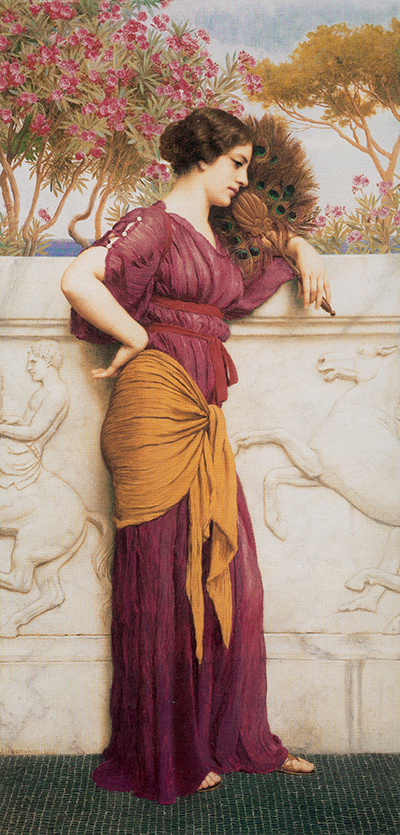
A dark green eyespot peeks out beside the woman’s brow. A few more follow the line of her cheek, and only at her dangling fingers do we see the end of the fan’s handle. She stands in profile against a carved wall, with one arm resting on the coping and the other bent sharply at her waist. John William Godward’s The Peacock Fan is an oil on canvas from 1912, measuring 80 × 38.4 centimetres. A faint signature and date sit low on the stone at the left, just above the tiled floor. The Art Renewal Center’s record gives the dimensions and describes the painting as privately held, without naming a collection. [1] [2]
At a Glance
- Date1912
- MediumOil on canvas
- Dimensions80 × 38.4 cm
This work across John William Godward’s career
Contents
- The woman and the fan
- What the wall lets us see
- Four other places Godward put a fan
- A fan made of feathers
- Annotated details
The woman and the fan
Begin with the hand hanging over the wall. The wrist bends down over the marble and the dark handle emerges diagonally below her fingertips. Follow it back and the fan broadens past her shoulder to the side of her face. Its loose outer feathers continue upwards against the sky. At the narrow end of this spread, close to her chin, the brown mount has distinct raised lobes. The handle, exposed mount and loose feather tips give the object three different edges within a space scarcely wider than the woman’s head. [2]
The fan sits close enough to the face for its feathers to form a background to her profile. The little dark centres of the eyespots sharpen the outline of her forehead and nose, while the feathers blur into her dark hair near the temple. At her shoulder, individual strands are easier to pick out against the wine-coloured sleeve. Both the object and the face are turned at an angle. We get a clear view of the woman’s lowered eye, but only parts of the feather arrangement can be traced around her. The hand hangs at rest. Godward makes that moment of stillness legible even though the whole fan seems poised to turn with a small movement of her wrist. [2]
At a distance, the yellow cloth wrapped around the hips is the brightest area of colour on the woman. Its folds spread away from a knot on the right and fall again in two long, uneven ends. Those folds repeat something of the fan’s radiating pattern on a larger scale. The narrow red belt above them encloses the finer gatherings of the bodice. Look higher and small pale fastenings run along a slit at the shoulder. Lower down, the dress falls almost to the floor, where part of a sandal appears on either side of the hem. The shoulder fastenings and sandals help give the figure a classical setting, while the folds show how the costume follows the way she is standing. [2]
What the wall lets us see
The narrow canvas places most of the garden above the wall. Pink flowers crowd the left corner overhead and recur as smaller sprays on the right. Farther back, lightly coloured branches carry a canopy into the open sky. A strip of blue is visible through the trunks on the left. There is no matching gap below the coping. Across much of the lower picture the woman’s silhouette is set straight against the pale stone, with the elbow at her waist and the hanging wrist interrupting its strongest horizontal line. [2]
The biggest interruption is at the centre of the carved panel, where the dress hides the meeting of its figures. On the left, a carved head and torso emerge among the animal forms. On the right, an equine head and curving body enter from the edge, with lifted legs reaching towards the folds of the dress. The relief has the palest shadows in the picture. Its limbs take longer to see than the woman’s arm or the drapery, and the painting gives us only fragments of the carved scene. The deep green grid at the foot of the wall brings another change of scale. Its tiny divisions make the trailing hem look particularly soft where it spreads across them. [2]
Another painting of 1912, A Tryst, brings a woman and a marble wall close together but opens a bed of flowers in front of her. The plants rise across her knees, and the curve of her lifted arm shades a face turned towards us. A carved band runs behind her head. In The Peacock Fan the flowers are beyond the wall and the raised forearm can settle on the stone. The woman’s downward look leads into the narrow space beside her, around the object she holds. Both pictures bring the viewer close, with quite different effects on the sense of being seen. [2] [8]
Annotated Details from The Peacock Fan
The numbered points identify visible features discussed in this article. Return from each detail to the numbered overview. John William Godward, The Peacock Fan (1912). Image source. Public domain.
.jpg)
Details from THE PEACOCK FAN
Compare the cropped details with the source images above. Notice how their colours, shapes and positions contribute to the larger compositions.
Eyespots beside the face
The dark spots appear close to the brow and cheek, bringing the feathers into the outline of the profile.
 Detail 01 eyespots-beside-the-face.jpg)
The fingers and the handle
The hand dangles against the coping, where the end of the handle is easy to overlook.
 Detail 02 the-fingers-and-the-handle.jpg)
Relief behind the clothing
The shallow carving depends on small changes of light where the fabric has bolder folds and colour.
 Detail 03 relief-behind-the-clothing.jpg)
John William Godward videos
See Godward’s paintings and studio practice alongside films on two Victorian contemporaries.
John William Godward - Part 1: The Last Painter of the Victorian Age
An overview of Godward’s career and the Victorian market for pictures set in antiquity.
Watch on YouTubeFour other places Godward put a fan
The small Clymene catalogued by Sotheby’s carries an inscription to Godward’s friend E. P. Scoones and the date 1892. Sotheby’s connects it to Godward’s larger submission of Clymené to the Royal Academy in 1891 and describes the smaller work as a study. In that canvas a woman leans against a high marble parapet and raises a peacock fan beside her head. She looks outward, so the fan sits alongside a face that meets the viewer. Two decades later the woman in The Peacock Fan turns into profile. By bringing her close to the feathers, Godward lets the fan determine how clearly we see the edge of her face. [2] [9]
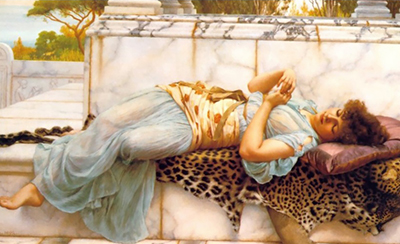
In When the Heart is Young, signed and dated 1902, the fan lies on the mosaic floor. A reclining woman keeps one hand by her hair while the feathers spread at the opposite end of the long picture. The separation is easy to feel in a wide composition, where the eye must travel from hand to fan across the bench and down to the patterned pavement. In the tall canvas of 1912 a glance takes in the hand and the feathers beside her face. [2] [10]
The Royal Academy listed Flabellifera in Gallery IV of its 1905 exhibition as no. 252. In the oil, a woman in pink sits with her legs gathered on a seat and the fan lifted beside her head. The long shaft projects well past the raised hand. A pencil study catalogued around 1905 is also associated with the composition. The finished oil drew the attention of H. Goodchild, who visited the Academy and wrote about its bird pictures for Bird Notes. Alongside paintings of ptarmigan and crowned cranes, he singled out Godward’s figure picture for the accuracy of its peacock feathers. His review attaches that response to the specific canvas on the Academy wall. It gives us a contemporary reason to look closely at the feathers when they reappear seven years later. [11] [12] [13] [14]
In the signed 1914 In the Prime of the Summertime, a woman reclines on a curving marble seat above the sea and holds a peacock fan behind her head. The red-purple and gold of the clothing recall the 1912 painting, while the terrace, mountains and open water give the fan a very different setting. Christie’s records the canvas with the Thomas McLean Gallery in 1915 and lists the 1916 Pears chromolithograph as no. 13. The later picture is also known as Reverie, the title Christie’s associates with its circulation in print. Christie’s notes Godward’s habit of reusing favourite props. Across these compositions, the feather fans vary in how much of the handle they show and in the angle at which we see the feathers. The recurrence of the motif leaves the identity of the physical prop open. [2] [15]
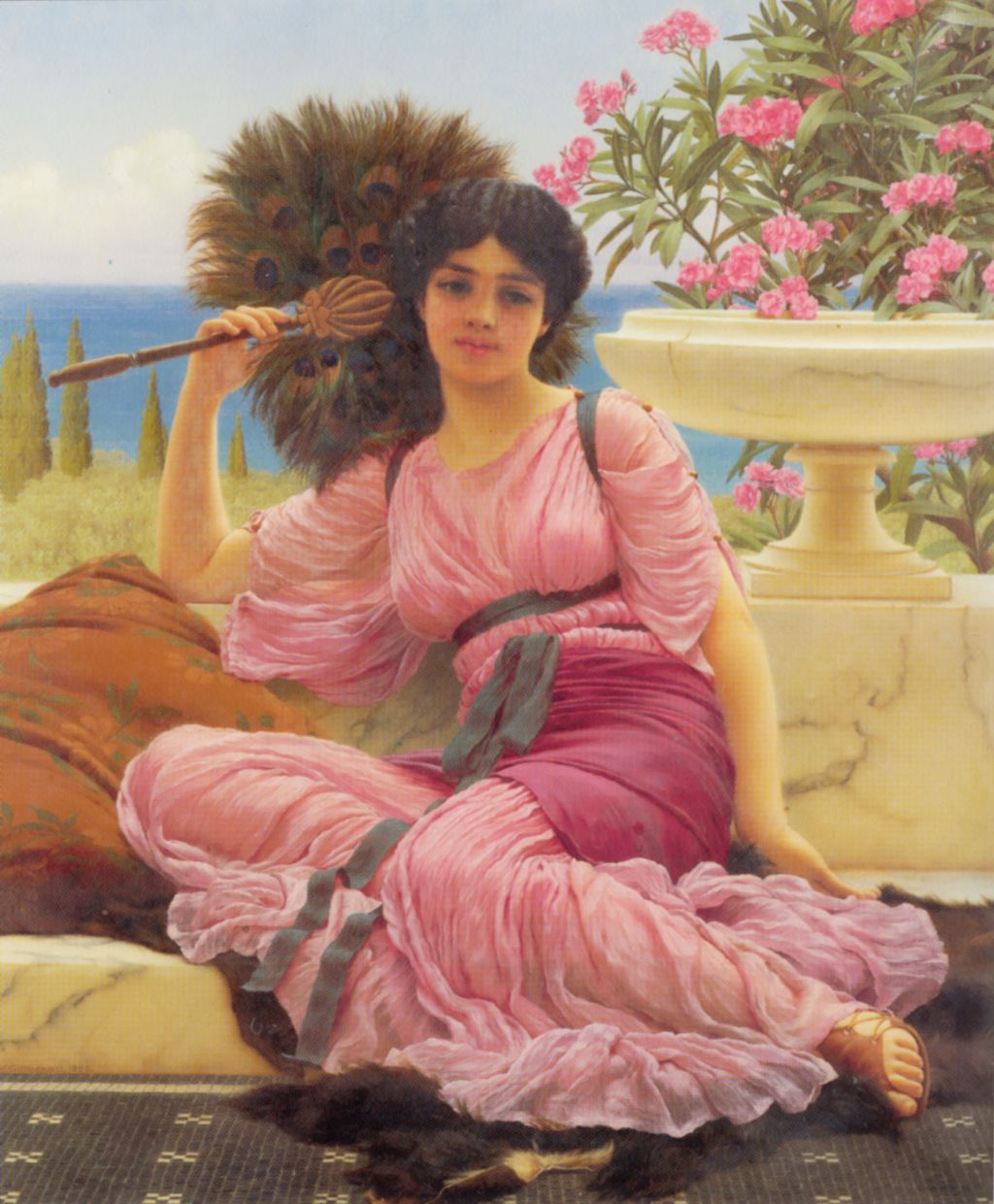
John William Godward, Flabellifera (1905), finished oil. The raised shaft projects well beyond her fingers and the large feathers interrupt the sky. Image source. Public domain.
A fan made of feathers
A folding fan in the Spencer Museum of Art helps put the materials in perspective. The museum dates it to the late Qing dynasty and describes this kind of fan as a Chinese product made for Western export. It combines white goose feathers and peacock feathers with gouache and pierced ivory. The pale feathers create a surface for a painted design, while the peacock feathers bring a pattern of their own. In Godward’s picture the eyespots are visible within a field of brown strands, beside a handle the woman can hold against the stone. The Spencer example shows how makers could vary the arrangement of the same feathers and how much the mount and handle contribute to the shape of the finished object. It offers a comparison with a real implement available in Godward’s era. The maker and origin of the particular fan in his painting remain unknown. [2] [16]
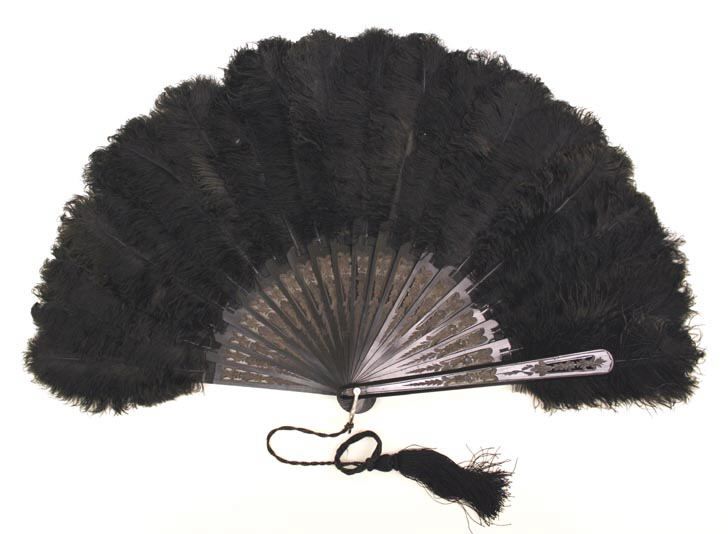
Feather-and-wood fan, The Met. The feather-and-wood fan makes its mount and handle visible. Its feathers are catalogued without a species. The Metropolitan Museum of Art. Image source. CC0 / Public domain.
John William Godward artworks directory
Search documented oil paintings, drawings, watercolours and reproductive prints. The directory includes the Art Renewal Center’s catalogue and additional works in museum, exhibition and sale records.
| Name | Date | Medium |
|---|---|---|
| Absence Makes the Heart Grow Fonder | 1912 | Oil on canvas |
| Amaryllis | 1903 | Oil on canvas |
| An Amateur | 1915 | Oil on canvas |
| Ancient Pastimes | 1916 | Oil on canvas |
| The Answer | 1917 | Oil on canvas |
| An Arcadian Beauty | 1899 | Painting |
| At the Fountain | 1893 | Oil on canvas |
| At the Garden Door | 1901 | Oil on canvas |
| At the Garden Shrine, Pompeii | 1892 | Oil on canvas |
| At the Gate of the Temple | 1898 | Oil on canvas |
| At the Thermae | 1909 | Oil on canvas |
| Atalanta | 1892 | Oil on canvas |
| Athenais | 1908 | Oil on canvas |
| An Auburn Beauty | 1895 | Oil on canvas |
| Autumn | 1900 | Oil on canvas |
| Beauty in a Marble Room | 1894 | Oil on canvas |
| The Belvedere | 1913 | Oil on canvas |
| The Betrothed | 1892 | Oil on canvas |
| The Betrothed (print after Godward) | 1893 | Photoengraving, as reported |
| The Bouquet | 1899 | Oil on canvas |
| Briseis | 1896 | Painting |
| The Broken Vase | 1889 | Oil on canvas |
| By the Blue Ionian Sea | 1916 | Oil on canvas |
| By the Wayside | 1912 | Oil on canvas |
| Byrsina | 1915 | Painting |
| Campaspe | 1896 | Oil on canvas |
| Campaspe (print after Godward) | Print, process unconfirmed | |
| Chloris (A Summer Rose) | 1902 | Oil on canvas |
| Classical Beauty | Oil on canvas | |
| A Classical Beauty | Oil on canvas | |
| A Classical Beauty | Painting | |
| A Classical Beauty | Oil on canvas | |
| A Classical Beauty | 1909 | Oil on canvas |
| A Classical Beauty In Profile | Oil on canvas | |
| A Classical Lady | 1908 | Oil on canvas |
| Clymene | 1892 | Oil on canvas |
| A Congenial Task | 1915 | Oil on canvas |
| Contemplation | 1922 | Oil on canvas |
| A Cool Retreat | 1910 | Oil on canvas |
| Country House in the 18th Century | c. 1883 | Oil on canvas |
| Cytheris | 1922 | Painting |
| The Day Dream | 1920 | Oil on canvas |
| The Delphic Oracle | 1899 | Oil on canvas |
| A Dilettante | 1922 | Oil on canvas |
| Distant Thoughts | 1918 | Oil on canvas |
| Dolce Far Niente | 1897 | Oil on canvas |
| Dolce Far Niente | 1906 | Oil on canvas |
| Dolce far niente (A Pompeian Fishpond) | 1904 | Oil on canvas |
| Dolce far niente (coloured print after Godward) | Exhibited 1900 | Coloured print, exact process unconfirmed |
| Dolce far niente (grapes) | 1907 | Oil on canvas |
| Dora | 1887 | Oil on canvas |
| Drusilla | 1906 | Oil on canvas |
| An Edition de Luxe | 1920 | Oil on canvas |
| Eighty and Eighteen | 1898 | Oil on canvas |
| Endymion | 1893 | Oil on canvas |
| The Engagement Ring (horizontal composition) | 1888 | Oil on canvas |
| The Engagement Ring (upright composition) | c. 1891 | Oil on canvas |
| Erato at Her Lyre | Oil on canvas | |
| A Fair Reflection | 1915 | Oil on canvas |
| A Fair Reflection (Taber-Prang print) | By 1923 | Sepia artotype |
| Far Away Thoughts (circular sewing scene) | 1911 | Oil on canvas |
| Far Away Thoughts (left-facing profile) | 1892 | Oil on canvas |
| Far Away Thoughts (right-facing profile) | 1892 | Oil on canvas |
| Female Figure (probable Grecian Idyll study) | 1907 | Oil on board |
| Flabellifera | 1905 | Oil on canvas |
| Flabellifera (painted study) | c. 1905 | Oil study |
| Flabellifera (pencil study) | c. 1905 | Pencil on paper |
| The Flower Girl | Painting | |
| A Flower Seller | 1896 | Oil on canvas |
| The Flowers of Venus | 1890 | Oil on canvas |
| A Fond Farewell | 1918 | Watercolour |
| The Fragrant Rose | 1892 | Painting |
| The Fruit Vendor | 1917 | Oil on canvas |
| A Garland Seller | 1914 | Painting |
| Giotto Drawing from Nature | Painting | |
| Girl in Yellow Drapery | 1901 | Oil on canvas |
| Golden Hours | 1913 | Oil on canvas |
| A Grecian Girl | 1908 | Oil on canvas |
| Grecian Idyll | 1907 | Oil on canvas |
| A Grecian Lovely | 1909 | Oil on canvas |
| Grecian Reverie | 1889 | Oil on canvas |
| Grecian Reverie | 1889 | Oil on canvas |
| A Greek Beauty | 1905 | Oil on canvas |
| A Happy Awakening | 1903 | Oil on canvas |
| He Loves Me, He Loves Me Not | 1896 | Oil on canvas |
| A head and shoulders profile portrait of a young woman wearing a white tunic style blouse | c. 1889 | Painting |
| Head of a Girl (The Priestess) | 1896 | Oil on canvas |
| Heart on her Lips and Soul within her Eyes | 1904 | Painting |
| His Birthday Gift | 1889 | Oil on canvas |
| Ianthe | 1889 | Oil on canvas |
| An Idle Hour | 1890 | Oil on canvas |
| Idle Moments | 1895 | Oil on canvas |
| Idle Thoughts | 1898 | Oil on canvas |
| Idleness | 1900 | Oil on canvas |
| Il Dolce Far Niente (Pears print after Amaryllis) | 1906 | Chromolithograph |
| Il Dolce far niente (seated figure) | 1893 | Oil on canvas |
| In Expectation | c. 1892 | Oil on canvas |
| In Realms of Fancy | 1911 | Oil on canvas |
| In the Prime of the Summertime (Reverie) | 1914 | Oil on canvas |
| In the Tepidarium | 1913 | Oil on canvas |
| Innocent Amusements | 1891 | Oil on canvas |
| Ione | c. 1896-1898 | Oil on canvas |
| Ionian Dancing Girl | 1902 | Oil on canvas |
| Ismenia | 1908 | Oil on canvas |
| An Italian Beauty | 1897 | Oil on canvas |
| An Italian Girls' Head | 1902 | Oil on canvas |
| The Jewel Casket | 1900 | Oil on canvas |
| Julia | 1914 | Painting |
| Knuckle Bones | 1890 | Oil on canvas |
| La Pensierosa | 1913 | Oil on canvas |
| A Lady | 1895 | Oil on canvas |
| Landscape: Blossoming Red Almond [study] | c. 1912 | Oil on panel |
| Le Billet Doux (The Love Letter) | 1913 | Oil on canvas |
| Leaning Against a Column | 1901 | Painting |
| Leaning on the Balcony | 1892 | Oil on canvas |
| Leisure Hours | 1905 | Oil on canvas |
| Lesbia with her Sparrow | 1916 | Oil on canvas |
| The Letter | 1899 | Painting |
| Liegende | 1893 | Oil on canvas |
| A Lily Pond | 1917 | Oil on canvas |
| Looking Out to Sea | 1918 | Pencil and watercolour |
| The Love Letter (circular composition) | 1907 | Oil on canvas |
| Lucilia | 1917 | Oil on canvas |
| Lycinna | 1918 | Oil on canvas |
| Marcella | 1912 | Painting |
| Matrona Superba | Oil on canvas | |
| Megilla | 1921 | Oil on canvas |
| A Melody | 1904 | Oil on canvas |
| Memories | c. 1891 | Oil on canvas |
| Mirinna | Painting | |
| The Mirror | 1899 | Oil on canvas |
| Mischief | 1905 | Oil on canvas |
| Mischief and Repose | 1895 | Oil on canvas |
| A Mouse in the Work Basket | 1893 | Oil on canvas |
| Nerissa | 1906 | Oil on canvas |
| The New Perfume | 1914 | Oil on canvas |
| Noon Day Rest | 1910 | Oil on canvas |
| Nu Sur La Plage | 1922 | Oil on panel |
| Nude Study | Oil on canvas | |
| An Offering to Venus | 1912 | Oil on canvas |
| The Old, Old Story | Oil on canvas | |
| The Old, Old Story | 1903 | Oil on canvas |
| On the Balcony | 1911 | Oil on canvas |
| On The Terrace | 1918 | Oil on canvas |
| Ophelia | Oil on panel | |
| The Peacock Fan | 1912 | Oil on canvas |
| Phyleis | 1908 | Oil on canvas |
| The Playground | 1892 | Oil on canvas |
| Playtime | 1891 | Oil on canvas |
| A Pompeian Bath | 1890 | Oil on canvas |
| A Pompeian Lady | 1891 | Oil on canvas |
| A Pompeian Lady | 1895 | Oil on board |
| A Pompeian Lady | 1901 | Painting |
| A Pompeian Lady | 1904 | Painting |
| Portrait of Mary Frederica 'Nin' Godward | c. 1882-1883 | Oil on canvas |
| Portrait of Mary Perkinton Godward | c. 1880-1881 | Watercolor |
| The Posy | 1900 | Painting |
| A Priestess (bare-shouldered figure) | 1893 | Oil on canvas |
| A Priestess (clothed composition) | 1894 | Oil on canvas |
| A Priestess (W. Biscombe Gardner after Godward) | Exhibited 1897 | Print, process unconfirmed |
| A Priestess of Bacchus | 1890-1890 | Oil on canvas |
| Pyrallis | 1918 | Oil on canvas |
| The Quiet Pet | 1906 | Oil on canvas |
| A Red, Red Rose | 1920 | Oil on canvas |
| Reflections | 1893 | Oil on canvas |
| The Rendezvous | 1903 | Oil on canvas |
| Repose, the Flower Girl | c. 1887 | Oil on canvas |
| Reverie | 1888 | Oil on panel |
| Reverie | 1912 | Oil on canvas |
| Reverie (In the Days of Sappho) | 1904 | Oil on canvas |
| Reverie (Pears print after In the Prime of the Summertime) | 1916 | Chromolithograph |
| 'Rich Gifts Wax Poor When Lovers Prove Unkind' | 1916 | Oil on canvas |
| The Ring | 1898 | Oil on canvas |
| A Roman Matron | 1905 | Oil on canvas |
| Sabinella | 1912 | Oil on canvas |
| Sappho | 1910 | Oil on canvas |
| The Siesta | Oil on canvas | |
| A Siesta | 1895 | Oil on canvas |
| The Signal | 1899 | Oil on canvas |
| Sitting for Her Portrait | 1893 | Oil on canvas |
| Sketch for Amaryllis | 1903 | Oil on board |
| A Souvenir | 1920 | Oil on canvas |
| Stesicrate | 1914 | Oil on canvas |
| Study for 'Rêverie' | 1890 | Oil on canvas |
| Study for 'The Priestess' | 1895 | Oil on board |
| Study for An Egyptian Minstrel | 1906 | Painting |
| Study for The New Perfume | Drawing, medium unconfirmed | |
| Study for ‘The Old, Old Story’ | 1903 | Oil paint on wood |
| Study of a Girl's Head | 1899 | Painting |
| Study of Campaspe | Oil on canvas | |
| Study of Head and Drapery, Miss Ethel Warwick | 1898 | Painting |
| Summer Day | 1897 | Painting |
| Summer Flowers | 1903 | Oil on canvas |
| Sweet Dreams | 1901 | Oil on canvas |
| Sweet Dreams | 1904 | Painting |
| The Sweet Siesta of a Summer's Day | 1891 | Oil on canvas |
| The Tambourine Girl (profile at the marble wall) | 1906 | Oil on canvas |
| The Tambourine Girl (relief-backed version) | 1906 | Oil on canvas |
| Tender Thoughts | 1917 | Oil on canvas |
| Tender Thoughts (woman leaning over a parapet) | 1918 | Pencil and watercolour |
| The Tiff (oil) | By 1888 | Oil on canvas |
| The Tiff (print after Godward) | 1894 | Photogravure |
| The Tigerskin | 1889 | Oil on canvas |
| The Time of Roses | 1916 | Oil on canvas |
| Tranquillity | 1914 | Oil on canvas |
| A Tryst | 1912 | Oil on canvas |
| Tympanistria | 1909 | Oil on canvas |
| Under the Blossom that Hangs on the Bough | 1917 | Oil on canvas |
| Venus at the Bath | 1901 | Oil on canvas |
| Venus Binding Her Hair | 1897 | Oil on canvas |
| Violets, Sweet Violets | 1906 | Painting |
| Waiting for an Answer | 1889 | Oil on canvas |
| Waiting for the Procession | 1890 | Oil on canvas |
| Waiting for the Procession | 1890 | Painting |
| The Water Carrier (magazine reproduction of At the Fountain) | 1898 | Magazine reproduction |
| When the Heart is Young | 1902 | Oil on canvas |
| Who Can They Be | Painting | |
| Winding Wool | 1894 | Painting |
| 'With Violets Wreathed and Robe of Saffron Hue' | 1902 | Oil on canvas |
| The Yellow Shawl | 1893 | Painting |
| 'Yes or No?' | 1893 | Oil on canvas |
| Young Girl Picking Grapes | 1902 | Oil on canvas |
| Youth and Time | 1901 | Oil on canvas |
Discussion
Look again at the images and ideas explored in The Peacock Fan by John William Godward. These editorial prompts invite your observations.
Reader Insights
What changes in the figure’s silhouette where it meets the fan?
Where do the greens and blues of the feathers recur in the setting?
Join the Conversation
Share a detail, comparison or question about The Peacock Fan by John William Godward below.
References
- Art Renewal Center. John William Godward, The Peacock Fan, artwork 11600. Title, date, medium, dimensions and collection description. View source.
- Wikimedia Commons. John William Godward, The Peacock Fan, 1912. Full reproduction from Art Renewal Center artwork 11600, including the lower-left inscription. View source.
- The Flowers of Venus. View source.
- A Priestess. View source.
- At the Gate of the Temple. View source.
- The Bouquet. View source.
- An Offering to Venus. View source.
- Art Renewal Center. John William Godward, A Tryst, artwork 10988. Full Sotheby’s reproduction on Wikimedia Commons. View source 1. View source 2.
- Sotheby’s. John William Godward, Clymene, New York, 2013, lot 8. Dated inscription, provenance and account of the 1891 Academy composition. View source.
- Sotheby’s. John William Godward, When the Heart is Young, New York, 2014, lot 24. Reproduction and signed date. View source.
- Royal Academy of Arts. The Exhibition of the Royal Academy, 1905, Gallery IV, no. 252. Digitised annual catalogue, Paul Mellon Centre, canvas c15. View source.
- Art Renewal Center. John William Godward, Flabellifera, artwork 9526. Reproduction and object record of the finished oil. View source.
- H. Goodchild. “Bird Pictures at the Royal Academy,” Bird Notes IV (1905–06), p. 69. Digitised original. View source.
- Art Renewal Center. John William Godward, pencil study for Flabellifera, artwork 11390, c. 1905. View source.
- Christie’s. John William Godward, In the Prime of the Summertime (Reverie), London, 2020, lot 33. Reproduction, signature, McLean provenance and Pears print history. View source.
- Spencer Museum of Art, University of Kansas. Folding fan, late Qing dynasty, 1928.0009. Object record and exhibition labels on its materials and export context. View source.