 by Tom Gurney
Tom Gurney BSc (Hons) is an art history expert with over 20 years experience
Published on June 19, 2020 / Updated on October 14, 2023
Email: tomgurney1@gmail.com / Phone: +44 7429 011000
A Priestess by John William Godward: Introduction
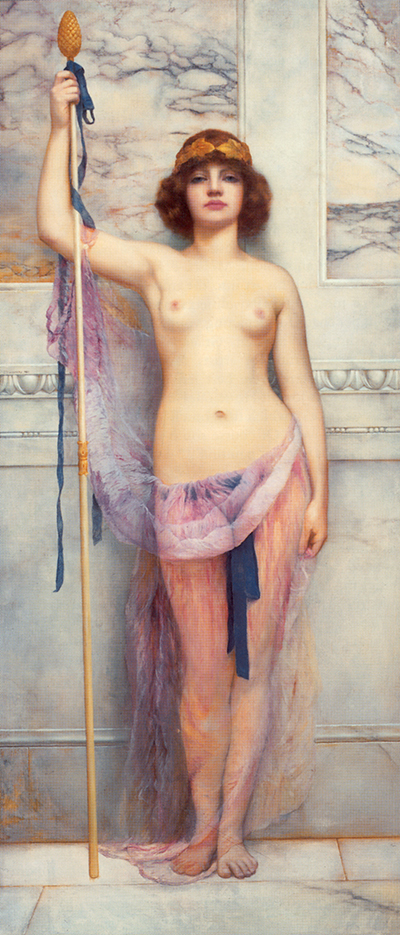
A barefoot woman raises a gold-tipped staff almost to the top of the canvas. Blue ribbons hang from the shaft. Translucent cloth passes around her hips and falls to the marble floor, leaving her chest and shoulders bare. Her head is level and her eyes meet ours. This is John William Godward’s A Priestess of 1893, an oil on canvas measuring 159.4 × 71.4 cm. Godward painted a second standing figure under the same title in 1894, recognisable by her black robe and the brass-coloured doors behind her. The different settings change what each woman seems to be doing. [1] [2]
At a Glance
- Date1893
- MediumOil on canvas
- Dimensions159.4 × 71.4 cm
This work across John William Godward’s career
Contents
- The blue ribbons and the marble wall
- A sign of Bacchus
- The black robe at the Royal Academy
- From a large canvas to a small panel
- The priestess as a head and as a figure at a door
- Annotated details
The blue ribbons and the marble wall
Start at the woman’s raised hand. Her fingers close around the staff just below its cone-shaped head. The ribbon breaks into loops and tails, sending a dark strip down one side. The foot of the shaft comes to rest beside her toes. The staff gives the painting a straight measure from top to bottom. One elbow reaches almost to the edge of the canvas and the opposite hand hangs beside her thigh. The angles of her arms and the tilt of her hips introduce movement into a pose she seems capable of holding for some time. [1]
The cloth makes that small shift in weight easier to see. Where it hangs loosely between the raised arm and the waist, it has the cool violet of the shadow behind it. Gathered across the front of the hips, it turns lilac and pink, then hangs in long, warmer folds over the legs. The lower blue sash makes an arresting interruption in those pale folds and echoes the ribbon on the staff. The cloth brushes the floor on the viewer’s left, beside a pair of feet placed so close that one partly overlaps the other. Her feet are at rest even as the cloth describes several different directions across the canvas. [1]
Large slabs of veined marble fill the space behind her. A pale upright divides the upper wall, and a narrow moulding crosses it near her lowered elbow. The painted stone is cool and cloudy next to the warm flesh. Its level bands also bring out the slight angles of her shoulders and hips. One of the few clues to depth is the join in the stone floor below her feet. Her raised arm suggests readiness. The wall gives little indication of the action to come. [1]
Swanson’s illustrated account of this near-nude canvas traces it to the London dealers Nathan Mitchell, who handled several of Godward’s paintings in the first half of the twentieth century. [1]
A sign of Bacchus
The staff resembles a thyrsus, the attribute of Dionysus, known to the Romans as Bacchus, and of his followers. Two objects at the Metropolitan Museum of Art show how ancient artists pictured it. On an Attic oil flask attributed to Hermonax and dated about 460 BCE, a maenad holds a fennel stalk tipped with ivy, with a snake wound around it. An Augustan marble relief, dated about 27 BCE–14 CE and adapted from an earlier Greek composition, gives a dancing maenad an ivy wreath and a stalk decorated with ivy leaves and berries. The relief’s swirling drapery makes the dance unmistakable. In Godward’s arrangement, the staff stays upright, the feet stay together and the woman sustains her eye contact with the viewer. The object suggests a Dionysian subject, while her exact role and the occasion remain open. [9] [10]
Godward had already painted an explicitly Bacchic figure in the signed A Priestess of Bacchus of 1890. The oil on canvas is only 29 × 45 cm and opens onto blue water and distant land. A woman in an ochre dress reclines along a curved marble bench. Two companions appear below the terrace at the left, and the staff tilts at the right with its purple ribbons hanging from the head. Sotheby’s records the London dealer Thomas McLean handling the picture in 1890. It later changed hands under the titles Bacchante Resting and On the Terrace. The first foregrounds the woman and her state of repose. The second names the setting and lets the viewer discover the mythological clue. [11]
Michael Allan Kodysz identifies the wreath and staff in the 1890 picture as signs of a bacchante and compares the woman’s frank gaze with that in Godward’s later At the Gate of the Temple. His discussion helps explain what Godward could suggest through an encounter with the viewer. In the 1890 composition, the partly hidden people and the view across the water offer other places for the eye to go. The 1893 canvas closes down those alternatives. When we look up from the ribbons or follow the shaft back to the hand, her face is waiting at the centre. [1] [11] [12]
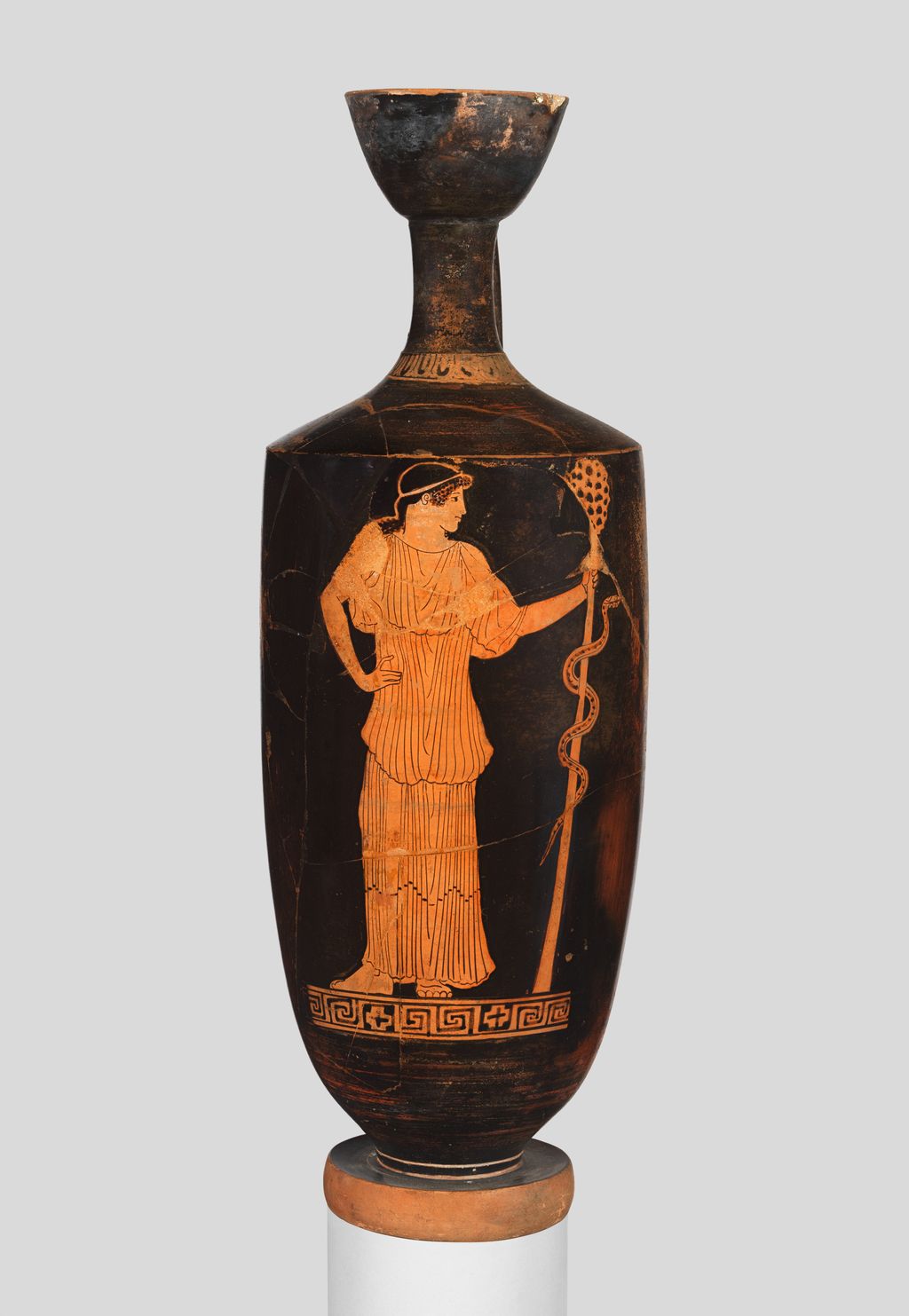
Attic red-figure vessel attributed to Hermonax, The Met. The ancient representation shows a different treatment of the Dionysian staff and its bearer. The Metropolitan Museum of Art. Image source. CC0 / Public domain.
Annotated Details from A Priestess
The numbered points identify visible features discussed in this article. Return from each detail to the numbered overview. John William Godward, A Priestess (1893), near-nude composition. Image source. Public domain.
, near-nude composition.jpg)
Details from A PRIESTESS
Compare the cropped details with the source images above. Notice how their colours, shapes and positions contribute to the larger compositions.
The raised staff and ribbons
The high staff draws a long line beside the figure. Blue ties move away from it into the marble field.
, near-nude composition Detail 01 the-raised-staff-and-ribbons.jpg)
The face and lifted arm
Her eyes face forward while the forearm pulls the pose to one side.
, near-nude composition Detail 02 the-face-and-lifted-arm.jpg)
Cloth and the staff below the waist
The transparent fabric changes colour where the dark upright crosses in front of it.
, near-nude composition Detail 03 cloth-and-the-staff-below-the-waist.jpg)
John William Godward videos
See Godward’s paintings and studio practice alongside films on two Victorian contemporaries.
John William Godward - Part 1: The Last Painter of the Victorian Age
An overview of Godward’s career and the Victorian market for pictures set in antiquity.
Watch on YouTubeThe black robe at the Royal Academy
Godward’s clothed A Priestess of 1894 measures 219.7 × 96.8 cm. Vern Grosvenor Swanson describes it as the largest picture Godward had painted up to that point. It keeps the lifted arm, the closely placed feet and the steady look outward. A dark robe now falls from the shoulders in long folds and a gold sash gathers the cloth around the waist. Behind her is a double door with rows of rounded bosses. Its central seam and the shaft of the staff run close to parallel. The woman stands at the point where the two leaves meet. Swanson read her as a bacchante guarding the temple gates. In the 1893 oil the stone provides a backdrop, while the door gives her a passage to control. [1] [2]
In 1895 the Royal Academy listed A Priestess by John W. Godward as no. 304 in Gallery IV. The catalogue supplies the title and artist. Henry Blackburn’s contemporary Academy Notes supplies the detail that makes the entry especially valuable. In his account, the chestnut-haired figure faces the spectator in a “transparent black gauze robe” in front of “polished brass doors”. Those two details point squarely to the clothed composition. The standing figure of 1893 shares the general pose, but has neither the black costume nor the doors Blackburn describes. The 1894 canvas is a plausible match for the Academy exhibit. Blackburn provides no measurements or illustration to settle which physical version of the clothed design hung there. [1] [2] [13] [14]
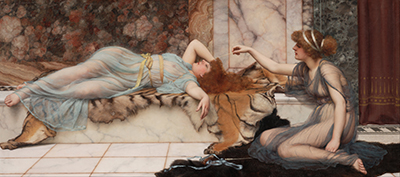
The same exhibition included Godward’s Mischief and Repose as no. 472 in Gallery VI. There the long horizontal format gives two women room to stretch and lean across a marble seat. The eye follows one woman’s gaze to a small pin held over the other’s brow. The priestess fills her upright format alone, and her gaze comes out of the picture to meet ours. [2] [13] [14] [15]
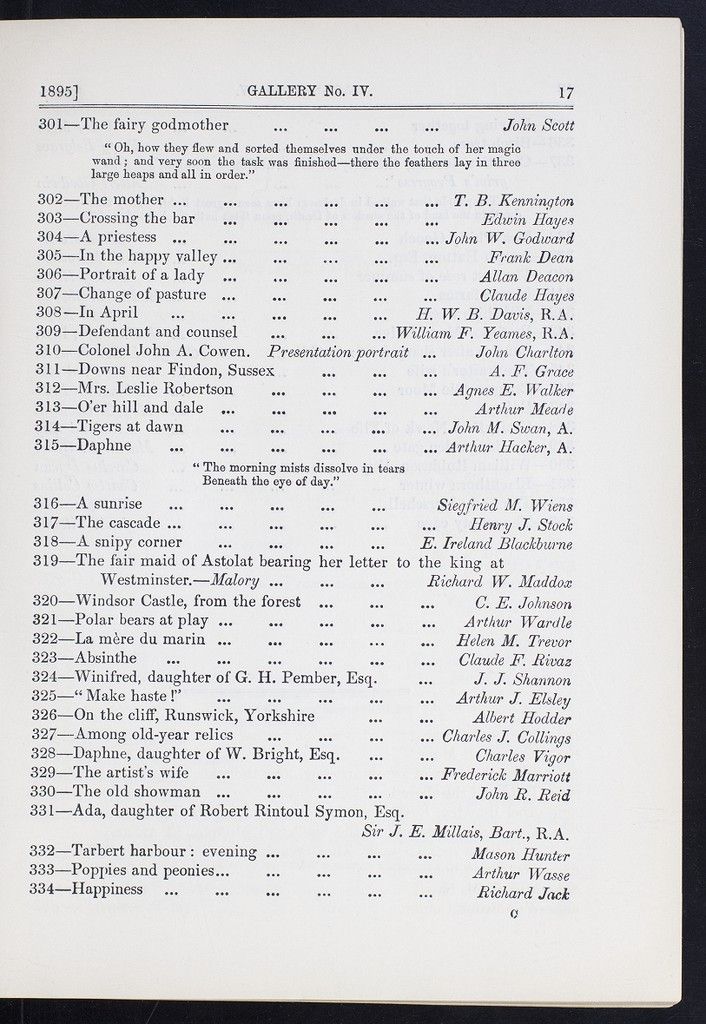
Royal Academy of Arts, 1895 exhibition catalogue, no. 304. The 1895 catalogue identifies work no. 304 in Gallery IV. Royal Academy of Arts. Image source. Public domain.
From a large canvas to a small panel
A small oil on board catalogued as 1895 preserves the clothed design. The Art Renewal Center lists it as Study for ‘The Priestess’ and gives its dimensions as 31.2 × 16.1 cm. The picture retains the individual bosses on the door, the pale finial on the staff and the divided gold sash. There is more wall beside the jamb and more floor between the woman’s feet and the bottom edge. At roughly one-seventh the height of the large canvas, the panel makes the figure occupy less of the architecture too. [2] [16]
Humrich Fine Art, which catalogued the small panel, says Godward painted it for W. Biscombe Gardner to use for an engraving made in 1896 for Cadbury, Jones & Co. The dealer dates the original Academy showing to 1894. The Academy’s own entry and Blackburn’s description date it to 1895. [13] [14] [17]
In 1897 the Academy catalogue lists Gardner’s A Priestess, after J. W. Godward, as no. 1719 in the Black and White Room. Algernon Graves repeats the entry in his dictionary of Academy exhibitors. That establishes a public showing of Gardner’s work after Godward a year after the reported engraving date. The listing has no picture or publisher’s imprint, so the exact painted model, production date and publisher remain to be checked against an impression. The entry gives A Priestess a place in the history of prints after Godward, alongside the surviving work of painters, engravers and publishers who brought his subjects to new audiences. [17] [18] [19]
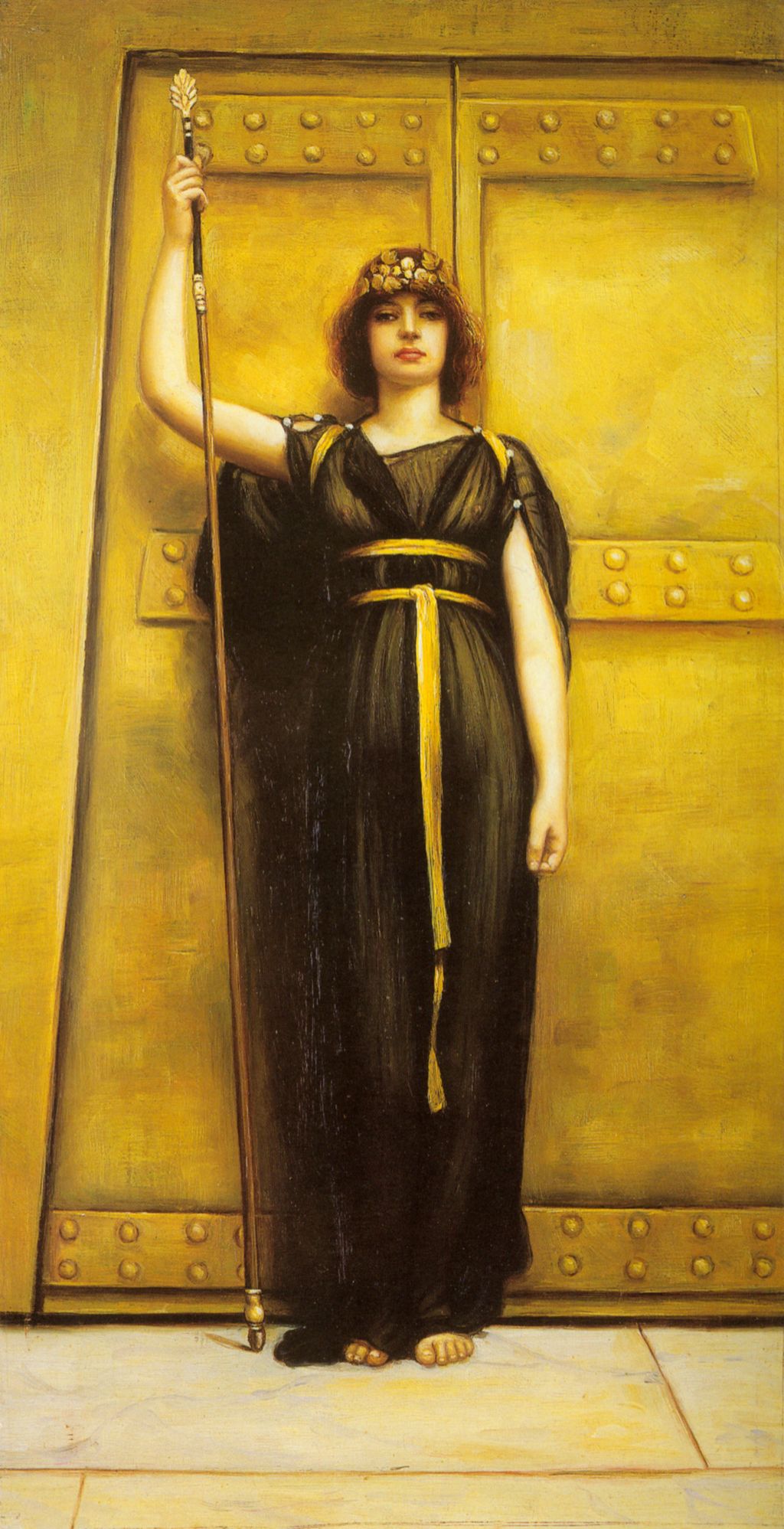
John William Godward, A Priestess, the small clothed panel. The small panel preserves the dark robe and the metal doors described for the clothed type. Image source. Public domain.
The priestess as a head and as a figure at a door
In 1896 Godward signed a small Head of a Girl (The Priestess), now known from an illustrated Christie’s catalogue. On this 34.2 × 29.2 cm canvas the woman turns a shoulder toward us, with blue gauze gathered across it. A gold circlet of pointed leaves stands out against her dark hair. With the staff and marble out of the picture, the circlet is the principal clue to the title. Godward has brought the face so close that we can follow the change of light across the woman’s eyes and cheeks. Christie’s traces the picture to Merton Russell-Cotes’s sale in London in 1905, where it went for twenty guineas. [20]
Godward returned to the full-length figure in At the Gate of the Temple, a signed oil of 1898. At 161.6 × 71.1 cm, it is very close in size to the near-nude canvas of 1893. This time the woman holds her staff low across her body with both hands. Someone approaching the gate would have to pass the staff and get past the woman herself. In the 1893 Priestess, the staff stands beside her, leaving the space directly in front of her clear. Her gaze still has the power to stop someone there. [1] [5]
John William Godward artworks directory
Search documented oil paintings, drawings, watercolours and reproductive prints. The directory includes the Art Renewal Center’s catalogue and additional works in museum, exhibition and sale records.
| Name | Date | Medium |
|---|---|---|
| Absence Makes the Heart Grow Fonder | 1912 | Oil on canvas |
| Amaryllis | 1903 | Oil on canvas |
| An Amateur | 1915 | Oil on canvas |
| Ancient Pastimes | 1916 | Oil on canvas |
| The Answer | 1917 | Oil on canvas |
| An Arcadian Beauty | 1899 | Painting |
| At the Fountain | 1893 | Oil on canvas |
| At the Garden Door | 1901 | Oil on canvas |
| At the Garden Shrine, Pompeii | 1892 | Oil on canvas |
| At the Gate of the Temple | 1898 | Oil on canvas |
| At the Thermae | 1909 | Oil on canvas |
| Atalanta | 1892 | Oil on canvas |
| Athenais | 1908 | Oil on canvas |
| An Auburn Beauty | 1895 | Oil on canvas |
| Autumn | 1900 | Oil on canvas |
| Beauty in a Marble Room | 1894 | Oil on canvas |
| The Belvedere | 1913 | Oil on canvas |
| The Betrothed | 1892 | Oil on canvas |
| The Betrothed (print after Godward) | 1893 | Photoengraving, as reported |
| The Bouquet | 1899 | Oil on canvas |
| Briseis | 1896 | Painting |
| The Broken Vase | 1889 | Oil on canvas |
| By the Blue Ionian Sea | 1916 | Oil on canvas |
| By the Wayside | 1912 | Oil on canvas |
| Byrsina | 1915 | Painting |
| Campaspe | 1896 | Oil on canvas |
| Campaspe (print after Godward) | Print, process unconfirmed | |
| Chloris (A Summer Rose) | 1902 | Oil on canvas |
| Classical Beauty | Oil on canvas | |
| A Classical Beauty | Oil on canvas | |
| A Classical Beauty | Painting | |
| A Classical Beauty | Oil on canvas | |
| A Classical Beauty | 1909 | Oil on canvas |
| A Classical Beauty In Profile | Oil on canvas | |
| A Classical Lady | 1908 | Oil on canvas |
| Clymene | 1892 | Oil on canvas |
| A Congenial Task | 1915 | Oil on canvas |
| Contemplation | 1922 | Oil on canvas |
| A Cool Retreat | 1910 | Oil on canvas |
| Country House in the 18th Century | c. 1883 | Oil on canvas |
| Cytheris | 1922 | Painting |
| The Day Dream | 1920 | Oil on canvas |
| The Delphic Oracle | 1899 | Oil on canvas |
| A Dilettante | 1922 | Oil on canvas |
| Distant Thoughts | 1918 | Oil on canvas |
| Dolce Far Niente | 1897 | Oil on canvas |
| Dolce Far Niente | 1906 | Oil on canvas |
| Dolce far niente (A Pompeian Fishpond) | 1904 | Oil on canvas |
| Dolce far niente (coloured print after Godward) | Exhibited 1900 | Coloured print, exact process unconfirmed |
| Dolce far niente (grapes) | 1907 | Oil on canvas |
| Dora | 1887 | Oil on canvas |
| Drusilla | 1906 | Oil on canvas |
| An Edition de Luxe | 1920 | Oil on canvas |
| Eighty and Eighteen | 1898 | Oil on canvas |
| Endymion | 1893 | Oil on canvas |
| The Engagement Ring (horizontal composition) | 1888 | Oil on canvas |
| The Engagement Ring (upright composition) | c. 1891 | Oil on canvas |
| Erato at Her Lyre | Oil on canvas | |
| A Fair Reflection | 1915 | Oil on canvas |
| A Fair Reflection (Taber-Prang print) | By 1923 | Sepia artotype |
| Far Away Thoughts (circular sewing scene) | 1911 | Oil on canvas |
| Far Away Thoughts (left-facing profile) | 1892 | Oil on canvas |
| Far Away Thoughts (right-facing profile) | 1892 | Oil on canvas |
| Female Figure (probable Grecian Idyll study) | 1907 | Oil on board |
| Flabellifera | 1905 | Oil on canvas |
| Flabellifera (painted study) | c. 1905 | Oil study |
| Flabellifera (pencil study) | c. 1905 | Pencil on paper |
| The Flower Girl | Painting | |
| A Flower Seller | 1896 | Oil on canvas |
| The Flowers of Venus | 1890 | Oil on canvas |
| A Fond Farewell | 1918 | Watercolour |
| The Fragrant Rose | 1892 | Painting |
| The Fruit Vendor | 1917 | Oil on canvas |
| A Garland Seller | 1914 | Painting |
| Giotto Drawing from Nature | Painting | |
| Girl in Yellow Drapery | 1901 | Oil on canvas |
| Golden Hours | 1913 | Oil on canvas |
| A Grecian Girl | 1908 | Oil on canvas |
| Grecian Idyll | 1907 | Oil on canvas |
| A Grecian Lovely | 1909 | Oil on canvas |
| Grecian Reverie | 1889 | Oil on canvas |
| Grecian Reverie | 1889 | Oil on canvas |
| A Greek Beauty | 1905 | Oil on canvas |
| A Happy Awakening | 1903 | Oil on canvas |
| He Loves Me, He Loves Me Not | 1896 | Oil on canvas |
| A head and shoulders profile portrait of a young woman wearing a white tunic style blouse | c. 1889 | Painting |
| Head of a Girl (The Priestess) | 1896 | Oil on canvas |
| Heart on her Lips and Soul within her Eyes | 1904 | Painting |
| His Birthday Gift | 1889 | Oil on canvas |
| Ianthe | 1889 | Oil on canvas |
| An Idle Hour | 1890 | Oil on canvas |
| Idle Moments | 1895 | Oil on canvas |
| Idle Thoughts | 1898 | Oil on canvas |
| Idleness | 1900 | Oil on canvas |
| Il Dolce Far Niente (Pears print after Amaryllis) | 1906 | Chromolithograph |
| Il Dolce far niente (seated figure) | 1893 | Oil on canvas |
| In Expectation | c. 1892 | Oil on canvas |
| In Realms of Fancy | 1911 | Oil on canvas |
| In the Prime of the Summertime (Reverie) | 1914 | Oil on canvas |
| In the Tepidarium | 1913 | Oil on canvas |
| Innocent Amusements | 1891 | Oil on canvas |
| Ione | c. 1896-1898 | Oil on canvas |
| Ionian Dancing Girl | 1902 | Oil on canvas |
| Ismenia | 1908 | Oil on canvas |
| An Italian Beauty | 1897 | Oil on canvas |
| An Italian Girls' Head | 1902 | Oil on canvas |
| The Jewel Casket | 1900 | Oil on canvas |
| Julia | 1914 | Painting |
| Knuckle Bones | 1890 | Oil on canvas |
| La Pensierosa | 1913 | Oil on canvas |
| A Lady | 1895 | Oil on canvas |
| Landscape: Blossoming Red Almond [study] | c. 1912 | Oil on panel |
| Le Billet Doux (The Love Letter) | 1913 | Oil on canvas |
| Leaning Against a Column | 1901 | Painting |
| Leaning on the Balcony | 1892 | Oil on canvas |
| Leisure Hours | 1905 | Oil on canvas |
| Lesbia with her Sparrow | 1916 | Oil on canvas |
| The Letter | 1899 | Painting |
| Liegende | 1893 | Oil on canvas |
| A Lily Pond | 1917 | Oil on canvas |
| Looking Out to Sea | 1918 | Pencil and watercolour |
| The Love Letter (circular composition) | 1907 | Oil on canvas |
| Lucilia | 1917 | Oil on canvas |
| Lycinna | 1918 | Oil on canvas |
| Marcella | 1912 | Painting |
| Matrona Superba | Oil on canvas | |
| Megilla | 1921 | Oil on canvas |
| A Melody | 1904 | Oil on canvas |
| Memories | c. 1891 | Oil on canvas |
| Mirinna | Painting | |
| The Mirror | 1899 | Oil on canvas |
| Mischief | 1905 | Oil on canvas |
| Mischief and Repose | 1895 | Oil on canvas |
| A Mouse in the Work Basket | 1893 | Oil on canvas |
| Nerissa | 1906 | Oil on canvas |
| The New Perfume | 1914 | Oil on canvas |
| Noon Day Rest | 1910 | Oil on canvas |
| Nu Sur La Plage | 1922 | Oil on panel |
| Nude Study | Oil on canvas | |
| An Offering to Venus | 1912 | Oil on canvas |
| The Old, Old Story | Oil on canvas | |
| The Old, Old Story | 1903 | Oil on canvas |
| On the Balcony | 1911 | Oil on canvas |
| On The Terrace | 1918 | Oil on canvas |
| Ophelia | Oil on panel | |
| The Peacock Fan | 1912 | Oil on canvas |
| Phyleis | 1908 | Oil on canvas |
| The Playground | 1892 | Oil on canvas |
| Playtime | 1891 | Oil on canvas |
| A Pompeian Bath | 1890 | Oil on canvas |
| A Pompeian Lady | 1891 | Oil on canvas |
| A Pompeian Lady | 1895 | Oil on board |
| A Pompeian Lady | 1901 | Painting |
| A Pompeian Lady | 1904 | Painting |
| Portrait of Mary Frederica 'Nin' Godward | c. 1882-1883 | Oil on canvas |
| Portrait of Mary Perkinton Godward | c. 1880-1881 | Watercolor |
| The Posy | 1900 | Painting |
| A Priestess (bare-shouldered figure) | 1893 | Oil on canvas |
| A Priestess (clothed composition) | 1894 | Oil on canvas |
| A Priestess (W. Biscombe Gardner after Godward) | Exhibited 1897 | Print, process unconfirmed |
| A Priestess of Bacchus | 1890-1890 | Oil on canvas |
| Pyrallis | 1918 | Oil on canvas |
| The Quiet Pet | 1906 | Oil on canvas |
| A Red, Red Rose | 1920 | Oil on canvas |
| Reflections | 1893 | Oil on canvas |
| The Rendezvous | 1903 | Oil on canvas |
| Repose, the Flower Girl | c. 1887 | Oil on canvas |
| Reverie | 1888 | Oil on panel |
| Reverie | 1912 | Oil on canvas |
| Reverie (In the Days of Sappho) | 1904 | Oil on canvas |
| Reverie (Pears print after In the Prime of the Summertime) | 1916 | Chromolithograph |
| 'Rich Gifts Wax Poor When Lovers Prove Unkind' | 1916 | Oil on canvas |
| The Ring | 1898 | Oil on canvas |
| A Roman Matron | 1905 | Oil on canvas |
| Sabinella | 1912 | Oil on canvas |
| Sappho | 1910 | Oil on canvas |
| The Siesta | Oil on canvas | |
| A Siesta | 1895 | Oil on canvas |
| The Signal | 1899 | Oil on canvas |
| Sitting for Her Portrait | 1893 | Oil on canvas |
| Sketch for Amaryllis | 1903 | Oil on board |
| A Souvenir | 1920 | Oil on canvas |
| Stesicrate | 1914 | Oil on canvas |
| Study for 'Rêverie' | 1890 | Oil on canvas |
| Study for 'The Priestess' | 1895 | Oil on board |
| Study for An Egyptian Minstrel | 1906 | Painting |
| Study for The New Perfume | Drawing, medium unconfirmed | |
| Study for ‘The Old, Old Story’ | 1903 | Oil paint on wood |
| Study of a Girl's Head | 1899 | Painting |
| Study of Campaspe | Oil on canvas | |
| Study of Head and Drapery, Miss Ethel Warwick | 1898 | Painting |
| Summer Day | 1897 | Painting |
| Summer Flowers | 1903 | Oil on canvas |
| Sweet Dreams | 1901 | Oil on canvas |
| Sweet Dreams | 1904 | Painting |
| The Sweet Siesta of a Summer's Day | 1891 | Oil on canvas |
| The Tambourine Girl (profile at the marble wall) | 1906 | Oil on canvas |
| The Tambourine Girl (relief-backed version) | 1906 | Oil on canvas |
| Tender Thoughts | 1917 | Oil on canvas |
| Tender Thoughts (woman leaning over a parapet) | 1918 | Pencil and watercolour |
| The Tiff (oil) | By 1888 | Oil on canvas |
| The Tiff (print after Godward) | 1894 | Photogravure |
| The Tigerskin | 1889 | Oil on canvas |
| The Time of Roses | 1916 | Oil on canvas |
| Tranquillity | 1914 | Oil on canvas |
| A Tryst | 1912 | Oil on canvas |
| Tympanistria | 1909 | Oil on canvas |
| Under the Blossom that Hangs on the Bough | 1917 | Oil on canvas |
| Venus at the Bath | 1901 | Oil on canvas |
| Venus Binding Her Hair | 1897 | Oil on canvas |
| Violets, Sweet Violets | 1906 | Painting |
| Waiting for an Answer | 1889 | Oil on canvas |
| Waiting for the Procession | 1890 | Oil on canvas |
| Waiting for the Procession | 1890 | Painting |
| The Water Carrier (magazine reproduction of At the Fountain) | 1898 | Magazine reproduction |
| When the Heart is Young | 1902 | Oil on canvas |
| Who Can They Be | Painting | |
| Winding Wool | 1894 | Painting |
| 'With Violets Wreathed and Robe of Saffron Hue' | 1902 | Oil on canvas |
| The Yellow Shawl | 1893 | Painting |
| 'Yes or No?' | 1893 | Oil on canvas |
| Young Girl Picking Grapes | 1902 | Oil on canvas |
| Youth and Time | 1901 | Oil on canvas |
Discussion
Look again at the images and ideas explored in A Priestess by John William Godward. These editorial prompts invite your observations.
Reader Insights
How do the raised staff and the stone opening direct your attention?
Which visual details best distinguish this version from the clothed priestess?
Join the Conversation
Share a detail, comparison or question about A Priestess by John William Godward below.
References
- Vern Grosvenor Swanson and the Art Renewal Center, A Priestess, 1893, painted in oil on canvas, 159.4 × 71.4 cm. Archived illustrated catalogue plate and current object record 11075. English. View source 1. View source 2.
- Vern Grosvenor Swanson and the Art Renewal Center, A Priestess, 1894, the clothed oil on canvas. Archived discussion of the 1894 composition and current object record 6633. English. View source 1. View source 2.
- The Flowers of Venus. View source.
- A Priestess. View source.
- Christie’s, At the Gate of the Temple, illustrated catalogue for the signed 1898 oil on canvas. English. View source.
- The Bouquet. View source.
- An Offering to Venus. View source.
- The Peacock Fan. View source.
- The Metropolitan Museum of Art, Lekythos (oil flask), attributed to Hermonax, 26.60.77, Attic red-figure terracotta, about 460 BCE. English. View source.
- The Metropolitan Museum of Art, Marble Relief with a Dancing Maenad, 35.11.3, Augustan Roman marble relief after a Greek work attributed to Kallimachos. English. View source.
- Sotheby’s, A Priestess of Bacchus, lot 19, illustrated 2015 sale catalogue with signature, dimensions and provenance. English. View source.
- Michael Allan Kodysz, The Classical-Genre Paintings of John William Godward: From Archaeology to Archetypes, University of Manchester master’s dissertation, 2007, restored digital edition, chapter 3, pp. 45–48 and figure 40. English. View source.
- Royal Academy of Arts, 1895 exhibition catalogue, Gallery IV, p. 17, no. 304 and Gallery VI, p. 23, no. 472. English. View source 1. View source 2. View source 3.
- Henry Blackburn, Academy Notes for 1895, p. 12, description of no. 304. English. View source.
- J. Paul Getty Museum, Mischief and Repose, 79.PA.149, illustrated collection record. English. View source.
- Art Renewal Center, Study for ‘The Priestess’, record 32127, illustrated oil on board. English. View source.
- Humrich Fine Art, catalogue entry for the small 1895 panel, with the dealer’s account of its use for a print. English. View source.
- Royal Academy of Arts, 1897 exhibition catalogue, Black and White Room, p. 51, no. 1719, W. Biscombe Gardner after J. W. Godward. See also the full exhibition catalogue. English. View source 1. View source 2.
- Algernon Graves, The Royal Academy of Arts, vol. 3, p. 202, W. Biscombe Gardner. English. View source.
- Christie’s, Head of a Girl (The Priestess), illustrated catalogue with signature, date and Merton Russell-Cotes provenance. English. View source.