 by Tom Gurney
Tom Gurney BSc (Hons) is an art history expert with over 20 years experience
Published on June 19, 2020 / Updated on October 14, 2023
Email: tomgurney1@gmail.com / Phone: +44 7429 011000
Mischief and Repose by John William Godward: Introduction
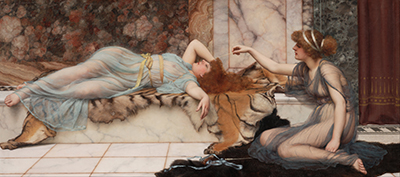
A pale dress pin hovers at the hairline of a woman stretched out on a marble bench. The woman holding it kneels beside her, eyes fixed on her companion’s face. From across a room, the reclining figure, the tiger skin under her and the dark sweep of marble behind her would register first. Come closer and the tiny point of the pin changes the picture. John William Godward’s Mischief and Repose of 1895 turns on how long it takes to notice that movement and how little the painter gives away about what happens next. [1]
The J. Paul Getty Museum’s painting is an oil on canvas, signed and dated at the upper left. It measures 60.6 × 133 cm unframed, more than twice as wide as it is high. The museum identifies it as 79.PA.149. Godward used the title again in 1909 for a smaller oil with a single reclining woman on an open terrace. The Getty picture takes place indoors and gives its two title roles to two bodies. [1] [2]
At a Glance
- Date1895
- MediumOil on canvas
- Dimensions60.6 × 133 cm
- CollectionJ. Paul Getty Museum, Los Angeles
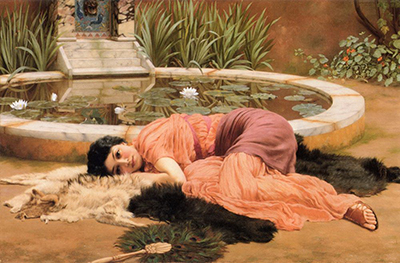
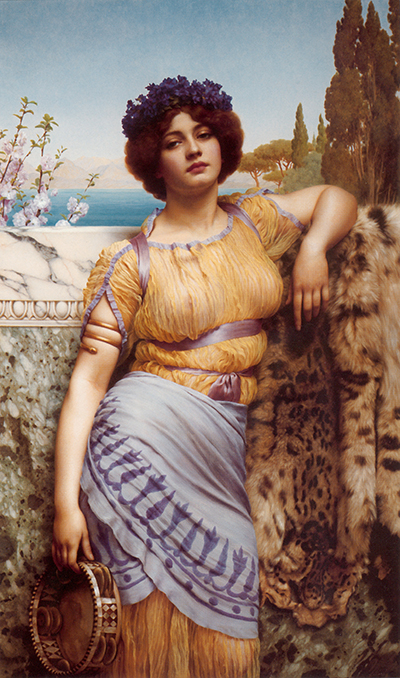
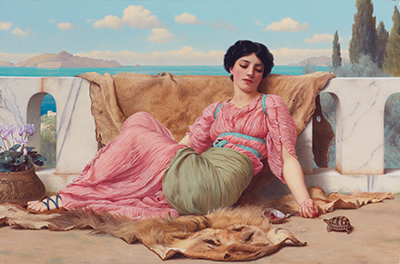
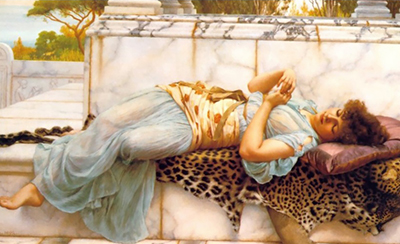
This work across John William Godward’s career
The Engagement Ring
c. 1891 [4]The Betrothed
1892 [5]Far Away Thoughts
1892 [6]Contents
- The distance between the pin and the brow
- How the long canvas holds a small gesture
- Cloth, fur and stone
- The Royal Academy and the path to the Getty
- An ancient room imagined in the nineteenth century
- What changed in Mischief and Repose of 1909
- Annotated details
The distance between the pin and the brow
Repose occupies almost the whole bench. Her bare feet reach the left edge, one knee rises beneath the garment, and her head rests on a spread of auburn hair near the middle of the canvas. One arm bends back above her head. The other drops over the bench and ends in fingers that curl loosely beside the ragged edge of the pelt. Her eyelids are lowered and her body keeps its settled weight. The Getty describes her as being disturbed from sleep. At the instant Godward paints, the quiet face and loose hand give the viewer little outward sign of a response. [1]
On the right, Mischief has folded her legs beneath and beside her. Her lowered hand rests in a fold near her thigh. The other extends from the shoulder above the marble seat, then turns at the wrist. The thumb and forefinger hold the end of the pin, with the other fingers tucked loosely in. You can follow the gesture all the way from her face to the point of the pin. She has to reach out, yet the angle of her arm and the care with which she holds the object suggest that she is trying to control even this small advance. The pin reaches the loose curls just above Repose’s brow. Godward makes it hard to tell how much contact there has been. It could be a touch light enough to be ignored or the start of an irritated awakening.
The Getty collection entry calls the raised object and the one on the floor dress pins. The historical Getty Villa exhibition text describes the one in Mischief’s fingers as an ivory hairpin. Its pale shaft runs diagonally across a seam between two marble panels and ends at the front of the auburn curls. The second pin lies close to the blue hair ribbon in the foreground, on the dark pelt spread over the floor. It is nearly horizontal, with its ornamented head beside the ribbon and its shaft extending to the right. Mischief also wears a light ribbon in her hair. The two pins and the two ribbons give the impression of an interrupted routine of dressing or arranging hair, even though the painting leaves their use before the prank to the imagination. [1] [8]
How the long canvas holds a small gesture
The figures’ arrangement brings the eye in from both sides. Repose extends from the far left towards the middle, where the sweep of her hair comes to rest. Mischief’s torso rises on the right and her arm leads back towards the same point. The space between the women is small, and the change in their posture is marked. Repose’s elbow makes a high bend across the wall behind her while her forearm disappears into the space above her head. Mischief’s bent wrist makes a smaller angle further to the right. One lifted arm belongs to a body at rest. The other lifted arm carries an intention.
The picture also has strong lines that keep the two figures from reading as separate incidents. The seat runs under both their arms, and the wall panels supply vertical divisions behind their heads and shoulders. Left of centre, the broad dark panel gives the blue cloth and pale limbs a continuous background. Near the point of the pin, the darker mottling gives way to a narrow strip of ochre stone and then to pale, grey-veined marble. The pale panel gives the meeting of hand and brow a lighter ground. Dark, closely figured stone resumes behind the knot of Mischief’s hair. At the far right the deep red curtain hangs in a vertical strip, but its gold ornament runs across the bottom. Its hem stops close to the level of the bench and the patterned threshold. The band along the curtain and the bench both draw the eye back across the picture.
Look down next from the head and arm of Repose. The light marble bench is broken by the fall of the tiger skin, then the skin is interrupted by the dark mat of fur under Mischief. The companion’s pale foot emerges near the bottom right, diagonally opposite the feet at the left end of the bench. A grid of broad floor slabs remains exposed in the left foreground, while the figures and pelts cover much of the floor towards the right. Along the far right edge, a strip of small mosaic pieces survives between the curtain and the dark foreground. Repose looks stretched out partly because these lines travel so far, and Mischief looks momentarily arrested because so many lines lead back to a single point. The width of the picture lets both sensations last.
Cloth, fur and stone
The painted fabrics both disclose and conceal the bodies. On Repose, bands of blue sweep over the raised knee and flatten along the shin, then gather more closely where yellow ties cross the waist. Near the bench edge the free cloth sags between her ankles and the fur. A bunched sleeve ends above the elbow of her hanging arm. Mischief’s garment looks darker blue where the fabric bunches, while the contour of her flexed knee shows through a much lighter area. Notice the difference between the way a fold follows a limb and the way it turns sharply under its own weight. Across the chest and thigh Godward gives us both the line of the body and the separate movement of the cloth.
The Getty takes the women’s dress as an adaptation of the ancient Greek chiton. A chiton could be made from a broad rectangle of relatively light fabric, seamed at the sides and fastened at the shoulders, then gathered by a belt. Some forms used fastenings along the upper arms as well. The Metropolitan Museum of Art has an East Greek gold pin dated to the sixth century BCE. Its decorated head and straight shaft make a useful comparison for an object whose working end was slender and whose visible end could be ornamental. The Getty’s description situates Godward’s costume in that tradition. The painted robes and pins also have a job peculiar to this room. The ties collect the cloth into bundles of folds, and an accessory that normally keeps fabric or hair in place becomes something with which to disturb a person. [1] [9] [10]
The tiger skin lies under one figure and comes almost to the other. Its stripes continue from the flatter surface of the seat down over the side, curving as the pelt bends. Along the ledge the pale tufts have an irregular edge against the stone. The edge of the blue cloth has a different softness, wavering as it falls and turning almost translucent over the warm colours below. Across the exposed marble the veins appear to continue under the surface. The woman’s hanging fingertips almost reach the tapering edge of the pelt, above the pale front of the bench. A viewer can almost feel the change from polished stone to fur to the thin fabric at her shoulder. [1]
Godward arranges the expectation of touch in other settings. In the signed 1906 The Quiet Pet, an extended hand reaches towards a tortoise. A small plate of cherries lies just behind her hand. An outdoor terrace provides pale masonry, richly coloured fabric and a small action whose completion is left open. The animal at the woman’s feet gives her downward gaze a place to land. In the Getty picture, the interval between point and brow does the same work at the height of the reclining woman’s face, where the smallest change of expression might give the game away. For The Quiet Pet, Sotheby’s published a 2012 condition report recording a synthetic lining and a small retouched line in the marble parapet. The close Getty photograph of the 1895 painting shows a fine web of cracks, especially across the dark foreground. The Getty’s published entry identifies the medium and support and leaves the painting’s treatment history open. [1] [11]
John William Godward videos
See Godward’s paintings and studio practice alongside films on two Victorian contemporaries.
John William Godward - Part 1: The Last Painter of the Victorian Age
An overview of Godward’s career and the Victorian market for pictures set in antiquity.
Watch on YouTubeThe Royal Academy and the path to the Getty
The 1895 Royal Academy catalogue lists Mischief and repose as no. 472 in Gallery VI. It also places a Godward titled A priestess, no. 304, in Gallery IV. The exhibitor index puts both under John W. Godward at 410 Fulham Road. Visitors could thus have encountered two works by the same artist in different rooms under very different titles. The year, title, catalogue number and Getty’s exhibition history tie no. 472 to the surviving canvas. The line for no. 304 establishes what the Academy exhibited under that title. For the similarly titled surviving painting, see A Priestess. [1] [12]
The Getty traces the first sale to the London dealer Léon H. Lefevre, who bought the work from Godward in 1895. The transaction puts the canvas on the London market the same year it was shown publicly. Lefevre was a partner in the gallery at 1A King Street, part of the trade in contemporary painting in London’s West End. [13] By 1924 it belonged to Sir Henry Grayson, who sold it at Christie’s in London on 29 February as lot 104 to Nathan Mitchell. On 15 May 1925 it was offered as lot 89 from H. Aron and went unsold. That entry records an attempt to sell the painting and places it with a named owner at a specific date. Another sale, on 15 July 1938, places it with J. Woolf. This time, as lot 28, it was bought for J. Paul Getty through Nathan Mitchell, the buyer recorded in 1924. The museum’s catalogue leaves some intervals between these transactions open. [1]
Getty owned the painting until his death in 1976. The estate held it in trust until its distribution to the museum in 1979. Getty Research Institute also records Reverie as an alternative title for the 1895 work. The accession number is especially helpful here. The museum also holds Godward’s Reverie, known as In the Days of Sappho, signed in 1904 and catalogued as 79.PA.150. That picture gives a marble seat and an ancient literary association to a lone woman. The 1895 canvas can always be recognised by its two figures and the tiny encounter between them. [1] [14] [15]
An ancient room imagined in the nineteenth century
From 4 May to 30 August 1993, the Getty showed Mischief and Repose in Picturing the Ancient World: Antique Revival Paintings. The museum’s announcement describes the first display together of six works, including three by Godward, with Lawrence Alma-Tadema’s Spring at the centre. The museum linked the paintings to Getty’s interest in Greece and Rome, also evident in the design of the building around them. It presented Spring as a fantasy of a lost age built with convincing archaeological details. The same emphasis helps frame Godward’s interior. Instead of creating a public procession, he puts the period detail to work on an amusement between two people. [1] [16]
In 2012–13 the Getty Villa showed the painting in the Decadence section of The Last Days of Pompeii. The exhibition took its title from Edward Bulwer-Lytton’s 1834 novel and examined the modern afterlife of the city. In the section containing Godward’s canvas, the curators argued that an antique setting gave Neoclassical painters room to explore sexuality in ways less available in a contemporary setting. They drew attention to the transparent robes and the luxuries of the room. The catalogue of the painting itself makes a further point about the figures’ statue-like air. That reading fits what the eyes do. Mischief watches her companion and Repose’s attention remains inward. The beholder can look closely at the exposed skin and sheer cloth, and the women keep their attention within the scene. [1] [8] [17]
The curators link the coloured wall panels and the black-and-white mosaic at the doorway to Roman homes excavated around the Bay of Naples. The archaeological remains help explain the familiarity of the setting to an audience interested in Pompeii. The Archaeological Park’s guide, for instance, documents labyrinth and checkerboard designs in black-and-white floors in Pompeii’s House of the Geometric Mosaics. That is an example of Roman domestic decoration, while the painted strip at the edge of Godward’s curtain has a specific pictorial role. It makes the threshold legible through a change of scale, from the broad slabs in the foreground to a pattern made up of much smaller elements. The Getty exhibition caption used 58.4 × 130.8 cm for 79.PA.149. The museum’s collection record gives the unframed measurements of 60.6 × 133 cm used here. [1] [8] [18]
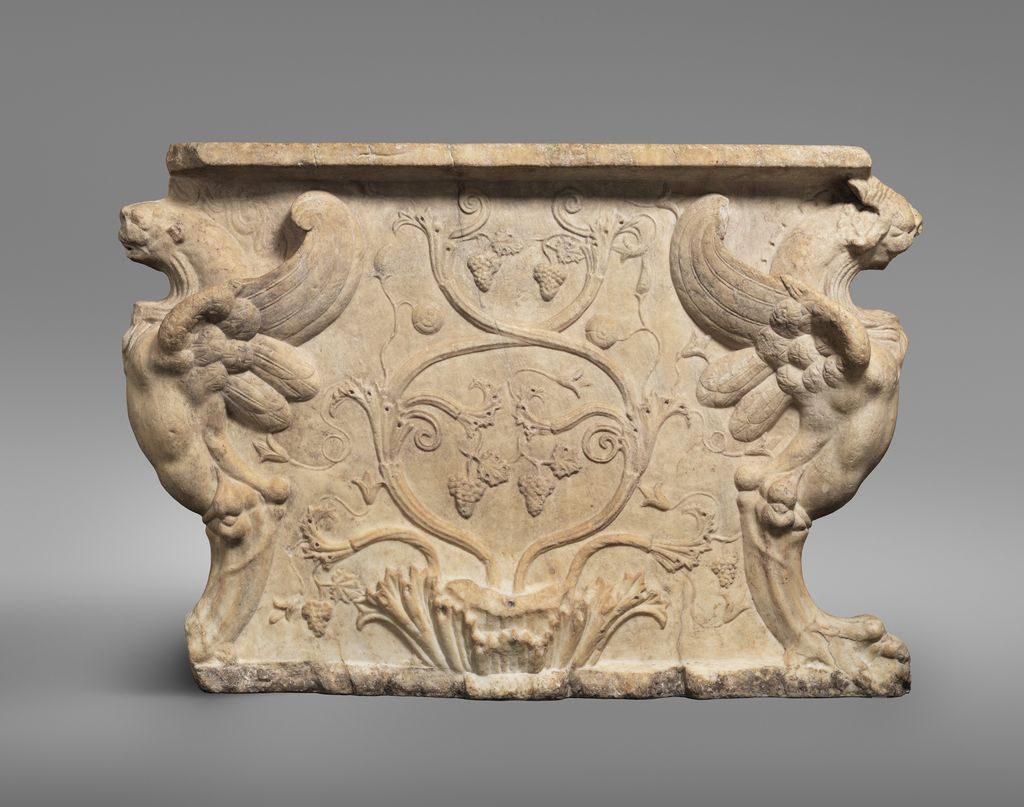
Roman marble table support with a griffin, The Met. The carved support shows how a decorative animal can form part of an actual piece of Roman furniture. The Metropolitan Museum of Art. Image source. CC0 / Public domain.
What changed in Mischief and Repose of 1909
The second Mischief and Repose is signed and dated 1909 at centre right. Christie’s recorded it as oil on canvas, 38.4 × 76.9 cm, and traced a sale by the artist for £175 in that year. It was sold from Mrs Helena Sarah Young’s collection at Christie’s in 1933 and reappeared at Sotheby’s in March 1963, followed by a Harrods entry in June. Christie’s offered it in London on 11 December 2008, when it realised £181,250. The later painting’s width is a little under three fifths that of the Getty canvas. Two equally wide reproductions can obscure how much smaller its single figure is on the actual canvas. [2]
The raised elbow, the thin blue cloth and the striped skin recall the 1895 figure of Repose, as Christie’s catalogue points out. The 1909 figure keeps the same orientation, with her feet to the left, and shifts her head further right onto a pile of cushions. A bent knee rises high beside a rounded stone pier. The parapet runs behind her, with the sea, upright trees and pink flowering branches visible beyond it. Some of the colours return in a new form. A deep blue band in the distance meets the pale blue worn close to the body, while reddish touches in the sandals and flowers punctuate opposite sides of the canvas. The eye that moved along the solid panels of the 1895 interior can now travel past the figure and out to the horizon. [2]
The Christie’s essay sees this single woman as combining the two sides of the title. Her body is still at ease, her open eyes alert to the person in front of the painting. That outward look is the most consequential change. In 1895 the viewer could follow the pin and wait for Repose to notice. In 1909 the woman seems already to have noticed the viewer. Sleep, near-touch and a prank were enough to hold a whole interior in suspense in the earlier picture. With the same set of words, the later one gives a direct glance the pressure once carried by the point of the pin. [1] [2]
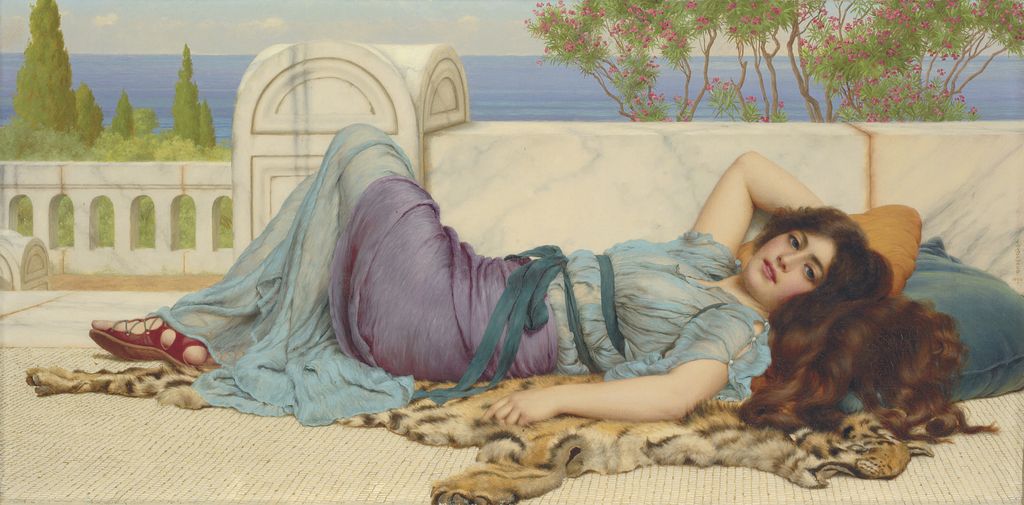
John William Godward, Mischief and Repose (1909). The later version gives the full width of the picture to a single reclining figure. Image source. Public domain.
Annotated Details from Mischief and Repose
The numbered points identify visible features discussed in this article. Return from each detail to the numbered overview. Each caption identifies the work shown.
Mischief and Repose (1895)
John William Godward, Mischief and Repose (1895). J. Paul Getty Museum. Image source. CC0 / Public domain.
.jpg)
Mischief and Repose (1909)
John William Godward, Mischief and Repose (1909). The later version gives the full width of the picture to a single reclining figure. Image source. Public domain.
.jpg)
Details from MISCHIEF AND REPOSE
Compare the cropped details with the source images above. Notice how their colours, shapes and positions contribute to the larger compositions.
Mischief and Repose (1895)
The slender pin and sleeping face
The loose tip of the pin points towards the sleeping woman’s face. The painted gap is part of the joke.
 Detail 01 the-slender-pin-and-sleeping-face.jpg)
Skin on the ledge
The bands of the tiger skin follow the ledge before the fur drops over its edge.
 Detail 02 skin-on-the-ledge.jpg)
The patterned floor
Fine lines divide the paving. Their geometry makes a foil for the loose edges of the fur.
 Detail 03 the-patterned-floor.jpg)
Mischief and Repose (1909)
Arm and cushion
The arm rises beside the face and the cushion supports the head. A single figure fills the long format.
 Detail 04 arm-and-cushion.jpg)
The legs under the folds
A raised knee interrupts the nearly level body and sends folds of colour down towards the ground.
 Detail 05 the-legs-under-the-folds.jpg)
A skin spread beneath the sitter
The skin spreads low across the ground and keeps its broad pattern beneath the quieter drapery.
 Detail 06 a-skin-spread-beneath-the-sitter.jpg)
John William Godward artworks directory
Search documented oil paintings, drawings, watercolours and reproductive prints. The directory includes the Art Renewal Center’s catalogue and additional works in museum, exhibition and sale records.
| Name | Date | Medium |
|---|---|---|
| Absence Makes the Heart Grow Fonder | 1912 | Oil on canvas |
| Amaryllis | 1903 | Oil on canvas |
| An Amateur | 1915 | Oil on canvas |
| Ancient Pastimes | 1916 | Oil on canvas |
| The Answer | 1917 | Oil on canvas |
| An Arcadian Beauty | 1899 | Painting |
| At the Fountain | 1893 | Oil on canvas |
| At the Garden Door | 1901 | Oil on canvas |
| At the Garden Shrine, Pompeii | 1892 | Oil on canvas |
| At the Gate of the Temple | 1898 | Oil on canvas |
| At the Thermae | 1909 | Oil on canvas |
| Atalanta | 1892 | Oil on canvas |
| Athenais | 1908 | Oil on canvas |
| An Auburn Beauty | 1895 | Oil on canvas |
| Autumn | 1900 | Oil on canvas |
| Beauty in a Marble Room | 1894 | Oil on canvas |
| The Belvedere | 1913 | Oil on canvas |
| The Betrothed | 1892 | Oil on canvas |
| The Betrothed (print after Godward) | 1893 | Photoengraving, as reported |
| The Bouquet | 1899 | Oil on canvas |
| Briseis | 1896 | Painting |
| The Broken Vase | 1889 | Oil on canvas |
| By the Blue Ionian Sea | 1916 | Oil on canvas |
| By the Wayside | 1912 | Oil on canvas |
| Byrsina | 1915 | Painting |
| Campaspe | 1896 | Oil on canvas |
| Campaspe (print after Godward) | Print, process unconfirmed | |
| Chloris (A Summer Rose) | 1902 | Oil on canvas |
| Classical Beauty | Oil on canvas | |
| A Classical Beauty | Oil on canvas | |
| A Classical Beauty | Painting | |
| A Classical Beauty | Oil on canvas | |
| A Classical Beauty | 1909 | Oil on canvas |
| A Classical Beauty In Profile | Oil on canvas | |
| A Classical Lady | 1908 | Oil on canvas |
| Clymene | 1892 | Oil on canvas |
| A Congenial Task | 1915 | Oil on canvas |
| Contemplation | 1922 | Oil on canvas |
| A Cool Retreat | 1910 | Oil on canvas |
| Country House in the 18th Century | c. 1883 | Oil on canvas |
| Cytheris | 1922 | Painting |
| The Day Dream | 1920 | Oil on canvas |
| The Delphic Oracle | 1899 | Oil on canvas |
| A Dilettante | 1922 | Oil on canvas |
| Distant Thoughts | 1918 | Oil on canvas |
| Dolce Far Niente | 1897 | Oil on canvas |
| Dolce Far Niente | 1906 | Oil on canvas |
| Dolce far niente (A Pompeian Fishpond) | 1904 | Oil on canvas |
| Dolce far niente (coloured print after Godward) | Exhibited 1900 | Coloured print, exact process unconfirmed |
| Dolce far niente (grapes) | 1907 | Oil on canvas |
| Dora | 1887 | Oil on canvas |
| Drusilla | 1906 | Oil on canvas |
| An Edition de Luxe | 1920 | Oil on canvas |
| Eighty and Eighteen | 1898 | Oil on canvas |
| Endymion | 1893 | Oil on canvas |
| The Engagement Ring (horizontal composition) | 1888 | Oil on canvas |
| The Engagement Ring (upright composition) | c. 1891 | Oil on canvas |
| Erato at Her Lyre | Oil on canvas | |
| A Fair Reflection | 1915 | Oil on canvas |
| A Fair Reflection (Taber-Prang print) | By 1923 | Sepia artotype |
| Far Away Thoughts (circular sewing scene) | 1911 | Oil on canvas |
| Far Away Thoughts (left-facing profile) | 1892 | Oil on canvas |
| Far Away Thoughts (right-facing profile) | 1892 | Oil on canvas |
| Female Figure (probable Grecian Idyll study) | 1907 | Oil on board |
| Flabellifera | 1905 | Oil on canvas |
| Flabellifera (painted study) | c. 1905 | Oil study |
| Flabellifera (pencil study) | c. 1905 | Pencil on paper |
| The Flower Girl | Painting | |
| A Flower Seller | 1896 | Oil on canvas |
| The Flowers of Venus | 1890 | Oil on canvas |
| A Fond Farewell | 1918 | Watercolour |
| The Fragrant Rose | 1892 | Painting |
| The Fruit Vendor | 1917 | Oil on canvas |
| A Garland Seller | 1914 | Painting |
| Giotto Drawing from Nature | Painting | |
| Girl in Yellow Drapery | 1901 | Oil on canvas |
| Golden Hours | 1913 | Oil on canvas |
| A Grecian Girl | 1908 | Oil on canvas |
| Grecian Idyll | 1907 | Oil on canvas |
| A Grecian Lovely | 1909 | Oil on canvas |
| Grecian Reverie | 1889 | Oil on canvas |
| Grecian Reverie | 1889 | Oil on canvas |
| A Greek Beauty | 1905 | Oil on canvas |
| A Happy Awakening | 1903 | Oil on canvas |
| He Loves Me, He Loves Me Not | 1896 | Oil on canvas |
| A head and shoulders profile portrait of a young woman wearing a white tunic style blouse | c. 1889 | Painting |
| Head of a Girl (The Priestess) | 1896 | Oil on canvas |
| Heart on her Lips and Soul within her Eyes | 1904 | Painting |
| His Birthday Gift | 1889 | Oil on canvas |
| Ianthe | 1889 | Oil on canvas |
| An Idle Hour | 1890 | Oil on canvas |
| Idle Moments | 1895 | Oil on canvas |
| Idle Thoughts | 1898 | Oil on canvas |
| Idleness | 1900 | Oil on canvas |
| Il Dolce Far Niente (Pears print after Amaryllis) | 1906 | Chromolithograph |
| Il Dolce far niente (seated figure) | 1893 | Oil on canvas |
| In Expectation | c. 1892 | Oil on canvas |
| In Realms of Fancy | 1911 | Oil on canvas |
| In the Prime of the Summertime (Reverie) | 1914 | Oil on canvas |
| In the Tepidarium | 1913 | Oil on canvas |
| Innocent Amusements | 1891 | Oil on canvas |
| Ione | c. 1896-1898 | Oil on canvas |
| Ionian Dancing Girl | 1902 | Oil on canvas |
| Ismenia | 1908 | Oil on canvas |
| An Italian Beauty | 1897 | Oil on canvas |
| An Italian Girls' Head | 1902 | Oil on canvas |
| The Jewel Casket | 1900 | Oil on canvas |
| Julia | 1914 | Painting |
| Knuckle Bones | 1890 | Oil on canvas |
| La Pensierosa | 1913 | Oil on canvas |
| A Lady | 1895 | Oil on canvas |
| Landscape: Blossoming Red Almond [study] | c. 1912 | Oil on panel |
| Le Billet Doux (The Love Letter) | 1913 | Oil on canvas |
| Leaning Against a Column | 1901 | Painting |
| Leaning on the Balcony | 1892 | Oil on canvas |
| Leisure Hours | 1905 | Oil on canvas |
| Lesbia with her Sparrow | 1916 | Oil on canvas |
| The Letter | 1899 | Painting |
| Liegende | 1893 | Oil on canvas |
| A Lily Pond | 1917 | Oil on canvas |
| Looking Out to Sea | 1918 | Pencil and watercolour |
| The Love Letter (circular composition) | 1907 | Oil on canvas |
| Lucilia | 1917 | Oil on canvas |
| Lycinna | 1918 | Oil on canvas |
| Marcella | 1912 | Painting |
| Matrona Superba | Oil on canvas | |
| Megilla | 1921 | Oil on canvas |
| A Melody | 1904 | Oil on canvas |
| Memories | c. 1891 | Oil on canvas |
| Mirinna | Painting | |
| The Mirror | 1899 | Oil on canvas |
| Mischief | 1905 | Oil on canvas |
| Mischief and Repose | 1895 | Oil on canvas |
| A Mouse in the Work Basket | 1893 | Oil on canvas |
| Nerissa | 1906 | Oil on canvas |
| The New Perfume | 1914 | Oil on canvas |
| Noon Day Rest | 1910 | Oil on canvas |
| Nu Sur La Plage | 1922 | Oil on panel |
| Nude Study | Oil on canvas | |
| An Offering to Venus | 1912 | Oil on canvas |
| The Old, Old Story | Oil on canvas | |
| The Old, Old Story | 1903 | Oil on canvas |
| On the Balcony | 1911 | Oil on canvas |
| On The Terrace | 1918 | Oil on canvas |
| Ophelia | Oil on panel | |
| The Peacock Fan | 1912 | Oil on canvas |
| Phyleis | 1908 | Oil on canvas |
| The Playground | 1892 | Oil on canvas |
| Playtime | 1891 | Oil on canvas |
| A Pompeian Bath | 1890 | Oil on canvas |
| A Pompeian Lady | 1891 | Oil on canvas |
| A Pompeian Lady | 1895 | Oil on board |
| A Pompeian Lady | 1901 | Painting |
| A Pompeian Lady | 1904 | Painting |
| Portrait of Mary Frederica 'Nin' Godward | c. 1882-1883 | Oil on canvas |
| Portrait of Mary Perkinton Godward | c. 1880-1881 | Watercolor |
| The Posy | 1900 | Painting |
| A Priestess (bare-shouldered figure) | 1893 | Oil on canvas |
| A Priestess (clothed composition) | 1894 | Oil on canvas |
| A Priestess (W. Biscombe Gardner after Godward) | Exhibited 1897 | Print, process unconfirmed |
| A Priestess of Bacchus | 1890-1890 | Oil on canvas |
| Pyrallis | 1918 | Oil on canvas |
| The Quiet Pet | 1906 | Oil on canvas |
| A Red, Red Rose | 1920 | Oil on canvas |
| Reflections | 1893 | Oil on canvas |
| The Rendezvous | 1903 | Oil on canvas |
| Repose, the Flower Girl | c. 1887 | Oil on canvas |
| Reverie | 1888 | Oil on panel |
| Reverie | 1912 | Oil on canvas |
| Reverie (In the Days of Sappho) | 1904 | Oil on canvas |
| Reverie (Pears print after In the Prime of the Summertime) | 1916 | Chromolithograph |
| 'Rich Gifts Wax Poor When Lovers Prove Unkind' | 1916 | Oil on canvas |
| The Ring | 1898 | Oil on canvas |
| A Roman Matron | 1905 | Oil on canvas |
| Sabinella | 1912 | Oil on canvas |
| Sappho | 1910 | Oil on canvas |
| The Siesta | Oil on canvas | |
| A Siesta | 1895 | Oil on canvas |
| The Signal | 1899 | Oil on canvas |
| Sitting for Her Portrait | 1893 | Oil on canvas |
| Sketch for Amaryllis | 1903 | Oil on board |
| A Souvenir | 1920 | Oil on canvas |
| Stesicrate | 1914 | Oil on canvas |
| Study for 'Rêverie' | 1890 | Oil on canvas |
| Study for 'The Priestess' | 1895 | Oil on board |
| Study for An Egyptian Minstrel | 1906 | Painting |
| Study for The New Perfume | Drawing, medium unconfirmed | |
| Study for ‘The Old, Old Story’ | 1903 | Oil paint on wood |
| Study of a Girl's Head | 1899 | Painting |
| Study of Campaspe | Oil on canvas | |
| Study of Head and Drapery, Miss Ethel Warwick | 1898 | Painting |
| Summer Day | 1897 | Painting |
| Summer Flowers | 1903 | Oil on canvas |
| Sweet Dreams | 1901 | Oil on canvas |
| Sweet Dreams | 1904 | Painting |
| The Sweet Siesta of a Summer's Day | 1891 | Oil on canvas |
| The Tambourine Girl (profile at the marble wall) | 1906 | Oil on canvas |
| The Tambourine Girl (relief-backed version) | 1906 | Oil on canvas |
| Tender Thoughts | 1917 | Oil on canvas |
| Tender Thoughts (woman leaning over a parapet) | 1918 | Pencil and watercolour |
| The Tiff (oil) | By 1888 | Oil on canvas |
| The Tiff (print after Godward) | 1894 | Photogravure |
| The Tigerskin | 1889 | Oil on canvas |
| The Time of Roses | 1916 | Oil on canvas |
| Tranquillity | 1914 | Oil on canvas |
| A Tryst | 1912 | Oil on canvas |
| Tympanistria | 1909 | Oil on canvas |
| Under the Blossom that Hangs on the Bough | 1917 | Oil on canvas |
| Venus at the Bath | 1901 | Oil on canvas |
| Venus Binding Her Hair | 1897 | Oil on canvas |
| Violets, Sweet Violets | 1906 | Painting |
| Waiting for an Answer | 1889 | Oil on canvas |
| Waiting for the Procession | 1890 | Oil on canvas |
| Waiting for the Procession | 1890 | Painting |
| The Water Carrier (magazine reproduction of At the Fountain) | 1898 | Magazine reproduction |
| When the Heart is Young | 1902 | Oil on canvas |
| Who Can They Be | Painting | |
| Winding Wool | 1894 | Painting |
| 'With Violets Wreathed and Robe of Saffron Hue' | 1902 | Oil on canvas |
| The Yellow Shawl | 1893 | Painting |
| 'Yes or No?' | 1893 | Oil on canvas |
| Young Girl Picking Grapes | 1902 | Oil on canvas |
| Youth and Time | 1901 | Oil on canvas |
Discussion
Look again at the images and ideas explored in Mischief and Repose by John William Godward. These editorial prompts invite your observations.
Reader Insights
When did you first spot the dress pin?
How do the two figures distribute the action across the wide canvas?
Join the Conversation
Share a detail, comparison or question about Mischief and Repose by John William Godward below.
References
- J. Paul Getty Museum. Mischief and Repose, 1895, 79.PA.149. Collection record, image, provenance and exhibition history. View source.
- Christie’s. Mischief and Repose, signed 1909, London sale of 11 December 2008, lot 39. Plate and catalogue entry. View source.
- Waiting for an Answer. View source.
- The Engagement Ring. View source.
- The Betrothed. View source.
- Far Away Thoughts. View source.
- Le Billet Doux (The Love Letter). View source.
- J. Paul Getty Museum. “Decadence”, The Last Days of Pompeii. Getty Villa exhibition interpretation and historical caption. View source.
- The Metropolitan Museum of Art, Department of Greek and Roman Art. “Ancient Greek Dress”. Description of the chiton and its fastenings. View source.
- The Metropolitan Museum of Art. Gold pin, East Greek, accession 1977.11.10. View source.
- Sotheby’s and Simon Parkes Art Conservation. The Quiet Pet, signed 1906, 2012 sale N08847, lot 80. Plate, catalogue and historical condition report. View source.
- Royal Academy of Arts. The Exhibition of the Royal Academy, 1895. Gallery IV, no. 304, Gallery VI, no. 472, and exhibitor index. View source.
- Pamela Fletcher and David Israel, Bowdoin College. “Lefevre Gallery”, Victorian London: Mapping the Emergence of the Modern Art Gallery. View source.
- Getty Research Institute. Mischief and Repose, Cultural Objects Name Authority, 700002121. Alternate title and object identifiers. View source.
- J. Paul Getty Museum. Reverie, 1904, 79.PA.150. View source.
- J. Paul Getty Museum. Picturing the Ancient World: Antique Revival Paintings, exhibition press release, 12 April 1993. View source.
- J. Paul Getty Museum. The Last Days of Pompeii. Exhibition overview. View source.
- Archaeological Park of Pompeii. Guida agli scavi di Pompei, p. 108. Casa dei Mosaici Geometrici. View source.