 by Tom Gurney
Tom Gurney BSc (Hons) is an art history expert with over 20 years experience
Published on June 19, 2020 / Updated on November 25, 2026
Email: tomgurney1@gmail.com / Phone: +44 7429 011000
An Angel Playing a Flageolet: Introduction
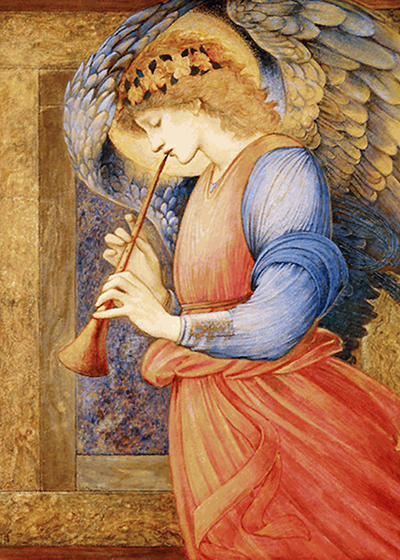
Edward Burne-Jones signed and dated An Angel Playing a Flageolet in 1878. The watercolour, heightened with bodycolour and gold, measures 74.9 by 61.2 centimetres and belongs to National Museums Liverpool at Sudley House (WAG 192). It is also known as Angel with Pipe. The design grew out of a musical angel Burne-Jones had drawn the previous year for a stained-glass window at Christ Church Cathedral, Oxford. In the painting, the musician has the picture to itself. The hands, the halo and the overlapping feathers can be studied at a distance that the window's high tracery would scarcely allow. [1]
At a Glance
- ArtistEdward Burne-Jones
- Date1878
- MediumWatercolour, bodycolour and gold
- SubjectMusician angel
This work across Edward Burne-Jones’s career
The Mirror of Venus
1870sThe Wheel of Fortune
1875–83The Last Sleep of Arthur in Avalon
1880s–1898The Star of Bethlehem
Signed 1890Contents
- The angel and the pipe
- From the cathedral window to the painting
- The gold, the feathers and the other musical angels
- From the artist to Sudley House
The angel and the pipe
The pipe leads the eye from the angel's lips down to the left, cutting across the upright lines of the painted surround. Its mouthpiece is scarcely wider than a line, but it opens into a bell below the hands. The lower hand curves across the shaft, and the fingers of the upper hand rise and fall along its other side. That slight separation of the fingers suggests a tune in progress. The lowered eyes and bent head make it seem as though the angel is attending to the sound it produces. A crown of orange flowers follows the curve of the hair, just inside the larger circle of the halo. [2]
The word flageolet covers a family of duct flutes related to the recorder. In a duct flute a channel directs the player's breath towards a sharp edge, and the player changes notes by covering or uncovering holes. Historical flageolets vary in the placement of their holes and in the presence of keys, as music historian Douglas MacMillan shows in his study of the instrument. Burne-Jones gives the pipe enough detail to make the act of playing convincing. The title supplies a name for the instrument, while the painted view, with the hands partly covering the shaft, leaves its precise construction open. [3]
The wings take up almost as much room as the angel. One curves over the crown of flowers and down alongside the halo. The other spreads behind the shoulder and continues out of the picture at the upper right. At the edge of the halo the feathers are small and pale, while those behind the shoulder are longer and darker. Their changing scale draws the eye around the head and back to the musician's hands. Below, the blue sleeve tightens into a band at the elbow and ends in a narrow cuff. The strokes running along the sleeve and the warm lines picking out the folds of the rose-coloured robe give the two fabrics different rhythms. [2]
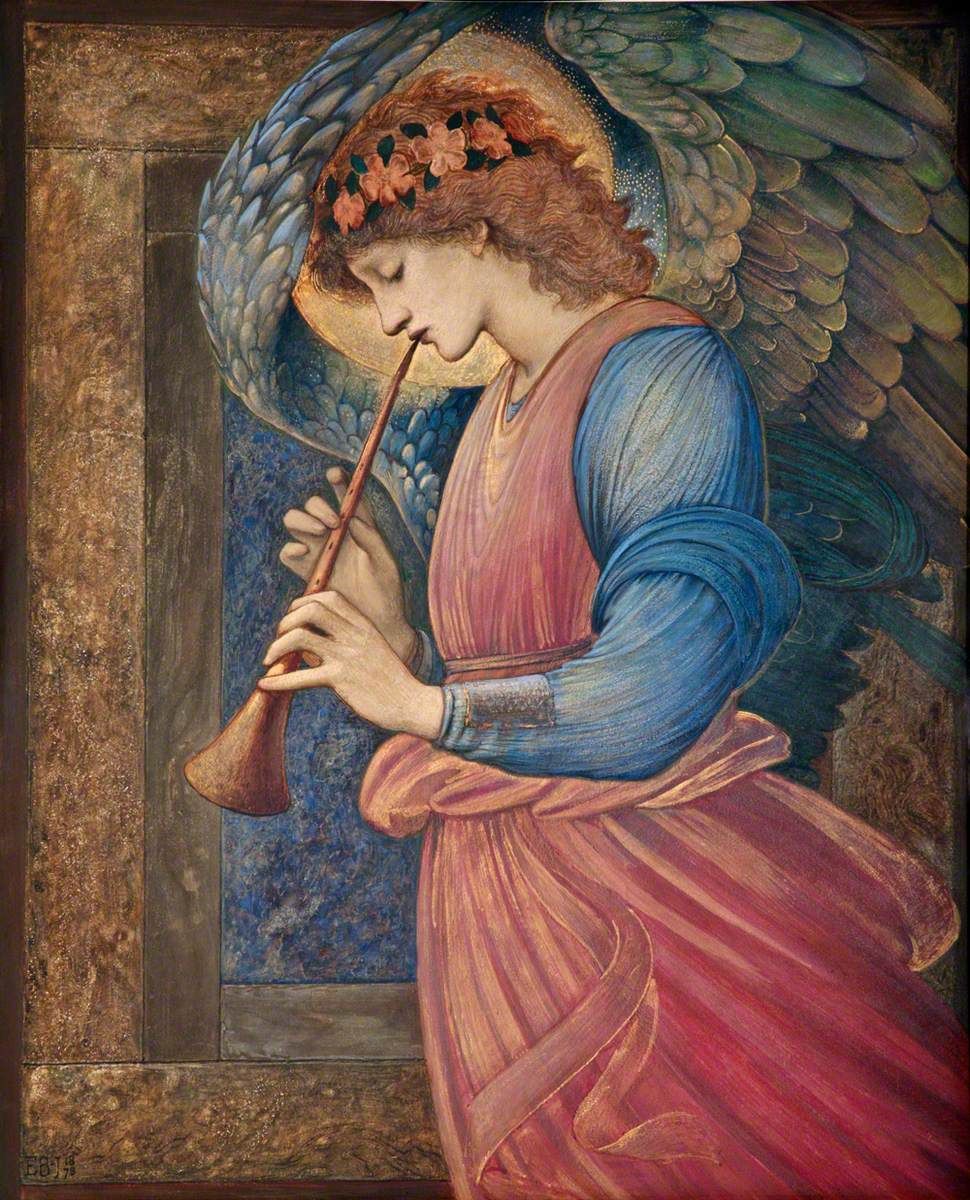
Edward Burne-Jones, An Angel Playing a Flageolet. Sudley House, National Museums Liverpool, WAG 192. Image source. Public domain.
From the cathedral window to the painting
The flageolet player belonged to a group of three musicians in the patterned openings above the main panels of the St Catherine window, at the east end of the south choir aisle in the Regimental Chapel at Christ Church. The window commemorates Edith Liddell, a daughter of the dean. St Catherine occupies the middle of the three main lights, with the Angel of Victory and the Angel of Suffering to either side. The three panels underneath show episodes from Catherine's legend. Seen in the window, the musicians crown a much larger composition. Their designs came first in the work for the Morris firm. Burne-Jones entered the three tracery angels in his account book in November 1877 at £6 each. The accounts for the principal lights and the narrative panels followed in 1878. [1] [4]
Burne-Jones had been fitting angel musicians into church windows since the early years of his work with William Morris. At St Michael and All Angels in Lyndhurst, Hampshire, six half-length musicians occupy the three-lobed openings high in the east window. The glass below them depicts the New Jerusalem, with apostles, the three Marys and further angel musicians. Burne-Jones prepared designs for this window in 1862 and 1863. Lyndhurst shows how early he learned to turn a head, shoulders and an instrument into a clear silhouette within a small architectural opening. The closest documented design for the Liverpool painting comes from the later Oxford commission. [5]
In the stained-glass windows, Burne-Jones supplied designs and the Morris firm translated them into glass. The Liverpool work is a signed painting, with a marble-like surround painted into the composition. The hard vertical inside edge to the left holds the figure in place, while the sleeve, wing and flare of the robe press against the sides. William Waters has suggested that the Liverpool sheet could be one of the original cartoons, the working drawings for the glass, subsequently painted over by Burne-Jones and an assistant. That remains a proposal about the physical sheet. The relationship between the designs is clearer than the route by which the paper became a finished painting. [1]
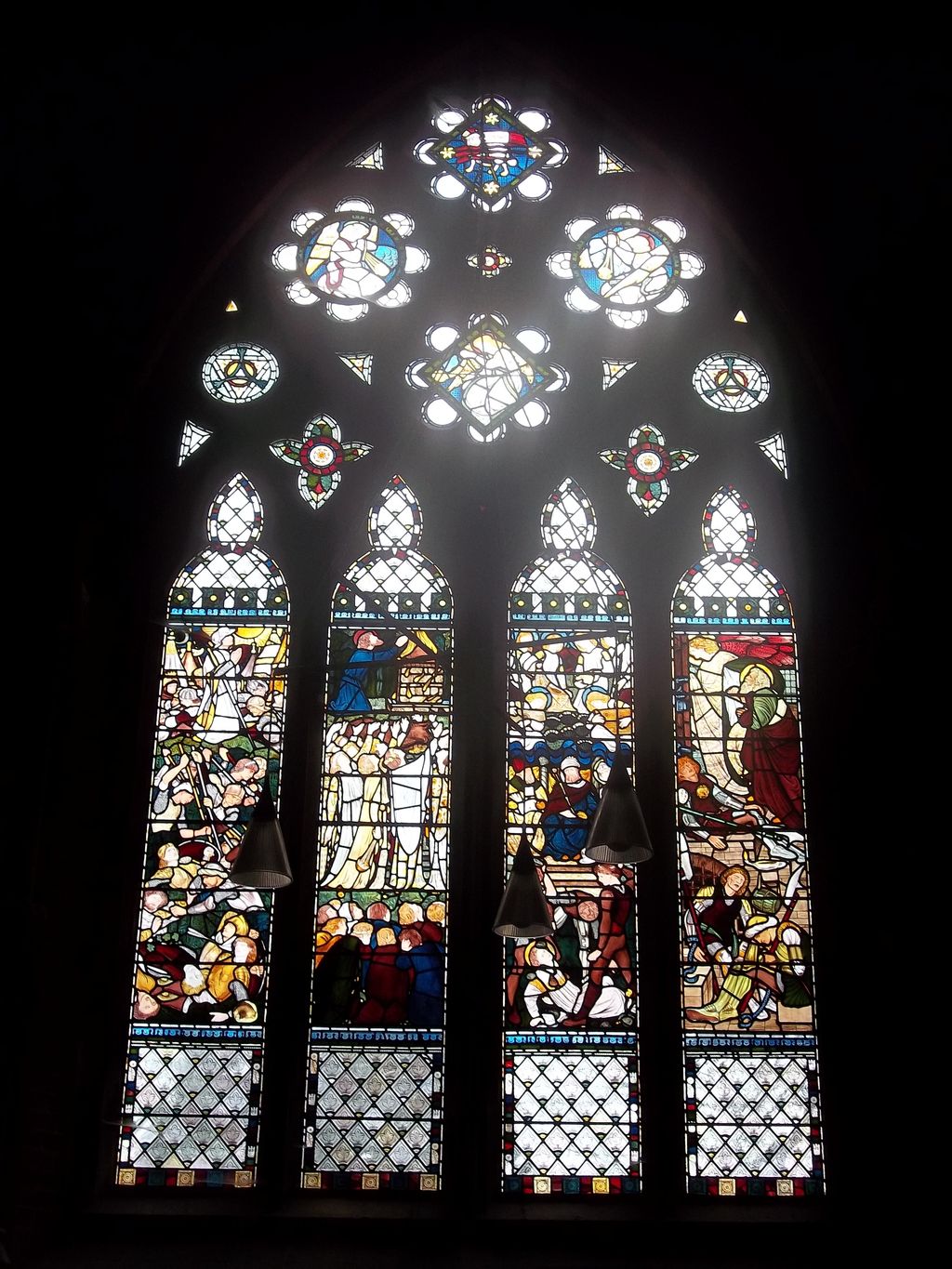
Answers to Prayer, south transept window, St Michael and All Angels, Lyndhurst. Morris, Marshall, Faulkner & Co., with figure design by Edward Burne-Jones and other contributions by Dante Gabriel Rossetti, Philip Webb and William Morris. Image source. CC0 / Public domain.
The gold, the feathers and the other musical angels
Bodycolour is opaque watercolour. It allows pale marks to stand out over darker areas, whereas a transparent wash relies more on light reflected from the paper beneath it. The Liverpool picture combines watercolour and bodycolour with gold. Look at the difference between the concentrated gold of the halo and the fine warm accents that run through the drapery. One gives the head a luminous ground. The others carry light along the turns of the fabric and around the knot at the waist. A photograph shows the placement of those accents more readily than it conveys how metallic highlights respond when the viewer or the light moves. [1] [2] [6]
Stephen Wildman points to an undated sketchbook at Wightwick Manor in which Burne-Jones noted the changing colours of angels' wings in the Douce Apocalypse, an English illuminated manuscript made around 1265–70 and now in Oxford's Bodleian Library. His notes follow a sequence from black through brown and muted red to various pale tones. They show how closely he could attend to the organisation of colour within a single wing. The Liverpool painting invites a similar kind of looking, from the dark tips of the longer feathers to the small highlights that define their edges. The sketchbook establishes a strand of his study of medieval art, while the precise source of the painted wings remains open. In another context, Oscar Wilde recalled Burne-Jones speaking of angels' wings as an affirmation of the immortality of the soul. The wings could carry spiritual meaning for the artist and still demand close, practical attention as forms to be painted. [1] [7] [8]
A related work in Kansas City shows how much Burne-Jones could change the format while returning to this subject. The Nelson-Atkins Museum's Musical Angel is a tall, full-length figure in gouache on joined sheets of paper, holding a violin and a palm. The figure corresponds to the right-hand light of the cathedral's separate St Cecilia window. The palm refers to martyrdom, and the violin is held upright instead of played. Yet the framing stonework, layered wings and closely spaced drapery invite comparison with the Liverpool picture. Wildman also records a related image of an angel with cymbals against a similar surround. [1] [9]
The Glasgow Museums painting The Angel offers an even closer comparison in subject. It is a much smaller oil on panel, dated 1881, with the musician turned to the right. Burne-Jones's work list records three small oil panels of angels and larger watercolours of the same figures under that year. The date on the Liverpool sheet places it three years earlier, so the entry cannot securely identify WAG 192. The recurrence of the pipe player shows how readily a figure could travel between formats in Burne-Jones's work. Its scale, direction and materials are the quickest ways to distinguish the Glasgow oil from the Liverpool watercolour. [1] [10]
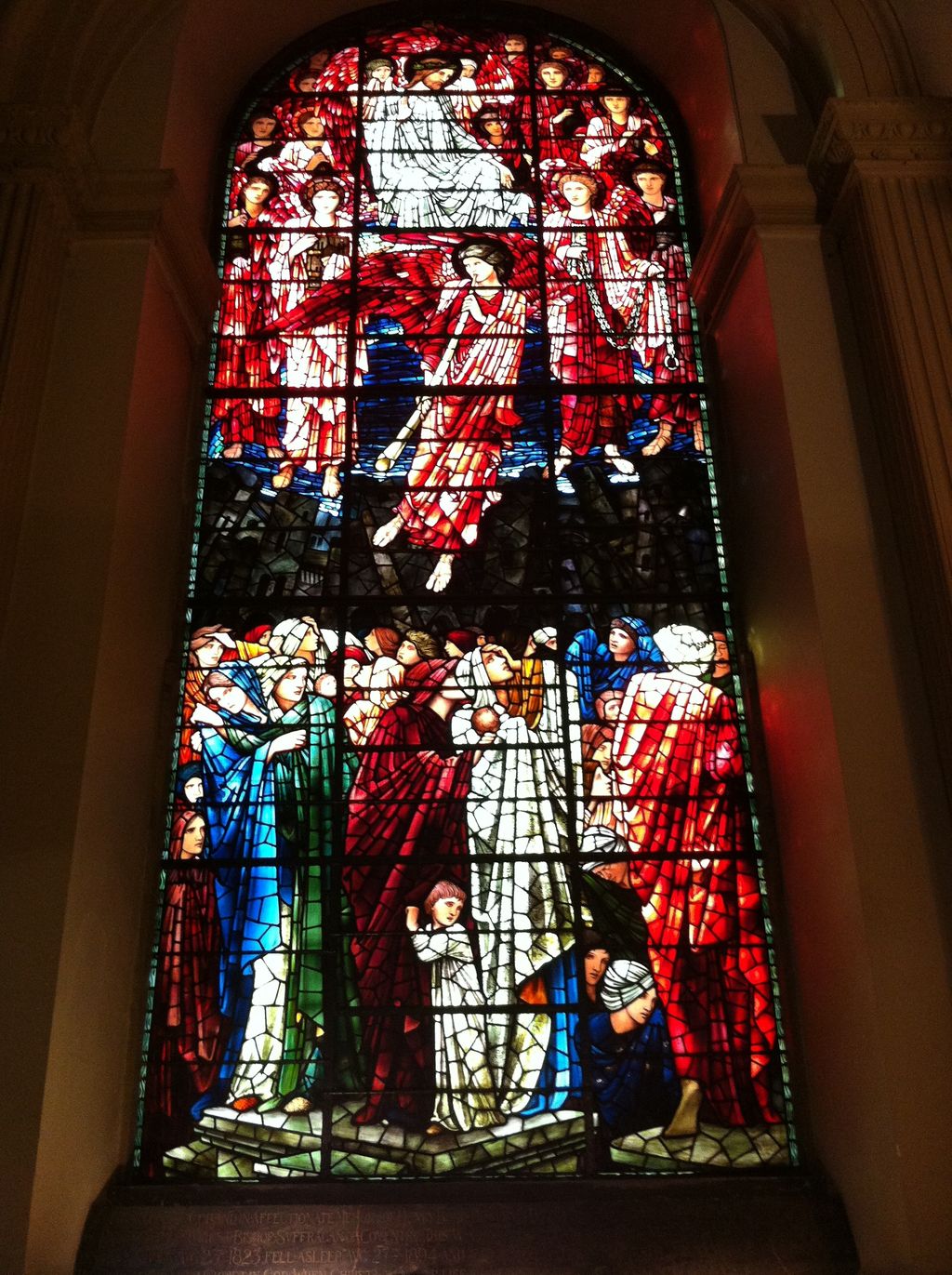
The Last Judgement, the west window at Birmingham Cathedral, designed by Edward Burne-Jones and made by Morris & Co. Photograph by Andrewrabbott. Image source. CC BY-SA 3.0. Resized for the web, under the same licence.
From the artist to Sudley House
Thomas Agnew & Sons bought the watercolour from Burne-Jones in 1888 and sold it to George Holt of Liverpool in 1889. It passed to Holt's daughter Emma, whose 1944 bequest brought the picture into Liverpool's public collection. Sudley House preserves the setting in which the Holt family assembled and lived with its collection. The painting also travelled as a loan in the Burne-Jones centenary exhibition staged in New York and Birmingham in 1998 and at the Musée d'Orsay in Paris in 1999. Those exhibition records identify the Liverpool sheet through its lender and accession, useful distinctions given the repeated figure and similar titles. [1] [11] [12]
National Museums Liverpool curator Jessie Petheram has highlighted two paintings at Sudley House that are kept behind curtains, the Burne-Jones and Lawrence Alma-Tadema's Sunday Morning. Covering a watercolour between viewings reduces its cumulative light exposure, which can fade colours and alter the appearance of paper. It is a reversal of the conditions under which the design first took shape. At Christ Church, the figure was made to be seen with light passing through the glass. At Sudley House, the colours depend on light falling on the painted surface, and the curtain helps preserve them for the next viewer. [13] [6]
Edward Burne-Jones on film
Explore Burne-Jones’s paintings, illustrated stories and stained-glass designs.
Edward Burne-Jones: Pre-Raphaelite Visionary | Exhibitions | Showcase
A look at Burne-Jones’s paintings and the Tate retrospective.
Watch on YouTubeArtworks directory
This directory records paintings, studies, designs and collaborative works, with separate entries for documented versions and series where known.
| Name | Date | Medium |
|---|---|---|
| Sidonia von Bork 1560 | 1860 | Watercolour and bodycolour |
| Clara von Bork 1560 | 1860 | Watercolour and bodycolour |
| The Merciful Knight | 1863 | Watercolour |
| Sibylla Delphica | c. 1886 | Oil on panel |
| Phyllis and Demophoön | 1870 | Watercolour and bodycolour |
| The Legend of the Briar Rose (Buscot series) | 1870s–1890 | Oils on canvas |
| The Briar Wood (Buscot series) | By 1890 | Oil on canvas |
| The Council Chamber (Buscot series) | By 1890 | Oil on canvas |
| The Garden Court (Buscot series) | By 1890 | Oil on canvas |
| The Rose Bower (Buscot series) | By 1890 | Oil on canvas |
| Group of Women, study for The Golden Stairs | 1872 | Drawing |
| The Beguiling of Merlin | 1870s | Oil on canvas |
| The Perseus Cycle | From 1875 | Paintings and full-scale designs |
| The Call of Perseus (Stuttgart) | From 1875 | Oil painting |
| Perseus and the Graeae (Stuttgart) | From 1875 | Oil painting |
| The Rock of Doom (Stuttgart) | 1884–88 | Oil on canvas |
| The Doom Fulfilled (Stuttgart) | 1888 | Oil on canvas |
| The Baleful Head (Stuttgart) | 1885–87 | Oil on canvas |
| The Baleful Head (Southampton design) | 1880s | Bodycolour |
| The Rock of Doom (Southampton design) | 1880s | Bodycolour |
| The Doom Fulfilled (Southampton design) | 1880s | Bodycolour |
| The Mirror of Venus (Gulbenkian) | 1870s | Oil on canvas |
| Drawing associated with The Mirror of Venus | 1870s | Drawing |
| Laus Veneris (Laing) | 1873–78 | Oil on canvas |
| The Days of Creation | 1870s | Watercolour and bodycolour |
| The Golden Stairs | 1880 | Oil on canvas |
| An Angel Playing a Flageolet | 1878 | Watercolour, bodycolour and gold |
| The Tree of Forgiveness | 1881–82 | Oil on canvas |
| The Wheel of Fortune (Orsay) | 1875–83 | Oil on canvas |
| King Cophetua and the Beggar Maid | 1884 | Oil on canvas |
| The Depths of the Sea (oil) | 1886 | Oil |
| The Morning of the Resurrection | 1886 | Oil on panel |
| Study for the Head of Mary Magdalene | c. 1882 | Oil study |
| The Sleep of King Arthur in Avalon | 1880s–1898 | Oil on canvas |
| The Sleep of King Arthur in Avalon (modello) | ca. 1881 | Oil on canvas (modello) |
| The Star of Bethlehem | Signed 1890 | Watercolour and bodycolour |
| Study for The Star of Bethlehem | About 1887–91 | Drawing |
| Sponsa de Libano | 1891 | Watercolour and bodycolour |
| The Summons (Holy Grail tapestries) | 1890s | Tapestry |
| The Failure of Sir Gawaine (Holy Grail tapestries) | 1890s | Tapestry |
| Hope (Boston) | 1896 | Oil on canvas |
| La Belle au bois dormant (theatre programme) | 1894 | Collotype |
| The Wedding of Psyche | 1895 | Oil on canvas |
| The Works of Geoffrey Chaucer (Kelmscott edition) | 1896 | Illustrated book |
| The Ascension (Birmingham Cathedral) | 1885 | Stained glass |
| The Last Judgement (Birmingham Cathedral) | 1897 | Stained glass |
| Adoration of the Magi (Huntington) | 1890s | Tapestry |
| Love among the Ruins (Wightwick) | 1894 | Oil on canvas |
| The Merciful Knight (photogravure after Burne-Jones) | 1900 | Photogravure |
| The Garden Court (preparatory work) | 1870–75 | Graphite and watercolour with white gouache |
| Study of a Female Figure | 1885 | Graphite drawing |
| Psyche Throwing Herself into the River | 1865–68 | Wood engraving |
| Beauty | 1887–89 | Colour lithograph |
| Study for the Failure of Gawain | 1893 | Crayon and graphite on Japanese paper |
| The Prince Enters the Briar Wood (after Burne-Jones) | After 1890 | Photogravure |
| The Rose Bower (after Burne-Jones) | 1892 | Photogravure |
| Adoration of the Magi (Musée d’Orsay) | 1904 | Tapestry |
| Answers to Prayer (Lyndhurst) | 1860s | Stained glass |
| The Depths of the Sea (photogravure after Burne-Jones) | 1900 | Photogravure |
| Perseus and Andromeda (Adelaide composite) | 1876 | Oil on canvas |
| The Adoration of the Magi (Hamburg) | Woven 1900 | Tapestry |
| Love leading the Pilgrim through the Briars | 1874–76 | Embroidery |
| Musica (worked by Lady Jane Cory) | 1906 | Embroidery |
| Pomona (worked by Lady Jane Cory) | 1907 | Embroidery |
| Flora (worked by Lady Jane Cory) | 1909 | Embroidery |
| The Fourth Day of Creation (photogravure after Burne-Jones) | 1900 | Photogravure |
| The Morning of the Resurrection (photogravure after Burne-Jones) | 1900 | Photogravure |
| Musical angels of the St Catherine window (Christ Church) | Designed 1877 | Stained glass |
Discussion
Look again at the images and ideas explored in An Angel Playing a Flageolet. These editorial prompts invite your observations.
Reader Insights
How does the angle of the instrument change the way you read the angel’s pose?
What changes when you compare the angel’s tilted head in paint with the figures in glass?
Join the Conversation
Share a detail, comparison or question about An Angel Playing a Flageolet below.
References
- Burne-Jones Catalogue Raisonné, An Angel Playing a Flageolet (Angel with Pipe), WAG 192, Stephen Wildman's catalogue entry, William Waters's commentary, provenance and exhibition history. View source.
- National Museums Liverpool via Art UK, Angel Playing a Flageolet, WAG 192, collection photograph indexed by accession. View source.
- Douglas MacMillan, The Flageolet Prior to 1660, opening discussion of duct flutes and variation in tone holes and keywork. View source.
- Christie's, St Catherine disputing with the pagan philosophers, lot essay on the Christ Church window and the Morris account-book entries. View source.
- Burne-Jones Catalogue Raisonné, The Battle of Beth-Horon, exhibition catalogue entry on the Lyndhurst east window and design chronology. View source.
- Canadian Conservation Institute, Caring for paper objects, sections on watercolour, gouache and light exposure. View source.
- Bodleian Libraries and Biblissima, Oxford. Bodleian Library, MS. Douce 180, shelfmark, date and digitisation record. View source.
- Oscar Wilde, The English Renaissance of Art, New York lecture of 9 January 1882, recollection of Burne-Jones's remark on painting angels. View source.
- Nelson-Atkins Museum of Art, Musical Angel, F59-59, gallery label, medium and description. View source.
- Glasgow Museums, The Angel, 1742, signed-work chronology, medium and dimensions. View source.
- National Museums Liverpool, Strategic Plan 2019–20, Sudley House profile and Holt family collection. View source.
- The Metropolitan Museum of Art, Edward Burne-Jones: Victorian Artist-Dreamer, exhibition catalogue, cat. 102, pp. 237–38. View source.
- National Museums Liverpool, The hidden watercolours of Sudley House, curatorial display account by Jessie Petheram. View source.