 by Tom Gurney
Tom Gurney BSc (Hons) is an art history expert with over 20 years experience
Published on June 19, 2020 / Updated on November 25, 2026
Email: tomgurney1@gmail.com / Phone: +44 7429 011000
Edward Burne-Jones Quotes: Introduction
Edward Burne-Jones called his vast painting of Arthur in Avalon his “chief dream” in a letter from the autumn of 1882. On the same page of her 1904 Memorials, his wife Georgiana quotes another letter in which he insists that beauty can soften, comfort and stir people into life. The two passages bring together an ambition for a particular painting and a conviction about what art could do for the person looking at it. [1]
The painter’s letters range from private anxieties to jokes about visiting Italian churches. In Oscar Wilde’s public account of a conversation, Burne-Jones sounds altogether more combative. The words other people wrote about him open up another set of questions, including why one viewer admired the very qualities another thought made his figures unnatural.
At a Glance
- ArtistEdward Burne-Jones
- FocusLetters and recollections
- ExploreSpeaker, source, date and context
Contents
- Beauty as a consolation
- What Burne-Jones meant by a picture
- Six inches above our heads
- The angels in Oscar Wilde’s lecture
- Freda Stanhope on work and colour
- Dante Gabriel Rossetti on the early drawings
- Robert de La Sizeranne on the grace of the figures
- Vladimir Stasov on the romantic dream
Beauty as a consolation
“beauty is very beautiful, and softens, and comforts, and inspires, and rouses, and lifts up, and never fails.” — Edward Burne-Jones, letter excerpt in Georgiana Burne-Jones’s Memorials, volume II, p. 125 [1]
At the start of the letter excerpt, Burne-Jones declares himself to have no politics, party or particular hope. Georgiana places the passage alongside other remarks about public affairs. Nearby, she describes the couple’s efforts to urge the government to secure works from the Duke of Hamilton’s collection for the National Gallery. They wrote letters and copied appeals. In that company, Burne-Jones’s declaration reads as a moment of discouragement caught in correspondence. Georgiana introduces it as something written on another occasion and leaves the addressee unspecified. [1]
“Comforts” matters to the movement of the sentence. The first actions are gentle. Then come the verbs that take more energy, as beauty inspires, rouses and lifts. A painting can give someone the relief of standing still for a few minutes and stir the same person into looking harder. Burne-Jones’s repetition of the word beauty sounds almost like someone reaching for an explanation and finding that the things beauty does are easier to name than the thing itself.
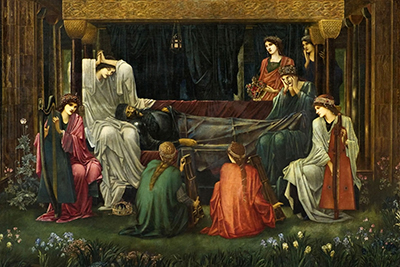
The Arthur letter supplies a particular case. Burne-Jones hoped that the canvas could contain what mattered most to him. His patron, George Howard, originally commissioned it for a library, but Burne-Jones kept working on it after Howard withdrew the commission. It remained unfinished at his death in 1898. In the painting, attention gathers around the motionless king while the surrounding figures keep their long watch. The scale that might have overwhelmed a moment of repose instead gives the viewer room to follow the different ways people wait. The Museo de Arte de Ponce catalogues the painting as The Sleep of King Arthur in Avalon, while the letter uses The Sleep of Arthur in Avalon. [1] [2]
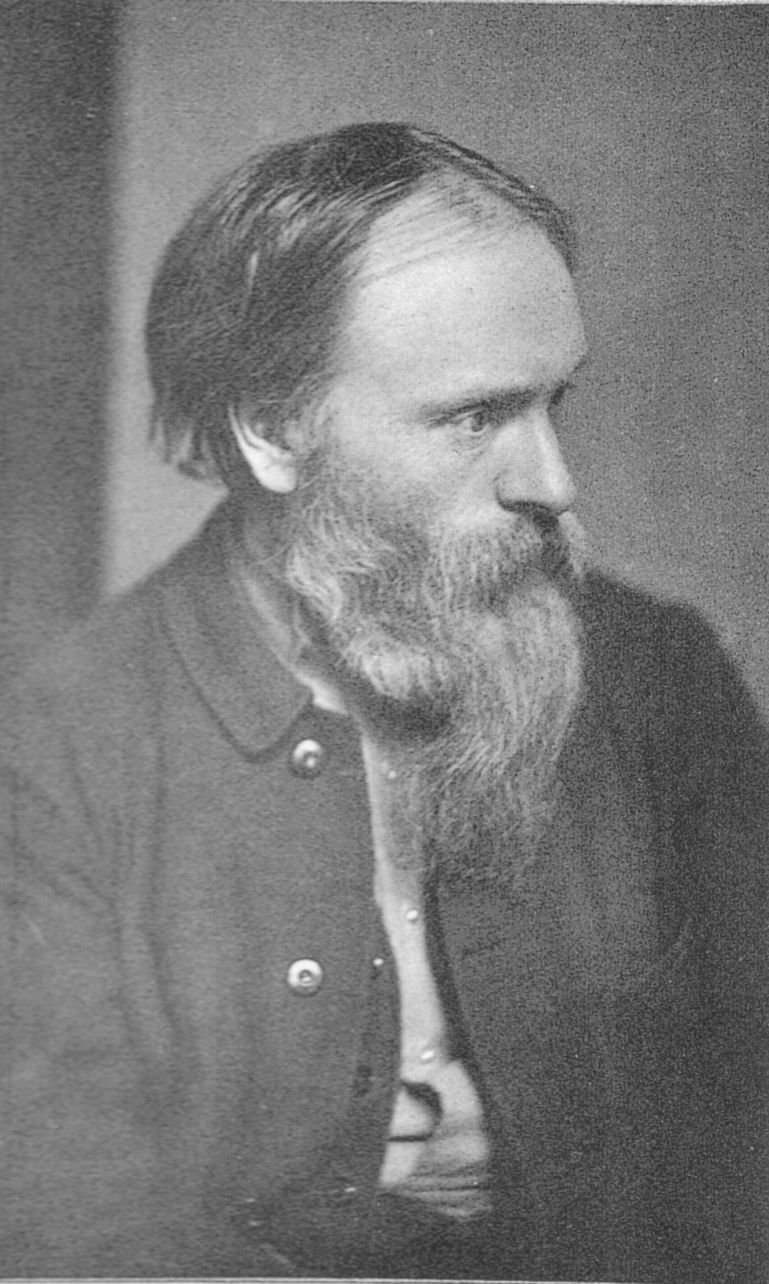
Frederick Hollyer, Portrait of Edward Burne-Jones, about 1882. Image source. Public domain.
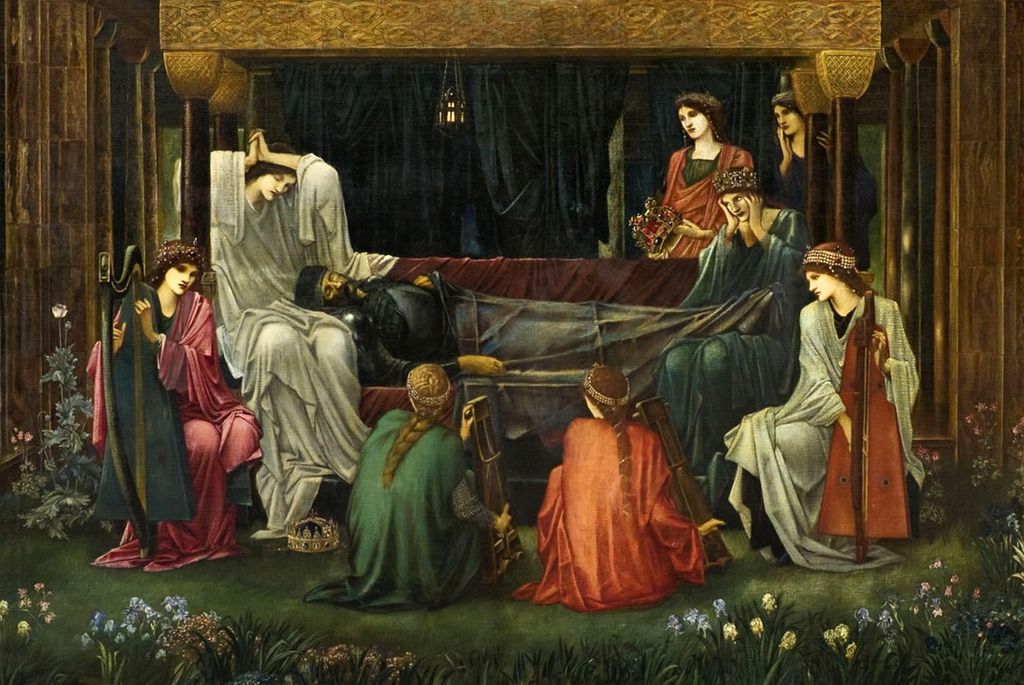
Detail of the figures around Arthur in The Sleep of King Arthur in Avalon. Museo de Arte de Ponce. Image source. Public domain.
What Burne-Jones meant by a picture
“I mean by a picture a beautiful romantic dream of something that never was, never will be” — Edward Burne-Jones, letter quoted in the Burlington Fine Arts Club’s 1899 exhibition catalogue [3]
The catalogue introduces this as a letter to a friend. It gives no date or recipient in the introduction. The passage goes on to imagine an extraordinary light, beautiful figures and a place the artist can long for without being able to locate it. Finally he wakes “with the waking of Brynhild.” There is no comma between beautiful and romantic in the catalogue, although some later versions add one. Ending the extract before the awakening can make the picture sound like a fantasy the artist wants to inhabit indefinitely. The ending gives the imagined experience a limit and lends a note of surprise to his return from it. [3]
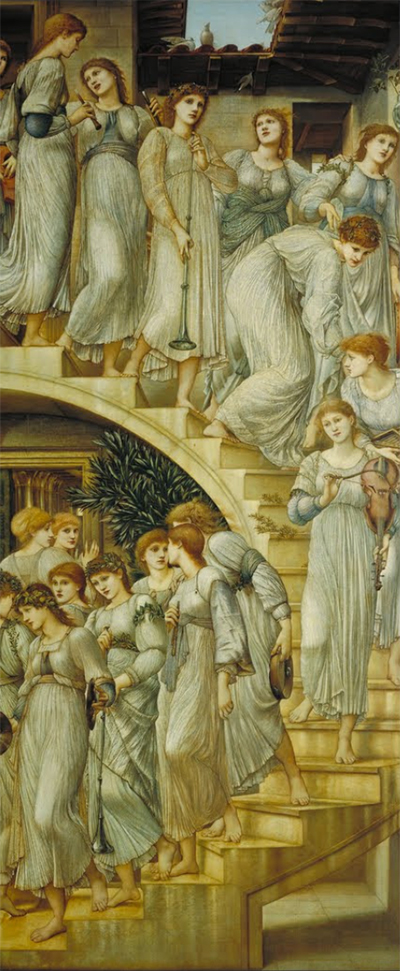
The Golden Stairs gives a way to see what such a picture might look like. A file of musicians descends a tightly turning staircase, their pale dresses catching light differently as they move past one another. Their instruments and glances hold the group together while leaving the occasion for the procession open. Viewers can trace the curve, compare the figures and imagine how the instruments would sound without having to settle on a story. The letter expresses a general idea of painting. The 1899 introduction gives no basis for identifying the passage as his description of this particular work. [3] [4]
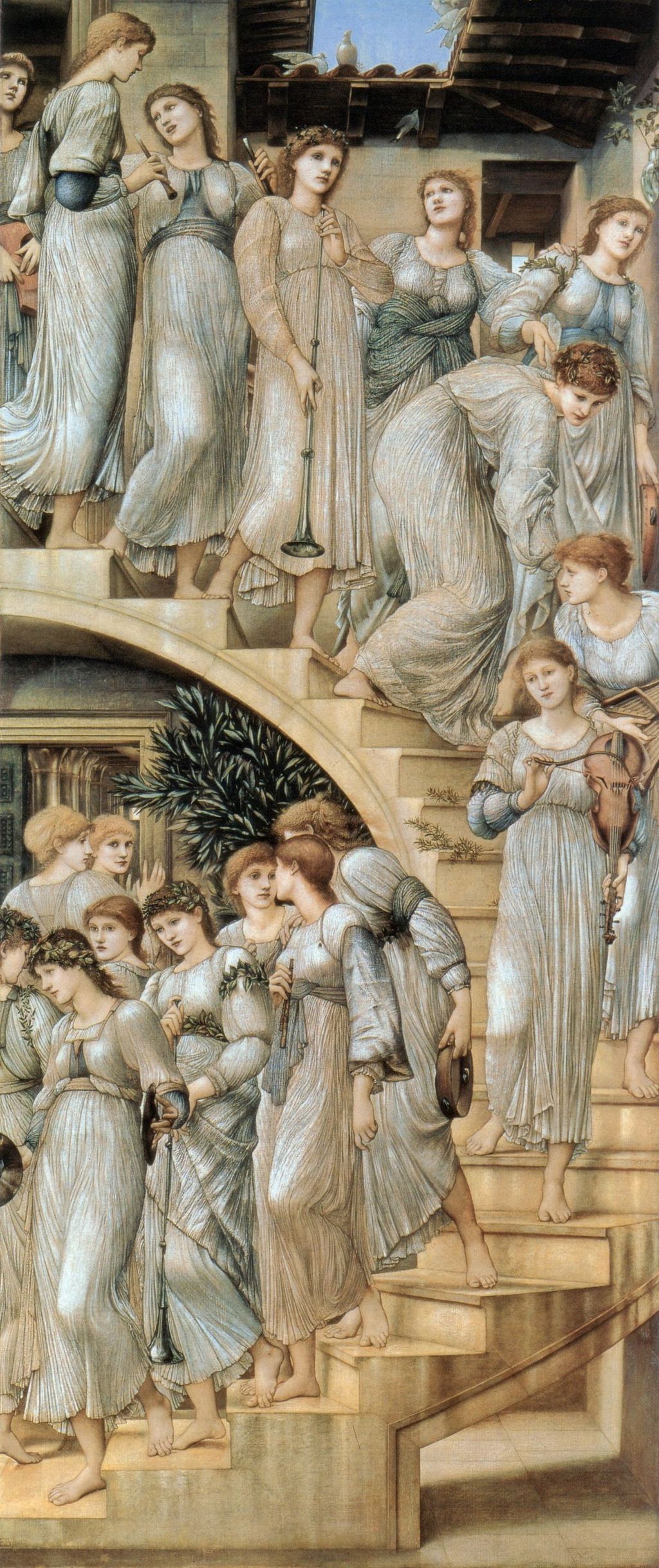
The Golden Stairs, 1876–1880, by Edward Burne-Jones, oil on canvas. Image source. Public domain.
Six inches above our heads
“heaven beginning six inches over the tops of our heads as it really does” — Edward Burne-Jones, letter to Miss Graham, printed in Memorials, volume II, p. 65 [5]
Writing to Miss Graham about Florence, Burne-Jones recommends the chapel in Santa Croce where Giotto painted the death of St Francis. He then recalls a Coronation of the Virgin that he took for a Botticelli in the chapel of San Jacopo in Ripoli. In his account, candles got in the way and he moved them. When Miss Graham evidently wondered how he got into the convent, he promised to keep the secret but admitted stacking the stools so he could sketch the painting. The description conveys the pleasure of discovering a picture in a working chapel, where a visitor could have difficulty finding it and an even harder time looking closely. [5]
The measurement makes an expansive idea wonderfully domestic. Six inches is about the space a person might glance up into at any moment. A Tate exhibition guide adapted the wording for its introduction to the artist’s stained glass and decorative work, using the singular top and adding a comma before as. The printed letter gives tops and runs the phrase straight through. Its immediate subject is the Florentine picture, which brings the heavenly and earthly parts of the scene remarkably close together in the artist’s account. [5] [6]
The angels in Oscar Wilde’s lecture
“the more materialistic science becomes, the more angels shall I paint: their wings are my protest in favour of the immortality of the soul.” — Edward Burne-Jones, as recalled by Oscar Wilde in The English Renaissance of Art [7]
Wilde first delivered the lecture in New York on 9 January 1882. In the printed text, he introduces the quip as something he remembered Burne-Jones saying in a conversation about modern science. With the colon, the explanation about the wings seems to follow in the same breath as the promise to paint more angels. The 1913 edition of Essays and Lectures prints the British spelling favour. The anecdote belongs to Wilde’s discussion of what art can express through its own forms, and the remembered conversation supplies his audience with a single, unmistakable example. [7]
The angels also had a practical life in Burne-Jones’s work. One minstrel playing a flageolet was designed in 1877 for stained-glass tracery at Christ Church Cathedral in Oxford. A signed watercolour of 1878 reproduces the figure in another medium. In a window, the curve of the wings has to fit the shape of the tracery and be legible from below. In the watercolour, the viewer can take in the gold, the wings and the folds of the drapery at close range. The figure exemplifies the kind of design to which Wilde could attach an argument, even as its changing setting gives it other things to do. [8]
Freda Stanhope on work and colour
“I only get tired when I am doing nothing.” — Edward Burne-Jones, as recorded by Freda Stanhope and printed in Memorials, volume II, p. 347 [9]
In 1898, Freda Stanhope visited Burne-Jones at the Grange with Alice Wortley, a daughter of John Everett Millais. She had studied painting in Florence with her uncle, John Roddam Spencer Stanhope. Her diary describes how Burne-Jones took her from the garden studio to his working studio upstairs. Surprised by the number of pictures there, she asked if he ever tired of working. Her diary preserves his answer as part of an exchange between painters. Earlier, he had encouraged her to carry on painting when she was away from Florence, where social duties tended to interrupt her work. [9]
“Well, I try and try till they come.” — Edward Burne-Jones, answering Stanhope’s question about his colours, Memorials, volume II, p. 349 [10]
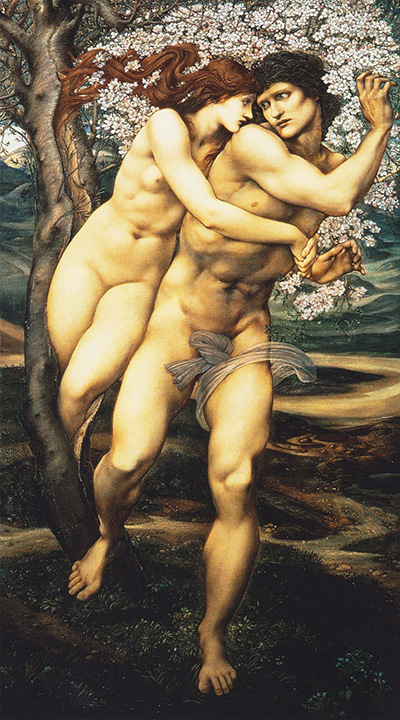
Stanhope told him that she loved blue and had been copying a Carpaccio in order to understand how red worked. Burne-Jones shared her affection for blue and offered to show her another method of working in oils. His reply about his own colours sounds simple after a conversation full of particulars. He could recognise a slow process and propose a different one. Finding the colour he wanted still meant trying for it repeatedly. There is something of that patience in Stanhope’s record of the visit itself. When the light had almost gone, he fetched a candle so she could see one last work, the watercolour design for The Tree of Forgiveness. [9] [10]
Dante Gabriel Rossetti on the early drawings
“Jones’s designs are marvels of finish and imaginative detail, unequalled by anything unless perhaps Albert Dürer’s finest works” — Dante Gabriel Rossetti to William Bell Scott, February 1857, as printed in Scott’s Autobiographical Notes [11]
Rossetti wrote to Scott about two young men associated with the Oxford and Cambridge Magazine, Burne-Jones and William Morris, who had become friends of his. He praised Burne-Jones’s designs and expressed confidence in Morris’s abilities in the same letter. The comparison with the German printmaker Albrecht Dürer praises the invention in the small areas of a picture, where a lesser draughtsman might have relied on stock patterns. Burne-Jones’s early vellum drawing Going to the Battle puts a parrot on a perch and distributes birds and other animals across the central figure’s dress. The letter predates that drawing, which shows what Rossetti was already noticing in the young artist’s work. Tate’s exhibition guide attaches a slightly different wording to the drawings as a group. Scott’s printed version gives of finish, unless perhaps and the plural works. [6] [11] [12]
Robert de La Sizeranne on the grace of the figures
“Burne-Jones obtains the infinite grace of his figures only by sacrificing the great features of proportion and natural attitude.” — Robert de La Sizeranne, English Contemporary Art, translated by H. M. Poynter, 1898 [13]
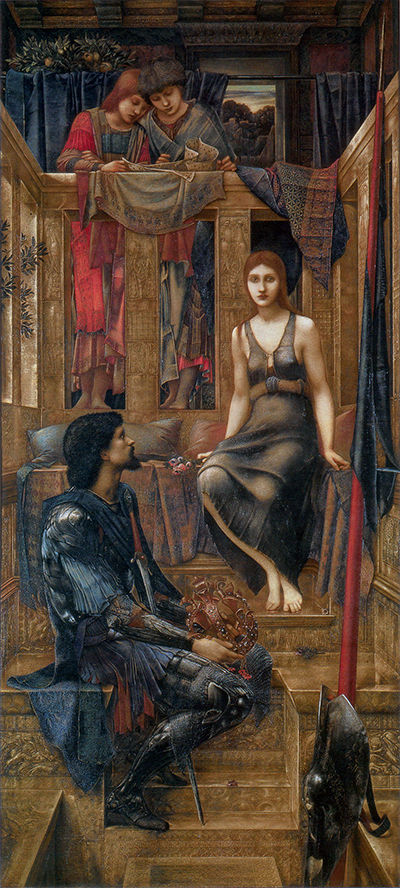
The French critic proposed that the public responded particularly well to pictures in which no figure stands upright. He named King Cophetua and the Beggar Maid alongside Le Chant d’Amour and Love among the Ruins. His point makes sense of the seated relationships in King Cophetua. The king, held low on the steps, looks up at the woman, while the elevation gives her a bearing that her plain dress alone would scarcely suggest. The folds of fabric carry part of the weight of the pose. De La Sizeranne admired the effect while questioning what happened to ordinary proportions in the pursuit of it. [13] [14]
The painting had helped make Burne-Jones’s name in France at the Paris Exposition Universelle in 1889. The distance between the young artist Rossetti praised and the internationally exhibited painter discussed by La Sizeranne makes their points of agreement worth noticing. Rossetti saw the effort of invention in the details. The later critic could see the lengths to which Burne-Jones would go to make a group of figures move or sit with the grace he had imagined. One was writing to a friend about an unfamiliar talent. The other was explaining to readers why pictures they already knew had made that talent famous. [11] [13] [14]
Vladimir Stasov on the romantic dream
The Russian critic Vladimir Stasov made a far harsher judgment of the dream Burne-Jones described. In his survey of nineteenth-century art, first published in abridged form in 1901, he quoted a Russian rendering of the passage and treated it as evidence that Burne-Jones’s art turned away from the pressures of everyday life. The version he discussed stops at the beautiful forms and ends by declaring what constitutes a picture. Brynhild’s awakening is absent. His charge that these pictures offered an idle pastime for the wealthy follows directly from the version of the passage his readers saw. [15]
Stasov could acknowledge that Burne-Jones drew the human body skilfully. He took issue with what the artist chose to do with that skill, arguing that the long limbs and repeated types made the figures of one story interchangeable with those of another. His response takes the painter’s ambitions seriously enough to reject them on specific grounds. It also shows what happens when a line addressed to a friend becomes the basis for a public judgment about what art should attempt. [3] [15]
Edward Burne-Jones on film
Explore Burne-Jones’s paintings, illustrated stories and stained-glass designs.
Edward Burne-Jones: Pre-Raphaelite Visionary | Exhibitions | Showcase
A look at Burne-Jones’s paintings and the Tate retrospective.
Watch on YouTubeArtworks directory
This directory records paintings, studies, designs and collaborative works, with separate entries for documented versions and series where known.
| Name | Date | Medium |
|---|---|---|
| Sidonia von Bork 1560 | 1860 | Watercolour and bodycolour |
| Clara von Bork 1560 | 1860 | Watercolour and bodycolour |
| The Merciful Knight | 1863 | Watercolour |
| Sibylla Delphica | c. 1886 | Oil on panel |
| Phyllis and Demophoön | 1870 | Watercolour and bodycolour |
| The Legend of the Briar Rose (Buscot series) | 1870s–1890 | Oils on canvas |
| The Briar Wood (Buscot series) | By 1890 | Oil on canvas |
| The Council Chamber (Buscot series) | By 1890 | Oil on canvas |
| The Garden Court (Buscot series) | By 1890 | Oil on canvas |
| The Rose Bower (Buscot series) | By 1890 | Oil on canvas |
| Group of Women, study for The Golden Stairs | 1872 | Drawing |
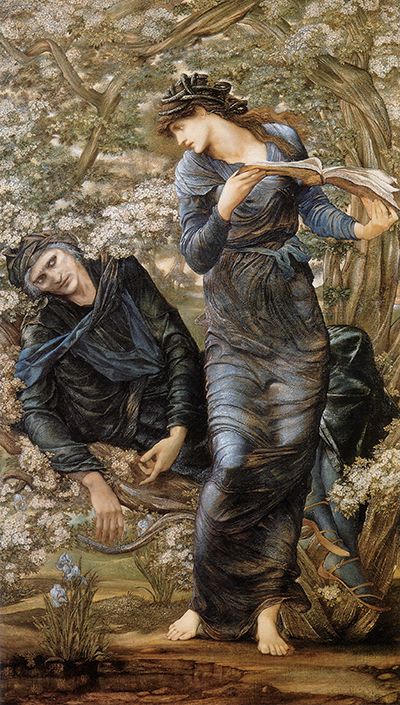
| The Beguiling of Merlin | 1870s | Oil on canvas |
| The Perseus Cycle | From 1875 | Paintings and full-scale designs |
| The Call of Perseus (Stuttgart) | From 1875 | Oil painting |
| Perseus and the Graeae (Stuttgart) | From 1875 | Oil painting |
| The Rock of Doom (Stuttgart) | 1884–88 | Oil on canvas |
| The Doom Fulfilled (Stuttgart) | 1888 | Oil on canvas |
| The Baleful Head (Stuttgart) | 1885–87 | Oil on canvas |
| The Baleful Head (Southampton design) | 1880s | Bodycolour |
| The Rock of Doom (Southampton design) | 1880s | Bodycolour |
| The Doom Fulfilled (Southampton design) | 1880s | Bodycolour |
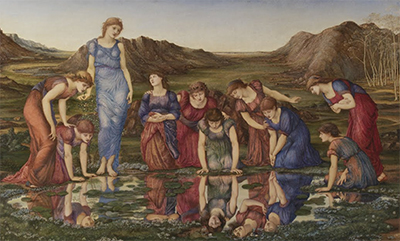
| The Mirror of Venus (Gulbenkian) | 1870s | Oil on canvas |
| Drawing associated with The Mirror of Venus | 1870s | Drawing |
| Laus Veneris (Laing) | 1873–78 | Oil on canvas |
| The Days of Creation | 1870s | Watercolour and bodycolour |
| The Golden Stairs | 1880 | Oil on canvas |
| An Angel Playing a Flageolet | 1878 | Watercolour, bodycolour and gold |
| The Tree of Forgiveness | 1881–82 | Oil on canvas |
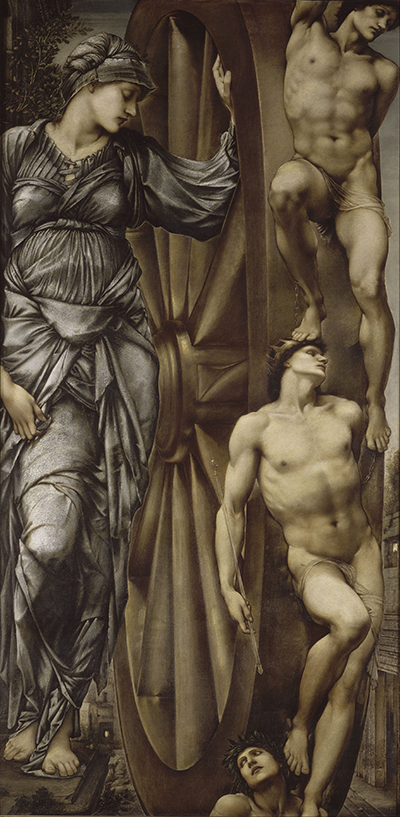
| The Wheel of Fortune (Orsay) | 1875–83 | Oil on canvas |
| King Cophetua and the Beggar Maid | 1884 | Oil on canvas |
| The Depths of the Sea (oil) | 1886 | Oil |
| The Morning of the Resurrection | 1886 | Oil on panel |
| Study for the Head of Mary Magdalene | c. 1882 | Oil study |
| The Sleep of King Arthur in Avalon | 1880s–1898 | Oil on canvas |
| The Sleep of King Arthur in Avalon (modello) | ca. 1881 | Oil on canvas (modello) |
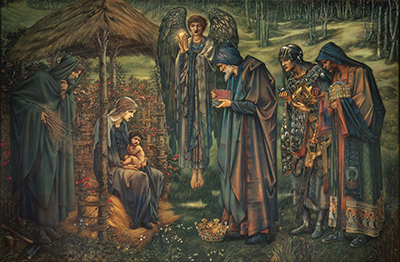
| The Star of Bethlehem | Signed 1890 | Watercolour and bodycolour |
| Study for The Star of Bethlehem | About 1887–91 | Drawing |
| Sponsa de Libano | 1891 | Watercolour and bodycolour |
| The Summons (Holy Grail tapestries) | 1890s | Tapestry |
| The Failure of Sir Gawaine (Holy Grail tapestries) | 1890s | Tapestry |
| Hope (Boston) | 1896 | Oil on canvas |
| La Belle au bois dormant (theatre programme) | 1894 | Collotype |
| The Wedding of Psyche | 1895 | Oil on canvas |
| The Works of Geoffrey Chaucer (Kelmscott edition) | 1896 | Illustrated book |
| The Ascension (Birmingham Cathedral) | 1885 | Stained glass |
| The Last Judgement (Birmingham Cathedral) | 1897 | Stained glass |
| Adoration of the Magi (Huntington) | 1890s | Tapestry |
| Love among the Ruins (Wightwick) | 1894 | Oil on canvas |
| The Merciful Knight (photogravure after Burne-Jones) | 1900 | Photogravure |
| The Garden Court (preparatory work) | 1870–75 | Graphite and watercolour with white gouache |
| Study of a Female Figure | 1885 | Graphite drawing |
| Psyche Throwing Herself into the River | 1865–68 | Wood engraving |
| Beauty | 1887–89 | Colour lithograph |
| Study for the Failure of Gawain | 1893 | Crayon and graphite on Japanese paper |
| The Prince Enters the Briar Wood (after Burne-Jones) | After 1890 | Photogravure |
| The Rose Bower (after Burne-Jones) | 1892 | Photogravure |
| Adoration of the Magi (Musée d’Orsay) | 1904 | Tapestry |
| Answers to Prayer (Lyndhurst) | 1860s | Stained glass |
| The Depths of the Sea (photogravure after Burne-Jones) | 1900 | Photogravure |
| Perseus and Andromeda (Adelaide composite) | 1876 | Oil on canvas |
| The Adoration of the Magi (Hamburg) | Woven 1900 | Tapestry |
| Love leading the Pilgrim through the Briars | 1874–76 | Embroidery |
| Musica (worked by Lady Jane Cory) | 1906 | Embroidery |
| Pomona (worked by Lady Jane Cory) | 1907 | Embroidery |
| Flora (worked by Lady Jane Cory) | 1909 | Embroidery |
| The Fourth Day of Creation (photogravure after Burne-Jones) | 1900 | Photogravure |
| The Morning of the Resurrection (photogravure after Burne-Jones) | 1900 | Photogravure |
| Musical angels of the St Catherine window (Christ Church) | Designed 1877 | Stained glass |
Discussion
Look again at the images and ideas explored in Edward Burne-Jones Quotes. These editorial prompts invite your observations.
Reader Insights
Which statement helps you understand an artwork more clearly once you know its original audience?
Which of the accounts by another person adds most to your understanding of Burne-Jones at work?
Join the Conversation
Share a detail, comparison or question about Edward Burne-Jones Quotes below.
References
- Georgiana Burne-Jones, Memorials of Edward Burne-Jones, vol. II (1904), p. 125, autumn 1882 letter on Avalon and separate letter excerpt on beauty. View source.
- Museo de Arte de Ponce, The Sleep of King Arthur in Avalon, collection object record. View source.
- Burlington Fine Arts Club, Exhibition of Drawings and Studies by Sir Edward Burne-Jones, Bart. (1899), Cosmo Monkhouse’s introduction, first paragraph. View source.
- Burne-Jones Catalogue Raisonné, The Golden Stairs, object entry and expert commentary. View source.
- Georgiana Burne-Jones, Memorials of Edward Burne-Jones, vol. II (1904), pp. 64–66, letters to Miss Graham. View source.
- Tate Britain, Edward Burne-Jones: Large Print Guide (2018), pp. 9 and 127, Going to the Battle and Room 7 introduction. View source.
- Oscar Wilde, The English Renaissance of Art, first delivered 9 January 1882 and collected in Essays and Lectures, Methuen (1913), p. 132, CELT transcription. View source.
- Stephen Wildman, An Angel Playing a Flageolet (Angel with Pipe), catalogue entry in Edward Burne-Jones: Victorian Artist-Dreamer (1998), reproduced by the Burne-Jones Catalogue Raisonné. View source.
- Georgiana Burne-Jones, Memorials of Edward Burne-Jones, vol. II (1904), pp. 346–347, Freda Stanhope’s visit and diary. View source.
- Georgiana Burne-Jones, Memorials of Edward Burne-Jones, vol. II (1904), p. 349, Stanhope’s question about colour and the final picture on the studio visit. View source.
- William Bell Scott, Autobiographical Notes, ed. William Minto, vol. II (1892), pp. 36–37, letter from Dante Gabriel Rossetti. View source.
- Burne-Jones Catalogue Raisonné, The Knight’s Farewell, catalogue commentary on the early drawings and Rossetti’s letter to Scott. View source.
- Robert de La Sizeranne, English Contemporary Art (1898), translated by H. M. Poynter, excerpt reprinted on pp. 31–32 of Masters in Art: Burne-Jones. View source.
- Laurence des Cars, Edward Burne-Jones and France, in Edward Burne-Jones: Victorian Artist-Dreamer (1998), section on the Paris Exposition Universelle of 1889. View source.
- Vladimir Stasov, Искусство девятнадцатого века (Art of the Nineteenth Century), first published in abridged form in 1901, painting section on Burne-Jones, transcription derived from the author-corrected 1906 edition. View source.