 by Tom Gurney
Tom Gurney BSc (Hons) is an art history expert with over 20 years experience
Published on June 19, 2020 / Updated on November 25, 2026
Email: tomgurney1@gmail.com / Phone: +44 7429 011000
The Morning of the Resurrection: Introduction
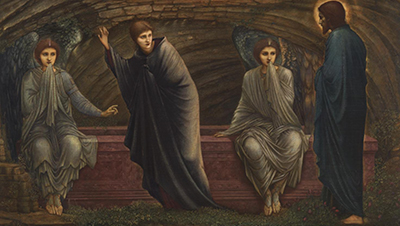
Mary Magdalene has just turned her head. One hand is raised, her cloak still sweeps toward the tomb, and the man she has seen stands at the far right with his hands hidden. Edward Burne-Jones holds the scene in the instant before Mary realises she is looking at the risen Christ. Tate dates this second version of The Morning of the Resurrection, also known as Mary Magdalene at the Sepulchre, to 1886. Its wide wooden panel, painted in oil, measures 84.5 cm high by 151.1 cm wide. It was shown at London’s Grosvenor Gallery that year and entered Tate through the bequest of Mrs S. G. Potter in 1937. [1] [2]
At a Glance
- ArtistEdward Burne-Jones
- Date1886
- MediumOil on panel
- SubjectChrist and Mary Magdalene
This work across Edward Burne-Jones’s career
The Mirror of Venus
1870sThe Wheel of Fortune
1875–83The Last Sleep of Arthur in Avalon
1880s–1898The Star of Bethlehem
Signed 1890Contents
- What Mary sees at the tomb
- How Burne-Jones holds the moment
- From a church altar to the Grosvenor Gallery
- What the preparatory studies reveal
- The encounter in earlier paintings
- The dedication to Laura Lyttelton
- Annotated details
What Mary sees at the tomb
In John 20, Mary goes to the tomb while it is still dark and finds the stone moved away. By the time she looks inside, she is weeping. Two angels dressed in white sit where Jesus’s body lay, one at the head and one at the feet. Mary tells them that someone has taken him away. When she turns and sees Jesus, she supposes he is the gardener and asks where the body has been laid. She knows him only when he says her name. She will then go to the disciples with news that she has seen him. [3]
The verse that accompanied the painting at the Grosvenor Gallery was John 20:14, the turn at which Mary sees Jesus and has yet to recognise him. Burne-Jones keeps the two angels in view while Mary turns back towards Christ. With both encounters in the same space, a reader of John can trace the sequence in a single glance. Mary’s raised hand still hovers beside the angel to her left, even though her face has already turned towards the figure on the right. The audience can identify Christ by the gold light behind his head while Mary is still working out why he is there. [4]
How Burne-Jones holds the moment
The reddish stone tomb stretches nearly the width of the panel. Its moulded front is exposed between the figures, so that much of the low foreground reads as a single continuous block. The dark opening behind it is framed by bands of rock that curve down from the upper edge. A few low plants gather at the foot of the stone, but there is little sense of open air. Christ stands close to the right edge with his head in profile. The rock bends around his halo and the heavy blue robe falls almost to his bare feet. His stillness makes Mary’s movement easier to see.
The angels have grey draperies, dark wings and closely matched poses. Each gathers a fold of cloth up to the lips. Their free hands do different things. The angel at the left extends delicate fingers towards Mary, while the one nearest Christ steadies a hand on the rim of the tomb. Their sandals and bare toes appear close to the foreground, just below the biggest folds of cloth. The repeated gesture at their mouths makes them look as if they are holding their breath. That impression is one way to read the picture’s hush. An early account by Fortunée de Lisle read the covered mouth as a gesture of adoration, an interpretation Anthea Brooke later recorded in her catalogue essay on the related canvas version. [5]
William Waters compared the first version’s tightly ordered group to The Holy Women at the Tomb in the twelfth-century Shaftesbury Psalter, a manuscript now in the British Library. The comparison helps explain how much can happen in such a shallow space. The broad band of stone and the repeated upright figures give the four presences something of the independence of figures in a miniature. In the Tate panel the eye can follow the continuous line of rock above their heads, or move from one pocket of light to the next, from the angels’ faces to Mary’s cheek and finally to Christ’s halo. [6]
Annotated Details from The Morning of the Resurrection
The numbered points identify visible features discussed in this article. Return from each detail to the numbered overview. The Morning of the Resurrection, photogravure published in 1900 by the Berlin Photographic Company, after Edward Burne-Jones. Museum of New Zealand Te Papa Tongarewa, 1981-0086-1/83. Image source. No Known Copyright Restrictions.
.jpg)
Details from THE MORNING OF THE RESURRECTION
Compare the cropped details with the source images above. Notice how their colours, shapes and positions contribute to the larger compositions.
Magdalene turns to Christ
Mary raises a hand and turns across the tomb. The raised fingers and the turn of her eyes can both be followed in the early print.
 Detail 01 magdalene-turns-to-christ.jpg)
Christ at the right
Christ stands in profile near the edge. The dark robe and upright stance give the encounter a steady point beside the shifting figures.
 Detail 02 christ-at-the-right.jpg)
An angel beside the tomb
One angel’s seated body overlaps the stone edge of the sepulchre. Behind the shoulder, individual feathers follow the broad curve of the vault.
 Detail 03 an-angel-beside-the-tomb.jpg)
From a church altar to the Grosvenor Gallery
The subject began as a memorial to Frederick Denison Maurice, a theologian associated with Christian Socialism who served at St Peter’s, Vere Street, from 1860 to 1869. Maurice helped establish the Working Men’s College, where Burne-Jones heard him speak as a young man. Dr Charles Bland Radcliffe, a physician and friend of the painter, commissioned the picture for the altar at St Peter’s. The commission joined another of Burne-Jones’s designs already made for the church, a stained-glass window of Christ and the Samaritan woman at the well. Two encounters from John’s Gospel thus came into view together at the altar. The Survey of London records the window’s installation in 1881 and the addition of two Annunciation panels alongside the church painting in 1893, as a memorial to Radcliffe himself. [2] [4] [7] [8]
A Christmas letter from Burne-Jones to Radcliffe, discussed by art historian Colette Crossman, describes paint that was still wet and a panel so heavy the artist worried it could break away from its nails in transit. It concerns the first version, finished in December 1882 and installed at St Peter’s early the following year. Burne-Jones’s records contain two entries for the subject in 1882, and Crossman notes that one may clarify the other. The records establish the start of the project while leaving the precise starting date of the second panel open. The artist recorded finishing the second version at the beginning of 1886, and it appeared as no. 96 at the Grosvenor Gallery. Crossman also identifies it as no. 207 at Manchester’s Royal Jubilee Exhibition in 1887. [4]
The two settings gave the subject different surroundings. At St Peter’s the painting formed part of a church interior, seen in conjunction with worship and the east window. Tate describes the second version as an unusual biblical subject among Burne-Jones’s exhibition pictures. Crossman points to changes the artist made for it, including a more elaborate tomb and a shift towards darker blues and violets. The basic arrangement and the moment of uncertainty remained legible in public exhibition even without the window above. A visitor could read John 20:14 and then look for the instant it described in the turn of Mary’s head. [2] [4]
At the Grosvenor, Burne-Jones showed the Easter picture alongside Flamma Vestalis and Sibylla Delphica. The three subjects brought together a Christian witness, a figure associated with the Roman sacred flame and an ancient prophetess. A reproduction took the composition beyond the exhibition room. Te Papa in Wellington holds a photogravure published by the Berlin Photographic Company in 1900. In a print made with ink alone, a reader could still follow the turn of Mary’s head, the paired angels and the figure beside them. The panel’s arrangement of light and dark could carry the story beyond its distinctive colour. [9] [10]
Edward Burne-Jones, The Merciful Knight, 1863. Birmingham Museums Trust. Image source. Public domain.
What the preparatory studies reveal
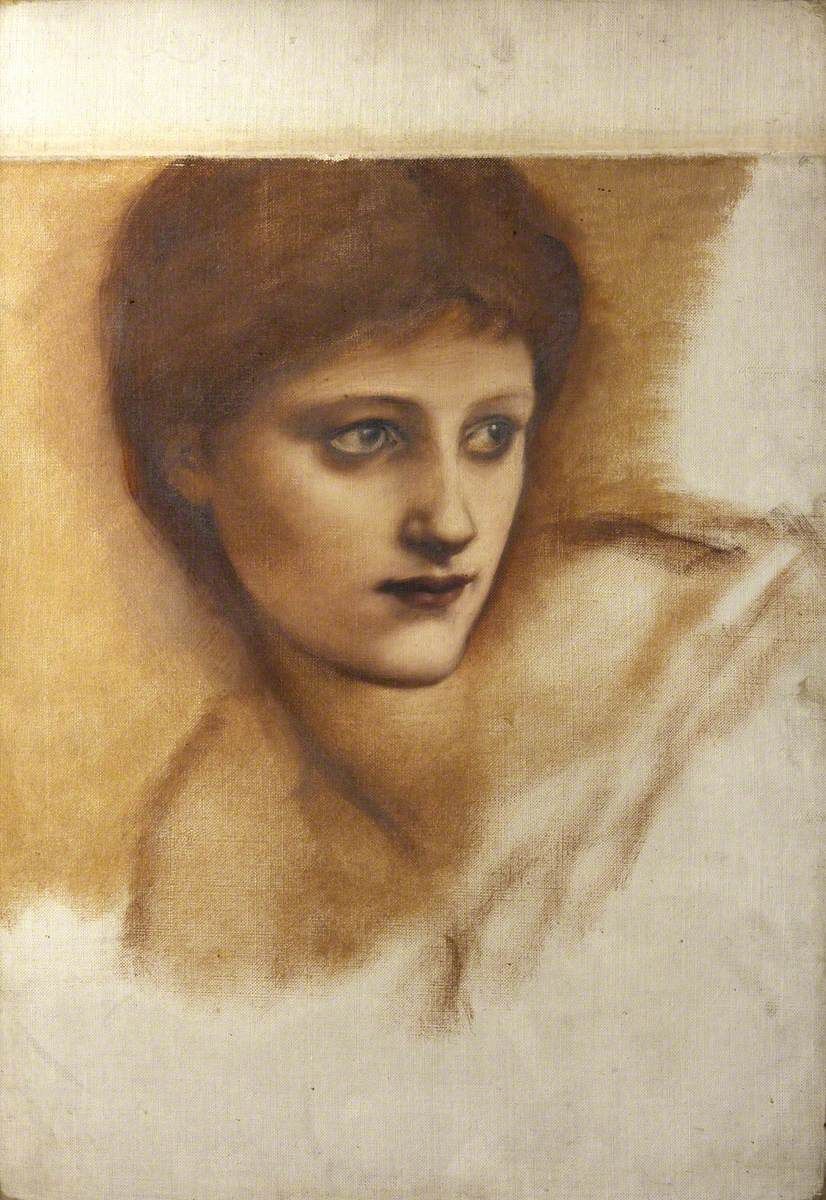
In an oil study from about 1882 recorded at Worcester College, Oxford, Burne-Jones worked on Mary’s head and shoulders turned towards the right. A signed pencil study dated 1886 also looks right and carries an inscription identifying both Mary and the painting. The two studies put that small turn of the head at either end of the years in which he worked on the subject. The pencil drawing allows the angle of the face to hold the eye independently. In the finished panel, the tilt becomes more arresting because the broad cloak pulls the rest of Mary’s body in the opposite direction. [11] [12]
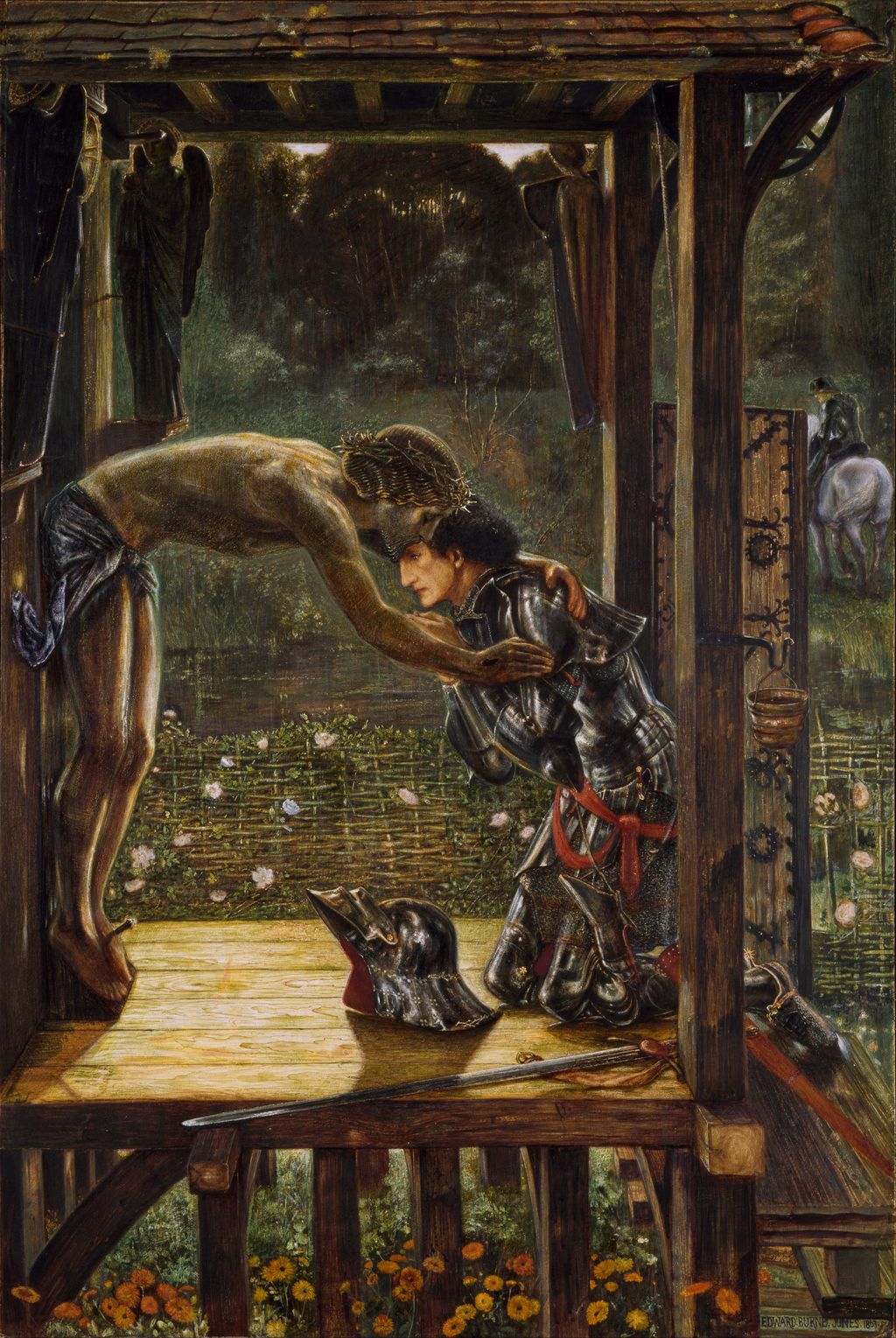
Katherine Hinzman reproduces two graphite studies of Christ in the Ashmolean’s Western Art Print Room in which Burne-Jones tried different positions for an outstretched hand. In the Tate panel the robe conceals the hand. Since Mary’s palm remains plainly visible, there is an imbalance between the clarity of her movement and the unreadability of his. Hinzman connects that choice to the way the painting leaves recognition in suspense. It also changes what we notice first about Christ. His face and halo carry the full weight of his appearance while the figure’s intent stays harder to read. Hinzman compares the question of contact here to The Merciful Knight, where the figure of Christ on a wooden crucifix bends to embrace a kneeling knight. The embrace gives that earlier painting its central action. In the Tate panel the viewer has to make do with the distance between Mary and Christ and the look she casts across it. [13]
Studies for the angels survive in several media. The National Gallery of Canada records a study from about 1885 in black and white chalk on brown paper, where the paper itself offered a middle tone between shade and highlight. Two other angel studies in watercolour and pastel were exhibited together in one frame in 1899 at the Burlington Fine Arts Club. Their Latin inscription draws on Luke 24:6 and announces that Christ has risen. In the Tate composition the presence of Christ accords with John’s account, but the related studies show Burne-Jones using Luke’s words to frame the angels’ part in the story. [14] [15] [16]
Edward Burne-Jones, oil study for the head and shoulders of Mary Magdalene. Worcester College, Oxford, no. 323. Image source. Public domain.
The encounter in earlier paintings
In Titian’s Noli me Tangere at the National Gallery, Mary kneels and reaches towards Christ. He gathers his drapery and draws back, and the lines of a tree and hillside bring attention to their meeting eyes. Fra Angelico’s fresco of the same subject in the first cell at San Marco in Florence also places the encounter in a garden, where the interval between the kneeling Mary and standing Christ is easy to read. Both works help locate the particular instant Burne-Jones chose. His Mary is on her feet, her hand raised towards the stone overhead, and the space beside Christ is occupied by an angel. The gesture of reaching out to touch him still belongs to the future. [13] [17] [18]
Burne-Jones’s own work for Morris & Co. offers another comparison. A stained-glass design at The Huntington divides the story between two lights. On the left, Mary encounters a single angel seated on the tomb. On the right, she kneels before Christ in the garden. The separate openings give each episode a place of its own. In the Tate painting the two angels stay beside Mary as her attention shifts to Christ, so what she has just seen remains visible while she tries to make sense of what she sees now. [19]
The dedication to Laura Lyttelton
Laura Lyttelton, née Tennant, died after giving birth in 1886. Burne-Jones added a small memorial to her along the left-hand edge of the second painting. He described it as deliberately difficult to find. The words record her initials and Easter 1886. Maurice’s memorial had established the subject years earlier. Lyttelton’s inscription gave the panel shown at the Grosvenor a more personal association. It sat at the edge of a picture in which the sight of someone thought lost is already the centre of attention. [2] [4] [20]
Burne-Jones also designed a memorial relief for Lyttelton at St Andrew’s Church in Mells, Somerset. There a peacock stands on a laurel growing out of a stone tomb. Burne-Jones explained the bird in terms of resurrection and pictured the tree breaking out through the sides of the tomb. The relief uses the words from Luke that also appear on the paired angel studies. At Mells those words help make the promise of resurrection explicit. In the Tate painting, the private dedication is tucked beneath a scene that ends just before Mary hears her name. [15] [21]
Edward Burne-Jones on film
Explore Burne-Jones’s paintings, illustrated stories and stained-glass designs.
Edward Burne-Jones: Pre-Raphaelite Visionary | Exhibitions | Showcase
A look at Burne-Jones’s paintings and the Tate retrospective.
Watch on YouTubeArtworks directory
This directory records paintings, studies, designs and collaborative works, with separate entries for documented versions and series where known.
| Name | Date | Medium |
|---|---|---|
| Sidonia von Bork 1560 | 1860 | Watercolour and bodycolour |
| Clara von Bork 1560 | 1860 | Watercolour and bodycolour |
| The Merciful Knight | 1863 | Watercolour |
| Sibylla Delphica | c. 1886 | Oil on panel |
| Phyllis and Demophoön | 1870 | Watercolour and bodycolour |
| The Legend of the Briar Rose (Buscot series) | 1870s–1890 | Oils on canvas |
| The Briar Wood (Buscot series) | By 1890 | Oil on canvas |
| The Council Chamber (Buscot series) | By 1890 | Oil on canvas |
| The Garden Court (Buscot series) | By 1890 | Oil on canvas |
| The Rose Bower (Buscot series) | By 1890 | Oil on canvas |
| Group of Women, study for The Golden Stairs | 1872 | Drawing |
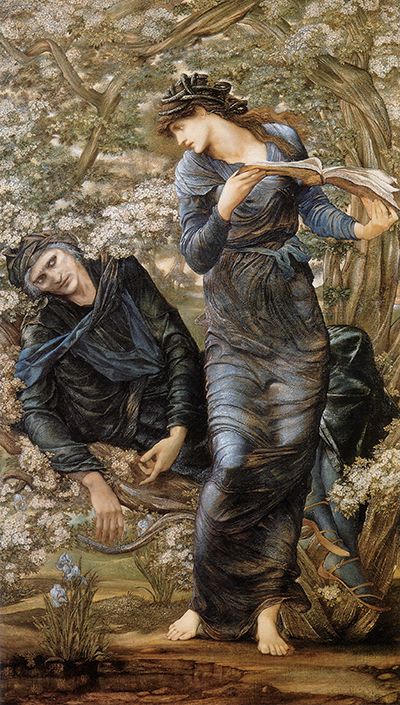
| The Beguiling of Merlin | 1870s | Oil on canvas |
| The Perseus Cycle | From 1875 | Paintings and full-scale designs |
| The Call of Perseus (Stuttgart) | From 1875 | Oil painting |
| Perseus and the Graeae (Stuttgart) | From 1875 | Oil painting |
| The Rock of Doom (Stuttgart) | 1884–88 | Oil on canvas |
| The Doom Fulfilled (Stuttgart) | 1888 | Oil on canvas |
| The Baleful Head (Stuttgart) | 1885–87 | Oil on canvas |
| The Baleful Head (Southampton design) | 1880s | Bodycolour |
| The Rock of Doom (Southampton design) | 1880s | Bodycolour |
| The Doom Fulfilled (Southampton design) | 1880s | Bodycolour |
| The Mirror of Venus (Gulbenkian) | 1870s | Oil on canvas |
| Drawing associated with The Mirror of Venus | 1870s | Drawing |
| Laus Veneris (Laing) | 1873–78 | Oil on canvas |
| The Days of Creation | 1870s | Watercolour and bodycolour |
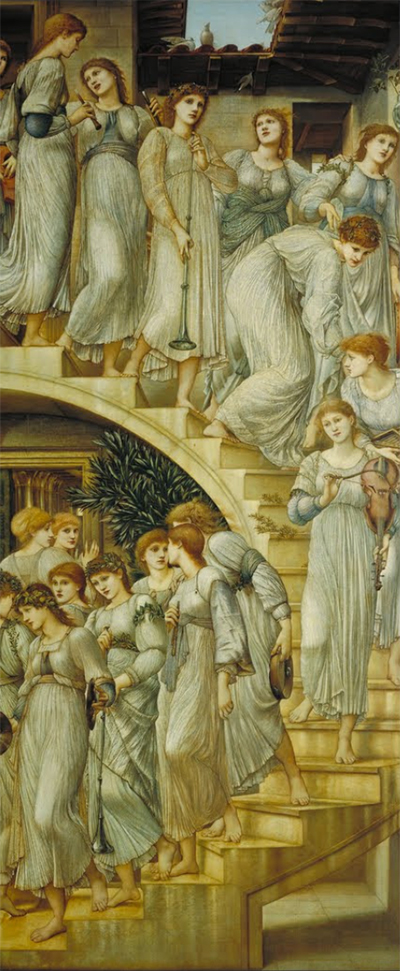
| The Golden Stairs | 1880 | Oil on canvas |
| An Angel Playing a Flageolet | 1878 | Watercolour, bodycolour and gold |
| The Tree of Forgiveness | 1881–82 | Oil on canvas |
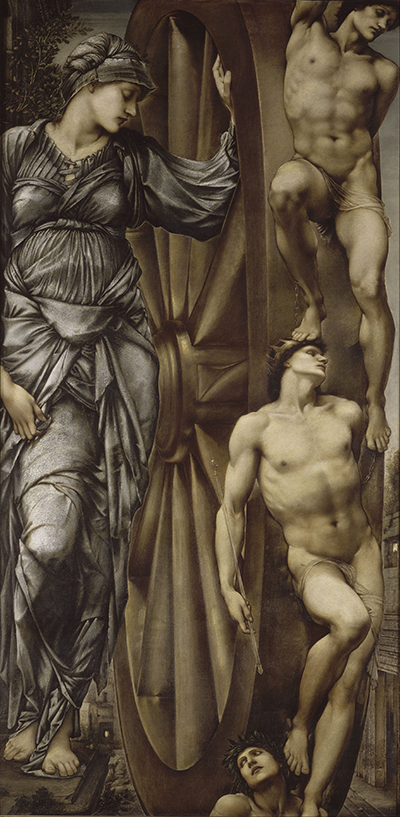
| The Wheel of Fortune (Orsay) | 1875–83 | Oil on canvas |
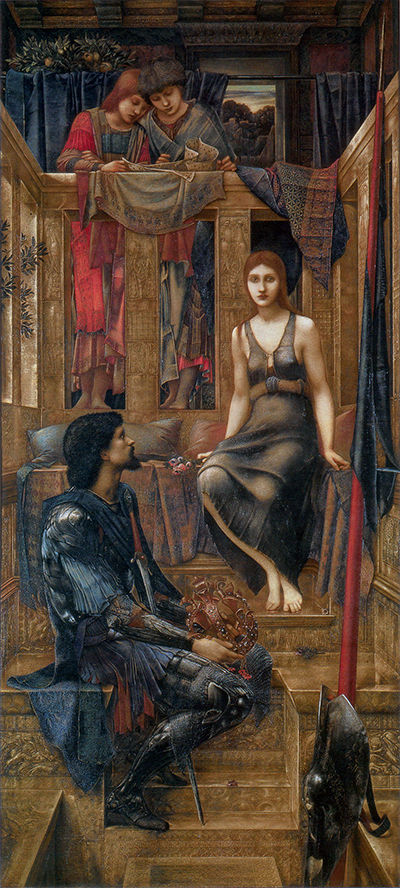
| King Cophetua and the Beggar Maid | 1884 | Oil on canvas |
| The Depths of the Sea (oil) | 1886 | Oil |
| The Morning of the Resurrection | 1886 | Oil on panel |
| Study for the Head of Mary Magdalene | c. 1882 | Oil study |
| The Sleep of King Arthur in Avalon | 1880s–1898 | Oil on canvas |
| The Sleep of King Arthur in Avalon (modello) | ca. 1881 | Oil on canvas (modello) |
| The Star of Bethlehem | Signed 1890 | Watercolour and bodycolour |
| Study for The Star of Bethlehem | About 1887–91 | Drawing |
| Sponsa de Libano | 1891 | Watercolour and bodycolour |
| The Summons (Holy Grail tapestries) | 1890s | Tapestry |
| The Failure of Sir Gawaine (Holy Grail tapestries) | 1890s | Tapestry |
| Hope (Boston) | 1896 | Oil on canvas |
| La Belle au bois dormant (theatre programme) | 1894 | Collotype |
| The Wedding of Psyche | 1895 | Oil on canvas |
| The Works of Geoffrey Chaucer (Kelmscott edition) | 1896 | Illustrated book |
| The Ascension (Birmingham Cathedral) | 1885 | Stained glass |
| The Last Judgement (Birmingham Cathedral) | 1897 | Stained glass |
| Adoration of the Magi (Huntington) | 1890s | Tapestry |
| Love among the Ruins (Wightwick) | 1894 | Oil on canvas |
| The Merciful Knight (photogravure after Burne-Jones) | 1900 | Photogravure |
| The Garden Court (preparatory work) | 1870–75 | Graphite and watercolour with white gouache |
| Study of a Female Figure | 1885 | Graphite drawing |
| Psyche Throwing Herself into the River | 1865–68 | Wood engraving |
| Beauty | 1887–89 | Colour lithograph |
| Study for the Failure of Gawain | 1893 | Crayon and graphite on Japanese paper |
| The Prince Enters the Briar Wood (after Burne-Jones) | After 1890 | Photogravure |
| The Rose Bower (after Burne-Jones) | 1892 | Photogravure |
| Adoration of the Magi (Musée d’Orsay) | 1904 | Tapestry |
| Answers to Prayer (Lyndhurst) | 1860s | Stained glass |
| The Depths of the Sea (photogravure after Burne-Jones) | 1900 | Photogravure |
| Perseus and Andromeda (Adelaide composite) | 1876 | Oil on canvas |
| The Adoration of the Magi (Hamburg) | Woven 1900 | Tapestry |
| Love leading the Pilgrim through the Briars | 1874–76 | Embroidery |
| Musica (worked by Lady Jane Cory) | 1906 | Embroidery |
| Pomona (worked by Lady Jane Cory) | 1907 | Embroidery |
| Flora (worked by Lady Jane Cory) | 1909 | Embroidery |
| The Fourth Day of Creation (photogravure after Burne-Jones) | 1900 | Photogravure |
| The Morning of the Resurrection (photogravure after Burne-Jones) | 1900 | Photogravure |
| Musical angels of the St Catherine window (Christ Church) | Designed 1877 | Stained glass |
Discussion
Look again at the images and ideas explored in The Morning of the Resurrection. These editorial prompts invite your observations.
Reader Insights
How does Magdalene’s hand signal a change between her discovery of the tomb and recognition of Christ?
How do the seated angels frame the space between Mary Magdalene and Christ?
Join the Conversation
Share a detail, comparison or question about The Morning of the Resurrection below.
References
- Tate, The Morning of the Resurrection, collection metadata for N04888, support dimensions, date, accession and credit line. View source.
- Tate Britain, Edward Burne-Jones, large-print exhibition guide, p. 72, N04888. View source.
- United States Conference of Catholic Bishops, New American Bible, John 20:1–18. View source.
- Colette M. Crossman, University of Maryland, Art as Lived Religion: Edward Burne-Jones as Painter, Priest, Pilgrim, and Monk, pp. 181–87, nn. 101–118 and figs. 41–45. View source.
- Anthea Brooke, Fine Art Society, Victorian Painting exhibition catalogue (1977), entry for the related canvas version, reproduced by the Victorian Web. View source.
- William Waters, Burne-Jones Catalogue Raisonné, Edward Burne-Jones, His Medieval Sources and Their Relevance to His Personal Journey, p. 11 and n. 30. View source.
- King’s College London Archives, AIM25, MAURICE, Professor Frederick Denison (1805–1872), biographical note on the Working Men’s College and St Peter’s. View source.
- Survey of London, University College London, South of Cavendish Square: John Prince’s Street to Vere Street, p. 6, St Peter’s chancel, glazing and altar panels. View source.
- Malcolm Bell, Sir Edward Burne-Jones: A Record and Review, pp. 61, 63, the 1882 commencement and 1886 Grosvenor Gallery exhibition. View source.
- Museum of New Zealand Te Papa Tongarewa, The Morning of the Resurrection, from the portfolio The Work of E. Burne-Jones, photogravure no. 1981-0086-1/83. View source.
- Burne-Jones Catalogue Raisonné, Study for the Head and Shoulders of Mary Magdalene in ‘The Morning of the Resurrection’ looking right, Worcester College no. 323. View source.
- Burne-Jones Catalogue Raisonné, Study for the Head of Mary Magdalene in ‘The Morning of the Resurrection’ looking right, signed pencil study dated 1886. View source.
- Katherine Hinzman, University of York, Love Between Worlds: Edward Burne-Jones and the Theology of Art, pp. 235–39 and figs. 74–77. View source.
- National Gallery of Canada, Acquisitions 2023–24, p. 9, Study of an Angel for ‘The Morning of the Resurrection’, no. 50610. View source.
- Burne-Jones Catalogue Raisonné, Angels at the Sepulchre, inscription and Burlington Fine Arts Club exhibition record, no. 113. View source.
- United States Conference of Catholic Bishops, New American Bible, Luke 24:1–8. View source.
- National Gallery, London, Titian, Noli me Tangere, NG270, overview and analysis of gesture and landscape. View source.
- Direzione regionale Musei nazionali Toscana, Il Museo di San Marco dalla riapertura della Sala dell’Angelico a Mark Rothko, entry for cell 1 and Fra Angelico’s Noli me tangere. View source.
- The Huntington, Mary Magdalene at the Sepulchre; Christ and Mary Magdalene in the Garden, stained-glass design, no. 2000.5.1464. View source.
- Christie’s, Portrait of Laura Lyttelton, née Tennant, lot essay and transcription of the panel’s dedication. View source.
- Art & the Country House, Memorials at Mells: An Emerging Story of Remembrance, Laura Lyttelton memorial, figs. 1–2 and n. 8. View source.