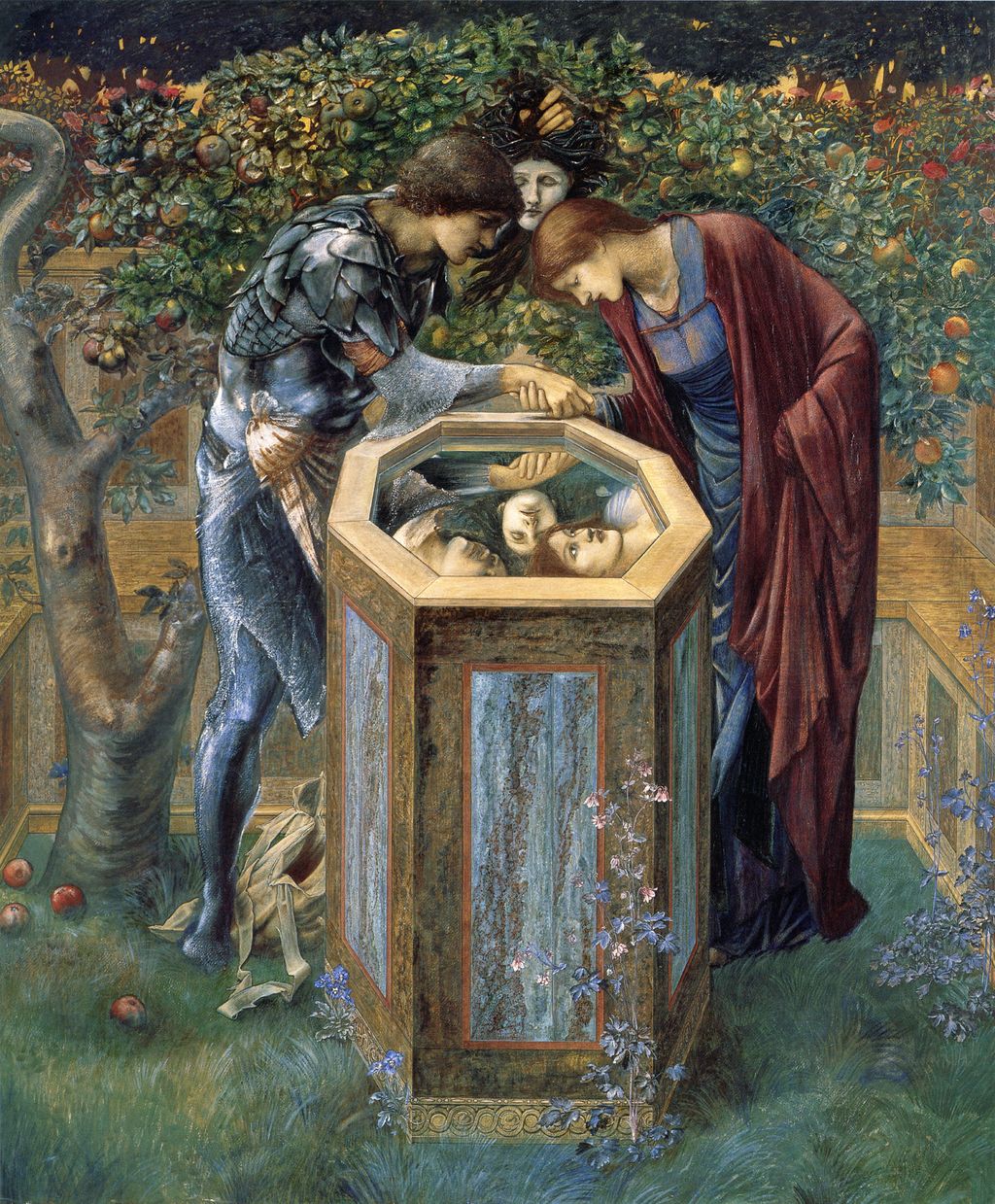
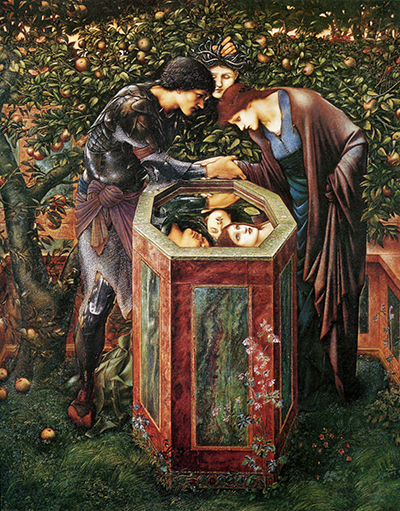
Edward Burne-Jones, The Baleful Head, full-scale design for the Perseus cycle. Southampton City Art Gallery, SOTAG 108. Image source. Public domain.
 by Tom Gurney
Tom Gurney BSc (Hons) is an art history expert with over 20 years experience
Email: tomgurney1@gmail.com / Phone: +44 7429 011000
The Perseus Cycle by Edward Burne-Jones: Introduction
Edward Burne-Jones opens his Perseus cycle with a young man sitting with his head in his hand. Perseus appears twice in the same landscape, first bowed in distress and then looking up at Athena. By the final scene he is the one holding up a marvel for somebody else to see. He raises the severed head of Medusa over a well so Andromeda can look down at its reflection. Between those two encounters, a stolen eye, a small mirror and a helmet that makes its wearer invisible decide who can see whom, and who survives. [1] [2]
At a Glance
- ArtistEdward Burne-Jones
- DateFrom 1875
- MediumPaintings and full-scale designs
- SubjectArthur Balfour’s commission
This work across Edward Burne-Jones’s career
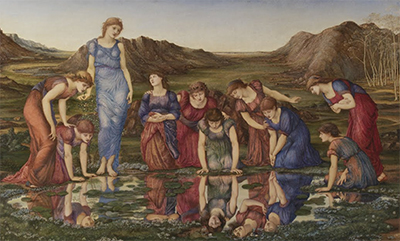
The Mirror of Venus
1870sThe Wheel of Fortune
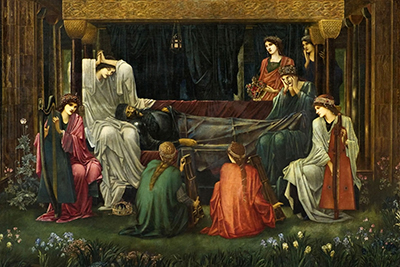
1875–83The Last Sleep of Arthur in Avalon
1880s–1898The Star of Bethlehem
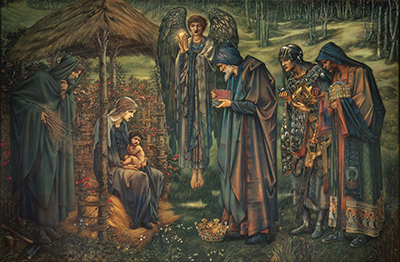
Signed 1890Contents
- A myth designed for a London room
- From Athena to the Gorgons
- Atlas, Andromeda and the last reflection
- What survives in Stuttgart and Southampton
- Annotated details
A myth designed for a London room
Arthur Balfour, the young Conservative politician who would later become prime minister, commissioned the cycle in 1875 for his drawing room, also described as the music room, at 4 Carlton Gardens in London. He left the subject to Burne-Jones, who had already worked on the Perseus story in the 1860s. He and William Morris had planned an illustrated edition of The Earthly Paradise, Morris’s collection of narrative poems. The edition they imagined never appeared, but the William Morris Archive records twenty-eight sketches intended for the tale of Perseus. The commission gave Burne-Jones a room in which to revisit ideas first conceived for the page. [3] [4] [5] [6]
Morris’s poem, The Doom of King Acrisius, begins with an oracle warning the King of Argos that his daughter Danaë’s son will kill him. Acrisius shuts Danaë in a tower and later sets her and the infant Perseus adrift. At the end of the poem the grown Perseus fulfils the prophecy by accidentally killing his grandfather with a discus. Burne-Jones takes the adventures in between. His opening finds Perseus old enough to undertake the quest for Medusa’s head, and his last scene brings Perseus, Medusa and Andromeda into the same picture. The king’s fear governs the poem. Across the pictures, the danger and fascination of looking supply a thread of their own. [3] [7]
Tate’s three small designs of 1875–76 show how Burne-Jones planned for a viewer to follow the story from wall to wall. Each sheet represents a wall, with paintings fitted around features including a door and a fireplace. A design based on the acanthus pattern made by Morris & Co. was to surround the panels in raised plasterwork. Burne-Jones also planned the panelling and lighting. Four scenes were intended as low reliefs, including Perseus and the Graiae, which stood above the fireplace in the design. A visitor looking around the room would move between surfaces that caught the light in different ways. [3] [5]
From Athena to the Gorgons
In Stuttgart’s unfinished oil The Call of Perseus, Athena first approaches as a bent, cloaked figure. She appears again in the foreground in armour, holding a blade and a hand mirror. The repetition puts two moments in one landscape, a device the art historian N. Yu. Bartosh compares to medieval fresco painting. [8] The hand mirror is itself a departure from Morris’s text, in which the goddess equips the hero with a polished shield. The small object fits the scale of the next encounter, when Perseus reaches out to steal the single eye the Graiae pass between them. Holding it lets him bargain for the whereabouts of the nymphs. Burne-Jones gives the sisters youthful faces and makes their hands and interlocking figures as expressive as their eyes. [1] [5] [9]
The Graiae episode developed from Tate’s small design through Southampton’s full-size gouache cartoon and the relief now in National Museum Cardiff to the Stuttgart oil of 1892. In the relief, folds of drapery and contours rise from a layer of gesso on oak, with metal leaf and paint catching the light. A Latin verse summary spans the upper part of the panel. It was written by the classical scholar Richard Claverhouse Jebb and still includes the encounter at the court of Phineas, a scene dropped from the later sequence. The relief received a poor reception at the Grosvenor Gallery in 1878. Burne-Jones set the other planned reliefs aside and eventually gave this episode its own treatment in oil. [3] [5] [10] [11]
In Perseus and the Sea Nymphs, the hero receives a helmet of invisibility, winged sandals and a pouch to carry Medusa’s head. Burne-Jones added this meeting to the account he took from Morris. The scene gives the women a moment of authority. Perseus sits with his head lowered as he fastens a sandal, his dark armour set against their pale, flowing clothes. Much of what will look like his own power in the next scenes has been lent to him. [12]
In The Finding of Medusa the helmet allows Perseus to approach unseen, and the mirror lets him avoid a direct look. In Stuttgart’s chalk and bodycolour version, the standing Medusa draws her cloak around herself while her winged sisters crouch together. The gesture brings out an aspect of Morris’s poem in which she weeps and wipes her tears on her clothing. Southampton divides what comes next into two pictures. In The Death of Medusa I, the winged horse Pegasus and the figure of Chrysaor spring from Medusa at her death. The Death of Medusa II shows the sisters in pursuit as Perseus stows the head. Stuttgart’s version of that second scene leaves areas of paper visible, while the gestures of the pursuing sisters carry the grief and violence of the episode. [7] [11] [13] [14] [15]
Atlas, Andromeda and the last reflection
In Morris’s poem, Atlas is a king who mocks Perseus in a crowded hall and orders his death. The Southampton cartoon Atlas Turned to Stone replaces the court with a solitary giant carrying the sky, pictured as a globe marked with zodiac signs. Medusa’s head is now a weapon in Perseus’s hands. The next episodes move from its power to petrify towards the possibility of seeing it safely. [7] [16]
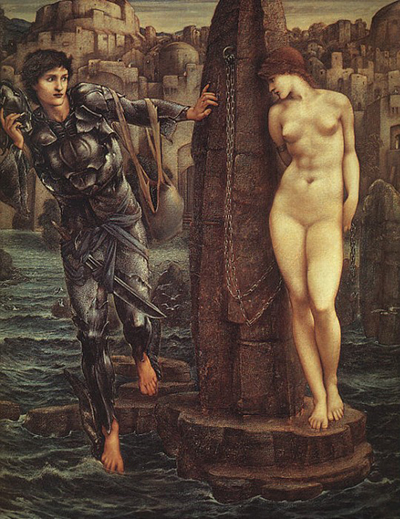
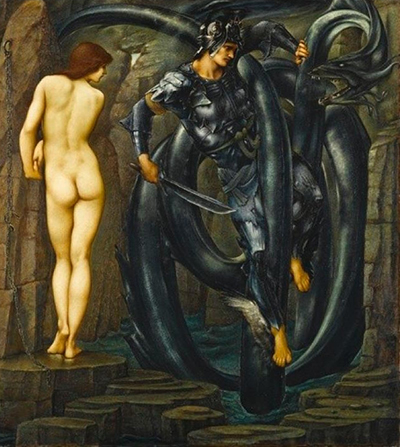
An early oil in Adelaide, Perseus and Andromeda, places the first meeting with Andromeda and the fight against the sea monster side by side on one wide canvas. Burne-Jones ultimately gave each its own picture. In The Rock of Doom, Perseus takes off the helmet to let Andromeda see him. The narrow rock separates them, delaying the action. In The Doom Fulfilled, Andromeda turns away from us and watches as the monster’s coils draw Perseus into the centre of the picture. Tate’s room designs and a Fitzwilliam sketchbook preserve ideas for The Court of Phineas, in which the wedding is interrupted and Perseus turns the attackers to stone. With the first encounter and the rescue separated into two pictures, the surviving full-size sequence goes straight from the fight to the couple in the garden. [3] [11] [17] [18] [19]
In The Baleful Head, Burne-Jones moves the reflected encounter from the shore in Morris’s poem to an enclosed garden. The small mirror Athena gave Perseus now has its counterpart in the broad, still surface of the well. Andromeda bends towards it, while the real head hangs within reach above the water. Fallen apples and a dead leaf floating on the surface make the safety of the garden feel provisional. The water allows the couple to approach what once threatened Perseus without doing away with its power. [2] [20]
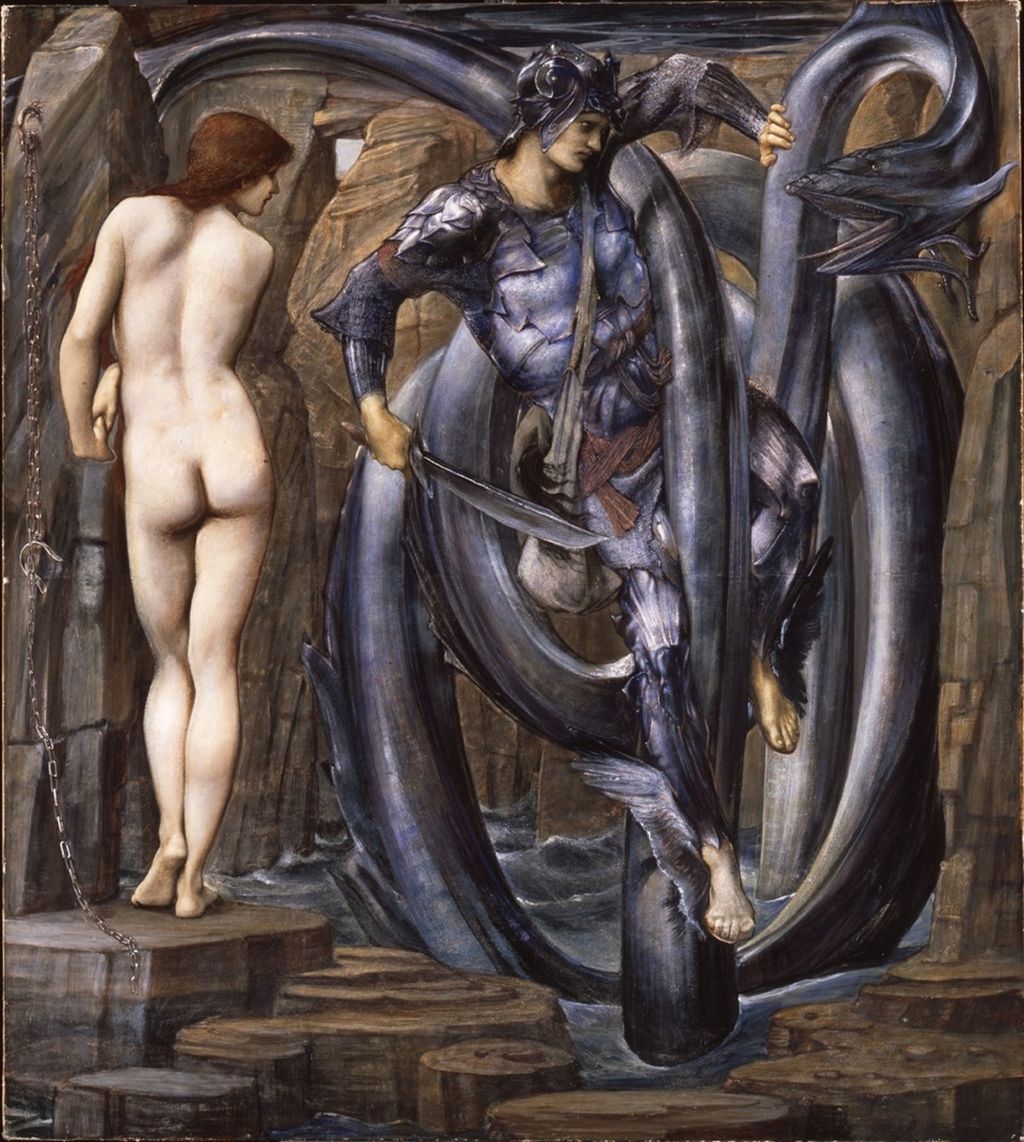
Edward Burne-Jones, The Doom Fulfilled, full-scale design. Southampton City Art Gallery, SOTAG 106. Image source. Public domain.
Annotated Details from The Perseus Cycle
The numbered points identify visible features discussed in this article. Return from each detail to the numbered overview. Edward Burne-Jones, Perseus and Andromeda, 1876, an unfinished painting combining the meeting and combat. Art Gallery of South Australia, 0.329. Image source. Public domain.
.jpg)
Details from THE PERSEUS CYCLE
Compare the cropped details with the source images above. Notice how their colours, shapes and positions contribute to the larger compositions.
The meeting
The figure on the far left and the standing woman share a stretch of coast. They occupy the quieter half of the composite.
 Detail 01 the-meeting.jpg)
The same woman beside the fight
Andromeda appears again beside the combat. The serpent’s long body spreads into the space around Perseus, marking the later moment within the same landscape.
 Detail 02 the-same-woman-beside-the-fight.jpg)
What survives in Stuttgart and Southampton
For a scene Burne-Jones intended to paint in oil, work could begin with studies of separate details. A drawing now in the Getty shows his close attention to the working of armour, which he and Georgiana Burne-Jones also fashioned for a clay model. At full scale, he used opaque watercolour, sometimes with chalk or pastel and metallic paint. The grids visible in the Southampton cartoons for The Death of Medusa II and Atlas Turned to Stone show how a composition could be prepared for transfer. Fröhlich argues that further working drawings probably stood between the Southampton studies and the oils, with the two Stuttgart Medusa scenes surviving from that stage. [9] Other passages, such as the gleam of gold through the trees in Southampton’s version of The Baleful Head, show how far Burne-Jones took the colour and light on paper. [21] [22]
Southampton City Art Gallery holds ten full-size gouache cartoons, including The Death of Medusa I and Atlas Turned to Stone. Stuttgart’s eight works consist of four finished oils, Perseus and the Graiae, The Rock of Doom, The Doom Fulfilled and The Baleful Head, alongside the unfinished oils The Call of Perseus and Perseus and the Sea Nymphs and the two works on paper for The Finding of Medusa and The Death of Medusa. In Stuttgart the latter title refers to the pursuit after the beheading, the episode Southampton calls The Death of Medusa II. The cartoons in Southampton carry the fullest surviving sequence, while Stuttgart’s oils and works on paper show how unevenly the project advanced. Even the surfaces vary within one collection. The exposed paper in Stuttgart’s pursuit scene and the finished oil of the well make very different demands on the eye. [1] [3] [4] [12] [13] [14] [23]
The full decorative scheme was never realised. Individual oils appeared in public while Burne-Jones was still working on the commission. The Grosvenor Gallery showed The Baleful Head in 1887, and the New Gallery showed The Rock of Doom in 1888. [24] [25] The art historian Fabian Fröhlich identified The Call of Perseus in a photograph of the dining room at 10 Downing Street published in 1901. He also cites a 1922 account placing the eight pictures in Balfour’s drawing room and the Graiae relief over a separate fireplace downstairs. The Southampton cartoons followed a different route. Alexander Henderson bought the set, which had hung in Burne-Jones’s garden studio. Southampton acquired it from Lady Violet Henderson in 1934 through the Chipperfield Bequest Fund. Balfour’s pictures passed through an American collection before the Staatsgalerie acquired them in 1971 with lottery funds. [1] [9] [11] [26]
In 1902 the New York publisher R. H. Russell issued Morris’s poem as a separate book with an introduction by Fitzroy Carrington and reproductions from Frederick Hollyer’s photographs. Carrington included images of Danaë alongside the Perseus scenes. Their appearance near the beginning gives the king’s prophecy a presence that it had lost in the room scheme. [27]
Later exhibitions have allowed the series to be seen in different ways. The Musée d’Orsay showed the ten Southampton cartoons together in 1999. The 2009–10 exhibition The Earthly Paradise in Stuttgart and Bern included loans of other Perseus material, such as a study of Medusa’s head from the Fitzwilliam. The Mitsubishi Ichigokan Museum’s Tokyo exhibition in 2012 showed Southampton’s The Death of Medusa II and The Doom Fulfilled alongside Birmingham studies of Perseus in armour and a Gorgon’s wing. Southampton replaced the cartoons’ scratched glazing in 2013 with low-reflective, ultraviolet-filtering acrylic, and conserved their frames in stages. Tate Britain’s 2018–19 retrospective gathered designs, cartoons, oils and the Cardiff relief in one room. The sequence of pictures could be followed around the walls again, with the differences in material and composition visible along the way. [3] [26] [28] [29] [30] [31] Southampton’s Baleful Head later appeared on its own in the 2024 exhibition Preraffaelliti. Rinascimento moderno in Forlì, where the organisers displayed it among works exploring the Italian sources of Pre-Raphaelite art. [32]
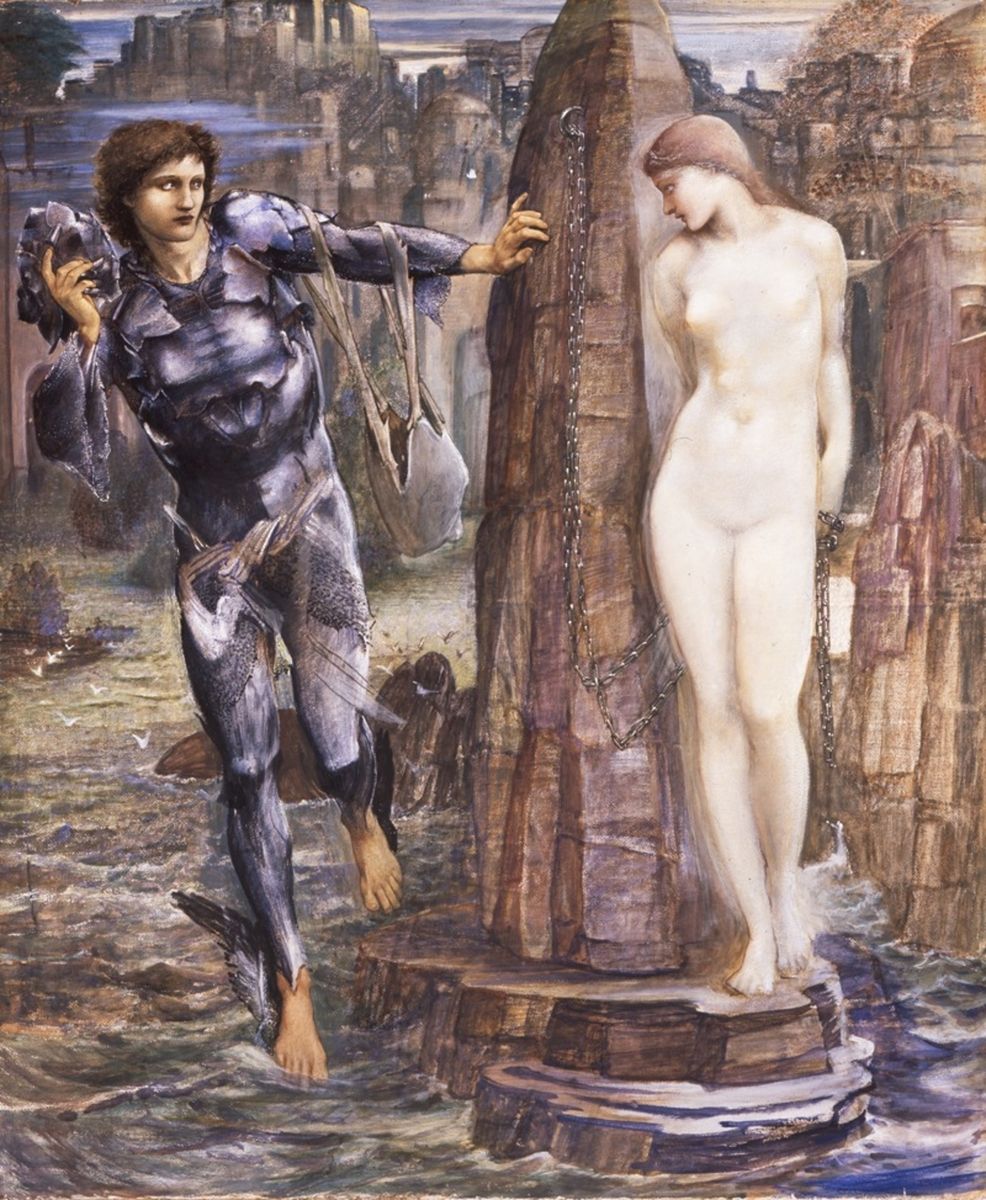
Edward Burne-Jones, The Rock of Doom, full-scale design. Southampton City Art Gallery, SOTAG 107. Image source. Public domain.
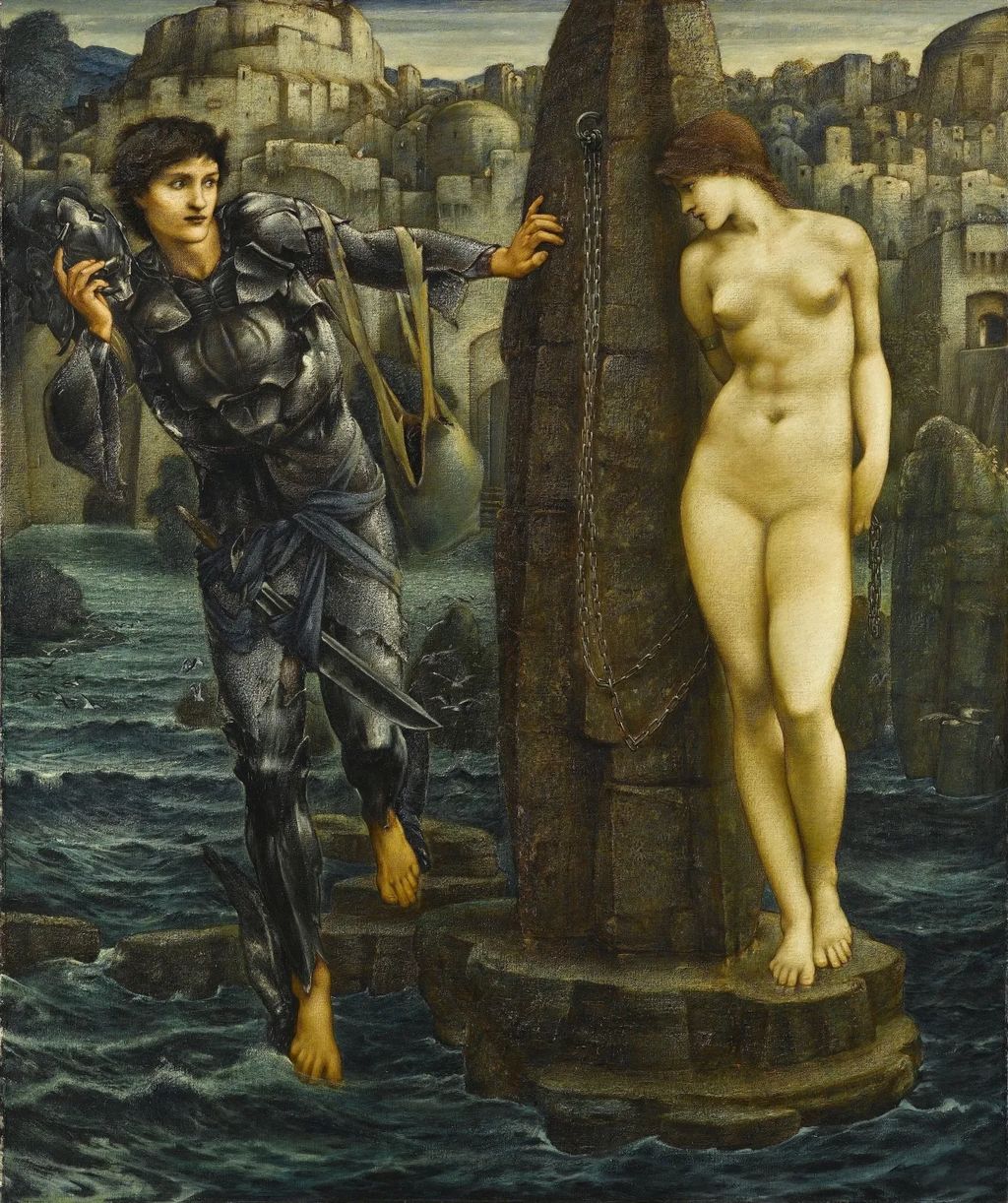
Edward Burne-Jones, The Rock of Doom, 1884–88. Staatsgalerie Stuttgart, inventory 3108. Image source. Public domain.
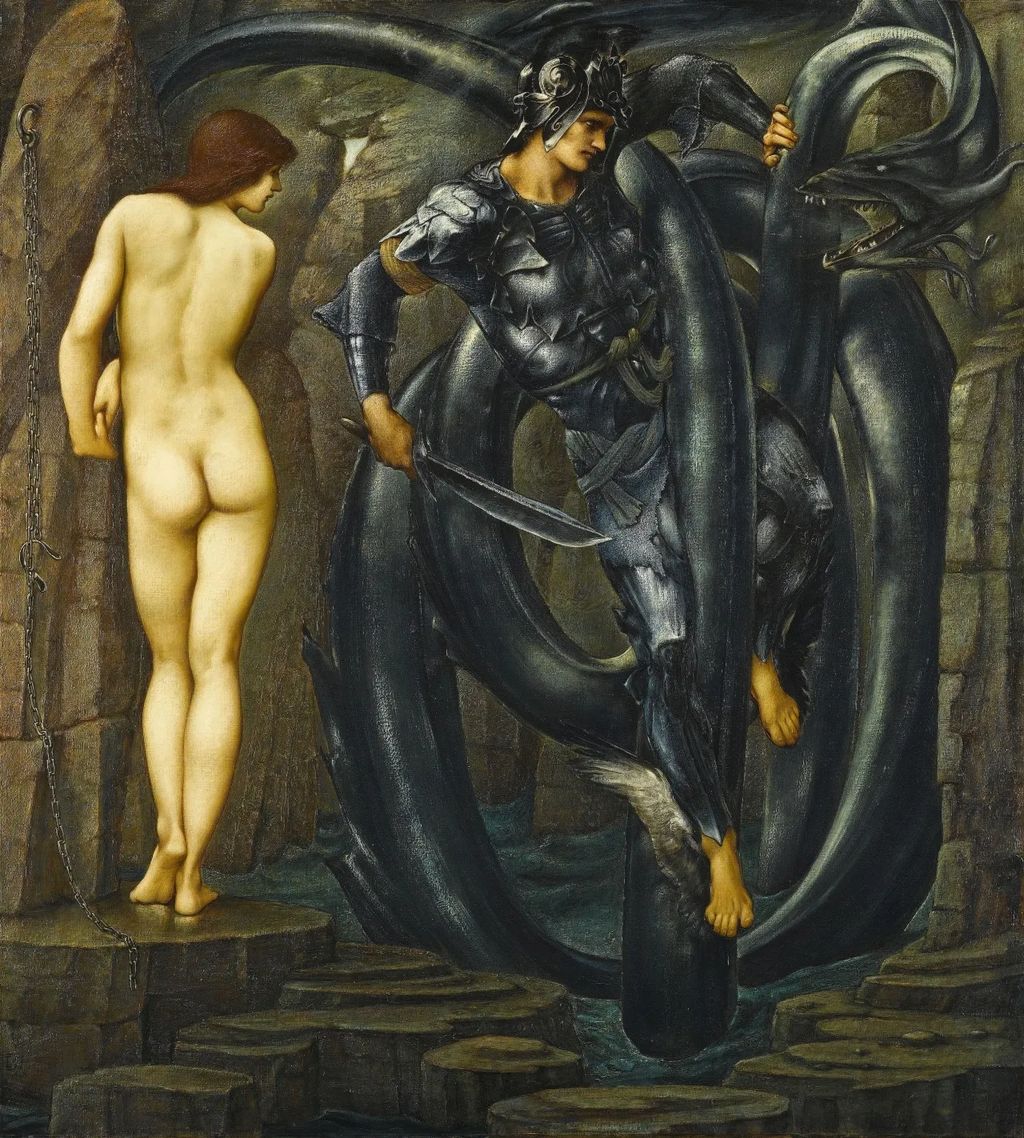
Edward Burne-Jones, The Doom Fulfilled, 1888. Staatsgalerie Stuttgart, inventory 3109. Image source. Public domain.
Related artworks
Edward Burne-Jones on film
Explore Burne-Jones’s paintings, illustrated stories and stained-glass designs.
Edward Burne-Jones: Pre-Raphaelite Visionary | Exhibitions | Showcase
A look at Burne-Jones’s paintings and the Tate retrospective.
Watch on YouTubeArtworks directory
This directory records paintings, studies, designs and collaborative works, with separate entries for documented versions and series where known.
| Name | Date | Medium |
|---|---|---|
| Sidonia von Bork 1560 | 1860 | Watercolour and bodycolour |
| Clara von Bork 1560 | 1860 | Watercolour and bodycolour |
| The Merciful Knight | 1863 | Watercolour |
| Sibylla Delphica | c. 1886 | Oil on panel |
| Phyllis and Demophoön | 1870 | Watercolour and bodycolour |
| The Legend of the Briar Rose (Buscot series) | 1870s–1890 | Oils on canvas |
| The Briar Wood (Buscot series) | By 1890 | Oil on canvas |
| The Council Chamber (Buscot series) | By 1890 | Oil on canvas |
| The Garden Court (Buscot series) | By 1890 | Oil on canvas |
| The Rose Bower (Buscot series) | By 1890 | Oil on canvas |
| Group of Women, study for The Golden Stairs | 1872 | Drawing |
| The Beguiling of Merlin | 1870s | Oil on canvas |
| The Perseus Cycle | From 1875 | Paintings and full-scale designs |
| The Call of Perseus (Stuttgart) | From 1875 | Oil painting |
| Perseus and the Graeae (Stuttgart) | From 1875 | Oil painting |
| The Rock of Doom (Stuttgart) | 1884–88 | Oil on canvas |
| The Doom Fulfilled (Stuttgart) | 1888 | Oil on canvas |
| The Baleful Head (Stuttgart) | 1885–87 | Oil on canvas |
| The Baleful Head (Southampton design) | 1880s | Bodycolour |
| The Rock of Doom (Southampton design) | 1880s | Bodycolour |
| The Doom Fulfilled (Southampton design) | 1880s | Bodycolour |
| The Mirror of Venus (Gulbenkian) | 1870s | Oil on canvas |
| Drawing associated with The Mirror of Venus | 1870s | Drawing |
| Laus Veneris (Laing) | 1873–78 | Oil on canvas |
| The Days of Creation | 1870s | Watercolour and bodycolour |
| The Golden Stairs | 1880 | Oil on canvas |
| An Angel Playing a Flageolet | 1878 | Watercolour, bodycolour and gold |
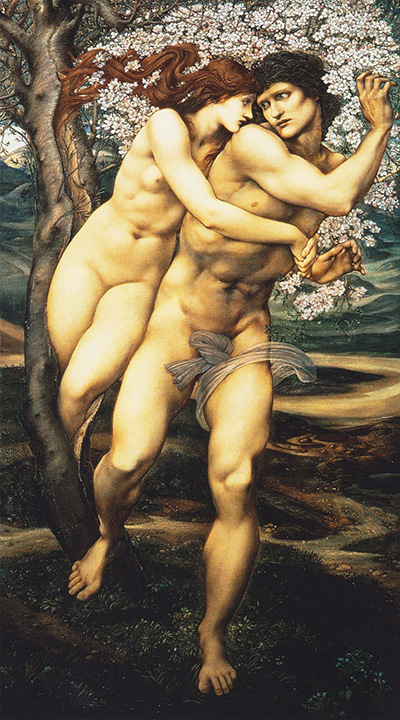
| The Tree of Forgiveness | 1881–82 | Oil on canvas |
| The Wheel of Fortune (Orsay) | 1875–83 | Oil on canvas |
| King Cophetua and the Beggar Maid | 1884 | Oil on canvas |
| The Depths of the Sea (oil) | 1886 | Oil |
| The Morning of the Resurrection | 1886 | Oil on panel |
| Study for the Head of Mary Magdalene | c. 1882 | Oil study |
| The Sleep of King Arthur in Avalon | 1880s–1898 | Oil on canvas |
| The Sleep of King Arthur in Avalon (modello) | ca. 1881 | Oil on canvas (modello) |
| The Star of Bethlehem | Signed 1890 | Watercolour and bodycolour |
| Study for The Star of Bethlehem | About 1887–91 | Drawing |
| Sponsa de Libano | 1891 | Watercolour and bodycolour |
| The Summons (Holy Grail tapestries) | 1890s | Tapestry |
| The Failure of Sir Gawaine (Holy Grail tapestries) | 1890s | Tapestry |
| Hope (Boston) | 1896 | Oil on canvas |
| La Belle au bois dormant (theatre programme) | 1894 | Collotype |
| The Wedding of Psyche | 1895 | Oil on canvas |
| The Works of Geoffrey Chaucer (Kelmscott edition) | 1896 | Illustrated book |
| The Ascension (Birmingham Cathedral) | 1885 | Stained glass |
| The Last Judgement (Birmingham Cathedral) | 1897 | Stained glass |
| Adoration of the Magi (Huntington) | 1890s | Tapestry |
| Love among the Ruins (Wightwick) | 1894 | Oil on canvas |
| The Merciful Knight (photogravure after Burne-Jones) | 1900 | Photogravure |
| The Garden Court (preparatory work) | 1870–75 | Graphite and watercolour with white gouache |
| Study of a Female Figure | 1885 | Graphite drawing |
| Psyche Throwing Herself into the River | 1865–68 | Wood engraving |
| Beauty | 1887–89 | Colour lithograph |
| Study for the Failure of Gawain | 1893 | Crayon and graphite on Japanese paper |
| The Prince Enters the Briar Wood (after Burne-Jones) | After 1890 | Photogravure |
| The Rose Bower (after Burne-Jones) | 1892 | Photogravure |
| Adoration of the Magi (Musée d’Orsay) | 1904 | Tapestry |
| Answers to Prayer (Lyndhurst) | 1860s | Stained glass |
| The Depths of the Sea (photogravure after Burne-Jones) | 1900 | Photogravure |
| Perseus and Andromeda (Adelaide composite) | 1876 | Oil on canvas |
| The Adoration of the Magi (Hamburg) | Woven 1900 | Tapestry |
| Love leading the Pilgrim through the Briars | 1874–76 | Embroidery |
| Musica (worked by Lady Jane Cory) | 1906 | Embroidery |
| Pomona (worked by Lady Jane Cory) | 1907 | Embroidery |
| Flora (worked by Lady Jane Cory) | 1909 | Embroidery |
| The Fourth Day of Creation (photogravure after Burne-Jones) | 1900 | Photogravure |
| The Morning of the Resurrection (photogravure after Burne-Jones) | 1900 | Photogravure |
| Musical angels of the St Catherine window (Christ Church) | Designed 1877 | Stained glass |
Discussion
Look again at the images and ideas explored in The Perseus Cycle by Edward Burne-Jones. These editorial prompts invite your observations.
Reader Insights
How do the full-scale designs change your sense of the paintings as parts of a room?
Which object seems most important to the narrative of seeing and being seen?
Join the Conversation
Share a detail, comparison or question about The Perseus Cycle by Edward Burne-Jones below.
References
- Staatsgalerie Stuttgart, The Call of Perseus, collection guide, stop 115. View source.
- Staatsgalerie Stuttgart, Das Schreckenshaupt, collection guide, stop 122. View source.
- Tate Britain, Edward Burne-Jones, 2018–19 exhibition labels, Room 5, pp. 107–121, especially the designs for The Story of Perseus, N03456–8. View source.
- Southampton City Art Gallery, The Perseus Series, collection overview and individual cartoon records. View source.
- Ruth Helen Smith, Inside-Out: The Sensory Bodies of Perseus and the Graiae by Edward Burne-Jones, Courtauld immediations, introduction and figures 1–5. View source.
- William Morris Archive, General Introduction to The Earthly Paradise, §32, the planned illustrations and their later uses. View source.
- William Morris, The Doom of King Acrisius, in The Earthly Paradise, 1896 edition, Argument and narrative. View source.
- N. Yu. Bartosh, The Image of Athena in Art and Literature of Art Nouveau, pp. 711–713, comparison with medieval narrative painting. View source.
- Fabian Fröhlich, Frauen im Spiegel: Der Perseus-Zyklus von Edward Burne-Jones, pp. 9–11, 102–104, 119–122 and section 4.1. View source.
- Amgueddfa Cymru – Museum Wales, Perseus and the Graiae, collection record NMW A 29299. View source.
- Janice M. Benario, Sir Edward Burne-Jones: The Perseus Series, The Classical Outlook, vol. 78, no. 2, pp. 53–57. View source.
- Staatsgalerie Stuttgart, Perseus and the Sea Nymphs, collection guide, stop 117. View source.
- Staatsgalerie Stuttgart, Die Auffindung der Medusa, collection guide, stop 118. View source.
- Staatsgalerie Stuttgart, Der Tod der Medusa, collection guide, stop 119. View source.
- Burne-Jones Catalogue Raisonné, The Death of Medusa I – The Birth of Pegasus and Chrysaor from the Blood of Medusa, Southampton cartoon entry and work-list transcription. View source.
- Stephen Wildman, The Perseus Series: Atlas Turned to Stone (Southampton), Burne-Jones Catalogue Raisonné, catalogue commentary. View source.
- Art Gallery of South Australia, Perseus and Andromeda, collection record 0.329 and Tansy Curtin’s wall label. View source.
- Staatsgalerie Stuttgart, Der Schicksalsfelsen, collection guide, stop 120. View source.
- The Fitzwilliam Museum, Sketches for the Perseus series, accession 1085.f.21, recto and verso. View source.
- ZDF and Staatsgalerie Stuttgart, Edward Burne-Jones: Das Schreckenshaupt, Geheimnis der Bilder, commentary on the shoreline and garden settings. View source.
- Getty Museum, Study for Perseus, collection record and account of the armour experiment. View source.
- Fiona Mann, “Opaque with a vengeance”: Burne-Jones’s later watercolours, 1880–98, The Burlington Magazine, 2019, discussion of the Perseus cartoons and fig. 9. View source.
- Stephen Wildman, The Perseus Series: Perseus and the Sea Nymphs (Perseus and the Nereids) – The Arming of Perseus (Southampton), Burne-Jones Catalogue Raisonné, commentary on the unfinished Stuttgart painting. View source.
- Stephen Wildman, The Perseus Series: The Baleful Head (Southampton), Burne-Jones Catalogue Raisonné, commentary on the 1887 exhibition of the oil and provenance. View source.
- Stephen Wildman, The Perseus Series: The Rock of Doom (Southampton), Burne-Jones Catalogue Raisonné, commentary on the 1888 showing of the oil and exhibition record. View source.
- Rebecca Moisan, Perseus series by Burne-Jones re-glazed for Southampton City Art Gallery, conservation officer’s account of the acquisition and glazing project. View source.
- William Morris and Fitzroy Carrington, The Doom of King Acrisius, New York, R. H. Russell, 1902, list of illustrations and Carrington’s introduction, pp. xv–xvi. View source.
- Musée d’Orsay, Edward Burne-Jones (1833–1898). Un maître anglais de l’imaginaire, exhibition record, March–June 1999. View source.
- The Fitzwilliam Museum, Study for the Head of Medusa (Perseus Series), accession 2021, related exhibitions, including Das irdische Paradies. View source.
- Mitsubishi Ichigokan Museum, 2012 Annual Report, Edward Burne-Jones exhibition checklist, nos. 43–46. View source.
- Southampton City Council, Chipperfield Advisory Committee public reports pack, 3 April 2017, conservation of the Perseus cartoons and frames. View source.
- Fondazione Cassa dei Risparmi di Forlì, Preraffaelliti. Rinascimento moderno, 2024 exhibition checklist, La testa funesta, Southampton loan. View source.