 by Tom Gurney
Tom Gurney BSc (Hons) is an art history expert with over 20 years experience
Published on June 19, 2020 / Updated on November 25, 2026
Email: tomgurney1@gmail.com / Phone: +44 7429 011000
King Cophetua and the Beggar Maid: Introduction
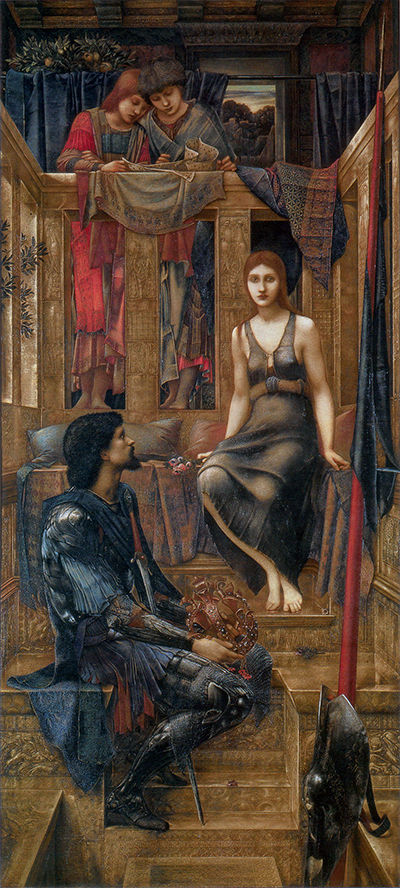
Edward Burne-Jones places a king on the steps below his own throne. Cophetua is still in armour, with his shield propped beside him and his crown turned in his hands. The woman he looks up at has bare feet and a grey dress. She sits with a handful of flowers and looks out past him. Finished in 1884, King Cophetua and the Beggar Maid is an oil on canvas measuring 293.4 × 135.9 centimetres in Tate’s collection, accession N01771. Its nearly three metres of height give a public, monumental scale to an encounter in which scarcely anyone moves. [1] [2]
At a Glance
- ArtistEdward Burne-Jones
- Date1884
- MediumOil on canvas
- SubjectBallad and Tennyson
This work across Edward Burne-Jones’s career
The Mirror of Venus
1870sThe Wheel of Fortune
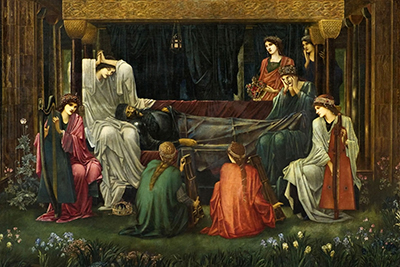
1875–83The Last Sleep of Arthur in Avalon
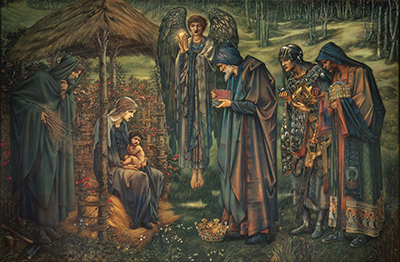
1880s–1898The Star of Bethlehem
Signed 1890Contents
- What happens in the ballad and in Tennyson
- From the first oil to the finished canvas
- What the steps and the light make visible
- From the Grosvenor Gallery to Paris
- Annotated details
What happens in the ballad and in Tennyson
In the old English ballad printed by Thomas Percy in his Reliques of Ancient English Poetry in 1765, Cophetua is an African king who scorns the company of women. One day he looks from a window and sees a beggar dressed in grey. Cupid’s arrow accounts for the sudden change in him. He struggles against the desire to marry her, then fears he will die if he cannot win her love. At the palace gate he scatters money among the crowd of beggars, then calls the young woman back and gives her his chain. She tells him her name, Penelophon. When they walk inside she reddens, turns pale and falls speechless as he embraces her. Then she answers, and the ballad proceeds to their marriage and eventually to their shared tomb. Percy took the text from a version published by Richard Johnson in 1612 as “A Song of a Beggar and a King”, with corrections from another copy. Its interest lies partly in the reversal of the king’s own resolve, long before it reaches the reversal in the woman’s fortunes. [3]
Alfred Tennyson’s 1842 poem The Beggar Maid compresses the tale to sixteen lines. It begins with the woman crossing her arms and coming barefoot before Cophetua. The king, wearing robe and crown, steps down to meet her. Tennyson leaves out the window, Cupid and the king’s earlier struggle. The courtiers praise her eyes, ankles, dark hair and bearing, and her beauty shines through her poor clothes like the moon through cloud. The poem ends with Cophetua’s oath that she will be queen. At a court where a woman in her position would ordinarily attract little attention, everyone has something to say about her beauty. The poem gives her no speaking part. [4]
William Holman Hunt drew the encounter for Edward Moxon’s illustrated edition of Tennyson in 1857. In the Dalziels’ wood engraving after Hunt, the king lifts a crown over the standing woman, whose dark hair hangs almost to her waist. The stair behind them rises diagonally and a man watches from below. In the book, the lifted crown makes a public gesture out of the oath that ends the poem. Burne-Jones’s finished painting gives the woman the throne and lets the king’s descent register after the fact. Stephen Wildman draws attention to the older ballad’s account of her speechlessness in the palace. Rachel Sloan points out that neither text describes the precise tableau of a king seated below the woman on his throne. Burne-Jones uses the barefoot arrival, the king’s descent and the maid’s silence to imagine what it might feel like to be the focus of a whole court’s attention. [5] [6]
From the first oil to the finished canvas
Burne-Jones first attempted the subject in an oil of 1861–62, now in the Tate collection. The early king moves toward the maid and reaches for her. A double page of drawings at the Fitzwilliam Museum, which D. Robinson dated to around 1875 by comparing other subjects in the same sketchbook, still gives Cophetua an outstretched arm in one of its designs. The artist tried various placements of the two figures before settling on the scene in which each stays on a separate level. Even some later watercolours keep them close together and give the attendants more to do. In two studies discussed by Wildman, the choristers sing openly and the maid looks away. The pencil sketch at Amgueddfa Cymru, dated about 1883, puts an attendant at either side above the principal figures. At 35.5 centimetres high, that sheet handles in miniature some of the problems of placing figures within a tall field. [6] [7] [8]
The preparatory drawings also show how much attention went into details that can look simple in the finished picture. At Wightwick Manor a black chalk sheet works out the dress across the maid’s knees and left leg, with a separate study of the leg in the upper corner. The group there includes studies of her feet and of the king’s crown. Tate’s 1883 graphite Study of the Maid is a separate drawing. In November 1883 Burne-Jones wrote about the difficulty of finding a dress that appeared poor while allowing the king, and by extension the viewer, to imagine her in gold cloth and pearls. The loose grey folds of the finished dress give the body room to sit and also leave its wearer visibly out of place among the worked metals and expensive fabrics. The artist even imagined the king saving the old dress and looking at it from time to time. [9] [2] [10]
For Cophetua, Burne-Jones worked with William Arthur Smith Benson. Tate’s retrospective identified the architect and metalwork designer as the sitter for a separate painted profile study, his face already turned up to the right. Benson also manufactured full-scale models of the royal equipment, including the crown and shield. The painter had actual surfaces on which to study the shine of a rim or the depth of a recess. The catalogue raisonné names Frances Graham as the model for the maid. In a separate oil study of one of the singers, Amgueddfa Cymru suggests Jessie Keene or her older sister Laura, while a dated drawing for a page records another sitter, Philip Comyns Carr. The various studies give evidence about the work of posing for individual figures as well as the painter’s development of the scene. [2] [6] [11] [12]
The full-size cartoon of about 1883 at Birmingham Museums, made with bodycolour and coloured chalks, allowed Burne-Jones to test light and finish at nearly the scale of the oil. Strong daylight enters from the left in the cartoon. In the canvas the architecture closes in around the pair, and the maid’s arms, face and feet have a luminosity that recalls Tennyson’s moon. Her visibility depends as much on the decision to darken the room as on the painting of the dress itself. The artist’s work list records the sustained painting of the large canvas from October 1883 into the following spring, and he told Madeleine Wyndham on 23 April 1884 that he had finished it. A separate, much smaller oil on panel allowed him to explore a similar arrangement. That panel is the privately held work listed in the Japanese exhibition Parabola of Pre-Raphaelitism in 2019. [6] [10] [13] [14]
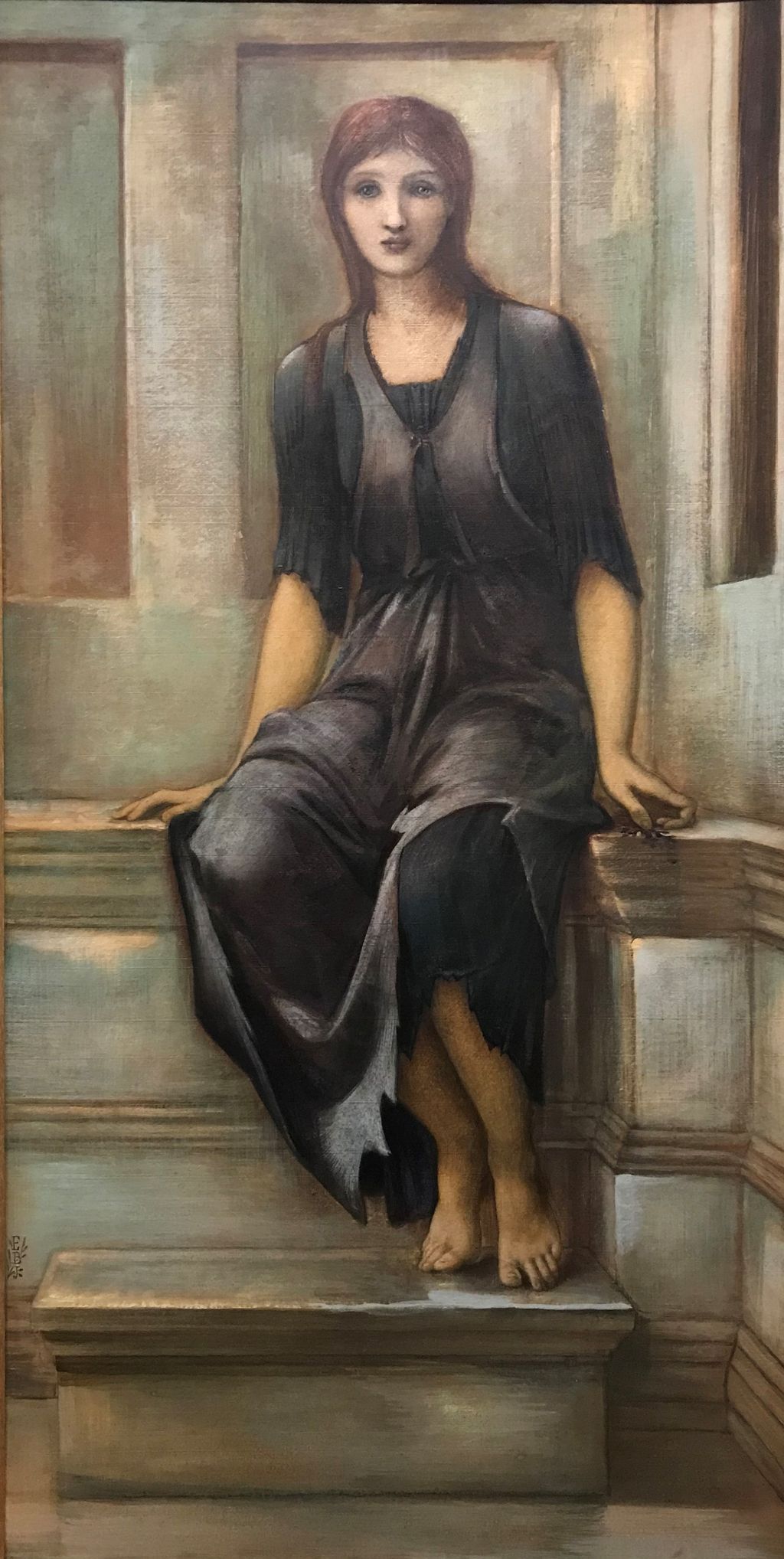
Edward Burne-Jones, Study of the Maid for King Cophetua and the Beggar Maid. Tate. Photograph by Gotogo. Image source. CC BY-SA 4.0. Resized for the web, under the same licence.
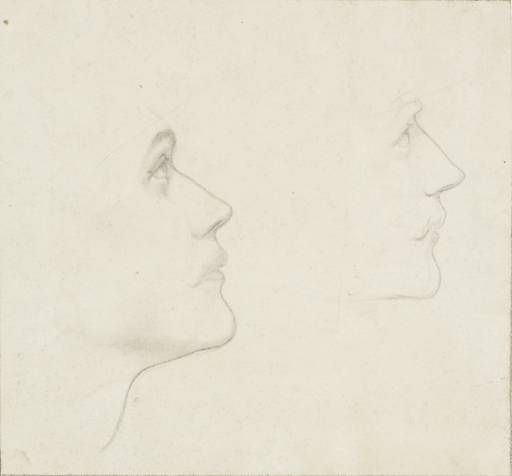
Edward Burne-Jones, Study for the Head of Cophetua. Image source. Public domain.
What the steps and the light make visible
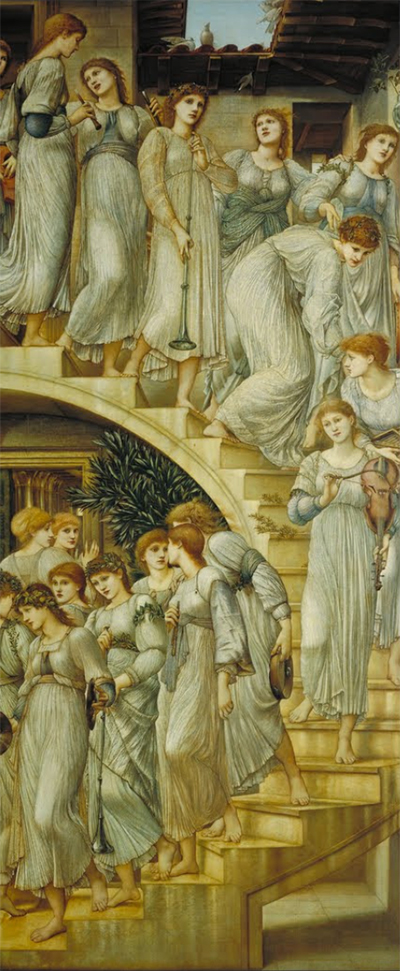
The edge of the lowest step brings the setting almost into the viewer’s space. Follow the steps up from the foreground and the eye moves past the shield and the king’s dark figure to the maid’s gleaming feet, then up her dress to the faces and the book above the railing. The gold-toned uprights keep that ascent within a narrow channel. Farther up, beyond the patterned hanging, a glimpse of landscape offers the only substantial break from the enclosed tiers. Burne-Jones had already made a staircase determine how a viewer read The Golden Stairs. There the sequence of women carrying musical instruments gives the descent its rhythm. Here each level keeps a different part of the court in place, and the king’s tilted face sends the eye back to the woman who holds his attention. [1] [2] [15]
The raised seat and the lover below it recall Andrea Mantegna’s Madonna della Vittoria, now at the Louvre. In the Renaissance altarpiece, the Virgin and Child sit above the kneeling Francesco II Gonzaga, whose raised gaze and folded hands are answered by a blessing. Burne-Jones knew Mantegna’s painting and owned an engraving of it, according to Sloan. He gave the place usually occupied by the holy figure to a woman in a plain dress and provided no equivalent to the blessing. That arrangement lends the king’s upward look something of the character of worship, while her own look remains difficult to read. The resemblance extends to the architecture around both groups. The Venetian Renaissance style of the frame extends the impression of an architectural surround beyond the painted surface. [6] [16]
The Vacani family of London made the frame. When Tate conservator Alastair Johnson worked on it for the 2012 exhibition, he used an 1898 photograph by Emery Walker to recover its earlier proportions. A later glazing door had widened the base and pushed the pilasters outward. It had also displaced the ornament that met the edge of the canvas. The conservation restored the narrower opening and reinstated the central winged head on the base. The photograph shows just how closely the pilasters of the frame once answered the uprights in the picture. [17]
The palette sets Cophetua’s darker complexion and black armour against the woman’s light skin and grey costume. The ballad identifies him as African, a detail Tennyson leaves out. The painting makes the difference in complexion visible, while the composition gives the king the commanding profile and the maid the strongest light. The identity of a studio sitter offers evidence about the making of a figure, while the ballad gives the figure his character and origin. The building itself brings together references from different places. Caroline Arscott sees precedents in the reliefs from ancient Assyria that reached the British Museum, as well as Byzantine touches in the textiles and a design resembling Meroitic script on the pillars. Look at the risers near the king and there are small figures of animals and violence, repeated as less readable reflections on the treads. The elaborate interior is a Victorian invention that draws on the museum and the Renaissance altarpiece alongside the geographic suggestion of the ballad. [3] [6] [18]
Seen as a reversal of social rank, the painting gives a woman in poverty the most prominent seat in a room made to display a king’s wealth. Tate has linked that aspect of the picture to the socialism of Burne-Jones’s friend William Morris. A viewer can also follow a different implication of the same arrangement. The crown is off Cophetua’s head and still in his possession. The maid has the higher seat and remains surrounded by his furniture, metalwork and attendants. Her dress gathers over her closed knees while she holds the drooping flowers. Wildman identifies them as anemones and connects them with unrequited love. Arscott finds additional associations with modesty and with the tears of Venus. The flowers and her still posture can sustain either a reading of inward composure or one of uncertainty. The person on whom the whole scene depends is the one whose answer we cannot hear. [1] [6] [18]
Annotated Details from King Cophetua and the Beggar Maid
The numbered points identify visible features discussed in this article. Return from each detail to the numbered overview. King Cophetua and the Beggar Maid, 1884, by Edward Burne-Jones, oil on canvas. Image source. Public domain.
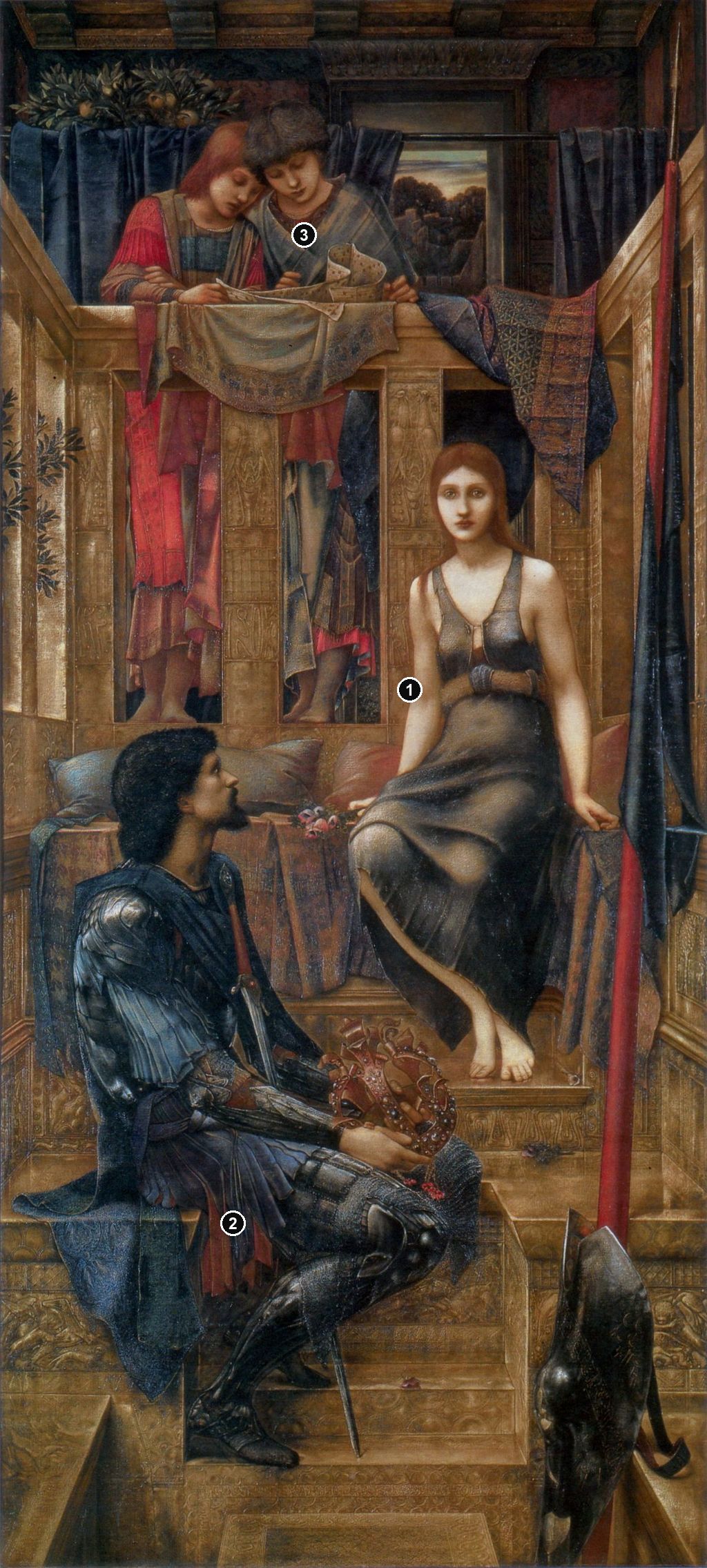
Details from KING COPHETUA AND THE BEGGAR MAID
Compare the cropped details with the source images above. Notice how their colours, shapes and positions contribute to the larger compositions.
The seated maid
Her pale skin and the light steps pick her out from the darker patterned interior.
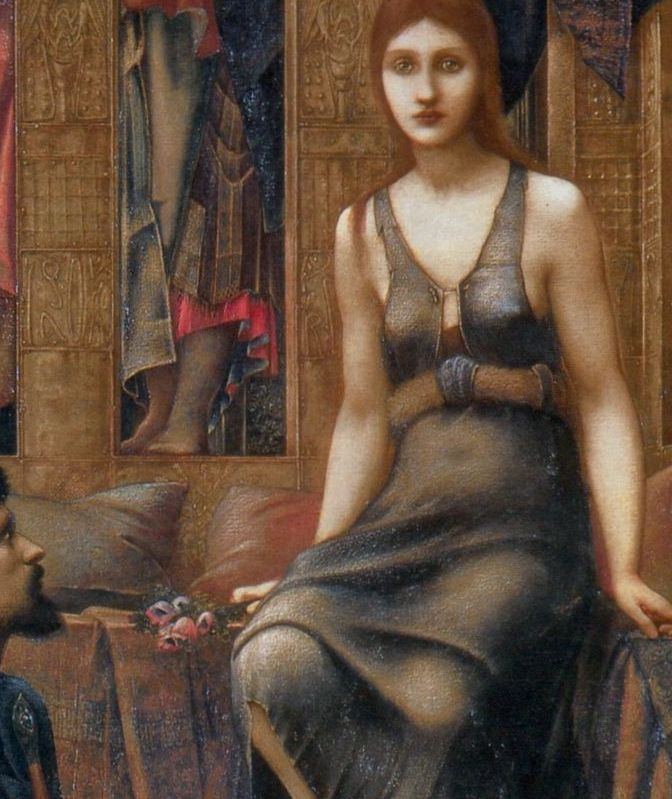
King below
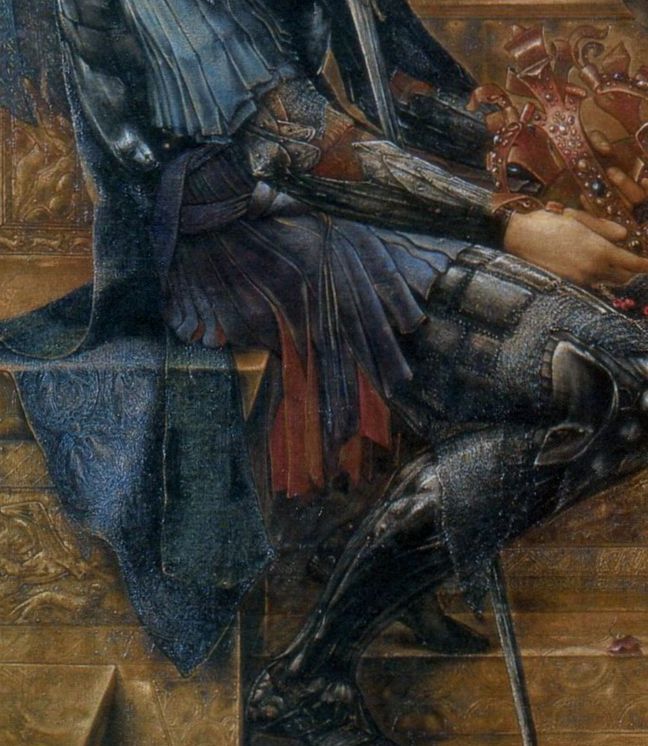
The king’s dark clothing is strongest low in the composition. The view leads up from him towards the maid.
Witnesses above
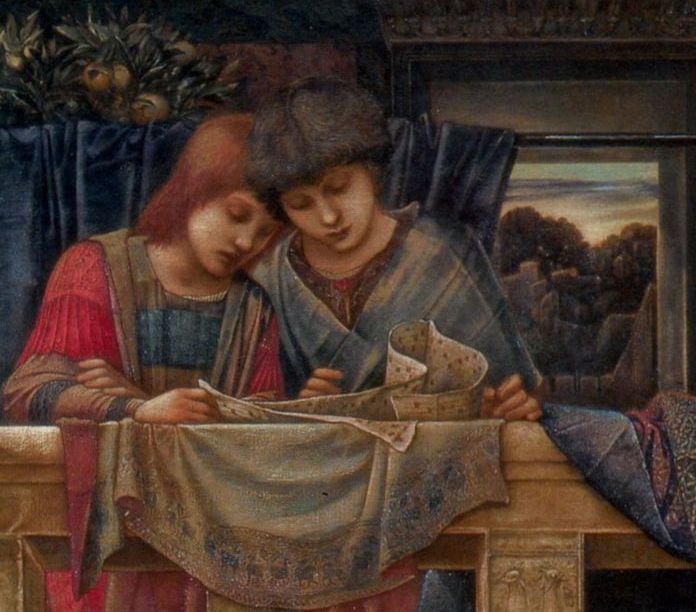
Two heads above the central figures repeat the downward gaze. Cloth and carved shapes give them a setting of their own.
From the Grosvenor Gallery to Paris
The painting appeared as no. 69 at the Grosvenor Gallery in 1884. F. G. Stephens in The Athenaeum admired the subtle gradations within the dark golds, blues and bronzes and thought the painting more solidly worked than Burne-Jones’s earlier pictures. The Art Journal praised the king’s humility as a chivalrous quality. Its response shows how readily a reviewer could understand the difference in height as part of the king’s nobility. Punch made the throne and crown into the elements of a domestic joke, imagining the king complaining that the maid had been sitting on his crown. The joke exploits the awkwardness of the poses that the admiring reviews took so seriously. [6]
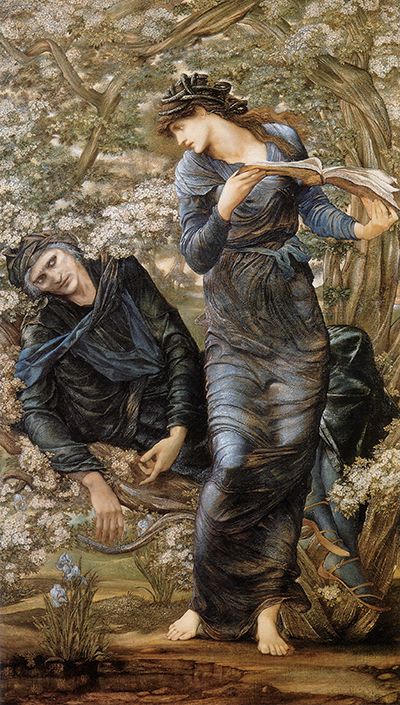
The French critic Théodore Duret, reporting on the London exhibition in 1884, doubted that the subject could make sense to anyone outside England, even with a catalogue. At the Exposition Universelle of 1889 in Paris the picture drew conspicuous attention. Antonin Proust admired the force of its line and colour, along with its echoes of Italian painting. Laurence des Cars records that the exhibition brought Burne-Jones a gold medal, with support from Gustave Moreau on the jury. He was also awarded the cross of the Légion d’honneur. Compared with the smaller circle of French admirers of The Beguiling of Merlin at the 1878 Paris exposition, this was a much broader public success. [6] [19]
The visitors who admired it could nevertheless see very different things in it. Robert de La Sizeranne remembered walking from displays of machinery and wealth into the English art section. In an exhibition designed to show off what nations could manufacture or acquire, he saw a man lay his crown at the feet of a poor woman and called the picture an “Apotheosis of Poverty.” The Swiss writer Édouard Rod, whose response Sloan discusses, thought the woman looked so marked by suffering that she could never answer the king’s devotion. The Belgian painter Fernand Khnopff dwelt on the polish of the metal, the luxury of the fabrics and the two figures absorbed in their own thoughts. Philippe Saunier traces a further afterlife among French-language writers, including Jean Lorrain, who published his own Le Roi Cophetua in 1892. Her silence left room for writers to give the story a different ending. [6] [20] [21]
The Dutch poet J. C. Bloem composed his own Cophetua ballad in 1912. The scholar A. L. Sötemann traces its verse form back to the English ballad and suggests that Burne-Jones’s painting influenced the scene in the fifth stanza. Bloem changes the old happy ending. His poem shows how a writer could return to the same ballad that informed the canvas and come away with a story closer in mood to the uncertainty of Burne-Jones’s figures. [22]
The painting appeared in the New Gallery exhibitions of 1892–93 and 1898–99. In 1900 subscribers to the Burne-Jones Memorial Fund bought it for the nation from the Earl of Wharncliffe’s executors. An early illustrated catalogue of the Tate Gallery lists it as no. 1771 and gives it a full-page monochrome illustration. The Berlin Photographic Company also published a photogravure in The Work of E. Burne-Jones in 1900. The impression at Te Papa is just over half a metre high. On paper the light dress and bare feet still make a strong shape in the dark room, and the direction of the king’s gaze remains clear. The canvas preserves what drew reviewers to its colour and what made the original encounter so imposing. Standing before it, a viewer has to look up as Cophetua does. [6] [23] [24]
Artworks directory
This directory records paintings, studies, designs and collaborative works, with separate entries for documented versions and series where known.
| Name | Date | Medium |
|---|---|---|
| Sidonia von Bork 1560 | 1860 | Watercolour and bodycolour |
| Clara von Bork 1560 | 1860 | Watercolour and bodycolour |
| The Merciful Knight | 1863 | Watercolour |
| Sibylla Delphica | c. 1886 | Oil on panel |
| Phyllis and Demophoön | 1870 | Watercolour and bodycolour |
| The Legend of the Briar Rose (Buscot series) | 1870s–1890 | Oils on canvas |
| The Briar Wood (Buscot series) | By 1890 | Oil on canvas |
| The Council Chamber (Buscot series) | By 1890 | Oil on canvas |
| The Garden Court (Buscot series) | By 1890 | Oil on canvas |
| The Rose Bower (Buscot series) | By 1890 | Oil on canvas |
| Group of Women, study for The Golden Stairs | 1872 | Drawing |
| The Beguiling of Merlin | 1870s | Oil on canvas |
| The Perseus Cycle | From 1875 | Paintings and full-scale designs |
| The Call of Perseus (Stuttgart) | From 1875 | Oil painting |
| Perseus and the Graeae (Stuttgart) | From 1875 | Oil painting |
| The Rock of Doom (Stuttgart) | 1884–88 | Oil on canvas |
| The Doom Fulfilled (Stuttgart) | 1888 | Oil on canvas |
| The Baleful Head (Stuttgart) | 1885–87 | Oil on canvas |
| The Baleful Head (Southampton design) | 1880s | Bodycolour |
| The Rock of Doom (Southampton design) | 1880s | Bodycolour |
| The Doom Fulfilled (Southampton design) | 1880s | Bodycolour |
| The Mirror of Venus (Gulbenkian) | 1870s | Oil on canvas |
| Drawing associated with The Mirror of Venus | 1870s | Drawing |
| Laus Veneris (Laing) | 1873–78 | Oil on canvas |
| The Days of Creation | 1870s | Watercolour and bodycolour |
| The Golden Stairs | 1880 | Oil on canvas |
| An Angel Playing a Flageolet | 1878 | Watercolour, bodycolour and gold |
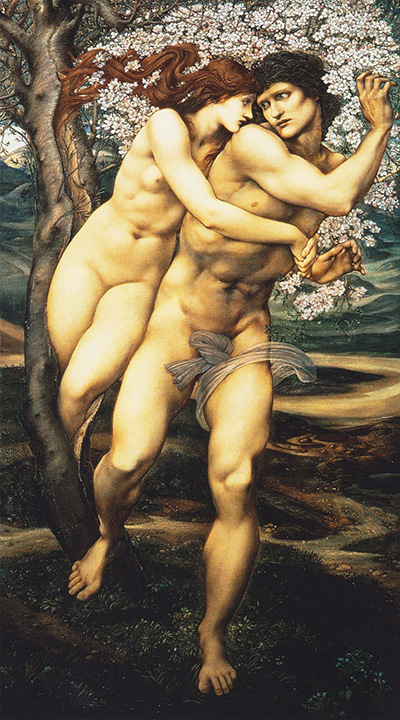
| The Tree of Forgiveness | 1881–82 | Oil on canvas |
| The Wheel of Fortune (Orsay) | 1875–83 | Oil on canvas |
| King Cophetua and the Beggar Maid | 1884 | Oil on canvas |
| The Depths of the Sea (oil) | 1886 | Oil |
| The Morning of the Resurrection | 1886 | Oil on panel |
| Study for the Head of Mary Magdalene | c. 1882 | Oil study |
| The Sleep of King Arthur in Avalon | 1880s–1898 | Oil on canvas |
| The Sleep of King Arthur in Avalon (modello) | ca. 1881 | Oil on canvas (modello) |
| The Star of Bethlehem | Signed 1890 | Watercolour and bodycolour |
| Study for The Star of Bethlehem | About 1887–91 | Drawing |
| Sponsa de Libano | 1891 | Watercolour and bodycolour |
| The Summons (Holy Grail tapestries) | 1890s | Tapestry |
| The Failure of Sir Gawaine (Holy Grail tapestries) | 1890s | Tapestry |
| Hope (Boston) | 1896 | Oil on canvas |
| La Belle au bois dormant (theatre programme) | 1894 | Collotype |
| The Wedding of Psyche | 1895 | Oil on canvas |
| The Works of Geoffrey Chaucer (Kelmscott edition) | 1896 | Illustrated book |
| The Ascension (Birmingham Cathedral) | 1885 | Stained glass |
| The Last Judgement (Birmingham Cathedral) | 1897 | Stained glass |
| Adoration of the Magi (Huntington) | 1890s | Tapestry |
| Love among the Ruins (Wightwick) | 1894 | Oil on canvas |
| The Merciful Knight (photogravure after Burne-Jones) | 1900 | Photogravure |
| The Garden Court (preparatory work) | 1870–75 | Graphite and watercolour with white gouache |
| Study of a Female Figure | 1885 | Graphite drawing |
| Psyche Throwing Herself into the River | 1865–68 | Wood engraving |
| Beauty | 1887–89 | Colour lithograph |
| Study for the Failure of Gawain | 1893 | Crayon and graphite on Japanese paper |
| The Prince Enters the Briar Wood (after Burne-Jones) | After 1890 | Photogravure |
| The Rose Bower (after Burne-Jones) | 1892 | Photogravure |
| Adoration of the Magi (Musée d’Orsay) | 1904 | Tapestry |
| Answers to Prayer (Lyndhurst) | 1860s | Stained glass |
| The Depths of the Sea (photogravure after Burne-Jones) | 1900 | Photogravure |
| Perseus and Andromeda (Adelaide composite) | 1876 | Oil on canvas |
| The Adoration of the Magi (Hamburg) | Woven 1900 | Tapestry |
| Love leading the Pilgrim through the Briars | 1874–76 | Embroidery |
| Musica (worked by Lady Jane Cory) | 1906 | Embroidery |
| Pomona (worked by Lady Jane Cory) | 1907 | Embroidery |
| Flora (worked by Lady Jane Cory) | 1909 | Embroidery |
| The Fourth Day of Creation (photogravure after Burne-Jones) | 1900 | Photogravure |
| The Morning of the Resurrection (photogravure after Burne-Jones) | 1900 | Photogravure |
| Musical angels of the St Catherine window (Christ Church) | Designed 1877 | Stained glass |
Discussion
Look again at the images and ideas explored in King Cophetua and the Beggar Maid. These editorial prompts invite your observations.
Reader Insights
How do the staircase and the two figures’ positions shape your reading of the encounter?
What do the two figures looking down from above add to this version of the ballad?
Join the Conversation
Share a detail, comparison or question about King Cophetua and the Beggar Maid below.
References
- Tate Britain, Edward Burne-Jones, King Cophetua and the Beggar Maid, 1884, collection details and reproduction via Google Arts & Culture. View source.
- Tate Britain, Edward Burne-Jones, exhibition large-print guide, 2018–19, pp. 40, 79, 81 and 101, entries for T00565, N01771, N04005 and X64775. View source.
- Thomas Percy, Reliques of Ancient English Poetry, vol. I, “King Cophetua and the Beggar-Maid”, first published in the collection in 1765, book II, no. 6, pp. 189–194. View source.
- Alfred Tennyson, “The Beggar Maid”, first published in Poems in 1842, scanned 1843 edition, vol. II. View source.
- William Holman Hunt and the Dalziel Brothers, “The Beggar Maid”, wood engraving for Tennyson’s Poems, Edward Moxon, 1857, period impression digitised by George P. Landow. View source.
- Burne-Jones Catalogue Raisonné, King Cophetua and the Beggar Maid, Tate N01771, entry by Stephen Wildman with notes by William Waters and Rachel Sloan, provenance and exhibitions. View source.
- D. Robinson, “Burne-Jones’s King Cophetua and the Beggar Maid”, letter to the editor, Apollo, May 1973, p. 626 and figs. 1–2. View source.
- Amgueddfa Cymru – Museum Wales, Sketch for King Cophetua, c. 1883, NMW A 5479. View source.
- National Trust, Drapery Studies for King Cophetua and the Beggarmaid, c. 1883, Wightwick Manor, NT 1288002 and related studies. View source.
- Georgiana Burne-Jones, Memorials of Edward Burne-Jones, 1904, vol. II, pp. 134–135 and 139, letters of November 1883 and April 1884. View source.
- Amgueddfa Cymru – Museum Wales, Study of a head, c. 1883, study for a singer. View source.
- Christie’s, preparatory head of a page for King Cophetua and the Beggar Maid, signed and dated 1882, lot 69, with J. Comyns Carr’s recollection. View source.
- The Metropolitan Museum of Art, Edward Burne-Jones: Victorian Artist-Dreamer, 1998, cat. nos. 112–113, including the Birmingham cartoon, 1947P18. View source.
- Abeno Harukas Art Museum, Parabola of Pre-Raphaelitism, 2019, Japanese and English checklist, cat. no. 119. View source.
- Rebecca Jeffrey Easby, “Sir Edward Coley Burne-Jones, King Cophetua and the Beggar Maid”, Smarthistory, composition and reproduction. View source.
- Musée du Louvre, Andrea Mantegna, La Vierge de la Victoire, INV 369, painting and catalogue record. View source.
- Alastair Johnson, “Conservation of the frame around Edward Burne-Jones’s King Cophetua and the Beggar Maid (1884)”, Tate conservator’s account, 2012. View source.
- Caroline Arscott, “Edward Burne-Jones (1833–1898)”, in The Cambridge Companion to the Pre-Raphaelites, 2012, pp. 232–234 and fig. 19, analysis of the flowers, figures, reflections and architectural ornament. View source.
- Laurence des Cars, “Edward Burne-Jones and France”, in Edward Burne-Jones: Victorian Artist-Dreamer, 1998, section on the 1889 Exposition Universelle. View source.
- Philippe Saunier, “Edward Burne-Jones et la France : Madeleine Deslandes, une préraphaélite oubliée”, Revue de l’Art 123, 1999, pp. 58–59 and 68, including Robert de La Sizeranne’s 1898 account and French literary adaptations. View source.
- Fernand Khnopff, account of King Cophetua and the Beggar Maid, quoted in Masters in Art, vol. II, July 1901, “Descriptions of the Plates”, p. 33. View source.
- A. L. Sötemann, “Over de dichter J.C. Bloem”, Jaarboek van de Maatschappij der Nederlandse Letterkunde, 1972, pp. 59–60, entry on “Koning Cophetua en het bedelmeisje”. View source.
- National Gallery of British Art, The National Gallery of British Art [The Tate Gallery] Illustrated Catalogue, illustration and entry no. 1771. View source.
- Museum of New Zealand Te Papa Tongarewa, King Cophetua and the Beggar Maid, from The Work of E. Burne-Jones, Berlin Photographic Company, 1900, 1981-0086-1/75. View source.