 by Tom Gurney
Tom Gurney BSc (Hons) is an art history expert with over 20 years experience
Published on June 19, 2020 / Updated on November 25, 2026
Email: tomgurney1@gmail.com / Phone: +44 7429 011000
Edward Burne-Jones: Introduction
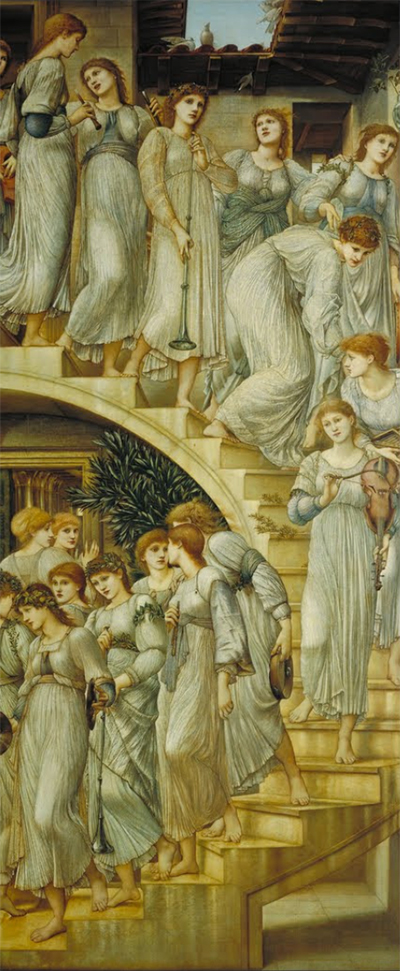
In Edward Burne-Jones’s Golden Stairs, eighteen musicians descend a staircase in a stream of pale robes. One carries a violin. Others carry horns or cymbals. The curve of the stair draws the eye down through the company, but the music is left to the imagination. Burne-Jones could give a scene that kind of expectancy even when he was working from a familiar story. In The Legend of the Briar Rose, a prince arrives to find an entire household asleep. Across four canvases, the painter keeps the princess asleep and lets the viewer spend time in the world the prince has just entered. [1]
Edward Burne-Jones (1833–1898) was a British painter, draughtsman and designer who carried Pre-Raphaelitism into the later Victorian period. The friendships he formed with William Morris at Oxford and with Dante Gabriel Rossetti in London opened different ways of working. His figures came to inhabit exhibition paintings, churches, domestic interiors and printed books. Some began in drawings he made at his own desk and took their eventual form in the hands of a glazier, weaver or engraver. A painting could take years to reach an exhibition. A design could reach several places, in several forms, over the same span of time. [1] [2] [3]
At a Glance
- ArtistEdward Burne-Jones
- Life1833–1898
- Known forPainting and design
- ContextLater Pre-Raphaelitism, Aestheticism and Arts and Crafts
Edward Burne-Jones in context
Pre-Raphaelite Brotherhood
Founded 1848Aesthetic Movement
Second half of the 19th centuryGrosvenor Gallery
Burne-Jones exhibited 1877–87 [1]Dante Gabriel Rossetti
Career and mentorshipEdward Burne-Jones
Working career [1]William Morris
Career and collaborationWilliam Holman Hunt
Pre-Raphaelite painterJohn Everett Millais
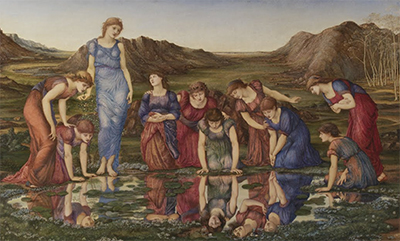
Pre-Raphaelite painterThe Mirror of Venus
1870sThe Wheel of Fortune
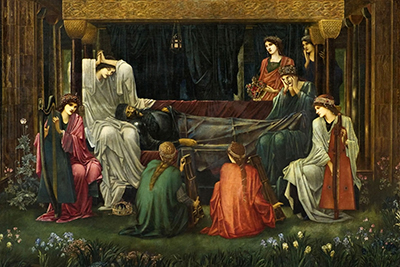
1875–83The Last Sleep of Arthur in Avalon
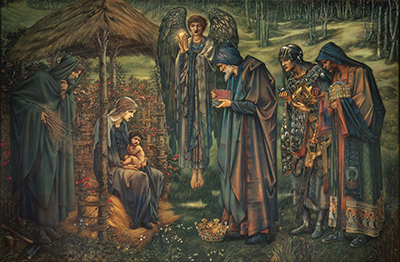
1880s–1898The Star of Bethlehem
Signed 1890Essential Edward Burne-Jones works
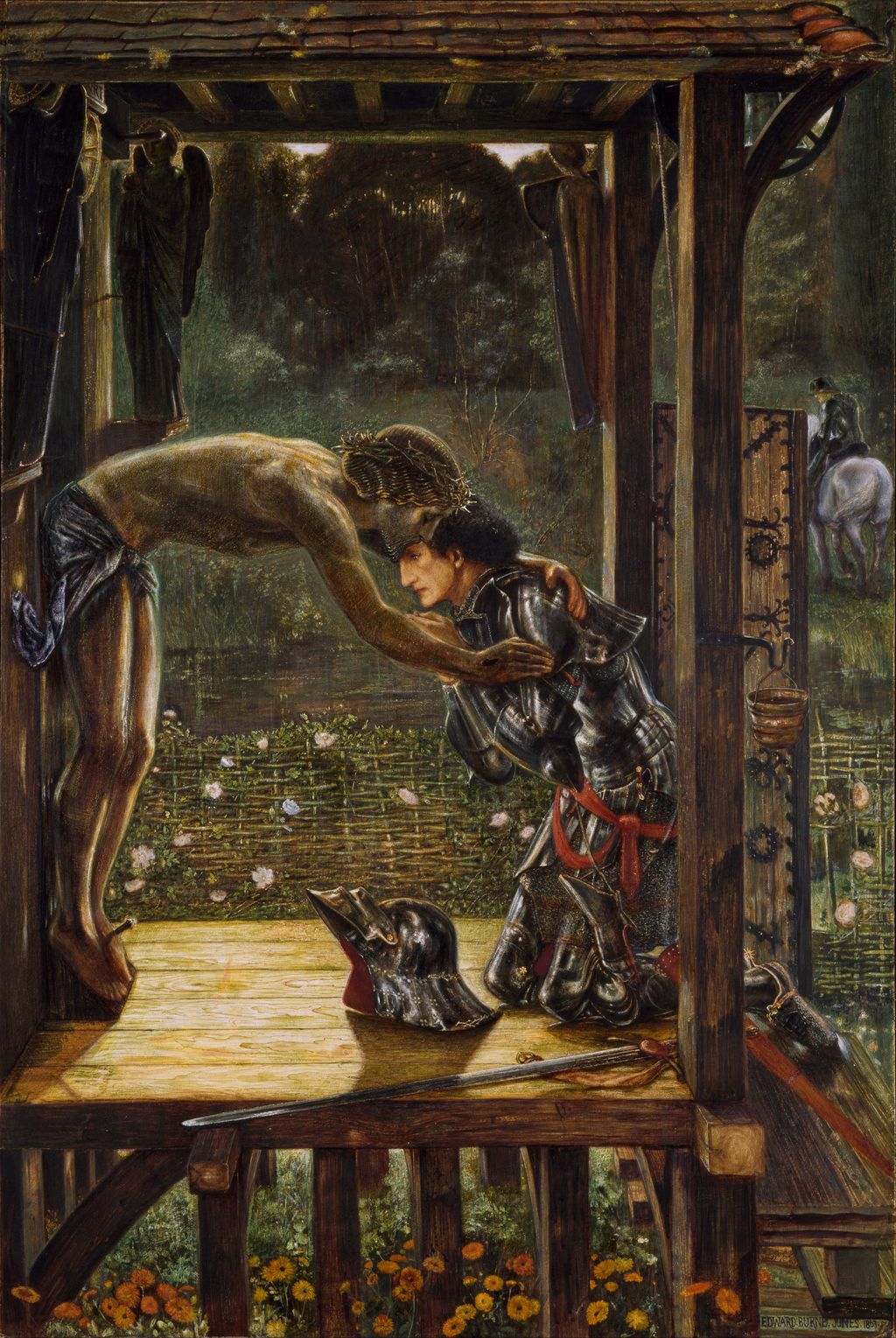
The Merciful Knight
1863 · The figure on the cross bends towards a kneeling knight.
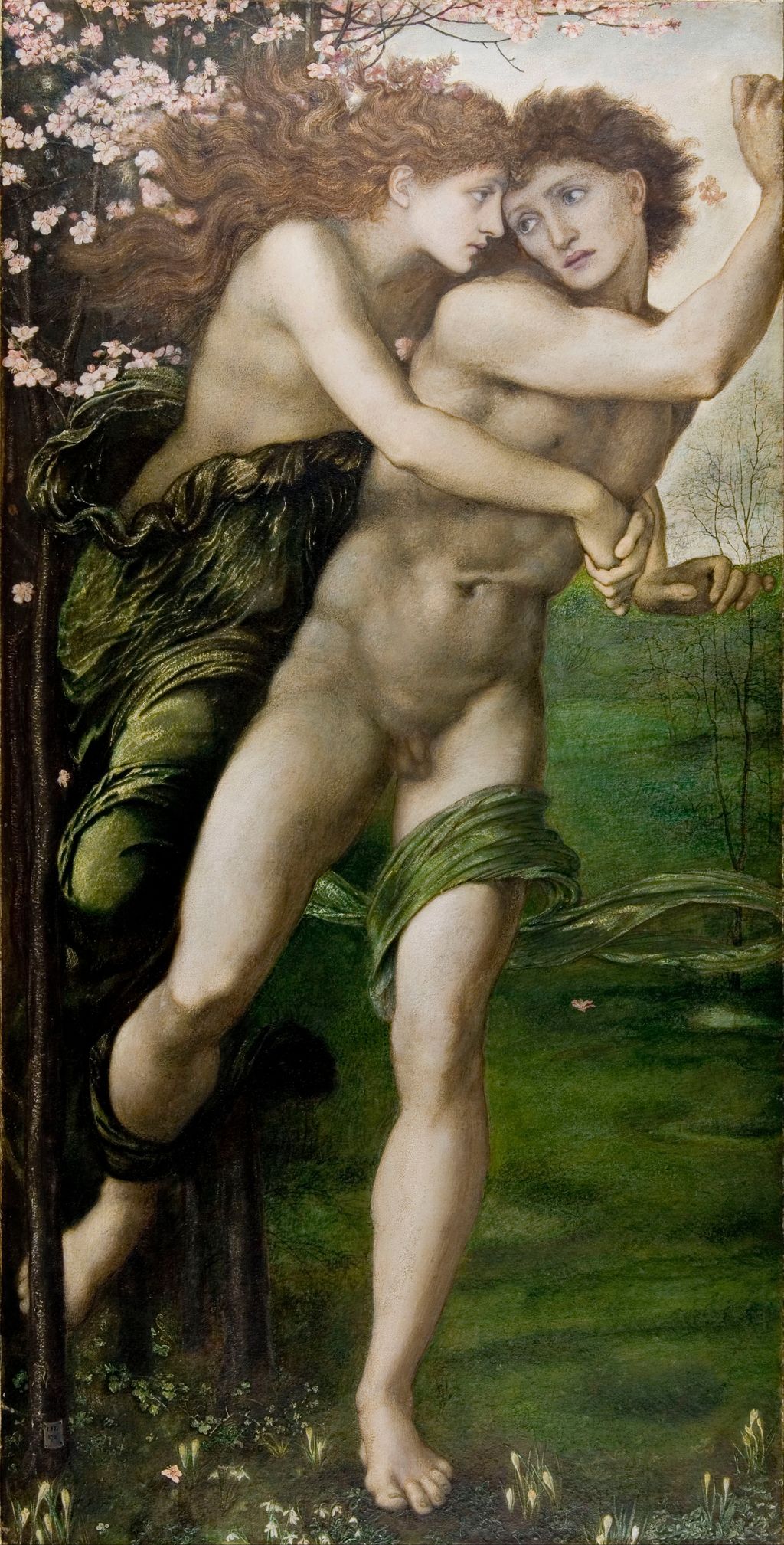
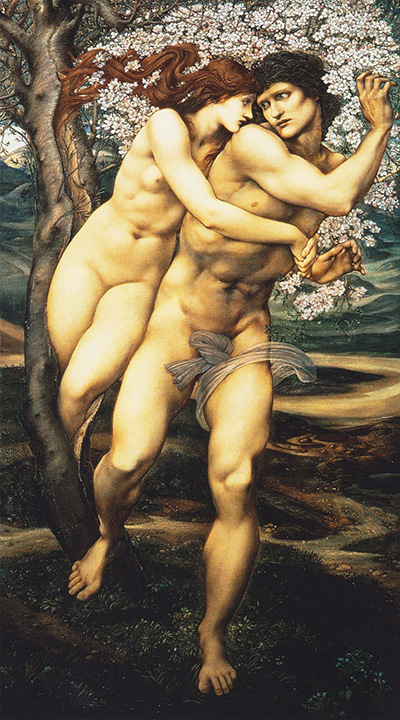
Phyllis and Demophoön
1870 · Two figures meet at the edge of a tree in the earlier Phyllis composition.
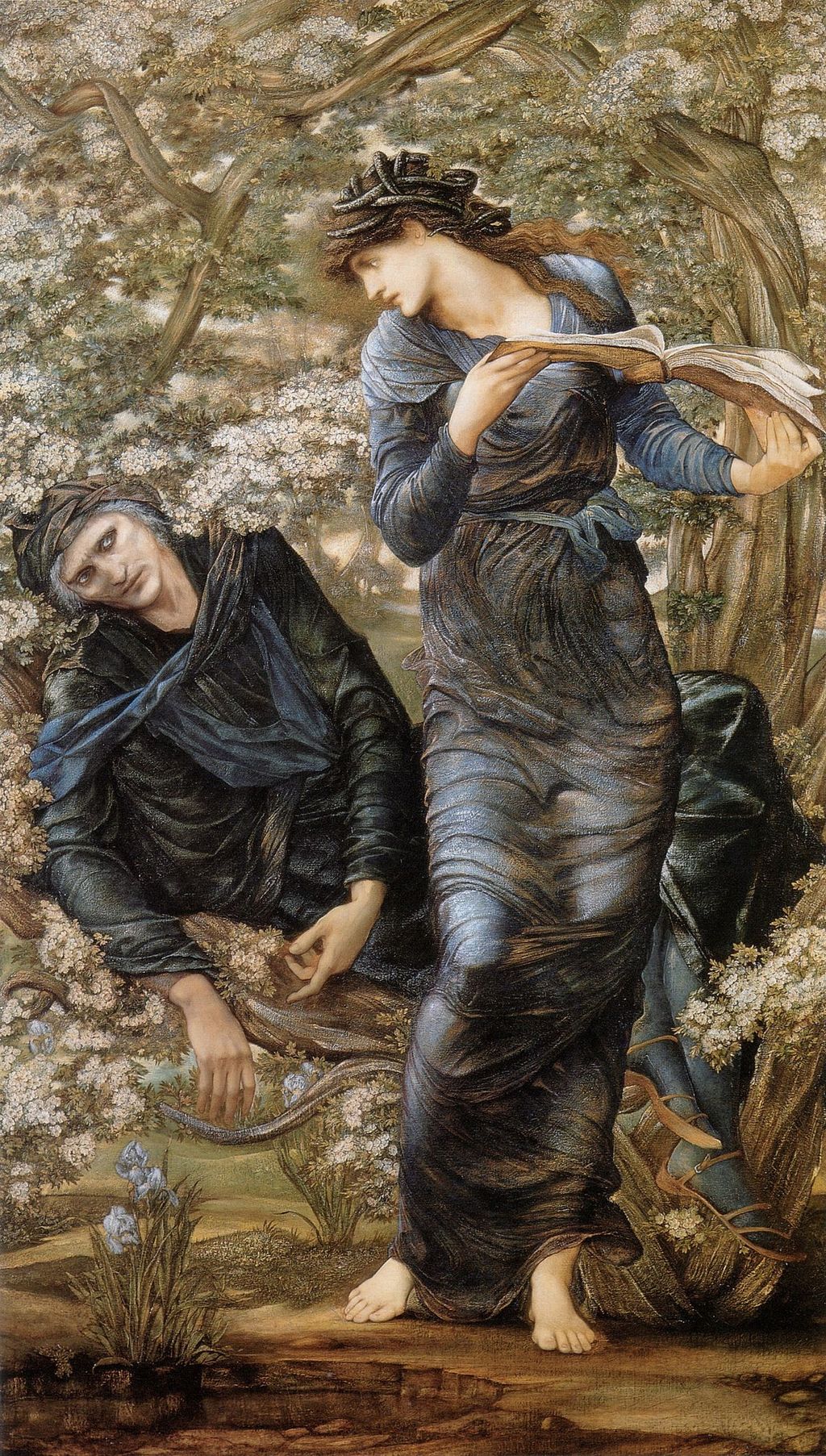
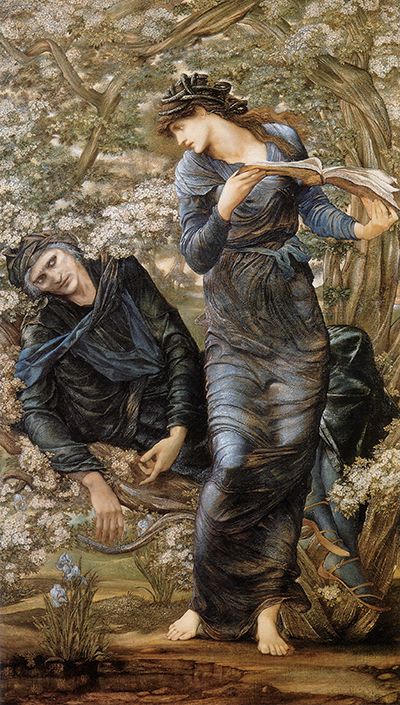
The Beguiling of Merlin
1870s · A hawthorn thicket closes around the magician as Vivien reads.
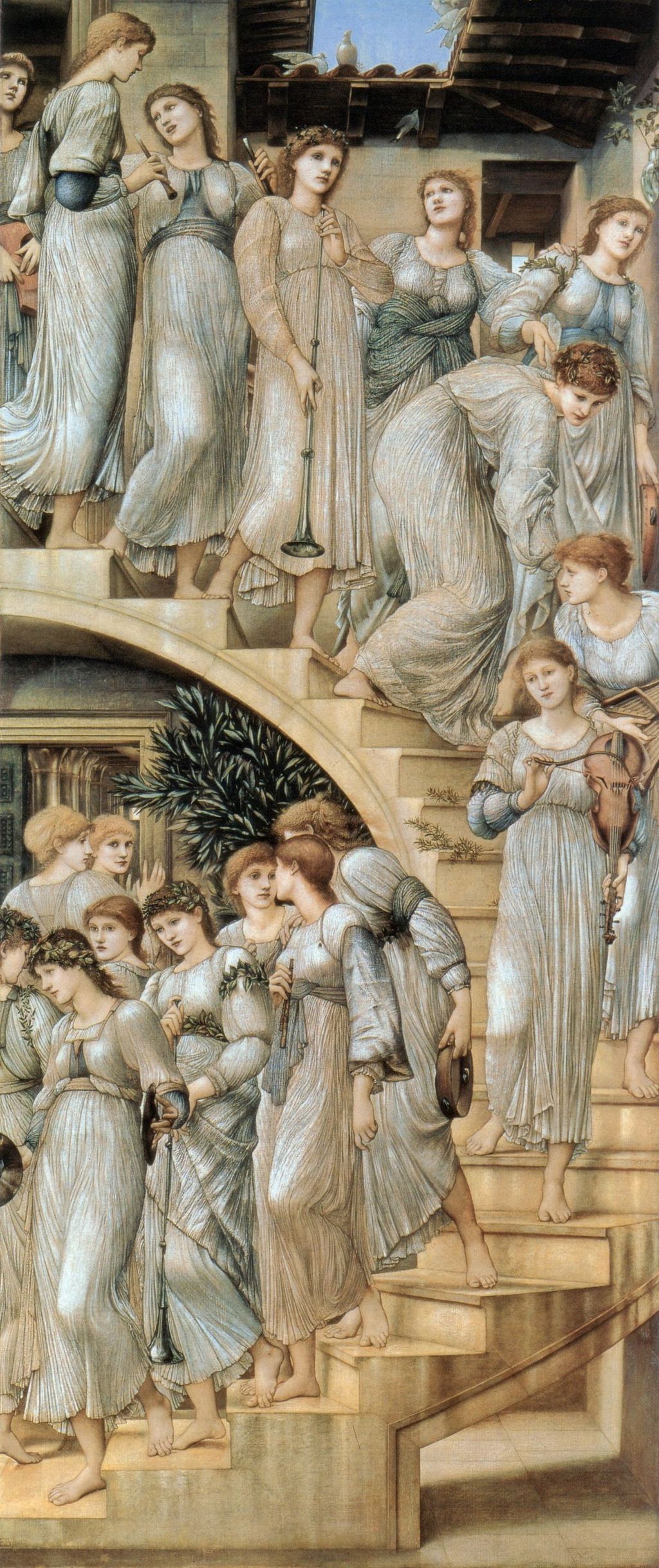
The Golden Stairs
1880 · Musicians descend in a procession measured by the turns of the stair.
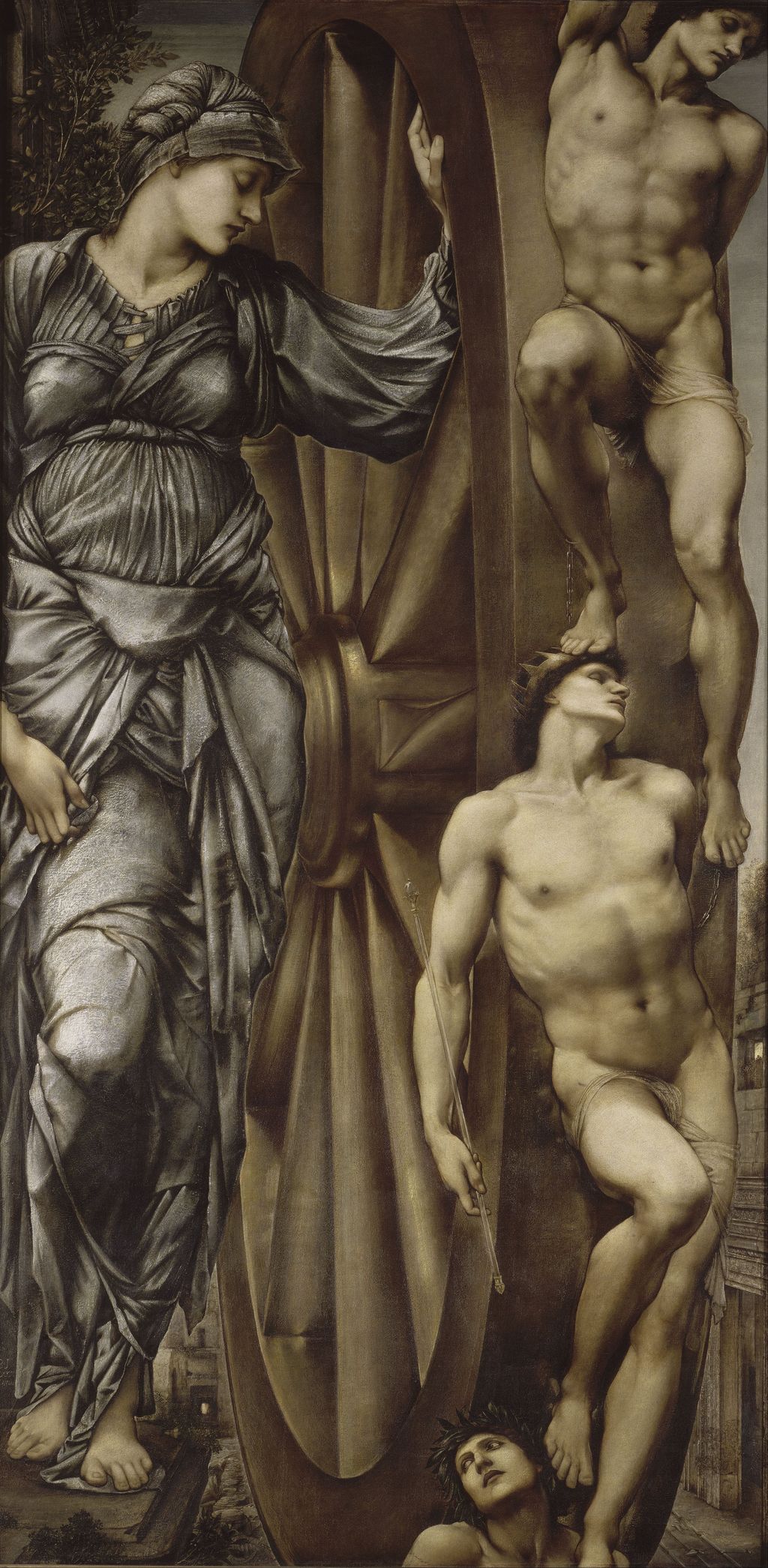
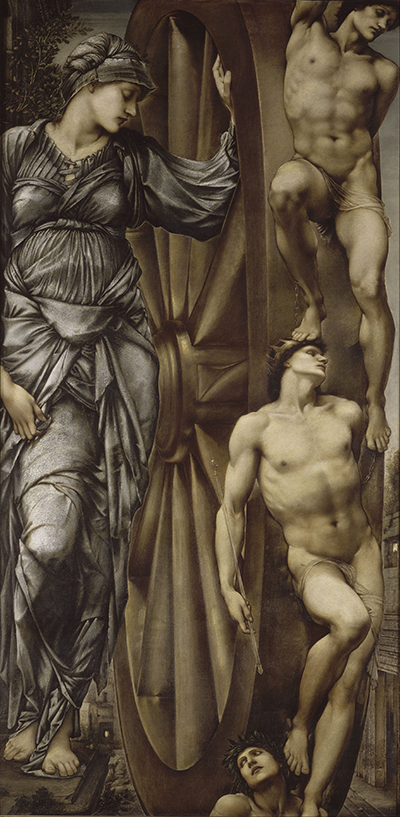
The Wheel of Fortune
1875–83 · Fortune guides a wheel on which three figures circle.
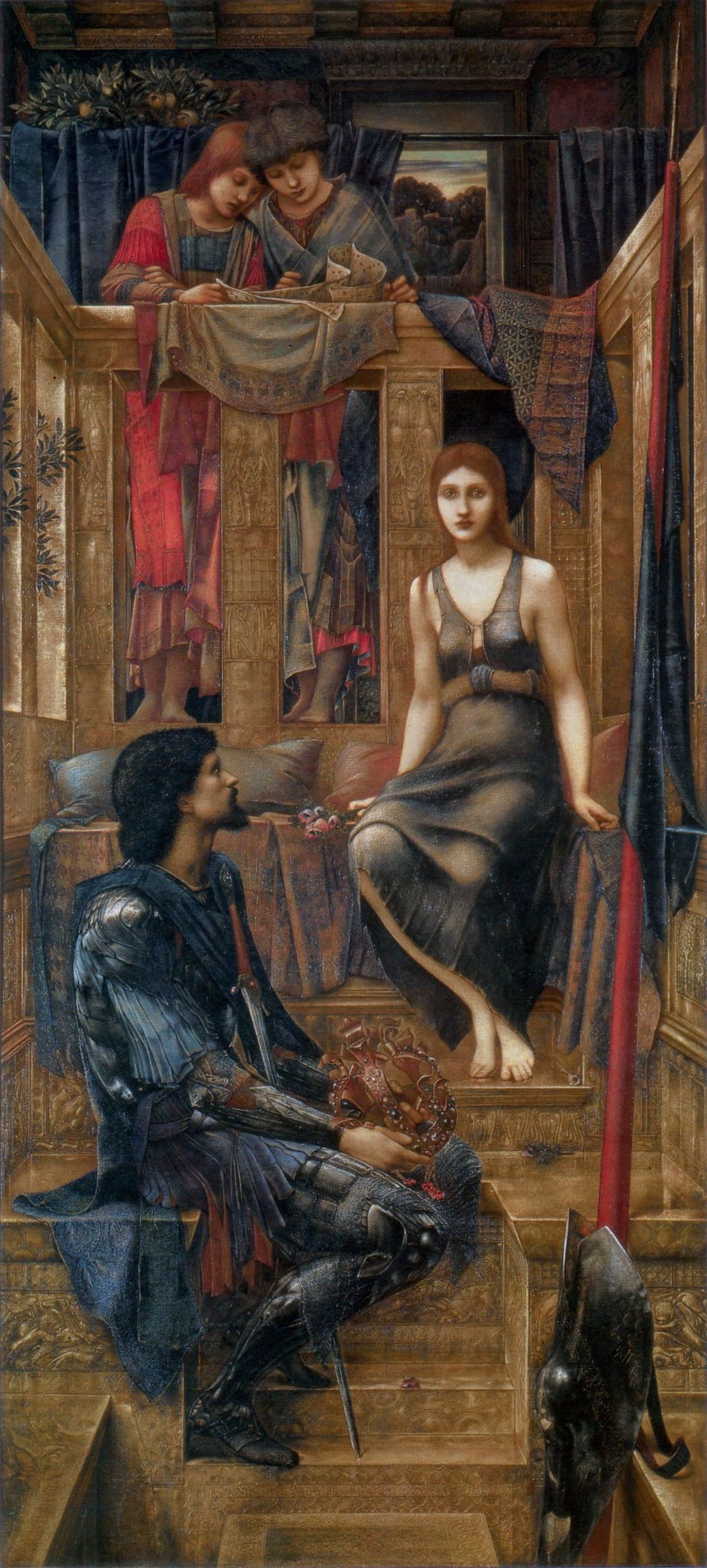
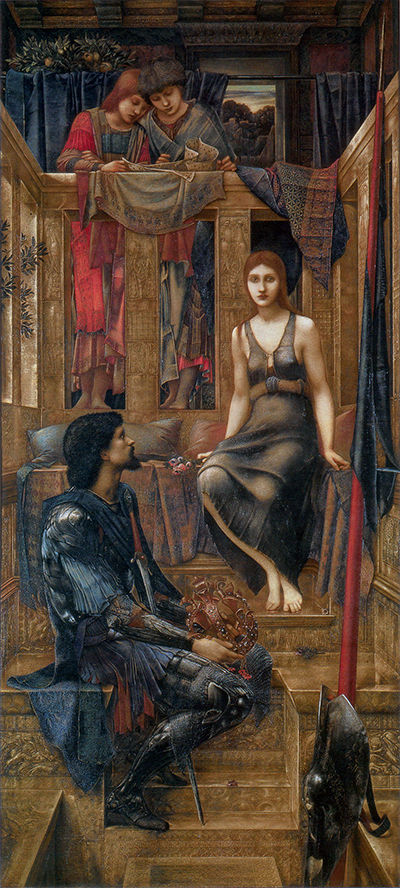
King Cophetua and the Beggar Maid
1884 · Steps, poses and costume set the terms of an encounter drawn from a ballad.
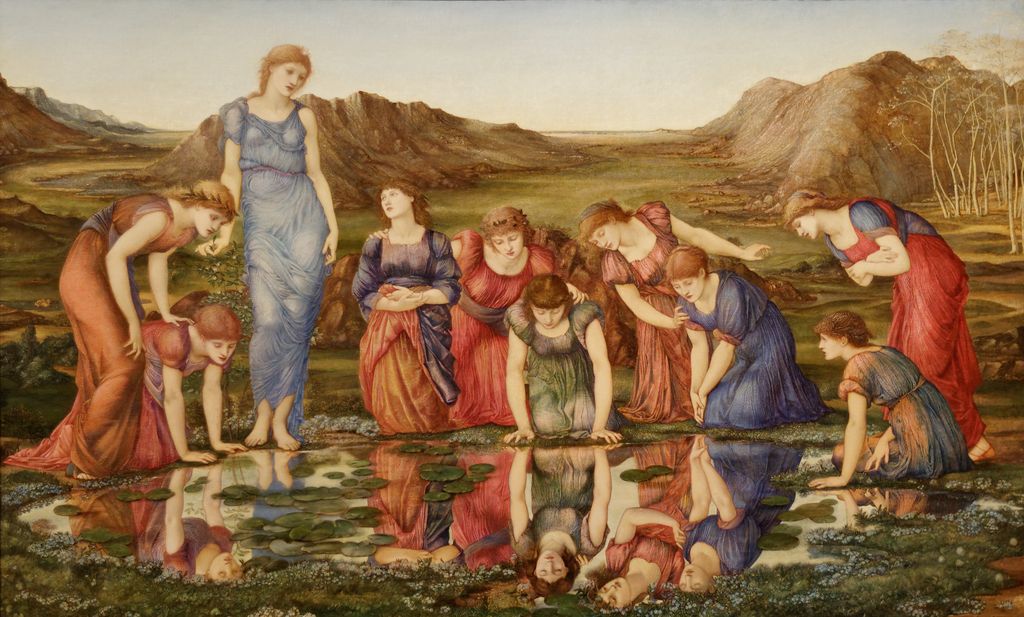
The Mirror of Venus
1870s · The still pool repeats the gestures and colours of a gathering of women.
The Star of Bethlehem
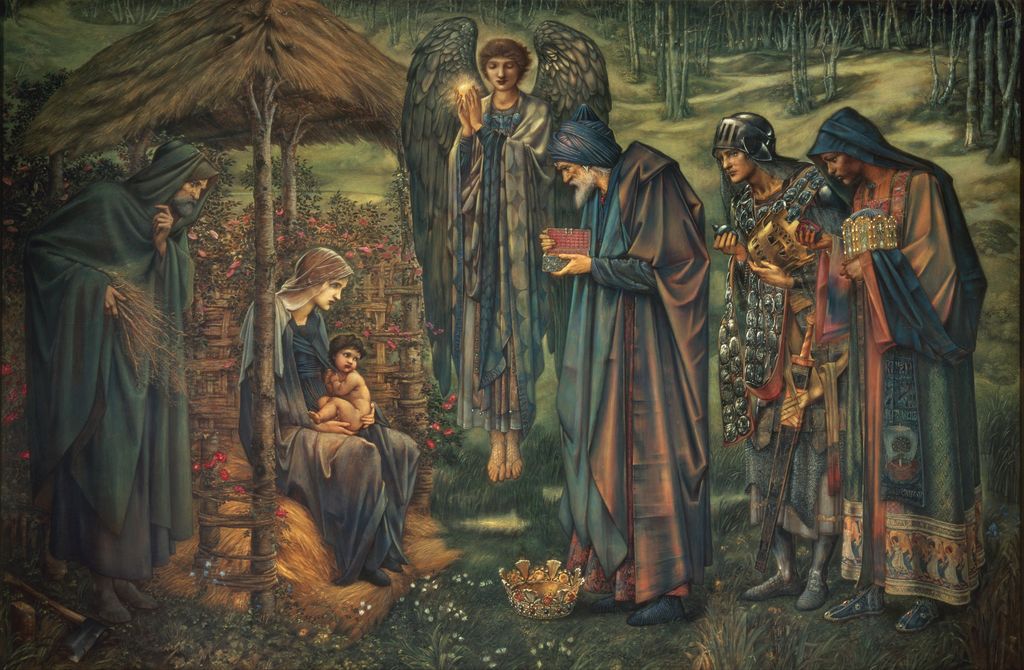
Signed 1890 · The Birmingham watercolour translates a tapestry design into a vast work on paper.
The Last Sleep of Arthur in Avalon
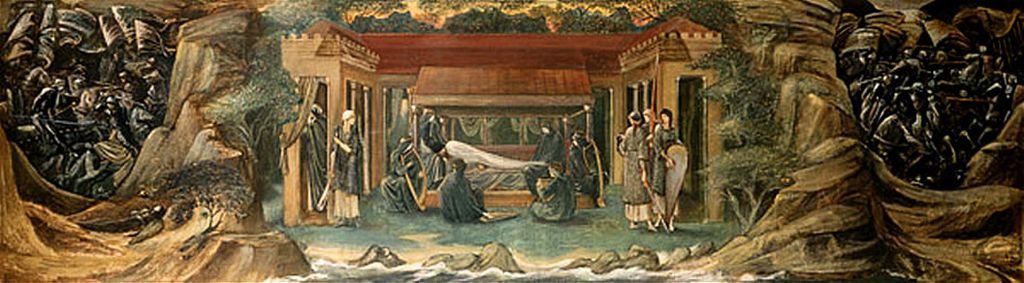
1880s–1898 · A long canvas gathers a group around the sleeping Arthur.
The Last Judgement window
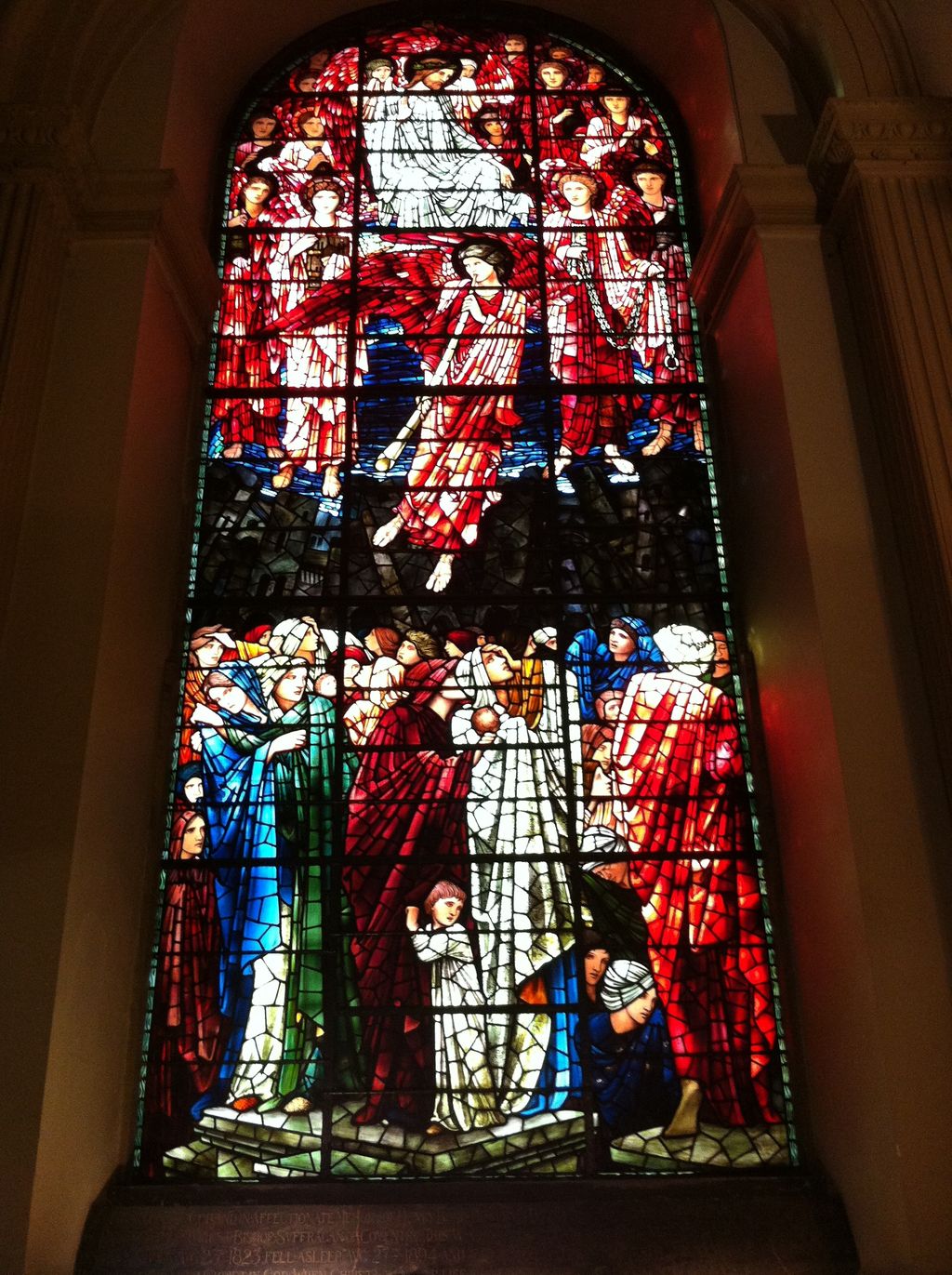
1897 · Coloured light carries the figures across the stone divisions of Birmingham Cathedral’s west window.
Photograph by Andrewrabbott. Resized for the web, under the same licence. · Image source · CC BY-SA 3.0
Edward Burne-Jones and his circle
Follow the people, places and forms of art that shaped his work.
- Dante Gabriel Rossetti: Rossetti encouraged Burne-Jones’s move into art and worked alongside him on the Oxford Union murals. [1]
- William Morris: They met at Oxford. Burne-Jones supplied designs to the firm Morris founded with the other partners in 1861. [1]
- Italian Renaissance art: Burne-Jones studied Italian painting and drawings. Renaissance examples helped shape his figure groups and some of the settings he imagined. [1]
- The Grosvenor Gallery: Eight works in the inaugural exhibition brought wider attention to Burne-Jones’s painting. [2]
- Church windows: Cartoons fed into glass made by the workshop. Changes in light, height and setting make the same design read differently from a drawing on a table. [1]
- Symbolism: Burne-Jones’s paintings reached European audiences and were admired by artists who gave dreams, myths and legends a central place in their work. [1]
Contents
- A later Pre-Raphaelite
- What audiences saw at the Grosvenor Gallery
- Stories painted across walls
- Designing with William Morris
- Drawings, books and the life of a printed image
- From London to Paris and beyond
A later Pre-Raphaelite
The Pre-Raphaelite Brotherhood was founded in 1848 by a group that included Rossetti, John Everett Millais and William Holman Hunt. Burne-Jones came into its orbit in the following decade. He shared the circle’s interest in medieval art and literature, and Rossetti gave him informal instruction and encouragement. The early Brotherhood’s close observation of plants, landscapes and other physical details had helped to make its work distinctive. Burne-Jones used equally painstaking detail to give imagined places their own coherence. In his pictures a real flower, an elaborate dress and an impossible event can all command the same degree of attention. [1] [2] [3]
An early pair of watercolours shows how he went about it. The women in Sidonia von Bork and Clara von Bork came from a historical novel by Wilhelm Meinhold, in the English translation by Lady Wilde. Burne-Jones gave Sidonia a dress crossed by dark, knotted bands that make her silhouette emphatic. Clara’s figure reads more softly. The costumes do some of the work of introducing the characters before a viewer knows a thing about them. Burne-Jones used opaque bodycolour as well as watercolour, giving the fabrics weight and the designs enough definition to stand out even at the scale of a sheet of paper. [1]
John Ruskin encouraged Burne-Jones’s study of Italian art. On later visits to Italy he looked closely at artists including Botticelli, Mantegna and Michelangelo. His choices could change considerably with the subject. The heavy, straining bodies in The Wheel of Fortune are indebted to Michelangelo. Fortune turns the wheel on which a slave, a king and a poet are caught. The figures’ stacked bodies give the viewer a sense of the wheel’s size and make it possible to follow its movement through space. Their positions also make changes of rank legible before the viewer knows who each figure represents. [1] [4] [5]
Four stages of Edward Burne-Jones’s career
These periods group related developments; painting, travel and local work overlap across their boundaries.
Finding a vocation
Burne-Jones grew up in Birmingham. At Oxford he met William Morris, and in London Dante Gabriel Rossetti helped turn his interest in medieval literature and design into a painter’s work.[1]
Designs moving between media
The early watercolours and the firm’s church commissions brought together drawing, colour and applied design. The 1870 Phyllis picture shows how far he could push the watercolour exhibition tradition.[1]
The Grosvenor years
Burne-Jones’s Grosvenor Gallery exhibitions made his large paintings and poetic subjects widely known. Oil painting, figure studies and designs for stained glass continued side by side.[1]
Painting at architectural scale
Large paintings and workshop designs occupied his later years. The Star of Bethlehem and the unfinished Sleep of King Arthur in Avalon show two ways he worked on the scale of a room.[1]
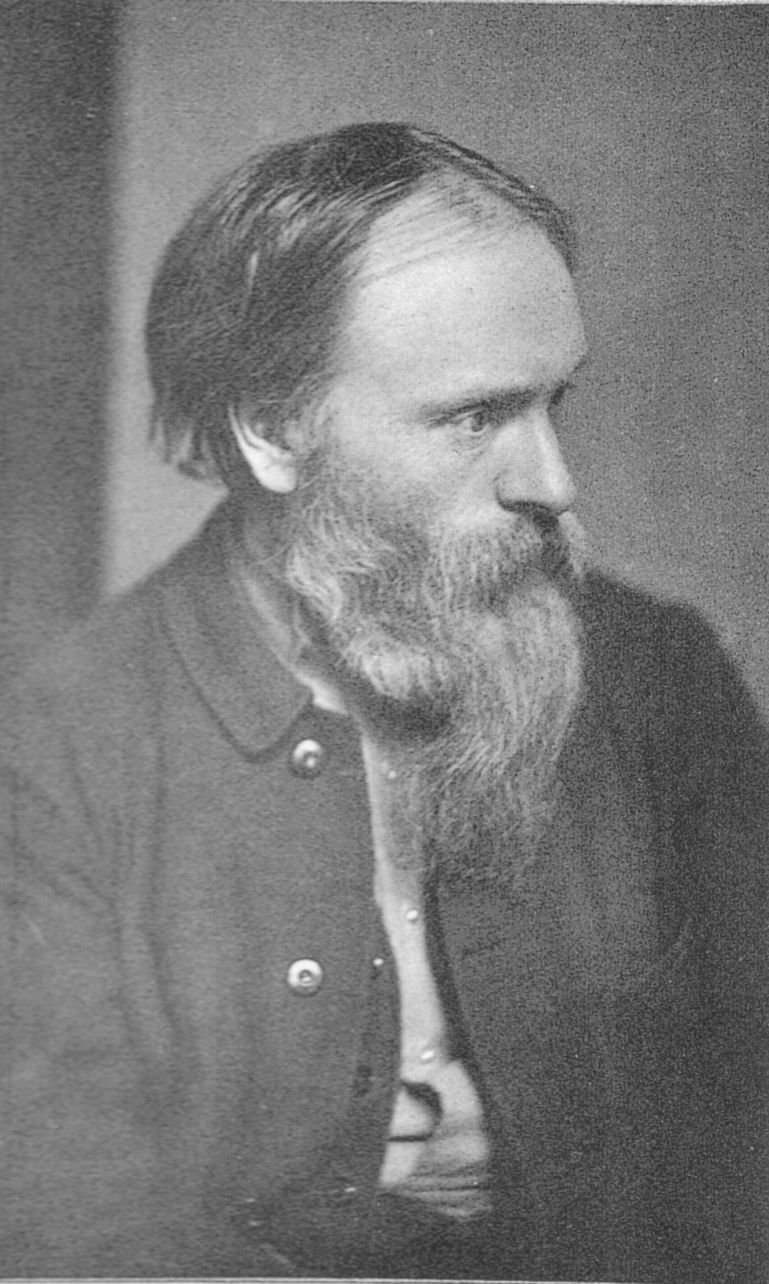
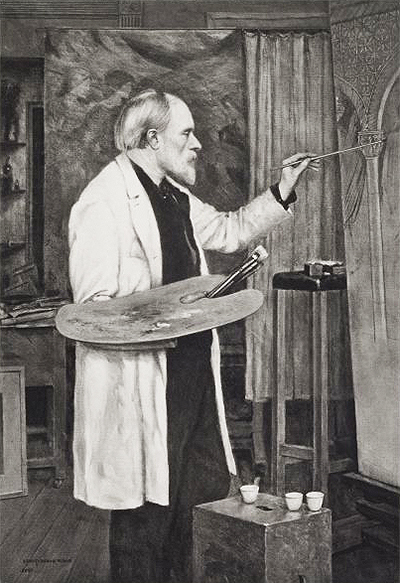
Frederick Hollyer, Portrait of Edward Burne-Jones, about 1882. Image source. Public domain.
What audiences saw at the Grosvenor Gallery
Burne-Jones had shown work at the Hogarth Club and the Old Water Colour Society before his wider breakthrough. In 1877 eight of his pictures appeared in the first exhibition at the Grosvenor Gallery in London. They included The Beguiling of Merlin, in which Nimue uses the magician’s learning against him. She holds a book, turning her head towards Merlin as he sinks among the branches. The hawthorn sweeps around him, carrying the action of the spell through the composition. Three years later at the same gallery, The Golden Stairs put a comparable command of flowing line to work in a picture whose subject is far more open. The musicians’ turns of the wrist, tilts of the head and steps down the curve hold the sequence together. For viewers drawn to Aestheticism, the arrangement of bodies and the tight range of silver, ivory and gold offered much to look at in their own right. [1] [2] [4]
Laus Veneris shows the rich colour viewers encountered at the Grosvenor in 1878. A crowd of figures fills the hanging at the back of the room. At the window there is a glimpse of mounted knights beneath a strip of blue sky. Most of the painted surface stays with the richly coloured enclosure and the women inside it. The little break in the pattern makes the distance to the outside world all the more apparent. Burne-Jones painted the work for William Graham, a Glasgow wine merchant and collector of Italian Renaissance art who also lent works from his collection to the painter. Graham’s support gave Burne-Jones time and a sympathetic audience for pictures whose subjects and settings could take years to work out. [1] [6]
Burne-Jones remained a leading exhibitor at the Grosvenor through 1887 and went on to show at the New Gallery. He was elected an Associate of the Royal Academy in 1885 and resigned in 1893. The range of venues matters because it made different kinds of work visible. A figure study might stay in the studio while a related oil went to an exhibition, and a window already in place would be known principally to the people who used that building. His biography follows the chronology and relationships behind those public appearances. [2]
Edward Burne-Jones, The Beguiling of Merlin. Lady Lever Art Gallery. Image source. Public domain.
Stories painted across walls
A commission for a room made it possible for Burne-Jones to stretch a story across several pictures. In 1875 Arthur Balfour commissioned a Perseus cycle for his London music room. An encounter with a goddess sends the hero out to face Medusa. Later he meets Andromeda, fights the sea monster and shows her Medusa’s head reflected in water. Each episode has its own space and pace. In the final scene the figures bend towards a reflection, asking the viewer to look at the water as carefully as they do. Burne-Jones left the commission unfinished. Southampton City Art Gallery holds ten full-size gouache designs, and the Staatsgalerie Stuttgart holds the paintings made for the unfinished cycle. Seeing the works on paper alongside the paintings makes it possible to follow a project that never reached its intended room. [7] [8]
The preparations were ambitious artworks in their own right. Studying the artist’s suppliers’ accounts, Fiona Mann identified three supports of linen and brown paper ordered in 1877 whose dimensions match the first three Perseus cartoons. In the unfinished design for the second scene of Medusa’s death, patches of brown paper and white chalk grid lines remain visible. A viewer can see both the shape of the composition as Burne-Jones established it and the surface he still had to cover. [9]
In The Legend of the Briar Rose, the view changes from canvas to canvas while much of the action stays suspended. The sleeping knights in the wood, the king and his councillors, the women in the garden court and the princess in her bower all seem to have slipped out of ordinary time. A separate earlier group of three small oils is held by the Museo de Arte de Ponce. The later set of four principal canvases was exhibited in 1890 and installed at Buscot Park after its purchase by Alexander Henderson. Ten smaller linking panels carry the briars between the principal paintings, and verses by Morris sit beneath the main scenes. At Buscot the viewer can turn from one part of the household to another as though walking around the edges of an enchanted place. [1] [10]
The same breadth of attention can unfold inside one frame. In The Last Sleep of Arthur in Avalon, attendants and musicians gather around the resting king across an oil painting six and a half metres wide. Burne-Jones began it in 1881 for George Howard’s library and was still working on it near the end of his life. The space around Arthur allows the viewer to look away from him for a while, following the lines of the architecture and the quiet movements of those who keep watch. The small preliminary painting and Frederick Hollyer’s photograph of the partly finished canvas, both also held at Ponce, let viewers see how the artist developed an image of that scale. [11]
Designing with William Morris
Burne-Jones helped found Morris, Marshall, Faulkner & Co. in 1861. A cabinet from those early years shows where he fitted into the enterprise. Philip Webb designed the case, the firm made it, and Burne-Jones painted the players on leather. In The Backgammon Players, two people bend towards their game, their concentration contained within the doors of a piece of furniture. Punched detail in the leather surrounds the painted figures. In a room the cabinet could be approached and handled, and the viewer could come much closer to its surface than to a picture hung high on a gallery wall. [12]
The firm’s stained-glass windows show an equally close relation between what the figures do and where viewers encounter them. King David the Poet was one of four poet panels made in 1863 for the breakfast room at Silsden, a house in Yorkshire. Burne-Jones designed the figure, William Morris designed the daisies and forget-me-nots that surround it, and the firm made the panel. The design reaches beyond the figure into the small rectangular panes of the background. In Birmingham, the four windows Burne-Jones designed for what is now St Philip’s Cathedral work on the scale of the building. They include The Ascension at the east end and The Last Judgement at the west. As daylight changes, colour from the windows reaches the floor and walls. A drawing can describe how those figures fit the openings. The building and the passing day determine much of how they are seen. [13] [14]
A design could travel without carrying all of its original surroundings. In the Fitzwilliam Museum’s tile of Penelope, the figure at the loom belongs to a group of heroines that Burne-Jones drew from Chaucer. He also used the series for an embroidered frieze and for stained-glass roundels. An upright figure and recognisable gesture could survive an adjustment in scale, colour or framing. With a more elaborate transfer, another designer could transform what lay around the figures. Burne-Jones drew the angels of Angeli Laudantes for stained glass at Salisbury Cathedral. John Henry Dearle later reworked them for weaving, setting them among small flowers. The Metropolitan Museum’s 1898 example also records the weaving team led by John Martin with Robert Ellis and Merritt. In embroidery the pattern is stitched onto a fabric. In tapestry the weavers build the image into the fabric itself. [15] [16]
After the firm became Morris & Co. in 1875, commissions from it remained a regular source of work for Burne-Jones. Some compositions moved between workshop production and painting on a large scale. In the Star of Bethlehem, his immense watercolour for Birmingham, the three Magi stand close to an angel holding a star. The artist returned to the composition he had devised for an Adoration of the Magi tapestry commissioned for Exeter College, Oxford. He built the Birmingham picture on ten sheets of paper and could give the margins of the scene a different kind of detail. Leaves and flowers gather below the line of figures. The small star and the faces around it are the focus of the encounter. The scale of the paper and the fineness of the details can both come as a surprise after seeing the watercolour reduced to the size of a book page. [17] [18]
Edward Burne-Jones, The Star of Bethlehem. Birmingham Museums Trust. Image source. Public domain.
Drawings, books and the life of a printed image
Burne-Jones did much of his thinking on paper. Among his studies for The Golden Stairs are sheets devoted to feet and to hands holding instruments. In the finished painting those details take their place among eighteen closely spaced figures. Isolating them in a study gave him scope to work out how fingers would fall around a cymbal or a violin and how a foot would meet a step. His drawings also include works with a finished life of their own and designs for other people to work from. In the studio these were different tasks, even where graphite on paper was the starting point for all of them. [1]
At Morris’s Kelmscott Press the relationship of line to surface became a question of how to arrange a printed page. The 1896 Works of Geoffrey Chaucer combines the artist’s figure designs, engraved in wood by William Harcourt Hooper, with the typography and ornament that Morris devised for the book. The illustrations have to hold their own against the strong black of type, borders and decorated initials. Readers meet a figure at the pace of turning pages, with text on either side of the image or across the opening. This is a different way to follow a story from moving between the panels in a room at Buscot, and it depends just as much on how the separate parts have been brought together. [19]
Other prints associated with Burne-Jones carried images into settings that were far removed from the studio. For a Paris production of La Belle au bois dormant in 1894, the programme credited a design to Burne-Jones. The image came from a reproduction of the sleeping princess in The Rose Bower. The National Gallery of Art’s example is a collotype, a photomechanical print. The Van Gogh Museum records the same theatre programme for the performance on 24 May. Art historian Laurence des Cars traces the image back through an etching and finds that the production also drew on the paintings for its look. The credit on the programme records the reach of a composition first made for another setting. The printed object and its images can be compared with photographs and engravings in the Burne-Jones catalogue raisonné, which gives separate records to paintings, preparatory work and reproductive prints. [20] [21] [22] [23]
From London to Paris and beyond
The French reception of Burne-Jones’s work had already begun before the 1894 programme. The Beguiling of Merlin went to the Paris international exhibition of 1878 after its appearance at the Grosvenor. At the Exposition Universelle of 1889, King Cophetua and the Beggar Maid drew attention and won a gold medal. The French critic Antonin Proust admired the drawing and colour and picked out echoes of the Italian painters Carpaccio and Mantegna. Gustave Moreau received a framed photograph of the six designs of The Days of Creation in 1892 and wrote to thank Burne-Jones. An exhibition introduced Paris audiences to individual oils at their full scale. A photograph let a fellow painter study the arrangement of an entire series in his own time. [1] [22] [24]
Modern exhibitions have brought those widely dispersed objects together in different ways. The late-1990s retrospective at the Metropolitan Museum of Art, Birmingham Museum and Art Gallery and the Musée d’Orsay showed paintings alongside furniture, glass, tapestries and books. At Tokyo’s Mitsubishi Ichigokan Museum in 2012, a major exhibition presented studies with work from his narrative series and toured to Hyogo and Fukushima. In 2024 the exhibition Preraffaelliti. Rinascimento moderno in Forlì brought the small Briar Rose paintings into an exhibition about the British artists’ sustained engagement with Italian art. The Paul Mellon Centre’s guide brings together leads on Burne-Jones in its library, archives and photographic collections. A reader coming from one painting can follow its design history across a much wider group of objects. [3] [24] [25] [26] [27]
For a first look through Burne-Jones’s paintings, follow the moving line of the musicians in The Golden Stairs, then spend some time with the sleeping figures of the Briar Rose. In the tapestries, examine how a figure stands out against the flowers around it. Looking closely at the embroideries brings a different set of decisions about line and pattern into view. Across these surfaces, a small tilt of the head or a fold of cloth can change the direction of attention. The materials and the setting determine how close a viewer can come to those details and how long they might spend with them.
Further reading on Edward Burne-Jones
Two exhibition catalogues and a study of how his decorative work engaged with Victorian life.
Edward Burne-Jones: Victorian Artist-Dreamer. Stephen Wildman and John Christian, with essays by Alan Crawford and Laurence des Cars. Metropolitan Museum of Art, 1998.
The retrospective catalogue brings together collection histories, working studies and different versions of individual works. Read the catalogue at The Met.
Burne-Jones. Edited by Alison Smith. Tate Publishing, 2018.
This retrospective catalogue follows the artist from early drawing and painting to his work in print, glass and textiles. View the catalogue record.
The Radical Vision of Edward Burne-Jones. Andrea Wolk Rager. Paul Mellon Centre for Studies in British Art, 2022.
The book examines the decorative arts within the social and industrial life of Victorian Britain. View the publisher’s record.
Artworks directory
This directory records paintings, studies, designs and collaborative works, with separate entries for documented versions and series where known.
| Name | Date | Medium |
|---|---|---|
| Sidonia von Bork 1560 | 1860 | Watercolour and bodycolour |
| Clara von Bork 1560 | 1860 | Watercolour and bodycolour |
| The Merciful Knight | 1863 | Watercolour |
| Sibylla Delphica | c. 1886 | Oil on panel |
| Phyllis and Demophoön | 1870 | Watercolour and bodycolour |
| The Legend of the Briar Rose (Buscot series) | 1870s–1890 | Oils on canvas |
| The Briar Wood (Buscot series) | By 1890 | Oil on canvas |
| The Council Chamber (Buscot series) | By 1890 | Oil on canvas |
| The Garden Court (Buscot series) | By 1890 | Oil on canvas |
| The Rose Bower (Buscot series) | By 1890 | Oil on canvas |
| Group of Women, study for The Golden Stairs | 1872 | Drawing |
| The Beguiling of Merlin | 1870s | Oil on canvas |
| The Perseus Cycle | From 1875 | Paintings and full-scale designs |
| The Call of Perseus (Stuttgart) | From 1875 | Oil painting |
| Perseus and the Graeae (Stuttgart) | From 1875 | Oil painting |
| The Rock of Doom (Stuttgart) | 1884–88 | Oil on canvas |
| The Doom Fulfilled (Stuttgart) | 1888 | Oil on canvas |
| The Baleful Head (Stuttgart) | 1885–87 | Oil on canvas |
| The Baleful Head (Southampton design) | 1880s | Bodycolour |
| The Rock of Doom (Southampton design) | 1880s | Bodycolour |
| The Doom Fulfilled (Southampton design) | 1880s | Bodycolour |
| The Mirror of Venus (Gulbenkian) | 1870s | Oil on canvas |
| Drawing associated with The Mirror of Venus | 1870s | Drawing |
| Laus Veneris (Laing) | 1873–78 | Oil on canvas |
| The Days of Creation | 1870s | Watercolour and bodycolour |
| The Golden Stairs | 1880 | Oil on canvas |
| An Angel Playing a Flageolet | 1878 | Watercolour, bodycolour and gold |
| The Tree of Forgiveness | 1881–82 | Oil on canvas |
| The Wheel of Fortune (Orsay) | 1875–83 | Oil on canvas |
| King Cophetua and the Beggar Maid | 1884 | Oil on canvas |
| The Depths of the Sea (oil) | 1886 | Oil |
| The Morning of the Resurrection | 1886 | Oil on panel |
| Study for the Head of Mary Magdalene | c. 1882 | Oil study |
| The Sleep of King Arthur in Avalon | 1880s–1898 | Oil on canvas |
| The Sleep of King Arthur in Avalon (modello) | ca. 1881 | Oil on canvas (modello) |
| The Star of Bethlehem | Signed 1890 | Watercolour and bodycolour |
| Study for The Star of Bethlehem | About 1887–91 | Drawing |
| Sponsa de Libano | 1891 | Watercolour and bodycolour |
| The Summons (Holy Grail tapestries) | 1890s | Tapestry |
| The Failure of Sir Gawaine (Holy Grail tapestries) | 1890s | Tapestry |
| Hope (Boston) | 1896 | Oil on canvas |
| La Belle au bois dormant (theatre programme) | 1894 | Collotype |
| The Wedding of Psyche | 1895 | Oil on canvas |
| The Works of Geoffrey Chaucer (Kelmscott edition) | 1896 | Illustrated book |
| The Ascension (Birmingham Cathedral) | 1885 | Stained glass |
| The Last Judgement (Birmingham Cathedral) | 1897 | Stained glass |
| Adoration of the Magi (Huntington) | 1890s | Tapestry |
| Love among the Ruins (Wightwick) | 1894 | Oil on canvas |
| The Merciful Knight (photogravure after Burne-Jones) | 1900 | Photogravure |
| The Garden Court (preparatory work) | 1870–75 | Graphite and watercolour with white gouache |
| Study of a Female Figure | 1885 | Graphite drawing |
| Psyche Throwing Herself into the River | 1865–68 | Wood engraving |
| Beauty | 1887–89 | Colour lithograph |
| Study for the Failure of Gawain | 1893 | Crayon and graphite on Japanese paper |
| The Prince Enters the Briar Wood (after Burne-Jones) | After 1890 | Photogravure |
| The Rose Bower (after Burne-Jones) | 1892 | Photogravure |
| Adoration of the Magi (Musée d’Orsay) | 1904 | Tapestry |
| Answers to Prayer (Lyndhurst) | 1860s | Stained glass |
| The Depths of the Sea (photogravure after Burne-Jones) | 1900 | Photogravure |
| Perseus and Andromeda (Adelaide composite) | 1876 | Oil on canvas |
| The Adoration of the Magi (Hamburg) | Woven 1900 | Tapestry |
| Love leading the Pilgrim through the Briars | 1874–76 | Embroidery |
| Musica (worked by Lady Jane Cory) | 1906 | Embroidery |
| Pomona (worked by Lady Jane Cory) | 1907 | Embroidery |
| Flora (worked by Lady Jane Cory) | 1909 | Embroidery |
| The Fourth Day of Creation (photogravure after Burne-Jones) | 1900 | Photogravure |
| The Morning of the Resurrection (photogravure after Burne-Jones) | 1900 | Photogravure |
| Musical angels of the St Catherine window (Christ Church) | Designed 1877 | Stained glass |
Discussion
Look again at the images and ideas explored in Edward Burne-Jones. These editorial prompts invite your observations.
Reader Insights
Which work best shows how Burne-Jones brought a designer’s eye to painting?
Which subject would you follow from its first drawing to a finished painting, print or piece of glass?
Join the Conversation
Share a detail, comparison or question about Edward Burne-Jones below.
References
- Tate Britain, Edward Burne-Jones, exhibition large-print guide, pp. 4, 27–28, 40–42, 75–81, 91 and 123–127. View source.
- National Portrait Gallery, Sir Edward Coley Burne-Jones, 1st Bt, Later Victorian Portraits Catalogue, Biography. View source.
- Stephen Wildman and John Christian, with Alan Crawford and Laurence des Cars, The Metropolitan Museum of Art, Edward Burne-Jones: Victorian Artist-Dreamer (1998), exhibition scope, itinerary, catalogue and authors’ essays. View source.
- National Portrait Gallery, Sir Edward Burne-Jones, 2005 display introduction, Italy and the Grosvenor Gallery. View source.
- Musée d’Orsay, La Roue de la Fortune, RF 1980 4, description and exhibition history. View source.
- Laing Art Gallery, Laus Veneris, TWCMS B8145, artwork and collection interpretation. View source.
- Southampton City Art Gallery, The Perseus Series, commission, preparatory cartoons and episode entries. View source.
- Staatsgalerie Stuttgart, Das Schreckenshaupt, collection media guide, final encounter and the reflected head. View source.
- Fiona Mann, “A ‘born rebel’: Edward Burne-Jones and watercolour painting 1857–80”, The Burlington Magazine 156 (October 2014), p. 664, Perseus supports and fig. 30. View source.
- Museo de Arte de Ponce, The Prince Enters the Wood, collection entry and explanation of the Small Briar Rose Series. View source.
- Museo de Arte de Ponce, The Sleep of King Arthur in Avalon, 63.0369, artwork, commission and linked records for the modello and photograph. View source.
- The Metropolitan Museum of Art, The Backgammon Players, 26.54, materials, design and maker credits. View source.
- The Metropolitan Museum of Art, King David the Poet, 1998.231, commission and design and maker credits. View source.
- Birmingham Cathedral, Our stained-glass windows, subjects, orientation and changing natural light. View source.
- The Fitzwilliam Museum, Penelope, C.3-1922, tile and other uses of the design. View source.
- The Metropolitan Museum of Art, Angels Praising (Angeli Laudantes), 2008.8a–c, design and weaving credits and adaptation from glass. View source.
- Birmingham Museums, Secrets revealed from beneath the glass: Edward Burne-Jones’ The Star of Bethlehem, examination of the watercolour. View source.
- Burne-Jones Catalogue Raisonné, The Star of Bethlehem, OTUw, support and commissioning history. View source.
- Library of Congress, British Medievalism: A Subject Guide, “William Morris and the Kelmscott Press”, Chaucer holding and illustration credit. View source.
- National Gallery of Art, La Belle au bois dormant, 1997.96.2, programme and inscription record. View source.
- Van Gogh Museum, Theaterprogramma voor La belle au bois dormant van Henri Bataille en Robert d’Humières, p1343V2000, performance date and collection record. View source.
- Laurence des Cars, “Edward Burne-Jones and France”, in Edward Burne-Jones: Victorian Artist-Dreamer (1998), sections on the 1889 Exposition Universelle and the Théâtre de l’Œuvre. View source.
- Burne-Jones Catalogue Raisonné, The Work of Edward Burne-Jones, portfolio of 86 photoengravings, related artwork records and Berlin Photographic Company credits. View source.
- Musée d’Orsay, Edward Burne-Jones (1833–1898). Un maître anglais de l’imaginaire, exhibition introduction and discussion of the Paris exhibitions. View source.
- Mitsubishi Ichigokan Museum, Tokyo, Annual Report 2012–2013, pp. 25–29, “バーン=ジョーンズ展——装飾と象徴” and exhibition checklist. View source.
- Fondazione Cassa dei Risparmi di Forlì, Preraffaelliti. Rinascimento Moderno, 2024 exhibition press dossier, exhibition itinerary and the Burne-Jones room. View source.
- Paul Mellon Centre, Research Edward Burne-Jones at the Paul Mellon Centre, sections on the archives, library and photographic collections. View source.