 by Tom Gurney
Tom Gurney BSc (Hons) is an art history expert with over 20 years experience
Published on June 19, 2020 / Updated on November 25, 2026
Email: tomgurney1@gmail.com / Phone: +44 7429 011000
The Merciful Knight: Introduction
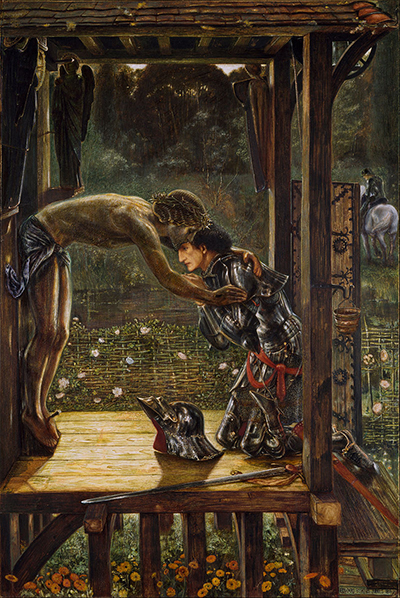
A knight kneels on a wooden platform, his helmet on the boards and his sword laid across the threshold. The figure on the crucifix bends almost double to reach him. In The Merciful Knight, Edward Burne-Jones painted the moment after a Florentine knight has spared the man who killed his brother. The signed watercolour and bodycolour on paper dates from 1863 and measures 100.3 × 69.2 cm. Birmingham Museum & Art Gallery holds the original as 1973P84. [1]
At a Glance
- ArtistEdward Burne-Jones
- Date1863
- MediumWatercolour
- SubjectJohn Gualbert’s legend
This work across Edward Burne-Jones’s career
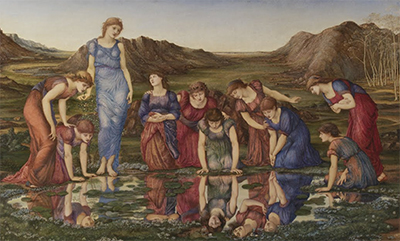
The Mirror of Venus
1870sThe Wheel of Fortune
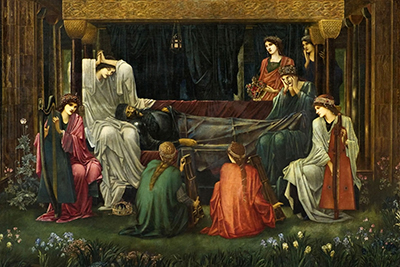
1875–83The Last Sleep of Arthur in Avalon
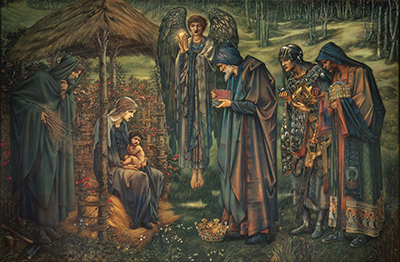
1880s–1898The Star of Bethlehem
Signed 1890Contents
- The knight at the shrine
- The Florentine legend and its Victorian retelling
- The drawings and the painted surface
- The 1864 exhibition and the picture's later life
- Annotated details
The knight at the shrine
Start with the feet at the far left. They still hang against the upright of the cross, while the torso extends into the shrine at nearly a right angle. One hand comes around the knight's shoulder and the other rests against his arm. Christ's bowed head meets the knight at the forehead. The inscription on the inner mount identifies the gesture as a kiss and explains its meaning. The knight had the power to kill his enemy and forgave him. The image of Christ came to life to show that the act had pleased God. This account went with the picture into the first exhibition and appeared again in the catalogue of the memorial exhibition, where someone unfamiliar with the saint could follow the story. [1] [2] [3]
The knight's armour catches the light in thin white streaks. His bare face emerges from it, and his arms fold close against his chest. A wound marks the hand that reaches around him. The helmet catches much the same light as the armour, but lies tipped back on the floor. The empty helmet, loose gauntlets and sword bring the knight's act of restraint into the foreground. At the far right, the tiny figure riding away on a pale horse allows the eye to follow the story back to the man who has been spared. [1] [4]
Few things in the shrine quite stand square to the eye. The boards run back into shadow, light falls obliquely across the floor, and part of the figure group is screened by the joinery on the right. The shadow along the roof makes the lit bend of Christ's back particularly clear. Under the front rail, orange and yellow marigolds crowd up almost to the boards. Georgiana Burne-Jones recalled that her husband studied the woods while visiting the painter Spencer Stanhope near Cobham, while the marigolds came from Russell Square, near the couple's home opposite the British Museum. The landscape brings a country visit and a London garden into an imagined Florentine encounter. [1] [5]
Katherine Hinzman draws attention to the way the architecture and plants control access to the scene. The bed of flowers marks a boundary below the platform, a flowering trellis shelters the shrine, and behind it the wood darkens. Hinzman also points to a possible connection with small watercolour landscapes in Birmingham whose colour and foliage recall Venetian painting. The connection is suggestive because the wood here is sufficiently detailed to register as a place, even though its recession and shadow keep attention at the shrine. The landscape studies of 1863 have also been associated with Green Summer. Their exact use remains open. [6]
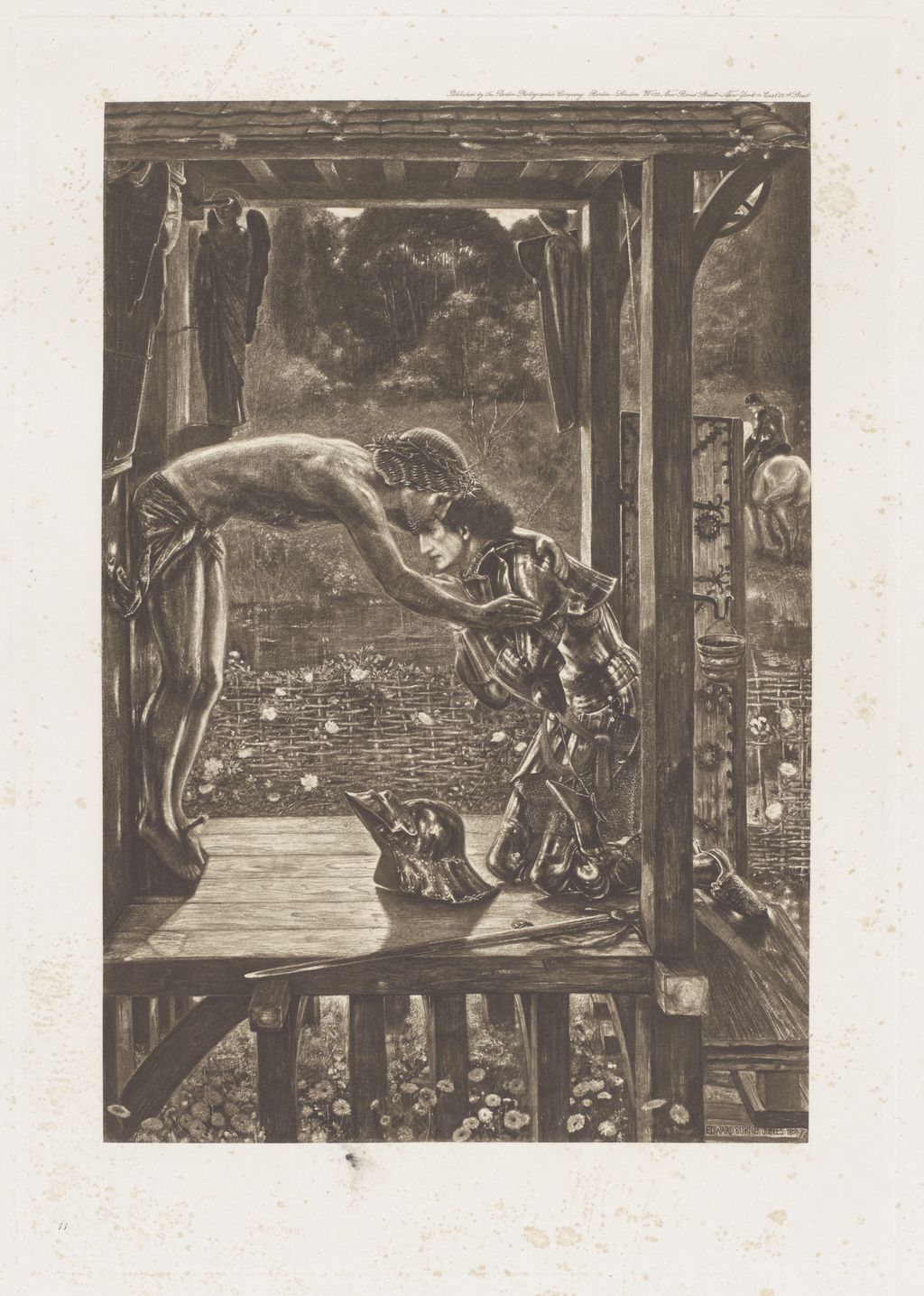
The Merciful Knight, photogravure published by the Berlin Photographic Company in 1900, after Edward Burne-Jones. Museum of New Zealand Te Papa Tongarewa, 1981-0086-1/11. Image source. No Known Copyright Restrictions.
Annotated Details from The Merciful Knight
The numbered points identify visible features discussed in this article. Return from each detail to the numbered overview. Edward Burne-Jones, The Merciful Knight, 1863. Birmingham Museums Trust. Image source. Public domain.
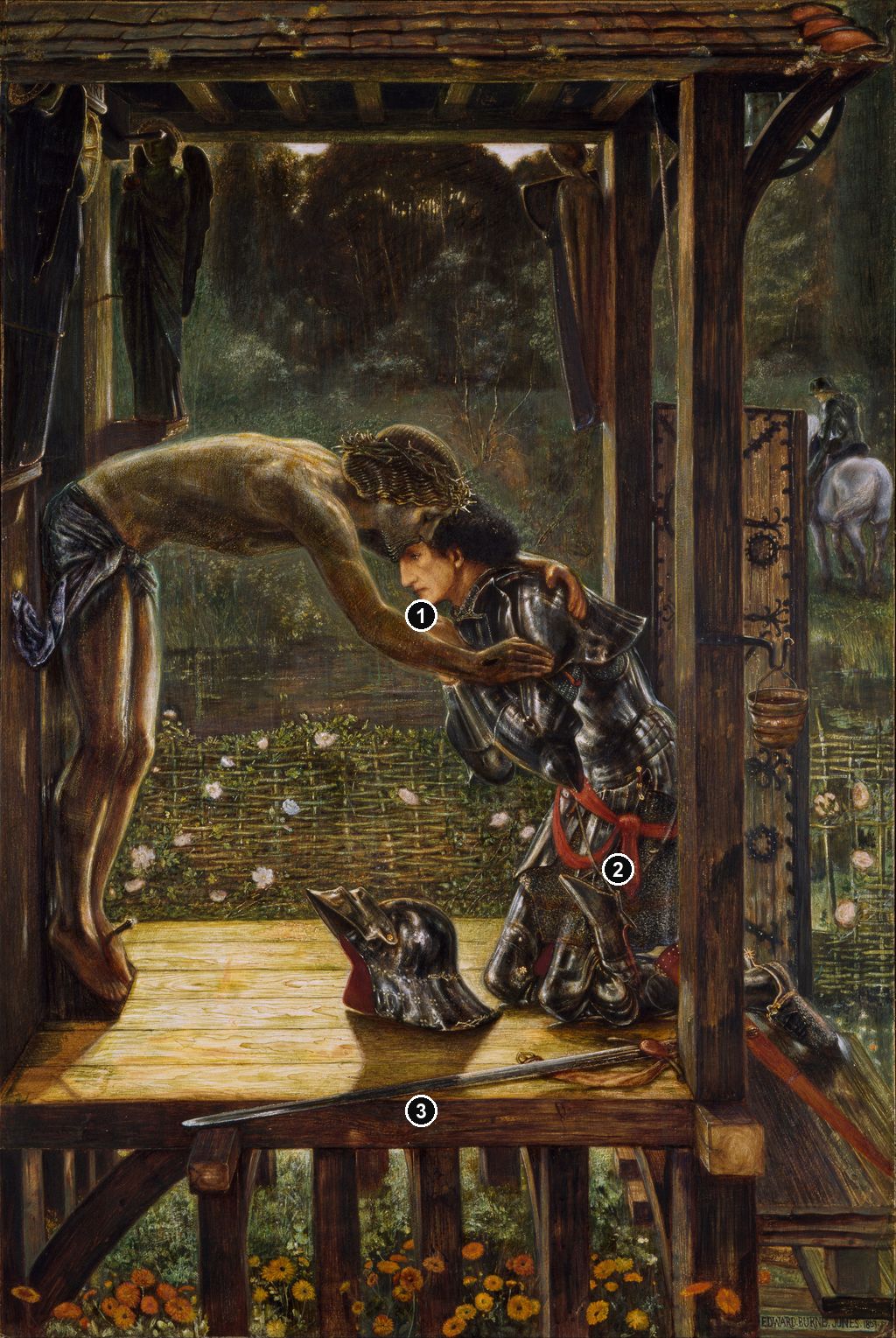
Details from THE MERCIFUL KNIGHT
Compare the cropped details with the source images above. Notice how their colours, shapes and positions contribute to the larger compositions.
The descending arms
The arms of the crucified figure leave their expected position on the cross and approach the bowed knight.
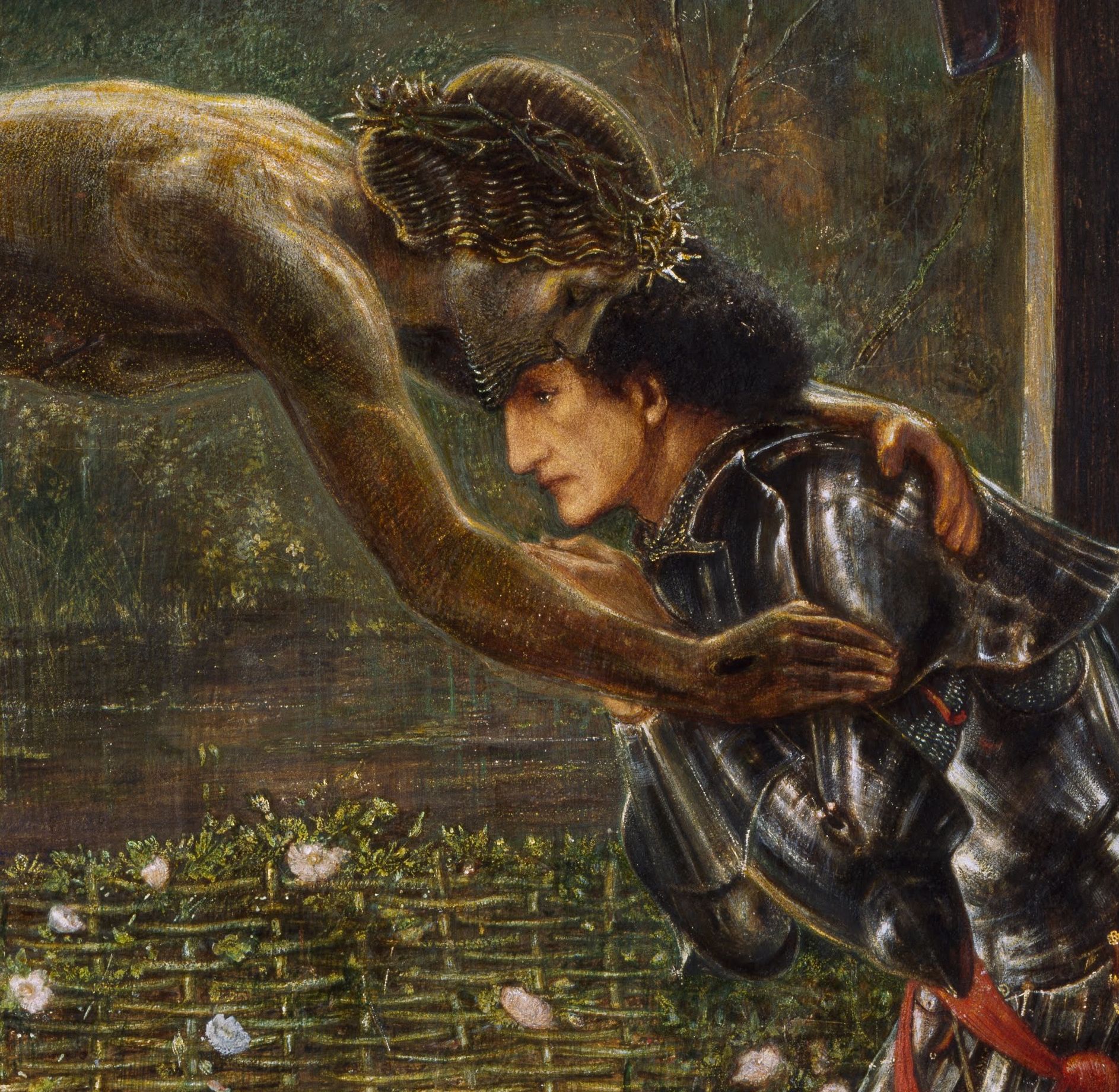
The knight’s armour
Small reflected lights can be picked out from the darker armour. The figure reads clearly even amid the close colours of the setting.
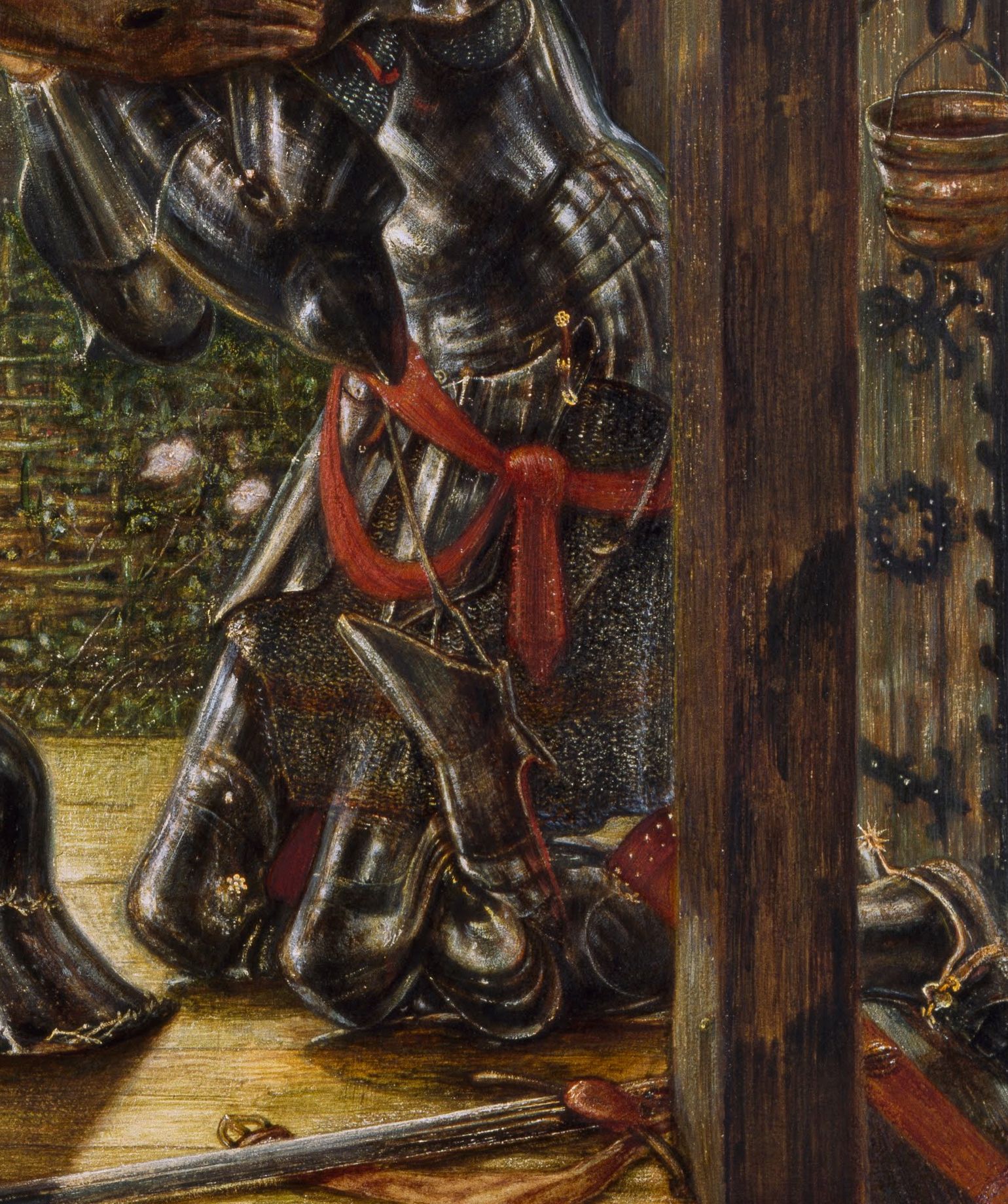
The opening below
The brightest part of the floor carries the figures’ shadows and gives the dark shrine an opening at the bottom.
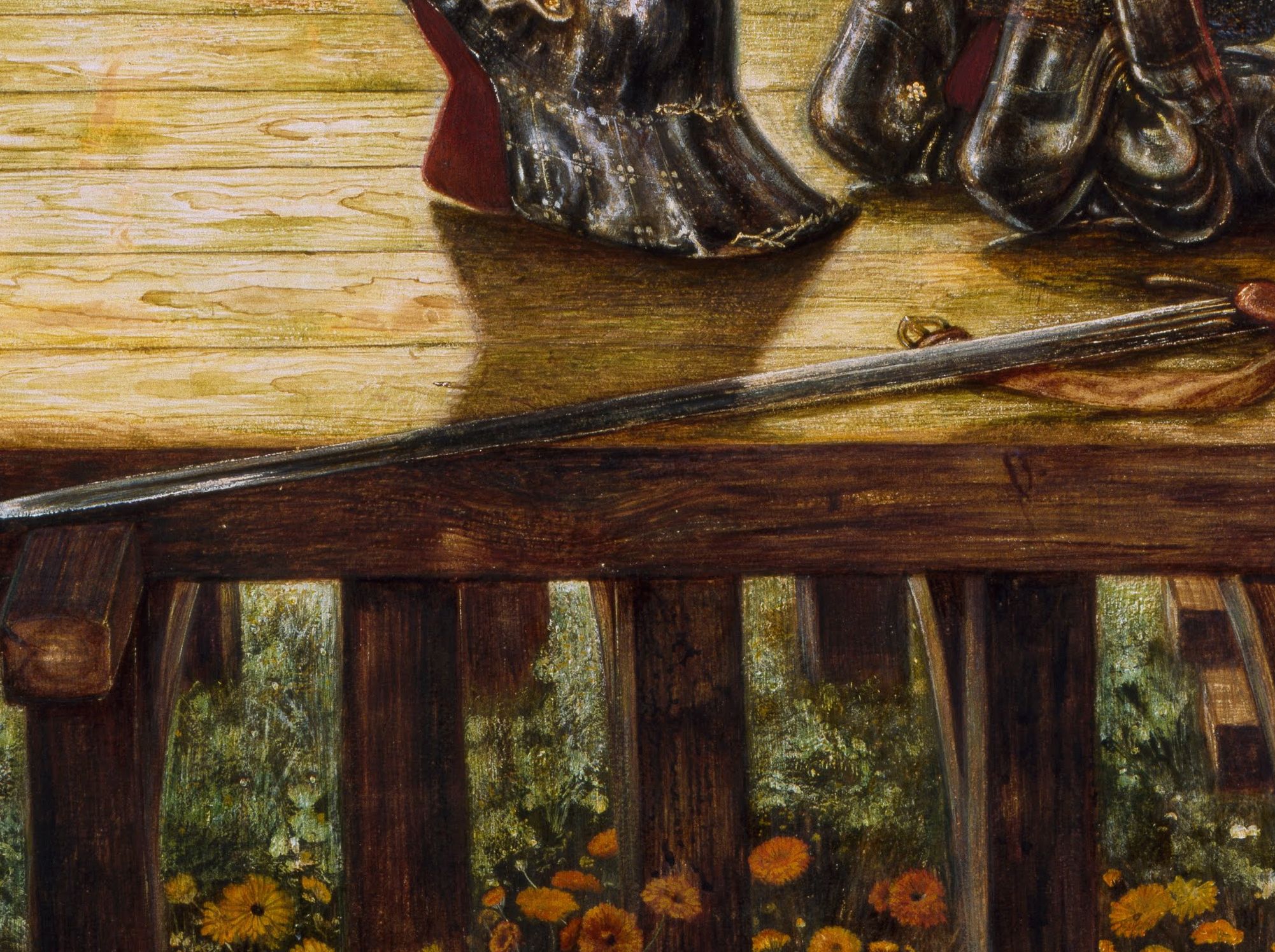
The Florentine legend and its Victorian retelling
John Gualbert is the English form of Giovanni Gualberto, an eleventh-century Florentine nobleman who became a monk and founded the community at Vallombrosa. The Florentine chronicle attributed to Ricordano Malespini tells how an armed Giovanni met his brother's killer near San Miniato al Monte. The man threw himself down and crossed his arms, pleading for mercy in the name of the crucified Christ. Giovanni spared him and led him to the church. In this telling the crucifix bowed before witnesses, after which Giovanni left secular life and became a monk at San Miniato. The joined episodes move from an act of human mercy to a sign of approval, then to a change in the knight's life. [7] [8]
The story also has a physical history in Florence. At San Miniato, the fifteenth-century shrine designed by Michelozzo was made to house the crucifix venerated in connection with the miracle. The cross associated with Giovanni was transferred to Santa Trinita in 1671. Research published by Florence University Press dates the surviving crucifix to the thirteenth century. At San Miniato, panels by Agnolo Gaddi include the saint and preserve a different part of the story's visual history. The modest painted structure in Burne-Jones's picture belongs to his narrative setting, while the marble shrine and the surviving cross belong to the later history of the devotion. [8] [9]
Earlier artists chose different points in the saint's life. In Pietro Sorri's painting of the miracle, recorded by Lombardia Beni Culturali, the pardoned man is still present before the crucifix with Giovanni. Andrea del Sarto's Vallombrosa altarpiece presents Giovanni among four saints and devotes a scene below them to the ordeal by fire of his follower Pietro. In that scene the dispute is with a bishop accused of selling spiritual offices or favours. Jacques Callot, whose print of four saints for July survives in the Rijksmuseum, gives the miracle one small oval. A body tilting forward on a cross is enough to identify the saint in that company. Burne-Jones's cross is partly lost against the framework of the shrine. With the bend carried into the torso and both arms, the brief inclination of the traditional image becomes a physical encounter. [10] [11] [12]
The nineteenth-century route to the story was Kenelm Henry Digby's The Broad Stone of Honour, first published in 1822. Digby's chapter on bearing injuries names the murdered brother Hugo and places the meeting on Good Friday, in a passage so narrow the riders cannot avoid one another. The killer dismounts and pleads by Christ's Passion. Remembering that Christ prayed for the men who killed him, Giovanni lifts his enemy off the ground, offers him friendship and asks him to pray for him. Digby moves on to a story about Charlemagne at that point. The episode in his text ends with one man raising the other. Burne-Jones paints Giovanni himself on his knees as the figure above him stoops. [1] [13]
Georgiana recalled that Edward kept Digby's book in his room and dipped into it when he could not sleep or woke early. The detail of Good Friday makes the movement of Christ's hand especially pointed. In the encounter with Giovanni, the man who begged for mercy made the sign of the cross with his own arms. In the picture, that gesture has its echo in the arms of Christ, who has loosened his hands from the cross and reaches down with the wound still visible. [14] [15] [13]
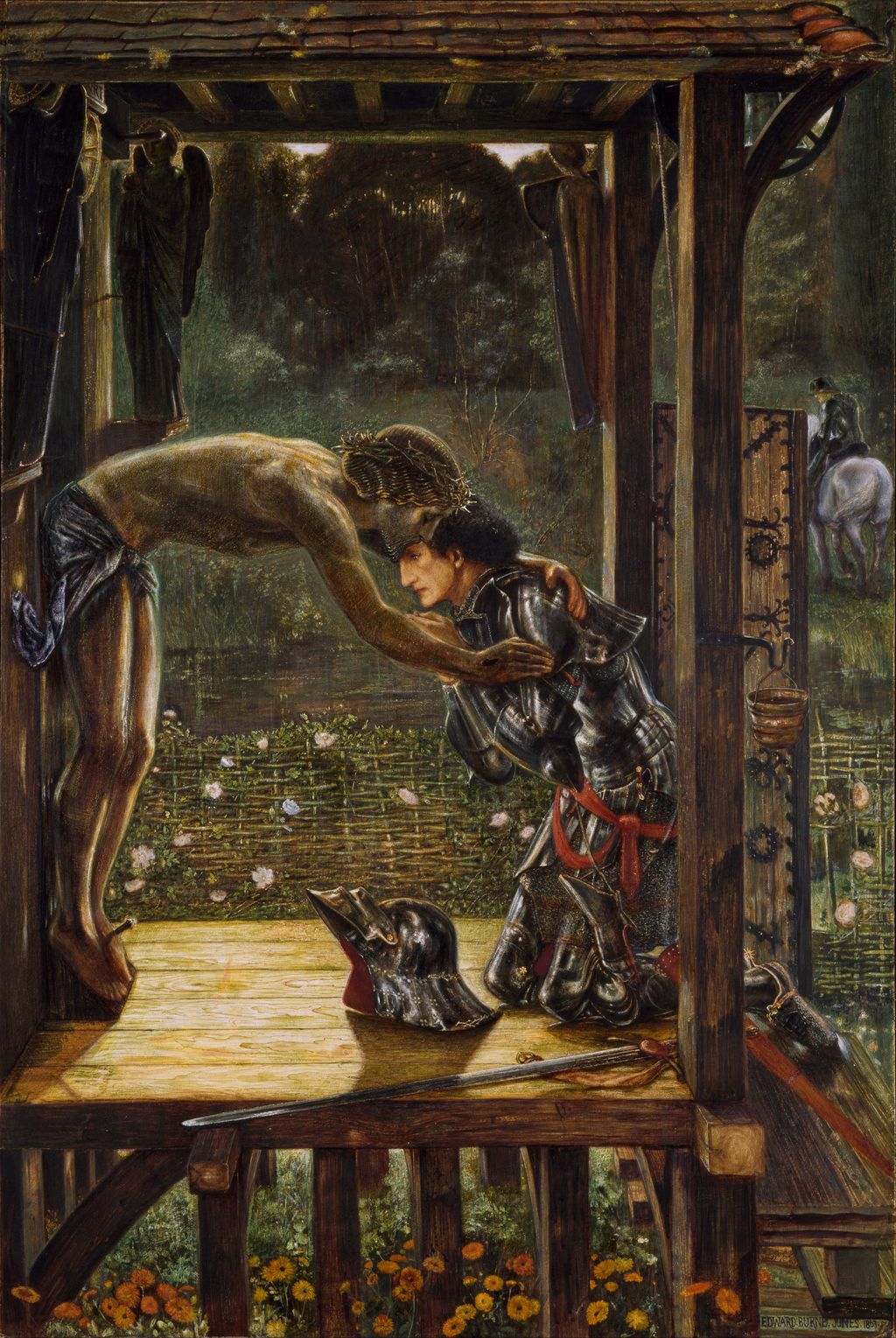
Edward Burne-Jones, The Merciful Knight, 1863. Birmingham Museums Trust. Image source. Public domain.
The drawings and the painted surface
The surviving drawings let us see how the encounter took shape. In one Tate composition study, a rectangular altar fills much of the lower part of the scene. The finished paintwork gives that space to the open floor, where the angle of the light joins the figures and there is room for the helmet and sword to register. Other preparatory sheets in Tate's collection isolate the knight's posture, including nude studies that work out the body underneath the armour. The studies help make sense of the weight on the knees and the tilt of the torso beneath those plates. William Waters identifies the model as Ciamelli, an Italian street musician. Georgiana remembered his blue-black hair and recognised him as one of the kings in Burne-Jones's Adoration triptych, where a similar suit of armour appears. [1] [16] [2] [5]
Joanna Meacock singles out an early pencil treatment in which a youthful Christ kisses the knight directly on the lips. In the finished image the encounter is higher and partly veiled by the bend of Christ's head. Meacock discusses the intimacy of the study alongside Dante Gabriel Rossetti's Sir Galahad. Rossetti designed the subject for Edward Moxon's 1857 edition of Tennyson's Poems and returned to it in the 1859 watercolour Sir Galahad at the Ruined Chapel. The Metropolitan Museum catalogue also connects the two artists' designs, while relating the subtler movement from light to shade in Burne-Jones's picture to his study of Italian Renaissance painting. The nearly upright framing and the armoured figure kneeling before a sign of grace help explain the association. Burne-Jones gives the gesture its own meaning by making it the consequence of forgiving a particular man. [1] [17]
Bodycolour is opaque paint mixed and applied with water. Its opacity helps explain why the lights in the armour and the brighter passages of the floor have such presence against the darker paint around them. The historian of artists' materials Fiona Mann used Burne-Jones's orders from the London colourman Charles Roberson to trace his movement towards larger exhibition watercolours. An 1863 order for extra-thick Double Elephant paper is close to the format of this sheet. Mann also associates its dense surface with substantial use of bodycolour and ox gall, an additive that helps aqueous paint spread. She tentatively identifies a refined vermilion in the red sash and scabbard. The 2019 Mitsubishi Ichigokan Museum exhibition checklist also lists gum arabic in the medium. That is a common binder in watercolour. Here the paper supports relatively heavy passages of paint, a far more substantial surface than a thin wash would leave. [18] [19] [20]
The combination of materials matters at picture scale. The knight's red sash is one of the few strong colours in the shrine and connects his body to his discarded equipment. On the platform, concentrated pale colour throws a pool of light in front of him. Behind him, patches of foliage remain separately visible even as the vegetation sinks into green and brown shadow. Burne-Jones gives a moment that requires an almost impossible bend of the body the weight of an observed scene. Art historian Caroline Arscott follows the little points of light on the nails that still hold Christ's feet and on the rivets that hold the knight's armour together. In her reading, both figures have their movement constrained by what they wear or are fastened to. Even the shrine, with the pattern of its hinges standing out against the view through the open door, keeps breaking the view into small areas of detail through which the eye travels into the distance. [1] [6] [15]
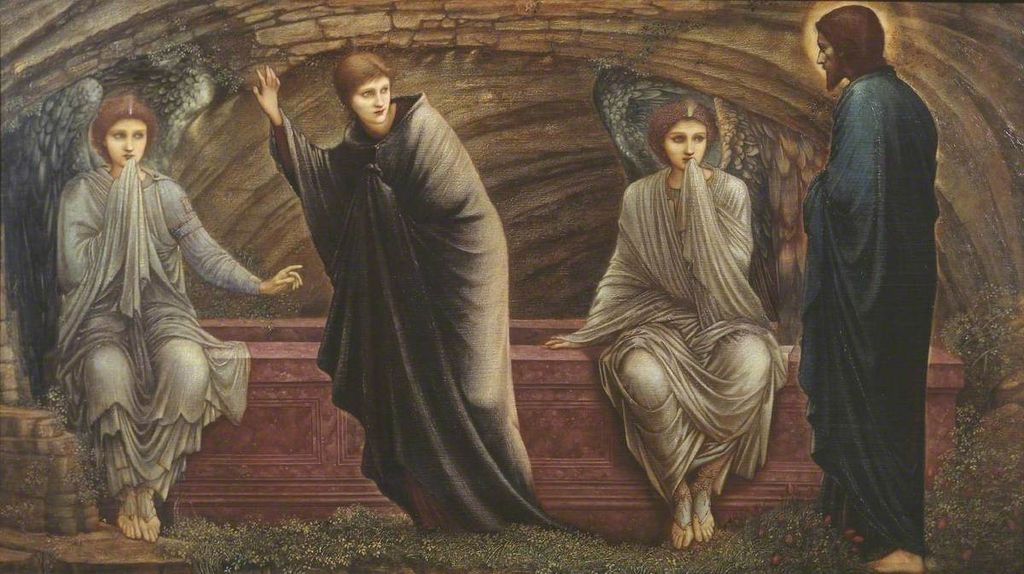
Edward Burne-Jones, The Morning of the Resurrection. N04888. Image source. Public domain.
The 1864 exhibition and the picture's later life
The watercolour was one of four Burne-Jones exhibited at the Old Water-Colour Society in London in 1864. He later recalled that the Society hung it high behind a door and that members let him overhear unfriendly remarks. The Art Journal objected to both the knight's seemingly clattering armour and the use of a medieval idiom for revered religious ideas. Frederic George Stephens, generally sympathetic to Pre-Raphaelite work, found the picture strange and partly mystical. William Michael Rossetti was more enthusiastic. Writing in the Fine Arts Quarterly Review, he saw it as evidence that Burne-Jones deserved a leading place in the Society. These reactions register different expectations of what an ambitious watercolour should look like and how directly it should tell a sacred story. [1] [18] [21]
Georgiana judged the picture more personally. Writing forty years on, she said it seemed “to sum up and seal the ten years that had passed since Edward first went to Oxford.” That decade had taken him from intending to enter the Church to making pictures for a living, in close contact with William Morris and Rossetti. His early enthusiasm for Christian chivalry stayed with him. Birmingham Museums records that he tried to borrow the watercolour in 1894 with a larger oil in mind. Arthurian legend meanwhile occupied him on the scale of a wall in The Last Sleep of Arthur in Avalon. The older Arthur lies waiting to be healed. In the early watercolour the wound belongs to the figure who reaches for the knight. [2] [5] [17]
Writing in Germany in 1901, Otto von Schleinitz thought the design and handling showed Burne-Jones taking on a problem of his own. He still recognised Rossetti in the character of the picture's mysticism. In Belgium, the writer Olivier-Georges Destrée looked back through the picture to the Italian art he had seen in Florence, Assisi and Perugia. His poem about Gualberto took its inspiration from the watercolour. A scene that some London reviewers had treated as an awkward revival of medieval art could itself become the basis of a new telling of the saint's life. [22] [23]
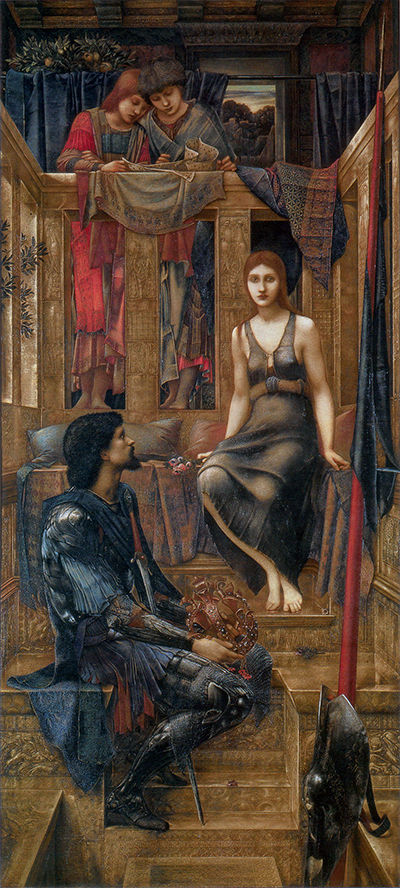
James Leathart bought the original directly from Burne-Jones for 180 guineas. It was shown at the New Gallery in 1892–93 and again in the memorial exhibition of 1898–99. It passed through William Marchant to Sir John Middlemore, whose trustees sold it to Birmingham in 1973. Birmingham lent it to the 2019 Parabola of Pre-Raphaelitism exhibition in Tokyo, where the checklist placed it after the earlier chivalric watercolour King Mark and La Belle Iseult and before two Birmingham landscapes. The grouping let viewers consider how the woodland and the furnishings of the shrine serve the story as much as the poses. [1] [2] [20]
Reproduction gave the picture a separate history. The Berlin Photographic Company published a plate in London in 1900 as part of The Work of E. Burne-Jones. Te Papa holds an impression, 1981-0086-1/11, catalogued as a photogravure on paper. The process made it possible to print the photographically transferred image in ink with fine gradations of tone. Its printed image measures 24 × 35.6 cm. This is one of the prints through which Burne-Jones's pictures reached viewers far from the galleries where the originals were shown. On a page small enough to hold, the angle of the body and the enclosure of the two heads remain clear. In the original, the passage from golden marigolds to red sash and white metal leads the eye upwards by colour. In the print, the pale gaps through the rail and the bright floor give the same passage its rhythm in light and dark. [1] [2] [24]
Edward Burne-Jones on film
Explore Burne-Jones’s paintings, illustrated stories and stained-glass designs.
Edward Burne-Jones: Pre-Raphaelite Visionary | Exhibitions | Showcase
A look at Burne-Jones’s paintings and the Tate retrospective.
Watch on YouTubeArtworks directory
This directory records paintings, studies, designs and collaborative works, with separate entries for documented versions and series where known.
| Name | Date | Medium |
|---|---|---|
| Sidonia von Bork 1560 | 1860 | Watercolour and bodycolour |
| Clara von Bork 1560 | 1860 | Watercolour and bodycolour |
| The Merciful Knight | 1863 | Watercolour |
| Sibylla Delphica | c. 1886 | Oil on panel |
| Phyllis and Demophoön | 1870 | Watercolour and bodycolour |
| The Legend of the Briar Rose (Buscot series) | 1870s–1890 | Oils on canvas |
| The Briar Wood (Buscot series) | By 1890 | Oil on canvas |
| The Council Chamber (Buscot series) | By 1890 | Oil on canvas |
| The Garden Court (Buscot series) | By 1890 | Oil on canvas |
| The Rose Bower (Buscot series) | By 1890 | Oil on canvas |
| Group of Women, study for The Golden Stairs | 1872 | Drawing |
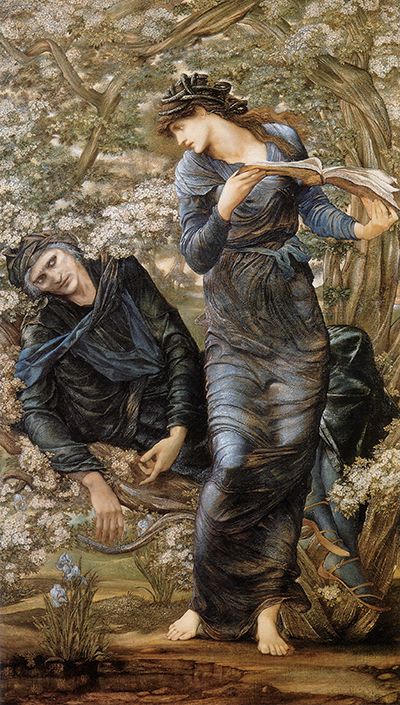
| The Beguiling of Merlin | 1870s | Oil on canvas |
| The Perseus Cycle | From 1875 | Paintings and full-scale designs |
| The Call of Perseus (Stuttgart) | From 1875 | Oil painting |
| Perseus and the Graeae (Stuttgart) | From 1875 | Oil painting |
| The Rock of Doom (Stuttgart) | 1884–88 | Oil on canvas |
| The Doom Fulfilled (Stuttgart) | 1888 | Oil on canvas |
| The Baleful Head (Stuttgart) | 1885–87 | Oil on canvas |
| The Baleful Head (Southampton design) | 1880s | Bodycolour |
| The Rock of Doom (Southampton design) | 1880s | Bodycolour |
| The Doom Fulfilled (Southampton design) | 1880s | Bodycolour |
| The Mirror of Venus (Gulbenkian) | 1870s | Oil on canvas |
| Drawing associated with The Mirror of Venus | 1870s | Drawing |
| Laus Veneris (Laing) | 1873–78 | Oil on canvas |
| The Days of Creation | 1870s | Watercolour and bodycolour |
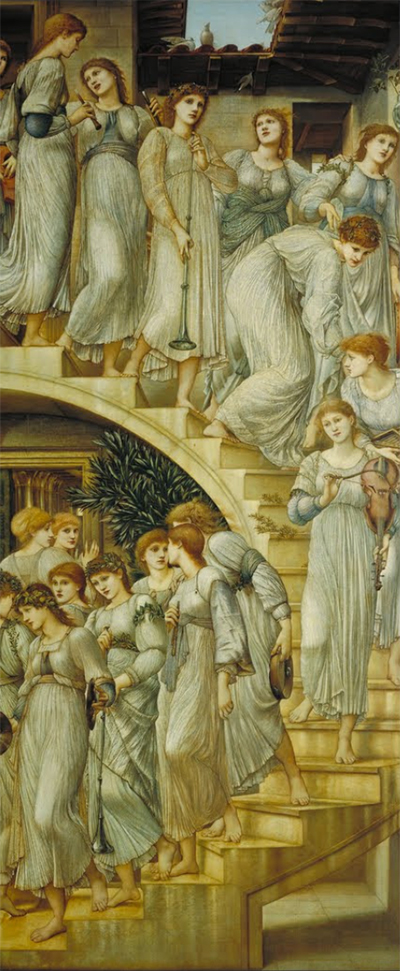
| The Golden Stairs | 1880 | Oil on canvas |
| An Angel Playing a Flageolet | 1878 | Watercolour, bodycolour and gold |
| The Tree of Forgiveness | 1881–82 | Oil on canvas |
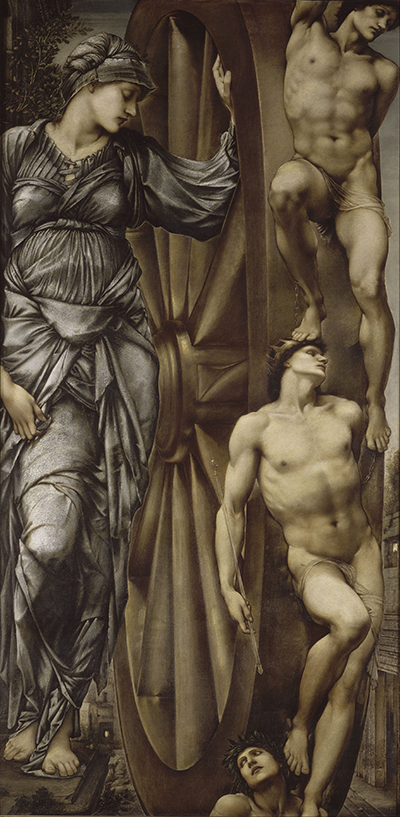
| The Wheel of Fortune (Orsay) | 1875–83 | Oil on canvas |
| King Cophetua and the Beggar Maid | 1884 | Oil on canvas |
| The Depths of the Sea (oil) | 1886 | Oil |
| The Morning of the Resurrection | 1886 | Oil on panel |
| Study for the Head of Mary Magdalene | c. 1882 | Oil study |
| The Sleep of King Arthur in Avalon | 1880s–1898 | Oil on canvas |
| The Sleep of King Arthur in Avalon (modello) | ca. 1881 | Oil on canvas (modello) |
| The Star of Bethlehem | Signed 1890 | Watercolour and bodycolour |
| Study for The Star of Bethlehem | About 1887–91 | Drawing |
| Sponsa de Libano | 1891 | Watercolour and bodycolour |
| The Summons (Holy Grail tapestries) | 1890s | Tapestry |
| The Failure of Sir Gawaine (Holy Grail tapestries) | 1890s | Tapestry |
| Hope (Boston) | 1896 | Oil on canvas |
| La Belle au bois dormant (theatre programme) | 1894 | Collotype |
| The Wedding of Psyche | 1895 | Oil on canvas |
| The Works of Geoffrey Chaucer (Kelmscott edition) | 1896 | Illustrated book |
| The Ascension (Birmingham Cathedral) | 1885 | Stained glass |
| The Last Judgement (Birmingham Cathedral) | 1897 | Stained glass |
| Adoration of the Magi (Huntington) | 1890s | Tapestry |
| Love among the Ruins (Wightwick) | 1894 | Oil on canvas |
| The Merciful Knight (photogravure after Burne-Jones) | 1900 | Photogravure |
| The Garden Court (preparatory work) | 1870–75 | Graphite and watercolour with white gouache |
| Study of a Female Figure | 1885 | Graphite drawing |
| Psyche Throwing Herself into the River | 1865–68 | Wood engraving |
| Beauty | 1887–89 | Colour lithograph |
| Study for the Failure of Gawain | 1893 | Crayon and graphite on Japanese paper |
| The Prince Enters the Briar Wood (after Burne-Jones) | After 1890 | Photogravure |
| The Rose Bower (after Burne-Jones) | 1892 | Photogravure |
| Adoration of the Magi (Musée d’Orsay) | 1904 | Tapestry |
| Answers to Prayer (Lyndhurst) | 1860s | Stained glass |
| The Depths of the Sea (photogravure after Burne-Jones) | 1900 | Photogravure |
| Perseus and Andromeda (Adelaide composite) | 1876 | Oil on canvas |
| The Adoration of the Magi (Hamburg) | Woven 1900 | Tapestry |
| Love leading the Pilgrim through the Briars | 1874–76 | Embroidery |
| Musica (worked by Lady Jane Cory) | 1906 | Embroidery |
| Pomona (worked by Lady Jane Cory) | 1907 | Embroidery |
| Flora (worked by Lady Jane Cory) | 1909 | Embroidery |
| The Fourth Day of Creation (photogravure after Burne-Jones) | 1900 | Photogravure |
| The Morning of the Resurrection (photogravure after Burne-Jones) | 1900 | Photogravure |
| Musical angels of the St Catherine window (Christ Church) | Designed 1877 | Stained glass |
Discussion
Look again at the images and ideas explored in The Merciful Knight. These editorial prompts invite your observations.
Reader Insights
How does the movement of the figure on the cross change your sense of the surrounding space?
Where does Burne-Jones leave room for you to see the shrine as a physical object?
Join the Conversation
Share a detail, comparison or question about The Merciful Knight below.
References
- The Metropolitan Museum of Art, Edward Burne-Jones: Victorian Artist-Dreamer, catalogue no. 26, pp. 93–95. View source.
- Burne-Jones Catalogue Raisonné and Birmingham Museums Trust, The Merciful Knight, object record NjQx, including the museum's note, signature, mount, provenance and exhibition history. View source.
- The New Gallery, Exhibition of the Works of Sir Edward Burne-Jones, Bart., 1898–99, South Room, catalogue no. 53. View source.
- Uliana E. Vlasova, Vremennik of the Zubov Institute, “Концепция рыцарского образа в живописи Э. Бёрн-Джонса” [The concept of the knight in Burne-Jones's painting], 2024, no. 2, pp. 117–119, fig. 1. View source.
- Georgiana Burne-Jones, Memorials of Edward Burne-Jones, vol. I, pp. 261–262. View source.
- Katherine Hinzman, Aspectus, Edward Burne-Jones: Super-Naturalist Painter, pp. 2–6, figs. 1–4. View source.
- Ricordano Malespini, attributed, Istoria fiorentina, chapter LXV, “Di Santo Giovanni Gualberti da Petrojo.”. View source.
- Abbazia di San Miniato al Monte, I tesori e la Porta Santa, the altar of Michelozzo and the miraculous crucifix. View source.
- Florence University Press, La Basilica di San Miniato al Monte di Firenze (1018–2018). Storia e documentazione, discussion of the ciborium, crucifix and Agnolo Gaddi panels. View source.
- Lombardia Beni Culturali, Pietro Sorri, San Giovanni Gualberto e l'uccisore del fratello davanti al crocifisso, object record w6010-01049. View source.
- Gallerie degli Uffizi, Andrea del Sarto, La pala di Vallombrosa, altarpiece and predella. View source.
- Rijksmuseum, Jacques Callot, Heilige Abundius van Cordoba, Heilige Johannes Gualbertus, Heilige Marciana van Toledo/Caesarea, Heilige Anacletus (11–13 juli), object catalogue and image. View source.
- Kenelm Henry Digby, The Broad Stone of Honour, book II, Tancredus, pp. 303–304. View source.
- Georgiana Burne-Jones, Memorials of Edward Burne-Jones, vol. II, p. 56. View source.
- Caroline Arscott, 19: Interdisciplinary Studies in the Long Nineteenth Century, “Mutability and Deformity: Models of the Body and the Art of Edward Burne-Jones,” no. 7, 2008, opening case study and fig. 1. View source.
- Katherine Hinzman, University of York, Love Between Worlds: Edward Burne-Jones and the Theology of Art, illustrations volume, figs. 16–21, Tate sheets A00083–A00085 and A00087–A00089. View source.
- Joanna Meacock, University of Glasgow, Saintly Ecstasies: The Appropriation and Secularisation of Saintly Imagery in the Paintings and Poems of Dante Gabriel Rossetti, 2001, Part 2, fig. 78 and the discussion of the pencil study that follows. View source.
- Fiona Mann, The Burlington Magazine, “A ‘born rebel’: Edward Burne-Jones and watercolour painting 1857–80,” 2014, fig. 23 and the Roberson orders and Society exhibition discussion. View source.
- Fiona Mann, Oxford Brookes University, Brushing the Surface: The Practice and Critical Reception of Watercolour Techniques in England, 1850–1880, chapter 7, pigments and materials 1861–65. View source.
- Mitsubishi Ichigokan Museum, Parabola of Pre-Raphaelitism, 2019 exhibition checklist, cat. nos. 101–104, in the museum's annual report. View source.
- Mariam Hale, University of York, ‘Magic Casements:’ Fantasy in Victorian Art, p. 154, n. 459, citing William Michael Rossetti, “Art-Exhibitions in London,” Fine Arts Quarterly Review 3, October 1864, p. 36. View source.
- Otto von Schleinitz, Burne-Jones, 1901, pp. 47–48 and fig. 12. View source.
- Laurence Brogniez, Université libre de Bruxelles, “Georges-Olivier Destrée et la religion de l'art: de l'esthète au converti,” Dimensions du sacré, p. 40. View source.
- Museum of New Zealand Te Papa Tongarewa, The Merciful Knight, from The Work of E. Burne-Jones, object 1768762, registration 1981-0086-1/11. View source.