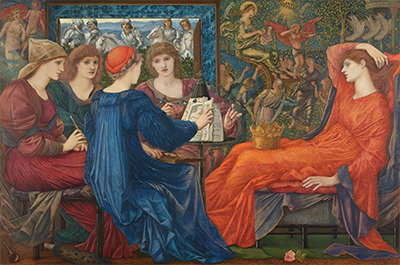
 by Tom Gurney
Tom Gurney BSc (Hons) is an art history expert with over 20 years experience
Published on June 19, 2020 / Updated on November 25, 2026
Email: tomgurney1@gmail.com / Phone: +44 7429 011000
Edward Burne-Jones Biography: Introduction
When Philip Burne-Jones painted his father in 1897–98, he showed him standing at an easel in the upstairs studio at The Grange. On the easel is a composition from the legend of the Holy Grail, already used for a tapestry. Behind him stands an unfinished oil from the story of Perseus. Edward thought the likeness caught him busy at his work. Philip had been painting and exhibiting in his own right for years, and his choice of setting gives the portrait the intimacy of a visit from someone who knew the house well. [1]
The painter standing between those two pictures had grown up in a Birmingham frame-maker’s household, intended to take holy orders and learnt to draw professionally in the company of other artists. He and William Morris met at Oxford and went on working together for four decades. His reputation in his own lifetime depended on several quite different publics, from church congregations and the visitors to a London exhibition to readers turning the pages of a book. The studios, homes and workshops in which those relationships took shape tell the story of how Edward Jones of Birmingham became Sir Edward Burne-Jones. [2] [3]
At a Glance
- ArtistEdward Burne-Jones
- Life1833–1898
- Known forLife and chronology
- ContextBirmingham, Oxford, London and international exhibitions
Edward Burne-Jones in context
Pre-Raphaelite Brotherhood
Founded 1848Aesthetic Movement
Second half of the 19th centuryGrosvenor Gallery
Burne-Jones exhibited 1877–87 [10]Dante Gabriel Rossetti
Career and mentorshipEdward Burne-Jones
Working career [10]William Morris
Career and collaborationWilliam Holman Hunt
Pre-Raphaelite painterJohn Everett Millais
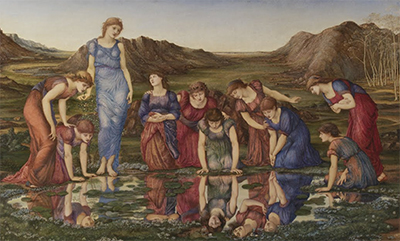
Pre-Raphaelite painterThe Mirror of Venus
1870sThe Wheel of Fortune
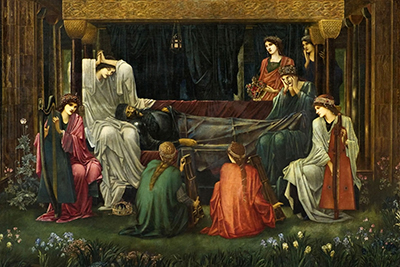
1875–83The Last Sleep of Arthur in Avalon
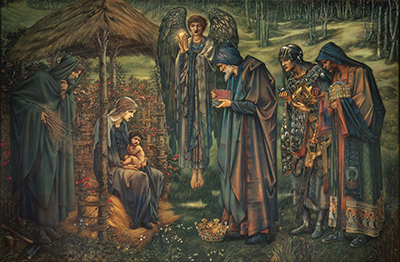
1880s–1898The Star of Bethlehem
Signed 1890Contents
- Birmingham and Oxford, 1833–56
- Rossetti, the Oxford Union and Italy, 1856–60
- Georgiana, the Firm and The Grange, 1860–70
- The studio years and the Grosvenor Gallery, 1870–85
- London, Rottingdean and Paris, 1885–96
- Avalon and the end of his life, 1896–98
- Georgiana’s account and the exhibitions after 1898
Birmingham and Oxford, 1833–56
Edward Coley Burne-Jones was born on 28 August 1833 on Bennett’s Hill, a street in the commercial centre of Birmingham. His father, Edward Richard Jones, was a frame-maker and gilder, while his mother, Elizabeth Coley, came from a family in the city’s jewellery trade. She died soon after the birth. The child grew up with his father and the care of their housekeeper, Ann Sampson. Birmingham supplied an early acquaintance with the skilled labour surrounding art. He entered King Edward’s School and took drawing classes at Birmingham’s School of Design before going to Oxford. The early name under which he wrote and studied was Edward Jones. He adopted Burne as part of his working surname later in life. [2] [4]
The dates of his arrival at Oxford mark two events. He matriculated at Exeter College in 1852, but a shortage of rooms delayed residence until the beginning of 1853. Georgiana Burne-Jones, writing half a century later, had the matriculation certificate dated 2 June 1852 in front of her when she recorded the distinction. She also printed the excited note Edward sent his father during the examinations. For what followed she had different kinds of evidence. Burne-Jones’s own recollection of his first months with Morris, written after his friend’s death, warned that the years ran together when he tried to recall them without a diary or his early letters. [5] [4]
Both young men initially imagined a life in the Church. They read medieval literature, Ruskin and Carlyle, and Oxford gave them buildings and pictures to look at together. Thomas Combe, superintendent of the university press, and his wife Martha collected early Pre-Raphaelite paintings in the city. Their circle gave the students a chance to see what contemporary painting could make of subjects that mattered to them. The friends also travelled in northern France in 1855. The great Gothic churches had a contemporary purpose for Morris, whose essay on Amiens appeared the following February. Walking through a building, seeing how sculpture was placed and reading a story could all feed the same conversation. [3] [6] [7]
Burne-Jones was already publishing during the change of vocation. The first number of the Oxford and Cambridge Magazine, financed by Morris, included his story The Cousins and his essay on Thackeray’s The Newcomes. His A Story of the North appeared in the second issue alongside Morris’s essay on Amiens. The magazine’s twelve issues made room for fiction and criticism as well as poetry. They show Burne-Jones trying the trade of writing just as drawing was beginning to occupy more of his life. By 1856 he had left Oxford without a degree to make his living as an artist. [8] [9] [10]
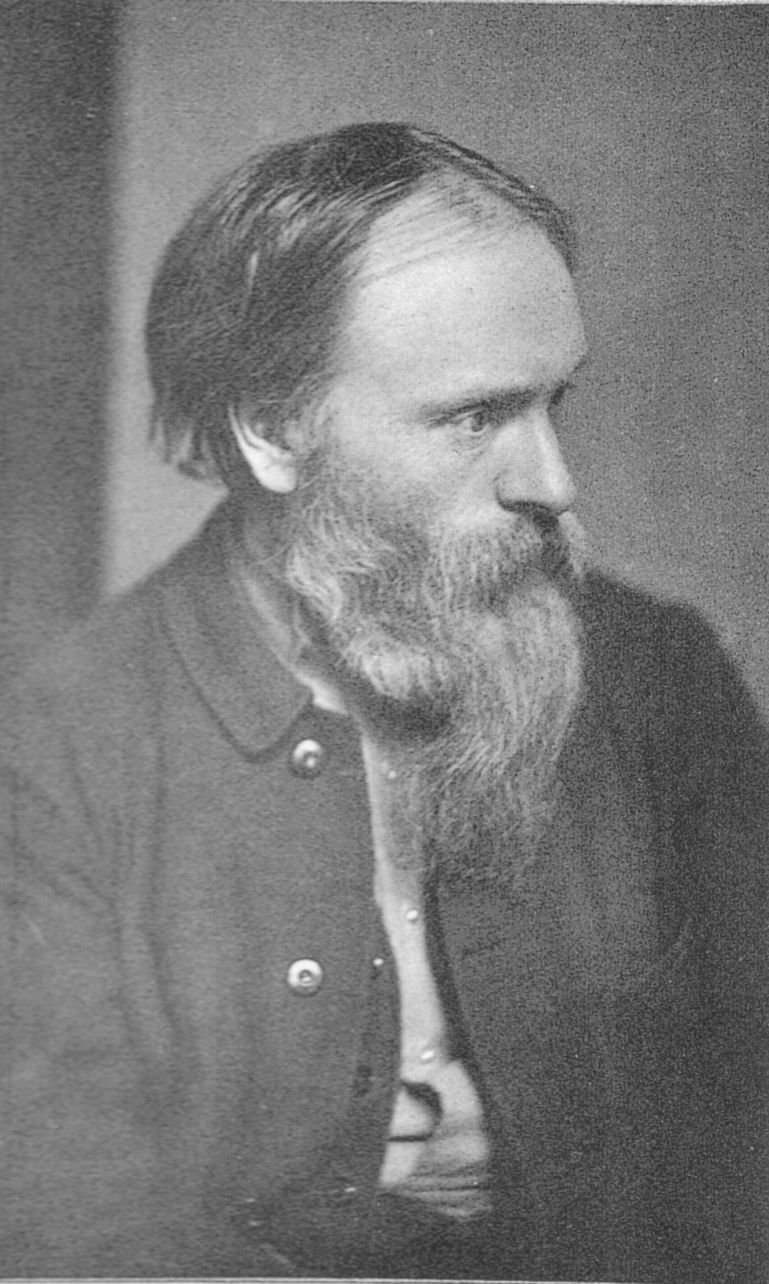
Frederick Hollyer, Portrait of Edward Burne-Jones, about 1882. Image source. Public domain.
Four stages of Edward Burne-Jones’s career
These periods group related developments; painting, travel and local work overlap across their boundaries.
Finding a vocation
Burne-Jones grew up in Birmingham. At Oxford he met William Morris, and in London Dante Gabriel Rossetti helped turn his interest in medieval literature and design into a painter’s work.[10]
Designs moving between media
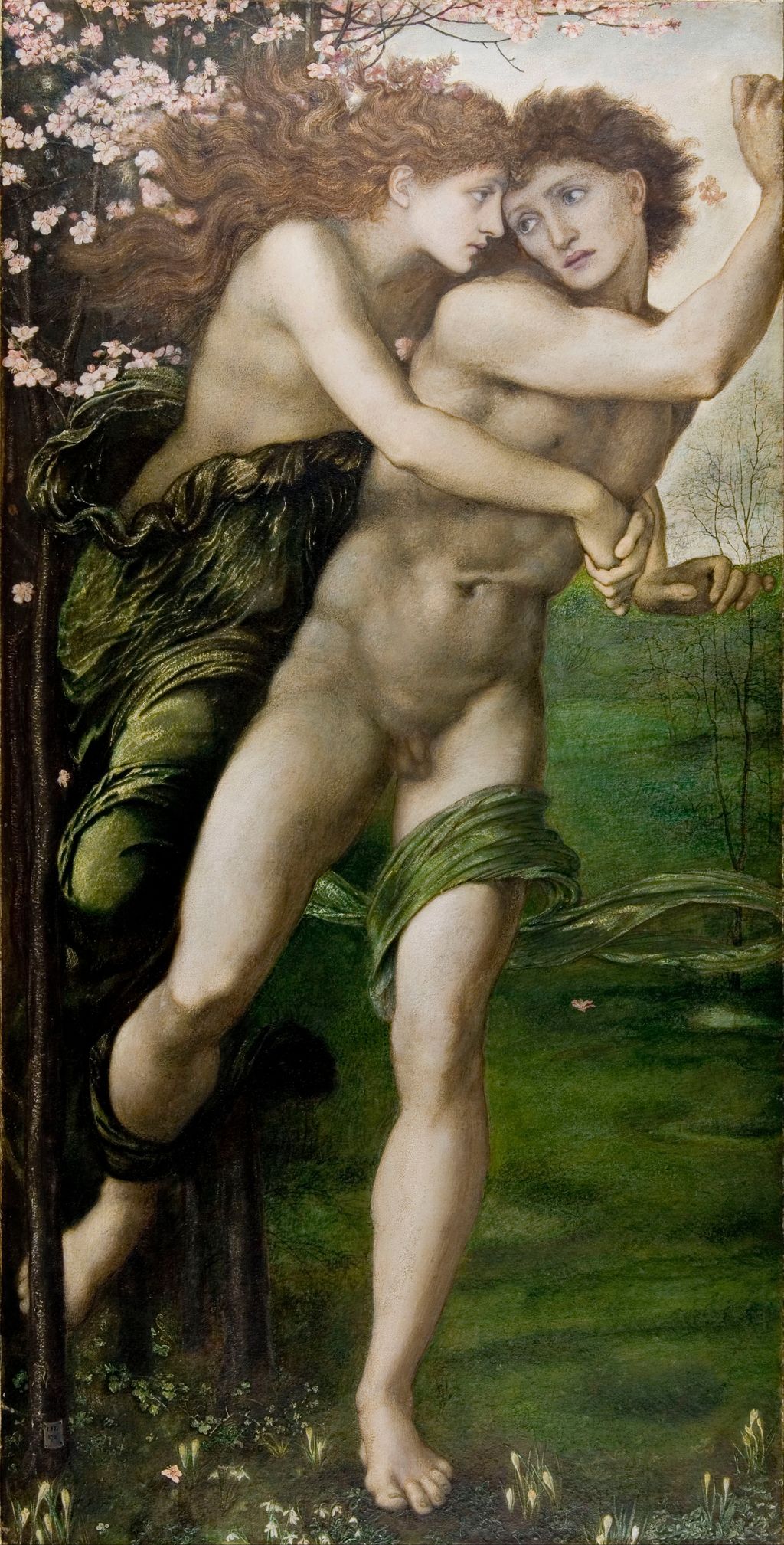
The early watercolours and the firm’s church commissions brought together drawing, colour and applied design. The 1870 Phyllis picture shows how far he could push the watercolour exhibition tradition.[10]
The Grosvenor years
Burne-Jones’s Grosvenor Gallery exhibitions made his large paintings and poetic subjects widely known. Oil painting, figure studies and designs for stained glass continued side by side.[10]
Painting at architectural scale
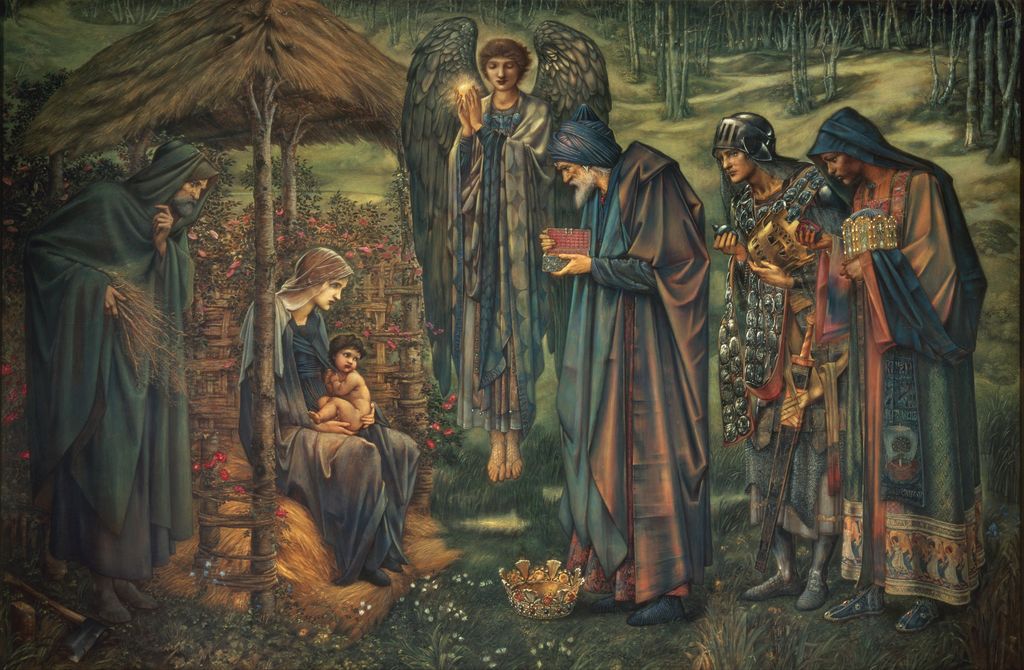
Large paintings and workshop designs occupied his later years. The Star of Bethlehem and the unfinished Sleep of King Arthur in Avalon show two ways he worked on the scale of a room.[10]
Rossetti, the Oxford Union and Italy, 1856–60
In London Burne-Jones found a mentor in Dante Gabriel Rossetti. Morris and Burne-Jones shared rooms at 17 Red Lion Square, where Rossetti could give Edward guidance and introduce him to other artists and prospective buyers. The Pre-Raphaelite Brotherhood had been founded in 1848. Burne-Jones entered its artistic orbit years later through these relationships. He began with labour-intensive drawings, often made with pen and ink on a small scale. In Alice, la Belle Pèlerine he outlined buildings, rich clothes and a narrow view of a summer landscape around a figure from Malory. The head and shoulders were drawn on a separate piece of vellum attached to the main sheet. The object records the patience with which he was already prepared to revise a drawing, even at the scale of a single head. [9] [11] [12]
In 1857 the circle moved from the rented rooms to a very different sort of workplace. Rossetti enlisted Burne-Jones, Morris, Arthur Hughes and other young painters to decorate the new Oxford Union building with scenes from Arthurian legend. Burne-Jones painted a scene with Merlin and Nimue. The high wall surfaces and their preparation gave the undertaking problems of a kind quite different from working on vellum. The weakened appearance of the murals today is part of their history as paintings made directly on the building. Their value to Burne-Jones’s biography is also apparent four decades later, when memories of what happened there could still set him and a younger visitor talking about a mutual friend. [6] [13] [14]
Another opportunity that year offered a more durable livelihood. Burne-Jones began designing for James Powell & Sons, the glassmakers at Whitefriars. Tate identifies The Good Shepherd as his earliest stained-glass design for the firm. It put his drawing into the hands of craftsmen who cut and assembled coloured glass. A young artist establishing a name through drawings could already supply figures intended to be seen across a room or through the changing light in a church. Stained glass would remain part of his working life even when his large oils attracted more public attention. [10]
In 1859 he travelled to Italy with the painter Val Prinsep. Buondelmonte’s Wedding, made that year, assembles people, architecture and costume in ink and wash on vellum. The figures in its foreground gave Tate’s curators a basis for tracing what he had seen of early Renaissance art in Venice. The fine lines and densely occupied surface still belong to the world of his early drawings. By returning to Italy at several points in his career he was able to put different sorts of pictures to use, from the close-packed scenes of early Renaissance painters to the much heavier bodies of Michelangelo. [3] [10]
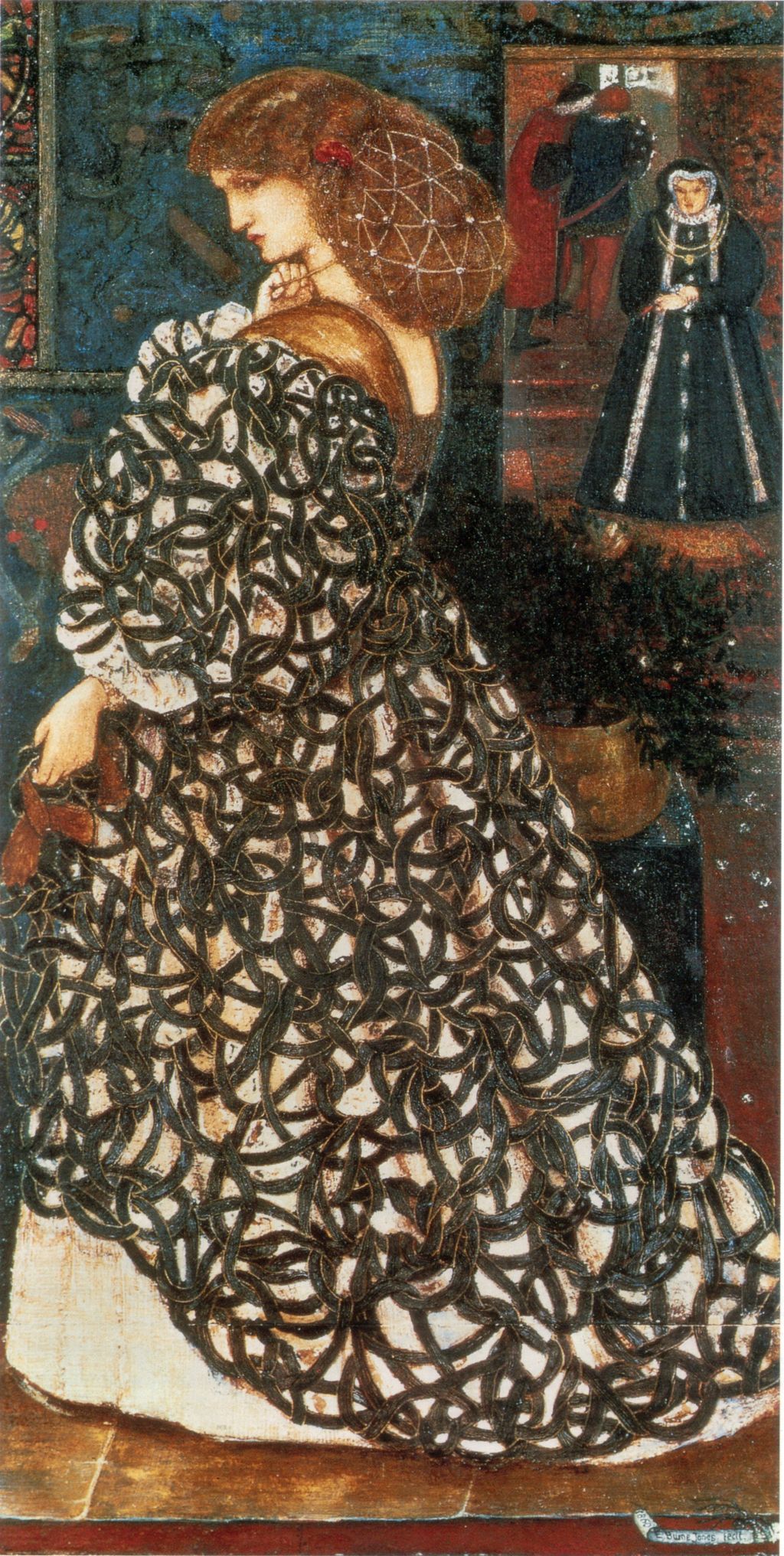
Edward Burne-Jones, Sidonia von Bork 1560, 1860. Tate. Image source. Public domain.
Georgiana, the Firm and The Grange, 1860–70
Edward married Georgiana Macdonald in June 1860. One object brings their early married life into view. He painted and gilded a panel for their wedding piano, setting the approach of Death among a company of ladies. The piano was furniture made to be used, with a picture in the place where the player and anyone listening nearby would repeatedly see it. Georgiana had artistic training of her own. She painted tiles for the Firm in its early years and made drawings and designs for wood engraving. Her friendships with people including George Eliot and Ruskin and her contribution to the family’s work gave her access to worlds that later met in the pages of the Memorials. [4] [10] [15] [16]
The Burne-Joneses were among the visitors to Red House at Bexleyheath, where William and Jane Morris moved in 1860. Philip Webb designed the building and furniture, and their friends helped paint walls and furnishings. Sections of the original scheme came back into view when National Trust conservators investigated later coatings and alterations. Edward was a founding partner of Morris, Marshall, Faulkner & Co. in 1861. The work at Red House was one place where the partners had seen what was possible when an architect, designers, painters and craftspeople had a room to furnish together. The Firm offered their work to customers and exhibited it at the 1862 International Exhibition in London. [17] [18] [10]
Edward and Georgiana travelled to northern Italy with Ruskin in 1862. In Padua Edward made a study from Titian’s fresco of The Miracle of the Newborn Child, concentrating on the central section. Another study records the head of Bacchus in a Tintoretto before the painting was restored. From the surviving copies it is possible to see what he chose to isolate on the page. The trips that bookend the beginning of his married life involved careful looking in front of works whose handling and scale could be hard to judge in reproduction. [3] [10]
The families briefly considered moving closer still. Webb drew up plans in 1864 to extend Red House with room for the Burne-Jones family and workshops for the business. The prospect depended on money, health and the practical demands of running a company in London. When Georgiana fell ill with scarlet fever, her son Christopher was born prematurely and died. The Burne-Joneses withdrew from the plan. Philip, born in 1861, and Margaret, born in 1866, grew up principally at The Grange on North End Road in west London after the family moved there in 1867. For the next three decades the house served as a family home and as a place to see paintings in progress. [17] [19] [4] [1]
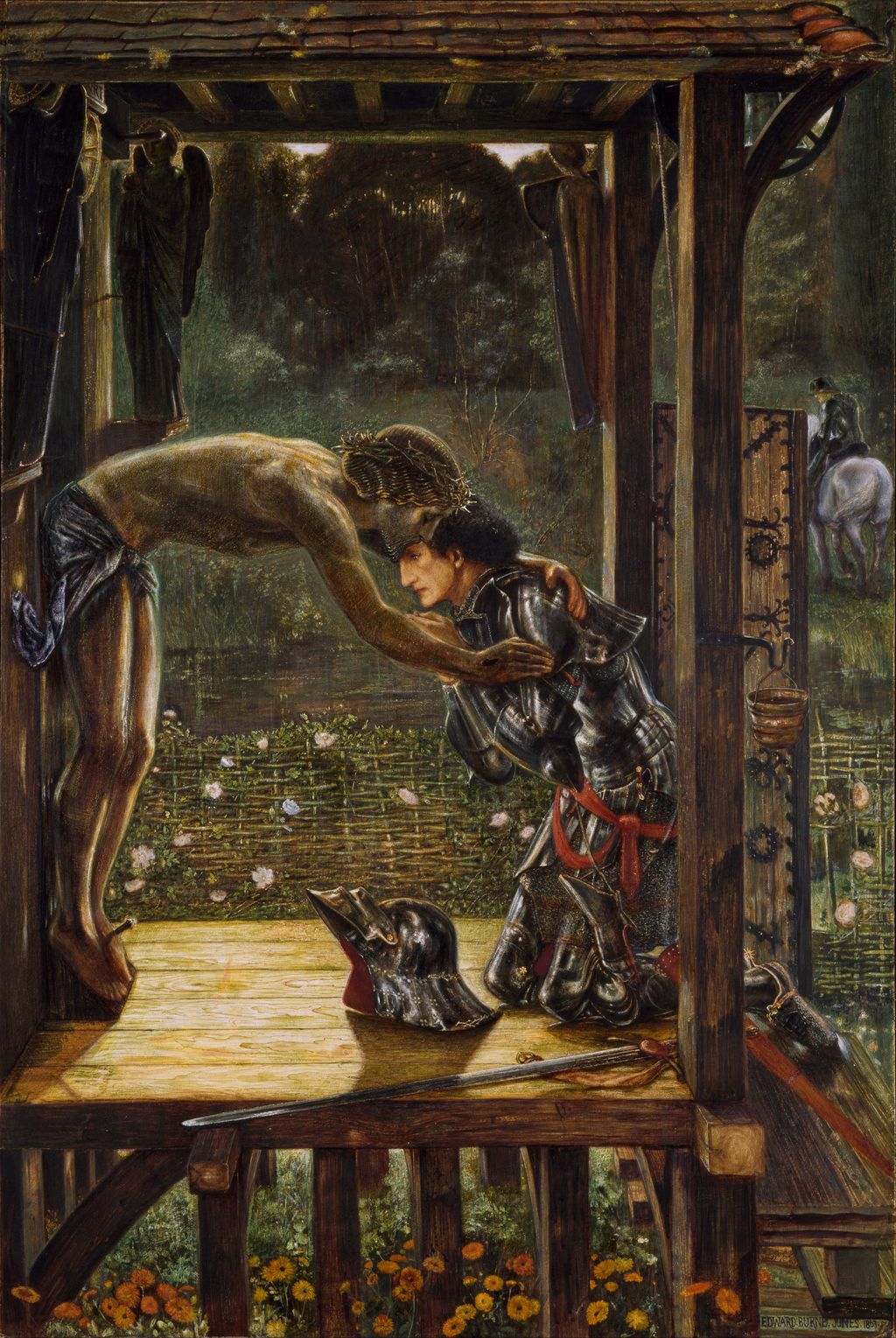
The Old Watercolour Society gave Burne-Jones an established exhibition public in the 1860s. He joined as an Associate in 1864 and exhibited that spring. The works on view included The Annunciation, originally commissioned by the engravers George and Edward Dalziel, and The Merciful Knight. He became a full member in 1868. The shift to exhibition-scale work was visible in his orders to the artists’ supplier Charles Roberson. In 1863 he bought extra-thick sheets about forty inches long. By 1869 he was ordering dozens of prepared supports, with paper stretched over fabric and panelled board to withstand the weight of paint and the risks of handling. The Dalziel Annunciation, for example, sets Mary high in a steeply receding structure amid a concentrated field of red. William Graham, a wine merchant and collector, bought the 1865 watercolour Le Chant d’Amour at the Society’s next exhibition and became one of his most loyal patrons. Graham also lent him Italian paintings and helped oversee his finances. [20] [21] [10] [3]
In 1870 the Society objected to the treatment of the nude Demophoön in Phyllis and Demophoön. Burne-Jones declined to alter the figure, withdrew the picture and resigned. By then he had been romantically involved with Maria Zambaco, who studied painting with him and modelled for several works. She later trained in sculpture under Alphonse Legros and exhibited portrait medals in her own right. One medal of her cousin Marie Spartali Stillman appeared at the Royal Academy, at the New Gallery and at the 1889 Paris exhibition, where Zambaco’s group of medals won an award. Evidence of the relationship helps identify people in Burne-Jones’s circle. Her own exhibition career shows where those relationships led for her. [20] [10] [22]
The studio years and the Grosvenor Gallery, 1870–85
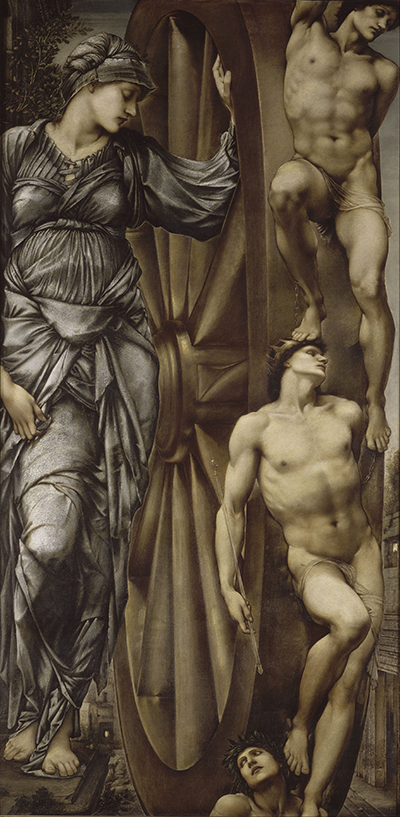
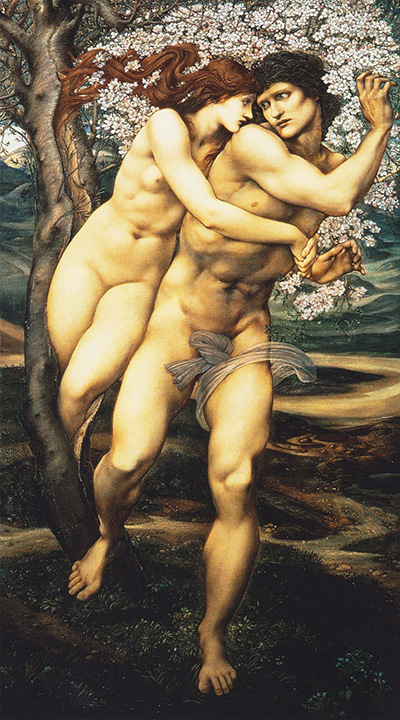
Burne-Jones continued working at The Grange through the years between his resignation and the opening of the Grosvenor Gallery. His pace of exhibiting slowed, although the Dudley Gallery showed his watercolour Love among the Ruins in 1873. [10] He travelled to Italy in 1871 and 1873. The later visits widened his knowledge of the Italian Renaissance, including the work of Mantegna, Botticelli and Michelangelo. The Wheel of Fortune, exhibited in 1883, shows the effect of close study of Michelangelo on how he stacked and turned the naked figures on the wheel. In The Tree of Forgiveness, shown in 1882, he went back to the Phyllis story in a large oil and reworked the bodies. He gave the male figure a strip of drapery in the later painting. [23] [10] [24]
Workshop work kept its place throughout these years. When the original partnership was reorganised under Morris in 1875, Burne-Jones carried on supplying figure designs. The surviving account books distinguish the making of drawings from the work of keeping a business record. Burne-Jones wrote most of the entries in both sides of the books at first. Staff at the Firm later assisted with accounts and added place names to entries he had made. Georgiana’s hand appears on the debit side of one folio. The two surviving books have caricatures on their opening leaves, including one of the friends as stained-glass figures, a private joke at the front of records that were used to account for time and money. [10] [25]
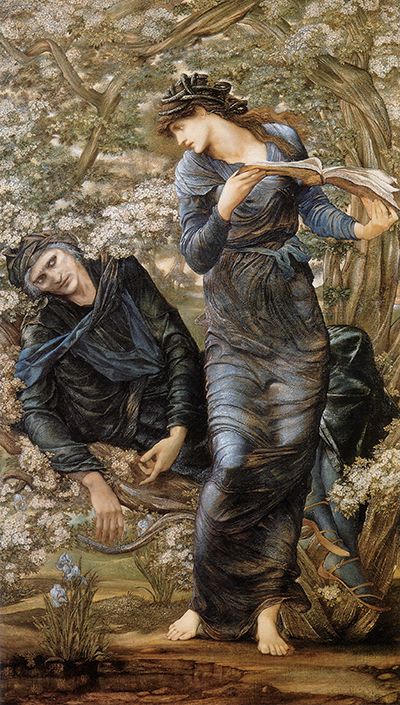
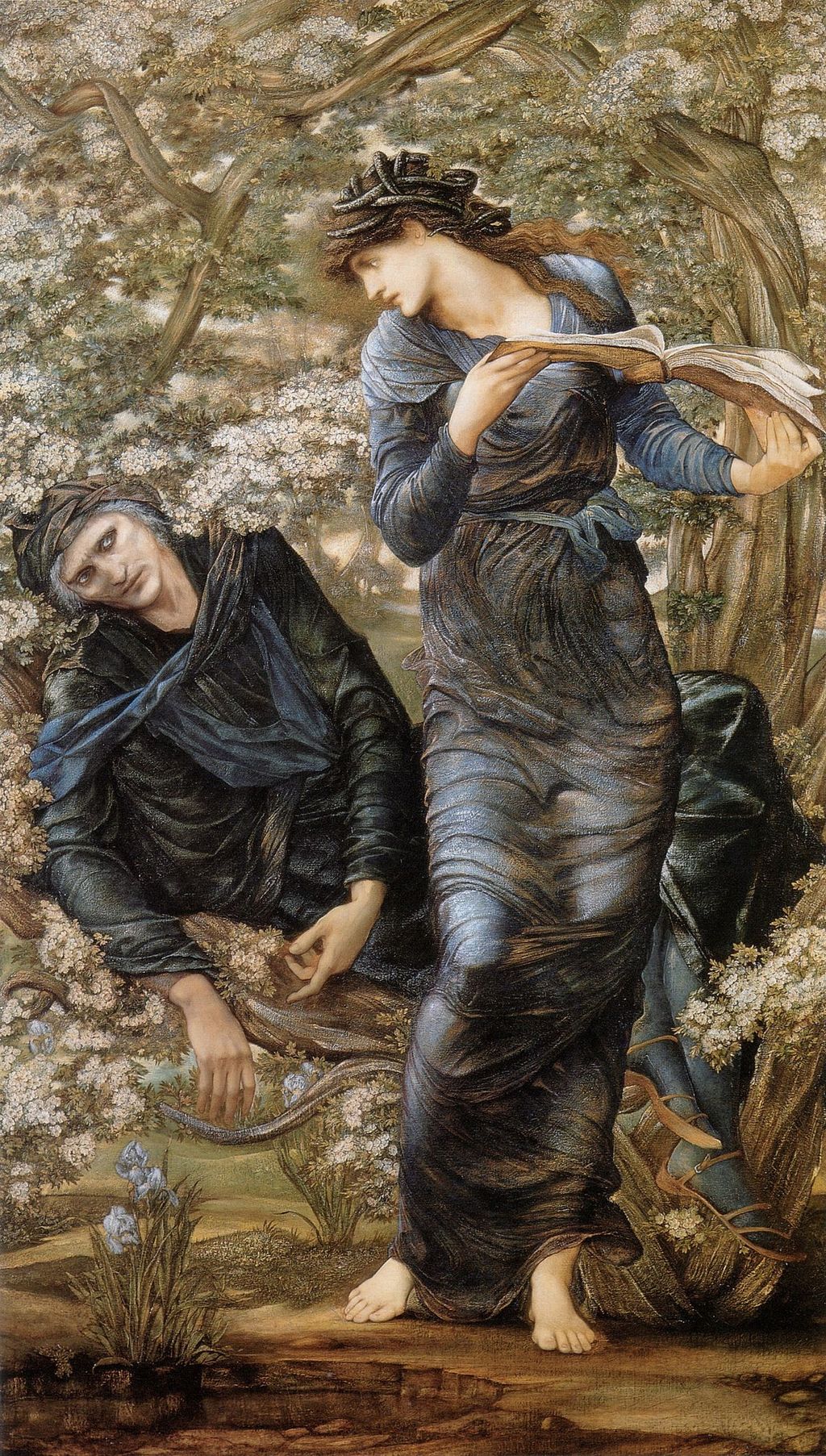
In 1877 the new Grosvenor Gallery in New Bond Street gave Burne-Jones a chance to present eight pictures together. Among them was The Beguiling of Merlin, commissioned by Frederick Leyland, a Liverpool shipping magnate. Viewers could see how far Burne-Jones had extended the figures and foliage of his drawings to fill a tall canvas. They could also compare such an oil with the six panels of The Days of Creation, shown together. Henry James praised his invention and colour in the American magazine The Galaxy, where he also wondered at the similarity of the painter’s figures. [26] [21] Merlin appeared at the Paris international exhibition of 1878. [27] [23] [10] [28]
The Grosvenor also put him in the middle of a public argument about painting. Ruskin attacked James McNeill Whistler’s work in print after the 1877 exhibition. When Whistler sued for libel the following year, Burne-Jones agreed to testify on Ruskin’s behalf. His letter offering support survives. In court the discussion turned in part on what finish meant and how much work a viewer ought to be able to recognise in a picture. Burne-Jones, who had spent years adjusting canvases before showing them, approached the question from a practice of his own. The case places him in a dispute among living artists and critics about the costs and appearance of modern work. [29] [30]
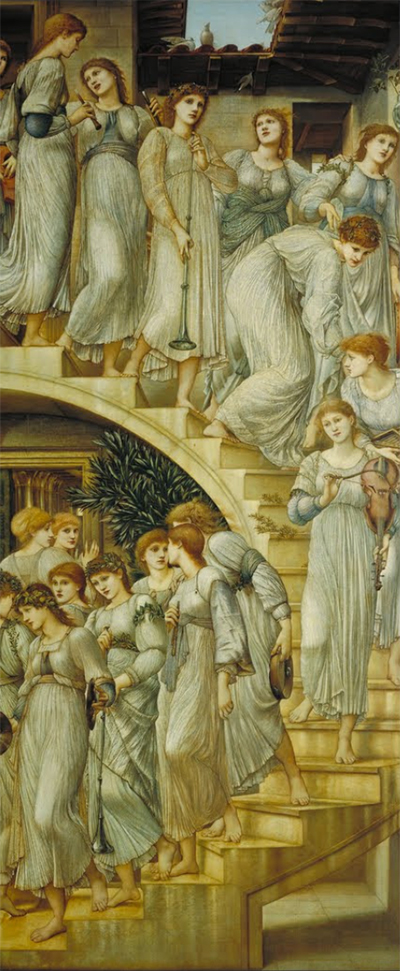
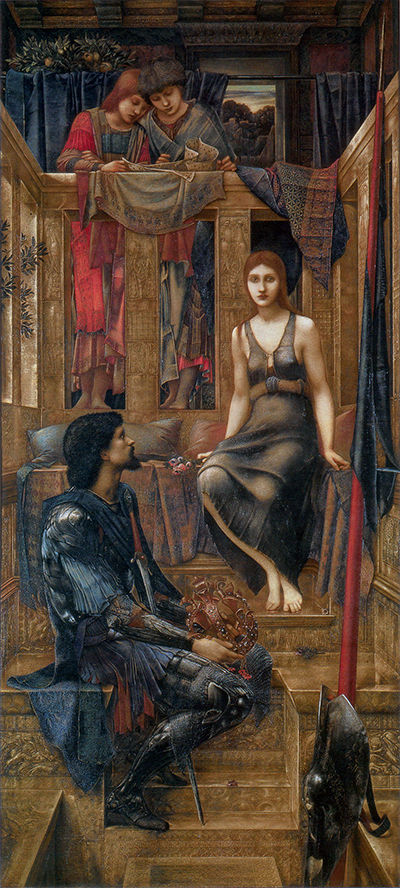
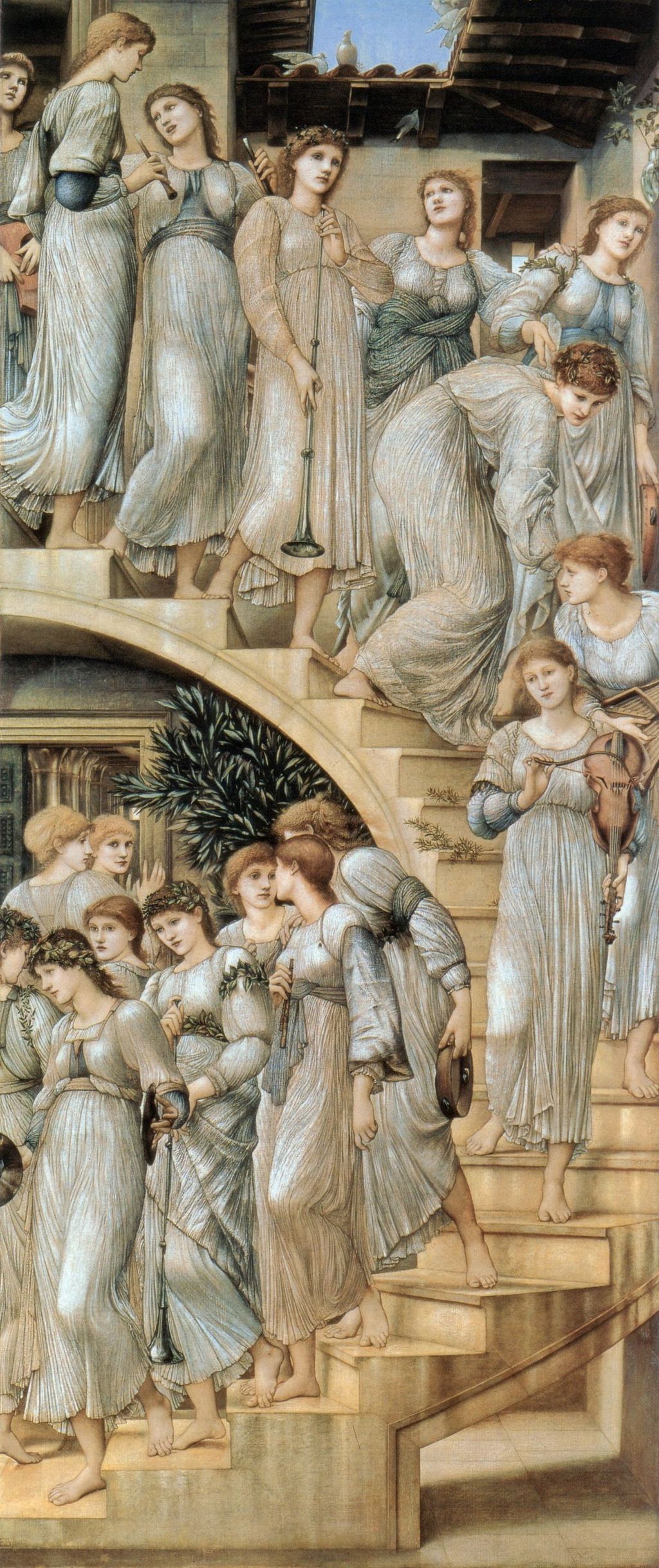
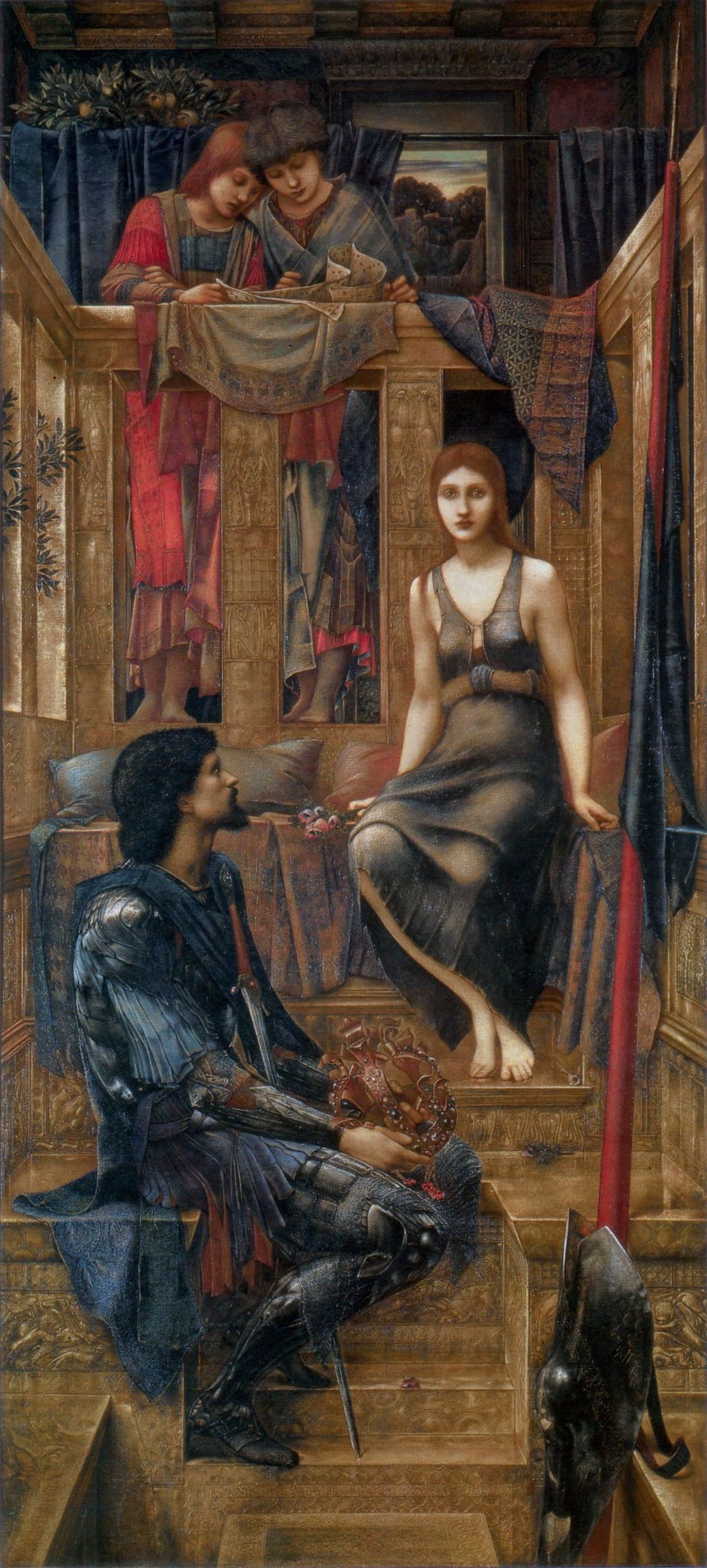
New pictures kept testing what the Grosvenor audience would accept. In 1880 The Golden Stairs drew attention to a procession of women with instruments whose destination and occasion the picture left to the imagination. King Cophetua and the Beggar Maid, finished and shown in 1884, asked an audience to spend time with an old story through the arrangement of two figures and the carefully observed surfaces between them. The designer W. A. S. Benson sat for Cophetua and supplied models for the shield, crown and armour. He also designed the Garden Studio at The Grange, putting expertise in design and metalwork to use in the place where paintings were made. Burne-Jones worked for years on the Perseus cycle, commissioned in 1875 by Arthur Balfour for his London home. Several stages of that commission were still visible at the artist’s studio twenty years later. [10] [31] [1]
The Golden Stairs, 1876–1880, by Edward Burne-Jones, oil on canvas. Image source. Public domain.
London, Rottingdean and Paris, 1885–96
The Royal Academy elected Burne-Jones an Associate in 1885. The next year he sent The Depths of the Sea to its summer exhibition. The canvas, with its mermaid taking a man down through the water, was the only work he showed there during his membership. He resigned in 1893. His exhibitions more often followed the circles in which he had built his reputation. An important part of that public moved to the New Gallery, which opened in Regent Street in 1888. Its exhibitions provided space for his newest work and, in the winter of 1892–93, a survey of the work he had been making for decades. [32] [10] [19] [3] [33]
The effect of the 1889 Paris exhibition was on another scale. King Cophetua attracted attention at the Exposition Universelle, and Burne-Jones received the Légion d’honneur. The painting helped French critics see how one painter could combine English poetry and legend with a highly worked visual language shaped by study in Italy. Laurence des Cars traces his place in French and Belgian art through the reception of individual pictures and the interest shown by artists such as Fernand Khnopff. A later example of a connection made in France is Madeleine Deslandes, who wrote about Burne-Jones in Le Figaro in 1893 under the name Ossit. She met him in London, and he took on the commission to paint her portrait. His assistant Thomas Matthews Rooke noted him working on the dress and background in December 1895. It was on view at the Champ de Mars Salon the following spring. [3] [34] [26]
In England the four principal panels of The Legend of the Briar Rose went on show at Agnew’s in 1890 and subsequently at Toynbee Hall in the East End. Alexander Henderson acquired them for Buscot Park. Burne-Jones designed the framing scheme and added connecting panels so that the separate pictures could run around the room. The shift from an art dealer’s gallery to a settlement in Whitechapel and then to a private country house brought different viewers to the same undertaking. At Buscot it also gave the artist another piece of work to do after the main canvases had been sold. [10] [35]
By about 1880 the family had made a second home in Rottingdean. The house and the village church were close enough for the work made for friends, family and the parish to be part of the same landscape. A series of Grail scenes for stained glass at the house preceded the tapestries made for Stanmore Hall. Rottingdean was also associated with the development of The Flower Book, a series of small, circular watercolours inspired by such things as the names people had given flowers. Georgiana arranged for the designs to be published in 1905. Her account makes clear how different the pleasure of working privately on these images could be from setting out on several large canvases for an exhibition or for somebody else’s house. [36] [1] [37] [14]
In the 1890s commissions for tapestries and illustrated books kept the old partnership going. In the 1860s Burne-Jones had already drawn scenes from the tale of Cupid and Psyche for Morris’s The Earthly Paradise. Morris began cutting blocks himself but could not carry through the scheme to illustrate the whole book. Burne-Jones went on to use episodes from the story for paintings. The Kelmscott press later gave the two friends a workshop with the resources to bring a sustained collaboration in print to completion. [10] [19] The National Portrait Gallery dates the first weaving of the Grail series to 1893–95. For the Kelmscott Chaucer, completed in 1896, Burne-Jones made designs to be engraved on wood by William Harcourt Hooper. Morris’s pages gave those designs a place alongside a new typeface, decorated initials and borders. The printed colophon identifies the press on Upper Mall, Hammersmith. More than forty years after the Oxford friendship began, the project was again bringing together the reading of medieval literature and the making of a physical object. Burne-Jones accepted a baronetcy in 1894 and formally hyphenated his surname. Morris died two years later, in October 1896. [1] [38] [19] [14]
Avalon and the end of his life, 1896–98
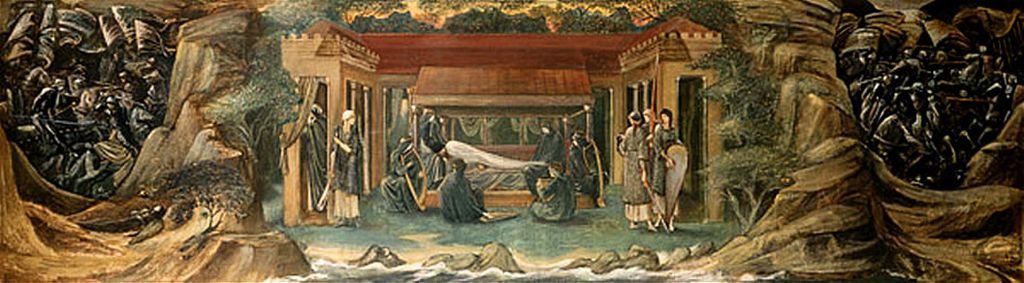
Philip’s portrait of his father shows one of several workspaces. The big canvas of The Last Sleep of Arthur in Avalon needed the space of St Paul’s Studios. Originally undertaken for George Howard, it stayed with Burne-Jones after Howard released him from the commission. Georgiana records that in the spring of 1898, after clearing the space, Edward settled to work on it several days a week with his assistant Thomas Matthews Rooke. They filled the foreground with flowers, including columbines, irises and forget-me-nots. On 16 June, Edward was still thinking through a detail he considered anachronistic. He had put red apples among spring flowers, and he wanted another way to get the red into the painting. [39] [14] [3]
Later that day he received Alice Wortley, a daughter of Millais, and Freda Stanhope, a young painter who had studied with her uncle, his old friend Spencer Stanhope. Georgiana prints the younger visitor’s diary account. As Edward took her from the garden studio to his upstairs workroom, they talked about how to use oils and about Carpaccio. Edward encouraged her to make time to work when she went home. He fetched a candle to show her one final watercolour in the hall. Georgiana’s account of the rest of the day is from her own memory. They played dominoes after dinner, and she read aloud from Mary Kingsley’s account of her travels in West Africa. Edward was taken suddenly ill in the night and died at The Grange on 17 June 1898, aged sixty-four. There was a memorial service at Westminster Abbey, and his ashes were laid at St Margaret’s Church, Rottingdean. [14] [40] [36]
Edward Burne-Jones, The Sleep of King Arthur in Avalon. Museo de Arte de Ponce. Image source. Public domain.
Georgiana’s account and the exhibitions after 1898
The New Gallery opened a memorial exhibition at the end of December 1898, bringing together pictures lent by owners. Drawings and studies could be seen at a separate exhibition at the Burlington Fine Arts Club. Frederick Hollyer photographed the New Gallery rooms. Looked at alongside its printed catalogue, the photographs show how works that had been made over decades and acquired by different families could be brought back into one exhibition. In 1901 Thomas Humphry Ward observed that Burne-Jones’s reliance on literature helped explain the fierceness of both the admiration and the resistance he encountered. Ward also pointed to what pictures, drawings and windows shared, in particular the shaping force of line and colour. [40] Georgiana’s two-volume Memorials appeared in 1904. Her account draws on the letters she saved or recovered, her own observations and testimony such as Freda Stanhope’s diary. It offers an unusually close view of the household and working studios, filtered through the decisions Georgiana took about what to print after Edward’s death. [33] [41] [4] [14]
Photographs allowed works in different collections to be studied together even when there was no exhibition. Mounted photographs in the Paul Mellon Centre’s archive carry notes on ownership, sales and exhibitions, details that can identify a picture and trace it after it left the studio. [42]
Later exhibitions brought different evidence into view. The 1998 centenary retrospective organised by the Metropolitan Museum of Art, Birmingham Museums and Art Gallery and the Réunion des musées nationaux put paintings beside furniture, glass, designs and books. In Madrid in 2009 the Prado presented the Ponce Arthur as part of a selection of Victorian British paintings from Puerto Rico, where the canvas had found a home. A retrospective in Japan opened at the Mitsubishi Ichigokan Museum in Tokyo in 2012 and travelled to Hyōgo and Kōriyama. In 2024 the curators at Forlì set aside a room for Burne-Jones within an exhibition examining the Pre-Raphaelites’ encounters with Italian art. Each of these exhibitions could bring a different part of his working life into focus. Considered together, the paintings and the drawings show an artist who could move from a medieval story to a window, a book or a room full of landscape and figures, and who spent much of his life working out with other people how each of those stories would take shape. [28] [43] [44] [45]
Artworks directory
This directory records paintings, studies, designs and collaborative works, with separate entries for documented versions and series where known.
| Name | Date | Medium |
|---|---|---|
| Sidonia von Bork 1560 | 1860 | Watercolour and bodycolour |
| Clara von Bork 1560 | 1860 | Watercolour and bodycolour |
| The Merciful Knight | 1863 | Watercolour |
| Sibylla Delphica | c. 1886 | Oil on panel |
| Phyllis and Demophoön | 1870 | Watercolour and bodycolour |
| The Legend of the Briar Rose (Buscot series) | 1870s–1890 | Oils on canvas |
| The Briar Wood (Buscot series) | By 1890 | Oil on canvas |
| The Council Chamber (Buscot series) | By 1890 | Oil on canvas |
| The Garden Court (Buscot series) | By 1890 | Oil on canvas |
| The Rose Bower (Buscot series) | By 1890 | Oil on canvas |
| Group of Women, study for The Golden Stairs | 1872 | Drawing |
| The Beguiling of Merlin | 1870s | Oil on canvas |
| The Perseus Cycle | From 1875 | Paintings and full-scale designs |
| The Call of Perseus (Stuttgart) | From 1875 | Oil painting |
| Perseus and the Graeae (Stuttgart) | From 1875 | Oil painting |
| The Rock of Doom (Stuttgart) | 1884–88 | Oil on canvas |
| The Doom Fulfilled (Stuttgart) | 1888 | Oil on canvas |
| The Baleful Head (Stuttgart) | 1885–87 | Oil on canvas |
| The Baleful Head (Southampton design) | 1880s | Bodycolour |
| The Rock of Doom (Southampton design) | 1880s | Bodycolour |
| The Doom Fulfilled (Southampton design) | 1880s | Bodycolour |
| The Mirror of Venus (Gulbenkian) | 1870s | Oil on canvas |
| Drawing associated with The Mirror of Venus | 1870s | Drawing |
| Laus Veneris (Laing) | 1873–78 | Oil on canvas |
| The Days of Creation | 1870s | Watercolour and bodycolour |
| The Golden Stairs | 1880 | Oil on canvas |
| An Angel Playing a Flageolet | 1878 | Watercolour, bodycolour and gold |
| The Tree of Forgiveness | 1881–82 | Oil on canvas |
| The Wheel of Fortune (Orsay) | 1875–83 | Oil on canvas |
| King Cophetua and the Beggar Maid | 1884 | Oil on canvas |
| The Depths of the Sea (oil) | 1886 | Oil |
| The Morning of the Resurrection | 1886 | Oil on panel |
| Study for the Head of Mary Magdalene | c. 1882 | Oil study |
| The Sleep of King Arthur in Avalon | 1880s–1898 | Oil on canvas |
| The Sleep of King Arthur in Avalon (modello) | ca. 1881 | Oil on canvas (modello) |
| The Star of Bethlehem | Signed 1890 | Watercolour and bodycolour |
| Study for The Star of Bethlehem | About 1887–91 | Drawing |
| Sponsa de Libano | 1891 | Watercolour and bodycolour |
| The Summons (Holy Grail tapestries) | 1890s | Tapestry |
| The Failure of Sir Gawaine (Holy Grail tapestries) | 1890s | Tapestry |
| Hope (Boston) | 1896 | Oil on canvas |
| La Belle au bois dormant (theatre programme) | 1894 | Collotype |
| The Wedding of Psyche | 1895 | Oil on canvas |
| The Works of Geoffrey Chaucer (Kelmscott edition) | 1896 | Illustrated book |
| The Ascension (Birmingham Cathedral) | 1885 | Stained glass |
| The Last Judgement (Birmingham Cathedral) | 1897 | Stained glass |
| Adoration of the Magi (Huntington) | 1890s | Tapestry |
| Love among the Ruins (Wightwick) | 1894 | Oil on canvas |
| The Merciful Knight (photogravure after Burne-Jones) | 1900 | Photogravure |
| The Garden Court (preparatory work) | 1870–75 | Graphite and watercolour with white gouache |
| Study of a Female Figure | 1885 | Graphite drawing |
| Psyche Throwing Herself into the River | 1865–68 | Wood engraving |
| Beauty | 1887–89 | Colour lithograph |
| Study for the Failure of Gawain | 1893 | Crayon and graphite on Japanese paper |
| The Prince Enters the Briar Wood (after Burne-Jones) | After 1890 | Photogravure |
| The Rose Bower (after Burne-Jones) | 1892 | Photogravure |
| Adoration of the Magi (Musée d’Orsay) | 1904 | Tapestry |
| Answers to Prayer (Lyndhurst) | 1860s | Stained glass |
| The Depths of the Sea (photogravure after Burne-Jones) | 1900 | Photogravure |
| Perseus and Andromeda (Adelaide composite) | 1876 | Oil on canvas |
| The Adoration of the Magi (Hamburg) | Woven 1900 | Tapestry |
| Love leading the Pilgrim through the Briars | 1874–76 | Embroidery |
| Musica (worked by Lady Jane Cory) | 1906 | Embroidery |
| Pomona (worked by Lady Jane Cory) | 1907 | Embroidery |
| Flora (worked by Lady Jane Cory) | 1909 | Embroidery |
| The Fourth Day of Creation (photogravure after Burne-Jones) | 1900 | Photogravure |
| The Morning of the Resurrection (photogravure after Burne-Jones) | 1900 | Photogravure |
| Musical angels of the St Catherine window (Christ Church) | Designed 1877 | Stained glass |
Discussion
Look again at the images and ideas explored in Edward Burne-Jones Biography. These editorial prompts invite your observations.
Reader Insights
What changed most in Burne-Jones’s work between his Oxford years and the Grosvenor Gallery exhibition?
Which of his collaborations helps explain the direction his career took?
Join the Conversation
Share a detail, comparison or question about Edward Burne-Jones Biography below.
References
- Jan Marsh, National Portrait Gallery, Sir Edward Burne-Jones, by Philip Burne-Jones, NPG 1864, extended catalogue, “This portrait” and notes 1–10. View source.
- Stephen Wildman, “Birmingham and Oxford”, in Edward Burne-Jones: Victorian Artist-Dreamer (1998), opening section and fig. 41. View source.
- Stephen Wildman, “Biography of Edward Burne-Jones (1833–1898)”, Waking Dreams (2004), pp. 359–360, Delaware Art Museum. View source.
- Georgiana Burne-Jones, Memorials of Edward Burne-Jones, vol. I (1904), opening Birmingham chapters, pp. 68–72 and the account of 1860–67. View source.
- Exeter College, Oxford, “Archives”, matriculation record for 1852. View source.
- Ashmolean Museum, “Oxford and the Pre-Raphaelites”, the Combes’ collection and the Union murals. View source.
- William Morris Archive, “Periodicals”, “Churches of North France: The Shadows of Amiens”, Oxford and Cambridge Magazine, February 1856, pp. 99–110. View source.
- Oxford and Cambridge Magazine, nos. 1–2 (January–February 1856), contents and facsimile, William Morris Archive. View source.
- J. W. Mackail, The Life of William Morris (1899), account of the magazine and Red Lion Square, William Morris Archive. View source.
- Tate Britain, Edward Burne-Jones, large-print exhibition guide (2018), pp. 3–28, 35–38, 69–83, 87–110 and 120–137. View source.
- Elizabeth E. Barker, Metropolitan Museum of Art, “The Pre-Raphaelites”, essay on the 1848 Brotherhood and the following generation. View source.
- Metropolitan Museum of Art, Alice, la Belle Pèlerine, 2016.619, collection record and linked Recent Acquisitions bulletin, p. 61. View source.
- US Oxford Union Foundation, “Supporting Preservation of the Oxford Union’s Pre-Raphaelite Murals”, Oxford Union condition-survey update. View source.
- Georgiana Burne-Jones, Memorials of Edward Burne-Jones, vol. II (1904), pp. 113–115, 289–290 and 335–350, including the diary of Freda Stanhope. View source.
- National Portrait Gallery, Pre-Raphaelite Sisters exhibition (2019–20), contributors and curatorial scope. View source.
- Burne-Jones Catalogue Raisonné, Portrait of Georgiana Burne-Jones with Philip B-J and Margaret B-J at the piano, catalogue history and sitter biography. View source.
- National Trust, “The history of Red House”, sections on decoration, the Firm and Webb’s plans for the extension. View source.
- National Trust, “Our work at Red House”, “Revealing Red House’s secrets”. View source.
- Jan Marsh, National Portrait Gallery, Sir Edward Coley Burne-Jones, 1st Bt, Later Victorian Portraits Catalogue, biography. View source.
- John Lewis Roget, A History of the “Old Water-Colour” Society (1891), vol. II, pp. 116–117, on the 1864 newcomers, full membership and resignation. View source.
- Fiona Mann, “A ‘born rebel’: Edward Burne-Jones and watercolour painting 1857–80”, The Burlington Magazine 156 (2014), pp. 658–663, especially pp. 660–662. View source.
- York Art History Collaborations, “Maria (née Cassavetti) Zambaco: Constructing Identities”, account of artistic training and the portrait medal of Marie Stillman. View source.
- National Portrait Gallery, Sir Edward Burne-Jones, display archive, 2005–06. View source.
- Musée d’Orsay, La Roue de la Fortune, RF 1979 56, collection and exhibition record. View source.
- Douglas E. Schoenherr, ed., Burne-Jones’s Account Books with Morris & Company (1861–1900), Fitzwilliam Museum manuscripts, transcription introduction and vol. I, fol. 64r. View source.
- Emily Wubben, National Gallery of Victoria, “Artistic souls: Edward Burne-Jones and his portrait of Baronne Deslandes”, account of the commission and the 1896 Salon, notes 10–15. View source.
- Burne-Jones Catalogue Raisonné, The Beguiling of Merlin, commission, work-list entry for 1877 and provenance. View source.
- Stephen Wildman and John Christian, with Alan Crawford and Laurence des Cars, Edward Burne-Jones: Victorian Artist-Dreamer (1998), Metropolitan Museum of Art, exhibition catalogue and introduction. View source.
- Edward Burne-Jones, autograph letter to John Ruskin, 5 November [1878], Mark Samuels Lasner Collection, University of Delaware Library, Friends & Enemies, exhibit no. 37. View source.
- University of Bristol, “Whistler’s Effort, Ruskin’s Finish”, research abstract on Burne-Jones’s testimony in the 1878 libel trial. View source.
- Staatsgalerie Stuttgart, The Call of Perseus, collection guide and commission history. View source.
- New Gallery, Exhibition of the Works of Edward Burne-Jones, 1892–3, contemporary exhibition catalogue, digitised from Harvard University. View source.
- New Gallery, Exhibition of the Works of Sir Edward Burne-Jones, Bart. (1898–99), foreword and exhibit entries. View source.
- Laurence des Cars, “Edward Burne-Jones (1833–1898), un maître de l’imaginaire”, 48/14. La revue du Musée d’Orsay 8 (1999), discussion of French reception. View source.
- Faringdon Collection, Buscot Park, “The Saloon”, acquisition and surviving installation of the four Briar Rose canvases. View source.
- Rottingdean Heritage, “The Edward Burne-Jones Room”, North End House and St Margaret’s Church. View source.
- Rottingdean Heritage, “Edward Burne-Jones – The Flower Book – Myth, Romance & Religion”, the illustrations and the 1905 edition. View source.
- William Morris, Edward Burne-Jones and William Harcourt Hooper, The Works of Geoffrey Chaucer (Kelmscott Press, 1896), Library of Congress facsimile, colophon and catalogue. View source.
- Museo de Arte de Ponce, The Sleep of King Arthur in Avalon, collection catalogue, commission and unfinished state. View source.
- Thomas Humphry Ward, “Burne-Jones, Edward Coley”, Dictionary of National Biography, 1901 supplement, death, commemoration and critical assessment. View source.
- Frederick Hollyer, Photographs recording the Burne-Jones Memorial Exhibition, The New Gallery 1898–9, Burne-Jones Catalogue Raisonné. View source.
- Paul Mellon Centre for Studies in British Art, “Edward Burne-Jones (1833–1898)”, artist guide, “Burne-Jones in the Photographic Archives”. View source.
- Museo Nacional del Prado, Memoria de actividades 2009, “La Bella Durmiente. Pintura victoriana del Museo de Arte de Ponce”. View source.
- Mitsubishi Ichigokan Museum and partner museums, Edward Burne-Jones (2012), Japanese exhibition catalogue and itinerary, CiNii Books. View source.
- Musei di San Domenico, Forlì, Preraffaelliti. Rinascimento moderno (2024), exhibition press dossier, the Burne-Jones room and Italian comparisons. View source.