


 by Tom Gurney
Tom Gurney BSc (Hons) is an art history expert with over 20 years experience
Published on June 19, 2020 / Updated on November 25, 2026
Email: tomgurney1@gmail.com / Phone: +44 7429 011000
Edward Burne-Jones Paintings: Introduction
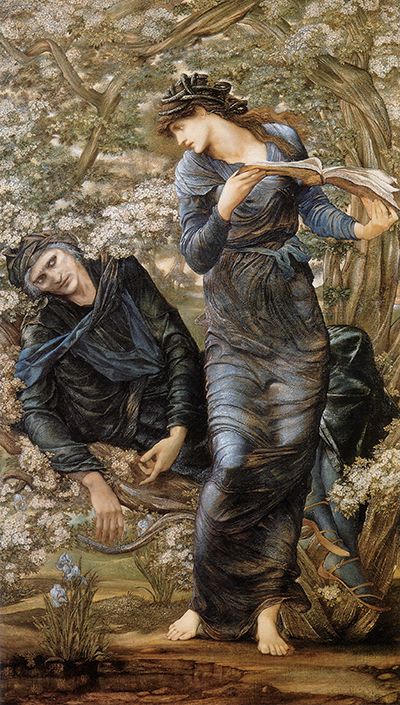
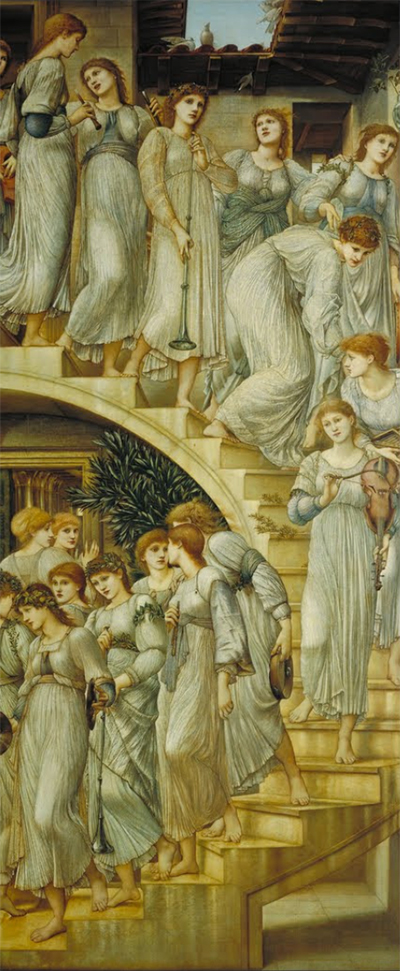
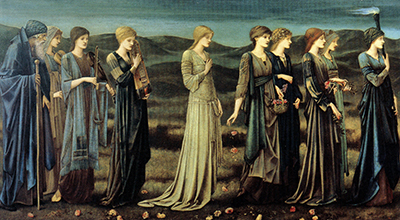
In The Beguiling of Merlin, a flowering hawthorn seems to take up what little room Merlin has left to move. In The Golden Stairs, a procession seems to keep moving even after the lowest figure has reached the floor. Edward Burne-Jones painted both in oil, using the tall shape of each canvas to different ends. The hawthorn crowds the figures into a story about captivity. The stairs send a pattern of pale dresses and instruments around a turn, with no clear end to the procession. Both paintings reward following a branch, a foot or the fall of a sleeve before asking what the scene means. [1]
From his early watercolours to the immense, unfinished Last Sleep of Arthur in Avalon, Burne-Jones returned to compositions across years and materials. A watercolour could have the density of an oil painting, a full-size design could retain stages of a commission that the oils never reached, and the same figure could appear in glass and on paper. Identifying a work by its title, date, medium and collection makes those relationships easier to see. [1] [2]
At a Glance
- ArtistEdward Burne-Jones
- FocusOil and watercolour
- ExploreExhibition pictures and series
Contents
- Early watercolours and painted detail
- Oil, colour and the Grosvenor Gallery
- The Perseus and Briar Rose cycles
- Late watercolour, remaking and unfinished work
- Exhibitions, reproductions and collections
Early watercolours and painted detail
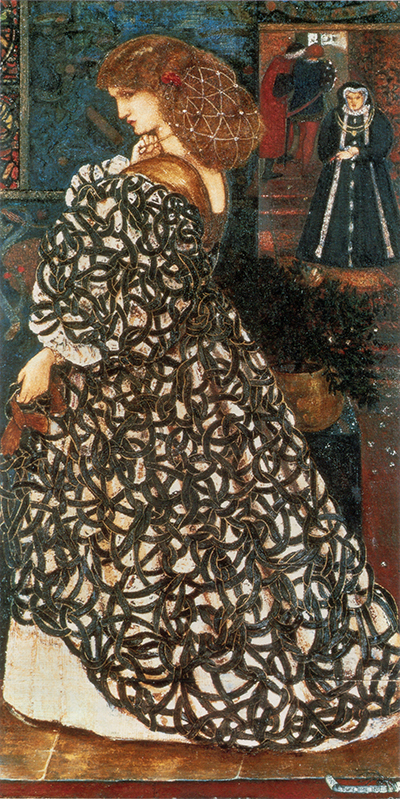
The narrow watercolour Sidonia von Bork (1860) holds a surprising amount of incident. The black knots on Sidonia’s dress turn and tighten with the shape of her body, while an opening at the right gives a glimpse of other figures. Burne-Jones borrowed the costume pattern from a Renaissance portrait he knew at Hampton Court. He took the character and her cousin Clara from Wilhelm Meinhold’s Gothic tale about a woman accused of witchcraft. See the two Tate pictures together and the difference between the women registers first in their clothes and in how they hold themselves. The paired frames, made by the painter’s father, give the small portraits a shared setting. The year 1560 in their titles belongs to that imagined setting. Both works date from 1860. [1] [3]
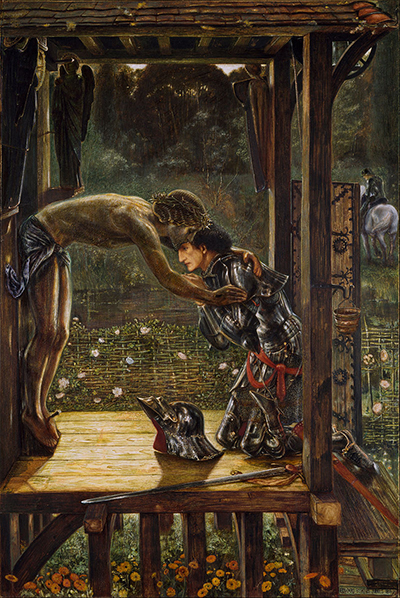
Burne-Jones used bodycolour, the opaque form of watercolour also called gouache, to build up passages that could carry pale accents over darker paint. Fiona Mann’s technical study traces how he took advantage of stronger brushes, opaque pigments and prepared grounds. The effect can be seen at a different scale in The Merciful Knight (1863), at Birmingham Museum and Art Gallery. There is weight in the armour, while the light picks out flowers and the figure of Christ bending down to embrace the kneeling knight. The gesture is the reward for a deed of mercy in the legend of John Gualbert. The rose trellis has a part of its own in the composition. It opens up the space behind the meeting and gives the eye somewhere to rest away from the joined figures. The painting was among Burne-Jones’s first exhibits at the Old Water-Colour Society, in 1864. [2] [4]
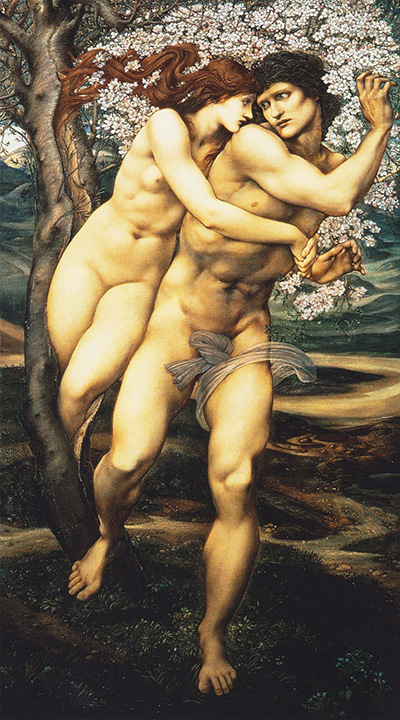
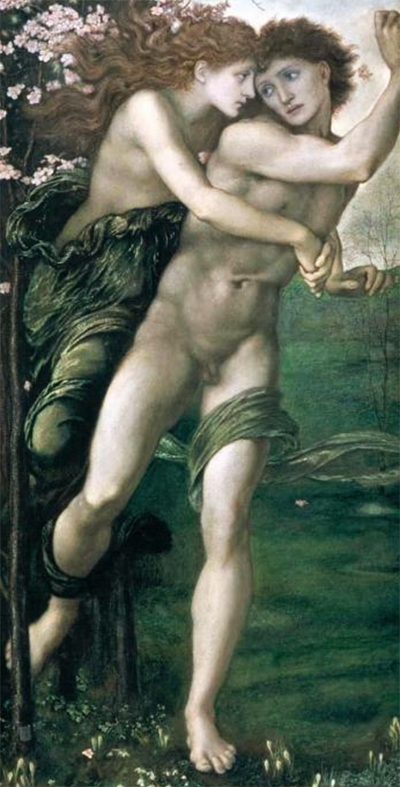
In the 1870 watercolour Phyllis and Demophoön, the meeting of two bodies again carries the story. Phyllis comes out of an almond tree to embrace the man who deserted her. The inscription recorded on the back points to Ovid’s Heroides. The narrow shape leaves little space around the figures, whose elongated limbs and cool tones surprised some reviewers at the Old Water-Colour Society. Burne-Jones came back to this subject in The Tree of Forgiveness, a much larger oil of 1881–82. He gave the bodies greater weight, opened the composition and added a narrow sweep of fabric across Demophoön. The effect of Phyllis clasping his waist is stronger at the new scale, where the almond blossom can spread across a larger field behind them. Compare the 1870 work in Birmingham with the larger oil in the Lady Lever Art Gallery. The change of title accompanies a substantial revision of how the story looks and feels. [5] [6] [1]
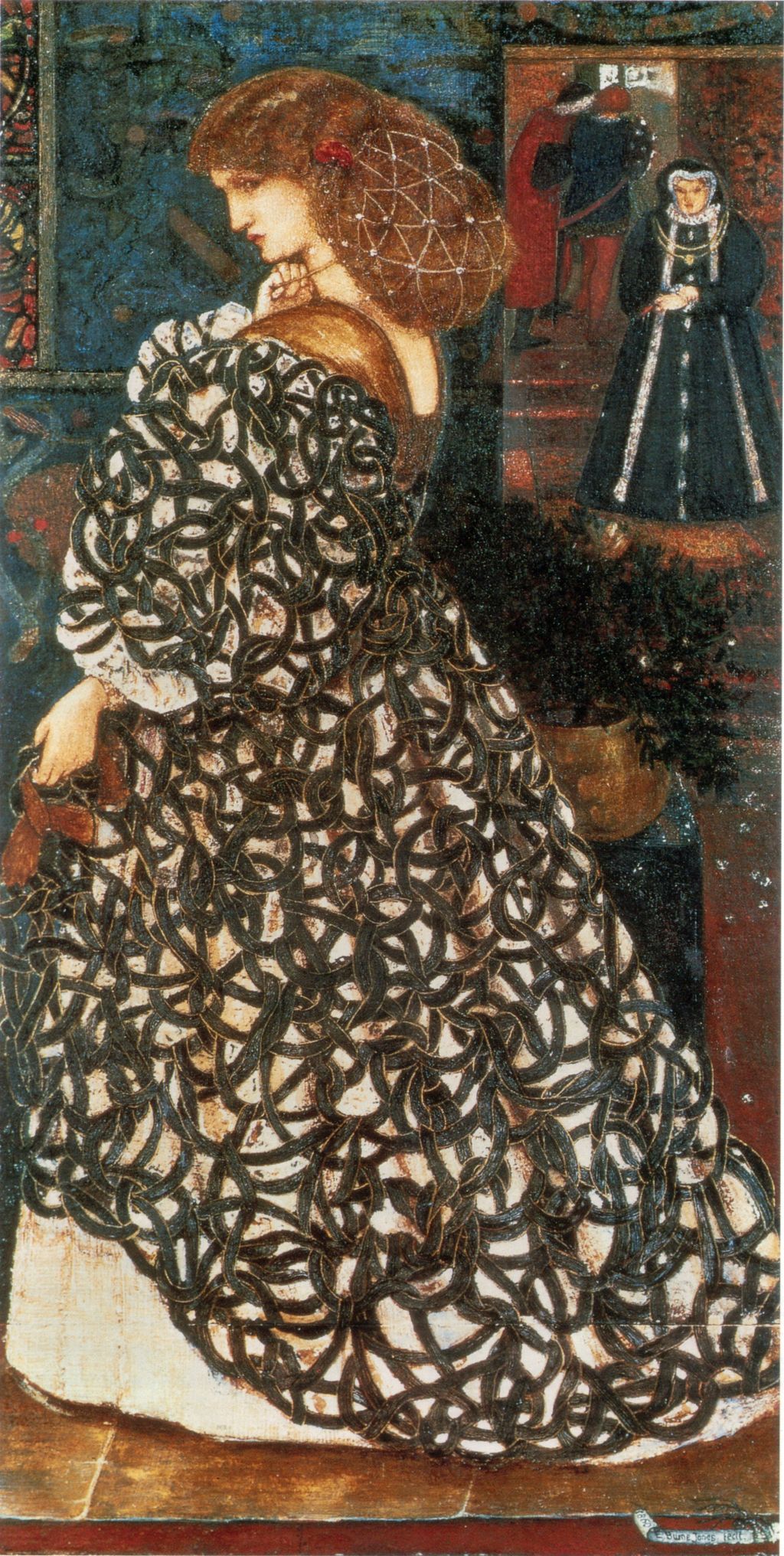
Edward Burne-Jones, Sidonia von Bork 1560, 1860. Tate. Image source. Public domain.
Oil, colour and the Grosvenor Gallery
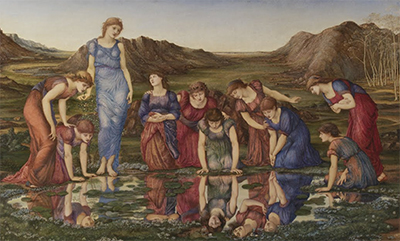
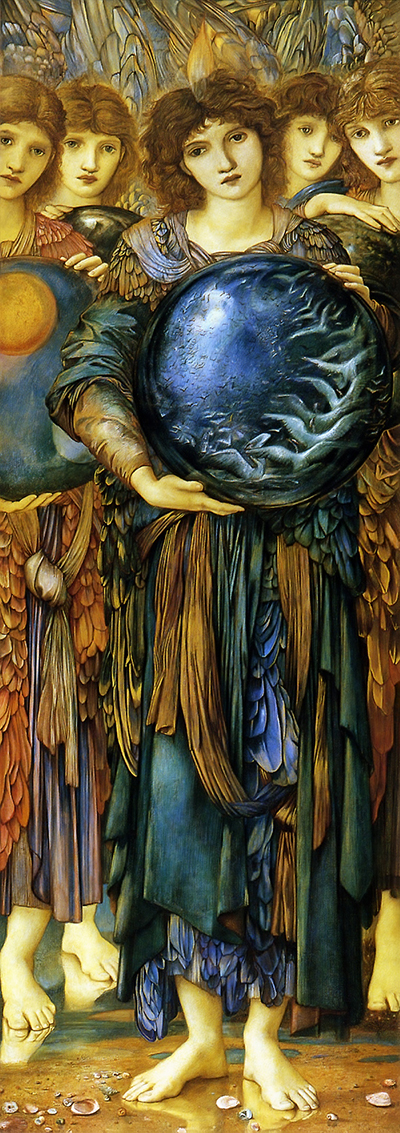
Eight pictures at the inaugural Grosvenor Gallery exhibition of 1877 brought Burne-Jones to a wider public. A contemporary survey of the Grosvenor singled out three of his entries among the 209 works in the opening show. The Beguiling of Merlin shows an episode from Arthurian legend. The Mirror of Venus gathers women around a pool, where the story is barely more than the act of looking. The Days of Creation builds a sequence in watercolour and other media out of the first chapter of Genesis. The subjects invite different kinds of attention even where the figures seem to inhabit the same quiet world. In Merlin the curve of the branches follows the enchanter’s body down into the thicket. In The Mirror of Venus the figures bow towards the water, their angled bodies echoed below. In The Days of Creation an angel presents a sphere that gives each image its centre, with earlier angels accumulating as the series progresses. Metallic paint on linen-covered panels could bring a different quality of light to this last work, something a reproduction can flatten. [7] [8] [9] [1] [10] [11] [12]
The Lisbon Mirror of Venus, the larger oil shown at the Grosvenor, has a low, open horizon and enough space for the dresses and their reflections to establish a horizontal rhythm. The smaller treatment was begun earlier. The Fitzwilliam Museum distinguishes groups of studies for the two versions, including head studies associated with the smaller one and draughtsmanship and drapery linked to the larger oil. Even the year attached to the Lisbon painting depends on what the record describes. The Gulbenkian dates its picture 1875, while the Fitzwilliam records a working span ending in 1877. The catalogue raisonné distinguishes the date on the painting from the work done before the exhibition. It also identifies a link between the two imposing oils in the 1877 room. Liverpool collector Frederick Leyland commissioned both The Mirror of Venus and The Beguiling of Merlin. [10] [11] [13]
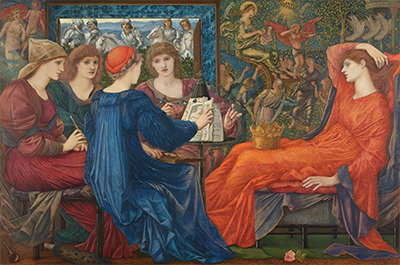
The Grosvenor exhibitions that followed put colour and composition under a different kind of pressure. In Laus Veneris, shown in 1878, a narrow window gives a view of passing knights. Most of the painting is given over to the women and the saturated pattern of the room around them. Their absorbed stillness is part of Burne-Jones’s reading of the legend of Tannhäuser, which his friend Algernon Charles Swinburne had retold in verse. The window makes the distance between the two worlds legible in a small patch of space. In The Golden Stairs, shown in 1880, pale silver and cream carry most of the picture and the story is more elusive. The people at the bottom of the stairs turn and look in different directions, allowing the eye to follow the group back up along the same path it has just descended. The grouping is easier to read from across a room, while the instruments and varied positions of the feet repay looking closely. [1] [8]
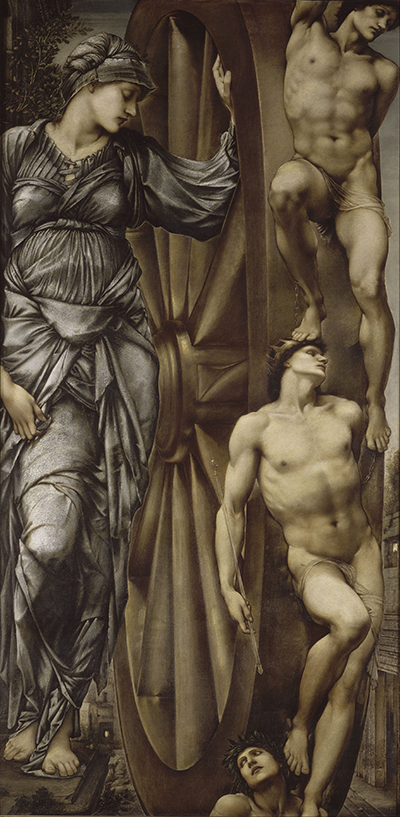
The Wheel of Fortune, exhibited at the Grosvenor in 1883, pares back colour and presses the bodies up against the picture plane. A slave, a king and a poet occupy successive positions on the wheel. Look for the buildings and the mill through the gaps. The setting is still there but the huge figure of Fortune and the rotating bodies make it hard to see. Burne-Jones had looked at Michelangelo’s work in Italy, and Tate identifies that study as a source for the nude figures. The Musée d’Orsay oil is one of several versions of the composition in oil or gouache. The French national catalogue lists others and gives their locations separately. The National Gallery of Victoria also holds an oil version. Its wheel and figures can be compared directly with their counterparts in Paris, across two canvases of different size. [1] [7] [14] [15] [16]
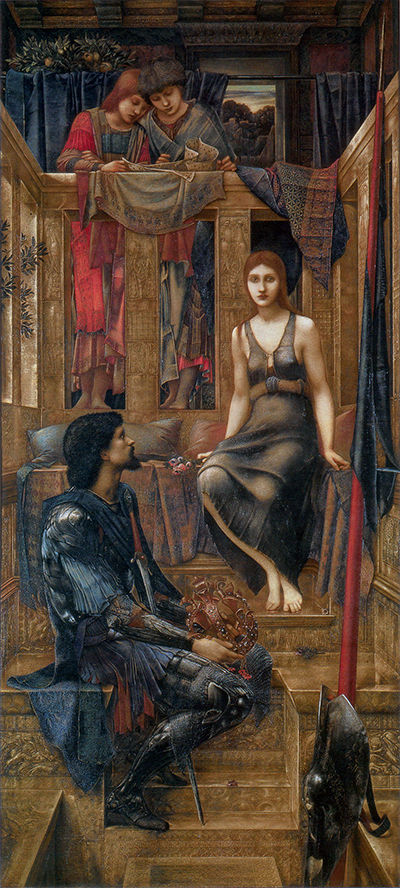
A staircase orders the figures of King Cophetua and the Beggar Maid (1884), just as it does in The Golden Stairs. Here the flight helps tell a story. The king is lower in the composition than the woman he looks up to, and the metal of his armour catches the light below the loose folds of her clothing. Their difference in rank is visible, while the composition gives her the higher seat. Burne-Jones knew the story from a ballad and Tennyson’s retelling. When the painting went to Paris in 1889, its reversal of social hierarchy caught the attention of French critics. The staircase makes that reversal available even to a viewer who has never read the poem. The 1884 survey of the Grosvenor also singled out the king as an unusually vigorous figure for Burne-Jones, a reminder that a pose as quiet as his could still strike contemporaries as a new departure. [1] [8] [9]
In The Garden of Pan (1886–87), in Melbourne, two figures listen as Pan plays. The museum’s account draws attention to the kingfisher and dragonflies, creatures whose darting movement seems to stop with the human listeners. X-radiographs examined by the museum’s conservators showed that Burne-Jones repeatedly altered the limbs of the two figures. The apparent ease of the poses belongs to a finished surface worked out in stages, a process the visible painting gives little reason to suspect. [17] [18]
The oil The Wedding of Psyche (1895), in Brussels, offers a late variation on the grouping of women and landscape in The Mirror of Venus. The women by the pool draw the eye towards a shared object, which also holds them in place. In the wedding procession the line of people draws the eye sideways into the landscape. The Royal Museums of Fine Arts of Belgium catalogue it as Le cortège nuptial de Psyché. That word cortège, meaning procession, is a useful clue to what the picture chooses to show. [10] [19]
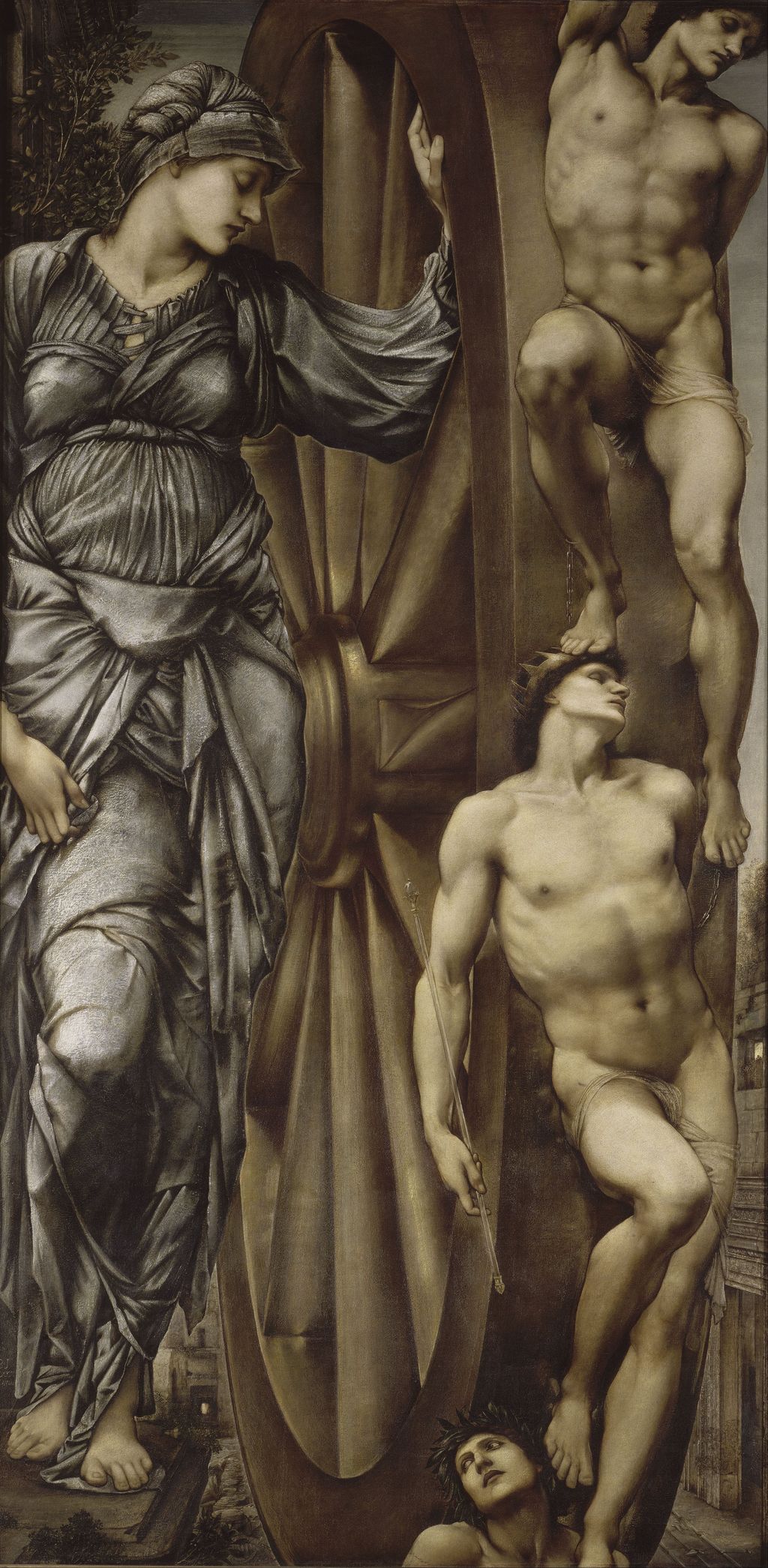
Edward Burne-Jones, The Wheel of Fortune. Musée d’Orsay. Image source. Public domain.
The Perseus and Briar Rose cycles
Arthur Balfour commissioned the Perseus Cycle in 1875 for his London home. Burne-Jones took the story from William Morris’s The Earthly Paradise. Southampton City Art Gallery holds ten full-size gouache designs covering the story, including two treatments of Medusa’s death. The Staatsgalerie Stuttgart holds eight works from the unfinished project, including completed and unfinished paintings. The Stuttgart guide identifies The Call of Perseus as an unfinished oil of 1877. Its twilight and small, repeated figure of Perseus belong to a young hero who is still hesitating, quite different from the fighter who enters the later pictures. Seeing the two collections together gives a better sense of the cycle than counting either group as a complete set of finished oils. [20] [21] [1]
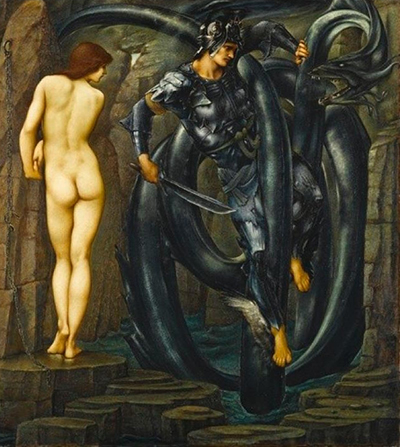
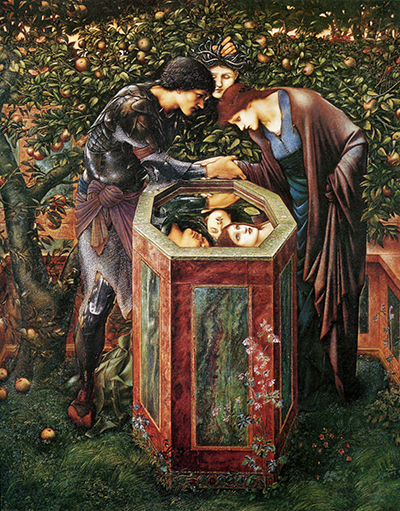
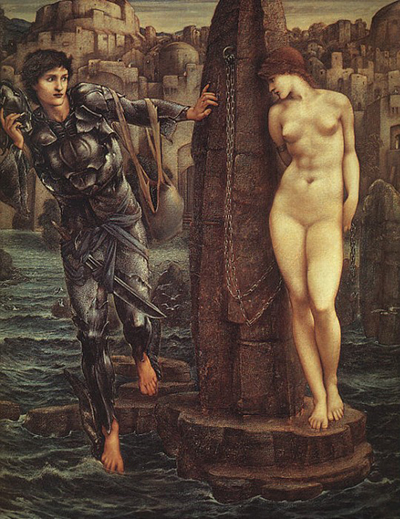
Three episodes show how Burne-Jones changes the pace. In The Rock of Doom, Perseus comes upon Andromeda on a shore, their encounter exposed against the rock and sea. In The Doom Fulfilled, the curling sea monster draws the movement tight around Perseus. Andromeda, at the edge of the struggle, gives the eye a relatively still form to return to. In The Baleful Head, the violence has passed. Perseus shows Andromeda Medusa’s head as a reflection in water, so the danger is held within the still surface they inspect together. Water had gathered the figures in The Mirror of Venus too. Here the act of looking allows the last event in the series to take place safely. Each of these three scenes can be compared in a Southampton design and a Stuttgart oil. [1] [20] [21]
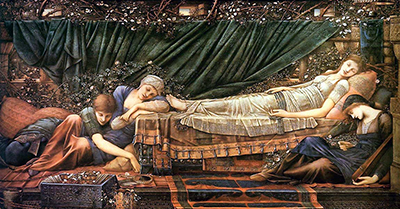
The Legend of the Briar Rose allows an almost opposite reading of time. In the four major canvases shown in 1890, the knights, courtiers, women at work and the princess’s attendants all share the same enchanted sleep. If you start with the sleeping knights and follow the briars, they carry your attention across changes of room and set of characters. Burne-Jones extended the scheme for its installation at Buscot Park with connecting pictures, and verses by William Morris ran under the main canvases. The movement is therefore partly the viewer’s, walking through a room while the people in the pictures remain still. The earlier, three-panel Small Briar Rose in the Museo de Arte de Ponce is a separate undertaking, with its own rhythm and its own choice of scenes. [1] [22] [23]
Another long investigation of a single story, the second Pygmalion and the Image series, is in Birmingham. Four oils follow the sculptor’s desire, his work, the animation of the statue and the encounter in the last panel. In the final picture, Pygmalion kneels before the woman he has made, and their joined hands give the sequence an endpoint. Compare the precision of that contact with the withheld awakening in the Buscot canvases. Both stories are about a transformation, but the paintings allow it to appear at very different speeds. [24] [22]
Late watercolour, remaking and unfinished work
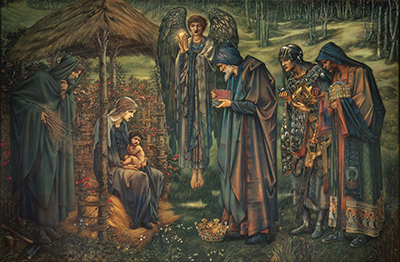
The dimensions of The Star of Bethlehem make it one of the most striking watercolours of Burne-Jones’s career. Birmingham’s conservators found minor damage to the frame and small areas of detached paper when they removed the old plate glass, and recovered a clear view of the vertically arranged signature and the date 1890 in the lower right. The painting developed from the design for the Adoration of the Magi tapestry, and the surface gives the design a different kind of clarity. The rich red of the robes holds its own among the greens and earth colours, while the small star between the angel’s hands brings attention to a point well away from the deepest colour. The conserved object is a reminder that watercolour at this size involves decisions about joins, framing, weight and protection as well as the application of colour. [25] [26]
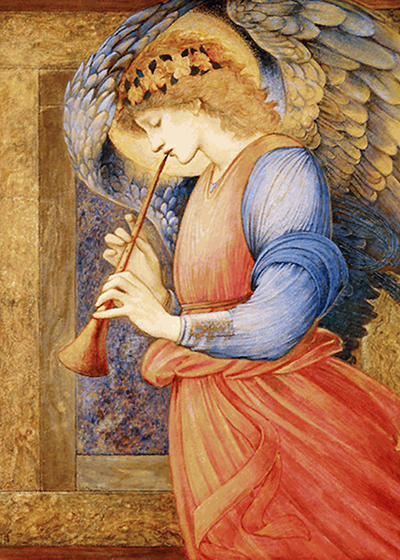
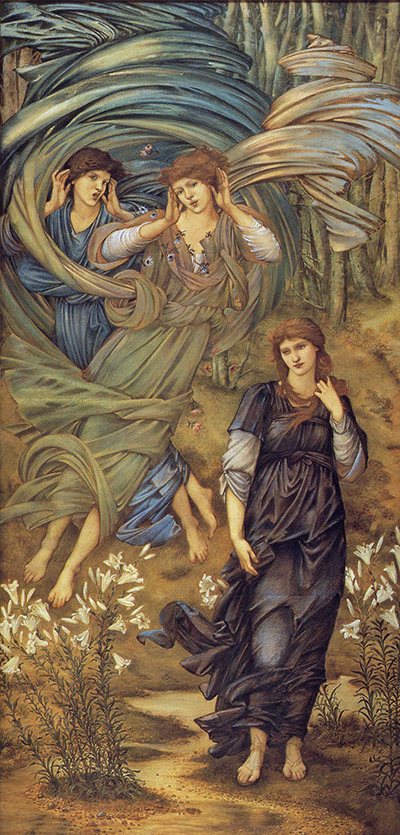
Sponsa de Libano (1891), in the Walker Art Gallery, is another unusually tall watercolour. Its figure in white, attended by winds, comes from the Song of Songs. The related design in the National Gallery of Canada was made for embroidery. A similar crossing between media can be traced backwards from An Angel Playing a Flageolet. The finished watercolour of 1878, heightened with bodycolour and gold, follows the design for a minstrel angel in a window at Christ Church Cathedral, Oxford. The painted sheet keeps the narrow, contained figure of the stained-glass design while giving the painter a surface on which gold can catch the light. A later small oil angel with the same kind of pipe is a separate work. A familiar motif could be scaled up, reversed or moved to another surface as the artist worked out what each commission needed. [26] [27] [28]
Sometimes returning to a composition was prompted by damage. In Love among the Ruins, the two seated lovers almost seem sheltered by the old stones and the briars. The early watercolour was damaged during preparation for reproduction and was later restored. Burne-Jones also made an oil of the design in 1894, now at Wightwick Manor. He describes the earlier work as destroyed in a note on the back of the oil. That inscription records what the damage meant to him at the time, and the survival of both versions lets a viewer see how a painting could have a second history as a separate physical object. [1] [29]
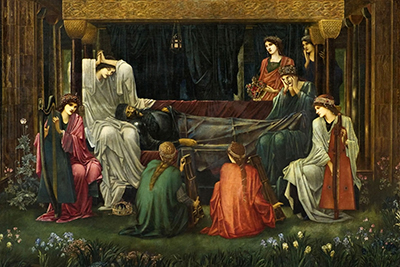
The unfinished Last Sleep of Arthur in Avalon gives a sense of how long a composition could stay open to change. George Howard commissioned a painting for his library in 1881. Burne-Jones continued with the work after Howard released him from the commission. The canvas in Ponce is about six and a half metres wide, with the sleeping king low in the centre and the attendants and architecture spreading outward. A painted model, figure drawings and an early photograph in the same collection allow some of that development to be followed. At the 1898–99 New Gallery exhibition the painting had a place in the North Room, among the late pictures, where it was catalogued as Arthur in Avalon and marked unfinished. The Central Hall catalogue listed The Hill Fairies, two oils described as a part of the design that Burne-Jones left out of the final arrangement. It also listed studies of heads and a lamp. Taken together, these objects show the labour behind a scene in which almost no one is moving. [30] [31]
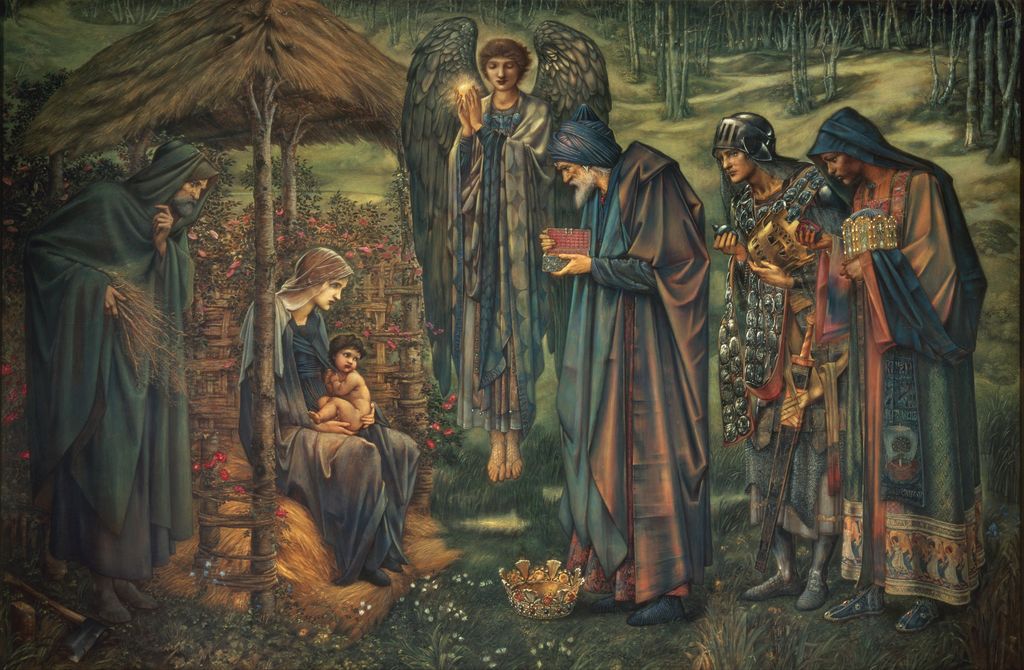
Edward Burne-Jones, The Star of Bethlehem. Birmingham Museums Trust. Image source. Public domain.
Exhibitions, reproductions and collections
The New Gallery’s memorial catalogue arranged smaller oils and watercolours together, followed them with pictures of the middle and later periods, and gave space to drawings, designs and tapestry. It records a moment when loans could bring works like these under one roof. Outside Britain, the Paris exhibitions and the Brussels exhibition of 1897 helped make Burne-Jones significant to artists working in the orbit of Symbolism. Printed images reached readers who may never have stood in front of his oils. The catalogue raisonné describes one Berlin Photographic Company portfolio containing 86 photoengravings and 12 text sheets. The publisher’s catalogue marketed works such as Laus Veneris separately, and the Canadian Centre for Architecture holds a copy of the Burne-Jones publication that announces 91 photogravures in its title. Such portfolios show how a print publisher and collectors could bring together pictures that had long since passed into separate hands. An 1898 article in De Nieuwe Belgische Illustratie also paired a discussion of Burne-Jones with reproductions to give its readers a sense of his painting. The prints show how much of Europe encountered his compositions at the scale of a page. [31] [32] [33] [34] [35] [36]
Later exhibitions have brought different parts of the oeuvre into view. When the Prado borrowed from Ponce in 2009, the immense Arthur appeared alongside the Small Briar Rose series. The pairing allowed visitors to compare how the horizontal shape works in the two projects. One holds a single moment across a vast canvas. The other carries an enchanted stillness from picture to picture. [37] The Burne-Jones exhibition that opened at Tokyo’s Mitsubishi Ichigokan Museum in 2012 grouped pictures and other work by subjects such as Scripture, myth and literature. In Forlì in 2024, the Small Briar Rose and the unfinished Venus Discordia shared a room in an exhibition on the Pre-Raphaelites and their use of earlier Italian art. The choices make for different encounters. A room built around a set of paintings makes it possible to follow how an episode changes across panels. A room that includes tapestries or illustrated books lets visitors trace a figure or a way of filling a surface from one medium to another. [38] [39]
| Collection | Paintings and versions to look for |
|---|---|
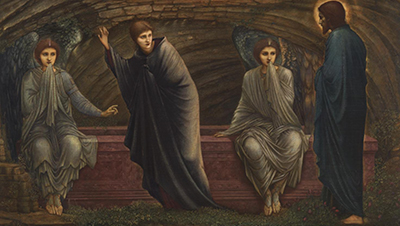
| Tate, London | Sidonia von Bork 1560 and Clara von Bork 1560, The Golden Stairs, King Cophetua and the Beggar Maid, and The Morning of the Resurrection, the 1886 oil on wood. [1] |
| Birmingham Museums | The Merciful Knight, Phyllis and Demophoön, the second Pygmalion series and The Star of Bethlehem. [4] [5] [24] [25] |
| National Museums Liverpool | The Beguiling of Merlin and The Tree of Forgiveness at the Lady Lever Art Gallery, and Sponsa de Libano in the Walker collection. [1] [26] |
| Laing Art Gallery, Newcastle upon Tyne | The large oil Laus Veneris. [1] |
| Calouste Gulbenkian Museum, Lisbon, and Musée d’Orsay, Paris | The larger Mirror of Venus in Lisbon and the 1883 Wheel of Fortune in Paris. [10] [14] |
| National Gallery of Victoria, Melbourne | The Garden of Pan and a separate oil version of The Wheel of Fortune. [16] [17] |
| Royal Museums of Fine Arts of Belgium, Brussels | The Wedding of Psyche, signed and dated 1895. [19] |
| Southampton City Art Gallery and Staatsgalerie Stuttgart | The ten full-size gouache designs in Southampton and the Stuttgart group from the unfinished Perseus project. [20] [21] |
| Buscot Park, Oxfordshire, and Museo de Arte de Ponce, Puerto Rico | The four large Briar Rose canvases at Buscot, and the earlier three-panel series and The Sleep of King Arthur in Avalon in Ponce. [22] [23] [30] |
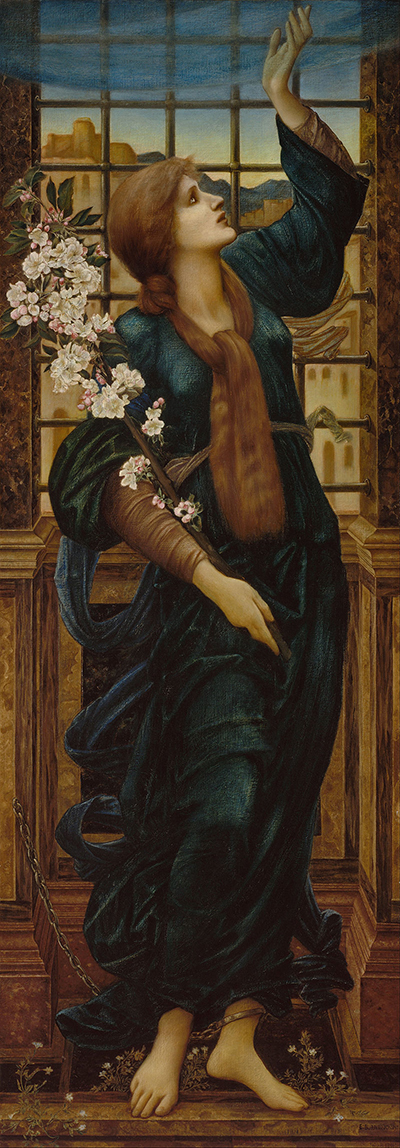
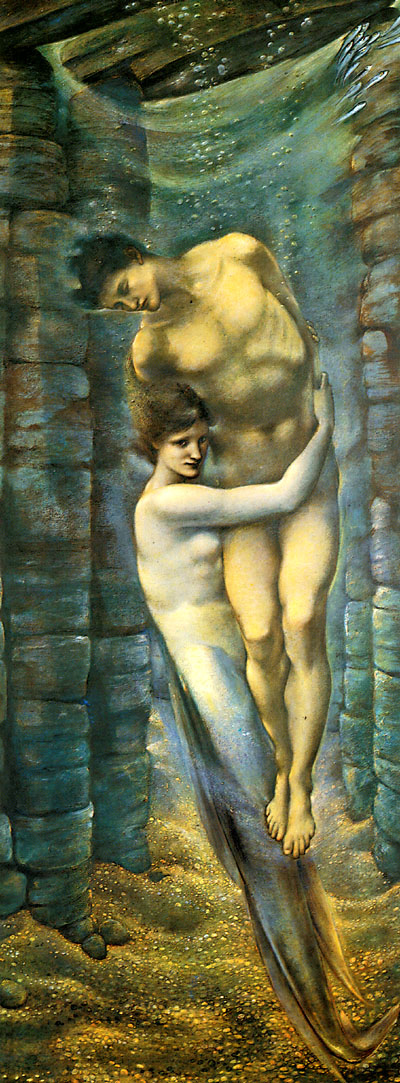
| Harvard Art Museums and Museum of Fine Arts, Boston | Harvard holds works from The Days of Creation and the 1887 watercolour and gouache Depths of the Sea, distinct from the 1886 oil shown at the Royal Academy. Boston holds the 1896 oil Hope, in which a woman carrying blossoms reaches up towards a gap in her prison. [12] [40] [41] |
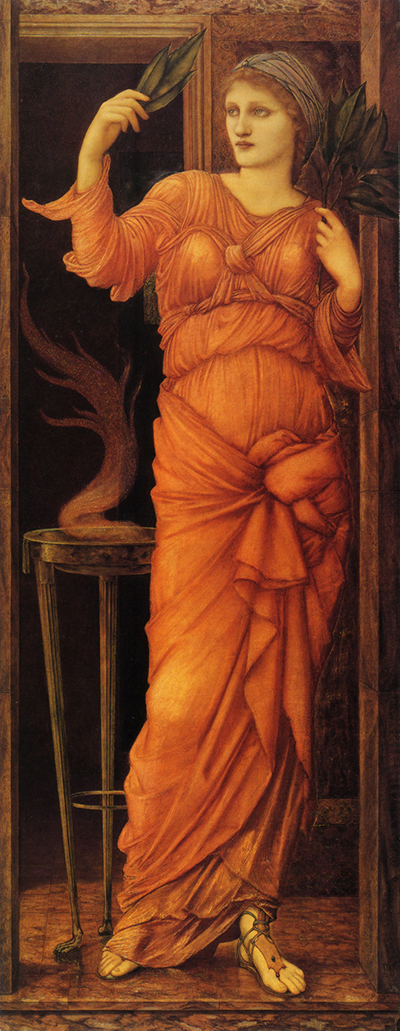
| Manchester Art Gallery | Sibylla Delphica, an oil on panel in which the Delphic Sibyl looks down at a sprig of laurel. [42] |
The collection records give the holding institutions. For a visit, check whether the particular work is on view, since works can be lent, rested or taken down for treatment. Check the medium as well when following a familiar title. La Belle au bois dormant leads to a Paris theatre programme with a Burne-Jones design. It belongs with the painted Briar Rose as another use of the Sleeping Beauty subject, and with the prints as a work made to reach a different audience. [43]
Browse Burne-Jones’s paintings and related works
Exhibition catalogues
Compare the works, preparatory designs and exhibition histories discussed in the two retrospectives.
Edward Burne-Jones: Victorian Artist-Dreamer. Stephen Wildman and John Christian, with essays by Alan Crawford and Laurence des Cars. Metropolitan Museum of Art, 1998.
The retrospective catalogue brings together collection histories, working studies and different versions of individual works. Read the catalogue at The Met.
Burne-Jones. Edited by Alison Smith. Tate Publishing, 2018.
This retrospective catalogue follows the artist from early drawing and painting to his work in print, glass and textiles. View the catalogue record.
Edward Burne-Jones on film
Explore Burne-Jones’s paintings, illustrated stories and stained-glass designs.
Edward Burne-Jones: Pre-Raphaelite Visionary | Exhibitions | Showcase
A look at Burne-Jones’s paintings and the Tate retrospective.
Watch on YouTubeArtworks directory
This directory records paintings, studies, designs and collaborative works, with separate entries for documented versions and series where known.
| Name | Date | Medium |
|---|---|---|
| Sidonia von Bork 1560 | 1860 | Watercolour and bodycolour |
| Clara von Bork 1560 | 1860 | Watercolour and bodycolour |
| The Merciful Knight | 1863 | Watercolour |
| Sibylla Delphica | c. 1886 | Oil on panel |
| Phyllis and Demophoön | 1870 | Watercolour and bodycolour |
| The Legend of the Briar Rose (Buscot series) | 1870s–1890 | Oils on canvas |
| The Briar Wood (Buscot series) | By 1890 | Oil on canvas |
| The Council Chamber (Buscot series) | By 1890 | Oil on canvas |
| The Garden Court (Buscot series) | By 1890 | Oil on canvas |
| The Rose Bower (Buscot series) | By 1890 | Oil on canvas |
| Group of Women, study for The Golden Stairs | 1872 | Drawing |
| The Beguiling of Merlin | 1870s | Oil on canvas |
| The Perseus Cycle | From 1875 | Paintings and full-scale designs |
| The Call of Perseus (Stuttgart) | From 1875 | Oil painting |
| Perseus and the Graeae (Stuttgart) | From 1875 | Oil painting |
| The Rock of Doom (Stuttgart) | 1884–88 | Oil on canvas |
| The Doom Fulfilled (Stuttgart) | 1888 | Oil on canvas |
| The Baleful Head (Stuttgart) | 1885–87 | Oil on canvas |
| The Baleful Head (Southampton design) | 1880s | Bodycolour |
| The Rock of Doom (Southampton design) | 1880s | Bodycolour |
| The Doom Fulfilled (Southampton design) | 1880s | Bodycolour |
| The Mirror of Venus (Gulbenkian) | 1870s | Oil on canvas |
| Drawing associated with The Mirror of Venus | 1870s | Drawing |
| Laus Veneris (Laing) | 1873–78 | Oil on canvas |
| The Days of Creation | 1870s | Watercolour and bodycolour |
| The Golden Stairs | 1880 | Oil on canvas |
| An Angel Playing a Flageolet | 1878 | Watercolour, bodycolour and gold |
| The Tree of Forgiveness | 1881–82 | Oil on canvas |
| The Wheel of Fortune (Orsay) | 1875–83 | Oil on canvas |
| King Cophetua and the Beggar Maid | 1884 | Oil on canvas |
| The Depths of the Sea (oil) | 1886 | Oil |
| The Morning of the Resurrection | 1886 | Oil on panel |
| Study for the Head of Mary Magdalene | c. 1882 | Oil study |
| The Sleep of King Arthur in Avalon | 1880s–1898 | Oil on canvas |
| The Sleep of King Arthur in Avalon (modello) | ca. 1881 | Oil on canvas (modello) |
| The Star of Bethlehem | Signed 1890 | Watercolour and bodycolour |
| Study for The Star of Bethlehem | About 1887–91 | Drawing |
| Sponsa de Libano | 1891 | Watercolour and bodycolour |
| The Summons (Holy Grail tapestries) | 1890s | Tapestry |
| The Failure of Sir Gawaine (Holy Grail tapestries) | 1890s | Tapestry |
| Hope (Boston) | 1896 | Oil on canvas |
| La Belle au bois dormant (theatre programme) | 1894 | Collotype |
| The Wedding of Psyche | 1895 | Oil on canvas |
| The Works of Geoffrey Chaucer (Kelmscott edition) | 1896 | Illustrated book |
| The Ascension (Birmingham Cathedral) | 1885 | Stained glass |
| The Last Judgement (Birmingham Cathedral) | 1897 | Stained glass |
| Adoration of the Magi (Huntington) | 1890s | Tapestry |
| Love among the Ruins (Wightwick) | 1894 | Oil on canvas |
| The Merciful Knight (photogravure after Burne-Jones) | 1900 | Photogravure |
| The Garden Court (preparatory work) | 1870–75 | Graphite and watercolour with white gouache |
| Study of a Female Figure | 1885 | Graphite drawing |
| Psyche Throwing Herself into the River | 1865–68 | Wood engraving |
| Beauty | 1887–89 | Colour lithograph |
| Study for the Failure of Gawain | 1893 | Crayon and graphite on Japanese paper |
| The Prince Enters the Briar Wood (after Burne-Jones) | After 1890 | Photogravure |
| The Rose Bower (after Burne-Jones) | 1892 | Photogravure |
| Adoration of the Magi (Musée d’Orsay) | 1904 | Tapestry |
| Answers to Prayer (Lyndhurst) | 1860s | Stained glass |
| The Depths of the Sea (photogravure after Burne-Jones) | 1900 | Photogravure |
| Perseus and Andromeda (Adelaide composite) | 1876 | Oil on canvas |
| The Adoration of the Magi (Hamburg) | Woven 1900 | Tapestry |
| Love leading the Pilgrim through the Briars | 1874–76 | Embroidery |
| Musica (worked by Lady Jane Cory) | 1906 | Embroidery |
| Pomona (worked by Lady Jane Cory) | 1907 | Embroidery |
| Flora (worked by Lady Jane Cory) | 1909 | Embroidery |
| The Fourth Day of Creation (photogravure after Burne-Jones) | 1900 | Photogravure |
| The Morning of the Resurrection (photogravure after Burne-Jones) | 1900 | Photogravure |
| Musical angels of the St Catherine window (Christ Church) | Designed 1877 | Stained glass |
Discussion
Look again at the images and ideas explored in Edward Burne-Jones Paintings. These editorial prompts invite your observations.
Reader Insights
Which two works would you compare to show how his treatment of a group of figures changed?
What becomes easier to see about a painting when you look at it beside one of its studies?
Join the Conversation
Share a detail, comparison or question about Edward Burne-Jones Paintings below.
References
- Tate Britain, Edward Burne-Jones, 2018 exhibition large-print guide, Rooms 1, 3, 5 and 6. View source.
- Fiona Mann, A ‘born rebel’: Edward Burne-Jones and watercolour painting 1857–80, technical discussion and figs. 24–26. View source.
- Burne-Jones Catalogue Raisonné, Sidonia von Bork, object entry and essays. View source.
- Burne-Jones Catalogue Raisonné, The Merciful Knight, object entry and exhibition history. View source.
- Burne-Jones Catalogue Raisonné, Phyllis and Demophoön, 1870 watercolour record and discussion. View source.
- Burne-Jones Catalogue Raisonné, The Tree of Forgiveness, 1881–82 oil record and discussion. View source.
- National Portrait Gallery, Sir Edward Burne-Jones, 2005–06 display introduction. View source.
- Stephen Wildman and John Christian, with Alan Crawford and Laurence des Cars, Edward Burne-Jones: Victorian Artist-Dreamer, Metropolitan Museum of Art retrospective catalogue, 1998. View source.
- Henry Blackburn (ed.), English Art in 1884, The Grosvenor Gallery, opening exhibition and contemporary discussion of King Cophetua. View source.
- Museu Calouste Gulbenkian, The Mirror of Venus, Lisbon oil, object record. View source.
- Fitzwilliam Museum, Study for the ‘Mirror of Venus’, collection record 2005.3, notes on both versions and their studies. View source.
- Burne-Jones Catalogue Raisonné, The Days of Creation 1st day, object record and ensemble discussion. View source.
- Burne-Jones Catalogue Raisonné, The Mirror of Venus 1877, entry for the Lisbon oil, including chronology and Leyland commission. View source.
- Ministère de la Culture, La Roue de la Fortune, Joconde record 000PE018095, Musée d’Orsay oil and related works. View source.
- Musée d’Orsay, La Roue de la Fortune, Paris canvas, RF 1980 3, and exhibition history. View source.
- National Gallery of Victoria, The Wheel of Fortune, Melbourne oil, collection record. View source.
- National Gallery of Victoria, The garden of Pan, collection record, accession 961-3. View source.
- Carl Villis, National Gallery of Victoria, X-ray discoveries in The Garden of Pan 1886–87 by Edward Burne-Jones, NGV Magazine 43, conservation report. View source.
- Musées royaux des Beaux-Arts de Belgique, Le cortège nuptial de Psyché, collection record inv. 7350. View source.
- Southampton City Art Gallery, The Perseus Series, overview and ten individual works. View source.
- Katrin Zultner, Staatsgalerie Stuttgart, The Call of Perseus, gallery guide and collection details. View source.
- Faringdon Collection, The Briar Rose Series: The Garden Court, exhibition, related works and installation notes. View source.
- Museo de Arte de Ponce, The Prince Enters the Wood, Small Briar Rose series, object record and related paintings. View source.
- Burne-Jones Catalogue Raisonné, Pygmalion and the Image: IV. The Soul Attains, second-series object record and discussion. View source.
- Jane Thompson-Webb, Birmingham Museums, Secrets revealed from beneath the glass: Edward Burne-Jones’ The Star of Bethlehem, 14 April 2022, conservation account. View source.
- Fiona Mann, ‘Opaque with a Vengeance’: Burne-Jones’s Later Watercolours, 1880–98, discussion of The Star of Bethlehem and Sponsa de Libano. View source.
- National Gallery of Canada, Annual Report 2008–2009, acquisitions, Sponsa de Libano (Design for an Embroidery). View source.
- Burne-Jones Catalogue Raisonné, An Angel Playing a Flageolet (Angel with Pipe), 1878 watercolour record and related designs. View source.
- National Trust, Love among the Ruins, Wightwick Manor oil, NT 1288953, including its inscription. View source.
- Museo de Arte de Ponce, The Sleep of King Arthur in Avalon, object 63.0369 and related works. View source.
- New Gallery, Exhibition of the Works of Sir Edward Burne-Jones, Bart., 1898–99, arrangement, prefatory note and nos. 124, 151 and 153–156. View source.
- Jan Marsh, National Portrait Gallery, Sir Edward Coley Burne-Jones, 1st Bt, Later Victorian Portraits biography. View source.
- Burne-Jones Catalogue Raisonné, The Work of Edward Burne-Jones, Berlin Photographic Company portfolio, catalogue entry. View source.
- Berlin Photographic Company, Catalogue of Select Publications, Burne-Jones entries and portfolio notice. View source.
- Canadian Centre for Architecture, The Work of Edward Burne-Jones, library copy m 85456. View source.
- De Nieuwe Belgische Illustratie, Burne Jones en het Prerafaëlisme, year 15, 1898, digitised by DBNL. View source.
- Museo Nacional del Prado, Memoria de actividades 2009, exhibitions, account of the Ponce loans. View source.
- National Art Center, Tokyo, バーン=ジョーンズ展, 2012 exhibition record for Mitsubishi Ichigokan Museum. View source.
- Musei San Domenico and Fondazione Cassa dei Risparmi di Forlì, Preraffaelliti. Rinascimento moderno, 2024 exhibition press dossier, Burne-Jones room. View source.
- Burne-Jones Catalogue Raisonné, The Depths of the Sea 1886, oil record and account of the 1887 version. View source.
- Museum of Fine Arts, Boston, Hope, object 40.778, museum-supplied collection record. View source.
- Manchester Art Gallery, Sibylla Delphica, object 1886.5, collection description reproduced by Victorian Web. View source.
- National Gallery of Art, Washington, La Belle au bois dormant, collection record for accession 1997.96.2. View source.