 by Tom Gurney
Tom Gurney BSc (Hons) is an art history expert with over 20 years experience
Published on June 19, 2020 / Updated on November 25, 2026
Email: tomgurney1@gmail.com / Phone: +44 7429 011000
Sponsa de Libano: Introduction
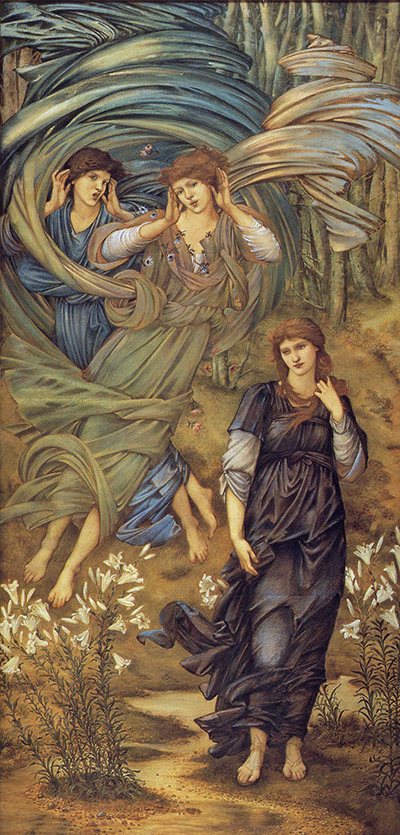
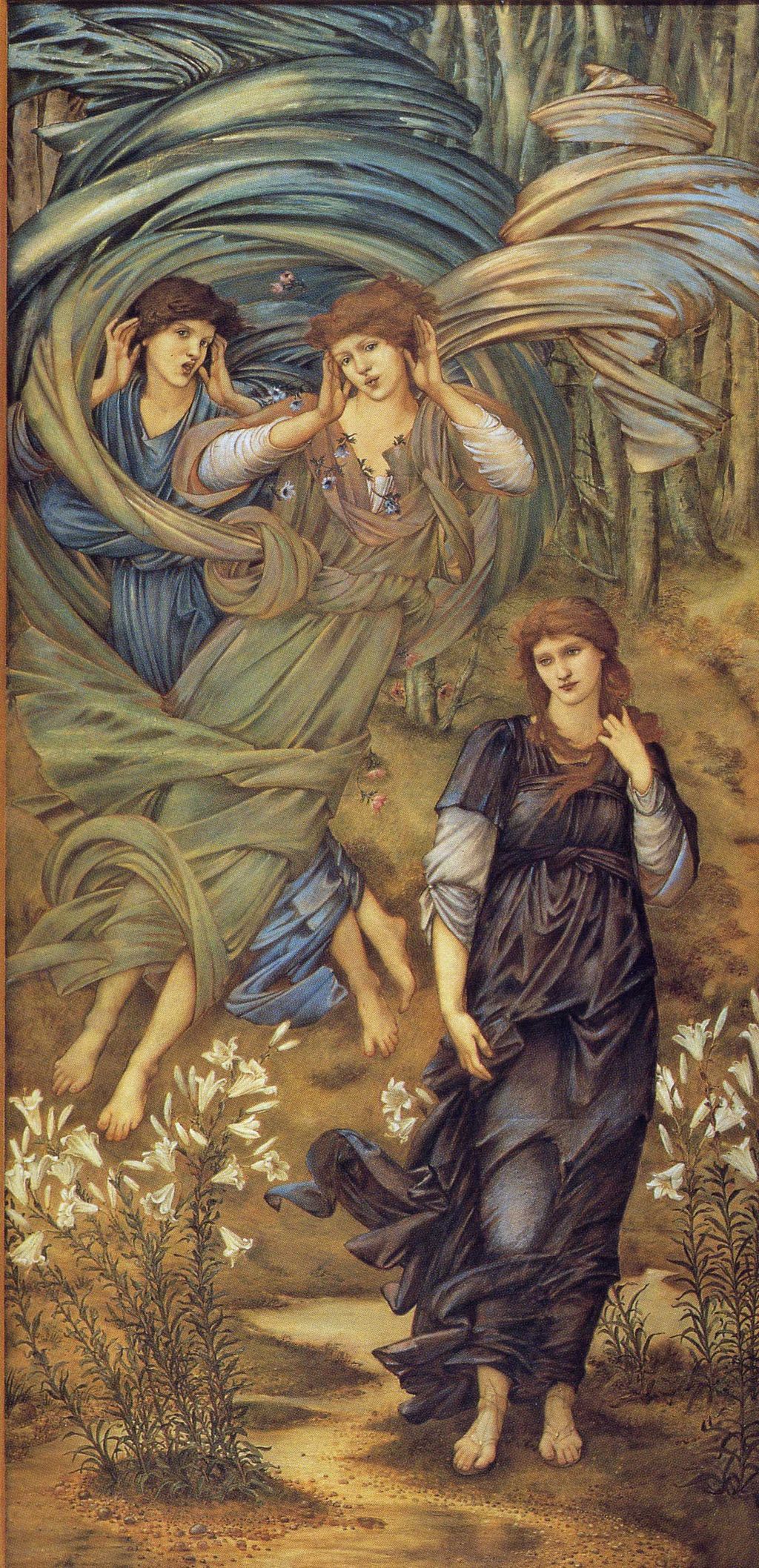
In Edward Burne-Jones’s Sponsa de Libano, two women hang in the air above a garden while a third, barefoot and darkly dressed, pauses among white lilies. The airborne figures are the north and south winds summoned in the biblical Song of Songs. Most of the upper half is given over to the fabric curling around them. A hand lifted to the bride’s neck and the pull on the hem of her dress show how far their breath reaches. Burne-Jones finished the watercolour in 1891. It stands more than three metres high and belongs to the Walker Art Gallery in Liverpool. [1] [2]
At a Glance
- ArtistEdward Burne-Jones
- Date1891
- MediumWatercolour and bodycolour
- SubjectThe bride from the Song of Songs
This work across Edward Burne-Jones’s career
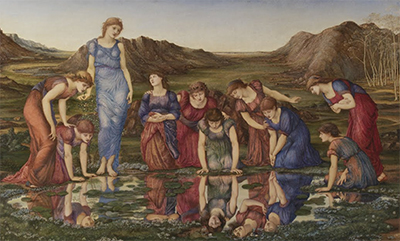
The Mirror of Venus
1870sThe Wheel of Fortune
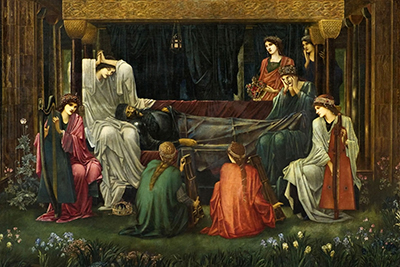
1875–83The Last Sleep of Arthur in Avalon
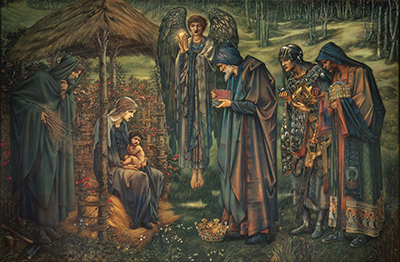
1880s–1898The Star of Bethlehem
Signed 1890Contents
- The bride and the two winds
- What the Song of Songs says
- From the pencil designs to the watercolour
- Watercolour on an exhibition scale
- From the New Gallery to the Walker
- Annotated details
The bride and the two winds
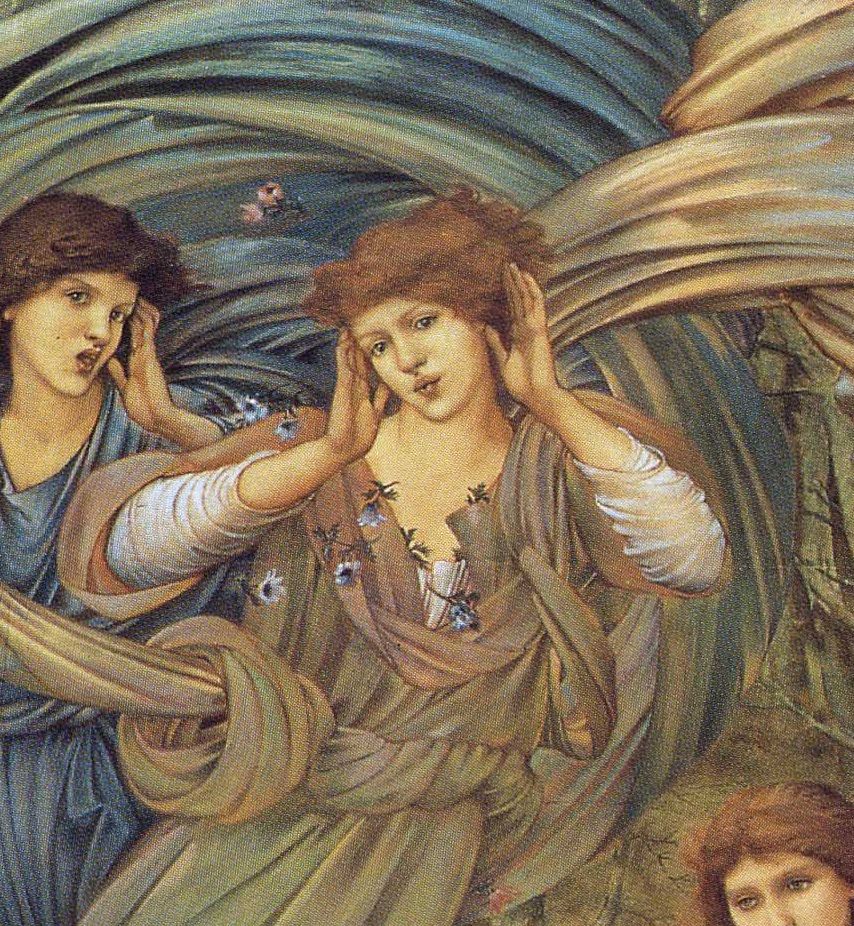
The shape of the painting makes its action easy to follow. Against the upright tree trunks in the upper right, bands of blue and green cloth sweep over the winds’ heads. A paler loop unfurls across their path. Both figures lift their hands beside their faces and round their lips to blow. Lower down, four bare feet emerge from the overlapping clothes without touching the ground. The bride has bare feet too, but hers anchor her at the front of the scene. The alternating colours and the contours of the fabric help separate the winds even where their bodies are almost impossible to disentangle. [3]
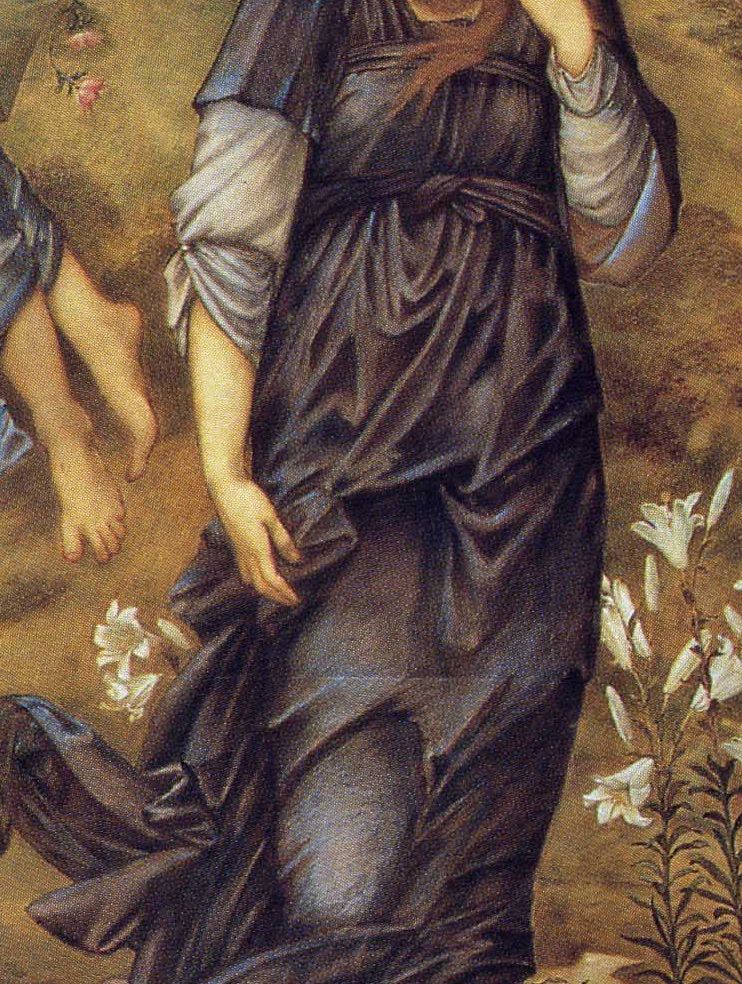
The bride stands to the right of centre. Her glance turns towards the left while one hand gathers dark cloth at her hip. The other rests lightly at her neck, where a strand of hair passes across her chest. Her robe catches the gust at knee height and billows into the open space on her left. That extension of the skirt carries the movement down from the airborne figures without disturbing the calm of her face. Small blossoms scatter around the winds. The lilies below have sharply defined stems, buds and open flowers, and the shallow water and pebbles underfoot give the garden a scale and texture of its own. [3] [4]
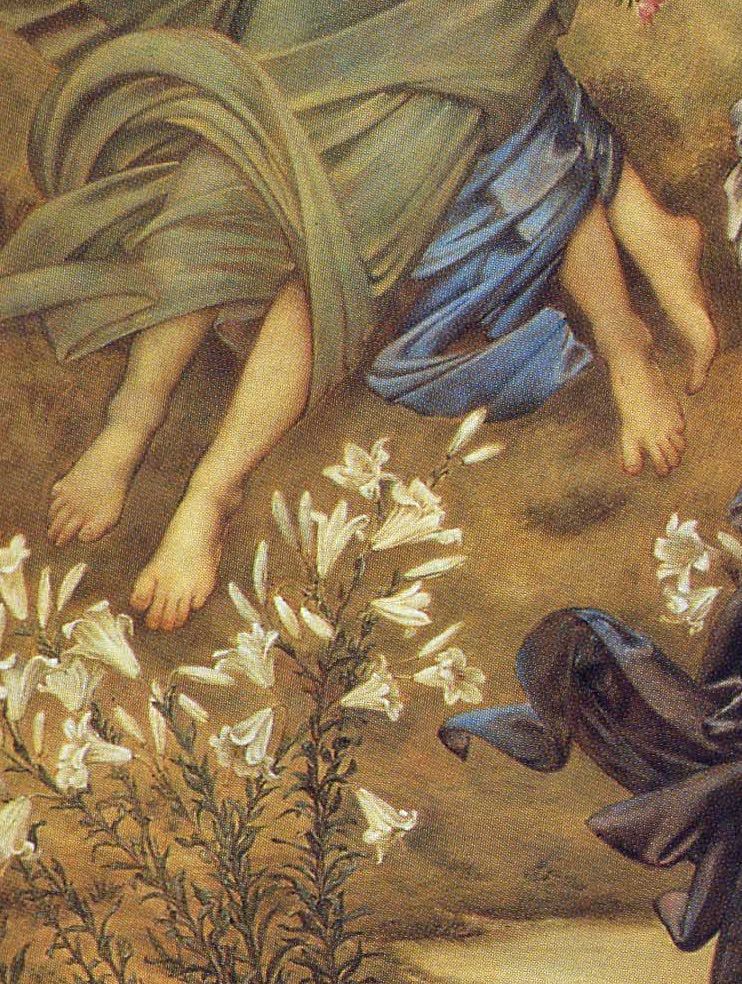
The lilies also belong to the poem’s vocabulary. Earlier in the Song of Songs the beloved is compared to a lily among thorns, and elsewhere the lovers are pictured among lilies. White lilies also carry a traditional association with purity, as the Bunkamura Museum of Art noted when it showed the painting in Tokyo. [5] The painting gives them a physical role as well. Their thin upright stems frame the lowest part of the composition, where the gust that looked so powerful above reaches the ground. The contrast between these closely observed plants and the two women suspended overhead lets the scene feel at once like a garden and like a figure of speech made visible. [4] [6] [7]
Edward Burne-Jones, Hope, 1896. Museum of Fine Arts, Boston. Image source. Public domain.
Edward Burne-Jones, Sponsa de Libano. Walker Art Gallery. Image source. Public domain.
Annotated Details from Sponsa de Libano
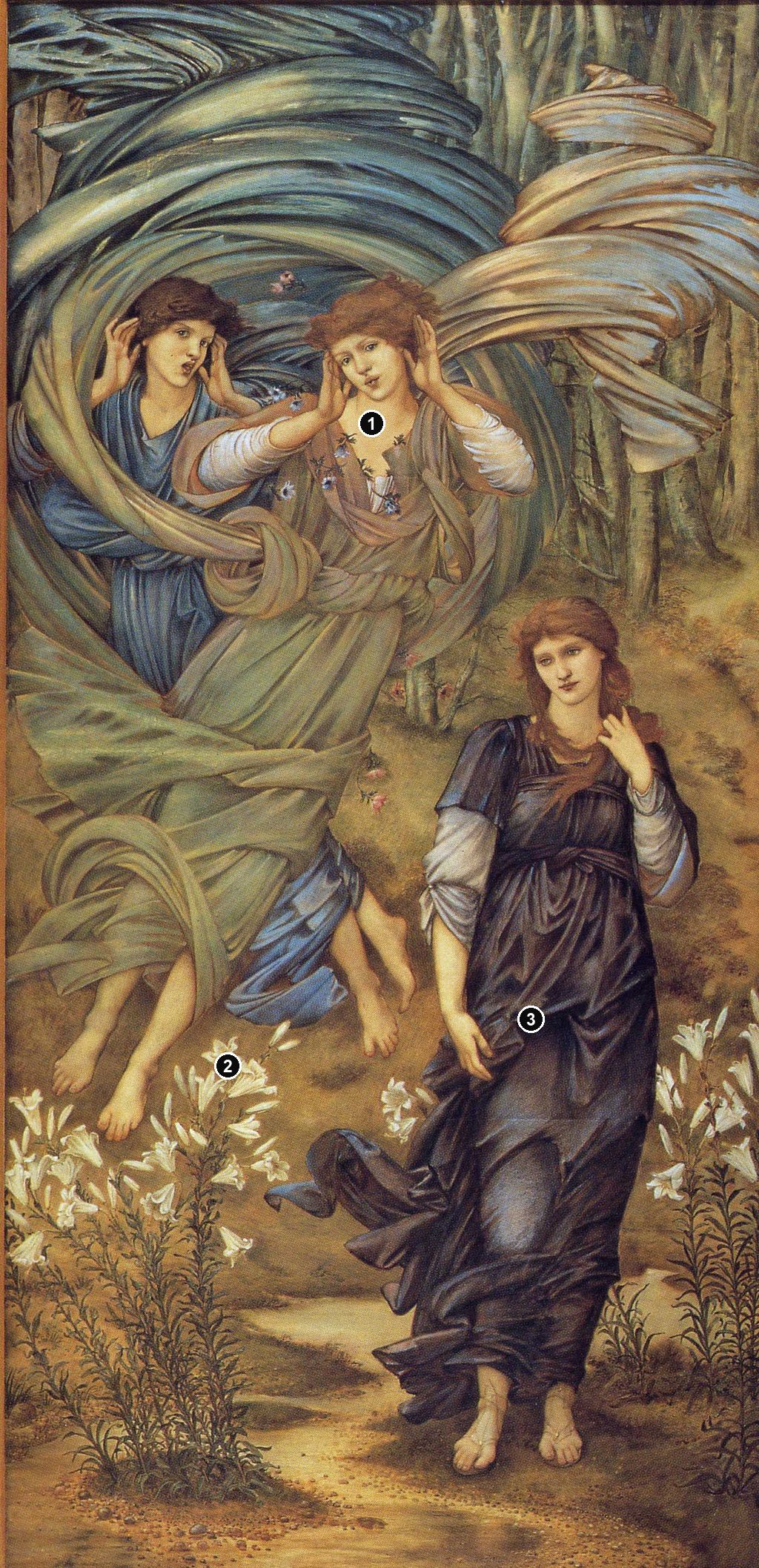
The numbered points identify visible features discussed in this article. Return from each detail to the numbered overview. Edward Burne-Jones, Sponsa de Libano. Walker Art Gallery. Image source. Public domain.
Details from SPONSA DE LIBANO
Compare the cropped details with the source images above. Notice how their colours, shapes and positions contribute to the larger compositions.
Forms in the upper air
Curved streams of cloth and the faces of the winds turn together above the bride.
Lilies along the route
The upright lilies interrupt the diagonal pace of the walk. Pale petals catch the eye below the forceful movement above.
The bride’s movement
A slight turn in her body echoes the folds of her dress and gives the vertical format a lower rhythm.
What the Song of Songs says
The title and the action draw on two moments in the fourth chapter of the Song of Songs, also known as the Song of Solomon. In verse 8 the lover calls his bride to come from Lebanon. The Latin Vulgate begins “Veni de Libano, sponsa mea”, addressing her as “my bride”. The Latin title is commonly rendered as The Bride of Lebanon. The same biblical invitation also appears, with its words rearranged, in canto 30 of Dante’s Purgatorio. There the cry “Veni, sponsa, de Libano” sounds just before Beatrice appears. Dante offers a literary parallel for the title. The New Gallery’s memorial catalogue gives the direct source for the painted scene as verse 16. [1] [8] [9]
“Awake, O North wind, and come, thou South” is how the catalogue introduces the verse. The speaker asks the two winds to blow on her garden and release its fragrance. In the English Bible the verse continues with her invitation for her beloved to enter and eat its fruit. Burne-Jones paints the moment of the summons. The beloved remains outside the scene, and the sensory detail the poem asks readers to imagine is conveyed by bodies, fabric and flowers. Scent itself cannot be seen, but the scattered blossoms and the way the bride’s clothes catch the air make its passage imaginable. Both winds arrive together, crossing and converging above the garden. [1] [3] [6]
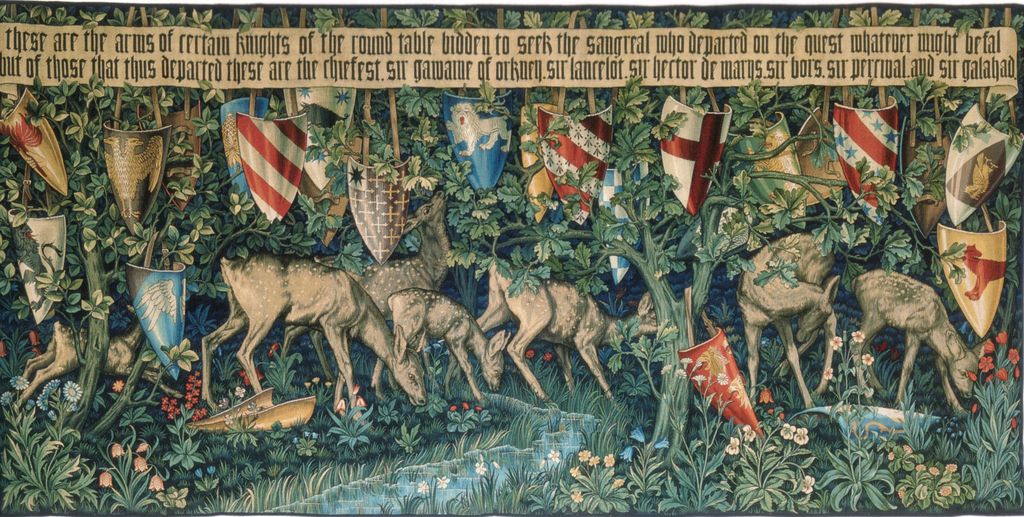
Morris & Co., Verdure from the Holy Grail scheme. Image source. Public domain.
From the pencil designs to the watercolour
The composition began about fifteen years earlier. In 1876 Burne-Jones made five pencil designs from the Song of Songs and recorded that he hoped to turn them into paintings on panels. The 1998 Metropolitan Museum of Art exhibition catalogue discusses the group together with his similarly tall designs for needlework. A drawing with the bride and winds has two Latin inscriptions, one from the summons to the winds in 4:16 and another from 7:6, praising the beloved’s beauty. That second verse belongs to the evidence of the pencil design. The passages set an invocation and an address to the beloved within the same drawn scene. [10] [11]
Malcolm Bell printed the finished painting and the pencil design side by side in his early account of Burne-Jones. Bell observed that both give the bride white lilies and set the two winds diagonally across one another. In the design, ruled lines indicate the air leaving their mouths, and a scroll cuts across the vegetation. The finished work lets their pursed lips and the movement of the clothes communicate the action. Bell also contrasted the formal plants in the design with the detail of the painted lilies and the small stream. Enlarging the design gave Burne-Jones room to keep the sweeping outline and fill its surroundings with the detail one might notice at the edge of a real path. [4]
Bell compared the airborne pair to the figures blowing towards Venus in Botticelli’s Birth of Venus. The comparison makes the visual problem clear. In both pictures two airborne bodies have to read as a single current of air. Burne-Jones draws the broadest curves around the winds themselves and carries them down towards the bride with the darker fabric of her dress. The Metropolitan Museum’s catalogue also discusses early Italian engravings, including illustrations for a fifteenth-century edition of Dante, as possible sources for the formal arrangement of the 1876 drawings. [4] [10]
For the faces, Burne-Jones drew from life. In a letter to Lady Rayleigh reproduced in the exhibition catalogue, he recalled drawing the south wind one day and the north wind the next, with the same young model posing for both. He asked her to blow with her lips, the gesture that makes the moving air intelligible in the watercolour. The Burlington Fine Arts Club later exhibited a separate study titled The North Wind, dated 1891 and drawn in black and white chalk on red ground. Arthur James Balfour lent it to the 1899 exhibition. Two head studies appeared with the finished painting at the Nagoya City Art Museum in 2015. Its checklist distinguishes a head in black chalk on Japanese paper from another in coloured chalk and watercolour. Together these records show how much Burne-Jones could work out on a small sheet before bringing a head into the full composition. [12] [10] [13]
Embroidery was another way a tall design could be realised. The National Gallery of Canada preserves a related design dated 1876, drawn in black chalk on cream wove paper and catalogued as a design for embroidery. [14] The catalogue raisonné records an account in which the Royal School of Needlework executed this subject in embroidery. It also includes differing views about whether the five Song of Songs designs were conceived for stitching in the first place. Burne-Jones’s work record names painting on panel as his aim. The distinction matters because the drawn design, the work of embroiderers and the signed watercolour represent different stages or uses of the image. Burne-Jones’s Poesis, which survives in an embroidered version made by the Royal School, gives a documented example of how the designer’s figures and lines could be realised by needleworkers at a large scale. [10] [11] [15]
Watercolour on an exhibition scale
The memorial catalogue calls Sponsa de Libano a watercolour. The Frame Blog describes it more specifically as watercolour and gouache on paper mounted on panel. The 2015 Nagoya checklist gives the painting’s dimensions as 325.7 by 158 centimetres. [12] The Frame Blog also records the carved frame, with a deep rounded moulding covered in a garland of fruit, flowers and foliage, bound at intervals by ribbons. The painted garden ends at the edge of the paper, but the frame surrounds it with another kind of plant ornament. The article relates the garland to those on Renaissance frames, a comparison that helps explain why this biblical subject and its frame belong together visually. [1] [7]
Fiona Mann’s study of Burne-Jones’s late watercolours places the actual painting in the first months of 1891. The gap since the 1876 drawings was long, but the work on the enormous finished picture was comparatively quick. At the New Gallery in 1891 it hung on a wall next to The Star of Bethlehem, another monumental watercolour with a biblical subject. Their formats made different demands on the viewer. The wide Birmingham work extends across a wall, while the narrow Sponsa de Libano draws the eye from the lily beds past the figures and up into the canopy of drapery. The two paintings gave the medium a presence in the exhibition usually associated with large oils. [2]
From the New Gallery to the Walker
The London firm Agnew’s bought the watercolour from Burne-Jones in June 1891 for £1,200, according to Mann’s research in the firm’s stock book. The painting was shown in Venice in 1895 at the first international exhibition now known as the Venice Biennale. The Italian catalogue listed it as no. 44 under the Latin title. The Trieste critic Silvio Benco devoted an article in L’Indipendente to the painting, remarking on its restrained colouring, the sophistication of its line and the extraordinary swirl of the drapery. He singled out the same parts of the picture that reward a close look today, from the controlled lines of the bride’s clothing to the near-impossible movement of the drapery above her. [2] [16] [17]
The Walker Art Gallery acquired the painting after it was exhibited in Liverpool in 1896. By the time of the New Gallery’s memorial exhibition in 1898–99, the Lord Mayor and Corporation of Liverpool lent it back to London, where the catalogue placed it in the North Room and recorded Burne-Jones’s initials and the date 1891. The work had travelled from a private dealer’s stock to international exhibition and then to a municipal gallery within a few years of its completion. It travelled again in 2015 for an exhibition of works from National Museums Liverpool in Nagoya and then Tokyo. [12] [5] Seeing the huge watercolour alongside the much smaller head studies in Nagoya would have made the distance between the studio drawing and the exhibition piece especially apparent. Three bodies, a handful of gestures and the curves of falling cloth give a visible course to a breeze summoned in a single verse. [1] [2]
Edward Burne-Jones on film
Explore Burne-Jones’s paintings, illustrated stories and stained-glass designs.
Edward Burne-Jones: Pre-Raphaelite Visionary | Exhibitions | Showcase
A look at Burne-Jones’s paintings and the Tate retrospective.
Watch on YouTubeArtworks directory
This directory records paintings, studies, designs and collaborative works, with separate entries for documented versions and series where known.
| Name | Date | Medium |
|---|---|---|
| Sidonia von Bork 1560 | 1860 | Watercolour and bodycolour |
| Clara von Bork 1560 | 1860 | Watercolour and bodycolour |
| The Merciful Knight | 1863 | Watercolour |
| Sibylla Delphica | c. 1886 | Oil on panel |
| Phyllis and Demophoön | 1870 | Watercolour and bodycolour |
| The Legend of the Briar Rose (Buscot series) | 1870s–1890 | Oils on canvas |
| The Briar Wood (Buscot series) | By 1890 | Oil on canvas |
| The Council Chamber (Buscot series) | By 1890 | Oil on canvas |
| The Garden Court (Buscot series) | By 1890 | Oil on canvas |
| The Rose Bower (Buscot series) | By 1890 | Oil on canvas |
| Group of Women, study for The Golden Stairs | 1872 | Drawing |
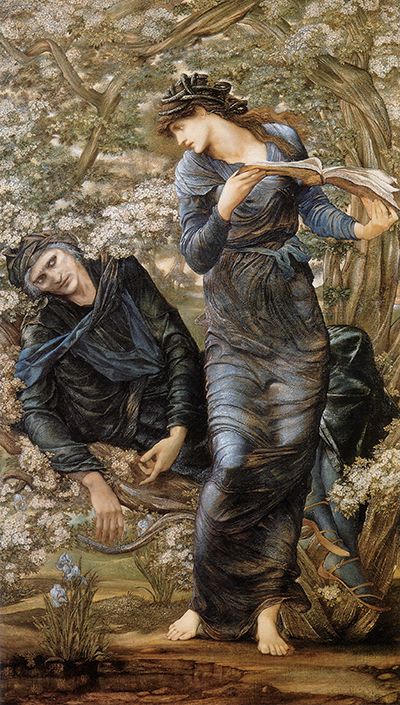
| The Beguiling of Merlin | 1870s | Oil on canvas |
| The Perseus Cycle | From 1875 | Paintings and full-scale designs |
| The Call of Perseus (Stuttgart) | From 1875 | Oil painting |
| Perseus and the Graeae (Stuttgart) | From 1875 | Oil painting |
| The Rock of Doom (Stuttgart) | 1884–88 | Oil on canvas |
| The Doom Fulfilled (Stuttgart) | 1888 | Oil on canvas |
| The Baleful Head (Stuttgart) | 1885–87 | Oil on canvas |
| The Baleful Head (Southampton design) | 1880s | Bodycolour |
| The Rock of Doom (Southampton design) | 1880s | Bodycolour |
| The Doom Fulfilled (Southampton design) | 1880s | Bodycolour |
| The Mirror of Venus (Gulbenkian) | 1870s | Oil on canvas |
| Drawing associated with The Mirror of Venus | 1870s | Drawing |
| Laus Veneris (Laing) | 1873–78 | Oil on canvas |
| The Days of Creation | 1870s | Watercolour and bodycolour |
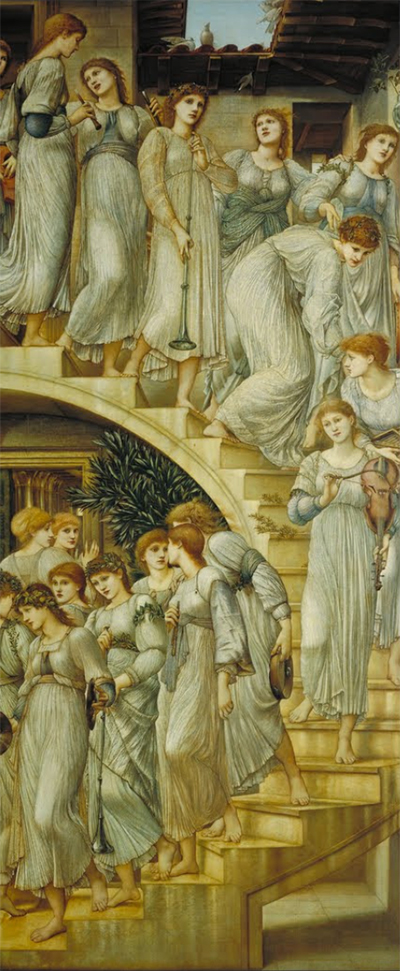
| The Golden Stairs | 1880 | Oil on canvas |
| An Angel Playing a Flageolet | 1878 | Watercolour, bodycolour and gold |
| The Tree of Forgiveness | 1881–82 | Oil on canvas |
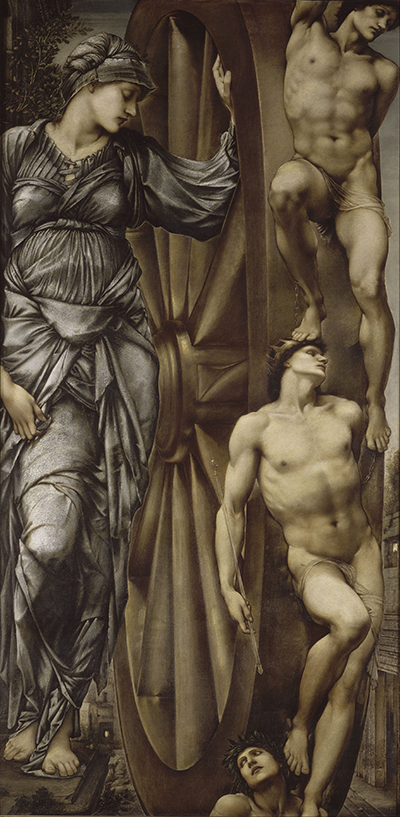
| The Wheel of Fortune (Orsay) | 1875–83 | Oil on canvas |
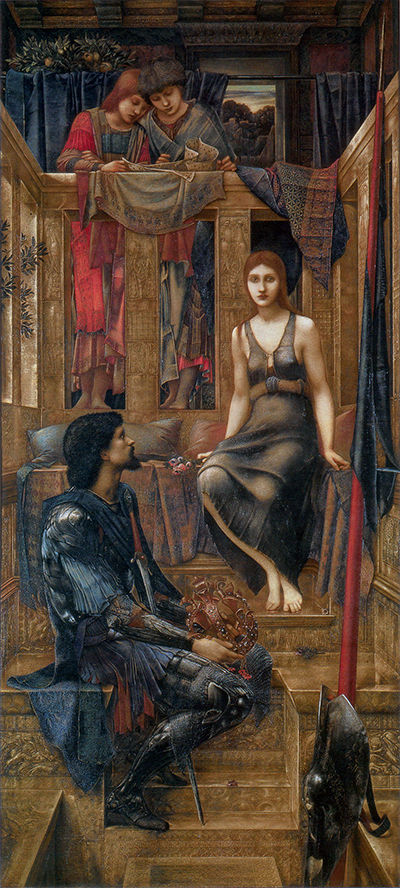
| King Cophetua and the Beggar Maid | 1884 | Oil on canvas |
| The Depths of the Sea (oil) | 1886 | Oil |
| The Morning of the Resurrection | 1886 | Oil on panel |
| Study for the Head of Mary Magdalene | c. 1882 | Oil study |
| The Sleep of King Arthur in Avalon | 1880s–1898 | Oil on canvas |
| The Sleep of King Arthur in Avalon (modello) | ca. 1881 | Oil on canvas (modello) |
| The Star of Bethlehem | Signed 1890 | Watercolour and bodycolour |
| Study for The Star of Bethlehem | About 1887–91 | Drawing |
| Sponsa de Libano | 1891 | Watercolour and bodycolour |
| The Summons (Holy Grail tapestries) | 1890s | Tapestry |
| The Failure of Sir Gawaine (Holy Grail tapestries) | 1890s | Tapestry |
| Hope (Boston) | 1896 | Oil on canvas |
| La Belle au bois dormant (theatre programme) | 1894 | Collotype |
| The Wedding of Psyche | 1895 | Oil on canvas |
| The Works of Geoffrey Chaucer (Kelmscott edition) | 1896 | Illustrated book |
| The Ascension (Birmingham Cathedral) | 1885 | Stained glass |
| The Last Judgement (Birmingham Cathedral) | 1897 | Stained glass |
| Adoration of the Magi (Huntington) | 1890s | Tapestry |
| Love among the Ruins (Wightwick) | 1894 | Oil on canvas |
| The Merciful Knight (photogravure after Burne-Jones) | 1900 | Photogravure |
| The Garden Court (preparatory work) | 1870–75 | Graphite and watercolour with white gouache |
| Study of a Female Figure | 1885 | Graphite drawing |
| Psyche Throwing Herself into the River | 1865–68 | Wood engraving |
| Beauty | 1887–89 | Colour lithograph |
| Study for the Failure of Gawain | 1893 | Crayon and graphite on Japanese paper |
| The Prince Enters the Briar Wood (after Burne-Jones) | After 1890 | Photogravure |
| The Rose Bower (after Burne-Jones) | 1892 | Photogravure |
| Adoration of the Magi (Musée d’Orsay) | 1904 | Tapestry |
| Answers to Prayer (Lyndhurst) | 1860s | Stained glass |
| The Depths of the Sea (photogravure after Burne-Jones) | 1900 | Photogravure |
| Perseus and Andromeda (Adelaide composite) | 1876 | Oil on canvas |
| The Adoration of the Magi (Hamburg) | Woven 1900 | Tapestry |
| Love leading the Pilgrim through the Briars | 1874–76 | Embroidery |
| Musica (worked by Lady Jane Cory) | 1906 | Embroidery |
| Pomona (worked by Lady Jane Cory) | 1907 | Embroidery |
| Flora (worked by Lady Jane Cory) | 1909 | Embroidery |
| The Fourth Day of Creation (photogravure after Burne-Jones) | 1900 | Photogravure |
| The Morning of the Resurrection (photogravure after Burne-Jones) | 1900 | Photogravure |
| Musical angels of the St Catherine window (Christ Church) | Designed 1877 | Stained glass |
Discussion
Look again at the images and ideas explored in Sponsa de Libano. These editorial prompts invite your observations.
Reader Insights
How do the winds and lilies change the pace of the central figure’s movement?
How does the bride react to the movement around her, and which part of the image shows it best?
Join the Conversation
Share a detail, comparison or question about Sponsa de Libano below.
References
- New Gallery, Exhibition of the Works of Sir Edward Burne-Jones, Bart. (1898–99), North Room, no. 136, p. 72. View source.
- Fiona Mann, “‘Opaque with a Vengeance’: Burne-Jones’s Later Watercolours, 1880–98”, The Burlington Magazine 161 (February 2019), pp. 136–137 and notes 71–72. View source.
- A. L. Baldry, Burne-Jones, plate III and accompanying text. View source.
- Malcolm Bell, Sir Edward Burne-Jones: A Record and Review, pp. 54–56 and adjoining plates. View source.
- Bunkamura Museum of Art, Pre-Raphaelite and Romantic Painting from National Museums Liverpool (2015–16), selected works, chapter 4, Walker Art Gallery object caption. View source.
- King James Bible, Song of Solomon, chapters 2 and 4. View source.
- The Frame Blog, “Burne-Jones’s Picture Frames”, 1 May 2019, adapted from the study by Paul Mitchell and Lynn Roberts, discussion of the Sponsa di Libano frame and caption. View source.
- Latin Vulgate, Canticum Canticorum, chapter 4, verse 8. View source.
- Dante Alighieri, Purgatorio, canto 30, lines 10–33, Princeton Dante Project. View source.
- Stephen Wildman and John Christian, Edward Burne-Jones: Victorian Artist-Dreamer, Metropolitan Museum of Art (1998), nos. 82–83, especially p. 190 and note 3. View source.
- Burne-Jones Catalogue Raisonné, Awake O North Wind, The South Wind – Sponsa di Libano, design inscriptions and expertise entries. View source.
- Nagoya City Art Museum, annual report for fiscal 2015, Pre-Raphaelite and Romantic Painting, checklist nos. 55 and 56-a/b. View source.
- Burlington Fine Arts Club, Exhibition of Drawings and Studies by Sir Edward Burne-Jones, Bart. (1899), no. 114, p. 23. View source.
- National Gallery of Canada, annual report 2008–09, acquisitions, p. 59, Sponsa de Libano (Design for an Embroidery from the “Song of Solomon”), 42495. View source.
- Burne-Jones Catalogue Raisonné, Poesis, Needlework by the Royal School of Needlework (Melbourne), object record and Met catalogue entry. View source.
- Esposizione Internazionale d’Arte della Città di Venezia, Catalogo (1895), p. 76, no. 44. View source.
- Silvio Benco, “Viaggi per l’arte. Sponsa de Libano”, L’Indipendente, 27 May 1895, quoted in Lorenzo Nuovo, Silvio Benco critico d’arte: la formazione (1890–1914), University of Trieste, pp. 34–35 and note 103. View source.