 by Tom Gurney
Tom Gurney BSc (Hons) is an art history expert with over 20 years experience
Published on June 19, 2020 / Updated on November 25, 2026
Email: tomgurney1@gmail.com / Phone: +44 7429 011000
The Baleful Head by Edward Burne-Jones: Introduction
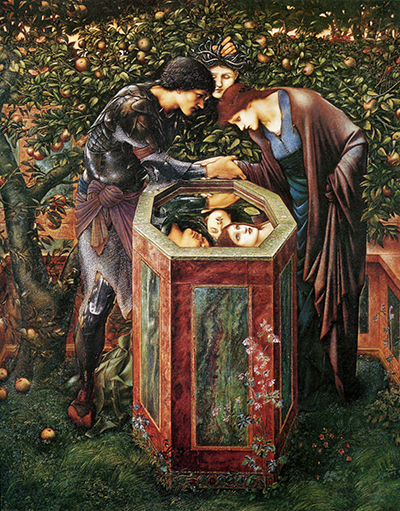
At an octagonal well, Perseus takes Andromeda by the hand and holds up the severed head of Medusa. Andromeda bends to inspect it in the water. The reflection lets her see the Gorgon without turning to stone, and it brings all three faces together in a space scarcely wider than her shoulders. Edward Burne-Jones painted The Baleful Head in oil on canvas between 1885 and 1887. The canvas measures 150 by 130 centimetres and belongs to the Staatsgalerie Stuttgart. It closes his Perseus cycle in the shelter of a walled garden. [1]
At a Glance
- ArtistEdward Burne-Jones
- Date1885–87
- MediumOil on canvas
- SubjectPerseus and Andromeda
This work across Edward Burne-Jones’s career
The Mirror of Venus
1870sThe Wheel of Fortune
1875–83The Last Sleep of Arthur in Avalon
1880s–1898The Star of Bethlehem
Signed 1890Contents
- Three faces in a well
- The reflection in William Morris and Dante Gabriel Rossetti
- From the full-scale design to the oil
- An ending in a walled garden
- The last subject and the first completed canvas
- Annotated details
Three faces in a well
Perseus leans in from the left, the scales of his shoulder armour overlapping like the leaves behind him. On the right, the folds of Andromeda’s cloak hang straight down from her bent arm. Their joined right hands cross the near-vertical lines of their bodies just above the far side of the well. Perseus’s other hand appears among the branches high over them. The fingers are wrapped in Medusa’s dark, serpentine hair, and her pale, closed-eyed face hangs between the two inclined heads. All three can be seen before the eye reaches the water. [1]
The well takes up much of the lower half of the canvas. Reddish-brown stone surrounds narrow panels with blue-green veining. The angles of its green rim carry the eye from the grass up to the closest edge of the water. There the two figures’ profiles give way to a more intimate view. Andromeda’s reflected face turns up from the right, while Medusa appears near the centre, upside down. Their cheeks almost touch in the pool. At the left a patch of armour catches light beside Perseus’s face. The joined hands appear again at the back of the well, as if they were just beneath the surface. [1]
The painter sets up the symmetry of a couple leaning towards each other and then gives their eyes different work to do. Andromeda is intent on Medusa. The Staatsgalerie reads Perseus’s gaze as directed towards Andromeda, who is too absorbed to return it. That distinction matters because the danger in the story depends on the direction of a look. Andromeda depends on the pool for a safe view of the Gorgon. The head with the power to arrest every other figure has the quietest face in the painting. [1]
The reflection in William Morris and Dante Gabriel Rossetti
Perseus has already survived a dangerous encounter by looking indirectly. In the Library traditionally ascribed to Apollodorus, Athena guides his hand while he watches Medusa in a bronze shield and strikes off her head. Later he turns Phineus and his supporters to stone by showing it to them. Burne-Jones’s picture takes the rule that once let Perseus kill Medusa and applies it to a scene in which someone wants to see her. [2]
The immediate literary source for the cycle was William Morris’s “The Doom of King Acrisius” in The Earthly Paradise. Morris places the encounter on the shore after the rescue and before the wedding. Perseus has told Andromeda his story when she notices the salt pool left by the tide. It is so clear that he can see the jewels on her hands. She asks whether she might see Medusa there and live. In the reflection the pale head rises over Andromeda’s shoulder, beside the image of her own face. She cries out that she has seen enough and accepts his claim to be the son of Jove. Her request drives the scene, and the sea is coming in while they talk. [3] [4]
Dante Gabriel Rossetti had already pictured the lovers and the reflected Gorgon in Aspecta Medusa. In his drawing Perseus sits, holding up the head, and Andromeda leans across him towards a fountain at their feet. Rossetti’s poem makes the head the instrument of Andromeda’s rescue. Morris has Perseus kill the sea monster with his sword, as Burne-Jones shows in the preceding episode. The physical arrangement in the drawing offers a closer parallel to Burne-Jones than the plot does. Both artists give the reflection a constructed setting. Burne-Jones puts that structure between the figures and brings the water within reach of their hands. The shift from Morris’s shore to the walled garden also lets the two remain together without the pressure of a rising tide. [3] [5] [6]
From the full-scale design to the oil
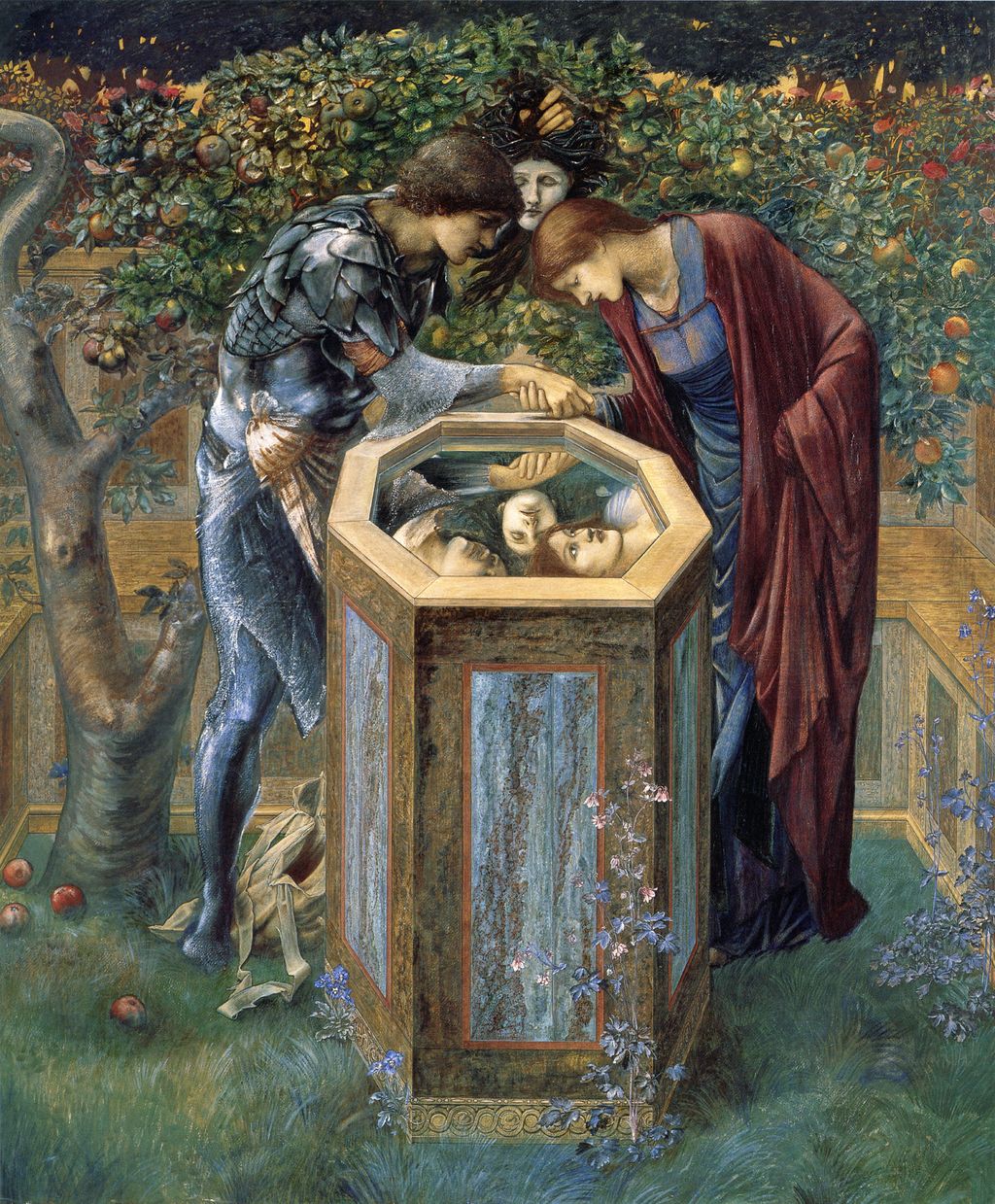
In early sketches Burne-Jones tried having Andromeda crouch over a pool. A pencil sketchbook in the Victoria and Albert Museum preserves stages in the design’s development. The full-scale cartoon at Southampton City Art Gallery, generally dated 1885, shows how far he had developed the upright composition before completing the canvas. Southampton catalogues the work as mixed media on paper, while the Tate exhibition guide describes it as gouache on paper. It measures 153.7 by 129 centimetres and entered the collection in 1934 through the Chipperfield Bequest Fund. The artist’s work list places the making of the three closing cartoons in the winter of 1884–85, with the group nearly finished by April 1885. [7] [8] [9] [10]
The Southampton design and the Stuttgart oil have virtually the same arrangement. In both, apples frame the heads, the well cuts a straight path through the grass and Medusa has a face above and below the rim. Compare the rims themselves. The pale, tan-coloured band in the cartoon makes a bright border around its dark water. In the oil the band is green, closer to the colours of grass and foliage, and a leaf floats near the upper right of the pool. The darker armour and muted violet-brown cloak in the oil leave the warm reflections particularly visible. The abundance of the garden was already fully worked out in the cartoon. The oil gives the water and the faces a different balance of light and dark. [1] [8]
Annotated Details from The Baleful Head
The numbered points identify visible features discussed in this article. Return from each detail to the numbered overview. Each caption identifies the work shown.
The Baleful Head (Southampton full-scale design)
Edward Burne-Jones, The Baleful Head, full-scale design for the Perseus cycle. Southampton City Art Gallery, SOTAG 108. Image source. Public domain.
.jpg)
The Baleful Head (Stuttgart oil)
Edward Burne-Jones, The Baleful Head, 1885–87. Staatsgalerie Stuttgart, inventory 3110. Image source. Public domain.
.jpg)
Details from THE BALEFUL HEAD
Compare the cropped details with the source images above. Notice how their colours, shapes and positions contribute to the larger compositions.
The Baleful Head (Southampton full-scale design)
A glimpse from above
The picture moves the thing being observed down into the pool. The oval of reflected water closes off its own small scene.
 Detail 01 a-glimpse-from-above.jpg)
Two inclining heads
The slope of each head leads towards the basin. The figures share a direction of looking even though they stand on opposite sides.
 Detail 02 two-inclining-heads.jpg)
Surrounding leaves
Dots and clusters of colour make the garden a dense backdrop, above the smooth surfaces of the foreground.
 Detail 03 surrounding-leaves.jpg)
The Baleful Head (Stuttgart oil)
Faces in the water
The three faces gather inside the rim. The reflection brings Perseus and Andromeda close to Medusa’s head without their touching it.
 Detail 04 faces-in-the-water.jpg)
Perseus’s hand
The hand holding the head appears among dark branches just above the women’s faces. The leaves partly hide the gesture that makes the reflection possible.
 Detail 05 perseus-s-hand.jpg)
The well’s coloured stone
Green and russet stone form a vertical block below the crowded working space of hands, faces and water.
 Detail 06 the-well-s-coloured-stone.jpg)
An ending in a walled garden
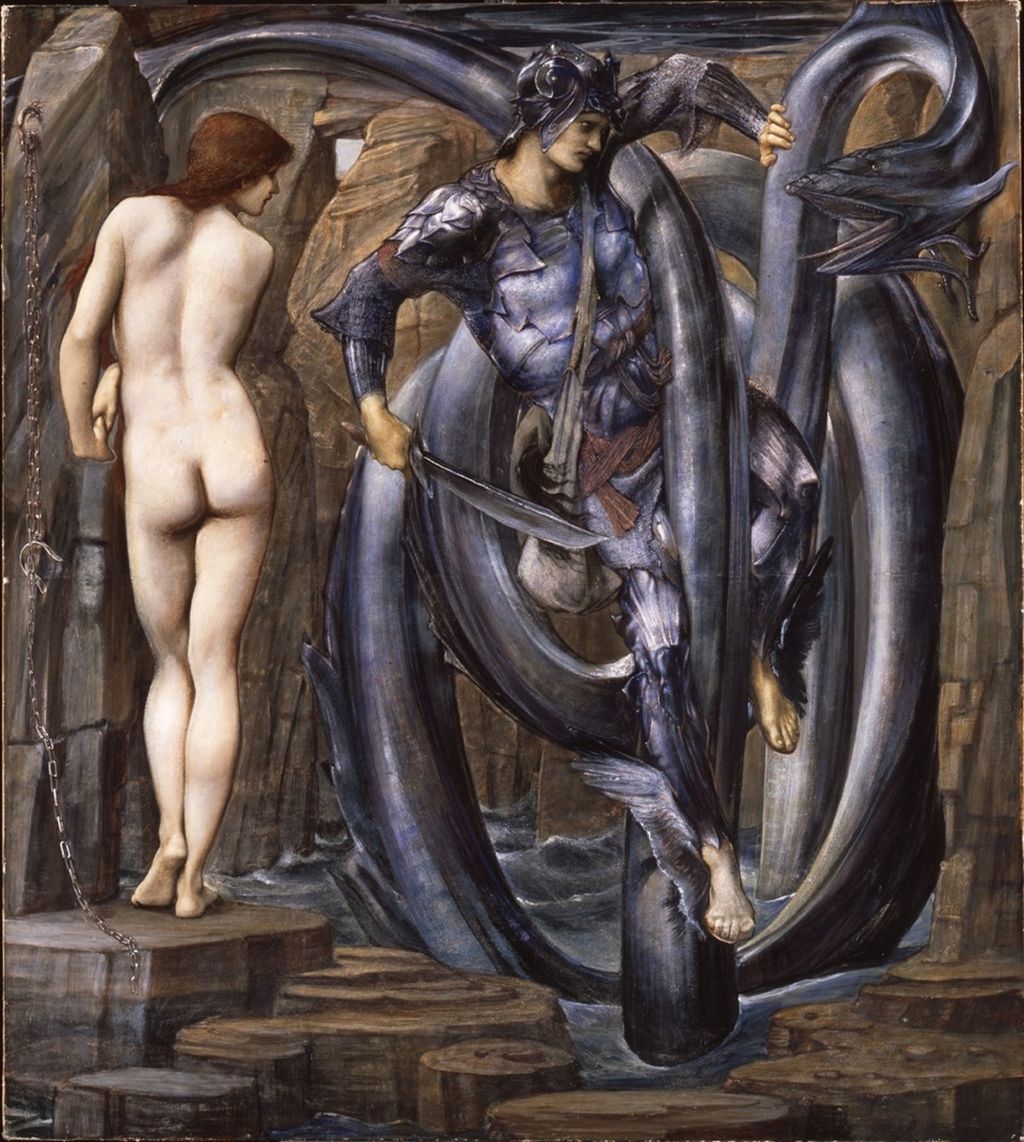
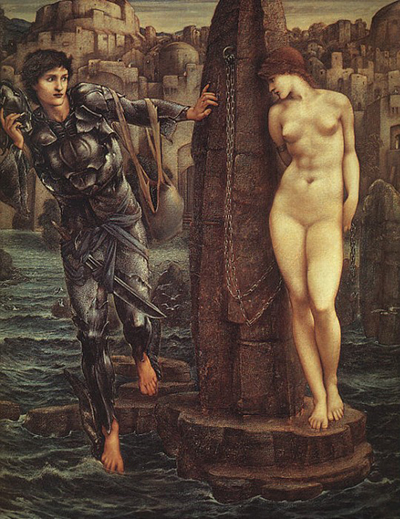
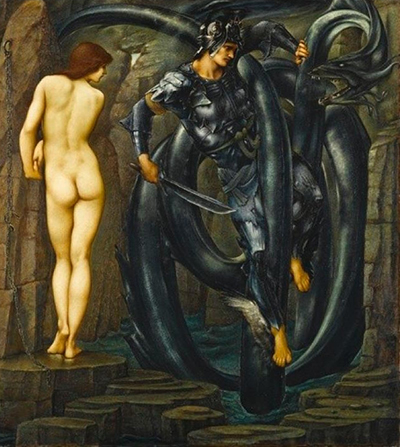
In The Rock of Doom, Andromeda is exposed and chained to a cliff. In The Doom Fulfilled, she looks on as Perseus fights the sea monster. Here her heavy cloak and the garden wall close around her. Rock has become polished stone with flowering stems at its base. A bent tree trunk occupies one edge of the painting, and apples have already fallen into the grass. There are still glimpses of light through the canopy, but the garden wall and the closely laid leaves leave little sense of a world beyond it. The story can rest here even though the hero has further adventures in Morris’s poem. [1] [3] [4] [11]
The Staatsgalerie reads the symmetry and joined hands as signs of a marriage portrait. Its guide also proposes a comparison with Adam, Eve and the serpent. The apples, the curving branches and the snakes make the association available within a Greek story. The garden’s fallen fruit and the leaf in the pool are signs of passing time in the gallery’s reading. It interprets the covered body of Andromeda in the light of Victorian morality and suggests that she finds something of herself in Medusa’s reflected face. The resemblance between the two pale faces is strongest in the well. That is where the figure whose gaze we have been following can finally be seen face on, close to the woman she has been looking at. [1]
The Gorgon’s closed eyes are a distinct choice. On a fifth-century BC terracotta roof tile in the Metropolitan Museum of Art, the face is framed for a viewer approaching it straight on. The museum describes the tile as a transitional example between fiercer archaic Gorgons and calmer later ones. Caravaggio’s painted parade shield at the Uffizi centres the wide eyes and open mouth of Medusa at the moment of the cut. In Burne-Jones the head is pale and composed, and the painter gives as much attention to the face looking at it as to Medusa herself. The comparison helps explain why the well matters. It allows the Gorgon’s face to be regarded for a long time in a story that makes the consequences of seeing it immediate. [1] [12] [13]
The last subject and the first completed canvas
Arthur Balfour commissioned the cycle in 1875 for the music room of his London home. The planned set was never completed in oil, and Burne-Jones finished its final scene before the other canvases. In his work list he recorded finishing the picture in the winter and spring of 1887. The Staatsgalerie interprets his decision to give the scene priority as an effort to establish how the cycle would come to a close. The Baleful Head was already on view at the Grosvenor Gallery in 1887, a year before Burne-Jones showed the discovery of Andromeda and the battle that are meant to come before it. [1] [4] [10] [11]
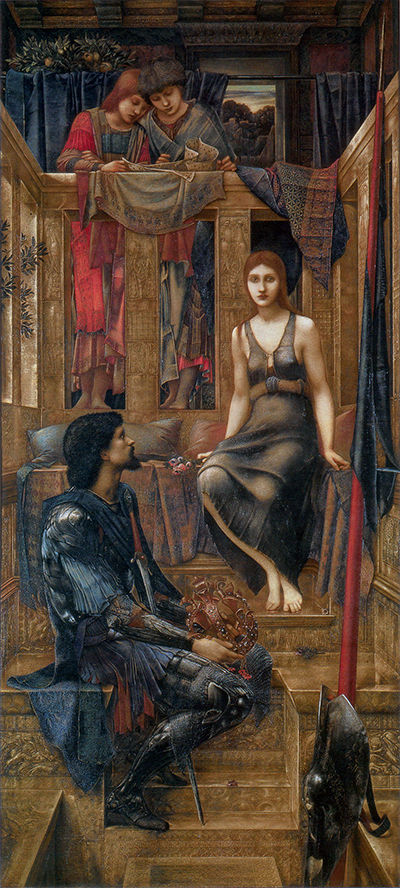
F. G. Stephens praised the harmony of design and subject in his Athenaeum coverage of the 1887 exhibition, placing the oil close to King Cophetua and the Beggar Maid and The Golden Stairs among the artist’s works. By the winter of 1898–99, Balfour lent it to the New Gallery’s memorial exhibition. Its catalogue described the encounter at the well as taking place after the marriage, while Tate’s account of the Southampton cartoon places the revelation in the courtship, closer to Morris’s poem. At the Burlington Fine Arts Club in 1899 the early scheme was exhibited separately. Its catalogue describes the last scene as a view into a pool, and in his introduction Cosmo Monkhouse questioned whether the departures from the original design had improved the painting. The issue for him was how Burne-Jones had reworked the scene between the first scheme and the exhibited oil. [7] [9] [11] [14]
The Berlin Photographic Company published a photogravure of The Baleful Head in London in 1900. An impression at the Museum of New Zealand Te Papa Tongarewa preserves the composition in ink in an image less than half a metre high. The print gave readers of the portfolio a way to inspect the closely grouped heads on a scale very different from the wall pictures for Balfour’s room. [15]
The Staatsgalerie acquired the oil in 1971 with lottery funds. The canvas now in Stuttgart and the paper design in Southampton preserve the moment when Burne-Jones settled on the raised well as the centre of the ending. Its rim gives the three faces a second frame, and its still water brings Andromeda and Medusa close enough to study together. The head has lost none of its danger in the story. The picture shows what becomes visible once Andromeda can take her time over looking at it. [1] [8]
Edward Burne-Jones, The Doom Fulfilled, full-scale design. Southampton City Art Gallery, SOTAG 106. Image source. Public domain.
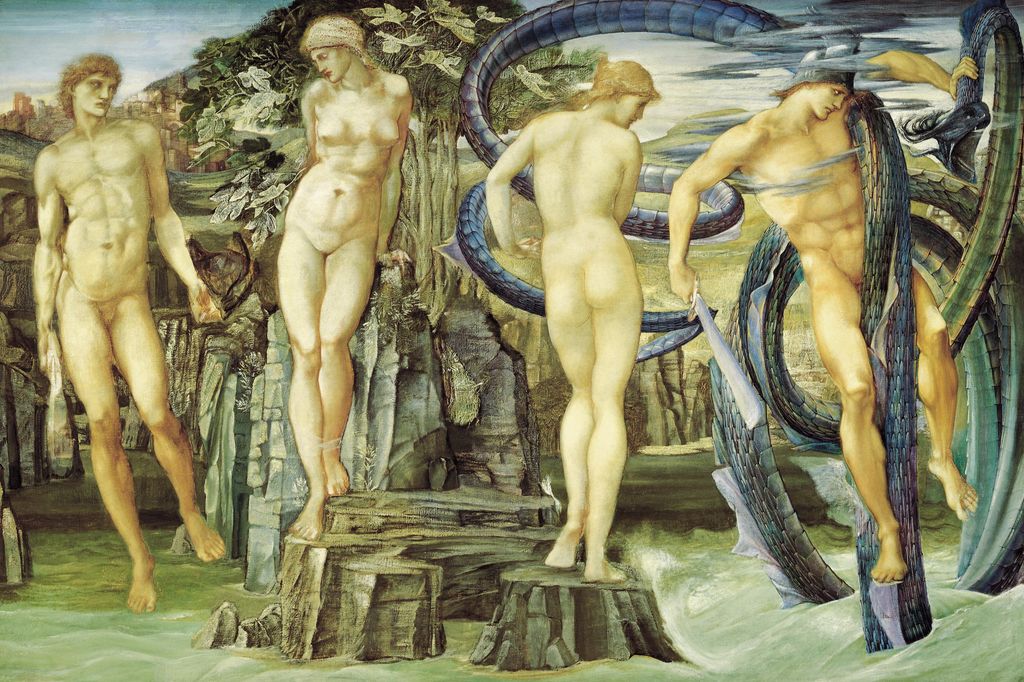
Edward Burne-Jones, Perseus and Andromeda, 1876, an unfinished painting combining the meeting and combat. Art Gallery of South Australia, 0.329. Image source. Public domain.
Related artworks
Edward Burne-Jones on film
Explore Burne-Jones’s paintings, illustrated stories and stained-glass designs.
Edward Burne-Jones: Pre-Raphaelite Visionary | Exhibitions | Showcase
A look at Burne-Jones’s paintings and the Tate retrospective.
Watch on YouTubeArtworks directory
This directory records paintings, studies, designs and collaborative works, with separate entries for documented versions and series where known.
| Name | Date | Medium |
|---|---|---|
| Sidonia von Bork 1560 | 1860 | Watercolour and bodycolour |
| Clara von Bork 1560 | 1860 | Watercolour and bodycolour |
| The Merciful Knight | 1863 | Watercolour |
| Sibylla Delphica | c. 1886 | Oil on panel |
| Phyllis and Demophoön | 1870 | Watercolour and bodycolour |
| The Legend of the Briar Rose (Buscot series) | 1870s–1890 | Oils on canvas |
| The Briar Wood (Buscot series) | By 1890 | Oil on canvas |
| The Council Chamber (Buscot series) | By 1890 | Oil on canvas |
| The Garden Court (Buscot series) | By 1890 | Oil on canvas |
| The Rose Bower (Buscot series) | By 1890 | Oil on canvas |
| Group of Women, study for The Golden Stairs | 1872 | Drawing |
| The Beguiling of Merlin | 1870s | Oil on canvas |
| The Perseus Cycle | From 1875 | Paintings and full-scale designs |
| The Call of Perseus (Stuttgart) | From 1875 | Oil painting |
| Perseus and the Graeae (Stuttgart) | From 1875 | Oil painting |
| The Rock of Doom (Stuttgart) | 1884–88 | Oil on canvas |
| The Doom Fulfilled (Stuttgart) | 1888 | Oil on canvas |
| The Baleful Head (Stuttgart) | 1885–87 | Oil on canvas |
| The Baleful Head (Southampton design) | 1880s | Bodycolour |
| The Rock of Doom (Southampton design) | 1880s | Bodycolour |
| The Doom Fulfilled (Southampton design) | 1880s | Bodycolour |
| The Mirror of Venus (Gulbenkian) | 1870s | Oil on canvas |
| Drawing associated with The Mirror of Venus | 1870s | Drawing |
| Laus Veneris (Laing) | 1873–78 | Oil on canvas |
| The Days of Creation | 1870s | Watercolour and bodycolour |
| The Golden Stairs | 1880 | Oil on canvas |
| An Angel Playing a Flageolet | 1878 | Watercolour, bodycolour and gold |
| The Tree of Forgiveness | 1881–82 | Oil on canvas |
| The Wheel of Fortune (Orsay) | 1875–83 | Oil on canvas |
| King Cophetua and the Beggar Maid | 1884 | Oil on canvas |
| The Depths of the Sea (oil) | 1886 | Oil |
| The Morning of the Resurrection | 1886 | Oil on panel |
| Study for the Head of Mary Magdalene | c. 1882 | Oil study |
| The Sleep of King Arthur in Avalon | 1880s–1898 | Oil on canvas |
| The Sleep of King Arthur in Avalon (modello) | ca. 1881 | Oil on canvas (modello) |
| The Star of Bethlehem | Signed 1890 | Watercolour and bodycolour |
| Study for The Star of Bethlehem | About 1887–91 | Drawing |
| Sponsa de Libano | 1891 | Watercolour and bodycolour |
| The Summons (Holy Grail tapestries) | 1890s | Tapestry |
| The Failure of Sir Gawaine (Holy Grail tapestries) | 1890s | Tapestry |
| Hope (Boston) | 1896 | Oil on canvas |
| La Belle au bois dormant (theatre programme) | 1894 | Collotype |
| The Wedding of Psyche | 1895 | Oil on canvas |
| The Works of Geoffrey Chaucer (Kelmscott edition) | 1896 | Illustrated book |
| The Ascension (Birmingham Cathedral) | 1885 | Stained glass |
| The Last Judgement (Birmingham Cathedral) | 1897 | Stained glass |
| Adoration of the Magi (Huntington) | 1890s | Tapestry |
| Love among the Ruins (Wightwick) | 1894 | Oil on canvas |
| The Merciful Knight (photogravure after Burne-Jones) | 1900 | Photogravure |
| The Garden Court (preparatory work) | 1870–75 | Graphite and watercolour with white gouache |
| Study of a Female Figure | 1885 | Graphite drawing |
| Psyche Throwing Herself into the River | 1865–68 | Wood engraving |
| Beauty | 1887–89 | Colour lithograph |
| Study for the Failure of Gawain | 1893 | Crayon and graphite on Japanese paper |
| The Prince Enters the Briar Wood (after Burne-Jones) | After 1890 | Photogravure |
| The Rose Bower (after Burne-Jones) | 1892 | Photogravure |
| Adoration of the Magi (Musée d’Orsay) | 1904 | Tapestry |
| Answers to Prayer (Lyndhurst) | 1860s | Stained glass |
| The Depths of the Sea (photogravure after Burne-Jones) | 1900 | Photogravure |
| Perseus and Andromeda (Adelaide composite) | 1876 | Oil on canvas |
| The Adoration of the Magi (Hamburg) | Woven 1900 | Tapestry |
| Love leading the Pilgrim through the Briars | 1874–76 | Embroidery |
| Musica (worked by Lady Jane Cory) | 1906 | Embroidery |
| Pomona (worked by Lady Jane Cory) | 1907 | Embroidery |
| Flora (worked by Lady Jane Cory) | 1909 | Embroidery |
| The Fourth Day of Creation (photogravure after Burne-Jones) | 1900 | Photogravure |
| The Morning of the Resurrection (photogravure after Burne-Jones) | 1900 | Photogravure |
| Musical angels of the St Catherine window (Christ Church) | Designed 1877 | Stained glass |
Discussion
Look again at the images and ideas explored in The Baleful Head by Edward Burne-Jones. These editorial prompts invite your observations.
Reader Insights
Why might Burne-Jones have ended the series with an act of looking?
What changes when you trace Medusa’s face from the garden into the well?
Join the Conversation
Share a detail, comparison or question about The Baleful Head by Edward Burne-Jones below.
References
- Staatsgalerie Stuttgart, The Baleful Head (Das Schreckenshaupt), inventory 3110, oil on canvas, 1885–87, gallery guide, reproduction and acquisition credit. View source.
- Pseudo-Apollodorus, Library, 2.4.2–3, translated by James George Frazer, shield, beheading and Phineus. View source.
- William Morris, “The Doom of King Acrisius,” The Earthly Paradise, 1868, pp. 274–77, fight, rescue and the tide pool, and pp. 286–91, wedding and Phineus. View source.
- Southampton City Art Gallery, The Perseus Series, introduction, Balfour’s 1875 commission and full-size cartoons. View source.
- Dante Gabriel Rossetti, Aspecta Medusa, c. 1865, drawing and related poem, Rossetti Archive object record and commentary. View source.
- Fabian Fröhlich, Frauen im Spiegel. Der Perseus-Zyklus von Edward Burne-Jones, 2009, section 8.1, “Aspecta Medusa,” pp. 373–82, and section 8.3, “Hortus conclusus,” pp. 386 ff. View source.
- Stephen Wildman and John Christian, Edward Burne-Jones: Victorian Artist-Dreamer, 1998, cat. no. 97, reproduced by the Burne-Jones Catalogue Raisonné, including the V&A sketches and Athenaeum, 30 April and 7 May 1887, pp. 584 and 613. View source.
- Southampton City Art Gallery, The Baleful Head, accession SOTAG 108, collection record and reproduction. View source.
- Tate Britain, Edward Burne-Jones exhibition large-print guide, 2018, p. 109, no. 10, The Baleful Head, Southampton cartoon, loan reference X64590. View source.
- Edward Burne-Jones, Fitzwilliam Museum work list, 1884–85 and 1887 entries, transcribed in the Burne-Jones Catalogue Raisonné’s entry on The Death of Medusa I. View source.
- New Gallery, Exhibition of the Works of Sir Edward Burne-Jones, Bart., 1898–99, pp. 65–68, entries 115, 117, 118 and 120. View source.
- The Metropolitan Museum of Art, Terracotta gorgoneion antefix (roof tile), Greek, South Italian, Tarentine, 20.215, collection record. View source.
- Gallerie degli Uffizi, Sguardi dal mondo, Caravaggio’s Scudo con testa di Medusa and its portrayal of the instant of the beheading. View source.
- Burlington Fine Arts Club, Exhibition of Drawings and Studies by Sir Edward Burne-Jones, Bart., 1899, introduction by W. Cosmo Monkhouse, p. xv, and p. 25, cat. no. 118, design no. 10. View source.
- Museum of New Zealand Te Papa Tongarewa, The Baleful Head, from the portfolio The Work of E. Burne-Jones, published in London in 1900, 1981-0086-1/71. View source.