 by Tom Gurney
Tom Gurney BSc (Hons) is an art history expert with over 20 years experience
Published on June 19, 2020 / Updated on November 25, 2026
Email: tomgurney1@gmail.com / Phone: +44 7429 011000
The Star of Bethlehem: Introduction
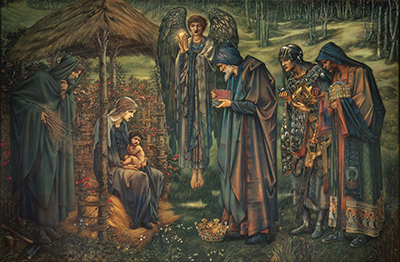
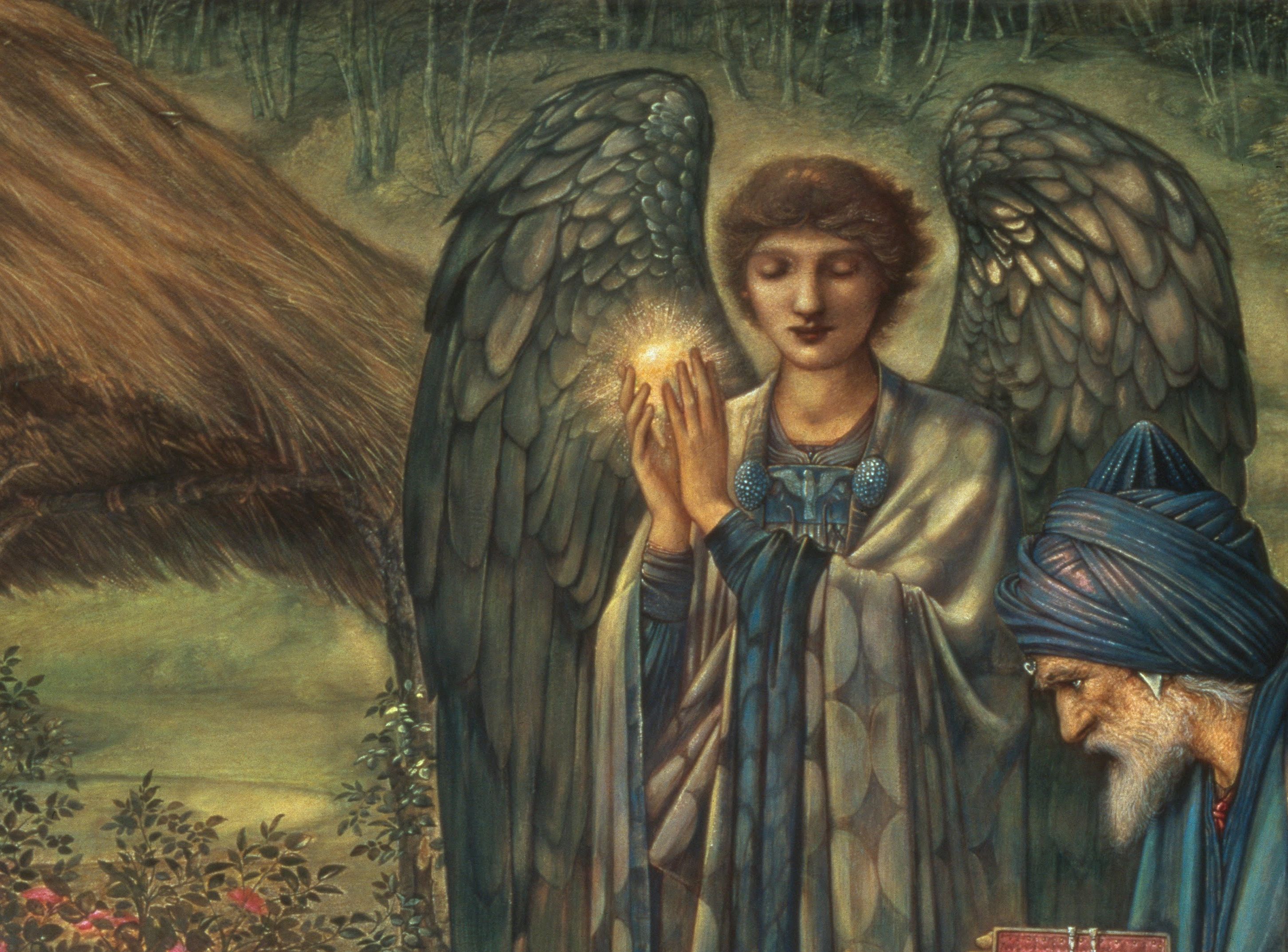
In Edward Burne-Jones’s The Star of Bethlehem, the light that guided the Magi fits between an angel’s hands. The angel floats above a meadow, between the barefoot child on Mary’s lap and the richly dressed visitors who have come to honour him. At nearly four metres wide, the watercolour is large enough for these figures to meet us on a human scale. The small flare of gold that gives the painting its title is easily overlooked beside the glitter of the kings’ clothes and gifts. Birmingham Museums photographed the artist’s initials and the date 1890 when the painting came out of its outer frame for conservation in 2022. [1]
The painting belongs to Birmingham Museum & Art Gallery, where it is recorded as 1891P75. The museum dates the commission and making of the work to 1887–1891. The dated signature and the later year in the museum’s record follow different events in the life of the painting. Birmingham commissioned it in 1887, Burne-Jones signed it in 1890, and it went on public exhibition and entered the city’s collection in 1891. The composition grew from an earlier commission for a tapestry at Exeter College, Oxford, whose first weaving was completed in 1890. [2] [3] [4]
At a Glance
- ArtistEdward Burne-Jones
- DateSigned 1890
- MediumWatercolour and bodycolour
- SubjectBirmingham’s large watercolour
This work across Edward Burne-Jones’s career
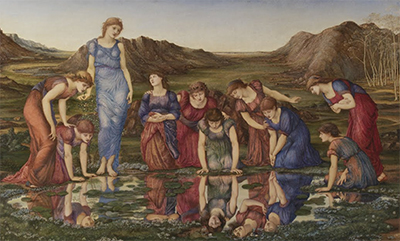
The Mirror of Venus
1870sThe Wheel of Fortune
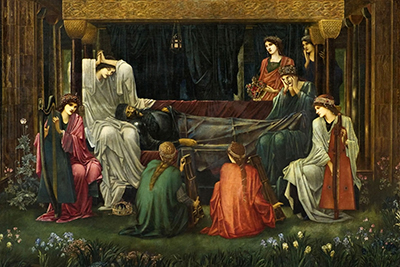
1875–83The Last Sleep of Arthur in Avalon
1880s–1898The Star of Bethlehem (current article)
Signed 1890Contents
- The angel and the three kings
- Two commissions for one composition
- Drawing the figures and painting at full scale
- Exhibition and conservation in Birmingham
- Annotated details
The angel and the three kings
In Matthew’s Gospel, Magi travel from the East after seeing a star. They find Mary and her child in a house and offer gold, frankincense and myrrh. Matthew gives neither their number nor their names. The three kings of Western art belong to a tradition that grew around the gifts. An early Birmingham gallery catalogue connected Burne-Jones’s choice of figures with the medieval legend of the Three Kings of Cologne, which gave the travellers names and kingdoms and followed the story of their relics beyond Bethlehem. [5] [6]
Here the visitors form a procession across the right side of the meadow. The oldest bends forward with an open casket, his crown set down among the flowers near his feet. The young king behind him, wearing armour, carries a vessel in his left hand and holds a small object in his right. Balthazar brings up the rear, his hands gathered around an ornate container. The line of figures slows at the angel and comes to rest with Mary and the child. The star occupies a patch of shadow beside the angel’s face, while the crown catches light low down in the grass. Following that glint from the ground to the angel’s hands shows how carefully Burne-Jones placed small highlights within the dark greens and blues of the larger composition. [2] [3]
To the left, a rough shelter of thatch and woven branches frames the Holy Family. A strut rises beside Mary’s seat and divides her from Joseph. He has a handful of straw and bends forward, his raised hand close to his chin. Mary looks down towards the child as he turns his head to watch the visitors. The fullness of the child’s cheek, the tucked-up feet and the grasp of Mary’s supporting hand are easier to see once the eye settles on this part of the painting. The surrounding figures hold themselves with the formality of a ceremony. The child’s twisting posture introduces a fleeting movement into that stillness. [2] [7]
The crowd in Sandro Botticelli’s fifteenth-century Adoration of the Magi brings Florentine society into the biblical story. Figures gather on both sides of a centrally placed Holy Family, and real patrons take on roles within the scene. Burne-Jones gives his three travellers a clear stretch of ground and approaches the child from one side. The comparison helps explain the prominence of the angel in Birmingham. Its wings rise almost to the upper edge and mark a division within the procession, leaving Joseph, Mary and the child in their own pocket of space. [8] [2]
Two commissions for one composition
In 1886 Exeter College rector John Prideaux Lightfoot approached William Morris about a tapestry for the college chapel. Morris and Burne-Jones had both studied at Exeter. Lightfoot proposed the Adoration, and Morris’s correspondence records his readiness to take it on and Burne-Jones’s agreement to design it. In 1887 the Corporation of Birmingham approached the artist for a substantial work for its new municipal gallery. Birmingham was his birthplace and had recently made a fresh claim on his attention through the Royal Birmingham Society of Artists, which elected him honorary president in 1885. Burne-Jones took the opportunity to develop the Adoration as a large independent watercolour for the city. The catalogue raisonné puts the Birmingham commission at £2,000. [4] [3]
The different works on paper show what each commission required. A small watercolour over graphite in the Huntington, dated before 1888, sets out the figures against a wooded background and flowered foreground. The Huntington suggests that Morris & Co. could show this kind of presentation design to prospective clients. A separate design previously in the artist’s family is associated with the 1888 Exeter tapestry entry in Burne-Jones’s account with the firm. Its probable enlargement survives at the Victoria and Albert Museum, where the 1888 cartoon measures 240 by 376 centimetres. Four sheets of photographic paper were joined and worked over in watercolour and bodycolour. The photograph enlarged the design to working size, and the painted reworking sharpened what the weavers had to follow. [9] [3] [10]
The V&A’s cartoon shows how much of the tapestry remained to be designed. The figures, folds and thatched shelter stand out against a largely unworked setting. The museum traces the crown on the ground in this cartoon to the one worn by the Virgin in the Van Eyck brothers’ Ghent Altarpiece, which Burne-Jones had sketched. The crown turns a borrowed detail into part of the action. A king has taken it off before the child, whom the crown also evokes as a sovereign. Morris worked on the ornamental scheme, while the attribution of the flowered ground, background and borders in later weavings records the part played by John Henry Dearle. Morris & Co.’s Merton Abbey workshop then had to build the whole scene in thread. [10] [11] [12]
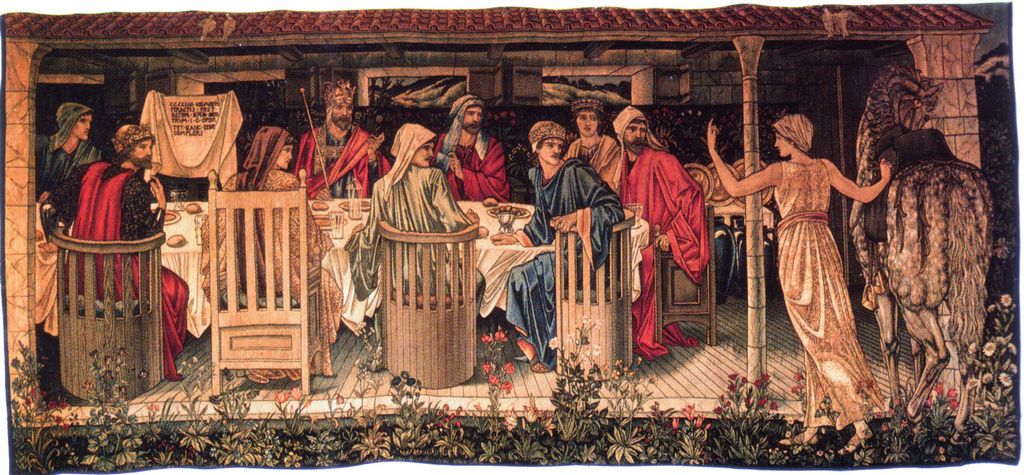
The first Adoration of the Magi tapestry was finished in February 1890, shown at Morris & Co.’s Oxford Street premises that Easter and delivered to Exeter College. Subsequent commissions carried the design into other chapels, public collections and private homes. Manchester’s weaving of 1894 was the third, commissioned by the calico printer William Simpson and given to the city. In 2012 the Mitsubishi Ichigokan Museum in Tokyo exhibited that Manchester tapestry and recorded it as the largest object it had borrowed up to that point. The Hamburg museum’s weaving dates from 1900 and was acquired at that year’s Paris exhibition. The Musée d’Orsay’s example, woven in 1904 for Guillaume Mallet’s house at Bois des Moutiers, shows how long the design remained in production after Burne-Jones’s death. Its wool and silk were woven on a cotton foundation. [3] [13] [14] [12] [11]
Other versions illustrate how patrons placed the composition. At Eton the weaving presented by Henry Elford Luxmoore in 1895 became the central panel of a three-part chapel arrangement, and his name is woven into its upper inscription. The Australian businessman George Brookman saw Morris & Co.’s work at the 1900 Paris exhibition and commissioned an Adoration directly from the firm. Four artisans took two years to execute it. The tapestry arrived in Adelaide in 1902 and hung in his home. The artist’s tapestry designs depended on just this capacity of the workshop to adapt a figure composition to another patron, surround and setting. [15] [16]
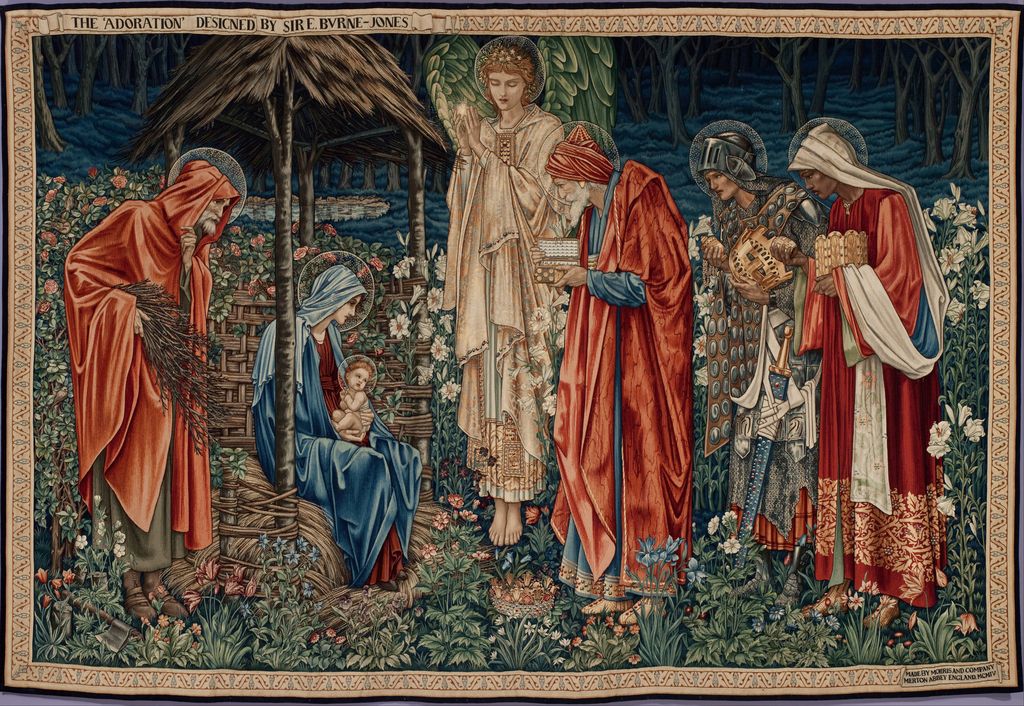
The Adoration of the Magi, tapestry designed by Edward Burne-Jones with William Morris and John Henry Dearle, woven by Morris & Co. Musée d’Orsay version. Image source. Public domain.
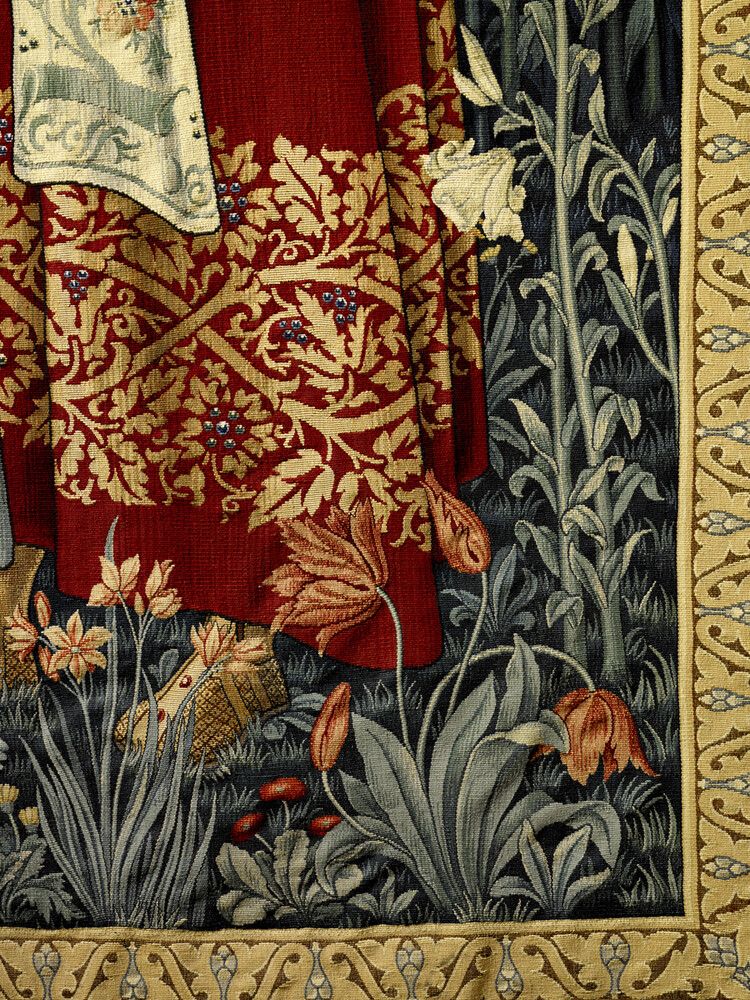
Gold-patterned robe, woven flowers and border in The Adoration of the Magi, detail of the 1900 Morris & Co. tapestry. Museum für Kunst und Gewerbe Hamburg, 1901.136. Image source. Public domain.
Drawing the figures and painting at full scale
Joseph’s small chalk study at Aberdeen is an unusually direct way into the picture. His beard and his inclined head are already defined, and the folds of his garment fall in broad ridges. The fingers of his raised hand work against those descending lines. At full scale the shelter places him at the edge of the gathering, where a viewer may miss that gesture at first. The drawing makes it possible to follow the same pose before it is partly absorbed into the dark paint and vegetation. Aberdeen links the sheet to the tapestry or the watercolour. The figure could serve both designs, and the collection record leaves the precise destination open. [7]
Other preparations worked at different scales. The catalogue raisonné links three small black-chalk compositions in Cincinnati and a V&A sketchbook with the early development of the scene. It also records seven figure studies from 1887, in coloured chalks on brown paper with gold accents, including one of Balthazar in Birmingham. In 1898–99 the New Gallery’s memorial exhibition listed separate studies of Balthazar, Joseph and Melchior. A surviving drawing of a baby in red and white chalk belongs to another stage of observation. The little body in the final painting differs from the child in the working tapestry design. The evidence of the studies helps explain how Burne-Jones could retain the broad placement of the figures while giving a fresh turn and weight to the child at the centre of their attention. [3] [17] [18]
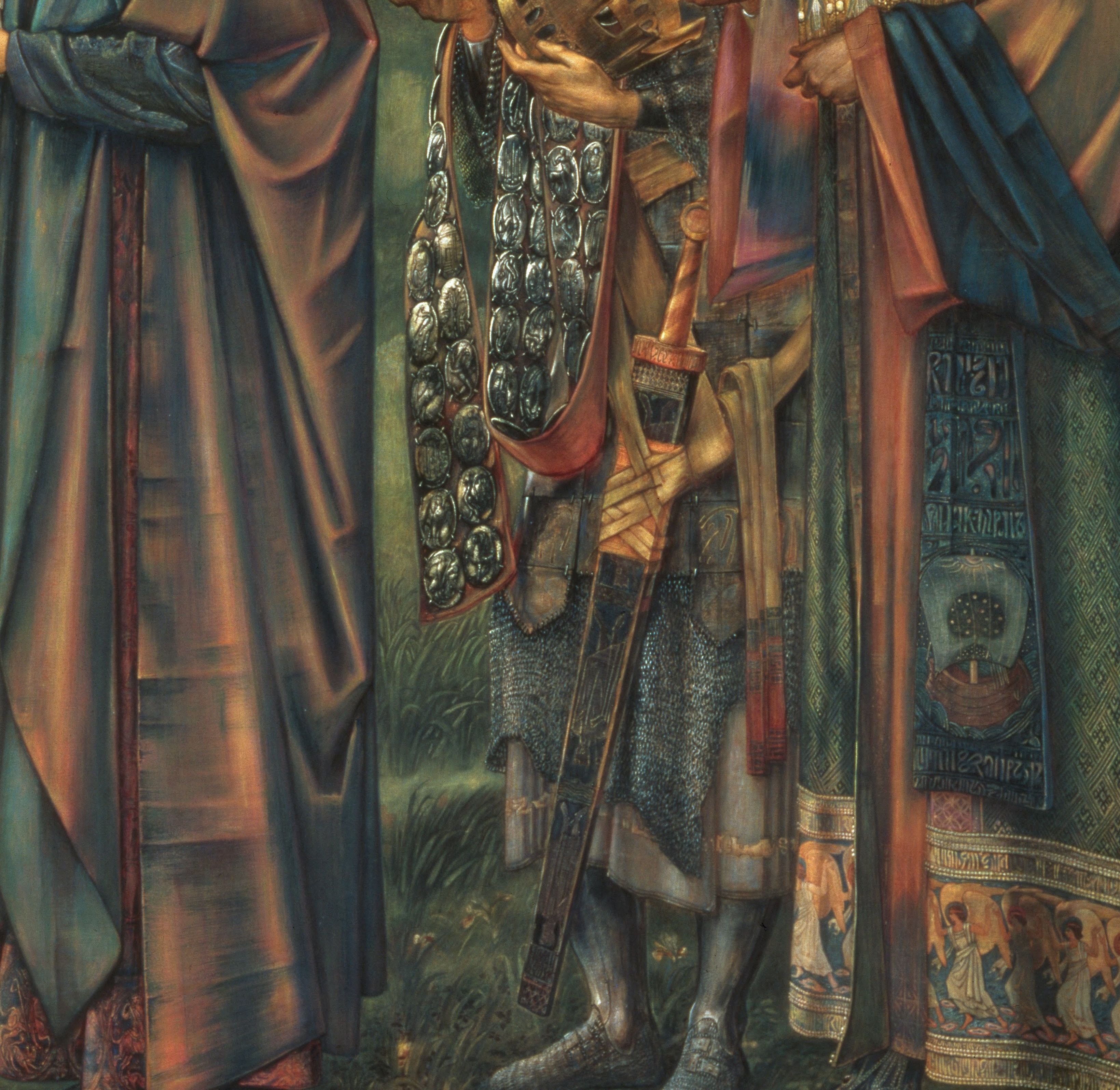
For the Birmingham picture, Burne-Jones used ten sheets of Whatman paper mounted on canvas. The catalogue records watercolour and bodycolour, the latter giving more opaque passages, and areas worked by scraping. Painting took place in the garden studio at the Grange. Burne-Jones described the tiring climb up and down his steps and joked that he had already travelled as far as his kings. The scale of that effort is apparent in the painting’s range of detail. From a distance, the sweep of the oldest king’s cloak guides the eye through the group. Close up, the younger king has small medallions that can be read individually, and Balthazar’s hem carries a band of patterned figures. The catalogue also notes a ship motif and links the painted lettering to historical Kufic examples. [3] [2]
The space between the figures opens into the landscape. A winding clearing recedes behind the kings, and the bare trunks of the wood mark its undulations. Underfoot the fine points of white and yellow suggest flowers at different distances. In the Hamburg tapestry, the brightly patterned flowers, dense foliage and patterned border pull the eye back to the plane of the cloth. Both works make much of repeated plant forms. Their different grounds give the figures a distinct setting in each medium. The textile makes them part of a dense field of interlocking patterns, while paint lets the meadow and forest soften into a continuous space behind them. [2] [12]
Exhibition and conservation in Birmingham
The New Gallery in London showed the watercolour in spring 1891. It then travelled to Birmingham, where it took centre stage in a loan exhibition of Pre-Raphaelite work that opened on 2 October with an address by Morris. The city acquired the painting that year through the Art Gallery Purchase Fund. Among its later appearances were the 1998–99 Birmingham retrospective and the 2007 exhibition Hidden Burne-Jones, devoted to the museum’s works on paper. [3]
A reviewer in the Art Journal compared the angel to a figure from a French Gothic cathedral endowed with life. An early municipal catalogue drew readers’ attention to the blue, green and russet of its robes and to wings that almost blended into the landscape. These readings pick out different qualities in the same figure, whose upright, sculptural pose is set against delicately worked feathers and subdued colour. [3] [6]
Birmingham Museums’ conservation team believes the painting had last been out of its outer frame around the time it moved into Gallery 14, about 1912. In 2022 scaffolding, chains and pulleys allowed the team to ease the framed work from the wall onto a specially built A-frame. The Victorian plate glass was secured with tape before removal to protect both the painting and the people working around it. Inside the outer frame, conservators found a close-fitting box-like surround. Inspecting the back would have meant dismantling that enclosure and risking damage. They could examine the painted surface, including the vertically arranged initials and date at the lower right. [1]
The museum’s annual report records small tears along the top edge, caused by the weight of the painting and repaired with Japanese tissue. The frame’s joints were strengthened and its gilding touched in. The recess that holds the glazing was enlarged to create space between the painted surface and the new acrylic, which can flex. Conservation Team Leader Jane Thompson-Webb reported that the frame measures approximately 2.9 by 4.2 metres and that the work had to be done on site over several weeks. The museum’s photograph taken after treatment and before reglazing records the whole image in that brief interval. The condition of the paper at the top edge and the inscription near the bottom tell complementary parts of the same story. One records what a century at this scale did to the support. The other preserves the date Burne-Jones gave the picture that Birmingham has cared for since 1891. [19] [20] [2]
Annotated Details from The Star of Bethlehem
The numbered points identify visible features discussed in this article. Return from each detail to the numbered overview. Edward Burne-Jones, The Star of Bethlehem. Birmingham Museums Trust. Image source. Public domain.
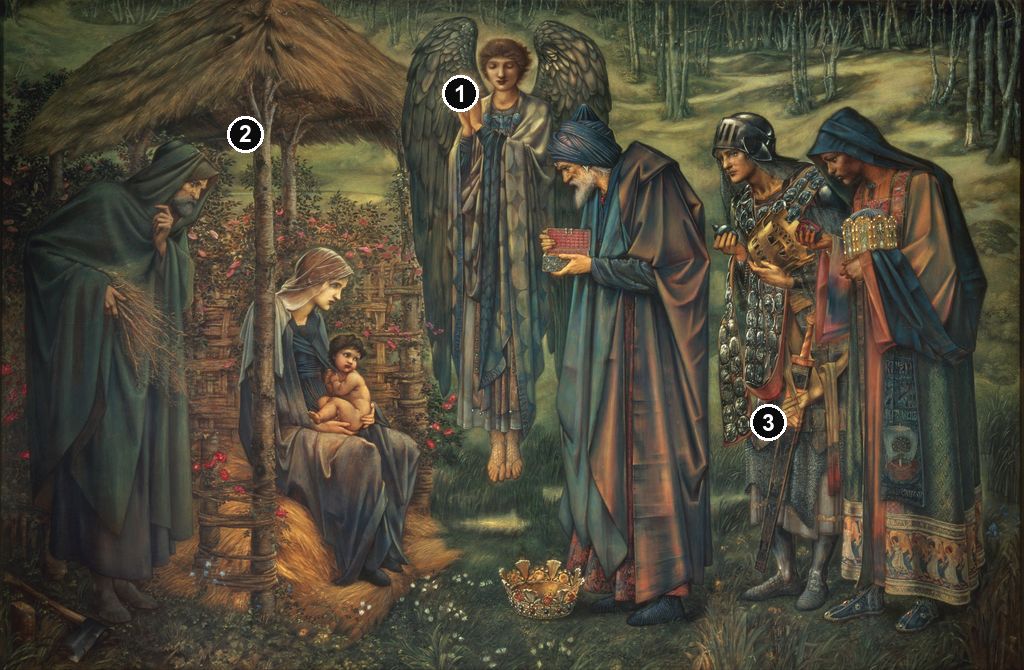
Details from THE STAR OF BETHLEHEM
Compare the cropped details with the source images above. Notice how their colours, shapes and positions contribute to the larger compositions.
The angel and star
The star is held close to the angel rather than high in the sky. It occupies the interval between the visitors and the shelter.
The shelter
The shelter’s sloping roof leaves room for a dark pocket around the mother and child. Fine marks colour its edge.
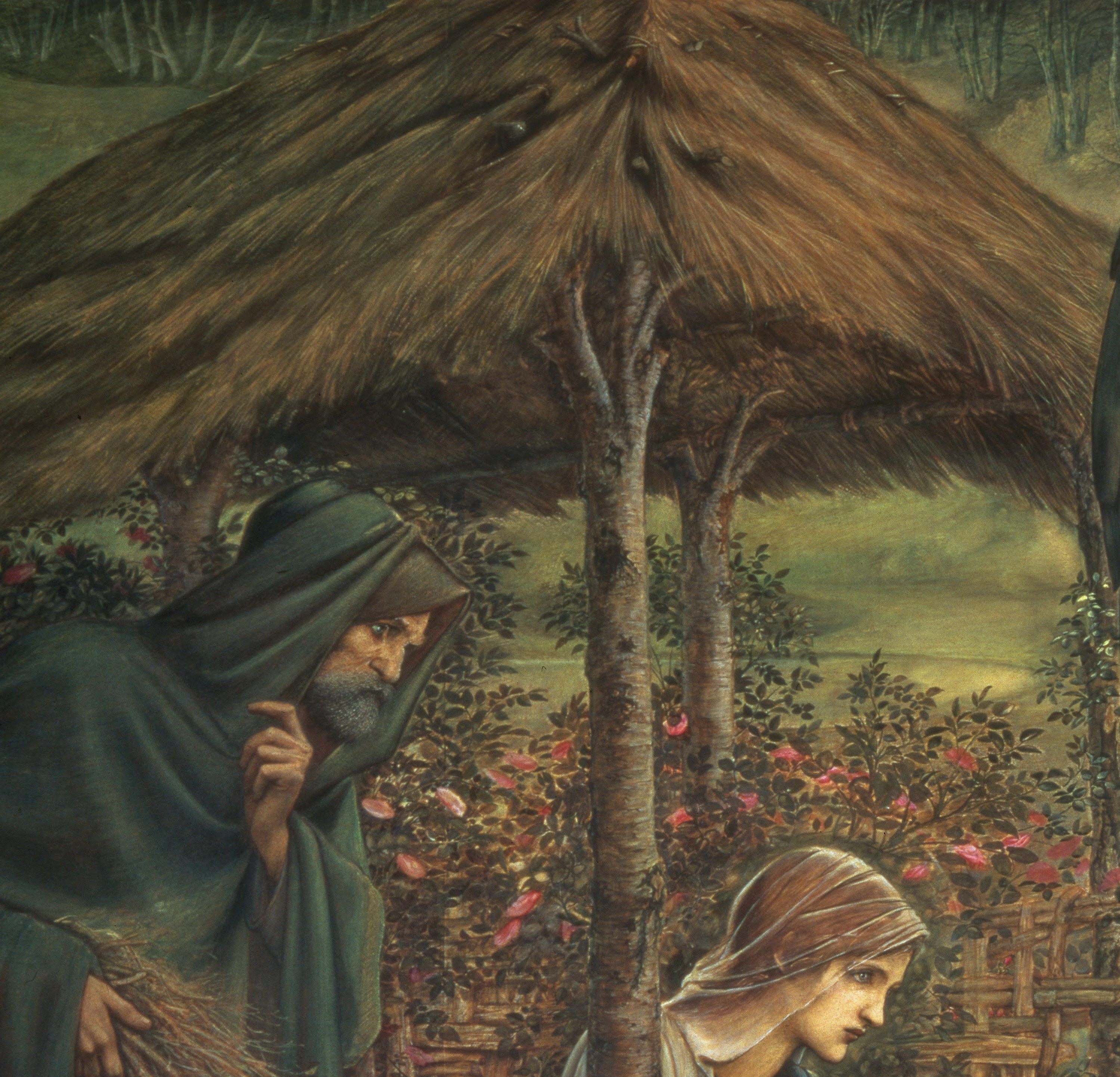
Patterns on robes
Pattern breaks up the visitors’ robes into repeated touches. The heavy fall of the cloth stays visible underneath.
A curator’s look at The Star of Bethlehem
Victoria Osborne discusses the Birmingham watercolour.
Birmingham Museums Trust. The film places the large work on paper in the context of Burne-Jones’s designs and the museum’s collection. Watch on YouTube.
Related artworks
Artworks directory
This directory records paintings, studies, designs and collaborative works, with separate entries for documented versions and series where known.
| Name | Date | Medium |
|---|---|---|
| Sidonia von Bork 1560 | 1860 | Watercolour and bodycolour |
| Clara von Bork 1560 | 1860 | Watercolour and bodycolour |
| The Merciful Knight | 1863 | Watercolour |
| Sibylla Delphica | c. 1886 | Oil on panel |
| Phyllis and Demophoön | 1870 | Watercolour and bodycolour |
| The Legend of the Briar Rose (Buscot series) | 1870s–1890 | Oils on canvas |
| The Briar Wood (Buscot series) | By 1890 | Oil on canvas |
| The Council Chamber (Buscot series) | By 1890 | Oil on canvas |
| The Garden Court (Buscot series) | By 1890 | Oil on canvas |
| The Rose Bower (Buscot series) | By 1890 | Oil on canvas |
| Group of Women, study for The Golden Stairs | 1872 | Drawing |
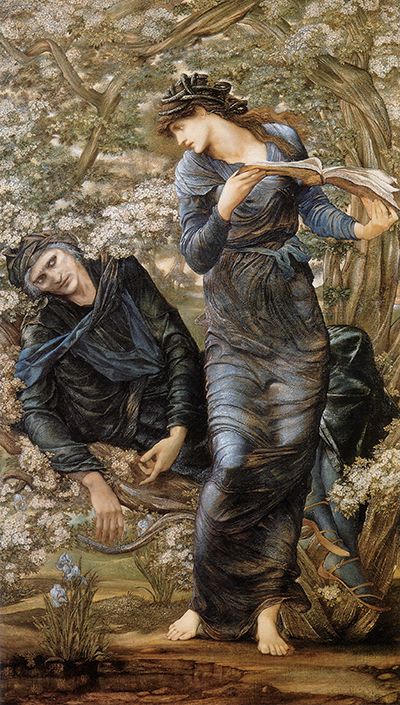
| The Beguiling of Merlin | 1870s | Oil on canvas |
| The Perseus Cycle | From 1875 | Paintings and full-scale designs |
| The Call of Perseus (Stuttgart) | From 1875 | Oil painting |
| Perseus and the Graeae (Stuttgart) | From 1875 | Oil painting |
| The Rock of Doom (Stuttgart) | 1884–88 | Oil on canvas |
| The Doom Fulfilled (Stuttgart) | 1888 | Oil on canvas |
| The Baleful Head (Stuttgart) | 1885–87 | Oil on canvas |
| The Baleful Head (Southampton design) | 1880s | Bodycolour |
| The Rock of Doom (Southampton design) | 1880s | Bodycolour |
| The Doom Fulfilled (Southampton design) | 1880s | Bodycolour |
| The Mirror of Venus (Gulbenkian) | 1870s | Oil on canvas |
| Drawing associated with The Mirror of Venus | 1870s | Drawing |
| Laus Veneris (Laing) | 1873–78 | Oil on canvas |
| The Days of Creation | 1870s | Watercolour and bodycolour |
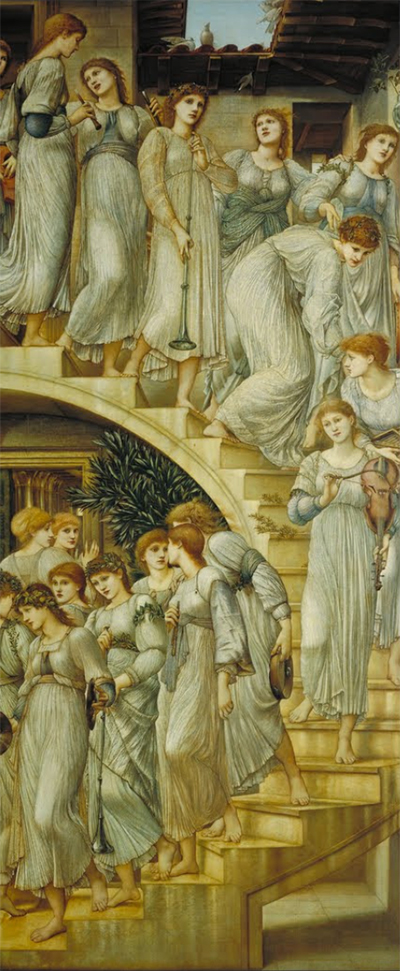
| The Golden Stairs | 1880 | Oil on canvas |
| An Angel Playing a Flageolet | 1878 | Watercolour, bodycolour and gold |
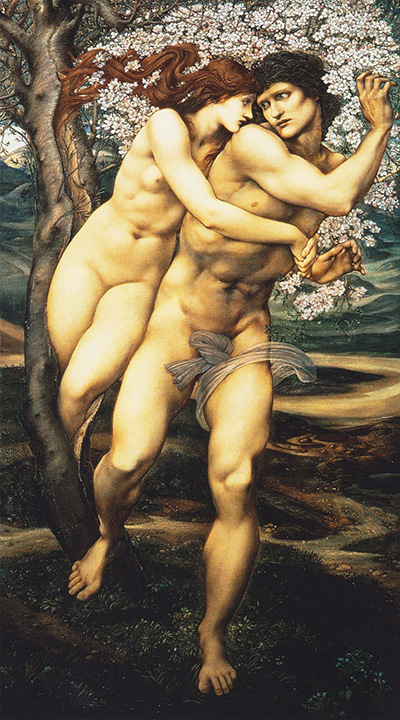
| The Tree of Forgiveness | 1881–82 | Oil on canvas |
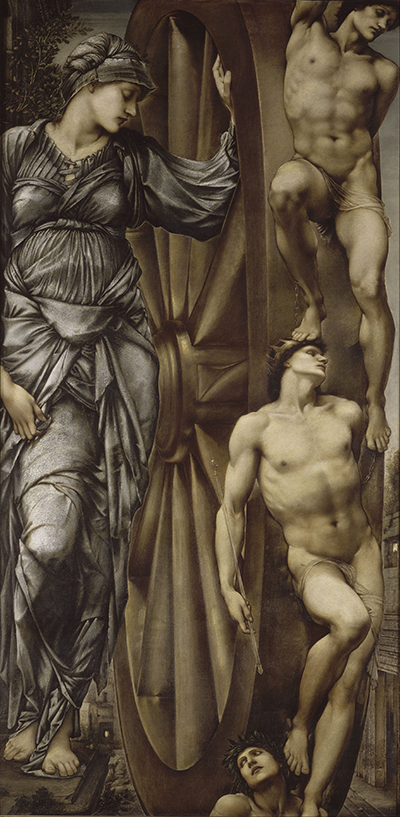
| The Wheel of Fortune (Orsay) | 1875–83 | Oil on canvas |
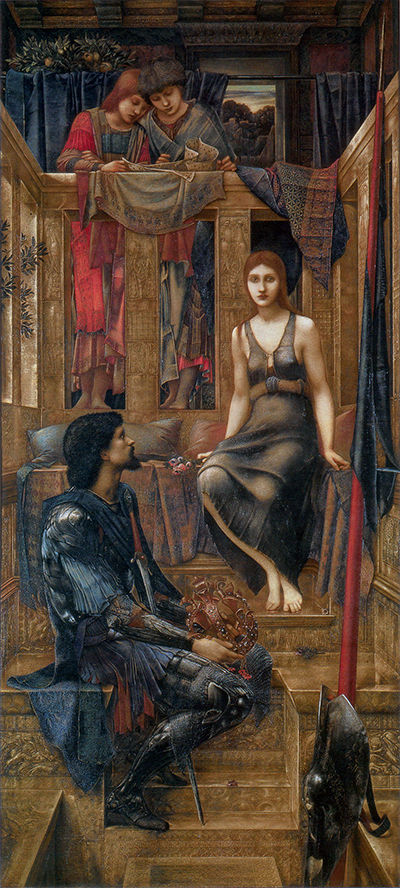
| King Cophetua and the Beggar Maid | 1884 | Oil on canvas |
| The Depths of the Sea (oil) | 1886 | Oil |
| The Morning of the Resurrection | 1886 | Oil on panel |
| Study for the Head of Mary Magdalene | c. 1882 | Oil study |
| The Sleep of King Arthur in Avalon | 1880s–1898 | Oil on canvas |
| The Sleep of King Arthur in Avalon (modello) | ca. 1881 | Oil on canvas (modello) |
| The Star of Bethlehem | Signed 1890 | Watercolour and bodycolour |
| Study for The Star of Bethlehem | About 1887–91 | Drawing |
| Sponsa de Libano | 1891 | Watercolour and bodycolour |
| The Summons (Holy Grail tapestries) | 1890s | Tapestry |
| The Failure of Sir Gawaine (Holy Grail tapestries) | 1890s | Tapestry |
| Hope (Boston) | 1896 | Oil on canvas |
| La Belle au bois dormant (theatre programme) | 1894 | Collotype |
| The Wedding of Psyche | 1895 | Oil on canvas |
| The Works of Geoffrey Chaucer (Kelmscott edition) | 1896 | Illustrated book |
| The Ascension (Birmingham Cathedral) | 1885 | Stained glass |
| The Last Judgement (Birmingham Cathedral) | 1897 | Stained glass |
| Adoration of the Magi (Huntington) | 1890s | Tapestry |
| Love among the Ruins (Wightwick) | 1894 | Oil on canvas |
| The Merciful Knight (photogravure after Burne-Jones) | 1900 | Photogravure |
| The Garden Court (preparatory work) | 1870–75 | Graphite and watercolour with white gouache |
| Study of a Female Figure | 1885 | Graphite drawing |
| Psyche Throwing Herself into the River | 1865–68 | Wood engraving |
| Beauty | 1887–89 | Colour lithograph |
| Study for the Failure of Gawain | 1893 | Crayon and graphite on Japanese paper |
| The Prince Enters the Briar Wood (after Burne-Jones) | After 1890 | Photogravure |
| The Rose Bower (after Burne-Jones) | 1892 | Photogravure |
| Adoration of the Magi (Musée d’Orsay) | 1904 | Tapestry |
| Answers to Prayer (Lyndhurst) | 1860s | Stained glass |
| The Depths of the Sea (photogravure after Burne-Jones) | 1900 | Photogravure |
| Perseus and Andromeda (Adelaide composite) | 1876 | Oil on canvas |
| The Adoration of the Magi (Hamburg) | Woven 1900 | Tapestry |
| Love leading the Pilgrim through the Briars | 1874–76 | Embroidery |
| Musica (worked by Lady Jane Cory) | 1906 | Embroidery |
| Pomona (worked by Lady Jane Cory) | 1907 | Embroidery |
| Flora (worked by Lady Jane Cory) | 1909 | Embroidery |
| The Fourth Day of Creation (photogravure after Burne-Jones) | 1900 | Photogravure |
| The Morning of the Resurrection (photogravure after Burne-Jones) | 1900 | Photogravure |
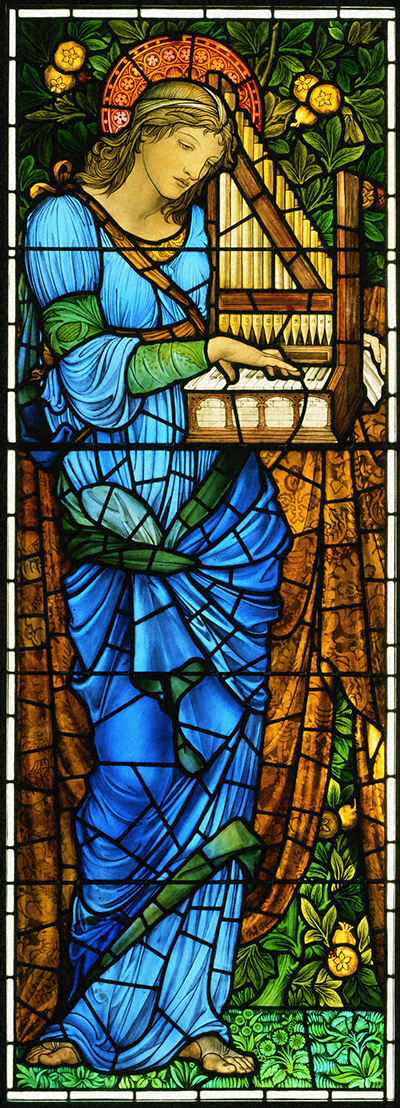
| Musical angels of the St Catherine window (Christ Church) | Designed 1877 | Stained glass |
Discussion
Look again at the images and ideas explored in The Star of Bethlehem. These editorial prompts invite your observations.
Reader Insights
Which detail shows how much an image can change when it moves from weaving to watercolour?
How does holding the star at the angel’s chest affect the grouping of the visitors?
Join the Conversation
Share a detail, comparison or question about The Star of Bethlehem below.
References
- Birmingham Museums, Jane Thompson-Webb, Secrets revealed from beneath the glass, 14 April 2022, signature photograph and account of removal. View source.
- Birmingham Museums Trust, The Star of Bethlehem, object 1891P75, post-conservation photograph and artwork metadata. View source.
- Burne-Jones Catalogue Raisonné, The Star of Bethlehem watercolour, OTUw, Stephen Wildman’s expertise notes, object data, provenance and exhibition entries. View source.
- Exeter College, Oxford, Morris and Burne-Jones tapestry to be housed in museum-quality display conditions, original chapel commission. View source.
- United States Conference of Catholic Bishops, Matthew, 2:1–12 and notes. View source.
- City of Birmingham Museum and Art Gallery, Illustrated catalogue of the permanent collection, entry 33, The Star of Bethlehem. View source.
- Aberdeen Archives, Gallery & Museums, Study for ‘The Star of Bethlehem’, ABDAG002653, medium, image and object commentary. View source.
- Gallerie degli Uffizi, Adorazione dei magi di Sandro Botticelli, Del Lama altarpiece and Florentine portraits. View source.
- The Huntington Library, Art Museum, and Botanical Gardens, Adoration of the Magi, 2000.5.521, object fields and 2022 label. View source.
- Victoria and Albert Museum, Adoration of the Magi, E.5012-1919, collection record O88582, physical description and summary. View source.
- Musée d’Orsay, L’Adoration des Mages, OAO 1786, production credits, date, medium and commissioning history. View source.
- Museum für Kunst und Gewerbe Hamburg, Tapisserie “Anbetung der Könige”, 1901.136, workshop identification, image and 1900 acquisition. View source.
- Tate Britain, Edward Burne-Jones large print guide, room 7, p. 130, Manchester Metropolitan University tapestry X64660. View source.
- Mitsubishi Ichigokan Museum, Tokyo, 2012 Annual Report, Edward Burne-Jones exhibition account and checklist no. 58, 東方の三博士の礼拝. View source.
- Eton College Collections, The Adoration of the Magi, FDA-A.81:2-2013, provenance, inscription and position within the tapestry reredos. View source.
- Art Gallery of South Australia, The Adoration of the Magi, 26803, object data and Tansy Curtin’s account of Brookman’s commission and the making of the Adelaide weaving. View source.
- The New Gallery, Exhibition of the Works of Sir Edward Burne-Jones, 1898–99, p. 77, nos. 165, 166 and 170. View source.
- Peter Nahum and William Waters, Study of a Baby for the Infant Christ, primary object catalogue text and reproduction hosted by Victorian Web. View source.
- Birmingham Museums Trust, Collections Annual Report 2022–2023, p. 15, completed treatment of the paper, frame and glazing of 1891P75. View source.
- Institute of Conservation, Jane Thompson-Webb, Client Spotlight, Iconnect, spring 2024, p. 50, frame dimensions and treatment. View source.