 by Tom Gurney
Tom Gurney BSc (Hons) is an art history expert with over 20 years experience
Published on June 19, 2020 / Updated on November 25, 2026
Email: tomgurney1@gmail.com / Phone: +44 7429 011000
The Last Sleep of Arthur in Avalon: Introduction
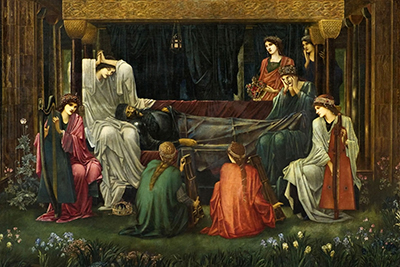
King Arthur lies with his eyes closed beneath a gold canopy. The women closest to him keep vigil, while attendants at the ends of the cloister look out towards the valley. Across more than six metres of canvas, Edward Burne-Jones makes the difference between sleep and death depend on what those watchers expect to hear. He began the painting in 1881 and was still working on it when he died in 1898. The Museo de Arte de Ponce in Puerto Rico catalogues the oil as The Sleep of King Arthur in Avalon. It measures 279.4 × 650.2 cm and is the largest of Burne-Jones’s paintings. [1] [2]
At a Glance
- ArtistEdward Burne-Jones
- Date1880s–1898
- MediumOil on canvas
- SubjectArthur, Avalon and the studio
This work across Edward Burne-Jones’s career
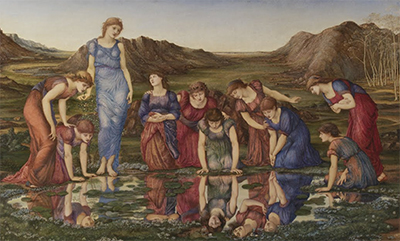
The Mirror of Venus
1870sThe Wheel of Fortune
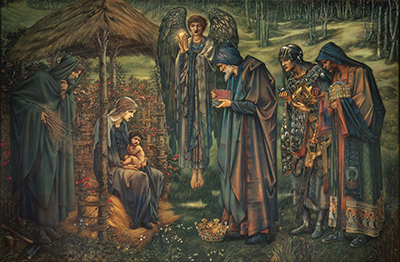
1875–83The Star of Bethlehem
Signed 1890Contents
- The wounded king
- A painting built to be read across a room
- From Naworth Castle to the painter’s studio
- What the studies reveal
- The hill fairies that never flanked Arthur
- The flowers and the unfinished paint
- Ponce and the journey back to Europe
The wounded king
In the closing chapters of Thomas Malory’s Le Morte d’Arthur, Arthur suffers a grievous wound in his last battle against Mordred. Sir Bedivere carries the king to a barge, where grieving women take him aboard. Arthur says he is bound for Avalon to heal his wounds. Malory names three queens among the company, including Arthur’s sister Morgan le Fay. Bedivere subsequently finds a tomb, but the hermit cannot be certain who was buried there. Malory records the belief that Arthur will come again while leaving the account of his death unresolved. [3]
Burne-Jones paints what Bedivere never sees. Avalon itself has a marble cloister, a mountain backdrop and water in the foreground. The 1898–99 memorial exhibition catalogue presented the king as sleeping until called back to his kingdom. Its entry began with the Latin epitaph from the legend, which hails Arthur as the once and future king. The epitaph belongs to the vocabulary of burial, while the people in the painting are equipped for the possibility of an awakening. Three attendants on the right hold the king’s armour, still available to him should he rise. Others hold horns or a trumpet. Their role gives a shape to the hope that Malory records as a rumour. [3] [4]
There is an important difference between watching Arthur and watching for a signal. The queens near the couch attend to the body, while figures farther out survey the landscape. In her Memorials, Georgiana Burne-Jones recalled that her husband had once intended to show a battle raging beyond the resting place. He replaced it with figures looking and listening for trouble. From inside the cloister the world beyond remains out of reach. The change makes us share the watchers’ uncertainty about when the king might be needed. [2]
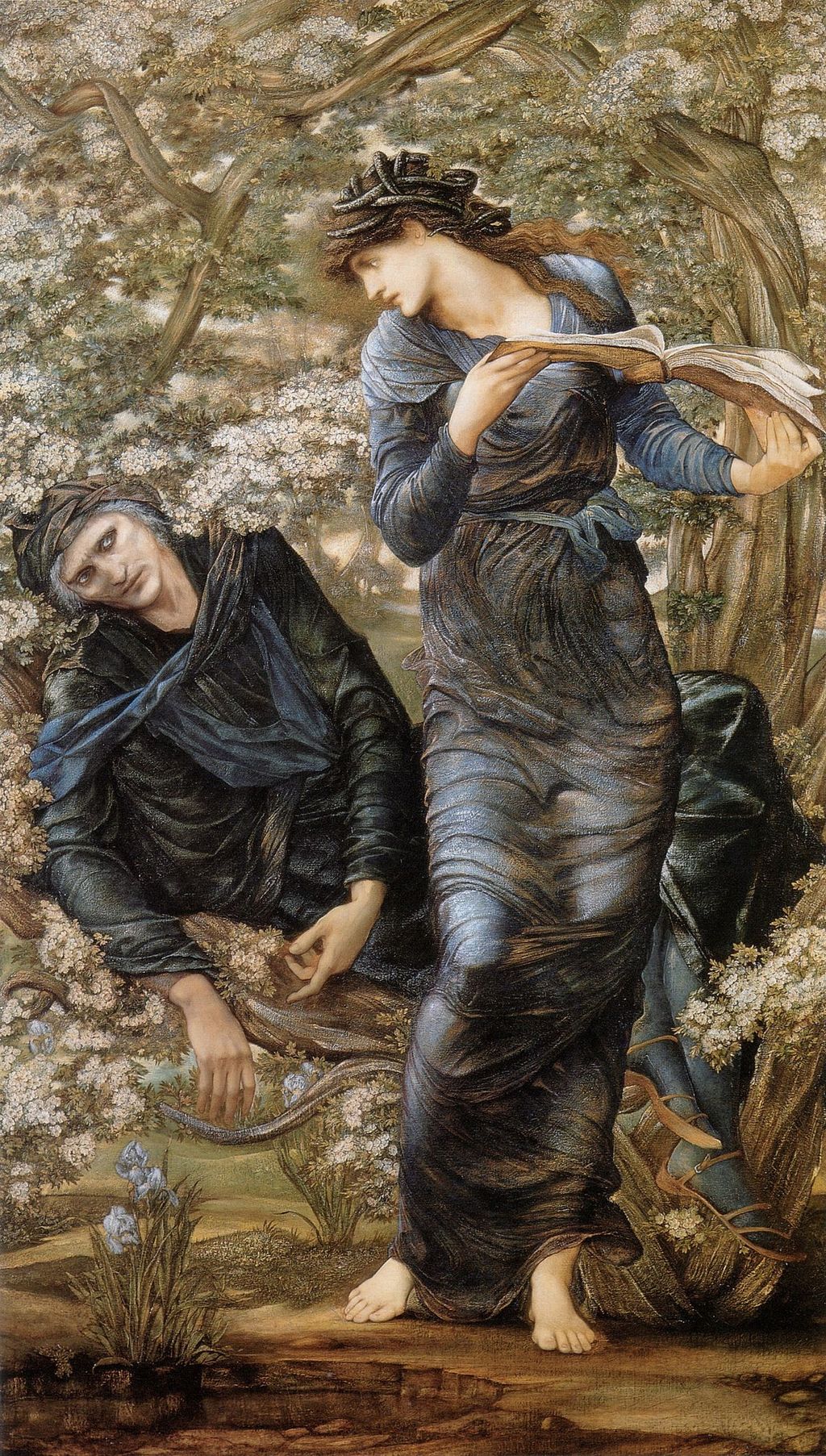
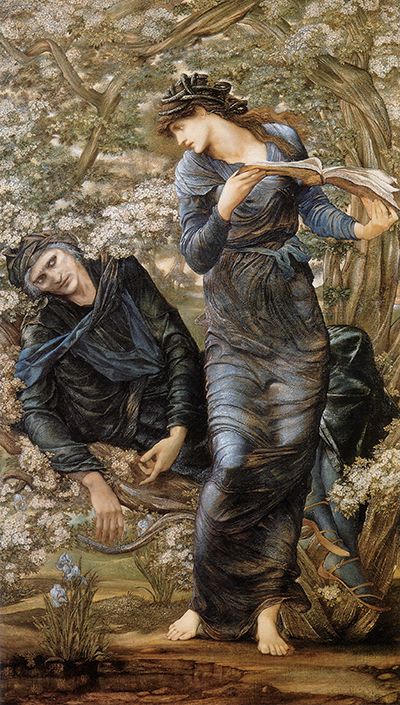
Edward Burne-Jones, The Beguiling of Merlin. Lady Lever Art Gallery. Image source. Public domain.
A painting built to be read across a room
Start with the couch and look upwards. The canopy catches the eye before the small scenes across it come into focus. The New Gallery’s catalogue identified twelve designs from the history of the Holy Grail on the canopy, describing it as gilded bronze. These pictures sit above Arthur like scenes on a precious object. The canopy surrounds him with episodes from the larger history of his court even while the knights and their adventures are absent from the cloister. The details reward a second look after the width and architectural rhythm of the painting have registered. [4]
The foreground gives the scene another tempo. The seated musicians and the continuous band of plants and water lead the eye along the foot of the couch. The outer figures, spaced at intervals by the architecture, ask the eye to stop and reconsider where they are looking. A harp brings the suggestion of quiet music close to the sleeper. The horns are poised for a different kind of sound, one loud enough to break a long silence. Tate’s conservators observed that some of the instruments still lack strings. That material fact belongs to the history of an unfinished picture, even though the effect of suspended sound suits the story. [4] [5]
The long architecture helps explain why the painting could be conceived for a particular wall. Bay follows bay like a sequence of windows, and the canopy is almost a smaller artwork housed within the central opening. In Burne-Jones’s stained-glass windows, the surrounding architecture also helps to set the distance and order in which a viewer encounters figures. Here the architecture is painted, allowing Burne-Jones to suggest a common atmosphere across all the figures and open the space between them onto distant slopes. In a reproduction the pattern is apparent at a glance. At the scale of the canvas, moving from Arthur to the watchers means looking across a distance that a single page-sized image compresses. [1]
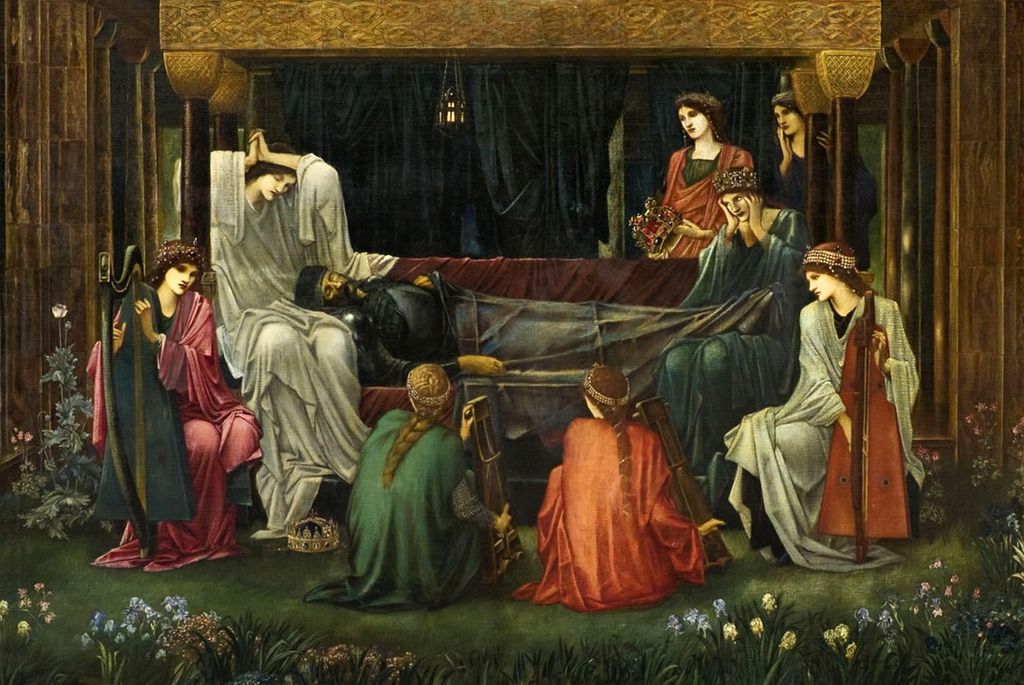
Detail of the figures around Arthur in The Sleep of King Arthur in Avalon. Museo de Arte de Ponce. Image source. Public domain.
From Naworth Castle to the painter’s studio
George Howard, later the ninth Earl of Carlisle, commissioned the work for his library at Naworth Castle in Cumberland in 1881. Georgiana explained that it was intended for a particular space and was to be relatively simple. As the design grew, Burne-Jones needed a separate studio in Campden Hill Road because the canvas was too large for the studio at his home, the Grange. He worked at Campden Hill when he could spare time from other projects. Howard eventually relinquished his claim to the painting, allowing Burne-Jones to continue it on his own terms. [2]
The oil modello in Ponce, dated about 1881, shows the scale on which he could work out the whole composition before committing to details on the large canvas. At 82.6 × 288.3 cm it is almost three metres wide in its own right. Its width is about three and a half times its height. The monumental canvas is only about two and a third times as wide as it is high. The two works consequently offer different proportions in which to consider the sleeping king and the space around him. Ponce assigns the model its own accession number, 63.0370, distinct from the monumental canvas, 63.0369. [1] [6]
By early 1885 Burne-Jones was proposing a simpler version for Naworth. A large mixed-media study at Amgueddfa Cymru in Cardiff preserves that alternative. The catalogue raisonné describes a more wooded setting with figures standing guard around the bier. The proposal went no further than studies. A design for the Battle of Flodden Field, to be worked out in bronze by Joseph Edgar Boehm, went to the castle in place of the Arthur commission. Burne-Jones could give Howard a work for the building and keep pursuing the much larger Avalon picture. [2] [7] [8]
What the studies reveal
A study at the Carnegie Museum of Art, dated 1881–82 and attributed to Burne-Jones’s studio assistant Matthew William Webb, sets out the central group as a set of small, almost model-like people. At this stage the recognisable elements are the horizontal king, the women around him and the musicians close by. The catalogue raisonné suggests that the drawing might record a three-dimensional model made in the studio. Whether or not such a model existed, the sheet shows how the central group could be treated as a problem of spacing and relative size before each face and costume received close attention. [9]
The studies for Morgan le Fay bring the job down to the scale of a single person. One Ponce sheet in black and blue chalk sets out the queen’s pose as a nude. An 1883 pencil study, just over 25 cm tall, takes up her skirt alone. A painter can establish how a seated body bears its weight before deciding how much of that posture the garment will reveal. Burne-Jones worked at the same level of detail on other attendants. Ponce holds five nude studies for the queen playing the Welsh harp on a single sheet dated 1882, as well as a rejected costume study for the shield-bearer on the right. The survival of a rejected design makes it possible to see an actual choice in the long preparation, even where the sequence of individual revisions is hard to recover. [10] [11] [12]
The artist could also revise an image of the whole painting at a manageable scale. Frederick Hollyer photographed the partially painted canvas. The surviving worked print in Ponce, catalogued by the museum as about 1890, has additions in chalk and graphite. It is approximately 26 × 61 cm, close to the large canvas in proportion. The drawn marks let the studio try changes against shapes that were already established on the oil. The precise date is uncertain. The catalogue raisonné gives about 1883, so the photograph is evidence of work in progress without providing a secure date for each detail it preserves. [13] [14]
The hill fairies that never flanked Arthur
Georgiana recalled a design with a slender panel on each side of the sleeping king. In those wings Burne-Jones imagined hill fairies that would make the island’s magic more overt. His work record for 1885 mentions work on Avalon and the design of the fairies, and related drawings and oils survive. The male and female compositions show how he considered bringing a distinctly wild kind of movement into the picture. A figure in the Art Institute of Chicago’s graphite study, with one arm raised and its hair sweeping out from the head, has been traced to the upper part of the proposed right panel. [2] [7] [15] [16]
The fairy panels were never installed as wings to the large painting. The New Gallery showed two Hill Fairies pictures with the studies in 1898–99 and identified them as part of a design that the painter had set aside. There is uncertainty over which surviving versions the catalogue records. In the main canvas, the outer stretches instead open out to landscape and the king’s human attendants. The difference is visible in the kinds of movement allowed at the edges. The fairies would have given the flanks an action of their own. The watchers make the view beyond the cloister serve the scene at its centre. [4] [7] [15]
Burne-Jones revisited the subject in other forms. A 53.6 × 190.7 cm gouache on paper dated 1894, now at Koriyama City Museum of Art in Japan, carries a version of the design on a similarly long support. The New Gallery catalogue records an inscribed 1894 colour design lent by Eleanor, Lady Leighton. In the same year Burne-Jones was also devising scenery and costumes for Joseph Comyns Carr’s King Arthur, staged at the Lyceum in 1895 with Henry Irving. For that production he sketched Arthur in the barge among the queens, the passage at which Malory leaves Bedivere behind. That surviving design tradition gives the movement into Avalon its own image, apart from the stillness of the oil. For another instance of Burne-Jones giving an Arthurian story its decisive moment, see The Beguiling of Merlin. [4] [17] [18]
The flowers and the unfinished paint
“The Sleep of Arthur in Avalon is my chief dream now,” Burne-Jones wrote in an autumn letter that Georgiana printed in her memoir. She also records a very practical decision almost at the end of his life. In June 1898 he was filling the long foreground with summer flowers. He and his assistant Thomas Matthews Rooke painted columbines, irises and forget-me-nots among the grasses. The two records put the artist’s investment in the picture alongside a small, sustained part of the work that held his attention when the main design was already visible. [2]
At the 1898–99 New Gallery memorial exhibition the executors lent the oil, and the catalogue explicitly described it as unfinished. It also listed dozens of studies, from heads and hands to designs for a lamp. The picture now looks resolved from a distance, since the main relations of space, figure and colour are firmly established. Up close, Tate’s team found figures wearing socks whose shoes had yet to be painted, as well as the partly realised instruments. Documentary evidence and the paint surface agree about the unfinished state. In some places the artist was adding fully observed particulars while elsewhere comparatively small tasks still remained. [4] [5]
Ponce and the journey back to Europe
Luis A. Ferré, founder of the Museo de Arte de Ponce, bought the canvas for the museum in 1963. A detailed provenance published with an 1885 study for the painting traces the oil from the memorial exhibition to the collector Charles Sydney Goldman, a loan to Tate, and the 1963 London sale. It was in Ponce that the work became an anchor of a collection of Victorian painting. The transfer therefore changed the surroundings in which the picture was understood. When it returned to Tate Britain on loan in April 2008, it travelled with Frederic Leighton’s Flaming June while the Ponce galleries were being renovated and expanded. [5] [19]
The 2008 journey exposed a different kind of construction. The paint is carried on three pieces of cloth with two vertical sewn joins. Light falling across the surface can reveal those seams. To remove the work from its gallery in Puerto Rico the team had to roll the canvas, protecting the joins and the edges that turn around the stretcher. Tate reports that fragile edges were reinforced and the canvas lined in Puerto Rico before transport. The heavy hardwood stretcher and the frame were dismantled and packed separately from the rolled painting. [5]
In London, the canvas had to be unrolled face down in the gallery because it would have been too large to move there once stretched. Conservators worked on opposite sides to tension it evenly and attach it to the stretcher from the back. Handlers then had to raise it without twisting it, fit it into its frame and lift it onto its supports. The Ponce and Tate teams inspected the mounted surface together and monitored vulnerable areas during the loan. The operation made it possible to show the familiar entire composition while caring for seams and edges that are barely apparent to a visitor standing in front of it. [5]
From 24 February to 31 May 2009 the Museo Nacional del Prado showed the work in La bella durmiente. Pintura victoriana del Museo de Arte de Ponce. Its Spanish annual report places the canvas alongside sketches and drawings that traced the development of the subject. Spain’s official loan guarantee lists the model and the large canvas separately. The exhibition then opened at the Gemeentemuseum Den Haag, now Kunstmuseum Den Haag, from 4 July to 20 September 2009. A related exhibition at the Belvedere in Vienna in 2010 again brought the monumental Arthur painting together with other works from Ponce. [20] [21] [22] [23]
The early oil model continued to travel as an independent work. The 2024 Pre-Raphaelite exhibition in Forlì listed the 82.6 × 288.3 cm model from Ponce. Its size alone would make it a large painting in many galleries, yet the canvas on which Burne-Jones continued to work until 1898 is more than twice as wide. Taken together, the two works let us see what that commitment in scale made possible. The scheme could hold a story about an entire kingdom, while its decisive event remains as small as the first sound that might cause a sleeper to stir. [1] [6] [24]
Edward Burne-Jones on film
Explore Burne-Jones’s paintings, illustrated stories and stained-glass designs.
Edward Burne-Jones: Pre-Raphaelite Visionary | Exhibitions | Showcase
A look at Burne-Jones’s paintings and the Tate retrospective.
Watch on YouTubeArtworks directory
This directory records paintings, studies, designs and collaborative works, with separate entries for documented versions and series where known.
| Name | Date | Medium |
|---|---|---|
| Sidonia von Bork 1560 | 1860 | Watercolour and bodycolour |
| Clara von Bork 1560 | 1860 | Watercolour and bodycolour |
| The Merciful Knight | 1863 | Watercolour |
| Sibylla Delphica | c. 1886 | Oil on panel |
| Phyllis and Demophoön | 1870 | Watercolour and bodycolour |
| The Legend of the Briar Rose (Buscot series) | 1870s–1890 | Oils on canvas |
| The Briar Wood (Buscot series) | By 1890 | Oil on canvas |
| The Council Chamber (Buscot series) | By 1890 | Oil on canvas |
| The Garden Court (Buscot series) | By 1890 | Oil on canvas |
| The Rose Bower (Buscot series) | By 1890 | Oil on canvas |
| Group of Women, study for The Golden Stairs | 1872 | Drawing |
| The Beguiling of Merlin | 1870s | Oil on canvas |
| The Perseus Cycle | From 1875 | Paintings and full-scale designs |
| The Call of Perseus (Stuttgart) | From 1875 | Oil painting |
| Perseus and the Graeae (Stuttgart) | From 1875 | Oil painting |
| The Rock of Doom (Stuttgart) | 1884–88 | Oil on canvas |
| The Doom Fulfilled (Stuttgart) | 1888 | Oil on canvas |
| The Baleful Head (Stuttgart) | 1885–87 | Oil on canvas |
| The Baleful Head (Southampton design) | 1880s | Bodycolour |
| The Rock of Doom (Southampton design) | 1880s | Bodycolour |
| The Doom Fulfilled (Southampton design) | 1880s | Bodycolour |
| The Mirror of Venus (Gulbenkian) | 1870s | Oil on canvas |
| Drawing associated with The Mirror of Venus | 1870s | Drawing |
| Laus Veneris (Laing) | 1873–78 | Oil on canvas |
| The Days of Creation | 1870s | Watercolour and bodycolour |
| The Golden Stairs | 1880 | Oil on canvas |
| An Angel Playing a Flageolet | 1878 | Watercolour, bodycolour and gold |
| The Tree of Forgiveness | 1881–82 | Oil on canvas |
| The Wheel of Fortune (Orsay) | 1875–83 | Oil on canvas |
| King Cophetua and the Beggar Maid | 1884 | Oil on canvas |
| The Depths of the Sea (oil) | 1886 | Oil |
| The Morning of the Resurrection | 1886 | Oil on panel |
| Study for the Head of Mary Magdalene | c. 1882 | Oil study |
| The Sleep of King Arthur in Avalon | 1880s–1898 | Oil on canvas |
| The Sleep of King Arthur in Avalon (modello) | ca. 1881 | Oil on canvas (modello) |
| The Star of Bethlehem | Signed 1890 | Watercolour and bodycolour |
| Study for The Star of Bethlehem | About 1887–91 | Drawing |
| Sponsa de Libano | 1891 | Watercolour and bodycolour |
| The Summons (Holy Grail tapestries) | 1890s | Tapestry |
| The Failure of Sir Gawaine (Holy Grail tapestries) | 1890s | Tapestry |
| Hope (Boston) | 1896 | Oil on canvas |
| La Belle au bois dormant (theatre programme) | 1894 | Collotype |
| The Wedding of Psyche | 1895 | Oil on canvas |
| The Works of Geoffrey Chaucer (Kelmscott edition) | 1896 | Illustrated book |
| The Ascension (Birmingham Cathedral) | 1885 | Stained glass |
| The Last Judgement (Birmingham Cathedral) | 1897 | Stained glass |
| Adoration of the Magi (Huntington) | 1890s | Tapestry |
| Love among the Ruins (Wightwick) | 1894 | Oil on canvas |
| The Merciful Knight (photogravure after Burne-Jones) | 1900 | Photogravure |
| The Garden Court (preparatory work) | 1870–75 | Graphite and watercolour with white gouache |
| Study of a Female Figure | 1885 | Graphite drawing |
| Psyche Throwing Herself into the River | 1865–68 | Wood engraving |
| Beauty | 1887–89 | Colour lithograph |
| Study for the Failure of Gawain | 1893 | Crayon and graphite on Japanese paper |
| The Prince Enters the Briar Wood (after Burne-Jones) | After 1890 | Photogravure |
| The Rose Bower (after Burne-Jones) | 1892 | Photogravure |
| Adoration of the Magi (Musée d’Orsay) | 1904 | Tapestry |
| Answers to Prayer (Lyndhurst) | 1860s | Stained glass |
| The Depths of the Sea (photogravure after Burne-Jones) | 1900 | Photogravure |
| Perseus and Andromeda (Adelaide composite) | 1876 | Oil on canvas |
| The Adoration of the Magi (Hamburg) | Woven 1900 | Tapestry |
| Love leading the Pilgrim through the Briars | 1874–76 | Embroidery |
| Musica (worked by Lady Jane Cory) | 1906 | Embroidery |
| Pomona (worked by Lady Jane Cory) | 1907 | Embroidery |
| Flora (worked by Lady Jane Cory) | 1909 | Embroidery |
| The Fourth Day of Creation (photogravure after Burne-Jones) | 1900 | Photogravure |
| The Morning of the Resurrection (photogravure after Burne-Jones) | 1900 | Photogravure |
| Musical angels of the St Catherine window (Christ Church) | Designed 1877 | Stained glass |
Discussion
Look again at the images and ideas explored in The Last Sleep of Arthur in Avalon. These editorial prompts invite your observations.
Reader Insights
Which detail rewards looking past the central figure of Arthur?
Which part of the painted setting would have mattered most to a viewer entering the room?
Join the Conversation
Share a detail, comparison or question about The Last Sleep of Arthur in Avalon below.
References
- Museo de Arte de Ponce, The Sleep of King Arthur in Avalon, object 63.0369, collection record and image. View source.
- Georgiana Burne-Jones, Memorials of Edward Burne-Jones, vol. II, pp. 116, 120, 125 and 343–344. View source.
- Thomas Malory, Le Morte d’Arthur, Book XXI, chapters IV–VII. View source.
- The New Gallery, Exhibition of the Works of Sir Edward Burne-Jones, winter 1898–99, no. 124, pp. 68–69, and studies under nos. 150–156, pp. 74–75. View source.
- Tate Conservation, Moving Sir Edward Coley Burne-Jones’ The Sleep of Arthur in Avalon from Puerto Rico to London, conservation project. View source.
- Museo de Arte de Ponce, The Sleep of King Arthur in Avalon (modello), object 63.0370, collection record. View source.
- Burne-Jones Catalogue Raisonné, The Hill Fairies (Hill Fairy, Wood Nymph) – Female, expertise notes on the Naworth alternative, work record and proposed wings. View source.
- Amgueddfa Cymru – Museum Wales, King Arthur at Avalon (study), NMW A 11747. View source.
- Burne-Jones Catalogue Raisonné, Study establishing the disposition of the central group of figures in The Last Sleep of Arthur in Avalon, object record and notes by William Waters and John Christian. View source.
- Burne-Jones Catalogue Raisonné, Nude study for Queen Morgan le Fay in The Last Sleep of Arthur in Avalon, object record. View source.
- Burne-Jones Catalogue Raisonné, Drapery study for Queen Morgan le Fay in The Last Sleep of Arthur in Avalon – skirt, object record. View source.
- Museo de Arte de Ponce, Related works for The Sleep of King Arthur in Avalon, drawings and photograph. View source.
- Museo de Arte de Ponce, Photograph of the Partly Finished Painting, The Sleep of King Arthur in Avalon, object 63.0371.1. View source.
- Burne-Jones Catalogue Raisonné, The Last Sleep of Arthur in Avalon (partly finished over photograph), dating, materials and Christie's catalogue note. View source.
- Burne-Jones Catalogue Raisonné, Hill Fairies, Wood Nymphs (Hill Fairy) – Male, surviving panel and notes on the 1898–99 exhibition. View source.
- Art Institute of Chicago, Objects of Desire: Victorian Art at the Art Institute of Chicago, p. 55 and fig. 17, Study of a Male Nude for Hill Fairies, 1980.412. View source.
- Koriyama City Museum of Art via Art Platform Japan, The Sleep of King Arthur in Avalon, FP-1989005, 1894 gouache. View source.
- Burne-Jones Catalogue Raisonné, Passing of Arthur, scenery design for the play, Sir Henry Irving’s King Arthur at the Lyceum Theatre, object record and production history. View source.
- Stephen Ongpin Fine Art, The Head of a Woman in Profile: Study for The Last Sleep of Arthur in Avalon, object research and provenance of the monumental canvas. View source.
- Museo Nacional del Prado, Memoria de actividades 2009, exhibition entry La bella durmiente. Pintura victoriana del Museo de Arte de Ponce. View source.
- Boletín Oficial del Estado, Order CUL/230/2009, Annex, separate entries for the model and the monumental painting. View source.
- Kunstmuseum Den Haag, Sleeping Beauty, exhibition record, 4 July–20 September 2009. View source.
- Belvedere, Sleeping Beauty: Masterpieces of Victorian Painting from Museo de Arte de Ponce, exhibition record, 15 June–3 October 2010. View source.
- Fondazione Cassa dei Risparmi di Forlì, Preraffaelliti. Rinascimento moderno, 2024 exhibition checklist, The Sleep of Arthur in Avalon (model). View source.