 by Tom Gurney
Tom Gurney BSc (Hons) is an art history expert with over 20 years experience
Published on June 19, 2020 / Updated on November 25, 2026
Email: tomgurney1@gmail.com / Phone: +44 7429 011000
Sidonia von Bork: Introduction
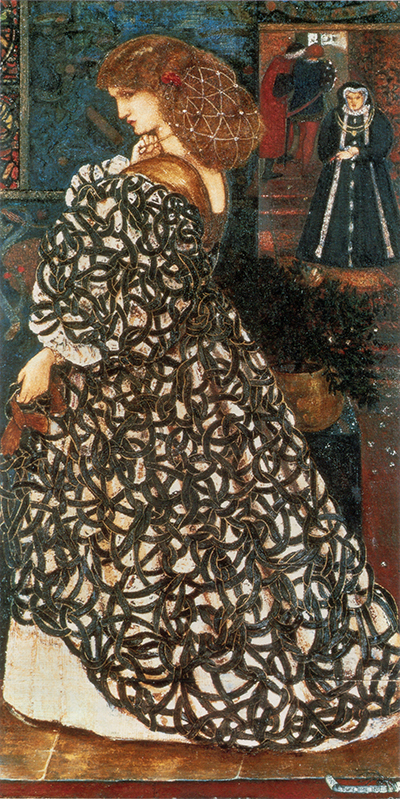
Edward Burne-Jones painted Sidonia von Bork 1560 in 1860. The earlier date belongs to the title on the oak mount, which places the young Sidonia at a sixteenth-century court. The later date is on the little painted scroll at the lower right. At just 33.3 by 17.1 centimetres, the Tate watercolour gives nearly the whole foreground to a woman in profile and her extraordinary gown. A few figures on the far side of the room supply the drama. The picture is one of a pair that Burne-Jones took from Wilhelm Meinhold’s Gothic novel Sidonia the Sorceress. [1] [2]
At a Glance
- ArtistEdward Burne-Jones
- Date1860
- MediumWatercolour and bodycolour
- SubjectA literary portrait
This work across Edward Burne-Jones’s career
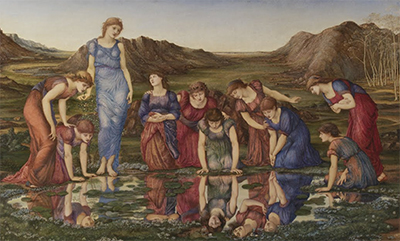
The Mirror of Venus
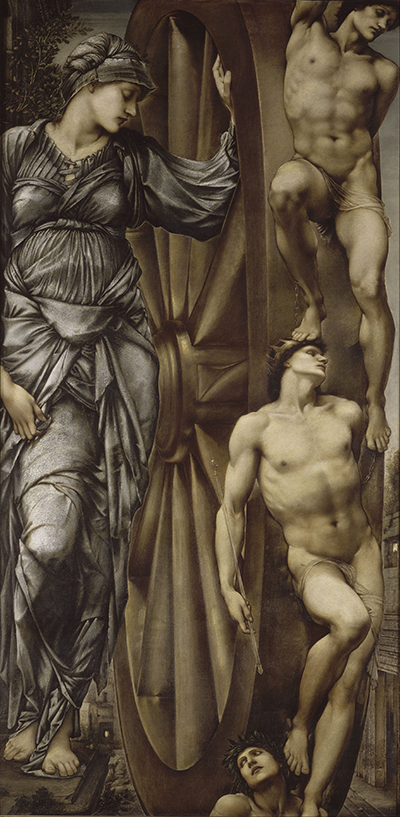
1870sThe Wheel of Fortune
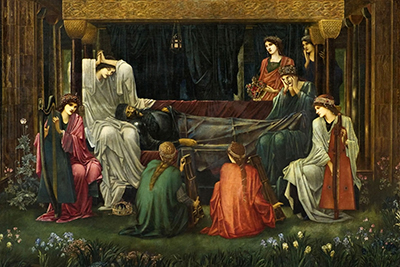
1875–83The Last Sleep of Arthur in Avalon
1880s–1898The Star of Bethlehem
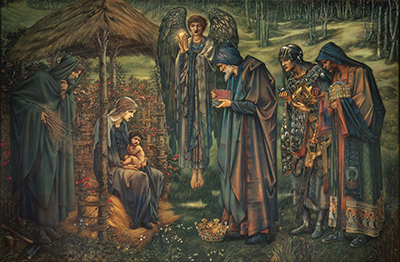
Signed 1890Contents
- The woman in the foreground
- The portrait behind the dress
- A Gothic novel and a double portrait
- The historical Sidonia von Borcke
- Clara von Bork, the companion watercolour
- From the studio to Tate
- Annotated details
The woman in the foreground
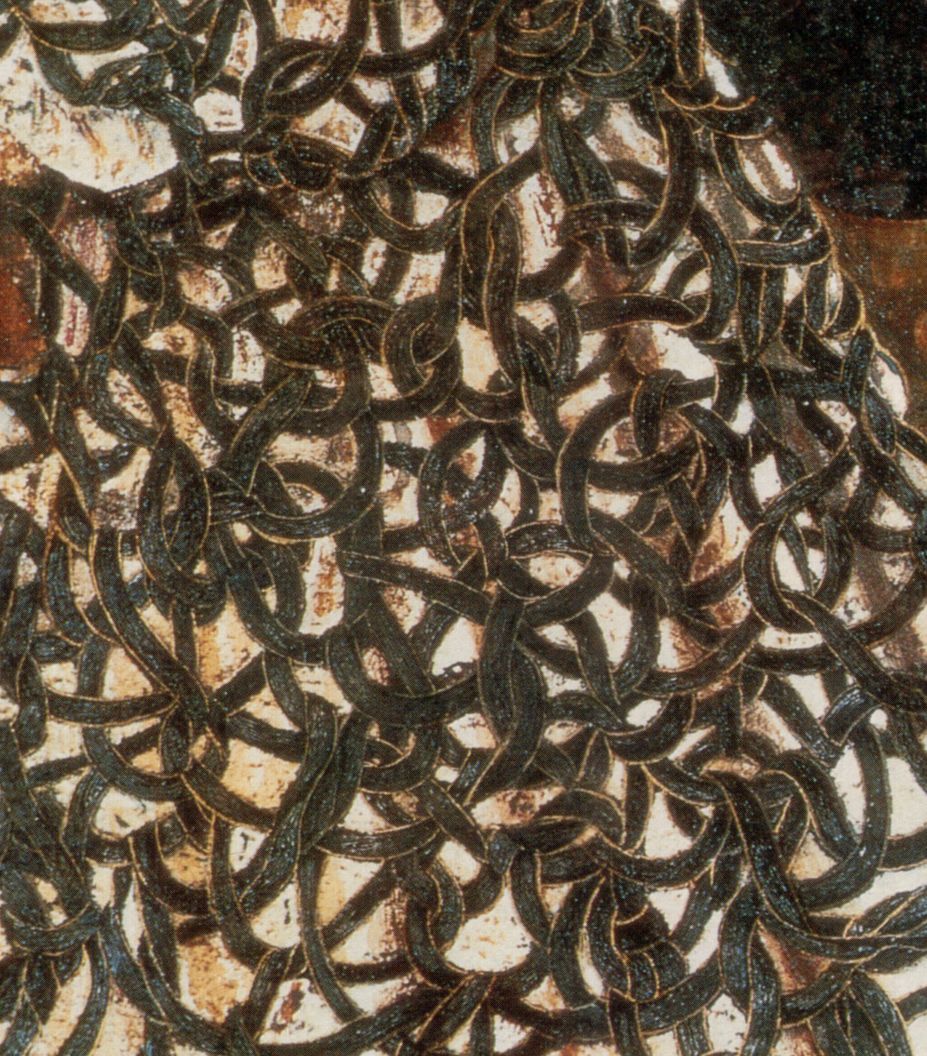
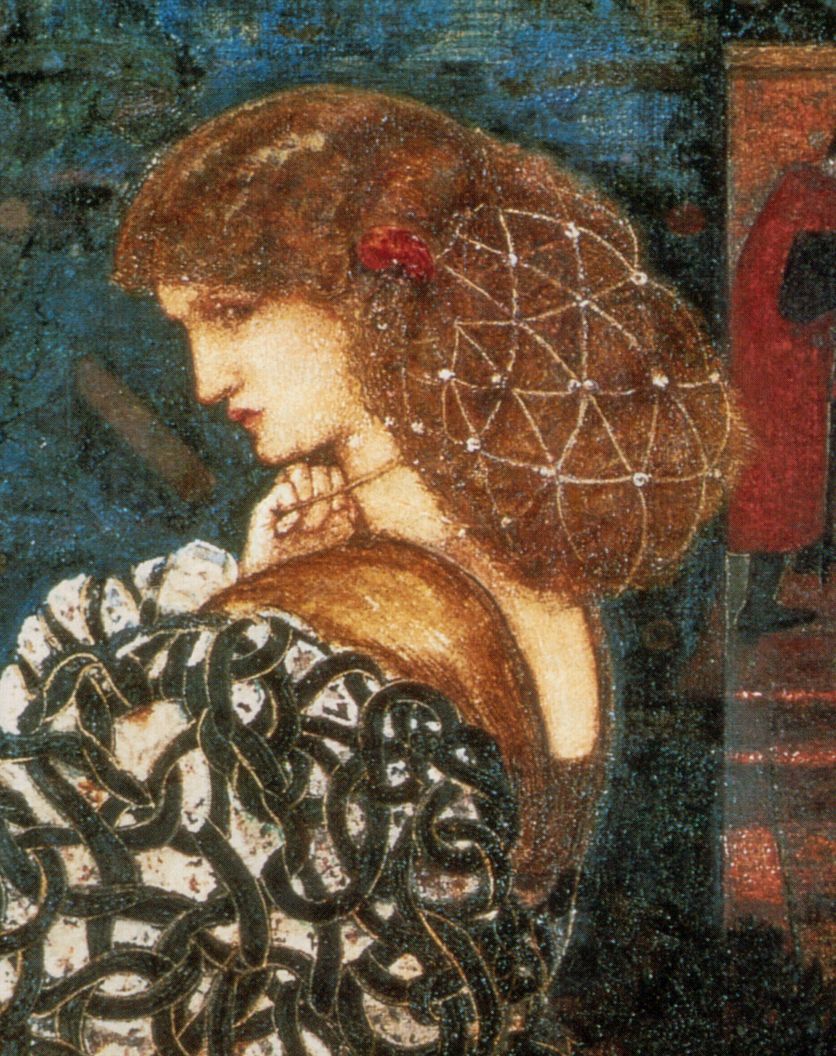
Sidonia turns to the left, her chin almost touching the fingers she has raised to her throat. Her lowered hand holds a small brown bag. A fine net, dotted with points of light, catches her hair behind a red ornament. The net’s clear diamonds give way below to something much harder to follow. Black bands spread over the sleeve and round the skirt, disappearing under one another and re-emerging across the white fabric. At the hem, the pattern nearly reaches both edges of the picture. The few uninterrupted patches of pale cloth help the eye make sense of the size and sweep of the skirt. [1]
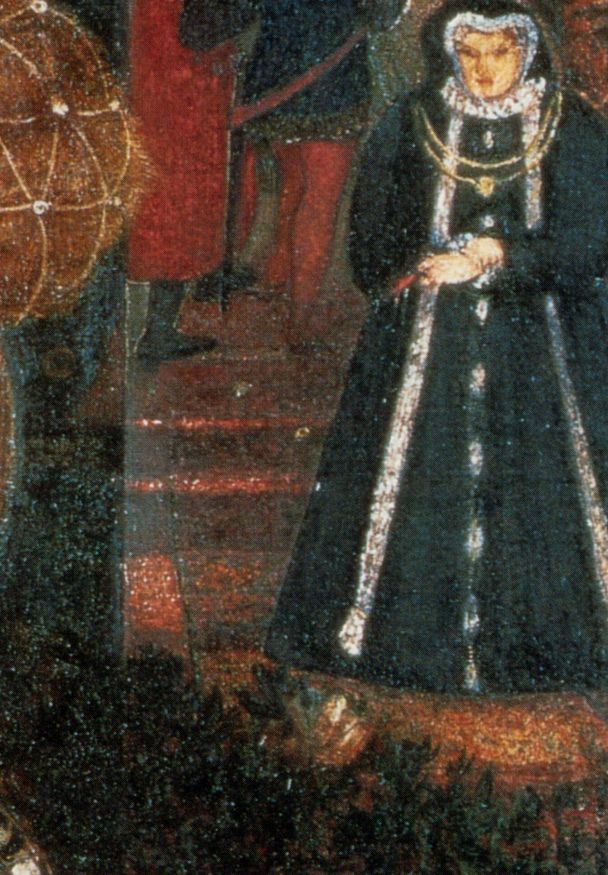
There is also room for a second encounter, on a much smaller scale. At the upper right, a dark-robed woman with a white headdress comes forward from a reddish doorway. Two people behind her turn towards the brighter opening. The art historian John Christian identified the woman as the dowager Duchess of Wolgast, at whose court the young Sidonia causes trouble in Meinhold’s novel. The doorway lets Burne-Jones suggest a whole court beyond the woman in the foreground. Sidonia’s face points away from the Duchess, and the space between them leaves the viewer to imagine what will happen when they meet. [2]
The crossing bands are easy to take for snakes. The poet Algernon Charles Swinburne saw them that way, comparing the young Sidonia to a drawing he studied in Florence and describing her gown in terms of knotted serpents. His essay, first published in 1868, shows how early a viewer familiar with the story could read the ornament as part of the character. The loops are also close observations of Renaissance costume. Their resemblance to snakes can do its work without the painter having to give them eyes or heads. [3]
Annotated Details from Sidonia von Bork
The numbered points identify visible features discussed in this article. Return from each detail to the numbered overview. Edward Burne-Jones, Sidonia von Bork 1560, 1860. Tate. Image source. Public domain.
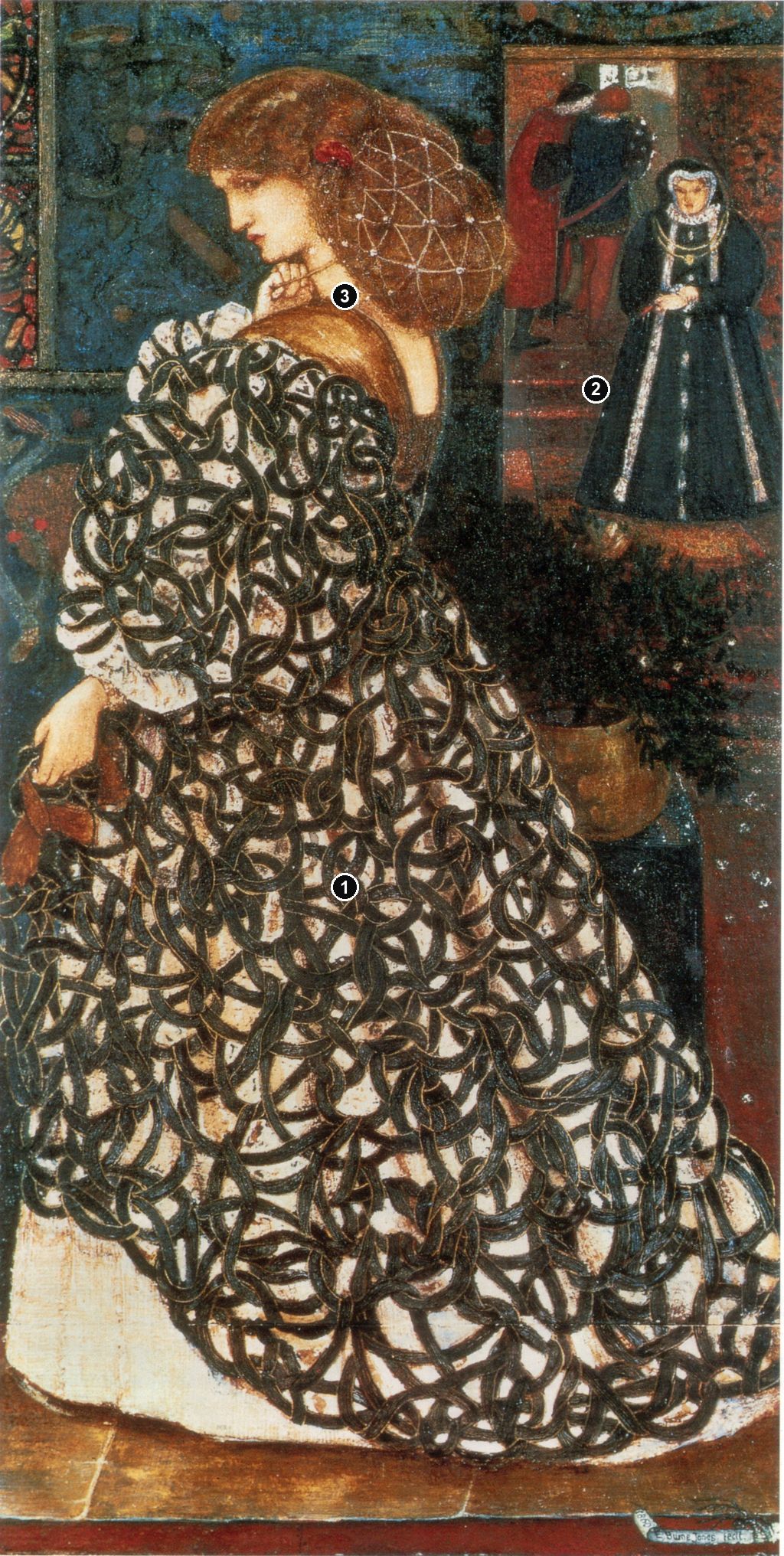
Details from SIDONIA VON BORK
Compare the cropped details with the source images above. Notice how their colours, shapes and positions contribute to the larger compositions.
The black knots
Dark loops lie along the curved folds of the dress. Some seem to continue into the next fold before the ivory fabric breaks them off.
A second figure in the room
A smaller figure occupies the opening behind Sidonia. The scale and the framing tighten the sense of space around the foreground figure.
Profile and headdress
The turned profile and curved headdress create a soft outline above the hard linear patterns of the dress.
The portrait behind the dress
Edward Clifford, an artist who knew Burne-Jones and owned another version of Sidonia, recalled that a picture at Hampton Court suggested the dress. Christian identified that work as Giulio Romano’s portrait of a Mantuan noblewoman, painted around 1531. Its sitter was long called Isabella d’Este, and that name still appears in some accounts of Burne-Jones’s picture. The Royal Collection Trust now considers Isabella’s daughter-in-law Margherita Paleologo the likelier candidate. The sitter looks closer to Margherita’s age when she married Federico Gonzaga, and the background doorframes resemble those in the rooms prepared for the couple. The woman’s clothing belongs to a fashion associated with Isabella’s circle, so its appearance alone does little to settle the identity. [2] [4]
In Giulio’s portrait, dark strips edged with gold cross over a pale crimson underdress. A small group of visitors gathers in a room behind the main figure. Burne-Jones took up both features, tightening the loops over a much paler ground and carrying them down the length of a standing figure. He relocated the activity behind her to the Duchess’s court. Even the balance of the two scenes changes. Giulio’s sitter holds a lapis lazuli rosary and turns her face towards the viewer. Sidonia keeps her face in profile, with one hand at her neck and the other occupied by the bag. The borrowed device gives the two pictures a family resemblance while allowing them to tell quite different stories. [2] [4]
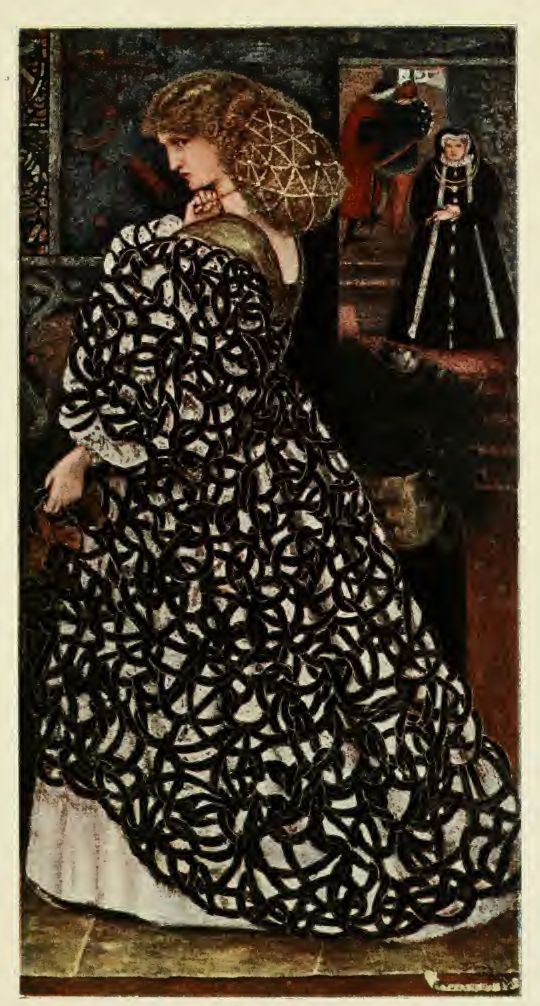
Sidonia von Bork, early colour reproduction after Edward Burne-Jones. Plate II in A. Lys Baldry’s Burne-Jones. Image source. Public domain. Printed plate isolated from the surrounding page and set upright.
A Gothic novel and a double portrait
Meinhold began publishing Sidonia von Bork, die Klosterhexe in German in 1847. Francesca Speranza Wilde’s English translation circulated as Sidonia the Sorceress in an 1849 edition. The book takes the form of an old chronicle. A physician’s letter to the last Duke of Pomerania introduces a history pieced together from accounts of the woman blamed for the ruin of his house. At Wolgast, the novel places Sidonia among the Duchess’s attendants and brings her close to the young Prince Ernest. Its court scenes give Burne-Jones the setting for an imaginary likeness of his character in her youth, long before the trials of the book’s final part. [2] [5] [6]
In the preface, Meinhold describes a double portrait he said he saw at Stargard, near Regenwalde. Its young woman has golden hair held in a net, a fur-trimmed purple bodice, an azure gown and a brown leather bag. The figure looking over her shoulder is described as Sidonia again, in old age, wearing white death clothes with dark stripes. Meinhold ascribed the younger figure to the school of Cranach. Burne-Jones’s hairnet and bag recall that written description. Christian also suggested that the light and dark of the dress could echo the older figure’s clothes. It is possible to see both the book and the Hampton Court picture at work here. The preface gives the colour scheme a possible foreboding, while Giulio’s painting supplies a close parallel for the interlacing itself. [6] [2]
A related double portrait in the National Museum in Szczecin makes it easier to see how uncertain the tradition is. The museum dates its canvas to the late eighteenth century and traces the composition to a much earlier painting. In its foreground, a richly dressed woman holds a cup. An older figure with keys peers over her shoulder. The costume in the earlier composition has been dated to the 1530s, before Sidonia’s probable birth, and the museum records a competing interpretation of the image as an allegory of lust. The two figures help explain the kind of image Meinhold could turn into a story. Its identification as a likeness of the historical Sidonia remains conjectural. [7]
The historical Sidonia von Borcke
The Greifswald state archive dates Sidonia von Borcke’s birth to about 1548. Its records describe long disputes with her family over money and accommodation. Sidonia and her sister Dorothea took legal action when their brother Ulrich failed to meet obligations under the family settlement. Sidonia entered the Protestant foundation at Marienfließ in 1604, and her disputes with its officers also left a paper trail. She was investigated for witchcraft in 1619, interrogated under torture and executed outside Stettin, now Szczecin, in 1620. She was beheaded and her body burned. The archive treats the exact date as uncertain. [8]
The story of a broken promise of marriage and a curse gained force from the later history of the dynasty. In 1637 the last Pomeranian duke, Bogislaw XIV, died childless. In the legend, this became the fulfilment of Sidonia’s curse. A letter catalogued by the State Archive in Szczecin gives a different kind of evidence. Sidonia appeals for protection to the duke’s councillor and chancellor, Marcin Hemnitius, and says she will prove her innocence at the coming hearing. Burne-Jones inherited the young woman of the novel. The surviving records let the older woman speak from within the legal proceedings that ended her life. [8] [9]
Clara von Bork, the companion watercolour
The other Tate watercolour, Clara von Bork 1560, was also painted in 1860. Its subject is Clara von Dewitz, who marries Marcus Bork, Sidonia’s cousin, in Meinhold’s story. Clara tries to guide Sidonia while both are at court, then falls victim to her later in the book. Meinhold gives Sidonia a sister who is also called Clara. The character in the companion picture is the woman who takes the Bork name through marriage. [6] [10]
Clara faces to the right and draws a nest of fledgling doves close to her. A cat at her feet looks up towards them. Her yellow dress and brown sleeves form larger areas of colour than Sidonia’s busy white skirt. The animal gives the gentle scene an immediate threat that a viewer can recognise without knowing Clara’s fate. Both paintings put small figures beyond the principal woman, but the foreground tells the two stories differently. In Clara, attention gathers around a living thing she is trying to protect. In Sidonia, it disperses across the dress before finding its way to the people at the back of the room. [1] [10] [11]
Tate identifies Fanny Cornforth, who also sat for Dante Gabriel Rossetti, as Sidonia’s model. Christian makes the identification more cautiously. Cornforth is documented sitting for Burne-Jones in 1858, and Christian sees her features in the watercolour. He proposes Georgiana Macdonald as the model for Clara. She married Burne-Jones in June 1860, around the time of the paintings. The two likenesses show how the artist could use faces familiar to his circle to give separate identities to figures drawn from a book. [2] [10] [12]
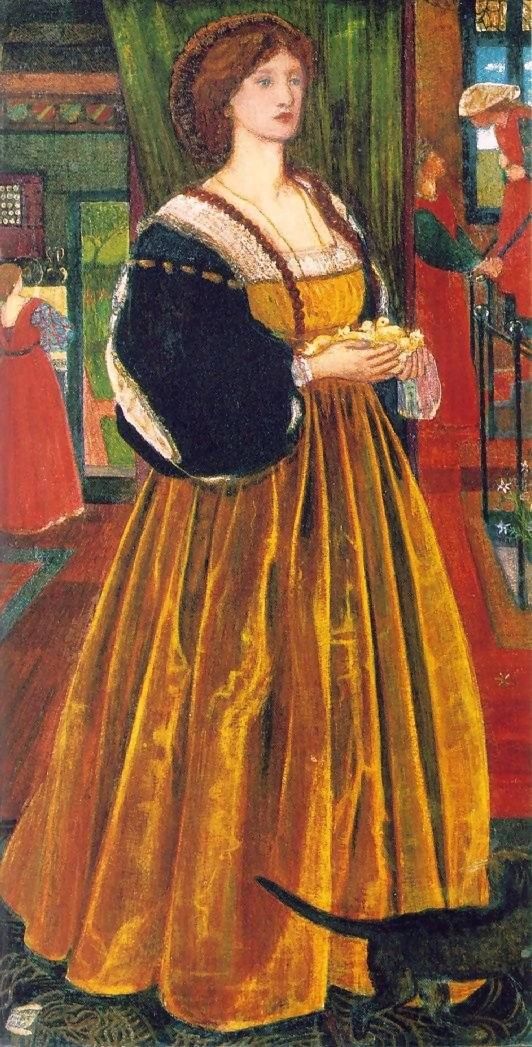
Edward Burne-Jones, Clara von Bork 1560, 1860. Tate. Image source. Public domain.
From the studio to Tate
The watercolours date from the point when Burne-Jones was moving from intricate pen-and-ink work towards painting in watercolour and gouache. Gouache’s opacity gave him the dense colour needed to make the pale skirt stand clear of the dark room. The fine edges of the loops still have the precision of his earlier drawing. Leathart would also own The Merciful Knight, a larger watercolour in which Burne-Jones used the same medium for a medieval Christian legend. [1] [2]
The paired frames were made by Burne-Jones’s father, a carver and gilder in Birmingham. The oak mounts carry matching title scrolls, while the paintings themselves are signed differently. Sidonia’s little scroll reads E. Burne Jones fecit. Clara’s cartouche gives the name as E. Jones. The small variation catches an artist whose familiar double surname was still taking shape. The matching mounts, like the opposed profiles, make the relationship between the two objects legible even when the scenes are unfamiliar. [2] [10] [12]
The Newcastle collector James Leathart owned both watercolours. The New Gallery exhibited them in 1892–93, and its retrospective of 1898–99 recorded them as loans from their next owner, W. Graham Robertson. He left both to Tate in 1948. Between those first New Gallery appearances, William Morris reprinted Wilde’s translation at the Kelmscott Press in 1893, more than three decades after the young Burne-Jones had painted the characters. The novel’s elaborate new edition and the matched watercolours preserve two stages of the same circle’s interest in Meinhold. Dante Gabriel Rossetti was especially taken with the book, and Swinburne counted it among his favourites. The reprint gave Morris a chance to revisit a book the circle had shared as young readers. [2] [11] [6]
Tate displayed the pair together again in its 2018–19 retrospective. At the National Portrait Gallery’s Pre-Raphaelite Sisters exhibition in 2019–20, Sidonia formed part of a show that explored the contributions of women to the movement, among them Cornforth and Georgiana Burne-Jones. In 2024 the Musei San Domenico in Forlì showed Sidonia in a section on Burne-Jones’s response to Italy. A year later the Musée de Pont-Aven placed it among representations of witches. The different settings bring the watercolour’s studio history, Renaissance costume and literary subject into view. [12] [2] [13] [14] [15]
Edward Burne-Jones on film
Explore Burne-Jones’s paintings, illustrated stories and stained-glass designs.
Edward Burne-Jones: Pre-Raphaelite Visionary | Exhibitions | Showcase
A look at Burne-Jones’s paintings and the Tate retrospective.
Watch on YouTubeArtworks directory
This directory records paintings, studies, designs and collaborative works, with separate entries for documented versions and series where known.
| Name | Date | Medium |
|---|---|---|
| Sidonia von Bork 1560 | 1860 | Watercolour and bodycolour |
| Clara von Bork 1560 | 1860 | Watercolour and bodycolour |
| The Merciful Knight | 1863 | Watercolour |
| Sibylla Delphica | c. 1886 | Oil on panel |
| Phyllis and Demophoön | 1870 | Watercolour and bodycolour |
| The Legend of the Briar Rose (Buscot series) | 1870s–1890 | Oils on canvas |
| The Briar Wood (Buscot series) | By 1890 | Oil on canvas |
| The Council Chamber (Buscot series) | By 1890 | Oil on canvas |
| The Garden Court (Buscot series) | By 1890 | Oil on canvas |
| The Rose Bower (Buscot series) | By 1890 | Oil on canvas |
| Group of Women, study for The Golden Stairs | 1872 | Drawing |
| The Beguiling of Merlin | 1870s | Oil on canvas |
| The Perseus Cycle | From 1875 | Paintings and full-scale designs |
| The Call of Perseus (Stuttgart) | From 1875 | Oil painting |
| Perseus and the Graeae (Stuttgart) | From 1875 | Oil painting |
| The Rock of Doom (Stuttgart) | 1884–88 | Oil on canvas |
| The Doom Fulfilled (Stuttgart) | 1888 | Oil on canvas |
| The Baleful Head (Stuttgart) | 1885–87 | Oil on canvas |
| The Baleful Head (Southampton design) | 1880s | Bodycolour |
| The Rock of Doom (Southampton design) | 1880s | Bodycolour |
| The Doom Fulfilled (Southampton design) | 1880s | Bodycolour |
| The Mirror of Venus (Gulbenkian) | 1870s | Oil on canvas |
| Drawing associated with The Mirror of Venus | 1870s | Drawing |
| Laus Veneris (Laing) | 1873–78 | Oil on canvas |
| The Days of Creation | 1870s | Watercolour and bodycolour |
| The Golden Stairs | 1880 | Oil on canvas |
| An Angel Playing a Flageolet | 1878 | Watercolour, bodycolour and gold |
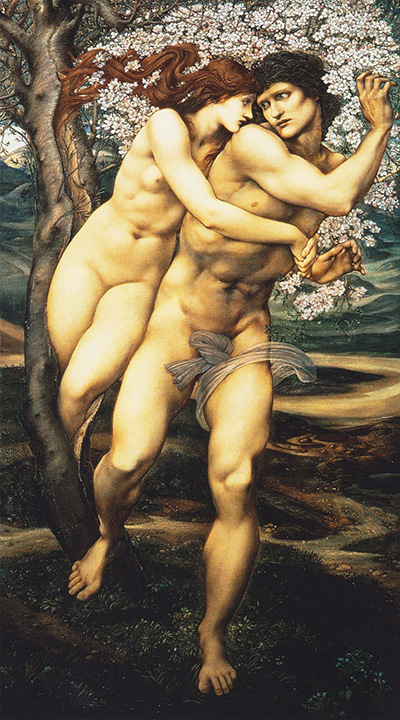
| The Tree of Forgiveness | 1881–82 | Oil on canvas |
| The Wheel of Fortune (Orsay) | 1875–83 | Oil on canvas |
| King Cophetua and the Beggar Maid | 1884 | Oil on canvas |
| The Depths of the Sea (oil) | 1886 | Oil |
| The Morning of the Resurrection | 1886 | Oil on panel |
| Study for the Head of Mary Magdalene | c. 1882 | Oil study |
| The Sleep of King Arthur in Avalon | 1880s–1898 | Oil on canvas |
| The Sleep of King Arthur in Avalon (modello) | ca. 1881 | Oil on canvas (modello) |
| The Star of Bethlehem | Signed 1890 | Watercolour and bodycolour |
| Study for The Star of Bethlehem | About 1887–91 | Drawing |
| Sponsa de Libano | 1891 | Watercolour and bodycolour |
| The Summons (Holy Grail tapestries) | 1890s | Tapestry |
| The Failure of Sir Gawaine (Holy Grail tapestries) | 1890s | Tapestry |
| Hope (Boston) | 1896 | Oil on canvas |
| La Belle au bois dormant (theatre programme) | 1894 | Collotype |
| The Wedding of Psyche | 1895 | Oil on canvas |
| The Works of Geoffrey Chaucer (Kelmscott edition) | 1896 | Illustrated book |
| The Ascension (Birmingham Cathedral) | 1885 | Stained glass |
| The Last Judgement (Birmingham Cathedral) | 1897 | Stained glass |
| Adoration of the Magi (Huntington) | 1890s | Tapestry |
| Love among the Ruins (Wightwick) | 1894 | Oil on canvas |
| The Merciful Knight (photogravure after Burne-Jones) | 1900 | Photogravure |
| The Garden Court (preparatory work) | 1870–75 | Graphite and watercolour with white gouache |
| Study of a Female Figure | 1885 | Graphite drawing |
| Psyche Throwing Herself into the River | 1865–68 | Wood engraving |
| Beauty | 1887–89 | Colour lithograph |
| Study for the Failure of Gawain | 1893 | Crayon and graphite on Japanese paper |
| The Prince Enters the Briar Wood (after Burne-Jones) | After 1890 | Photogravure |
| The Rose Bower (after Burne-Jones) | 1892 | Photogravure |
| Adoration of the Magi (Musée d’Orsay) | 1904 | Tapestry |
| Answers to Prayer (Lyndhurst) | 1860s | Stained glass |
| The Depths of the Sea (photogravure after Burne-Jones) | 1900 | Photogravure |
| Perseus and Andromeda (Adelaide composite) | 1876 | Oil on canvas |
| The Adoration of the Magi (Hamburg) | Woven 1900 | Tapestry |
| Love leading the Pilgrim through the Briars | 1874–76 | Embroidery |
| Musica (worked by Lady Jane Cory) | 1906 | Embroidery |
| Pomona (worked by Lady Jane Cory) | 1907 | Embroidery |
| Flora (worked by Lady Jane Cory) | 1909 | Embroidery |
| The Fourth Day of Creation (photogravure after Burne-Jones) | 1900 | Photogravure |
| The Morning of the Resurrection (photogravure after Burne-Jones) | 1900 | Photogravure |
| Musical angels of the St Catherine window (Christ Church) | Designed 1877 | Stained glass |
Discussion
Look again at the images and ideas explored in Sidonia von Bork. These editorial prompts invite your observations.
Reader Insights
What does the knotted costume lead you to expect about Sidonia before you know her story?
What becomes more noticeable about the sisters when you view Sidonia and Clara together?
Join the Conversation
Share a detail, comparison or question about Sidonia von Bork below.
References
- Tate, Sidonia von Bork 1560, work details and reproduction for accession N05877. View source.
- John Christian and the Burne-Jones Catalogue Raisonné, Sidonia von Bork, object NjE0, catalogue essay, inscriptions and provenance. View source.
- Algernon Charles Swinburne, Notes on Designs of the Old Masters at Florence, 1868, reprinted in Essays and Studies, 1875, passage on Filippino Lippi, Indiana University digital edition. View source.
- Royal Collection Trust, Giulio Romano, Portrait of Margherita Paleologo, c. 1531, RCIN 405777, description and sitter identification. View source.
- Wilhelm Meinhold, Sidonia von Bork, die Klosterhexe, J. J. Weber, 1847, German edition record. View source.
- Wilhelm Meinhold, translated by Francesca Speranza, Lady Wilde, Sidonia the Sorceress, Kelmscott Press, 1893, preface, Plönnies’s letter and Books I–II, Library of Congress Rosenwald copy. View source.
- National Museum in Szczecin, Sydonia von Borck przedstawiona w jej młodości i starości, oil on canvas, MNS/Szt/1167, object description and Justyna Bądkowska’s catalogue note. View source.
- Martin Schoebel, Landesarchiv Greifswald, Die Prozesse der Sidonia von Borcke, account and selected records, including Rep. 40 II Nr. 37. View source.
- State Archive in Szczecin, Świadectwa Historii Pomorza, catalogue entry for Sidonia von Borck’s letter to Marcin Hemnitius. View source.
- John Christian and the Burne-Jones Catalogue Raisonné, Clara von Bork, probably a likeness of Georgiana B-J, object NjE2, catalogue essay, inscriptions and provenance. View source.
- The New Gallery, Exhibition of the Works of Sir Edward Burne-Jones, 1898–99, pp. 36–37, catalogue nos. 22 and 24. View source.
- Tate Britain, Edward Burne-Jones, 2018–19 exhibition guide, pp. 26–27, entries N05878 and N05877. View source.
- National Portrait Gallery, Pre-Raphaelite Sisters, 2019–20 exhibition description. View source.
- Musei San Domenico, Preraffaelliti. Rinascimento moderno, 2024 press dossier and checklist, section 7, Edward Burne-Jones and the Myth of Italy. View source.
- Musée de Pont-Aven, Sorcières (1860–1920). Fantasmes, savoirs, liberté, 2025 exhibition with the Tate Sidonia von Bork. View source.