 by Tom Gurney
Tom Gurney BSc (Hons) is an art history expert with over 20 years experience
Published on June 19, 2020 / Updated on November 25, 2026
Email: tomgurney1@gmail.com / Phone: +44 7429 011000
The Days of Creation by Edward Burne-Jones: Introduction
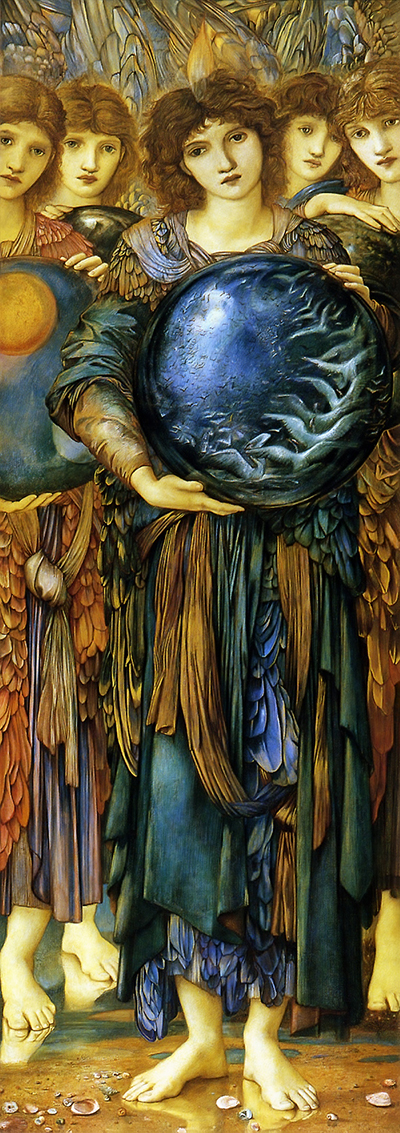
In Edward Burne-Jones’s The Days of Creation, an angel holds a sphere between its hands, and inside it light begins to separate from darkness. Five more panels follow. Each brings a new angel to the front and gives its globe a different subject, from the ordering of the waters to the appearance of Adam and Eve. Behind each newcomer, the earlier angels gather until their overlapping wings fill the last panel. Burne-Jones designed the sequence in 1870, painted it in 1875–76 and exhibited it at the opening of London’s Grosvenor Gallery in 1877. He devised a single frame for the six panels so they could be seen together. [1] [2]
Five original panels survive in the Harvard Art Museums’ Fogg Museum collection. The original Fourth Day, which showed the making of the sun, moon and stars, was reported stolen in 1970 and its whereabouts remain unconfirmed. Harvard retains its object record. Contemporary descriptions and early reproductions show what that panel contributed to the sequence. [3] [4]
At a Glance
- ArtistEdward Burne-Jones
- Date1870s
- MediumWatercolour and bodycolour
- SubjectSix compositions and repeated angels
This work across Edward Burne-Jones’s career
The Mirror of Venus
1870sThe Wheel of Fortune
1875–83The Last Sleep of Arthur in Avalon
1880s–1898The Star of Bethlehem
Signed 1890Contents
- From church glass to six painted panels
- What the angels show in each globe
- The surface of the watercolours
- What the first audiences saw
- What survives of the complete cycle
- Annotated details
From church glass to six painted panels
Burne-Jones worked on the subject well before he began this cycle. He made Creation designs for Waltham Abbey around 1860–61 and returned to the subject in designs for the Dalziel brothers’ illustrated Bible in the early 1860s. [4] At Waltham Abbey a figure of God with a globe occupies the centre of the rose window, surrounded by Creation scenes set inside circles. The later design distributes the globes among individual angels. [5] The closer ancestor of the six paintings is the west window at All Saints, Middleton Cheney, in Northamptonshire. Burne-Jones prepared the Creation designs for William Morris’s firm in 1870. In the window, the six angels occupy small lights above the three main scenes of the fiery furnace. Seen from below, the repeated pose and round globe make the angels easy to pick out even at a distance. The designs were reused in coloured glass at St Editha’s in Tamworth in 1874, where they appear in the east window of St George’s Chapel. [6] [7]
The high, narrow shape of a stained-glass light carries over into the paintings. Each figure is nearly as tall as its field, and the wings turn upward to fit the slender space. In a church window, stone and lead divide one image from the next. In the paintings, the frame did that work, while the recurrence of the same figures invited the viewer to follow them from panel to panel. Harris Manchester College in Oxford has a later example of the design in glass, installed on the chapel’s north wall in 1896. A version above the altar at Llandaff Cathedral was made by Harold Rathbone’s Della Robbia Pottery from the stained-glass designs. The painted sequence belongs to this longer history of Burne-Jones’s stained glass and its adaptation to different settings. [8] [9]
The inscription Harvard records for the First Day gives the design and painting dates. Burne-Jones’s work record, cited in the catalogue raisonné, also marks an intermediate step. In 1872 he noted that he had begun the series of Creation angels. He returned to the paintings in 1875 and continued into 1876, recording ten months of work on them. A set of six pencil designs once owned by Aglaia Coronio shows how far the arrangement had developed at the drawing stage. Coronio lent the drawings to the 1898–99 memorial exhibition, where visitors could see them upstairs and the paintings in the South Room. The catalogue raisonné treats the drawings as a work in their own right, with differences of detail from the painted set. Other studies isolate particular problems. The Fitzwilliam Museum keeps drawings of the angels’ drapery and a nude study for Eve in the final panel. [10] [11]
The globe itself has a possible precedent. Martin Harrison and William Waters proposed an engraving, once attributed to Mantegna, of a winged figure holding a sphere full of stars. That comparison helps explain the pose and object. Burne-Jones made the globe do more by placing a changing image inside it and repeating the form across six panels. The viewer knows where to look on each successive day even as the sky, water, plants or figures inside the circle change. [12]
What the angels show in each globe
The opening of Genesis gives the sequence its order. Light comes first, followed by the division of the waters, the emergence of dry land and vegetation, the lights in the heavens, creatures of sea and sky, and finally land animals and humankind. The biblical account assigns these acts to God. Burne-Jones puts the angels in the position of presenting them to the viewer. The new angel takes the foreground, its head marked by a flame, while figures from previous days stay in the picture. The world grows busier inside the glass at the same time that the company of angels grows outside it. [13] [14]
In the First Day, the globe contains the separation of light and darkness. It is the simplest subject in the cycle, with no vegetation or creatures to establish a scale. With only one figure in view, the symmetry of the wings draws attention to the sphere and to the hands enclosing it. The gap between the angel’s gaze and the globe gives the viewer a moment to look before moving on.
On the Second Day, a second figure stands behind the angel holding the globe. The memorial catalogue described the subject as the ordering of chaos. In Genesis this is the day of the firmament, or expanse dividing the waters above from those below. The globe still gives an impression of masses in motion. It is only in the next panel that trees make the painted world familiar as a landscape.
The Third Day brings vegetation within the globe, an image of the land taking shape and becoming fertile. The memorial catalogue identified the separation of land and waters, and Genesis places the first growth of plants on the same day. There is now a small landscape to look into, held at the chest of a figure that fills most of the panel. The difference in scale is one of the pleasures of the series: the hand and the tree belong to different spaces, yet here they almost touch.
The Fourth Day brought the sun, moon and stars. Oscar Wilde, who saw the complete work in 1877, compared the fourth angel’s sphere to a heated opal. His account preserves an impression of the original colour. The 1900 photoengraving held by the Museum of New Zealand Te Papa Tongarewa shows the arrangement clearly. Four faces rise above the foreground sphere, where points of light cluster below larger, round forms. Harvard’s online record also includes an image digitised from an original photographic negative. The photographs and prints preserve the design, while Wilde’s account gives a sense of how it looked in colour. [15] [16]
In the Fifth Day, birds stand for the living creatures introduced into the waters and skies in Genesis. Their forms become a second pattern of wings inside the globe. The birds are small enough to register as a flock, while the angels’ wings are large enough to show the disposition of individual feathers. Burne-Jones lets the eye travel between the two scales.
The globe in the Sixth Day gives pride of place to Adam and Eve. They stand naked and touch hands. Behind them the serpent winds around a tree, bringing the later story of the Fall into the picture before it has happened. Look below the globe and there is a further change in the pattern. An angel sits among the flowers at the feet of the group and plays a stringed instrument, identified as a medieval psaltery in the Lyon exhibition material. The seated musician represents the Seventh Day, when God rests, within the sixth and final panel. After each new day has been marked by another standing angel and globe, the change in posture and the suggestion of music give the eye somewhere to pause. [17]
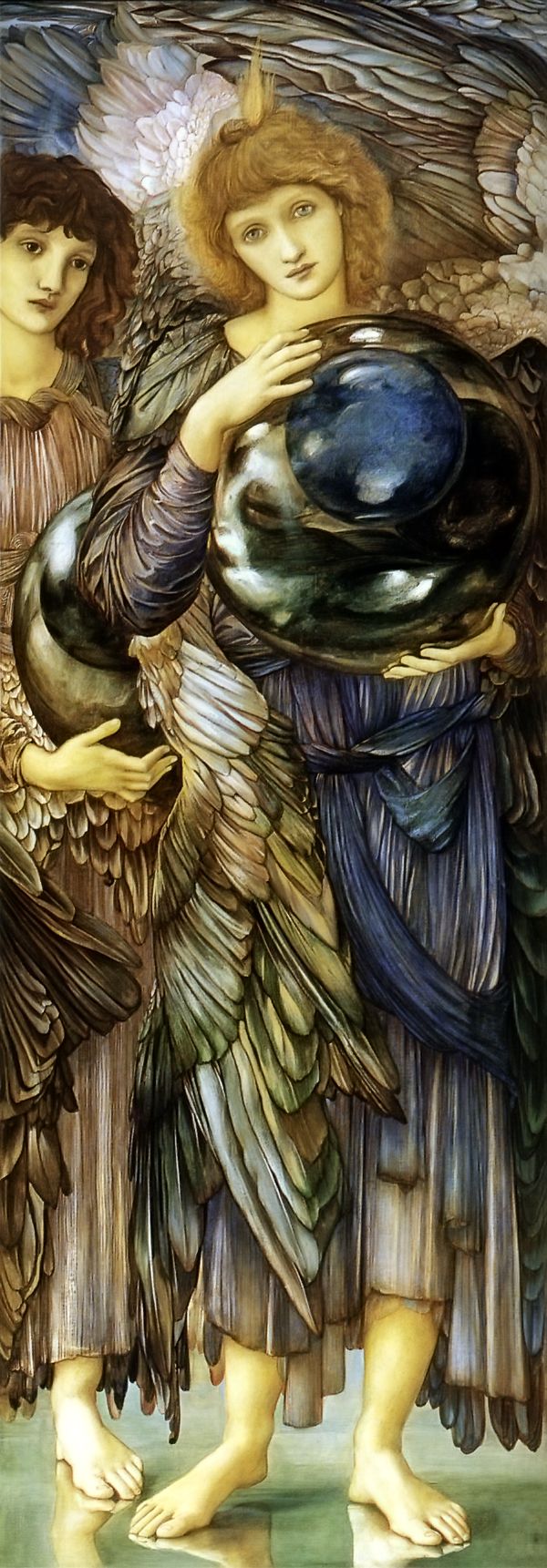
Edward Burne-Jones, The Second Day, from The Days of Creation. Photograph by Edward Burne-Jones. Image source. CC BY 2.0. Resized for the web.
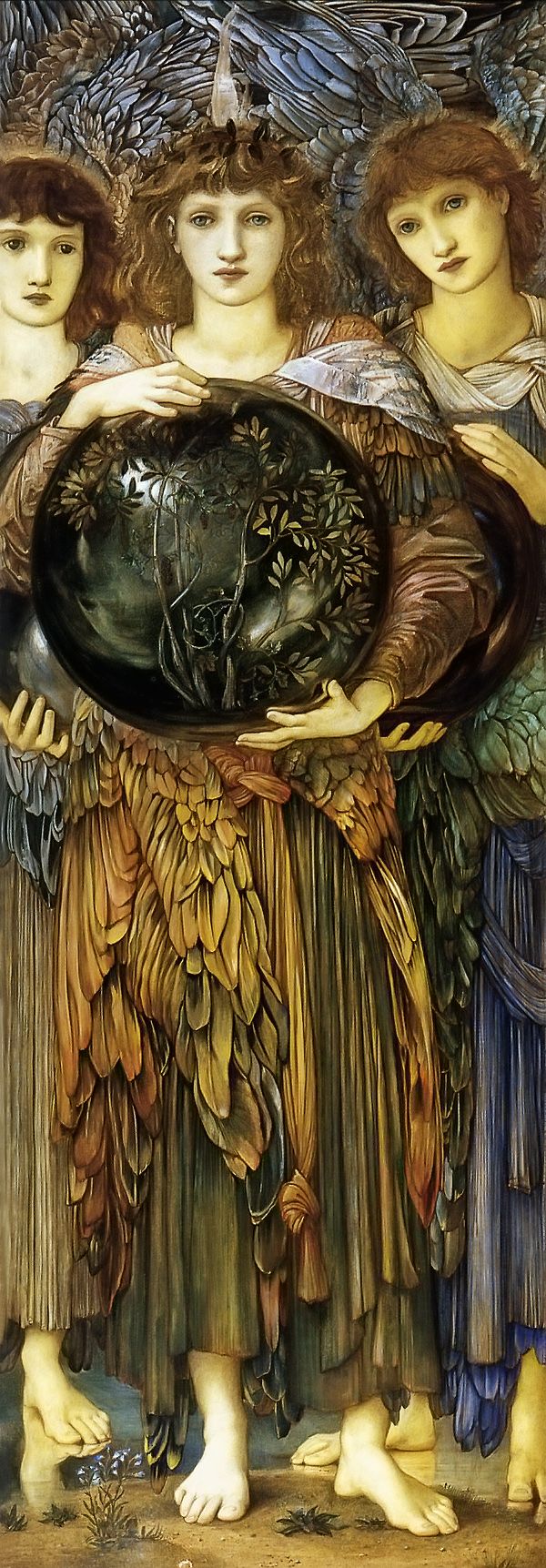
Edward Burne-Jones, The Third Day, from The Days of Creation. Photograph by Edward Burne-Jones. Image source. CC BY 2.0. Resized for the web.
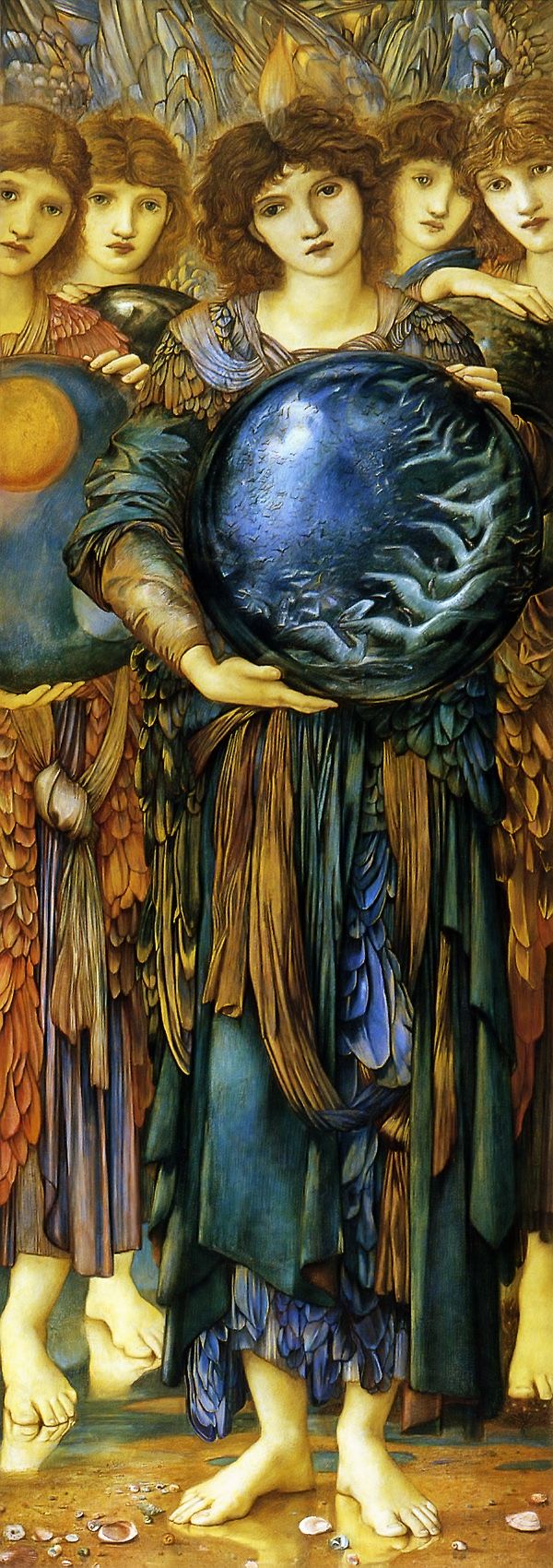
Edward Burne-Jones, The Fifth Day, from The Days of Creation. Photograph by Edward Burne-Jones. Image source. CC BY 2.0. Resized for the web.
The surface of the watercolours
The First Day is about a metre high and just over 35 centimetres wide. Harvard catalogues it at 102.2 by 35.5 centimetres, as watercolour, gouache, shell gold and platinum paint on linen over a rigid panel prepared with a zinc-white ground. Series reproductions can make the painted figures look smooth, but the ground and cloth give the actual surface a fine texture. Opaque paint supplies the solid body of the feathers and the drapery. Touches of metal catch light in the same field, where the globe is painted to suggest that light and small forms can be seen through its curved surface. The Lyon exhibition described the matte finish as closer in appearance to fresco or tempera. [1] [14]
Fiona Mann’s study of Burne-Jones’s materials puts that combination in the context of his experiments with artists’ supplies. The colourman’s ledgers record purchases of aluminium beginning in 1870, and Mann proposes the Creation cycle as a possible use for it. Harvard catalogues the metal as platinum, and the kind of paint that Burne-Jones bought and what he used in particular passages are separate questions. Across the painted sequence the balance of colour changes. Cool passages dominate early on. As the figures gather, warmer colours spread through the plumage and the final panel becomes dense with feathers, flowers and reflected light. [18]
What the first audiences saw
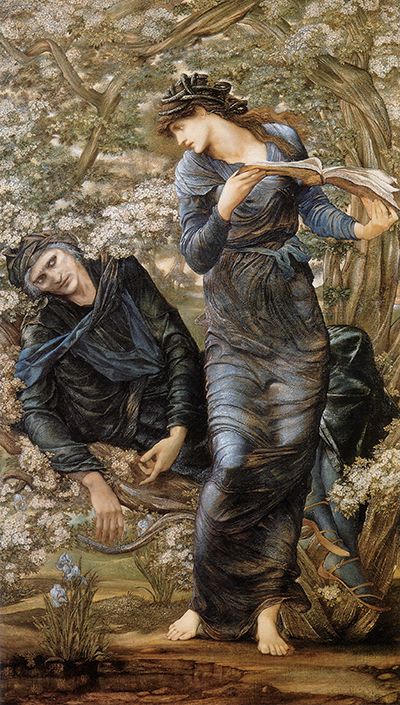
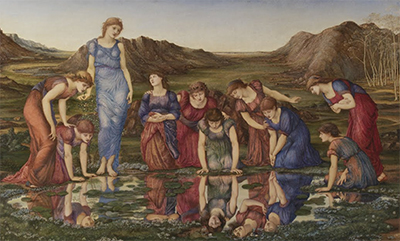
At the opening of the Grosvenor Gallery in May 1877, the watercolours hung among Burne-Jones’s submissions, which also included The Beguiling of Merlin and The Mirror of Venus. Wilde described the increasing number of angels and intensity of colour in his July review for the Dublin University Magazine. He was also drawn to the figures’ faces and bare feet, details that make the creatures standing outside the globes as compelling as the events within them. Henry James admired the faces that emerged from the mass of feathers. The series provoked disagreement as well. A correspondent to The Spectator granted Burne-Jones’s technical accomplishment but regarded the symbolism of The Days of Creation as fit chiefly for children. The responses show how differently viewers could take the same device of setting a large story inside a small sphere. [15] [19] [20]
The frame mattered to the way those audiences saw the panels. Burne-Jones specified in his inscription that each picture was one of six, incomplete by itself, and asked that the paintings stay in the frame he had designed. When Alexander Henderson lent the work to the memorial exhibition of 1898–99, the six were still framed as one and hung in the centre of the South Room’s south wall. A viewer could make out all six repeated uprights from across the room, then approach to see what each angel held. That change in viewing distance is harder to recover when photographs show the panels one at a time. [1] [12]
What survives of the complete cycle
William Graham bought the paintings from Burne-Jones in 1877. After Graham’s death they passed through Thomas Agnew & Sons to Alexander Henderson, later Lord Faringdon. Grenville L. Winthrop acquired the sequence at Henderson’s 1934 sale, and the panels were individually reframed. The artist’s original frame has since been lost. Winthrop’s bequest took the works to the Fogg Museum in 1943. Harvard catalogues each day separately, with numbers running from 1943.454 for the First Day to 1943.459 for the Sixth. The Fourth Day’s number, 1943.457, identifies the missing original. Surviving panels appeared in the 2003 Winthrop exhibition that travelled from Lyon to London and New York. Harvard’s online catalogue gives the exhibition history and individual object records for the five surviving originals, without a current gallery location. [21] [1] [3] [12] [22]
Reproductions had begun to circulate long before the frame disappeared. Frederick Hollyer’s platinotypes, photographic prints made with platinum, offered viewers the entire sequence in reduced form. They could be had in several kinds of frame, including a simplified version of the one Burne-Jones had designed. Wilde owned a set. In 1892 a framed set reached the French painter Gustave Moreau through Lady Brooke. His letter of thanks survives, and the Musée Gustave Moreau records the photographs among the works associated with his home. Te Papa’s Fourth Day comes from a different edition, a photoengraving issued by the Berlin Photographic Company in 1900. Its image is 139 by 399 millimetres, considerably smaller than the missing watercolour. These objects show how the composition could travel as a whole or as individual images, even as the history of the originals made it harder to see the cycle together. [14] [16] [23] [24]
Annotated Details from The Days of Creation
The numbered points identify visible features discussed in this article. Return from each detail to the numbered overview. The Fourth Day of Creation, photogravure after Edward Burne-Jones, published by the Berlin Photographic Company in 1900. Museum of New Zealand Te Papa Tongarewa, 1981-0086-1/25. Image source. No Known Copyright Restrictions.
.jpg)
Details from THE DAYS OF CREATION
Compare the cropped details with the source images above. Notice how their colours, shapes and positions contribute to the larger compositions.
The crowd of angels
Four faces press into the upper part of the composition. Small differences of angle distinguish the repeated faces.
 Detail 01 the-crowd-of-angels.jpg)
The lights in the globe
The large globe contains a pattern of small bright marks beside larger bodies. The early print records their positions in monochrome.
 Detail 02 the-lights-in-the-globe.jpg)
Hem and reflected light
The folds reach nearly to the feet. Thin marks on the ground sit immediately below the central drapery and feet.
 Detail 03 hem-and-reflected-light.jpg)
Edward Burne-Jones on film
Explore Burne-Jones’s paintings, illustrated stories and stained-glass designs.
Edward Burne-Jones: Pre-Raphaelite Visionary | Exhibitions | Showcase
A look at Burne-Jones’s paintings and the Tate retrospective.
Watch on YouTubeArtworks directory
This directory records paintings, studies, designs and collaborative works, with separate entries for documented versions and series where known.
| Name | Date | Medium |
|---|---|---|
| Sidonia von Bork 1560 | 1860 | Watercolour and bodycolour |
| Clara von Bork 1560 | 1860 | Watercolour and bodycolour |
| The Merciful Knight | 1863 | Watercolour |
| Sibylla Delphica | c. 1886 | Oil on panel |
| Phyllis and Demophoön | 1870 | Watercolour and bodycolour |
| The Legend of the Briar Rose (Buscot series) | 1870s–1890 | Oils on canvas |
| The Briar Wood (Buscot series) | By 1890 | Oil on canvas |
| The Council Chamber (Buscot series) | By 1890 | Oil on canvas |
| The Garden Court (Buscot series) | By 1890 | Oil on canvas |
| The Rose Bower (Buscot series) | By 1890 | Oil on canvas |
| Group of Women, study for The Golden Stairs | 1872 | Drawing |
| The Beguiling of Merlin | 1870s | Oil on canvas |
| The Perseus Cycle | From 1875 | Paintings and full-scale designs |
| The Call of Perseus (Stuttgart) | From 1875 | Oil painting |
| Perseus and the Graeae (Stuttgart) | From 1875 | Oil painting |
| The Rock of Doom (Stuttgart) | 1884–88 | Oil on canvas |
| The Doom Fulfilled (Stuttgart) | 1888 | Oil on canvas |
| The Baleful Head (Stuttgart) | 1885–87 | Oil on canvas |
| The Baleful Head (Southampton design) | 1880s | Bodycolour |
| The Rock of Doom (Southampton design) | 1880s | Bodycolour |
| The Doom Fulfilled (Southampton design) | 1880s | Bodycolour |
| The Mirror of Venus (Gulbenkian) | 1870s | Oil on canvas |
| Drawing associated with The Mirror of Venus | 1870s | Drawing |
| Laus Veneris (Laing) | 1873–78 | Oil on canvas |
| The Days of Creation | 1870s | Watercolour and bodycolour |
| The Golden Stairs | 1880 | Oil on canvas |
| An Angel Playing a Flageolet | 1878 | Watercolour, bodycolour and gold |
| The Tree of Forgiveness | 1881–82 | Oil on canvas |
| The Wheel of Fortune (Orsay) | 1875–83 | Oil on canvas |
| King Cophetua and the Beggar Maid | 1884 | Oil on canvas |
| The Depths of the Sea (oil) | 1886 | Oil |
| The Morning of the Resurrection | 1886 | Oil on panel |
| Study for the Head of Mary Magdalene | c. 1882 | Oil study |
| The Sleep of King Arthur in Avalon | 1880s–1898 | Oil on canvas |
| The Sleep of King Arthur in Avalon (modello) | ca. 1881 | Oil on canvas (modello) |
| The Star of Bethlehem | Signed 1890 | Watercolour and bodycolour |
| Study for The Star of Bethlehem | About 1887–91 | Drawing |
| Sponsa de Libano | 1891 | Watercolour and bodycolour |
| The Summons (Holy Grail tapestries) | 1890s | Tapestry |
| The Failure of Sir Gawaine (Holy Grail tapestries) | 1890s | Tapestry |
| Hope (Boston) | 1896 | Oil on canvas |
| La Belle au bois dormant (theatre programme) | 1894 | Collotype |
| The Wedding of Psyche | 1895 | Oil on canvas |
| The Works of Geoffrey Chaucer (Kelmscott edition) | 1896 | Illustrated book |
| The Ascension (Birmingham Cathedral) | 1885 | Stained glass |
| The Last Judgement (Birmingham Cathedral) | 1897 | Stained glass |
| Adoration of the Magi (Huntington) | 1890s | Tapestry |
| Love among the Ruins (Wightwick) | 1894 | Oil on canvas |
| The Merciful Knight (photogravure after Burne-Jones) | 1900 | Photogravure |
| The Garden Court (preparatory work) | 1870–75 | Graphite and watercolour with white gouache |
| Study of a Female Figure | 1885 | Graphite drawing |
| Psyche Throwing Herself into the River | 1865–68 | Wood engraving |
| Beauty | 1887–89 | Colour lithograph |
| Study for the Failure of Gawain | 1893 | Crayon and graphite on Japanese paper |
| The Prince Enters the Briar Wood (after Burne-Jones) | After 1890 | Photogravure |
| The Rose Bower (after Burne-Jones) | 1892 | Photogravure |
| Adoration of the Magi (Musée d’Orsay) | 1904 | Tapestry |
| Answers to Prayer (Lyndhurst) | 1860s | Stained glass |
| The Depths of the Sea (photogravure after Burne-Jones) | 1900 | Photogravure |
| Perseus and Andromeda (Adelaide composite) | 1876 | Oil on canvas |
| The Adoration of the Magi (Hamburg) | Woven 1900 | Tapestry |
| Love leading the Pilgrim through the Briars | 1874–76 | Embroidery |
| Musica (worked by Lady Jane Cory) | 1906 | Embroidery |
| Pomona (worked by Lady Jane Cory) | 1907 | Embroidery |
| Flora (worked by Lady Jane Cory) | 1909 | Embroidery |
| The Fourth Day of Creation (photogravure after Burne-Jones) | 1900 | Photogravure |
| The Morning of the Resurrection (photogravure after Burne-Jones) | 1900 | Photogravure |
| Musical angels of the St Catherine window (Christ Church) | Designed 1877 | Stained glass |
Discussion
Look again at the images and ideas explored in The Days of Creation by Edward Burne-Jones. These editorial prompts invite your observations.
Reader Insights
Which visual change between two consecutive days makes the sequence clearest to you?
What does the early print tell you about the missing panel when viewed beside the surviving compositions?
Join the Conversation
Share a detail, comparison or question about The Days of Creation by Edward Burne-Jones below.
References
- Harvard Art Museums / Fogg Museum, The Days of Creation: The First Day, 1943.454, physical description, inscription and provenance. View source.
- The New Gallery, Exhibition of the Works of Sir Edward Burne-Jones (1898–99), South Room, no. 39, and balcony, no. 178. View source.
- Harvard Art Museums / Fogg Museum, The Days of Creation: The Fourth Day, historical object record 1943.457. View source.
- Burne-Jones Catalogue Raisonné, The Days of Creation, pencil drawings for the six days, John Christian’s entry on the drawings and painted sequence. View source.
- Università Ca’ Foscari Venezia, thesis study of Gothic Revival glass, discussion of the Creation rose window at Waltham Abbey. View source.
- Stained Glass Museum / Visit Stained Glass, Church of All Saints, Middleton Cheney, Northamptonshire, west window. View source.
- St Editha’s Parish Church, Welcome to Tamworth, St George’s Chapel east window. View source.
- Harris Manchester College, University of Oxford, Design and History, chapel and north-wall windows. View source.
- Llandaff Cathedral, The Chapels, St Dyfrig’s Chapel. View source.
- The Fitzwilliam Museum, The Stained Glass of William Morris and his Circle, connected object records for drapery and figure studies. View source.
- The Fitzwilliam Museum, Nude study for Eve in the sixth panel of ‘The Days of Creation’, 2011B. View source.
- Debbie Innes, University of York, Exhibitions as Palimpsest: The New Gallery, Regent Street, 1888–1910 (2023), pp. 187–89 and figs. 122–25. View source.
- United States Conference of Catholic Bishops, Genesis, 1:1–31 and 2:1–3, New American Bible, Revised Edition. View source.
- Musée des Beaux-Arts de Lyon, La Collection Grenville L. Winthrop, no. 13, “Les Jours de la création : le sixième jour,” pp. 19–20. View source.
- Oscar Wilde, “The Grosvenor Gallery, 1877,” Dublin University Magazine, July 1877, reprinted in Miscellanies. View source.
- Museum of New Zealand Te Papa Tongarewa, The Days of Creation: The Fourth Day. From the portfolio: The Work of E. Burne-Jones, Berlin Photographic Company, 1900, 1981-0086-1/25. View source.
- Harvard Art Museums / Fogg Museum, The Days of Creation: The Sixth Day, 1943.459. View source.
- Fiona Mann, “A ‘born rebel’: Edward Burne-Jones and watercolour painting 1857–80,” fig. 24, discussion of the Roberson records and notes 49–51. View source.
- Noriko Yoshimura, 絵画と空間 ―バーン=ジョーンズの《黄金の階段》とグロヴナー・ギャラリーをめぐって― (2019), pp. 35–36, first Grosvenor exhibition and Henry James. View source.
- The Spectator, “Art Critics,” 16 June 1877, p. 15, correspondence on The Days of Creation. View source.
- The Metropolitan Museum of Art, A Private Passion: 19th-Century Paintings and Drawings from the Grenville L. Winthrop Collection, Harvard University, 2003 exhibition announcement. View source.
- Harvard Art Museums / Fogg Museum, The Days of Creation: The Second Day, 1943.455, with linked records for the Third and Fifth Days. View source.
- Burne-Jones Catalogue Raisonné, The Days of Creation, platinotypes, Frederick Hollyer, and the 1892 Moreau letter. View source.
- Musée national Gustave Moreau, Dossier de presse, display account of the photographs of Les Jours de la Création. View source.