 by Tom Gurney
Tom Gurney BSc (Hons) is an art history expert with over 20 years experience
Published on June 19, 2020 / Updated on November 25, 2026
Email: tomgurney1@gmail.com / Phone: +44 7429 011000
The Golden Stairs: Introduction
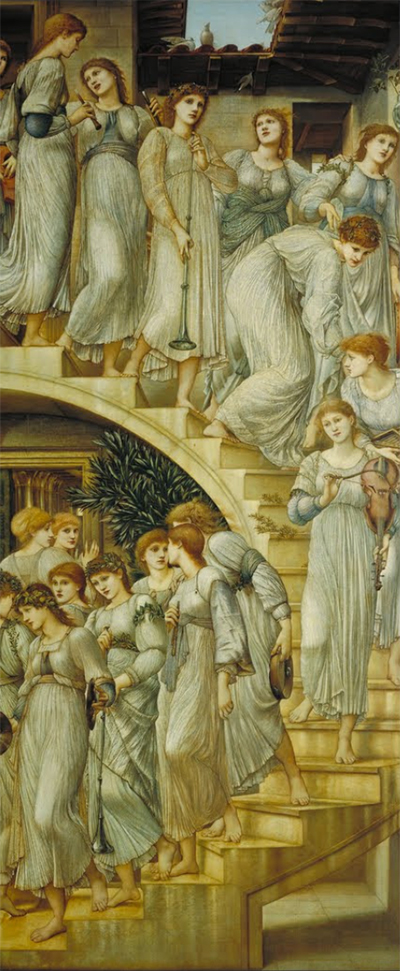
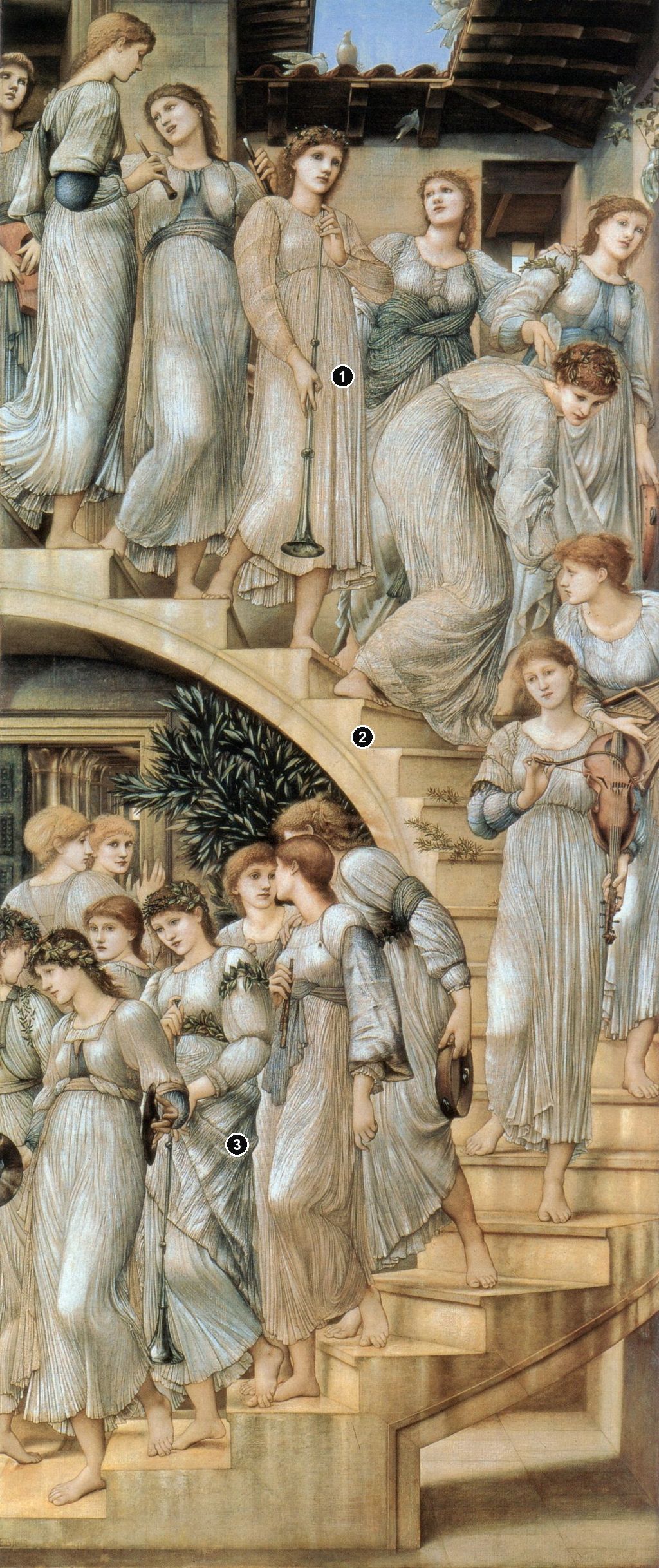
Eighteen women come down a winding staircase with musical instruments in their hands. Some watch their footing, some turn to one another, and one looks out as she holds a bow across her instrument. Edward Burne-Jones gives the descent an unmistakable direction, yet the place the women are coming from and the occasion that has brought them together remain a mystery. He finished The Golden Stairs in 1880, four years after beginning work on the canvas. The oil painting measures 269.2 by 116.8 centimetres and belongs to Tate Britain in London. [1] [2] [3]
At a Glance
- ArtistEdward Burne-Jones
- Date1880
- MediumOil on canvas
- SubjectA procession of musicians
This work across Edward Burne-Jones’s career
The Mirror of Venus
1870sThe Wheel of Fortune
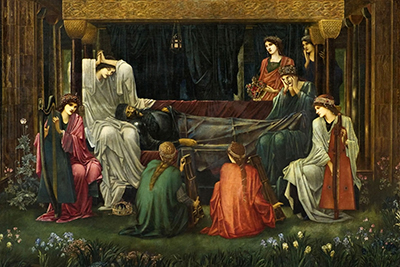
1875–83The Last Sleep of Arthur in Avalon
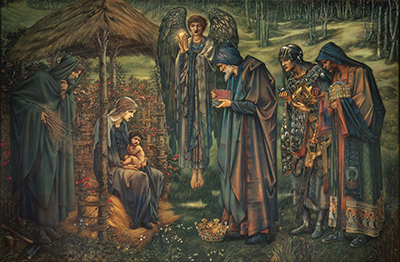
1880s–1898The Star of Bethlehem
Signed 1890Contents
- How the staircase sets the pace
- The music in the painting
- From the first design to the finished oil
- The women who posed
- A wedding, a dream or a procession?
- From the Grosvenor Gallery to Tate
- Annotated details
How the staircase sets the pace
The staircase first carries the eye from the upper left across to the right, then turns and brings the procession to the lower left. At the top a musician in profile arrives on a broad step with her head inclined towards the woman below her. Around the bend another woman pitches forward, and the skirts close up where the steps are most difficult to see. On the last stretch, the pale rectangles of the treads are visible again. A bare foot reaches for the next step while another still takes the weight on the one above. The angle of the stone changes at the turn, and so does the apparent pace of the women. [1]
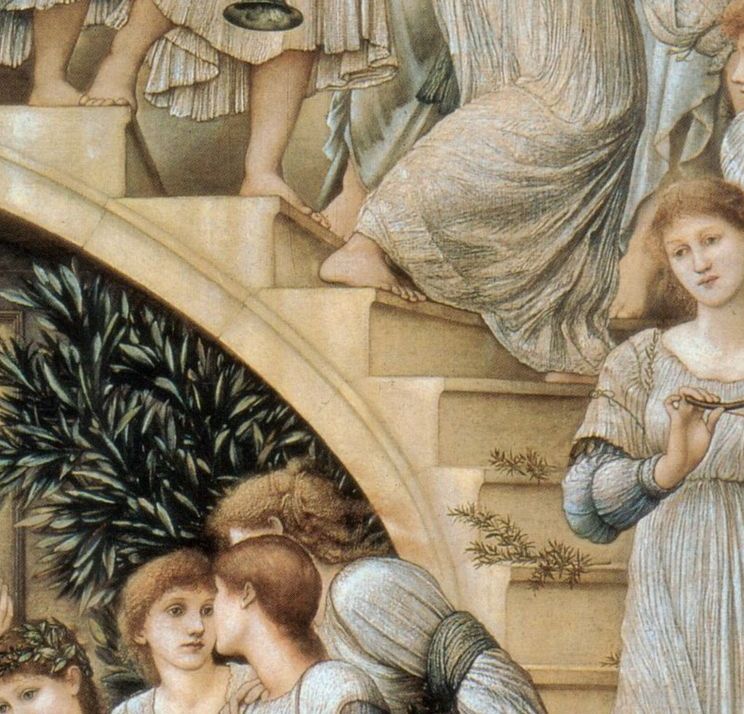
Look below the arch and the design becomes harder to follow as a piece of architecture. The lower group gathers in front of a doorway and across the line of the descending figures. Behind them are columns and dark leaves, glimpsed through the spaces between heads. Higher up, Burne-Jones allows a small opening to the sky between the roof beams, where birds gather on a ledge. Both openings give the setting depth, while the mass of dresses remains close to the surface. Mie Kubo likens this organisation of space to Gothic stained glass. The comparison makes particular sense where a figure, a dark strip of foliage and a stair edge meet. Each occupies a closely fitted patch of the design, even when it suggests a different distance from the viewer. [1] [4]
The title calls attention to gold, but silver and grey carry much of the painting. Where a dress falls straight, the narrow pleats pick up light in parallel. On the sharply bending figure near the upper right the same folds fan out over the hip, then gather around the feet. Warmer fabric near the bottom almost meets the colour of the stairs. Blue-grey sleeves and waistbands help separate neighbouring bodies, particularly where their pale skirts run together. A visitor who starts by counting faces may soon find it easier to follow the procession by the changes in the folds. [1] [2]
Annotated Details from The Golden Stairs
The numbered points identify visible features discussed in this article. Return from each detail to the numbered overview. The Golden Stairs, 1876–1880, by Edward Burne-Jones, oil on canvas. Image source. Public domain.
Details from THE GOLDEN STAIRS
Compare the cropped details with the source images above. Notice how their colours, shapes and positions contribute to the larger compositions.
Upper procession
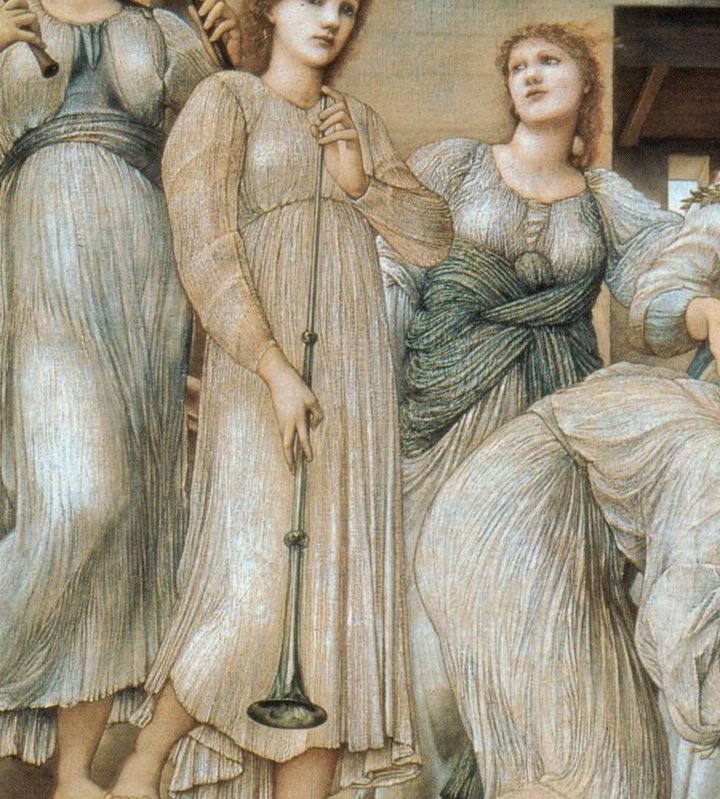
The figures above the curving stair shift their weight as they pass the landing. Their instruments turn in a sequence of small angles.
The curve of the stair
The light edge of the stair gives the procession a diagonal, then a curve. Parts of the descending figures are hidden by the line of the architecture.
A second cluster
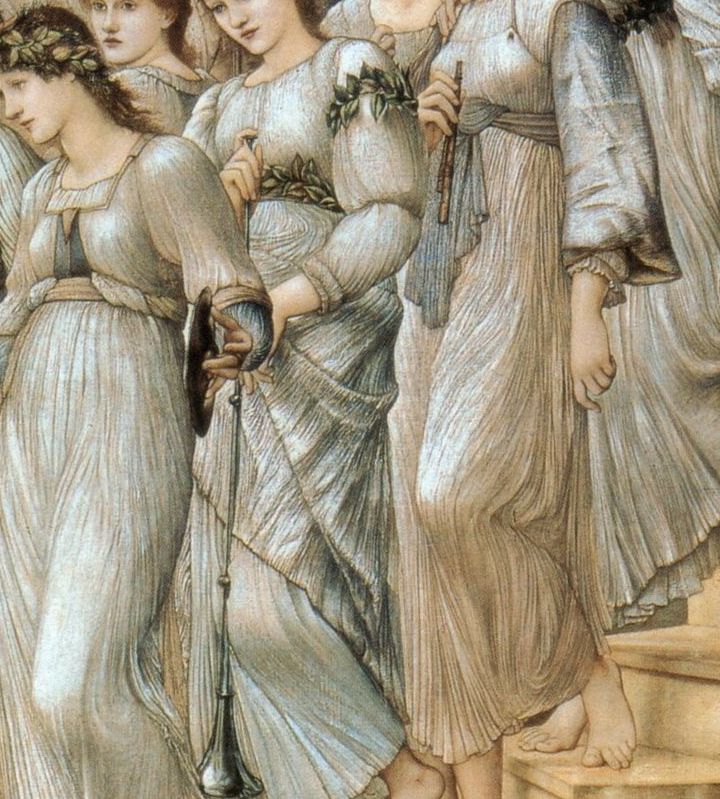
Heads, hands and instruments crowd together where the route turns again. A change in the spacing of the figures modulates the pace.
The music in the painting
The instruments give certain gestures a purpose. At the front of the group a pair of cymbals hangs near a woman’s waist, and a long horn drops towards the steps. The bowed instrument at the outer turn draws a line across the body of its player. Those objects are held at different angles and heights, so they punctuate a design in which the dresses share so many long verticals. Writing in The Athenaeum in 1880, F. G. Stephens identified a wider assortment, including pipes, tambourines, violas and dulcimers. He was reminded of the musician angels carved in the Pórtico de la Gloria at Santiago de Compostela. The comparison records what a contemporary critic saw in their bearing and instruments. [3] [5]
The women carry most of the instruments at rest. Near the bend, the bow held against or just above the strings is the closest Burne-Jones comes to suggesting audible music. The adjacent figure turns her head away from the direction of descent. Phyllis Weliver sees the arrangement as an invitation to imagine listening, a possibility the picture opens for the spectator as well as for the women on the stairs. The critic for The Times made much the same connection through the feet, whose fall suggested a musical rhythm. Imagine the spacing of those footsteps. The eye can cross a close cluster quickly, then pause over a single figure who occupies the full width of the staircase. [1] [3] [5]
In his 1877 essay The School of Giorgione, Walter Pater wrote, “All art constantly aspires towards the condition of music.” He was interested in the way a piece of music makes its form inseparable from what it expresses. That idea helps explain the affinity of The Golden Stairs with Aestheticism, a movement that took the sensory experience of a work seriously in its own right. James McNeill Whistler called his near-contemporary painting of fireworks Nocturne in Black and Gold, the Falling Rocket. He lets a scatter of sparks interrupt a dark field of colour. Burne-Jones gives his lights and darks a much more tangible setting of bodies, fabric and stone, but both painters make the spacing of a colour or accent crucial to the experience of the picture. [6] [7]
From the first design to the finished oil
The idea took shape after Burne-Jones’s 1871 trip to Italy. In Arezzo he copied frescoes by Piero della Francesca in San Francesco. Stephens, who appears to have seen the work in progress, thought the finished picture had lost some of the Greek character he had first admired. He credited Piero with the impression made by the broad foreheads, pale flesh and distinctive way the heads are carried. The clothes still evoke antiquity in their belted waists and fine pleats. It was the poise of the figures, including the way some incline their heads without turning the whole body, that led him to an early Renaissance painter. [3]
The order of work can be traced from several kinds of record. Burne-Jones’s work list records the design and studies in 1872 and dates the start of the tall picture to 1876. Georgiana Burne-Jones remembered both The Golden Stairs and the large Annunciation being underway in 1875. Her recollection describes an increasingly crowded studio, while the work list is more specific about time spent on the canvas. By 22 April 1880 the picture was finished. Georgiana recorded the date in her diary and joked that the painter, after working under so much pressure, was nearly finished himself. [3] [8]
A pencil drawing at Statens Museum for Kunst in Copenhagen bears Burne-Jones’s initials and the date 1872. It shows how much of the design was already in place that year. The top right of the painting is recognisable in the drawn group. One woman lifts her face, the one beside her inclines her head, and a third leans far forward across them. Burne-Jones worked some of the heads and gathered sleeves fairly distinctly and allowed the faint outlines of other figures to trail off. The staircase itself barely registers. Seen alongside the finished canvas, the sheet makes it possible to follow the positions of shoulders, heads and folds that give this crowded turn its shape before the setting and colour pull it together. [9] [1]
Two studies dated 1875 at the National Gallery of Victoria isolate individual figures. Burne-Jones worked with pencil and gouache on grey grounds. The neutral paper supplies an intermediate tone so that darker pencil lines and pale strokes can give separate emphasis to edges and lit surfaces. In the Ashmolean Museum’s drawing dated 1877, the figure is worked out undraped, with white heightening on grey prepared paper. The Metropolitan Museum’s exhibition catalogue describes its medium as silverpoint and places it in the context of Burne-Jones’s practice of studying the body before clothes. The knee, balance and turn of the hip would still be legible under a robe if the lower folds followed those movements. The drawing also lets us see him adapting an old technique. As the historian Susan Owens points out, he reinforced the faint metalpoint lines with graphite, especially around the head. The stronger line helps keep the face distinct from the grey paper, while the pale marks on the body give it volume. [10] [11] [12] [13]
Burne-Jones gave the feet drawings of their own. The Fitzwilliam Museum’s sheet numbered 1992 is a graphite drawing on white cartridge paper. A separate Fitzwilliam sheet, 1998, brings together six studies of feet descending stairs. One problem these drawings help explain is how to show the instant when the weight passes between feet, especially when a long hem obscures the ankle. In the oil, feet reach over the edge of one step, settle flat, or leave only the toes in contact with the one above. Tate’s 2018 exhibition also brought drapery and head studies into the account of the work. At each scale, from the angle of a foot to a bundle of figures on the turn, Burne-Jones could examine a feature that the finished procession lets the eye take in at speed. [14] [15] [2]
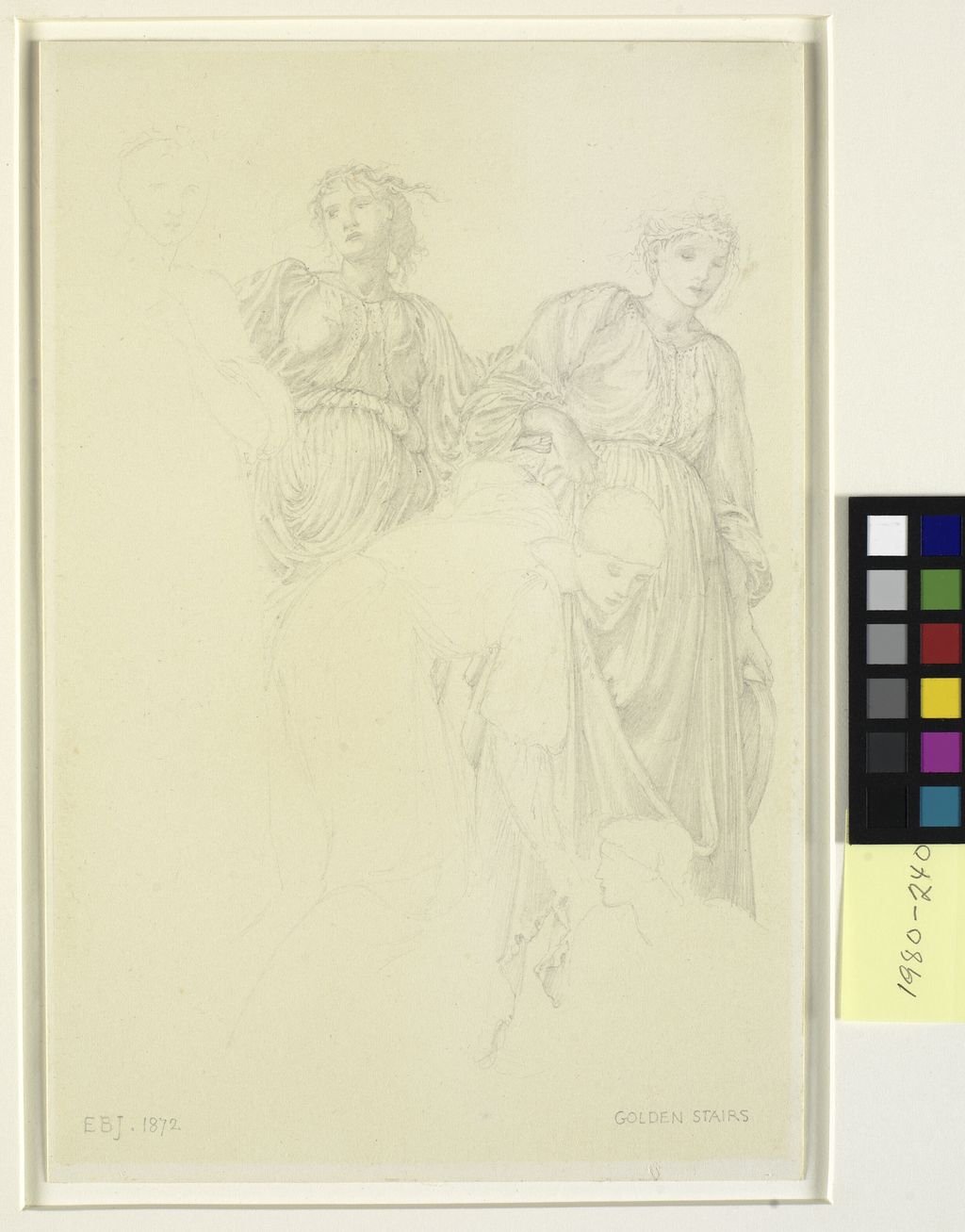
Edward Burne-Jones, Group of Women, a study for The Golden Stairs. Statens Museum for Kunst, KKS1980-240. Image source. Public domain. The collection photograph includes the original colour target and mounting margins.
The women who posed
The painting draws on people Burne-Jones knew, as well as professional models. Tate identifies his daughter Margaret with the profile at the top and places Frances Graham, daughter of the collector William Graham, at the lower left, with Mary Gladstone behind her. The National Portrait Gallery lists May Morris as the eighth figure from the top, facing forward with the violin. The faces share a characteristic set of lips, brows and eyelids, so an identification depends on evidence beyond a resemblance. The painting also leaves some faces in profile or partly hidden by a neighbour, limiting what comparisons with portraits can tell us. [2] [16]
Drawings can establish the involvement of a model more firmly than they establish a likeness on the canvas. The 1877 Ashmolean sheet is inscribed with the first name of Antonia Caiva. The catalogue raisonné connects her pose with the cymbal bearer near the foot of the stairs, a figure associated with Frances Graham. That distinction makes sense in a studio that worked out the stance and the head separately. An oil study from the collection of Burne-Jones’s studio assistant Matthew Webb provides another example. Christie’s catalogued it as a downward-looking head of Dorothy Dene for the painting and notes the associated correspondence from Webb. These are records of specific stages in the work. The published suggestions for other faces, including Mary Stuart Wortley and the sisters Laura and Margot Tennant, vary in certainty. [12] [17] [18] [3] [5]
Mary Gladstone’s own account makes her an especially interesting figure in the painting’s history. She saw the finished canvas at Burne-Jones’s studio in April and visited the Grosvenor exhibition, which she preferred to the Royal Academy show. She also played music and worked as secretary to her father, William Ewart Gladstone. On the flyleaf of her copy of the third volume of Ruskin’s The Stones of Venice, she copied out Burne-Jones’s description of a picture as a beautiful dream, a rare note in her edition of Ruskin’s works that drew on another writer. Weliver uses the annotation to show that Mary drew connections between the two men’s ideas about dreams. Her diary and letters make the picture part of a culture in which some of the women associated with it were active readers, musicians and participants in public life. [5]
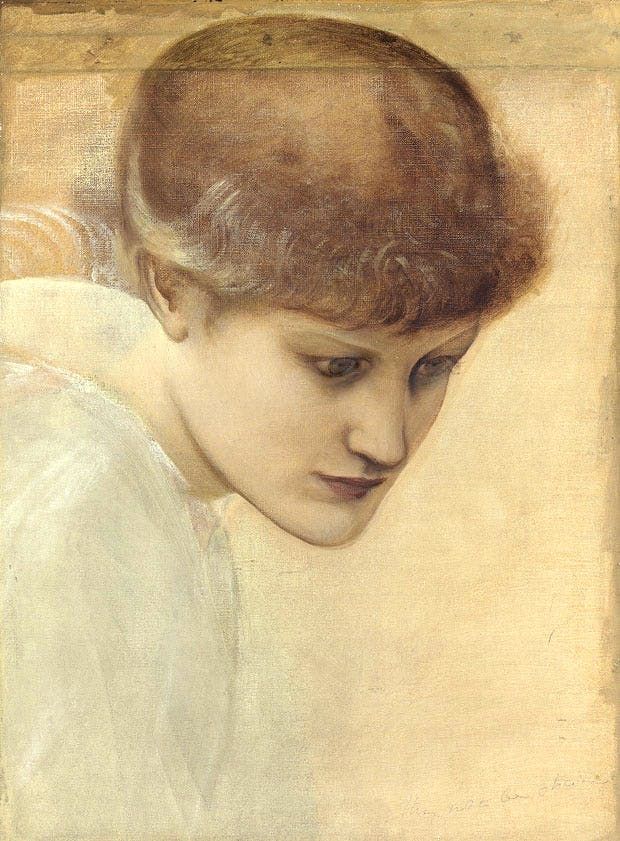
Edward Burne-Jones, Head study associated with The Golden Stairs. Image source. Public domain.
A wedding, a dream or a procession?
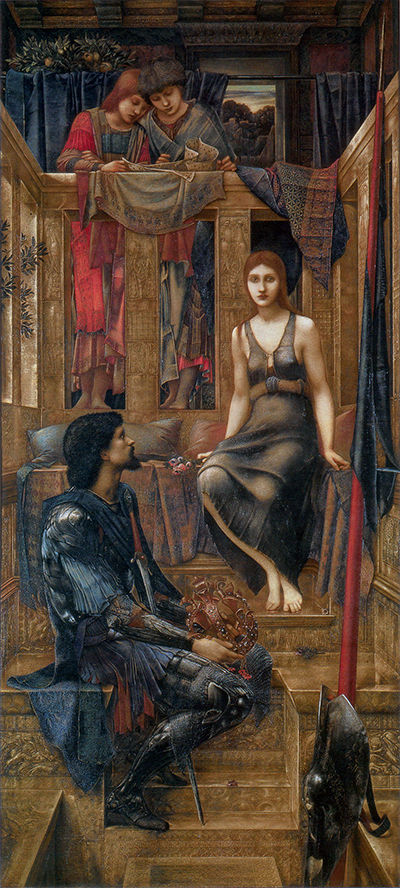
Burne-Jones used The King’s Wedding and Music on the Stairs while the work was in development. An earlier design, Venus Epithalamia of 1871, gives the wedding idea a visual precedent. In the portal of that composition, candle-bearing women descend an S-shaped stair. The catalogue raisonné suggests that Burne-Jones may have developed that small architectural detail into the basis for the whole of The Golden Stairs. Changing candles to instruments shifts the emphasis from one kind of ceremony to another, and the final title directs attention to the staircase itself. The finished painting supplies no bride or groom and gives the duties of the procession little explanation. [3]
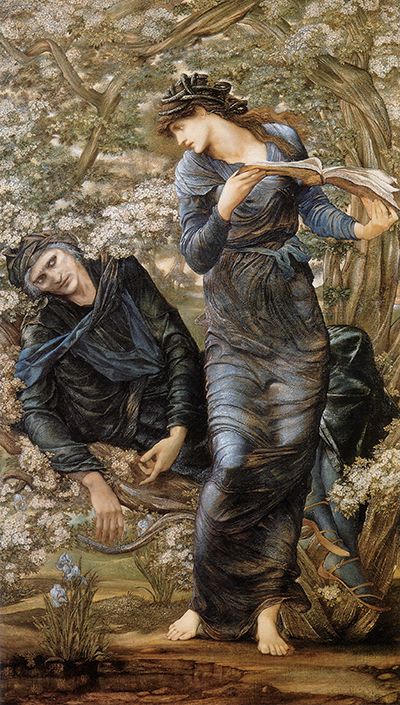
For Weliver, the title and the resemblance of the women to musical angels evoke Jacob’s dream of a ladder joining earth and heaven. The painter later treated Jacob’s Ladder explicitly in The Flower Book, where winged figures climb a ladder. Weliver links that vision to the reforming ideals of Liberal families around Burne-Jones, including the Gladstones and the Flowers. That reading gives the dreamlike air a contemporary resonance. The biblical episode’s sleeper has no clear equivalent in the oil. A visitor looking for the kind of narrative suggested by the spell book and the encounter between the two protagonists in The Beguiling of Merlin will find only glimpses of the spaces the women pass through. [1] [5]
From the Grosvenor Gallery to Tate
The Golden Stairs was Burne-Jones’s sole contribution to the Grosvenor Gallery in 1880. The private showing took place on 30 April and the public exhibition opened on 4 May. Noriko Yoshimura traces the gallery’s preference for giving individual paintings room on the wall in contrast to the crowded display of the Royal Academy. In a tall canvas like this, the edges matter as much as the space at the centre. The interruption of a face at the upper left and of the company at the lower left leaves the eye to imagine bodies and architecture extending into the surrounding space. Seen in a gallery, the staircase can feel as though it is delivering the women almost to the floor where the spectator stands. [3] [5] [19]
Stephens compared the figures to “spirits in an enchanted dream.” He admired the design and found its lack of explanation part of the experience. The Illustrated London News critic was less satisfied, imagining a party leaving a marriage feast and taking issue with the idea that beauty alone would justify the procession. Vanity Fair turned the unusual silvery pleats into a joke about “tinfoil night-gowns.” It was possible to admire the finish, question the point of the gathering, or even laugh at the clothes, all in response to the same set of artistic choices. Georgiana said her husband received letters from different parts of the world asking for an explanation. The response she records is in keeping with the picture itself. He wanted people to see in it what they could for themselves. [3] [20]
Cyril Flower, later Lord Battersea, bought the painting from Burne-Jones, and a description of his London home in 1901 records that it hung on the grand staircase at Surrey House. In that setting a guest could ascend beside a painted procession going the opposite way. Battersea lent the canvas to the Burne-Jones memorial exhibition at the New Gallery in 1898–99, where the catalogue also lists Félix Jasinski’s etching after it. His widow Constance presented it to Tate in 1924 under the terms of his bequest. It was later shown in the British Symbolism exhibition that travelled to Munich and Amsterdam, in the Burne-Jones retrospective at the Musée d’Orsay in 1999, and at Tate Britain in 2018–19. Those settings brought out different qualities in the painting, from its affinity with European Symbolism to its place in the artist’s own development. On the stairs at Surrey House, a guest turning on the landing could look again at the women going by in the other direction. The picture would have changed with the movement of the person looking at it, just as it changes when we follow the line of a step or the tilt of a face. [2] [3] [5] [21]
Artworks directory
This directory records paintings, studies, designs and collaborative works, with separate entries for documented versions and series where known.
| Name | Date | Medium |
|---|---|---|
| Sidonia von Bork 1560 | 1860 | Watercolour and bodycolour |
| Clara von Bork 1560 | 1860 | Watercolour and bodycolour |
| The Merciful Knight | 1863 | Watercolour |
| Sibylla Delphica | c. 1886 | Oil on panel |
| Phyllis and Demophoön | 1870 | Watercolour and bodycolour |
| The Legend of the Briar Rose (Buscot series) | 1870s–1890 | Oils on canvas |
| The Briar Wood (Buscot series) | By 1890 | Oil on canvas |
| The Council Chamber (Buscot series) | By 1890 | Oil on canvas |
| The Garden Court (Buscot series) | By 1890 | Oil on canvas |
| The Rose Bower (Buscot series) | By 1890 | Oil on canvas |
| Group of Women, study for The Golden Stairs | 1872 | Drawing |
| The Beguiling of Merlin | 1870s | Oil on canvas |
| The Perseus Cycle | From 1875 | Paintings and full-scale designs |
| The Call of Perseus (Stuttgart) | From 1875 | Oil painting |
| Perseus and the Graeae (Stuttgart) | From 1875 | Oil painting |
| The Rock of Doom (Stuttgart) | 1884–88 | Oil on canvas |
| The Doom Fulfilled (Stuttgart) | 1888 | Oil on canvas |
| The Baleful Head (Stuttgart) | 1885–87 | Oil on canvas |
| The Baleful Head (Southampton design) | 1880s | Bodycolour |
| The Rock of Doom (Southampton design) | 1880s | Bodycolour |
| The Doom Fulfilled (Southampton design) | 1880s | Bodycolour |
| The Mirror of Venus (Gulbenkian) | 1870s | Oil on canvas |
| Drawing associated with The Mirror of Venus | 1870s | Drawing |
| Laus Veneris (Laing) | 1873–78 | Oil on canvas |
| The Days of Creation | 1870s | Watercolour and bodycolour |
| The Golden Stairs | 1880 | Oil on canvas |
| An Angel Playing a Flageolet | 1878 | Watercolour, bodycolour and gold |
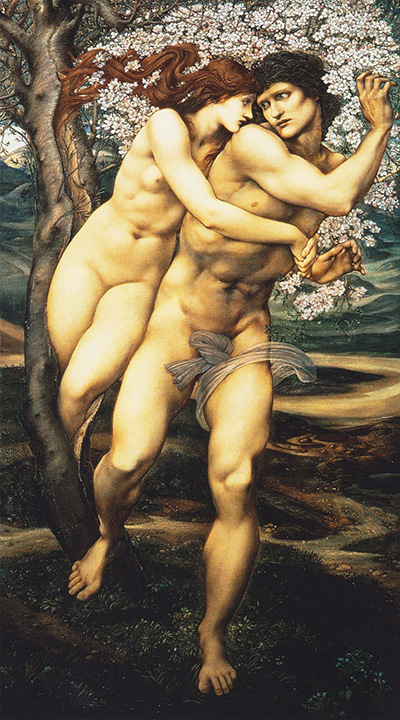
| The Tree of Forgiveness | 1881–82 | Oil on canvas |
| The Wheel of Fortune (Orsay) | 1875–83 | Oil on canvas |
| King Cophetua and the Beggar Maid | 1884 | Oil on canvas |
| The Depths of the Sea (oil) | 1886 | Oil |
| The Morning of the Resurrection | 1886 | Oil on panel |
| Study for the Head of Mary Magdalene | c. 1882 | Oil study |
| The Sleep of King Arthur in Avalon | 1880s–1898 | Oil on canvas |
| The Sleep of King Arthur in Avalon (modello) | ca. 1881 | Oil on canvas (modello) |
| The Star of Bethlehem | Signed 1890 | Watercolour and bodycolour |
| Study for The Star of Bethlehem | About 1887–91 | Drawing |
| Sponsa de Libano | 1891 | Watercolour and bodycolour |
| The Summons (Holy Grail tapestries) | 1890s | Tapestry |
| The Failure of Sir Gawaine (Holy Grail tapestries) | 1890s | Tapestry |
| Hope (Boston) | 1896 | Oil on canvas |
| La Belle au bois dormant (theatre programme) | 1894 | Collotype |
| The Wedding of Psyche | 1895 | Oil on canvas |
| The Works of Geoffrey Chaucer (Kelmscott edition) | 1896 | Illustrated book |
| The Ascension (Birmingham Cathedral) | 1885 | Stained glass |
| The Last Judgement (Birmingham Cathedral) | 1897 | Stained glass |
| Adoration of the Magi (Huntington) | 1890s | Tapestry |
| Love among the Ruins (Wightwick) | 1894 | Oil on canvas |
| The Merciful Knight (photogravure after Burne-Jones) | 1900 | Photogravure |
| The Garden Court (preparatory work) | 1870–75 | Graphite and watercolour with white gouache |
| Study of a Female Figure | 1885 | Graphite drawing |
| Psyche Throwing Herself into the River | 1865–68 | Wood engraving |
| Beauty | 1887–89 | Colour lithograph |
| Study for the Failure of Gawain | 1893 | Crayon and graphite on Japanese paper |
| The Prince Enters the Briar Wood (after Burne-Jones) | After 1890 | Photogravure |
| The Rose Bower (after Burne-Jones) | 1892 | Photogravure |
| Adoration of the Magi (Musée d’Orsay) | 1904 | Tapestry |
| Answers to Prayer (Lyndhurst) | 1860s | Stained glass |
| The Depths of the Sea (photogravure after Burne-Jones) | 1900 | Photogravure |
| Perseus and Andromeda (Adelaide composite) | 1876 | Oil on canvas |
| The Adoration of the Magi (Hamburg) | Woven 1900 | Tapestry |
| Love leading the Pilgrim through the Briars | 1874–76 | Embroidery |
| Musica (worked by Lady Jane Cory) | 1906 | Embroidery |
| Pomona (worked by Lady Jane Cory) | 1907 | Embroidery |
| Flora (worked by Lady Jane Cory) | 1909 | Embroidery |
| The Fourth Day of Creation (photogravure after Burne-Jones) | 1900 | Photogravure |
| The Morning of the Resurrection (photogravure after Burne-Jones) | 1900 | Photogravure |
| Musical angels of the St Catherine window (Christ Church) | Designed 1877 | Stained glass |
Discussion
Look again at the images and ideas explored in The Golden Stairs. These editorial prompts invite your observations.
Reader Insights
Where do you notice the first break in the rhythm of the descending figures?
What can you infer about the music from the poses and the spacing of the instruments?
Join the Conversation
Share a detail, comparison or question about The Golden Stairs below.
References
- Tate, Edward Burne-Jones, The Golden Stairs, N04005, painting reproduction and Tate collection record. View source 1. View source 2.
- Tate Britain, Edward Burne-Jones, 2018–19 exhibition guide, PDF pp. 40–42 and 63 for studies and p. 81 for N04005. View source.
- Burne-Jones Catalogue Raisonné, John Christian, William Waters and Anne Anderson, The Golden Stairs, ODg1, expertise, Fitzwilliam work list, provenance and exhibitions. View source.
- Mie Kubo, Surface Matters in Burne-Jones’ The Golden Stairs, Machikaneyama Ronso, Aesthetics 42, pp. 1–24. View source.
- Phyllis Weliver, Liberal Dreaminess and “The Golden Stairs” of Edward Burne-Jones (1833–1898), The British Art Journal, vol. XVII, no. 3, sections on the 1880 exhibition, musical listening and Surrey House. View source.
- Walter Pater, The School of Giorgione, Fortnightly Review, October 1877, pp. 526–538, transcribed by the University of Wuppertal. View source.
- Detroit Institute of Arts, James McNeill Whistler, Nocturne in Black and Gold, the Falling Rocket, 1875, collection record and image. View source.
- Georgiana Burne-Jones, Memorials of Edward Burne-Jones, vol. II, pp. 68 and 103, quoted in Christie’s 2016 lot essay for the Dorothy Dene study. View source.
- Statens Museum for Kunst, Gruppe af kvinder. Forstudie til maleriet “The Golden Stairs”, 1872, KKS1980-240, collection record and drawing. View source.
- National Gallery of Victoria, Study for The Golden Stairs, 1875, 287-2, object record. View source.
- National Gallery of Victoria, Study for The Golden Stairs, 1875, 288-2, object record. View source.
- John Christian, Edward Burne-Jones: Victorian Artist-Dreamer, Metropolitan Museum of Art, 1998, cat. nos. 109–110, pp. 246–250. View source.
- Susan Owens, chapter 18 in Burning Bright: Essays in Honour of David Bindman, pp. 183–184, fig. 18.2 and discussion of the Ashmolean sheet 1939.15. View source.
- Fitzwilliam Museum, Studies of feet for ‘The Golden Stairs’, 1992, object record. View source.
- Fitzwilliam Museum, Studies for ‘The Golden Stairs’, 1998, object record. View source.
- National Portrait Gallery, Mary (‘May’) Morris, portrait iconography, entry for Burne-Jones’s N04005. View source.
- Burne-Jones Catalogue Raisonné, 1877 study of Antonia Caiva for the cymbal bearer, ODg3, Ashmolean Museum 1939.15. View source.
- Christie’s, Head study of Dorothy Dene looking downwards, for ‘The Golden Stairs’, 14 December 2016, lot 15, object, provenance and sale-room notice. View source.
- Noriko Yoshimura, A Picture and Its Surrounding Space: A Study of The Golden Stairs by Edward Burne-Jones in the Grosvenor Gallery, 2019, no. 28, sections 1.3 and 2.3. View source.
- Georgiana Burne-Jones, Memorials of Edward Burne-Jones, vol. I, p. 297, recollection of letters asking for explanations, excerpted in the catalogue raisonné commentary. View source.
- New Gallery, Exhibition of the Works of Sir Edward Burne-Jones, 1898–99, cat. nos. 108 and 228, Lord Battersea’s loan and Félix Jasinski’s etching. View source.