 by Tom Gurney
Tom Gurney BSc (Hons) is an art history expert with over 20 years experience
Published on June 19, 2020 / Updated on November 25, 2026
Email: tomgurney1@gmail.com / Phone: +44 7429 011000
Phyllis and Demophoön by Edward Burne-Jones: Introduction
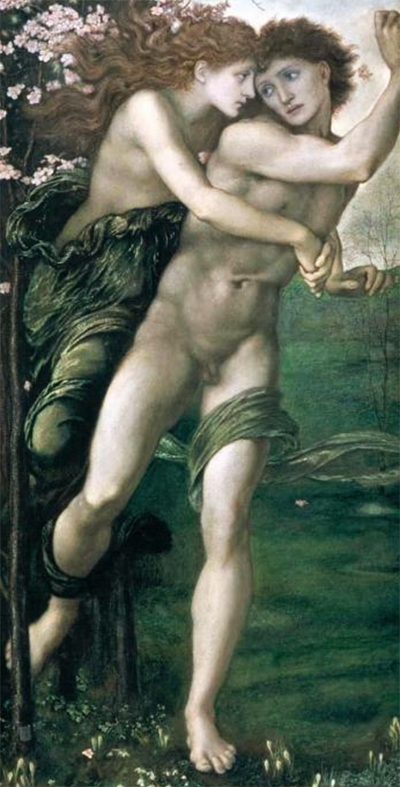
Demophoön has one heel in the air when Phyllis catches him. His body is moving past the tree, but he turns his head so far back that their temples almost touch. She leans out of the branches with a sweep of brown hair and an arm across his chest. Look down at their feet and the space between them opens again. His toes press into the ground while her body is still caught in the folds beside the trunk. Edward Burne-Jones painted this encounter in 1870. Phyllis and Demophoön, accession 1916P37 at Birmingham Museum & Art Gallery, is a watercolour heightened with bodycolour on paper. The museum records the work at 93.8 by 47.5 centimetres. The artist signed and dated it with the initials EBJ and the year 1870. [1] [2]
At a Glance
- ArtistEdward Burne-Jones
- Date1870
- MediumWatercolour and bodycolour
- SubjectOvidian narrative
This work across Edward Burne-Jones’s career
The Mirror of Venus
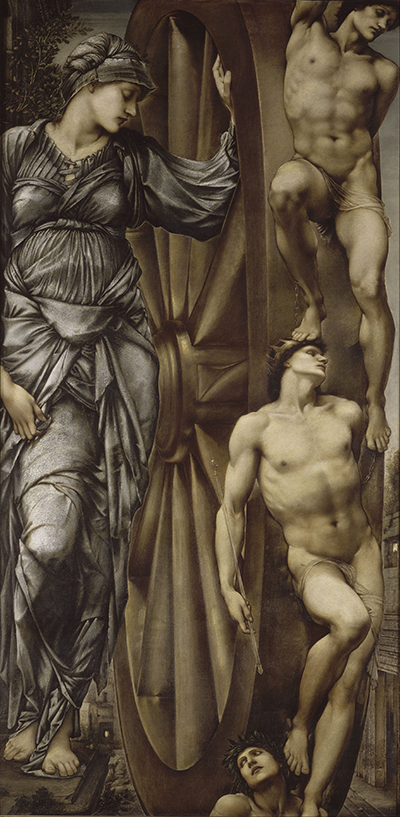
1870sThe Wheel of Fortune
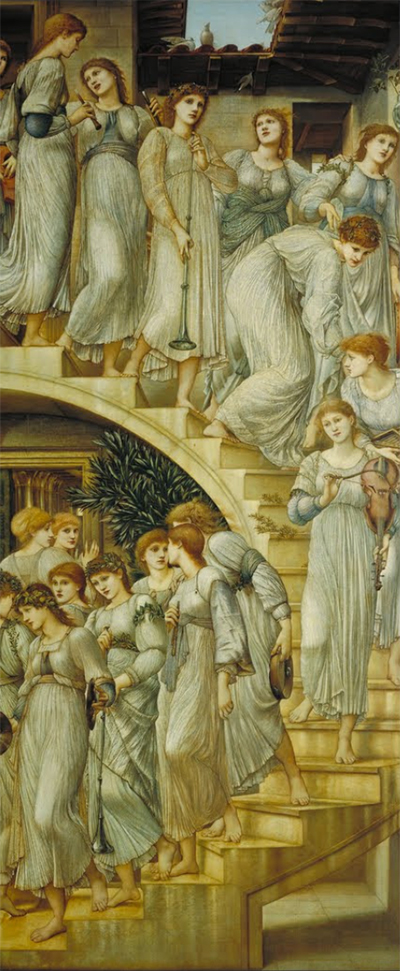
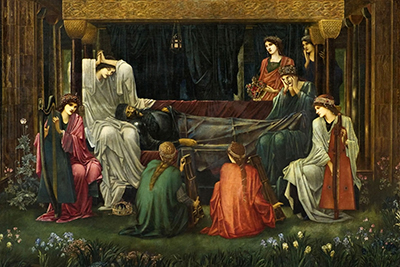
1875–83The Last Sleep of Arthur in Avalon
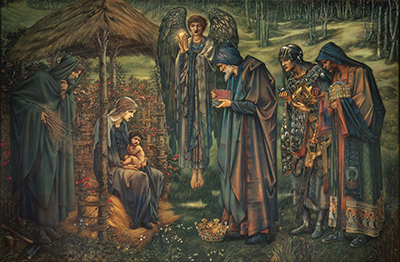
1880s–1898The Star of Bethlehem
Signed 1890Contents
- Beneath the almond blossom
- What Phyllis asks in Ovid's letter
- Studies and Italian precedents
- Maria Zambaco and the exhibition of 1870
- From Leyland's drawing room to Birmingham
- Annotated details
Beneath the almond blossom
The picture is nearly twice as tall as it is wide, and there is just room for the movement Burne-Jones gives the pair. Demophoön's raised arm nearly runs out of the frame at the upper right. An end of green cloth flies towards the right edge lower down. The almond trunk holds the opposite edge, with sprays of pink and white blossom breaking into Phyllis's hair. Her face projects from this tangle in a clear profile. His face is more open to us, and the whites of his eyes show how far he has turned to see her. Their clasp is lower than either face. Follow her forearm towards his ribs and you can see where his lowered hand meets hers. A thumb and a few fingertips make contact in a picture otherwise full of movement. [1] [2]
The landscape grows much quieter below their hands. Behind the figures there are small trees, stretches of green and a little open sky. At the bottom, tiny pale flowers run along the ground around Demophoön's planted foot. The same green that runs through the country behind them deepens in the fabric at Phyllis's hip and cools the shadow on Demophoön's skin. Her shoulder and his upper arm catch a much warmer light. A reviewer for The Art Journal found the flesh too green, while F. G. Stephens in The Athenaeum admired the colour of Demophoön and the landscape, comparing it to Giorgione's painting. The colour joins Demophoön's body to his surroundings even as he starts away from the tree. [1] [2]
The thickness of the paint surprised viewers too. Bodycolour is opaque watercolour, capable of laying a bright mark over a dark passage such as the blossom against the trunk. Stephen Wildman describes dense, dry-brush handling and a mixture of watercolour, bodycolour and gum. The Art Journal reviewer thought the surface could almost pass for oil. Fiona Mann's technical study records gold medium and gum arabic on layers of paper mounted on canvas, and reports the same measurements as Birmingham. The catalogue raisonné gives the smaller dimensions of 91.5 by 45.8 centimetres. Mann identifies a panel of roughly that size in Burne-Jones's 1869 orders from the artists’ supplier Charles Roberson and suggests that it may have been intended for this work. The order gives us a glimpse of the materials he was assembling in the year before the exhibition. [2] [3]
Annotated Details from Phyllis and Demophoön
The numbered points identify visible features discussed in this article. Return from each detail to the numbered overview. Edward Burne-Jones, Phyllis and Demophoön, 1870. Birmingham Museums Trust. Image source. Public domain.
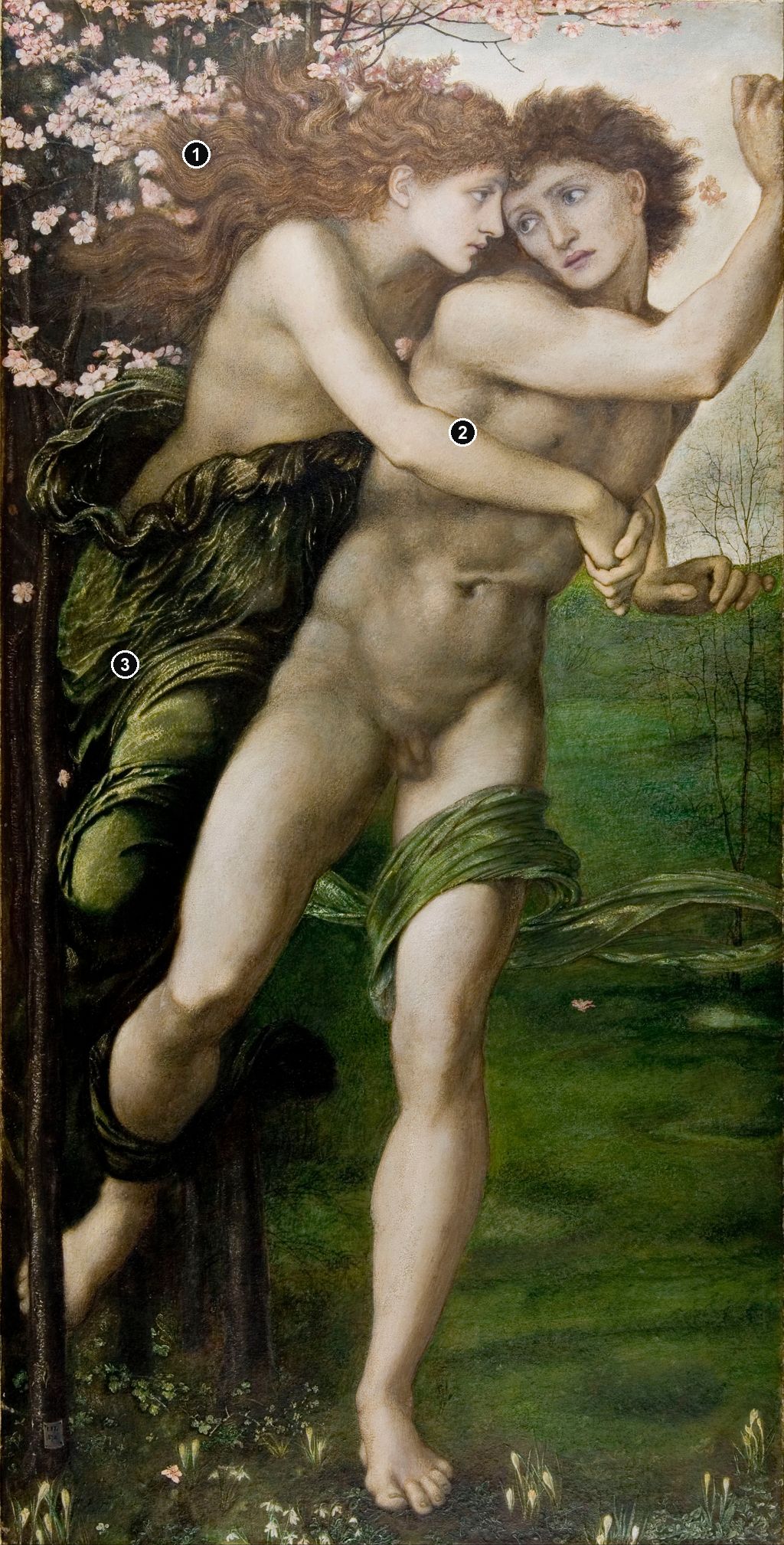
Details from PHYLLIS AND DEMOPHOÖN
Compare the cropped details with the source images above. Notice how their colours, shapes and positions contribute to the larger compositions.
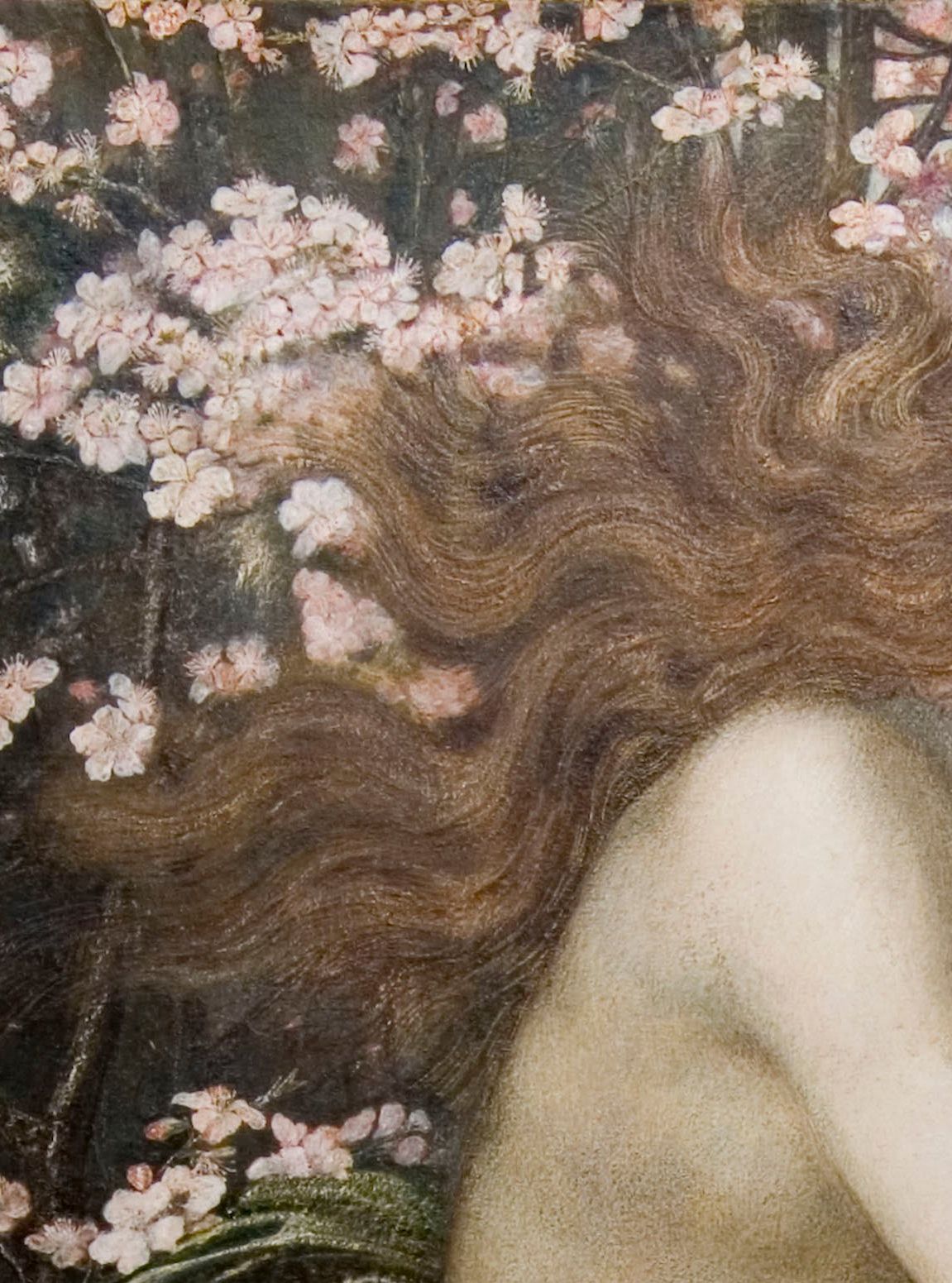
A bright corner
Pale blossom sets off Phyllis’s outline where the upper edge of the tree darkens.
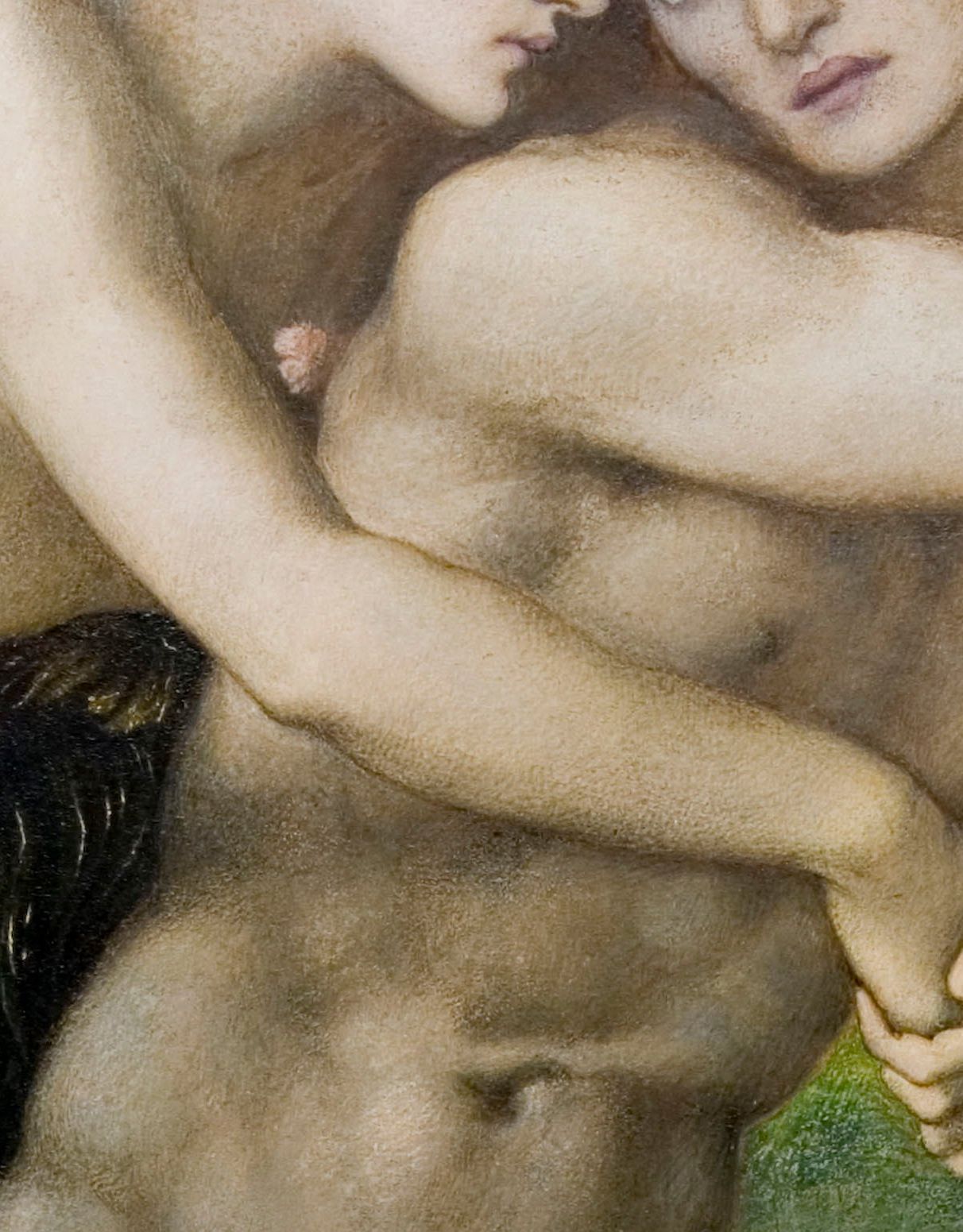
Physical turn
Phyllis’s arm and Demophoön’s shoulder form a continuous turn across the middle of the picture.
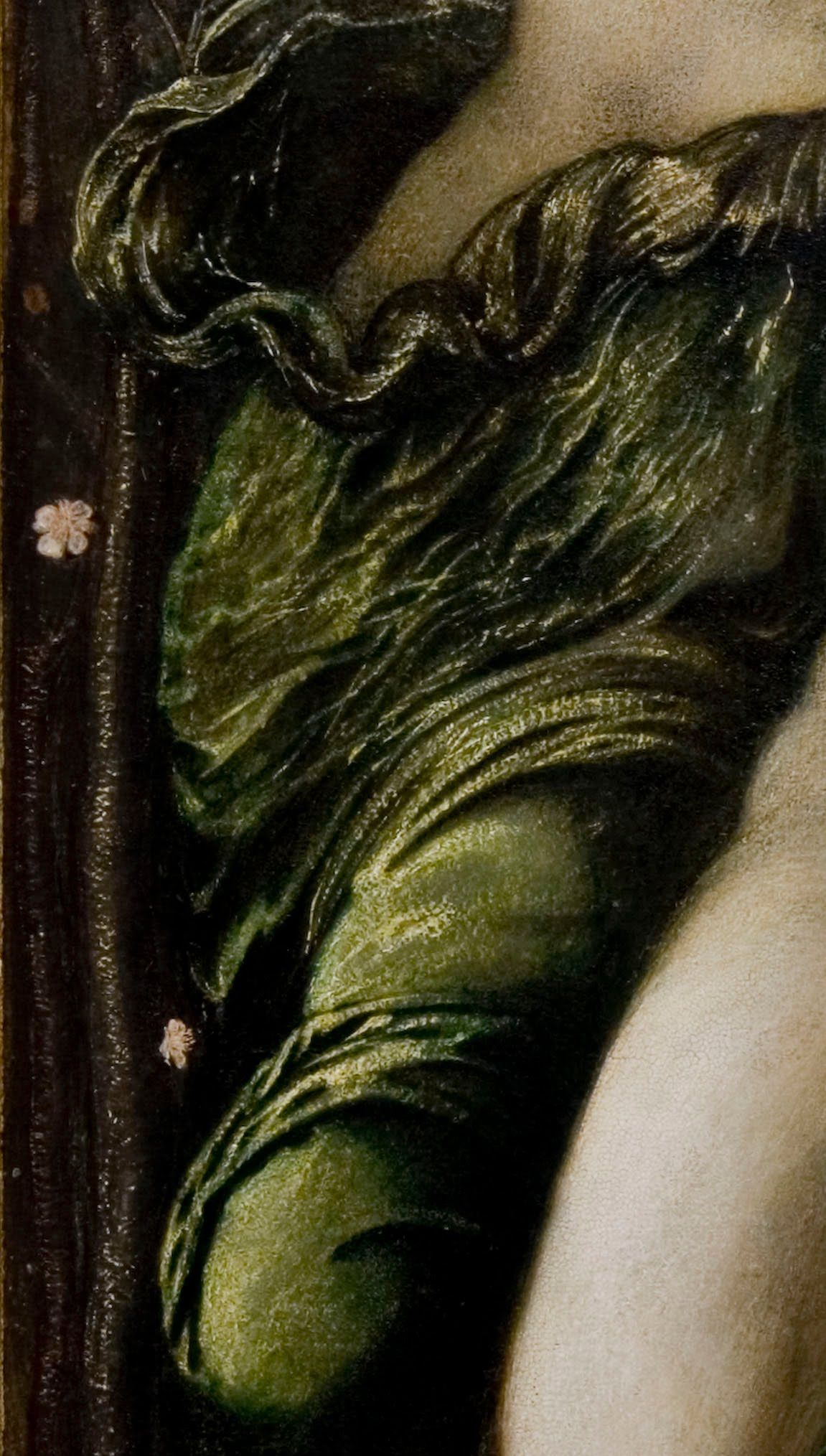
Folds across the trunk
The green fabric follows the surface of the trunk before hanging free. Colour helps link the figure and the tree.
What Phyllis asks in Ovid's letter
Demophoön, son of Theseus, reaches Thrace on his way home from the Trojan War. Phyllis welcomes him and he promises to return after leaving her. In the story told about the painting, Phyllis takes her own life when he fails to return, and the gods turn her into an almond tree. When he comes back he embraces the trunk in sorrow. It flowers, and Phyllis comes out to meet him. Burne-Jones shows her far enough out of the tree to grasp him, while the direction of his stride suggests that he might have walked straight past. The reunion can register as a surprise before it registers as an act of forgiveness. [2]
The artist put Phyllis's side of the story on a label on the back of the work. Beneath the title he wrote a line from the second of Ovid's Heroides. In the Latin text it reads Dic mihi, quid feci, nisi non sapienter amavi? Phyllis asks what she has done except love unwisely. The question falls at a turning point in the letter. Phyllis has been imagining the troubles that may have kept Demophoön from her, from a shipwreck to the opposition of his father, Theseus. Then she begins to think he chose to stay away. Among the promises she calls in question is the one made with their hands joined. In the watercolour, her hand has reached his once more. His answering gesture is small enough for a viewer to wonder whether it is deliberate. [2] [4]
Geoffrey Chaucer tells the story in The Legend of Good Women, where Phyllis condemns Demophoön's false tears and imagines how his betrayal might be made public. Her letter takes up much of the poem. Both Chaucer and Ovid leave her words with the reader and stop short of the meeting shown in the painting. The tradition in which the tree comes to life when Demophoön embraces it can be found in Servius's commentary on Virgil. There the barren branches put out leaves. Wildman suggests that Phyllis's return in visible human form was Burne-Jones's own addition. The pink-white flowers give the almond tree a clear identity, but her arm gives the story a new outcome. [5] [6] [2]
Studies and Italian precedents
A red chalk sketch held by the William Morris Gallery already has the essential action. Phyllis leans from the almond tree towards the figure going past it. It is only 18.5 centimetres tall, small enough that the encounter can be taken in at once. Wildman finds Phyllis more dominant there than in the watercolour. Amgueddfa Cymru holds a separate preliminary study worked with watercolour, gouache, ink, chalk and charcoal on brown paper. Burne-Jones also explored Demophoön on his own. A pencil study catalogued by Christie's is specifically connected with the 1870 watercolour. Working at both scales gave him room to decide how the bodies would hold together as a pair and how much tension an individual pose could carry. [7] [2] [8] [9]
William Waters points to the reversed composition of Apollo and Daphne, the small Florentine panel now attributed by the National Gallery to Piero del Pollaiuolo. Apollo has caught up with Daphne and holds her around the waist just as her leg roots itself and her arms turn into laurel branches. His trailing leg and flying cloth show how fast he ran. Burne-Jones gives the grasp to the woman in the tree. Phyllis has already been transformed and is coming back into human life as she reaches for him. The relation between the two paintings is clearest at the point where a hand closes around a waist. The direction of the pursuit and of the transformation has changed. [2] [10]
Jeremy Melius makes a different comparison with the airborne pair at the left of Botticelli's Birth of Venus. The bodies travel together, their faces nestle close, and the woman's clasp helps pull their forms into a single movement. Look at the billowing hair and the strip of cloth at Demophoön's thigh and the resemblance extends out from the bodies. For Melius, Burne-Jones was also responding to Simeon Solomon's Love in Autumn, which had already adapted Botticelli's windswept figure types. These comparisons help explain the force of the watercolour's narrow design. Phyllis and Demophoön are so closely interwoven from the shoulders upwards that their bodies temporarily share a direction, even as one turns and the other reaches. [11]
Maria Zambaco and the exhibition of 1870
Tate and Wildman identify Phyllis's head as that of Maria Zambaco, the painter and sculptor with whom Burne-Jones had a relationship. His formal portrait of her, dated August 1870 and now in the Clemens Sels Museum Neuss, makes a useful comparison. There she looks directly out, as Cupid lifts a curtain behind her. In the Birmingham watercolour the features are brought into profile and her gaze stops at the other figure. Published accounts differ on Demophoön's model. Wildman describes his head as that of a studio model, while another note in the catalogue raisonné identifies Zambaco with both figures. Her role as Phyllis is the better established identification. She went on to exhibit sculpture herself, including a large bronze portrait medal of her cousin Marie Spartali Stillman at the Royal Academy in 1887. [12] [2] [13] [14]
In 1870 the Old Water-Colour Society put the watercolour on view as no. 154 in its sixty-sixth exhibition. The full-frontal male nude drew objections. In The Times, Tom Taylor took issue with what he saw as a lack of distinction between the male and female figures. He also disliked the idea of a woman pursuing a man. Wildman finds it uncertain how widely the relationship with Zambaco was known. The reviews give a closer view of what visitors actually argued about. Looking at the green cloth from Phyllis's waist as it curls around Demophoön's thigh, a viewer can see just how close Burne-Jones came to covering him. [2]
Georgiana Burne-Jones remembered an anonymous letter of complaint and a visit to the artist by Frederick Tayler, the Society's president. John Lewis Roget's history of the Society reports that Burne-Jones refused an alteration in removable chalk. Georgiana describes Tayler asking about removal and then proposing that a work by Carl Haag fill the space. The watercolour came down during the exhibition. Burne-Jones waited until the show closed to send his formal resignation. In the letter, which Georgiana reproduces, he said that his conviction that his work and the Society's tastes were at odds had been growing for years. His colleague Frederick Burton resigned in sympathy. Roget records works by Burne-Jones in exhibitions at the Dudley Gallery in 1872 and 1873, where he found another audience for his watercolours. [15] [16] [2]
From Leyland's drawing room to Birmingham
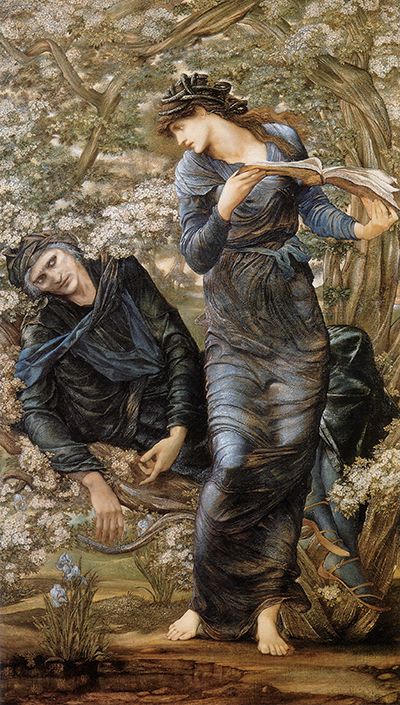
The Liverpool shipowner Frederick Richards Leyland already owned the watercolour when it went on show in 1870. A reconstruction of his rooms at 49 Prince's Gate places it beside another Burne-Jones, The Beguiling of Merlin, over an old commode in the first drawing room. Guests could have looked from one picture to another and seen two figures caught among branches, in very different kinds of trouble. At Leyland's 1892 sale the watercolour fetched 810 guineas and passed to John Bibby. The John Feeney Charitable Trust presented it to Birmingham in 1916. [15] [17] [18] [2] [19]
The New Gallery showed the watercolour at its 1892–93 exhibition of Burne-Jones. In 1972 it went to the Petit Palais in Paris for an exhibition of British Romantic painting and the Pre-Raphaelites. It has since been shown as both a Burne-Jones watercolour and a document in the history of the nude. Exposed: The Victorian Nude took it from Tate Britain to Munich and Brooklyn, and then to Kobe and Tokyo in 2003. In that exhibition, it could be seen alongside other Victorian artists' ways of making the naked figure acceptable in public, and the disputes those works still provoked. Tate’s 2018–19 retrospective placed it in a room on the artist’s early development, when his study of Italian Renaissance painting was giving him a new way to draw the body. [2] [20] [21] [22] [12]
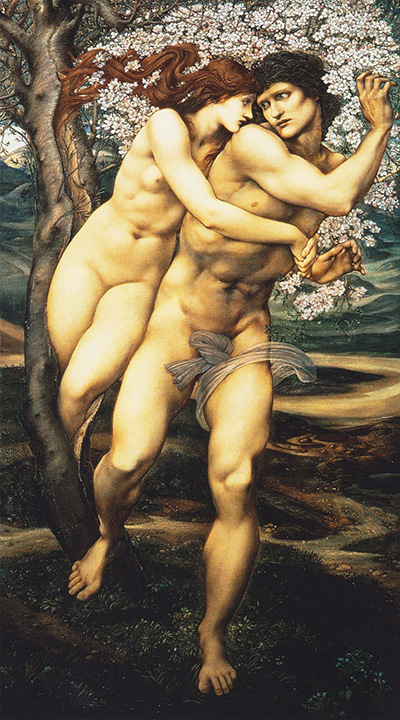
Burne-Jones returned to the story himself in 1881–82. The Tree of Forgiveness, the larger oil at the Lady Lever Art Gallery, gives Demophoön a heavier chest and leaves a narrow piece of cloth across his loins. The dark green garment that wraps Phyllis in the watercolour gives way to her bare hip and leg against the tree. In Birmingham, the blossom is especially conspicuous where it stops along the line of her hair. Her body still seems tied to the tree even as her hand has found the person she has waited for. [23] [1]
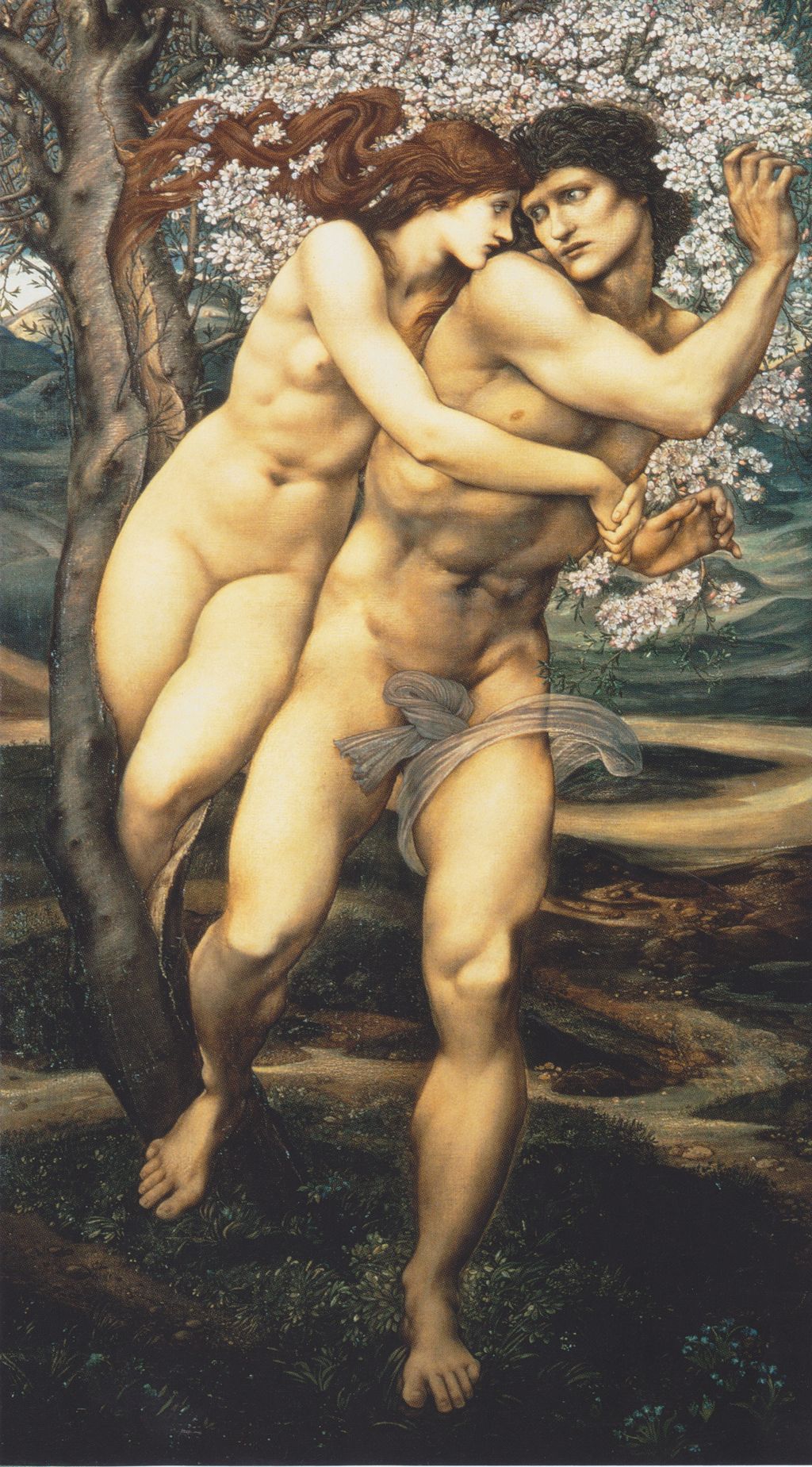
Edward Burne-Jones, The Tree of Forgiveness, 1881–82. Lady Lever Art Gallery. Image source. Public domain.
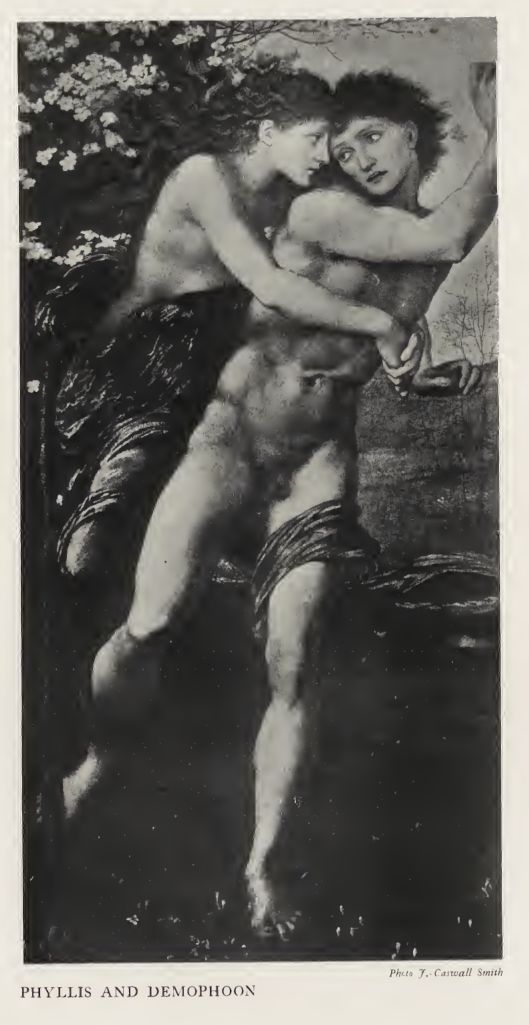
Phyllis and Demophoon, early monochrome reproduction of the later composition. Plate 5 in Malcolm Bell’s Sir Edward Burne-Jones. Image source. Public domain. Printed plate isolated from the surrounding page and set upright.
Related artworks
Edward Burne-Jones on film
Explore Burne-Jones’s paintings, illustrated stories and stained-glass designs.
Edward Burne-Jones: Pre-Raphaelite Visionary | Exhibitions | Showcase
A look at Burne-Jones’s paintings and the Tate retrospective.
Watch on YouTubeArtworks directory
This directory records paintings, studies, designs and collaborative works, with separate entries for documented versions and series where known.
| Name | Date | Medium |
|---|---|---|
| Sidonia von Bork 1560 | 1860 | Watercolour and bodycolour |
| Clara von Bork 1560 | 1860 | Watercolour and bodycolour |
| The Merciful Knight | 1863 | Watercolour |
| Sibylla Delphica | c. 1886 | Oil on panel |
| Phyllis and Demophoön | 1870 | Watercolour and bodycolour |
| The Legend of the Briar Rose (Buscot series) | 1870s–1890 | Oils on canvas |
| The Briar Wood (Buscot series) | By 1890 | Oil on canvas |
| The Council Chamber (Buscot series) | By 1890 | Oil on canvas |
| The Garden Court (Buscot series) | By 1890 | Oil on canvas |
| The Rose Bower (Buscot series) | By 1890 | Oil on canvas |
| Group of Women, study for The Golden Stairs | 1872 | Drawing |
| The Beguiling of Merlin | 1870s | Oil on canvas |
| The Perseus Cycle | From 1875 | Paintings and full-scale designs |
| The Call of Perseus (Stuttgart) | From 1875 | Oil painting |
| Perseus and the Graeae (Stuttgart) | From 1875 | Oil painting |
| The Rock of Doom (Stuttgart) | 1884–88 | Oil on canvas |
| The Doom Fulfilled (Stuttgart) | 1888 | Oil on canvas |
| The Baleful Head (Stuttgart) | 1885–87 | Oil on canvas |
| The Baleful Head (Southampton design) | 1880s | Bodycolour |
| The Rock of Doom (Southampton design) | 1880s | Bodycolour |
| The Doom Fulfilled (Southampton design) | 1880s | Bodycolour |
| The Mirror of Venus (Gulbenkian) | 1870s | Oil on canvas |
| Drawing associated with The Mirror of Venus | 1870s | Drawing |
| Laus Veneris (Laing) | 1873–78 | Oil on canvas |
| The Days of Creation | 1870s | Watercolour and bodycolour |
| The Golden Stairs | 1880 | Oil on canvas |
| An Angel Playing a Flageolet | 1878 | Watercolour, bodycolour and gold |
| The Tree of Forgiveness | 1881–82 | Oil on canvas |
| The Wheel of Fortune (Orsay) | 1875–83 | Oil on canvas |
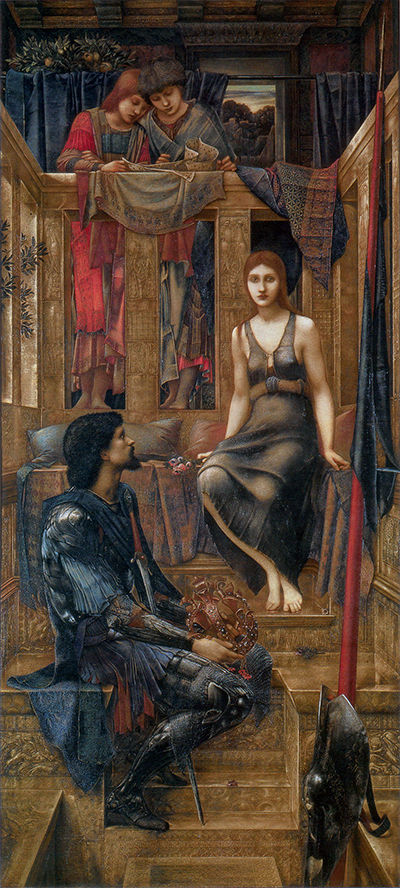
| King Cophetua and the Beggar Maid | 1884 | Oil on canvas |
| The Depths of the Sea (oil) | 1886 | Oil |
| The Morning of the Resurrection | 1886 | Oil on panel |
| Study for the Head of Mary Magdalene | c. 1882 | Oil study |
| The Sleep of King Arthur in Avalon | 1880s–1898 | Oil on canvas |
| The Sleep of King Arthur in Avalon (modello) | ca. 1881 | Oil on canvas (modello) |
| The Star of Bethlehem | Signed 1890 | Watercolour and bodycolour |
| Study for The Star of Bethlehem | About 1887–91 | Drawing |
| Sponsa de Libano | 1891 | Watercolour and bodycolour |
| The Summons (Holy Grail tapestries) | 1890s | Tapestry |
| The Failure of Sir Gawaine (Holy Grail tapestries) | 1890s | Tapestry |
| Hope (Boston) | 1896 | Oil on canvas |
| La Belle au bois dormant (theatre programme) | 1894 | Collotype |
| The Wedding of Psyche | 1895 | Oil on canvas |
| The Works of Geoffrey Chaucer (Kelmscott edition) | 1896 | Illustrated book |
| The Ascension (Birmingham Cathedral) | 1885 | Stained glass |
| The Last Judgement (Birmingham Cathedral) | 1897 | Stained glass |
| Adoration of the Magi (Huntington) | 1890s | Tapestry |
| Love among the Ruins (Wightwick) | 1894 | Oil on canvas |
| The Merciful Knight (photogravure after Burne-Jones) | 1900 | Photogravure |
| The Garden Court (preparatory work) | 1870–75 | Graphite and watercolour with white gouache |
| Study of a Female Figure | 1885 | Graphite drawing |
| Psyche Throwing Herself into the River | 1865–68 | Wood engraving |
| Beauty | 1887–89 | Colour lithograph |
| Study for the Failure of Gawain | 1893 | Crayon and graphite on Japanese paper |
| The Prince Enters the Briar Wood (after Burne-Jones) | After 1890 | Photogravure |
| The Rose Bower (after Burne-Jones) | 1892 | Photogravure |
| Adoration of the Magi (Musée d’Orsay) | 1904 | Tapestry |
| Answers to Prayer (Lyndhurst) | 1860s | Stained glass |
| The Depths of the Sea (photogravure after Burne-Jones) | 1900 | Photogravure |
| Perseus and Andromeda (Adelaide composite) | 1876 | Oil on canvas |
| The Adoration of the Magi (Hamburg) | Woven 1900 | Tapestry |
| Love leading the Pilgrim through the Briars | 1874–76 | Embroidery |
| Musica (worked by Lady Jane Cory) | 1906 | Embroidery |
| Pomona (worked by Lady Jane Cory) | 1907 | Embroidery |
| Flora (worked by Lady Jane Cory) | 1909 | Embroidery |
| The Fourth Day of Creation (photogravure after Burne-Jones) | 1900 | Photogravure |
| The Morning of the Resurrection (photogravure after Burne-Jones) | 1900 | Photogravure |
| Musical angels of the St Catherine window (Christ Church) | Designed 1877 | Stained glass |
Discussion
Look again at the images and ideas explored in Phyllis and Demophoön by Edward Burne-Jones. These editorial prompts invite your observations.
Reader Insights
How do the figures and tree divide your attention when you first look at the watercolour?
How does Demophoön’s turning head affect the sense of welcome or surprise?
Join the Conversation
Share a detail, comparison or question about Phyllis and Demophoön by Edward Burne-Jones below.
References
- Birmingham Museums Trust, Phyllis and Demophoon, 1870, accession 1916P37, reproduction, medium, measurements and acquisition credit. View source.
- Stephen Wildman and Burne-Jones Catalogue Raisonné, Phyllis and Demophoön, record NzM5, including Wildman's 1998 retrospective catalogue entry no. 48, pp. 136–38, William Waters's and John Christian's notes, and object, provenance and exhibition records. View source.
- Fiona Mann, Brushing the Surface: The Practice and Critical Reception of Watercolour Techniques in England 1850–1880, Oxford Brookes University, entry for fig. 167 and pp. 172–77 on supplies from Charles Roberson. View source.
- Ovid, Heroides, epistle II, “Phyllis to Demophoon”, lines 1–50, trans. A. S. Kline, with the Latin text in the Leiden University edition. View source 1. View source 2.
- Geoffrey Chaucer, The Legend of Good Women, “The Legend of Phyllis”, lines 2394–2561, especially 2525–57, trans. A. S. Kline. View source.
- Servius, Commentarii in Vergilii Bucolica, commentary on Virgil's fifth Eclogue, line 10, “phyllidis ignes”. View source.
- William Morris Gallery, Phyllis and Demophoon, c. 1870, preparatory study in red chalk, D219. View source.
- Amgueddfa Cymru, Phyllis and Demophöon (Preliminary study), accession NMW A 11746, catalogue and medium. View source.
- Christie's, Edward Burne-Jones, Study for ‘Phyllis and Demophoön’, lot 3017976, pencil study and catalogue note connecting it with the 1870 watercolour. View source.
- National Gallery, Piero del Pollaiuolo, Apollo and Daphne, probably 1470–80, NG928. View source.
- Jeremy Melius, Art History and the Invention of Botticelli, University of California, Berkeley, pp. 39–41 and figs. 23–25. View source.
- Tate Britain, Edward Burne-Jones, 2018–19 exhibition guide, p. 20, Phyllis and Demophoön, and introductory material on painting the body. View source.
- Clemens Sels Museum Neuss, Edward Burne-Jones, Bildnis Maria Theresa Zambaco, 1870, accession 1968Ma106, subject, date inscription and reproduction. View source.
- York Art History Collaborations, “Maria (née Cassavetti) Zambaco: Constructing Identities”, exhibition essay on Zambaco's medals and exhibition record. View source.
- Georgiana Burne-Jones, Memorials of Edward Burne-Jones, vol. II, 1904, pp. 11–12, visit from Tayler, correspondence and resignation. View source.
- John Lewis Roget, A History of the ‘Old Water-Colour’ Society, vol. II, 1891, p. 117, proposed chalk alteration, resignation and Dudley Gallery exhibitions. View source.
- Eunmin Lim, Re-collections and Movements, University of York, reconstruction of Leyland's first drawing room at 49 Prince's Gate, pp. 115–16 and fig. 79. View source.
- William Roberts, Memorials of Christie's, vol. II, 1897, p. 188, sale of the Leyland collection. View source.
- John Feeney Charitable Trust, “Gifts to Birmingham Museum and Art Gallery”, 1916 acquisition entry. View source.
- Paris Musées, La Peinture romantique anglaise et les préraphaélites, Petit Palais exhibition archive, 1972. View source.
- Brooklyn Museum, Exposed: The Victorian Nude, 2002, exhibition announcement, themes and international itinerary. View source.
- Kobe City Museum, annual report no. 28, retrospective register of exhibitions, entry for the Tate touring exhibition Victorian Nude in 2003. View source.
- National Museums Liverpool, Edward Burne-Jones, The Tree of Forgiveness, 1881–82, Lady Lever Art Gallery, LL 3635. View source.