 by Tom Gurney
Tom Gurney BSc (Hons) is an art history expert with over 20 years experience
Published on June 19, 2020 / Updated on November 25, 2026
Email: tomgurney1@gmail.com / Phone: +44 7429 011000
La Belle au bois dormant: Introduction
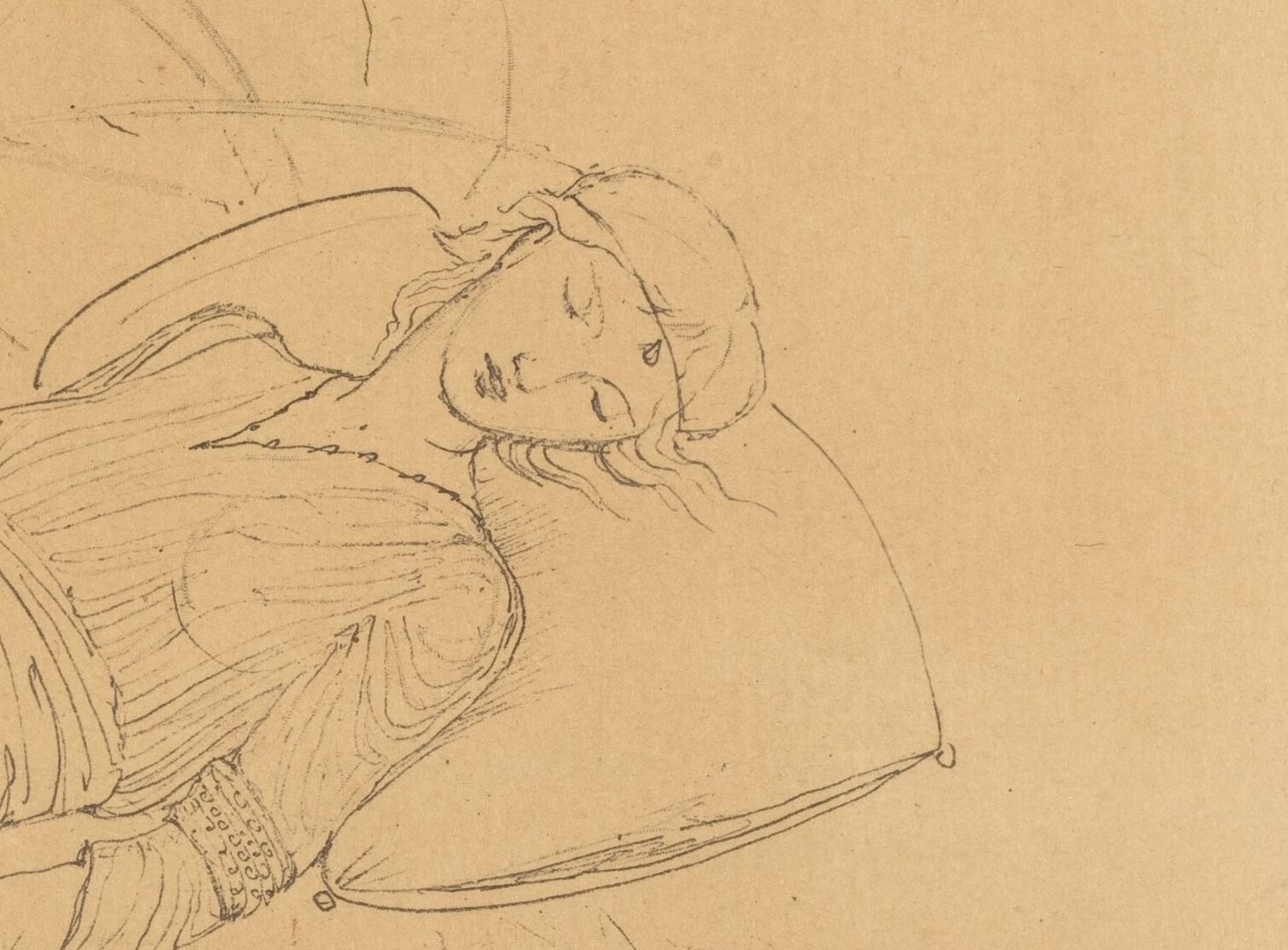
A sleeping princess lies across a sheet of light brown paper. One cheek rests on a pillow, one hand hangs loose over a fold of fabric, and a row of tiny marks describes the decoration on her shoes. The lines are so fine that the image could be mistaken for a drawing. It is a collotype made for a theatre programme. On 24 May 1894, at the Nouveau Théâtre in Paris, the Théâtre de l’Œuvre presented La Belle au bois dormant, a three-act fairy drama by Henry Bataille and Robert d’Humières. Edward Burne-Jones’s treatments of the tale gave the programme its image of the sleeping princess. The credits reveal how readily his name travelled with the image, all the way into the account of the staging. [1] [2]
At a Glance
- ArtistEdward Burne-Jones
- Date1894
- MediumCollotype
- SubjectThe 1894 theatre programme
This work across Edward Burne-Jones’s career
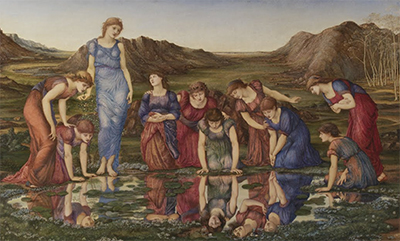
The Mirror of Venus
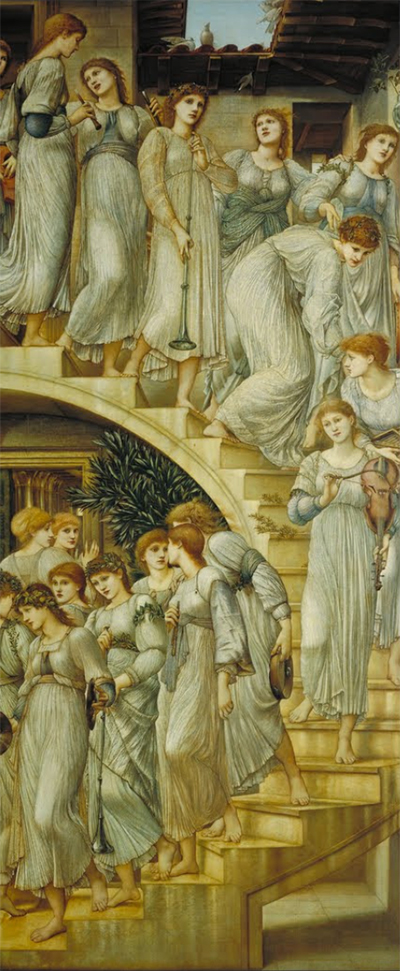
1870sThe Wheel of Fortune
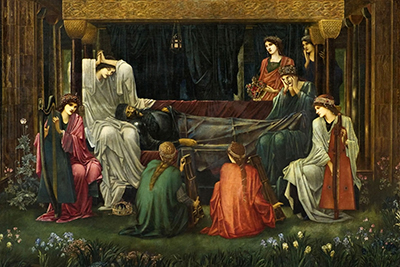
1875–83The Last Sleep of Arthur in Avalon
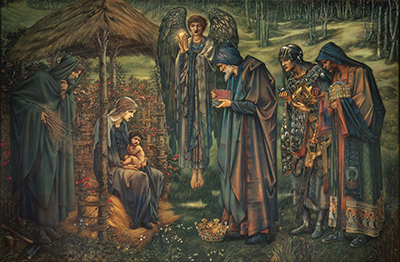
1880s–1898The Star of Bethlehem
Signed 1890Contents
- The picture and the folded sheet
- How the illustration became a print
- What the audience saw on stage
- From the Briar Rose paintings to Paris
- Annotated details
The picture and the folded sheet
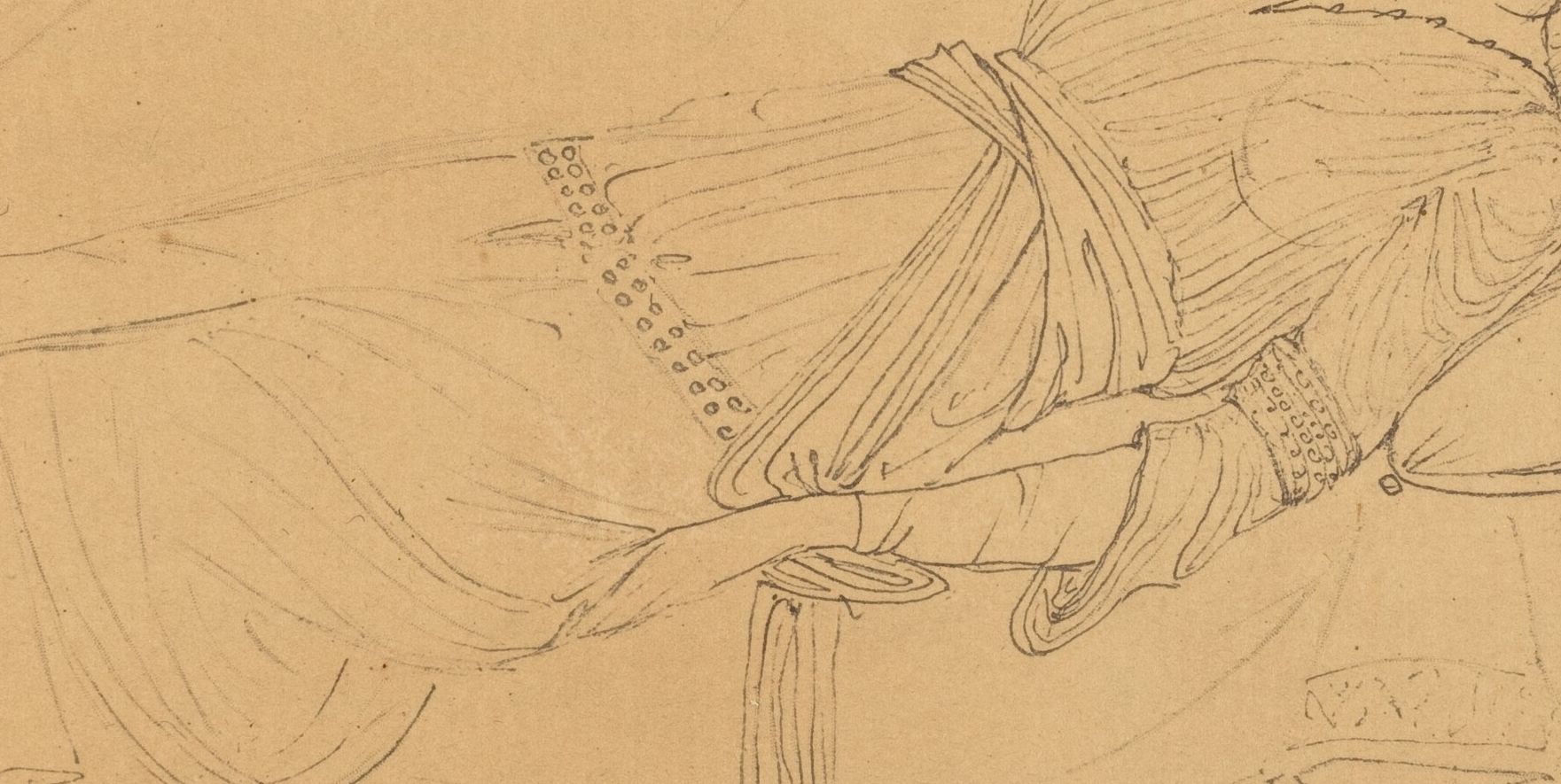
The princess’s body runs at a gentle diagonal from her shoes to her head. The pillow gives her face one of the few firmly drawn surroundings. Across the upper half of the image, light arcs suggest folds that are barely there. The lines gather where her gown pulls in at the waist and again at the hanging sash, the cuff and the edge of the skirt. Those small concentrations of detail make the quieter passages around them seem even fainter. Burne-Jones gives the eye time to move from the closed face to the hands and shoes, much as it might move around a figure in a painting. Most of the setting remains open paper. The figure is enough to establish the spell. [1]
The National Gallery of Art in Washington holds two impressions. Its light-brown wove-paper copy, accession 1995.76.11, measures 17.1 by 27.5 centimetres closed and 17.1 by 54.8 centimetres open. The museum gives the picture area a width of 21.9 centimetres. The other copy, 1997.96.2, is catalogued as a collotype in black on wove paper. Its opened sheet is 55 centimetres wide. These measurements explain the different proportions seen in reproductions. A closely cropped view can show the sleeper alone, while an open view shows the full width of the printed handout. Amsterdam’s Van Gogh Museum catalogues two examples, p1343V2000 and p2764V2000, under the title of the May performance. [1] [2] [3] [4]
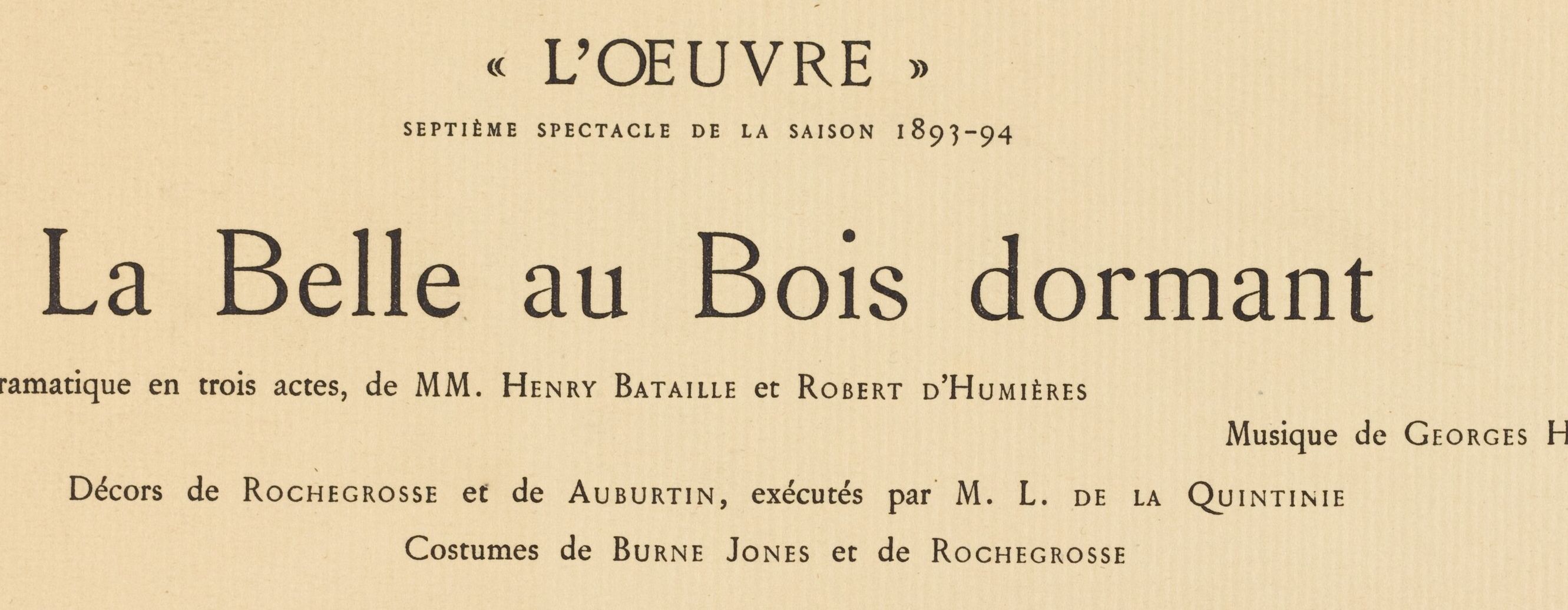
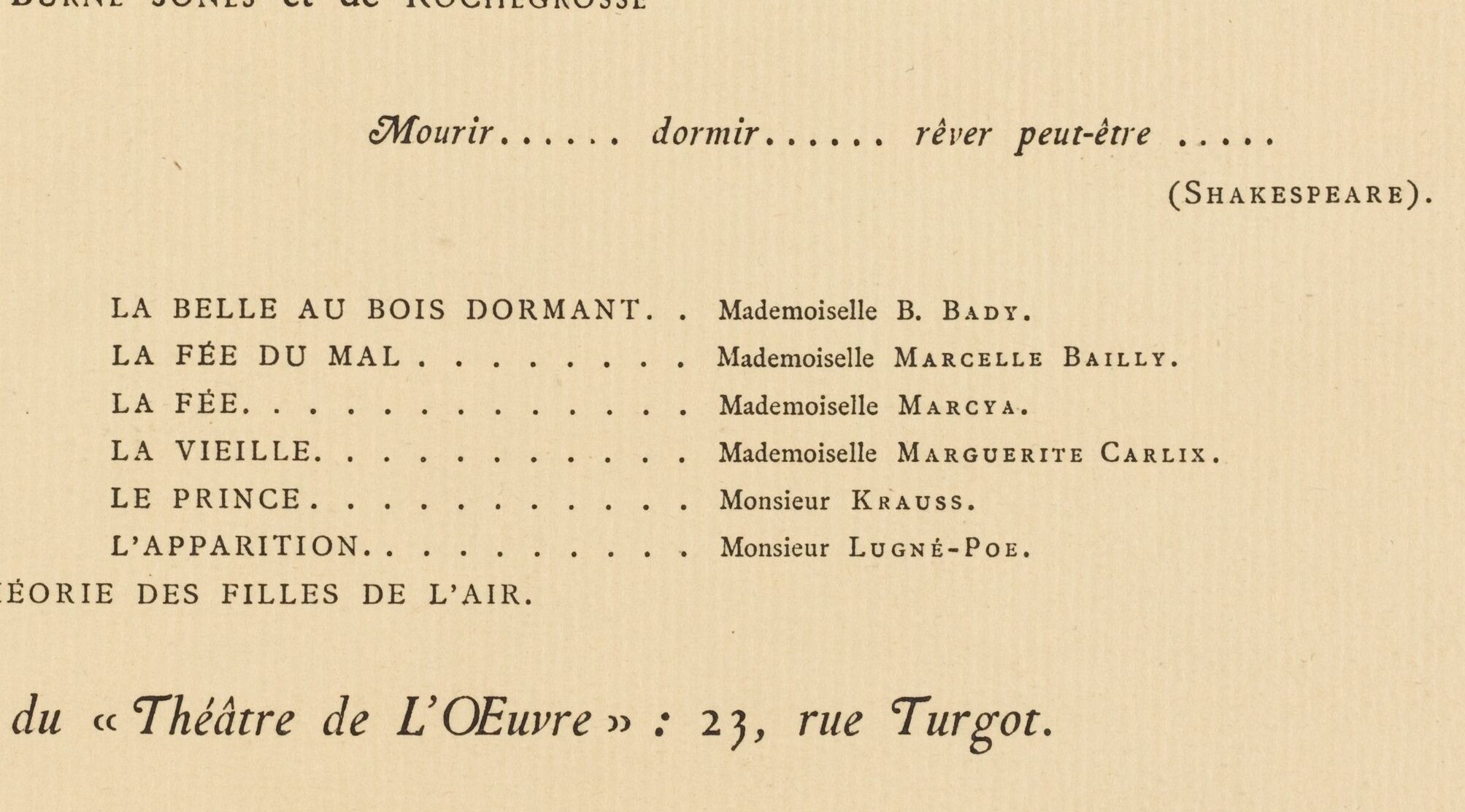
The other side has a different rhythm. The company and title come first, followed by the writers, production credits and cast. There is a short French rendering of Hamlet’s thought about dying, sleeping and perhaps dreaming. The programme identifies the play as the seventh presentation in the company’s 1893–94 season. Alphonse Lemerre’s printing credit appears below the picture and L’Estampe Originale is named as publisher on the text side. The theatre administration’s rue Turgot address belongs to another part of the operation. The performance itself took place at the Nouveau Théâtre. [1] [2] [3]
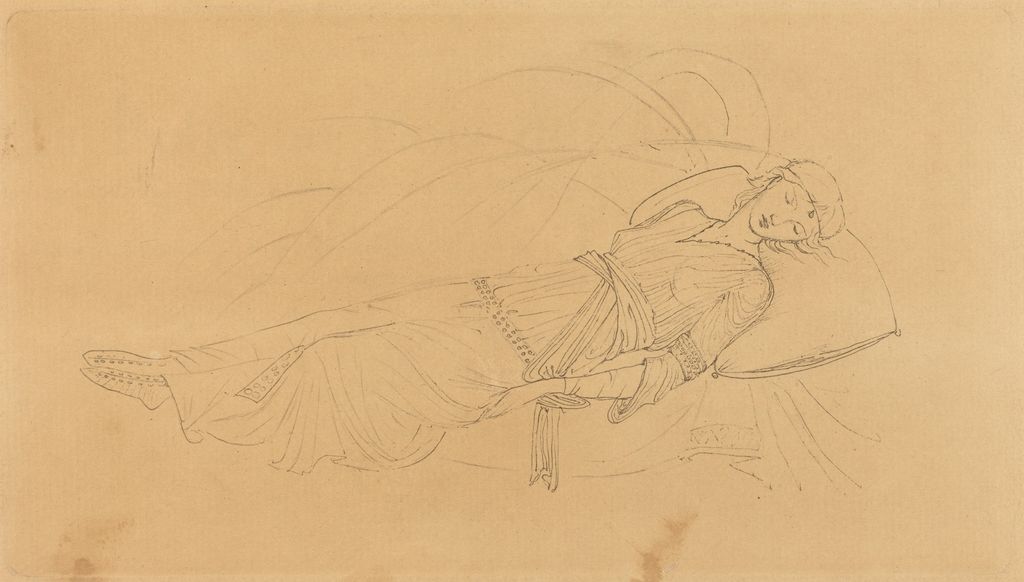
La Belle au bois dormant, image side, 1894, after Edward Burne-Jones. National Gallery of Art, Washington, 1995.76.11. Image source. CC0 / Public domain.
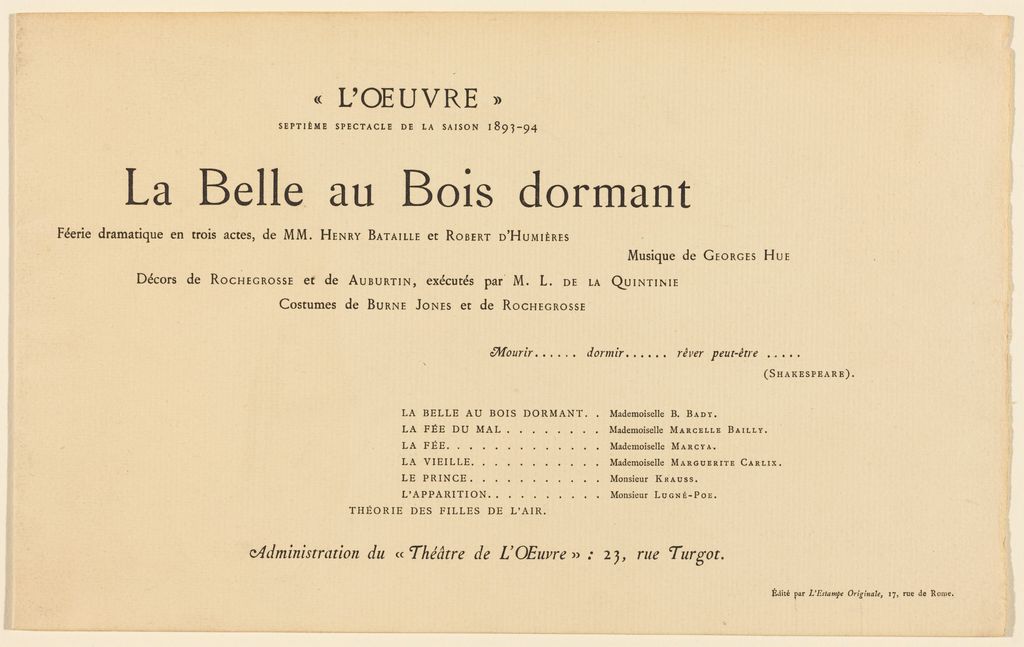
La Belle au bois dormant, programme text, 1894. National Gallery of Art, Washington, 1997.96.2. Image source. CC0 / Public domain.
Annotated Details from La Belle au bois dormant
The numbered points identify visible features discussed in this article. Return from each detail to the numbered overview. Each caption identifies the work shown.
La Belle au bois dormant - image side
La Belle au bois dormant, image side, 1894, after Edward Burne-Jones. National Gallery of Art, Washington, 1995.76.11. Image source. CC0 / Public domain.
La Belle au bois dormant - programme text
La Belle au bois dormant, programme text, 1894. National Gallery of Art, Washington, 1997.96.2. Image source. CC0 / Public domain.
Details from LA BELLE AU BOIS DORMANT
Compare the cropped details with the source images above. Notice how their colours, shapes and positions contribute to the larger compositions.
La Belle au bois dormant - image side
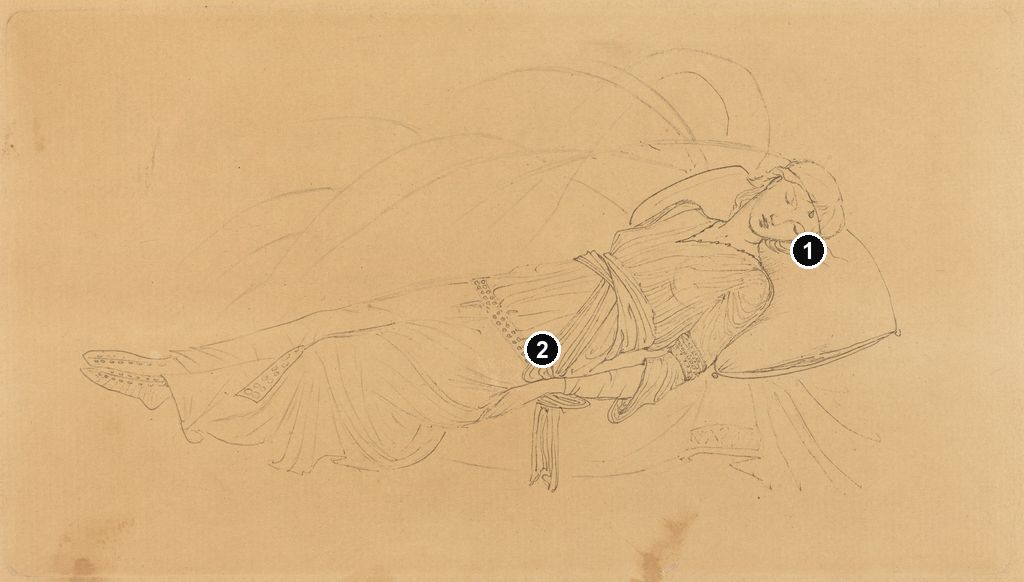
The face and pillow
Soft outlines settle the head into the pillow. The ink records the changing weight of the drawn line.
The line of the garment
Short darker strokes carry the pattern of the garment around the body without closing the drawing into a solid patch.
La Belle au bois dormant - programme text
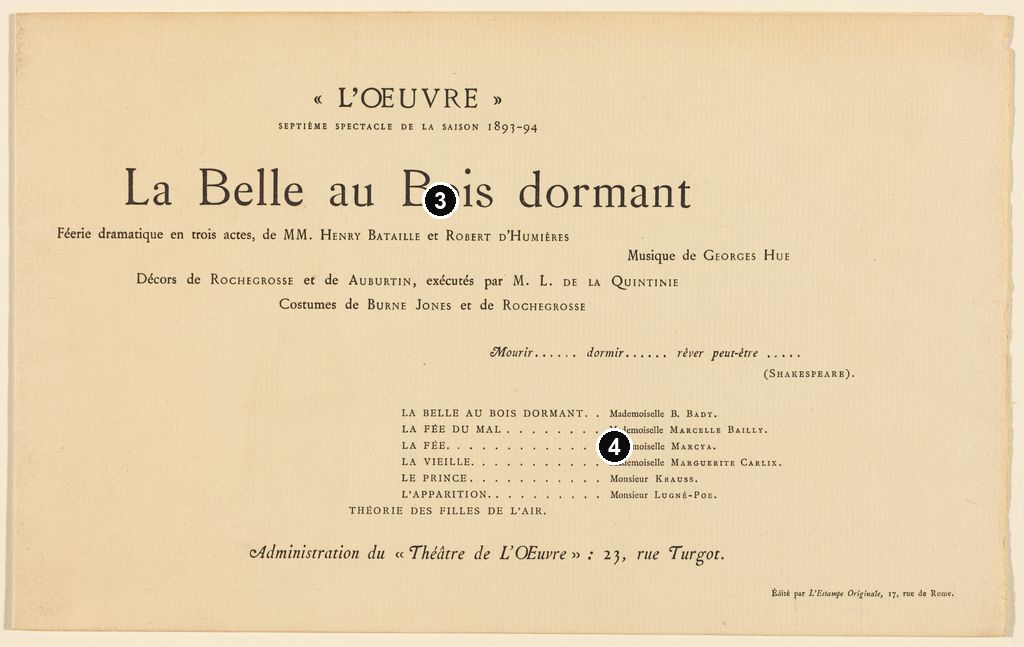
Title and type
The large title is surrounded by smaller lines of cast and production information. The size difference makes the performance title easy to find on the folded sheet.
Cast and performance credits
The tightly spaced names below the title shift from the image-maker’s name to the people and roles in the performance.
How the illustration became a print
Collotype uses light to transfer an image to a gelatin-coated printing surface. In printing, areas of the gelatin behave differently according to how much they have hardened. The damper areas repel greasy ink, while the harder areas accept it. That process can preserve a subtle gradation of tone as well as the narrow lines of a sketch. The programme’s slightly uneven, delicate marks belong to an ink impression on paper. Photography entered into making the printing surface. The image shows a drawn figure. The two impressions are part of the broader history of prints after Burne-Jones, in which the designer and the people who put the image into circulation often did different work. [1] [3] [5]
The words Dessin de Burne-Jones beneath the image assign the design to the artist. The National Gallery of Art’s acquisition reports describe the prints as after Burne-Jones. Laurence des Cars traced the collotype image to a facsimile of an etching after a Rose Bower composition. Her reference is to the catalogue entry for the smaller Sleeping Beauty, dated 1871–73 by its present owner, the Museo de Arte de Ponce. That catalogue reference identifies the family of images. On the programme, the solitary figure has been set apart from the background and attendants of the painting, and the precise steps between the painting, the design and the printed leaflet are less clear. [1] [6] [7] [8] [9] [10]
Philippe Saunier points to a contemporary reproduction in La Revue encyclopédique, where Léo Claretie praised the programme and its image appeared with a caption referring to an etching from L’Estampe Originale. Saunier found that the print did not appear in the albums of that name. The imprint establishes that L’Estampe Originale published the programme, and Claretie’s article gives the image a second life in the illustrated press. The precise history of the intermediate print remains open. A separate pencil drawing catalogued as Margaret Burne-Jones in the pose shows how close other versions can come. The catalogue’s William Waters reads that sheet as a likely demonstration for a pupil, a reminder that the same pose could serve more than one purpose. [11] [12]
What the audience saw on stage
Berthe Bady played the princess, Marcelle Bailly the malevolent fairy and the director, Aurélien Lugné-Poë, the Apparition. Georges Hüe wrote the music. The printed credits assign the scenery to Georges Rochegrosse and Auburtin and its execution to M. L. de la Quintinie. They name Burne-Jones alongside Rochegrosse for the costumes. Des Cars’s account treats the princess’s dress as inspired by Burne-Jones and finds no direct collaboration by him on the production. Saunier also notes how long the attribution circulated, even in Lugné-Poë’s later recollections. Some of the strongest traces of Burne-Jones on the stage may have been visual echoes. A contemporary critic associated a design with Love among the Ruins, while Saunier suggests that the giant briars around the columns might recall the Briar Rose paintings. [2] [3] [8] [11]
The familiar French title, taken from Perrault’s tale, gave little warning of the play’s argument with its ending. As Sophie Lucet shows from the surviving manuscript, the prince wakes the princess, and waking proves a disappointment. In sleep she has loved an apparition whom the living prince cannot replace. She returns to enchanted sleep, and he goes back to her for a last kiss. Both end up motionless. The quotation from Hamlet on the programme now has a particular point. Dreaming is where the princess’s desires have taken shape, and the world that opens when she wakes asks her to give them up. [3] [13]
For Rachilde, reviewing the production in the Mercure de France, the lavish setting delighted the eye at the expense of the inward drama she expected from Lugné-Poë. Jean Lorrain responded more warmly to the unsettling idea of a princess who had dreamed of someone other than the man who wakes her. The little picture is quieter than the spectacle these critics describe. It leaves room to imagine an inner life behind the closed eyes, while the play gives that inner life a character of its own in the Apparition. [13]
From the Briar Rose paintings to Paris
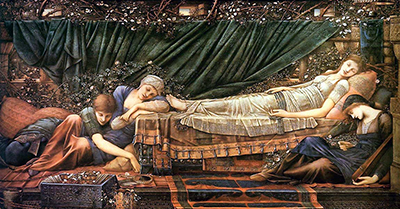
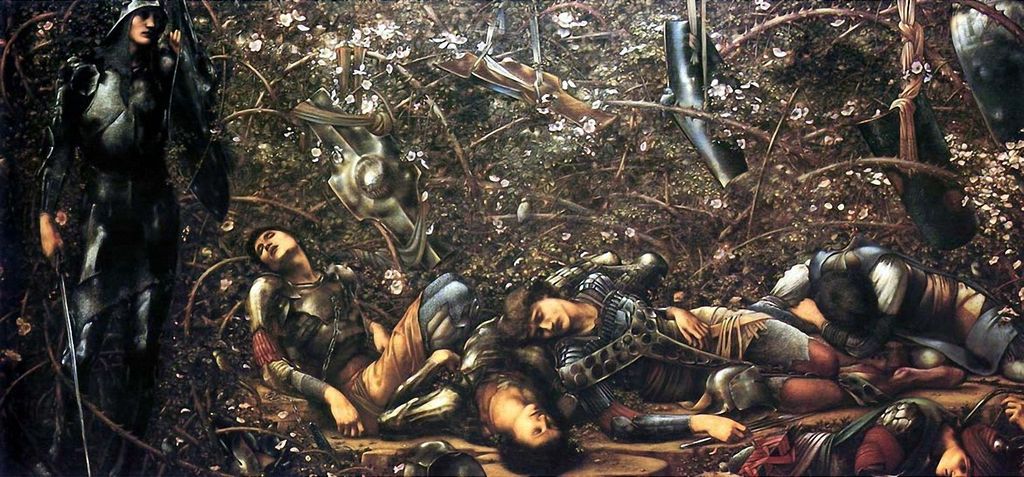
In the four large canvases at Buscot Park, the sleep spreads well beyond the princess’s chamber. Knights, courtiers and women at work seem to have been overtaken within the same suspended interval. The arrangement at Buscot carries the scene around the room through smaller connecting canvases. William Morris’s verse beneath the paintings helps the viewer linger over details such as the idle shuttle in The Garden Court. Burne-Jones had explored the legend in several versions, including the smaller painting in Ponce. In The Legend of the Briar Rose, the viewer never sees the princess awake. The Paris drama takes the opposite route through time, making her awakening the beginning of the trouble that eventually brings her back to sleep. [10] [13] [14] [15]
The Van Gogh Museum places the sheet in a tradition of illustrated programmes that helped put contemporary printmaking into the hands of Paris theatre audiences. At the Théâtre de l’Œuvre, the imagery could suggest the tone of a production without following its action literally. Here a single sleeping figure does that work. A visitor could unfold the sheet to read the practical details, fold it up again and take away a version of the image. One of the Washington impressions passed through the collection of Rodolphe Darzens in Paris before entering the National Gallery of Art. The programme still has both lives visible in it, as a record of a night at the theatre and as a picture someone thought worth keeping. [1] [16]
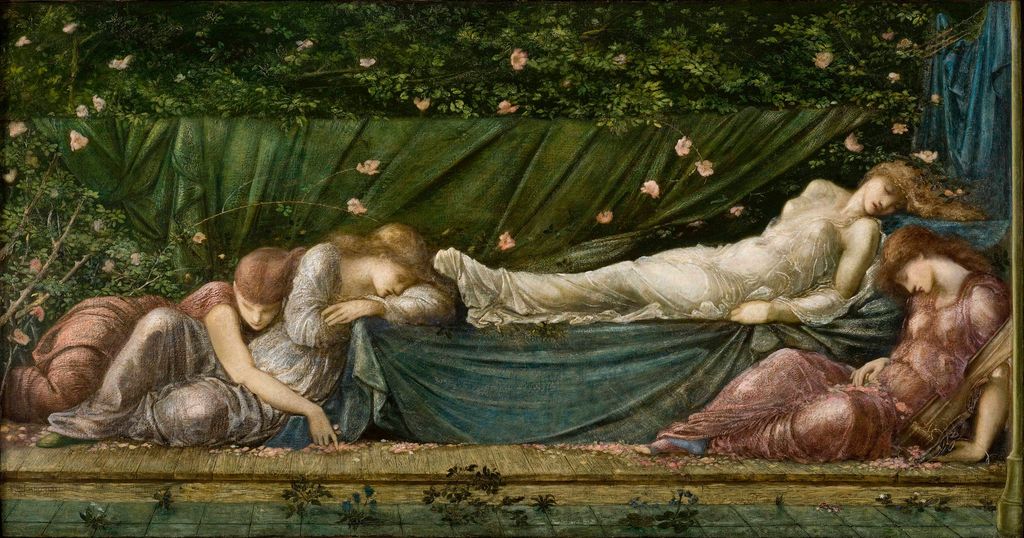
Edward Burne-Jones, The Sleeping Beauty, from the small Briar Rose series. Museo de Arte de Ponce. Image source. Public domain.
Related artworks
Edward Burne-Jones on film
Explore Burne-Jones’s paintings, illustrated stories and stained-glass designs.
Edward Burne-Jones: Pre-Raphaelite Visionary | Exhibitions | Showcase
A look at Burne-Jones’s paintings and the Tate retrospective.
Watch on YouTubeArtworks directory
This directory records paintings, studies, designs and collaborative works, with separate entries for documented versions and series where known.
| Name | Date | Medium |
|---|---|---|
| Sidonia von Bork 1560 | 1860 | Watercolour and bodycolour |
| Clara von Bork 1560 | 1860 | Watercolour and bodycolour |
| The Merciful Knight | 1863 | Watercolour |
| Sibylla Delphica | c. 1886 | Oil on panel |
| Phyllis and Demophoön | 1870 | Watercolour and bodycolour |
| The Legend of the Briar Rose (Buscot series) | 1870s–1890 | Oils on canvas |
| The Briar Wood (Buscot series) | By 1890 | Oil on canvas |
| The Council Chamber (Buscot series) | By 1890 | Oil on canvas |
| The Garden Court (Buscot series) | By 1890 | Oil on canvas |
| The Rose Bower (Buscot series) | By 1890 | Oil on canvas |
| Group of Women, study for The Golden Stairs | 1872 | Drawing |
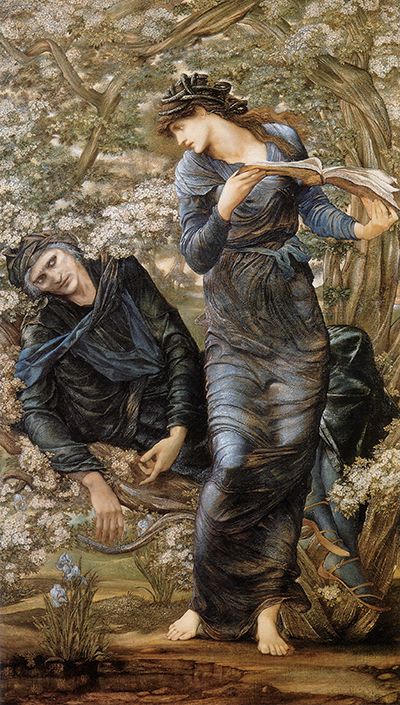
| The Beguiling of Merlin | 1870s | Oil on canvas |
| The Perseus Cycle | From 1875 | Paintings and full-scale designs |
| The Call of Perseus (Stuttgart) | From 1875 | Oil painting |
| Perseus and the Graeae (Stuttgart) | From 1875 | Oil painting |
| The Rock of Doom (Stuttgart) | 1884–88 | Oil on canvas |
| The Doom Fulfilled (Stuttgart) | 1888 | Oil on canvas |
| The Baleful Head (Stuttgart) | 1885–87 | Oil on canvas |
| The Baleful Head (Southampton design) | 1880s | Bodycolour |
| The Rock of Doom (Southampton design) | 1880s | Bodycolour |
| The Doom Fulfilled (Southampton design) | 1880s | Bodycolour |
| The Mirror of Venus (Gulbenkian) | 1870s | Oil on canvas |
| Drawing associated with The Mirror of Venus | 1870s | Drawing |
| Laus Veneris (Laing) | 1873–78 | Oil on canvas |
| The Days of Creation | 1870s | Watercolour and bodycolour |
| The Golden Stairs | 1880 | Oil on canvas |
| An Angel Playing a Flageolet | 1878 | Watercolour, bodycolour and gold |
| The Tree of Forgiveness | 1881–82 | Oil on canvas |
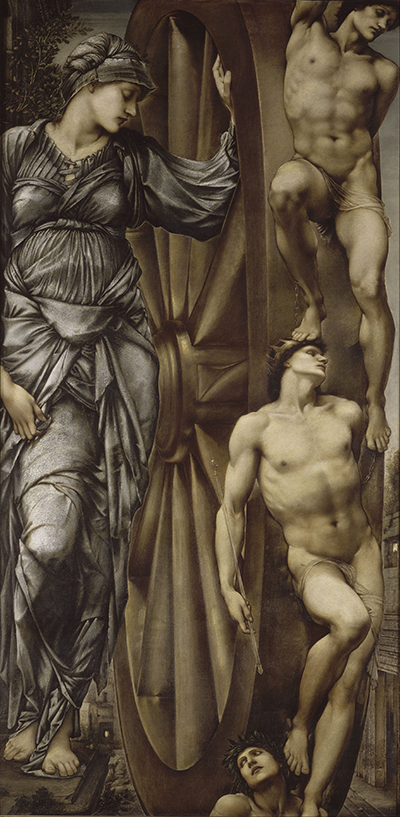
| The Wheel of Fortune (Orsay) | 1875–83 | Oil on canvas |
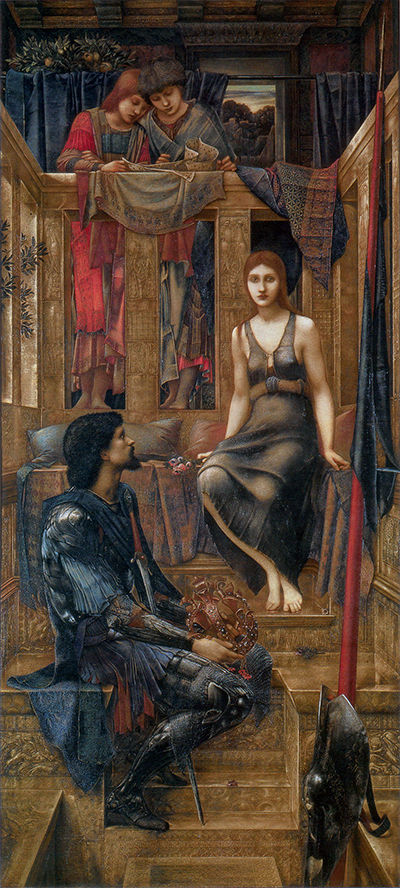
| King Cophetua and the Beggar Maid | 1884 | Oil on canvas |
| The Depths of the Sea (oil) | 1886 | Oil |
| The Morning of the Resurrection | 1886 | Oil on panel |
| Study for the Head of Mary Magdalene | c. 1882 | Oil study |
| The Sleep of King Arthur in Avalon | 1880s–1898 | Oil on canvas |
| The Sleep of King Arthur in Avalon (modello) | ca. 1881 | Oil on canvas (modello) |
| The Star of Bethlehem | Signed 1890 | Watercolour and bodycolour |
| Study for The Star of Bethlehem | About 1887–91 | Drawing |
| Sponsa de Libano | 1891 | Watercolour and bodycolour |
| The Summons (Holy Grail tapestries) | 1890s | Tapestry |
| The Failure of Sir Gawaine (Holy Grail tapestries) | 1890s | Tapestry |
| Hope (Boston) | 1896 | Oil on canvas |
| La Belle au bois dormant (theatre programme) | 1894 | Collotype |
| The Wedding of Psyche | 1895 | Oil on canvas |
| The Works of Geoffrey Chaucer (Kelmscott edition) | 1896 | Illustrated book |
| The Ascension (Birmingham Cathedral) | 1885 | Stained glass |
| The Last Judgement (Birmingham Cathedral) | 1897 | Stained glass |
| Adoration of the Magi (Huntington) | 1890s | Tapestry |
| Love among the Ruins (Wightwick) | 1894 | Oil on canvas |
| The Merciful Knight (photogravure after Burne-Jones) | 1900 | Photogravure |
| The Garden Court (preparatory work) | 1870–75 | Graphite and watercolour with white gouache |
| Study of a Female Figure | 1885 | Graphite drawing |
| Psyche Throwing Herself into the River | 1865–68 | Wood engraving |
| Beauty | 1887–89 | Colour lithograph |
| Study for the Failure of Gawain | 1893 | Crayon and graphite on Japanese paper |
| The Prince Enters the Briar Wood (after Burne-Jones) | After 1890 | Photogravure |
| The Rose Bower (after Burne-Jones) | 1892 | Photogravure |
| Adoration of the Magi (Musée d’Orsay) | 1904 | Tapestry |
| Answers to Prayer (Lyndhurst) | 1860s | Stained glass |
| The Depths of the Sea (photogravure after Burne-Jones) | 1900 | Photogravure |
| Perseus and Andromeda (Adelaide composite) | 1876 | Oil on canvas |
| The Adoration of the Magi (Hamburg) | Woven 1900 | Tapestry |
| Love leading the Pilgrim through the Briars | 1874–76 | Embroidery |
| Musica (worked by Lady Jane Cory) | 1906 | Embroidery |
| Pomona (worked by Lady Jane Cory) | 1907 | Embroidery |
| Flora (worked by Lady Jane Cory) | 1909 | Embroidery |
| The Fourth Day of Creation (photogravure after Burne-Jones) | 1900 | Photogravure |
| The Morning of the Resurrection (photogravure after Burne-Jones) | 1900 | Photogravure |
| Musical angels of the St Catherine window (Christ Church) | Designed 1877 | Stained glass |
Discussion
Look again at the images and ideas explored in La Belle au bois dormant. These editorial prompts invite your observations.
Reader Insights
What effect does the typography have on an image most readers encounter without the programme text?
How does seeing the picture as part of a theatre programme change your reading of the sleeping figure?
Join the Conversation
Share a detail, comparison or question about La Belle au bois dormant below.
References
- National Gallery of Art, La Belle au bois dormant, 1894, accession 1995.76.11, image, dimensions, inscriptions and provenance. View source.
- Van Gogh Museum, Theatre programme for La belle au bois dormant, accession p2764V2000, performance date and production context. View source.
- National Gallery of Art, La Belle au bois dormant, 1894, accession 1997.96.2, printed text, medium and dimensions. View source.
- Van Gogh Museum, Theaterprogramma voor La belle au bois dormant, accession p1343V2000, Dutch object record. View source.
- Getty Research Institute, Collotype (process), Art & Architecture Thesaurus record 300053204. View source.
- National Gallery of Art, Annual Report 1996, acquired prints, accession 1995.76.11. View source.
- National Gallery of Art, Annual Report 1997, acquired prints, accession 1997.96.2. View source.
- Laurence des Cars, “Edward Burne-Jones and France,” in Edward Burne-Jones: Victorian Artist-Dreamer, 1998, discussion of the 1894 production, PDF pp. 17 and 28–29. View source.
- Burne-Jones Catalogue Raisonné, The Briar Rose: The Rose Bower – Sleeping Beauty, The Sleeping Princess from the small Briar Rose series, exhibition and bibliography records for catalogue no. 58. View source.
- Museo de Arte de Ponce, The Sleeping Beauty, object 59.0114, 1871–73, image and collection record. View source.
- Philippe Saunier, “Edward Burne-Jones et la France. Madeleine Deslandes, une préraphaélite oubliée,” Revue de l’Art 130, 2000, production discussion and notes 48–50. View source.
- William Waters, Drawing of Margaret Burne-Jones in the pose of Sleeping Beauty for La Belle au bois dormant, Burne-Jones Catalogue Raisonné, object record and expertise note. View source.
- Sophie Lucet, “Les Belles rendormies. Féeries fin-de-siècle,” Féeries 12, 2015, paragraphs 10–13 and notes 36, 43–51. View source.
- Faringdon Collection, The Briar Rose Series: the Garden Court, Buscot Park catalogue no. 35, frame inscription and installation history. View source.
- Tate Britain, Edward Burne-Jones, 2018 exhibition guide, The Briar Rose, PDF pp. 123–125. View source.
- Van Gogh Museum, Theatre Programme, collection essay on the illustrated programmes of the Théâtre de l’Œuvre and its Paris contemporaries. View source.