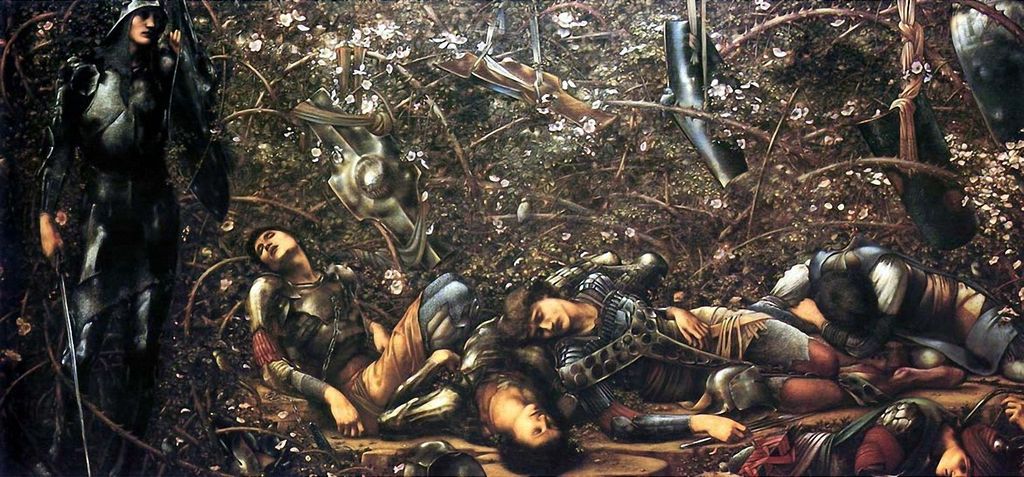
Edward Burne-Jones, The Briar Wood, from The Legend of the Briar Rose at Buscot Park. Image source. Public domain.
 by Tom Gurney
Tom Gurney BSc (Hons) is an art history expert with over 20 years experience
Email: tomgurney1@gmail.com / Phone: +44 7429 011000
The Legend of the Briar Rose by Edward Burne-Jones: Introduction
A prince steps into a thicket and finds armoured men fast asleep. In the next painting a king has slumped in his chair. In the third, young women have fallen asleep at their work. By the time we reach the princess, she is still lying where the spell left her. Edward Burne-Jones’s The Legend of the Briar Rose takes us deep into the palace of Sleeping Beauty and leaves its inhabitants asleep. The prince appears only in the first picture. The rest of his journey is ours to make. [1] [2]
The best-known version consists of four large oil paintings completed by 1890 and installed in the Saloon at Buscot Park in Oxfordshire. In story order they are The Briar Wood, The Council Chamber, The Garden Court and The Rose Bower. Ten smaller canvases were made for the installation after the main paintings had been exhibited. The title also belongs to a longer history of work on the subject, from painted tiles and a smaller series now in Puerto Rico to individual pictures that Burne-Jones took up again after the Buscot set was finished. [1] [2] [3]
At a Glance
- ArtistEdward Burne-Jones
- Date1870s–1890
- MediumOils on canvas
- SubjectThe Buscot Park sequence
This work across Edward Burne-Jones’s career
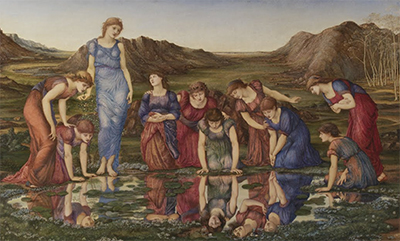
The Mirror of Venus
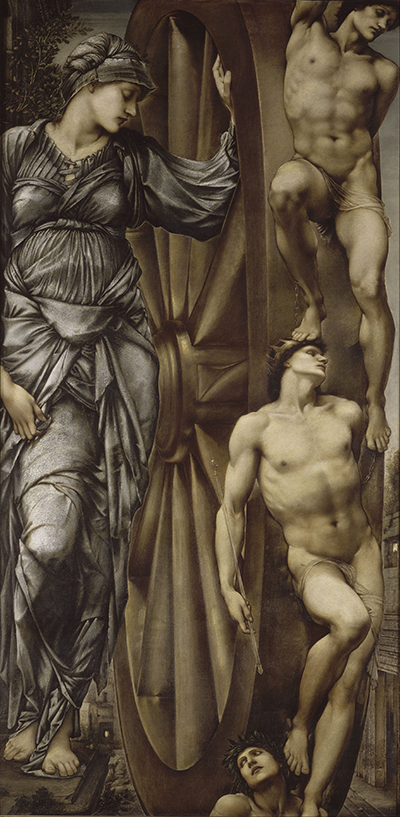
1870sThe Wheel of Fortune
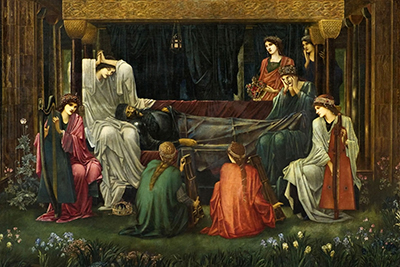
1875–83The Last Sleep of Arthur in Avalon
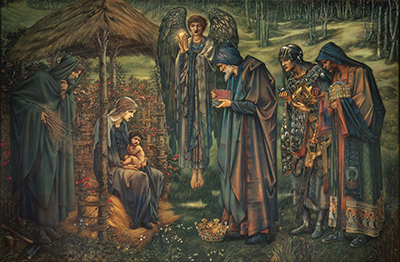
1880s–1898The Star of Bethlehem
Signed 1890Contents
- From a fireplace to the first oil paintings
- The four Buscot paintings
- The story and William Morris’s verses
- From a London exhibition to a room at Buscot
- Paintings dispersed and images circulated
- Annotated details
From a fireplace to the first oil paintings
The Sleeping Beauty story entered Burne-Jones’s work through a domestic commission. In the early 1860s he designed a sequence of tiles for The Hill, the painter Myles Birket Foster’s house in Witley, Surrey. At the William Morris Gallery, a surviving tile from the project records the division of work within Morris, Marshall, Faulkner & Co. Burne-Jones supplied the design and Lucy Faulkner, later Orrinsmith, painted it in enamels. A finished panel survives at the Victoria and Albert Museum. A drawing for the tiles at Cornell’s Herbert F. Johnson Museum gives a sense of what Faulkner received when she sat down to paint the imported Dutch blanks. [4] The tile series carried the story through to the awakening. A pair in the Delaware Art Museum, The Awakening Castle, depicts the palace coming back to life after a hundred years. The decision to leave everybody asleep came when Burne-Jones reworked the story for paintings. [5] [6]
In 1869 the Glasgow merchant and collector William Graham asked Burne-Jones for a picture on the subject. A sizeable early oil, The Prince entering the Briar Wood, has an old label on the stretcher identifying it as an early design painted that year. The auction catalogue records it at 107 by 183 centimetres, between the dimensions of the small oils and those of the eventual Buscot panel. Its presence makes it possible to follow the development of one scene outside the tidy succession of complete sets. Burne-Jones could start a composition at one scale while exploring closely related arrangements in other materials. The catalogue for the oil’s sale in 2021 notes that he returned to it after the 1890 exhibition. It also describes the glazes he used to build up dark colour over figures first worked in monochrome, a technique it relates to his interest in Venetian painting. [1] [7] [8]
Graham acquired the three oils now in the Museo de Arte de Ponce in Puerto Rico. The museum dates each to 1871–73. Their titles are The Prince Enters the Wood, The King and His Court and The Sleeping Beauty. They are about sixty centimetres high, roughly half the height of the principal Buscot canvases. At that scale the figures still form a continuous band across each painting, but an entire scene can be taken in from much closer. In Ponce’s Sleeping Beauty, the cloth around the princess’s body breaks into irregular folds and large roses hang above the sleeping women. At Buscot the bed and hangings give her repose a more regular outline, with smaller flowers worked into the decoration. [9] [10] [11] [12]
The artist’s work record, reproduced in Georgiana Burne-Jones’s Memorials, mentions four Sleeping Beauty pictures begun in 1871 for Graham. The surviving trio has no garden scene, although a graphite study at the Fitzwilliam Museum, dated 1870 in its catalogue, already explores the pose of one of the sleeping women later used in the Buscot Garden Court. The picture of the palace workers thus had a long history on paper before it took its place between the court and the bedroom. There was room for an independent version too. In 1871 Burne-Jones made a watercolour and bodycolour treatment on vellum for the dealer Murray Marks, now at Manchester Art Gallery. It belongs to the same period as the Ponce oils and gives the sleeping princess a life as a subject in her own right. He later gave a larger gouache concentrating on the princess and her attendant to his daughter Margaret and John William Mackail on their marriage in 1888. [13] [14] [1] [15] [16]
The larger pictures developed in stages. Graham declined the proposed large series for reasons of space, then helped arrange a sale to Burne-Jones’s dealer, Thomas Agnew & Sons, in 1885. The Faringdon Collection traces work on the large compositions to the 1870s and puts the concentrated campaign to finish them between autumn 1885 and April 1890. Tate dates The Briar Wood to 1874–84, the two middle pictures to 1885–90 and The Rose Bower to 1886–90. The double date 1870/1890 on The Briar Wood spans the evolution of the design and its eventual completion within the set. All four were ready to be shown together in 1890. [1] [3] [7] [17]
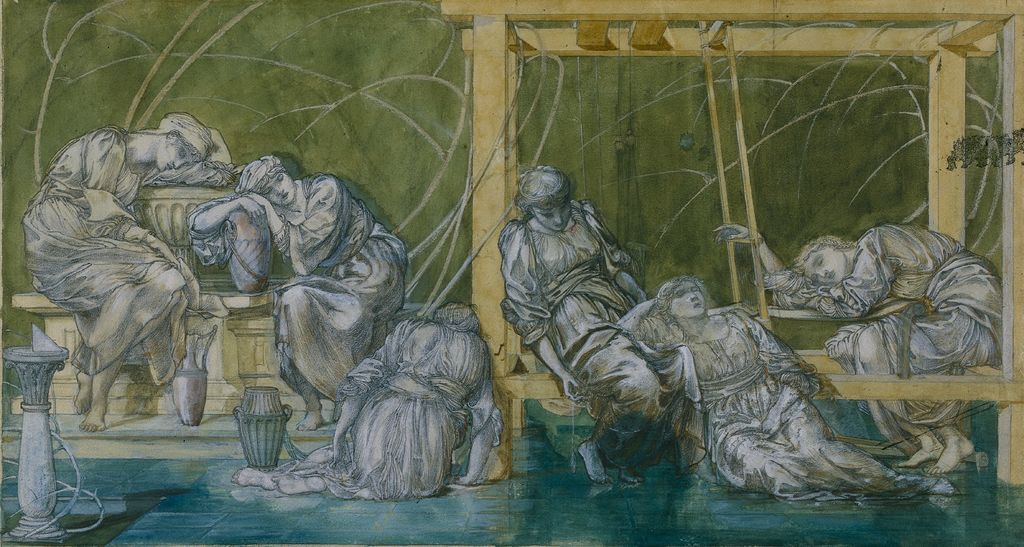
Edward Burne-Jones, The Garden Court, design in graphite and watercolour. Cleveland Museum of Art, 1994.197. Image source. CC0 / Public domain.
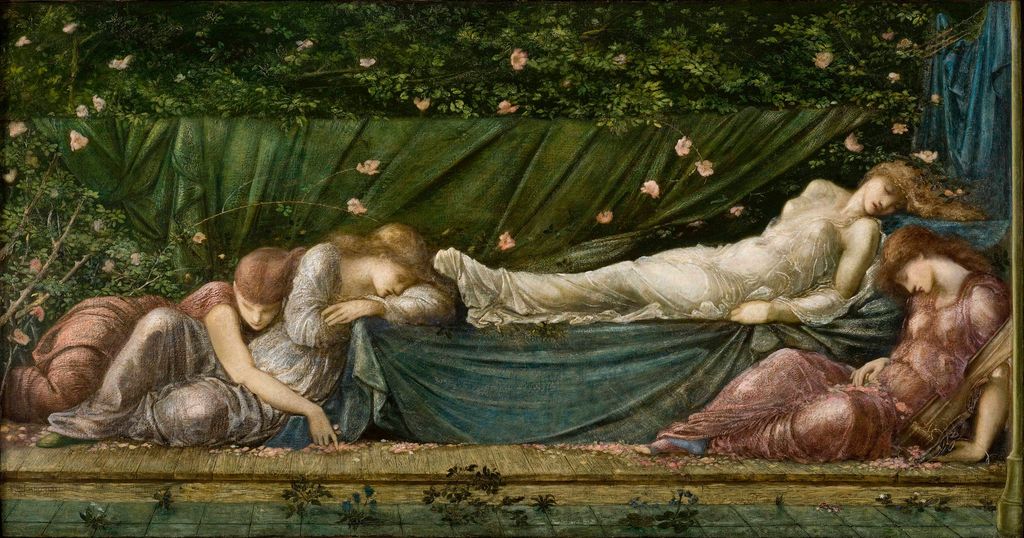
Edward Burne-Jones, The Sleeping Beauty, from the small Briar Rose series. Museo de Arte de Ponce. Image source. Public domain.
The four Buscot paintings
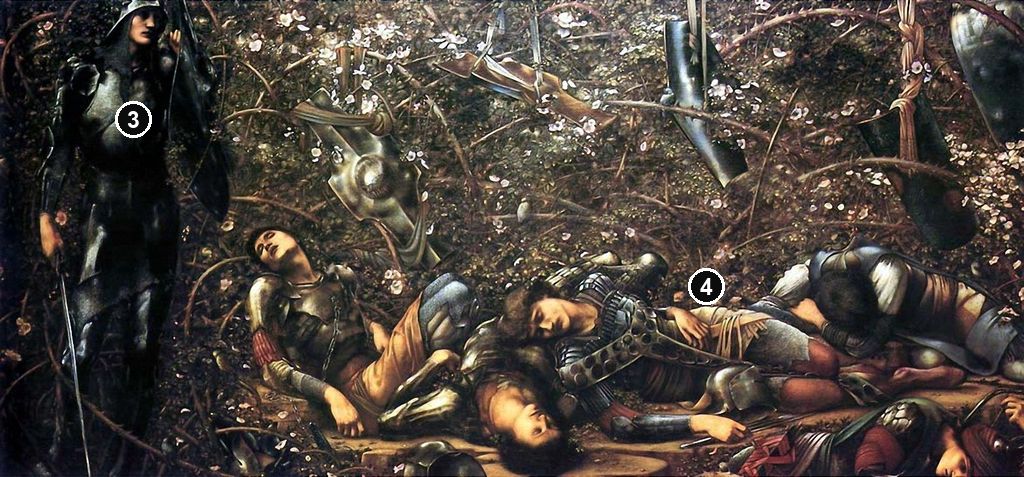
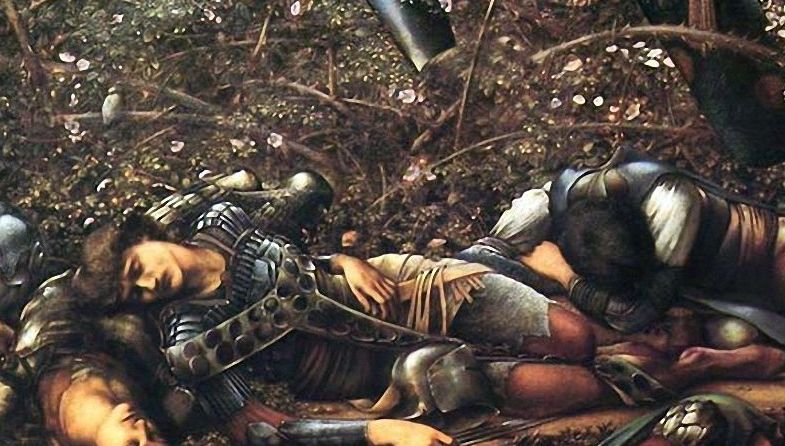
In The Briar Wood, the prince’s upright figure is a shock after the first sweep of tangled stems and recumbent bodies. His armour is ready for use. The armour scattered through the wood has become part of the undergrowth. A knee or a face emerges just far enough from the pattern of leaves to reveal another knight. Burne-Jones took the character of the briars seriously enough to ask Lady Leighton Warren for a specimen with large thorns. The effect depends on the plant looking capable of catching men and their equipment. Art historian Uliana Vlasova, drawing on Georgiana Burne-Jones’s account, traces the armour in this series and the Perseus pictures to studies from the collection of Sir Coutts Lindsay. Burne-Jones also designed elements of armour with the metalworker W. A. S. Benson. The mix gave him recognisable metalwork with the freedom to suggest a middle age of his own. [18] Placed against the sleeping bodies, even the smallest changes in the prince’s stance take on the force of action. [1] [17]
In The Council Chamber, the king remains raised above his company. The throne still marks his office, even with his head bowed. Below him the men spill across the foreground, some gathered near the drapery and others stretched low across the floor. The long folds and repeated angles of their bodies carry the eye from figure to figure. A figure study for a sleeping guard records the work that went into a body partly hidden by the finished arrangement. That guard belongs to the Buscot composition and is absent from the treatments at Ponce and Delaware. The palace has kept its ranks and roles in view, although sleep has put king, guards and councillors in the same condition. [19] [20]
In The Garden Court, the spell reaches the weavers at the loom and the women by the well. Loom and trellis establish an upright grid behind the row of figures. The roses curl across it and hands hang or rest where their work was interrupted. Birmingham Museums holds a group of figure studies that lets us follow Burne-Jones’s choices about how sleep should look at the instant it overtakes a worker. In the bodycolour study signed in 1889 for the second woman from the left, he worked on the ease with which her figure falls into the surrounding pattern. Others in the group preserve a hand poised above its task. The difference is small enough to see only when looking carefully, and it matters. In one pose the worker seems to have settled down, while in another the hand retains the position it held before the spell. [1] [21] [22]
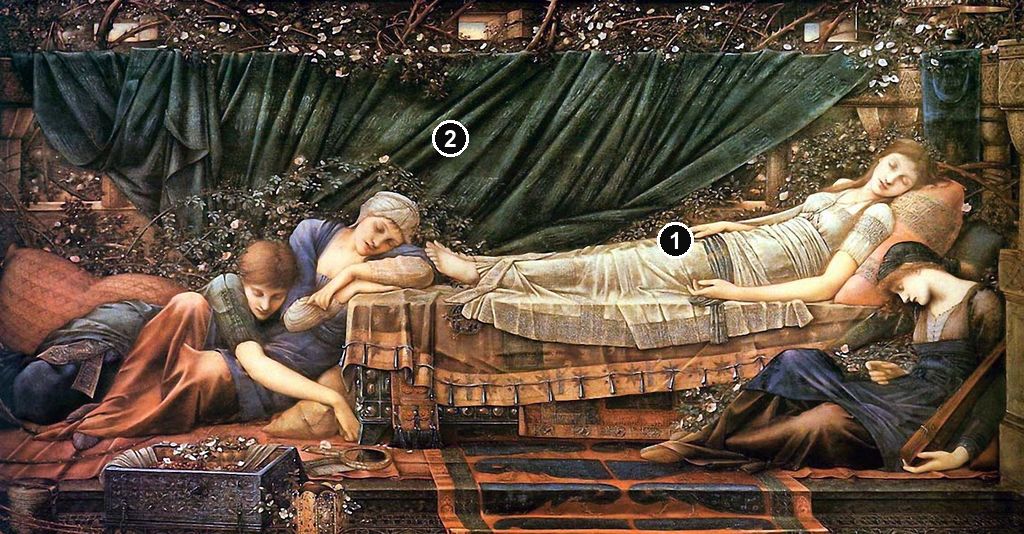
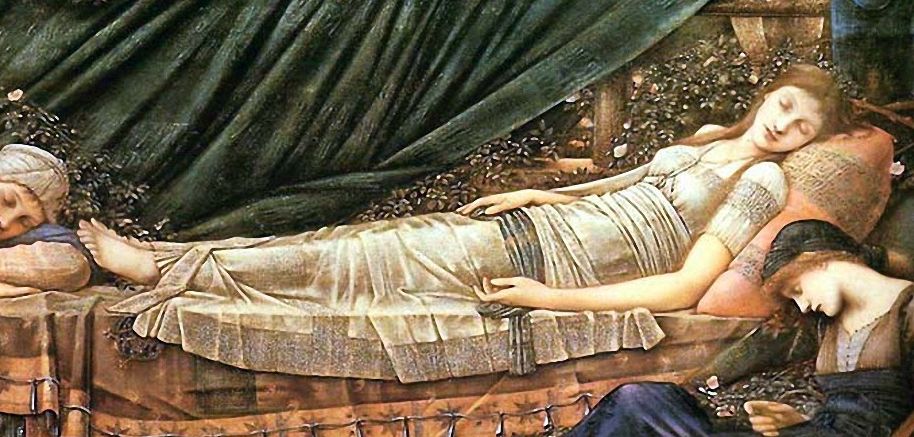
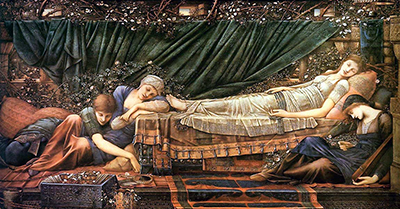
In The Rose Bower the bed rises behind the other sleepers. Its level edge and the straight run of fabric direct attention to the long, pale figure of the princess. Her attendants echo her repose at different angles. Gold ornament and enclosed hangings give the bed the formality of a place prepared for a ceremony. A chalk study of a woman’s lowered, braided head, dated 1886 and held by the British Museum, shows Burne-Jones isolating the fall of a head for this canvas. In the finished work, the quietness of those individual poses comes through the abundance of the room. After the snarl of the wood, the flowered branches appear at home among the fabrics. [23] [24] [12]
The four canvases share a low, wide shape. The first two each measure just over eight feet across. The final two are a little narrower. As we travel from the upright prince to the reclining princess, the narrow depth of each scene keeps the figures close to the picture surface. The journey covers several distinct spaces while the painted world sustains a single interval. Burne-Jones would hold attention on another legendary sleeper in The Last Sleep of Arthur in Avalon. Here the story’s effect depends on the repeated sight of rest, outside the palace, in its public rooms and finally at the bed. [1] [17] [19] [23]
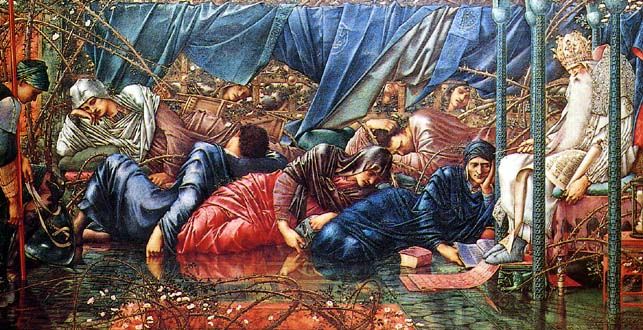
Edward Burne-Jones, The Council Chamber, from The Legend of the Briar Rose at Buscot Park. Image source. Public domain.
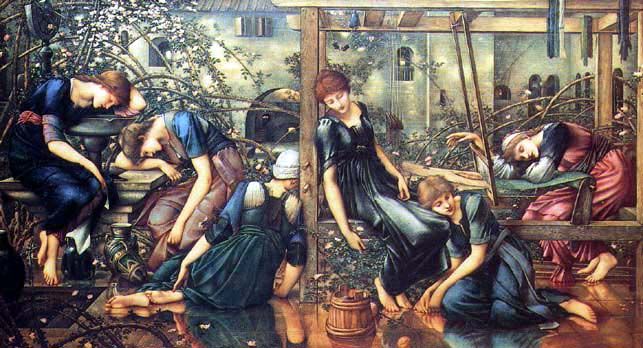
Edward Burne-Jones, The Garden Court, from The Legend of the Briar Rose at Buscot Park. Image source. Public domain.
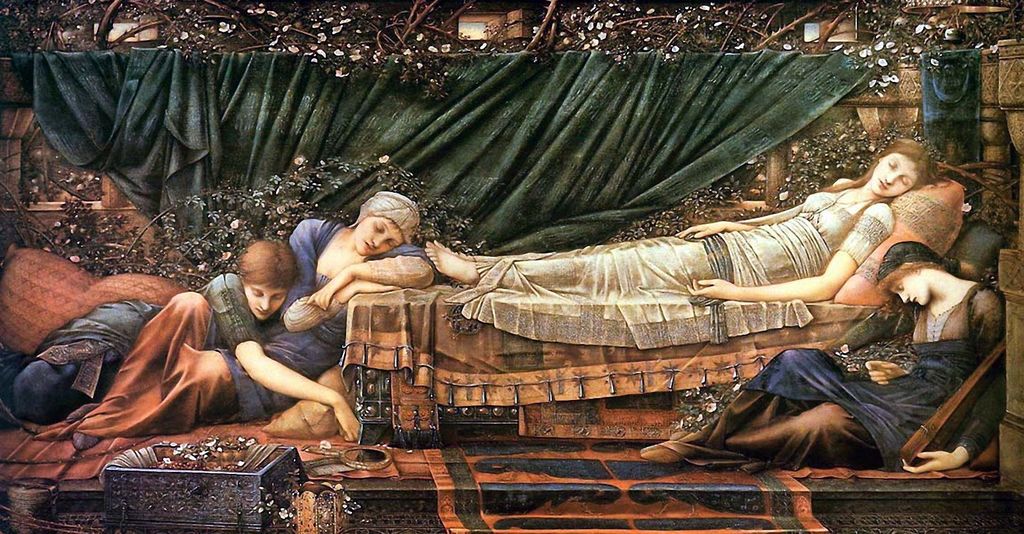
Edward Burne-Jones, The Rose Bower, from The Legend of the Briar Rose at Buscot Park. Image source. Public domain.
Annotated Details from The Legend of the Briar Rose
The numbered points identify visible features discussed in this article. Return from each detail to the numbered overview. Each caption identifies the work shown.
The Rose Bower
Edward Burne-Jones, The Rose Bower, from The Legend of the Briar Rose at Buscot Park. Image source. Public domain.
The Briar Wood
Edward Burne-Jones, The Briar Wood, from The Legend of the Briar Rose at Buscot Park. Image source. Public domain.
Details from THE LEGEND OF THE BRIAR ROSE
Compare the cropped details with the source images above. Notice how their colours, shapes and positions contribute to the larger compositions.
The Rose Bower
The sleeping princess
The pale figure runs almost the length of the bed. The surrounding sleepers bend towards the floor and the lower corners.
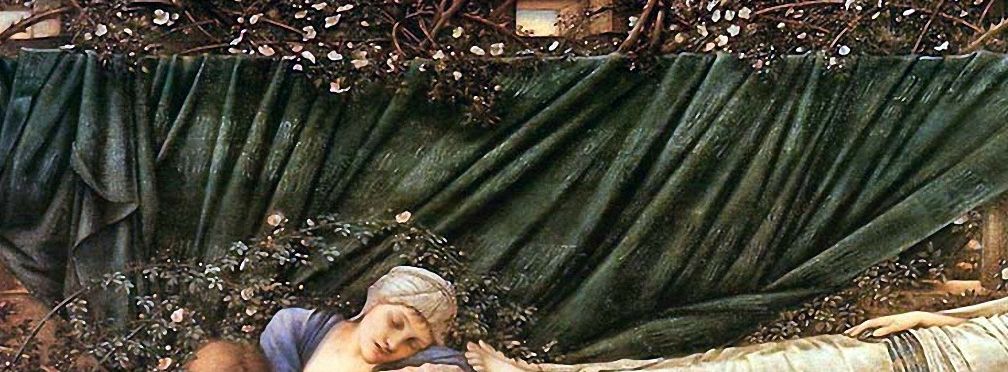
The sloping green hanging
Deep folds form long diagonals above the bed. They draw attention to the pale horizontal below and divide the figure from the branches overhead.
The Briar Wood
The entrance through briars
The upright arrival of the prince contrasts with the collapsed bodies beside him.
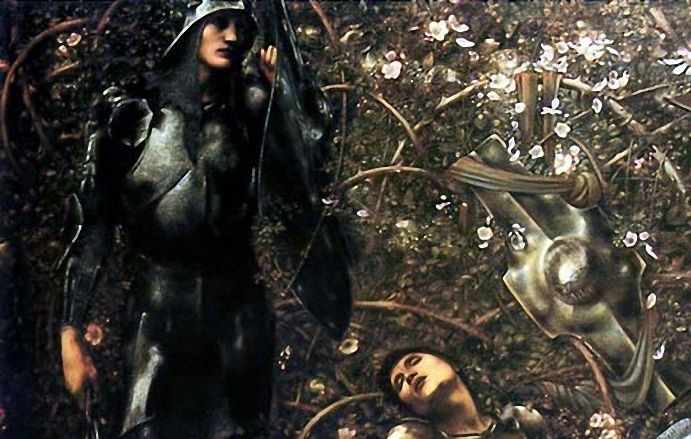
Briars and armour
The plant loops between resting bodies and hard armour. It fills the passage and slows the eye along the panel.
See the four paintings at Buscot
This film shows how the panels work across the room at Buscot Park.
Smarthistory. The discussion follows the sequence and the artist’s choice to leave the sleepers undisturbed. Watch on YouTube.
The story and William Morris’s verses
In Charles Perrault’s La Belle au bois dormant, included in his 1697 collection of tales, a fairy softens a death sentence into a sleep of a hundred years. The princess wakes when the term of the enchantment is up and the prince has reached her bedside. In Alfred Tennyson’s The Day-Dream, published in 1842, the prince kisses her and the poem continues through the awakening. Tennyson gives the sleeping palace its own attention, dwelling on its interrupted ordinary life. Burne-Jones uses that possibility to fill two canvases with a king’s business and the work of the women at the loom and well. His choice of stopping point leaves both the breaking of the spell and the revival of the palace in the future. [25] [26] [1]
William Morris wrote a quatrain for each painting. All four appeared in the pamphlet for the 1890 Agnew exhibition and were later inscribed beneath the corresponding pictures at Buscot. The wood’s verse brings the hand that will break the curse into view just as the prince enters. The council’s stanza broadens the spell to the kingdom’s prospects for war and peace. The garden’s stanza turns to the cup that stays empty and the shuttle that lies still. The final verse calls on the prince to “smite this sleeping world awake.” The imperative is stronger than anything that happens in the bedroom. Reading it beneath the sleeping women puts the promised action and its delay in direct contact. [27] [28] [1]
The promise of change has made the quiet of the paintings open to competing readings. The Faringdon Collection’s account emphasises the secluded world Burne-Jones imagined and the languor he evoked through colour, bent forms and shallow space. Art historian Andrea Wolk Rager argues that the shared sleep and prospect of awakening carry social as well as personal implications. The prominence given to the weavers supports the second reading. Care over the loom, the shuttle and the posture of a woman at work puts ordinary labour beside the king and the future of his court. The same absorbed looking that draws us into the quiet of the colour and line gives us time to notice whose activity the spell has stopped. [1] [29]
Cristina Pascu-Tulbure has traced a different path into the paintings through Burne-Jones’s exchanges with John Ruskin and through older images of sleep that both men studied. In Carpaccio’s Dream of Saint Ursula, the figure lying quietly in bed is already receiving a message in her sleep. The resemblance to the composed figure at Buscot gives her repose a different weight from the bundle of limbs in the wood. It also directs attention to a change across the series. The prince who acts is introduced first, while the figure who may have an inward life of her own occupies the place of honour at the end. [12]
From a London exhibition to a room at Buscot
Agnew’s showed the completed set at its Old Bond Street gallery in 1890. The exhibition catalogue survives at the Huntington Library, and the critic Thomas Humphry Ward describes the crowds and favourable reception. The pictures travelled beyond the dealer’s London gallery. The Faringdon exhibition record names Liverpool in 1890 and Toynbee Hall in Whitechapel in 1891, where the annual East End exhibition brought the paintings before a different public. Tate’s retrospective guide links that display to Burne-Jones’s belief that art should reach a broad audience. The fairy tale could be recognised at once, while the scale and scrutiny demanded by the separate panels gave visitors four vantage points from which to consider the same spell. [28] [30] [1] [3]
Alexander Henderson, later the first Lord Faringdon, acquired the paintings for Buscot. When Burne-Jones saw their setting, he designed a carved and gilded framework that joined the compositions to the room. In 1891 he made eight strips to extend the sides of the four canvases and two broader intermediate panels. Briars with Helmet and Greave carries the traces of the knights beyond The Briar Wood. A Stone Kitchen overgrown with Briars sits between The Garden Court and The Rose Bower. These additions let a visitor pass through more of the palace. A piece of armour remains when the last knight is out of view, while the kitchen carries the interrupted work of the courtyard farther indoors. The roses hold the passages together around the joinery. [2] [3] [31] [32] [33]
The Saloon’s late eighteenth-century plasterwork and mahogany doors survived from an earlier decorative scheme. The gold silk wall hangings belong to the period of the installation. The Italian craftsmen Vacari, a father and son working in Fulham Road, supplied the Renaissance-style framing for the pictures, which were hung above head height. When the Saloon was refurbished in 1995, evidence of its earlier pigments guided the return of the yellow-green below the paintings. [2] [34] At Buscot the sequence has to be followed around an existing room, with pauses at doors and fittings. The encounter differs from seeing four equal reproductions lined up on a page. Burne-Jones’s Perseus Cycle began with drawings for a room whose full painted scheme never materialised. At Buscot the finished paintings acquired their architectural setting after exhibition, when their artist had an opportunity to reconsider the spaces between them. Tate brought the four oils and the infills together again in its 2018–19 retrospective, where a gallery installation gave viewers another chance to follow the surround. [2] [3]
Paintings dispersed and images circulated
Burne-Jones returned to several large alternatives that had fallen out of the Buscot project. The Delaware Art Museum owns the Council Chamber bought by Samuel Bancroft in 1892. It catalogues the canvas as 1872–92 and describes the dry brushwork and pale palette that give it a surface like fresco. Bristol Museum & Art Gallery’s Garden Court, dated 1894 in the museum’s record, places six women across the foreground beneath the tangle. Its slightly wider canvas gives their interrupted tasks more room. Dublin’s Hugh Lane Gallery has The Sleeping Princess, shown under that title and dated 1874 in documentation from the National Gallery of Ireland. The Dublin picture also appeared in the 2012 Burne-Jones exhibition in Japan, where the Hyogo Prefectural Museum of Art gave its date as about 1872–74. The three pictures survive in different collections, and there is no established fourth Briar Wood in this group. [1] [35] [36] [37] [38]
The Ponce paintings have travelled together. The Kunstmuseum Den Haag presented the three oils as a group in its 2009 Sleeping Beauty exhibition from the Puerto Rican collection. The same international exhibition project brought Ponce’s Victorian paintings to the Prado and to the Belvedere, where the German title Schlafende Schönheit again put the sleeping princess at the centre of an exhibition that extended well beyond Burne-Jones. The difference in scale between the Ponce cycle and its Buscot successor can be hard to gauge in reproduction, which gives similarly wide rectangles the same space on a page. [39] [40] [41] At the 2024 exhibition Preraffaelliti. Rinascimento moderno in Forlì, all three Ponce oils were listed alongside Bristol’s larger Garden Court. Visitors could compare sizes and see what the later garden scene added to the three episodes Graham owned. [42]
One nineteenth-century route to the paintings was through Agnew’s photogravures, published in April 1892. The process transferred a photographic image to a printing plate. The Metropolitan Museum of Art holds a proof of the prince entering the wood, and Delaware has Bancroft’s copy, one of four reproductions he bought around the time he acquired his oil. The prints could keep the scenes together in collections far from Buscot. They also travelled without the new painted passages and the Saloon, putting the familiar four compositions back at the centre of the sequence. [1] [43] [44]
A different reproduction reached theatre audiences in Paris. The programme for La Belle au bois dormant, performed at the Théâtre de l’Œuvre on 24 May 1894, used the scene of the sleeping princess. The National Gallery of Art in Washington catalogues one copy of the programme as a black collotype on wove paper, with lettering identifying the three-act play by Henry Bataille and Robert d’Humières. Washington also records a version on light brown wove paper as a separate accession. The Van Gogh Museum in Amsterdam has a further example in its collection. Laurence des Cars traces its image to a facsimile of an etching reproducing The Rose Bower through L’Estampe Originale and finds no evidence that Burne-Jones designed the costumes for the production, despite the credit in the programme. An image whose force came from the absence of an ending now sat in the hands of an audience waiting for a play to begin. [45] [46] [47] [48]
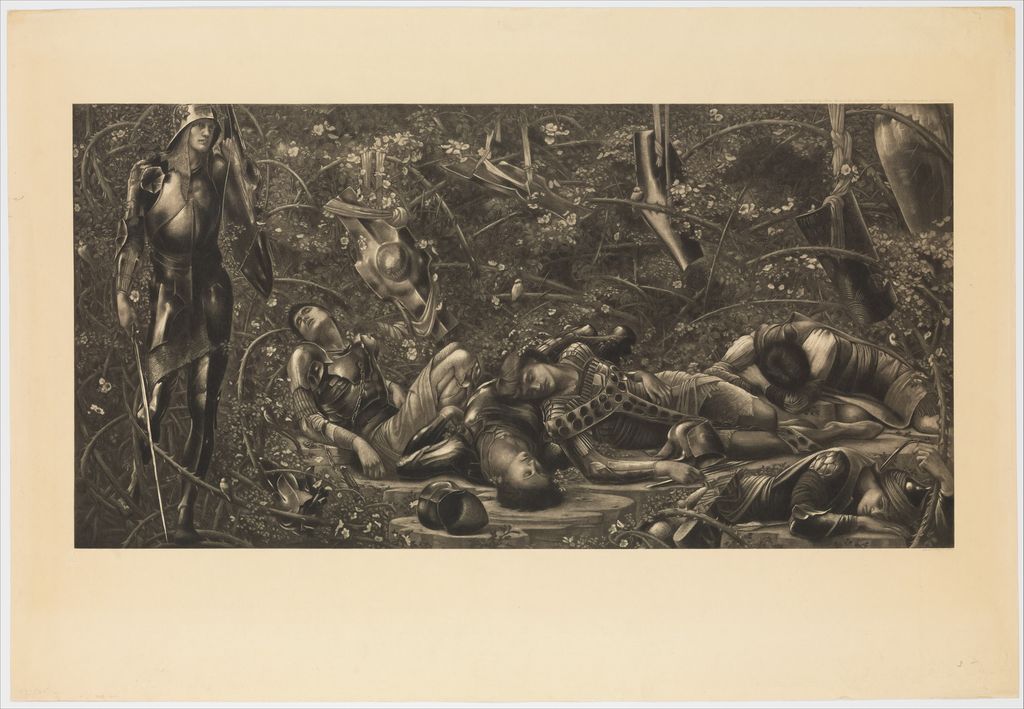
The Prince Enters the Briar Wood, photogravure after Edward Burne-Jones. The Metropolitan Museum of Art. Image source. CC0 / Public domain.
Related artworks
Artworks directory
This directory records paintings, studies, designs and collaborative works, with separate entries for documented versions and series where known.
| Name | Date | Medium |
|---|---|---|
| Sidonia von Bork 1560 | 1860 | Watercolour and bodycolour |
| Clara von Bork 1560 | 1860 | Watercolour and bodycolour |
| The Merciful Knight | 1863 | Watercolour |
| Sibylla Delphica | c. 1886 | Oil on panel |
| Phyllis and Demophoön | 1870 | Watercolour and bodycolour |
| The Legend of the Briar Rose (Buscot series) | 1870s–1890 | Oils on canvas |
| The Briar Wood (Buscot series) | By 1890 | Oil on canvas |
| The Council Chamber (Buscot series) | By 1890 | Oil on canvas |
| The Garden Court (Buscot series) | By 1890 | Oil on canvas |
| The Rose Bower (Buscot series) | By 1890 | Oil on canvas |
| Group of Women, study for The Golden Stairs | 1872 | Drawing |
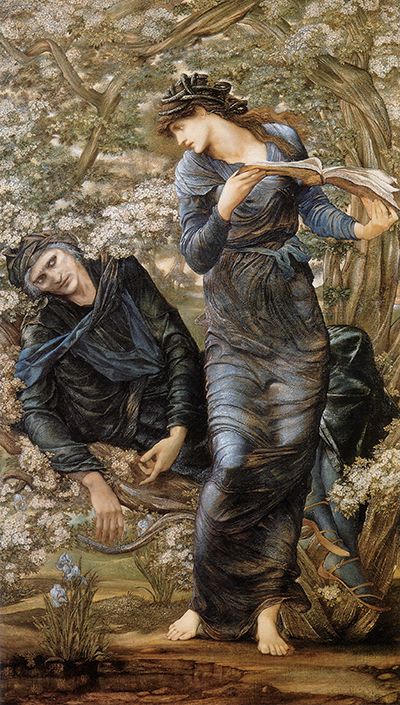
| The Beguiling of Merlin | 1870s | Oil on canvas |
| The Perseus Cycle | From 1875 | Paintings and full-scale designs |
| The Call of Perseus (Stuttgart) | From 1875 | Oil painting |
| Perseus and the Graeae (Stuttgart) | From 1875 | Oil painting |
| The Rock of Doom (Stuttgart) | 1884–88 | Oil on canvas |
| The Doom Fulfilled (Stuttgart) | 1888 | Oil on canvas |
| The Baleful Head (Stuttgart) | 1885–87 | Oil on canvas |
| The Baleful Head (Southampton design) | 1880s | Bodycolour |
| The Rock of Doom (Southampton design) | 1880s | Bodycolour |
| The Doom Fulfilled (Southampton design) | 1880s | Bodycolour |
| The Mirror of Venus (Gulbenkian) | 1870s | Oil on canvas |
| Drawing associated with The Mirror of Venus | 1870s | Drawing |
| Laus Veneris (Laing) | 1873–78 | Oil on canvas |
| The Days of Creation | 1870s | Watercolour and bodycolour |
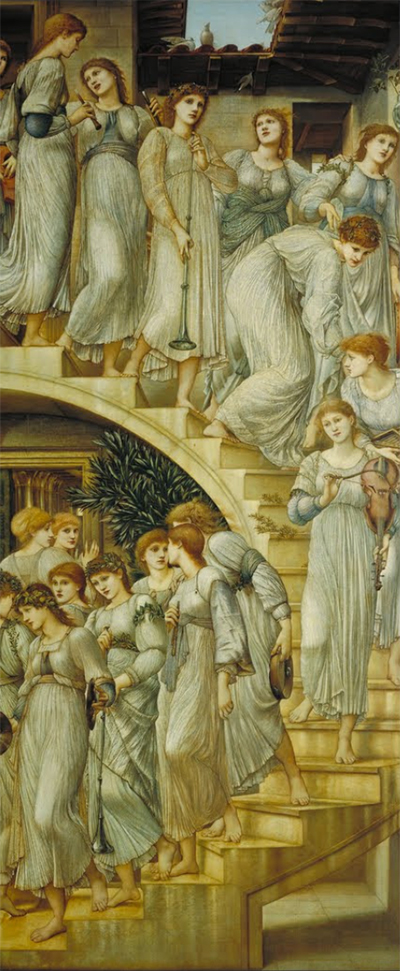
| The Golden Stairs | 1880 | Oil on canvas |
| An Angel Playing a Flageolet | 1878 | Watercolour, bodycolour and gold |
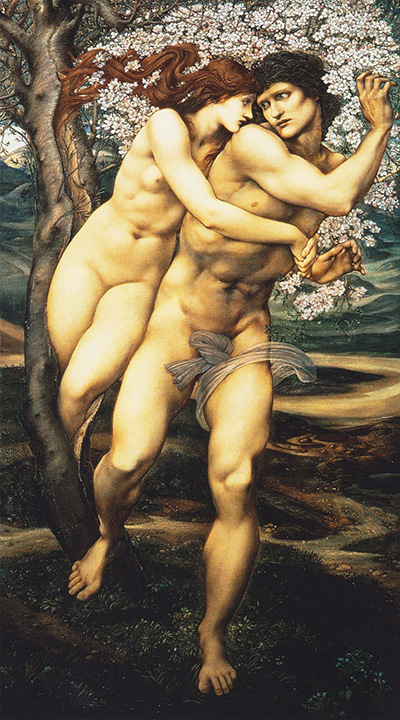
| The Tree of Forgiveness | 1881–82 | Oil on canvas |
| The Wheel of Fortune (Orsay) | 1875–83 | Oil on canvas |
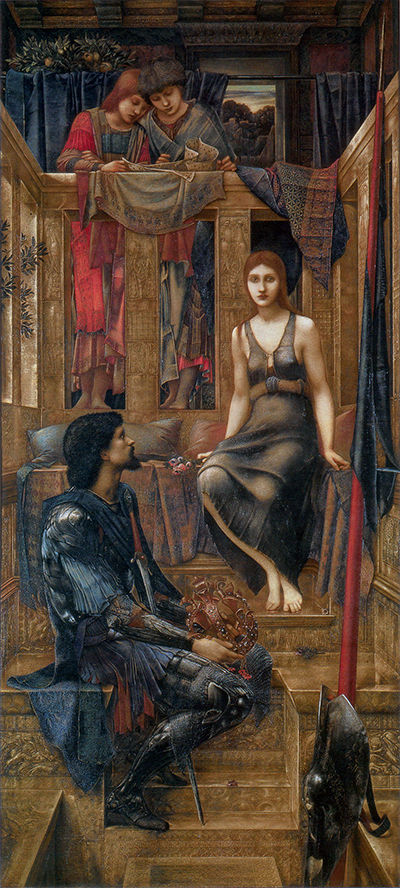
| King Cophetua and the Beggar Maid | 1884 | Oil on canvas |
| The Depths of the Sea (oil) | 1886 | Oil |
| The Morning of the Resurrection | 1886 | Oil on panel |
| Study for the Head of Mary Magdalene | c. 1882 | Oil study |
| The Sleep of King Arthur in Avalon | 1880s–1898 | Oil on canvas |
| The Sleep of King Arthur in Avalon (modello) | ca. 1881 | Oil on canvas (modello) |
| The Star of Bethlehem | Signed 1890 | Watercolour and bodycolour |
| Study for The Star of Bethlehem | About 1887–91 | Drawing |
| Sponsa de Libano | 1891 | Watercolour and bodycolour |
| The Summons (Holy Grail tapestries) | 1890s | Tapestry |
| The Failure of Sir Gawaine (Holy Grail tapestries) | 1890s | Tapestry |
| Hope (Boston) | 1896 | Oil on canvas |
| La Belle au bois dormant (theatre programme) | 1894 | Collotype |
| The Wedding of Psyche | 1895 | Oil on canvas |
| The Works of Geoffrey Chaucer (Kelmscott edition) | 1896 | Illustrated book |
| The Ascension (Birmingham Cathedral) | 1885 | Stained glass |
| The Last Judgement (Birmingham Cathedral) | 1897 | Stained glass |
| Adoration of the Magi (Huntington) | 1890s | Tapestry |
| Love among the Ruins (Wightwick) | 1894 | Oil on canvas |
| The Merciful Knight (photogravure after Burne-Jones) | 1900 | Photogravure |
| The Garden Court (preparatory work) | 1870–75 | Graphite and watercolour with white gouache |
| Study of a Female Figure | 1885 | Graphite drawing |
| Psyche Throwing Herself into the River | 1865–68 | Wood engraving |
| Beauty | 1887–89 | Colour lithograph |
| Study for the Failure of Gawain | 1893 | Crayon and graphite on Japanese paper |
| The Prince Enters the Briar Wood (after Burne-Jones) | After 1890 | Photogravure |
| The Rose Bower (after Burne-Jones) | 1892 | Photogravure |
| Adoration of the Magi (Musée d’Orsay) | 1904 | Tapestry |
| Answers to Prayer (Lyndhurst) | 1860s | Stained glass |
| The Depths of the Sea (photogravure after Burne-Jones) | 1900 | Photogravure |
| Perseus and Andromeda (Adelaide composite) | 1876 | Oil on canvas |
| The Adoration of the Magi (Hamburg) | Woven 1900 | Tapestry |
| Love leading the Pilgrim through the Briars | 1874–76 | Embroidery |
| Musica (worked by Lady Jane Cory) | 1906 | Embroidery |
| Pomona (worked by Lady Jane Cory) | 1907 | Embroidery |
| Flora (worked by Lady Jane Cory) | 1909 | Embroidery |
| The Fourth Day of Creation (photogravure after Burne-Jones) | 1900 | Photogravure |
| The Morning of the Resurrection (photogravure after Burne-Jones) | 1900 | Photogravure |
| Musical angels of the St Catherine window (Christ Church) | Designed 1877 | Stained glass |
Discussion
Look again at the images and ideas explored in The Legend of the Briar Rose by Edward Burne-Jones. These editorial prompts invite your observations.
Reader Insights
How does the effect of the four pictures change when you imagine seeing them across one room?
In which panel do the briars seem to shape the action most strongly?
Join the Conversation
Share a detail, comparison or question about The Legend of the Briar Rose by Edward Burne-Jones below.
References
- Faringdon Collection Trust, The Briar Rose Series: the Garden Court, catalogue no. 35 and series history. View source.
- Faringdon Collection Trust, The Saloon, house guide and installation history. View source.
- Tate Britain, Edward Burne-Jones, large-print exhibition guide, room 6, pp. 122–25. View source.
- Herbert F. Johnson Museum of Art, Cornell University, Study for the Sleeping Beauty tile series, object record 31781 and description of tile fabrication. View source.
- William Morris Gallery, The Sleeping Beauty tile, catalogue no. C83a. View source.
- Delaware Art Museum, ‘The Awakening Castle’ from ‘Sleeping Beauty’, object record. View source.
- Christie’s, The Prince entering the Briar Wood, object description, inscriptions and lot essay. View source.
- Christie’s, The Prince entering the Briar Wood, Houghton Hall collection sale, 2021, lot essay on the early oil and its subsequent reworking. View source.
- Museo de Arte de Ponce, The Prince Enters the Wood, object no. 59.0112. View source.
- Museo de Arte de Ponce, The King and His Court, object no. 59.0113. View source.
- Museo de Arte de Ponce, The Sleeping Beauty, object no. 59.0114. View source.
- Cristina Pascu-Tulbure, ‘Burne-Jones’s Briar Rose: New Contexts’, English, vol. 61, no. 233 (2012), pp. 151–73, especially pp. 159–61. View source.
- Georgiana Burne-Jones, Memorials of Edward Burne-Jones, vol. II, p. 29, transcription from the artist’s work record. View source.
- Fitzwilliam Museum, Study for another sleeping girl in ‘The Garden Court’ scene of the Briar Rose Series, accession 2008.2. View source.
- Liana De Girolami Cheney, ‘Edward Burne-Jones’s The Legend of the Briar Rose: A poema d’arte about Mysterious Dormancy’, discussion of independent versions and fig. 27, p. 354. View source.
- Stephen Wildman, entry for Ponce’s The Sleeping Beauty, Edward Burne-Jones: Victorian Artist-Dreamer, reproduced by the Burne-Jones Catalogue Raisonné, discussion of the independent works. View source.
- Faringdon Collection Trust, The Briar Rose Series: the Briar Wood, catalogue no. 37. View source.
- Uliana E. Vlasova, ‘Концепция рыцарского образа в живописи Э. Бёрн-Джонса’ [The conception of the knight in the painting of Edward Burne-Jones], Vremennik Zubovskogo Instituta, no. 2 (2024), pp. 124–25, discussion of armour. View source.
- Faringdon Collection Trust, The Briar Rose Series: the Council Chamber, catalogue no. 38. View source.
- Christie’s, Study from the nude for a sleeping guard in ‘The Council Chamber’ in the Briar Rose series, drawing and comparative lot note. View source.
- Birmingham Museums, Edward Burne-Jones and The Legend of the Briar Rose, discussion of the Garden Court studies. View source.
- Burne-Jones Catalogue Raisonné, The Briar Rose Series: Study for the Garden Court for the second figure from the left, signed study of 1889. View source.
- Faringdon Collection Trust, The Briar Rose Series: the Rose Bower, catalogue no. 36. View source.
- British Museum, British drawings with uncertain 1933–45 provenance, 1886 head study for the fourth painting of The Legend of the Briar Rose. View source.
- Charles Perrault, La Belle au bois dormant, collected in Histoires ou contes du temps passé (1697), in Popular Tales, ed. Andrew Lang. View source.
- Alfred Tennyson, The Day-Dream (1842), ‘The Sleeping Palace’, ‘The Arrival’, ‘The Revival’, and editorial notes, in The Early Poems of Alfred, Lord Tennyson, ed. John Churton Collins. View source.
- William Morris Archive, University of Iowa Libraries, For the Briar Rose, no. 31, text and publication history of the four quatrains. View source.
- The Huntington Library, The Legend of “The Briar Rose”, Thomas Agnew & Sons exhibition pamphlet (1890), library record 607385. View source.
- Andrea Wolk Rager, ‘“Smite this sleeping world awake”: Edward Burne-Jones and “The legend of the briar rose”’, Victorian Studies, vol. 51, no. 3 (2009), pp. 438–50, abstract. View source.
- Thomas Humphry Ward, ‘Burne-Jones, Edward Coley’, Dictionary of National Biography, first supplement (1901), discussion of the Agnew exhibition and reception. View source.
- Faringdon Collection Trust, Paintings at Buscot, catalogue nos. 589–598. View source.
- Faringdon Collection Trust, Briars with Helmet and Greave – Infill Panel, catalogue no. 591. View source.
- Faringdon Collection Trust, A Stone Kitchen overgrown with Briars – Infill Panel, catalogue no. 598. View source.
- Nicola Gifford and the David Parr House, No good deed goes unpunished, ‘The Saloon, Buscot Park’, p. 5, with information supplied by the Faringdon Collection. View source.
- Delaware Art Museum, The Council Chamber, object no. 1935-3. View source.
- Bristol Museums, The Garden Court; from the Briar Rose Series, collection record on Google Arts & Culture. View source.
- National Gallery of Ireland, Frederic William Burton: For the Love of Art, programme, caption for the Hugh Lane Gallery’s The Sleeping Princess. View source.
- Hyogo Prefectural Museum of Art, Burne-Jones exhibition guide (2012), section on Sleeping Beauty. View source.
- Kunstmuseum Den Haag, Sleeping Beauty, 2009 exhibition guide, Dutch edition. View source.
- Museo Nacional del Prado, Memoria de actividades 2009, exhibitions section, La bella durmiente. View source.
- Belvedere, Ausstellungseröffnung “Schlafende Schönheit” im Unteren Belvedere, 2010 press release. View source.
- Musei San Domenico and Fondazione Cassa dei Risparmi di Forlì, Preraffaelliti. Rinascimento moderno (2024), exhibition checklist for the Bristol and Ponce paintings. View source.
- Metropolitan Museum of Art, The Legend of the Briar Rose – The Prince Enters the Briar Wood, photogravure proof, object no. 59.592.25. View source.
- Delaware Art Museum, The Briar Wood, Briar Rose Series, 1892 photogravure, object no. 1935-117.1. View source.
- National Gallery of Art, La Belle au bois dormant, programme, accession 1997.96.2. View source.
- National Gallery of Art, La Belle au bois dormant, programme on light brown wove paper, accession 1995.76.11. View source.
- Van Gogh Museum, Theatre programme for La belle au bois dormant by Henri Bataille and Robert d’Humières, object no. p2764V2000. View source.
- Laurence des Cars, essay on Burne-Jones’s French reception in Edward Burne-Jones: Victorian Artist-Dreamer, Metropolitan Museum of Art (1998), discussion of the 1894 Théâtre de l’Œuvre production. View source.