 by Tom Gurney
Tom Gurney BSc (Hons) is an art history expert with over 20 years experience
Published on June 19, 2020 / Updated on November 25, 2026
Email: tomgurney1@gmail.com / Phone: +44 7429 011000
Laus Veneris: Introduction
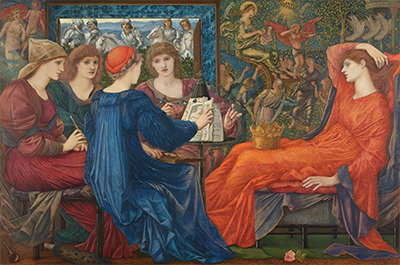
An open music book divides Edward Burne-Jones’s Laus Veneris almost in two. Four attendants gather to its left. On the right, a queen in an orange gown reclines with her crown resting on the folds of her skirt. Beyond them, armoured riders pass a window of startling blue. The title means “In Praise of Venus”, and the room offers plenty of evidence of her power. The woman it honours, however, seems too weary to take much pleasure in the ceremony. [1]
Burne-Jones painted the large oil for William Graham. It measures about 122 by 183 centimetres and belongs to the Laing Art Gallery in Newcastle upon Tyne, which acquired it in 1972. The signature on the painted stringed instrument carries the dates 1873–75, the range used in the Laing’s collection guide. Burne-Jones began work in 1873, devoted two months to the picture in 1874, returned to it in 1875 and finished it in 1878, shortly before its public debut at London’s Grosvenor Gallery. The fuller range, 1873–78, accounts for that last stage. [2]
At a Glance
- ArtistEdward Burne-Jones
- Date1873–78
- MediumOil on canvas
- SubjectThe Tannhäuser legend
This work across Edward Burne-Jones’s career
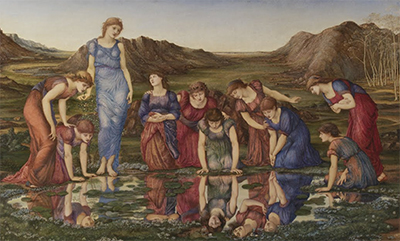
The Mirror of Venus
1870sThe Wheel of Fortune
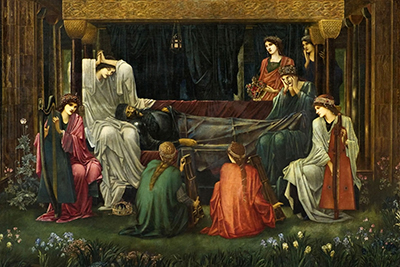
1875–83The Last Sleep of Arthur in Avalon
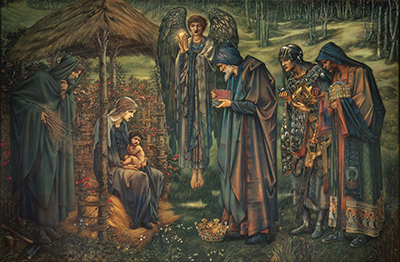
1880s–1898The Star of Bethlehem
Signed 1890Contents
- A song held in suspense
- The riders and the story of Tannhäuser
- Swinburne, Morris and the early watercolour
- The painting inside the painting
- At the Grosvenor Gallery
- Annotated details
A song held in suspense
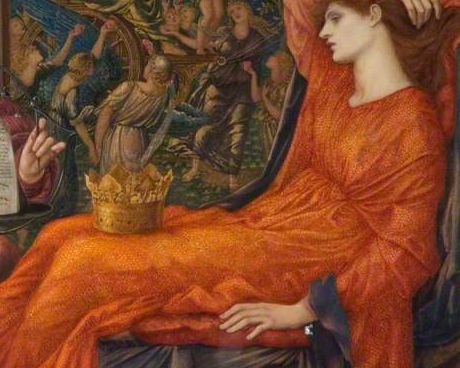
One of the queen’s hands lies open on the edge of the couch and her other arm curves above her head. The open palm and the crown on her lap do much to convey the exhaustion in her elongated pose. The colour of the gown makes her the most conspicuous person in the room, while her eyes are lowered and her body slopes away from the bustle of the group. The discarded rose on the floor introduces a small note of neglect. The Laing identifies it as an emblem of love. Its bent stem and the slumped dress above it give that familiar emblem a particular force here. [1]
Across from the queen, the woman in blue turns a page. Her back forms a broad expanse of colour, with a small red cap at the top and a long train spreading into the foreground. To her left, a woman holds a slender instrument. Farther right, an attendant raises a finger beside the book. The women’s gazes travel in different directions and their hands converge on the score. The posthumous New Gallery catalogue describes the four women as preparing to sing, while the Laing label describes them as playing music. The painting can sustain either impression. The gesture of the page-turner fixes a moment when a phrase might have just ended or be about to begin. [3]
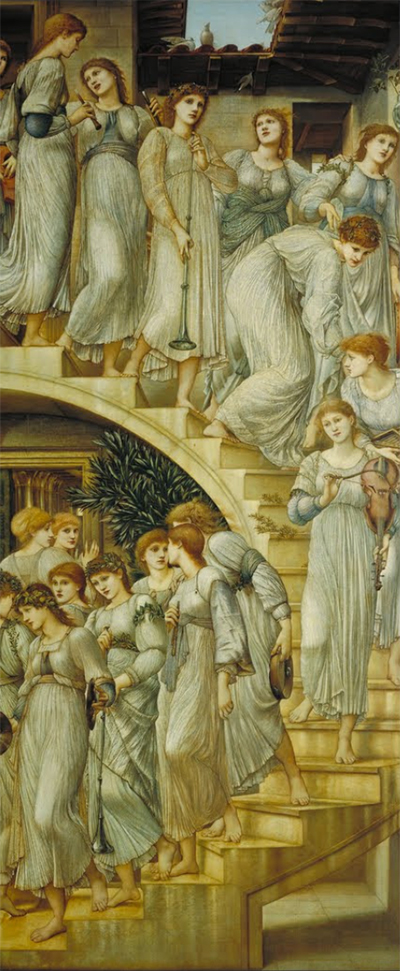
The lettering makes the song visible in another sense. The music historian Suzanne Fagence Cooper identifies the title in black and red on the illuminated pages and draws attention to the visible notation. The painted book shares the painting’s name. It gives the word “praise” a place in the room and gives each small gesture around it a purpose. The outer figures lean in, while the queen’s long diagonal takes the eye away again. Burne-Jones later used a different kind of musical rhythm in The Golden Stairs, where figures and instruments descend through the full height of the canvas. Here the activity of making music is concentrated around a single page. There is room for a whole performance in the viewer’s imagination, though all the painter supplies are a few poised hands, a shared score and the people gathered around it. [4]
Look closely at the orange fabric and its regular pattern of small marks. As John Christian explains in the Metropolitan Museum’s exhibition catalogue, Burne-Jones used a circular punch on the underpainting before glazing the dress with colour. The painted textile is therefore patterned both by the representation of cloth and by a physical treatment of the paint surface. The effect holds the figure close to the dense tapestry behind her, even though the brilliant colour sets her apart. Blue ties the other plane of the picture together. It is deep in the attendant’s robe and in the tiles framing the window, then turns abruptly pale in the open air beyond. [2]
The riders and the story of Tannhäuser
The painting belongs to the afterlife of a German legend. The knight Tannhäuser enters the Venusberg, the enchanted domain of Venus, and becomes her lover. In a common version, he leaves to seek absolution in Rome. The pope declares that he will receive forgiveness when the papal staff blossoms. Tannhäuser goes back to Venus in despair. The staff does flower, but the knight has already disappeared. The story allows both the attractions of the Venusberg and the refusal of mercy outside it to have consequences. [5]
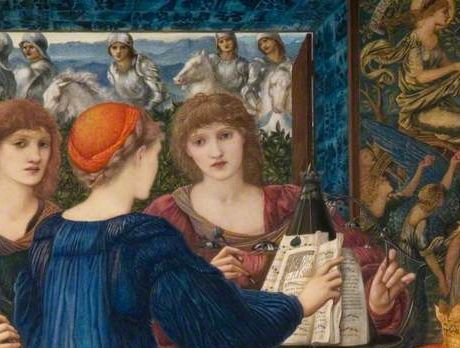
The Laing reads the central rider as the knight leaving to seek forgiveness. The New Gallery’s retrospective catalogue calls the five riders knights passing by, and Ernest Chesneau, writing in French in the 1880s, imagined them saluting the women. Looking through the window, it is easy to see why the details invite different readings. A raised lance and the shoulders and heads of horses suggest movement across the narrow opening. Some of the riders seem to look in. Seen from far back, the opening itself resembles another framed picture hanging flush with the wall. The armoured men could already be moving out of reach or could have just caught sight of the women on the other side. [6]
Wagner’s Tannhäuser, first performed in Dresden in 1845, made the legend newly prominent. Its Paris performances in 1861 provoked fierce controversy, and Charles Baudelaire published a defence. Christian traces how the opera and the arguments around it formed part of the artistic world shared by Burne-Jones and Algernon Charles Swinburne. The opera has its own plot, with a singing contest and Elisabeth’s intercession. The painting keeps its attention on the court of Venus and the men glimpsed through the window. The kinship with Wagner lies in a shared story and atmosphere, while the evidence of a direct borrowing for the painted scene remains uncertain. [7] [2]
Annotated Details from Laus Veneris
The numbered points identify visible features discussed in this article. Return from each detail to the numbered overview. Edward Burne-Jones, Laus Veneris. Laing Art Gallery, TWCMS B8145. Image source. Public domain.
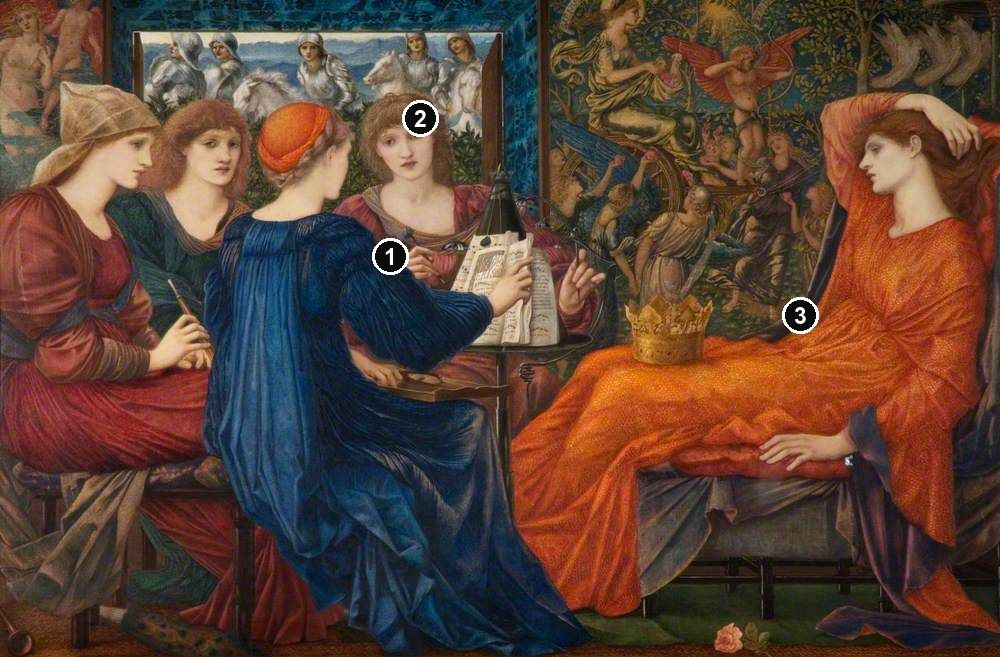
Details from LAUS VENERIS
Compare the cropped details with the source images above. Notice how their colours, shapes and positions contribute to the larger compositions.
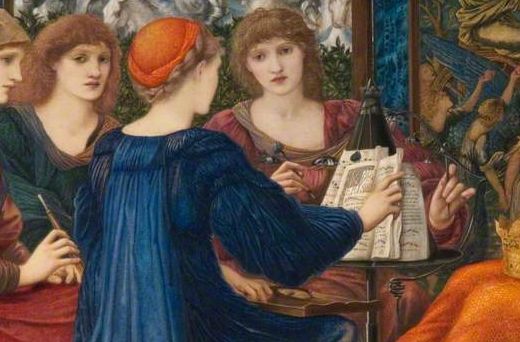
Faces beside the book
The attendants gather near the open pages. Their faces sit close together, even where their eyes are turned in different directions.
The window and distant riders
The opening over the group contains a separate scene. Heads and horses appear much smaller than the figures crowded against the near wall.
Venus against the hanging
The orange robe keeps the reclining figure legible in front of the dense hanging. The ornamental figures behind her have their own smaller scale.
Swinburne, Morris and the early watercolour
Swinburne’s Laus Veneris appeared separately in 1866 and in Poems and Ballads, which he dedicated to Burne-Jones. Swinburne gives the story to the knight to tell. The opening places him close enough to Venus to notice the purple mark on her neck as she sleeps. He recalls his own struggle to leave and repeatedly turns from the delights of her home to images of suffering and judgement. Heat, flowers and the sound of lyres fill the chambers. The vivid orange and red of the oil evoke a comparable warmth, but the choice of viewpoint changes the story. In the painting, the person whose account we hear in the poem is reduced to a possible face at the window. The queen and her company occupy most of the canvas. [8]
The surviving watercolour usually dated 1861 complicates any straightforward account of one work illustrating the other. In it, Burne-Jones had already arranged the main elements of the later oil, including the reclining woman and her attendants. A cat curled beneath the couch in the watercolour disappears in the oil. The British Library dates two surviving draft lines to around 1862, although William Bell Scott remembered Swinburne reciting the work close to Christmas 1861. They were working on the subject in close proximity. The later canvas and the published poem share enough details to reward comparison, even as the chronology of their first ideas remains open. [9] [2]
A pencil study of Fanny Cornforth lying back in a chair can be matched to the early watercolour. The drawing was once thought to be by Dante Gabriel Rossetti, for whom Cornforth also posed. The verso has studies related to another Burne-Jones watercolour, Clerk Saunders. The early association belongs to that particular drawing and watercolour. Two drawings for the later oil give a different glimpse of the painter’s process. A study of the leftmost attendant has been identified as Frances Graham, the patron’s daughter. A separate head study connected with the second woman from the left shows a more alert gaze than the finished figure, whose face turns a little further away. The two sheets help explain how distinct observations of sitters could be subdued into the common mood of the painted room. [10] [11] [12]
William Morris also retold the legend, as “The Hill of Venus” in The Earthly Paradise. Burne-Jones designed about twenty illustrations in 1866 for a projected edition. In The Court of Venus, a drawing now at The Huntington, the goddess stands by a fountain in an open courtyard, attended by women tending her and playing instruments. The contrast with the crowded oil recalls how selectively Burne-Jones used the legend. He could make the same court a place of open air and ceremonial activity. In Laus Veneris he makes it almost impossible to picture anyone crossing the room or stepping out of the frame. [13] [2]
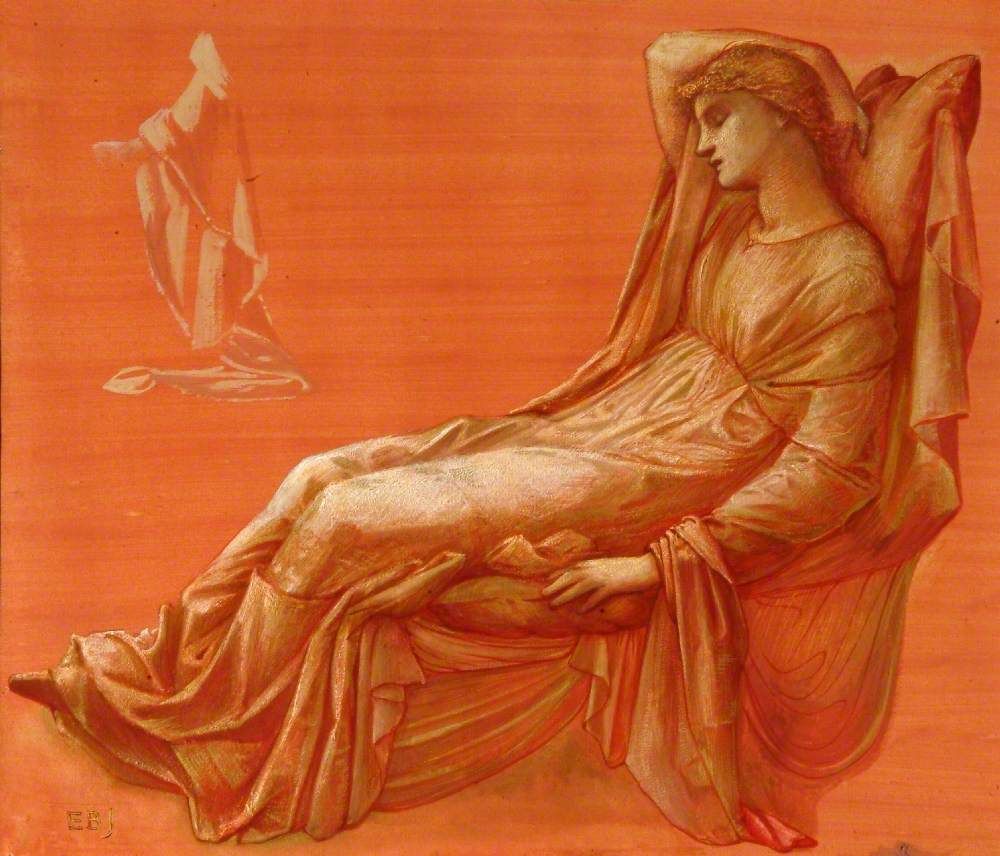
Edward Burne-Jones, study associated with Laus Veneris. Watts Gallery, COMWG 560. Image source. Public domain.
The painting inside the painting
Behind the queen, a winged Cupid draws his bow, beside the chariot of Venus. The Laing reads the tapestry as the goddess’s triumph, with Cupid shooting towards the figures around her. The triumph and the recline occupy nearly the same part of the canvas. In one scene the goddess advances with an entourage and commands the action. In the other, the tired woman lies almost motionless beneath her own story. The golds and blues of the hanging make it easy at first to read as an extravagant backdrop. Once Cupid and the chariot come into focus, it becomes a second account of what life in the Venusberg might mean. [1]
The motif began independently as an 1861 design for tiles. The Fitzwilliam Museum relates drawings for The Passing of Venus to the early tile scheme, this oil’s background and subsequent versions. In 1898 Burne-Jones returned to the procession in a study for an actual tapestry, which he was still developing when he died. In that design, now at the Met, Cupid precedes the chariot and takes aim at the figures before him. John Henry Dearle went on to develop the textile design. The surviving weaving at the Detroit Institute of Arts shows what became of the procession when it left the wall inside the painting and became a woven object in its own right. [14] [15] [16]
The crowded room has a literary ancestry of its own. Art historian Vanja Strukelj compares the women gathered around the queen and the densely decorated walls with a woodcut of a queen’s court in the Renaissance dream romance Hypnerotomachia Poliphili. She also relates the scenes on the hanging to the triumphal processions in that book. The comparison helps explain how the painted room can feel at once medieval and classical. Armour, court dress and an illuminated score belong beside a goddess arriving in a chariot, within a single Victorian invention. [17]
At the Grosvenor Gallery
Henry Blackburn’s illustrated guide puts Laus Veneris at the north end of the East Gallery in 1878, as number 106. It was the central picture among ten Burne-Jones works there, and Blackburn singled out the effect of its brilliant colour against the gallery’s olive-green wall. Graham had thought of it as a companion to Le Chant d’Amour, the large oil now known as The Love Song at the Met. Both paintings were shown in 1878 and both enlarge earlier watercolours Graham owned. An unfinished third oil, Blind Love, had been intended to hang between them. The two completed paintings share music, intimate groups and a broad horizontal format. The warmer, more crowded court of Venus gives a markedly different effect from the dusky light and quieter exchange of The Love Song. [18] [2]
The divided reception of the oil suggests how closely Victorian viewers connected colour and posture with character. Writing for the Athenaeum, F. G. Stephens reported the attraction the picture exerted on visitors and admired the way it rewarded close inspection. Frederick Wedmore, writing in Temple Bar, read the queen’s pallor and weariness as signs of disquieting ill health. Reviewing the exhibition for The Nation, Henry James wryly distinguished the queen’s worldly air from the comparatively innocent, listless look of her companions. Swinburne’s collection had already provoked a public outcry and was withdrawn by its first publisher. For readers familiar with the poem, the painting’s title could carry that history into the gallery before they had identified a single figure. [2] [19]
The painting remained in private collections for almost a century after its debut. Agnew’s bought it at the 1886 Graham sale, where it fetched 2,550 guineas. Sir William Agnew lent it to the New Gallery’s memorial exhibition in 1898–99. It later passed through the collection of Huntington Hartford before the Laing acquired it in 1972 with assistance from several organisations, including the National Art Collections Fund and the Friends of the Laing Art Gallery. [1] [2] [3]
Writing in Art History, David Peters Corbett argues that Burne-Jones’s pictures of the 1870s put what an image can show into tension with what words can tell us, even as they rely on words. Laus Veneris makes that tension tangible. The title links the oil to Swinburne, and the same words appear in the book, ready to be sung. Yet neither set of words determines whether the queen is stricken with regret, lost in thought or simply tired. The window affords a glimpse of another world. The music book, crown and rose keep drawing the eye back to the waiting figures inside. [20]
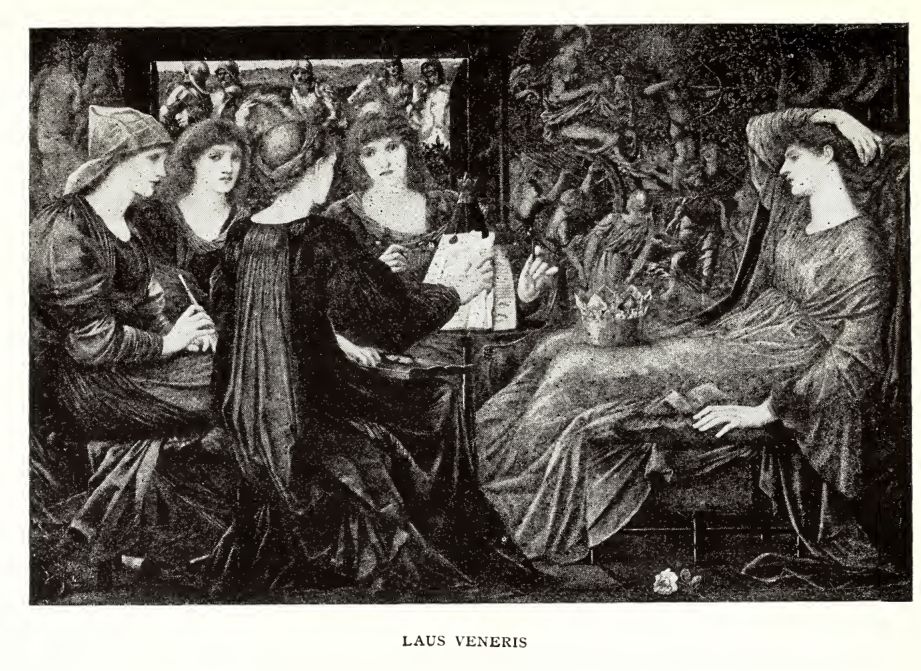
Laus Veneris, early monochrome reproduction after Edward Burne-Jones. Plate facing page 108 in Fortunée de Lisle’s Burne-Jones, from the Berlin Photographic Company. Image source. Public domain. Printed plate isolated from the surrounding page and set upright.
Edward Burne-Jones on film
Explore Burne-Jones’s paintings, illustrated stories and stained-glass designs.
Edward Burne-Jones: Pre-Raphaelite Visionary | Exhibitions | Showcase
A look at Burne-Jones’s paintings and the Tate retrospective.
Watch on YouTubeArtworks directory
This directory records paintings, studies, designs and collaborative works, with separate entries for documented versions and series where known.
| Name | Date | Medium |
|---|---|---|
| Sidonia von Bork 1560 | 1860 | Watercolour and bodycolour |
| Clara von Bork 1560 | 1860 | Watercolour and bodycolour |
| The Merciful Knight | 1863 | Watercolour |
| Sibylla Delphica | c. 1886 | Oil on panel |
| Phyllis and Demophoön | 1870 | Watercolour and bodycolour |
| The Legend of the Briar Rose (Buscot series) | 1870s–1890 | Oils on canvas |
| The Briar Wood (Buscot series) | By 1890 | Oil on canvas |
| The Council Chamber (Buscot series) | By 1890 | Oil on canvas |
| The Garden Court (Buscot series) | By 1890 | Oil on canvas |
| The Rose Bower (Buscot series) | By 1890 | Oil on canvas |
| Group of Women, study for The Golden Stairs | 1872 | Drawing |
| The Beguiling of Merlin | 1870s | Oil on canvas |
| The Perseus Cycle | From 1875 | Paintings and full-scale designs |
| The Call of Perseus (Stuttgart) | From 1875 | Oil painting |
| Perseus and the Graeae (Stuttgart) | From 1875 | Oil painting |
| The Rock of Doom (Stuttgart) | 1884–88 | Oil on canvas |
| The Doom Fulfilled (Stuttgart) | 1888 | Oil on canvas |
| The Baleful Head (Stuttgart) | 1885–87 | Oil on canvas |
| The Baleful Head (Southampton design) | 1880s | Bodycolour |
| The Rock of Doom (Southampton design) | 1880s | Bodycolour |
| The Doom Fulfilled (Southampton design) | 1880s | Bodycolour |
| The Mirror of Venus (Gulbenkian) | 1870s | Oil on canvas |
| Drawing associated with The Mirror of Venus | 1870s | Drawing |
| Laus Veneris (Laing) | 1873–78 | Oil on canvas |
| The Days of Creation | 1870s | Watercolour and bodycolour |
| The Golden Stairs | 1880 | Oil on canvas |
| An Angel Playing a Flageolet | 1878 | Watercolour, bodycolour and gold |
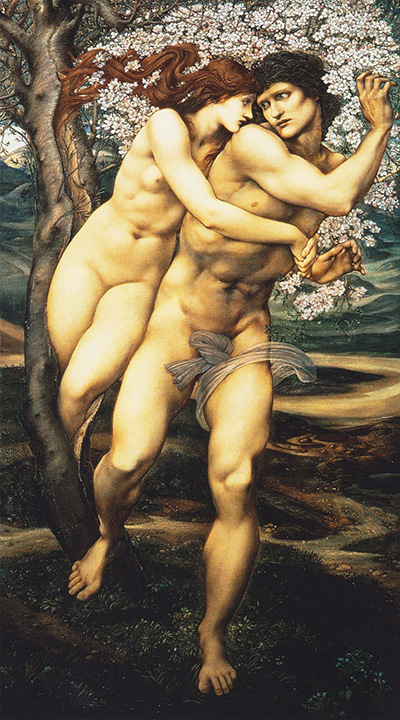
| The Tree of Forgiveness | 1881–82 | Oil on canvas |
| The Wheel of Fortune (Orsay) | 1875–83 | Oil on canvas |
| King Cophetua and the Beggar Maid | 1884 | Oil on canvas |
| The Depths of the Sea (oil) | 1886 | Oil |
| The Morning of the Resurrection | 1886 | Oil on panel |
| Study for the Head of Mary Magdalene | c. 1882 | Oil study |
| The Sleep of King Arthur in Avalon | 1880s–1898 | Oil on canvas |
| The Sleep of King Arthur in Avalon (modello) | ca. 1881 | Oil on canvas (modello) |
| The Star of Bethlehem | Signed 1890 | Watercolour and bodycolour |
| Study for The Star of Bethlehem | About 1887–91 | Drawing |
| Sponsa de Libano | 1891 | Watercolour and bodycolour |
| The Summons (Holy Grail tapestries) | 1890s | Tapestry |
| The Failure of Sir Gawaine (Holy Grail tapestries) | 1890s | Tapestry |
| Hope (Boston) | 1896 | Oil on canvas |
| La Belle au bois dormant (theatre programme) | 1894 | Collotype |
| The Wedding of Psyche | 1895 | Oil on canvas |
| The Works of Geoffrey Chaucer (Kelmscott edition) | 1896 | Illustrated book |
| The Ascension (Birmingham Cathedral) | 1885 | Stained glass |
| The Last Judgement (Birmingham Cathedral) | 1897 | Stained glass |
| Adoration of the Magi (Huntington) | 1890s | Tapestry |
| Love among the Ruins (Wightwick) | 1894 | Oil on canvas |
| The Merciful Knight (photogravure after Burne-Jones) | 1900 | Photogravure |
| The Garden Court (preparatory work) | 1870–75 | Graphite and watercolour with white gouache |
| Study of a Female Figure | 1885 | Graphite drawing |
| Psyche Throwing Herself into the River | 1865–68 | Wood engraving |
| Beauty | 1887–89 | Colour lithograph |
| Study for the Failure of Gawain | 1893 | Crayon and graphite on Japanese paper |
| The Prince Enters the Briar Wood (after Burne-Jones) | After 1890 | Photogravure |
| The Rose Bower (after Burne-Jones) | 1892 | Photogravure |
| Adoration of the Magi (Musée d’Orsay) | 1904 | Tapestry |
| Answers to Prayer (Lyndhurst) | 1860s | Stained glass |
| The Depths of the Sea (photogravure after Burne-Jones) | 1900 | Photogravure |
| Perseus and Andromeda (Adelaide composite) | 1876 | Oil on canvas |
| The Adoration of the Magi (Hamburg) | Woven 1900 | Tapestry |
| Love leading the Pilgrim through the Briars | 1874–76 | Embroidery |
| Musica (worked by Lady Jane Cory) | 1906 | Embroidery |
| Pomona (worked by Lady Jane Cory) | 1907 | Embroidery |
| Flora (worked by Lady Jane Cory) | 1909 | Embroidery |
| The Fourth Day of Creation (photogravure after Burne-Jones) | 1900 | Photogravure |
| The Morning of the Resurrection (photogravure after Burne-Jones) | 1900 | Photogravure |
| Musical angels of the St Catherine window (Christ Church) | Designed 1877 | Stained glass |
Discussion
Look again at the images and ideas explored in Laus Veneris. These editorial prompts invite your observations.
Reader Insights
What does the distant view of the knights contribute to the enclosed space?
How does the open book affect your reading of a painting concerned with sound and desire?
Join the Conversation
Share a detail, comparison or question about Laus Veneris below.
References
- Laing Art Gallery, Paintings from the Collection, March 2019 display guide, p. 5, Laus Veneris. View source.
- John Christian, Metropolitan Museum of Art, Edward Burne-Jones: Victorian Artist-Dreamer, 1998, cat. 63, pp. 166–69. View source.
- New Gallery, London, Exhibition of the Works of Sir Edward Burne-Jones, 1898–99, p. 59, cat. 96. View source.
- Suzanne Fagence Cooper, Picturing Music in Victorian England, 2005, vol. 1, ch. 5, “The Tannhäuser Motif in Aesthetic Art and Writing”, pp. 187–94. View source.
- Norbert H. J. Voorwinden, “Tannhäuser”, Van Aiol tot de Zwaanridder, Dutch Digital Library, account of the Venusberg legend and its variants. View source.
- Ernest Chesneau, Artistes anglais contemporains, 1887 edition, p. 15, description of Laus Veneris. View source.
- Bayreuth Festival, Tannhäuser, premiere date and synopsis, acts I–III. View source.
- Algernon Charles Swinburne, “Laus Veneris”, Representative Poetry Online, University of Toronto Libraries, poem and source notes. View source.
- British Library, Ashley MS A1851, f. 10a, Laus Veneris. View source.
- The Maas Gallery, Fanny Cornforth: a study for “Laus Veneris”, drawing record and catalogue note. View source.
- The Maas Gallery, Study for “Laus Veneris”, 2010 catalogue, no. 33, reproduced by the Victorian Web. View source.
- William Waters, Burne-Jones Catalogue Raisonné, Head Study for the Female Figure, Second from the Left, in Laus Veneris, expertise note. View source.
- The Huntington, The Court of Venus, c. 1866, accession 2000.5.1550.32. View source.
- Fitzwilliam Museum, Study for a Girl Seen from Behind, accession 2015.2, related designs for The Passing of Venus. View source.
- Metropolitan Museum of Art, The Passing of Venus, 1898, collection record 340951. View source.
- Detroit Institute of Arts, Passing of Venus, collection record 35754, design and weaving credits. View source.
- Vanja Strukelj, “Nel segno di Polifilo”, Parole Rubate, no. 2, 2010, pp. 63–65, figs. 11–13. View source.
- Henry Blackburn, Grosvenor Notes, 1878, East Gallery, p. 35, no. 106. View source.
- Tate Britain, Edward Burne-Jones exhibition large print guide, 2018, p. 80, Laus Veneris. View source.
- David Peters Corbett, “Visuality and Unmediation in Burne-Jones’s Laus Veneris”, Art History 24, no. 1, 2001, pp. 83–102, abstract. View source.