 by Tom Gurney
Tom Gurney BSc (Hons) is an art history expert with over 20 years experience
Published on June 19, 2020 / Updated on November 25, 2026
Email: tomgurney1@gmail.com / Phone: +44 7429 011000
The Wedding of Psyche: Introduction
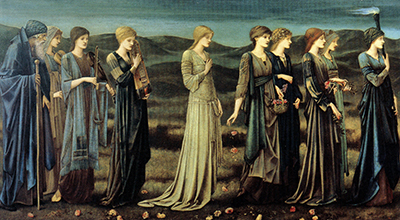
A torch burns at the head of the procession in Edward Burne-Jones’s The Wedding of Psyche. Behind it, attendants scatter flowers across the path and carry musical instruments. Near the middle, the bride walks with her head lowered. Her father, bent over a staff at the far left, brings up the rear. All the ceremony of a wedding is here, but the company is taking Psyche to a mountain where she expects to be given to a monster. [1] [2]
The Royal Museums of Fine Arts of Belgium in Brussels hold the oil on canvas as inventory 7350. The museum dates it to 1895, the year inscribed alongside Burne-Jones’s monogram at the lower left, and gives its dimensions as 119.5 × 215.5 cm. Its French title is Le cortège nuptial de Psyché and its Dutch title is De bruidsstoet van Psyche. Both correspond closely to The Wedding Procession of Psyche, the title used by the Burne-Jones catalogue raisonné. A London exhibition catalogue called it The Marriage of Psyche, and the Belgian museums’ acquisition bulletin gives the original English title as Psyche’s Wedding. The title The Wedding Procession of Psyche identifies the action that occupies almost every inch of the canvas. [1] [2] [3] [4] [5]
At a Glance
- ArtistEdward Burne-Jones
- Date1895
- MediumOil on canvas
- SubjectPsyche’s procession
This work across Edward Burne-Jones’s career
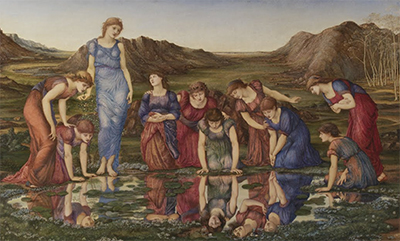
The Mirror of Venus
1870sThe Wheel of Fortune
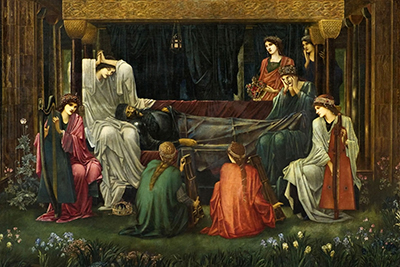
1875–83The Last Sleep of Arthur in Avalon
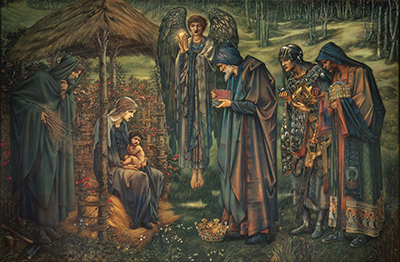
1880s–1898The Star of Bethlehem
Signed 1890Contents
- Why Psyche’s wedding is also a funeral
- How Burne-Jones slows the procession
- From two book designs to a dining-room frieze
- The late painting and the three trumpeters
- The procession and The Mirror of Venus
- Exhibitions and the Brussels acquisition
- Annotated details
Why Psyche’s wedding is also a funeral
In Apuleius’s Metamorphoses, or The Golden Ass, Psyche is a king’s daughter whose beauty draws the worship owed to Venus. Although people come to see her, nobody comes to marry her. Her father consults Apollo’s oracle and learns that he must put his daughter, dressed for marriage, on a high rock. The prophecy describes a terrifying bridegroom. As the family prepares to obey, the wedding music turns into lamentation and Psyche uses her bridal veil to wipe her tears. When her parents hesitate, she reproaches them for mourning too late and urges them to go on. Apuleius describes the procession as a living funeral. At the summit the mourners leave their wedding torches behind, extinguished by their tears. Zephyrus, the west wind, carries the abandoned princess down to a flowering valley. [6]
William Morris retold the story in verse for The Earthly Paradise, where it is the classical tale for May. His princess travels in a golden litter before descending and walking the last stretch among her maids, her head bowed. The streets are silent as the procession leaves town because the inhabitants are afraid of its music. On the mountain the flutes stop, and the king embraces his daughter before going home in the twilight. In Morris’s account, Cupid himself arranges for Zephyrus to lift the sleeping Psyche from the hill. The canvas holds back that rescue. Its dark landscape and single burning torch keep the scene within the interval when Psyche and her companions still believe the oracle’s threat. [7]
The story eventually gives Psyche a second wedding. She discovers that her hidden husband is Cupid and loses him after looking at him by lamplight. After a series of ordeals set by Venus, they are reunited. In Apuleius, Jupiter grants Psyche immortality and the gods attend the wedding feast. The title of Burne-Jones’s painting can therefore evoke two quite different occasions. The bowed bride, her mortal father and the exposed hillside place this picture early in the story, when the family still thinks it is escorting her to her death. [6] [7] [8]
The later wedding is central to the fresco cycle designed by Raphael for the Villa Farnesina in Rome, where the divine assembly and the marriage occupy two large panels painted to look like hanging tapestries. The great painted ceiling gives the story the destination that the Brussels canvas withholds. Burne-Jones gives the width of his picture to the earlier journey and makes the mortal bride, already dressed for a ceremony she fears, the figure we watch. [9]
How Burne-Jones slows the procession
The line of figures is easiest to follow from the old king at the far left. His head and shoulders bend over the straight staff, setting up a rhythm of leaning bodies and upright objects. Most of the heads sit at roughly the same height, but small changes of angle break the repetition. The king inclines forward, one musician concentrates on her instrument and Psyche looks down. The princess has a narrow interval of open ground on either side of her. Her pale dress falls in long folds that spread behind her along the path, making her passage visible in the hem as well as in the tilt of her head. A gap that might be unremarkable in a crowd becomes conspicuous in so tightly spaced a line. [1] [10]
At the right, scattered blossoms make small, irregular marks across the ground beneath the long, straight folds. The attendant at the front holds the tall torch close against her body. Its faint trail of smoke runs sidewards into the sky, following the long axis of the canvas. Beyond the procession the low ridges overlap in blues and greens almost as subdued as the clothes. The landscape gives the restrained movements of the hands an unusual prominence. It is possible to follow the dispersal of the flowers from the attendants’ fingers to the path, or to follow the music through a sequence of listening faces, bent wrists and instruments. The quietness here is an effect of the painting’s pace and colour, even though the story gives us every reason to imagine a sound. [1] [10]
Writing in the Brussels museums’ bulletin, Robert Hoozee connected the repeated vertical folds and closely aligned heads to Burne-Jones’s experience as a designer, including his work on stained glass. His point helps explain how a group in motion can look like a frieze. The folds hold one figure apart from the next, as if each woman has a narrow place of her own. The gaps, overlapping silhouettes and small turns of the heads keep pulling the eye along the band. Psyche’s isolation is especially apparent because the others have tasks. They scatter flowers, play music or bear the torch. Her sole part in the ceremony is to walk. The pictorial order makes it painfully easy to see how well everyone else knows what to do. [10]
Annotated Details from The Wedding of Psyche
The numbered points identify visible features discussed in this article. Return from each detail to the numbered overview. Edward Burne-Jones, The Wedding of Psyche. Royal Museums of Fine Arts of Belgium. Image source. Public domain.
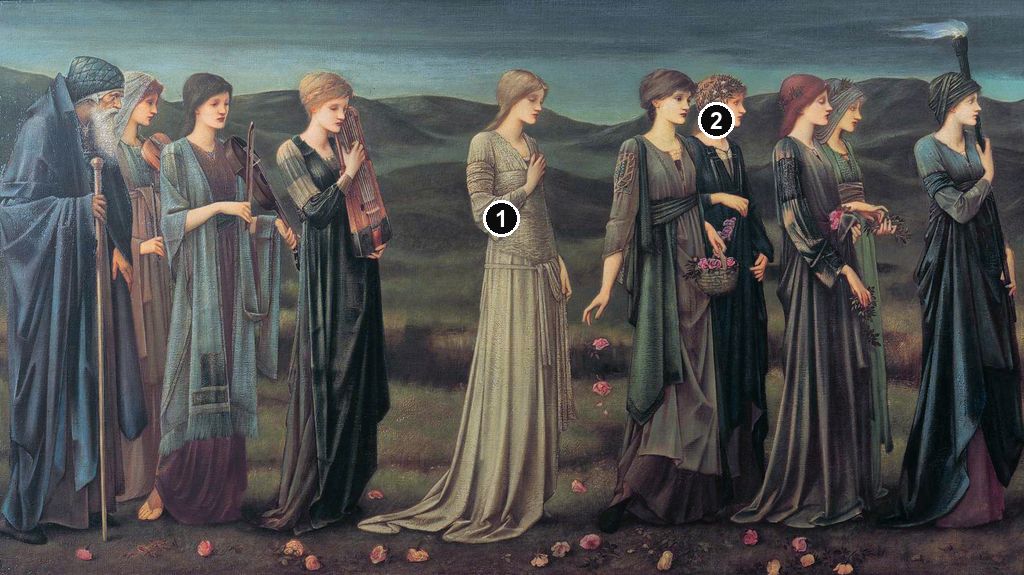
Details from THE WEDDING OF PSYCHE
Compare the cropped details with the source images above. Notice how their colours, shapes and positions contribute to the larger compositions.
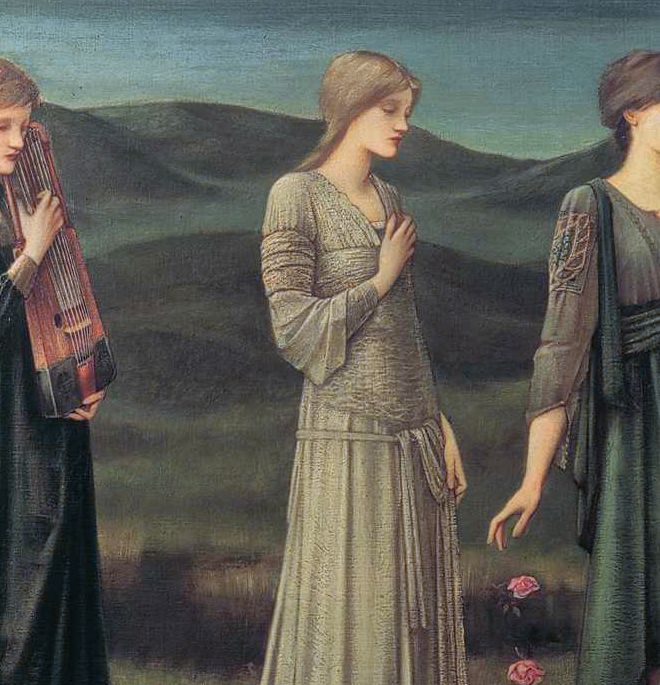
The solitary drift of Psyche
The pale dress stands apart among darker dresses. The tilt of the head and the weight of the drapery bring a brief pause into the procession.
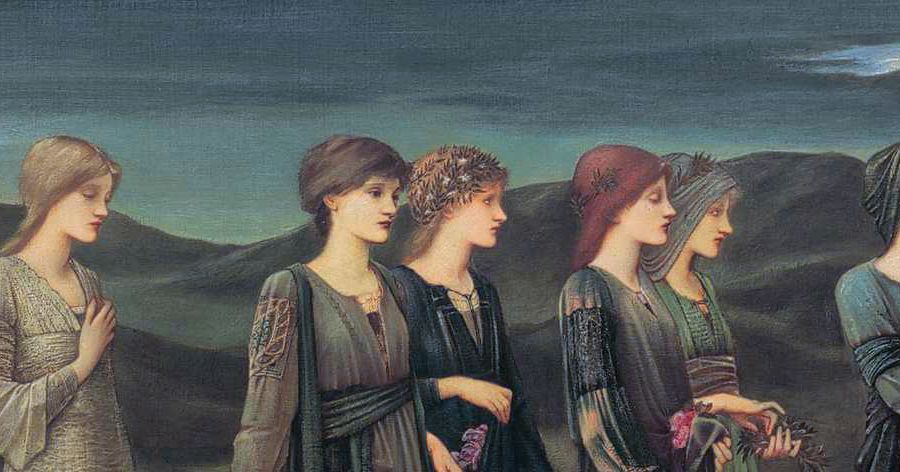
Horizon and gathering figures
The cool ridges of the distant land pass behind the thicker, more vertical shapes of the foreground figures.
From two book designs to a dining-room frieze
Burne-Jones began designing illustrations for Morris’s projected edition of The Earthly Paradise in the 1860s. Two drawings in John Ruskin’s teaching collection at the Ashmolean show how the procession was divided for the proposed book. One includes the king, Psyche with a spray of leaves, and the musicians and flower bearers. Its companion shows the head of the procession, with torchbearers and women blowing curved trumpets. The Huntington owns a related ink and graphite design, dated about 1866, in which Psyche also stands apart at the centre and holds a branch. Those studies make it possible to see how much of the late painting was already present in the spacing of the figures and how much Burne-Jones changed when he gave Psyche a free hand and let the fall of her dress occupy the open space. [11] [12] [13]
Morris and others cut the designs into woodblocks. The William Morris Gallery holds an early proof of Procession to the Hill: The Trumpeters, made from Burne-Jones’s design. Trial typesettings failed to satisfy Morris and the illustrated project was abandoned in 1868, although the poem appeared in print and impressions of the engravings survived. The images had an afterlife as book illustrations too. In 1935 the Gregynog Press used new blocks derived from original Burne-Jones designs for Robert Bridges’s Eros and Psyche. In 1974 a Clover Hill edition printed the procession from the nineteenth-century blocks. Ruskin’s drawings, meanwhile, had gone to Oxford and could be studied for the clarity of their outlines. [11] [12] [14]
In the 1870s George Howard commissioned a painted cycle of the story for his dining room at 1 Palace Green, Kensington. The canvases ran above ornament in silver and gold, and extracts from Morris’s poem appeared below. Walter Crane took over much of the work and provided his own rendering of the procession. Burne-Jones retouched parts of the cycle around its completion in 1881. In the finished room scheme, now in Birmingham’s collection, Psyche’s party and the trumpeters share the second panel. The following panel shows Zephyrus bearing her away and continues the tale at Cupid’s house. For somebody following the frieze around the room, the episode at the mountain was one stage in a sequence with a rescue close at hand. [15]
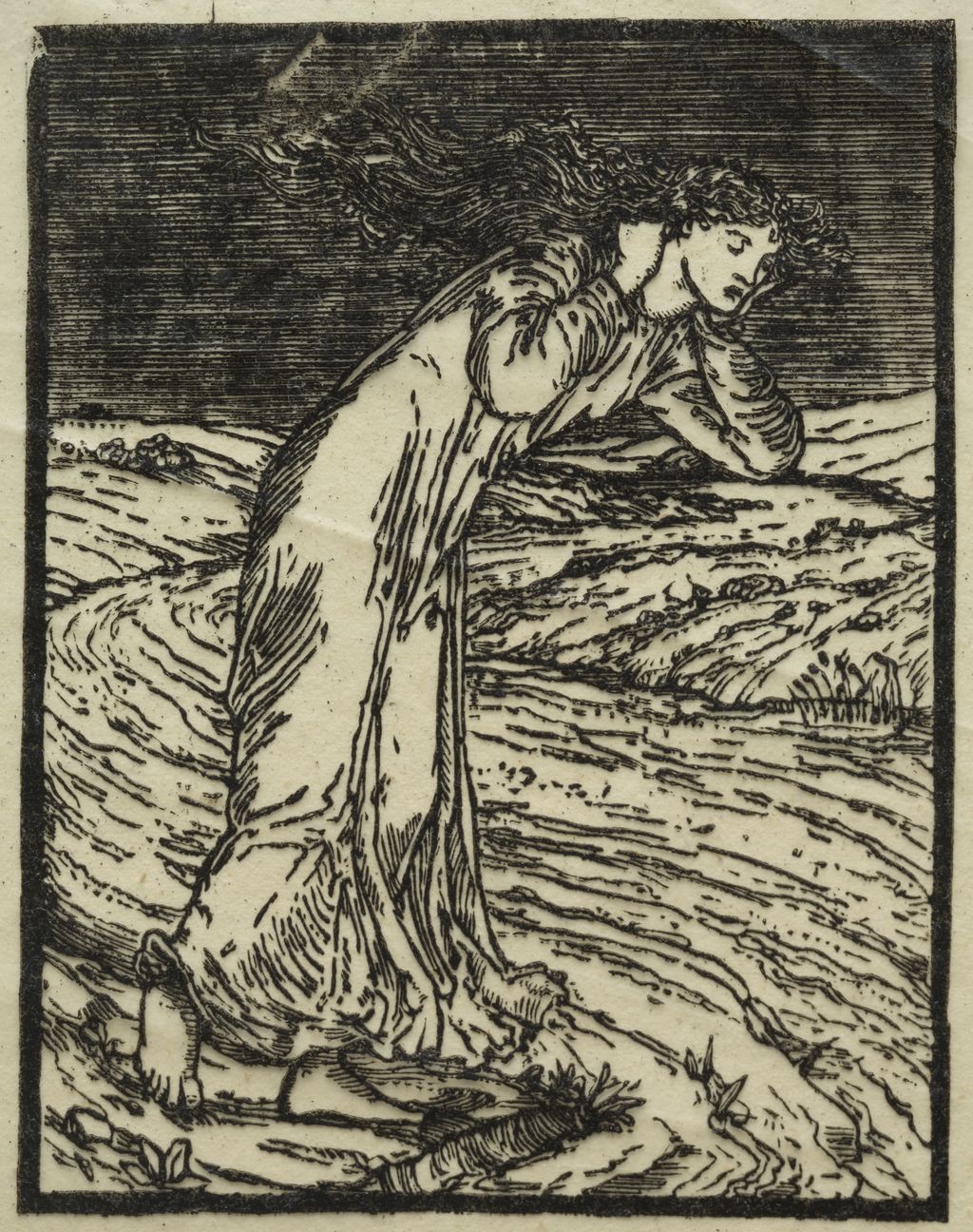
Psyche Throwing Herself into the River, a wood engraving from the Morris and Burne-Jones project. Cleveland Museum of Art, 1981.90. Image source. CC0 / Public domain.
The late painting and the three trumpeters
The Brussels canvas returns to the bride’s part of the procession. Burne-Jones keeps a torchbearer at the front while giving three trumpeters a composition of their own, The Challenge in the Wilderness. A studio photograph published in 1894 shows both canvases on easels at the Grange in Fulham. The Challenge remained unfinished at his death. Burne-Jones signed the Brussels painting in 1895, and it was exhibited that year in London. Another view of the project survives in a pencil study of Psyche and the musician immediately behind her, identified as a dulcimer player in the Christie’s catalogue. Christie’s suggested an early 1870s date for that sheet on stylistic grounds. The 1894 photograph provides a firmer date for work on the independent canvases. [2] [10] [16]
The two oils share a design history, but their dimensions, settings and colour differ. Hoozee drew attention to the more mauve colouring of The Challenge and the way the landscapes fail to continue into each other. The split matters for the Brussels composition. The cap of smoke ends the line of figures without revealing what lies ahead of them. The procession seems destined to run on beyond the frame, while Psyche’s route and the expected monster remain beyond our view. That uncertainty gives a different weight to the flowers and the music. They are the preparations of a group doing all it can for a bride whose destination it fears. [1] [10]
The procession and The Mirror of Venus
Twenty years earlier Burne-Jones arranged another band of long-robed women across a low landscape in The Mirror of Venus, now in the Museu Calouste Gulbenkian. The two paintings share a connection with The Earthly Paradise. The Lisbon composition derives from a design for The Hill of Venus, the tale of Tannhäuser. Its still pool gathers the women’s attention into the foreground and doubles their faces in reflection. Psyche’s painting directs the eye laterally, past flowers and instruments and up to the torch. The standing Venus presides over her group, while Psyche takes the same direction as her attendants, with clear ground around her. The similarity of the figures and landscape makes it easier to see how the two arrangements direct our attention. One asks us to pause over the reflected faces, while the other invites us to accompany a bride until she passes out of sight. [1] [17]
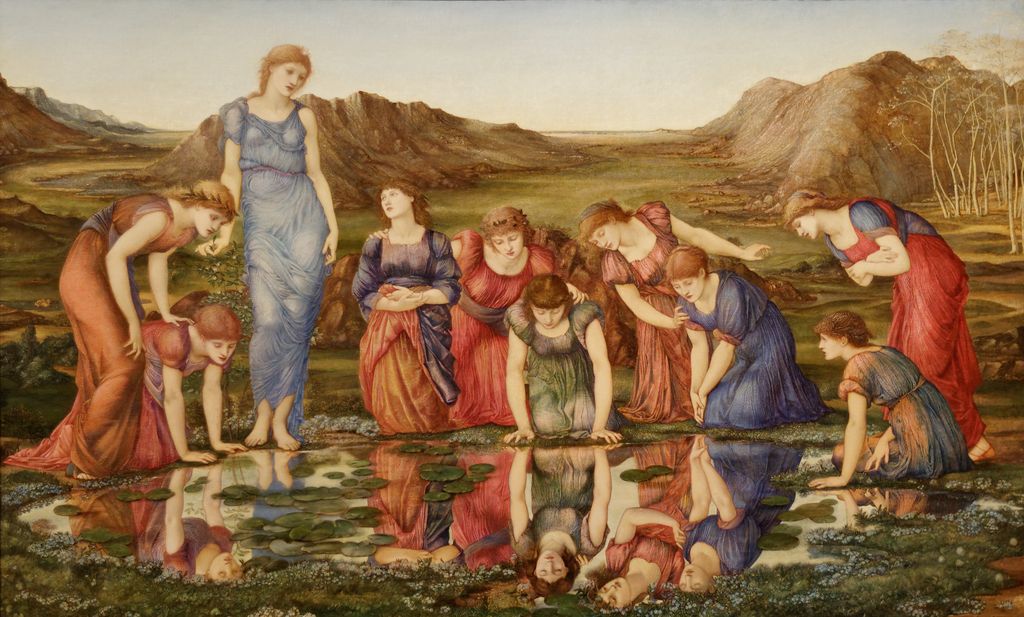
Edward Burne-Jones, The Mirror of Venus. Calouste Gulbenkian Museum. Image source. Public domain.
Exhibitions and the Brussels acquisition
The painting was no. 163 at the New Gallery in 1895 and returned as no. 133 in the 1898–99 memorial exhibition. The later catalogue lists Arthur Tooth and Sons as the lender. The firm also published Félix Jasinski’s engraving after the painting in 1900. That engraving reproduced a finished oil, whereas the woodblocks cut for Morris belonged to the earlier design of a book. The Royal Museums acquired the painting from the collection of Huntington Hartford at Sotheby’s in London on 23 March 1966, as lot 89. The painting later appeared as catalogue number 41 in the Edward Burne-Jones: Victorian Artist-Dreamer exhibition, which travelled from New York to Birmingham and Paris in 1998–99. As a single picture in a gallery, it makes an episode drawn for a book and once carried around the walls of a room stand on its own. [1] [2] [4] [5] [10]
Edward Burne-Jones on film
Explore Burne-Jones’s paintings, illustrated stories and stained-glass designs.
Edward Burne-Jones: Pre-Raphaelite Visionary | Exhibitions | Showcase
A look at Burne-Jones’s paintings and the Tate retrospective.
Watch on YouTubeArtworks directory
This directory records paintings, studies, designs and collaborative works, with separate entries for documented versions and series where known.
| Name | Date | Medium |
|---|---|---|
| Sidonia von Bork 1560 | 1860 | Watercolour and bodycolour |
| Clara von Bork 1560 | 1860 | Watercolour and bodycolour |
| The Merciful Knight | 1863 | Watercolour |
| Sibylla Delphica | c. 1886 | Oil on panel |
| Phyllis and Demophoön | 1870 | Watercolour and bodycolour |
| The Legend of the Briar Rose (Buscot series) | 1870s–1890 | Oils on canvas |
| The Briar Wood (Buscot series) | By 1890 | Oil on canvas |
| The Council Chamber (Buscot series) | By 1890 | Oil on canvas |
| The Garden Court (Buscot series) | By 1890 | Oil on canvas |
| The Rose Bower (Buscot series) | By 1890 | Oil on canvas |
| Group of Women, study for The Golden Stairs | 1872 | Drawing |
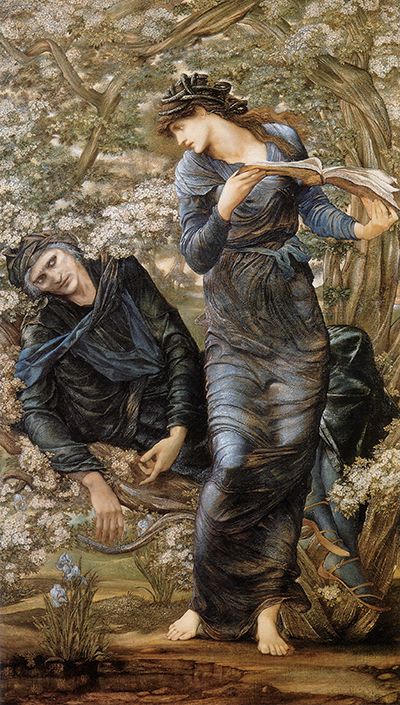
| The Beguiling of Merlin | 1870s | Oil on canvas |
| The Perseus Cycle | From 1875 | Paintings and full-scale designs |
| The Call of Perseus (Stuttgart) | From 1875 | Oil painting |
| Perseus and the Graeae (Stuttgart) | From 1875 | Oil painting |
| The Rock of Doom (Stuttgart) | 1884–88 | Oil on canvas |
| The Doom Fulfilled (Stuttgart) | 1888 | Oil on canvas |
| The Baleful Head (Stuttgart) | 1885–87 | Oil on canvas |
| The Baleful Head (Southampton design) | 1880s | Bodycolour |
| The Rock of Doom (Southampton design) | 1880s | Bodycolour |
| The Doom Fulfilled (Southampton design) | 1880s | Bodycolour |
| The Mirror of Venus (Gulbenkian) | 1870s | Oil on canvas |
| Drawing associated with The Mirror of Venus | 1870s | Drawing |
| Laus Veneris (Laing) | 1873–78 | Oil on canvas |
| The Days of Creation | 1870s | Watercolour and bodycolour |
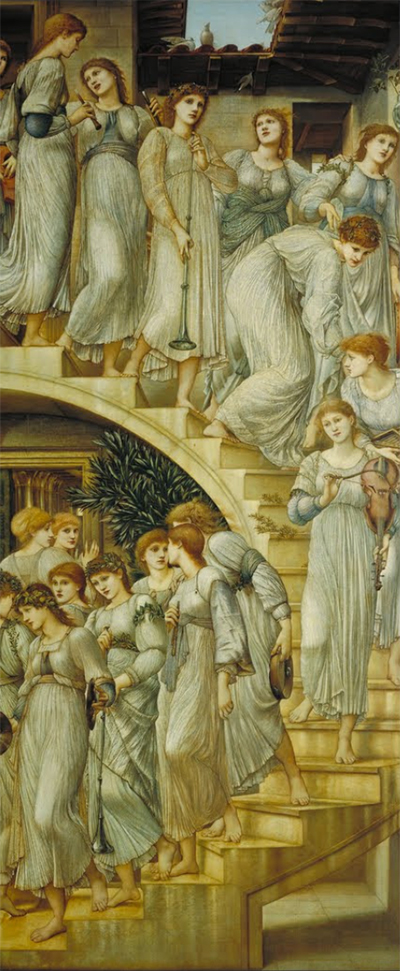
| The Golden Stairs | 1880 | Oil on canvas |
| An Angel Playing a Flageolet | 1878 | Watercolour, bodycolour and gold |
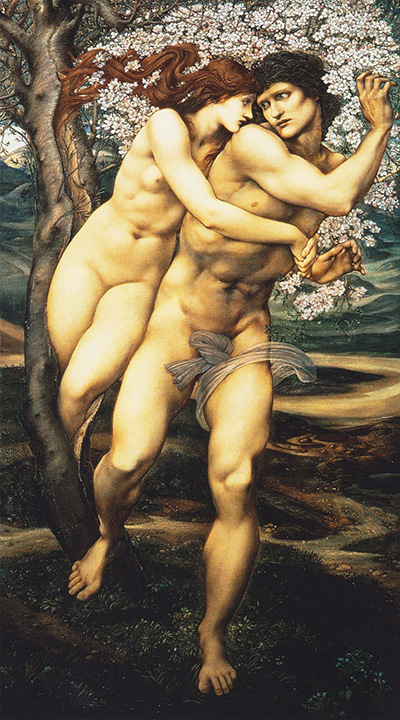
| The Tree of Forgiveness | 1881–82 | Oil on canvas |
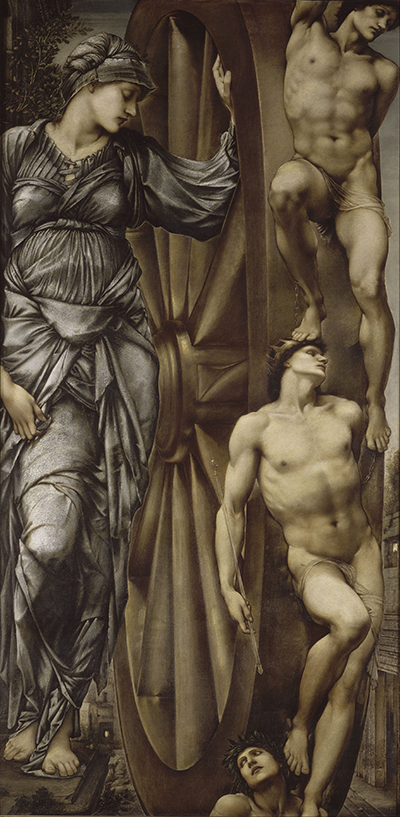
| The Wheel of Fortune (Orsay) | 1875–83 | Oil on canvas |
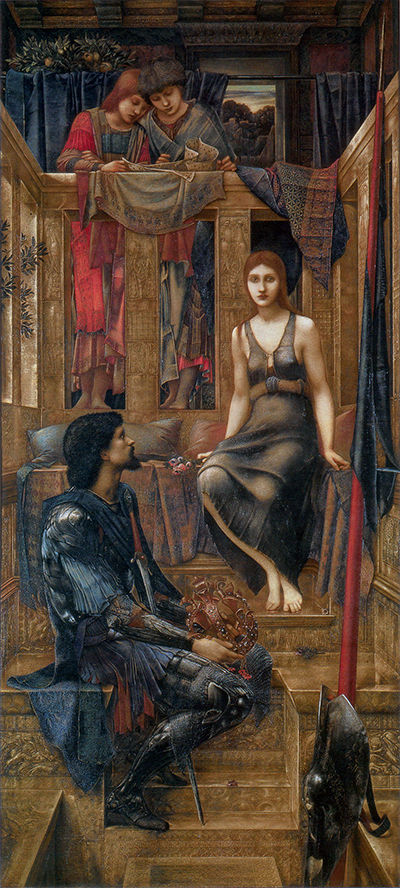
| King Cophetua and the Beggar Maid | 1884 | Oil on canvas |
| The Depths of the Sea (oil) | 1886 | Oil |
| The Morning of the Resurrection | 1886 | Oil on panel |
| Study for the Head of Mary Magdalene | c. 1882 | Oil study |
| The Sleep of King Arthur in Avalon | 1880s–1898 | Oil on canvas |
| The Sleep of King Arthur in Avalon (modello) | ca. 1881 | Oil on canvas (modello) |
| The Star of Bethlehem | Signed 1890 | Watercolour and bodycolour |
| Study for The Star of Bethlehem | About 1887–91 | Drawing |
| Sponsa de Libano | 1891 | Watercolour and bodycolour |
| The Summons (Holy Grail tapestries) | 1890s | Tapestry |
| The Failure of Sir Gawaine (Holy Grail tapestries) | 1890s | Tapestry |
| Hope (Boston) | 1896 | Oil on canvas |
| La Belle au bois dormant (theatre programme) | 1894 | Collotype |
| The Wedding of Psyche | 1895 | Oil on canvas |
| The Works of Geoffrey Chaucer (Kelmscott edition) | 1896 | Illustrated book |
| The Ascension (Birmingham Cathedral) | 1885 | Stained glass |
| The Last Judgement (Birmingham Cathedral) | 1897 | Stained glass |
| Adoration of the Magi (Huntington) | 1890s | Tapestry |
| Love among the Ruins (Wightwick) | 1894 | Oil on canvas |
| The Merciful Knight (photogravure after Burne-Jones) | 1900 | Photogravure |
| The Garden Court (preparatory work) | 1870–75 | Graphite and watercolour with white gouache |
| Study of a Female Figure | 1885 | Graphite drawing |
| Psyche Throwing Herself into the River | 1865–68 | Wood engraving |
| Beauty | 1887–89 | Colour lithograph |
| Study for the Failure of Gawain | 1893 | Crayon and graphite on Japanese paper |
| The Prince Enters the Briar Wood (after Burne-Jones) | After 1890 | Photogravure |
| The Rose Bower (after Burne-Jones) | 1892 | Photogravure |
| Adoration of the Magi (Musée d’Orsay) | 1904 | Tapestry |
| Answers to Prayer (Lyndhurst) | 1860s | Stained glass |
| The Depths of the Sea (photogravure after Burne-Jones) | 1900 | Photogravure |
| Perseus and Andromeda (Adelaide composite) | 1876 | Oil on canvas |
| The Adoration of the Magi (Hamburg) | Woven 1900 | Tapestry |
| Love leading the Pilgrim through the Briars | 1874–76 | Embroidery |
| Musica (worked by Lady Jane Cory) | 1906 | Embroidery |
| Pomona (worked by Lady Jane Cory) | 1907 | Embroidery |
| Flora (worked by Lady Jane Cory) | 1909 | Embroidery |
| The Fourth Day of Creation (photogravure after Burne-Jones) | 1900 | Photogravure |
| The Morning of the Resurrection (photogravure after Burne-Jones) | 1900 | Photogravure |
| Musical angels of the St Catherine window (Christ Church) | Designed 1877 | Stained glass |
Discussion
Look again at the images and ideas explored in The Wedding of Psyche. These editorial prompts invite your observations.
Reader Insights
Where does Psyche’s position first separate her from the rest of the procession?
How does the distant landscape change the pace of the procession?
Join the Conversation
Share a detail, comparison or question about The Wedding of Psyche below.
References
- Royal Museums of Fine Arts of Belgium, Le cortège nuptial de Psyché, inventory 7350, French collection record and photograph. View source.
- Burne-Jones Catalogue Raisonné, The Wedding Procession of Psyche, object, expertise and exhibition records. View source.
- Royal Museums of Fine Arts of Belgium, De bruidsstoet van Psyche, inventory 7350, Dutch collection record. View source.
- New Gallery, Exhibition of the Works of Sir Edward Burne-Jones, 1898–99, no. 133, The Marriage of Psyche. View source.
- Royal Museums of Fine Arts of Belgium, acquisition bulletin, 1966, no. 3, p. 217, English title and Huntington Hartford provenance. View source.
- Apuleius, Metamorphoses, Book IV, chapters 28–35, Latin text. View source.
- William Morris, The Story of Cupid and Psyche, in The Earthly Paradise, edited by Florence S. Boos, pp. 386–461, especially lines 238–247. View source.
- Apuleius, Metamorphoses, Book V, chapters 21–24, and Book VI, chapters 21–24, Latin text. View source.
- Villa Farnesina, La Loggia di Amore e Psiche, Italian site record, central marriage and divine assembly scenes. View source.
- Robert Hoozee, Sir Edward Burne-Jones en “The Earthly Paradise” van William Morris, Royal Museums of Fine Arts of Belgium bulletin, 1973, pp. 147–163, especially pp. 159–163. View source.
- Ashmolean Museum, The Procession to the Hill (left half), John Ruskin’s Teaching Collection, curator’s description. View source.
- Ashmolean Museum, The Procession to the Hill (right half), John Ruskin’s Teaching Collection, curator’s description. View source.
- The Huntington, The Procession to the Hill: Psyche and the King, accession 2000.5.1550.35. View source.
- William Morris Gallery, Procession to the Hill: The Trumpeters, catalogue K714a. View source.
- Stephen Wildman, The series: The Story of Cupid and Psyche (12 works, Cupid and Psyche frieze) for 1 Palace Green, Burne-Jones Catalogue Raisonné, panel listing and commission history. View source.
- Christie’s, Edward Burne-Jones, The Wedding of Psyche, pencil study of Psyche and a musician, lot essay. View source.
- Museu Calouste Gulbenkian, The Mirror of Venus, inventory 273, collection record. View source.