 by Tom Gurney
Tom Gurney BSc (Hons) is an art history expert with over 20 years experience
Published on June 19, 2020 / Updated on November 25, 2026
Email: tomgurney1@gmail.com / Phone: +44 7429 011000
The Beguiling of Merlin by Edward Burne-Jones: Introduction
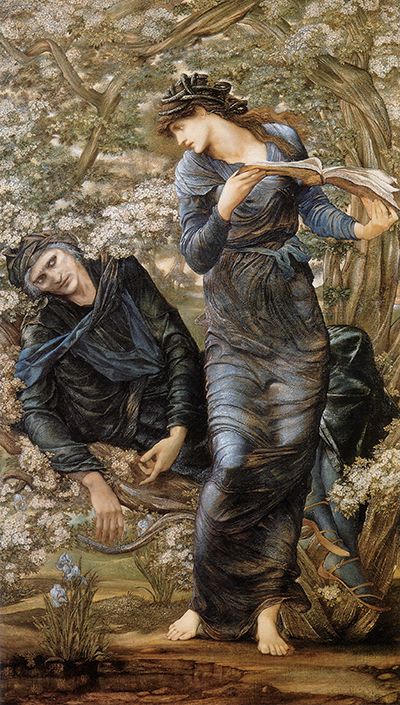
Nimue lifts an open book and looks back over her shoulder. Merlin, seated low among the branches, raises his eyes to meet hers. The sleeves of his dark robe hang down, and white hawthorn flowers press in around his face. It takes a moment to see where his body ends and the tree begins. In Edward Burne-Jones’s The Beguiling of Merlin, the great magician of Arthurian legend is falling under a spell learned from him by the woman who now holds the book. The oil painting, dated 1873–77 by National Museums Liverpool, belongs to the Lady Lever Art Gallery at Port Sunlight. It measures 186.7 by 110.5 centimetres. [1]
At a Glance
- ArtistEdward Burne-Jones
- Date1870s
- MediumOil on canvas
- SubjectMerlin and Vivien
This work across Edward Burne-Jones’s career
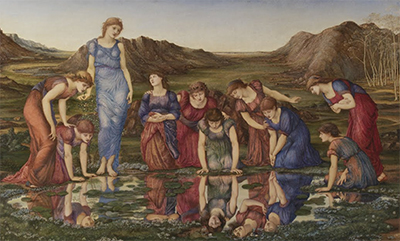
The Mirror of Venus
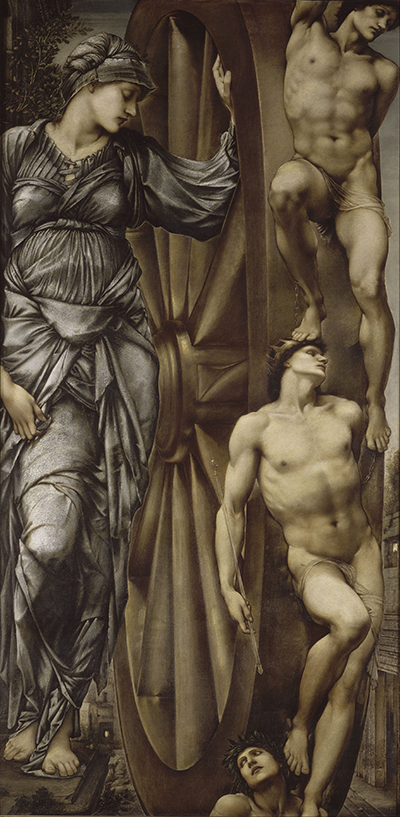
1870sThe Wheel of Fortune
1875–83The Last Sleep of Arthur in Avalon
1880s–1898The Star of Bethlehem
Signed 1890Contents
- The book, the branches and the two figures
- A prison made of air
- The watercolour of 1861
- Leyland’s commission and the second canvas
- The models and the studies
- London, Paris and the Lady Lever Art Gallery
- Annotated details
The book, the branches and the two figures
Start with the book. Nimue keeps both hands on it as she turns her head towards Merlin. There is a space between the faces, but her gaze crosses it. The book occupies the other side of her body, so that she seems to be moving away from Merlin at the same time as she watches him. In the New Gallery’s 1898–99 retrospective catalogue, the description of the painting picks out precisely these actions. She holds the pages open and turns towards the seated figure, who looks up. A reader might expect the spell to require her attention to the page. Her eyes are already on its effect. [1] [2]
Look down from Merlin’s face to his hands. They hang loose, in marked contrast to the grip that keeps the book raised. His shoulders and crossed legs settle into the low bough, with patches of blue emerging among the flowers and the wood. Burne-Jones lets the eye find the parts of the body in stages. The lower stretch of Nimue’s robe takes a longer, more continuous path towards the ground. The fabric gathers close against her as the torso turns. At the other end of that figure, snakes weave into her hair. The curves that describe the clothed figure and the winding shape of the tree make the two belong to the same painting even as the characters have very different freedom to move. [1] [2]
The flowers are an obstacle to looking straight through the scene. They are painted in small clusters across much of the canvas, with little open sky or distant ground to relieve the pattern. Katherine Hinzman argues that their even detail disperses the viewer’s attention. An eye that sets out to follow one branch can be diverted to another patch of white, back to a hand or back to Merlin’s face. That is a consequence of the attention Burne-Jones gives to the plant. At close range the flowers retain their structure. From farther back they form an enclosure, extending almost to the edges of the picture. The spell has changed what a flowering bush can do without changing its appearance beyond recognition. [1] [3]
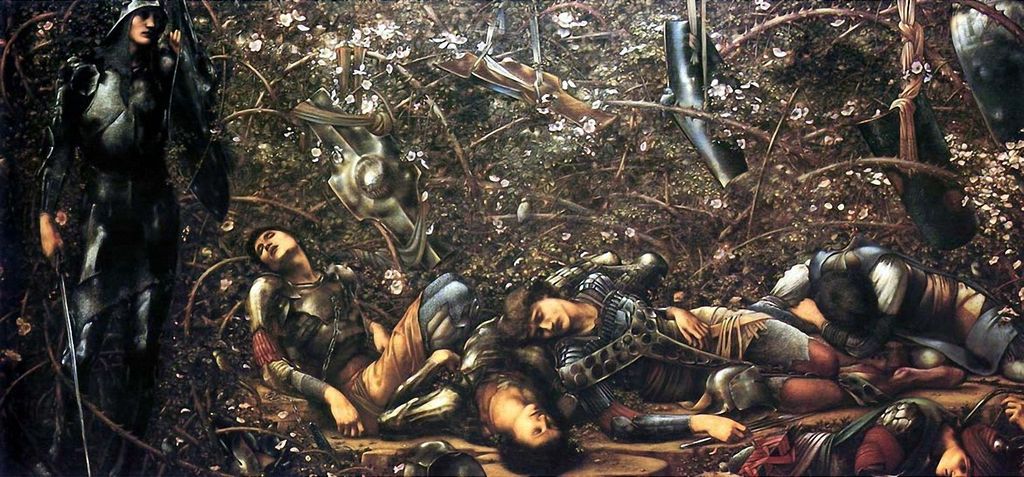
Edward Burne-Jones, The Briar Wood, from The Legend of the Briar Rose at Buscot Park. Image source. Public domain.
Annotated Details from The Beguiling of Merlin
The numbered points identify visible features discussed in this article. Return from each detail to the numbered overview. Edward Burne-Jones, The Beguiling of Merlin. Lady Lever Art Gallery. Image source. Public domain.
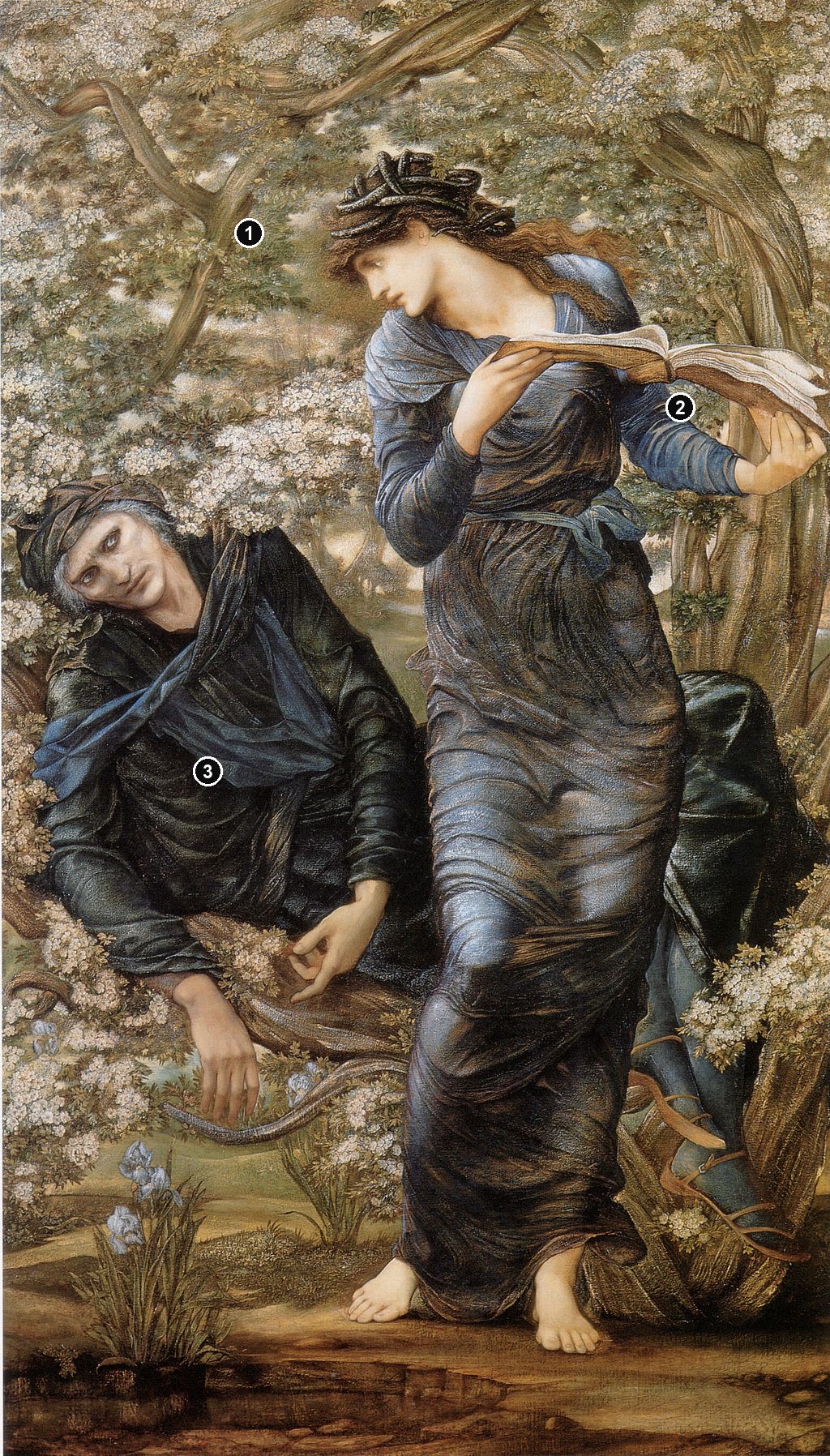
Details from THE BEGUILING OF MERLIN
Compare the cropped details with the source images above. Notice how their colours, shapes and positions contribute to the larger compositions.
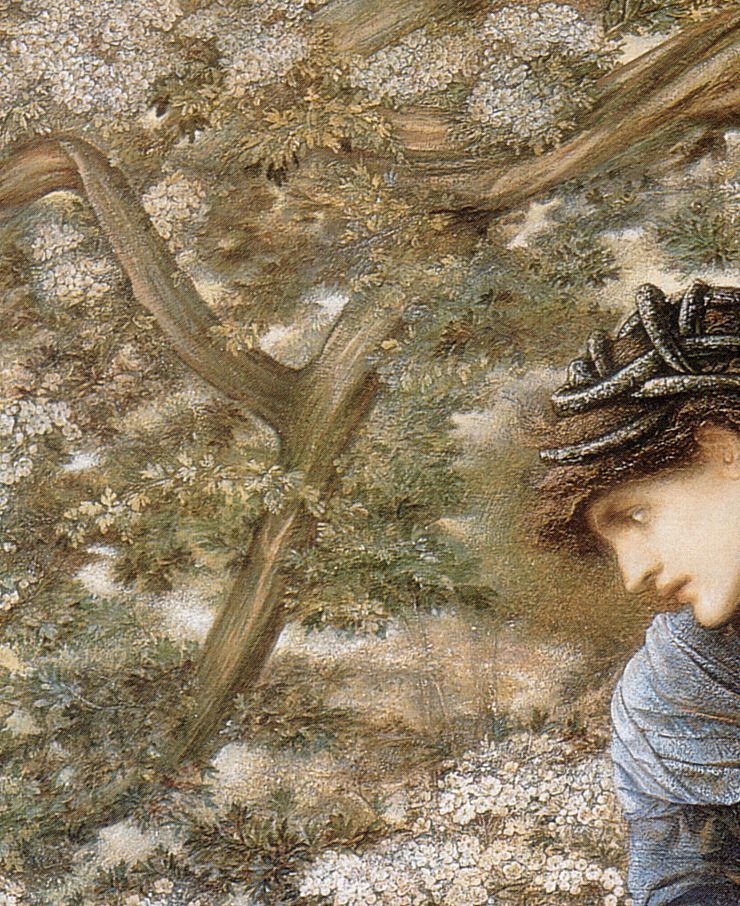
Branches across the picture
The hawthorn’s thin branches and clusters of flowers fill space that a more open landscape would leave empty.
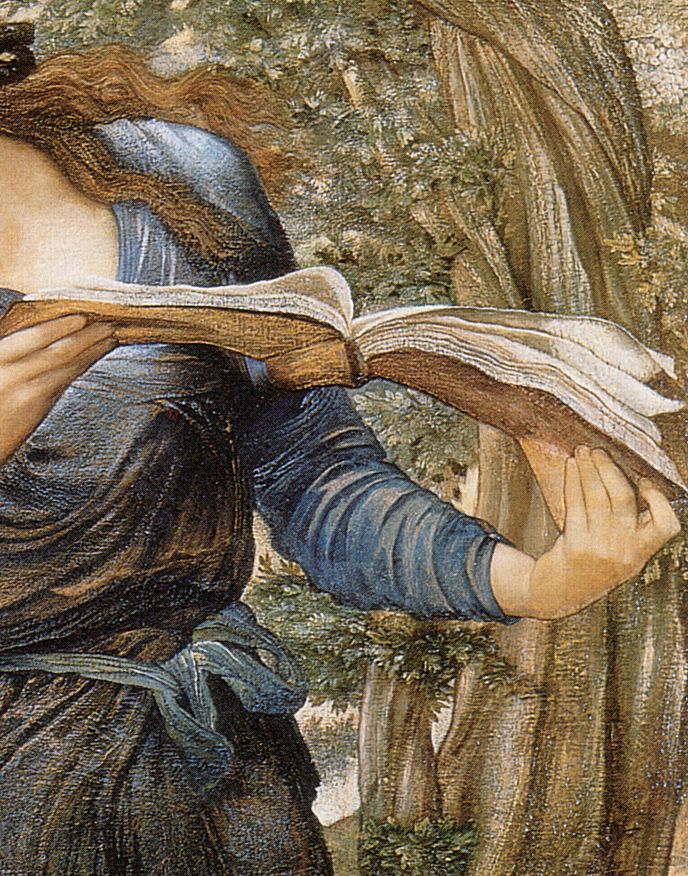
Vivien’s book
The open pages make a bright shape next to Vivien’s dress and give her gaze an object beyond the man beside her.
Merlin against the trunk
Merlin’s dark costume folds into the darker base of the tree. His lowered posture makes Vivien’s upright figure more conspicuous.
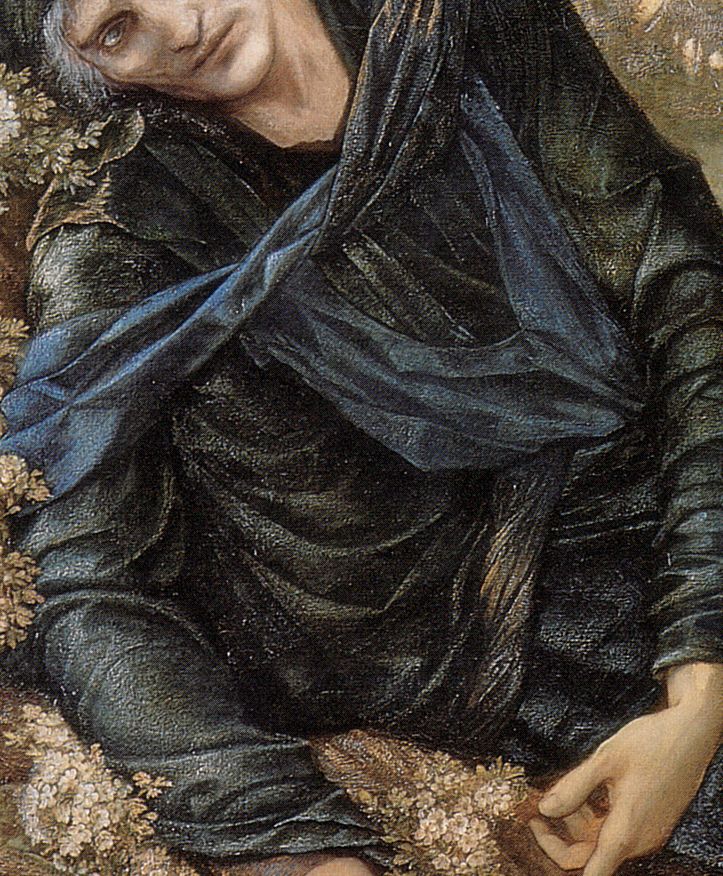
Looking closely at The Beguiling of Merlin
A close look at the painting in the Lady Lever Art Gallery.
Smarthistory. Beth Harris and Steven Zucker discuss the relationship between the two figures and the space around them. Watch on YouTube.
A prison made of air
At the Grosvenor Gallery in 1877, visitors could read a passage from a Romance of Merlin in the catalogue entry. Merlin and his companion stop in the shade of a flowering hawthorn in the forest of Brocéliande. After he falls asleep she works the enchantment nine times. When he opens his eyes, he believes he is in a tower. The account makes a point of what the tower is made of. Air, which in ordinary life offers no resistance at all, is enough to confine him permanently. The painting gives the viewer the hawthorn and the waking magician. The shape of a tower belongs to the experience described in the accompanying words. [4]
The medieval tale came down in different forms. The lines published in 1877 are close to the Middle English Prose Merlin printed by the Early English Text Society in the 1860s, a translation of a French Arthurian text. Toshiyuki Takamiya sets the exhibition passage against that edition. Both have the hawthorn, the sleep, the repeated enchantments and the tower. The Middle English text also has Nimue draw the circle with her wimple and put Merlin’s head back into her lap while he sleeps. The nineteenth-century catalogue gives a shortened version, and the exact route by which its wording reached Burne-Jones remains uncertain. It nevertheless gives stronger evidence for his choice of setting than the general resemblance to Victorian versions of the story. [4] [5]
Alfred Tennyson published his version as Vivien in 1859 and later called it Merlin and Vivien. His Vivien follows Merlin from Arthur’s court to Brocéliande and presses him to divulge a charm that can make another person seem imprisoned, cut off from everyone except the one who cast it. Merlin tells her about the old book in which the spell is written, in tiny ancient script hemmed in by dense marginal notes. He insists that she could scarcely read it. Only after a long exchange, and after Vivien throws herself against him for protection in a thunderstorm, does he tell her the charm. She uses it when he falls asleep, leaving him in the hollow oak. [6]
Readers of the poem had reason to recognise the forest, the transfer of knowledge and the undoing of a man long respected for his wisdom. They might also have recognised something of Tennyson’s description in the close-fitting dress and the hair twined with gold. Yet his Vivien gains the spell by persuading Merlin to tell her, and her performance at the end involves patterned steps and gestures. Burne-Jones makes the book conspicuous in her hands just when the spell is taking effect. The tree in the picture is clothed in white blossom. Bringing the two versions together lets the book carry, in a single visible object, a transaction that takes much of the poem to unfold. [1] [5] [6]
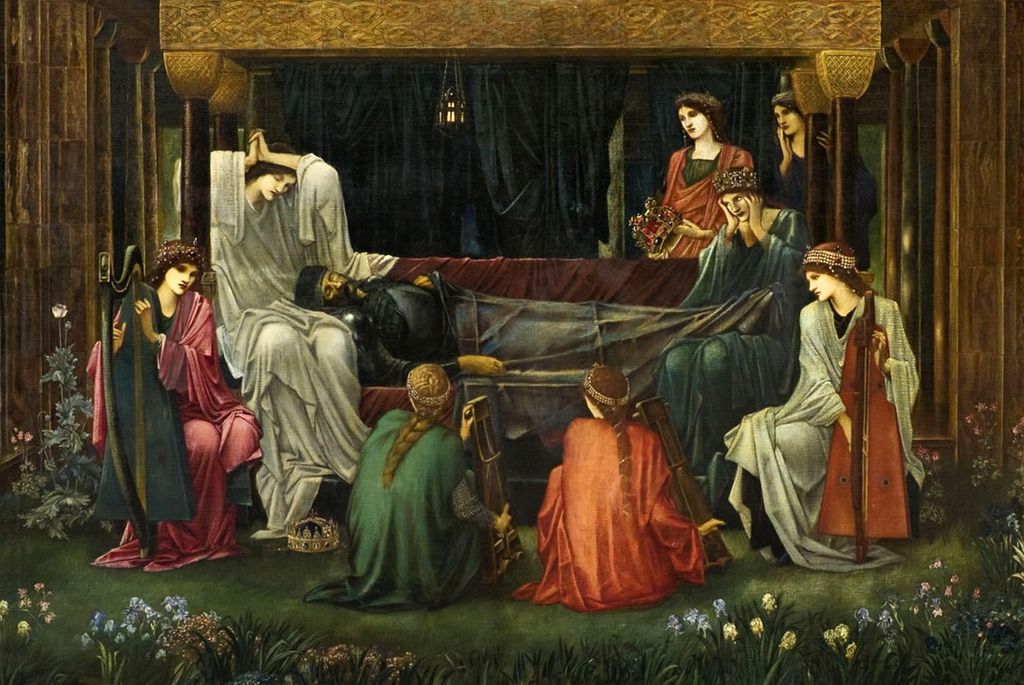
Detail of the figures around Arthur in The Sleep of King Arthur in Avalon. Museo de Arte de Ponce. Image source. Public domain.
The watercolour of 1861
Thomas Malory gave the enchantment a different ending in Le Morte Darthur. Merlin follows one of the ladies of the lake and teaches her many of his arts. She grows weary of him and fears him, and at a place where there is a great stone she contrives to trap him beneath it. Burne-Jones took up that ending in Merlin and Nimue, a watercolour and bodycolour of 1861 in the Victoria and Albert Museum. An inscription recorded from the back of the original frame identifies the heavy stone and the grave. In the earlier picture, too, Nimue holds a volume. The danger is signalled elsewhere, by the slabs of stone and by the small dog pulling at Merlin’s sleeve. As he is drawn towards the dark opening at the lower right, the dog’s tug gives the scene an urgency the man seems unable to muster. [7] [8] [9]
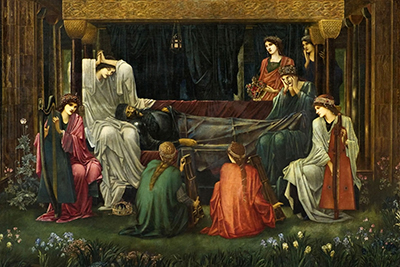
The later oil leaves the dog and the grave behind. Where the earlier work gives the figure a destination in the dark opening, the oil spreads the evidence of his captivity through the branches. The change also alters the spectator’s relation to the story. In the watercolour, the dog pulls against the direction in which the action is headed. In the oil, Merlin remains visible, his head still turned towards Nimue. Nothing fixes exactly how long that look can last. The legend became a means for Burne-Jones to give duration to an almost motionless scene, as he would do again on a very different scale in The Last Sleep of Arthur in Avalon. [1] [8]
Leyland’s commission and the second canvas
Frederick Richards Leyland, a Liverpool shipowner and collector, commissioned the oil. Burne-Jones’s work list records starting the large picture for him in 1872 and starting afresh in 1873. When the paint on the first canvas failed to adhere properly, Burne-Jones wrote to Leyland about the problem and offered to begin again. The early biographer Fortunée de Lisle dated intermittent work back to 1870. An inscribed study also bears that year, although the sale catalogue that reproduced it questioned whether it was dated accurately. The work list anchors the start of the first large oil to 1872. De Lisle also reported that the earlier version was on display at the artist’s former home, The Grange, and singled out the painting of the blossom there. The hawthorn survived the change of canvas. [4] [10] [11]
The oil carries an 1874 date in Roman numerals. There was further work after that date. The work list records substantial painting on the subject in 1875 and completion in 1877, the year it went to the Grosvenor. Tate’s 2018 exhibition guide gives the picture as 1873–74, ending with the signed year. The Lady Lever range, 1873–77, includes the work leading up to public exhibition. The commission, first attempt and inscription thus have their own places in the history of the picture. [1] [2] [4] [8]
The models and the studies
The Delaware Art Museum’s watercolour and gouache study for the head of Nimue dates from about 1872–73. The museum identifies the sitter as Maria Cassavetti Zambaco, a sculptor who had been romantically involved with Burne-Jones. The study gives the head its own scale and allows the viewer to look at the turn of the face without the interruption of the branches or the exchanged glances of the finished picture. A separate pencil study bears the inscription naming Nimue and the date 1870. Burne-Jones himself recalled, in a later letter, how much the painted figure’s way of standing and turning resembled Zambaco, and cast himself in the role of the magician becoming a hawthorn. His recollection makes the personal association explicit, while the many years between making and remembering the picture leave room for the story he was telling his correspondent. [4] [11] [12]
The choice of model for Merlin is less secure. Rossetti suggested the American journalist and artist William James Stillman. In the account Georgiana Burne-Jones gives in her Memorials, the painter hesitated to ask a man he barely knew to hold so awkward a position, and Stillman was willing to help. Scott Thomas Buckle compares the painted face with photographs of Stillman and proposes instead the professional model Alessandro di Marco. The difference between a report of sitting and an identification of the face as finally painted matters here. A painter can take a pose from one person and rework the features. Merlin’s clean-shaven face is one reason Buckle questions the identification. The identity of the final model remains open. [4] [13]
The drawings show just how much could be worked out part by part. A sheet in the Fitzwilliam Museum separates the cloth over Merlin’s crossed legs from the sandals. Where these features are hard to read among the flowers in the oil, the drawing gives them space. Another Fitzwilliam sheet studies Nimue’s drapery, and William Waters compares the closely gathered folds of a separate pencil study to the treatment of cloth in Greek sculpture. Those folds help make the turn of her body legible under the long gown. Burne-Jones worked out support and weight in specific parts of the figures before setting them against a pattern that makes the wizard seem almost to dissolve. [14] [15] [16]
John Ruskin once complained to Burne-Jones about painters who studied folds of cloth more carefully than the folds of water, clouds or branches. Georgiana Burne-Jones later wrote that a painter’s attention to cloth came from a love of the figure beneath it. Here those interests meet. Nimue’s dress retains the shape of the body that moves inside it, while the fall of Merlin’s clothes makes the sweep of the bough more apparent. The care given to cloth and branches is part of what makes them look as if they belong to the same set of movements. [4] [3]
London, Paris and the Lady Lever Art Gallery
At the inaugural Grosvenor exhibition in 1877, Oscar Wilde saw the painting on the east wall with The Days of Creation and The Mirror of Venus. He distinguished its source from both Malory and Tennyson and lingered over the painting’s colours. The grey, green and violet, he thought, suggested sleep. The flowers struck him as having the pallor of moonlight, far from the brightness of hawthorn seen flowering in English fields. His account gives an idea of how a visitor could use the catalogue to place the story and then find details that the printed passage could have given him no reason to expect. [17]
Henry James approached the exhibition with misgivings about pictures that depended too heavily on literary learning. In The Galaxy he found Burne-Jones’s figures generally flat, wanting the substance that would let him imagine their sides and backs. He nevertheless thought The Beguiling of Merlin the work of a painter who had looked closely. The two judgments fit together in front of the painting. One can see the concentration that went into the branches, flowers, fabric and book while still feeling that all these forms have been brought unusually close to the surface. What James doubted as a way of giving bodies volume is part of what makes it so hard to imagine a path out behind Merlin. [18]
Adolphe Lalauze’s reproductive print carried the design to readers in France before the painting appeared at the 1878 Exposition Universelle in Paris. The print allows the contours and the dark concentration around Merlin to be seen in monochrome. In Paris, the Belgian painter Fernand Khnopff remembered seeing the oil high in its frame, under glass, at the centre of one of the principal panels. He described Nimue slowly gliding away in a steel-blue dress, with the magician’s hands hanging idle among the lower branches. When writing on Burne-Jones in 1887, the French critic Ernest Chesneau gave readers substantial passages from Tennyson. By then the book, print and oil could lead their audiences through the tale in almost any order. [19] [20] [21] [22]
The painting was sold from Leyland’s collection in 1892 and appeared in the New Gallery retrospective on loan from Lilian, Duchess of Marlborough. William Hesketh Lever bought it for the Lady Lever Art Gallery in 1918. The painting can still be understood through the handful of details singled out by its early viewers. The hands holding the book give the eye one steady point, the hands below Merlin’s sleeves another. Follow the pale flowers between them and the branches keep returning the two figures to one another. [1] [2] [4]
Artworks directory
This directory records paintings, studies, designs and collaborative works, with separate entries for documented versions and series where known.
| Name | Date | Medium |
|---|---|---|
| Sidonia von Bork 1560 | 1860 | Watercolour and bodycolour |
| Clara von Bork 1560 | 1860 | Watercolour and bodycolour |
| The Merciful Knight | 1863 | Watercolour |
| Sibylla Delphica | c. 1886 | Oil on panel |
| Phyllis and Demophoön | 1870 | Watercolour and bodycolour |
| The Legend of the Briar Rose (Buscot series) | 1870s–1890 | Oils on canvas |
| The Briar Wood (Buscot series) | By 1890 | Oil on canvas |
| The Council Chamber (Buscot series) | By 1890 | Oil on canvas |
| The Garden Court (Buscot series) | By 1890 | Oil on canvas |
| The Rose Bower (Buscot series) | By 1890 | Oil on canvas |
| Group of Women, study for The Golden Stairs | 1872 | Drawing |
| The Beguiling of Merlin | 1870s | Oil on canvas |
| The Perseus Cycle | From 1875 | Paintings and full-scale designs |
| The Call of Perseus (Stuttgart) | From 1875 | Oil painting |
| Perseus and the Graeae (Stuttgart) | From 1875 | Oil painting |
| The Rock of Doom (Stuttgart) | 1884–88 | Oil on canvas |
| The Doom Fulfilled (Stuttgart) | 1888 | Oil on canvas |
| The Baleful Head (Stuttgart) | 1885–87 | Oil on canvas |
| The Baleful Head (Southampton design) | 1880s | Bodycolour |
| The Rock of Doom (Southampton design) | 1880s | Bodycolour |
| The Doom Fulfilled (Southampton design) | 1880s | Bodycolour |
| The Mirror of Venus (Gulbenkian) | 1870s | Oil on canvas |
| Drawing associated with The Mirror of Venus | 1870s | Drawing |
| Laus Veneris (Laing) | 1873–78 | Oil on canvas |
| The Days of Creation | 1870s | Watercolour and bodycolour |
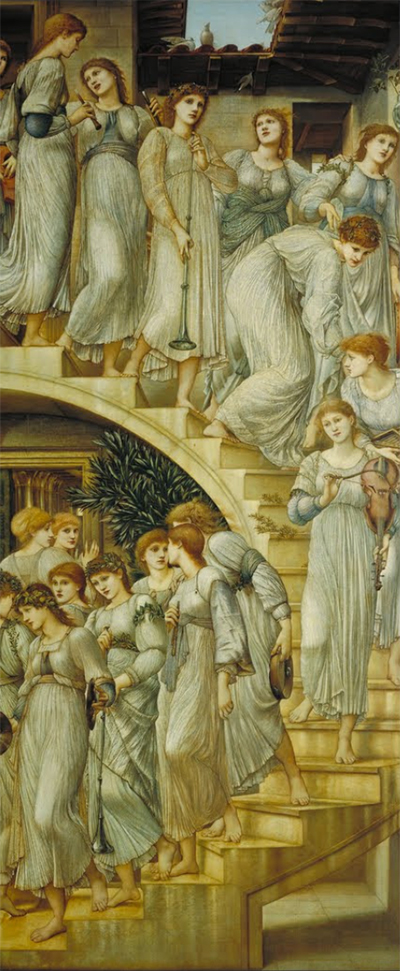
| The Golden Stairs | 1880 | Oil on canvas |
| An Angel Playing a Flageolet | 1878 | Watercolour, bodycolour and gold |
| The Tree of Forgiveness | 1881–82 | Oil on canvas |
| The Wheel of Fortune (Orsay) | 1875–83 | Oil on canvas |
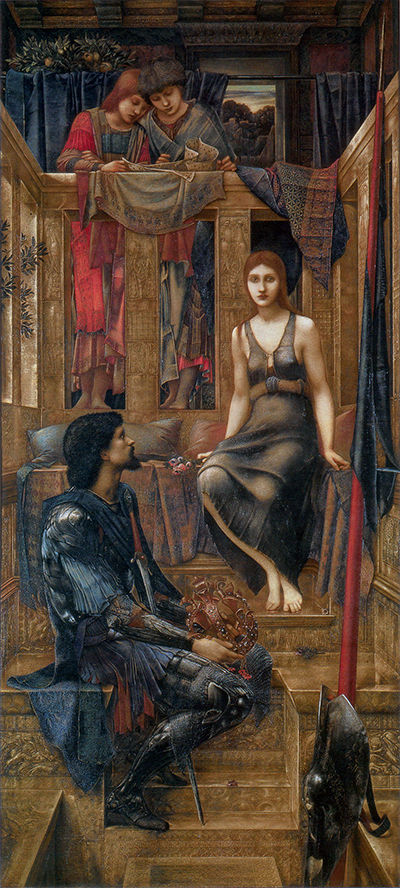
| King Cophetua and the Beggar Maid | 1884 | Oil on canvas |
| The Depths of the Sea (oil) | 1886 | Oil |
| The Morning of the Resurrection | 1886 | Oil on panel |
| Study for the Head of Mary Magdalene | c. 1882 | Oil study |
| The Sleep of King Arthur in Avalon | 1880s–1898 | Oil on canvas |
| The Sleep of King Arthur in Avalon (modello) | ca. 1881 | Oil on canvas (modello) |
| The Star of Bethlehem | Signed 1890 | Watercolour and bodycolour |
| Study for The Star of Bethlehem | About 1887–91 | Drawing |
| Sponsa de Libano | 1891 | Watercolour and bodycolour |
| The Summons (Holy Grail tapestries) | 1890s | Tapestry |
| The Failure of Sir Gawaine (Holy Grail tapestries) | 1890s | Tapestry |
| Hope (Boston) | 1896 | Oil on canvas |
| La Belle au bois dormant (theatre programme) | 1894 | Collotype |
| The Wedding of Psyche | 1895 | Oil on canvas |
| The Works of Geoffrey Chaucer (Kelmscott edition) | 1896 | Illustrated book |
| The Ascension (Birmingham Cathedral) | 1885 | Stained glass |
| The Last Judgement (Birmingham Cathedral) | 1897 | Stained glass |
| Adoration of the Magi (Huntington) | 1890s | Tapestry |
| Love among the Ruins (Wightwick) | 1894 | Oil on canvas |
| The Merciful Knight (photogravure after Burne-Jones) | 1900 | Photogravure |
| The Garden Court (preparatory work) | 1870–75 | Graphite and watercolour with white gouache |
| Study of a Female Figure | 1885 | Graphite drawing |
| Psyche Throwing Herself into the River | 1865–68 | Wood engraving |
| Beauty | 1887–89 | Colour lithograph |
| Study for the Failure of Gawain | 1893 | Crayon and graphite on Japanese paper |
| The Prince Enters the Briar Wood (after Burne-Jones) | After 1890 | Photogravure |
| The Rose Bower (after Burne-Jones) | 1892 | Photogravure |
| Adoration of the Magi (Musée d’Orsay) | 1904 | Tapestry |
| Answers to Prayer (Lyndhurst) | 1860s | Stained glass |
| The Depths of the Sea (photogravure after Burne-Jones) | 1900 | Photogravure |
| Perseus and Andromeda (Adelaide composite) | 1876 | Oil on canvas |
| The Adoration of the Magi (Hamburg) | Woven 1900 | Tapestry |
| Love leading the Pilgrim through the Briars | 1874–76 | Embroidery |
| Musica (worked by Lady Jane Cory) | 1906 | Embroidery |
| Pomona (worked by Lady Jane Cory) | 1907 | Embroidery |
| Flora (worked by Lady Jane Cory) | 1909 | Embroidery |
| The Fourth Day of Creation (photogravure after Burne-Jones) | 1900 | Photogravure |
| The Morning of the Resurrection (photogravure after Burne-Jones) | 1900 | Photogravure |
| Musical angels of the St Catherine window (Christ Church) | Designed 1877 | Stained glass |
Discussion
Look again at the images and ideas explored in The Beguiling of Merlin by Edward Burne-Jones. These editorial prompts invite your observations.
Reader Insights
What does Vivien’s book do for the balance of power in the painting?
Where do the branches make it hardest to separate Merlin from his surroundings?
Join the Conversation
Share a detail, comparison or question about The Beguiling of Merlin by Edward Burne-Jones below.
References
- National Museums Liverpool, The Beguiling of Merlin, Lady Lever Art Gallery, collection record, object details and painting reproduction. View source.
- The New Gallery, Exhibition of the Works of Sir Edward Burne-Jones, 1898–99, West Room, no. 68, p. 51. View source.
- Katherine Hinzman, Edward Burne-Jones: Super-Naturalist Painter, Aspectus 1, 2019, pp. 5–7. View source.
- Burne-Jones Catalogue Raisonné, The Beguiling of Merlin, entry Nzcz, Stephen Wildman and John Christian’s catalogue essay, transcribed work list and Grosvenor catalogue no. 59, provenance and exhibitions. View source.
- Toshiyuki Takamiya, In the Forest of Broceliande: Merlin and Vivian in Burne-Jones and in Chausson, The Geibun-Kenkyu 73, 1997, pp. 384–86 and notes 13, 18–19. View source.
- Alfred, Lord Tennyson, Merlin and Vivien, Idylls of the King, poem and edition history, University of Rochester, Robbins Library Digital Projects. View source.
- Sir Thomas Malory, Le Morte Darthur, book IV, chapter 1, on Merlin’s imprisonment beneath a stone. View source.
- Tate Britain, Edward Burne-Jones, 2018–19 exhibition large-print guide, entries for Merlin and Nimue, p. 25, and The Beguiling of Merlin, p. 76. View source.
- Victoria and Albert Museum, Merlin and Nimue, 1861, accession 257-1896, object O17355, medium and description. The original frame inscription is transcribed in the catalogue raisonné, entry NjIw. Frame inscription. View source 1. View source 2.
- Fortunée de Lisle, Burne-Jones, 1904, pp. 101–02 and note 1. View source.
- Christie’s, Victorian, Pre-Raphaelite & British Impressionist Art, 16 December 2015, lot 106, inscription and catalogue note for the pencil head study. View source.
- Delaware Art Museum, Study for the Head of Nimue in “The Beguiling of Merlin”, c. 1872–73, 1935-40, collection entry. View source.
- Scott Thomas Buckle, Is This the Face of Alessandro di Marco?, The British Art Journal 13, no. 2, pp. 67–69, especially pls. 1–2 and 4–7. View source.
- The Fitzwilliam Museum, studies of crossed legs and sandalled feet for Merlin, 962.f.9, object 26693, description and inscription. View source.
- The Fitzwilliam Museum, Study for the Drapery of Nimue (Vivien) from “Merlin and Nimue”, 962.f.2, object 26676. View source.
- William Waters, commentary on Study for the Drapery of Nimue (Vivien) in The Beguiling of Merlin, Burne-Jones Catalogue Raisonné, entry Mjc2ODU=. View source.
- Oscar Wilde, The Grosvenor Gallery, 1877, paragraphs on Burne-Jones’s pictures on the east wall, collected in Miscellanies. View source.
- Henry James, The Picture Season in London, The Galaxy 24, no. 2, August 1877, pp. 156–58, digitised original issue. View source.
- Laurence des Cars, essay on Burne-Jones in France and Belgium, Edward Burne-Jones, Victorian Artist-Dreamer, The Metropolitan Museum of Art, 1998, fig. 26 and accompanying discussion. View source.
- Northwest Missouri State University, Adolphe Lalauze after Edward Burne-Jones, The Beguiling of Merlin, DeLuce Family Collection, DC209, catalogue and print reproduction. View source.
- Fernand Khnopff, L’Enchantement de Merlin, Bulletin de la Classe des Beaux-Arts, Académie royale de Belgique, 1919, pp. 13–18, especially p. 13. View source.
- Ernest Chesneau, Artistes anglais contemporains, 1887, Burne-Jones chapter, discussion of The Beguiling of Merlin and excerpts from Francisque Michel’s translation of Tennyson. View source.