 by Tom Gurney
Tom Gurney BSc (Hons) is an art history expert with over 20 years experience
Published on June 19, 2020 / Updated on November 25, 2026
Email: tomgurney1@gmail.com / Phone: +44 7429 011000
The Mirror of Venus by Edward Burne-Jones: Introduction
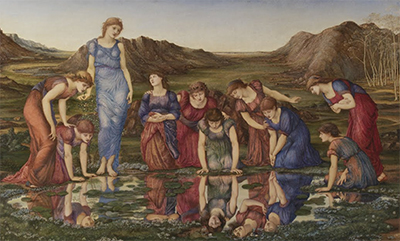
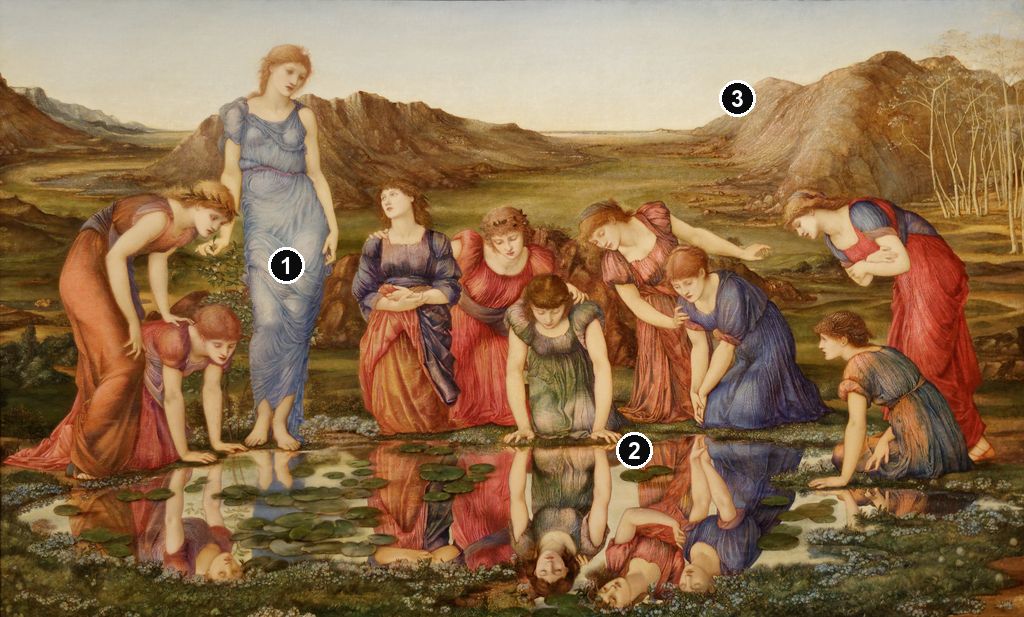
A woman in green braces both hands on the far bank of a pool. Her face is nearly hidden as she leans forward, but just below her, at the foot of the canvas, the water gives it back. To her left, a tall woman in blue stands barefoot beside the same pool. The water catches her feet and a little of her dress. These two encounters with the surface, one showing a face and the other only a fragment of the figure, give Edward Burne-Jones’s The Mirror of Venus its quiet drama. The oil on canvas in the Museu Calouste Gulbenkian, Lisbon, is two metres wide. The museum dates it 1875, the year Burne-Jones inscribed on the painting. He began it in 1873 and recorded finishing it in 1877, when it was shown at the opening exhibition of London’s Grosvenor Gallery. [1] [2] [3]
At a Glance
- ArtistEdward Burne-Jones
- Date1870s
- MediumOil on canvas
- SubjectVenus and her companions
This work across Edward Burne-Jones’s career
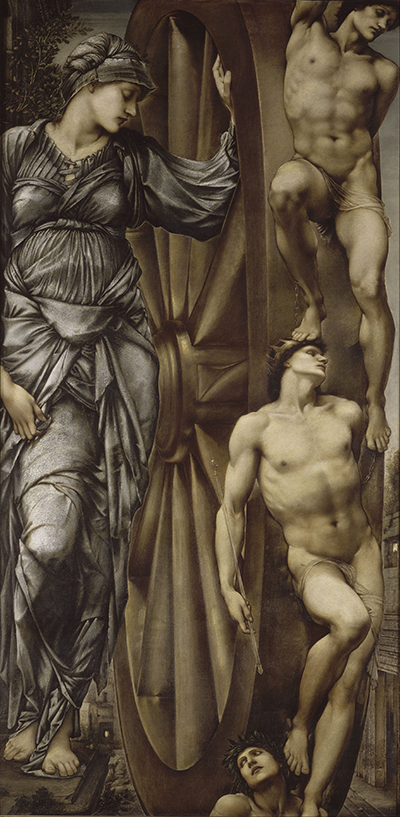
The Wheel of Fortune
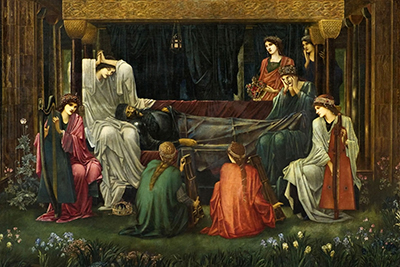
1875–83The Last Sleep of Arthur in Avalon
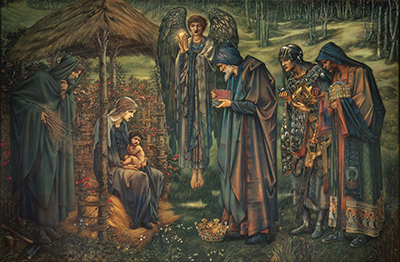
1880s–1898The Star of Bethlehem
Signed 1890Contents
- The women at the water’s edge
- The song in William Morris’s poem
- Italian figures and an open landscape
- Two oils and the drawings that precede them
- The Grosvenor Gallery and Leyland’s collection
- From the large canvas to a print
- Annotated details
The women at the water’s edge
There are ten women. The standing figure is traditionally identified as Venus, and the nine around her are her companions. The woman immediately to the right of Venus raises her eyes to the goddess, gathering a fold of her skirt at her waist. At the left, a woman in a reddish dress rests a hand on the back of a companion who braces both hands on the bank. To the right of centre, a woman reaches out an arm behind her while her other hand rests against the shoulder of the kneeling woman in blue. Further right, the woman with folded arms bends from the waist, whereas the last kneeling figure puts a hand down to steady herself. The women are absorbed in the same event, but Burne-Jones makes each of them approach it differently. [1] [3]
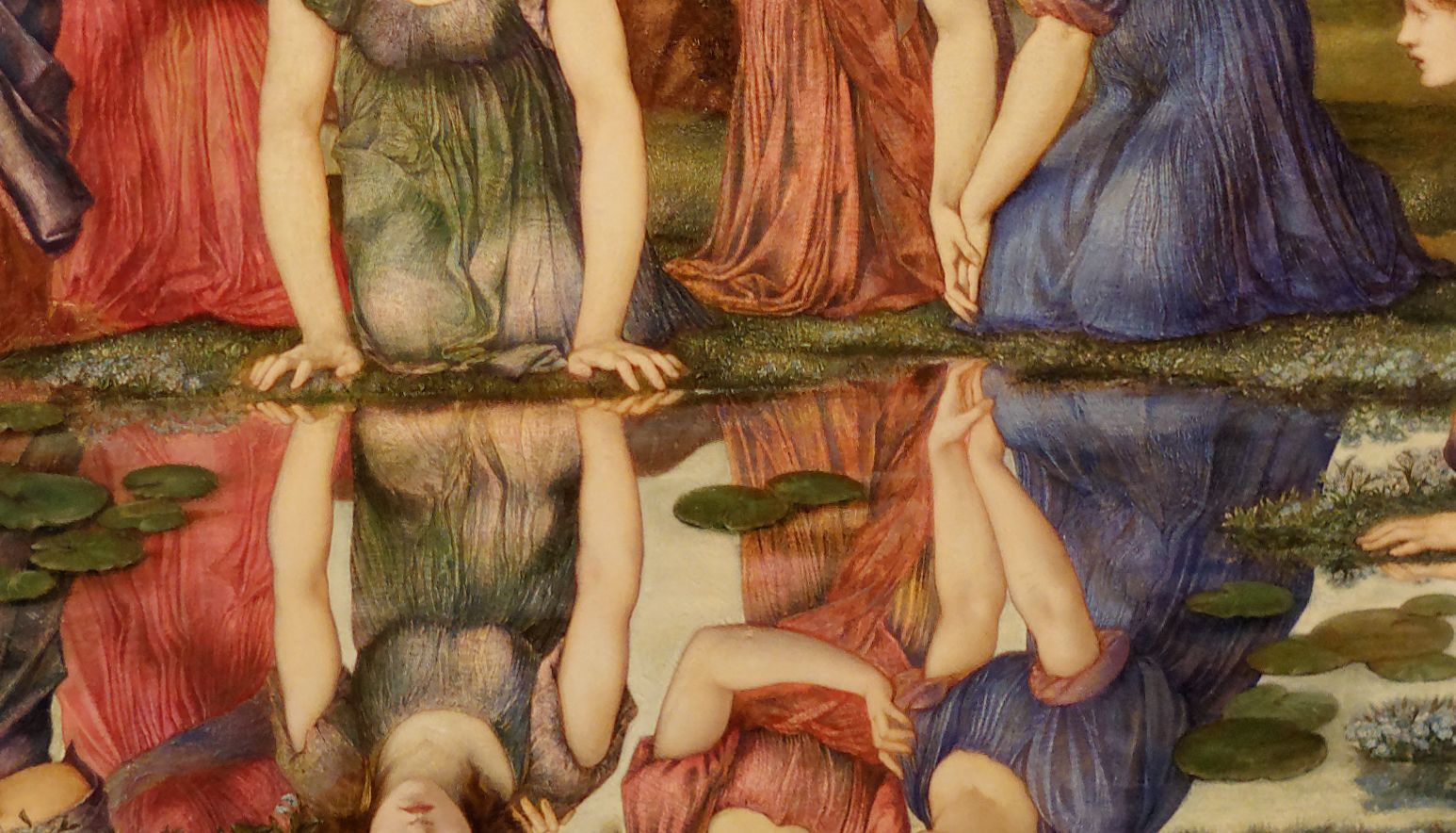
The pool occupies a low band that stretches almost the width of the canvas. Lily pads interrupt it, and the near bank cuts across the reflections wherever the strip of water narrows. Look at the woman in green in the middle. Her arms and their reflections nearly join across the line of the bank, while her reflected chin and features reach towards the flowers on the near side. Red and blue folds appear as broad patches in the water even where the heads above them are harder to match at first glance. The flowers remain on the viewer’s side of the pond, but they seem to crown the heads seen in the water. We look through the space of the picture to see a face, then become aware of how close to the surface of the canvas that face has been placed. [1] [4]
The standing goddess gives the design a different problem. The companions who bring their faces over the water can appear there from head to hand. The goddess is set back at the edge, so the space in which a viewer might look for her face runs out. The artist kept a study of this effect. A sheet in the Art Institute of Chicago isolates her hands and arms at the sides and her feet near the top centre, with their reflections carefully drawn below. Debra N. Mancoff points out that the reflected feet distinguish this preparation from a related drawing for The Story of Troy, where Burne-Jones used a similar stance and arrangement of the fingers. The detail that survives in the finished canvas was already important enough to rehearse by itself in pencil. [5]
Annotated Details from The Mirror of Venus
The numbered points identify visible features discussed in this article. Return from each detail to the numbered overview. Edward Burne-Jones, The Mirror of Venus. Calouste Gulbenkian Museum. Image source. Public domain.
Details from THE MIRROR OF VENUS
Compare the cropped details with the source images above. Notice how their colours, shapes and positions contribute to the larger compositions.
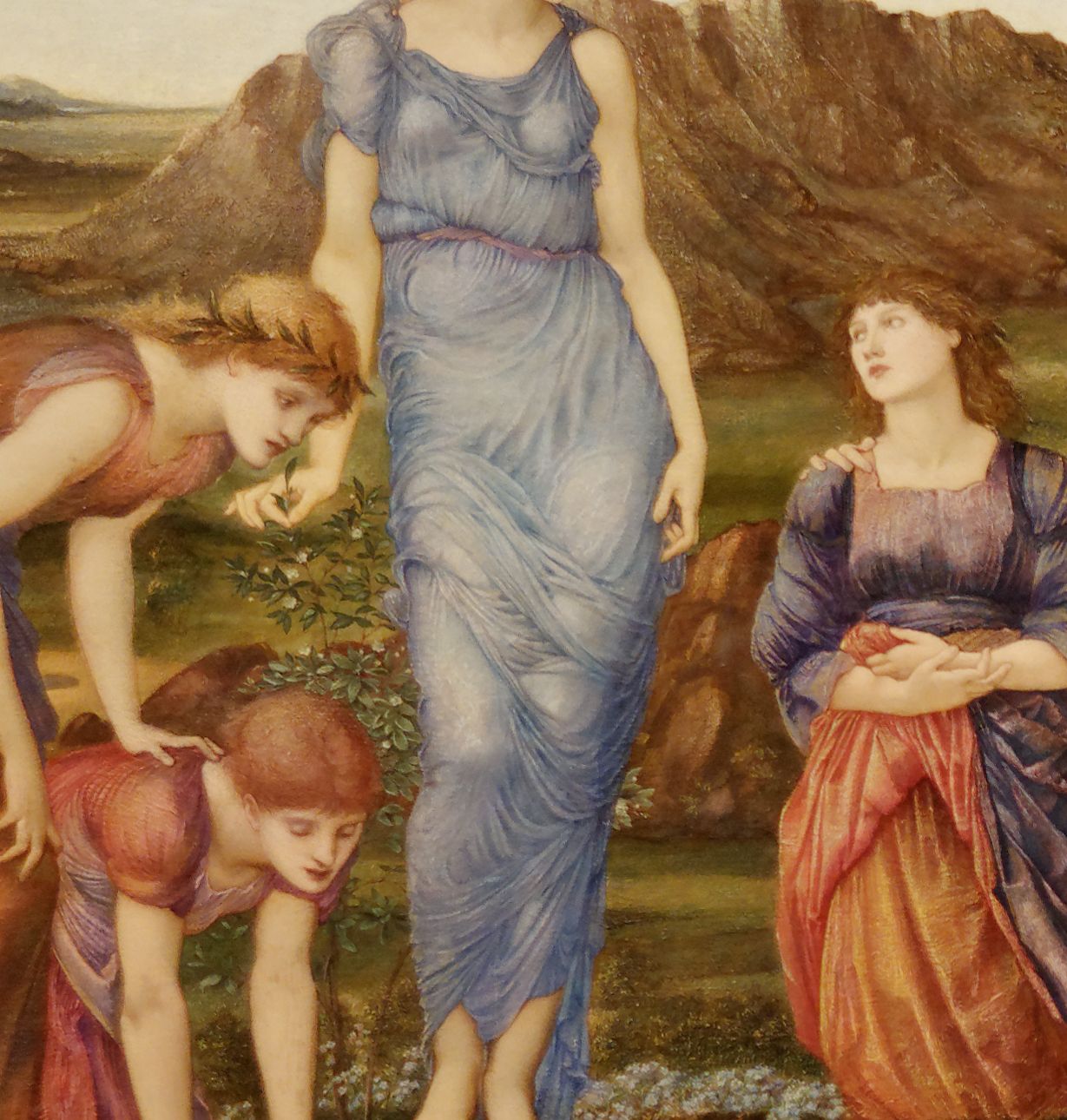
Standing figure
The standing Venus cuts across the distant slopes. The other figures repeat, bend or turn along the edge of the pool.
Where water meets figures
The border is narrow enough to bring dresses and reflections close. The reflected colours spread out more softly than their counterparts above.
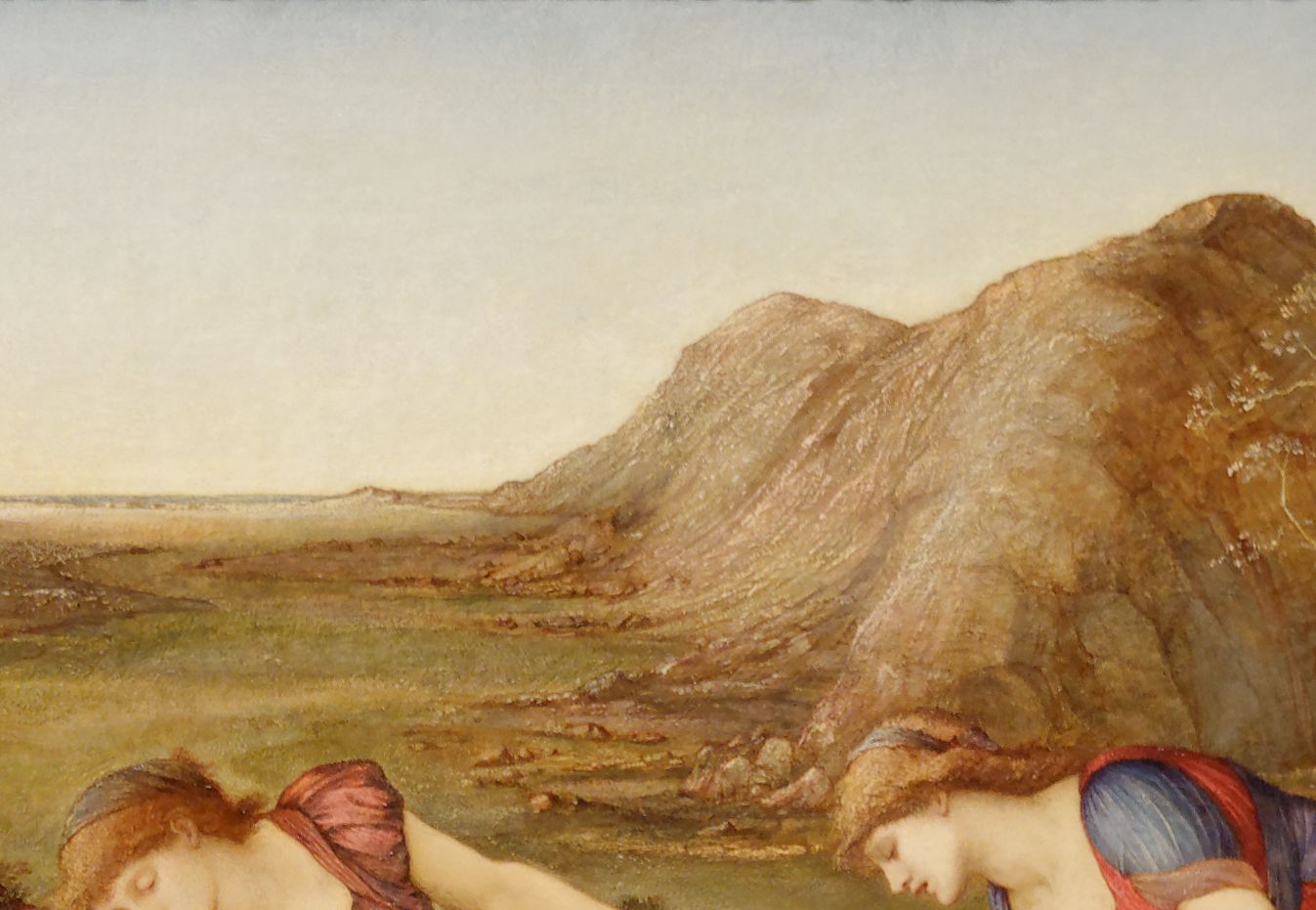
An open view behind the figures
The distant hills run across the near groups without following the curves of their poses. The contrast steadies the crowded foreground.
The song in William Morris’s poem
The picture began with “The Hill of Venus,” the last tale in William Morris’s The Earthly Paradise. The medieval legend behind it tells of a man who falls under the power of Venus, tries to return to the world and finds his repentance rejected. In the song Burne-Jones drew on, the goddess’s arrival is told from another point of view. Before she came, girls sat silently at their looms and men worked or went to sea without a kiss. The girls who looked into the stream could see their beauty, but they had no idea what it meant. The song thanks Venus for bringing desire and pleasure into a world that had had little of either. [6]
Morris proposed an illustrated edition of The Earthly Paradise before its publication in 1868–70. Burne-Jones listed twenty designs for “The Hill of Venus” in 1866. The planned woodcut edition was abandoned, but the pool scene gave him a design that could be developed at the scale of a painting. Catalogue scholar William Waters describes an early conception, The School of Venus, in which the goddess seems to be teaching the women. The completed canvas gives very little away about what she has said or done. The woman who turns her face up to Venus suggests how the scene might be read, while the other figures go on studying the water. The artist left out the mariner, the knights and the man at the centre of the legend. He made a scene from a passage of song that could suspend the larger story for as long as a viewer wanted to look. [2] [5] [6]
Burne-Jones treated the knight’s departure in Laus Veneris, now at the Laing Art Gallery in Newcastle. The mounted knight appears through a window, outside the room where the queen’s women attend to their music. The room is backed by a tapestry in which Venus rides in a chariot. The two paintings assign different places to the man and to the goddess. At the pool the goddess stands within reach of the women and there is no trace of the knight. In the court the knight is still visible outside, while the story of Venus plays out inside the tapestry. [7]
Italian figures and an open landscape
Behind the women are ridges that fall away towards a pale strip on the horizon. Almost leafless trees stand at the far right. The ridge rising behind Venus helps pick out her figure without swallowing its outline, and the open sky above the far valley leaves a gap behind the lower cluster of women. Most of the intense reds and blues belong to the clothes, and the water draws some of those colours down into the foreground. A red overskirt gathered over a fist takes one shape, a blue skirt pooled around a knee takes another. The folds give weight to bodies whose faces and gestures might otherwise seem too closely related. [1] [5]
The Gulbenkian compares the row of figures to a Greek frieze and singles out Botticelli as an example of the early Renaissance art Burne-Jones evokes. Botticelli’s Primavera offers a way to see what those two affinities have in common. Among the flowers of the Florentine painting, the upright, clothed Venus stands a little behind the other figures. Drapery helps distinguish the figures from one another and lets their movements be read across the width of the picture. Burne-Jones spreads his women just as widely but draws a low curve through the feet, skirts and knees at the bank. The pond gives that curve a second row of figures that trails off into foliage. The comparison is especially telling in the dresses, where a few lines over a shoulder or hip can establish the direction in which the whole body has turned. [1] [8]
In Titian’s Venus with a Mirror, a Cupid holds the glass up at the goddess’s face. The mirror is narrow enough to single her out. Burne-Jones has spread the reflective surface horizontally and placed the goddess just beyond the range in which it could show most of her figure. The women who bow or kneel make use of a space the goddess has opened to them. By the time the eye gets back to Venus, the pool has shown us several other faces. [9]
Burne-Jones later used a shallow band of figures and a spare landscape to a different end in The Wedding of Psyche. That painting, signed in 1895 and held by the Royal Museums of Fine Arts of Belgium, has roots in designs from the 1860s. The procession takes Psyche towards the mountain where she is to be left. The intervals between the figures and the repetitions in their drapery carry the eye onwards, towards a destination that gives their motion an urgency. At Venus’s pool the eye keeps returning to the bank because the repeated poses meet their counterparts below. Two subjects with origins in Burne-Jones’s work on Morris use the rhythm of a long procession or a long gathering to make time feel different. [10]
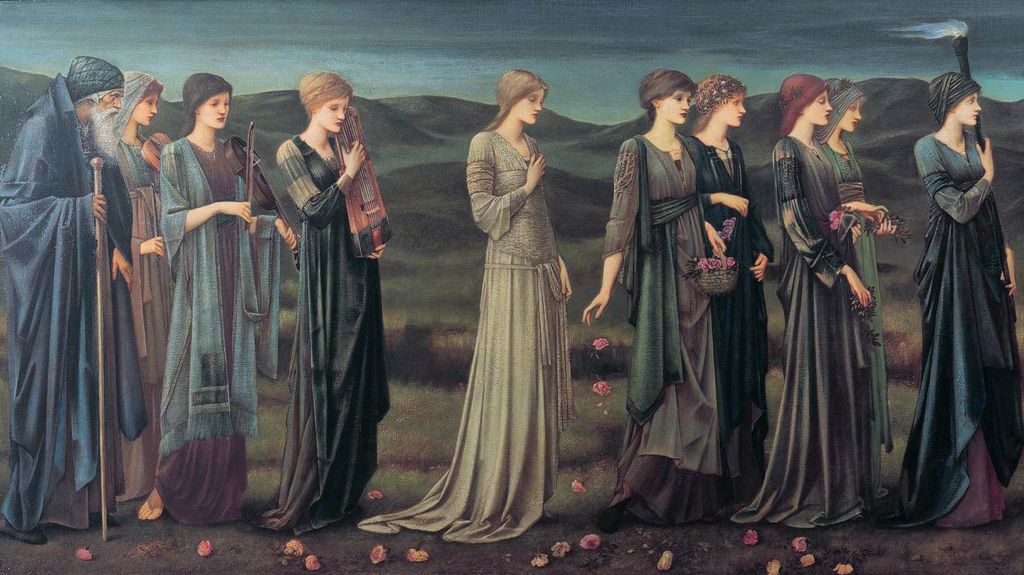
Edward Burne-Jones, The Wedding of Psyche. Royal Museums of Fine Arts of Belgium. Image source. Public domain.
Two oils and the drawings that precede them
Burne-Jones’s work list records “Venus Mirror in oils” in 1867 and the start of the large version for Frederick Leyland in 1873. In 1877 he recorded finishing both Leyland’s large picture and William Graham’s small one. The first version, an oil on canvas about 79 by 122 centimetres, is catalogued in a private collection. It puts the horizon higher. Mancoff also notes narrower folds in the earlier composition and warmer, more varied colour in the second, with more generous folds over fuller bodies. The larger picture was a chance to change the handling of the figures and the relation of the pool to its surroundings, even while both paintings were still in progress. [2] [5] [11]
The sketchbook in Chicago shows where some of those changes were worked out. In one graphite study, the kneeling woman who looks up towards Venus gathers the overskirt in both hands. Fabric spreads across her lap as it falls away from the place where she holds it. In the larger canvas the red folds moving out from her hands embody almost exactly that arrangement. Another preparatory drawing, bought by the Gulbenkian Foundation in 2017, brings much of the final group together but shows Venus nude. Clothing her in blue gave the finished picture a tall, largely continuous area of colour, which the brief glimpse in the pond picks up. The drawing and the two Chicago studies show the artist working at three scales, from the disposition of the whole group to the fall of a skirt and the sliver of water beneath a foot. [1] [5] [12]
The Grosvenor Gallery and Leyland’s collection
The first Grosvenor exhibition in 1877 put eight of Burne-Jones’s works before the public after several years in which he had exhibited little. Oscar Wilde, writing in the Dublin University Magazine, compared the water to “a mirror of polished steel.” He described how little of the upright figure it returned, an observation that catches a decision Burne-Jones had made in the studio. Henry James read the picture as a likeness of the painters and poets of Burne-Jones’s persuasion. To James they, too, were bending over a pool in a literary landscape, examining a vision that could seem marvellous to admirers and intolerable to others. The Art Journal praised the suggestion of Venetian colour while questioning the drawing. F. G. Stephens in the Athenaeum admired the variety of attitudes and felt the picture was closer to Florence. The same canvas could prompt an argument about how it was painted, what it owed to the past and how much private reverie a painting should ask a visitor to share. [2] [13] [14]
Burne-Jones himself worried that people would scarcely see the colours as he intended. Art historian Noriko Yoshimura draws attention to a comment preserved by Georgiana Burne-Jones in which he complained about the effect of the gallery’s vivid red walls on the painting. He favoured olive green or a subdued red. That reaction gives his care with the pictured landscape a practical counterpart. Muted hills leave Venus’s blue dress conspicuous and help the eye return to the small, precise colours at the water’s edge. A brilliant wall around the canvas could interfere with exactly those relationships. [15]
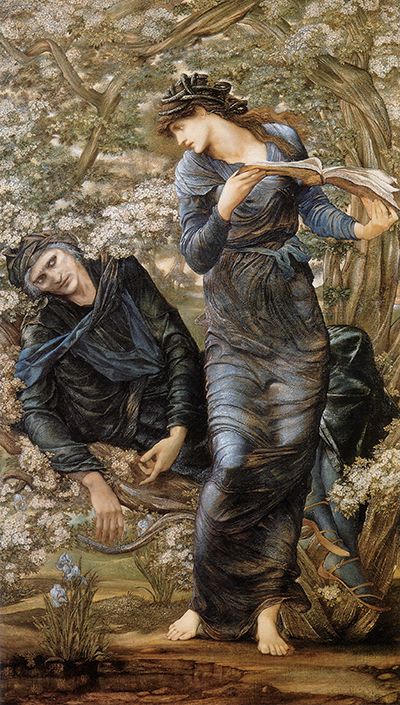
The larger Mirror and The Beguiling of Merlin were both commissioned by the Liverpool shipowner Frederick Richards Leyland and shown in the inaugural exhibition. In Leyland’s London house at 49 Prince’s Gate, The Mirror of Venus hung in one of three interconnected first-floor salons with paintings by Rossetti, Millais, Ford Madox Brown and Burne-Jones himself. The house also contained Whistler’s Peacock Room, Leyland’s dining room. After Leyland’s collection was dispersed in 1892, the picture passed through the Ruston collection and was lent by C. Sidney Goldmann to the 1898–99 Burne-Jones memorial exhibition. Calouste Gulbenkian acquired it in London in 1924 through Arthur Ruck. [2] [3] [16] [17]
The paint surface has needed care in Lisbon. In a 2024 study of the museum’s preventive conservation, Ana Santos recorded that the fragile paint layer of the Mirror had been stabilised in 2016. Her record identifies the canvas by its museum inventory number, 273. [18]
From the large canvas to a print
The composition reached another audience in Félix Jasinski’s 1896 etching after the Leyland painting. The Metropolitan Museum of Art holds a proof on imitation vellum with an image just under 52 centimetres wide, about a quarter of the canvas’s width. The publishers listed on the print record include firms in London and Berlin. In the etching, dark and light still guide the eye across the bowed heads and across the water below them. The edge of the pond, so easily overlooked between coloured clothes in the oil, becomes particularly easy to follow. The difference between the upright figure and the bowed bodies survives the change of scale and medium. An upright body can leave hardly a trace in the pool, while a bowed head can appear once more among the flowers. [1] [4]
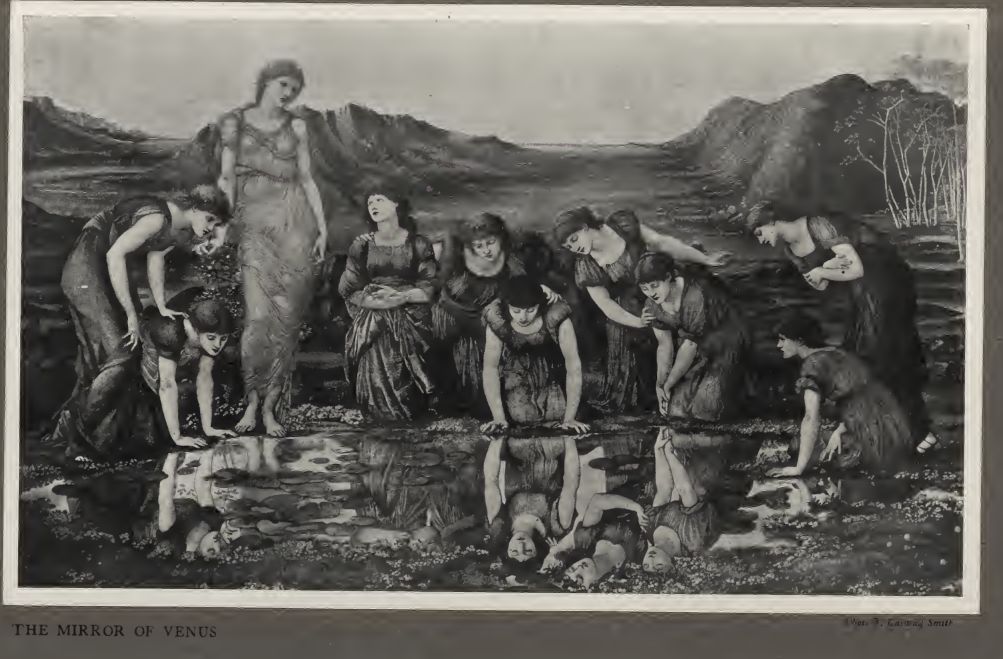
The Mirror of Venus, early monochrome reproduction after Edward Burne-Jones. Plate 52 in Malcolm Bell’s Sir Edward Burne-Jones. Image source. Public domain. Printed plate isolated from the surrounding page and set upright.
Edward Burne-Jones on film
Explore Burne-Jones’s paintings, illustrated stories and stained-glass designs.
Edward Burne-Jones: Pre-Raphaelite Visionary | Exhibitions | Showcase
A look at Burne-Jones’s paintings and the Tate retrospective.
Watch on YouTubeArtworks directory
This directory records paintings, studies, designs and collaborative works, with separate entries for documented versions and series where known.
| Name | Date | Medium |
|---|---|---|
| Sidonia von Bork 1560 | 1860 | Watercolour and bodycolour |
| Clara von Bork 1560 | 1860 | Watercolour and bodycolour |
| The Merciful Knight | 1863 | Watercolour |
| Sibylla Delphica | c. 1886 | Oil on panel |
| Phyllis and Demophoön | 1870 | Watercolour and bodycolour |
| The Legend of the Briar Rose (Buscot series) | 1870s–1890 | Oils on canvas |
| The Briar Wood (Buscot series) | By 1890 | Oil on canvas |
| The Council Chamber (Buscot series) | By 1890 | Oil on canvas |
| The Garden Court (Buscot series) | By 1890 | Oil on canvas |
| The Rose Bower (Buscot series) | By 1890 | Oil on canvas |
| Group of Women, study for The Golden Stairs | 1872 | Drawing |
| The Beguiling of Merlin | 1870s | Oil on canvas |
| The Perseus Cycle | From 1875 | Paintings and full-scale designs |
| The Call of Perseus (Stuttgart) | From 1875 | Oil painting |
| Perseus and the Graeae (Stuttgart) | From 1875 | Oil painting |
| The Rock of Doom (Stuttgart) | 1884–88 | Oil on canvas |
| The Doom Fulfilled (Stuttgart) | 1888 | Oil on canvas |
| The Baleful Head (Stuttgart) | 1885–87 | Oil on canvas |
| The Baleful Head (Southampton design) | 1880s | Bodycolour |
| The Rock of Doom (Southampton design) | 1880s | Bodycolour |
| The Doom Fulfilled (Southampton design) | 1880s | Bodycolour |
| The Mirror of Venus (Gulbenkian) | 1870s | Oil on canvas |
| Drawing associated with The Mirror of Venus | 1870s | Drawing |
| Laus Veneris (Laing) | 1873–78 | Oil on canvas |
| The Days of Creation | 1870s | Watercolour and bodycolour |
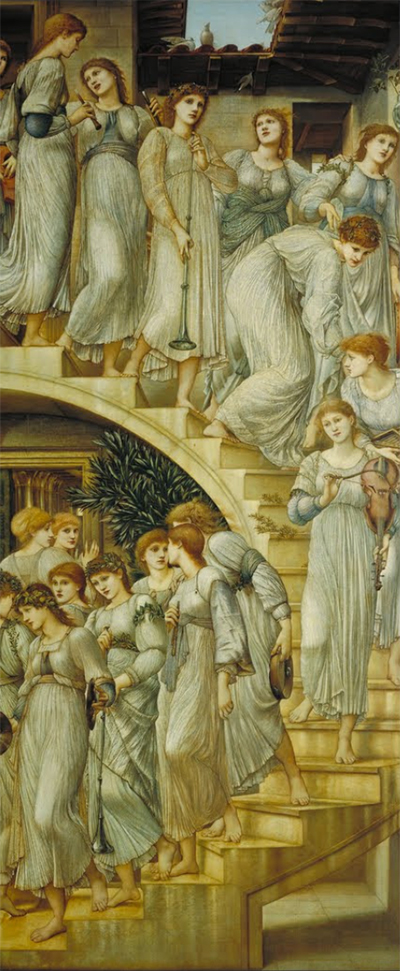
| The Golden Stairs | 1880 | Oil on canvas |
| An Angel Playing a Flageolet | 1878 | Watercolour, bodycolour and gold |
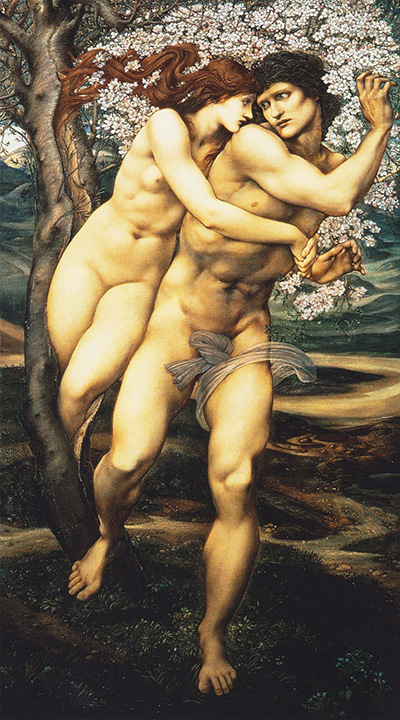
| The Tree of Forgiveness | 1881–82 | Oil on canvas |
| The Wheel of Fortune (Orsay) | 1875–83 | Oil on canvas |
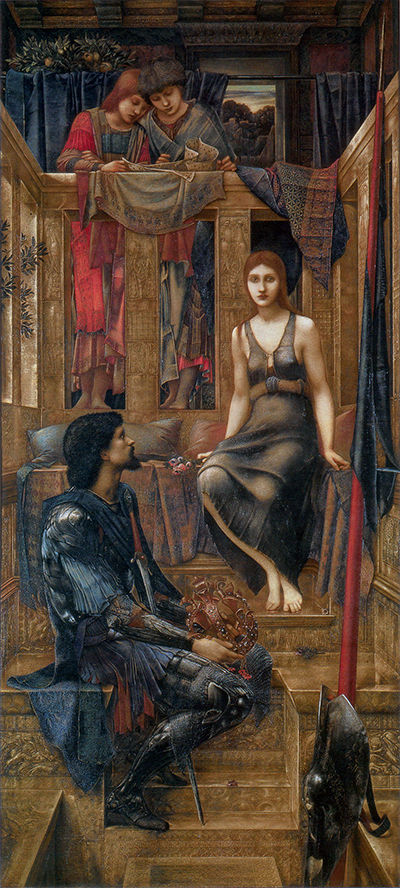
| King Cophetua and the Beggar Maid | 1884 | Oil on canvas |
| The Depths of the Sea (oil) | 1886 | Oil |
| The Morning of the Resurrection | 1886 | Oil on panel |
| Study for the Head of Mary Magdalene | c. 1882 | Oil study |
| The Sleep of King Arthur in Avalon | 1880s–1898 | Oil on canvas |
| The Sleep of King Arthur in Avalon (modello) | ca. 1881 | Oil on canvas (modello) |
| The Star of Bethlehem | Signed 1890 | Watercolour and bodycolour |
| Study for The Star of Bethlehem | About 1887–91 | Drawing |
| Sponsa de Libano | 1891 | Watercolour and bodycolour |
| The Summons (Holy Grail tapestries) | 1890s | Tapestry |
| The Failure of Sir Gawaine (Holy Grail tapestries) | 1890s | Tapestry |
| Hope (Boston) | 1896 | Oil on canvas |
| La Belle au bois dormant (theatre programme) | 1894 | Collotype |
| The Wedding of Psyche | 1895 | Oil on canvas |
| The Works of Geoffrey Chaucer (Kelmscott edition) | 1896 | Illustrated book |
| The Ascension (Birmingham Cathedral) | 1885 | Stained glass |
| The Last Judgement (Birmingham Cathedral) | 1897 | Stained glass |
| Adoration of the Magi (Huntington) | 1890s | Tapestry |
| Love among the Ruins (Wightwick) | 1894 | Oil on canvas |
| The Merciful Knight (photogravure after Burne-Jones) | 1900 | Photogravure |
| The Garden Court (preparatory work) | 1870–75 | Graphite and watercolour with white gouache |
| Study of a Female Figure | 1885 | Graphite drawing |
| Psyche Throwing Herself into the River | 1865–68 | Wood engraving |
| Beauty | 1887–89 | Colour lithograph |
| Study for the Failure of Gawain | 1893 | Crayon and graphite on Japanese paper |
| The Prince Enters the Briar Wood (after Burne-Jones) | After 1890 | Photogravure |
| The Rose Bower (after Burne-Jones) | 1892 | Photogravure |
| Adoration of the Magi (Musée d’Orsay) | 1904 | Tapestry |
| Answers to Prayer (Lyndhurst) | 1860s | Stained glass |
| The Depths of the Sea (photogravure after Burne-Jones) | 1900 | Photogravure |
| Perseus and Andromeda (Adelaide composite) | 1876 | Oil on canvas |
| The Adoration of the Magi (Hamburg) | Woven 1900 | Tapestry |
| Love leading the Pilgrim through the Briars | 1874–76 | Embroidery |
| Musica (worked by Lady Jane Cory) | 1906 | Embroidery |
| Pomona (worked by Lady Jane Cory) | 1907 | Embroidery |
| Flora (worked by Lady Jane Cory) | 1909 | Embroidery |
| The Fourth Day of Creation (photogravure after Burne-Jones) | 1900 | Photogravure |
| The Morning of the Resurrection (photogravure after Burne-Jones) | 1900 | Photogravure |
| Musical angels of the St Catherine window (Christ Church) | Designed 1877 | Stained glass |
Discussion
Look again at the images and ideas explored in The Mirror of Venus by Edward Burne-Jones. These editorial prompts invite your observations.
Reader Insights
Which figure’s reflection matters most to the way you understand the painted group?
What do the open hills contribute to a scene in which most of the figures look down?
Join the Conversation
Share a detail, comparison or question about The Mirror of Venus by Edward Burne-Jones below.
References
- Museu Calouste Gulbenkian, The Mirror of Venus, inventory 273, object details and painting reproduction. View source.
- Burne-Jones Catalogue Raisonné, The Mirror of Venus 1877 (Venus’s Looking Glass), Expertise, Provenance and Exhibitions, including the Fitzwilliam work list and the 1877 reviews. View source.
- New Gallery, Exhibition of the Works of Sir Edward Burne-Jones, Bart., 1898–99, p. 60, no. 99, signature and date, subject and owner. View source.
- Metropolitan Museum of Art, Félix Jasinski after Burne-Jones, The Mirror of Venus, 1896, proof, 59.592.20. View source.
- Debra N. Mancoff, “Unpainted Masterpieces: The Drawings of Edward Burne-Jones,” Art Institute of Chicago Museum Studies 31, no. 1, 2005, pp. 50–51, figs. 7–9. View source.
- William Morris, “The Hill of Venus,” The Earthly Paradise, 1870, opening synopsis and the song beginning “Before our lady came on earth,” pp. 381–83. View source.
- Laing Art Gallery, Paintings from the Laing Collection, collection label for Edward Burne-Jones’s Laus Veneris. View source.
- Gallerie degli Uffizi, Sandro Botticelli, Primavera, painting reproduction and subject notes. View source.
- National Gallery of Art, Titian, Venus with a Mirror, 1937.1.34, object description and reproduction. View source.
- Burne-Jones Catalogue Raisonné, The Wedding Procession of Psyche, Stephen Wildman on chronology, frieze and setting, and William Waters on the signature. View source.
- Burne-Jones Catalogue Raisonné, The Mirror of Venus – first version, object details, Expertise and Provenance. View source.
- Ana Maria Campino, Museu Calouste Gulbenkian, “Sir Edward Burne-Jones: Obra gráfica nas Coleções Gulbenkian,” 2024, opening gallery and commentary on the study. View source.
- Oscar Wilde, “The Grosvenor Gallery, 1877,” Dublin University Magazine, July 1877, reprinted in Miscellanies. View source.
- Henry James, “The Picture Season in London,” The Galaxy 24, August 1877, p. 157. View source.
- Noriko Yoshimura, “絵画と空間―バーン=ジョーンズの《黄金の階段》とグロヴナー・ギャラリーをめぐって” [Painting and Space: Burne-Jones’s The Golden Stairs and the Grosvenor Gallery], 2019, p. 36, section 2.2 and note 36. View source.
- Smithsonian Institution, Harmony in Blue and Gold: The Peacock Room, F1904.61, provenance of Leyland’s 49 Prince’s Gate dining room. View source.
- Museu Calouste Gulbenkian, O Espelho de Vénus, inventory 273, Portuguese record, Incorporação. View source.
- Ana Santos, Políticas e Práticas de Gestão de Riscos para Conservação Preventiva de Coleções de Pintura, Universidade do Porto, 2024, Apêndice 1, row 41, inventory 273, InArte condition notes. View source.