Edward Burne-Jones.jpg)
 by Tom Gurney
Tom Gurney BSc (Hons) is an art history expert with over 20 years experience
Published on June 19, 2020 / Updated on November 25, 2026
Email: tomgurney1@gmail.com / Phone: +44 7429 011000
Edward Burne-Jones Drawings: Introduction
In Desiderium, a young woman lifts her face in profile. Edward Burne-Jones used graphite to pick out the fine curve of her eyelid, the line from forehead to nose and the loose strands that soften the outline of her neck. The figure personifies Amorous Desire in Edmund Spenser’s The Faerie Queene. Burne-Jones made the drawing in 1873 for The Masque of Cupid, a proposed mural that he never completed. The sheet is only 21 centimetres high. It was already described as a finished study when his executors lent it to an exhibition of his drawings in 1899. [1] [2]
A finished study makes sense in a studio where a drawing could do several jobs. A head might be worked up to find the expression for a figure in a mural. A few strokes in a sketchbook could save the arrangement of a group for later. A cartoon, usually a full-size working design, could give glass painters or weavers the shapes they needed at the scale of the finished work. Burne-Jones also made intensely worked pictures on vellum that were conceived as drawings. Across these uses, a shift of support or material could change how a figure was imagined and how another person could carry the design forward. [3]
At a Glance
- ArtistEdward Burne-Jones
- FocusStudies and finished sheets
- ExploreDesign transfer, cartoons and figure studies
Contents
- Early ink drawings on vellum
- Sketchbooks, copying and the study of a figure
- From a study to a full-size cartoon
- Designs for glass, tapestry and embroidery
- Drawings made for the printed page
- Annotated details
Early ink drawings on vellum
In Going to the Battle, dated 1858 by the Tate exhibition guide and the catalogue raisonné, three courtly women occupy an enclosed garden. The dense pattern makes the mounted company in the background slow to emerge. In the foreground, animals appear in the pattern of the central woman’s dress, while a parrot sits on its perch. Ink establishes small, insistent marks, and wash gives the ornament, bodies and pockets of shade different densities. On the Fitzwilliam Museum’s vellum, a prepared animal skin, the edge of a leaf or a scrap of embroidery can command the same attention as a knight. That evenness is part of the drawing’s storytelling. The people leaving for battle almost disappear into the surface that holds them. [3] [4] [5]
The Metropolitan Museum’s Alice, la Belle Pèlerine of 1858–59 brings the same concentration indoors. Alice, a figure from Thomas Malory’s Arthurian writing, wears a pilgrim’s shell and moves among attendants. A window opens a small prospect of summer greenery behind the group. A viewer can trace the procession in the line of heads and then slow down over the costume and architecture. Burne-Jones used graphite and black ink with white heightening, and scraped areas to lighten the ground or soften the ink. Alice’s head and shoulders are on a subsidiary piece of vellum attached to the sheet. Even a work of such concentrated finish preserves the join between separate acts of drawing. [6]
Burne-Jones left Oxford in 1856 to become an artist, taking advice from Dante Gabriel Rossetti and John Ruskin. Rossetti’s own medieval subjects offered one example of how to crowd a small surface with incident. The precision of Albrecht Dürer’s engravings and the dense surfaces of illuminated manuscripts gave Burne-Jones further models. The comparison with Dürer is especially apt where the turn of a profile, a woven pattern and the edge of a wall all have the same clarity. Burne-Jones was already treating shifts in the weight and density of a line as a way of directing the eye around a complete picture. [5] [6]
Sketchbooks, copying and the study of a figure
The sketchbooks show what Burne-Jones chose to take away from other works of art. The Victoria and Albert Museum reproduces a pencil leaf of three figures from a sketchbook dated 1866–67. The principal information is in the poses, the direction of the limbs and the way one figure sits alongside another. In Perugia in October 1871 he wrote down which of Perugino’s painted heads he particularly admired at the Collegio del Cambio. He also collected photographs of earlier art. A sketch or written note could record the specific passage he wanted to remember, while a photograph gave him an image of the work to consult in the studio. [7]
A study from his 1862 trip to Venice shows how closely he could narrow the enquiry. The Ashmolean drawing of Bacchus after Tintoretto’s The Marriage of Bacchus and Ariadne in the Presence of Venus isolates the head with its crown of vine leaves. He worked from the painting at the Doge’s Palace before it was restored, using graphite and chalk. Ruskin eventually presented the sheet to his drawing school at Oxford. On another occasion Burne-Jones drew a central passage of Titian’s fresco of The Miracle of the Newborn Child at Padua in watercolour and chalk. The scale of the enquiry shifted with what he wanted to learn, from the modelling of a face to a group organised around a spoken accusation. The Tate exhibition guide also describes how earlier Italian models continued to inform his compositions. It singles out Signorelli, Pollaiuolo and Michelangelo in the drawings and design behind the unfinished Venus Discordia, whose monochrome base gives a sense of how assistants carried his designs from paper to canvas. [3]
The drawing could also be an inquiry into ornament. In the National Gallery of Art’s A Fragment from an Antique Frieze, a curling leaf pattern fills the sheet. Black chalk gives the hollows their depth, white gouache catches the raised edges and the brown paper stands in for the intermediate tone of the relief. It is a small demonstration of how he could turn the shape and lighting of an existing object into a design legible on paper. [8]
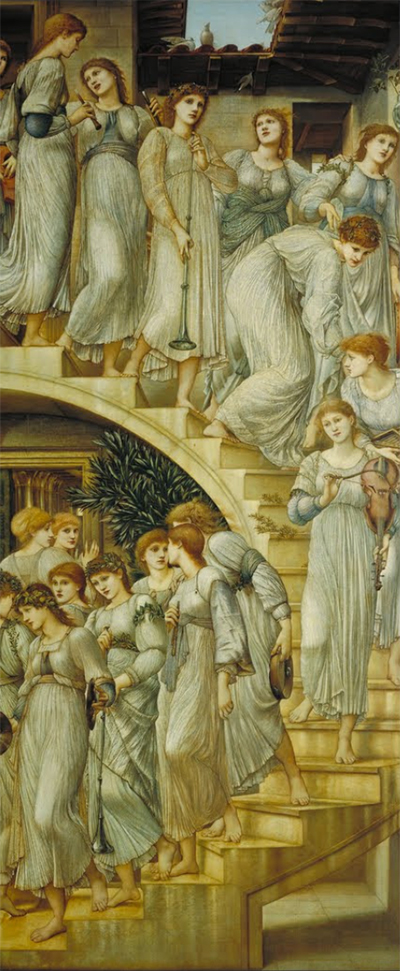
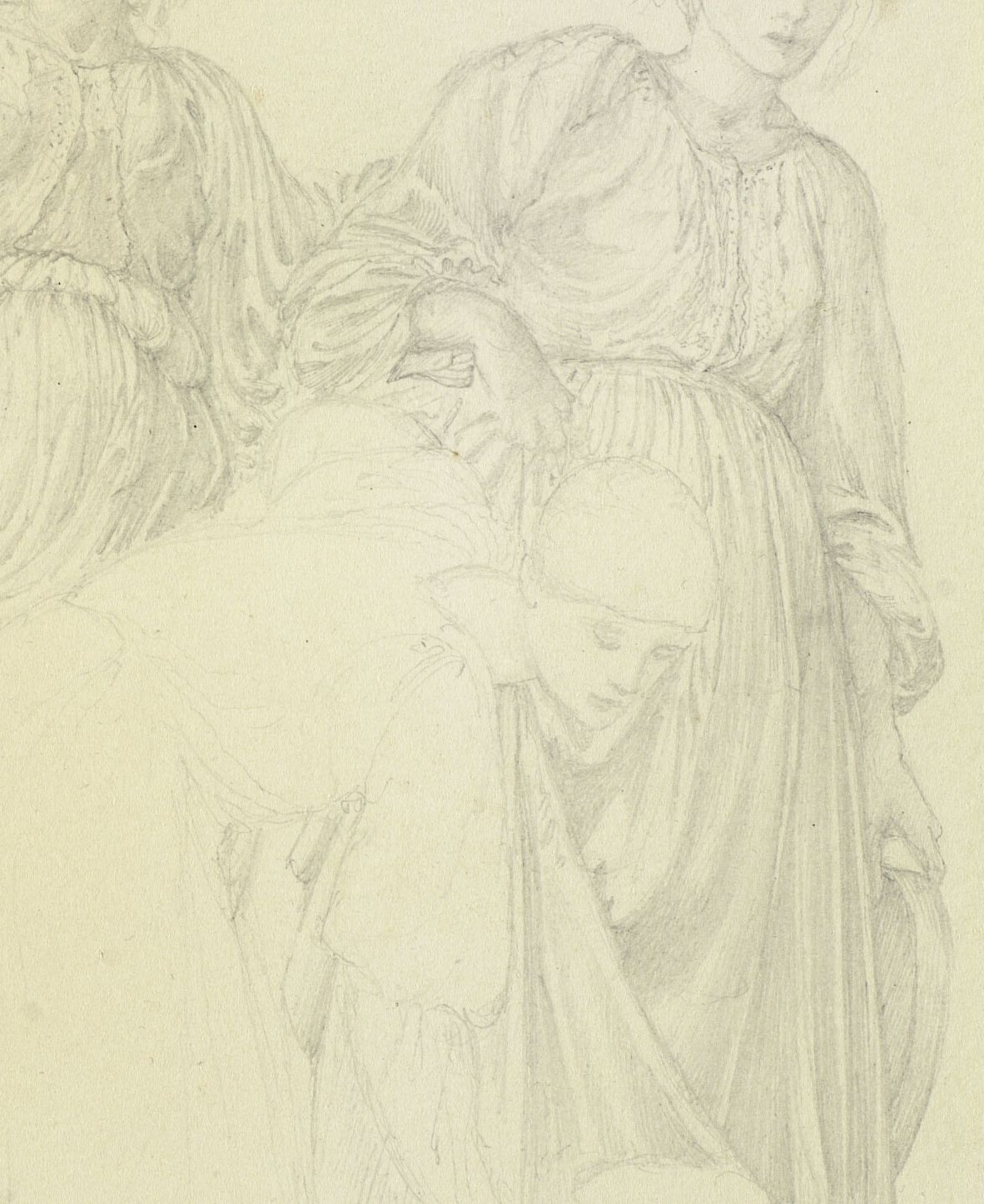
He could use a whole sheet to examine a foot, the fall of a sleeve or the angle at which an instrument sits in a hand. The surviving drawings for The Golden Stairs make that division of labour unusually visible. The Statens Museum for Kunst holds a pencil sketch dated 1872 that gathers figures around the upper part of a staircase. In the finished oil the steps are steep and the figures overlap. Looking at the early grouping makes it easier to see how much work was involved in spacing the figures around the bend and keeping their bodies legible through one another’s arms, sleeves and instruments. [9] [10]
In one of the Fitzwilliam sheets he studies bare feet at different angles. Other drawings isolate hands with cymbals or a violin, or give a draped figure much of a sheet. The foot studies help explain why the figures in the oil feel grounded in spite of the shallow steps and the near-continuous sweep of pale fabric. One foot can accept weight while another feels for a lower tread. A musician’s hand requires a different adjustment. For a cymbal bearer Burne-Jones drew a nude model, identified by his inscription as Antonia Caiva, in metalpoint on a prepared surface. Susan Owens describes his reinforcement of parts of the thin metalpoint line in graphite and his use of white to model the figure. The line and highlights establish the form that the folds could later follow. [3] [11] [12]
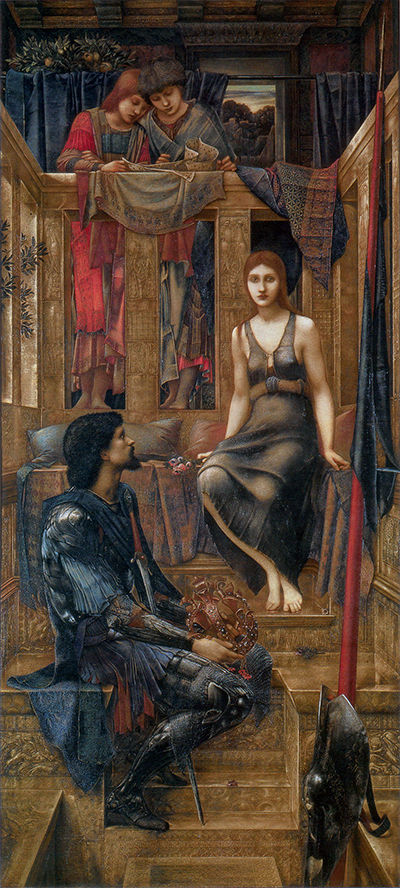
Paper could do much of the tonal work. In the Musée d’Orsay’s Study of a Kneeling Woman, dated about 1888, white chalk and touches of pastel catch the folds of the woman’s robe against red paper. The surface carries a Montgolfier watermark. The colour of the sheet shows through the strokes and supplies the middle tone, so the planes of the garment come forward wherever the chalk gathers. Compare that use of the ground with the white cartridge paper of the Fitzwilliam’s Study, perhaps for ‘Cophetua and the Beggar Maid’. There the graphite builds the shadows and the untouched paper supplies the light. The name written on the reverse is only possibly in the artist’s hand. The museum’s note points to the 1862 picture, and Tate has a securely identified graphite study of the maid dated 1883 for the later King Cophetua and the Beggar Maid. The two sheets preserve different degrees of certainty about how a drawing relates to a picture. [13] [14] [3]
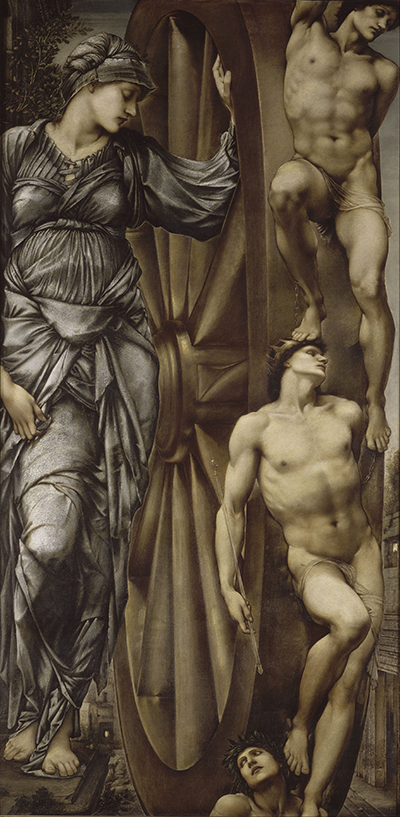
The body under the clothes posed its own problems. In a graphite study for The Doom Fulfilled, Burne-Jones drew Andromeda from behind, with her head turned to the right. The identification is written on the drawing, which is dated 1885 and now in the British Museum. The turn sets the shoulder and neck against the direction of the rest of her standing body. An isolated figure study makes that small movement easy to see before the eye takes in the hero and the wrapping coils of the sea monster in the oil. Tate’s exhibition also paired the graphite Study of the King for The Wheel of Fortune with other single-figure preparations. The Musée d’Orsay records an earlier drawing for the same painting, a young woman’s head signed and dated 1872. The artist gave that sheet to the French state in 1893, a decade after the painting was completed. Two preparatory sheets for a single picture can end up in different countries and enter collections by very different routes. [15] [3] [16]
The drawings for The Legend of the Briar Rose make particularly good comparisons because Burne-Jones returned to the same scene over many years. Tate’s small graphite study of a seated woman for The Garden Court dates from about 1873. In 1889 he studied the sleeping attendants on much larger sheets in chalk and gouache. In one Birmingham sheet, for the second figure from the left, the catalogue identifies a shift from a natural sleeping pose in the earlier painted version to a more trance-like state. A change to the pose of one attendant alters the mood of the whole court. The 2012 Tokyo exhibition checklist records six of the Birmingham studies together, including upright and horizontal sheets. The individual arrangements of each sleeper were an extended part of designing the whole scene. [3] [17] [18]
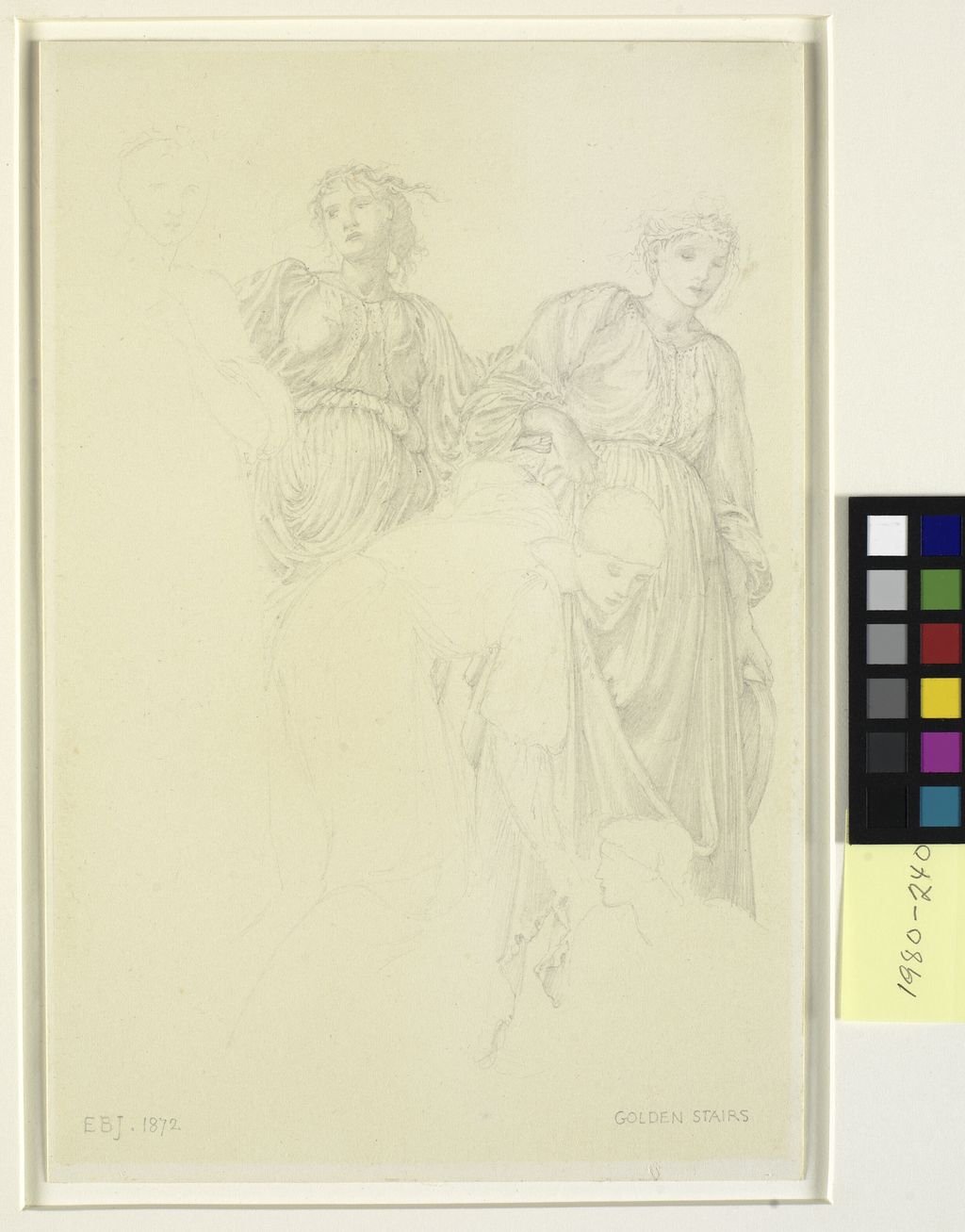
Edward Burne-Jones, Group of Women, a study for The Golden Stairs. Statens Museum for Kunst, KKS1980-240. Image source. Public domain. The collection photograph includes the original colour target and mounting margins.
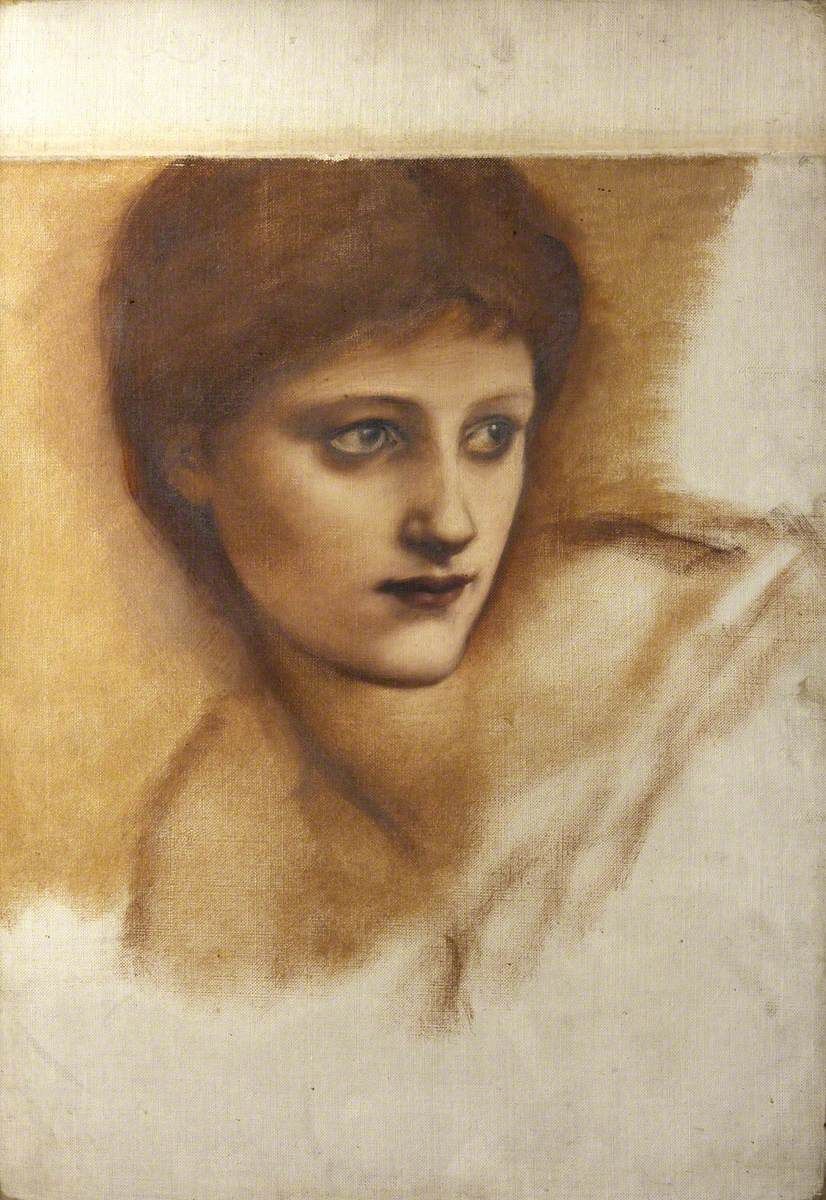
Edward Burne-Jones, oil study for the head and shoulders of Mary Magdalene. Worcester College, Oxford, no. 323. Image source. Public domain.
Annotated Details from Edward Burne-Jones Drawings
The numbered points identify visible features discussed in this article. Return from each detail to the numbered overview. Edward Burne-Jones, Group of Women, a study for The Golden Stairs. Statens Museum for Kunst, KKS1980-240. Image source. Public domain. The collection photograph includes the original colour target and mounting margins.
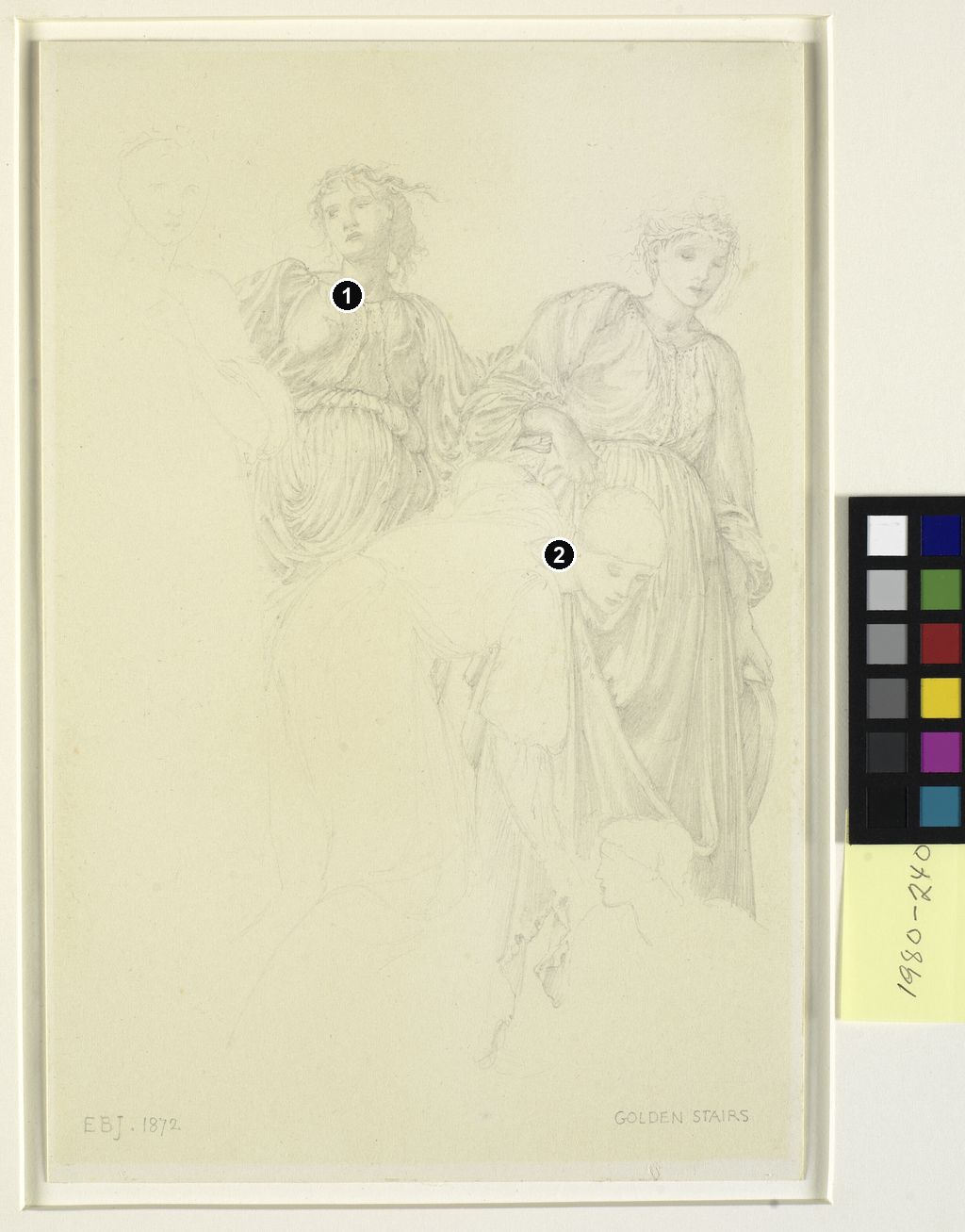
Details from EDWARD BURNE-JONES DRAWINGS
Compare the cropped details with the source images above. Notice how their colours, shapes and positions contribute to the larger compositions.
A turn of the head
The turn of the nearer head is established with a small concentration of pencil lines. Most of the paper around the face is left pale.
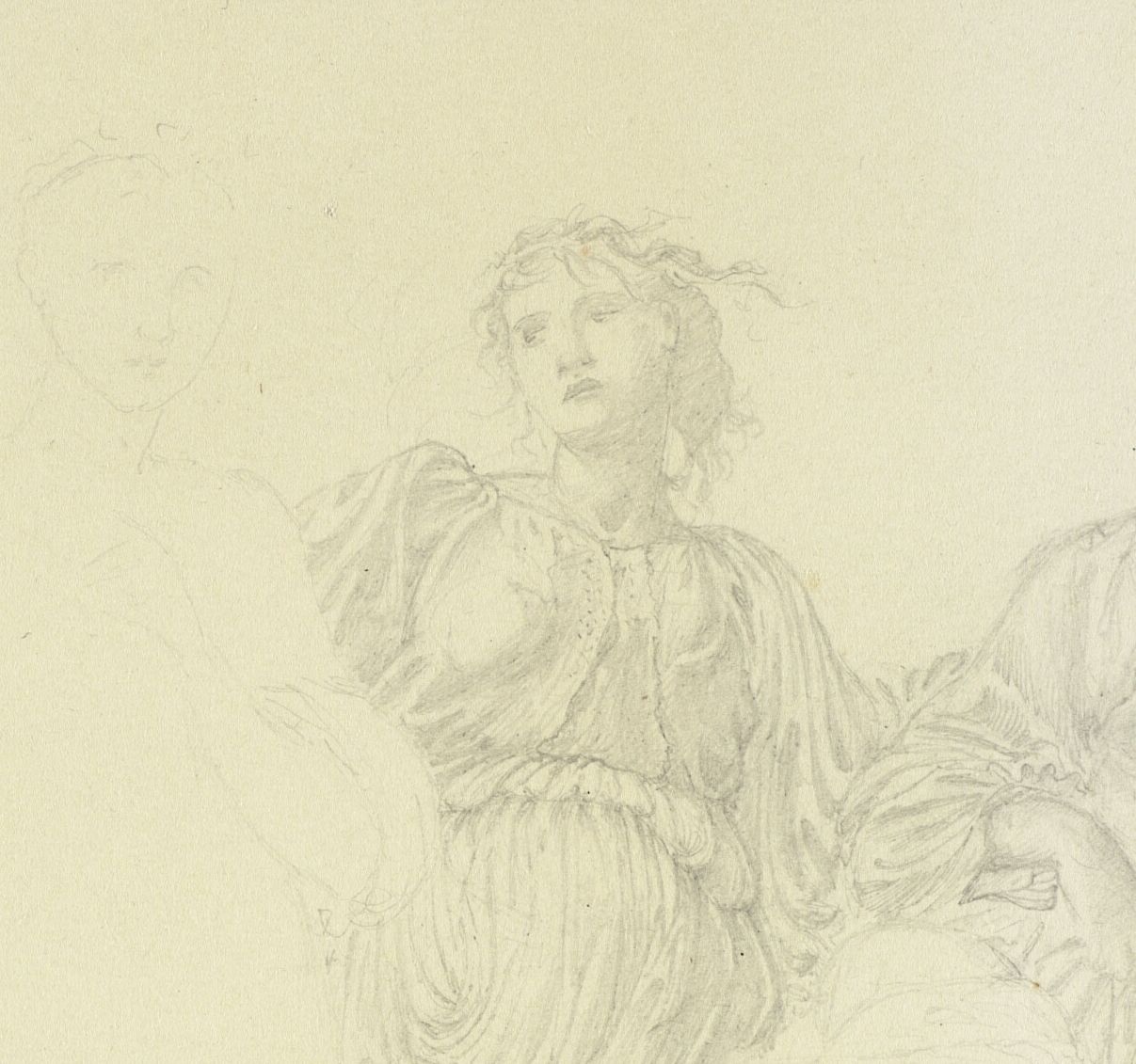
Where the figures overlap
Adjacent shoulders and sleeves are easier to distinguish than the legs. The concentrated lines let the upper figures read over the lightly worked lower part of the sheet.
From a study to a full-size cartoon
The Perseus cycle shows what could happen between a single figure and a picture made for a room. In the Getty’s Study for Perseus, about 1882, the hero launches himself into the air. Next to him is a separate trial of the backplate and shoulder armour. White chalk underlies opaque watercolour and brown essence, a thinned oil paint, on brown paper. The Getty describes the opaque greys and whites of the armour against the blue and the dilute wash used for the body. With Georgiana’s help Burne-Jones even fitted a clay model with armour. The study works out how the light on a hard surface can still make a moving figure read clearly. Elsewhere in the series he used pencil to work out a Gorgon’s wings, isolating the shape of a part that would have to read quickly in the crowded episode of Medusa’s death. [19] [18]
The figure belongs to Atlas Turned to Stone. Southampton City Art Gallery holds that scene among ten full-size gouache cartoons for the series, commissioned in 1875 by Arthur Balfour for the music room of his London home. The cartoon gives the flying figure a place relative to Atlas and shows how the two bodies fill the field. It could settle relationships that the separate armour study leaves open. The final oils survive in Stuttgart in varying stages of completion. Atlas Turned to Stone never reached a final painted version, making the cartoon the fullest surviving record of the scene’s composition. The distinction between the Getty drawing and the Southampton cartoon is a distinction of both scale and purpose. [19] [20] [21]
Paper designs also survive for work that changed dramatically as it was enlarged. The Fitzwilliam’s 1860 pen-and-ink Wedding Procession of Sir Degrevaunt was made for a mural at William Morris’s Red House. Its square sheet is only 26.5 centimetres across, and the museum describes scraping and moistening to work the ink. A related Birmingham study is marked with a grid for transfer. With a corresponding grid on the larger surface, the contents of each small square could be placed in proportion. The Fitzwilliam records John Christian’s suggestion that Giotto’s wedding procession at Padua informed the arrangement. The Arundel Society’s published woodcuts were one way the young artist could have known it. The Yale Center for British Art also holds a drawing in brown ink and graphite of The Wedding Feast of Sir Degrevaunt, a separate subject from the same story. [22] [23]
Designs for glass, tapestry and embroidery
For a stained-glass window, a preliminary drawing could help establish what the colour and arrangement would do before a workshop needed full-size information. In Yale’s Preparatory Design for a Stained Glass Window, Virgil and Horace, Burne-Jones used graphite and watercolour on cream wove paper. At a larger scale, the Met’s charcoal Noah stretches to 116.2 centimetres high. The patriarch was destined for one of four lights at Jesus College Chapel in Cambridge. His broad drapery folds and angular bearing have to remain legible once the figure is divided into sections of coloured and painted glass and joined with lead. The paper cartoon gives the glass painters a figure at a scale they can work from. [24] [25] [26]
For the Holy Grail tapestries, a photographic enlargement could do the work of moving from a small design to the size of the woven panel. The William Morris Gallery holds a photographic cartoon showing part of The Failure of Sir Gawain. At that stage Burne-Jones worked over the enlargements in ink, using sepia and white to clarify the contrasts. Tracing conveyed the design from the cartoon to the warp, where the weavers could follow it in the loom. The photograph was one of the working surfaces. Altering it helped specify how a drawn form would hold up when made from coloured threads. [27] [28]
Sometimes the same design crossed into a different craft. The harp-playing figures of Angeli Laudantes began as a glass design. John Henry Dearle adapted them for tapestry against a field of small flowers. For embroidery, a working drawing could also take on a second life as a picture in its own right. In Idleness and the Pilgrim of Love, Burne-Jones applied pastel, black chalk and watercolour over his earlier pencil cartoon for an embroidered frieze, working up a version he could sell as a separate artwork. An individual sheet might carry both the shapes needed for another material and a new surface intended to be looked at closely. [29] [30]
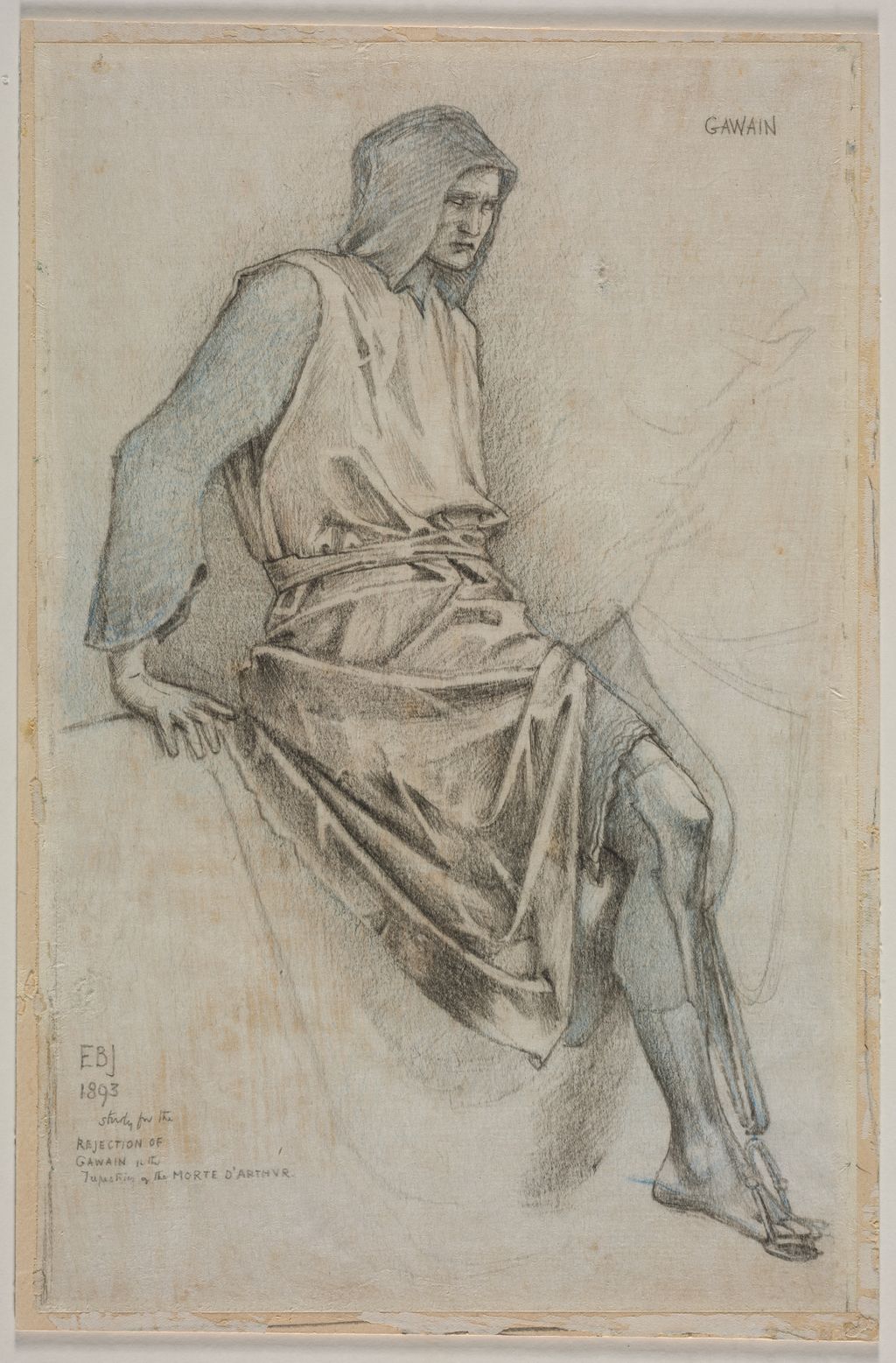
Edward Burne-Jones, Study for the Failure of Gawain. Cleveland Museum of Art, 2013.248. Image source. CC0 / Public domain.
Drawings made for the printed page
The work for engravers began decades before the Kelmscott Press. Tate holds four graphite studies for Ezekiel and the Boiling Pot, made around 1860, along with the design in ink and watercolour on vellum. The studies show Burne-Jones moving between parts of the scene and the whole composition. The change of support and medium brings the chosen arrangement together as a single image. The Dalziel Brothers’ illustrated Bible eventually published the design as a wood engraving in 1882. The long interval between design and publication is a reminder that a print’s date can tell a different story from the dates on the drawings behind it. [3]
The 1896 Kelmscott Chaucer lets us follow a drawing all the way to a printed impression. Burne-Jones’s soft pencil was one stage. Emery Walker photographed drawings, Robert Catterson-Smith worked the designs in ink for transfer to woodblocks and William Harcourt Hooper engraved them. The Morgan Library & Museum has a proof for an illustration to The Knight’s Tale, which lets the engraved treatment be seen on its own. Where the drawing can shade from dark to light by pressure, the printed page gets its tones from the density of marks and the intervals between them. The rendering of the figures can be read alongside the frame, border and lettering that William Morris supplied. At the Fitzwilliam, 87 finished drawings, earlier studies and the printed book survive as records of distinct stages in making the illustrations. [31] [32] [33]
Drawings eventually reached many viewers at their own exhibitions, and photographic copies brought the small originals to a wider audience. The Fine Art Society devoted its galleries to studies and drawings in 1896. When the New Gallery organised its retrospective after Burne-Jones’s death, it directed visitors to the Burlington Fine Arts Club for the companion drawing exhibition. The catalogue there lists Desiderium between an elaborate design in gold and watercolour and a pencil sheet of feet for The Golden Stairs. The company makes sense. A highly finished profile, a small set of observations tested against a staircase and a large design meant to be read across a room each repay attention to the physical surface. Each preserves a different decision about what a line had to do. [34] [35] [36] [2]
Edward Burne-Jones on film
Explore Burne-Jones’s paintings, illustrated stories and stained-glass designs.
Edward Burne-Jones: Pre-Raphaelite Visionary | Exhibitions | Showcase
A look at Burne-Jones’s paintings and the Tate retrospective.
Watch on YouTubeArtworks directory
This directory records paintings, studies, designs and collaborative works, with separate entries for documented versions and series where known.
| Name | Date | Medium |
|---|---|---|
| Sidonia von Bork 1560 | 1860 | Watercolour and bodycolour |
| Clara von Bork 1560 | 1860 | Watercolour and bodycolour |
| The Merciful Knight | 1863 | Watercolour |
| Sibylla Delphica | c. 1886 | Oil on panel |
| Phyllis and Demophoön | 1870 | Watercolour and bodycolour |
| The Legend of the Briar Rose (Buscot series) | 1870s–1890 | Oils on canvas |
| The Briar Wood (Buscot series) | By 1890 | Oil on canvas |
| The Council Chamber (Buscot series) | By 1890 | Oil on canvas |
| The Garden Court (Buscot series) | By 1890 | Oil on canvas |
| The Rose Bower (Buscot series) | By 1890 | Oil on canvas |
| Group of Women, study for The Golden Stairs | 1872 | Drawing |
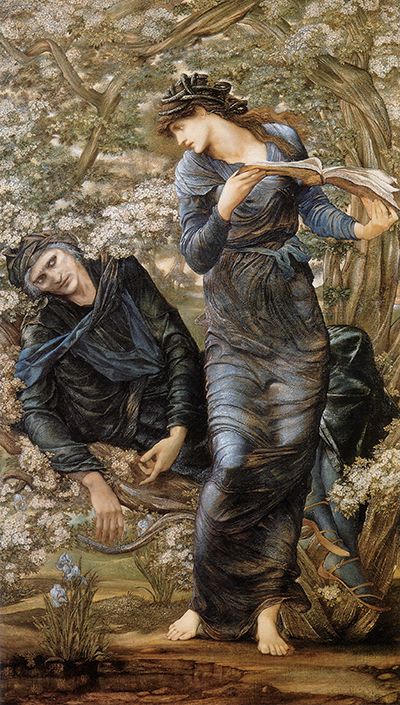
| The Beguiling of Merlin | 1870s | Oil on canvas |
| The Perseus Cycle | From 1875 | Paintings and full-scale designs |
| The Call of Perseus (Stuttgart) | From 1875 | Oil painting |
| Perseus and the Graeae (Stuttgart) | From 1875 | Oil painting |
| The Rock of Doom (Stuttgart) | 1884–88 | Oil on canvas |
| The Doom Fulfilled (Stuttgart) | 1888 | Oil on canvas |
| The Baleful Head (Stuttgart) | 1885–87 | Oil on canvas |
| The Baleful Head (Southampton design) | 1880s | Bodycolour |
| The Rock of Doom (Southampton design) | 1880s | Bodycolour |
| The Doom Fulfilled (Southampton design) | 1880s | Bodycolour |
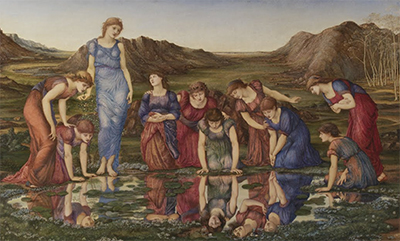
| The Mirror of Venus (Gulbenkian) | 1870s | Oil on canvas |
| Drawing associated with The Mirror of Venus | 1870s | Drawing |
| Laus Veneris (Laing) | 1873–78 | Oil on canvas |
| The Days of Creation | 1870s | Watercolour and bodycolour |
| The Golden Stairs | 1880 | Oil on canvas |
| An Angel Playing a Flageolet | 1878 | Watercolour, bodycolour and gold |
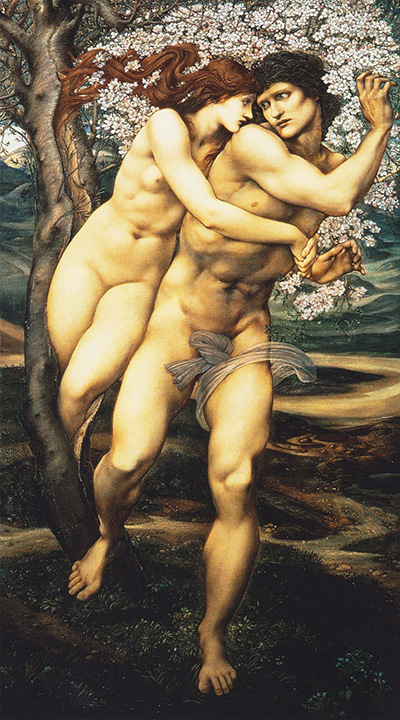
| The Tree of Forgiveness | 1881–82 | Oil on canvas |
| The Wheel of Fortune (Orsay) | 1875–83 | Oil on canvas |
| King Cophetua and the Beggar Maid | 1884 | Oil on canvas |
| The Depths of the Sea (oil) | 1886 | Oil |
| The Morning of the Resurrection | 1886 | Oil on panel |
| Study for the Head of Mary Magdalene | c. 1882 | Oil study |
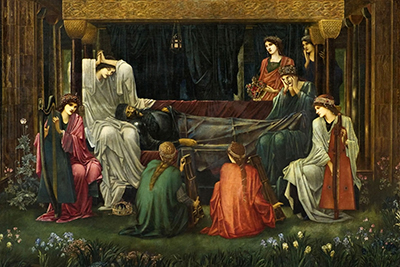
| The Sleep of King Arthur in Avalon | 1880s–1898 | Oil on canvas |
| The Sleep of King Arthur in Avalon (modello) | ca. 1881 | Oil on canvas (modello) |
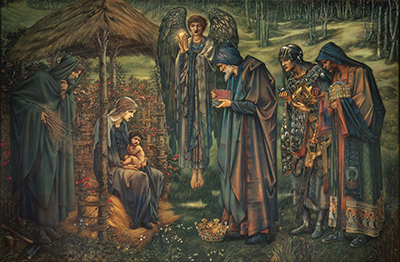
| The Star of Bethlehem | Signed 1890 | Watercolour and bodycolour |
| Study for The Star of Bethlehem | About 1887–91 | Drawing |
| Sponsa de Libano | 1891 | Watercolour and bodycolour |
| The Summons (Holy Grail tapestries) | 1890s | Tapestry |
| The Failure of Sir Gawaine (Holy Grail tapestries) | 1890s | Tapestry |
| Hope (Boston) | 1896 | Oil on canvas |
| La Belle au bois dormant (theatre programme) | 1894 | Collotype |
| The Wedding of Psyche | 1895 | Oil on canvas |
| The Works of Geoffrey Chaucer (Kelmscott edition) | 1896 | Illustrated book |
| The Ascension (Birmingham Cathedral) | 1885 | Stained glass |
| The Last Judgement (Birmingham Cathedral) | 1897 | Stained glass |
| Adoration of the Magi (Huntington) | 1890s | Tapestry |
| Love among the Ruins (Wightwick) | 1894 | Oil on canvas |
| The Merciful Knight (photogravure after Burne-Jones) | 1900 | Photogravure |
| The Garden Court (preparatory work) | 1870–75 | Graphite and watercolour with white gouache |
| Study of a Female Figure | 1885 | Graphite drawing |
| Psyche Throwing Herself into the River | 1865–68 | Wood engraving |
| Beauty | 1887–89 | Colour lithograph |
| Study for the Failure of Gawain | 1893 | Crayon and graphite on Japanese paper |
| The Prince Enters the Briar Wood (after Burne-Jones) | After 1890 | Photogravure |
| The Rose Bower (after Burne-Jones) | 1892 | Photogravure |
| Adoration of the Magi (Musée d’Orsay) | 1904 | Tapestry |
| Answers to Prayer (Lyndhurst) | 1860s | Stained glass |
| The Depths of the Sea (photogravure after Burne-Jones) | 1900 | Photogravure |
| Perseus and Andromeda (Adelaide composite) | 1876 | Oil on canvas |
| The Adoration of the Magi (Hamburg) | Woven 1900 | Tapestry |
| Love leading the Pilgrim through the Briars | 1874–76 | Embroidery |
| Musica (worked by Lady Jane Cory) | 1906 | Embroidery |
| Pomona (worked by Lady Jane Cory) | 1907 | Embroidery |
| Flora (worked by Lady Jane Cory) | 1909 | Embroidery |
| The Fourth Day of Creation (photogravure after Burne-Jones) | 1900 | Photogravure |
| The Morning of the Resurrection (photogravure after Burne-Jones) | 1900 | Photogravure |
| Musical angels of the St Catherine window (Christ Church) | Designed 1877 | Stained glass |
Discussion
Look again at the images and ideas explored in Edward Burne-Jones Drawings. These editorial prompts invite your observations.
Reader Insights
Which preparatory mark becomes most important in the finished work?
What can a full-scale cartoon convey to a workshop that a small sketch cannot?
Join the Conversation
Share a detail, comparison or question about Edward Burne-Jones Drawings below.
References
- Tate, Desiderium, 1873, N02760, catalogue description of the Spenser subject, project and graphite sheet. View source.
- Burlington Fine Arts Club, Exhibition of Drawings and Studies by Sir Edward Burne-Jones, Bart., 1899, cat. nos. 146–150, pp. 31–32, bound with the club’s catalogues. View source.
- Tate Britain, Edward Burne-Jones, 2018–19 exhibition guide, pp. 9, 31, 34, 37–43, 45–48 and 60–61. View source.
- Fitzwilliam Museum, Going to the Battle, 1223, support, medium, date range and collection image. View source.
- Stephen Wildman and John Christian, Burne-Jones Catalogue Raisonné, Going to Battle, NjAw, expertise, dating, technique and decorative motifs. View source.
- Metropolitan Museum of Art, Alice, la Belle Pèlerine, 2016.619, materials, subject, surface and join. View source.
- Victoria and Albert Museum, Perugino, and his rediscovery by the Pre-Raphaelites, leaf E.5-1955 and discussion of the October 1871 sketchbook entry and photograph albums. View source.
- National Gallery of Art, Washington, A Fragment from an Antique Frieze, 1995.52.14, medium, inscription and collection image. View source.
- Statens Museum for Kunst, Gruppe af kvinder. Forstudie til maleriet “The Golden Stairs”, KKS1980-240, 1872, object and image. View source.
- Tate, The Golden Stairs, N04005, museum text and image. View source.
- Fitzwilliam Museum, Studies of feet for ‘The Golden Stairs’, 1992, sheet and materials. View source.
- Susan Owens, Burning Bright: Essays in Honour of David Bindman, pp. 183–184, fig. 18.2 and discussion of the Ashmolean figure study 1939.15. View source.
- Musée d’Orsay, Étude de femme agenouillée, RF MO AG 2024 1, French collection entry, chalk and pastel technique and Montgolfier watermark. View source.
- Fitzwilliam Museum, Study, perhaps for ‘Cophetua and the Beggar Maid’, 1227, support, verso, and note on the 1862 work. View source.
- British Museum, British drawing collection records, Andromeda study 1967,1014.48, inscription, subject and medium. View source.
- Musée d’Orsay, Tête de jeune femme, étude pour ‘La Roue de la Fortune’, RF 1950, Recto, object record, date, subject and gift to the French state. View source.
- Burne-Jones Catalogue Raisonné, The Briar Rose Series: Study for the Garden Court for the second figure from the left, Birmingham Museums Trust 1961P50.2, medium, provenance and design changes. View source.
- Mitsubishi Ichigokan Museum, 2012 Annual Report, Burne-Jones exhibition checklist, p. 30, nos. 46 and 48–53. View source.
- J. Paul Getty Museum, Study for Perseus, 2023.16, materials, clay model, composition and dimensions. View source.
- Southampton City Art Gallery, The Perseus Series, commission and ten full-size gouache cartoons including Atlas Turned to Stone. View source.
- Staatsgalerie Stuttgart, Die Berufung des Perseus, series and collection context. View source.
- Fitzwilliam Museum, Design for the decoration of the Red House: ‘The Wedding Procession of Sir Degrevaunt’, 869, related squared study and note by John Christian. View source.
- Yale Center for British Art, Study for The Wedding Feast of Sir Degrevaunt, B1978.35, institution’s image and recorded medium. View source.
- Yale Center for British Art, Preparatory Design for a Stained Glass Window, Virgil and Horace, B1983.29, institution’s image and recorded medium. View source.
- Metropolitan Museum of Art, Noah, 48.52, drawing and Jesus College Chapel installation. View source.
- Alan Crawford, Burne-Jones as a Decorative Artist, PDF pp. 15–18, working scale of the glass cartoons, tapestry enlargements and workshop arrangements. View source.
- William Morris Gallery, Photographic Cartoon of a Detail of the Panel of Tapestry ‘The Failure of Sir Gawain’, BLPhA529, photographic enlargement and reworking. View source.
- Burne-Jones Catalogue Raisonné, Holy Grail Tapestries: Sir Gawaine and Sir Uwaine at the Chapel of the Sangreal, MTk5MTA, design transfer to the loom. View source.
- Metropolitan Museum of Art, Angels Praising (Angeli Laudantes), design origins and John Henry Dearle’s adaptation. View source.
- National Trust Collections, Idleness and the Pilgrim of Love, 584423, object data and the reworked embroidery cartoon. View source.
- University of Delaware Library, Museums and Press, A Book with a Claim to Beauty, Catterson-Smith presentation copy and the process from soft pencil through photography, ink and engraving. View source.
- Morgan Library & Museum, The Knight’s Tale, proof wood engraving by William Harcourt Hooper after Edward Burne-Jones for p. 15 of the Kelmscott Chaucer. View source.
- Fitzwilliam Museum, The pre-Raphaelites, Sydney Cockerell’s acquisitions of the Kelmscott Chaucer designs and preliminary drawings. View source.
- Malcolm Bell, Sir Edward Burne-Jones: A Record and Review, the account of the 1896 Fine Art Society exhibition of drawings and studies. View source.
- Burne-Jones Catalogue Raisonné, An Album of 62 Photographs by Frederick Hollyer of drawings after Sir Edward Burne-Jones, NTA1, album inventory including Desiderium. View source.
- New Gallery, Exhibition of the Works of Sir Edward Burne-Jones, 1898–99, prefatory note on the companion drawing exhibition at the Burlington Fine Arts Club. View source.