 by Tom Gurney
Tom Gurney BSc (Hons) is an art history expert with over 20 years experience
Published on June 19, 2020 / Updated on November 25, 2026
Email: tomgurney1@gmail.com / Phone: +44 7429 011000
The Depths of the Sea: Introduction
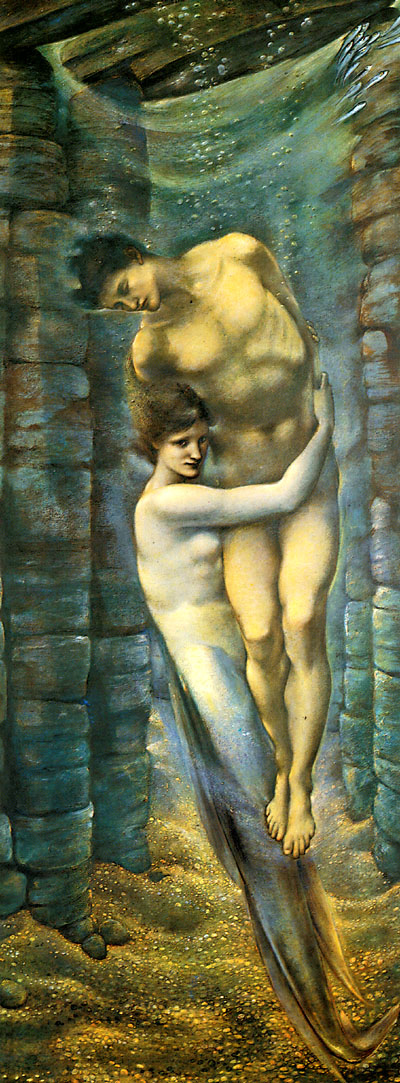
A mermaid holds a drowned sailor against her body as she carries him down through green water. She turns her face outward with a small smile, while his head drops against his shoulder. Edward Burne-Jones painted this scene twice at nearly the same height. The signed oil of 1886, now recorded in a private collection, measures 197 × 75 cm and appeared at that year's Royal Academy Summer Exhibition. The version illustrated here is the artist's signed watercolour and gouache of 1887, measuring 197 × 76 cm, in the Fogg Museum at Harvard Art Museums. [1] [2]
At a Glance
- ArtistEdward Burne-Jones
- Date1886
- MediumOil
- SubjectMermaid and captive
This work across Edward Burne-Jones’s career
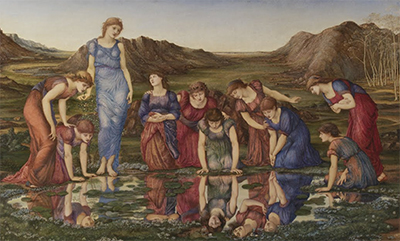
The Mirror of Venus
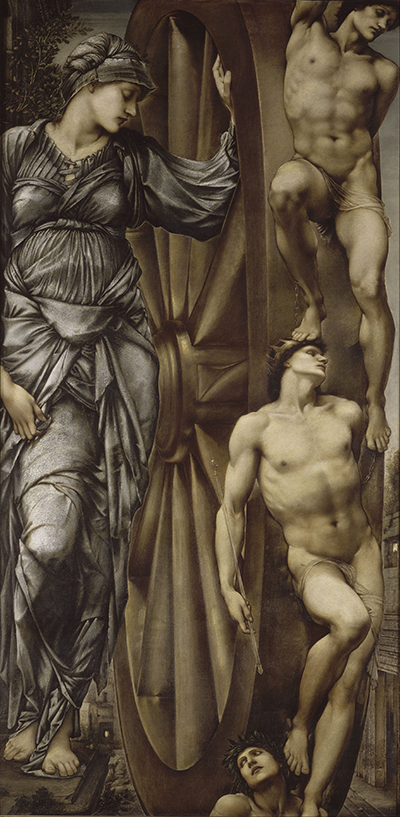
1870sThe Wheel of Fortune
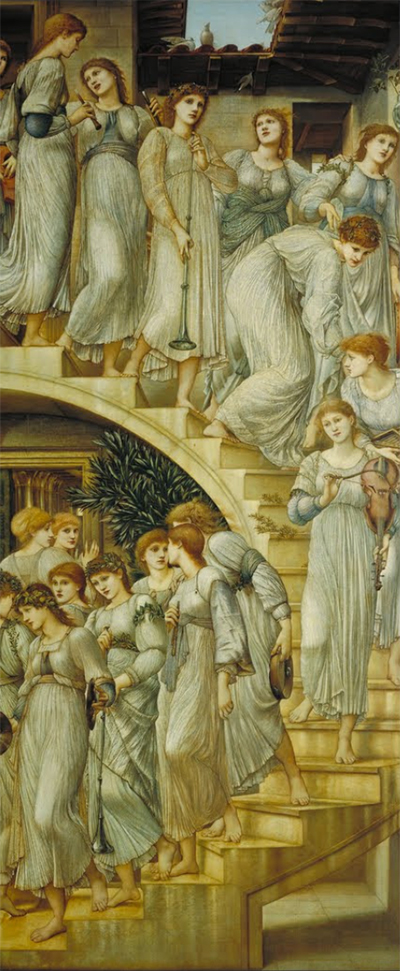
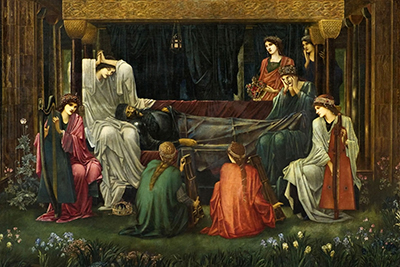
1875–83The Last Sleep of Arthur in Avalon
1880s–1898The Star of Bethlehem
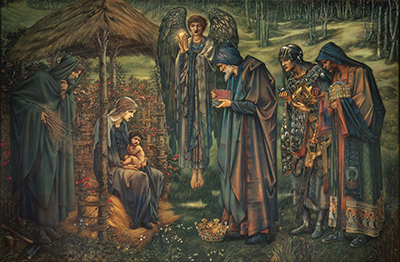
Signed 1890Contents
- The descent in the Harvard version
- The glass tank and the figure studies
- The expression and Laura Lyttelton
- The oil at the Royal Academy
- The story after the smile
- The 1887 watercolour and the 1900 print
- Annotated details
The descent in the Harvard version
The sailor's body takes up the centre of the picture. His head hangs towards the left and his shoulders tilt, yet his legs fall almost straight down. The mermaid presses close and stretches an arm across him. The pale curve of her forearm draws the eye towards her grip, while her tail continues the line of his legs towards the lower right, where it curls just above the seabed. A pose that might suggest an embrace on land reads differently when one of the two bodies hangs entirely slack. The pair descend together, but only one of them is swimming. [2]
Look beyond the figures and the setting grows more confined. Dark, pillar-like masses flank them, with a heavy band of rock-like forms along the upper edge. Tiny fish turn at the upper right and bubbles rise past the man's head. Reflections sweep across the scene in broad green-blue bands, and granular flecks of gold and ochre define the bottom. Overlapping rocks give a sense of distance, but the close-set sides leave little room for the bodies to move. The fish and bubbles give two upward paths for the eye as the long bend of the tail pulls it back down. [2] [3]
Burne-Jones distinguishes two bodies caught in the same light. Warm yellows remain on the sailor's shoulder, chest and thighs. Against them, the mermaid's skin looks pale and cool, passing into blue-grey along the tail. Her hair seems to lift slightly as it touches his torso. Her eyes meet ours from below his lowered face. The bright points on the seabed and the reflective curve of the tail can be seen first as patterns, but they also fix the direction of travel. His suspended feet hover against the brightly lit ground. [2]
The glass tank and the figure studies
The water began with a practical experiment. Henry Holiday recalled making a tank with a plate-glass front for a picture of the Rhine maidens from Wagner's Das Rheingold. He placed modelled figures and rocks in the tank and filled it with water coloured a transparent blue-green. He later lent the tank to Burne-Jones. The apparatus gave the painter something concrete to observe. Its usefulness is apparent in the way the scene can seem enclosed without becoming opaque. The spectator sees the bodies with unusual clarity while the colours and wavering bands give the water a presence of its own. [1] [3]
Frederic Leighton, then president of the Royal Academy, had seen the work ahead of the exhibition. Burne-Jones had considered leaving out the fish, but Leighton encouraged him to include them so that the submarine setting would register more readily. Their position shows how economical that addition was. A cluster in one corner is enough to bring the rest of the picture into focus as a space below water. The exchange also shows Leighton attending to a practical problem of exhibition. Someone encountering the picture among many others at Burlington House would have to recognise where the pair were before beginning to read their expressions. [3] [4]
The drawings preserve some of the choices behind that unusually still figure. The Fitzwilliam Museum holds a single study of the sailor's legs in blue chalk on tracing paper and a second sheet with three studies. These isolate the part of the pose farthest from the man's face, where the hanging feet have to convey the body's loss of control. The Victoria and Albert Museum owns a bound sketchbook with studies for both this picture and The Legend of the Briar Rose. The Ashmolean holds two watercolour studies of the subject. Together the sheets and sketchbook give a sense of how the artist worked through the figures and their arrangement before settling on the finished design. [5] [6] [7] [1]
The expression and Laura Lyttelton
Georgiana Burne-Jones remembered that she and her husband associated the mermaid's expression with their friend Laura Lyttelton, born Laura Tennant, whom they called the Siren. In her Memorials, Georgiana recalled the artist saying soon after beginning the painting that he was imagining a scene from Laura's previous existence. Laura died at Easter in 1886. Georgiana's account places the association at the start of the work, before Laura's death, and describes a likeness of expression. [4]
A drawing catalogued by Christie's as a portrait of Laura, with her eyes lowered, shows the artist had drawn her by 1885. The Lady Lever Art Gallery's graphite study expressly connected with the mermaid, shown at Tate Britain in 2018, is a separate object. The catalogue scholar John Christian thought that the study looked as though it had been made from a professional model. Lady Lewis, whose recollection Georgiana also printed, proposed another origin for the pictured face, a girl encountered on a country walk. The portrait and the recollections help explain the power of the association with Laura. The surviving evidence leaves the question of who sat for the head study open. [8] [9] [1] [4]
The oil at the Royal Academy
Burne-Jones had made his exhibition reputation at the Grosvenor Gallery. In 1885 the Royal Academy elected him an Associate, and his submission of the oil the following summer was his sole exhibition there before his resignation in 1893. With its nearly two-metre height and its strange incident, number 314 stood apart from the pictures around it. The Times reported that the hanging committee put it between portraits of women dressed in red, with small landscapes beneath the portraits and a stag-hunt scene below the mermaid. Burne-Jones had written to Frances Horner before the exhibition that he feared the picture would be lost in the Academy. The newspaper's account gives some idea of what he anticipated. [1] [4] [9]
F. G. Stephens in The Athenaeum admired the subtle colour and finish, although he found the male nude comparatively weak and wanted a larger mermaid. The Times wondered whether the figures really gave the impression of water between themselves and the spectator, but compared her expression with Leonardo's work. The two responses single out the face even as they question other aspects of the painting. For Stephens it was the strongest part of a picture with an unusual subject. For The Times it offered an instant of triumph whose character was difficult to place. His study of the nude made the man’s weight legible. The mermaid’s expression left her intention harder to read. [1]
The same question about depth came up beyond London. Reviewing the 1893 Salon at the Champ de Mars, the French critic George Lafenestre admired the drawing of the intertwined figures and felt that their sharply modelled bodies weakened the impression of moving through a great weight of water. An article in the German journal Zeitschrift für bildende Kunst in 1895 praised both the smile and the transparent depths of the Academy picture. The apparent clarity of the water, which some viewers felt broke the illusion, was for others one of Burne-Jones's achievements. [10] [11]
The story after the smile
The New Gallery's 1898–99 memorial exhibition catalogue described the oil as the moment of the mermaid's triumph, before she has realised the sailor is dead. It also printed the Latin motto used in 1886. Part of the motto comes from Book IV of Virgil's Aeneid, where Juno tells Venus that she has obtained all she desired as Dido falls in love with Aeneas. The added address to an unhappy recipient makes the sense of a victory turn towards regret. The line supplies a parallel about getting what one wishes for, while the picture leaves the mermaid somewhere between satisfaction and recognition. [12] [1] [13]
The writer E. Nesbit gave that moment a before and after in her sonnets for the painting. Her mermaid longs for the upper air, watches a strong man bending to his oar and imagines possession as the end of loneliness. In the second sonnet she carries the sailor off, and Nesbit imagines her future grief when she discovers what she has lost in obtaining her wish. A speaker who longs for another person draws a parallel with the mermaid in both sonnets, extending the story beyond the sea. Its opening motto is the one associated with the picture. Burne-Jones leaves that act of imagining to the spectator, whose view begins with the man already held fast. [14]
The subject also acquires definition alongside other works about the encounter between people and water creatures. Leighton's The Fisherman and the Syren, inspired by Goethe's Der Fischer, holds its two figures at the moment of enticement. John William Waterhouse's later Hylas and the Nymphs places Hylas at the edge of a pool, where several faces draw his attention below him. Burne-Jones shows a later stage of such an encounter. His lone mermaid looks outward, leaving the viewer in the uncomfortable position of knowing something the figure who commands the scene has yet to discover. The art historian Suzanne Fagence Cooper places Burne-Jones and Leighton together in a broader study of water, music and femininity in Victorian Aestheticism. [3] [15] [16]
In Burne-Jones’s earlier A Sea-Nymph of 1881, now in Minneapolis, a mermaid rises among the waves, holding a fish in each hand. The fish in that painting give her something to do and occupy the foreground. In The Depths of the Sea they have retreated to the top corner, leaving the space below to the sailor and his captor. The Spanish scholar Leticia Bravo Banderas points to the mermaid’s look out of the picture as central to its unsettling effect. Her comparison of Burne-Jones and Waterhouse shows how varied the Victorian figure of the siren could be, even across pictures concerned with the dangers of the water. [17] [18]
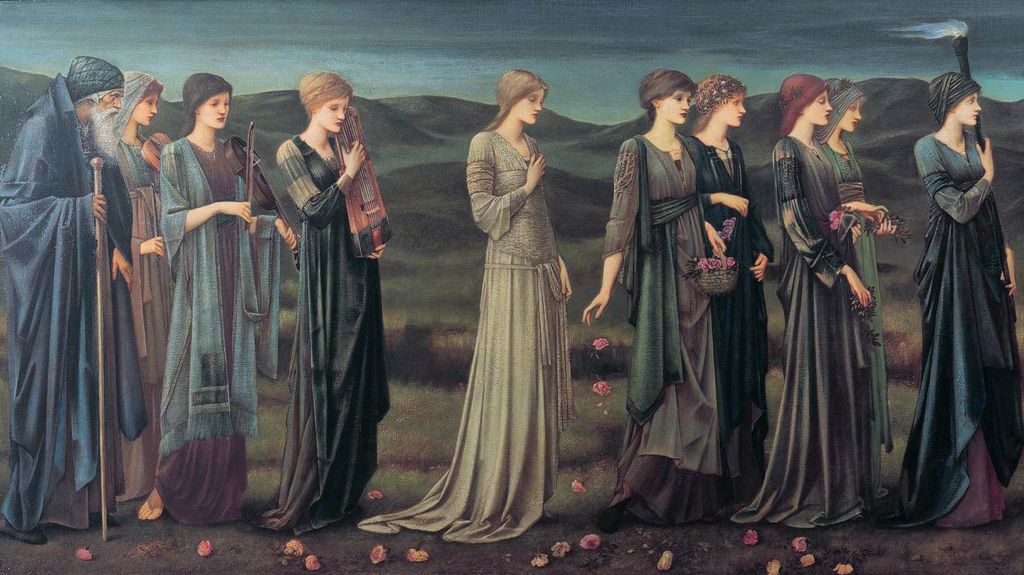
Edward Burne-Jones, The Wedding of Psyche. Royal Museums of Fine Arts of Belgium. Image source. Public domain.
The 1887 watercolour and the 1900 print
Harvard's record contains evidence of when the support for its version was assembled. The museum found that the wove paper had been mounted on another sheet and attached to a panel. The paint continues past the edge of the primary sheet, showing that the support was mounted before Burne-Jones painted it. Gouache is also the medium of the artist's initials and date in the lower left. The panel gives a work more than six feet tall a rigid support, while the combination of watercolour and gouache allows passages of translucent colour and denser, lighter paint to share the same surface. [2]
On the back, a Grosvenor Gallery label lists an asking price of £900 for the Intercolonial Exhibition. Harvard records the painting at that exhibition in 1889 and at the Walker Art Gallery's autumn exhibition in 1897. Grenville L. Winthrop acquired it from Jacques Seligmann and Co. in 1935 and bequeathed it to the Fogg in 1943. These exhibitions and ownership records belong to the watercolour. Harvard lists the watercolour in a show drawn from the Winthrop collection at Tokyo’s National Museum of Western Art in 2002, and the Musée des Beaux-Arts de Lyon listed the watercolour the following year in its own Winthrop exhibition. The oil, which Mrs R. H. Benson lent to the posthumous New Gallery exhibition, went on to appear in the Burne-Jones retrospective at the Musée d'Orsay in 1999 and at Tate Britain in 2018. [2] [19] [20] [12] [1] [9]
A third record of the composition reached viewers as a work on paper. In 1900 the Berlin Photographic Company published a photogravure after the 1886 oil in its portfolio of Burne-Jones prints. The impression at Te Papa has an image area of 195 × 515 mm and carries the arrangement of the oil into ink. The silhouette of the sailor's head and the diagonal sweep of the tail are easy to follow in the print. The dark face of the pillar on the left makes the pale arm stand out across the sailor’s waist, and the small fish read as a cluster of light strokes above the two bodies. In the Harvard watercolour, the cool pillar beside the warm torso and the gold-speckled ground make those same shapes feel submerged in coloured light. The print helps show how much of that effect already lay in the design, and how much the colour can add. [21] [2]
Annotated Details from The Depths of the Sea
The numbered points identify visible features discussed in this article. Return from each detail to the numbered overview. The Depths of the Sea, photogravure published by the Berlin Photographic Company in 1900, after the 1886 oil. Museum of New Zealand Te Papa Tongarewa, 1981-0086-1/77. Image source. No Known Copyright Restrictions.
.jpg)
Details from THE DEPTHS OF THE SEA
Compare the cropped details with the source images above. Notice how their colours, shapes and positions contribute to the larger compositions.
A face turned outwards
The mermaid turns her face out of the narrow group. The man’s tilted head and closed eyes direct attention back into it.
 Detail 01 a-face-turned-outwards.jpg)
The enclosing arm
The mermaid’s forearm crosses the larger body and closes the space between them. The print preserves the sharp silhouette of that grip.
 Detail 02 the-enclosing-arm.jpg)
Near the sea floor
The tail makes a long curve around the sailor’s feet. Rocks and small marks on the seabed give the curve a visible end.
 Detail 03 near-the-sea-floor.jpg)
Edward Burne-Jones on film
Explore Burne-Jones’s paintings, illustrated stories and stained-glass designs.
Edward Burne-Jones: Pre-Raphaelite Visionary | Exhibitions | Showcase
A look at Burne-Jones’s paintings and the Tate retrospective.
Watch on YouTubeArtworks directory
This directory records paintings, studies, designs and collaborative works, with separate entries for documented versions and series where known.
| Name | Date | Medium |
|---|---|---|
| Sidonia von Bork 1560 | 1860 | Watercolour and bodycolour |
| Clara von Bork 1560 | 1860 | Watercolour and bodycolour |
| The Merciful Knight | 1863 | Watercolour |
| Sibylla Delphica | c. 1886 | Oil on panel |
| Phyllis and Demophoön | 1870 | Watercolour and bodycolour |
| The Legend of the Briar Rose (Buscot series) | 1870s–1890 | Oils on canvas |
| The Briar Wood (Buscot series) | By 1890 | Oil on canvas |
| The Council Chamber (Buscot series) | By 1890 | Oil on canvas |
| The Garden Court (Buscot series) | By 1890 | Oil on canvas |
| The Rose Bower (Buscot series) | By 1890 | Oil on canvas |
| Group of Women, study for The Golden Stairs | 1872 | Drawing |
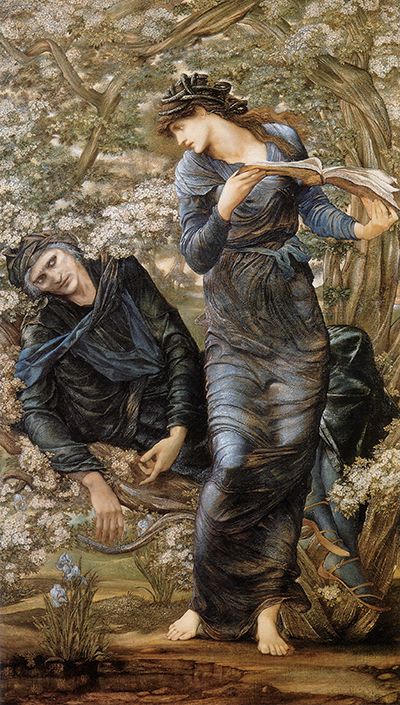
| The Beguiling of Merlin | 1870s | Oil on canvas |
| The Perseus Cycle | From 1875 | Paintings and full-scale designs |
| The Call of Perseus (Stuttgart) | From 1875 | Oil painting |
| Perseus and the Graeae (Stuttgart) | From 1875 | Oil painting |
| The Rock of Doom (Stuttgart) | 1884–88 | Oil on canvas |
| The Doom Fulfilled (Stuttgart) | 1888 | Oil on canvas |
| The Baleful Head (Stuttgart) | 1885–87 | Oil on canvas |
| The Baleful Head (Southampton design) | 1880s | Bodycolour |
| The Rock of Doom (Southampton design) | 1880s | Bodycolour |
| The Doom Fulfilled (Southampton design) | 1880s | Bodycolour |
| The Mirror of Venus (Gulbenkian) | 1870s | Oil on canvas |
| Drawing associated with The Mirror of Venus | 1870s | Drawing |
| Laus Veneris (Laing) | 1873–78 | Oil on canvas |
| The Days of Creation | 1870s | Watercolour and bodycolour |
| The Golden Stairs | 1880 | Oil on canvas |
| An Angel Playing a Flageolet | 1878 | Watercolour, bodycolour and gold |
| The Tree of Forgiveness | 1881–82 | Oil on canvas |
| The Wheel of Fortune (Orsay) | 1875–83 | Oil on canvas |
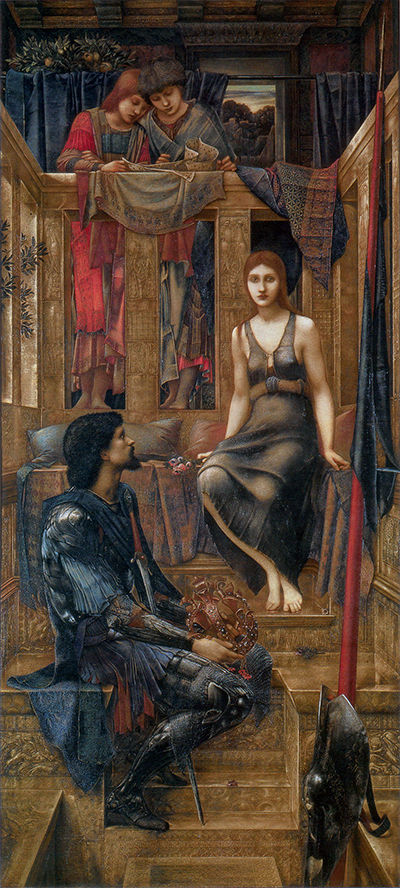
| King Cophetua and the Beggar Maid | 1884 | Oil on canvas |
| The Depths of the Sea (oil) | 1886 | Oil |
| The Morning of the Resurrection | 1886 | Oil on panel |
| Study for the Head of Mary Magdalene | c. 1882 | Oil study |
| The Sleep of King Arthur in Avalon | 1880s–1898 | Oil on canvas |
| The Sleep of King Arthur in Avalon (modello) | ca. 1881 | Oil on canvas (modello) |
| The Star of Bethlehem | Signed 1890 | Watercolour and bodycolour |
| Study for The Star of Bethlehem | About 1887–91 | Drawing |
| Sponsa de Libano | 1891 | Watercolour and bodycolour |
| The Summons (Holy Grail tapestries) | 1890s | Tapestry |
| The Failure of Sir Gawaine (Holy Grail tapestries) | 1890s | Tapestry |
| Hope (Boston) | 1896 | Oil on canvas |
| La Belle au bois dormant (theatre programme) | 1894 | Collotype |
| The Wedding of Psyche | 1895 | Oil on canvas |
| The Works of Geoffrey Chaucer (Kelmscott edition) | 1896 | Illustrated book |
| The Ascension (Birmingham Cathedral) | 1885 | Stained glass |
| The Last Judgement (Birmingham Cathedral) | 1897 | Stained glass |
| Adoration of the Magi (Huntington) | 1890s | Tapestry |
| Love among the Ruins (Wightwick) | 1894 | Oil on canvas |
| The Merciful Knight (photogravure after Burne-Jones) | 1900 | Photogravure |
| The Garden Court (preparatory work) | 1870–75 | Graphite and watercolour with white gouache |
| Study of a Female Figure | 1885 | Graphite drawing |
| Psyche Throwing Herself into the River | 1865–68 | Wood engraving |
| Beauty | 1887–89 | Colour lithograph |
| Study for the Failure of Gawain | 1893 | Crayon and graphite on Japanese paper |
| The Prince Enters the Briar Wood (after Burne-Jones) | After 1890 | Photogravure |
| The Rose Bower (after Burne-Jones) | 1892 | Photogravure |
| Adoration of the Magi (Musée d’Orsay) | 1904 | Tapestry |
| Answers to Prayer (Lyndhurst) | 1860s | Stained glass |
| The Depths of the Sea (photogravure after Burne-Jones) | 1900 | Photogravure |
| Perseus and Andromeda (Adelaide composite) | 1876 | Oil on canvas |
| The Adoration of the Magi (Hamburg) | Woven 1900 | Tapestry |
| Love leading the Pilgrim through the Briars | 1874–76 | Embroidery |
| Musica (worked by Lady Jane Cory) | 1906 | Embroidery |
| Pomona (worked by Lady Jane Cory) | 1907 | Embroidery |
| Flora (worked by Lady Jane Cory) | 1909 | Embroidery |
| The Fourth Day of Creation (photogravure after Burne-Jones) | 1900 | Photogravure |
| The Morning of the Resurrection (photogravure after Burne-Jones) | 1900 | Photogravure |
| Musical angels of the St Catherine window (Christ Church) | Designed 1877 | Stained glass |
Discussion
Look again at the images and ideas explored in The Depths of the Sea. These editorial prompts invite your observations.
Reader Insights
At what point in looking did you notice that the mermaid’s expression and her captive’s body tell different parts of the story?
Which marks in the water give the best impression of depth or movement?
Join the Conversation
Share a detail, comparison or question about The Depths of the Sea below.
References
- Burne-Jones Catalogue Raisonné, The Depths of the Sea, 1886 oil, John Christian and William Waters entries, exhibition and bibliography tables. View source.
- Harvard Art Museums / Fogg Museum, The Depths of the Sea, object 1943.462, physical description, inscriptions, provenance and exhibition history. View source.
- The Metropolitan Museum of Art, A Private Passion, catalogue no. 170, p. 384 and fig. 177. View source.
- Georgiana Burne-Jones, Memorials of Edward Burne-Jones, vol. II, pp. 165–66 and 307. View source.
- Fitzwilliam Museum, Study for “The Depths of the Sea”: single study of legs, 964(1). View source.
- Fitzwilliam Museum, Study for “The Depths of the Sea”: three studies, 964(2). View source.
- Mitsubishi Ichigokan Museum, Aubrey Beardsley exhibition checklist, no. 13, Victoria and Albert Museum sketchbook E.442-1943. View source.
- Christie's, Portrait of Laura Lyttelton, née Tennant, bust-length, with her eyes downcast, lot 5396363. View source.
- Tate Britain, Edward Burne-Jones exhibition guide, pp. 47 and 73, Lady Lever head study and private oil. View source.
- George Lafenestre, “Les Salons de 1893. II. La Peinture au Champ de Mars et la Sculpture dans les deux salons,” Revue des Deux Mondes 118, pp. 164–96. View source.
- Zeitschrift für bildende Kunst, “Burne-Jones,” signed Schl., new series VI, no. 4, 1895, p. 97. View source.
- New Gallery, Exhibition of the Works of Sir Edward Burne-Jones, 1898–99, p. 61, no. 101. View source.
- Virgil, Aeneid, IV.90–104, Latin text edited by R. A. B. Mynors. View source.
- E. Nesbit, Lays and Legends, “The Depths of the Sea,” pp. 153–54. View source.
- Manchester Art Gallery, Hylas and the Nymphs, John William Waterhouse, 1896, collection image and subject. View source.
- Suzanne Fagence Cooper, “The Liquefaction of Desire: Music, Water and Femininity in Victorian Aestheticism,” Women: A Cultural Review 20, no. 2, 2009. View source.
- Minneapolis Institute of Art, A Sea-Nymph, 1881, object 2010.83. View source.
- Leticia Bravo Banderas, “Sirenas victorianas o la recreación de la iconografía clásica en la pintura de Sir Edward Burne-Jones y John William Waterhouse,” pp. 142–47. View source.
- National Museum of Western Art, Tokyo, Between Reality and Dreams, Winthrop Collection exhibition, 2002. View source.
- Musée des Beaux-Arts de Lyon, Winthrop exhibition press dossier, work list entry Les Profondeurs de la mer, 1887. View source.
- Museum of New Zealand Te Papa Tongarewa, The Depths of the Sea, registration 1981-0086-1/77, production, medium and image dimensions. View source.