 by Tom Gurney
Tom Gurney BSc (Hons) is an art history expert with over 20 years experience
Published on June 19, 2020 / Updated on November 25, 2026
Email: tomgurney1@gmail.com / Phone: +44 7429 011000
The Doom Fulfilled by Edward Burne-Jones: Introduction
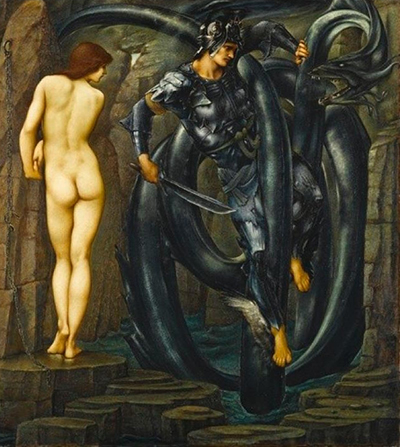
Andromeda stands on a rock at the left of Edward Burne-Jones’s The Doom Fulfilled, her back to us and her head turned towards the fight. Perseus is already inside the sea monster’s coils. His sword cuts a bright diagonal across the dark tangle, while his free hand pushes against the creature’s neck. The princess has been released from her chains, but the combat on which her rescue depends is still under way. Burne-Jones completed this oil on canvas in 1888. It measures 155 by 140.5 centimetres and belongs to the Staatsgalerie Stuttgart. [1]
At a Glance
- ArtistEdward Burne-Jones
- Date1888
- MediumOil on canvas
- SubjectPerseus’s fight with the sea monster
This work across Edward Burne-Jones’s career
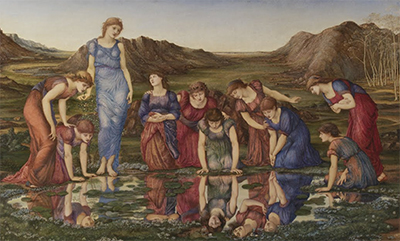
The Mirror of Venus
1870sThe Wheel of Fortune
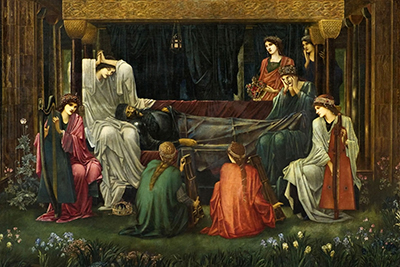
1875–83The Last Sleep of Arthur in Avalon
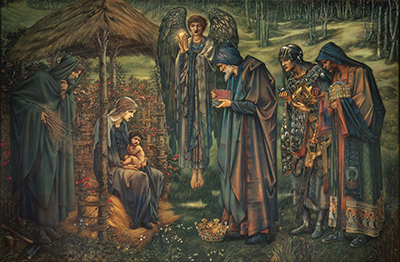
1880s–1898The Star of Bethlehem
Signed 1890Contents
- The coils and the sword
- The fight in William Morris’s poem
- From a shared canvas to separate episodes
- Working out Andromeda and the serpent
- From the Southampton design to the Stuttgart oil
- Another way to picture the rescue
- At the New Gallery and in Stuttgart
- Annotated details
The coils and the sword
Follow the sea monster from its open mouth at the upper right. The head turns towards Perseus while the rest of the creature bends away, sweeps down beside him and rises again from the water. One long curve arches over his helmet. Lower down, the dark body passes in front of and behind his legs, so that it takes a moment to separate one form from another. The contour of the sword is easier to follow, even where it crosses the monster’s flank. Its pale edge carries the eye out of the loops towards the part of the picture where the next movement might happen. The National Gallery of Art’s exhibition guide reproduces the oil with these coils occupying most of the centre and right of the canvas. [2]
The overlapping shapes also make it difficult to tell at a glance where flesh gives way to armour. Bands of silvery light pick out Perseus’s breastplate and shoulder, and narrower glints run down the creature’s body. The bright bare feet are easier to locate than the dark greaves above them. The monster could almost be clad in the same material as its opponent. Their difference becomes clearest at the edges of the shapes. Perseus’s plates meet in joints and points, while the serpent’s body keeps curving until another part of it blocks the view. The confined shoreline gives those turns extra weight. At the bottom, flat-topped rocks interrupt the narrow channels of water. Higher up, rock closes around the encounter, with little prospect beyond it.
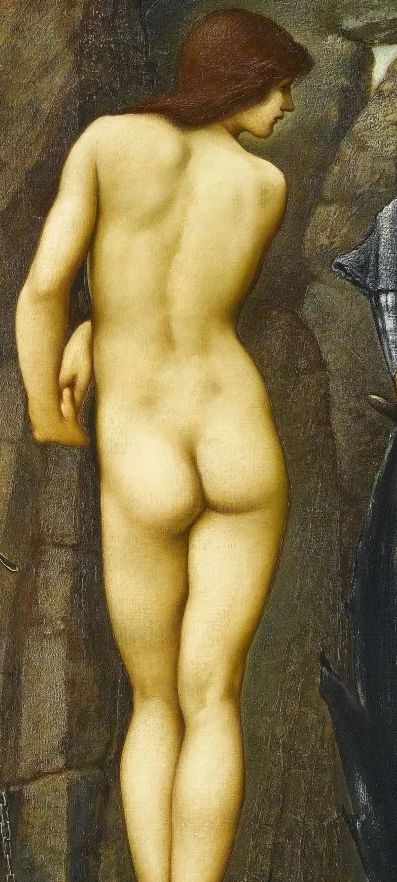
At left, Andromeda’s foot rests on one of the few level surfaces, with her other heel slightly raised. The change of weight gives her back and hips a gentle turn. Her hair and the glimpse of her profile carry the turn further towards the struggle. Much of the drama is visible to her, but very little of her reaction is available to the viewer. Tate’s 2018 exhibition guide identifies the enemy as Cetus and describes the scene as following her release. The painting puts the two kinds of confinement side by side. Andromeda has the small ledge to stand on. It is the armed figure who now has to contend with the monster closing around him. [3]
Annotated Details from The Doom Fulfilled
The numbered points identify visible features discussed in this article. Return from each detail to the numbered overview. Edward Burne-Jones, The Doom Fulfilled, 1888. Staatsgalerie Stuttgart, inventory 3109. Image source. Public domain.
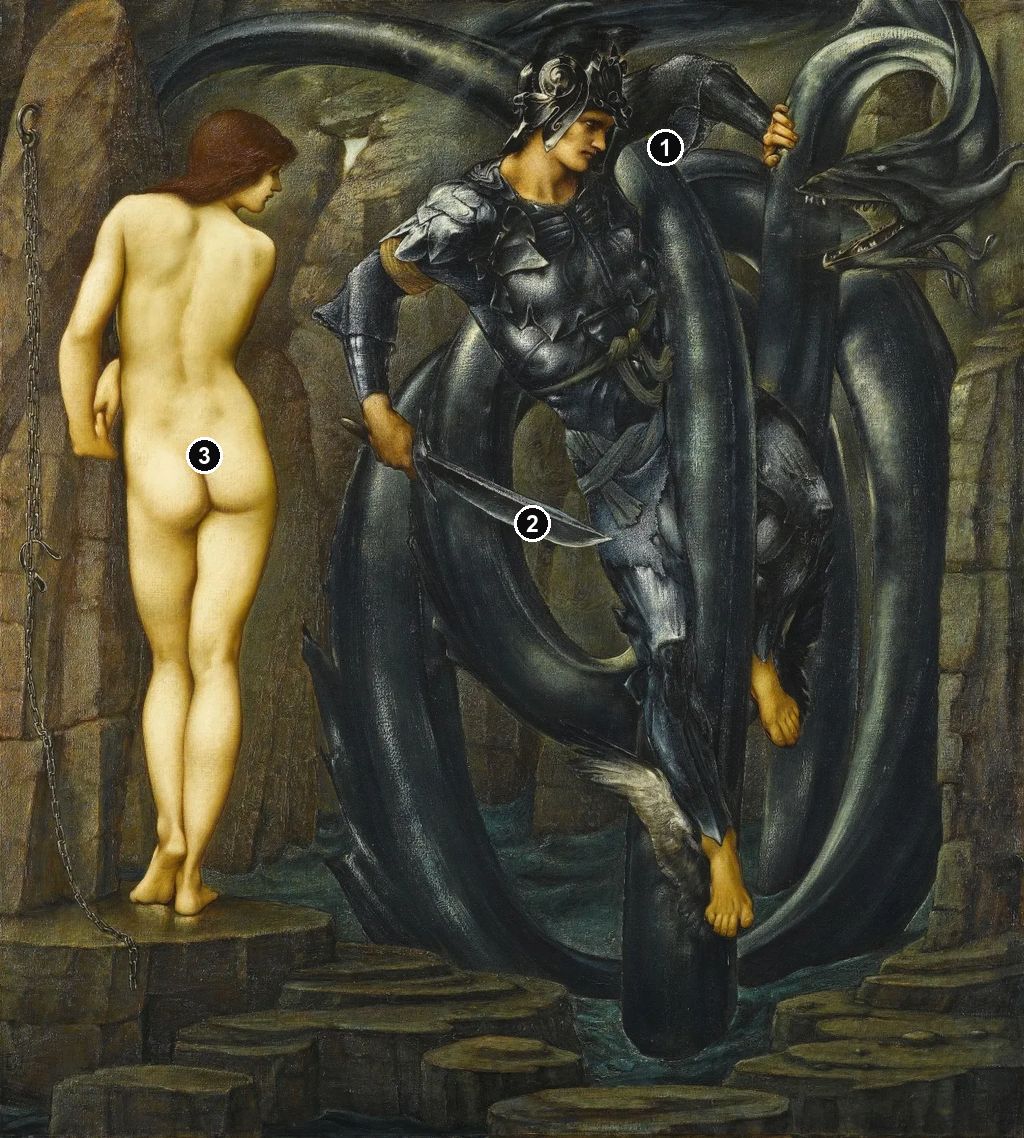
Details from THE DOOM FULFILLED
Compare the cropped details with the source images above. Notice how their colours, shapes and positions contribute to the larger compositions.
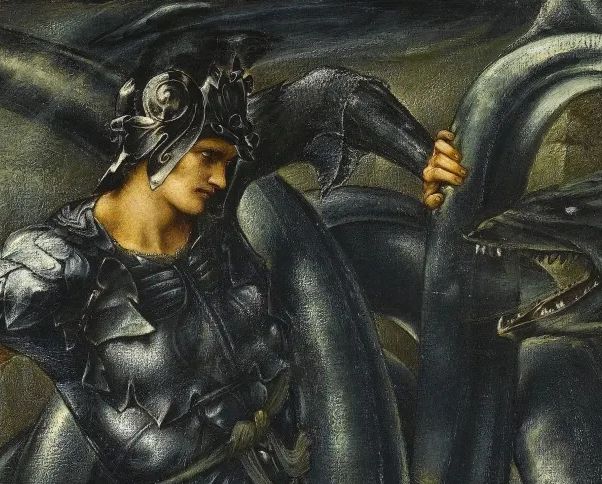
The raised sweep of the monster
One broad loop passes above Perseus and joins the tangle at his side. Its outer edge crosses the background cliffs.
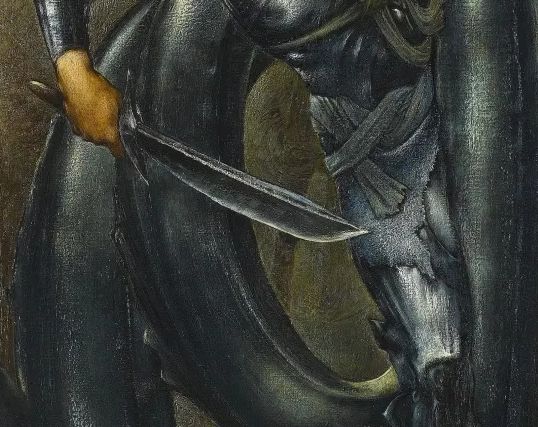
The sword across the coils
The bright blade runs across the turn of the creature’s body. Its straight edge makes the arm and weapon easier to follow through the overlapping forms.
Andromeda on the left
Her back and the outline of her legs are held against the rock and water. The upright position gives her a separate space beside the fight.
The fight in William Morris’s poem
For the Perseus cycle, Burne-Jones drew on William Morris’s The Doom of King Acrisius, the classical tale for April in The Earthly Paradise. Perseus reaches Andromeda after winning Medusa’s head. Andromeda has been offered up to a monster sent against her country, and in Morris’s poem the people onshore hear the terror of its approach. Perseus puts Andromeda gently aside before running towards the creature. She sinks down shivering as it rears up. Its head has burning eyes and tufts of grey hair like moss on a tree. The sword flashes just before the blood darkens it. The story then follows Perseus and Andromeda beyond the rescue, eventually reaching the death of Acrisius that the poem’s title foretells. [4]
Burne-Jones keeps the sword and the black folds of the creature. He gives those folds a smooth, shining surface and enlarges them until their circuits set the pace of the picture. The town and the noise of the approaching monster have dropped out of sight. Andromeda remains upright through the encounter, within a few steps of Perseus. That last change gives the picture time to hold both the fight and the figure watching it. Morris can say what her body feels as she sinks, while Burne-Jones makes us attend to the little he lets us see of her face.
From a shared canvas to separate episodes
Arthur Balfour, the future British prime minister, commissioned the Perseus series in 1875 for the music room of his house at 4 Carlton Gardens, London. The National Gallery of Art describes a plan for ten large canvases arranged high on the walls as a frieze. Southampton City Art Gallery preserves ten full-size designs for the project. Only four oil paintings were brought to completion. One of Tate’s early designs shows how extensively Burne-Jones reconsidered the arrangement. It puts the encounter and fight together on a single wall design with Atlas Turned to Stone, The Court of Phineas and The Baleful Head. The design also belongs to a group that sets out the pictures’ relationship to the room’s doors, fireplace and proposed decorative plasterwork. [3] [5]
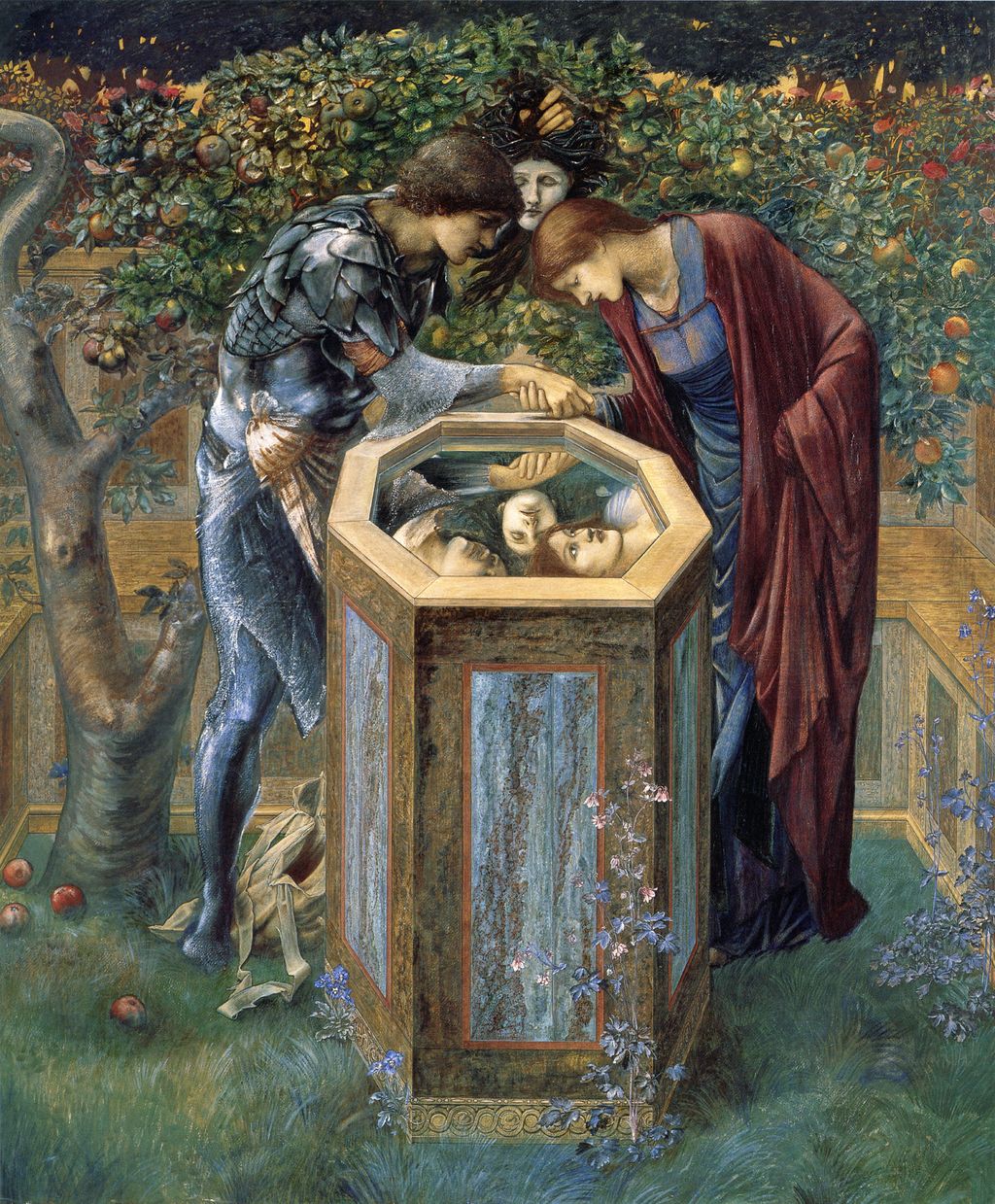
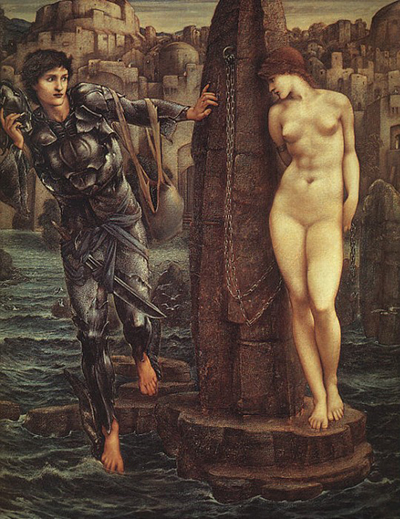
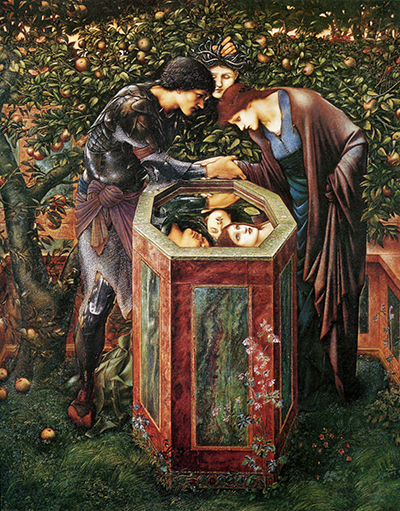
Athena sends Perseus on the quest in The Call of Perseus. By the time he reaches Andromeda, the search for Medusa and the winning of her head are already behind him. [6] The adjoining episodes help locate the action in the finished paintings. In The Rock of Doom, the chain still holds Andromeda to the rock, and Perseus removes the helmet that made him invisible. Behind them are water and the buildings of Joppa. By The Doom Fulfilled, the outer world has contracted to the few rocks and channels around the combat. Andromeda has moved to the left and turned her back towards us. In The Baleful Head, Perseus shows her Medusa’s head through its reflection in a well. The figures bend together to look at the water, which had been broken by the rocks and the monster’s body during the rescue. The New Gallery’s 1898 retrospective catalogue describes the three episodes in that narrative order, even though the last scene had been publicly exhibited before the two rescue canvases. [7]
An unfinished oil of 1876, Perseus and Andromeda, in the Art Gallery of South Australia, shows what setting the episodes side by side within one composition would have meant. The encounter occurs on the left, where the chained Andromeda meets Perseus. The fight unfolds at the right, and her back turns towards us as the story advances across the canvas. A single glance can take in her two positions. Separating the episodes gave Burne-Jones enough space to let each posture dominate its own setting. It also made the shift from the view of Joppa to close quarters with the serpent more pronounced. [8]
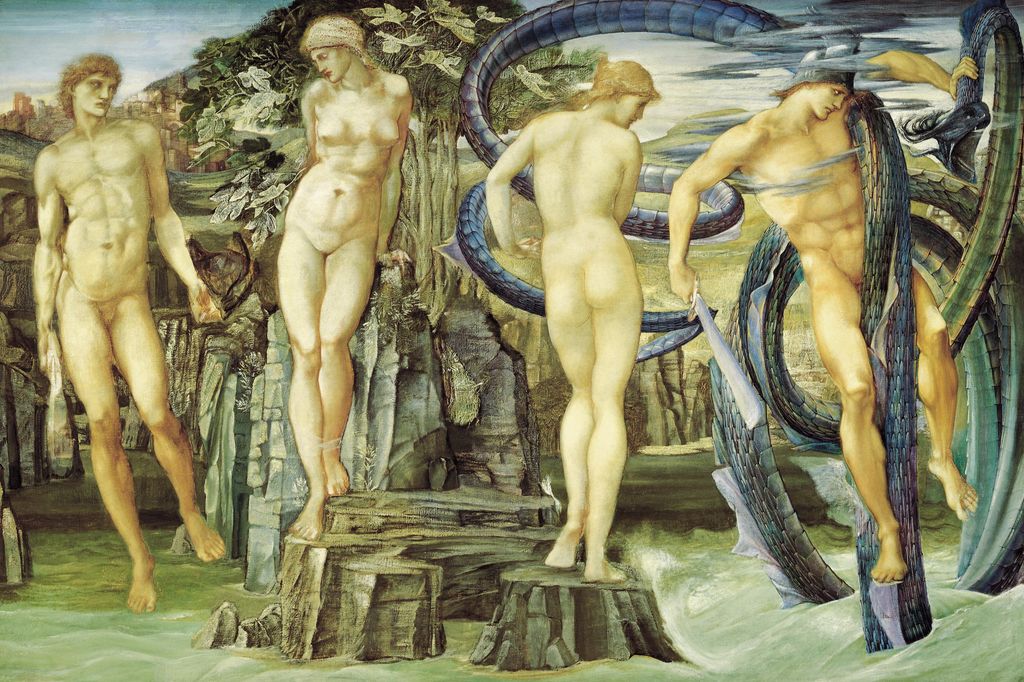
Edward Burne-Jones, Perseus and Andromeda, 1876, an unfinished painting combining the meeting and combat. Art Gallery of South Australia, 0.329. Image source. Public domain.
Working out Andromeda and the serpent
Burne-Jones could try out the rescue alongside other episodes or make it the subject of a sheet of its own. A Fitzwilliam Museum sketchbook page puts the battle in one corner, beside experiments with the flight from the Gorgons and the encounter with Atlas. [9] A small 1875 composition in the Art Institute of Chicago, painted in gouache and gold paint on board, gives the full space to the relationship between the two figures and the sea monster. [10] The catalogue of the Metropolitan Museum of Art’s Winthrop exhibition compares the Chicago design with a related Harvard drawing. In the earlier designs, two loops of the monster reach around Andromeda. In the large paper design and Stuttgart oil, they have been drawn away from her, and the creature’s open mouth is plainly visible. The revisions shift the pictorial pressure onto Perseus. They also leave a line of sight from the woman to the fight. Her pale back still picks up the curves of the scene, but the monster’s loops now make their tightest turns around a different body. [11]
At least two surviving graphite sheets show how long Burne-Jones worked on Andromeda as an individual figure. The University of Michigan Museum of Art dates its study to about 1875. It is on off-white wove paper and already takes her as a subject in her own right, a decade before the dated study in London. [12] The British Museum’s 1885 drawing bears the artist’s own inscription identifying the figure as a study for Andromeda in the Perseus series. She stands with her back to the viewer and turns her head right. In that drawing the right arm remains visible. In the oil, it crosses the front of her body and disappears from this angle. The change makes the outline of her back easier to take in at a glance and gives less away about what she is doing with her hands. Burne-Jones kept the raised heel even after settling on the relatively flat rock. The pose still looks poised between the decision to stand and the possibility of moving. [13] [11]
From the Southampton design to the Stuttgart oil
Southampton’s The Doom Fulfilled is almost the size of the Stuttgart painting. The city gallery records it as mixed media on paper, 153.8 by 138.4 centimetres, and gives no date in its current object entry. It also records Burne-Jones’s difficulty settling the rocky setting, which he elaborated and then stripped back. The work was purchased in 1934 through the Chipperfield Bequest Fund. [14] The Burne-Jones catalogue raisonné describes it as gouache and lists 1877. The Hyogo Prefectural Museum of Art’s 2012 exhibition material dates the Southampton work to about 1882. Those dates both refer to the design on paper. The Staatsgalerie gives 1888 for the oil, while the Washington exhibition guide describes its making with the range 1885–88. [15] [16]
Fiona Mann’s research on Burne-Jones’s late watercolours helps explain why the paper version is so close in scale and finish to the oil. In the studio method described by the artist’s son Philip, the design was worked out at full size on paper, then an assistant traced it and transferred the composition to canvas for painting. Across the surviving Perseus cartoons, Mann identifies grids on two unfinished works and experiments with metallic effects. She describes the artist’s collaboration with the designer W. A. S. Benson on imagined forms of armour. Leaf shapes and reptile scales were among the points of reference. That helps explain why the surfaces of the combatants can seem to belong to the same world of shapes and materials. [17] The Southampton Doom Fulfilled preserves the arrangement of the chief forms almost intact from paper to canvas. The pouch hanging across Perseus in the Southampton work is one of the telling changes Stephen Wildman identifies. In the Stuttgart oil it is gone. That leaves the turn of the torso and the line of the sword easier to see between the dark curves. [15]
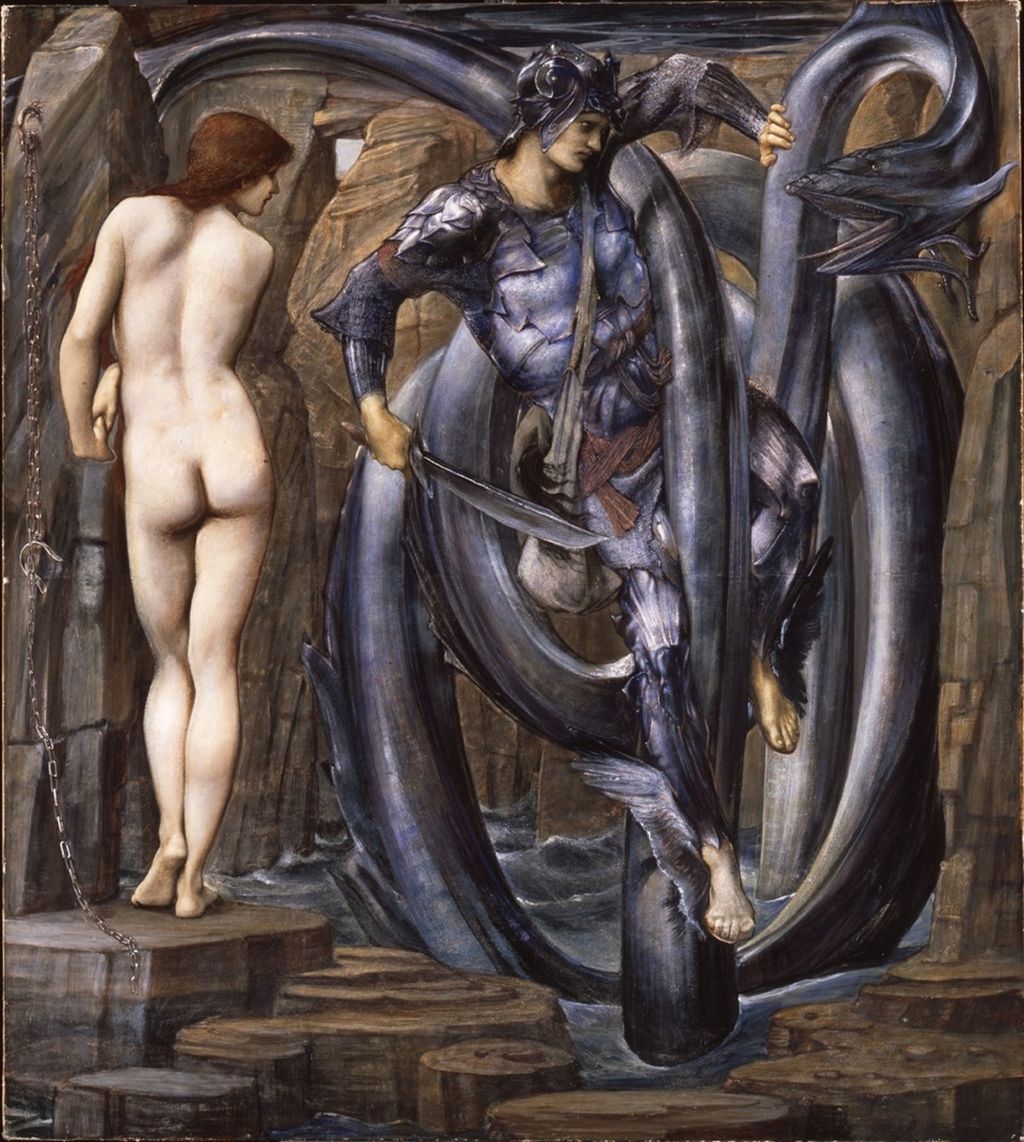
Edward Burne-Jones, The Doom Fulfilled, full-scale design. Southampton City Art Gallery, SOTAG 106. Image source. Public domain.
Another way to picture the rescue
An earlier treatment of the subject in the Isabella Stewart Gardner Museum, attributed to an artist working in the style of Paolo Veronese, has the same broad placement of Andromeda at left and the monster at right. The figure on the rock is still chained. Perseus comes down from above with his sword and shield, and the monster lifts its head out of the water to meet him. The elongated oval leaves room beyond them for sea, sky and distant land. In the much taller Stuttgart canvas Perseus has already met the creature at close quarters. His feet are down among the coils, and the room Andromeda has to move is measured in a few narrow ledges. Looking at the two works side by side makes the scale of Burne-Jones’s shift from the arrival to the struggle easier to see. [18]
At the New Gallery and in Stuttgart
The two rescue canvases appeared together at London’s New Gallery in 1888. They were among the completed oils that audiences could see while the wider project remained unfinished. In his working list Burne-Jones recorded finishing both paintings that year. Some reviewers wanted a more legible human response to the danger. Writing in The Academy, Cosmo Monkhouse found Andromeda’s composure hard to believe in a scene of terror. The drawings make the question raised by that review particularly interesting. Burne-Jones reconsidered the angle of her head, her hands and her footing, and moved the coils away from her. The calm that troubled Monkhouse took sustained work to achieve. [11]
Balfour lent the oil back to the New Gallery for the 1898–99 retrospective. [7] The Staatsgalerie acquired it with lottery funds in 1971. [1] The painting rejoined its neighbours The Rock of Doom and The Baleful Head for the Pre-Raphaelites: Victorian Avant-Garde exhibition of 2012–13, which travelled from Tate Britain to the National Gallery of Art in Washington and the Pushkin State Museum of Fine Arts in Moscow. [19] [20] Seen between the encounter and the scene at the well, the picture has the shortest time horizon of the three. A sword is poised, a hand is still holding back an open mouth, and Andromeda has had just enough time to turn her head.
Related artworks
Edward Burne-Jones on film
Explore Burne-Jones’s paintings, illustrated stories and stained-glass designs.
Edward Burne-Jones: Pre-Raphaelite Visionary | Exhibitions | Showcase
A look at Burne-Jones’s paintings and the Tate retrospective.
Watch on YouTubeArtworks directory
This directory records paintings, studies, designs and collaborative works, with separate entries for documented versions and series where known.
| Name | Date | Medium |
|---|---|---|
| Sidonia von Bork 1560 | 1860 | Watercolour and bodycolour |
| Clara von Bork 1560 | 1860 | Watercolour and bodycolour |
| The Merciful Knight | 1863 | Watercolour |
| Sibylla Delphica | c. 1886 | Oil on panel |
| Phyllis and Demophoön | 1870 | Watercolour and bodycolour |
| The Legend of the Briar Rose (Buscot series) | 1870s–1890 | Oils on canvas |
| The Briar Wood (Buscot series) | By 1890 | Oil on canvas |
| The Council Chamber (Buscot series) | By 1890 | Oil on canvas |
| The Garden Court (Buscot series) | By 1890 | Oil on canvas |
| The Rose Bower (Buscot series) | By 1890 | Oil on canvas |
| Group of Women, study for The Golden Stairs | 1872 | Drawing |
| The Beguiling of Merlin | 1870s | Oil on canvas |
| The Perseus Cycle | From 1875 | Paintings and full-scale designs |
| The Call of Perseus (Stuttgart) | From 1875 | Oil painting |
| Perseus and the Graeae (Stuttgart) | From 1875 | Oil painting |
| The Rock of Doom (Stuttgart) | 1884–88 | Oil on canvas |
| The Doom Fulfilled (Stuttgart) | 1888 | Oil on canvas |
| The Baleful Head (Stuttgart) | 1885–87 | Oil on canvas |
| The Baleful Head (Southampton design) | 1880s | Bodycolour |
| The Rock of Doom (Southampton design) | 1880s | Bodycolour |
| The Doom Fulfilled (Southampton design) | 1880s | Bodycolour |
| The Mirror of Venus (Gulbenkian) | 1870s | Oil on canvas |
| Drawing associated with The Mirror of Venus | 1870s | Drawing |
| Laus Veneris (Laing) | 1873–78 | Oil on canvas |
| The Days of Creation | 1870s | Watercolour and bodycolour |
| The Golden Stairs | 1880 | Oil on canvas |
| An Angel Playing a Flageolet | 1878 | Watercolour, bodycolour and gold |
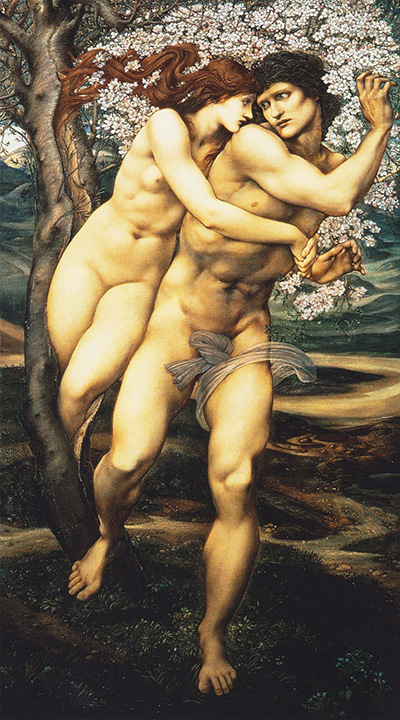
| The Tree of Forgiveness | 1881–82 | Oil on canvas |
| The Wheel of Fortune (Orsay) | 1875–83 | Oil on canvas |
| King Cophetua and the Beggar Maid | 1884 | Oil on canvas |
| The Depths of the Sea (oil) | 1886 | Oil |
| The Morning of the Resurrection | 1886 | Oil on panel |
| Study for the Head of Mary Magdalene | c. 1882 | Oil study |
| The Sleep of King Arthur in Avalon | 1880s–1898 | Oil on canvas |
| The Sleep of King Arthur in Avalon (modello) | ca. 1881 | Oil on canvas (modello) |
| The Star of Bethlehem | Signed 1890 | Watercolour and bodycolour |
| Study for The Star of Bethlehem | About 1887–91 | Drawing |
| Sponsa de Libano | 1891 | Watercolour and bodycolour |
| The Summons (Holy Grail tapestries) | 1890s | Tapestry |
| The Failure of Sir Gawaine (Holy Grail tapestries) | 1890s | Tapestry |
| Hope (Boston) | 1896 | Oil on canvas |
| La Belle au bois dormant (theatre programme) | 1894 | Collotype |
| The Wedding of Psyche | 1895 | Oil on canvas |
| The Works of Geoffrey Chaucer (Kelmscott edition) | 1896 | Illustrated book |
| The Ascension (Birmingham Cathedral) | 1885 | Stained glass |
| The Last Judgement (Birmingham Cathedral) | 1897 | Stained glass |
| Adoration of the Magi (Huntington) | 1890s | Tapestry |
| Love among the Ruins (Wightwick) | 1894 | Oil on canvas |
| The Merciful Knight (photogravure after Burne-Jones) | 1900 | Photogravure |
| The Garden Court (preparatory work) | 1870–75 | Graphite and watercolour with white gouache |
| Study of a Female Figure | 1885 | Graphite drawing |
| Psyche Throwing Herself into the River | 1865–68 | Wood engraving |
| Beauty | 1887–89 | Colour lithograph |
| Study for the Failure of Gawain | 1893 | Crayon and graphite on Japanese paper |
| The Prince Enters the Briar Wood (after Burne-Jones) | After 1890 | Photogravure |
| The Rose Bower (after Burne-Jones) | 1892 | Photogravure |
| Adoration of the Magi (Musée d’Orsay) | 1904 | Tapestry |
| Answers to Prayer (Lyndhurst) | 1860s | Stained glass |
| The Depths of the Sea (photogravure after Burne-Jones) | 1900 | Photogravure |
| Perseus and Andromeda (Adelaide composite) | 1876 | Oil on canvas |
| The Adoration of the Magi (Hamburg) | Woven 1900 | Tapestry |
| Love leading the Pilgrim through the Briars | 1874–76 | Embroidery |
| Musica (worked by Lady Jane Cory) | 1906 | Embroidery |
| Pomona (worked by Lady Jane Cory) | 1907 | Embroidery |
| Flora (worked by Lady Jane Cory) | 1909 | Embroidery |
| The Fourth Day of Creation (photogravure after Burne-Jones) | 1900 | Photogravure |
| The Morning of the Resurrection (photogravure after Burne-Jones) | 1900 | Photogravure |
| Musical angels of the St Catherine window (Christ Church) | Designed 1877 | Stained glass |
Discussion
Look again at the images and ideas explored in The Doom Fulfilled by Edward Burne-Jones. These editorial prompts invite your observations.
Reader Insights
Where does the sea monster lead your eye before it returns to Andromeda?
How does the space occupied by the fight differ between the full-scale design and the oil?
Join the Conversation
Share a detail, comparison or question about The Doom Fulfilled by Edward Burne-Jones below.
References
- Staatsgalerie Stuttgart, Die Erfüllung des Schicksals, 1888, German and Ukrainian mediaguide with medium, measurements, acquisition and reproduction. View source.
- National Gallery of Art, Pre-Raphaelites: Victorian Art and Design, 1848–1900, exhibition guide, fig. 28 and commission context. View source.
- Tate Britain, Edward Burne-Jones, 2018–19 large-print guide, pp. 60 and 109–14, drawing, finished paintings, and designs for Balfour’s room. View source.
- William Morris, The Doom of King Acrisius, The Earthly Paradise, 1868, argument and rescue episode, pp. 273–76. View source.
- Southampton City Art Gallery, The Perseus Series, commission and full-size designs. View source.
- Staatsgalerie Stuttgart, Die Berufung des Perseus, mediaguide on the opening scene and the scope of the series. View source.
- New Gallery, Exhibition of the Works of Sir Edward Burne-Jones, Bart., 1898–99, catalogue nos. 115, 117, 118 and 120. View source.
- Art Gallery of South Australia, Perseus and Andromeda, 1876, collection record and Tansy Curtin’s display text. View source.
- Fitzwilliam Museum, Sketches for the Perseus series, sketchbook 1085, fol. 21, collection record. View source.
- Art Institute of Chicago, Perseus and Andromeda, study for The Doom Fulfilled, 1875, object 7169, collection data. View source.
- Metropolitan Museum of Art, A Private Passion: 19th-Century Paintings and Drawings from the Grenville L. Winthrop Collection, Harvard University, discussion of The Doom Fulfilled and its studies, p. 374. View source.
- University of Michigan Museum of Art, Study for Andromeda in ‘The Doom Fulfilled’, circa 1875, 1951/2.37. View source.
- British Museum, documentation for Nude study of Andromeda for ‘The Doom Fulfilled’, 1885, 1967,1014.48. View source.
- Southampton City Art Gallery, The Doom Fulfilled, SOTAG 106, object record. View source.
- Stephen Wildman, The Perseus Series: The Doom Fulfilled (Southampton), Burne-Jones Catalogue Raisonné, object entry and comparison with the Stuttgart oil. View source.
- Hyogo Prefectural Museum of Art, Edward Burne-Jones, 2012 exhibition press material, image no. 6. View source.
- Fiona Mann, ‘Opaque with a vengeance’: Burne-Jones’s Later Watercolours, 1880–98, The Burlington Magazine 161, 2019, pp. 128–39. View source.
- Isabella Stewart Gardner Museum, Scene from the Metamorphoses of Ovid: Perseus and Andromeda, P17w32.6, collection record and reproduction. View source.
- Burne-Jones Catalogue Raisonné, Pre-Raphaelites: Victorian Avant-Garde, 2012–13, exhibition itinerary and artwork list. View source.
- Pushkin State Museum of Fine Arts, Прерафаэлиты. Викторианский авангард (Pre-Raphaelites: Victorian Avant-Garde), Moscow exhibition catalogue record, 2013. View source.