 by Tom Gurney
Tom Gurney BSc (Hons) is an art history expert with over 20 years experience
Published on June 19, 2020 / Updated on November 25, 2026
Email: tomgurney1@gmail.com / Phone: +44 7429 011000
Sibylla Delphica: Introduction
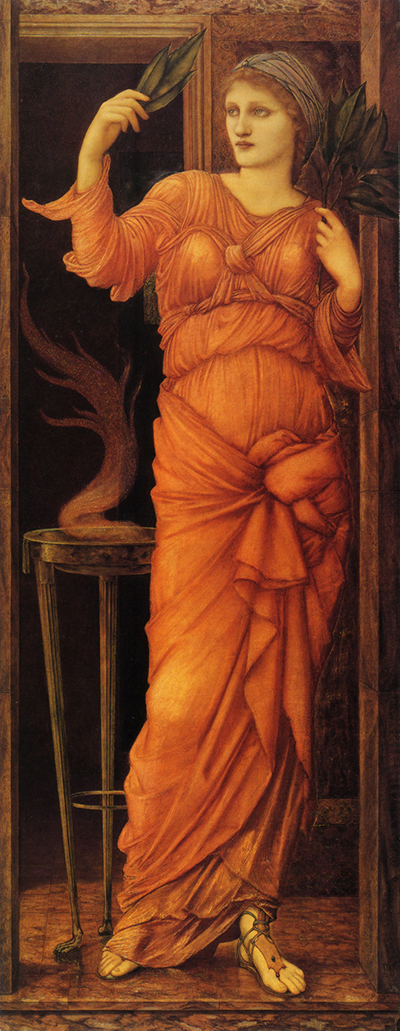
Edward Burne-Jones’s Sibylla Delphica shows the Delphic Sibyl raising a handful of laurel leaves to eye level. Smoke rises from a tripod altar beside her, but her whole attention seems to be on the leaves. The painting is an oil on panel, 152.8 by 60.3 centimetres, in Manchester Art Gallery. The gallery dates it to about 1886 and records its purchase from Mrs W. A. Turner that year under accession number 1886.5. [1] [2]
At a Glance
- ArtistEdward Burne-Jones
- Datec. 1886
- MediumOil on panel
- SubjectThe Delphic Sibyl
This work across Edward Burne-Jones’s career
The Mirror of Venus
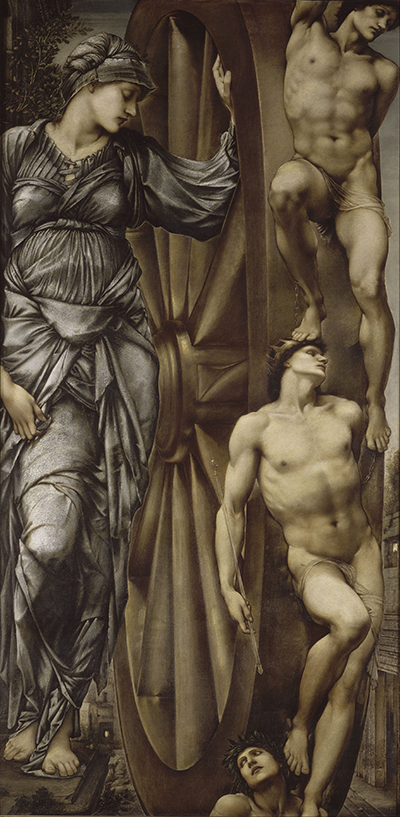
1870sThe Wheel of Fortune
1875–83The Last Sleep of Arthur in Avalon
1880s–1898The Star of Bethlehem
Signed 1890Contents
- The Sibyl at the threshold
- Apollo’s oracle and the Christian Sibyls
- From Cambridge glass to the Manchester painting
- The exhibition and the painting’s later history
The Sibyl at the threshold
The painting is more than twice as tall as it is wide. Burne-Jones places the Sibyl almost against the front of that narrow space. Her sandalled feet are close to its lower edge, and the horizontal lintel passes immediately above her raised hand. Behind her, a dark doorway suggests that the building continues. The stonework at the edge of the panel sets a limit to what we can see. The gallery also describes a Renaissance-style frame with moulded relief ornament. The frame adds a second architectural border around the painted stone. [1]
The Sibyl faces forward through the shoulders, with her head and eyes turned towards the leaves in her right hand, on the viewer’s left. Her left hand holds a longer stem close to her shoulder. Following the shift from one hand to the other shows how much action Burne-Jones puts into a small area of the composition. The raised sleeve opens into a curved edge below the wrist. The folds then gather across her chest and knot at the hip, before running diagonally down to her feet. Other lines in the painting are nearly straight, including the edges of the doorway and the long legs of the altar. The folds trace the turn of her body within that fixed space. [1]
Orange is the dominant colour, but it varies from the almost golden folds on the forward leg to the rusty shadows beneath the knot. The blue head covering and dark green leaves draw the eye back towards the face. The curl from the altar is especially legible against the doorway. It rises towards the lifted leaves, echoing the gesture without touching the Sibyl. Her lips are slightly parted and her gaze is steady. We can see the object she studies and the seriousness with which she studies it. Whatever she sees in the leaves is hers alone. [2]
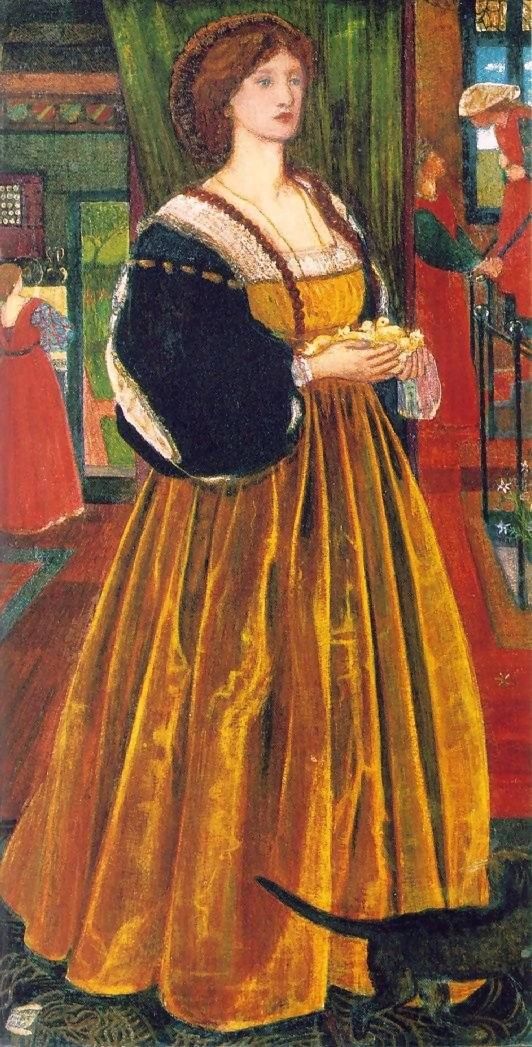
Edward Burne-Jones, Clara von Bork 1560, 1860. Tate. Image source. Public domain.
Apollo’s oracle and the Christian Sibyls
The Greek traveller Pausanias recorded a tradition that Herophile, called the Sibyl, stood on a rock at Delphi and chanted her oracles. He also describes rival claims about where she came from and reports that she foretold the destruction Helen would bring to Troy. The Pythia was the priestess through whom Apollo delivered oracles at his sanctuary. At Delphi, the tripod also stood for the oracular authority of Apollo himself. The temple’s fourth-century east pediment showed him seated on a tripod and holding a laurel branch. [3] [4]
In the Manchester panel, the tripod supports a vessel and the Sibyl stands beside it. These ancient associations make the tripod and laurel intelligible, while her scrutiny of the leaves is Burne-Jones’s way of making prophecy visible. Malcolm Bell, writing near the end of the nineteenth century, described her as reading a message from the laurel. A. L. Baldry went on to argue, in the commentary accompanying Plate IV of his book on Burne-Jones, that the painter approached the oracle through symbolism. Baldry admired the draughtsmanship, colour and suggestion of movement. The small turn of the head and the progression of the folds are good places to see what he was responding to. [5] [6]
A different tradition gave the Sibyls a place in Christian art. Their prophecies could be read as anticipating Christ, allowing painters to set figures from the ancient pagan world alongside biblical prophets. Michelangelo’s five Sibyls on the Sistine Chapel ceiling are a famous instance. His Delphic Sibyl sits holding a scroll and turns her head to look away from it. Burne-Jones studied the ceiling on his visit to Italy in 1871, a documented encounter that places the frescoes in his artistic formation. Their individual compositions have different centres of attention. Michelangelo’s seated Sibyl looks beyond her written text. Burne-Jones’s standing woman keeps her attention on a few leaves. [7] [8] [9]
From Cambridge glass to the Manchester painting
At Jesus College, Cambridge, medieval chapel restoration gave Burne-Jones and the Morris firm an opportunity to put classical prophetesses into a Christian building of their own time. The chapel’s South Transept windows pair the Evangelists with scenes from their Gospels and figures of Sibyls. The catalogue raisonné dates the St Luke glass, which includes the Delphic figure, to 1873. A spectator can see a woman associated with a pagan oracle in the same window as a Christian Evangelist and scenes from the Passion. [10] [11]
Burne-Jones changed the names attached to two of the designs when he adapted them for painting. In the Metropolitan Museum of Art’s exhibition catalogue, Stephen Wildman and John Christian identify the Delphic figure in the Cambridge glass as the model for the oil exhibited as the Cumaean Sibyl at the Grosvenor Gallery in 1877. The Cumaean design, in turn, is the one they relate to Manchester’s Sibylla Delphica. The switch matters because an image labelled Delphic Sibyl can show a markedly different pose or set of attributes, even when Burne-Jones designed both figures. [9]
His work for the glass can be traced in drawings and workshop material. A Fitzwilliam Museum sketchbook leaf carries tentative sketches for a Cumaean Sibyl, including one standing at a doorway with leaves scattered at her feet. Burne-Jones’s notes on the same sheet mention laurel, a crown of thorns and the Delphic Sibyl. At The Huntington, a photograph of the Delphic stained-glass cartoon, catalogued under 1872, records a draped, crowned woman with a scroll. The photograph has been cut in two and mounted with the halves side by side, with pencil marks visible between the hands. Its paper joins and drawing marks make it a particularly revealing record of the workshop’s use of photographs. [12] [13]
The Delphic Sibyl window at Powerhouse in Sydney belongs to that branch of the story. The museum’s curatorial account dates its manufacture at Morris & Co.’s Merton Abbey works to about 1900 and connects its figure to the earlier Jesus College design. A pale botanical ground and a canopy of stylised vines surround the figure, decoration Powerhouse tentatively attributes to William Morris. In the Manchester oil, similar proportions accommodate quite different surroundings. The straight doorway and smoke focus the eye on the woman, where the window integrates her with a repeatable pattern. Other stained glass designs by Burne-Jones show how often a narrow upright opening gave him the starting shape for a single figure. [14] [15]
The exhibition and the painting’s later history
Some listings give an earlier date for the oil. The catalogue raisonné places the panel under 1873, the period of the chapel designs, while Bell records Burne-Jones completing the painting in early 1886. Georgiana Burne-Jones lists the Delphic Sibyl among the three pictures sent to the Grosvenor Gallery on 27 April that year, along with Flamma Vestalis and The Morning of the Resurrection. The artist’s Depths of the Sea went to the Royal Academy that season. The gallery date of about 1886 accords with the account of the finished panel going on show, while the earlier chapel work helps explain the figure’s origins. [2] [5] [15] [16]
The painting’s public life in Manchester began quickly. It appeared at the city’s Royal Jubilee Exhibition in 1887 and returned to London for the New Gallery’s Burne-Jones exhibition of 1892–93. An early Manchester City Art Gallery collection catalogue reproduced it as no. 55. The black-and-white plate still shows how readily the outline of the Sibyl can be picked out against the doorway, even when the contrast between the orange dress and the blue scarf is lost. A print after the picture carried the composition to readers of the French Gazette des beaux-arts in 1887. The critic Édouard Rod pointed to the Sibyl as an example of the freedom with which Burne-Jones treated antiquity. His comment anticipates Baldry’s emphasis on the artist’s personal interpretation. [15] [17] [18]
On 3 April 1913, Sibylla Delphica was among the paintings whose protective glazing was broken during a suffragette protest at the Manchester gallery. The museum’s archive account places it alongside works by Dante Gabriel Rossetti, John Everett Millais and Frederic Leighton caught up in the same action. The picture went on to travel as a loan from Manchester, including to the exhibition Edward Burne-Jones: The Pre-Raphaelites and the North in Stockholm and Bergen in 2019 and 2020. There it took its place in an exhibition about the wider reach of the artist and his circle, a history that began for this panel with a figure adapted from a chapel window. [15] [19] [20] [21]
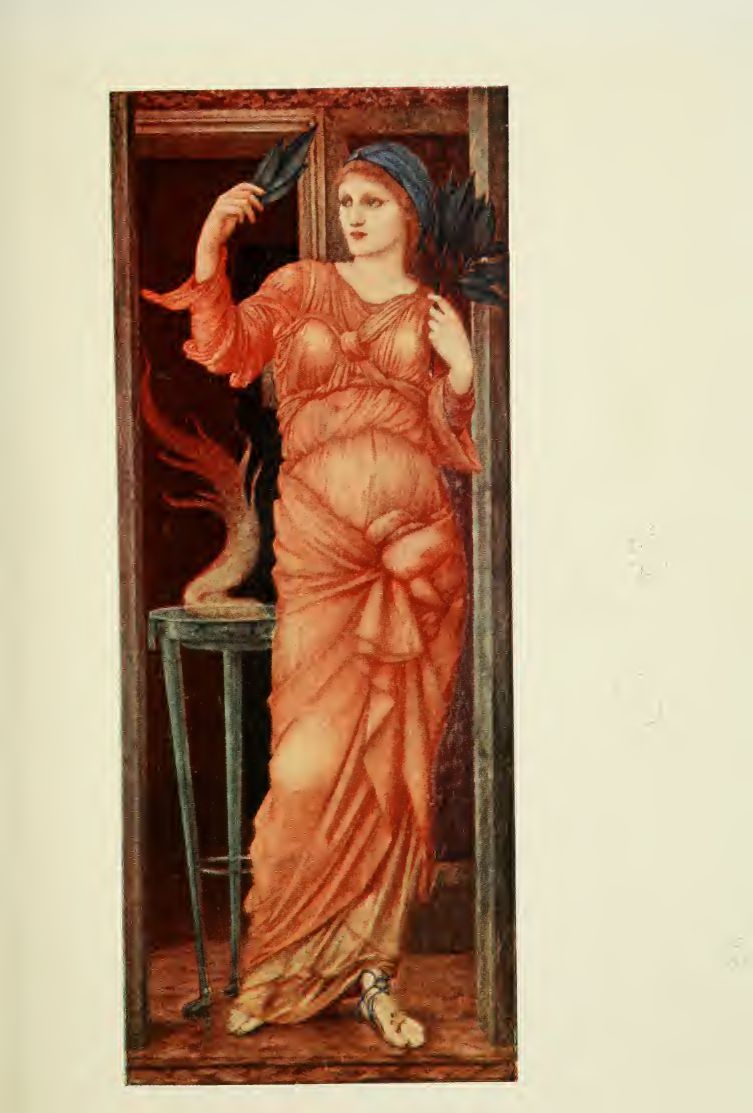
Sibylla Delphica, early colour reproduction after Edward Burne-Jones. Plate IV in A. Lys Baldry’s Burne-Jones. Image source. Public domain. Original printed plate shown with the surrounding page margin.
Edward Burne-Jones on film
Explore Burne-Jones’s paintings, illustrated stories and stained-glass designs.
Edward Burne-Jones: Pre-Raphaelite Visionary | Exhibitions | Showcase
A look at Burne-Jones’s paintings and the Tate retrospective.
Watch on YouTubeArtworks directory
This directory records paintings, studies, designs and collaborative works, with separate entries for documented versions and series where known.
| Name | Date | Medium |
|---|---|---|
| Sidonia von Bork 1560 | 1860 | Watercolour and bodycolour |
| Clara von Bork 1560 | 1860 | Watercolour and bodycolour |
| The Merciful Knight | 1863 | Watercolour |
| Sibylla Delphica | c. 1886 | Oil on panel |
| Phyllis and Demophoön | 1870 | Watercolour and bodycolour |
| The Legend of the Briar Rose (Buscot series) | 1870s–1890 | Oils on canvas |
| The Briar Wood (Buscot series) | By 1890 | Oil on canvas |
| The Council Chamber (Buscot series) | By 1890 | Oil on canvas |
| The Garden Court (Buscot series) | By 1890 | Oil on canvas |
| The Rose Bower (Buscot series) | By 1890 | Oil on canvas |
| Group of Women, study for The Golden Stairs | 1872 | Drawing |
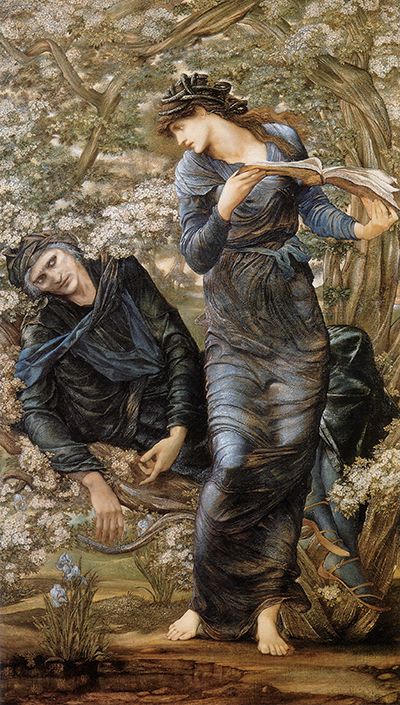
| The Beguiling of Merlin | 1870s | Oil on canvas |
| The Perseus Cycle | From 1875 | Paintings and full-scale designs |
| The Call of Perseus (Stuttgart) | From 1875 | Oil painting |
| Perseus and the Graeae (Stuttgart) | From 1875 | Oil painting |
| The Rock of Doom (Stuttgart) | 1884–88 | Oil on canvas |
| The Doom Fulfilled (Stuttgart) | 1888 | Oil on canvas |
| The Baleful Head (Stuttgart) | 1885–87 | Oil on canvas |
| The Baleful Head (Southampton design) | 1880s | Bodycolour |
| The Rock of Doom (Southampton design) | 1880s | Bodycolour |
| The Doom Fulfilled (Southampton design) | 1880s | Bodycolour |
| The Mirror of Venus (Gulbenkian) | 1870s | Oil on canvas |
| Drawing associated with The Mirror of Venus | 1870s | Drawing |
| Laus Veneris (Laing) | 1873–78 | Oil on canvas |
| The Days of Creation | 1870s | Watercolour and bodycolour |
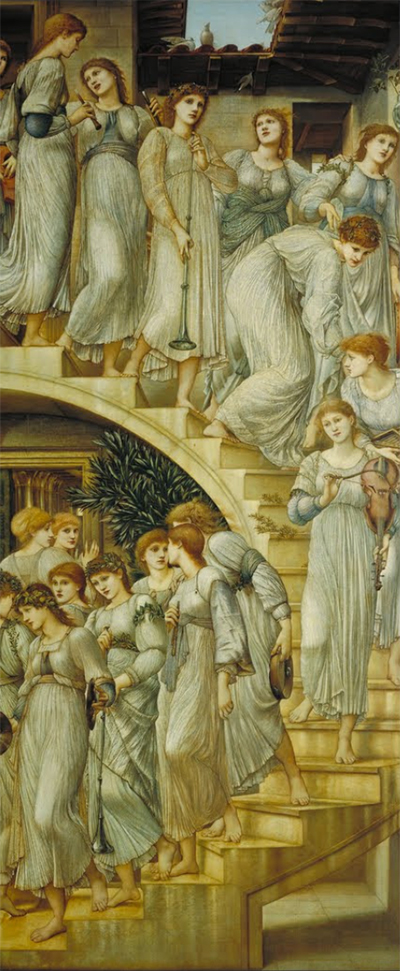
| The Golden Stairs | 1880 | Oil on canvas |
| An Angel Playing a Flageolet | 1878 | Watercolour, bodycolour and gold |
| The Tree of Forgiveness | 1881–82 | Oil on canvas |
| The Wheel of Fortune (Orsay) | 1875–83 | Oil on canvas |
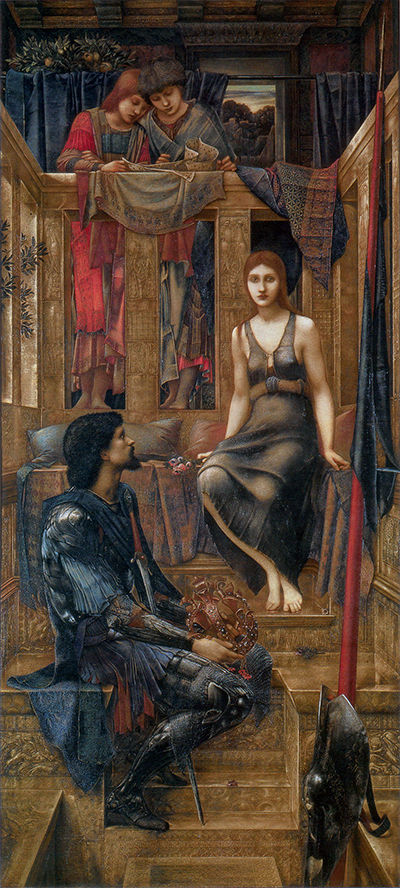
| King Cophetua and the Beggar Maid | 1884 | Oil on canvas |
| The Depths of the Sea (oil) | 1886 | Oil |
| The Morning of the Resurrection | 1886 | Oil on panel |
| Study for the Head of Mary Magdalene | c. 1882 | Oil study |
| The Sleep of King Arthur in Avalon | 1880s–1898 | Oil on canvas |
| The Sleep of King Arthur in Avalon (modello) | ca. 1881 | Oil on canvas (modello) |
| The Star of Bethlehem | Signed 1890 | Watercolour and bodycolour |
| Study for The Star of Bethlehem | About 1887–91 | Drawing |
| Sponsa de Libano | 1891 | Watercolour and bodycolour |
| The Summons (Holy Grail tapestries) | 1890s | Tapestry |
| The Failure of Sir Gawaine (Holy Grail tapestries) | 1890s | Tapestry |
| Hope (Boston) | 1896 | Oil on canvas |
| La Belle au bois dormant (theatre programme) | 1894 | Collotype |
| The Wedding of Psyche | 1895 | Oil on canvas |
| The Works of Geoffrey Chaucer (Kelmscott edition) | 1896 | Illustrated book |
| The Ascension (Birmingham Cathedral) | 1885 | Stained glass |
| The Last Judgement (Birmingham Cathedral) | 1897 | Stained glass |
| Adoration of the Magi (Huntington) | 1890s | Tapestry |
| Love among the Ruins (Wightwick) | 1894 | Oil on canvas |
| The Merciful Knight (photogravure after Burne-Jones) | 1900 | Photogravure |
| The Garden Court (preparatory work) | 1870–75 | Graphite and watercolour with white gouache |
| Study of a Female Figure | 1885 | Graphite drawing |
| Psyche Throwing Herself into the River | 1865–68 | Wood engraving |
| Beauty | 1887–89 | Colour lithograph |
| Study for the Failure of Gawain | 1893 | Crayon and graphite on Japanese paper |
| The Prince Enters the Briar Wood (after Burne-Jones) | After 1890 | Photogravure |
| The Rose Bower (after Burne-Jones) | 1892 | Photogravure |
| Adoration of the Magi (Musée d’Orsay) | 1904 | Tapestry |
| Answers to Prayer (Lyndhurst) | 1860s | Stained glass |
| The Depths of the Sea (photogravure after Burne-Jones) | 1900 | Photogravure |
| Perseus and Andromeda (Adelaide composite) | 1876 | Oil on canvas |
| The Adoration of the Magi (Hamburg) | Woven 1900 | Tapestry |
| Love leading the Pilgrim through the Briars | 1874–76 | Embroidery |
| Musica (worked by Lady Jane Cory) | 1906 | Embroidery |
| Pomona (worked by Lady Jane Cory) | 1907 | Embroidery |
| Flora (worked by Lady Jane Cory) | 1909 | Embroidery |
| The Fourth Day of Creation (photogravure after Burne-Jones) | 1900 | Photogravure |
| The Morning of the Resurrection (photogravure after Burne-Jones) | 1900 | Photogravure |
| Musical angels of the St Catherine window (Christ Church) | Designed 1877 | Stained glass |
Discussion
Look again at the images and ideas explored in Sibylla Delphica. These editorial prompts invite your observations.
Reader Insights
What makes the prophetess’s pose read as private thought or public prophecy?
What do the table, the branch and the dark recess contribute to the painted figure?
Join the Conversation
Share a detail, comparison or question about Sibylla Delphica below.
References
- Manchester Art Gallery, Sibylla Delphica, accession 1886.5, collection description and purchase details reproduced by The Victorian Web. View source.
- Art UK and Manchester Art Gallery, Sibylla Delphica, Art UK Shop record 204615 with the collection image and date. View source.
- Pausanias, Description of Greece, book 10, 12.1–5, translated by W. H. S. Jones. View source.
- Archaeological Museum of Delphi, The Temple of Apollo, account of the fourth-century temple and its east pediment. View source.
- Malcolm Bell, Sir Edward Burne-Jones: A Record and Review, discussion of the 1886 exhibitions and illustration of Sibylla Delphica. View source.
- Alfred Lys Baldry, Burne-Jones, Plate IV, Sibylla Delphica, and commentary. View source.
- Vatican Museums, Sibille e Profeti, Sistine Chapel ceiling programme. View source.
- Vatican Museums, Sibilla Delfica, Sistine Chapel ceiling fresco. View source.
- Stephen Wildman and John Christian, Edward Burne-Jones: Victorian Artist-Dreamer, 1998, cat. 69, pages 176–177 and fig. 82, as reproduced in the Burne-Jones Catalogue Raisonné. View source.
- Jesus College, Cambridge, Stained Glass, description of the Outer Chapel and South Transept. View source.
- Burne-Jones Catalogue Raisonné, Sibylla Delphica; St Luke; Sibylla Cumana; Christ at Gethsemane; Christ whipped and scourged; Christ Carrying the Cross, Jesus College Chapel stained glass record. View source.
- The Fitzwilliam Museum, Sketches of the Cumaean Sibyl and manuscript notes, sketchbook leaf 1085.f.10. View source.
- The Huntington, Delphic Sibyl, photograph of a stained-glass cartoon, 2000.5.1517E. View source.
- Powerhouse, The Delphic Sibyl, stained glass A10620, curatorial overview. View source.
- Burne-Jones Catalogue Raisonné, Sibylla Delphica (Sibylla Cumaea, The Cumaean Sibyl, The Delphic Sibyl), oil on panel, with Stephen Wildman’s commentary, provenance and exhibitions. View source.
- Georgiana Burne-Jones, Memorials of Edward Burne-Jones, vol. II, chapter XXI, page 165, 1886 Grosvenor Gallery submissions. View source.
- Manchester City Art Gallery, Reproductions from the Collection of the Manchester City Art Gallery, reproduction and catalogue entry no. 55, catalogue page 43. View source.
- Édouard Rod, Études sur le XIXe siècle, “Les préraphaélites anglais,” 1888, discussion of Burne-Jones and the engraving published with the previous instalment, OBVIL transcription. View source.
- Manchester Art Gallery, Tales from the Archives: A Brush with the Law, Part 1, account of the 1913 protest. View source.
- Helen E. Scott, University of St Andrews, doctoral thesis on museum vandalism, volume I, chapter one and accompanying notes on the 3 April 1913 Manchester protest. View source.
- Kode, Edward Burne-Jones: Prerafaelittene og Norden, institutional exhibition overview. View source.