 by Tom Gurney
Tom Gurney BSc (Hons) is an art history expert with over 20 years experience
Published on June 19, 2020 / Updated on November 25, 2026
Email: tomgurney1@gmail.com / Phone: +44 7429 011000
Hope: Introduction
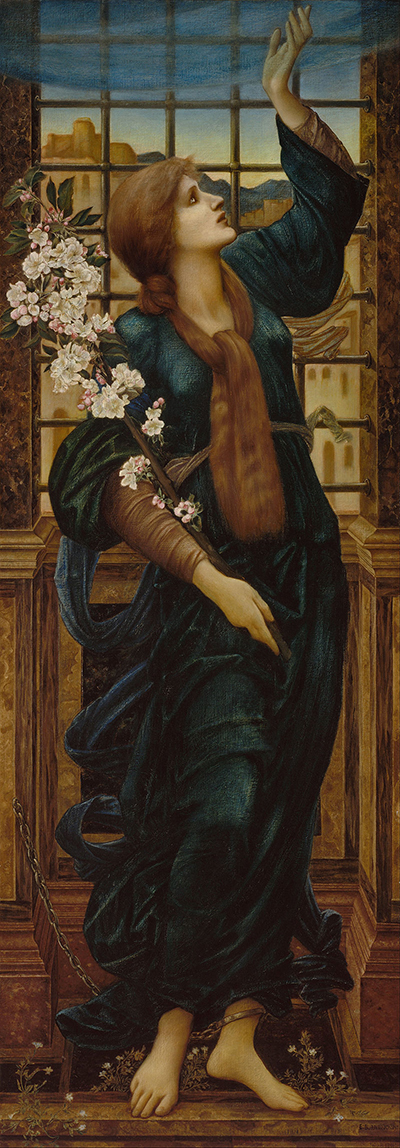
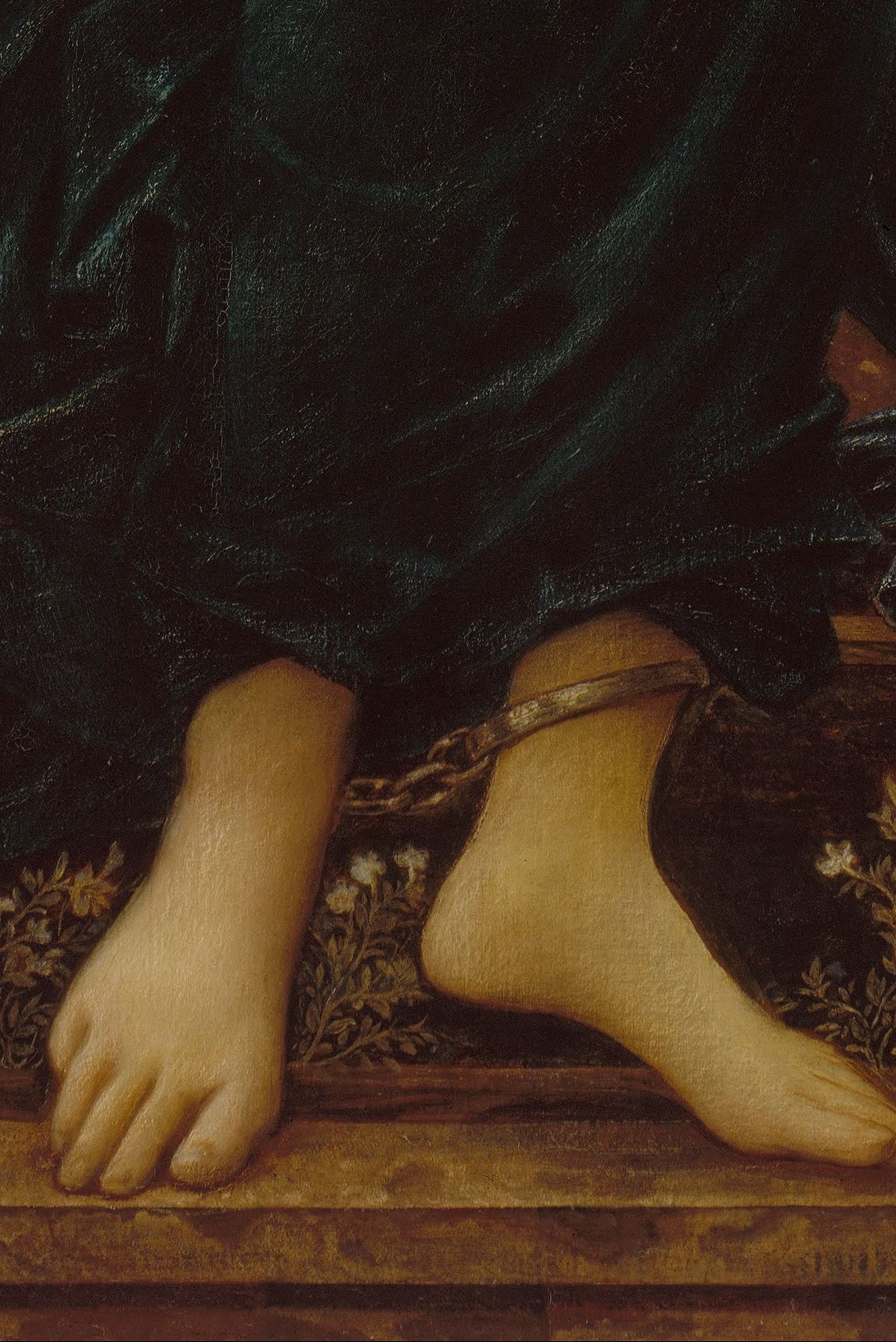
In Edward Burne-Jones’s Hope, the sky seems to come within reach of a woman who can scarcely move from where she stands. One bare foot projects towards the edge of the picture, while an iron chain trails from the other ankle to the wall. She lifts her hand towards a sweep of blue that hangs across the top of the window. The view beyond the bars offers distance, sunlight and air. Inside, the woman has just enough space to stand. This is the oil on canvas that Burne-Jones finished in 1896 for Mrs George Marston Whitin of Whitinsville, Massachusetts. At 179 centimetres high and 63.5 wide, it has the proportions of a church window and the presence of a person nearly your own height. The lower-right inscription names the artist and records the year of completion. The painting is in the Museum of Fine Arts, Boston, accession 40.778. [1] [2]
At a Glance
- ArtistEdward Burne-Jones
- Date1896
- MediumOil on canvas
- SubjectPersonification and commission
This work across Edward Burne-Jones’s career
The Mirror of Venus
1870sThe Wheel of Fortune
1875–83The Last Sleep of Arthur in Avalon
1880s–1898The Star of Bethlehem
Signed 1890Contents
- A painting for Mrs Whitin
- The prisoner and the flowers
- From an Oxford window to the Boston canvas
- Victorian audiences
- Annotated details
A painting for Mrs Whitin
Mrs Whitin had commissioned a dancing figure. The artist’s friend William Morris died on 3 October 1896 and, according to the account published by the Boston museum, Burne-Jones asked his patron to accept an oil version of an older watercolour of Hope in its place. Whitin agreed, and the oil was complete by the end of the year. Burne-Jones and Morris had met at Exeter College, Oxford, in 1853. They went on to work together in the firm founded in 1861 as Morris, Marshall, Faulkner & Co. The two men had already been friends for nearly twenty years when Burne-Jones first drew the figure of Hope for one of the firm’s windows. The death of Morris gives the choice of subject in 1896 a particular poignancy. The pose itself had a history that went back to their working life together. [3] [4] [5]
The finished picture was in America by 1897. Burne-Jones admitted in a letter that he had worried when he heard nothing after its arrival. The purchasers had bought it sight unseen, and he had considered offering to take it back. When word came, they were pleased with it and had hung it without glass to avoid reflections. Burne-Jones preferred the effect under glass and thought they could change the angle to lessen the glare. His description of glazing as “a kind of aethereal varnish” is especially apt for a painting in which a patch of blue is poised somewhere between a length of fabric and an opening to the sky. The exchange also offers a glimpse of the negotiations between artist and patron that continued even after a picture left the studio. [3]
The prisoner and the flowers
The painted frame of the window is richly veined and moulded. Below it, the panelling runs down to a narrow ledge where the woman balances. Seen through the opening, pale buildings and distant hills could belong to another world. The bars make their own grid in front of that view. The line from the woman’s shoulder through her elbow and wrist curves across it, and the upper hand follows the rise of her face. Her autumn-coloured hair, loosely gathered at her throat, falls down the front of a dress so dark that its blue-green catches the light only at the ridges of the folds. The same rhythm continues near the floor, where the cloth gathers around the chain. The artist has given the eye room to move within a space in which the body has very little. [1] [3] [6]
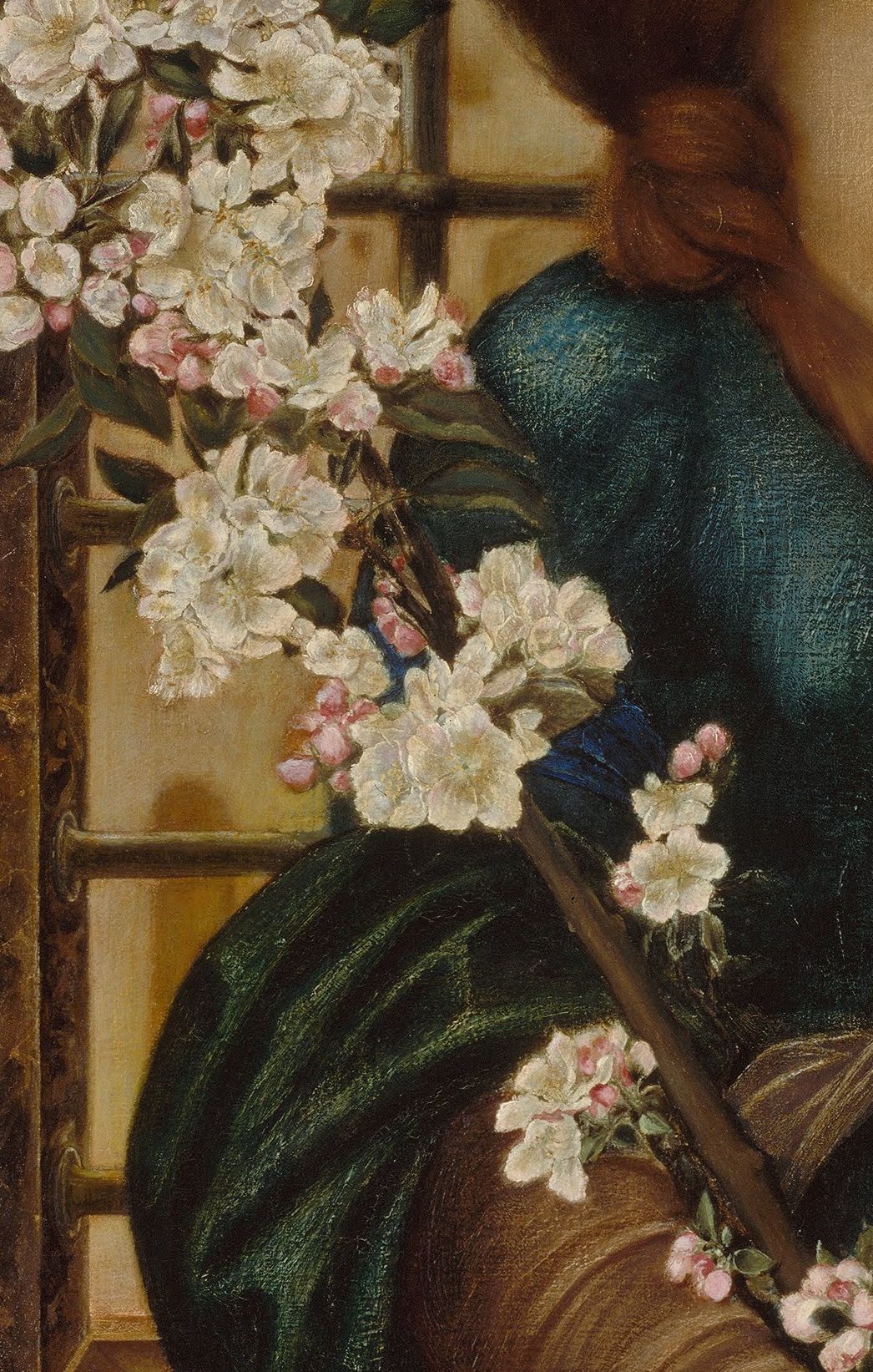
Faith, Hope and Charity are the three theological virtues. In Christian art a personification gives an idea a body, a gesture and objects through which it can be recognised. Here a spray of apple blossom crosses the prisoner’s body, its pale flowers opening towards the light. W. G. Constable, writing when the painting came into the museum’s collection, traced the flowering branch to a tradition in medieval Italian art in which Hope might hold flowers or a cornucopia. Fruit still lies in the future. The flowers at the prisoner’s feet tell a different story. Constable identified them as periwinkle and drew attention to the plant’s old association with people on their way to execution. The scale matters. The blossom catches the eye early, while the smaller, scattered growth on the floor is easy to miss until you follow the chain down. [1] [3]
The raised hand sits at the border between the room and the blue above it. In the museum’s reading, Hope pulls the sky down towards herself. Constable considered the blue a cloud or veil and suggested that it could signify the prospect of deliverance or a lifting of despair. He also heard an echo of Psalm 121 in the view of the hills and in the lifted face. These readings turn on what the gesture can accomplish. The painted chain is still intact. A dark bar crosses the sky beyond the hand. Yet the blue seems to spread across the ironwork, as if something from outside has already entered the room. [1] [3]
Annotated Details from Hope
The numbered points identify visible features discussed in this article. Return from each detail to the numbered overview. Edward Burne-Jones, Hope, 1896. Museum of Fine Arts, Boston. Image source. Public domain.
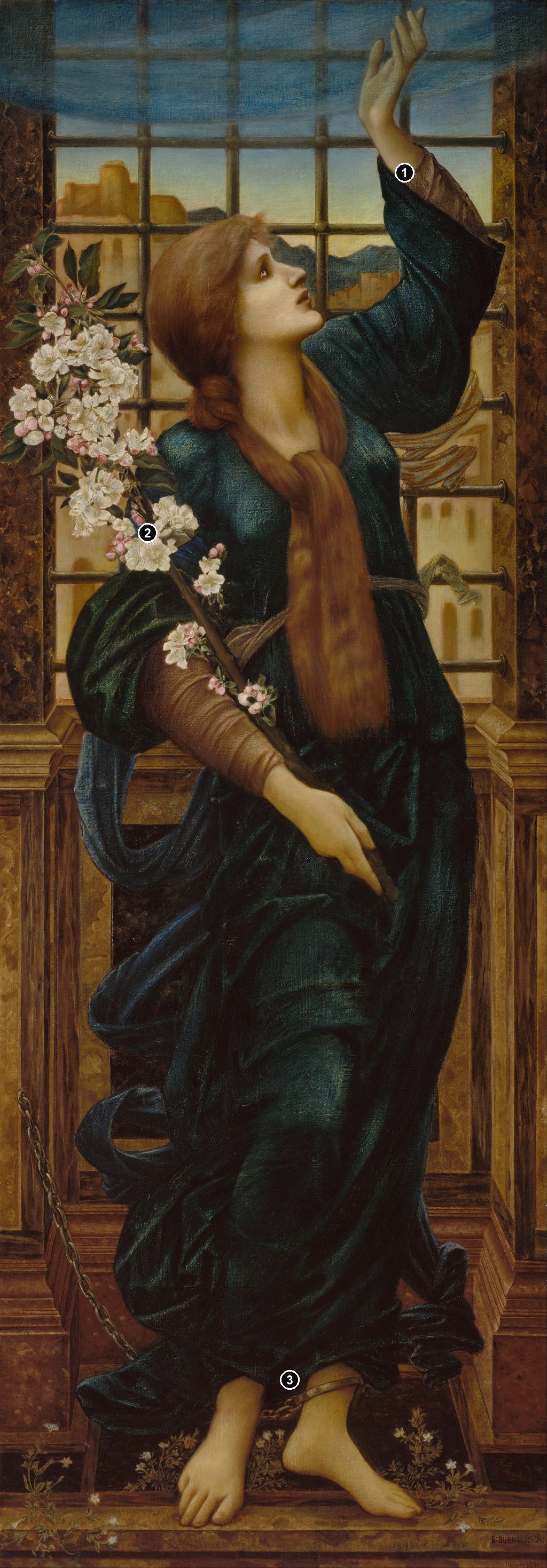
Details from HOPE
Compare the cropped details with the source images above. Notice how their colours, shapes and positions contribute to the larger compositions.
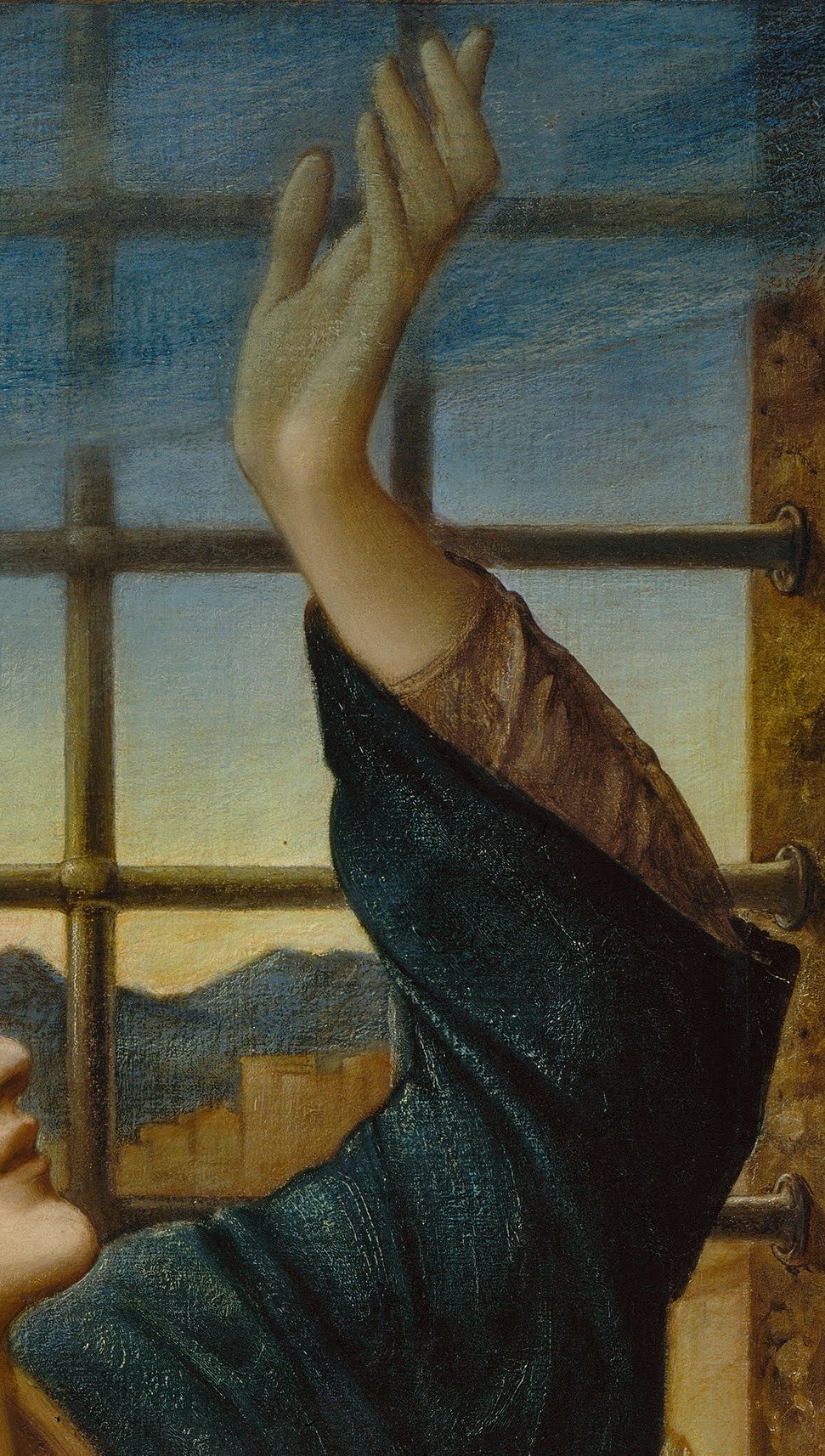
An arm by the bars
The raised hand approaches the bars near the top of the panel. The upright form makes the narrowness of the enclosure visible.
The blossom at her side
Pale flowers interrupt the dark folds and touches of brown nearby.
An ankle at the base
The shackle reduces the body’s freedom to leave. Look up from the feet to feel how far the raised arm has to reach.
From an Oxford window to the Boston canvas
Burne-Jones drew Hope in January 1871 for the left light of the west window in the south nave aisle of Christ Church Cathedral, Oxford. The three-light window brings together Faith, Hope and Charity. A. C. Sewter traced the entries for Hope and Faith in the artist’s accounts at £15 apiece and identified the Oxford figure as the source of the Boston oil’s pose, with a different setting. The narrow field of a single light suits the winding line of her body, which rises from the floor almost to the top of the opening. In a church, the glass is illuminated by the same daylight that the figure seems to seek. In the oil, Burne-Jones had to build that light out of paint, from the cool sheen on a sleeve to the bright buildings visible beyond the bars. The same transfer between media can be seen in several of his stained glass designs. [5] [6]
A large work on paper now in Dunedin Public Art Gallery, New Zealand, preserves an earlier treatment. The gallery calls it Spes or Hope, dates it to 1871 and identifies its materials as watercolour, bodycolour and gold on paper. The 1899 New Gallery memorial exhibition catalogue records a signed and dated Spes that had already been shown at the Grosvenor Gallery in 1877 and the New Gallery in 1892–93. Dunedin received the work from the National Art Collections Fund in 1934. Constable associates the watercolour with paintings of Faith and Temperance. The Oxford window pairs Hope with Faith and Charity, so the grouping changes along with the medium. In the Boston picture the floor is untiled and seen at a different angle, the lower architecture is more elaborate, and the upper margin leaves room for the whole raised hand. Constable thought the architecture brought the patterned interior into closer accord with the folding drapery. Akemi Sada, comparing the Oxford glass, Dunedin watercolour and Boston oil, draws attention to the gentler foreshortening of the forward foot in the oil and the interplay of the soft hair with the iron chain. [3] [6] [7] [8]
The title Hope in Prison also appears on a larger oil associated with Burne-Jones’s studio around 1874. Its reverse inscription describes it as unfinished, and the catalogue raisonné treats the extent of the master’s participation and the identity of the assistant as open questions. The same catalogue mentions an earlier finished oil, dated 1872–77, which it places in Melbourne’s National Gallery of Victoria. That identification awaits confirmation from a corresponding collection record. Sewter also identified other designs for Hope in glass, including figures for Meole Brace in 1873 and Llandefeilog in 1894. A later Morris & Co. drawing at The Huntington gives Hope a palm and a patterned ground. The recurrence of the name Spes therefore tells us which virtue a figure represents, while its pose, attributes and setting help establish which design we are looking at. [5] [9] [10]
In 1912 the stained-glass artist Karl Parsons adapted the prison motif for a memorial window at All Saints’ Church, Eastchurch, in Kent. He moved the chain to Hope’s wrist and set the flowering branch outside her cell. In Boston the prisoner carries the branch herself. At Eastchurch the blossom comes to her from beyond the place of confinement. In a window commemorating two aviators who had died in separate accidents, those familiar details served a different purpose. [11]
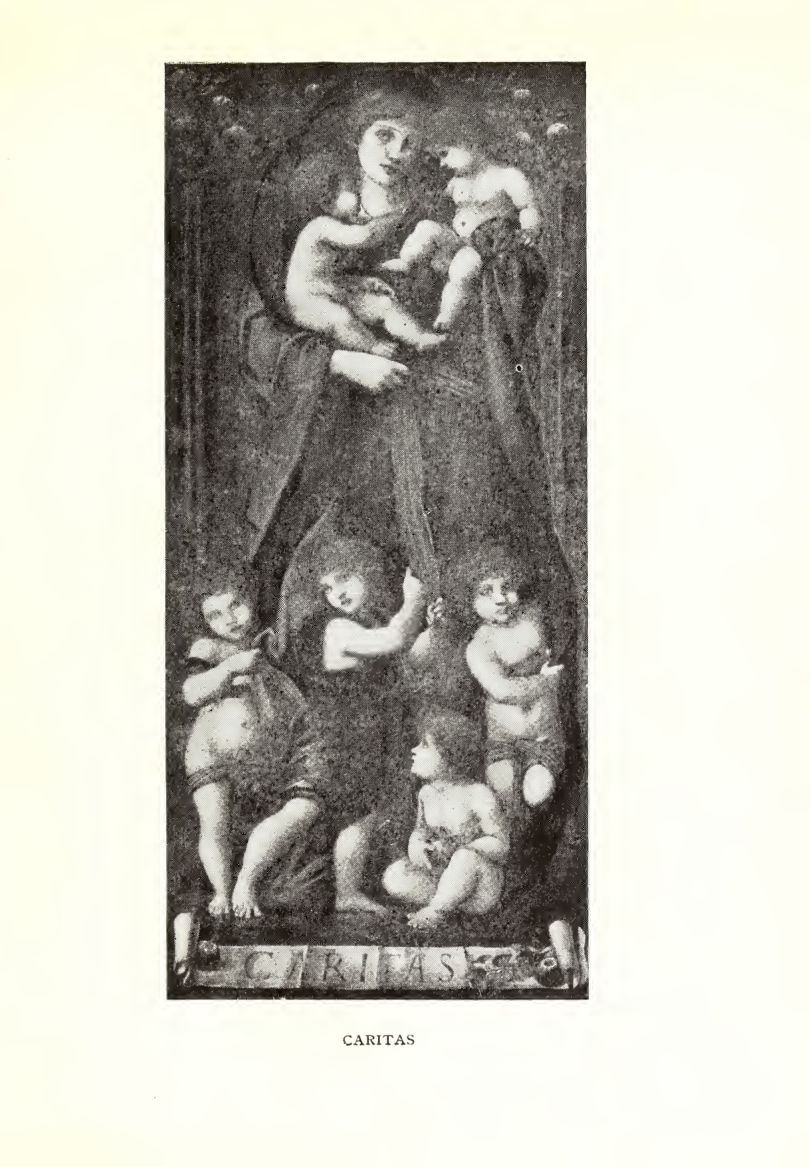
Caritas (Charity), early monochrome reproduction after Edward Burne-Jones. Plate facing page 104 in Fortunée de Lisle’s Burne-Jones. Image source. Public domain. Original printed plate shown with the surrounding page margin.
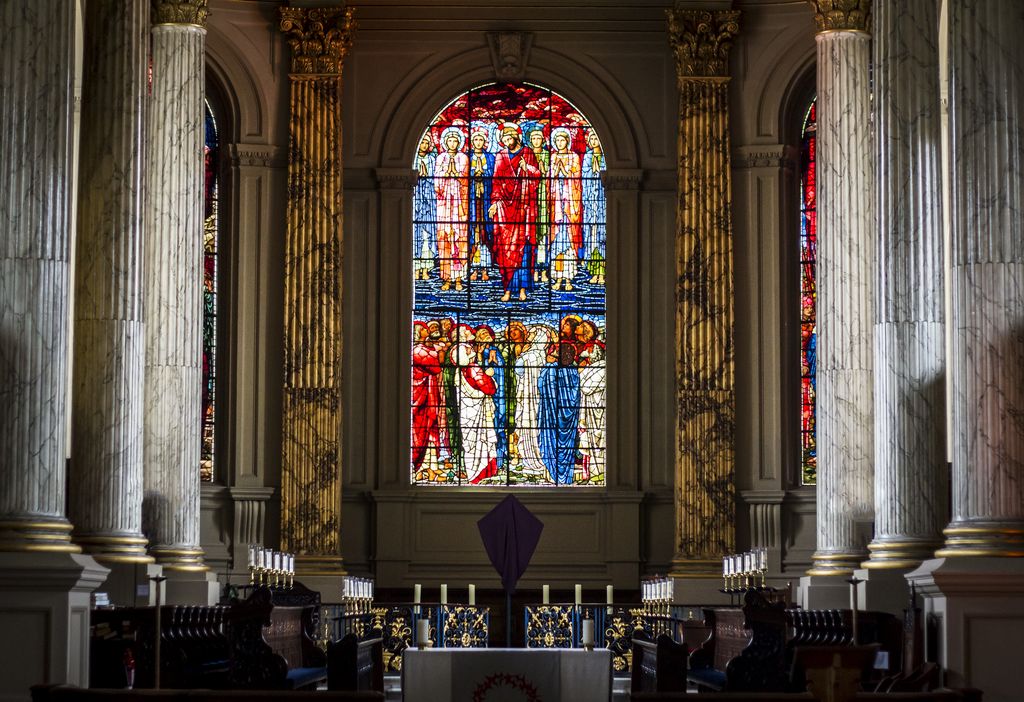
The east end and choir at Birmingham Cathedral, with windows designed by Edward Burne-Jones and made by Morris & Co. Photograph by Raheel Shahid. Image source. CC BY 2.0. Resized for the web.
Victorian audiences
Boston visitors encountered the oil while it still belonged to Mrs Whitin. The museum’s annual report for 1906 singled it out as one of the year’s most popular loans. Her four daughters later gave it to the museum in her memory. In the 1941 Bulletin of the Museum of Fine Arts, Constable acknowledged how remote Burne-Jones’s imagined settings could seem to viewers used to art drawn from contemporary life. He made a case for the painting’s care of execution and singled out the figure’s Botticelli-like pose and the harder folds that reminded him of Mantegna. He also remarked on the picture’s good state of preservation at the time. Burne-Jones generally built up oils in stages, allowing layers to harden between campaigns of work. That method left room for revision, a practical concern for a painter who returned to the same designs over many years. In 1964 the oil was shown alongside stained-glass designs in a Pre-Raphaelite loan exhibition that travelled from Indianapolis to New York, bringing its origins in a church commission into view again. [1] [3] [5] [12]
Another Victorian Hope, by George Frederick Watts, makes the distinctive character of the Boston figure easier to see. In the 1891 version at the Yale Center for British Art, Watts seats his blindfolded figure on a globe with a damaged lyre. A rainbow appears behind her, and she bends towards the instrument to catch what sound it can still make. Watts makes the act of listening carry the picture. Burne-Jones makes us follow a look and a raised hand. The strip of landscape behind his prisoner is important precisely because so little of it is visible. To see even that much, we have to look past the bars with her. [1] [13]
Artworks directory
This directory records paintings, studies, designs and collaborative works, with separate entries for documented versions and series where known.
| Name | Date | Medium |
|---|---|---|
| Sidonia von Bork 1560 | 1860 | Watercolour and bodycolour |
| Clara von Bork 1560 | 1860 | Watercolour and bodycolour |
| The Merciful Knight | 1863 | Watercolour |
| Sibylla Delphica | c. 1886 | Oil on panel |
| Phyllis and Demophoön | 1870 | Watercolour and bodycolour |
| The Legend of the Briar Rose (Buscot series) | 1870s–1890 | Oils on canvas |
| The Briar Wood (Buscot series) | By 1890 | Oil on canvas |
| The Council Chamber (Buscot series) | By 1890 | Oil on canvas |
| The Garden Court (Buscot series) | By 1890 | Oil on canvas |
| The Rose Bower (Buscot series) | By 1890 | Oil on canvas |
| Group of Women, study for The Golden Stairs | 1872 | Drawing |
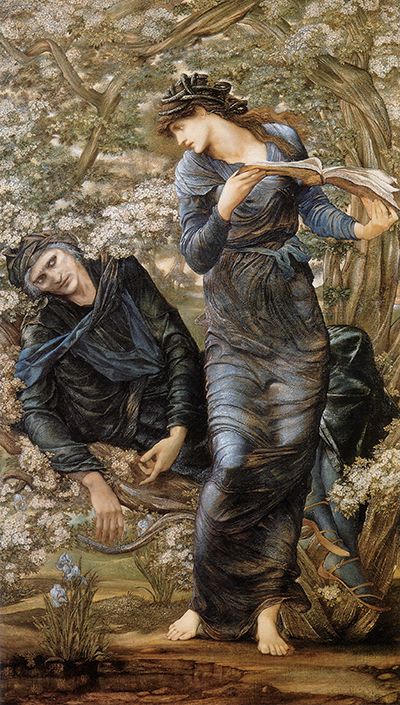
| The Beguiling of Merlin | 1870s | Oil on canvas |
| The Perseus Cycle | From 1875 | Paintings and full-scale designs |
| The Call of Perseus (Stuttgart) | From 1875 | Oil painting |
| Perseus and the Graeae (Stuttgart) | From 1875 | Oil painting |
| The Rock of Doom (Stuttgart) | 1884–88 | Oil on canvas |
| The Doom Fulfilled (Stuttgart) | 1888 | Oil on canvas |
| The Baleful Head (Stuttgart) | 1885–87 | Oil on canvas |
| The Baleful Head (Southampton design) | 1880s | Bodycolour |
| The Rock of Doom (Southampton design) | 1880s | Bodycolour |
| The Doom Fulfilled (Southampton design) | 1880s | Bodycolour |
| The Mirror of Venus (Gulbenkian) | 1870s | Oil on canvas |
| Drawing associated with The Mirror of Venus | 1870s | Drawing |
| Laus Veneris (Laing) | 1873–78 | Oil on canvas |
| The Days of Creation | 1870s | Watercolour and bodycolour |
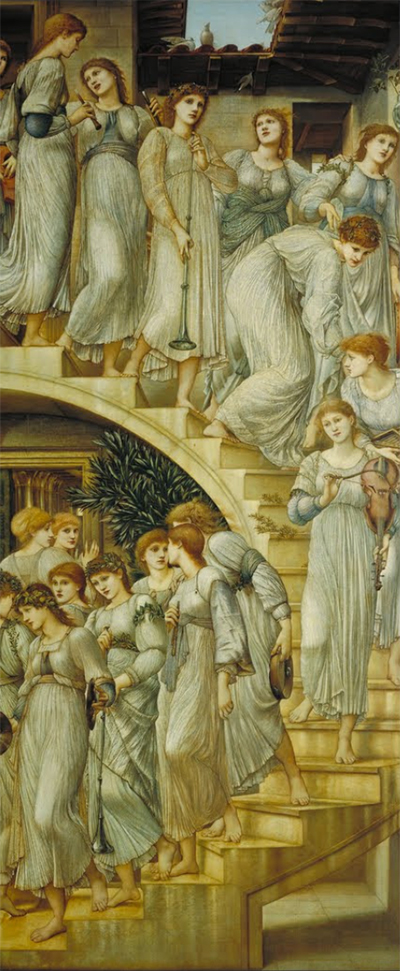
| The Golden Stairs | 1880 | Oil on canvas |
| An Angel Playing a Flageolet | 1878 | Watercolour, bodycolour and gold |
| The Tree of Forgiveness | 1881–82 | Oil on canvas |
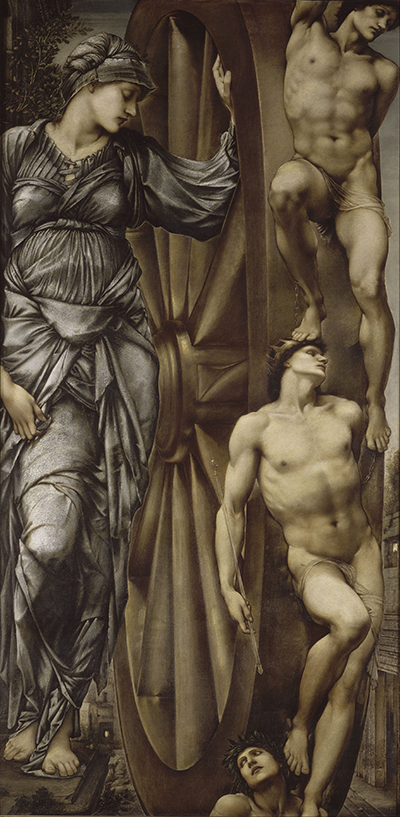
| The Wheel of Fortune (Orsay) | 1875–83 | Oil on canvas |
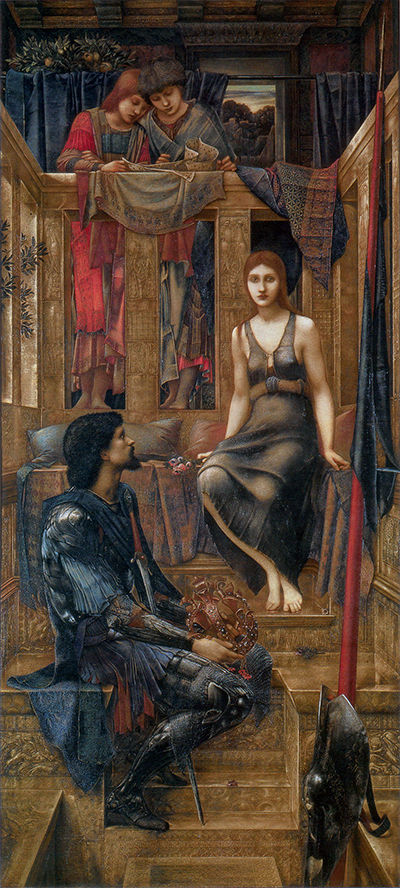
| King Cophetua and the Beggar Maid | 1884 | Oil on canvas |
| The Depths of the Sea (oil) | 1886 | Oil |
| The Morning of the Resurrection | 1886 | Oil on panel |
| Study for the Head of Mary Magdalene | c. 1882 | Oil study |
| The Sleep of King Arthur in Avalon | 1880s–1898 | Oil on canvas |
| The Sleep of King Arthur in Avalon (modello) | ca. 1881 | Oil on canvas (modello) |
| The Star of Bethlehem | Signed 1890 | Watercolour and bodycolour |
| Study for The Star of Bethlehem | About 1887–91 | Drawing |
| Sponsa de Libano | 1891 | Watercolour and bodycolour |
| The Summons (Holy Grail tapestries) | 1890s | Tapestry |
| The Failure of Sir Gawaine (Holy Grail tapestries) | 1890s | Tapestry |
| Hope (Boston) | 1896 | Oil on canvas |
| La Belle au bois dormant (theatre programme) | 1894 | Collotype |
| The Wedding of Psyche | 1895 | Oil on canvas |
| The Works of Geoffrey Chaucer (Kelmscott edition) | 1896 | Illustrated book |
| The Ascension (Birmingham Cathedral) | 1885 | Stained glass |
| The Last Judgement (Birmingham Cathedral) | 1897 | Stained glass |
| Adoration of the Magi (Huntington) | 1890s | Tapestry |
| Love among the Ruins (Wightwick) | 1894 | Oil on canvas |
| The Merciful Knight (photogravure after Burne-Jones) | 1900 | Photogravure |
| The Garden Court (preparatory work) | 1870–75 | Graphite and watercolour with white gouache |
| Study of a Female Figure | 1885 | Graphite drawing |
| Psyche Throwing Herself into the River | 1865–68 | Wood engraving |
| Beauty | 1887–89 | Colour lithograph |
| Study for the Failure of Gawain | 1893 | Crayon and graphite on Japanese paper |
| The Prince Enters the Briar Wood (after Burne-Jones) | After 1890 | Photogravure |
| The Rose Bower (after Burne-Jones) | 1892 | Photogravure |
| Adoration of the Magi (Musée d’Orsay) | 1904 | Tapestry |
| Answers to Prayer (Lyndhurst) | 1860s | Stained glass |
| The Depths of the Sea (photogravure after Burne-Jones) | 1900 | Photogravure |
| Perseus and Andromeda (Adelaide composite) | 1876 | Oil on canvas |
| The Adoration of the Magi (Hamburg) | Woven 1900 | Tapestry |
| Love leading the Pilgrim through the Briars | 1874–76 | Embroidery |
| Musica (worked by Lady Jane Cory) | 1906 | Embroidery |
| Pomona (worked by Lady Jane Cory) | 1907 | Embroidery |
| Flora (worked by Lady Jane Cory) | 1909 | Embroidery |
| The Fourth Day of Creation (photogravure after Burne-Jones) | 1900 | Photogravure |
| The Morning of the Resurrection (photogravure after Burne-Jones) | 1900 | Photogravure |
| Musical angels of the St Catherine window (Christ Church) | Designed 1877 | Stained glass |
Discussion
Look again at the images and ideas explored in Hope. These editorial prompts invite your observations.
Reader Insights
When you look at the hands and the feet, which details carry the allegory?
How does the narrowness of the painting shape your sense of the space around Hope?
Join the Conversation
Share a detail, comparison or question about Hope below.
References
- Museum of Fine Arts, Boston, Hope, museum-contributed object record and image, dimensions, inscription and donor credit. View source.
- Museum of Fine Arts, Boston, Hope, MFA Prints object identification, accession 40.778. View source.
- W. G. Constable, ‘“Hope” by Edward Burne-Jones’, Bulletin of the Museum of Fine Arts, vol. 39, no. 231 (February 1941), pp. 12–14, including the artist’s letter on p. 14. View source.
- National Portrait Gallery, William Morris, extended biography, Oxford friendship, firm and death date. View source.
- A. C. Sewter, ‘Notes on Some Burne-Jones Designs for Stained Glass in American Collections’, Art Institute of Chicago Museum Studies, vol. 5 (1970), pp. 78–79 and p. 81 n. 8. View source.
- Akemi Sada, ‘Edward Burne-Jones’s Stained Glass, Focusing on the 1870s’ [Japanese], Design Theory, no. 55 (2010), pp. 46–47 and fig. 17. View source.
- Dunedin Public Art Gallery, CREAM: European Paintings from the Dunedin Public Art Gallery, list of works, Spes or Hope. View source.
- The New Gallery, Exhibition of the Works of Sir Edward Burne-Jones, Bart. (1899), no. 63, Spes, p. 49. View source.
- Burne-Jones Catalogue Raisonné, Spes, Hope in Prison, studio oil of circa 1874, inscription and attribution notes. View source.
- The Huntington, Hope; Charity; Faith, Morris & Company drawing after Burne-Jones designs, c. 1920, accession 2000.5.852. View source.
- British Society of Master Glass Painters, ‘Church of All Saints, Eastchurch, Kent’, south aisle, Karl Parsons’s 1912 Rolls and Grace memorial. View source.
- Museum of Fine Arts, Boston, Thirty-First Annual Report (1906), Paintings, p. 6. View source.
- Yale Center for British Art, Britain in the World 1860–Now, gallery text for George Frederick Watts, Hope, 1891, B2011.32. View source.