 by Tom Gurney
Tom Gurney BSc (Hons) is an art history expert with over 20 years experience
Published on June 19, 2020 / Updated on November 25, 2026
Email: tomgurney1@gmail.com / Phone: +44 7429 011000
Edward Burne-Jones and Embroidery: Introduction
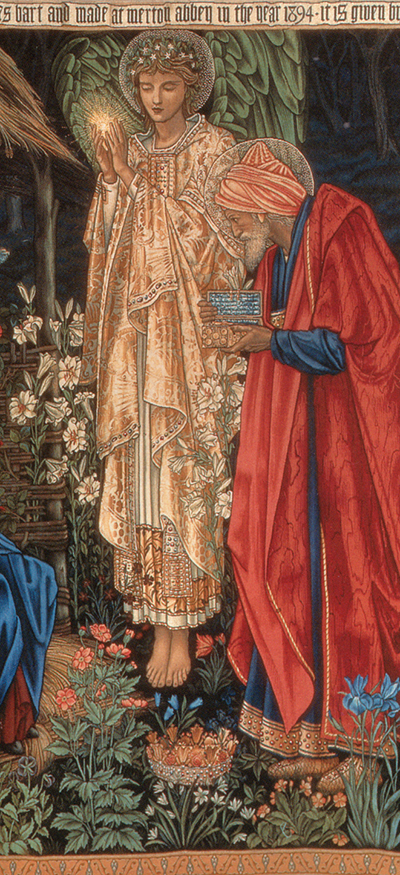
In the dining room at Rounton Grange, a pilgrim wandered through a garden above the oak panelling. Edward Burne-Jones drew the figures, William Morris designed their ornamental surroundings, and Margaret Bell and her daughter Florence Johnson worked the pictures in thread. The five-part frieze, now at the William Morris Gallery, is the largest scheme of figure embroidery that Morris & Co. designed. Other commissions range from a doorway hanging with an enthroned figure of Poetry to a portrait of the goddess Pomona in which Burne-Jones himself painted the face and hands directly onto the cloth. [1] [2] [3] [4]
At a Glance
- ArtistEdward Burne-Jones
- FocusNeedlework designs
- ExploreWorkshop execution, textile commissions and tapestry distinctions
Contents
- The Romance of the Rose at Rounton Grange
- From pencil line to needlework
- Poesis and the Royal School of Art Needlework
- Pomona in paint, silk and wool
- Frances Horner and the designs she worked
- Georgiana Burne-Jones, Launcelot and Thisbe
- How embroidery differs from tapestry
- Annotated details
The Romance of the Rose at Rounton Grange
The industrialist Isaac Lowthian Bell and his wife Margaret commissioned the frieze for their house near Northallerton, Yorkshire. Philip Webb designed the house, and the textiles occupied the upper part of the dining-room walls. The William Morris Gallery dates the designs to about 1874–76. The catalogue of the 2011 exhibition William Morris: Story, Memory, Myth gives 1874–82 for the embroidered panels. Their proportions make sense in the room for which they were designed. Three long stretches carry the story across the walls. Two more compact scenes mark important encounters. Love Leading the Pilgrim Through the Briars alone measures 88 centimetres high by 5.82 metres long. At that width the eye can follow the pilgrim through much the way it follows a line of print, taking in each figure in turn before moving on. [1] [5] [6]
The story comes from the Middle English Romaunt of the Rose, traditionally associated with Geoffrey Chaucer and based on the thirteenth-century French poem by Guillaume de Lorris and Jean de Meun. A young lover dreams of entering a walled garden and falling in love with a rose. Qualities such as Idleness and Beauty enter the story as people he can meet. Burne-Jones was already interested in the poem in 1860, when he showed the artist George Price Boyce a late medieval illuminated copy at the British Museum. The manuscript, now British Library Harley MS 4425, gives several of the vices their own little painted portraits. One miniature shows Idleness leading the lover into the garden. The manuscript and the embroidery both make a story out of the passage from one image to the next, on the page in one case and around a dining room in the other. [5] [7] [8]
The first embroidered panel, F140a, shows the pilgrim looking at the personified vices on the outer wall. Their figures are set in a row of architectural niches. In the dining room, a viewer looking up above the fireplace would have found a figure looking at a decorated wall of his own. The gate scene, F140b, gives the meeting with Idleness a panel of its own. The next long panel, F140c, opens out into the garden and its dancing virtues. In the briars, the pale wings of Love and the pilgrim’s reddish clothing are easy to pick out against the close mesh of stems. The thicket fills the intervals between figures and gives the section a very different pace from the regularly spaced vices. The final panel, F140e, The Pilgrim and the Heart of the Rose, brings the pursuit to a quiet meeting. In the surviving textile, the two figures incline toward each other at the scale of a single encounter, with the garden still close around them. [5] [9] [10] [11] [12]
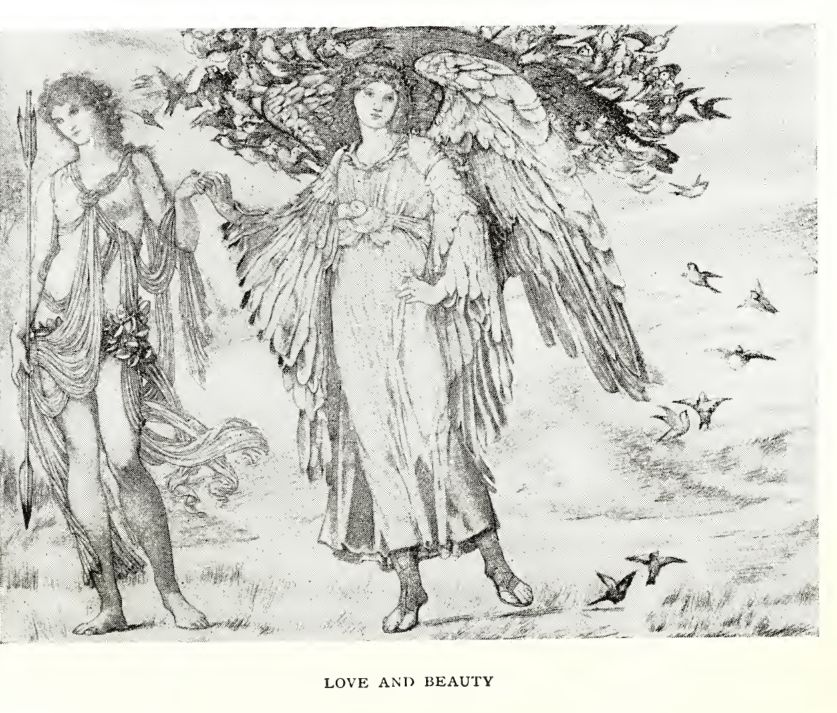
Love and Beauty, a design associated with the Rounton Grange needlework frieze. Reproduction after Edward Burne-Jones in Fortunée de Lisle’s Burne-Jones. Image source. Public domain. Printed plate isolated from the surrounding page and set upright.
From pencil line to needlework
Fortunée de Lisle, writing in 1904, describes the Rounton needleworkers using photographic enlargements of Burne-Jones’s drawings. She also credits Morris with the rose background in parts of the series and with dyeing the wools. Her book reproduces the designs Love and Beauty and Love Leading the Pilgrim. They preserve the fluid lines of costumes and wings that the stitchers had to interpret at a different scale. The surviving Love and Beauty is a large black-chalk drawing dated 1874. Burne-Jones paired the two figures for the design even though Beauty accompanies Richesse in the poem. The loose drapery and sweep of Love’s wings create a grouping one can recognise at a glance. The choice mattered on a wall where the figures would be seen from several feet away. [13] [14]
Silks, wools and gold thread were stitched into a linen ground. The long stitches and gradual shifts of colour described by the decorative arts historian Alan Crawford recall earlier English needlework. The technique rewards a close look at the folds of a garment, where adjoining shades can carry a line from a bright ridge into shadow. The sheen of silk and the glint of metal thread also give the design a surface that changes with the light. In the briar panel, the warm brown and gold of the thicket give Love’s pale wings a crisp outline. That relationship between a clearly legible figure and a surface full of small incidents belonged to the stitchers’ work as much as it did to the drawings. [2] [5] [6]
The gallery’s records name Margaret Bell and Florence Johnson as makers of the frieze and record Sir Hugh Bell’s 1953 gift. Margaret helped make the work she had commissioned. The embroiderers’ handling of colour and texture carried the design from one scene to the next. After Morris took sole charge of the firm in 1875, Burne-Jones became its principal figure designer. Morris’s ornamental settings and Burne-Jones’s figures appear together across several media, with each medium bringing its own choices about how to realise the designs. [1] [6] [12] [3]
Burne-Jones revisited the same poem in several media. The two figures in the Rounton briars have their counterpart in the later oil painting Love Leading the Pilgrim at Tate, where a broad, subdued landscape lies behind them. Morris and Burne-Jones also returned to the poem in the 1896 Kelmscott edition of The Works of Geoffrey Chaucer. A proof of one of its small wood engravings shows two women walking hand in hand, one richly dressed and the other scattering coins. The tiny engraving allows the reader to follow each turn of the wrist and each falling coin. At Rounton Grange, the sequence could unfold for the whole room at once. [15] [16]
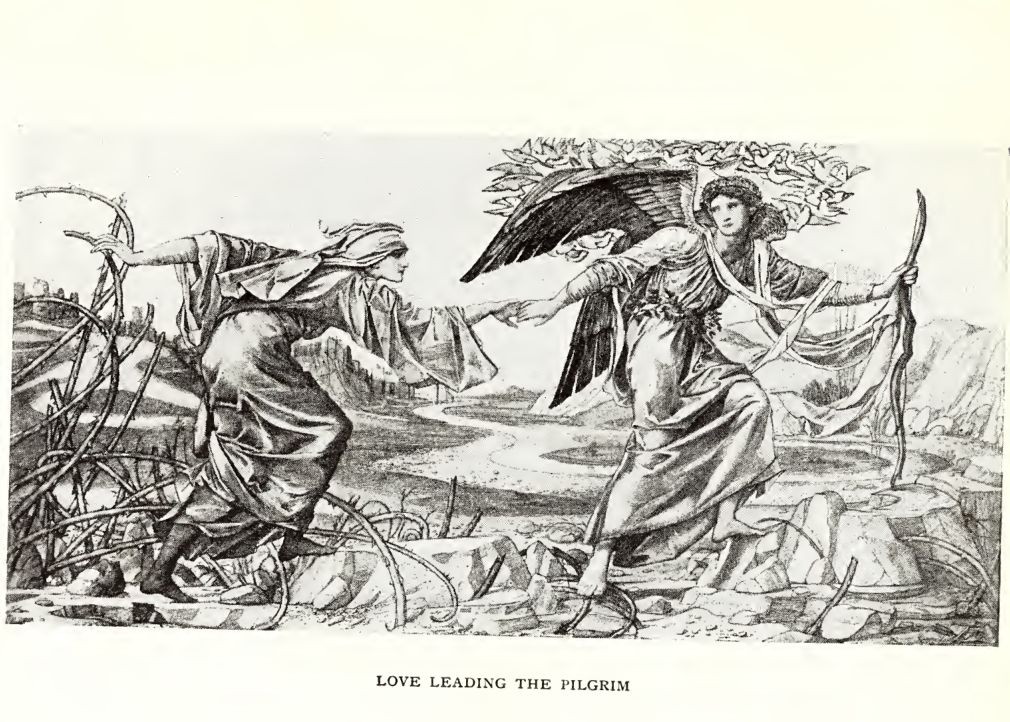
Love Leading the Pilgrim, a drawing of the Rounton Grange subject. Reproduction after Edward Burne-Jones in Fortunée de Lisle’s Burne-Jones. Image source. Public domain. Printed plate isolated from the surrounding page and set upright.
Poesis and the Royal School of Art Needlework
The Royal School of Art Needlework grew out of a school founded in 1872 to revive decorative embroidery and provide paid work for women. Its workers studied historic embroideries at what is now the Victoria and Albert Museum. It exhibited at the Philadelphia Centennial Exhibition in 1876 and published a handbook in 1880. The art needlework it promoted encouraged a flowing line and a choice of stitches suited to the design. As the design historian Asako Yamamoto has shown, this approach grew in part from dissatisfaction with the dominance of Berlin woolwork, in which a design was generally followed on a counted canvas grid. [17] [18]
The National Gallery of Victoria’s Poesis, made about 1880, shows what this kind of needlework could do with colour. Originally designed as a door hanging, the Melbourne piece measures just over two metres high. Poetry sits above the other figures with quill and book, while Orpheus plays below and the muses gather near her throne. The composition places one group above another with little suggestion of deep space, so the figures remain legible across the width of a doorway. The needleworkers gave them volume by blending different colours of wool on a cotton ground with interlocking long and short stitches. The museum credits the school as the maker and both Morris and Burne-Jones as designers. The individual embroiderers’ names went unrecorded, a common practice for the school’s commissions. Its early records nevertheless preserve the circumstances of women who applied to work there, some supporting siblings or left without an income after being widowed. [19] [20]
The school also worked Burne-Jones’s companion design Musica. Here a girl holds open a music book for a string player. As in Poesis, the stacked arrangement of figures makes the subject readable in a relatively narrow panel. The 1998 Metropolitan Museum exhibition catalogue records a version of Musica worked in brown crewel wool on linen that was illustrated in The Magazine of Art in 1880. Where the Melbourne Poesis shades faces and drapery in colour, the brown wool of that Musica gives the contours more of the character of a drawing. [17] [21]
Lady Jane Cory returned to the two designs a generation later. She borrowed the school’s version of Musica as a model and was able to match her colours to the original artwork lent by Mrs Percy Wyndham. Cory spent seven and a half months working her Musica in worsted wool and silk on linen, using long and short stitches, stem stitches and French knots. She took special instruction to work the flesh in stitches. Her Poesis followed in 1908 and appeared in the women’s section of the Franco-British Exhibition. The pair later hung in neighbouring recesses in her London home and are now at Te Papa in Wellington, New Zealand. Her choices of stitch and shade can be seen at their most concentrated in the hands she worked around the open book. [22] [23]
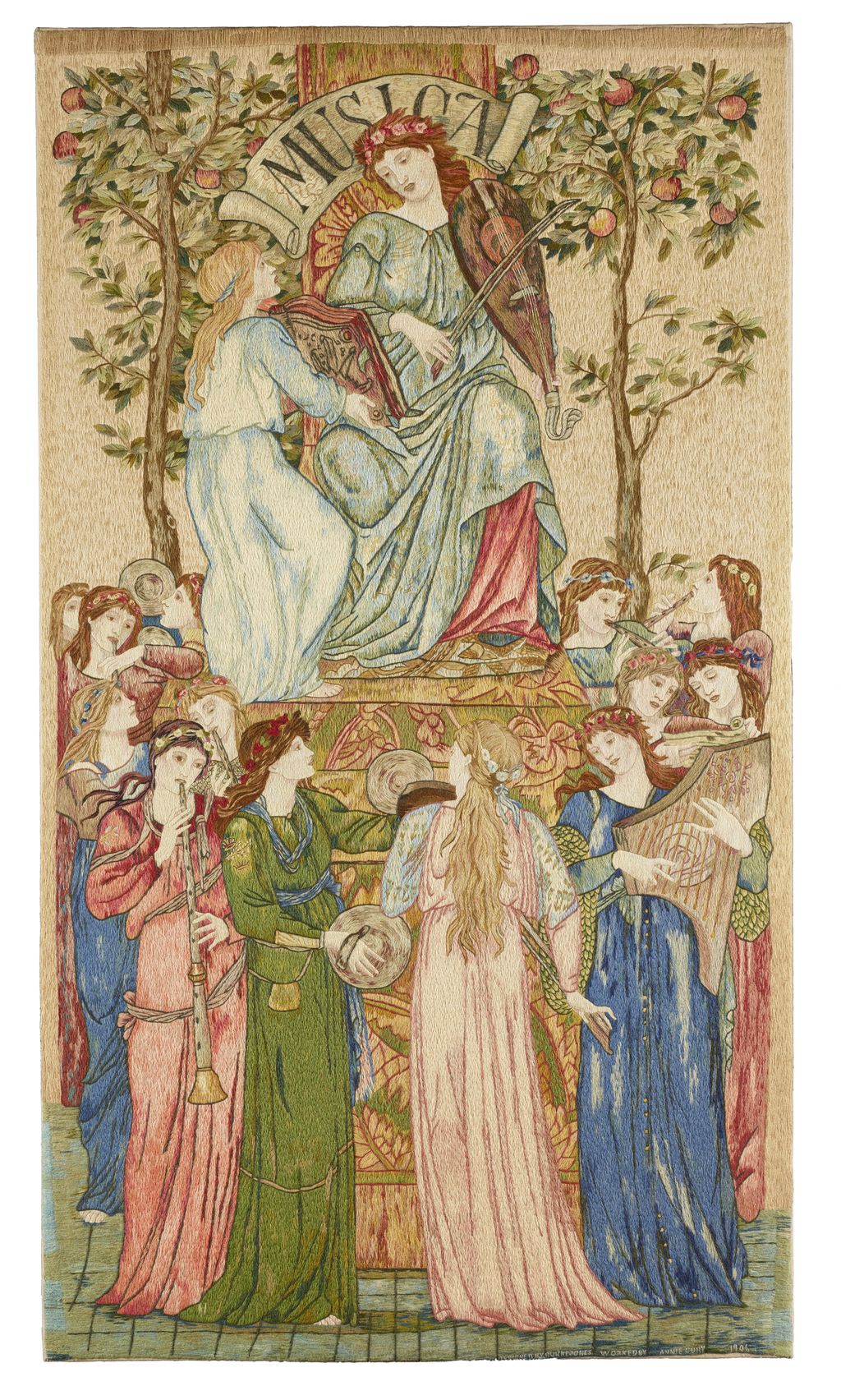
Lady Jane Cory, Musica, 1906, embroidery after a figure design by Edward Burne-Jones. Museum of New Zealand Te Papa Tongarewa, PC004115. Image source. No Known Copyright Restrictions.
Pomona in paint, silk and wool
In the embroidered Pomona of about 1885, the Roman guardian of orchards gathers apples in her skirt and holds an apple bough. William Morris surrounded the figure with curling foliage and a grapevine border. His verse, set out on banners above and below, gives the apple queen a voice that carries across the seasons. The Royal School’s archive preserves a photograph of the embroidered version shown at the Chicago World’s Fair in 1893. Tate credits the school’s needlewomen and places the work under May Morris’s direction. The school’s archive describes May’s supervision as a reported attribution. May was an embroiderer and designer in her own right and took charge of the embroidery department at Morris & Co. at the age of twenty-three. [3] [24] [25]
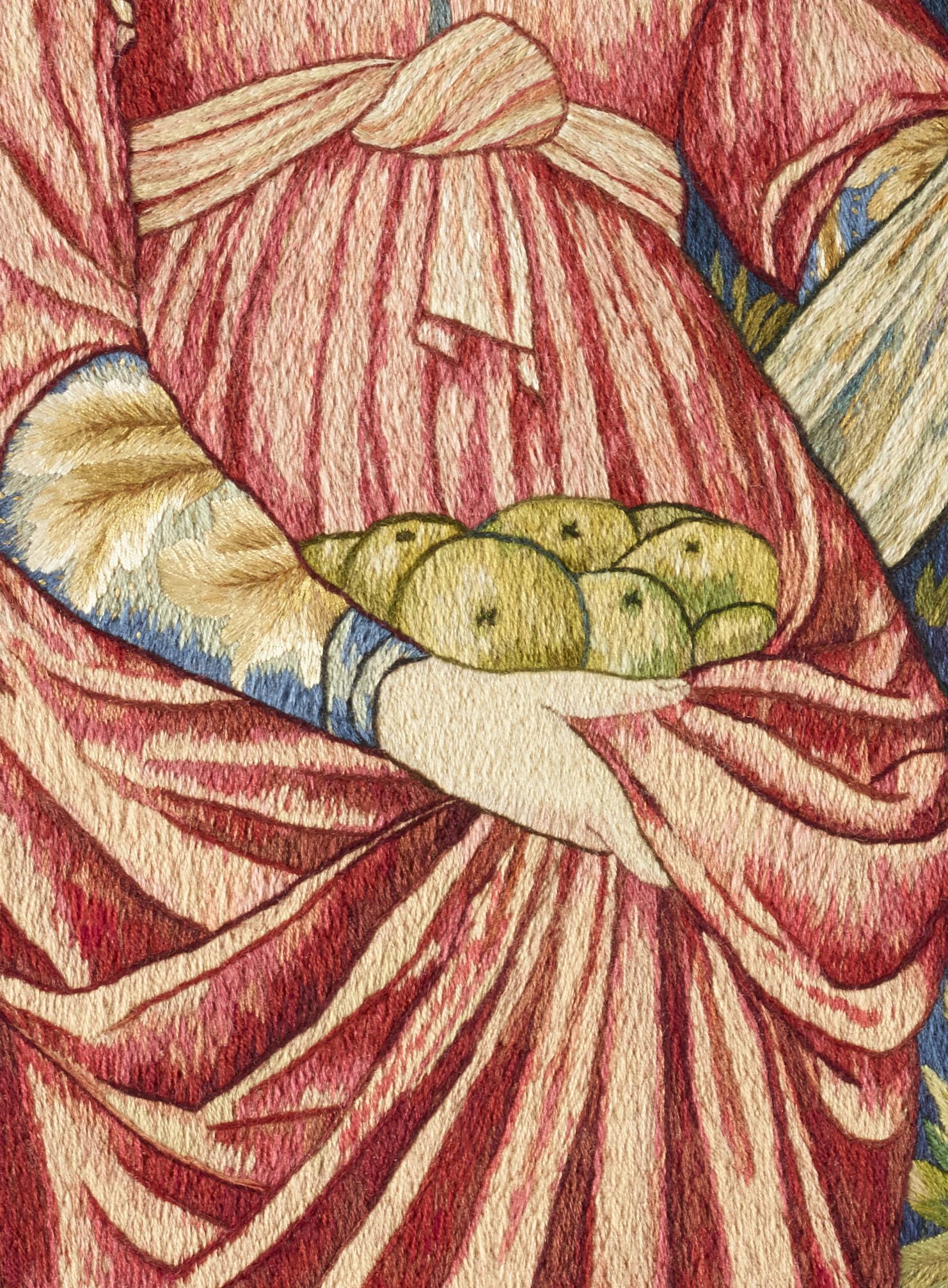
William G. Paulson Townsend’s early needlework manual describes the workmanship in unusual detail. The school’s embroiderers used long and short stitches in muted pinkish-red silk for the figure, laid threads for the broad scrolling leaves and gave the grapes in the border extra relief by padding them. For the smallest flowers and leaves they used long and short stitches again. Burne-Jones painted the face and hands on the linen itself. The softness of those painted details and the raised grapes at the edge show how several quite different approaches to the same surface could coexist within one hanging. [3] [26]
The Royal School’s photograph and the woven Pomona at the Whitworth show much the same orchard figure and bands of verse. A watercolour design at Wightwick Manor has similar foliage and a grape border, with the wording in the banners still in Latin. The National Trust identifies the figure and ornament as the work of Burne-Jones and Morris while suggesting the watercolour was painted in the firm’s workshop. In the later woven example at the Victoria and Albert Museum, John Henry Dearle’s background and simpler acanthus border change the setting of the familiar figure, and the banners disappear. Keeping track of which Pomona one is looking at helps explain how a single image passed through so many hands. [24] [27] [28]
Cory worked her own Pomona in 1907 and Flora in 1909, both now at Te Papa. The source for these embroideries was Dearle’s reworking of the tapestry designs. Cory’s Pomona is distinguishable from the Royal School’s version by its background and by the face and hands, which Cory rendered in thread. The figure travelled from a design for a loom into a work stitched by hand, while the decisions about how to render skin, foliage and cloth passed to a different maker. [29] [30] [23]
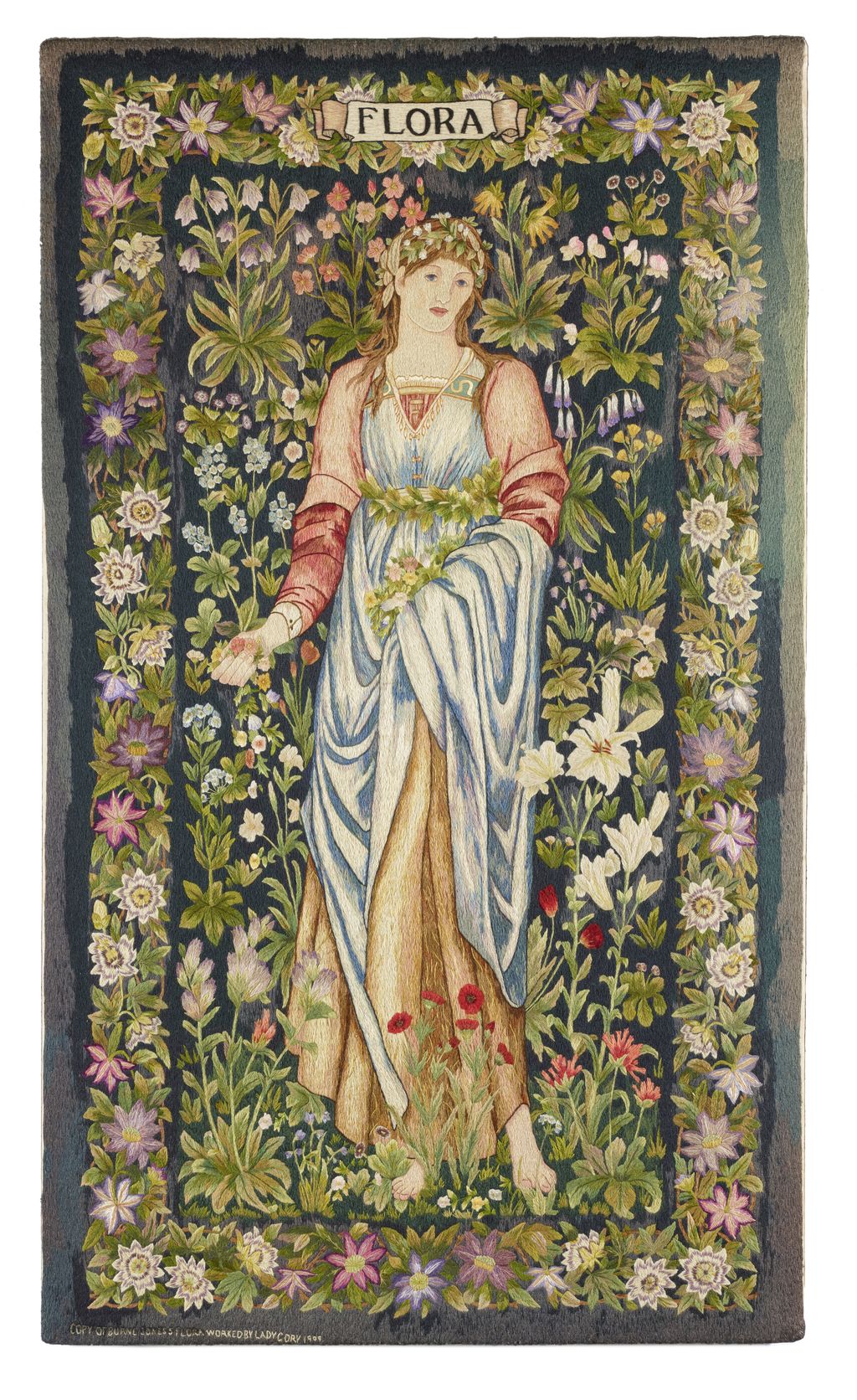
Lady Jane Cory, Flora, 1909, embroidery based on the Burne-Jones and Morris design. Museum of New Zealand Te Papa Tongarewa, PC004119. Image source. No Known Copyright Restrictions.
Annotated Details from Edward Burne-Jones and Embroidery
The numbered points identify visible features discussed in this article. Return from each detail to the numbered overview. Lady Jane Cory, Pomona, 1907, embroidery based on the Burne-Jones and Morris design. Museum of New Zealand Te Papa Tongarewa, PC004117. Image source. No Known Copyright Restrictions.
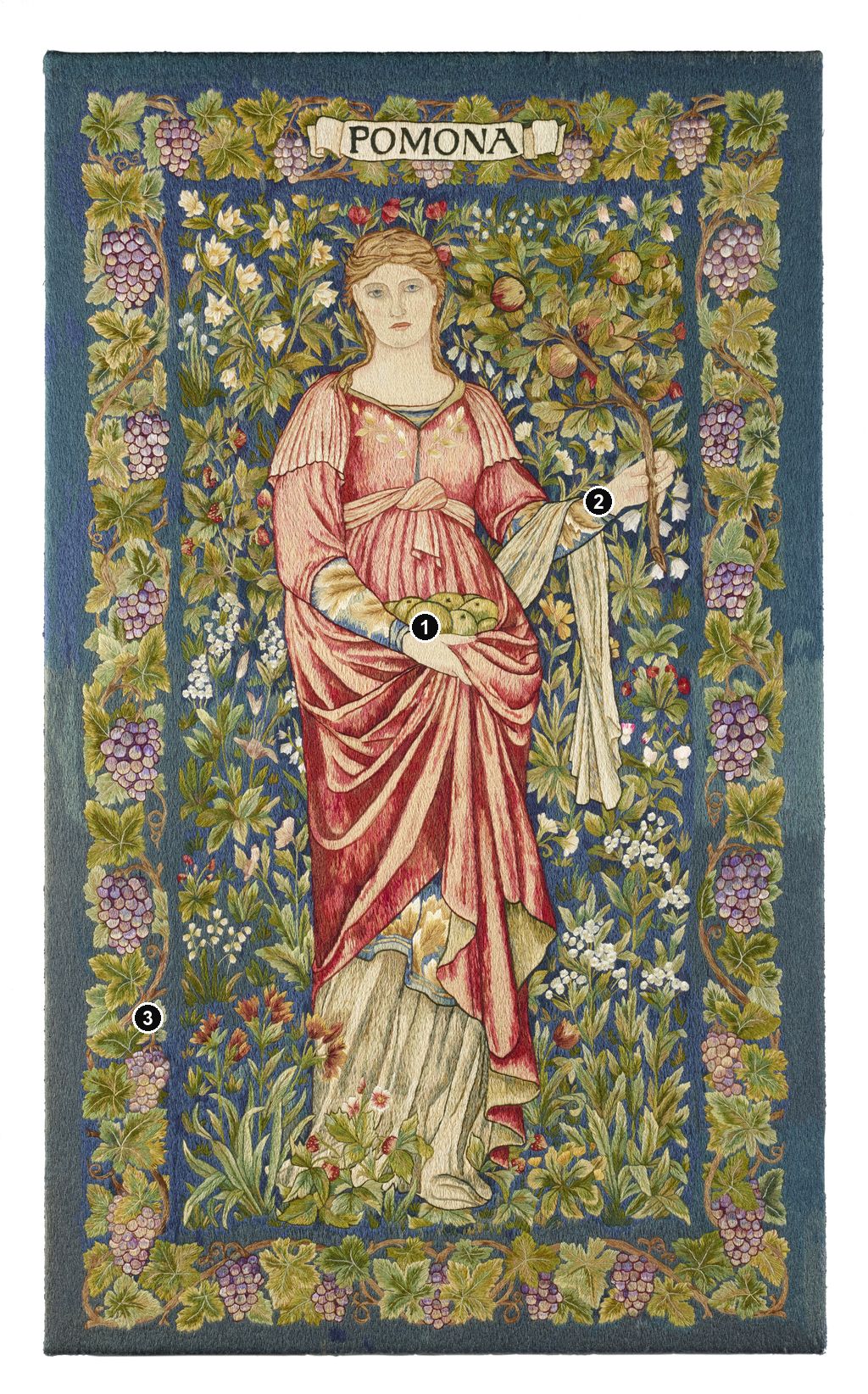
Details from EDWARD BURNE-JONES AND EMBROIDERY
Compare the cropped details with the source images above. Notice how their colours, shapes and positions contribute to the larger compositions.
Fruit gathered in a fold
The fold of the skirt makes a pocket for the fruit. Small warm stitches describe rounded shapes against the sharper folds of the rose-coloured cloth.
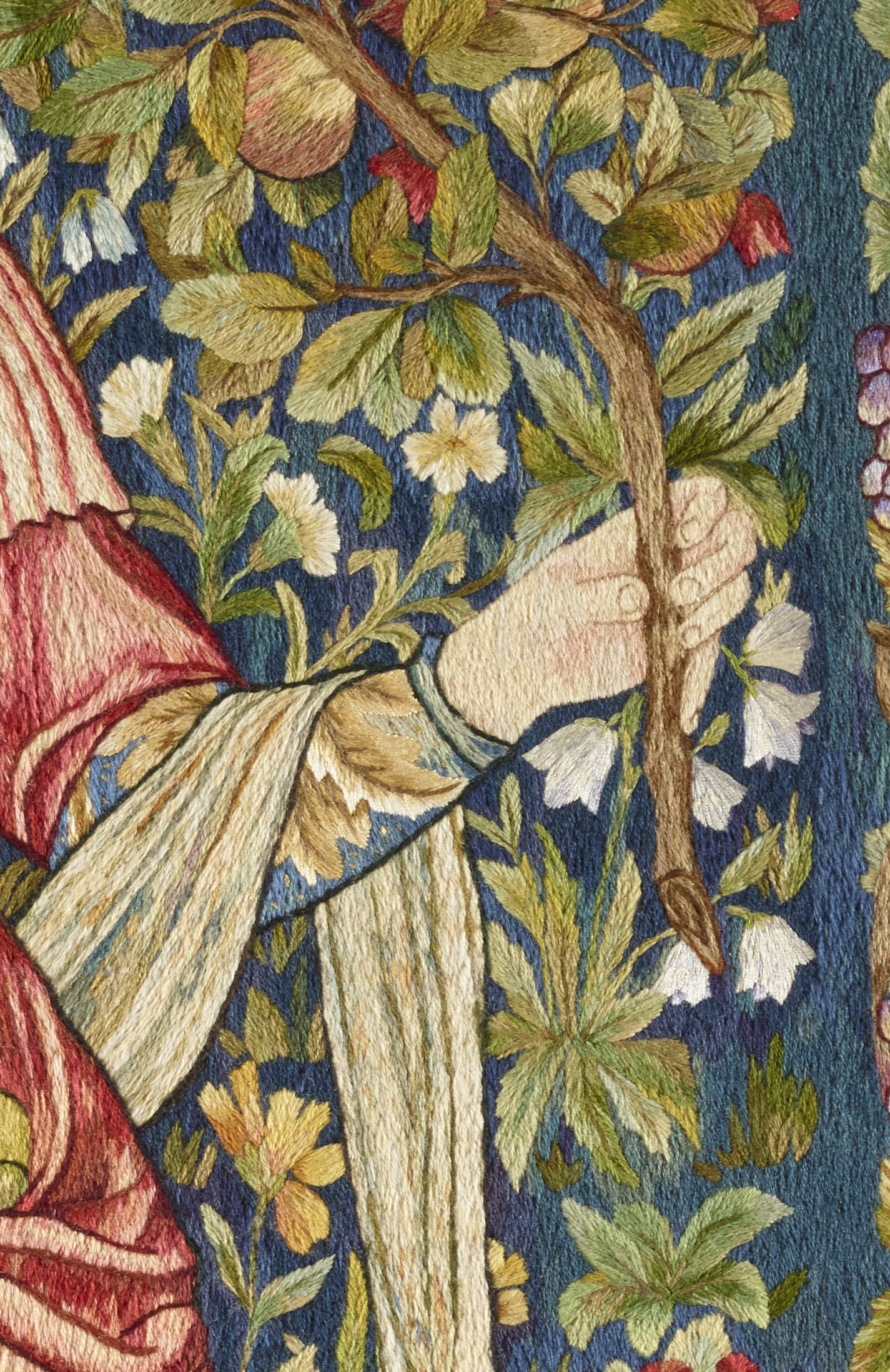
A hand amongst leaves
The pale hand and gathered sleeve interrupt the leaf pattern. Lines of thread give a separate direction to the sleeve and the branches beyond it.
The edge of the embroidered field
The upright border carries a continuous plant design. Its repeated leaves and small flowers give a firm edge to the irregular ground inside it.
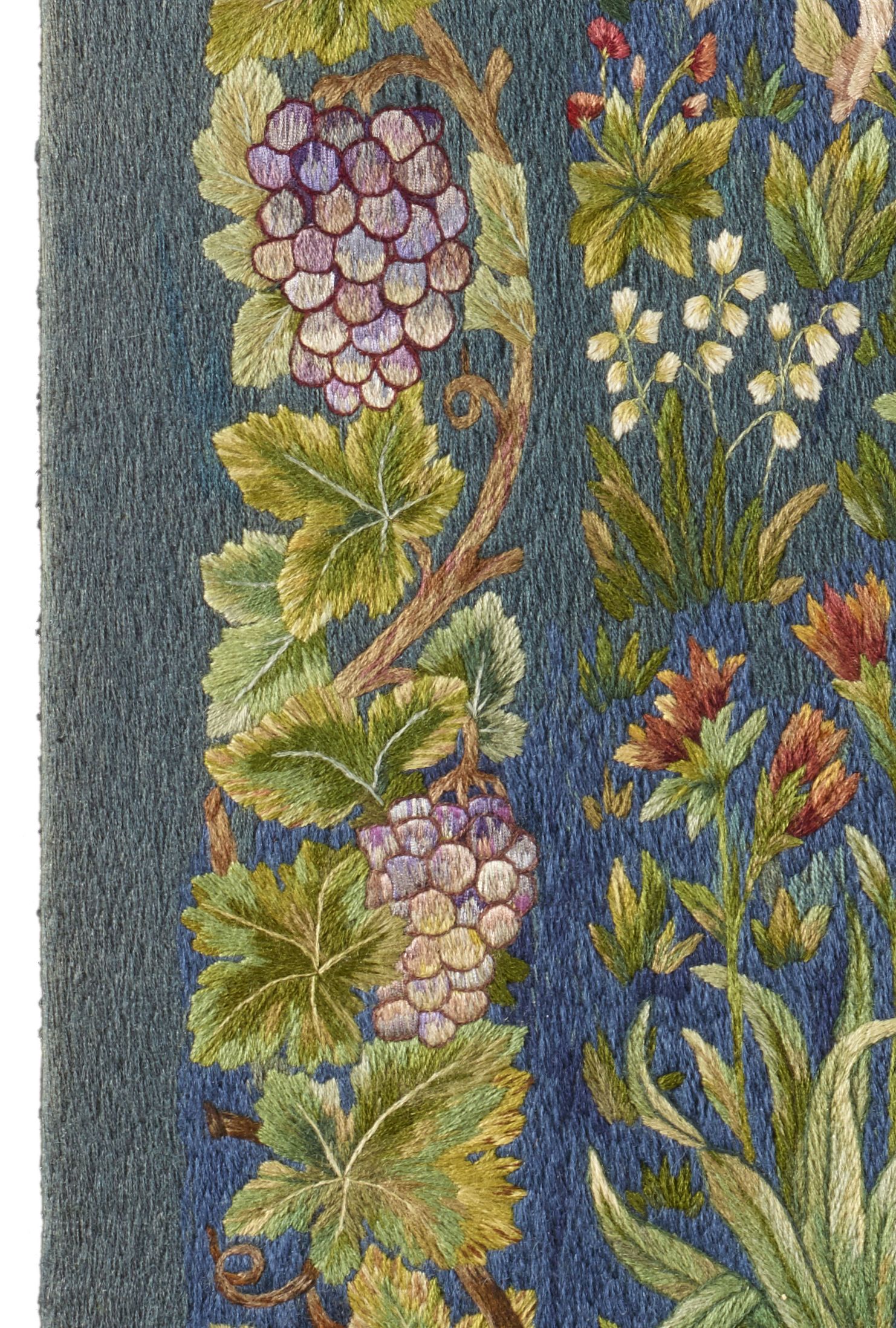
Frances Horner and the designs she worked
Burne-Jones also designed embroideries for Frances Graham, later Lady Horner. The small Ruth, about 25 centimetres high, is a piece she stitched with fine details painted by Burne-Jones. By contrast, her full-size Love survives at St Andrew’s Church in Mells, Somerset. The inscription comes from the closing line of Dante’s Paradiso, on the love that moves the sun and the other stars. The finished embroidery was shown at the Arts and Crafts Exhibition in 1896. Together the two pieces show how readily Horner could work at opposite ends of the scale, from an intimate picture to a hanging visible across a church. [2] [21] [31]
A related trail survives on paper. Burne-Jones’s 1876 chalk drawing Sponsa de Libano at the National Gallery of Canada is catalogued as a design for an embroidery from the Song of Solomon. The later watercolour Sponsa de Libano develops the imagery on a larger scale, with the Bride of Lebanon between the winds. Some of the associated drawings belonged to Frances Horner. Ownership of a drawing and completion of its design in thread are separate parts of its history. The survival of the paper studies helps to explain how Burne-Jones developed those tall compositions independently of any surviving textile. [32] [33]
Georgiana Burne-Jones, Launcelot and Thisbe
An unfinished Launcelot at the Victoria and Albert Museum preserves a rare view of an embroidery in progress. Edward Burne-Jones painted the armoured knight directly on the linen. Georgiana Burne-Jones began working the face and hair in cream, pink and brown wools, with the painted armour still visible below. Holes in the ground mark where the linen was held on its frame. In a note she later sewed to the textile, Georgiana explains that it belonged to a set of Arthurian figures they had hoped would decorate a room of their own. The exposed painted guide shows how a figure could be marked out for embroidery in the early 1860s, before photographic enlargements were used for the much larger scheme at Rounton Grange. [34] [13]
The William Morris Gallery’s Thisbe design, made about 1863–64 in pencil, sepia and watercolour, was intended for an embroidered frieze for John Ruskin’s home. The subject comes from Chaucer’s Legend of Good Women. Thisbe holds a mulberry leaf and the sword that connects her to the end of the story of Pyramus and Thisbe. Georgiana Burne-Jones and the pupils at Winnington Hall in Cheshire were to work the embroidery, but the scheme proved impracticable. Figures from the project subsequently found their way into stained glass for The Hill at Witley, Surrey. Six of those windows survive at Peterhouse, Cambridge. The drawing of Thisbe remains evidence of the intended needlework, even though the commission took a different form in glass. [35]
How embroidery differs from tapestry
Embroidery works into a fabric that has already been made. The linen beneath the painted features of Pomona and the cotton under the shading of Poesis are the foundation of each picture. In a woven tapestry the weavers build the picture into the cloth on a loom, passing the coloured weft through the warp. A tapestry can use wool and silk like an embroidery, and the same preparatory design can serve both kinds of work. The object’s structure, along with its record of manufacture, is a better guide to what you are looking at than its title, size or subject. In his account book, Burne-Jones himself used the word tapestry for one of the Rounton designs. [3] [19] [28] [10]
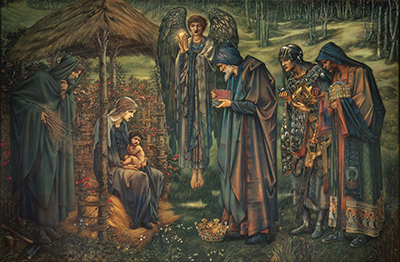
His tapestry designs include The Adoration of the Magi, which Morris & Co. wove in multiple versions, and the Holy Grail cycle, first woven in 1893–95. Philip Burne-Jones’s portrait of his father places the composition of The Attainment, the culminating Grail scene, on the studio easel. The portrait shows how readily the figure design could belong to a painting as well as to a tapestry. The embroidered Pomona, with paint beside raised silk stitches, shows just how much the appearance of a finished textile depended on the skills brought to it after that stage. [36] [37]
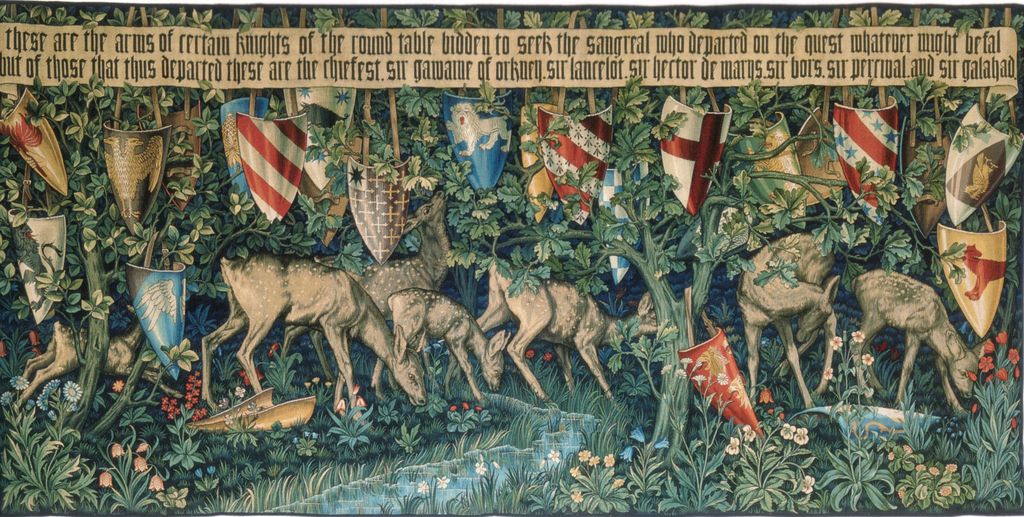
Morris & Co., Verdure from the Holy Grail scheme. Image source. Public domain.
Edward Burne-Jones on film
Explore Burne-Jones’s paintings, illustrated stories and stained-glass designs.
Edward Burne-Jones: Pre-Raphaelite Visionary | Exhibitions | Showcase
A look at Burne-Jones’s paintings and the Tate retrospective.
Watch on YouTubeArtworks directory
This directory records paintings, studies, designs and collaborative works, with separate entries for documented versions and series where known.
| Name | Date | Medium |
|---|---|---|
| Sidonia von Bork 1560 | 1860 | Watercolour and bodycolour |
| Clara von Bork 1560 | 1860 | Watercolour and bodycolour |
| The Merciful Knight | 1863 | Watercolour |
| Sibylla Delphica | c. 1886 | Oil on panel |
| Phyllis and Demophoön | 1870 | Watercolour and bodycolour |
| The Legend of the Briar Rose (Buscot series) | 1870s–1890 | Oils on canvas |
| The Briar Wood (Buscot series) | By 1890 | Oil on canvas |
| The Council Chamber (Buscot series) | By 1890 | Oil on canvas |
| The Garden Court (Buscot series) | By 1890 | Oil on canvas |
| The Rose Bower (Buscot series) | By 1890 | Oil on canvas |
| Group of Women, study for The Golden Stairs | 1872 | Drawing |
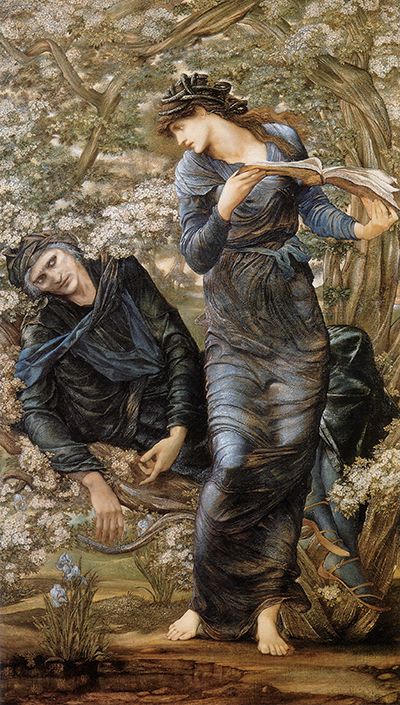
| The Beguiling of Merlin | 1870s | Oil on canvas |
| The Perseus Cycle | From 1875 | Paintings and full-scale designs |
| The Call of Perseus (Stuttgart) | From 1875 | Oil painting |
| Perseus and the Graeae (Stuttgart) | From 1875 | Oil painting |
| The Rock of Doom (Stuttgart) | 1884–88 | Oil on canvas |
| The Doom Fulfilled (Stuttgart) | 1888 | Oil on canvas |
| The Baleful Head (Stuttgart) | 1885–87 | Oil on canvas |
| The Baleful Head (Southampton design) | 1880s | Bodycolour |
| The Rock of Doom (Southampton design) | 1880s | Bodycolour |
| The Doom Fulfilled (Southampton design) | 1880s | Bodycolour |
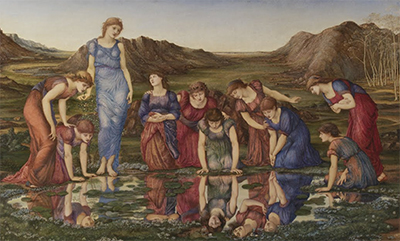
| The Mirror of Venus (Gulbenkian) | 1870s | Oil on canvas |
| Drawing associated with The Mirror of Venus | 1870s | Drawing |
| Laus Veneris (Laing) | 1873–78 | Oil on canvas |
| The Days of Creation | 1870s | Watercolour and bodycolour |
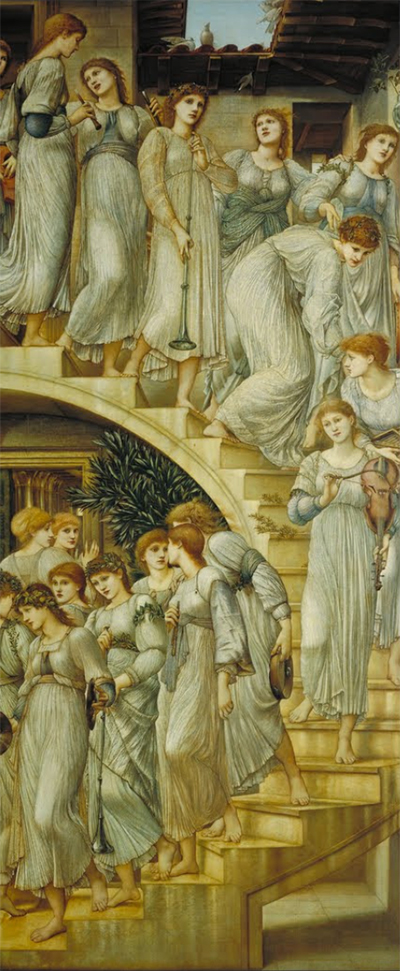
| The Golden Stairs | 1880 | Oil on canvas |
| An Angel Playing a Flageolet | 1878 | Watercolour, bodycolour and gold |
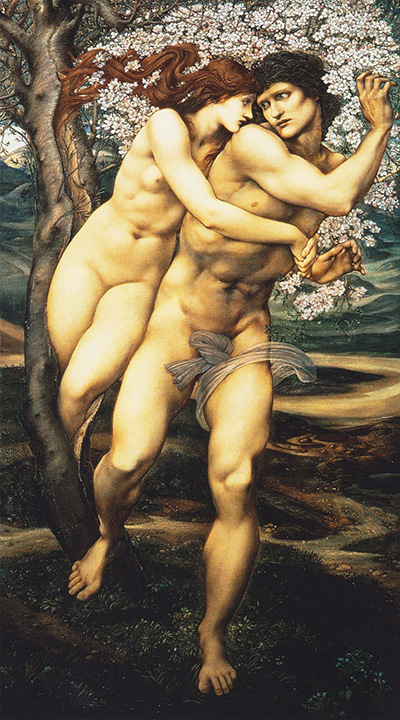
| The Tree of Forgiveness | 1881–82 | Oil on canvas |
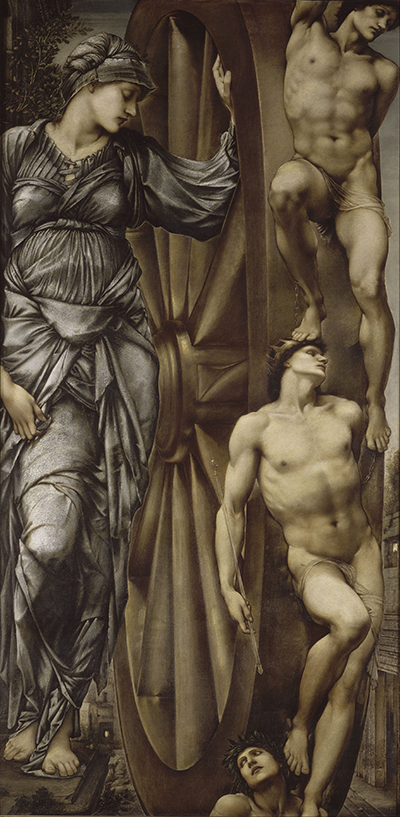
| The Wheel of Fortune (Orsay) | 1875–83 | Oil on canvas |
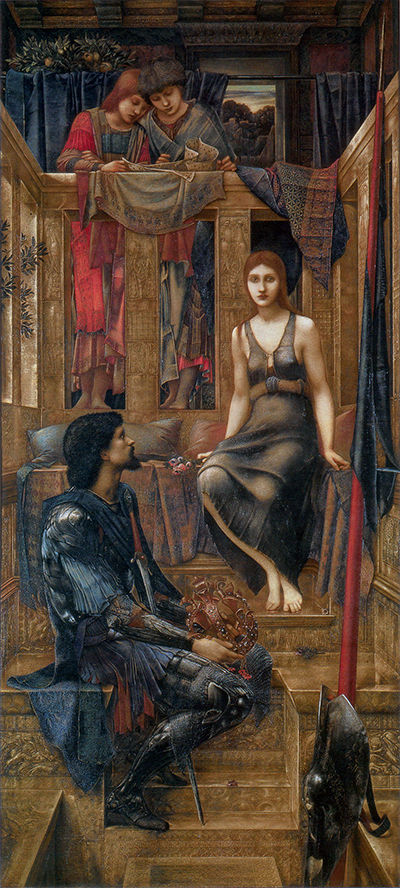
| King Cophetua and the Beggar Maid | 1884 | Oil on canvas |
| The Depths of the Sea (oil) | 1886 | Oil |
| The Morning of the Resurrection | 1886 | Oil on panel |
| Study for the Head of Mary Magdalene | c. 1882 | Oil study |
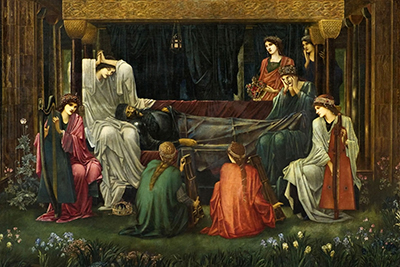
| The Sleep of King Arthur in Avalon | 1880s–1898 | Oil on canvas |
| The Sleep of King Arthur in Avalon (modello) | ca. 1881 | Oil on canvas (modello) |
| The Star of Bethlehem | Signed 1890 | Watercolour and bodycolour |
| Study for The Star of Bethlehem | About 1887–91 | Drawing |
| Sponsa de Libano | 1891 | Watercolour and bodycolour |
| The Summons (Holy Grail tapestries) | 1890s | Tapestry |
| The Failure of Sir Gawaine (Holy Grail tapestries) | 1890s | Tapestry |
| Hope (Boston) | 1896 | Oil on canvas |
| La Belle au bois dormant (theatre programme) | 1894 | Collotype |
| The Wedding of Psyche | 1895 | Oil on canvas |
| The Works of Geoffrey Chaucer (Kelmscott edition) | 1896 | Illustrated book |
| The Ascension (Birmingham Cathedral) | 1885 | Stained glass |
| The Last Judgement (Birmingham Cathedral) | 1897 | Stained glass |
| Adoration of the Magi (Huntington) | 1890s | Tapestry |
| Love among the Ruins (Wightwick) | 1894 | Oil on canvas |
| The Merciful Knight (photogravure after Burne-Jones) | 1900 | Photogravure |
| The Garden Court (preparatory work) | 1870–75 | Graphite and watercolour with white gouache |
| Study of a Female Figure | 1885 | Graphite drawing |
| Psyche Throwing Herself into the River | 1865–68 | Wood engraving |
| Beauty | 1887–89 | Colour lithograph |
| Study for the Failure of Gawain | 1893 | Crayon and graphite on Japanese paper |
| The Prince Enters the Briar Wood (after Burne-Jones) | After 1890 | Photogravure |
| The Rose Bower (after Burne-Jones) | 1892 | Photogravure |
| Adoration of the Magi (Musée d’Orsay) | 1904 | Tapestry |
| Answers to Prayer (Lyndhurst) | 1860s | Stained glass |
| The Depths of the Sea (photogravure after Burne-Jones) | 1900 | Photogravure |
| Perseus and Andromeda (Adelaide composite) | 1876 | Oil on canvas |
| The Adoration of the Magi (Hamburg) | Woven 1900 | Tapestry |
| Love leading the Pilgrim through the Briars | 1874–76 | Embroidery |
| Musica (worked by Lady Jane Cory) | 1906 | Embroidery |
| Pomona (worked by Lady Jane Cory) | 1907 | Embroidery |
| Flora (worked by Lady Jane Cory) | 1909 | Embroidery |
| The Fourth Day of Creation (photogravure after Burne-Jones) | 1900 | Photogravure |
| The Morning of the Resurrection (photogravure after Burne-Jones) | 1900 | Photogravure |
| Musical angels of the St Catherine window (Christ Church) | Designed 1877 | Stained glass |
Discussion
Look again at the images and ideas explored in Edward Burne-Jones and Embroidery. These editorial prompts invite your observations.
Reader Insights
What becomes visible about the embroiderer’s contribution when you compare a design and a finished object?
In Cory’s Pomona, where do the stitches most clearly give shape to the fruit or cloth?
Join the Conversation
Share a detail, comparison or question about Edward Burne-Jones and Embroidery below.
References
- William Morris Gallery, The Romance of the Rose: The Rounton Grange Embroideries and other works, 1998–99 exhibition record. View source.
- Alan Crawford, “Burne-Jones as a Decorative Artist,” in Edward Burne-Jones: Victorian Artist-Dreamer (1998), embroidery discussion and figs. 14–15, and section on the tapestries. View source.
- Tate, Edward Burne-Jones exhibition guide (2018–19), pp. 127 and 135, applied arts and Pomona, X64497. View source.
- William Morris Gallery, The Pilgrim and the Heart of the Rose, F140e, collection interpretation. View source.
- Esmé Whittaker and Two Temple Place, William Morris: Story, Memory, Myth (2011), pp. 7–8, 28–33 and checklist pp. 56–59. View source.
- William Morris Gallery, Love leading the Pilgrim through the Briars, F140d. View source.
- Burne-Jones Catalogue Raisonné, The Heart of the Rose (L’Amant), catalogue essay on George Price Boyce’s diary and the Rounton commission. View source.
- British Library, Guillaume de Lorris and Jean de Meun, Roman de la Rose, Harley MS 4425, fols. 8r–12v. View source.
- Burne-Jones Catalogue Raisonné, Pilgrim Studying Images of the Vices on the Exterior of the Garden of Idleness, F140a, catalogue entry. View source.
- Burne-Jones Catalogue Raisonné, The Pilgrim at the Gate of the Garden of Idleness, F140b, transcribed account-book entry and collection history. View source.
- Burne-Jones Catalogue Raisonné, The Pilgrim at the Garden of Idleness with the Dancing Figures of the Virtues, F140c, catalogue entry. View source.
- William Morris Gallery, The Pilgrim and the Heart of the Rose, F140e. View source.
- Fortunée de Lisle, Burne-Jones (1904), pp. 114–16 and illustrations Love and Beauty and Love Leading the Pilgrim. View source.
- Stephen Wildman, Study of Love and Beauty in the Garden of Idleness, Burne-Jones Catalogue Raisonné, catalogue entry and expertise. View source.
- Burne-Jones Catalogue Raisonné, Love Leading the Pilgrim, Tate oil painting, object details and catalogue essay. View source.
- Morgan Library & Museum, proof wood engraving for The Romaunt of the Rose, Kelmscott Chaucer, p. 252, record 423430. View source.
- Royal School of Needlework, Virtual Exhibition: Art Needlework and the school’s early practice. View source.
- Asako Yamamoto, The Influence of William Morris for Art Needlework, Japanese Society for the Science of Design (2006), sections on Berlin woolwork and design. View source.
- National Gallery of Victoria, Poesis, CT1-1992, catalogue entry and physical description. View source.
- Maria Quirk, feature on Poesis in NGV Magazine, issue 24, pp. 62–63, especially entries 1–3 and 5. View source.
- Stephen Wildman and John Christian, Poesis, catalogue no. 129 in Edward Burne-Jones: Victorian Artist-Dreamer (1998), pp. 278–80, with companion Musica and Frances Horner’s embroideries. View source.
- Museum of New Zealand Te Papa Tongarewa, Musica, PC004115, design and technique. View source.
- Mark Stocker, “All I want for Christmas is Burne-Jones,” Museum of New Zealand Te Papa Tongarewa (2018), discussion of Lady Jane Cory. View source.
- Royal School of Needlework Collection & Archive, Photographic Print: Pomona, D1/020, 1893, with comparative object references. View source.
- Victoria and Albert Museum, Unsung Artists: May Morris (1862–1938), embroidery design, work and career. View source.
- William G. Paulson Townsend, Embroidery, or, The Craft of the Needle, p. 173 and plate 41, Pomona. View source.
- National Trust, Pomona, Wightwick Manor, NT 1287891. View source.
- Stephen Wildman and John Christian, Pomona, catalogue no. 133 in Edward Burne-Jones: Victorian Artist-Dreamer (1998), woven tapestry and Merton Abbey practice. View source.
- Museum of New Zealand Te Papa Tongarewa, Pomona, PC004117, design and technique. View source.
- Museum of New Zealand Te Papa Tongarewa, Flora, PC004119, design and technique. View source.
- Stephen Wildman and William Waters, Love – L’Amor che Muove il Sole e L’altre Stelle, Burne-Jones Catalogue Raisonné, expertise and the Frances Horner textile at Mells. View source.
- National Gallery of Canada, Annual Report 2008–09, p. 59, acquisition of Sponsa de Libano, 42495. View source.
- Metropolitan Museum of Art, Edward Burne-Jones: Victorian Artist-Dreamer (1998), entries on The Song of Solomon designs and the later Sponsa de Libano. View source.
- Victoria and Albert Museum, Launcelot embroidery panel, T.120-1985, collection notes and transcription of Georgiana Burne-Jones’s label, reproduced in the Burne-Jones Catalogue Raisonné. View source.
- William Morris Gallery, Thisbe Embroidery Design, A211, object record and project history. View source.
- Burne-Jones Catalogue Raisonné, The Star of Bethlehem, catalogue essay on The Adoration of the Magi tapestry commission and subsequent weavings. View source.
- National Portrait Gallery, Sir Edward Burne-Jones by Philip Burne-Jones, NPG 1864, extended entry and note 7. View source.