 by Tom Gurney
Tom Gurney BSc (Hons) is an art history expert with over 20 years experience
Published on June 19, 2020 / Updated on November 25, 2026
Email: tomgurney1@gmail.com / Phone: +44 7429 011000
Autumn Leaves: Introduction
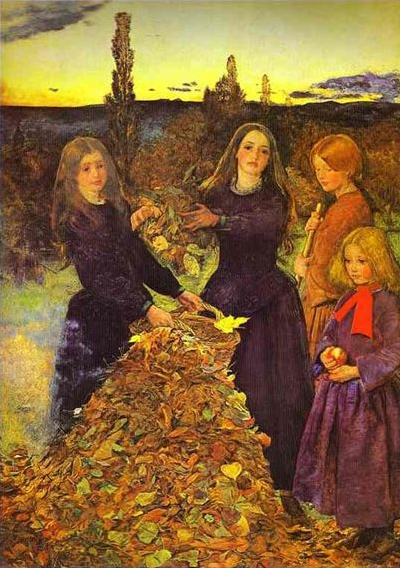
One girl lets a handful of leaves fall. Another holds the basket. Behind them, the last light picks out a distant ridge, and at the left of the heap a thin drift of smoke rises through the shadows. John Everett Millais painted Autumn Leaves in 1855–56 at Perth, Scotland, and exhibited it at the Royal Academy in 1856. The oil on canvas, dated 1856 by Manchester Art Gallery, measures 104.3 by 74 centimetres. The four girls are occupied with a familiar task, yet the gravity of their faces makes it difficult to look at the scene as an ordinary moment in a garden. [1] [2] [3] [4]
At a Glance
- Date1855–56, dated 1856 [1][3]
- MediumOil on canvas [1]
- CollectionManchester Art Gallery, 1892.4 [1]
- SubjectFour girls gathering leaves at dusk [1]
This work across John Everett Millais’s career
Contents
- The leaf pile and the last light
- Annat Lodge and the four girls
- A picture without a fixed story
- From the Royal Academy to Manchester
- A painting of loss
- Annotated details
The leaf pile and the last light
The upright canvas gives most of its space to the girls and the earth at their feet. The leaves make a broad, loosely rounded mound. Its edges spread across the grass and are hard to trace in the low light. The basket rests at an angle, and the leaves in the central figure’s hands extend the mound’s colours upward into the dark of her dress. Look a little to the left of the heap to see the smoke. There is no great flame to hold our attention. The smoke emerges where the leaf edges begin to disappear, a sign that the pile is already changing even as the girls add to it. [1] [4]
Across the narrow strip of sky, a pale band of yellow breaks through between clouds and hills. Slender trees and the girls’ heads interrupt that horizontal opening. The girls occupy much the same depth in the picture, but each makes a different silhouette against the light. The two older girls look out, the next tips her head towards the heap, and the youngest attends to the apple in her hands. Their gazes pull the viewer in and send the eye back down to the work. Millais could have shown everyone looking at the same object. The different directions give us four degrees of attention within a single, unhurried action. [1] [3] [4]
There is a marked difference between the leaves at ground level and the sky. Small turns of copper and yellow interrupt the brown of the heap, where one leaf meets another. The clouds and distant hills have broader edges, some sharp enough to mark the change from land to sky, others merging into the atmosphere. The leaf pile and the horizon are separated by the dark upright figures. As the eye moves between foreground and distance, it can recognise individual leaves while struggling to read a face or the edge of the hillside. The picture asks the viewer to spend time with the changing visibility it depicts. [1] [3] [4]
Annat Lodge and the four girls
Millais worked at Annat Lodge, near Effie Gray’s family home at Bowerswell. Two of her younger sisters sat for him. Alice Gray is at the left, holding the basket, and Sophie Gray stands beside her with the leaves. The two local sitters were Matilda Proudfoot, who stands immediately to Sophie’s right with the rake, and Isabella Nicol, the youngest girl, on the far right. The later catalogue for Millais’s portrait of Alice identifies her pose and Sophie’s place in the group. The portraits of the two sisters were painted in 1857, after the finished Autumn Leaves had been shown. The small portrait of Alice isolates a turn of the head and a familiar expression that Millais had already used within a complicated arrangement of faces, hands and light. [2] [4] [5]
Effie helped find the two local models and prepare them for their sittings. In her study of the Millais household, Naoko Asano traces Proudfoot to a Perth School of Industry and reports that Effie met Nicol, whose surname she gives as Nichol, while caring for the girl’s grandmother. Effie took particular notice of Proudfoot’s red hair and had Nicol wash and plait her hair overnight for the effect of waves when it was loosened. That account gives a practical history to a detail a viewer might otherwise take for a happy accident of the light. The faces in the painting came from Effie’s family and from her work finding and preparing sitters in Perth. [3] [4]
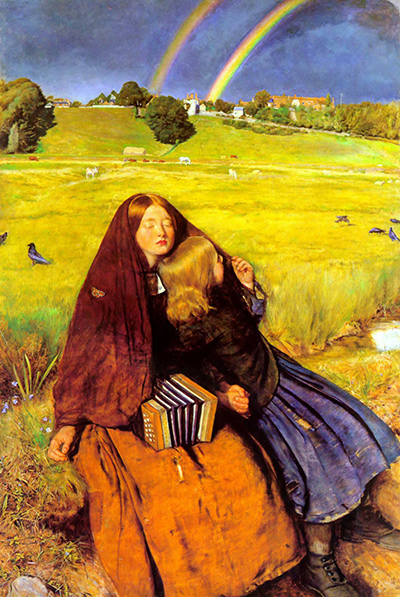
Proudfoot and Nicol also modelled for The Blind Girl, exhibited at the same Royal Academy show. The two paintings ask different things of their sitters. In The Blind Girl, their joined hands and the younger girl’s turn towards a double rainbow establish an intimate relationship between two people. The outlook in Autumn Leaves is less clearly shared. The girl with the apple has her own small occupation at the edge of the group, while the girl with the rake looks down at the work common to all four. With the same two models, Millais could paint two distinct kinds of attention and give each a place in a landscape under changing light. [3] [4] [6]
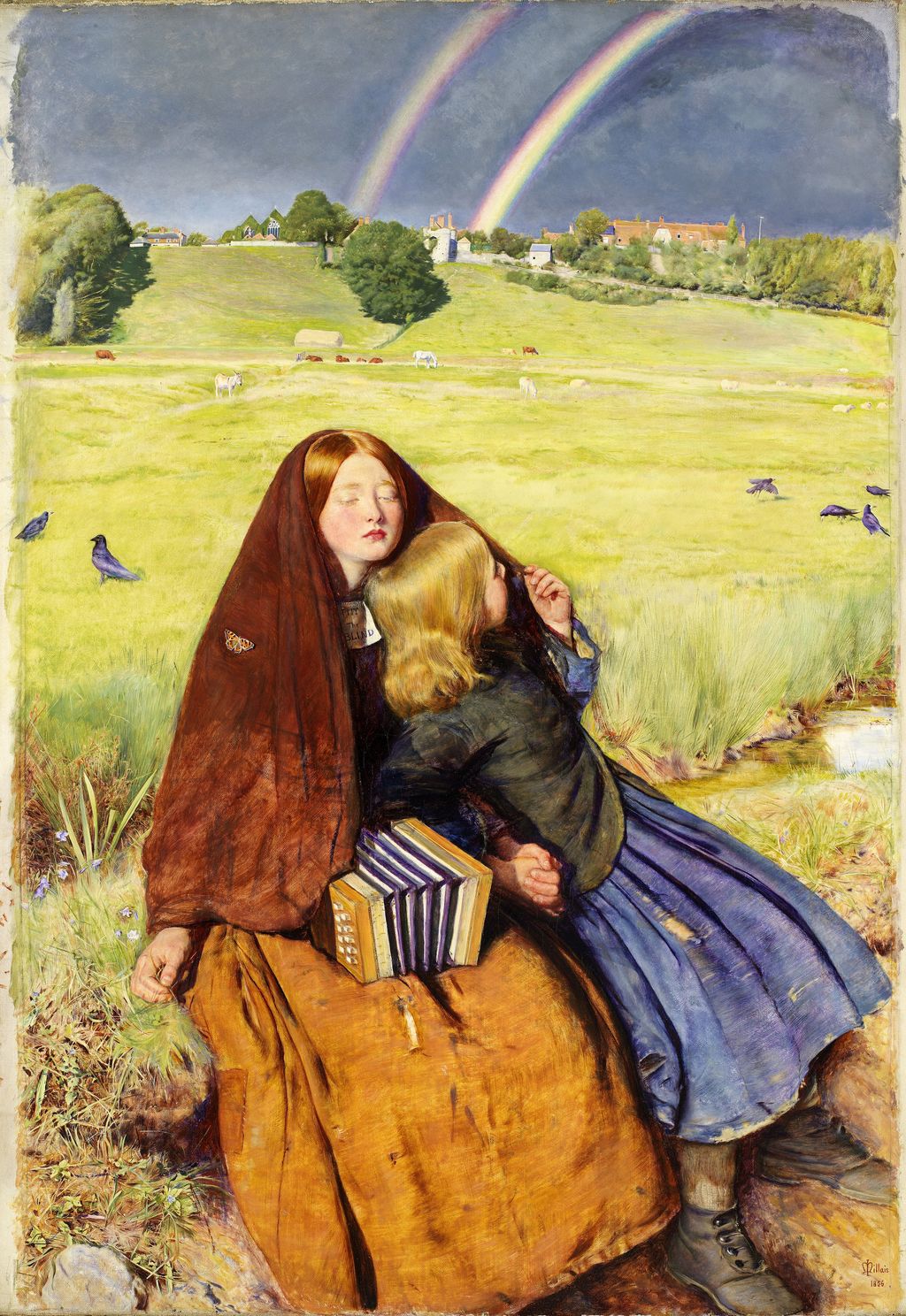
The Blind Girl, oil on canvas, Birmingham Museums Trust, 1892P3. Compare the shared sitters’ directed attention with the figures gathered around the leaves. Image source. Public domain.
A picture without a fixed story
Effie recorded Millais’s wish to paint a picture “full of beauty and without subject”. He described a further aim in a letter to the critic Frederic George Stephens, telling him that the painting’s solemnity should prompt religious reflection. Art historian Adele Ernstrom discusses both statements through Malcolm Warner’s scholarship. A viewer can recognise the task the girls are performing and still be left free to consider what gives it such weight. Ernstrom sees something like a rite in the way the girls surround the heap and attend to it. She relates the result to Elizabeth Eastlake’s contemporary argument that colour, form, light, shade and expression could themselves convey thought. [7]
The apple is a good place to test how this works. It marks the harvest season in the same picture as a heap of withered leaves, and its size and shape give the youngest girl something she can turn in both hands. The apple may recall the story of the Fall or suggest the pairing of something still ripe with material already gathered for burning. The picture gives the apple the intimacy of an object in a child’s hands. The visible evidence is a fruit, a girl and a season. What we bring to that combination can deepen the experience of it. [1] [4] [7]
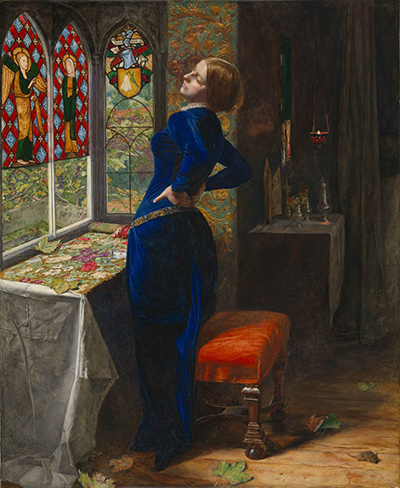
Poetry can give us a comparison for the mood. Flint, following Warner, notes that Millais and Tennyson raked leaves together during a visit in 1854. She links the painting’s melancholy to Tennyson’s “Tears, Idle Tears”, a lyric that moves from the sight of autumn fields to remembered days. Fallen leaves likewise mark passing time in Mariana, as Alexandra Harris observes in her essay for Tate. In that earlier painting they blow into the room of a named character from Tennyson’s poetry. In Autumn Leaves, tending the heap gives the girls an activity with its own rhythm, and the dusk belongs to the viewer’s experience as much as to theirs. [4] [8]
The French critic Ernest Chesneau treated Feuilles d’automne as one of Millais’s last great Pre-Raphaelite achievements in his 1887 account of contemporary English artists. For Chesneau, the artist’s willingness to paint a small corner of nature without an anecdote was exactly what had troubled earlier critics. Later scholars have also looked forward from the picture. Junko Nagao, writing in Japanese on Millais and Aestheticism, takes Autumn Leaves as an early instance of his pursuit of beauty through child figures, a line of inquiry she carries into the much later Cinderella. Where Chesneau saw a culmination, Nagao finds an experiment with possibilities Millais returned to long afterwards. Reviewing the 2008 Amsterdam retrospective in Dutch, Sabine Alexander also singles out the freer handling in Autumn Leaves and connects its interest in atmosphere to the shadowy interior Millais later painted in The Eve of St Agnes. [9] [10] [11]
From the Royal Academy to Manchester
Ruskin reviewed Autumn Leaves as no. 448 in his 1856 Academy Notes. In his notice of Peace Concluded he predicted great standing for both pictures. In the entry on Autumn Leaves itself, he concentrates on how twilight can retain a glow even as the ground darkens. He sets Millais’s effect beside that of Giorgione and points readers to the difference between the purple of the nearer line of hills and the blue of a peak just beyond it. His praise is as much about distance as darkness. The almost imperceptible change of hue gives the eye room to travel past the trees and figures into the valley. [2]
In his 1857 Academy Notes, Ruskin looked back on the previous year while reviewing A Dream of the Past: Sir Isumbras at the Ford. He continued to admire the play of colours in the leaf heap and explained that he had passed over faults of execution he expected Millais to outgrow. The later comments belong to a reassessment of the painter’s development, prompted by a different picture. The two notices together show Ruskin praising particular passages of colour even as his confidence in Millais’s new direction became more qualified. [2]
The picture had already become recognisable enough for John Leech to parody it in Punch in 1856. Leech converted the leaf pile into a heap of bills from the parliamentary session. The basket and faces can absorb a viewer looking at the painting, but the caricature shows what could be carried over into another setting with very little detail: people arrayed behind a spreading heap, a figure with a long implement and a drift of smoke. Leech traded the stillness of autumn for political housekeeping. [12]
At Manchester’s Art Treasures Exhibition of 1857, the painting was no. 543. The Art-Treasures Examiner called it a poem in paint and compared its mood with Francis Danby’s The Evening Gun. The writer judged the human faces an advantage, giving the season and the hour an emotional focus. The American Atlantic Monthly, in its November report on the exhibition, admired the tenderness of Millais’s A Huguenot and some of his technical accomplishments, but counted Autumn Leaves among his least satisfactory pictures. Its judgement was brief, part of a wider argument about the Pre-Raphaelites. The two responses show how much depended on the value a critic placed on the picture’s quiet action. [13] [14]
Theodor Fontane approached the Manchester painting with questions. As quoted in Johanna Gast’s study of Fontane, he wondered whether the fallen leaves were a reminder of death or whether one might imagine an evening bell beyond the garden wall, calling to mind a quiet prayer. The bell belongs to his response to the picture. In describing its effect as akin to that of a song, he valued the way a familiar activity could suggest several states of feeling at once. [15]
James Leathart lent the painting to the Grosvenor Gallery’s Millais exhibition in 1886. The critic A. L. Baldry records that Manchester Art Gallery’s picture was bought from the Leathart collection. By the time of the 1898 Millais memorial exhibition at the Royal Academy, the catalogue lists the Corporation of Manchester as lender and records the monogram and date of 1856 on the canvas. [16] [17] [18]
A painting of loss
The pairing of young faces, fading light and dead leaves makes mortality an available reading. Historian Kate Flint asks what kinds of loss a viewer at the 1856 exhibition might have brought to the work. The Crimean War had just ended, and Millais was living in Perth, home of the Black Watch. Flint finds a different treatment of war and its aftermath in Peace Concluded, which Millais showed that same year. There, the wounded officer and the newspaper put the recent conflict within the scene. The garden in Autumn Leaves gives the viewer space to connect an atmosphere of loss with contemporary experience. Flint proposes that historical context as one way of understanding the painting’s effect on a public for whom the war was recent. [4]
The twilight invited further experiments. In The Vale of Rest, Millais again sets human work against a fading sky, but the open grave makes mortality explicit. In a different direction, historian Marion Amblard relays Lindsay Errington’s proposal that Autumn Leaves and The Blind Girl helped shape William McTaggart’s Dora. Amblard points to the clear colours and careful foregrounds of McTaggart’s early work. Dora draws on a Tennyson poem, making it a useful comparison with a painting whose composition and mood could travel independently of a literary plot. [19] [20]
Return to the hand that is opening above the heap. The brown leaves have a little way left to fall. The smoke is already leaving the pile, and the colour in the sky will soon be gone. Millais gives us time to look at all three movements through a single moment of stillness. [1] [2]
Annotated Details from Autumn Leaves
The numbered points identify visible features discussed in this article. Return from each detail to the numbered overview. Autumn Leaves, oil on canvas, Manchester Art Gallery, 1892.4. From a scanned book reproduction. Image source. Public domain.
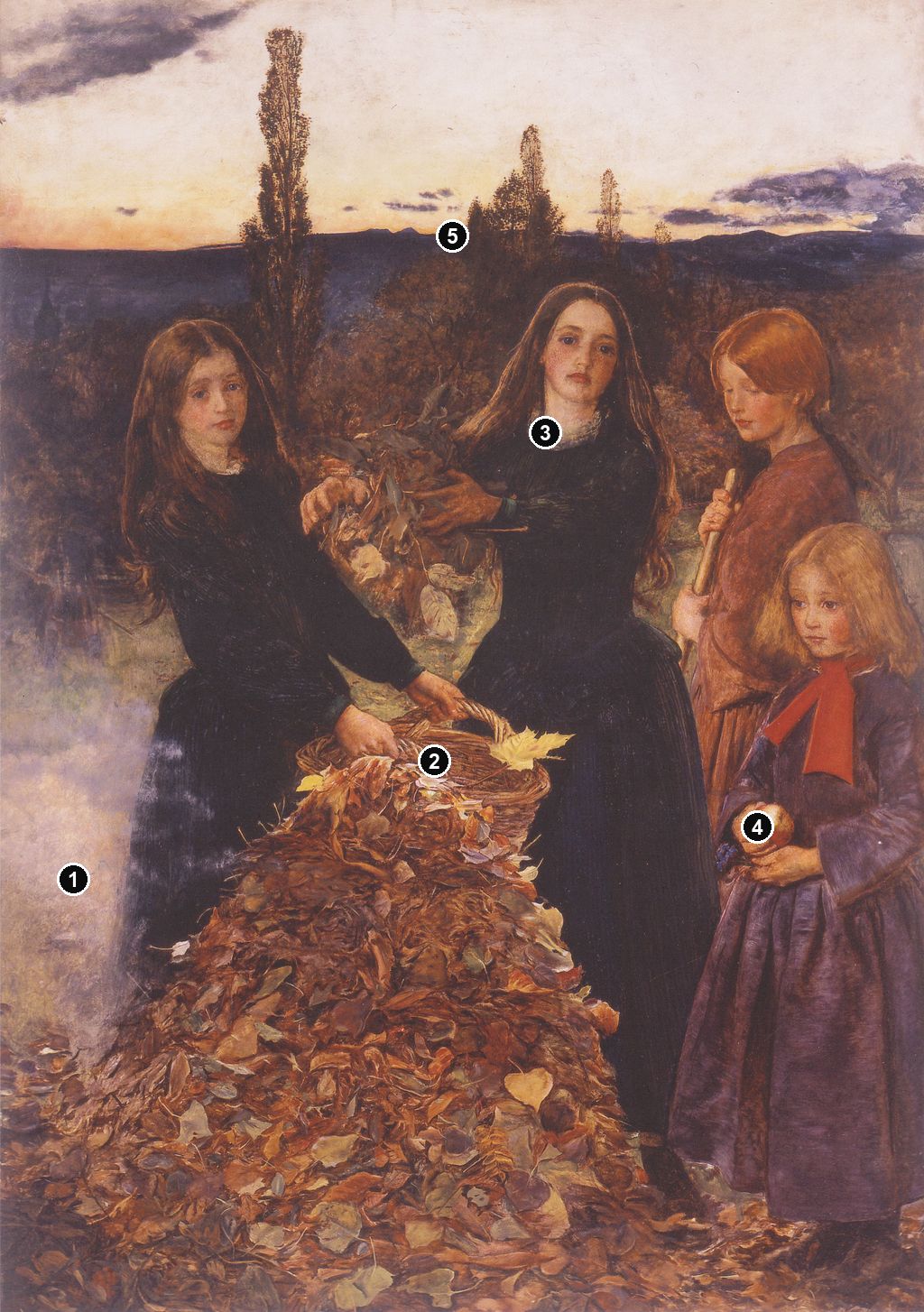
Details from AUTUMN LEAVES
Compare the sharp shapes of individual leaves with the diffuse smoke and last light behind the girls.
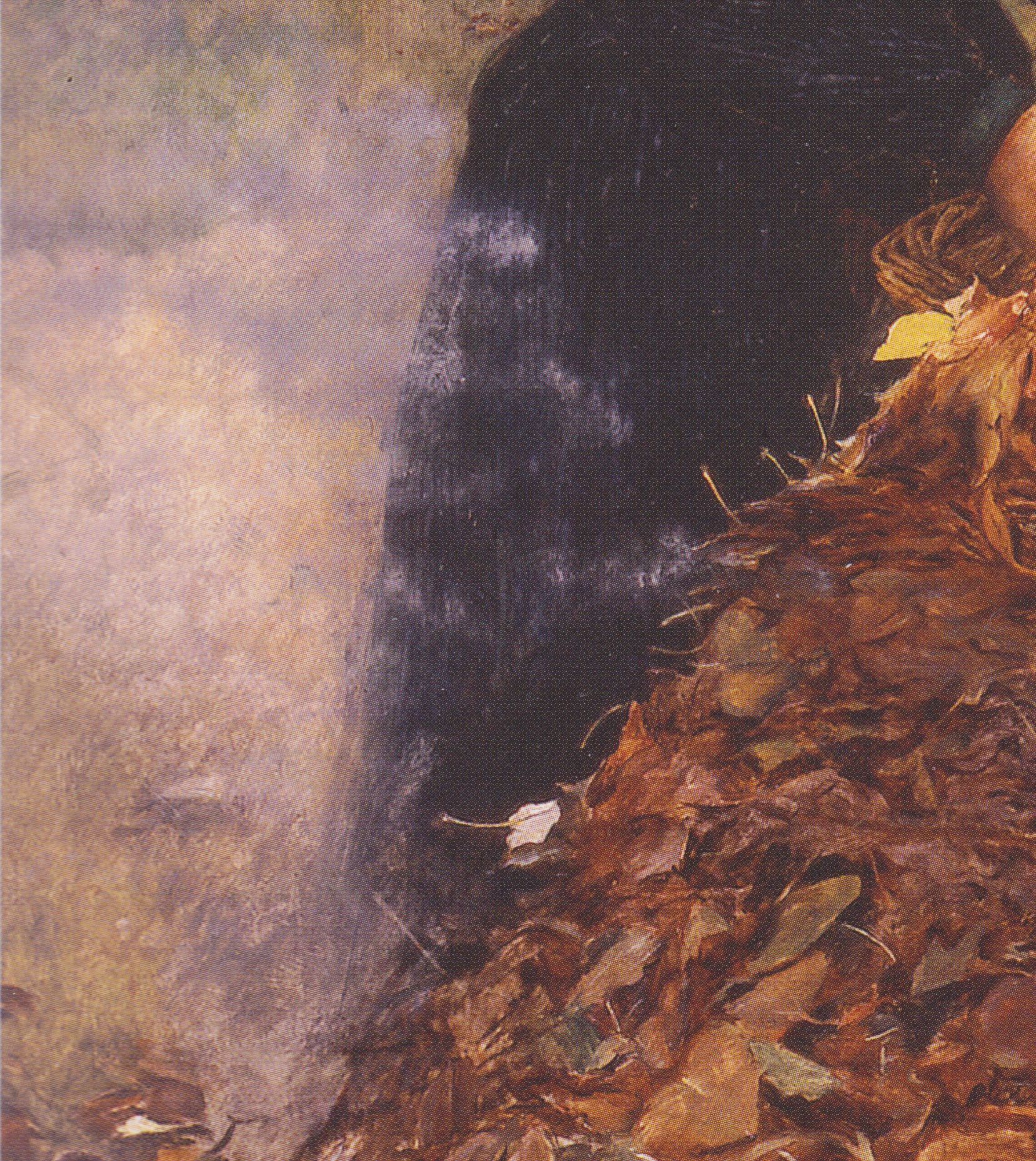
Smoke beside the leaves
A pale drift rises at the left edge of the mound. Look at the way it veils the ground and the dark skirt. A large flame would change the focus of the scene.
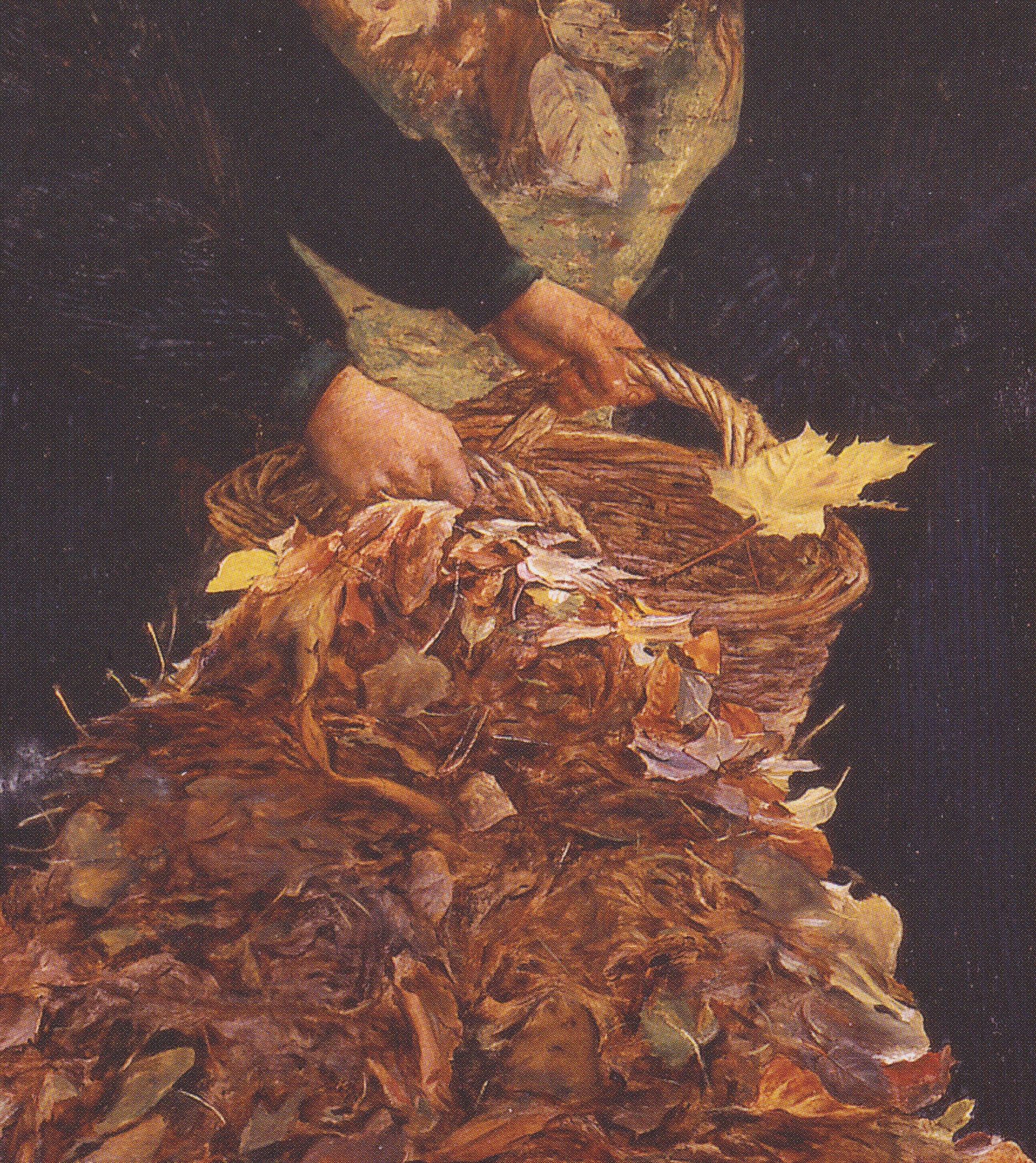
Leaves and basket
A tilted basket breaks the slope of the leaf pile. Its open shape and the leaves falling from above join the task of gathering with the act of letting go.
Attitudes of the four girls
Two figures gaze out, one inclines her head and the smallest attends to what she holds. The separate looks keep the eye moving between the figures and what they are doing.
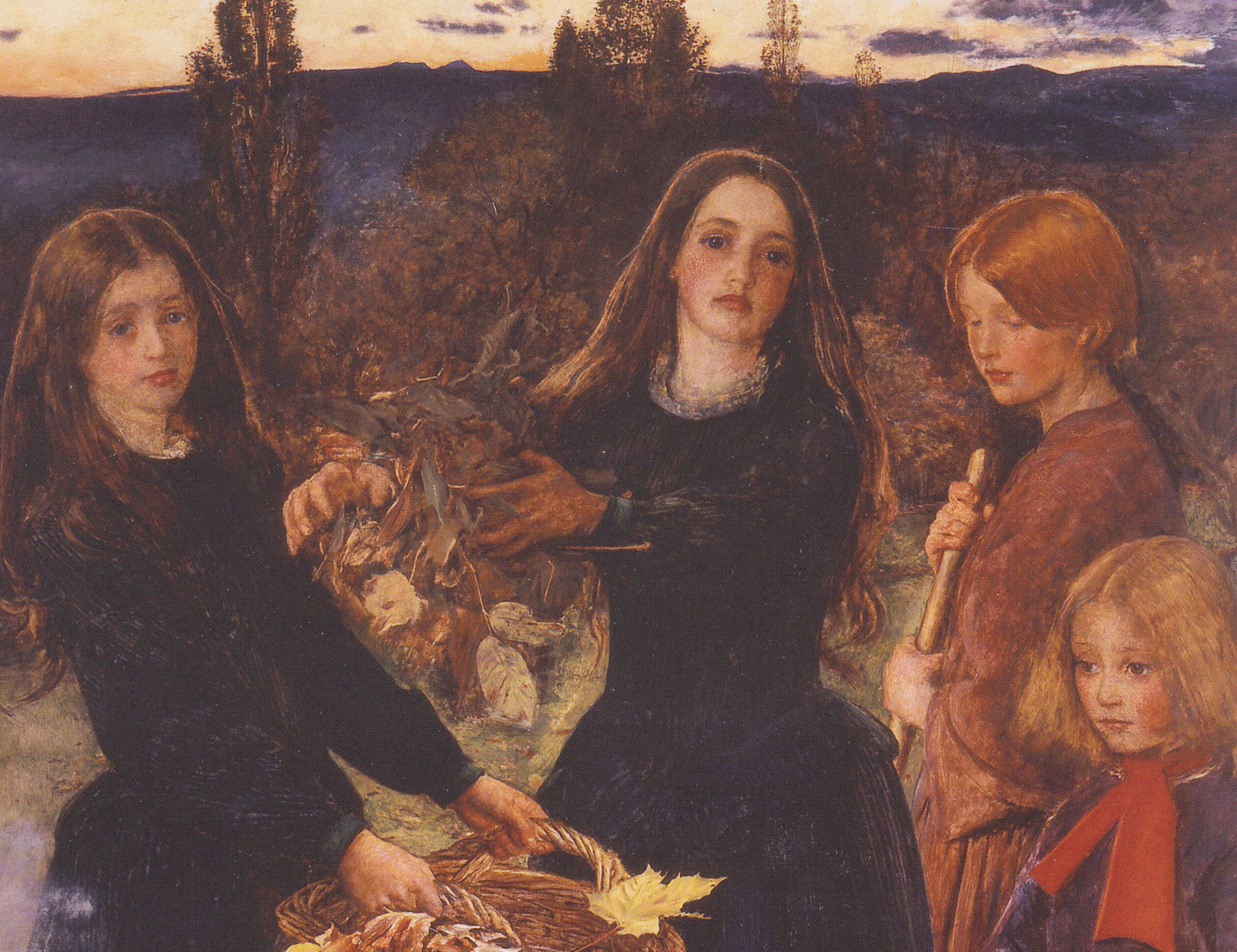
The apple
The youngest girl holds a bright apple while dead leaves accumulate in front of her. The fruit belongs to the harvest season and offers a small point of colour at the edge.
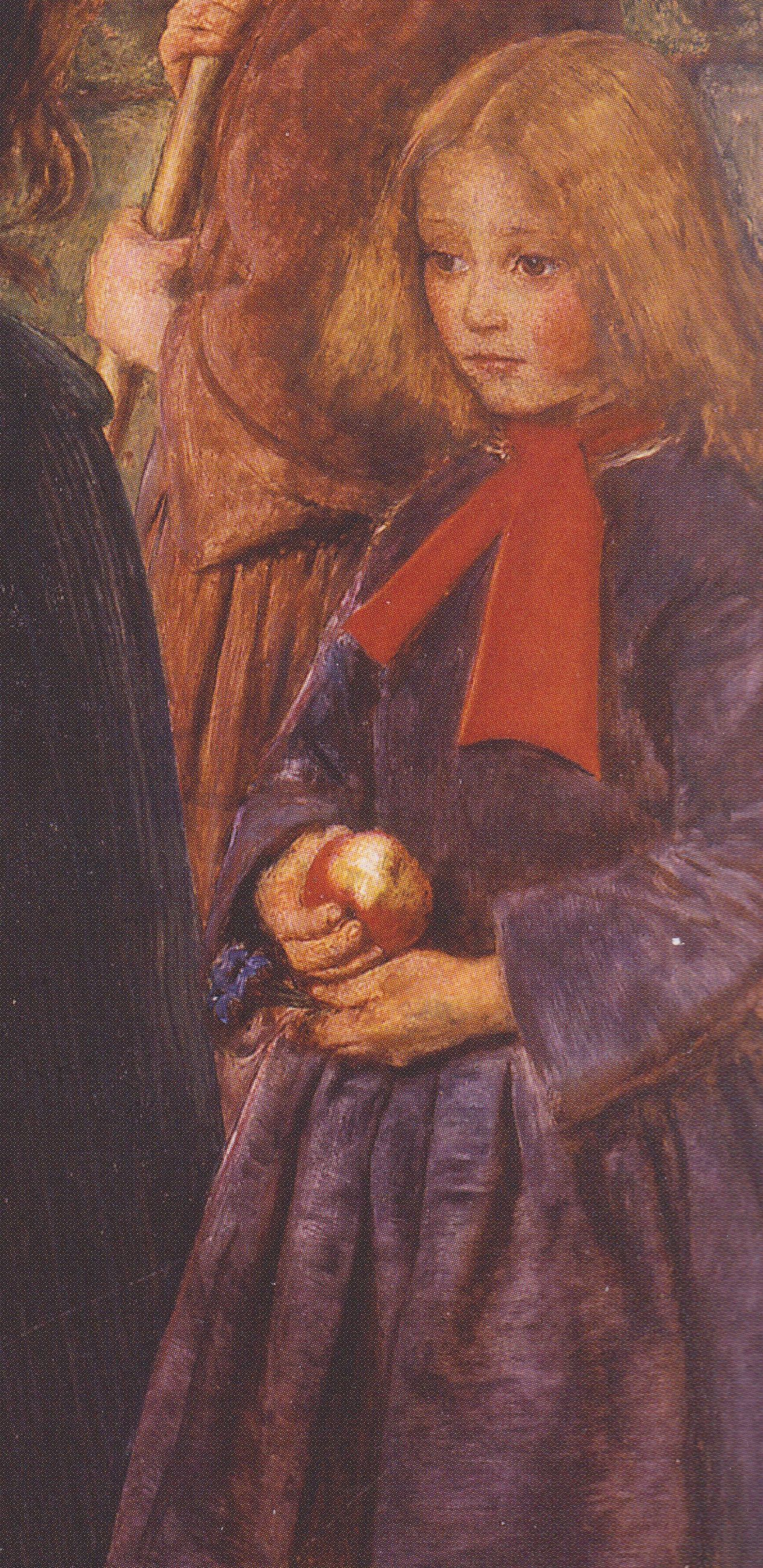
A band of light at the horizon
A narrow strip of light between earth and cloud catches the edges of the trees. It helps the eye find the figures whose clothes are already merging with the ground.
John Everett Millais artwork directory
Browse paintings and drawings covered in these articles, including related works held in public collections. Reproductive engravings and editions are discussed on the Prints page.
Prints and illustrated editions
- The Baby-House, 1872. Etching by Millais.
- The Good Shepherd, 1864. Wood engraving designed by Millais, engraved and printed by the Dalziel Brothers.
- Mariana, 1857. Wood engraving designed by Millais and cut by the Dalziel Brothers for the Moxon Tennyson.
- The Proscribed Royalist, 1858. Mixed-method engraving by William Henry Simmons after Millais.
| Name | Date | Medium |
|---|---|---|
| Pizarro Seizing the Inca of Peru | 1846 | Painting |
| The Young Men of Benjamin Seizing Their Brides | 1847 | Painting |
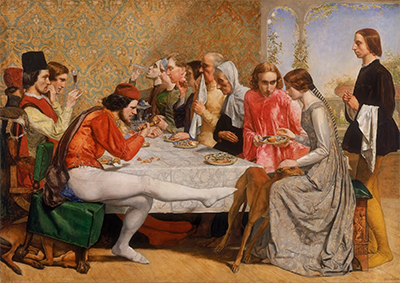
| Isabella | 1848–49 | Painting |
| Christ in the House of His Parents (‘The Carpenter’s Shop’) | 1849–50 | Painting |
| Ferdinand Lured by Ariel | 1849–50 (monogram dated 1849) | Painting |
| Study for Christ in the House of His Parents, Tate N04623 | c. 1849 | Drawing |
| Study for Christ in the House of His Parents, Tate N04792 | c. 1849 | Drawing |
| Study for Mariana in the Moated Grange | 1850 | Drawing |
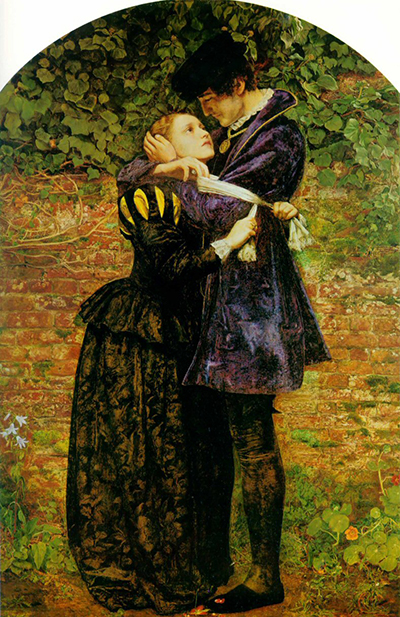
| A Huguenot, on St Bartholomew’s Day, Refusing to Shield Himself from Danger by Wearing the Roman Catholic Badge | 1851–52 (exhibited 1852) | Painting |
| Mariana | 1851 | Painting |
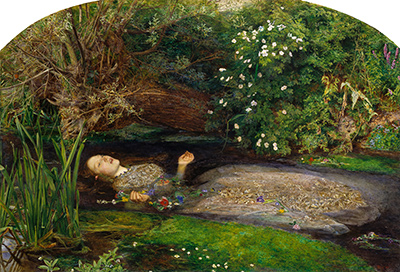
| Ophelia | 1851–52 | Painting |
| The Bridesmaid | 1851 | Painting |
| The Return of the Dove to the Ark | 1851 | Painting |
| The Order of Release 1746 | 1852–53 | Painting |
| The Proscribed Royalist, 1651 | 1852–53 (exhibited 1853) | Painting |
| Portrait of John Ruskin | 1853–54 | Painting |
| The Blind Girl | 1854–56 | Painting |
| Autumn Leaves | 1855–56 (Manchester labels 1856) | Painting |
| A Dream of the Past: Sir Isumbras at the Ford | 1856–57, later revised | Painting |
| The Vale of Rest | 1858–59 | Painting |
| Study for The Black Brunswicker, Tate A00812 | c. 1860 | Drawing |
| Study for The Black Brunswicker, Tate A00813 | c. 1860 | Drawing |
| Study for The Black Brunswicker, Tate A00814 | c. 1860 | Drawing |
| The Black Brunswicker | 1860 | Painting |
| The Ransom | 1860–62 | Painting |
| My First Sermon | 1863 | Painting |
| My Second Sermon | 1864 | Painting |
| Joan of Arc | 1865 | Painting |
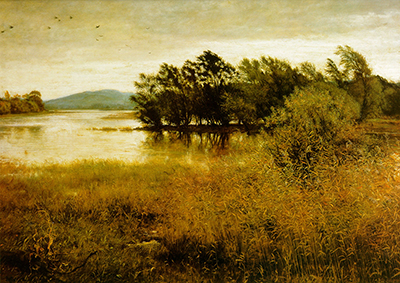
| Chill October | 1870 (exhibited 1871) | Painting |
| The Boyhood of Raleigh | 1870 | Painting |
| The Knight Errant | 1870 | Painting |
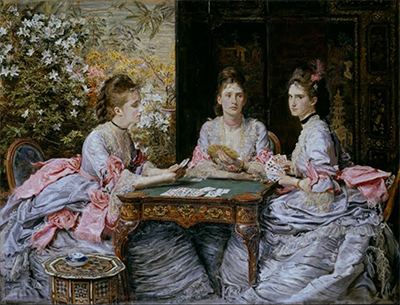
| Hearts are Trumps | 1872 | Painting |
| The North-West Passage | 1874 | Painting |
| Louise Jane Jopling | 1879 | Painting |
| William Ewart Gladstone, NPG 3637 | 1879 | Painting |
| Bubbles | 1886 | Painting |
| Portia | 1886 | Painting |
| Dew-Drenched Furze | 1889–90 | Painting |
| Ducklings | 1889 | Painting |
| Portrait of Sarah Hammond | 1891 | Painting |
Discussion
Look again at the images and ideas explored in Autumn Leaves. These editorial prompts invite your observations.
Reader Insights
Where does the thin smoke become visible, and what does it do to the edge of the leaf pile?
Which of the four girls changes the mood most when you follow the direction of her gaze?
Join the Conversation
Share a detail, comparison or question about Autumn Leaves below.
References
- Manchester Art Gallery, Autumn Leaves, collection record 1892.4 on Art UK. View source.
- John Ruskin, Academy Notes, 1856, pp. 56 and 66–67, and 1857, pp. 106–07, in The Works of John Ruskin, Library Edition, vol. XIV. View source.
- Naoko Asano, National Museum of Western Art research bulletin 25, “More than models and muses: The women of John Everett Millais’ domestic circle and their contributions”, fig. 5 and notes 18 and 26. View source.
- Kate Flint, “Feeling, Affect, Melancholy, Loss: Millais’s Autumn Leaves and the Siege of Sebastopol”, 19: Interdisciplinary Studies in the Long Nineteenth Century 23 (2016), author’s copy. View source.
- Christie’s, Alice Gray, lot catalogue entry. View source.
- Graeme Douglas, “John Everett Millais’ The Blind Girl (1856): The arts, the senses, and disability”, Midlands Art Papers. View source.
- Adele M. Ernstrom, “Elizabeth Eastlake v. John Ruskin: The Content of Idea and the Claims of Art”, RACAR 37, no. 2 (2012), p. 42 and notes 34–36. View source.
- Alexandra Harris, “A Turning Leaf”, Tate Etc. 41 (2017), on autumn and Millais’s Mariana. View source.
- Ernest Chesneau, Artistes anglais contemporains (1887), p. 8. View source.
- Junko Nagao, “J. E. Millais’s Cinderella: Peacock Feathers and Aestheticism”, conference abstract, Japan Art History Society, 2019. View source.
- Sabine Alexander, “John Everett Millais, dichter in verf”, Vlaanderen 57 (2008). View source.
- John Leech, “Autumn Leaves” (1856), reproduced with Mark Lemon’s notes in Later Pencillings from Punch, p. 176. View source.
- The Art-Treasures Examiner, “Autumn Leaves” (1857), p. 124, exhibition no. 543. View source.
- The Atlantic Monthly, “The Manchester Exhibition”, vol. 1, no. 1, November 1857. View source.
- Johanna Gast, Theodor Fontane: “Effi Briest” (Justus-Liebig-Universität Gießen, 2002), pp. 79–81, quoting Fontane’s tenth Manchester letter. View source.
- Grosvenor Gallery, Exhibition of the Works of Sir John E. Millais (1886), no. 121. View source.
- A. L. Baldry, Sir John Everett Millais, appendix of paintings in public galleries. View source.
- Royal Academy of Arts, Exhibition of Works by the Late Sir John Everett Millais, winter exhibition (1898), no. 38. View source.
- Tate, The Vale of Rest, collection record on Google Arts & Culture. View source.
- Marion Amblard, “Les tableaux de William McTaggart (1835–1910)”, Études écossaises 16 (2013), p. 53 and note 20. View source.