 by Tom Gurney
Tom Gurney BSc (Hons) is an art history expert with over 20 years experience
Published on June 19, 2020 / Updated on November 25, 2026
Email: tomgurney1@gmail.com / Phone: +44 7429 011000
The Order of Release 1746: Introduction
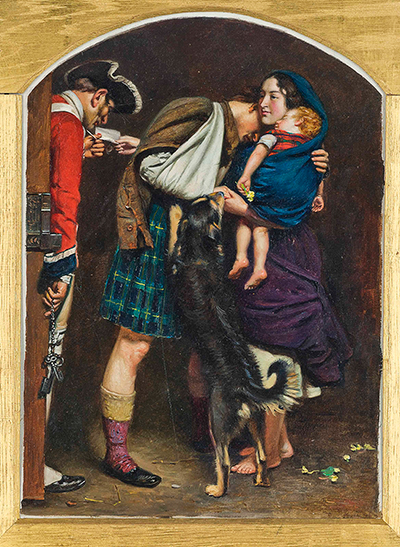
A woman holds a sleeping child in one arm and presents a written order with her free hand. Her husband, wounded and just released from prison, has buried his face against her shoulder. The gaoler looks down at the paper as a dog springs up to greet the man. John Everett Millais painted The Order of Release 1746 in 1852–53, setting this imagined reunion in the aftermath of the Jacobite defeat at Culloden. The oil on canvas measures 102.9 by 73.7 centimetres and belongs to Tate, where it is numbered N01657. Sir Henry Tate presented it in 1898. [1] [2] [3]
At a Glance
- Date1852–53 [1][2]
- MediumOil on canvas [1][2]
- CollectionTate, N01657 [1][2]
- SubjectA woman brings the paper that will free a wounded prisoner [1][3]
This work across John Everett Millais’s career
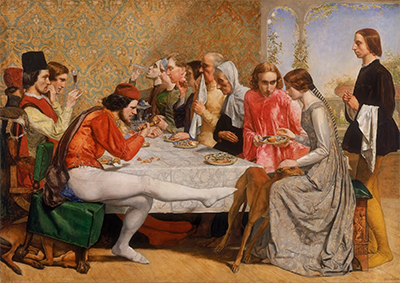
Isabella
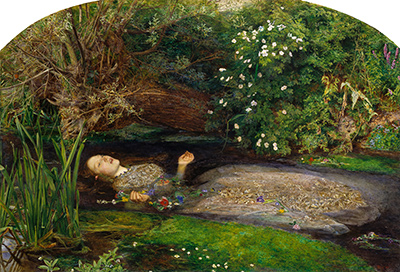
1848–49Ophelia
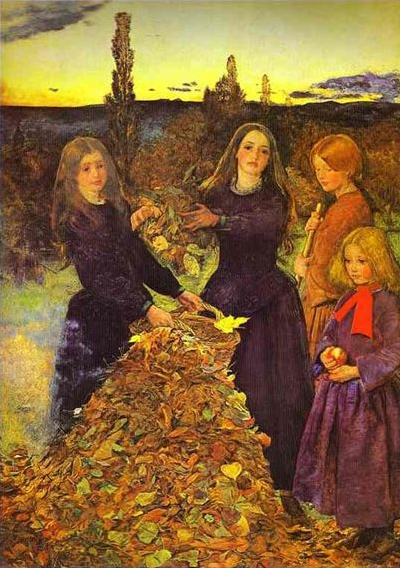
1851–52Autumn Leaves
1855–56Dew-Drenched Furze
1889–90Contents
- A reunion at the prison door
- From a purse to a release order
- Effie Gray, the studio and the Highland dress
- London in 1853 and Paris in 1855
- Annotated details
A reunion at the prison door
The woman stands between two men with different claims on her attention. The gaoler needs to see her paper. The prisoner leans against her, his injured arm in a white sling. She looks out past the exchange while the gaoler lowers his eyes and her husband turns his face away. The figures overlap so closely that the coat, sling and folds of her dress almost conceal where one body ends and the next begins. Her upright figure keeps the group from collapsing into the dark doorway. [1] [3]
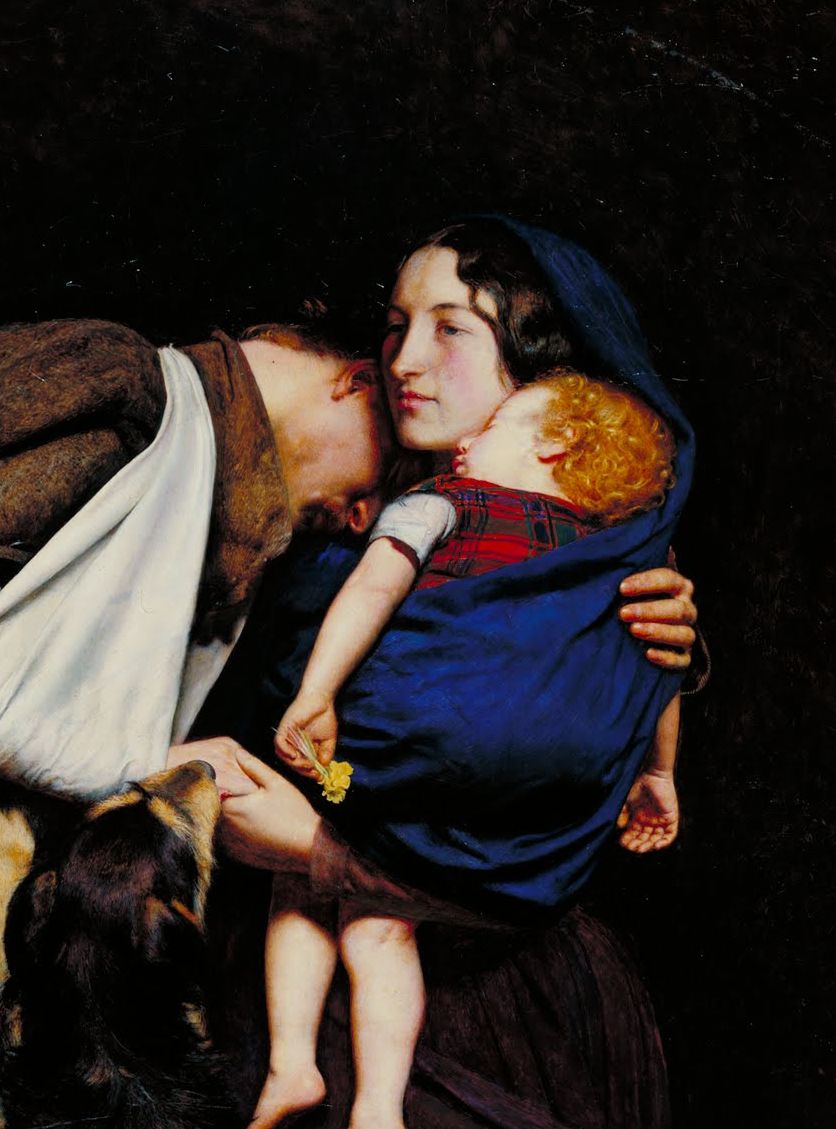
The sleeping child lies across her body, presenting the viewer with the weight she has to carry even as she reaches to complete the transaction. The child's legs hang loose, the bare feet left exposed amid layers of wool and cloth. Under them, the dog rises on its hind legs and turns towards its master. Its movement stands out against the slower action above, where a man reads a piece of paper and another gathers himself in his wife's arms. At floor level, flowers have fallen from the child’s grasp. Tate curator Frances Fowle identifies them as faded primroses, which suggest the season and give us a trace of what the child was doing before she fell asleep. [1] [3]
The prison is recognisable by the heavy door and the gaoler's keys. With so little architecture defined around them, the figures nearly fill the opening. In a letter to his friend Thomas Combe dated 23 October 1852, Millais says he is going to the Tower of London to look for a gateway or prison door. The letter documents the search for a model for the setting. The painting leaves the prison unnamed. Its deep shadow keeps the eye on the lit edge of the order and on the bodies gathered around it. [1] [4]
From a purse to a release order
An early version of the composition gave the woman a purse to offer the gaoler. Replacing it with a written order changed the moment Millais was asking viewers to imagine. A purse makes the encounter a negotiation, with the money still to change hands. The paper brings a decision made elsewhere into the prison. The gaoler has to read it, and the wife has already obtained it. We come in at the end of her efforts and can see their result in her husband's posture. Tate's account identifies The Ransom as the early title. Millais later used that title for a separate painting showing an exchange to recover two children. [3] [5]
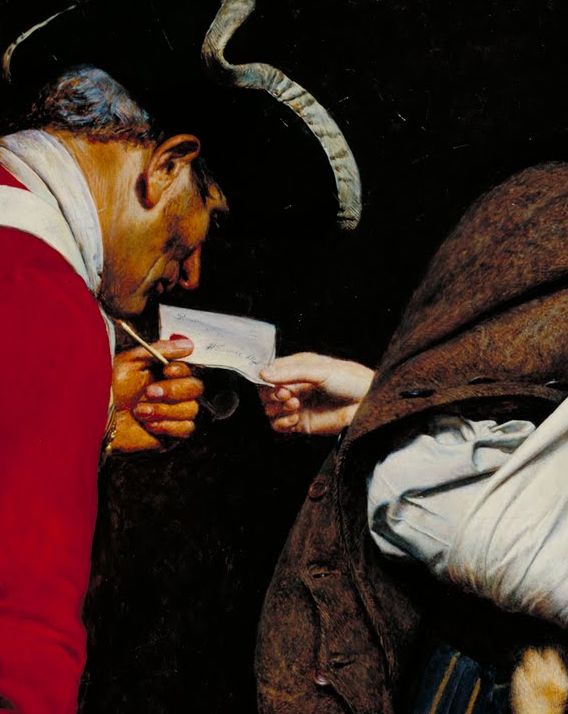
Fowle identifies the signature on the painted order as that of Sir Hilgrove Turner, an early supporter of Millais. The borrowed signature gives the letter the appearance of a document someone has actually handled and signed. The painted sheet is folded, held at an angle and extended partway into the shadow. The viewer can recognise its official purpose from title and gesture without having to read it. As long as the gaoler is looking down, the few inches between his hand and the woman's are the part of the painting where freedom still has to be made official. [1] [3]
The events implied by the date in the title were real. Charles Edward Stuart led the rising of 1745 in an attempt to restore the Stuarts. On 16 April 1746 government forces under the Duke of Cumberland defeated the Jacobite army at Culloden. The National Archives preserves a list dated 17 July 1746 that records prisoners by rank and counts the witnesses against them. That list shows officials sorting individual cases in the months after the battle. Millais appears to have invented the family and the specific reunion. He imagined how a decision of the kind faced by real prisoners might affect three people who had been separated. The anonymous gaoler keeps his eyes on the order while the viewer sees what its arrival means to the prisoner. [3] [6] [7]
Effie Gray, the studio and the Highland dress
Euphemia Chalmers Gray, known as Effie, sat for the woman. She was then married to John Ruskin. She and Millais married on 3 July 1855, after the painting's London debut. Their son, John Guille Millais, later wrote that the face closely resembled his mother and that the artist changed her auburn hair to black to set off the child's colouring. The art historian Naoko Asano traces an earlier stage of the woman’s modelling to Anne Ryan and notes that Ruskin encouraged Effie to sit. Looking at the woman's independent action, Asano sees a challenge to the Victorian ideal of a helpless heroine. Within the picture, the husband can finally let his weight rest on his wife because she has come with the means to take him home. [4] [8] [9]
Effie took an interest in the history as well as sitting for the face. Asano quotes a letter in which she describes the work as “quite Jacobite and after my own heart”. She went on to share stories of Scottish history with Millais on the trip he took with the Ruskins in 1853, the same visit on which he began his portrait of John Ruskin. The order and the prison door gave Millais one setting for that interest in Scotland, before the portrait posed the very different problem of painting a sitter against a particular stretch of river and rock. [4] [8] [9]
The man who leans against her was modelled by a professional sitter named Westall, according to the family biography. A letter Millais wrote to Combe on 16 December 1852 describes his difficulties getting the child and the dog to hold still. By the time the child tired herself out the light was generally failing. On one evening she fell asleep in the position he wanted. The letter gives a glimpse of the hours of studio work behind a figure who looks simply to have drifted to sleep. Art historian Amy Robson compares two pencil sketches with the oil and argues that the dog in the finished picture looks better suited to the Highlands than the more conventional hound in the early designs. In the oil, its lifted body also directs the eye back up from the tartan to the returning man. [1] [3] [4] [10]
For the clothing, Millais consulted Robert Ronald McIan's illustrations for The Clans of the Scottish Highlands, published with text by James Logan in 1845–47. Fowle identifies Gordon tartan on the father and Drummond tartan on the child. The thick red checks on the man's kilt follow the pleats as his body bends. The smaller and lighter passages of the child's clothing bring a second pattern into the group. The book was published about a century after Culloden, and its plates show a Victorian account of clan dress. They help explain how Millais gave the family a recognisable Highland identity for his own audience. [1] [3] [9] [11]
London in 1853 and Paris in 1855
At the Royal Academy in 1853, The Order of Release appeared alongside Millais's The Proscribed Royalist, 1651. Both make a private meeting carry the consequences of a political defeat. The Illustrated London News of 7 May described people planting themselves in front of The Order of Release in the Middle Room, looking and talking while others waited behind them. The review takes their prolonged attention as a mark of Millais's achievement. The Academy's exhibition chronicle places the two pictures within a broader and more divided debate over the rise of Pre-Raphaelitism. [12] [13]
The painting went to the Paris Exposition Universelle in 1855. Eugène Jouve, whose reports appeared in the Courrier de Lyon, felt that Millais had failed to give his figures convincing expression. His assessment covered three paintings, including Ophelia and The Return of the Dove to the Ark. In his journal entry of 17 June 1855, Eugène Delacroix recalled the sleeping child in The Order of Release by its silky hair, reddish legs and feet. He admired the feeling in those closely observed details, although he was momentarily unsure whether the painter was Millais or William Holman Hunt. The child left an impression on another visitor, the young Henry James. In his 1913 memoir he remembers stopping in front of the painting with his father and singles out the bare legs dangling from the mother's arms. [14] [15] [16]
The painting also reached audiences outside the exhibition room. Samuel Cousins made a mezzotint after it in 1856, and an impression appeared in the 1857 Manchester Art Treasures exhibition. The print translated the group into tones of light and dark, carrying the leaning bodies, the sleeve and the paper without the colours of the tartans. The French photographer Alexis Gaudin took a different approach after seeing the painting in Paris. He arranged models in a room furnished with a projecting door and made a pair of photographs for a stereoscope, which combines the two views into an impression of depth. In Tate curator Carol Jacobi's account, the relative depth of the photographed room makes the viewer feel enclosed with the figures. The painted doorway creates its pressure in a shallower space, where the entire action follows from the woman holding her ground. [1] [4] [17] [18]
By 1898, the Royal Academy was exhibiting the painting again, this time among works selected for Millais’s memorial exhibition. The catalogue lists it as a loan from the executors of James Renton and records the inscribed date of 1853. It gives the subject date as 1745, the year commonly used to name the rising. Tate records the picture under 1746, the year of Culloden and the imagined reunion. John Guille Millais recalled that his father had spoken warmly of the work when it was about to come back onto the market. Henry Tate bought it from Renton’s collection and gave it to the nation. [2] [4] [19]
Annotated Details from The Order of Release 1746
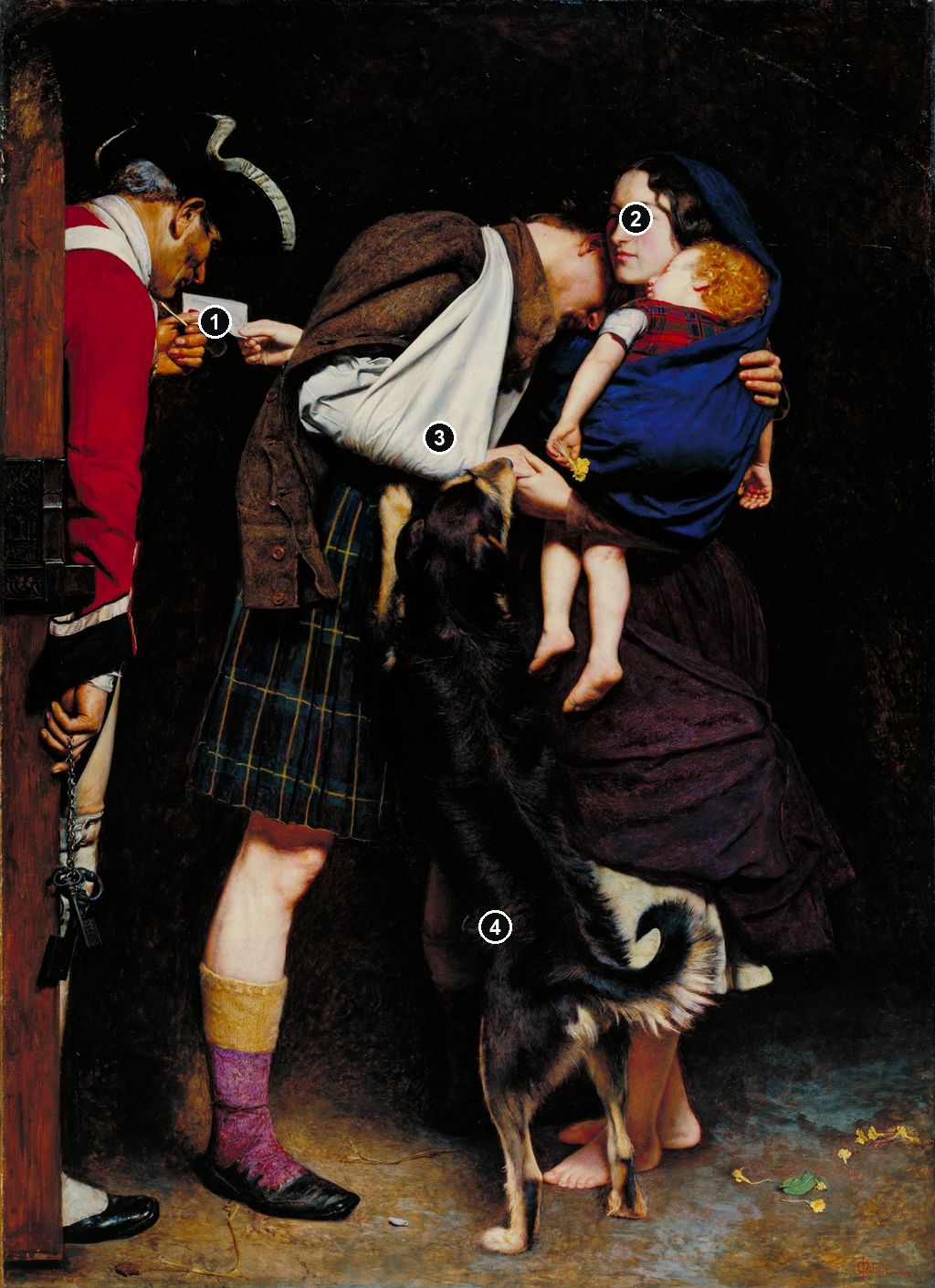
The numbered points identify visible features discussed in this article. Return from each detail to the numbered overview. The Order of Release 1746, oil on canvas, Tate, N01657. Image source. Public domain.
Details from THE ORDER OF RELEASE 1746
Compare the cropped details with the source images above. Notice how their colours, shapes and positions contribute to the larger compositions.
The release document
A small horizontal piece of paper approaches the warder at the left edge. Its pale surface picks out the action that makes the reunion possible.
The woman holding the child
The woman looks past the man’s bent head. Her shoulder and arm support the sleeping child while she holds out the paper with her other arm.
The injured man
A white sling makes a strong diagonal across the man’s dark clothes. He lowers his head against the woman, drawing the reunion into a tight knot of bodies.
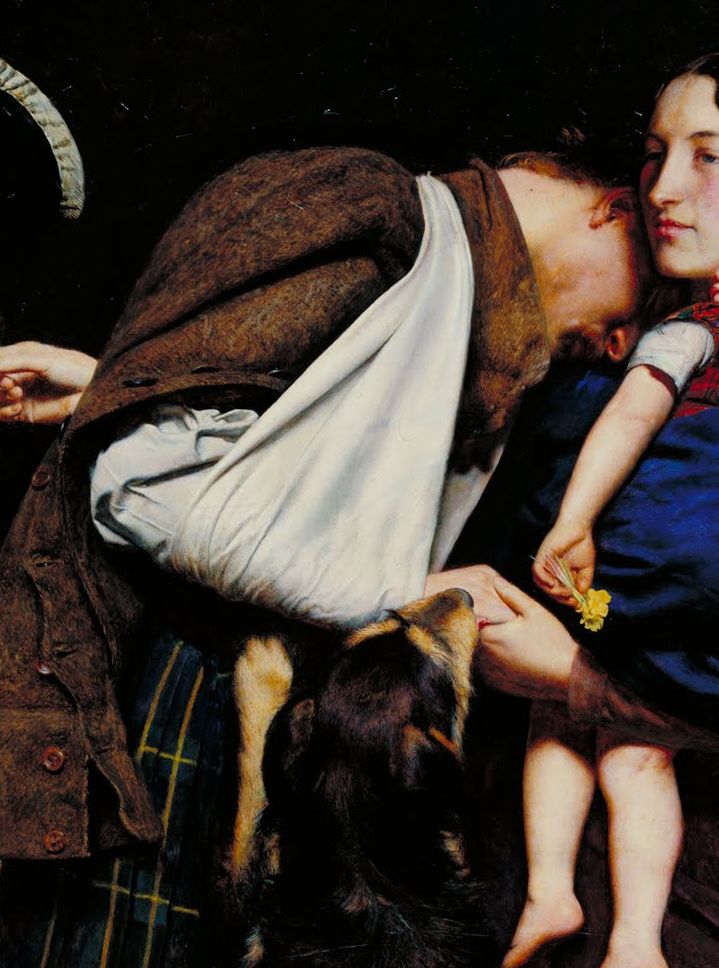
The dog and overlapping feet
The dog was painted on its hind legs, with its darker body overlapping the family’s clothing. Its movement carries the eye down to a shared strip of light at the threshold.
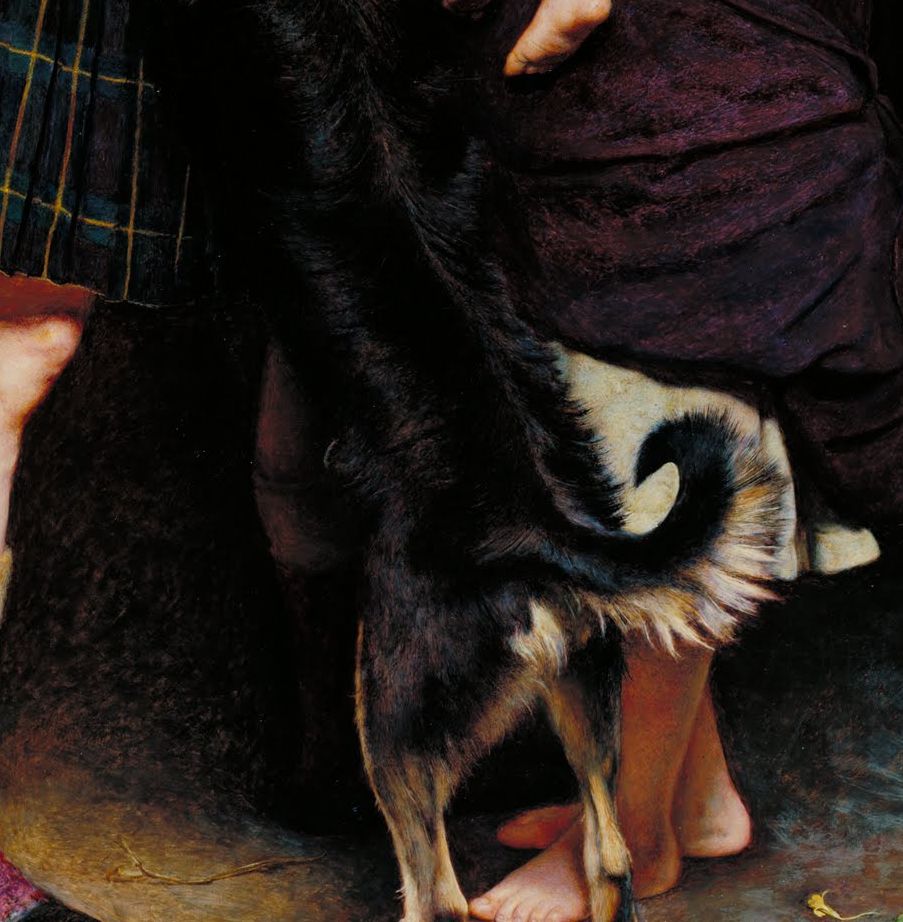
John Everett Millais artwork directory
Browse paintings and drawings covered in these articles, including related works held in public collections. Reproductive engravings and editions are discussed on the Prints page.
Prints and illustrated editions
- The Baby-House, 1872. Etching by Millais.
- The Good Shepherd, 1864. Wood engraving designed by Millais, engraved and printed by the Dalziel Brothers.
- Mariana, 1857. Wood engraving designed by Millais and cut by the Dalziel Brothers for the Moxon Tennyson.
- The Proscribed Royalist, 1858. Mixed-method engraving by William Henry Simmons after Millais.
| Name | Date | Medium |
|---|---|---|
| Pizarro Seizing the Inca of Peru | 1846 | Painting |
| The Young Men of Benjamin Seizing Their Brides | 1847 | Painting |
| Isabella | 1848–49 | Painting |
| Christ in the House of His Parents (‘The Carpenter’s Shop’) | 1849–50 | Painting |
| Ferdinand Lured by Ariel | 1849–50 (monogram dated 1849) | Painting |
| Study for Christ in the House of His Parents, Tate N04623 | c. 1849 | Drawing |
| Study for Christ in the House of His Parents, Tate N04792 | c. 1849 | Drawing |
| Study for Mariana in the Moated Grange | 1850 | Drawing |
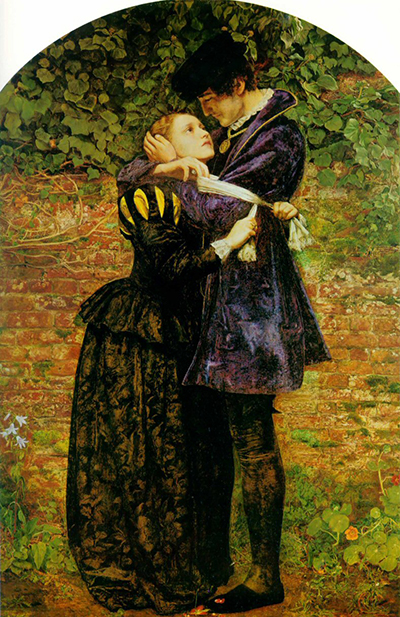
| A Huguenot, on St Bartholomew’s Day, Refusing to Shield Himself from Danger by Wearing the Roman Catholic Badge | 1851–52 (exhibited 1852) | Painting |
| Mariana | 1851 | Painting |
| Ophelia | 1851–52 | Painting |
| The Bridesmaid | 1851 | Painting |
| The Return of the Dove to the Ark | 1851 | Painting |
| The Order of Release 1746 | 1852–53 | Painting |
| The Proscribed Royalist, 1651 | 1852–53 (exhibited 1853) | Painting |
| Portrait of John Ruskin | 1853–54 | Painting |
| The Blind Girl | 1854–56 | Painting |
| Autumn Leaves | 1855–56 (Manchester labels 1856) | Painting |
| A Dream of the Past: Sir Isumbras at the Ford | 1856–57, later revised | Painting |
| The Vale of Rest | 1858–59 | Painting |
| Study for The Black Brunswicker, Tate A00812 | c. 1860 | Drawing |
| Study for The Black Brunswicker, Tate A00813 | c. 1860 | Drawing |
| Study for The Black Brunswicker, Tate A00814 | c. 1860 | Drawing |
| The Black Brunswicker | 1860 | Painting |
| The Ransom | 1860–62 | Painting |
| My First Sermon | 1863 | Painting |
| My Second Sermon | 1864 | Painting |
| Joan of Arc | 1865 | Painting |
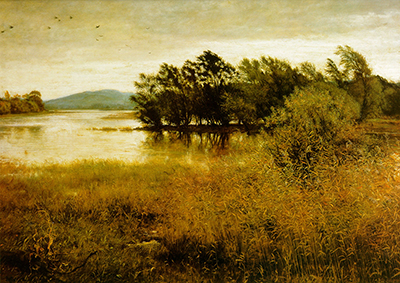
| Chill October | 1870 (exhibited 1871) | Painting |
| The Boyhood of Raleigh | 1870 | Painting |
| The Knight Errant | 1870 | Painting |
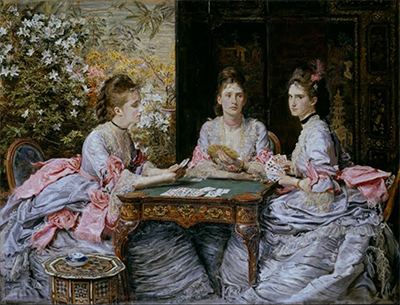
| Hearts are Trumps | 1872 | Painting |
| The North-West Passage | 1874 | Painting |
| Louise Jane Jopling | 1879 | Painting |
| William Ewart Gladstone, NPG 3637 | 1879 | Painting |
| Bubbles | 1886 | Painting |
| Portia | 1886 | Painting |
| Dew-Drenched Furze | 1889–90 | Painting |
| Ducklings | 1889 | Painting |
| Portrait of Sarah Hammond | 1891 | Painting |
Discussion
Look again at the images and ideas explored in The Order of Release 1746. These editorial prompts invite your observations.
Reader Insights
Follow the line from the document to the figures at the door. Who sees what first?
What do the injured man, dog and sleeping child contribute to your reading of the reunion?
Join the Conversation
Share a detail, comparison or question about The Order of Release 1746 below.
References
- Tate, The Order of Release 1746, N01657, collection image and syndicated object record. View source.
- Tate, Collection Data, object record for artwork N01657. View source.
- Frances Fowle for Tate Britain, commentary on The Order of Release, reproduced by The Victorian Web. View source.
- John Guille Millais, The Life and Letters of Sir John Everett Millais, vol. I, pp. 99–104, including the 23 October and 16 December 1852 letters to Thomas Combe. View source.
- J. Paul Getty Museum, The Ransom, object 103RCF. View source.
- National Library of Scotland, Jacobites: A Timeline, the 1745 rising and Culloden. View source.
- The National Archives, Prisoners after Culloden, 17 July 1746, SP 54/32/41C. View source.
- National Portrait Gallery, Later Victorian Portraits Catalogue, extended biography of Sir John Everett Millais. View source.
- Naoko Asano, “More than Models and Muses: The Women of John Everett Millais’ Domestic Circle and Their Contributions,” National Museum of Western Art bulletin, pp. 7–8. View source.
- Amy Robson, Dogs and Domesticity: Reading the Dog in Victorian British Visual Culture, Plymouth University PhD thesis, 2017, p. 115, discussion of two sketches and the completed painting. View source.
- National Library of New Zealand, catalogue of the Alexander Turnbull Library copy of Robert Ronald McIan and James Logan's The Clans of the Scottish Highlands, 1845–47. View source.
- Paul Mellon Centre and Royal Academy of Arts, The Royal Academy Summer Exhibition: A Chronicle, 1853 in context. View source.
- The Illustrated London News, Royal Academy review, 7 May 1853, transcription. View source.
- Guillaume Evrard, Directing the Eye: Stories of Modernity and Tradition at the 1878 Paris Universal Exhibition, University of Edinburgh PhD thesis, 2014, p. 195 and note 21, reproducing Eugène Jouve's 1855 criticism. View source.
- Eugène Delacroix, Journal, vol. III, entry for 17 June 1855, pp. 36–39 and editorial note 59. View source.
- Henry James, A Small Boy and Others, 1913, p. 297. View source.
- Manchester Art Treasures Exhibition, 1857 catalogue, mezzotints, no. 1319. View source.
- Carol Jacobi for Tate, “Tate Painting and the Art of Stereoscopic Photography,” discussion and figures of Millais's painting and Alexis Gaudin's stereograph. View source.
- Royal Academy of Arts, Exhibition of Works by the Late Sir John Everett Millais, Winter Exhibition 1898, p. 14, no. 25. View source.