 by Tom Gurney
Tom Gurney BSc (Hons) is an art history expert with over 20 years experience
Published on June 19, 2020 / Updated on November 25, 2026
Email: tomgurney1@gmail.com / Phone: +44 7429 011000
Hearts are Trumps: Introduction
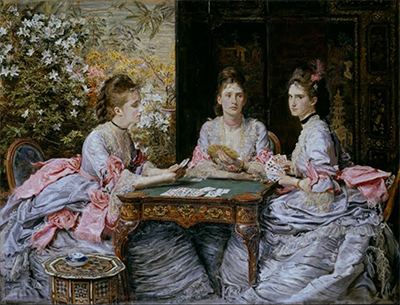
Mary Armstrong turns towards us, her hand of cards tilted so that we can see what she holds. Her sisters keep their attention closer to the table. Between them and the lower edge of the canvas, a fourth hand lies face up on the green cloth. John Everett Millais painted the three sisters in 1872, each in a pale evening dress with pink ribbons, and gave their portrait the title Hearts are Trumps. The oil painting, more than two metres wide, belongs to Tate in London. At that scale the table comes close enough for us to feel as though we have walked up to the game. [1] [2]
At a Glance
- Date1872 [1][2]
- MediumOil on canvas [1][2]
- CollectionTate, N05770 [2]
- SubjectElizabeth, Diana and Mary Armstrong playing dummy whist [1][2]
This work across John Everett Millais’s career
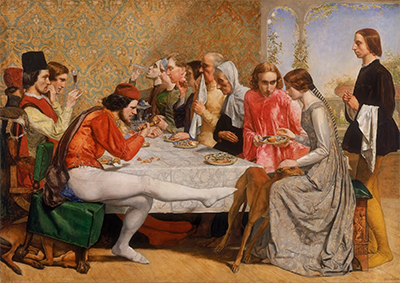
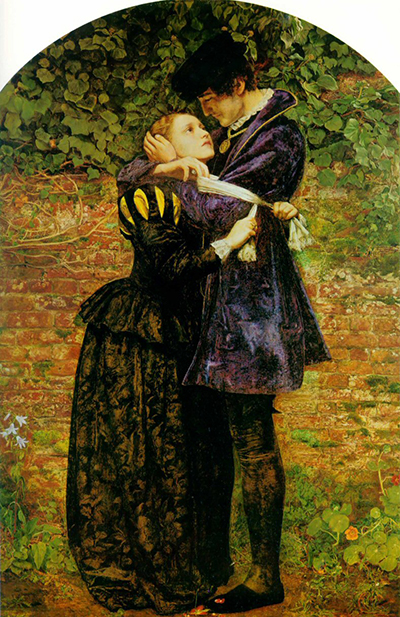
Isabella
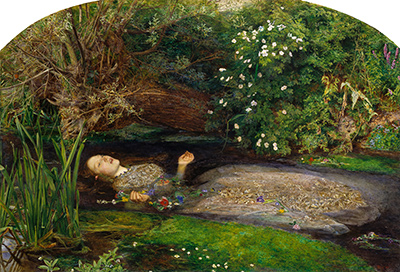
1848–49Ophelia
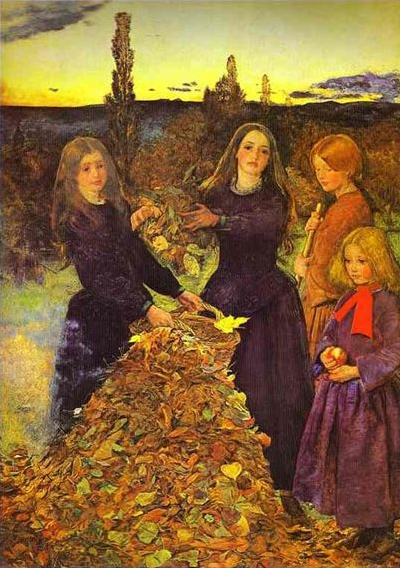
1851–52Autumn Leaves
1855–56Dew-Drenched Furze
1889–90Contents
- The Armstrong sisters at the card table
- How dummy whist gives the portrait its title
- A Victorian answer to Joshua Reynolds
- Three card players in a stereoscope
- From the Royal Academy to Tate
- What Tate’s conservation revealed
- Annotated details
The Armstrong sisters at the card table
Elizabeth, Diana and Mary were the daughters of Walter Armstrong, a prosperous merchant with ties to Scotland and London. The future art critic and gallery director Sir Walter Armstrong was their brother and shared their father’s name. Tate places the three women in their twenties at the time of the portrait. The similarity of their dresses helps establish the family likeness before we have had a chance to compare their faces. Their turns of the head and the different heights at which they hold their cards then divide the group into three distinct figures. [1] [3] [4]
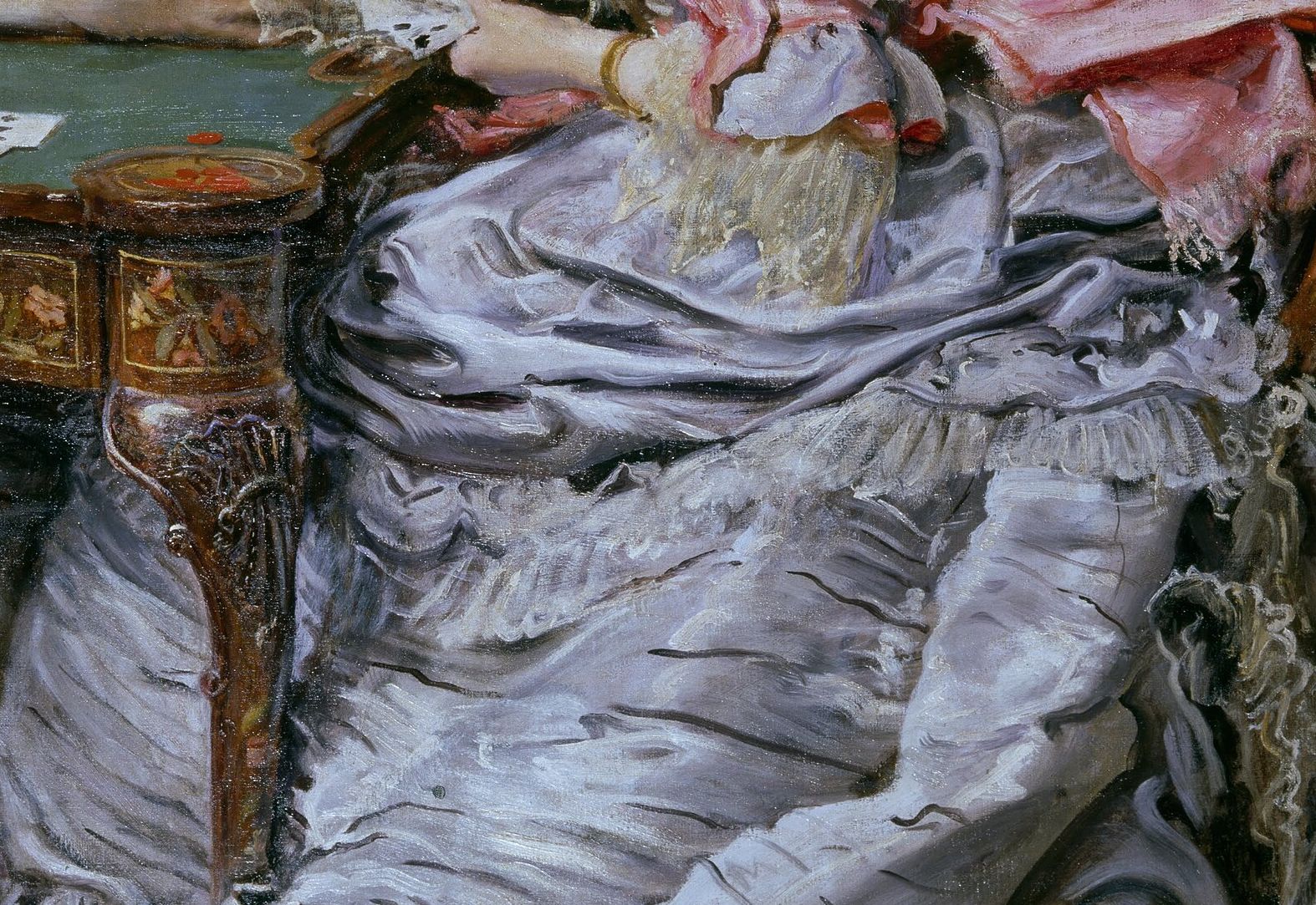
The dress fabric occupies much of the lower canvas, spreading in wide, silvery folds around the table legs. At the cuffs and necklines Millais breaks up those expanses with lace, ribbons and small flicks of light. The table’s dark, curling outline cuts across the dresses, and the straight edges of the playing cards stand out against both the fabric and the green cloth. The different shapes help us follow the sisters’ hands across a scene packed with detail. [1] [2]
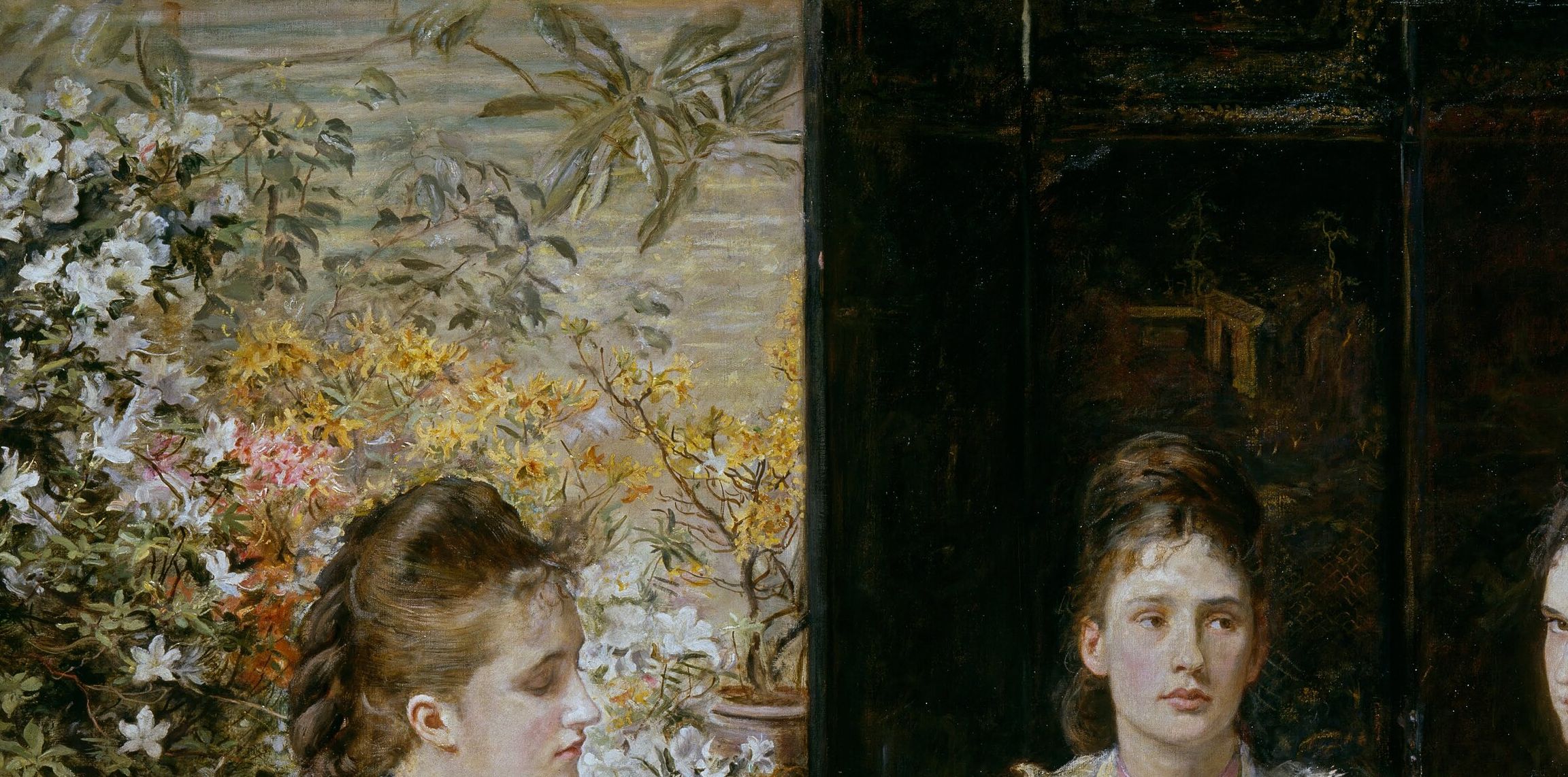
The setting is a conservatory, according to the Royal Academy’s 1898 catalogue. For a reviewer in The Examiner in 1872, the furnishings were as memorable as the activity. The writer noted an antique table and the dark screen with gilded pagodas, set against clusters of azaleas. The screen brings the space in close behind the figures. On the other side, the blossoms crowd against the dresses, where their paler tones make the edges of the fabric harder to follow. Millais varies the character of the light as well as its strength. A glint on furniture gives way to the softer sheen of a sleeve or the loosely brushed edge of a petal. [1] [5] [6]
How dummy whist gives the portrait its title
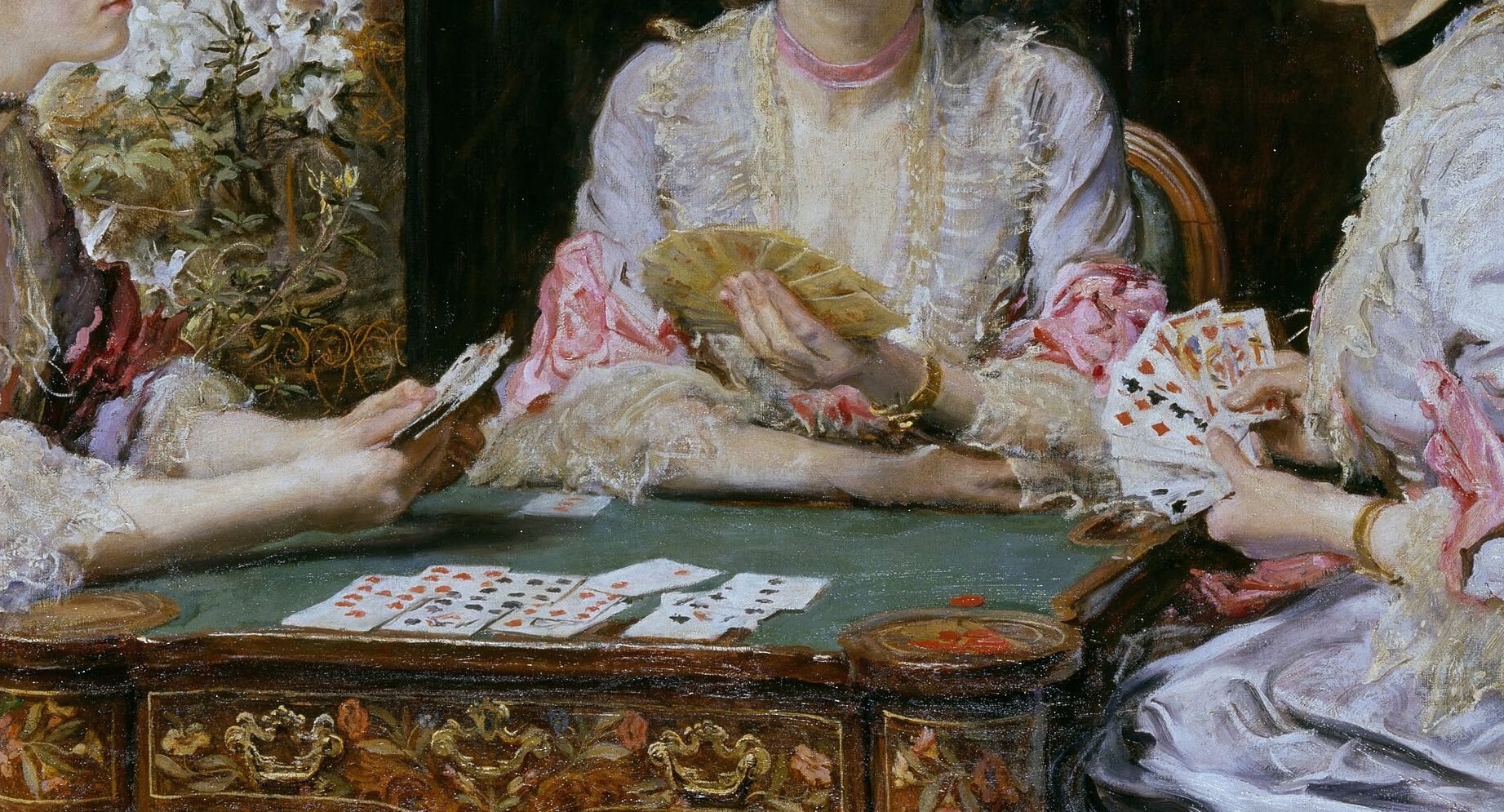
Both The Examiner and the Royal Academy’s retrospective catalogue identify the game as dummy whist. Three people play with four hands. The cards of the missing fourth player, the dummy, are placed face up for all to see, and one player plays those cards as well as her own. In whist, a card from the trump suit can beat cards from the other suits. Hearts have that power in the game Millais depicts. The cards at the near edge belong to the dummy, while the red hearts Tate draws attention to are among Mary’s own cards. Her glance makes us privy to an advantage each of her sisters must try to judge from inside the game. [1] [5] [6] [7]
One of the most observant early readings appeared in The Athenaeum and was reprinted for Millais’s 1886 Grosvenor Gallery exhibition. The critic understood the young woman on the right to be quietly confident in the strength of her trumps and read the other sisters’ faces and attitudes in light of the cards they held or hoped their partner held. Their expressions alone could have supported several stories. With the cards in view, a small tilt of a head can seem like calculation and a sideways glance can seem like an attempt to read another player. The positions make the action feel poised to continue after Mary has looked away. [8]
Tate’s interpretation hears a suggestion of courtship in the title and its play on hearts, including the possibility of friendly competition among the sisters. Nele Martina Putz, writing about the territory between portraiture and genre painting, takes up the idea of a game as a way to picture women weighing their chances and exercising judgement. The rules explain the open arrangement of the cards, while the title leaves room for the double meaning. The painted hand gives Mary an advantage at this moment. The joke was familiar. A verse from The Compleat Gamester that Cavendish reprinted as the frontispiece to his whist manual imagined a player losing their heart in the same moment as they lost the game. Millais’s portrait gives the familiar joke to the woman with the strongest hand. [1] [4] [7]
A Victorian answer to Joshua Reynolds
The prospect of the commission appears in a letter Millais wrote to his wife in August 1871, cited in Putz’s study. Walter Armstrong had seen Sisters, the 1868 picture of three of Millais’s own daughters, at the 1871 London International Exhibition and wanted a portrait of his daughters. Millais was to dine with him and meet the young women. That sequence gives the commission a concrete beginning in a picture Armstrong had already admired. An ambition to take on an older painter enters the story through a different source. Millais’s son, John Guille Millais, later recalled that his father had read a critic’s assertion that he could never paint three women in contemporary dress as well as Joshua Reynolds had done. The son also described a small copy of the Millais hanging near the Reynolds at Strawberry Hill, an arrangement that invited a direct comparison. [4] [9]
In Reynolds’s The Ladies Waldegrave of 1780, the three sisters work together on needlework. Elizabeth Laura, in the centre, winds silk, and the work in their hands makes a reason for the women to sit so closely. Both painters set similar dresses around a table and make small changes in pose stand out. The shared task brings the Waldegraves’ attention inward. At Millais’s table the sisters have different information and different interests. The hollow in the foreground where the dummy’s cards lie leaves a place for the eye to enter, and Mary’s look completes the invitation. The reviewer for The Examiner recognised Reynolds’s manner in the new portrait as early as 1872. The change from shared needlework to a competitive game is where Millais’s invention becomes especially clear. [4] [5] [10]
Three card players in a stereoscope
An image closer to Millais’s own day offers another comparison. In 1866 the photographer Michael Burr issued a stereograph also called Hearts are Trumps. Its paired views were designed to merge into a single image with an illusion of depth when seen through a stereoscope. Burr, too, staged three women in contemporary dress around a card table, with one turning her hand towards the viewer. The art historian Natalia Gurkina points out how modest Burr’s room is beside Millais’s conservatory. The same small drama of revealing a hand works in both settings. [11] [12]
Tate curator Carol Jacobi proposes that Millais may have had Burr’s image in mind. The likeness is strongest in the title and the arrangement, especially the way the women and their table press towards the front of the scene. In the photo, the viewer’s two eyes supply the impression of space. On Millais’s single canvas, overlapping skirts and furniture do part of that work, aided by changes in tone and the play of light across different materials. The two works show how closely fashionable portraiture could rub shoulders with the images Victorians enjoyed at home. [11] [12]
From the Royal Academy to Tate
London visitors saw Hearts are Trumps at the Royal Academy in 1872 as no. 223. Six years later, it appeared in the British fine art section of the Paris Universal Exhibition, where the official British catalogue listed J. H. Secker as lender. A French account called it Whist à trois and noticed how differently the background treated the women. The dark screen set off the complexions and pearl-grey silk of two of the sisters, while the third seemed almost to lose her outline against the flowers. The writer even wondered whether the garden was part of the room or depicted on a hanging. That is an especially sharp response to the setting, where one half of the picture gives the eye such definite edges and the other lets them dissolve. [5] [13] [14]
Secker lent the painting again to the Grosvenor Gallery in 1886 and to the Royal Academy’s memorial exhibition in 1898. The latter catalogue named the women both as Armstrong sisters and by the married names they then used, keeping the record of who they were alongside the playful title under which the picture was known. The Trustees of the Chantrey Bequest presented it to Tate in 1945. [2] [6] [8]
What Tate’s conservation revealed
Layers of ageing natural-resin varnish had altered the colour and made the picture look unusually flat. Millais’s use of resin with his oil paint made removing those coatings delicate. A layer that dulled the painting might sit close to material the artist himself had used. At Tate, conservation scientist Joyce Townsend studied the order of those layers in tiny samples. Ultraviolet fluorescence helped distinguish varnish, wax and paint, and much of the testing took place under a stereomicroscope. In tests, some blacks, browns and greens proved sensitive, so the team spent weeks establishing a way to take off the discoloured varnish while protecting the paint. [15]
Conservator Natasha Duff’s treatment took five months. Tate describes a gain in depth and colour, and much freer brushwork became easier to see. Alastair Johnson also worked on the frame, which Tate considers probably original. In Tate’s photographs the change matters especially where one surface touches another. A shift between cool dress fabric and warmer skin can make a hand more distinct, just as the transition from the dark screen to the flowers can make the room feel deeper. The painting’s condition influences how readily we notice the gestures and fleeting exchanges that make the card game convincing. [15]
Annotated Details from Hearts are Trumps
The numbered points identify visible features discussed in this article. Return from each detail to the numbered overview. Hearts are Trumps, oil on canvas, Tate, N05770. Image source. Public domain.
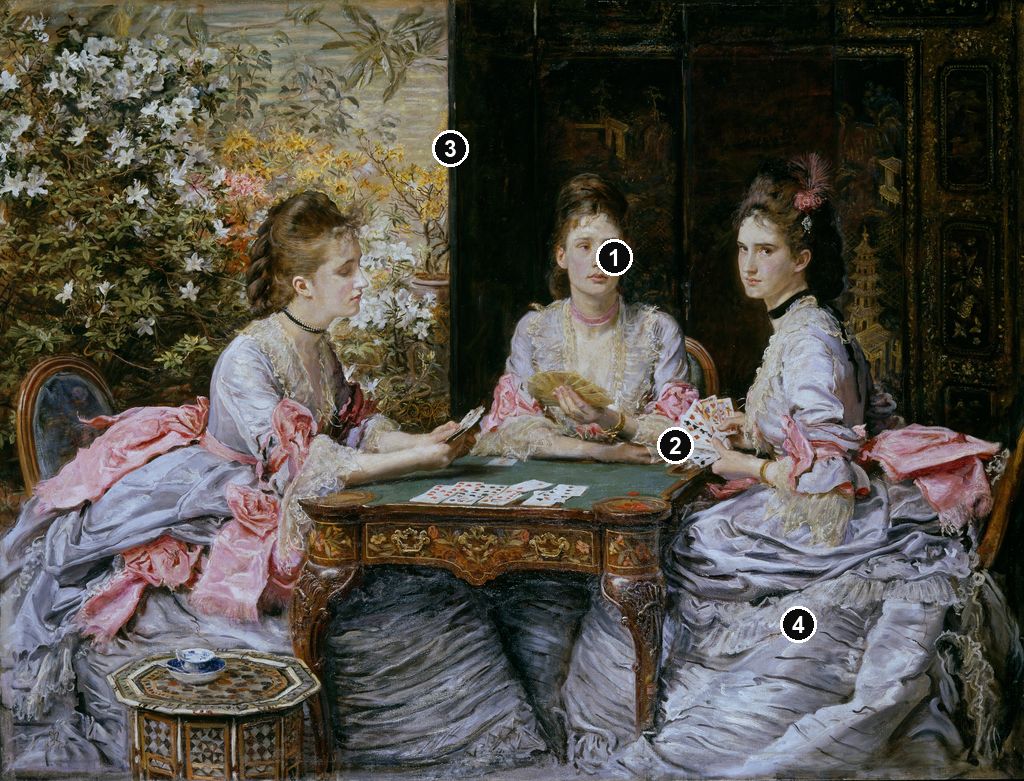
Details from HEARTS ARE TRUMPS
Compare the cropped details with the source images above. Notice how their colours, shapes and positions contribute to the larger compositions.
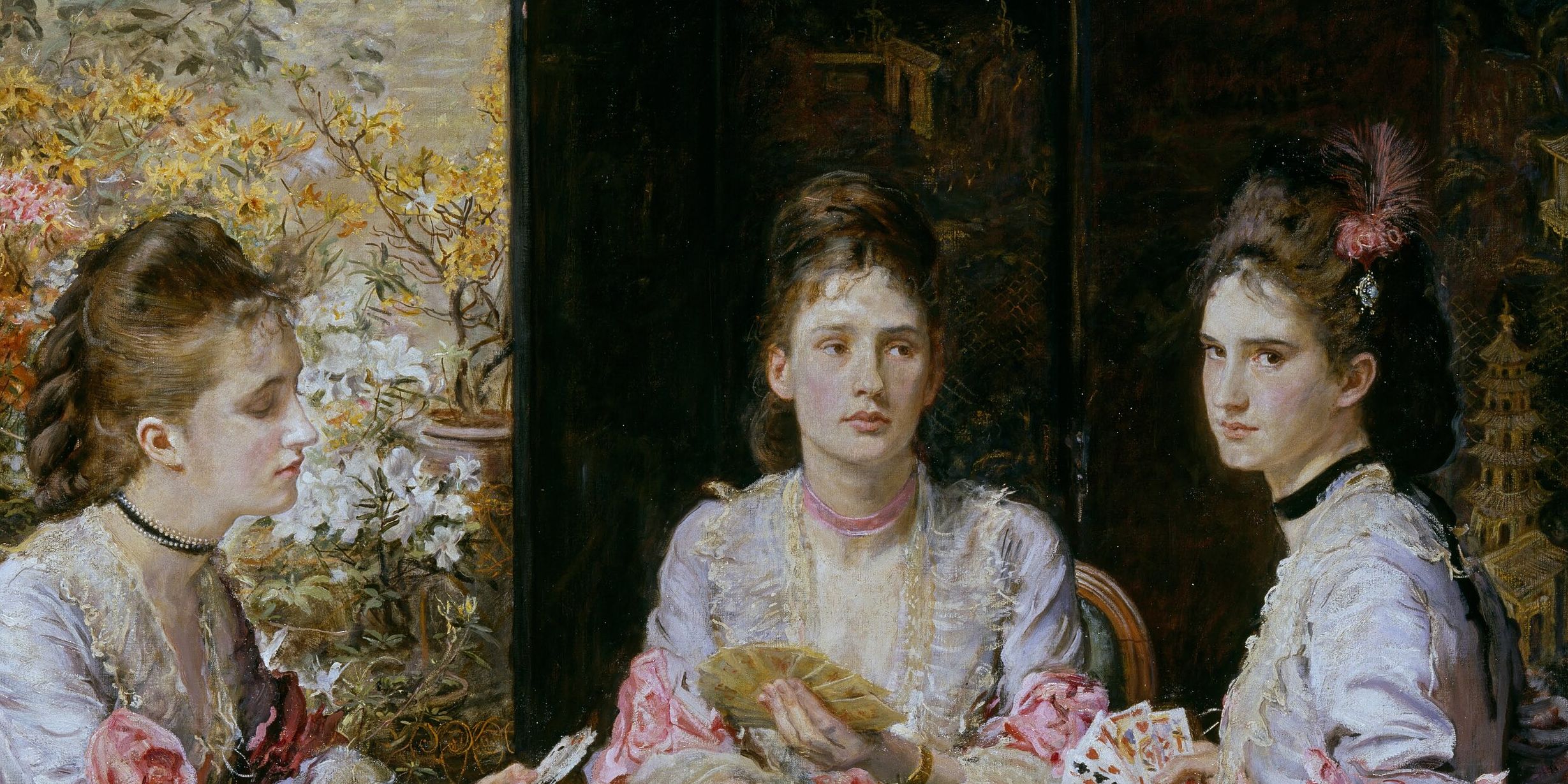
Three different lines of sight
One sister looks at her cards, one turns towards the right and the third looks out. Their glances keep attention circulating around the table.
Cards and hands
Cards are held, set down and gathered into a fan. Their light faces create a pattern across the dark tabletop and identify the action shared by the three sitters.
Flowers and dark screen
A bank of azaleas fills the left background. On the right, the dark painted screen gives the other two faces a different setting.
Folds of satin
Silver-blue fabric gathers in long folds beside the carved table. Pink ribbons are set across its ridges and change the pace of the passage from dress to furniture.
John Everett Millais artwork directory
Browse paintings and drawings covered in these articles, including related works held in public collections. Reproductive engravings and editions are discussed on the Prints page.
Prints and illustrated editions
- The Baby-House, 1872. Etching by Millais.
- The Good Shepherd, 1864. Wood engraving designed by Millais, engraved and printed by the Dalziel Brothers.
- Mariana, 1857. Wood engraving designed by Millais and cut by the Dalziel Brothers for the Moxon Tennyson.
- The Proscribed Royalist, 1858. Mixed-method engraving by William Henry Simmons after Millais.
| Name | Date | Medium |
|---|---|---|
| Pizarro Seizing the Inca of Peru | 1846 | Painting |
| The Young Men of Benjamin Seizing Their Brides | 1847 | Painting |
| Isabella | 1848–49 | Painting |
| Christ in the House of His Parents (‘The Carpenter’s Shop’) | 1849–50 | Painting |
| Ferdinand Lured by Ariel | 1849–50 (monogram dated 1849) | Painting |
| Study for Christ in the House of His Parents, Tate N04623 | c. 1849 | Drawing |
| Study for Christ in the House of His Parents, Tate N04792 | c. 1849 | Drawing |
| Study for Mariana in the Moated Grange | 1850 | Drawing |
| A Huguenot, on St Bartholomew’s Day, Refusing to Shield Himself from Danger by Wearing the Roman Catholic Badge | 1851–52 (exhibited 1852) | Painting |
| Mariana | 1851 | Painting |
| Ophelia | 1851–52 | Painting |
| The Bridesmaid | 1851 | Painting |
| The Return of the Dove to the Ark | 1851 | Painting |
| The Order of Release 1746 | 1852–53 | Painting |
| The Proscribed Royalist, 1651 | 1852–53 (exhibited 1853) | Painting |
| Portrait of John Ruskin | 1853–54 | Painting |
| The Blind Girl | 1854–56 | Painting |
| Autumn Leaves | 1855–56 (Manchester labels 1856) | Painting |
| A Dream of the Past: Sir Isumbras at the Ford | 1856–57, later revised | Painting |
| The Vale of Rest | 1858–59 | Painting |
| Study for The Black Brunswicker, Tate A00812 | c. 1860 | Drawing |
| Study for The Black Brunswicker, Tate A00813 | c. 1860 | Drawing |
| Study for The Black Brunswicker, Tate A00814 | c. 1860 | Drawing |
| The Black Brunswicker | 1860 | Painting |
| The Ransom | 1860–62 | Painting |
| My First Sermon | 1863 | Painting |
| My Second Sermon | 1864 | Painting |
| Joan of Arc | 1865 | Painting |
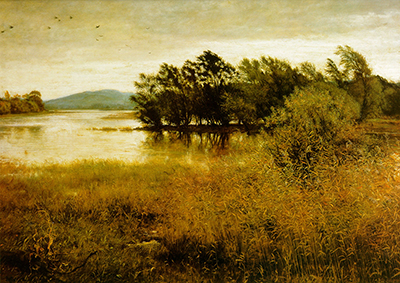
| Chill October | 1870 (exhibited 1871) | Painting |
| The Boyhood of Raleigh | 1870 | Painting |
| The Knight Errant | 1870 | Painting |
| Hearts are Trumps | 1872 | Painting |
| The North-West Passage | 1874 | Painting |
| Louise Jane Jopling | 1879 | Painting |
| William Ewart Gladstone, NPG 3637 | 1879 | Painting |
| Bubbles | 1886 | Painting |
| Portia | 1886 | Painting |
| Dew-Drenched Furze | 1889–90 | Painting |
| Ducklings | 1889 | Painting |
| Portrait of Sarah Hammond | 1891 | Painting |
Discussion
Look again at the images and ideas explored in Hearts are Trumps. These editorial prompts invite your observations.
Reader Insights
Which of the sisters first makes you feel included in the game?
Choose one passage of silk and another of flowers or lacquer. How does the handling of light help you tell them apart?
Join the Conversation
Share a detail, comparison or question about Hearts are Trumps below.
References
- Tate Britain, Hearts are Trumps, collection interpretation and artwork image, Google Arts & Culture. View source.
- Tate, Hearts are Trumps, collection record N05770. View source.
- University of Glasgow, “Walter Armstrong,” The Correspondence of James McNeill Whistler. View source.
- Nele Martina Putz, Demokratisierung des Luxus in der Malerei des späten 19. Jahrhunderts: Portrait und Genre bei John Everett Millais. Ludwig-Maximilians-Universität München, 2009, pp. 15–20. View source.
- The Examiner. Royal Academy exhibition review, 4 May 1872, no. 3353, p. 456. View source.
- Royal Academy of Arts, Exhibition of Works by the Late Sir John Everett Millais, Bart., 1898, no. 149, p. 44. View source.
- Henry Jones, writing as Cavendish. The Laws and Principles of Whist Stated and Explained, 18th ed., 1889, frontispiece and section on dummy whist. View source.
- Grosvenor Gallery, Exhibition of the Works of Sir John E. Millais, Bt., R.A., 1886, no. 83, pp. 50–51, reproducing the 1872 Athenaeum review. View source.
- John Guille Millais, The Life and Letters of Sir John Everett Millais, vol. 1, 1899, pp. 234–235. View source.
- National Galleries of Scotland, Sir Joshua Reynolds, The Ladies Waldegrave, collection record NG 2171. View source.
- Carol Jacobi, “Tate Painting and the Art of Stereoscopic Photography.” Tate. View source.
- Natalia S. Gurkina, “19th-Century British Stereoscopic Photography and Painting: Problems of Interaction.” Terra Artis. Art and Design, no. 4, 2022, pp. 44–54, especially pp. 51–52. View source.
- Royal Commission, Paris Universal Exposition of 1878: Catalogue of the British Fine Art Section, no. 172, p. 23. View source.
- L’art et l’industrie de tous les peuples à l’Exposition universelle de 1878, review of British painting. View source.
- Tate Conservation, “John Everett Millais’s Hearts are Trumps 1872,” treatment account and before-and-after photographs. View source.