 by Tom Gurney
Tom Gurney BSc (Hons) is an art history expert with over 20 years experience
Published on June 19, 2020 / Updated on November 25, 2026
Email: tomgurney1@gmail.com / Phone: +44 7429 011000
The Blind Girl: Introduction
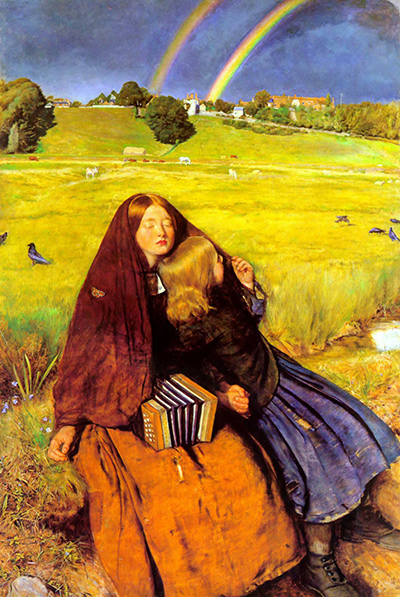
A girl raises her face to the sun while her younger companion turns to catch sight of a double rainbow. Their hands meet in the folds of a shared shawl. John Everett Millais gives the viewer the child’s view of the sky and places the older girl close enough for us to study the grass between her fingers. The Blind Girl, painted in oil on canvas between 1854 and 1856, is in the collection of Birmingham Museum & Art Gallery. In a canvas only 80.8 centimetres high, Millais makes room for a stretch of Sussex countryside and for two people experiencing the same few minutes in different ways. [1] [2]
At a Glance
- Date1854–56 [1][2]
- MediumOil on canvas [1]
- CollectionBirmingham Museums Trust, 1892P3 [1]
- SubjectTwo girls seated by a country road beneath a double rainbow [1][2]
This work across John Everett Millais’s career
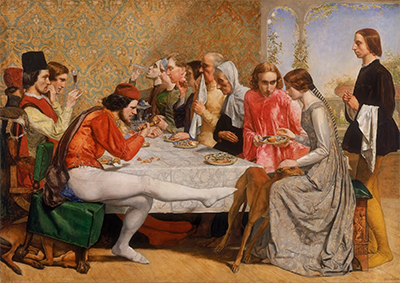
Isabella
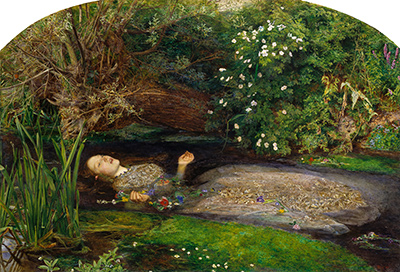
1848–49Ophelia
1851–52Autumn Leaves
1855–56Dew-Drenched Furze
1889–90Contents
- A landscape begun in Sussex
- Why the two rainbows have reversed colours
- The shawl, the concertina and the sign
- From the Royal Academy to Birmingham
- Bringing the smell of the pasture into the gallery
- Annotated details
A landscape begun in Sussex
Millais began the landscape at Winchelsea in 1854 and completed the picture in Perth in 1856, where Birmingham’s collection account places the addition of the figures. The girl with her face turned towards the light was first modelled by Effie Gray, then by Mathilda Proudfoot. Isabella Nicol modelled for the younger girl. Graeme Douglas records that Effie helped recruit Proudfoot from a Perth School of Industry, which trained girls from poor or insecure households. Proudfoot was sighted. Whatever the characters’ circumstances, the models brought two particular faces to a scene Millais had begun hundreds of miles from where he finished it. [1] [2]
The ground rises through the canvas in steps. Grass and low plants fill the bank under the girls. Beyond it, damp pasture with grazing animals leads to a hillside of houses. A pale road climbs towards the settlement, picking up the light after the shower. Winchelsea Museum associates the view with the approach from Sea Road and Strand Hill, where the road runs up towards Strand Gate. The Royal Academy’s 1898 catalogue also identifies the village as Winchelsea, although an 1894 loan catalogue names nearby Icklesham. The Sussex starting point is well documented. The exact identity of every distant building is harder to settle. [1] [3] [4] [5]
A graphite sheet in Tate’s collection also preserves evidence of how Millais worked on the subject. The narrow drawing measures 18.7 by 9.2 centimetres, with a study for Peace Concluded on its reverse. Two pictures that reached the Royal Academy in 1856 thus share a small piece of paper. The sheet is a reminder that the two girls and their setting were worked out over time, even though the picture gives us a brief interval in changing weather. [6] [7]
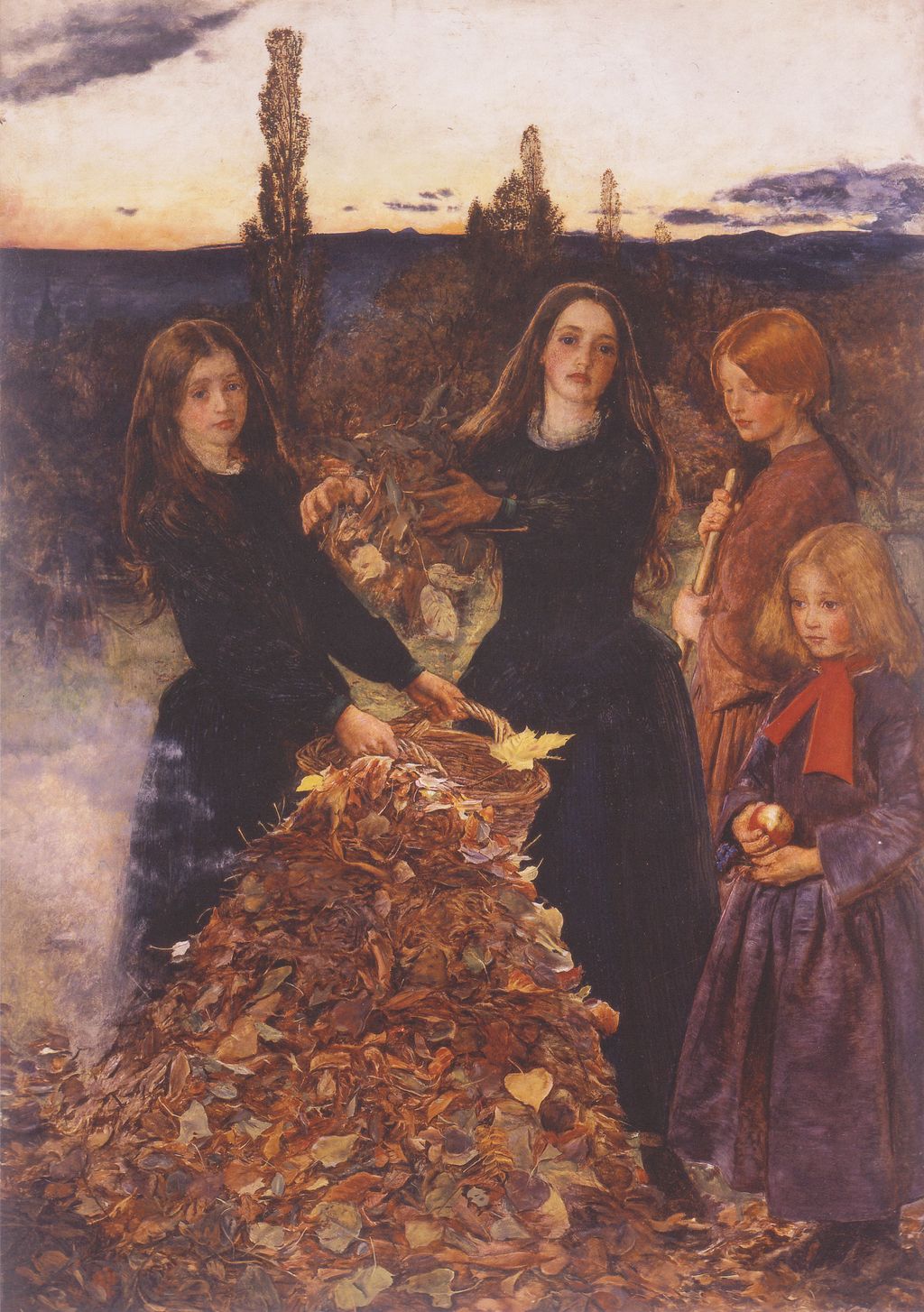
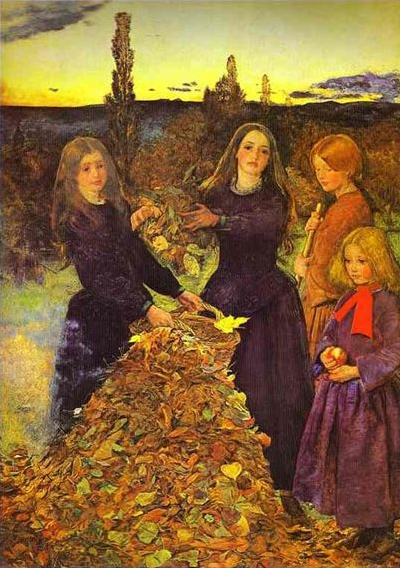
Autumn Leaves, oil on canvas, Manchester Art Gallery, 1892.4. From a scanned book reproduction. The two paintings share sitters and were both shown at the Royal Academy in 1856. Image source. Public domain.
Why the two rainbows have reversed colours
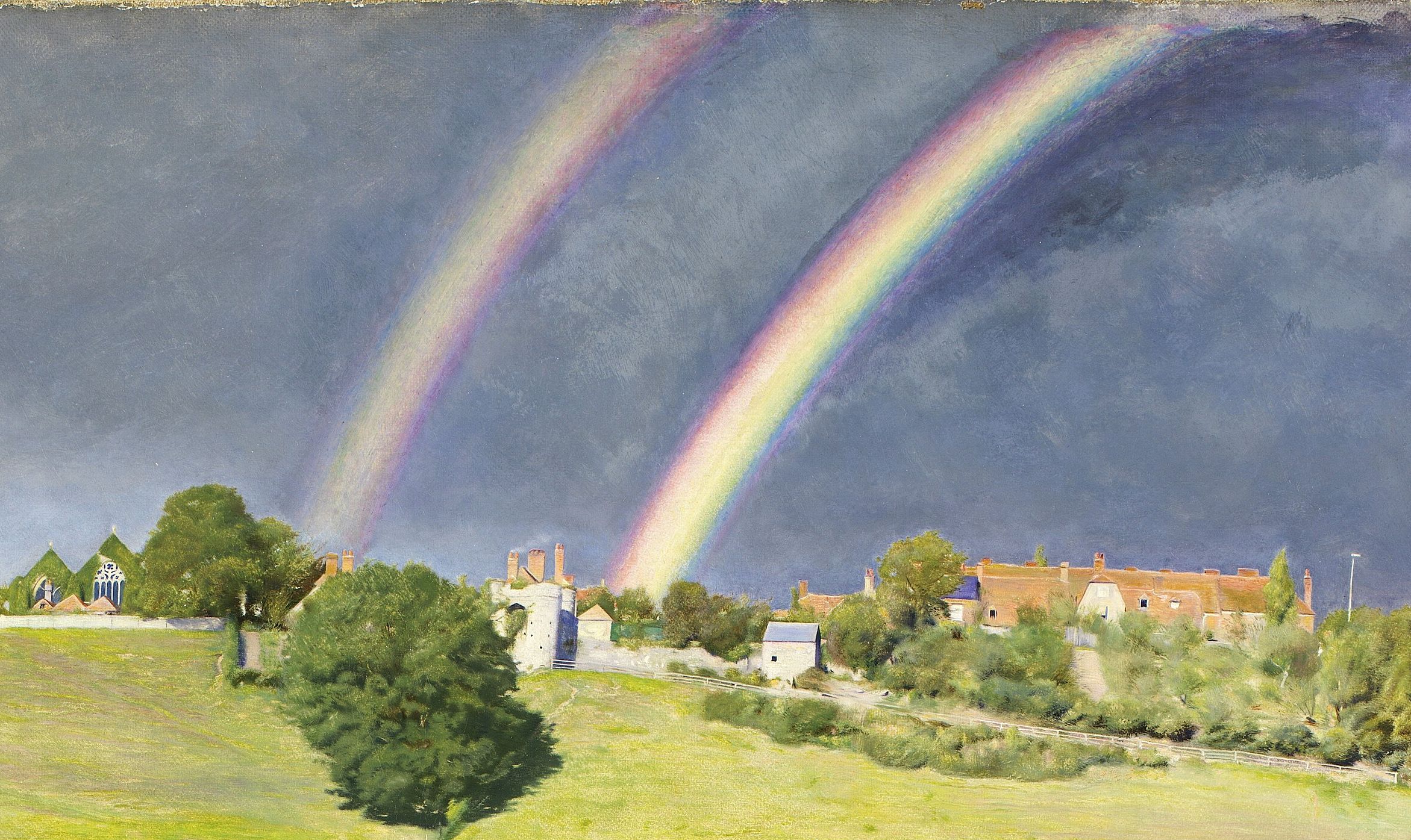
The brighter bow lies across a dark bank of rain, which makes its colours easy to see. Above it runs a broader, fainter arc with the colours in reverse order. A primary rainbow is formed when sunlight is refracted as it enters a raindrop, reflected once inside it and refracted again as it leaves. Light in the secondary bow reflects twice inside the drop. This puts the red edge on the inside of the outer bow. In the primary bow the red edge lies on the outside, so the red sides of the two arcs face across the gap. Mónica Vergés Alonso, writing in the University of Valencia’s Mètode, points to the arrangement as an example of Pre-Raphaelite attention to the behaviour of light. [8] [9]
According to the early biographer Arthur Fish, Millais originally put the colours in the same order in both bows and later reversed and softened the outer one. Fish says the correction came years afterwards. Vergés describes it as prompt, so the accounts agree on the reported change and differ on its timing. The finished sky shows the reversed colours, while the date and details of the revision remain uncertain. The comparison also matters for the composition. The inner band catches the eye first, and the faint outer bow rewards the slower scrutiny that the blades of grass and the butterfly demand at the other end of the canvas. [1] [8] [10]
The smaller girl’s turn makes the rainbows an event rather than a background effect. Her body is still drawn in towards her companion while her head swivels towards the weather. The older girl’s upturned face catches the same light that breaks through onto the pasture. Sun and shower belong to both figures, even though the colour in the sky is available to only one of them. [1] [2]
The shawl, the concertina and the sign
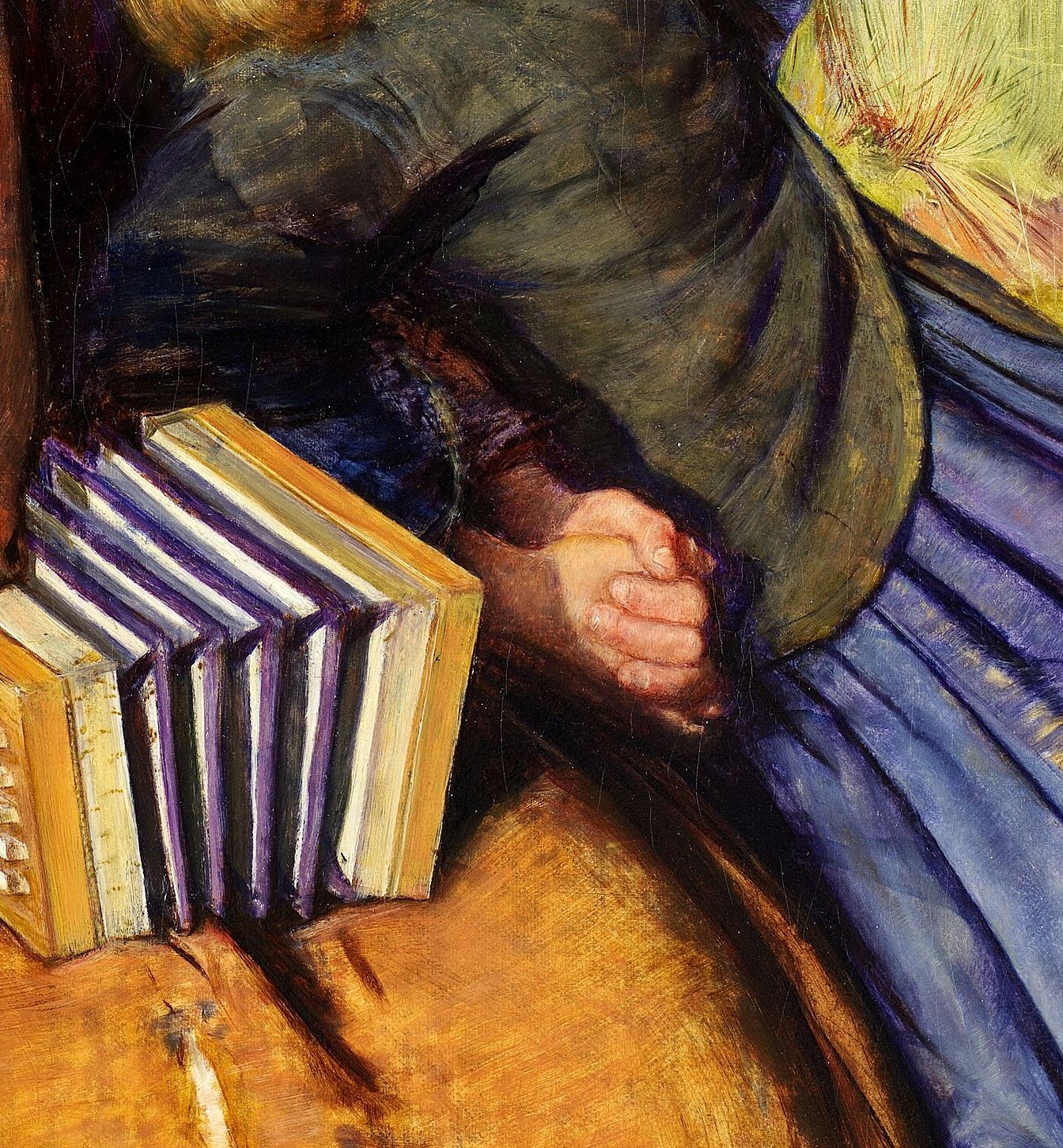
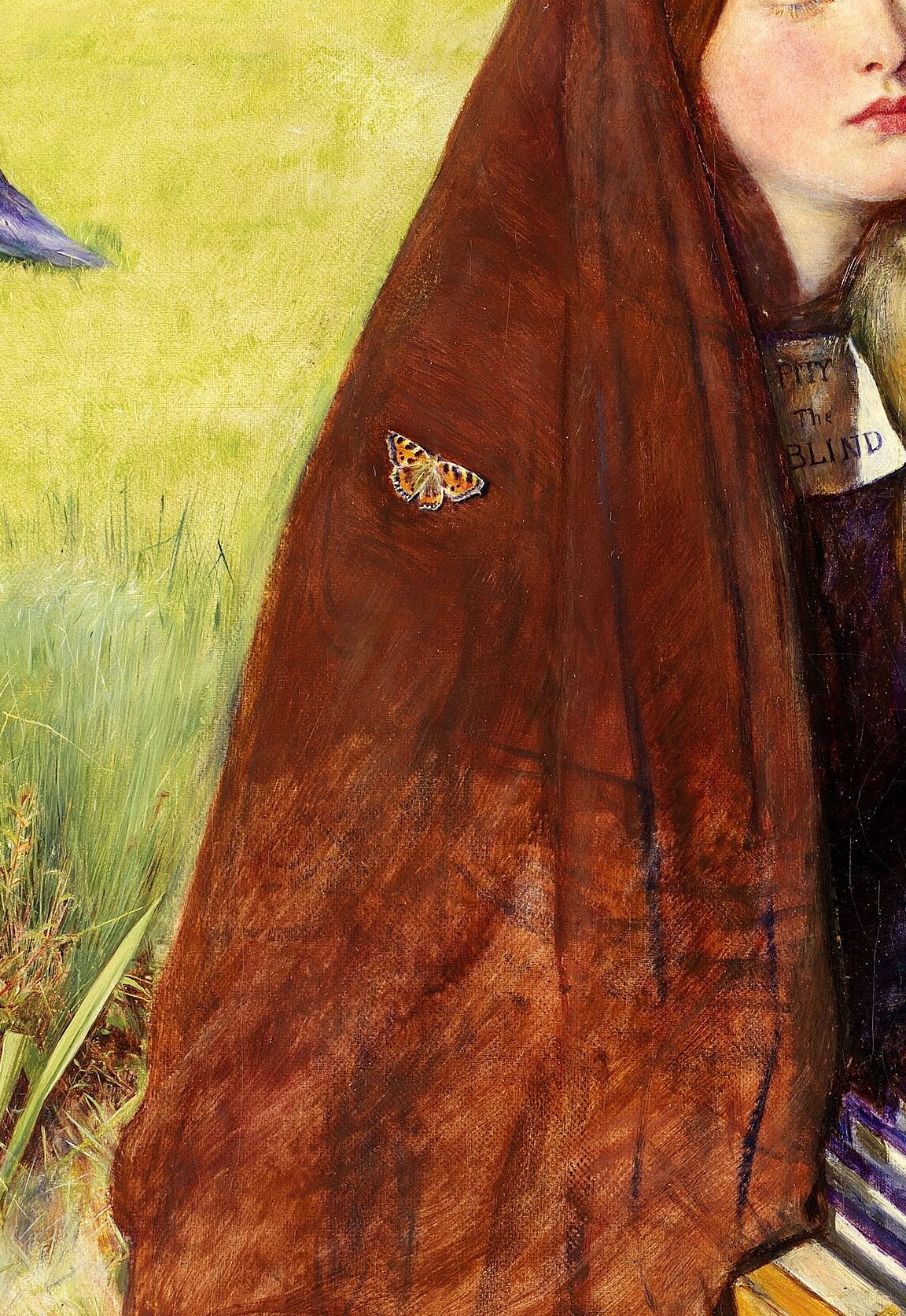
The shawl is a shelter that the younger child draws close to her face. For the older girl it frames her sunlit cheek and carries the small tortoiseshell butterfly. The insect poised on coarse fabric is as finely described as anything in the distance. It makes the stillness of the girl’s upper body especially clear while her free hand feels the grass. The contrast in textures continues at her lap, where the concertina’s patterned ends and folded bellows sit against the worn skirt. The instrument is idle, but its presence gives the pause some history. She has brought something she can play along the road. The picture invites us to imagine the instrument opening, the sound it could make and the different texture of wet grass and cloth. [1] [2] [8]
Tucked at the girl’s neck is a sign asking passers-by to “Pity the Blind”. It identifies her as blind and makes the encounter with the two girls an encounter with rural poverty. The concertina suggests one possible way of earning money. The sign suggests that a stranger’s willingness to give may depend on being told why the player needs help. In Millais’s England, the 1824 Vagrancy Act treated begging in public as a punishable offence. The roadside setting, worn clothes and appeal for charity would have had practical implications for a Victorian audience as well as emotional ones. The canvas leaves the girls’ home and the terms of their livelihood open. [1] [2] [11]
Their joined hands offer another way to read the scene. Douglas asks what changes when the blind girl is understood as someone with preferences, skills and relationships of her own. The older girl can offer warmth and cover as readily as the younger one can offer guidance or describe the sky. Millais leaves any conversation to our imagination. The visible gestures show a child seeking shelter and comfort from the girl whose sign asks the outside world to pity her. This is a small act of care with a particular direction. It runs from the older girl to the little one who presses into her side. [1] [2]
From the Royal Academy to Birmingham
At the Royal Academy in 1856, The Blind Girl was shown as no. 586. The critic for The Leader thought that its plainly dressed, poor protagonist made a stronger appeal to fellow feeling than an idealised figure could. The same writer called the handling of the red drapery careless and blamed the high hang for making the brush marks around the butterfly conspicuous. At that height the top caught the light awkwardly. The observation gives us two different experiences of the same detail: the little insect Millais used to suggest a moment of rest, and a conspicuous piece of paint seen across an Academy gallery. [7]
That review also discussed Autumn Leaves, the other Millais painting of girls outdoors in the exhibition. Its girls gather around a heap of leaves in the last light, and the critic again complained about passages that looked unfinished. Ruskin, writing about Autumn Leaves in his 1856 Academy Notes, thought the twilight exceptionally well painted. The two pictures make quite different demands on the eye. In Autumn Leaves the darkening sky gradually gives up details. In The Blind Girl sunshine makes the colours suddenly intense. What some viewers took for uneven or conspicuous handling was bound up with how Millais painted particular conditions of light. [7] [10] [12]
The Liverpool Academy awarded the painting its prize in 1857. According to the editors of Ruskin’s collected works, there was public support for a rival, Abraham Solomon’s Waiting for the Verdict, and one of the judges, the landscape painter Alfred William Hunt, wrote to Ruskin. Ruskin’s reply, printed in the Liverpool Albion on 11 January 1858, defended an academy’s ability to recognise unfamiliar excellence. He saw the suspicion of favouritism as a consequence of critics treating Pre-Raphaelite methods as eccentric. The dispute concerned what a prize ought to reward, and how often an institution could back innovators before it was accused of forming a clique. [12]
Ruskin returned to the picture in 1878 in The Three Colours of Pre-Raphaelitism. He had seen it in William Graham’s house, opposite Dante Gabriel Rossetti’s Annunciation, with a Burne-Jones drawing nearby. His description attends to the grazing donkeys, the smell of grass after the shower and the girl’s stillness in the sun. He reads the younger figure as a guide bored by the wait. A viewer following her turn towards the sky might see a child absorbed by the rainbows. Ruskin’s detailed account is evidence of what a sympathetic Victorian critic saw in the picture, down to the very different degrees of attention he assigned to the girls. [13]
When Graham’s collection was sold in 1886, a history of Christie’s sales records that The Blind Girl fetched 830 guineas. It was offered in the company of other Millais paintings, including The Vale of Rest, which brought 3,000 guineas. The collection in which Ruskin had compared Millais to Rossetti and Burne-Jones was dispersed, and the painting passed from the setting of a private house into public ownership within a few years. Alderman William Kenrick presented it to Birmingham in 1892, according to Fish, and the city was already lending it to an exhibition at London’s Guildhall in 1894. [5] [10] [13] [14]
When the Royal Academy mounted its posthumous exhibition of Millais’s work in 1898, the city corporation lent it back to London. The catalogue listed it as no. 56 and recorded the artist’s signature and the date 1856 on the canvas. The exhibition placed the roadside scene in the company of earlier works including Christ in the House of His Parents and the portrait of Ruskin, both entered near it in the catalogue. Their company made one of Millais’s recurring choices plain: a specific place and recognisable material surroundings can give weight to a figure’s gesture. [4] [5]
Bringing the smell of the pasture into the gallery
Christina Bradstreet’s exhibition Scent and the Art of the Pre-Raphaelites at the Barber Institute in 2024–25, expanded at Watts Gallery in 2025 as Scented Visions, invited visitors to smell fragrances created to accompany the painting. Perfumer Gregorio Sola devised one scent to evoke the rain-soaked pasture and another for the shawl. The first combined grassy and watery notes with damp earth. The second drew on wool, lanolin and the warmth of skin. Bradstreet connects the experiment with a Victorian literary association between rainbows and the scent of a meadow after rain. That association helps explain how Ruskin could write so readily about the smell of the painted grass long before a gallery introduced any scent of its own. [13] [15] [16]
The shawl gives a particularly concrete sense of how far a painting can reach beyond sight. The younger child presses it almost to her nose, close enough to feel its weave and smell the cloth as she looks at the sky. Her companion extends her fingers towards the grass and faces the warmth coming from the other direction. Millais lets the viewer travel from the distant arcs to the worn fabric and the touching hands. The rainbow lasts as long as the light and rain coincide. Down by the road there is also the time it takes the girls to rest, gather themselves and go on. [1] [2]
Annotated Details from The Blind Girl
The numbered points identify visible features discussed in this article. Return from each detail to the numbered overview. The Blind Girl, oil on canvas, Birmingham Museums Trust, 1892P3. Image source. Public domain.
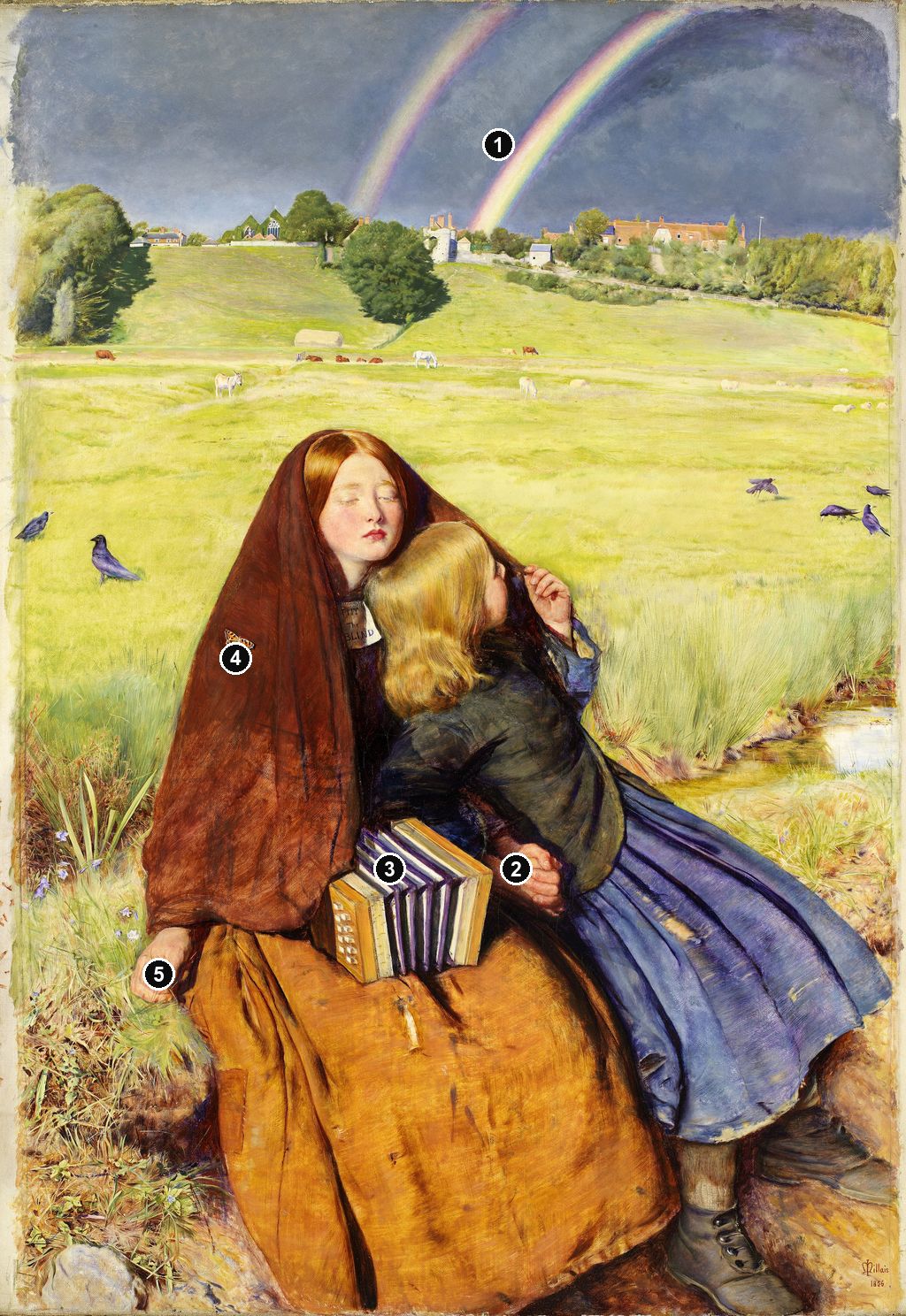
Details from THE BLIND GIRL
Compare the cropped details with the source images above. Notice how their colours, shapes and positions contribute to the larger compositions.
The double rainbow
Two arcs cut across the dark clouds. Their colour orders run in opposite directions, a distinction that becomes easier to see near the top edge.
Joined hands
The younger girl turns towards the sky but keeps her hand with her companion’s. The contact connects two bodies whose faces are turned different ways.
The concertina and the sign
The instrument lies closed on the older girl’s lap. Above it hangs a written sign. Both make parts of her daily life available to the viewer.
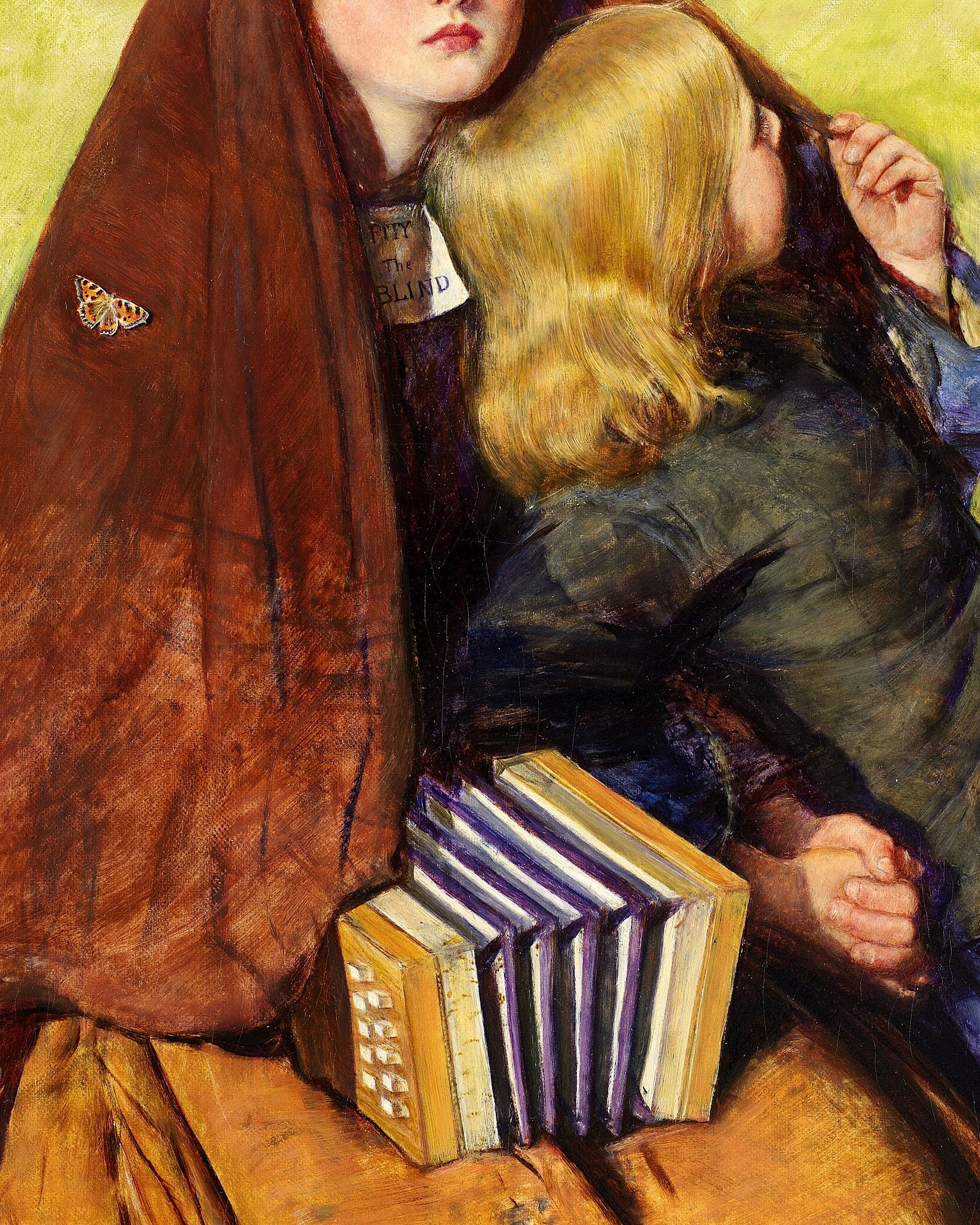
Butterfly and the texture of cloth
A small orange butterfly is set against the dark shawl. The surrounding folds and fine patterning make it easy to overlook from a distance.
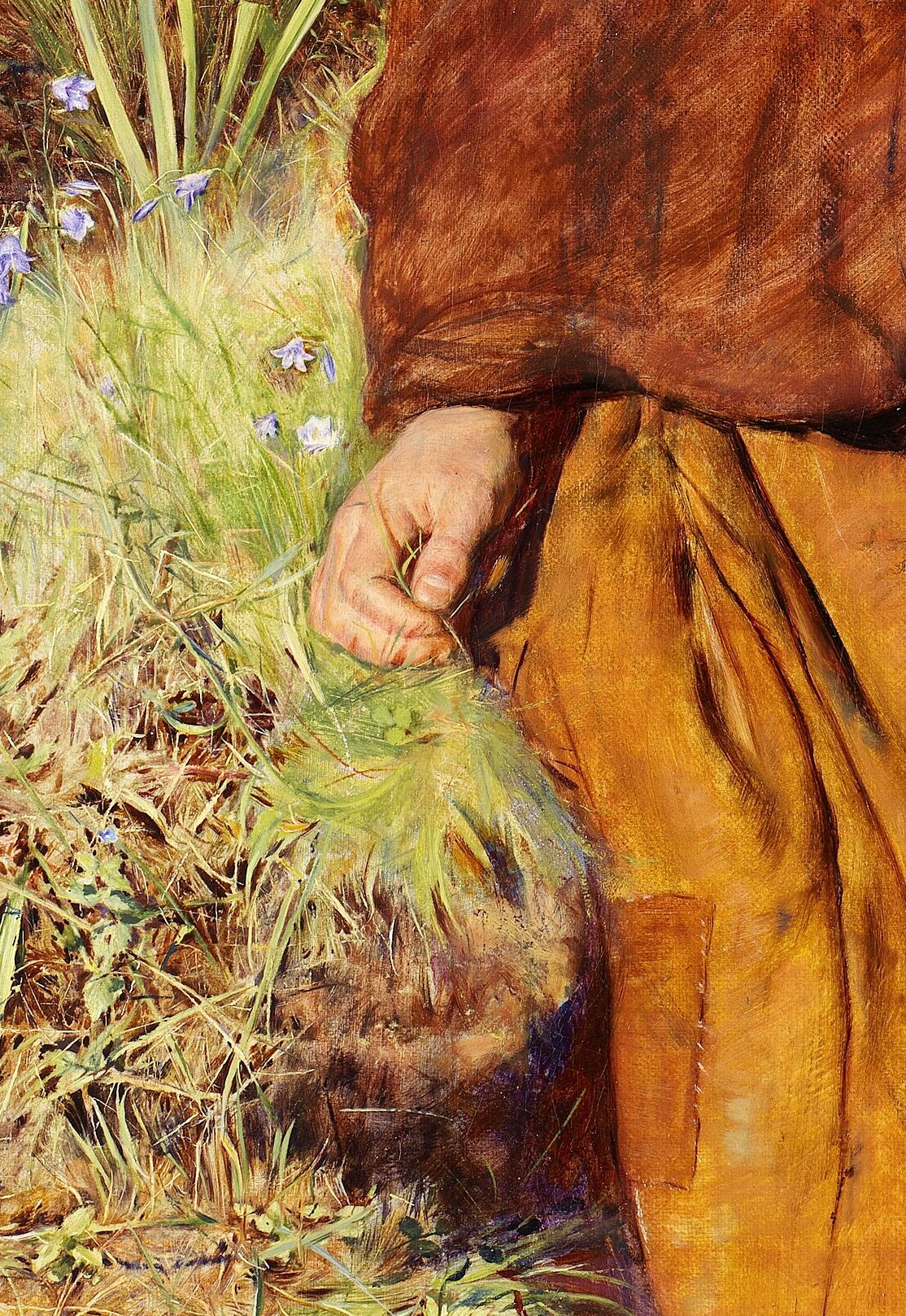
Fingers at the roadside
The older girl’s fingertips meet the plants at the edge of the road. This small action puts the foreground within reach, while the two rainbows remain far away.
John Everett Millais artwork directory
Browse paintings and drawings covered in these articles, including related works held in public collections. Reproductive engravings and editions are discussed on the Prints page.
Prints and illustrated editions
- The Baby-House, 1872. Etching by Millais.
- The Good Shepherd, 1864. Wood engraving designed by Millais, engraved and printed by the Dalziel Brothers.
- Mariana, 1857. Wood engraving designed by Millais and cut by the Dalziel Brothers for the Moxon Tennyson.
- The Proscribed Royalist, 1858. Mixed-method engraving by William Henry Simmons after Millais.
| Name | Date | Medium |
|---|---|---|
| Pizarro Seizing the Inca of Peru | 1846 | Painting |
| The Young Men of Benjamin Seizing Their Brides | 1847 | Painting |
| Isabella | 1848–49 | Painting |
| Christ in the House of His Parents (‘The Carpenter’s Shop’) | 1849–50 | Painting |
| Ferdinand Lured by Ariel | 1849–50 (monogram dated 1849) | Painting |
| Study for Christ in the House of His Parents, Tate N04623 | c. 1849 | Drawing |
| Study for Christ in the House of His Parents, Tate N04792 | c. 1849 | Drawing |
| Study for Mariana in the Moated Grange | 1850 | Drawing |
| A Huguenot, on St Bartholomew’s Day, Refusing to Shield Himself from Danger by Wearing the Roman Catholic Badge | 1851–52 (exhibited 1852) | Painting |
| Mariana | 1851 | Painting |
| Ophelia | 1851–52 | Painting |
| The Bridesmaid | 1851 | Painting |
| The Return of the Dove to the Ark | 1851 | Painting |
| The Order of Release 1746 | 1852–53 | Painting |
| The Proscribed Royalist, 1651 | 1852–53 (exhibited 1853) | Painting |
| Portrait of John Ruskin | 1853–54 | Painting |
| The Blind Girl | 1854–56 | Painting |
| Autumn Leaves | 1855–56 (Manchester labels 1856) | Painting |
| A Dream of the Past: Sir Isumbras at the Ford | 1856–57, later revised | Painting |
| The Vale of Rest | 1858–59 | Painting |
| Study for The Black Brunswicker, Tate A00812 | c. 1860 | Drawing |
| Study for The Black Brunswicker, Tate A00813 | c. 1860 | Drawing |
| Study for The Black Brunswicker, Tate A00814 | c. 1860 | Drawing |
| The Black Brunswicker | 1860 | Painting |
| The Ransom | 1860–62 | Painting |
| My First Sermon | 1863 | Painting |
| My Second Sermon | 1864 | Painting |
| Joan of Arc | 1865 | Painting |
| Chill October | 1870 (exhibited 1871) | Painting |
| The Boyhood of Raleigh | 1870 | Painting |
| The Knight Errant | 1870 | Painting |
| Hearts are Trumps | 1872 | Painting |
| The North-West Passage | 1874 | Painting |
| Louise Jane Jopling | 1879 | Painting |
| William Ewart Gladstone, NPG 3637 | 1879 | Painting |
| Bubbles | 1886 | Painting |
| Portia | 1886 | Painting |
| Dew-Drenched Furze | 1889–90 | Painting |
| Ducklings | 1889 | Painting |
| Portrait of Sarah Hammond | 1891 | Painting |
Discussion
Look again at the images and ideas explored in The Blind Girl. These editorial prompts invite your observations.
Reader Insights
Where does the younger girl’s turn towards the sky lead your eye next?
What do the concertina, the joined hands and the fingers on the ground each tell you about the encounter?
Join the Conversation
Share a detail, comparison or question about The Blind Girl below.
References
- Birmingham Museum & Art Gallery, The Blind Girl, collection record and reproduction. View source.
- Graeme Douglas, John Everett Millais’ The Blind Girl (1856), Midlands Art Papers, University of Birmingham. View source.
- Winchelsea Museum, Art and Literature, local accounts of the view towards Strand Gate. View source.
- Royal Academy of Arts, Exhibition of Works by the Late Sir John Everett Millais, winter exhibition catalogue, 1898, no. 56. View source.
- A. G. Temple, Descriptive Catalogue of the Loan Collection of Pictures, Corporation of London, 1894, no. 139, p. 77. View source.
- Tate, Study for ‘The Blind Girl’. Verso: Study for ‘Peace Concluded’, collection data, accession N04368. View source.
- The Leader, Exhibition of the Royal Academy, 3 May 1856, p. 428. View source.
- Mónica Vergés Alonso, El regreso a la naturaleza, Mètode, University of Valencia, no. 115, pp. 77–84. View source.
- NOAA National Environmental Satellite, Data, and Information Service, What Causes a Rainbow? View source.
- Arthur Fish, John Everett Millais, 1829–1896, pp. 88–91. View source.
- House of Lords Library, Vagrancy Act 1824: Will It Be Repealed?, historical overview and section 3. View source.
- John Ruskin, Pre-Raphaelitism in Liverpool and Academy Notes (1856), with the editors’ introduction, Library Edition, vol. XIV, pp. xxxi–xxxii, 65–66 and 327–28. View source.
- John Ruskin, The Three Colours of Pre-Raphaelitism, 1878, Library Edition, vol. XXXIV, §§ 1, 4 and 6. View source.
- William Roberts, Memorials of Christie’s, vol. II, account of the 1886 William Graham sale. View source.
- Christina Bradstreet, The Scent Experiences, Barber Institute of Fine Arts. View source.
- Watts Gallery, Scented Visions: Smell in Art 1850–1915, exhibition announcement. View source.