 by Tom Gurney
Tom Gurney BSc (Hons) is an art history expert with over 20 years experience
Published on June 19, 2020 / Updated on November 25, 2026
Email: tomgurney1@gmail.com / Phone: +44 7429 011000
The Proscribed Royalist, 1651: Introduction
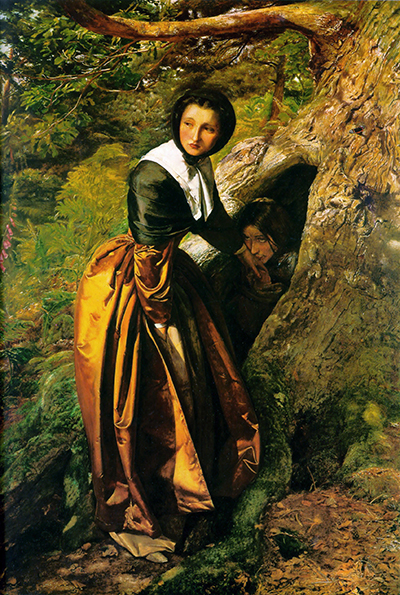
A woman looks back into a sunlit wood while a man in the hollow of an oak kisses her hand. She is reaching into her dress for the food she has brought him. John Everett Millais painted The Proscribed Royalist, 1651 in 1852–53 and exhibited it at the Royal Academy in 1853. The full-size work is an oil on canvas about a metre high, documented in the private collection of Andrew Lloyd Webber. The date in the title places the encounter in the year of the Royalist defeat at Worcester. Millais makes the aftermath of a battle legible in the way two people move when they think someone might be coming. [1] [2] [3]
At a Glance
- Date1852–53 [1][3]
- MediumOil on canvas [1][3]
- SubjectA woman helps a Royalist hiding in a tree after the Battle of Worcester [1][3]
- Related printWilliam Henry Simmons’s 1858 engraving after Millais [2]
This work across John Everett Millais’s career
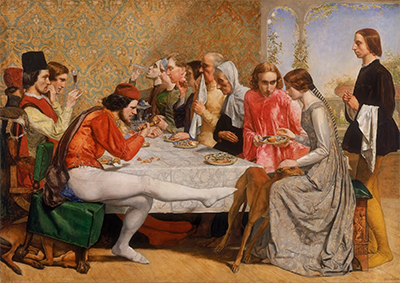
Isabella
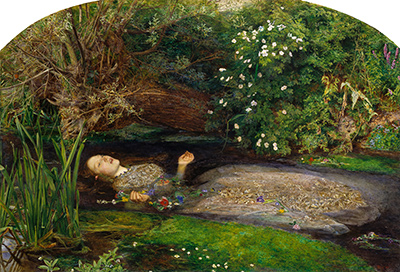
1848–49Ophelia
1851–52The Proscribed Royalist, 1651 (current article)
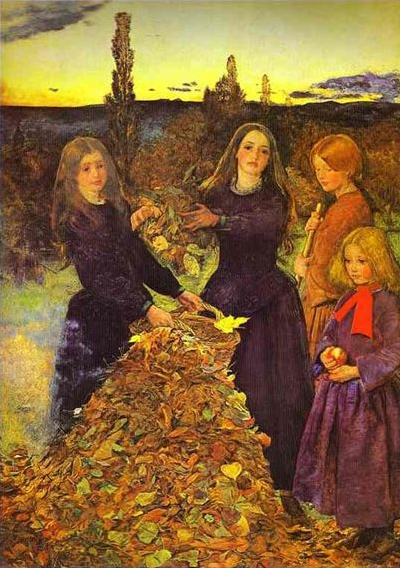
1852–53 (exhibited 1853) [1]Autumn Leaves
1855–56Dew-Drenched Furze
1889–90Contents
- Two people on watch
- Worcester and the Royal Oak
- The wood at Hayes and the people who posed
- The 1853 exhibition and the smaller version
- How the image travelled
Two people on watch
Look first at the woman’s white kerchief. It catches the light beneath her dark hood and makes her turn of the head easy to follow. Her body is close enough to the tree to reach the soldier, but her attention is already somewhere else. One hand is occupied with the provisions. The other reaches across to the mouth of the man in hiding. The 1886 Grosvenor Gallery catalogue, reprinted in Sir John Pender’s collection catalogue, calls her the soldier’s fiancée. Even without that description, their closeness comes through in the ease with which she gives him her hand while she minds the woods. [1] [3]
The fugitive is harder to find. His head is low within the cut of the hollow, with little of his body visible. The eye can pass over his face on its way from the woman’s dress to the silver-grey bark. Once you see him, the reach of his hand and the tilt of his head give his position away. Viewers can see both people at once, yet the couple cannot see everything that might matter. He is attending to her, she is watching beyond the pair, and the undergrowth interrupts even the viewer’s sightline into the trees. [1] [2] [3]
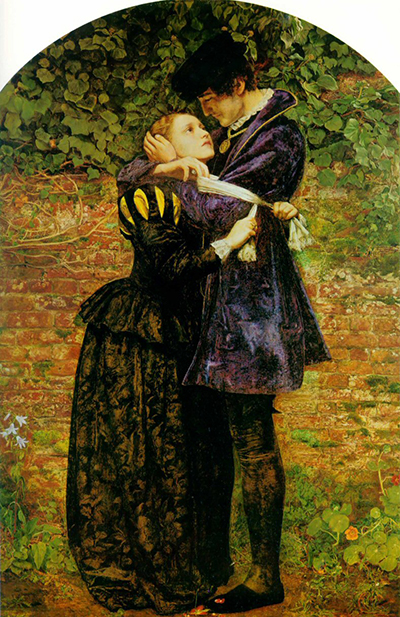
The gold and copper tones of the skirt draw attention to the one person who has to stand in the open. Its folds take up much of the space to the left of the trunk, while ferns and exposed roots fill the lower part of the picture. The scale of the tree presses the figures together. The moss and pale lichen also suggest how long it took for this shelter to come into being. Art historian Kate Flint places the oak alongside the lichened wall in Millais’s A Huguenot. Her reading makes time part of the landscape. An old surface can carry evidence of years of growth while the people beside it are caught in a moment that might end with the next footstep. [1] [3]
Worcester and the Royal Oak
In September 1651, Parliamentarian forces defeated the army of Charles II at Worcester. With soldiers searching the area, Charles and another fugitive, William Careless, climbed into an oak near Boscobel House, where they could watch for their pursuers. English Heritage recounts the episode using the king’s later account to Samuel Pepys. The escape became a recognisable story about the survival of the monarchy. On a Staffordshire dish made around 1680, Thomas Toft put a face among the oak branches and flanked the tree with the royal lion and unicorn. He included the letters CR, for Charles Rex. [4] [5]
The shared year and the oak make Boscobel a useful way into Millais’s picture. The single fugitive has taken shelter inside the trunk, and the encounter concerns the woman who can bring him food. The title gives his allegiance and predicament. His name is left open. The Grosvenor catalogue treated the story as the kind of incident that might happen in a civil conflict. The Metropolitan Museum of Art and the Acceptance in Lieu report describe the woman as Puritan. On that reading, her visit crosses the division that has put him in hiding. The soldier they describe is a Royalist, and the historical king provides a parallel for his predicament. [1] [2] [6]
The Met also hears an echo of Vincenzo Bellini’s I puritani, which Millais may have seen at Covent Garden. In the opera, Elvira comes from a Puritan family and loves the Royalist Arturo. As the Museo Teatrale Carlo Schmidl explains, the couple’s fortunes are bound up with the conflict between the Puritans and the Stuarts. Their relationship offers a parallel for the painting’s divided loyalties. Millais can barely suggest the political circumstances within the composition itself. A turn of the head has to convey the risk that Bellini and his librettist Carlo Pepoli could develop through several acts. [2] [7]
The wood at Hayes and the people who posed
Millais was considering Romeo and Juliet for a commission from Mr Pocock in the spring of 1852. His son, John Guille Millais, says the two discussed several subjects before settling on The Proscribed Royalist. In a letter dated 9 June 1852, Millais told Mrs Combe he had taken lodgings near a place he thought suited to the background. Later that month, writing from the George Inn at Hayes, he told Mrs Hodgkinson he had arranged with a farmer to shelter his equipment or himself if the weather turned. The 1886 catalogue independently locates the background in a wood near Hayes Common in Kent, painted in the summer of 1852. The family account identifies the great foreground oak with a tree at Coney Hall Hill. [1] [8]
Arthur Hughes, a painter in Millais’s circle, modelled for the fugitive. The National Portrait Gallery’s iconography for Hughes records a head-and-shoulders pencil study held by the Royal Academy. The period catalogue identifies the woman’s model as Miss Ryan, who also posed for A Huguenot. The pair of paintings have another connection in the family edition of the letters. In June 1852 Millais asked Mrs Combe to thank the woman who had lent him some lace. His son’s editorial note says the lace was used in both pictures. The surviving record thus points to people and materials outside the studio that helped Millais turn an imagined encounter into something he could observe and paint. [1] [8] [9]
The 1853 exhibition and the smaller version
At the Royal Academy in 1853, Millais also showed The Order of Release, 1746. A century separates the two subjects, but in both a woman takes action to help a man endangered by a defeated cause. In The Order of Release, she presents an official document to a gaoler. Her ability to act depends on making the paper visible to someone in authority. At the oak, help depends on keeping the encounter hidden. The Examiner preferred the prison scene. The reviewer mocked the hand-kiss and objected to the style of The Proscribed Royalist, while praising the expressive face and observed details of the other painting. Melissa Tricoire’s account of the exhibition places both works within a wider debate over Pre-Raphaelitism that year. [10] [11] [12]
The German art historian Richard Muther returned to the same two works in 1893. He grouped them with A Huguenot and The Black Brunswicker as dramas whose action is carried by figures held almost still. His account imagines the woman bringing food daily, extending the encounter into a routine of danger and dependence. The picture shows one visit. Muther’s reading gives a sense of how much of the story a viewer can supply from a hand held out, a woman’s turn, and the narrow shelter in the tree. [13]
Pender’s catalogue records the signed and dated canvas and lists it in the Grosvenor Gallery’s 1886 exhibition. James Ogston lent it to the Royal Academy’s memorial exhibition in 1898. Millais also made a smaller version, measuring 25.4 × 20 cm, in oil on panel and signed with his monogram. The Acceptance in Lieu panel described it as a reduced replica and proposed that it was painted around the time of the 1853 exhibition. Its report found no mention of it in the artist’s correspondence. The panel later went to Birmingham Museum and Art Gallery. At roughly a quarter of the height of the large canvas, the panel brings the hand-kiss and the turn of the head into the compass of a picture that can be taken in at close range. [1] [6] [14] [15]
How the image travelled
William Henry Simmons translated the painting into a print published in January 1858. The Met’s proof combines etching, mezzotint and stipple. The different marks and tones give the engraver ways to carry the contrast between rough bark, lit skin and shadowed fabric into a single-ink image. The Royal Collection also has a print of the composition. The woman’s pale kerchief and the light across the oak still lead to the shadow where the soldier is waiting. Colour does a great deal to separate forms in the oil, while the print has to make the distinction through value and texture. [2] [3] [16]
Princeton University Art Museum holds a 19 × 14 cm albumen print by an unidentified British photographer, dated to about the 1850s or 1860s. The National Portrait Gallery catalogues another small albumen object with an arched top in Cecilia Mary Jocelyn’s photograph album. These portable versions took an image first seen on a gallery wall into the scale of a page. The title supplied the date and the cause for which the man was in danger. The bend of his head and the direction of the woman’s glance could carry the rest of the scene even at album size. [17] [18]
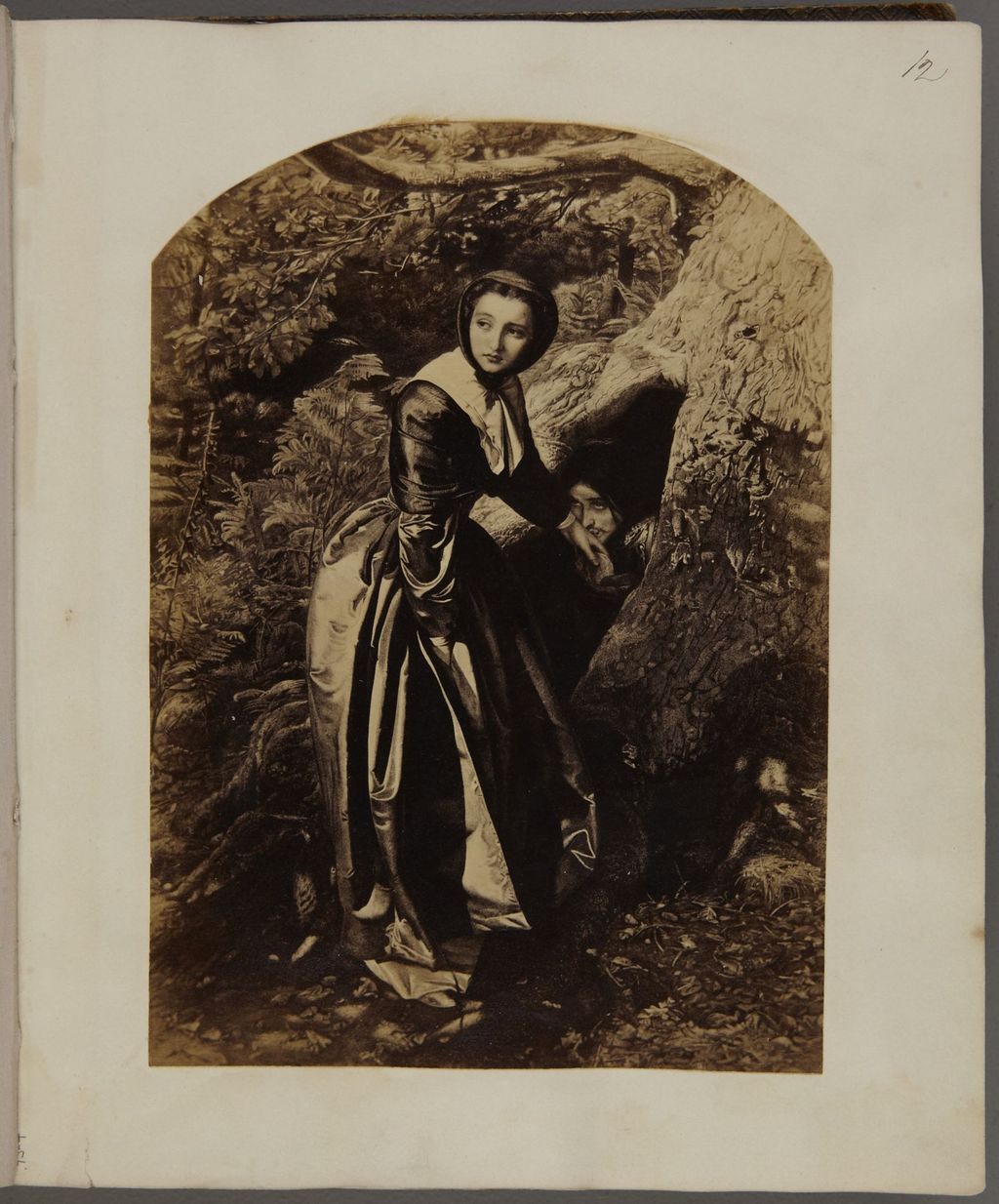
Unidentified British photographer, The Proscribed Royalist by John Everett Millais, ca. 1850s–60s. Albumen print on its mount. Princeton University Art Museum, museum purchase, anonymous gift, x1993-4. The mounted albumen print carries a handwritten number. Its photograph and publication history are separate questions from the painted canvas. Image source. Public domain.
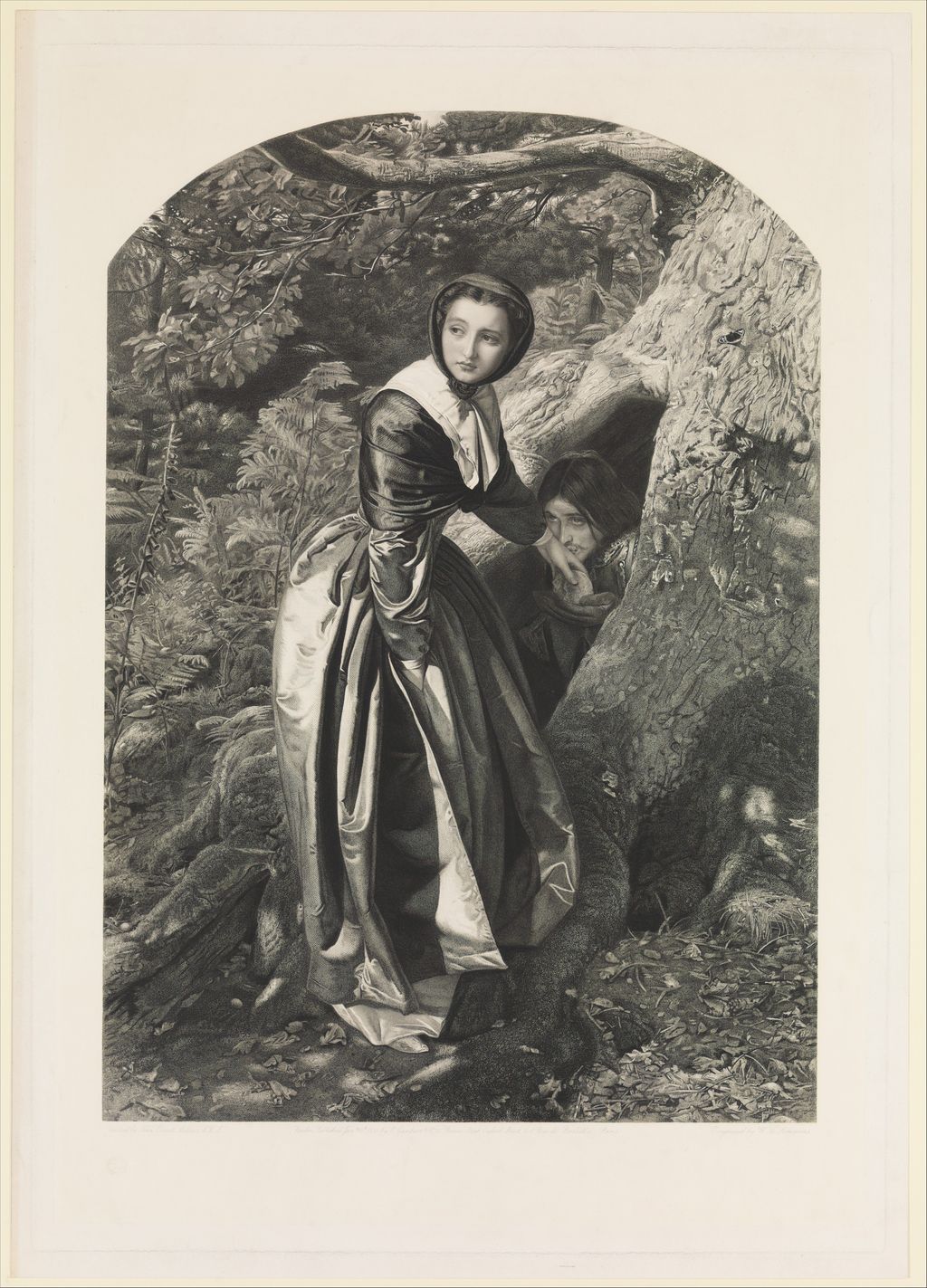
William Henry Simmons after John Everett Millais, The Proscribed Royalist, 1858. Mixed-method engraving on chine collé. Metropolitan Museum of Art, 49.40.209. The engraving preserves the print’s arched image and the margins of the surviving Met impression. Image source. CC0 / Public domain.
John Everett Millais artwork directory
Browse paintings and drawings covered in these articles, including related works held in public collections. Reproductive engravings and editions are discussed on the Prints page.
Prints and illustrated editions
- The Baby-House, 1872. Etching by Millais.
- The Good Shepherd, 1864. Wood engraving designed by Millais, engraved and printed by the Dalziel Brothers.
- Mariana, 1857. Wood engraving designed by Millais and cut by the Dalziel Brothers for the Moxon Tennyson.
- The Proscribed Royalist, 1858. Mixed-method engraving by William Henry Simmons after Millais.
| Name | Date | Medium |
|---|---|---|
| Pizarro Seizing the Inca of Peru | 1846 | Painting |
| The Young Men of Benjamin Seizing Their Brides | 1847 | Painting |
| Isabella | 1848–49 | Painting |
| Christ in the House of His Parents (‘The Carpenter’s Shop’) | 1849–50 | Painting |
| Ferdinand Lured by Ariel | 1849–50 (monogram dated 1849) | Painting |
| Study for Christ in the House of His Parents, Tate N04623 | c. 1849 | Drawing |
| Study for Christ in the House of His Parents, Tate N04792 | c. 1849 | Drawing |
| Study for Mariana in the Moated Grange | 1850 | Drawing |
| A Huguenot, on St Bartholomew’s Day, Refusing to Shield Himself from Danger by Wearing the Roman Catholic Badge | 1851–52 (exhibited 1852) | Painting |
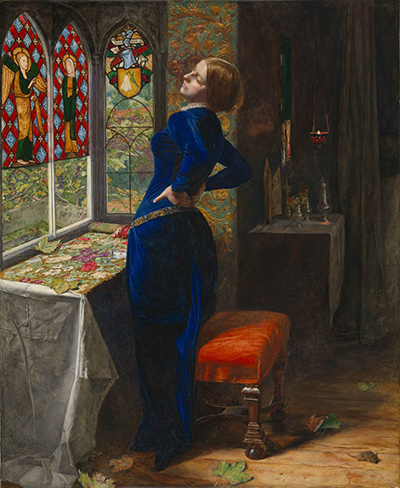
| Mariana | 1851 | Painting |
| Ophelia | 1851–52 | Painting |
| The Bridesmaid | 1851 | Painting |
| The Return of the Dove to the Ark | 1851 | Painting |
| The Order of Release 1746 | 1852–53 | Painting |
| The Proscribed Royalist, 1651 | 1852–53 (exhibited 1853) | Painting |
| Portrait of John Ruskin | 1853–54 | Painting |
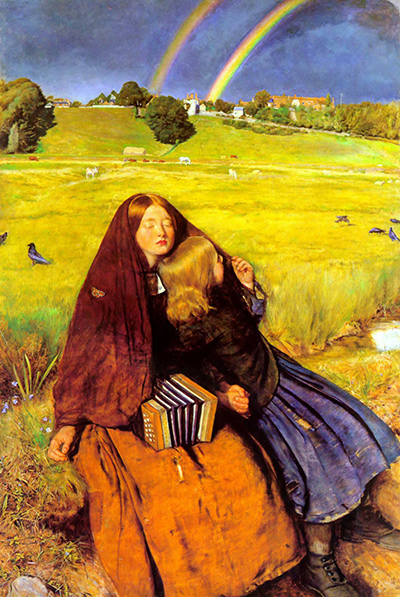
| The Blind Girl | 1854–56 | Painting |
| Autumn Leaves | 1855–56 (Manchester labels 1856) | Painting |
| A Dream of the Past: Sir Isumbras at the Ford | 1856–57, later revised | Painting |
| The Vale of Rest | 1858–59 | Painting |
| Study for The Black Brunswicker, Tate A00812 | c. 1860 | Drawing |
| Study for The Black Brunswicker, Tate A00813 | c. 1860 | Drawing |
| Study for The Black Brunswicker, Tate A00814 | c. 1860 | Drawing |
| The Black Brunswicker | 1860 | Painting |
| The Ransom | 1860–62 | Painting |
| My First Sermon | 1863 | Painting |
| My Second Sermon | 1864 | Painting |
| Joan of Arc | 1865 | Painting |
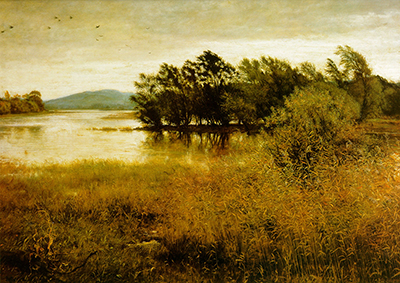
| Chill October | 1870 (exhibited 1871) | Painting |
| The Boyhood of Raleigh | 1870 | Painting |
| The Knight Errant | 1870 | Painting |
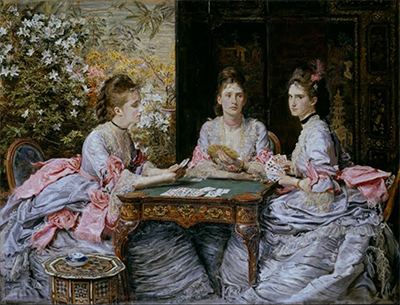
| Hearts are Trumps | 1872 | Painting |
| The North-West Passage | 1874 | Painting |
| Louise Jane Jopling | 1879 | Painting |
| William Ewart Gladstone, NPG 3637 | 1879 | Painting |
| Bubbles | 1886 | Painting |
| Portia | 1886 | Painting |
| Dew-Drenched Furze | 1889–90 | Painting |
| Ducklings | 1889 | Painting |
| Portrait of Sarah Hammond | 1891 | Painting |
Discussion
Look again at the images and ideas explored in The Proscribed Royalist, 1651. These editorial prompts invite your observations.
Reader Insights
What visible detail tells you where the hidden man is before you see his face?
What can you read about the scene in the engraving that you would first notice through colour in the painting?
Join the Conversation
Share a detail, comparison or question about The Proscribed Royalist, 1651 below.
References
- Sir John Pender collection catalogue, Pictures, Drawings and Sculpture Forming the Collection of Sir John Pender, entry 78, quoting the 1886 Grosvenor Gallery catalogue. View source.
- The Metropolitan Museum of Art, William Henry Simmons after John Everett Millais, The Proscribed Royalist, 15 January 1858, 49.40.209. View source.
- Kate Flint, Ruskin and Lichen, The Courtauld, figure 1.10 and accompanying discussion. View source.
- English Heritage, Charles II and the Royal Oak. View source.
- The Metropolitan Museum of Art, Thomas Toft, Display dish with Charles II (1630–1685) in a tree, ca. 1680, 24.241.2. View source.
- Acceptance in Lieu Panel, Acceptance in Lieu Report 2008/09, case 25, p. 33. View source.
- Museo Teatrale Carlo Schmidl, I Puritani, synopsis and introduction to the Teatro Verdi production. View source.
- John Guille Millais, The Life and Letters of Sir John Everett Millais, vol. I, ch. IV, April and June 1852 letters and editorial notes. View source.
- National Portrait Gallery, Arthur Hughes iconography, pencil study for Millais’s Cavalier, Royal Academy 02/220. View source.
- Tate, John Everett Millais, The Order of Release, 1746, N01657. View source.
- The Examiner, The Royal Academy Exhibition, no. 2361, 30 April 1853, p. 277. View source.
- Melissa Tricoire, 1853: Literary Quotations in the Summer Exhibition Catalogue, Royal Academy Summer Exhibition Chronicle. View source.
- Richard Muther, Geschichte der Malerei im XIX. Jahrhundert, vol. II, Munich, 1893, p. 505. View source.
- Royal Academy of Arts, Millais memorial exhibition catalogue, 1898, no. 45, p. 19. View source.
- Arts Council England, Acceptance in Lieu Report 2009/2010, appendix 4, p. 60. View source.
- Royal Collection Trust, print after The Proscribed Royalist, 1651, RCIN 831122. View source.
- Princeton University Art Museum, British photographer after Millais, The Proscribed Royalist, albumen print, x1993-4. View source.
- National Portrait Gallery, albumen print after The Proscribed Royalist, 1651, Jocelyn album, Ax129155. View source.